Volume 23, Issue 2
🗞️ Download Issue (PDF)
Forward in Flight - Summer 2025
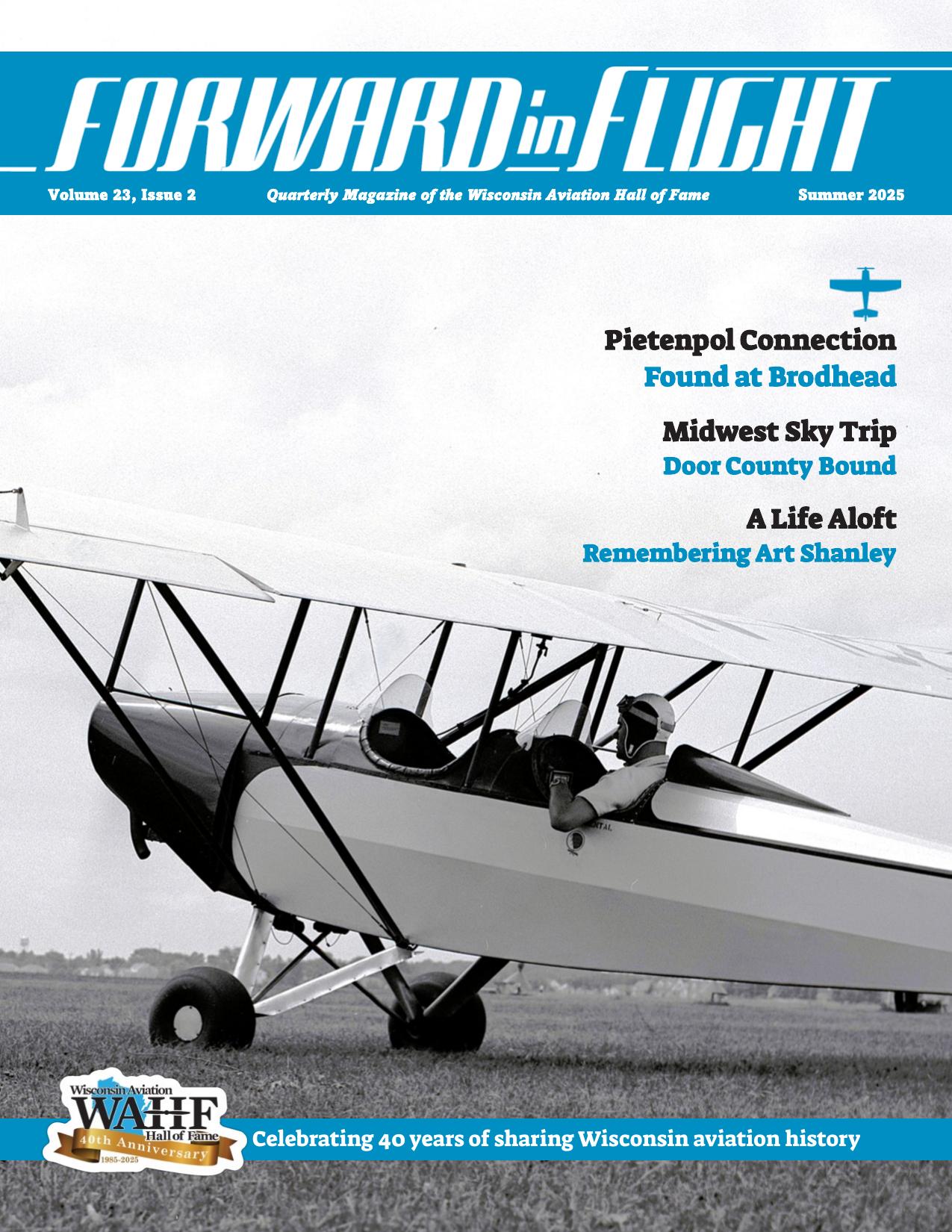
Volume 23, Issue 2 Quarterly Magazine of the Wisconsin Aviation Hall of Fame Summer 2025 Pietenpol Connection Found at Brodhead Midwest Sky Trip Door County Bound A Life Aloft Remembering Art Shanley Celebrating 40 years of sharing Wisconsin aviation history
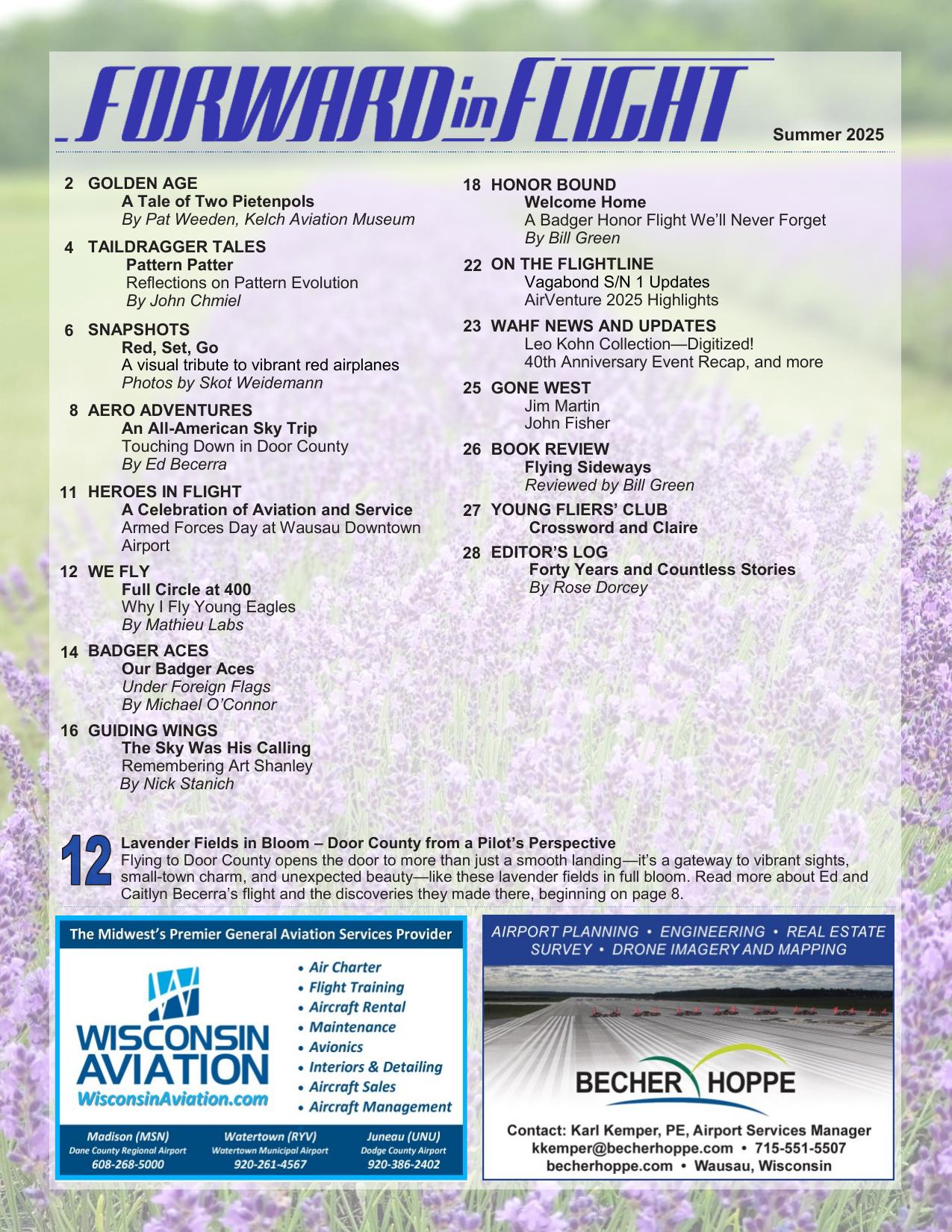
Summer 2025 2 GOLDEN AGE A Tale of Two Pietenpols By Pat Weeden, Kelch Aviation Museum 4 TAILDRAGGER TALES Pattern Patter Reflections on Pattern Evolution By John Chmiel 6 SNAPSHOTS Red, Set, Go A visual tribute to vibrant red airplanes Photos by Skot Weidemann 8 AERO ADVENTURES An All-American Sky Trip Touching Down in Door County By Ed Becerra 11 HEROES IN FLIGHT A Celebration of Aviation and Service Armed Forces Day at Wausau Downtown Airport 12 WE FLY Full Circle at 400 Why I Fly Young Eagles By Mathieu Labs 18 HONOR BOUND Welcome Home A Badger Honor Flight We’ll Never Forget By Bill Green 22 ON THE FLIGHTLINE Vagabond S/N 1 Updates AirVenture 2025 Highlights 23 WAHF NEWS AND UPDATES Leo Kohn Collection—Digitized! 40th Anniversary Event Recap, and more 25 GONE WEST Jim Martin John Fisher 26 BOOK REVIEW Flying Sideways Reviewed by Bill Green 27 YOUNG FLIERS’ CLUB Crossword and Claire 28 EDITOR’S LOG Forty Years and Countless Stories By Rose Dorcey 14 BADGER ACES Our Badger Aces Under Foreign Flags By Michael O’Connor 16 GUIDING WINGS The Sky Was His Calling Remembering Art Shanley By Nick Stanich Lavender Fields in Bloom – Door County from a Pilot’s Perspective Flying to Door County opens the door to more than just a smooth landing—it’s a gateway to vibrant sights, small-town charm, and unexpected beauty—like these lavender fields in full bloom. Read more about Ed and Caitlyn Becerra’s flight and the discoveries they made there, beginning on page 8.
PRESIDENT’S MESSAGE Looking Back, Moving Forward A Milestone Year for WAHF By WAHF President Kurt Stanich As we celebrate 40 years of the Wisconsin Aviation Hall of Fame, I want to extend my heartfelt thanks to everyone who made our anniversary reception at Waukesha County Airport such a memorable occasion. It was incredibly meaningful to be surrounded by longtime friends, inductees, and fellow aviation buffs as we looked back on how far WAHF has come—and how much more we can accomplish together. A special thank-you goes out to all who attended, and to the board members and volunteers (especially Julie Green) who helped organize and host the event. Your time, energy, and commitment made the afternoon not only possible, but unforgettable. WAHF was founded in 1985 to honor those who helped shape aviation in Wisconsin. That mission continues today, stronger than ever, thanks to the support and involvement of people like you. Our new initiative, “40 Years, 40 Stories,” will revisit standout features from past Forward in Flight issues—celebrating the rich history we preserve, and the new stories we’re still eager to tell. We’re also thrilled to share that the photo files from the Leo J. Kohn Collection have now been fully digitized. This is a major step forward in preserving and sharing one of the most important visual records of Wisconsin aviation history. Thank you to everyone who supported this effort— we look forward to unveiling more soon. Looking ahead, there’s plenty on the horizon. We’re already preparing for our 2025 Induction Ceremony, where we’ll welcome a new group of aviators into the Hall of Fame. And in 2026, we’ll mark our milestone 40th Induction Ceremony—an extra-special celebration you won’t want to miss. Forward in Flight the only magazine dedicated exclusively to Wisconsin’s aviation news and history. Rose Dorcey Editorial and Advertising 3980 Sharratt Drive Oshkosh WI 54901 920-279-6029 rose@wahf.org The Wisconsin Aviation Hall of Fame is a non-profit membership organization with a mission to collect and preserve the history of aviation in Wisconsin, recognize those who made that history, inform others of it, and promote aviation education for future generations. Honoring the pioneers, pilots, and visionaries who shaped Wisconsin’s skies is at the heart of WAHF’s mission. We invite you to be part of this year’s induction celebration. You’ll also see several of our board members speaking at aviation events in the coming weeks, creating more opportunities to connect with our community and share the passion for flight that unites us all. I encourage you to stay involved. Know someone who deserves to be recognized? Submit a nomination. Have a story to share—or want to help us with future projects? Please reach out. We’d love to hear from you. Thank you for being part of this journey. We’re grateful to have you with us as we continue the important work of preserving Wisconsin’s aviation history. About the Cover: Leo Kohn photographed N18224 in Milwaukee while it was owned by Everett Schermerhorn of Rochester, Minnesota. The log shows it had just passed inspection three days earlier with 101.3 hours since overhaul. Read more about the plane and its connection to Brodhead, beginning on page 2. Photo by Leo J. Kohn Leo J. Kohn Photography Collection
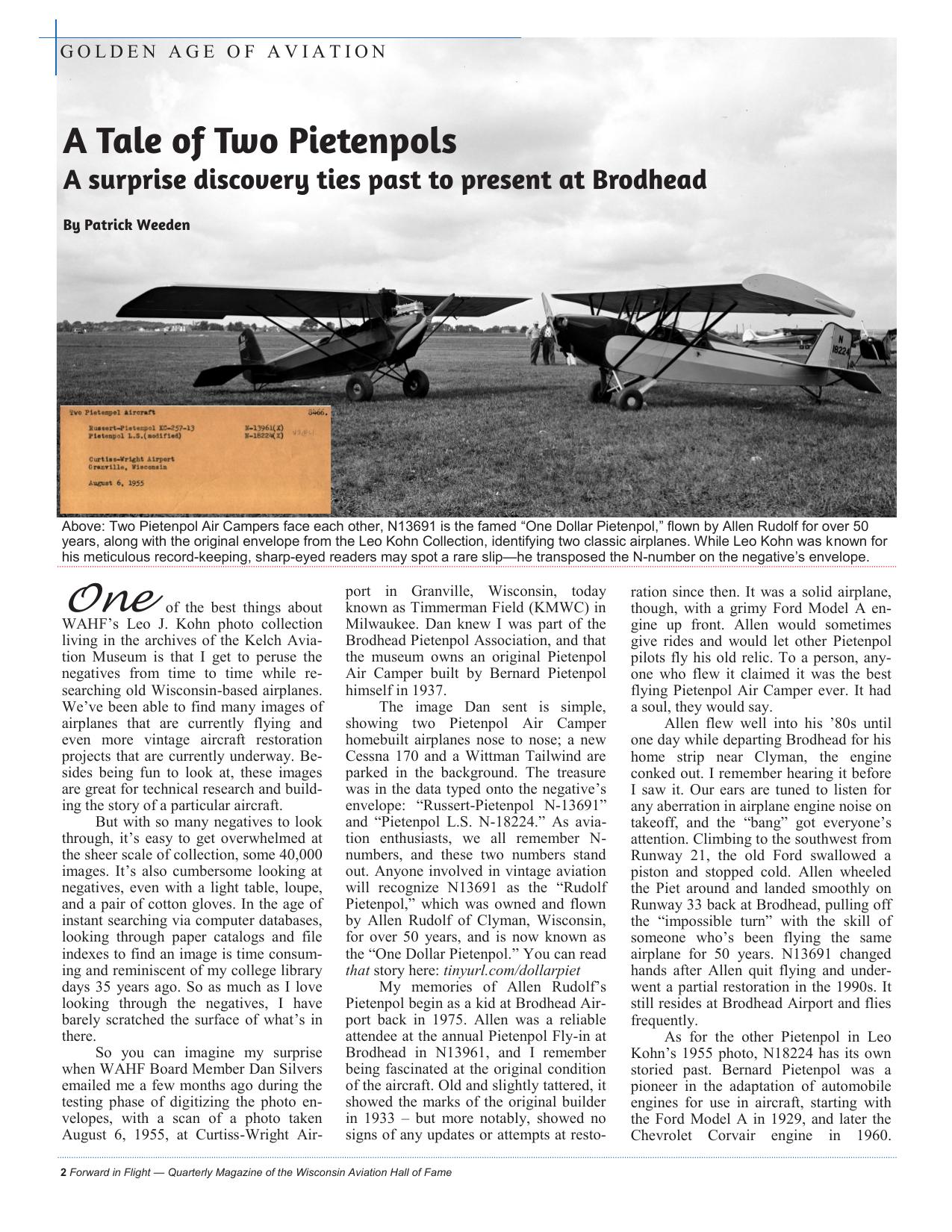
GOLDEN AGE OF AVIATION A Tale of Two Pietenpols A surprise discovery ties past to present at Brodhead By Patrick Weeden Above: Two Pietenpol Air Campers face each other, N13691 is the famed “One Dollar Pietenpol,” flown by Allen Rudolf for over 50 years, along with the original envelope from the Leo Kohn Collection, identifying two classic airplanes. While Leo Kohn was known for his meticulous record-keeping, sharp-eyed readers may spot a rare slip—he transposed the N-number on the negative’s envelope. One of the best things about WAHF’s Leo J. Kohn photo collection living in the archives of the Kelch Aviation Museum is that I get to peruse the negatives from time to time while researching old Wisconsin-based airplanes. We’ve been able to find many images of airplanes that are currently flying and even more vintage aircraft restoration projects that are currently underway. Besides being fun to look at, these images are great for technical research and building the story of a particular aircraft. But with so many negatives to look through, it’s easy to get overwhelmed at the sheer scale of collection, some 40,000 images. It’s also cumbersome looking at negatives, even with a light table, loupe, and a pair of cotton gloves. In the age of instant searching via computer databases, looking through paper catalogs and file indexes to find an image is time consuming and reminiscent of my college library days 35 years ago. So as much as I love looking through the negatives, I have barely scratched the surface of what’s in there. So you can imagine my surprise when WAHF Board Member Dan Silvers emailed me a few months ago during the testing phase of digitizing the photo envelopes, with a scan of a photo taken August 6, 1955, at Curtiss-Wright Air- port in Granville, Wisconsin, today known as Timmerman Field (KMWC) in Milwaukee. Dan knew I was part of the Brodhead Pietenpol Association, and that the museum owns an original Pietenpol Air Camper built by Bernard Pietenpol himself in 1937. The image Dan sent is simple, showing two Pietenpol Air Camper homebuilt airplanes nose to nose; a new Cessna 170 and a Wittman Tailwind are parked in the background. The treasure was in the data typed onto the negative’s envelope: “Russert-Pietenpol N-13691” and “Pietenpol L.S. N-18224.” As aviation enthusiasts, we all remember Nnumbers, and these two numbers stand out. Anyone involved in vintage aviation will recognize N13691 as the “Rudolf Pietenpol,” which was owned and flown by Allen Rudolf of Clyman, Wisconsin, for over 50 years, and is now known as the “One Dollar Pietenpol.” You can read that story here: tinyurl.com/dollarpiet My memories of Allen Rudolf’s Pietenpol begin as a kid at Brodhead Airport back in 1975. Allen was a reliable attendee at the annual Pietenpol Fly-in at Brodhead in N13961, and I remember being fascinated at the original condition of the aircraft. Old and slightly tattered, it showed the marks of the original builder in 1933 – but more notably, showed no signs of any updates or attempts at resto- 2 Forward in Flight — Quarterly Magazine of the Wisconsin Aviation Hall of Fame ration since then. It was a solid airplane, though, with a grimy Ford Model A engine up front. Allen would sometimes give rides and would let other Pietenpol pilots fly his old relic. To a person, anyone who flew it claimed it was the best flying Pietenpol Air Camper ever. It had a soul, they would say. Allen flew well into his ’80s until one day while departing Brodhead for his home strip near Clyman, the engine conked out. I remember hearing it before I saw it. Our ears are tuned to listen for any aberration in airplane engine noise on takeoff, and the “bang” got everyone’s attention. Climbing to the southwest from Runway 21, the old Ford swallowed a piston and stopped cold. Allen wheeled the Piet around and landed smoothly on Runway 33 back at Brodhead, pulling off the “impossible turn” with the skill of someone who’s been flying the same airplane for 50 years. N13691 changed hands after Allen quit flying and underwent a partial restoration in the 1990s. It still resides at Brodhead Airport and flies frequently. As for the other Pietenpol in Leo Kohn’s 1955 photo, N18224 has its own storied past. Bernard Pietenpol was a pioneer in the adaptation of automobile engines for use in aircraft, starting with the Ford Model A in 1929, and later the Chevrolet Corvair engine in 1960.
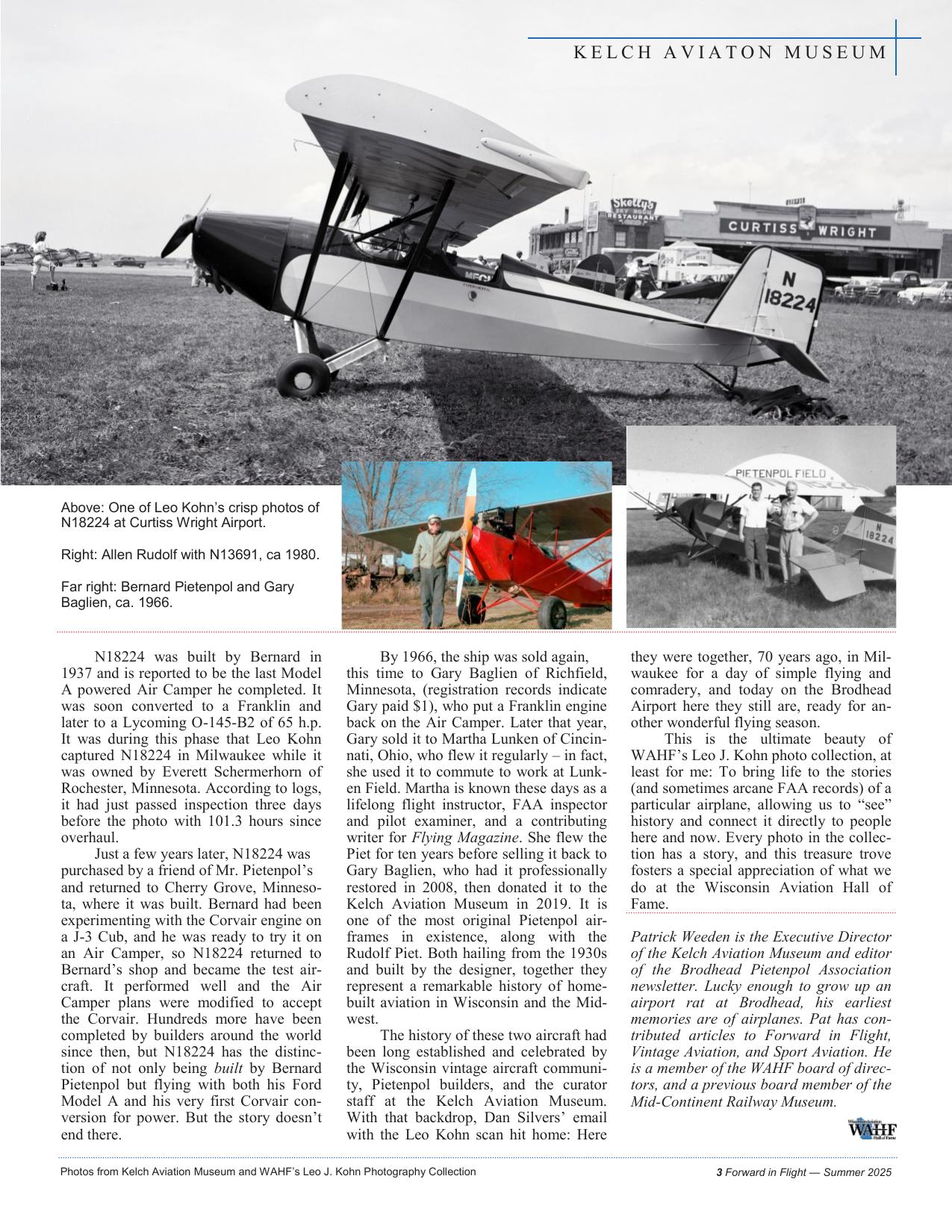
KELCH AVIATON MUSEUM Above: One of Leo Kohn’s crisp photos of N18224 at Curtiss Wright Airport. Right: Allen Rudolf with N13691, ca 1980. Far right: Bernard Pietenpol and Gary Baglien, ca. 1966. N18224 was built by Bernard in 1937 and is reported to be the last Model A powered Air Camper he completed. It was soon converted to a Franklin and later to a Lycoming O-145-B2 of 65 h.p. It was during this phase that Leo Kohn captured N18224 in Milwaukee while it was owned by Everett Schermerhorn of Rochester, Minnesota. According to logs, it had just passed inspection three days before the photo with 101.3 hours since overhaul. Just a few years later, N18224 was purchased by a friend of Mr. Pietenpol’s and returned to Cherry Grove, Minnesota, where it was built. Bernard had been experimenting with the Corvair engine on a J-3 Cub, and he was ready to try it on an Air Camper, so N18224 returned to Bernard’s shop and became the test aircraft. It performed well and the Air Camper plans were modified to accept the Corvair. Hundreds more have been completed by builders around the world since then, but N18224 has the distinction of not only being built by Bernard Pietenpol but flying with both his Ford Model A and his very first Corvair conversion for power. But the story doesn’t end there. By 1966, the ship was sold again, this time to Gary Baglien of Richfield, Minnesota, (registration records indicate Gary paid $1), who put a Franklin engine back on the Air Camper. Later that year, Gary sold it to Martha Lunken of Cincinnati, Ohio, who flew it regularly – in fact, she used it to commute to work at Lunken Field. Martha is known these days as a lifelong flight instructor, FAA inspector and pilot examiner, and a contributing writer for Flying Magazine. She flew the Piet for ten years before selling it back to Gary Baglien, who had it professionally restored in 2008, then donated it to the Kelch Aviation Museum in 2019. It is one of the most original Pietenpol airframes in existence, along with the Rudolf Piet. Both hailing from the 1930s and built by the designer, together they represent a remarkable history of homebuilt aviation in Wisconsin and the Midwest. The history of these two aircraft had been long established and celebrated by the Wisconsin vintage aircraft community, Pietenpol builders, and the curator staff at the Kelch Aviation Museum. With that backdrop, Dan Silvers’ email with the Leo Kohn scan hit home: Here Photos from Kelch Aviation Museum and WAHF’s Leo J. Kohn Photography Collection they were together, 70 years ago, in Milwaukee for a day of simple flying and comradery, and today on the Brodhead Airport here they still are, ready for another wonderful flying season. This is the ultimate beauty of WAHF’s Leo J. Kohn photo collection, at least for me: To bring life to the stories (and sometimes arcane FAA records) of a particular airplane, allowing us to “see” history and connect it directly to people here and now. Every photo in the collection has a story, and this treasure trove fosters a special appreciation of what we do at the Wisconsin Aviation Hall of Fame. Patrick Weeden is the Executive Director of the Kelch Aviation Museum and editor of the Brodhead Pietenpol Association newsletter. Lucky enough to grow up an airport rat at Brodhead, his earliest memories are of airplanes. Pat has contributed articles to Forward in Flight, Vintage Aviation, and Sport Aviation. He is a member of the WAHF board of directors, and a previous board member of the Mid-Continent Railway Museum. 3 Forward in Flight — Summer 2025
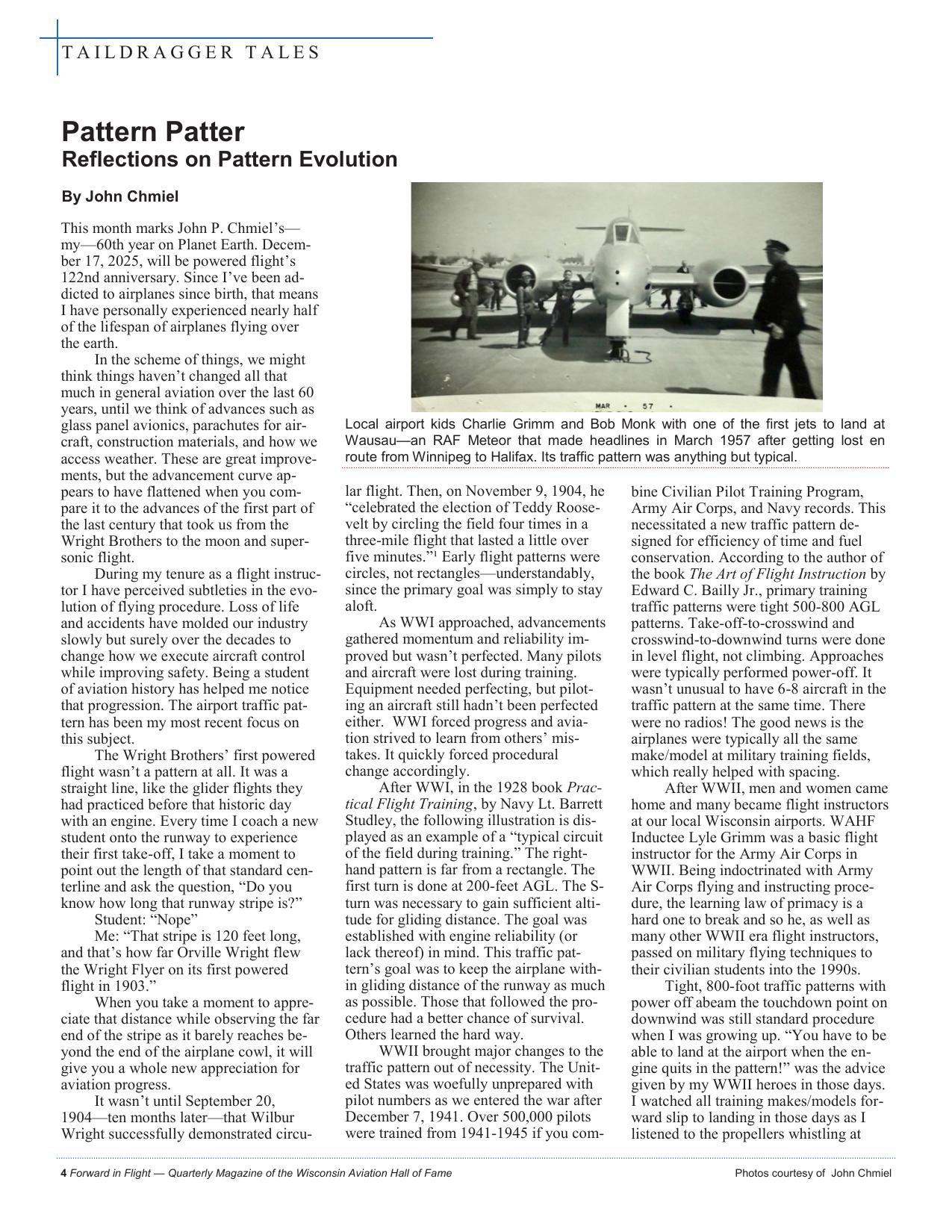
TAILDRAGGER TALES Pattern Patter Reflections on Pattern Evolution By John Chmiel This month marks John P. Chmiel’s— my—60th year on Planet Earth. December 17, 2025, will be powered flight’s 122nd anniversary. Since I’ve been addicted to airplanes since birth, that means I have personally experienced nearly half of the lifespan of airplanes flying over the earth. In the scheme of things, we might think things haven’t changed all that much in general aviation over the last 60 years, until we think of advances such as glass panel avionics, parachutes for aircraft, construction materials, and how we access weather. These are great improvements, but the advancement curve appears to have flattened when you compare it to the advances of the first part of the last century that took us from the Wright Brothers to the moon and supersonic flight. During my tenure as a flight instructor I have perceived subtleties in the evolution of flying procedure. Loss of life and accidents have molded our industry slowly but surely over the decades to change how we execute aircraft control while improving safety. Being a student of aviation history has helped me notice that progression. The airport traffic pattern has been my most recent focus on this subject. The Wright Brothers’ first powered flight wasn’t a pattern at all. It was a straight line, like the glider flights they had practiced before that historic day with an engine. Every time I coach a new student onto the runway to experience their first take-off, I take a moment to point out the length of that standard centerline and ask the question, “Do you know how long that runway stripe is?” Student: “Nope” Me: “That stripe is 120 feet long, and that’s how far Orville Wright flew the Wright Flyer on its first powered flight in 1903.” When you take a moment to appreciate that distance while observing the far end of the stripe as it barely reaches beyond the end of the airplane cowl, it will give you a whole new appreciation for aviation progress. It wasn’t until September 20, 1904—ten months later—that Wilbur Wright successfully demonstrated circu- Local airport kids Charlie Grimm and Bob Monk with one of the first jets to land at Wausau—an RAF Meteor that made headlines in March 1957 after getting lost en route from Winnipeg to Halifax. Its traffic pattern was anything but typical. lar flight. Then, on November 9, 1904, he “celebrated the election of Teddy Roosevelt by circling the field four times in a three-mile flight that lasted a little over five minutes.”¹ Early flight patterns were circles, not rectangles—understandably, since the primary goal was simply to stay aloft. As WWI approached, advancements gathered momentum and reliability improved but wasn’t perfected. Many pilots and aircraft were lost during training. Equipment needed perfecting, but piloting an aircraft still hadn’t been perfected either. WWI forced progress and aviation strived to learn from others’ mistakes. It quickly forced procedural change accordingly. After WWI, in the 1928 book Practical Flight Training, by Navy Lt. Barrett Studley, the following illustration is displayed as an example of a “typical circuit of the field during training.” The righthand pattern is far from a rectangle. The first turn is done at 200-feet AGL. The Sturn was necessary to gain sufficient altitude for gliding distance. The goal was established with engine reliability (or lack thereof) in mind. This traffic pattern’s goal was to keep the airplane within gliding distance of the runway as much as possible. Those that followed the procedure had a better chance of survival. Others learned the hard way. WWII brought major changes to the traffic pattern out of necessity. The United States was woefully unprepared with pilot numbers as we entered the war after December 7, 1941. Over 500,000 pilots were trained from 1941-1945 if you com- 4 Forward in Flight — Quarterly Magazine of the Wisconsin Aviation Hall of Fame bine Civilian Pilot Training Program, Army Air Corps, and Navy records. This necessitated a new traffic pattern designed for efficiency of time and fuel conservation. According to the author of the book The Art of Flight Instruction by Edward C. Bailly Jr., primary training traffic patterns were tight 500-800 AGL patterns. Take-off-to-crosswind and crosswind-to-downwind turns were done in level flight, not climbing. Approaches were typically performed power-off. It wasn’t unusual to have 6-8 aircraft in the traffic pattern at the same time. There were no radios! The good news is the airplanes were typically all the same make/model at military training fields, which really helped with spacing. After WWII, men and women came home and many became flight instructors at our local Wisconsin airports. WAHF Inductee Lyle Grimm was a basic flight instructor for the Army Air Corps in WWII. Being indoctrinated with Army Air Corps flying and instructing procedure, the learning law of primacy is a hard one to break and so he, as well as many other WWII era flight instructors, passed on military flying techniques to their civilian students into the 1990s. Tight, 800-foot traffic patterns with power off abeam the touchdown point on downwind was still standard procedure when I was growing up. “You have to be able to land at the airport when the engine quits in the pattern!” was the advice given by my WWII heroes in those days. I watched all training makes/models forward slip to landing in those days as I listened to the propellers whistling at Photos courtesy of John Chmiel
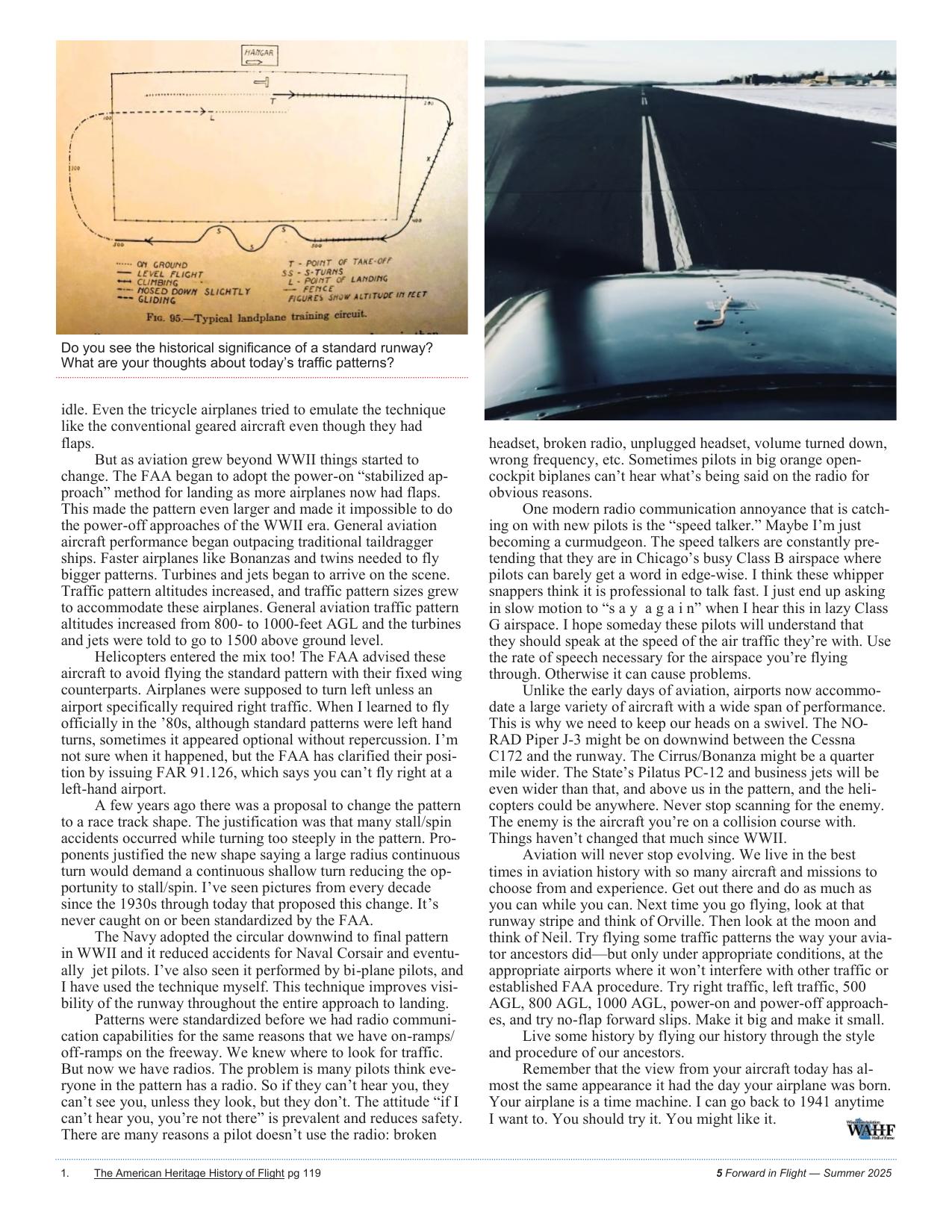
Do you see the historical significance of a standard runway? What are your thoughts about today’s traffic patterns? idle. Even the tricycle airplanes tried to emulate the technique like the conventional geared aircraft even though they had flaps. But as aviation grew beyond WWII things started to change. The FAA began to adopt the power-on “stabilized approach” method for landing as more airplanes now had flaps. This made the pattern even larger and made it impossible to do the power-off approaches of the WWII era. General aviation aircraft performance began outpacing traditional taildragger ships. Faster airplanes like Bonanzas and twins needed to fly bigger patterns. Turbines and jets began to arrive on the scene. Traffic pattern altitudes increased, and traffic pattern sizes grew to accommodate these airplanes. General aviation traffic pattern altitudes increased from 800- to 1000-feet AGL and the turbines and jets were told to go to 1500 above ground level. Helicopters entered the mix too! The FAA advised these aircraft to avoid flying the standard pattern with their fixed wing counterparts. Airplanes were supposed to turn left unless an airport specifically required right traffic. When I learned to fly officially in the ’80s, although standard patterns were left hand turns, sometimes it appeared optional without repercussion. I’m not sure when it happened, but the FAA has clarified their position by issuing FAR 91.126, which says you can’t fly right at a left-hand airport. A few years ago there was a proposal to change the pattern to a race track shape. The justification was that many stall/spin accidents occurred while turning too steeply in the pattern. Proponents justified the new shape saying a large radius continuous turn would demand a continuous shallow turn reducing the opportunity to stall/spin. I’ve seen pictures from every decade since the 1930s through today that proposed this change. It’s never caught on or been standardized by the FAA. The Navy adopted the circular downwind to final pattern in WWII and it reduced accidents for Naval Corsair and eventually jet pilots. I’ve also seen it performed by bi-plane pilots, and I have used the technique myself. This technique improves visibility of the runway throughout the entire approach to landing. Patterns were standardized before we had radio communication capabilities for the same reasons that we have on-ramps/ off-ramps on the freeway. We knew where to look for traffic. But now we have radios. The problem is many pilots think everyone in the pattern has a radio. So if they can’t hear you, they can’t see you, unless they look, but they don’t. The attitude “if I can’t hear you, you’re not there” is prevalent and reduces safety. There are many reasons a pilot doesn’t use the radio: broken 1. The American Heritage History of Flight pg 119 headset, broken radio, unplugged headset, volume turned down, wrong frequency, etc. Sometimes pilots in big orange opencockpit biplanes can’t hear what’s being said on the radio for obvious reasons. One modern radio communication annoyance that is catching on with new pilots is the “speed talker.” Maybe I’m just becoming a curmudgeon. The speed talkers are constantly pretending that they are in Chicago’s busy Class B airspace where pilots can barely get a word in edge-wise. I think these whipper snappers think it is professional to talk fast. I just end up asking in slow motion to “s a y a g a i n” when I hear this in lazy Class G airspace. I hope someday these pilots will understand that they should speak at the speed of the air traffic they’re with. Use the rate of speech necessary for the airspace you’re flying through. Otherwise it can cause problems. Unlike the early days of aviation, airports now accommodate a large variety of aircraft with a wide span of performance. This is why we need to keep our heads on a swivel. The NORAD Piper J-3 might be on downwind between the Cessna C172 and the runway. The Cirrus/Bonanza might be a quarter mile wider. The State’s Pilatus PC-12 and business jets will be even wider than that, and above us in the pattern, and the helicopters could be anywhere. Never stop scanning for the enemy. The enemy is the aircraft you’re on a collision course with. Things haven’t changed that much since WWII. Aviation will never stop evolving. We live in the best times in aviation history with so many aircraft and missions to choose from and experience. Get out there and do as much as you can while you can. Next time you go flying, look at that runway stripe and think of Orville. Then look at the moon and think of Neil. Try flying some traffic patterns the way your aviator ancestors did—but only under appropriate conditions, at the appropriate airports where it won’t interfere with other traffic or established FAA procedure. Try right traffic, left traffic, 500 AGL, 800 AGL, 1000 AGL, power-on and power-off approaches, and try no-flap forward slips. Make it big and make it small. Live some history by flying our history through the style and procedure of our ancestors. Remember that the view from your aircraft today has almost the same appearance it had the day your airplane was born. Your airplane is a time machine. I can go back to 1941 anytime I want to. You should try it. You might like it. 5 Forward in Flight — Summer 2025
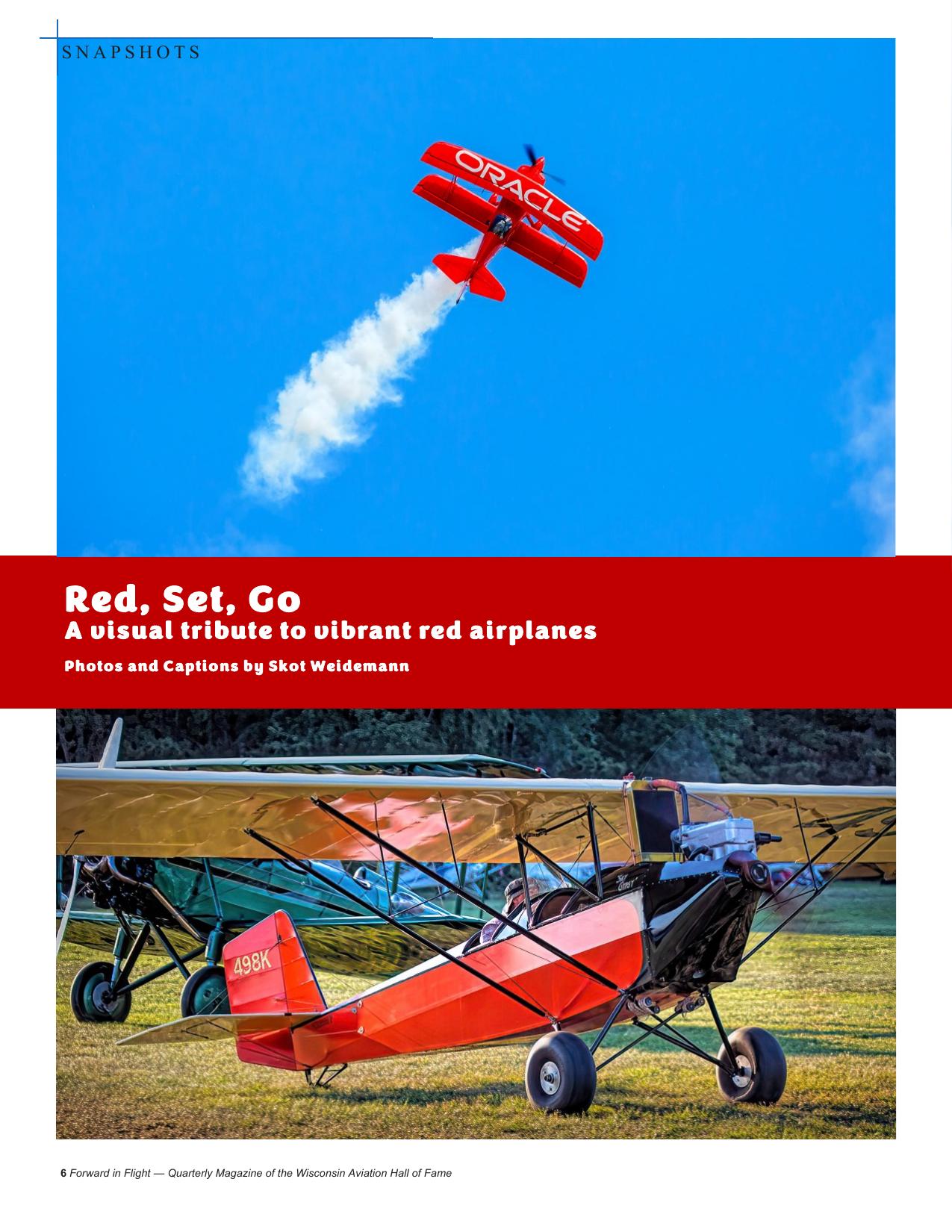
SNAPSHOTS Red, Set, Go A visual tribute to vibrant red airplanes Photos and Captions by Skot Weidemann 6 Forward in Flight — Quarterly Magazine of the Wisconsin Aviation Hall of Fame
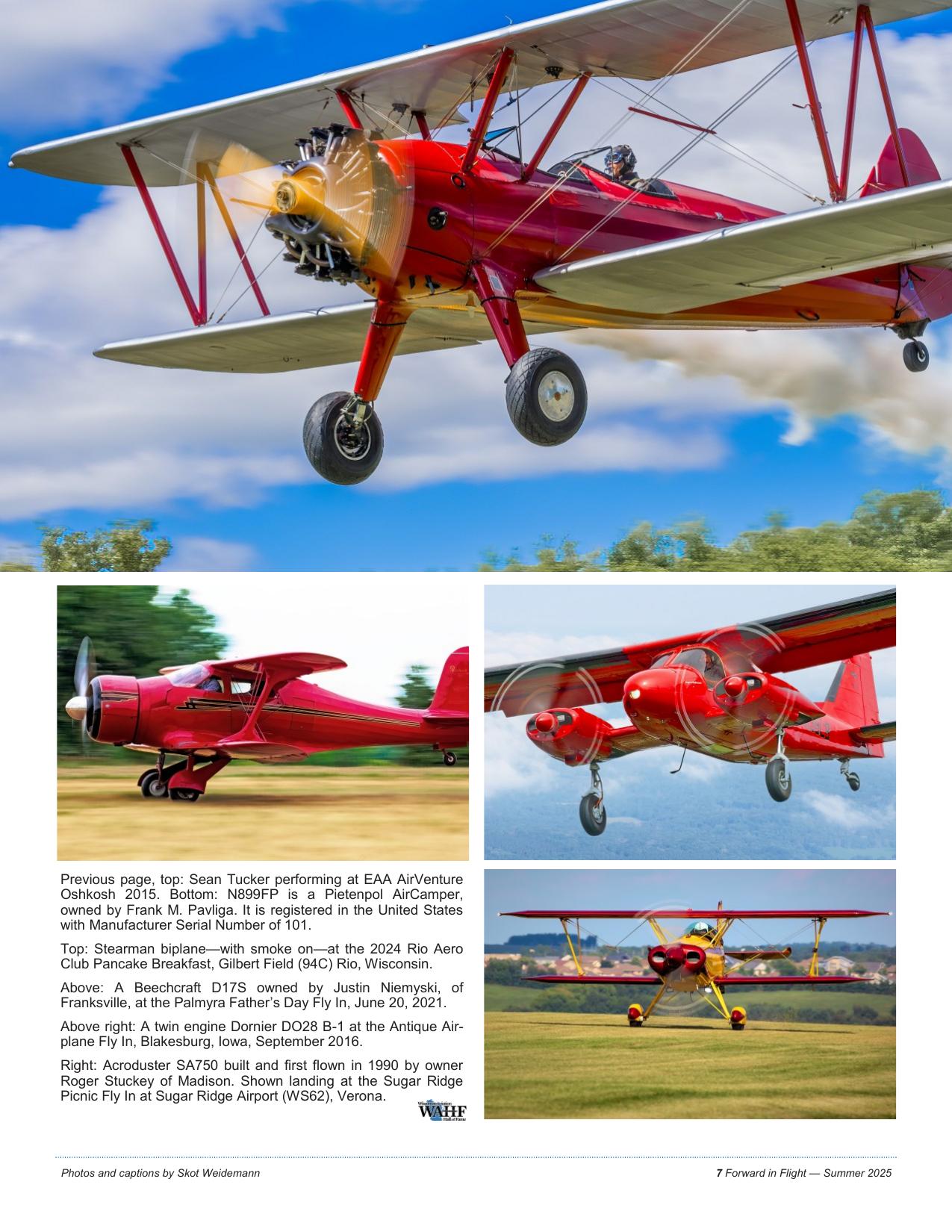
Previous page, top: Sean Tucker performing at EAA AirVenture Oshkosh 2015. Bottom: N899FP is a Pietenpol AirCamper, owned by Frank M. Pavliga. It is registered in the United States with Manufacturer Serial Number of 101. Top: Stearman biplane—with smoke on—at the 2024 Rio Aero Club Pancake Breakfast, Gilbert Field (94C) Rio, Wisconsin. Above: A Beechcraft D17S owned by Justin Niemyski, of Franksville, at the Palmyra Father’s Day Fly In, June 20, 2021. Above right: A twin engine Dornier DO28 B-1 at the Antique Airplane Fly In, Blakesburg, Iowa, September 2016. Right: Acroduster SA750 built and first flown in 1990 by owner Roger Stuckey of Madison. Shown landing at the Sugar Ridge Picnic Fly In at Sugar Ridge Airport (WS62), Verona. Photos and captions by Skot Weidemann 7 Forward in Flight — Summer 2025
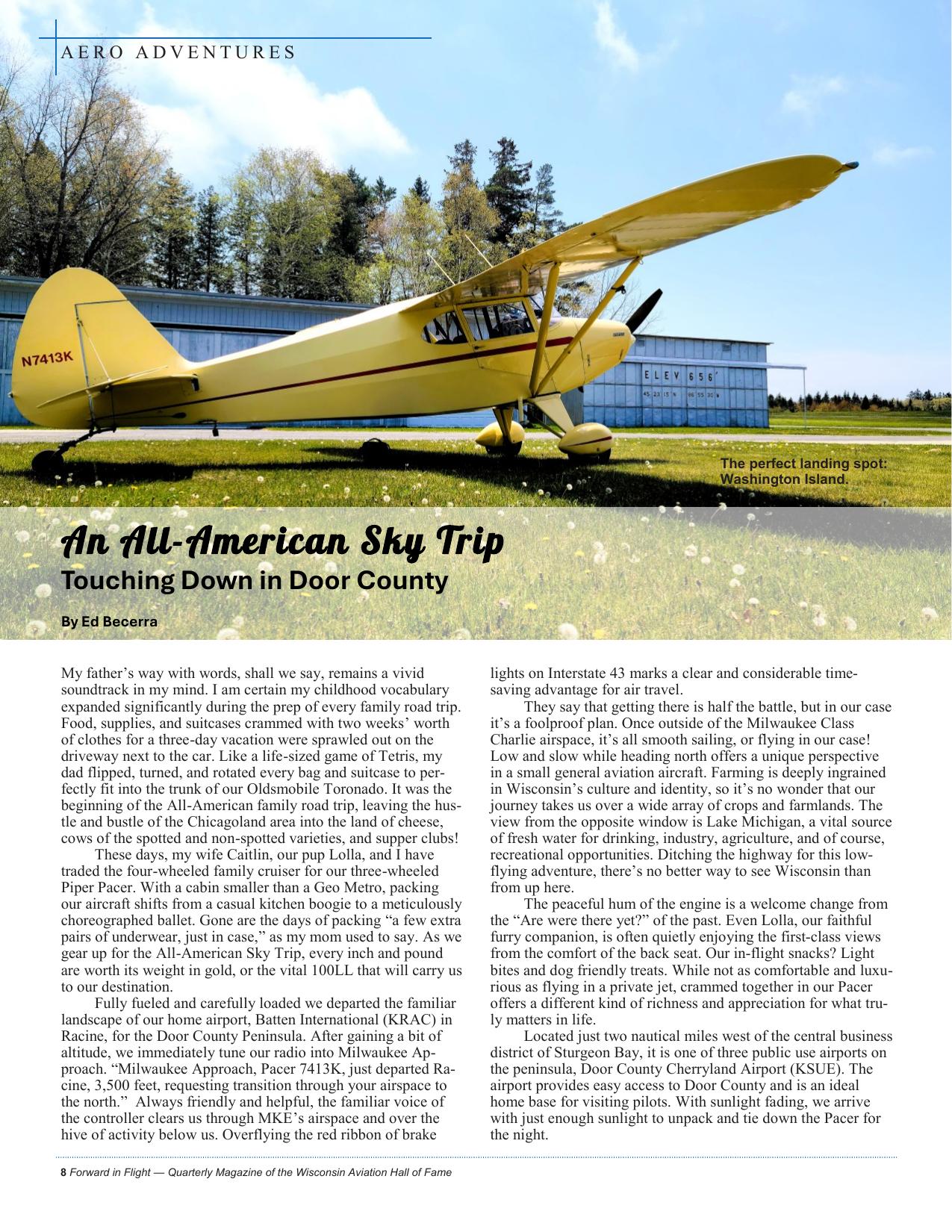
AERO ADVENTURES The perfect landing spot: Washington Island. An All-American Sky Trip Touching Down in Door County By Ed Becerra My father’s way with words, shall we say, remains a vivid soundtrack in my mind. I am certain my childhood vocabulary expanded significantly during the prep of every family road trip. Food, supplies, and suitcases crammed with two weeks’ worth of clothes for a three-day vacation were sprawled out on the driveway next to the car. Like a life-sized game of Tetris, my dad flipped, turned, and rotated every bag and suitcase to perfectly fit into the trunk of our Oldsmobile Toronado. It was the beginning of the All-American family road trip, leaving the hustle and bustle of the Chicagoland area into the land of cheese, cows of the spotted and non-spotted varieties, and supper clubs! These days, my wife Caitlin, our pup Lolla, and I have traded the four-wheeled family cruiser for our three-wheeled Piper Pacer. With a cabin smaller than a Geo Metro, packing our aircraft shifts from a casual kitchen boogie to a meticulously choreographed ballet. Gone are the days of packing “a few extra pairs of underwear, just in case,” as my mom used to say. As we gear up for the All-American Sky Trip, every inch and pound are worth its weight in gold, or the vital 100LL that will carry us to our destination. Fully fueled and carefully loaded we departed the familiar landscape of our home airport, Batten International (KRAC) in Racine, for the Door County Peninsula. After gaining a bit of altitude, we immediately tune our radio into Milwaukee Approach. “Milwaukee Approach, Pacer 7413K, just departed Racine, 3,500 feet, requesting transition through your airspace to the north.” Always friendly and helpful, the familiar voice of the controller clears us through MKE’s airspace and over the hive of activity below us. Overflying the red ribbon of brake 8 Forward in Flight — Quarterly Magazine of the Wisconsin Aviation Hall of Fame lights on Interstate 43 marks a clear and considerable timesaving advantage for air travel. They say that getting there is half the battle, but in our case it’s a foolproof plan. Once outside of the Milwaukee Class Charlie airspace, it’s all smooth sailing, or flying in our case! Low and slow while heading north offers a unique perspective in a small general aviation aircraft. Farming is deeply ingrained in Wisconsin’s culture and identity, so it’s no wonder that our journey takes us over a wide array of crops and farmlands. The view from the opposite window is Lake Michigan, a vital source of fresh water for drinking, industry, agriculture, and of course, recreational opportunities. Ditching the highway for this lowflying adventure, there’s no better way to see Wisconsin than from up here. The peaceful hum of the engine is a welcome change from the “Are were there yet?” of the past. Even Lolla, our faithful furry companion, is often quietly enjoying the first-class views from the comfort of the back seat. Our in-flight snacks? Light bites and dog friendly treats. While not as comfortable and luxurious as flying in a private jet, crammed together in our Pacer offers a different kind of richness and appreciation for what truly matters in life. Located just two nautical miles west of the central business district of Sturgeon Bay, it is one of three public use airports on the peninsula, Door County Cherryland Airport (KSUE). The airport provides easy access to Door County and is an ideal home base for visiting pilots. With sunlight fading, we arrive with just enough sunlight to unpack and tie down the Pacer for the night.
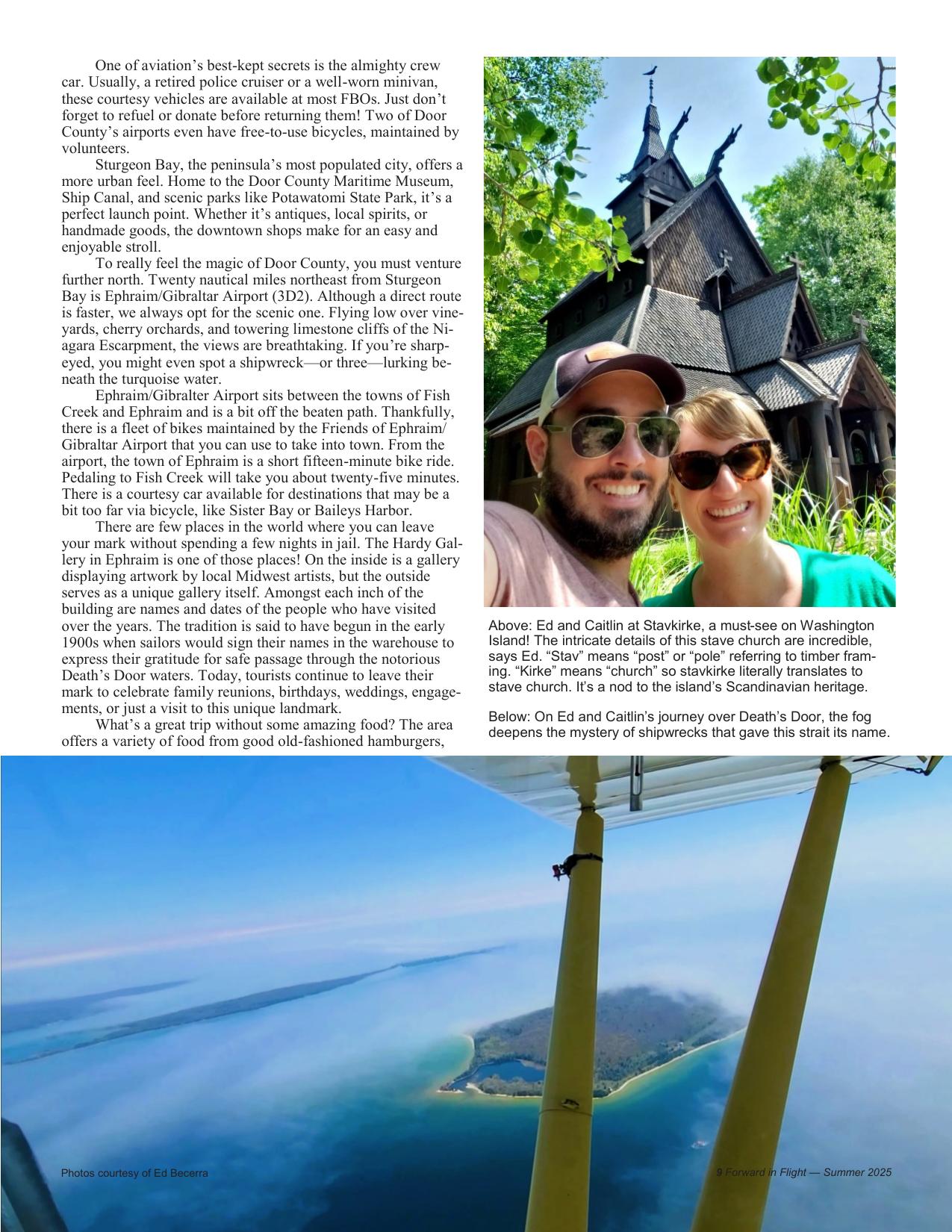
One of aviation’s best-kept secrets is the almighty crew car. Usually, a retired police cruiser or a well-worn minivan, these courtesy vehicles are available at most FBOs. Just don’t forget to refuel or donate before returning them! Two of Door County’s airports even have free-to-use bicycles, maintained by volunteers. Sturgeon Bay, the peninsula’s most populated city, offers a more urban feel. Home to the Door County Maritime Museum, Ship Canal, and scenic parks like Potawatomi State Park, it’s a perfect launch point. Whether it’s antiques, local spirits, or handmade goods, the downtown shops make for an easy and enjoyable stroll. To really feel the magic of Door County, you must venture further north. Twenty nautical miles northeast from Sturgeon Bay is Ephraim/Gibraltar Airport (3D2). Although a direct route is faster, we always opt for the scenic one. Flying low over vineyards, cherry orchards, and towering limestone cliffs of the Niagara Escarpment, the views are breathtaking. If you’re sharpeyed, you might even spot a shipwreck—or three—lurking beneath the turquoise water. Ephraim/Gibralter Airport sits between the towns of Fish Creek and Ephraim and is a bit off the beaten path. Thankfully, there is a fleet of bikes maintained by the Friends of Ephraim/ Gibraltar Airport that you can use to take into town. From the airport, the town of Ephraim is a short fifteen-minute bike ride. Pedaling to Fish Creek will take you about twenty-five minutes. There is a courtesy car available for destinations that may be a bit too far via bicycle, like Sister Bay or Baileys Harbor. There are few places in the world where you can leave your mark without spending a few nights in jail. The Hardy Gallery in Ephraim is one of those places! On the inside is a gallery displaying artwork by local Midwest artists, but the outside serves as a unique gallery itself. Amongst each inch of the building are names and dates of the people who have visited over the years. The tradition is said to have begun in the early 1900s when sailors would sign their names in the warehouse to express their gratitude for safe passage through the notorious Death’s Door waters. Today, tourists continue to leave their mark to celebrate family reunions, birthdays, weddings, engagements, or just a visit to this unique landmark. What’s a great trip without some amazing food? The area offers a variety of food from good old-fashioned hamburgers, Photos courtesy of Ed Becerra Above: Ed and Caitlin at Stavkirke, a must-see on Washington Island! The intricate details of this stave church are incredible, says Ed. “Stav” means “post” or “pole” referring to timber framing. “Kirke” means “church” so stavkirke literally translates to stave church. It’s a nod to the island’s Scandinavian heritage. Below: On Ed and Caitlin’s journey over Death’s Door, the fog deepens the mystery of shipwrecks that gave this strait its name. 9 Forward in Flight — Summer 2025
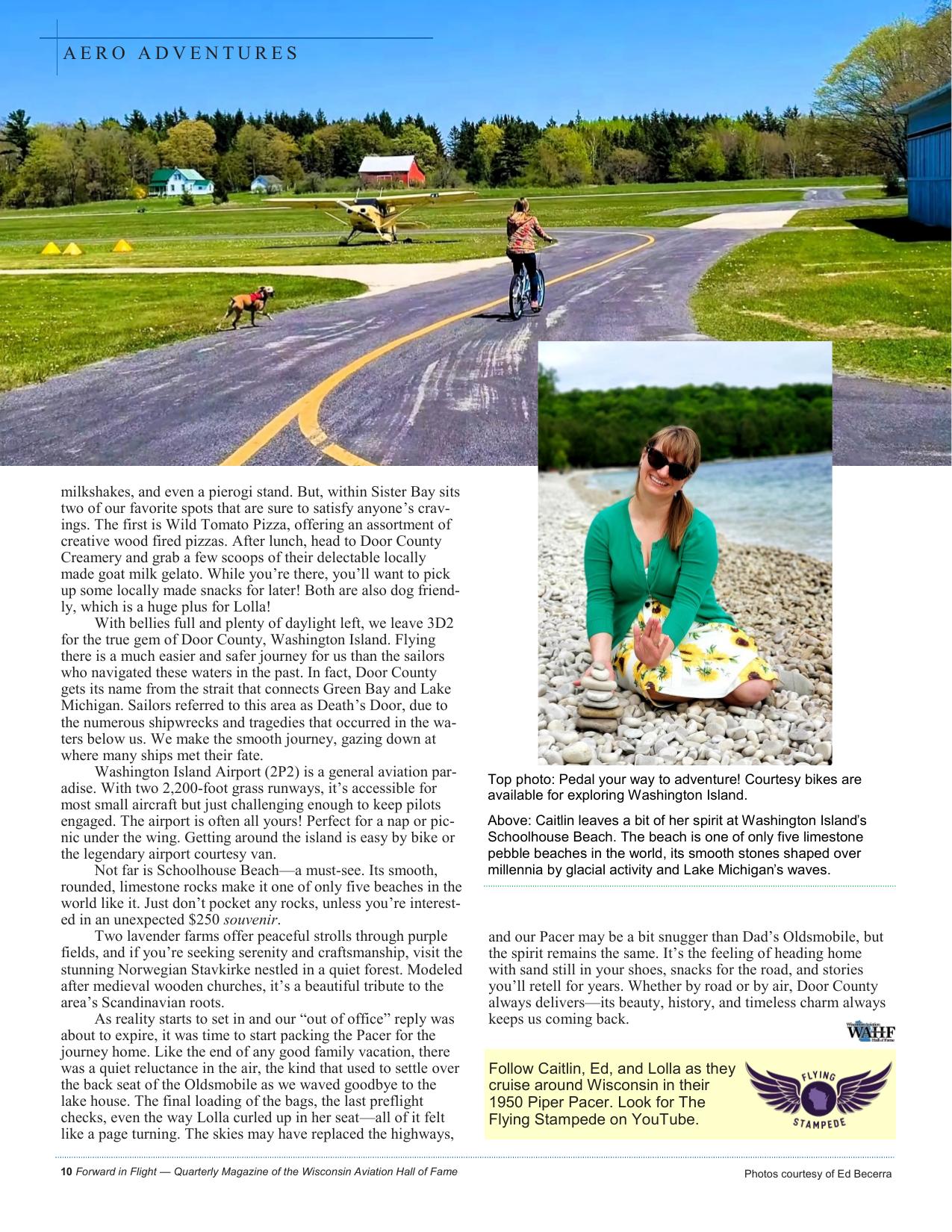
AERO ADVENTURES milkshakes, and even a pierogi stand. But, within Sister Bay sits two of our favorite spots that are sure to satisfy anyone’s cravings. The first is Wild Tomato Pizza, offering an assortment of creative wood fired pizzas. After lunch, head to Door County Creamery and grab a few scoops of their delectable locally made goat milk gelato. While you’re there, you’ll want to pick up some locally made snacks for later! Both are also dog friendly, which is a huge plus for Lolla! With bellies full and plenty of daylight left, we leave 3D2 for the true gem of Door County, Washington Island. Flying there is a much easier and safer journey for us than the sailors who navigated these waters in the past. In fact, Door County gets its name from the strait that connects Green Bay and Lake Michigan. Sailors referred to this area as Death’s Door, due to the numerous shipwrecks and tragedies that occurred in the waters below us. We make the smooth journey, gazing down at where many ships met their fate. Washington Island Airport (2P2) is a general aviation paradise. With two 2,200-foot grass runways, it’s accessible for most small aircraft but just challenging enough to keep pilots engaged. The airport is often all yours! Perfect for a nap or picnic under the wing. Getting around the island is easy by bike or the legendary airport courtesy van. Not far is Schoolhouse Beach—a must-see. Its smooth, rounded, limestone rocks make it one of only five beaches in the world like it. Just don’t pocket any rocks, unless you’re interested in an unexpected $250 souvenir. Two lavender farms offer peaceful strolls through purple fields, and if you’re seeking serenity and craftsmanship, visit the stunning Norwegian Stavkirke nestled in a quiet forest. Modeled after medieval wooden churches, it’s a beautiful tribute to the area’s Scandinavian roots. As reality starts to set in and our “out of office” reply was about to expire, it was time to start packing the Pacer for the journey home. Like the end of any good family vacation, there was a quiet reluctance in the air, the kind that used to settle over the back seat of the Oldsmobile as we waved goodbye to the lake house. The final loading of the bags, the last preflight checks, even the way Lolla curled up in her seat—all of it felt like a page turning. The skies may have replaced the highways, 10 Forward in Flight — Quarterly Magazine of the Wisconsin Aviation Hall of Fame Top photo: Pedal your way to adventure! Courtesy bikes are available for exploring Washington Island. Above: Caitlin leaves a bit of her spirit at Washington Island’s Schoolhouse Beach. The beach is one of only five limestone pebble beaches in the world, its smooth stones shaped over millennia by glacial activity and Lake Michigan’s waves. and our Pacer may be a bit snugger than Dad’s Oldsmobile, but the spirit remains the same. It’s the feeling of heading home with sand still in your shoes, snacks for the road, and stories you’ll retell for years. Whether by road or by air, Door County always delivers—its beauty, history, and timeless charm always keeps us coming back. Follow Caitlin, Ed, and Lolla as they cruise around Wisconsin in their 1950 Piper Pacer. Look for The Flying Stampede on YouTube. Photos courtesy of Ed Becerra
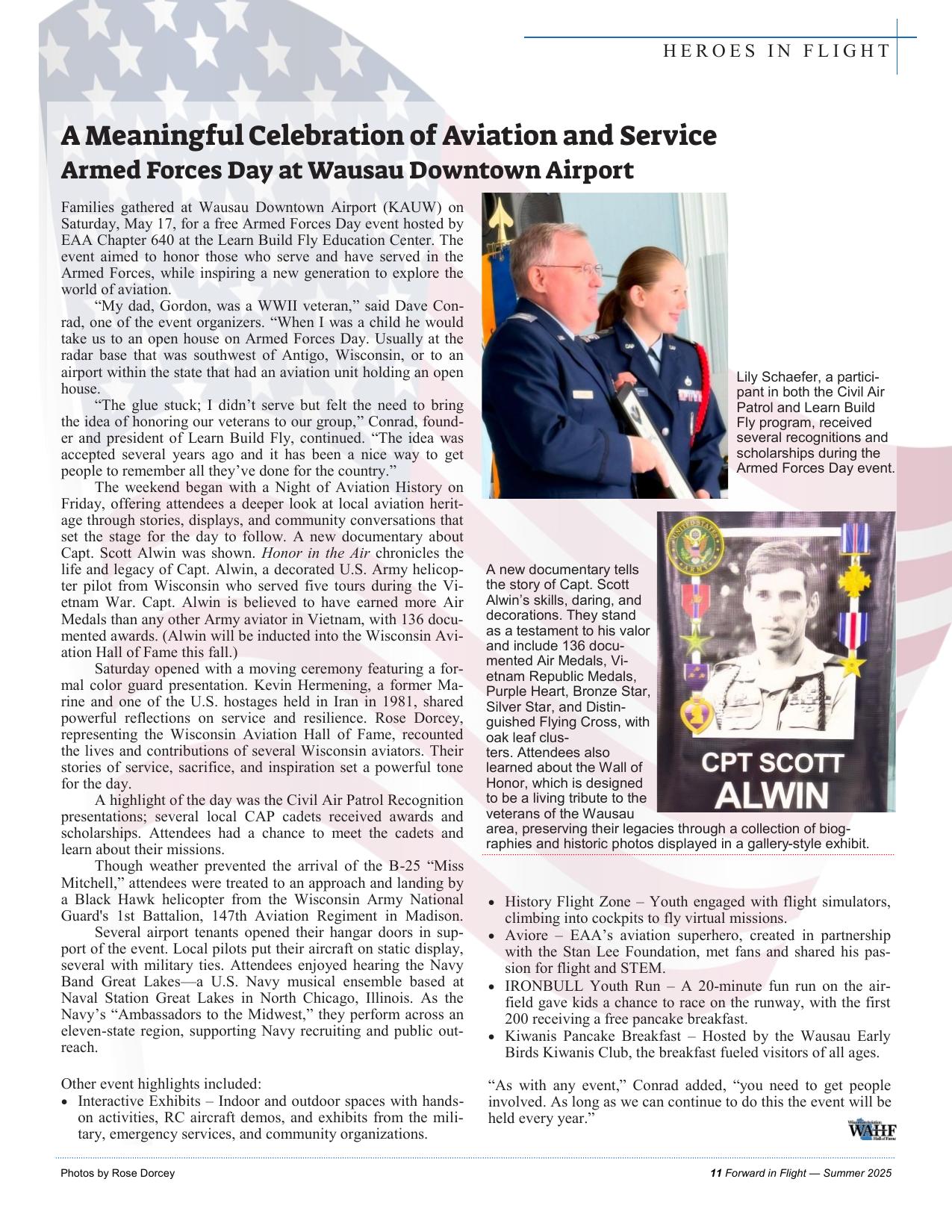
HEROES IN FLIGHT A Meaningful Celebration of Aviation and Service Armed Forces Day at Wausau Downtown Airport Families gathered at Wausau Downtown Airport (KAUW) on Saturday, May 17, for a free Armed Forces Day event hosted by EAA Chapter 640 at the Learn Build Fly Education Center. The event aimed to honor those who serve and have served in the Armed Forces, while inspiring a new generation to explore the world of aviation. “My dad, Gordon, was a WWII veteran,” said Dave Conrad, one of the event organizers. “When I was a child he would take us to an open house on Armed Forces Day. Usually at the radar base that was southwest of Antigo, Wisconsin, or to an airport within the state that had an aviation unit holding an open house. “The glue stuck; I didn’t serve but felt the need to bring the idea of honoring our veterans to our group,” Conrad, founder and president of Learn Build Fly, continued. “The idea was accepted several years ago and it has been a nice way to get people to remember all they’ve done for the country.” The weekend began with a Night of Aviation History on Friday, offering attendees a deeper look at local aviation heritage through stories, displays, and community conversations that set the stage for the day to follow. A new documentary about Capt. Scott Alwin was shown. Honor in the Air chronicles the life and legacy of Capt. Alwin, a decorated U.S. Army helicopter pilot from Wisconsin who served five tours during the Vietnam War. Capt. Alwin is believed to have earned more Air Medals than any other Army aviator in Vietnam, with 136 documented awards. (Alwin will be inducted into the Wisconsin Aviation Hall of Fame this fall.) Saturday opened with a moving ceremony featuring a formal color guard presentation. Kevin Hermening, a former Marine and one of the U.S. hostages held in Iran in 1981, shared powerful reflections on service and resilience. Rose Dorcey, representing the Wisconsin Aviation Hall of Fame, recounted the lives and contributions of several Wisconsin aviators. Their stories of service, sacrifice, and inspiration set a powerful tone for the day. A highlight of the day was the Civil Air Patrol Recognition presentations; several local CAP cadets received awards and scholarships. Attendees had a chance to meet the cadets and learn about their missions. Though weather prevented the arrival of the B-25 “Miss Mitchell,” attendees were treated to an approach and landing by a Black Hawk helicopter from the Wisconsin Army National Guard's 1st Battalion, 147th Aviation Regiment in Madison. Several airport tenants opened their hangar doors in support of the event. Local pilots put their aircraft on static display, several with military ties. Attendees enjoyed hearing the Navy Band Great Lakes—a U.S. Navy musical ensemble based at Naval Station Great Lakes in North Chicago, Illinois. As the Navy’s “Ambassadors to the Midwest,” they perform across an eleven-state region, supporting Navy recruiting and public outreach. Other event highlights included: • Interactive Exhibits – Indoor and outdoor spaces with handson activities, RC aircraft demos, and exhibits from the military, emergency services, and community organizations. Photos by Rose Dorcey Lily Schaefer, a participant in both the Civil Air Patrol and Learn Build Fly program, received several recognitions and scholarships during the Armed Forces Day event. A new documentary tells the story of Capt. Scott Alwin’s skills, daring, and decorations. They stand as a testament to his valor and include 136 documented Air Medals, Vietnam Republic Medals, Purple Heart, Bronze Star, Silver Star, and Distinguished Flying Cross, with oak leaf clusters. Attendees also learned about the Wall of Honor, which is designed to be a living tribute to the veterans of the Wausau area, preserving their legacies through a collection of biographies and historic photos displayed in a gallery-style exhibit. • History Flight Zone – Youth engaged with flight simulators, climbing into cockpits to fly virtual missions. • Aviore – EAA’s aviation superhero, created in partnership with the Stan Lee Foundation, met fans and shared his passion for flight and STEM. • IRONBULL Youth Run – A 20-minute fun run on the airfield gave kids a chance to race on the runway, with the first 200 receiving a free pancake breakfast. • Kiwanis Pancake Breakfast – Hosted by the Wausau Early Birds Kiwanis Club, the breakfast fueled visitors of all ages. “As with any event,” Conrad added, “you need to get people involved. As long as we can continue to do this the event will be held every year.” 11 Forward in Flight — Summer 2025
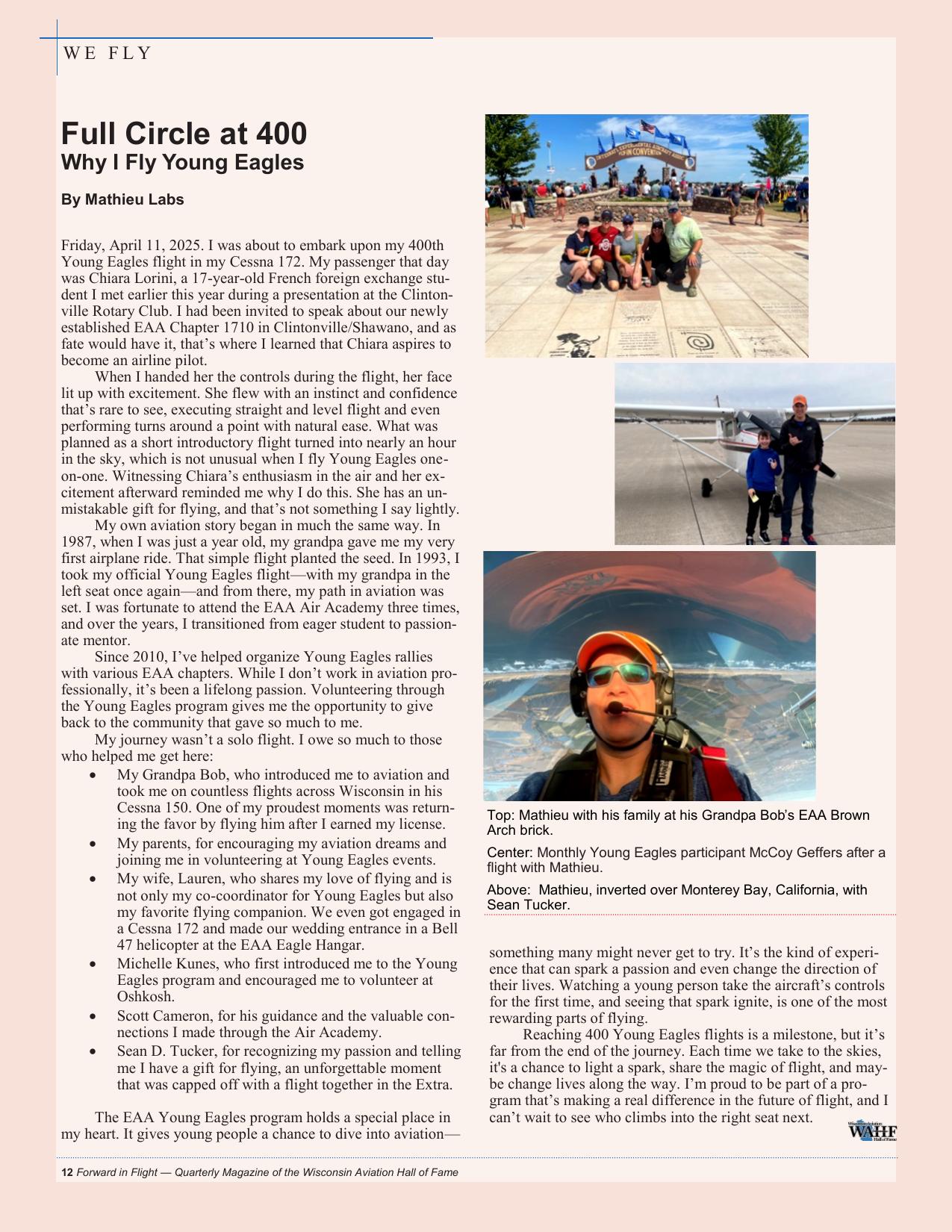
WE FLY Full Circle at 400 Why I Fly Young Eagles By Mathieu Labs Friday, April 11, 2025. I was about to embark upon my 400th Young Eagles flight in my Cessna 172. My passenger that day was Chiara Lorini, a 17-year-old French foreign exchange student I met earlier this year during a presentation at the Clintonville Rotary Club. I had been invited to speak about our newly established EAA Chapter 1710 in Clintonville/Shawano, and as fate would have it, that’s where I learned that Chiara aspires to become an airline pilot. When I handed her the controls during the flight, her face lit up with excitement. She flew with an instinct and confidence that’s rare to see, executing straight and level flight and even performing turns around a point with natural ease. What was planned as a short introductory flight turned into nearly an hour in the sky, which is not unusual when I fly Young Eagles oneon-one. Witnessing Chiara’s enthusiasm in the air and her excitement afterward reminded me why I do this. She has an unmistakable gift for flying, and that’s not something I say lightly. My own aviation story began in much the same way. In 1987, when I was just a year old, my grandpa gave me my very first airplane ride. That simple flight planted the seed. In 1993, I took my official Young Eagles flight—with my grandpa in the left seat once again—and from there, my path in aviation was set. I was fortunate to attend the EAA Air Academy three times, and over the years, I transitioned from eager student to passionate mentor. Since 2010, I’ve helped organize Young Eagles rallies with various EAA chapters. While I don’t work in aviation professionally, it’s been a lifelong passion. Volunteering through the Young Eagles program gives me the opportunity to give back to the community that gave so much to me. My journey wasn’t a solo flight. I owe so much to those who helped me get here: • My Grandpa Bob, who introduced me to aviation and took me on countless flights across Wisconsin in his Cessna 150. One of my proudest moments was returning the favor by flying him after I earned my license. • My parents, for encouraging my aviation dreams and joining me in volunteering at Young Eagles events. • My wife, Lauren, who shares my love of flying and is not only my co-coordinator for Young Eagles but also my favorite flying companion. We even got engaged in a Cessna 172 and made our wedding entrance in a Bell 47 helicopter at the EAA Eagle Hangar. • Michelle Kunes, who first introduced me to the Young Eagles program and encouraged me to volunteer at Oshkosh. • Scott Cameron, for his guidance and the valuable connections I made through the Air Academy. • Sean D. Tucker, for recognizing my passion and telling me I have a gift for flying, an unforgettable moment that was capped off with a flight together in the Extra. The EAA Young Eagles program holds a special place in my heart. It gives young people a chance to dive into aviation— 12 Forward in Flight — Quarterly Magazine of the Wisconsin Aviation Hall of Fame Top: Mathieu with his family at his Grandpa Bob’s EAA Brown Arch brick. Center: Monthly Young Eagles participant McCoy Geffers after a flight with Mathieu. Above: Mathieu, inverted over Monterey Bay, California, with Sean Tucker. something many might never get to try. It’s the kind of experience that can spark a passion and even change the direction of their lives. Watching a young person take the aircraft’s controls for the first time, and seeing that spark ignite, is one of the most rewarding parts of flying. Reaching 400 Young Eagles flights is a milestone, but it’s far from the end of the journey. Each time we take to the skies, it's a chance to light a spark, share the magic of flight, and maybe change lives along the way. I’m proud to be part of a program that’s making a real difference in the future of flight, and I can’t wait to see who climbs into the right seat next.
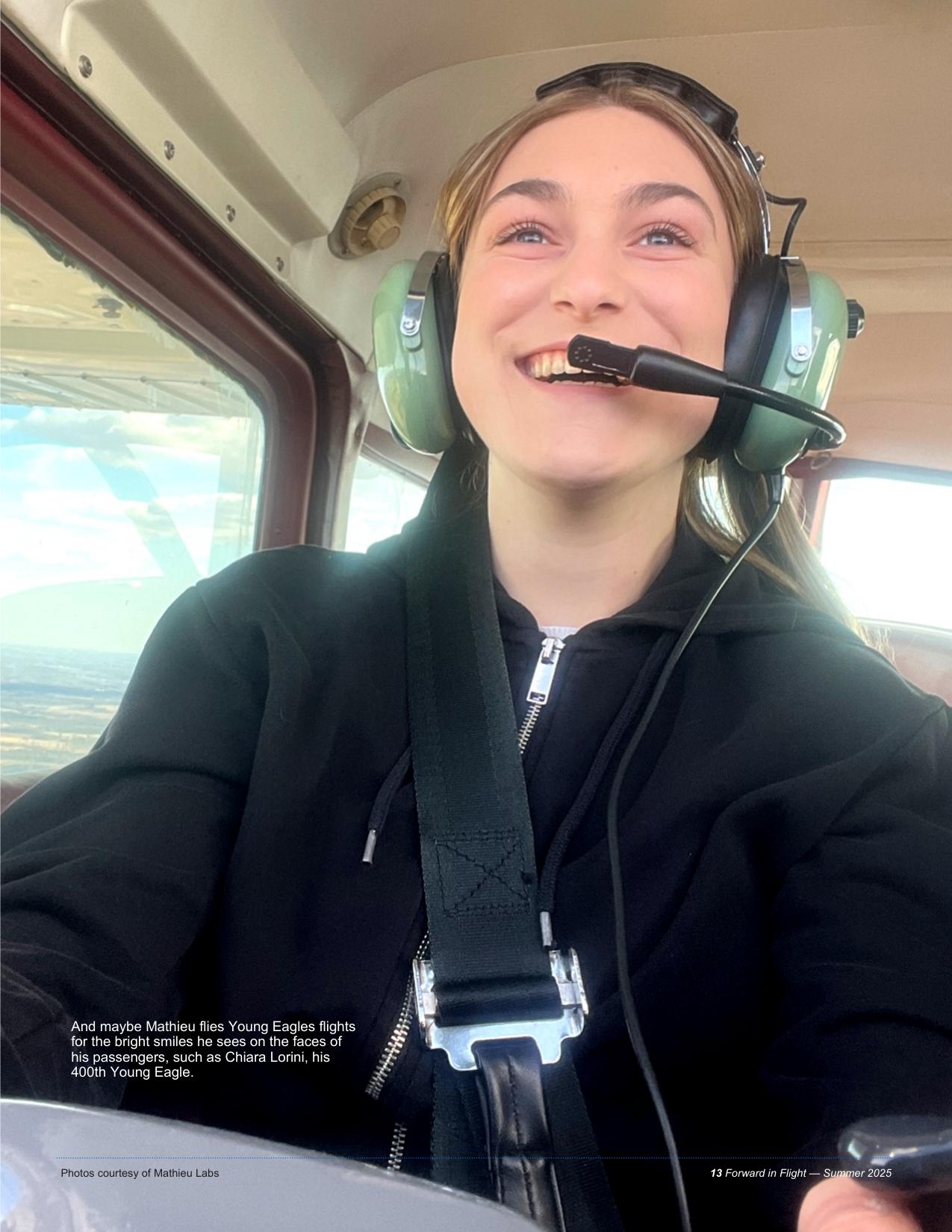
And maybe Mathieu flies Young Eagles flights for the bright smiles he sees on the faces of his passengers, such as Chiara Lorini, his 400th Young Eagle. Photos courtesy of Mathieu Labs 13 Forward in Flight — Summer 2025
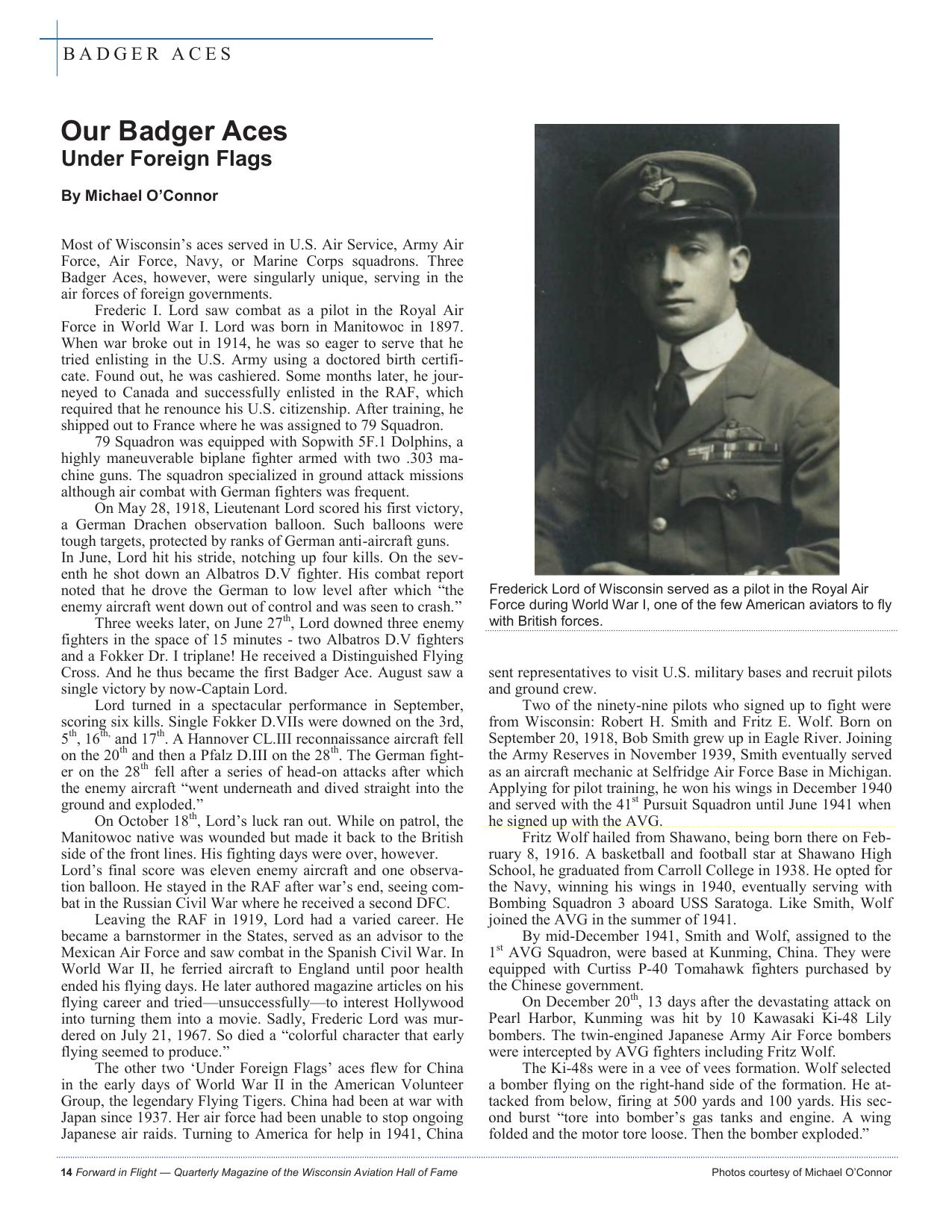
BADGER ACES Our Badger Aces Under Foreign Flags By Michael O’Connor Most of Wisconsin’s aces served in U.S. Air Service, Army Air Force, Air Force, Navy, or Marine Corps squadrons. Three Badger Aces, however, were singularly unique, serving in the air forces of foreign governments. Frederic I. Lord saw combat as a pilot in the Royal Air Force in World War I. Lord was born in Manitowoc in 1897. When war broke out in 1914, he was so eager to serve that he tried enlisting in the U.S. Army using a doctored birth certificate. Found out, he was cashiered. Some months later, he journeyed to Canada and successfully enlisted in the RAF, which required that he renounce his U.S. citizenship. After training, he shipped out to France where he was assigned to 79 Squadron. 79 Squadron was equipped with Sopwith 5F.1 Dolphins, a highly maneuverable biplane fighter armed with two .303 machine guns. The squadron specialized in ground attack missions although air combat with German fighters was frequent. On May 28, 1918, Lieutenant Lord scored his first victory, a German Drachen observation balloon. Such balloons were tough targets, protected by ranks of German anti-aircraft guns. In June, Lord hit his stride, notching up four kills. On the seventh he shot down an Albatros D.V fighter. His combat report noted that he drove the German to low level after which “the enemy aircraft went down out of control and was seen to crash.” Three weeks later, on June 27th, Lord downed three enemy fighters in the space of 15 minutes - two Albatros D.V fighters and a Fokker Dr. I triplane! He received a Distinguished Flying Cross. And he thus became the first Badger Ace. August saw a single victory by now-Captain Lord. Lord turned in a spectacular performance in September, scoring six kills. Single Fokker D.VIIs were downed on the 3rd, 5th, 16th, and 17th. A Hannover CL.III reconnaissance aircraft fell on the 20th and then a Pfalz D.III on the 28th. The German fighter on the 28th fell after a series of head-on attacks after which the enemy aircraft “went underneath and dived straight into the ground and exploded.” On October 18th, Lord’s luck ran out. While on patrol, the Manitowoc native was wounded but made it back to the British side of the front lines. His fighting days were over, however. Lord’s final score was eleven enemy aircraft and one observation balloon. He stayed in the RAF after war’s end, seeing combat in the Russian Civil War where he received a second DFC. Leaving the RAF in 1919, Lord had a varied career. He became a barnstormer in the States, served as an advisor to the Mexican Air Force and saw combat in the Spanish Civil War. In World War II, he ferried aircraft to England until poor health ended his flying days. He later authored magazine articles on his flying career and tried—unsuccessfully—to interest Hollywood into turning them into a movie. Sadly, Frederic Lord was murdered on July 21, 1967. So died a “colorful character that early flying seemed to produce.” The other two ‘Under Foreign Flags’ aces flew for China in the early days of World War II in the American Volunteer Group, the legendary Flying Tigers. China had been at war with Japan since 1937. Her air force had been unable to stop ongoing Japanese air raids. Turning to America for help in 1941, China sent representatives to visit U.S. military bases and recruit pilots and ground crew. Two of the ninety-nine pilots who signed up to fight were from Wisconsin: Robert H. Smith and Fritz E. Wolf. Born on September 20, 1918, Bob Smith grew up in Eagle River. Joining the Army Reserves in November 1939, Smith eventually served as an aircraft mechanic at Selfridge Air Force Base in Michigan. Applying for pilot training, he won his wings in December 1940 and served with the 41st Pursuit Squadron until June 1941 when he signed up with the AVG. Fritz Wolf hailed from Shawano, being born there on February 8, 1916. A basketball and football star at Shawano High School, he graduated from Carroll College in 1938. He opted for the Navy, winning his wings in 1940, eventually serving with Bombing Squadron 3 aboard USS Saratoga. Like Smith, Wolf joined the AVG in the summer of 1941. By mid-December 1941, Smith and Wolf, assigned to the 1st AVG Squadron, were based at Kunming, China. They were equipped with Curtiss P-40 Tomahawk fighters purchased by the Chinese government. On December 20th, 13 days after the devastating attack on Pearl Harbor, Kunming was hit by 10 Kawasaki Ki-48 Lily bombers. The twin-engined Japanese Army Air Force bombers were intercepted by AVG fighters including Fritz Wolf. The Ki-48s were in a vee of vees formation. Wolf selected a bomber flying on the right-hand side of the formation. He attacked from below, firing at 500 yards and 100 yards. His second burst “tore into bomber’s gas tanks and engine. A wing folded and the motor tore loose. Then the bomber exploded.” 14 Forward in Flight — Quarterly Magazine of the Wisconsin Aviation Hall of Fame Photos courtesy of Michael O’Connor Frederick Lord of Wisconsin served as a pilot in the Royal Air Force during World War I, one of the few American aviators to fly with British forces.
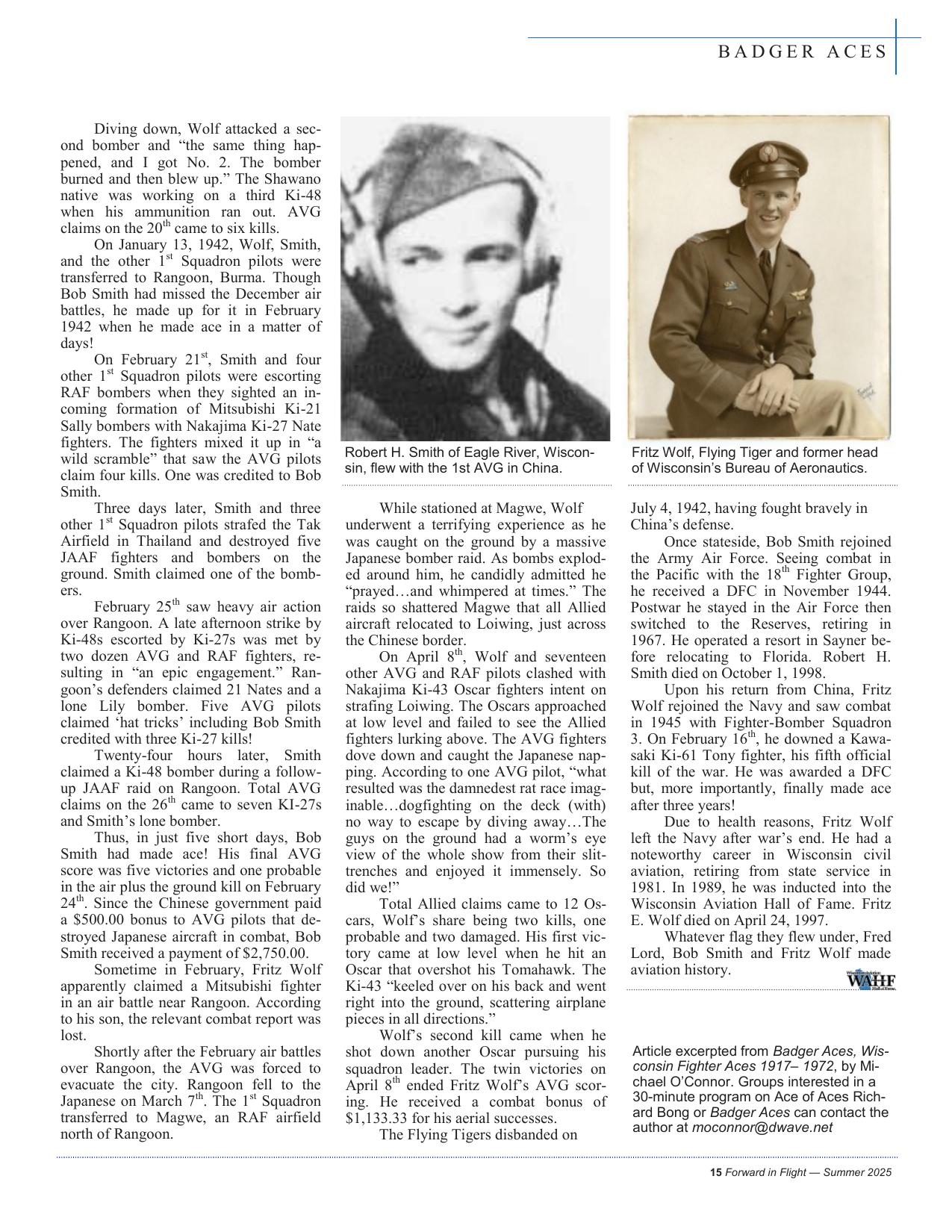
BADGER ACES Diving down, Wolf attacked a second bomber and “the same thing happened, and I got No. 2. The bomber burned and then blew up.” The Shawano native was working on a third Ki-48 when his ammunition ran out. AVG claims on the 20th came to six kills. On January 13, 1942, Wolf, Smith, and the other 1st Squadron pilots were transferred to Rangoon, Burma. Though Bob Smith had missed the December air battles, he made up for it in February 1942 when he made ace in a matter of days! On February 21st, Smith and four other 1st Squadron pilots were escorting RAF bombers when they sighted an incoming formation of Mitsubishi Ki-21 Sally bombers with Nakajima Ki-27 Nate fighters. The fighters mixed it up in “a wild scramble” that saw the AVG pilots claim four kills. One was credited to Bob Smith. Three days later, Smith and three other 1st Squadron pilots strafed the Tak Airfield in Thailand and destroyed five JAAF fighters and bombers on the ground. Smith claimed one of the bombers. February 25th saw heavy air action over Rangoon. A late afternoon strike by Ki-48s escorted by Ki-27s was met by two dozen AVG and RAF fighters, resulting in “an epic engagement.” Rangoon’s defenders claimed 21 Nates and a lone Lily bomber. Five AVG pilots claimed ‘hat tricks’ including Bob Smith credited with three Ki-27 kills! Twenty-four hours later, Smith claimed a Ki-48 bomber during a followup JAAF raid on Rangoon. Total AVG claims on the 26th came to seven KI-27s and Smith’s lone bomber. Thus, in just five short days, Bob Smith had made ace! His final AVG score was five victories and one probable in the air plus the ground kill on February 24th. Since the Chinese government paid a $500.00 bonus to AVG pilots that destroyed Japanese aircraft in combat, Bob Smith received a payment of $2,750.00. Sometime in February, Fritz Wolf apparently claimed a Mitsubishi fighter in an air battle near Rangoon. According to his son, the relevant combat report was lost. Shortly after the February air battles over Rangoon, the AVG was forced to evacuate the city. Rangoon fell to the Japanese on March 7th. The 1st Squadron transferred to Magwe, an RAF airfield north of Rangoon. Robert H. Smith of Eagle River, Wisconsin, flew with the 1st AVG in China. Fritz Wolf, Flying Tiger and former head of Wisconsin’s Bureau of Aeronautics. While stationed at Magwe, Wolf underwent a terrifying experience as he was caught on the ground by a massive Japanese bomber raid. As bombs exploded around him, he candidly admitted he “prayed…and whimpered at times.” The raids so shattered Magwe that all Allied aircraft relocated to Loiwing, just across the Chinese border. On April 8th, Wolf and seventeen other AVG and RAF pilots clashed with Nakajima Ki-43 Oscar fighters intent on strafing Loiwing. The Oscars approached at low level and failed to see the Allied fighters lurking above. The AVG fighters dove down and caught the Japanese napping. According to one AVG pilot, “what resulted was the damnedest rat race imaginable…dogfighting on the deck (with) no way to escape by diving away…The guys on the ground had a worm’s eye view of the whole show from their slittrenches and enjoyed it immensely. So did we!” Total Allied claims came to 12 Oscars, Wolf’s share being two kills, one probable and two damaged. His first victory came at low level when he hit an Oscar that overshot his Tomahawk. The Ki-43 “keeled over on his back and went right into the ground, scattering airplane pieces in all directions.” Wolf’s second kill came when he shot down another Oscar pursuing his squadron leader. The twin victories on April 8th ended Fritz Wolf’s AVG scoring. He received a combat bonus of $1,133.33 for his aerial successes. The Flying Tigers disbanded on July 4, 1942, having fought bravely in China’s defense. Once stateside, Bob Smith rejoined the Army Air Force. Seeing combat in the Pacific with the 18th Fighter Group, he received a DFC in November 1944. Postwar he stayed in the Air Force then switched to the Reserves, retiring in 1967. He operated a resort in Sayner before relocating to Florida. Robert H. Smith died on October 1, 1998. Upon his return from China, Fritz Wolf rejoined the Navy and saw combat in 1945 with Fighter-Bomber Squadron 3. On February 16th, he downed a Kawasaki Ki-61 Tony fighter, his fifth official kill of the war. He was awarded a DFC but, more importantly, finally made ace after three years! Due to health reasons, Fritz Wolf left the Navy after war’s end. He had a noteworthy career in Wisconsin civil aviation, retiring from state service in 1981. In 1989, he was inducted into the Wisconsin Aviation Hall of Fame. Fritz E. Wolf died on April 24, 1997. Whatever flag they flew under, Fred Lord, Bob Smith and Fritz Wolf made aviation history. Article excerpted from Badger Aces, Wisconsin Fighter Aces 1917– 1972, by Michael O’Connor. Groups interested in a 30-minute program on Ace of Aces Richard Bong or Badger Aces can contact the author at moconnor@dwave.net 15 Forward in Flight — Summer 2025
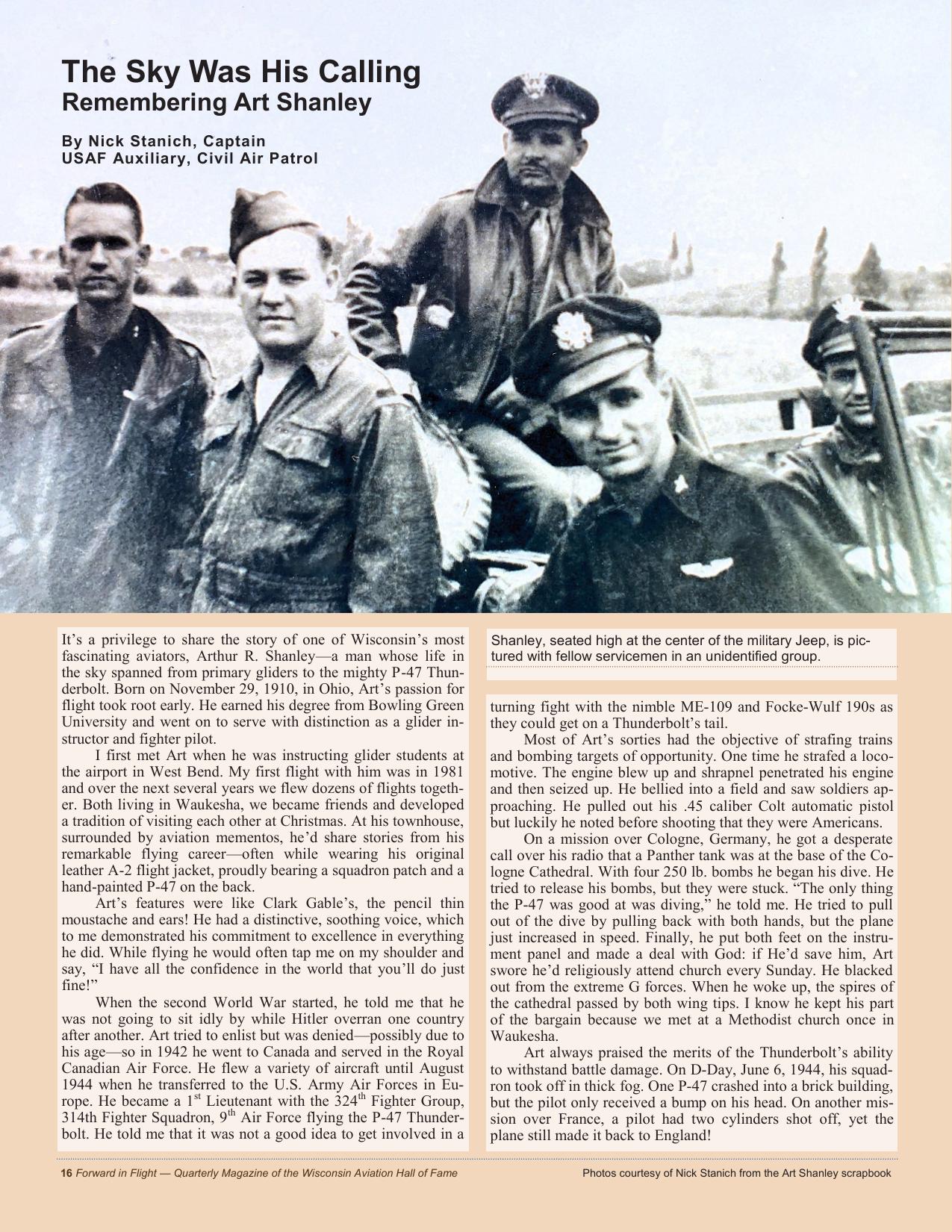
The Sky Was His Calling Remembering Art Shanley By Nick Stanich, Captain USAF Auxiliary, Civil Air Patrol It’s a privilege to share the story of one of Wisconsin’s most fascinating aviators, Arthur R. Shanley—a man whose life in the sky spanned from primary gliders to the mighty P-47 Thunderbolt. Born on November 29, 1910, in Ohio, Art’s passion for flight took root early. He earned his degree from Bowling Green University and went on to serve with distinction as a glider instructor and fighter pilot. I first met Art when he was instructing glider students at the airport in West Bend. My first flight with him was in 1981 and over the next several years we flew dozens of flights together. Both living in Waukesha, we became friends and developed a tradition of visiting each other at Christmas. At his townhouse, surrounded by aviation mementos, he’d share stories from his remarkable flying career—often while wearing his original leather A-2 flight jacket, proudly bearing a squadron patch and a hand-painted P-47 on the back. Art’s features were like Clark Gable’s, the pencil thin moustache and ears! He had a distinctive, soothing voice, which to me demonstrated his commitment to excellence in everything he did. While flying he would often tap me on my shoulder and say, “I have all the confidence in the world that you’ll do just fine!” When the second World War started, he told me that he was not going to sit idly by while Hitler overran one country after another. Art tried to enlist but was denied—possibly due to his age—so in 1942 he went to Canada and served in the Royal Canadian Air Force. He flew a variety of aircraft until August 1944 when he transferred to the U.S. Army Air Forces in Europe. He became a 1st Lieutenant with the 324th Fighter Group, 314th Fighter Squadron, 9th Air Force flying the P-47 Thunderbolt. He told me that it was not a good idea to get involved in a turning fight with the nimble ME-109 and Focke-Wulf 190s as they could get on a Thunderbolt’s tail. Most of Art’s sorties had the objective of strafing trains and bombing targets of opportunity. One time he strafed a locomotive. The engine blew up and shrapnel penetrated his engine and then seized up. He bellied into a field and saw soldiers approaching. He pulled out his .45 caliber Colt automatic pistol but luckily he noted before shooting that they were Americans. On a mission over Cologne, Germany, he got a desperate call over his radio that a Panther tank was at the base of the Cologne Cathedral. With four 250 lb. bombs he began his dive. He tried to release his bombs, but they were stuck. “The only thing the P-47 was good at was diving,” he told me. He tried to pull out of the dive by pulling back with both hands, but the plane just increased in speed. Finally, he put both feet on the instrument panel and made a deal with God: if He’d save him, Art swore he’d religiously attend church every Sunday. He blacked out from the extreme G forces. When he woke up, the spires of the cathedral passed by both wing tips. I know he kept his part of the bargain because we met at a Methodist church once in Waukesha. Art always praised the merits of the Thunderbolt’s ability to withstand battle damage. On D-Day, June 6, 1944, his squadron took off in thick fog. One P-47 crashed into a brick building, but the pilot only received a bump on his head. On another mission over France, a pilot had two cylinders shot off, yet the plane still made it back to England! 16 Forward in Flight — Quarterly Magazine of the Wisconsin Aviation Hall of Fame Photos courtesy of Nick Stanich from the Art Shanley scrapbook Shanley, seated high at the center of the military Jeep, is pictured with fellow servicemen in an unidentified group.
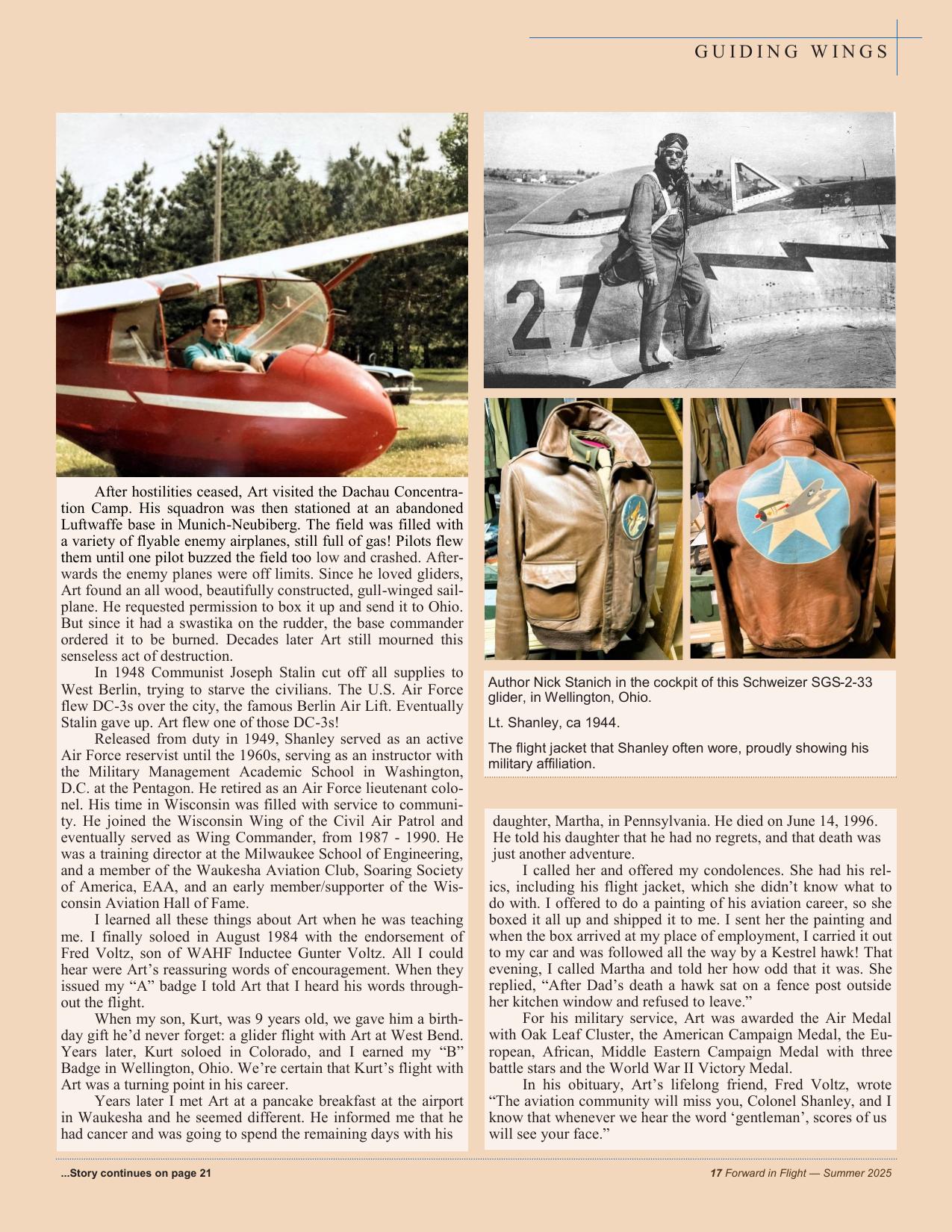
GUIDING WINGS After hostilities ceased, Art visited the Dachau Concentration Camp. His squadron was then stationed at an abandoned Luftwaffe base in Munich-Neubiberg. The field was filled with a variety of flyable enemy airplanes, still full of gas! Pilots flew them until one pilot buzzed the field too low and crashed. Afterwards the enemy planes were off limits. Since he loved gliders, Art found an all wood, beautifully constructed, gull-winged sailplane. He requested permission to box it up and send it to Ohio. But since it had a swastika on the rudder, the base commander ordered it to be burned. Decades later Art still mourned this senseless act of destruction. In 1948 Communist Joseph Stalin cut off all supplies to West Berlin, trying to starve the civilians. The U.S. Air Force flew DC-3s over the city, the famous Berlin Air Lift. Eventually Stalin gave up. Art flew one of those DC-3s! Released from duty in 1949, Shanley served as an active Air Force reservist until the 1960s, serving as an instructor with the Military Management Academic School in Washington, D.C. at the Pentagon. He retired as an Air Force lieutenant colonel. His time in Wisconsin was filled with service to community. He joined the Wisconsin Wing of the Civil Air Patrol and eventually served as Wing Commander, from 1987 - 1990. He was a training director at the Milwaukee School of Engineering, and a member of the Waukesha Aviation Club, Soaring Society of America, EAA, and an early member/supporter of the Wisconsin Aviation Hall of Fame. I learned all these things about Art when he was teaching me. I finally soloed in August 1984 with the endorsement of Fred Voltz, son of WAHF Inductee Gunter Voltz. All I could hear were Art’s reassuring words of encouragement. When they issued my “A” badge I told Art that I heard his words throughout the flight. When my son, Kurt, was 9 years old, we gave him a birthday gift he’d never forget: a glider flight with Art at West Bend. Years later, Kurt soloed in Colorado, and I earned my “B” Badge in Wellington, Ohio. We’re certain that Kurt’s flight with Art was a turning point in his career. Years later I met Art at a pancake breakfast at the airport in Waukesha and he seemed different. He informed me that he had cancer and was going to spend the remaining days with his ...Story continues on page 21 Author Nick Stanich in the cockpit of this Schweizer SGS-2-33 glider, in Wellington, Ohio. Lt. Shanley, ca 1944. The flight jacket that Shanley often wore, proudly showing his military affiliation. daughter, Martha, in Pennsylvania. He died on June 14, 1996. He told his daughter that he had no regrets, and that death was just another adventure. I called her and offered my condolences. She had his relics, including his flight jacket, which she didn’t know what to do with. I offered to do a painting of his aviation career, so she boxed it all up and shipped it to me. I sent her the painting and when the box arrived at my place of employment, I carried it out to my car and was followed all the way by a Kestrel hawk! That evening, I called Martha and told her how odd that it was. She replied, “After Dad’s death a hawk sat on a fence post outside her kitchen window and refused to leave.” For his military service, Art was awarded the Air Medal with Oak Leaf Cluster, the American Campaign Medal, the European, African, Middle Eastern Campaign Medal with three battle stars and the World War II Victory Medal. In his obituary, Art’s lifelong friend, Fred Voltz, wrote “The aviation community will miss you, Colonel Shanley, and I know that whenever we hear the word ‘gentleman’, scores of us will see your face.” 17 Forward in Flight — Summer 2025
HONOR BOUND Welcome Home A Badger Honor Flight We’ll Never Forget By Bill Green THE PLAN: Veterans’ Honor Flight is a well-known organization dedicated to veterans in all services who served our Country honorably. Badger Honor Flight (BHF), based in Madison, Wisconsin, is a hub of the national organization. I was notified almost three years ago that I had been selected for an Honor Flight at a future date. I found out early this year that my time would be April 19, 2025. I had designated my son, WAHF Board Member Scott Green, to be my guardian—he would accompany me on the special day. We began to get regular letters from Eileen Stevens, BHF Administrator, with information about the day. Scott attended a mandatory class on March 15 to prepare him to function as my guardian during the day. APRIL 19 Scott and I were up at about 3am to arrive at Dane County Regional Airport (KMSN) at the appointed time of 4:30am to begin our day with BHF. As we drove up to the airport we got our first clue as to what the day would be like. The terminal building was lit up with red, white, and blue lights and there was a crane with a huge American Flag suspended above the drive. Just beautiful! Scott let me off at the designated door and he went to park the car. I was greeted at the curb by BHF volunteers shaking my hands and thanking me for my service. Some Veterans were already there and there were BHF volunteers everywhere guiding me through registration and making sure I found the Red Cross coffee and pastries. Scott and I were issued badges that guided us through the day. They had our names, of course, a boarding sequence, a seat number for the flight, and a bus color for when we got to DC. There were service dogs from Custom K-9s with handlers all around. Service dogs have been extraordinarily successful as PTSD therapy for Veterans. A dog named Courage would accompany us on the flight to DC. A trumpet called Assembly. 18 Forward in Flight — Quarterly Magazine of the Wisconsin Aviation Hall of Fame There was an Honor Guard flag ceremony by the Maple Bluff American Legion, Nate Koehler sang the National Anthem, and we were welcomed and given information about the day by Brian Ziegler, BHF Chair. Air Force Col Jeannie Jeanetta gave a presentation, and we were ready to go to Washington, DC. We Veterans were made to feel incredibly special—it is amazing how many volunteers have been doing this for years. 6:00am: We began boarding the American Airlines airplane. There were 89 Veterans and our guardians plus several BHF staff and volunteers. Boarding took a while, but security was fast tracked through TSA. We were handed breakfast in paper bags at the gate. Scott and I were seated near the back of the airplane, but the whole thing was managed so efficiently by BHF that we didn’t mind. 7:00am+: The aircraft took off on the flight to DC, a little bumpy at first but soon smoothed out so we got our coffee and cookies from American Airlines attendants. 9:50* Eastern Daylight Time: Landed at Reagan National Airport (DCA) in Washington. Got a good aerial look at the city as the aircraft made a low slow 360-degree turn from short final for some reason (in our honor?). We flew over the Pentagon twice and could see the Washington Monument and Lincoln Memorial. Genuinely nice start to the tour. On landing we were treated to a water salute by a fire truck that washed the aircraft down as we taxied in. Then there was a row of patriotic flags on both sides of the aircraft as we approached the gate. We were obviously expected and again, were made to feel incredibly special. As we walked into the terminal there was a band in the concourse playing patriotic music. Washington Honor Flight staff and volunteers were there to greet us and thank us for our service. We walked to the buses. Ours was the last of four (the green bus as noted on our badge). * Times approximate
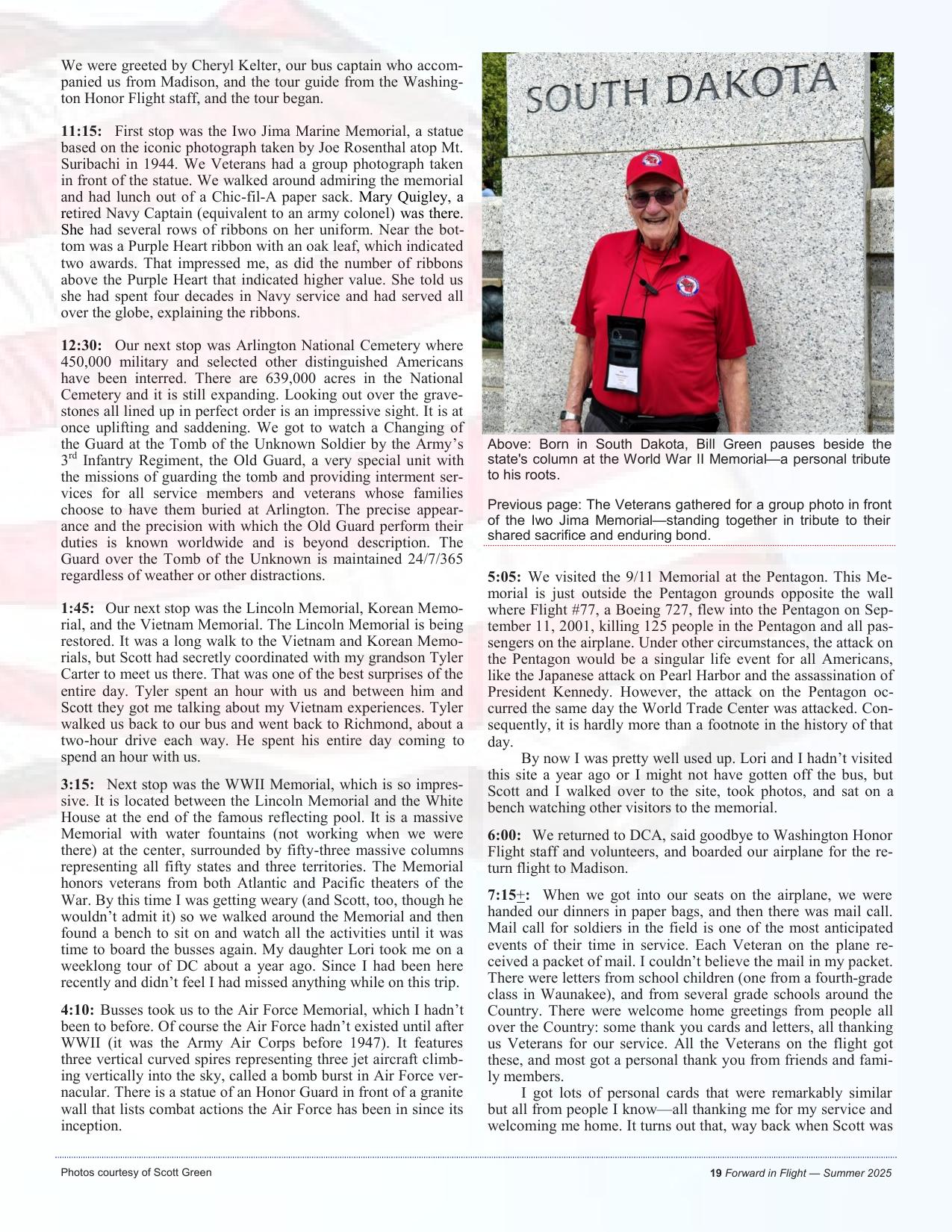
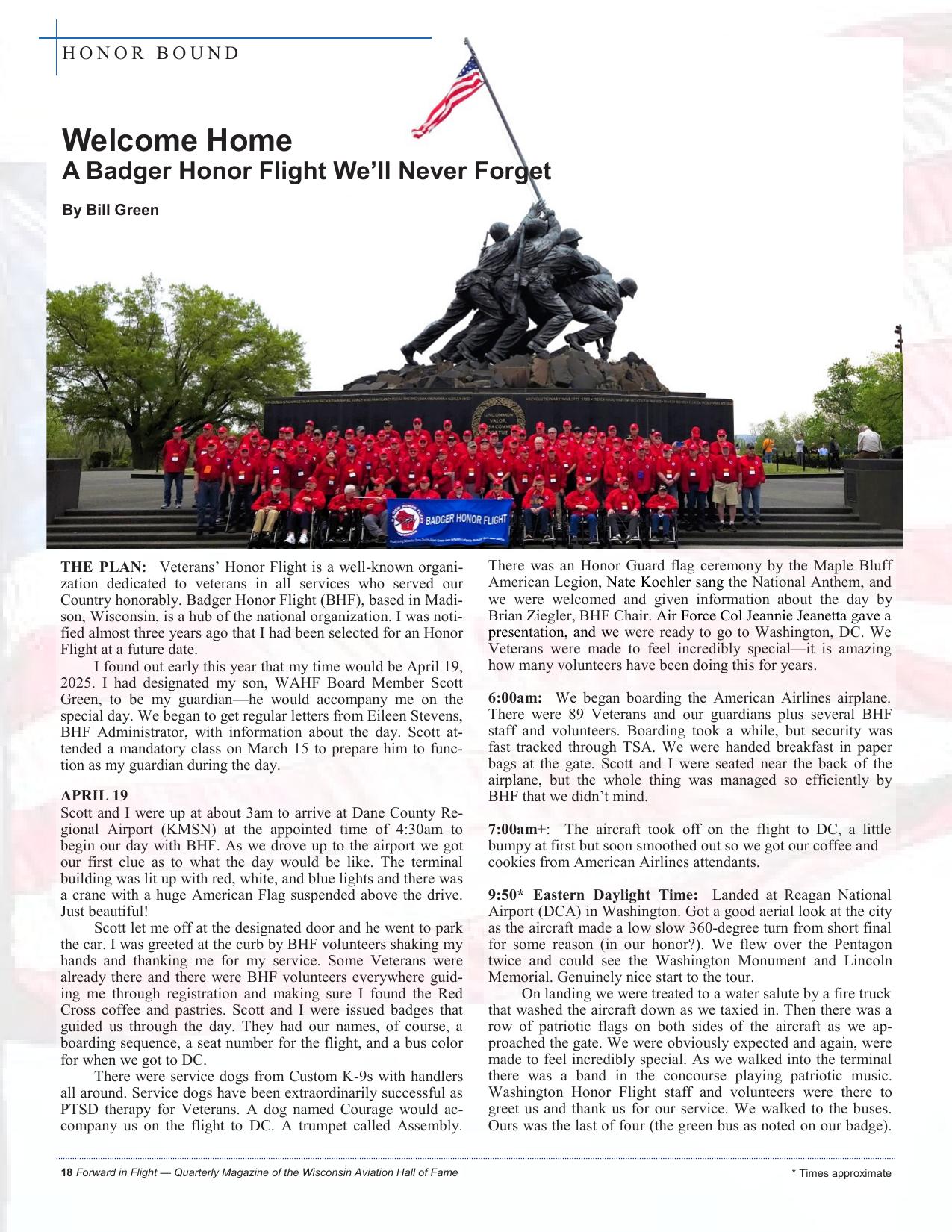
We were greeted by Cheryl Kelter, our bus captain who accompanied us from Madison, and the tour guide from the Washington Honor Flight staff, and the tour began. 11:15: First stop was the Iwo Jima Marine Memorial, a statue based on the iconic photograph taken by Joe Rosenthal atop Mt. Suribachi in 1944. We Veterans had a group photograph taken in front of the statue. We walked around admiring the memorial and had lunch out of a Chic-fil-A paper sack. Mary Quigley, a retired Navy Captain (equivalent to an army colonel) was there. She had several rows of ribbons on her uniform. Near the bottom was a Purple Heart ribbon with an oak leaf, which indicated two awards. That impressed me, as did the number of ribbons above the Purple Heart that indicated higher value. She told us she had spent four decades in Navy service and had served all over the globe, explaining the ribbons. 12:30: Our next stop was Arlington National Cemetery where 450,000 military and selected other distinguished Americans have been interred. There are 639,000 acres in the National Cemetery and it is still expanding. Looking out over the gravestones all lined up in perfect order is an impressive sight. It is at once uplifting and saddening. We got to watch a Changing of the Guard at the Tomb of the Unknown Soldier by the Army’s 3rd Infantry Regiment, the Old Guard, a very special unit with the missions of guarding the tomb and providing interment services for all service members and veterans whose families choose to have them buried at Arlington. The precise appearance and the precision with which the Old Guard perform their duties is known worldwide and is beyond description. The Guard over the Tomb of the Unknown is maintained 24/7/365 regardless of weather or other distractions. 1:45: Our next stop was the Lincoln Memorial, Korean Memorial, and the Vietnam Memorial. The Lincoln Memorial is being restored. It was a long walk to the Vietnam and Korean Memorials, but Scott had secretly coordinated with my grandson Tyler Carter to meet us there. That was one of the best surprises of the entire day. Tyler spent an hour with us and between him and Scott they got me talking about my Vietnam experiences. Tyler walked us back to our bus and went back to Richmond, about a two-hour drive each way. He spent his entire day coming to spend an hour with us. 3:15: Next stop was the WWII Memorial, which is so impressive. It is located between the Lincoln Memorial and the White House at the end of the famous reflecting pool. It is a massive Memorial with water fountains (not working when we were there) at the center, surrounded by fifty-three massive columns representing all fifty states and three territories. The Memorial honors veterans from both Atlantic and Pacific theaters of the War. By this time I was getting weary (and Scott, too, though he wouldn’t admit it) so we walked around the Memorial and then found a bench to sit on and watch all the activities until it was time to board the busses again. My daughter Lori took me on a weeklong tour of DC about a year ago. Since I had been here recently and didn’t feel I had missed anything while on this trip. 4:10: Busses took us to the Air Force Memorial, which I hadn’t been to before. Of course the Air Force hadn’t existed until after WWII (it was the Army Air Corps before 1947). It features three vertical curved spires representing three jet aircraft climbing vertically into the sky, called a bomb burst in Air Force vernacular. There is a statue of an Honor Guard in front of a granite wall that lists combat actions the Air Force has been in since its inception. Photos courtesy of Scott Green Above: Born in South Dakota, Bill Green pauses beside the state's column at the World War II Memorial—a personal tribute to his roots. Previous page: The Veterans gathered for a group photo in front of the Iwo Jima Memorial—standing together in tribute to their shared sacrifice and enduring bond. 5:05: We visited the 9/11 Memorial at the Pentagon. This Memorial is just outside the Pentagon grounds opposite the wall where Flight #77, a Boeing 727, flew into the Pentagon on September 11, 2001, killing 125 people in the Pentagon and all passengers on the airplane. Under other circumstances, the attack on the Pentagon would be a singular life event for all Americans, like the Japanese attack on Pearl Harbor and the assassination of President Kennedy. However, the attack on the Pentagon occurred the same day the World Trade Center was attacked. Consequently, it is hardly more than a footnote in the history of that day. By now I was pretty well used up. Lori and I hadn’t visited this site a year ago or I might not have gotten off the bus, but Scott and I walked over to the site, took photos, and sat on a bench watching other visitors to the memorial. 6:00: We returned to DCA, said goodbye to Washington Honor Flight staff and volunteers, and boarded our airplane for the return flight to Madison. 7:15+: When we got into our seats on the airplane, we were handed our dinners in paper bags, and then there was mail call. Mail call for soldiers in the field is one of the most anticipated events of their time in service. Each Veteran on the plane received a packet of mail. I couldn’t believe the mail in my packet. There were letters from school children (one from a fourth-grade class in Waunakee), and from several grade schools around the Country. There were welcome home greetings from people all over the Country: some thank you cards and letters, all thanking us Veterans for our service. All the Veterans on the flight got these, and most got a personal thank you from friends and family members. I got lots of personal cards that were remarkably similar but all from people I know—all thanking me for my service and welcoming me home. It turns out that, way back when Scott was 19 Forward in Flight — Summer 2025
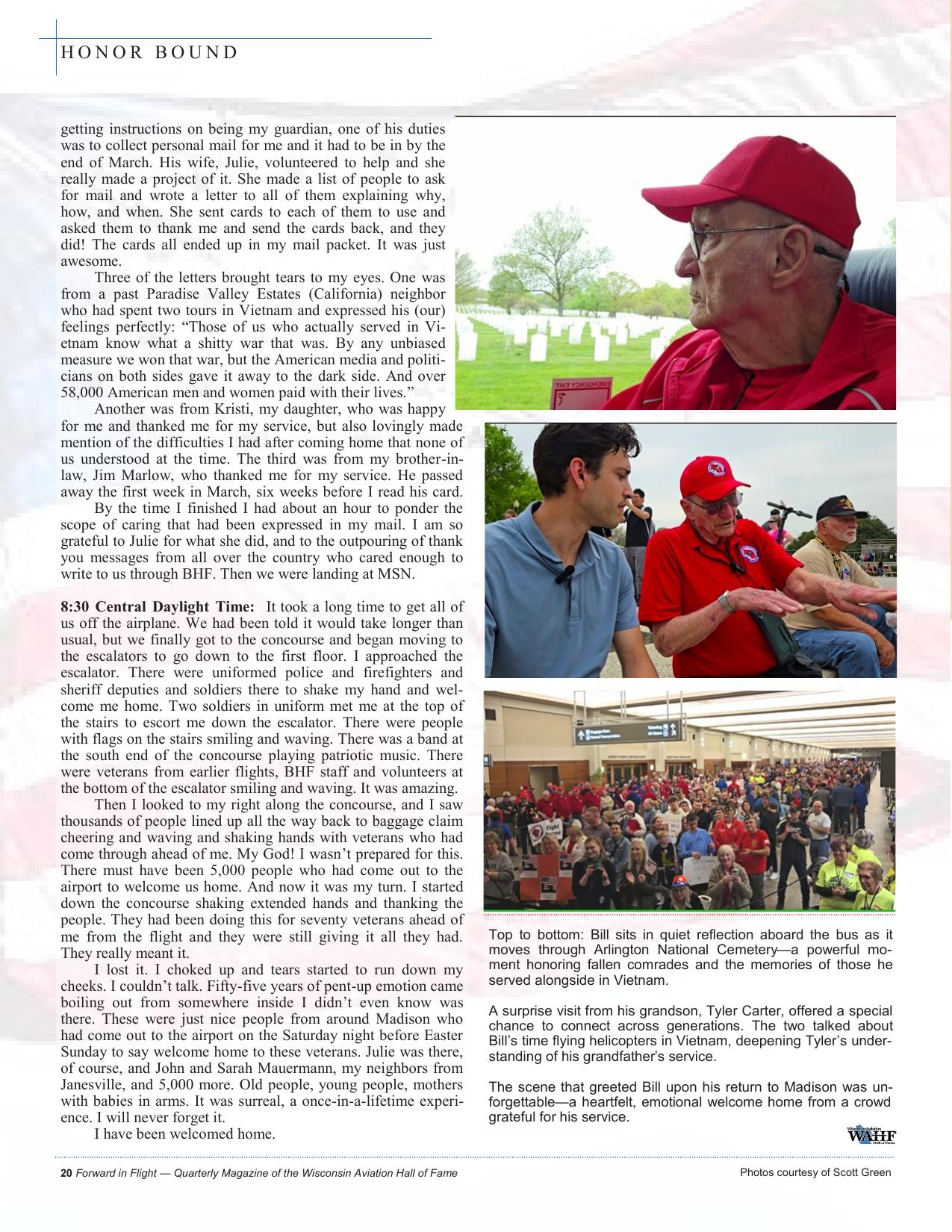
HONOR BOUND getting instructions on being my guardian, one of his duties was to collect personal mail for me and it had to be in by the end of March. His wife, Julie, volunteered to help and she really made a project of it. She made a list of people to ask for mail and wrote a letter to all of them explaining why, how, and when. She sent cards to each of them to use and asked them to thank me and send the cards back, and they did! The cards all ended up in my mail packet. It was just awesome. Three of the letters brought tears to my eyes. One was from a past Paradise Valley Estates (California) neighbor who had spent two tours in Vietnam and expressed his (our) feelings perfectly: “Those of us who actually served in Vietnam know what a shitty war that was. By any unbiased measure we won that war, but the American media and politicians on both sides gave it away to the dark side. And over 58,000 American men and women paid with their lives.” Another was from Kristi, my daughter, who was happy for me and thanked me for my service, but also lovingly made mention of the difficulties I had after coming home that none of us understood at the time. The third was from my brother-inlaw, Jim Marlow, who thanked me for my service. He passed away the first week in March, six weeks before I read his card. By the time I finished I had about an hour to ponder the scope of caring that had been expressed in my mail. I am so grateful to Julie for what she did, and to the outpouring of thank you messages from all over the country who cared enough to write to us through BHF. Then we were landing at MSN. 8:30 Central Daylight Time: It took a long time to get all of us off the airplane. We had been told it would take longer than usual, but we finally got to the concourse and began moving to the escalators to go down to the first floor. I approached the escalator. There were uniformed police and firefighters and sheriff deputies and soldiers there to shake my hand and welcome me home. Two soldiers in uniform met me at the top of the stairs to escort me down the escalator. There were people with flags on the stairs smiling and waving. There was a band at the south end of the concourse playing patriotic music. There were veterans from earlier flights, BHF staff and volunteers at the bottom of the escalator smiling and waving. It was amazing. Then I looked to my right along the concourse, and I saw thousands of people lined up all the way back to baggage claim cheering and waving and shaking hands with veterans who had come through ahead of me. My God! I wasn’t prepared for this. There must have been 5,000 people who had come out to the airport to welcome us home. And now it was my turn. I started down the concourse shaking extended hands and thanking the people. They had been doing this for seventy veterans ahead of me from the flight and they were still giving it all they had. They really meant it. I lost it. I choked up and tears started to run down my cheeks. I couldn’t talk. Fifty-five years of pent-up emotion came boiling out from somewhere inside I didn’t even know was there. These were just nice people from around Madison who had come out to the airport on the Saturday night before Easter Sunday to say welcome home to these veterans. Julie was there, of course, and John and Sarah Mauermann, my neighbors from Janesville, and 5,000 more. Old people, young people, mothers with babies in arms. It was surreal, a once-in-a-lifetime experience. I will never forget it. I have been welcomed home. 20 Forward in Flight — Quarterly Magazine of the Wisconsin Aviation Hall of Fame Top to bottom: Bill sits in quiet reflection aboard the bus as it moves through Arlington National Cemetery—a powerful moment honoring fallen comrades and the memories of those he served alongside in Vietnam. A surprise visit from his grandson, Tyler Carter, offered a special chance to connect across generations. The two talked about Bill’s time flying helicopters in Vietnam, deepening Tyler’s understanding of his grandfather’s service. The scene that greeted Bill upon his return to Madison was unforgettable—a heartfelt, emotional welcome home from a crowd grateful for his service. Photos courtesy of Scott Green
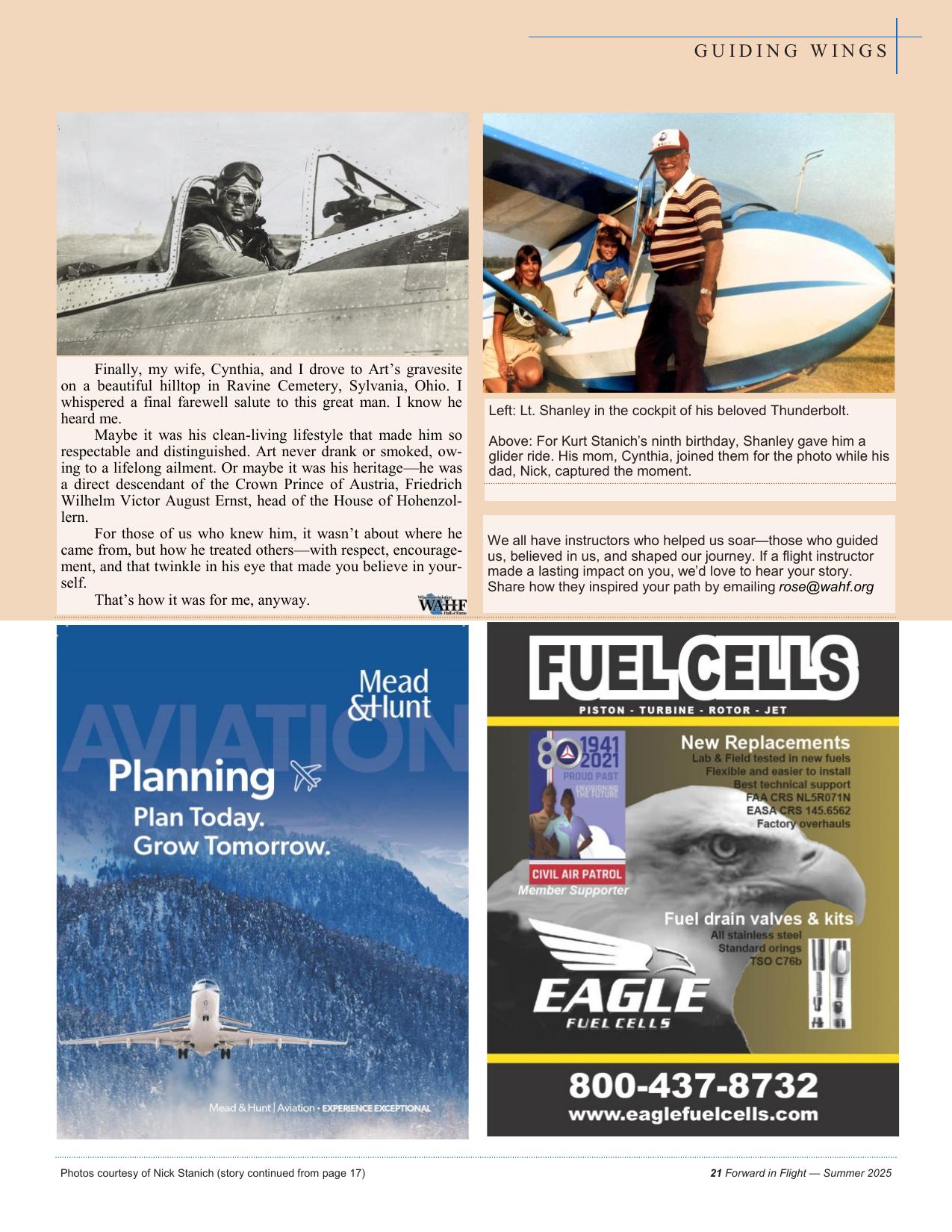
GUIDING WINGS Finally, my wife, Cynthia, and I drove to Art’s gravesite on a beautiful hilltop in Ravine Cemetery, Sylvania, Ohio. I whispered a final farewell salute to this great man. I know he heard me. Maybe it was his clean-living lifestyle that made him so respectable and distinguished. Art never drank or smoked, owing to a lifelong ailment. Or maybe it was his heritage—he was a direct descendant of the Crown Prince of Austria, Friedrich Wilhelm Victor August Ernst, head of the House of Hohenzollern. For those of us who knew him, it wasn’t about where he came from, but how he treated others—with respect, encouragement, and that twinkle in his eye that made you believe in yourself. That’s how it was for me, anyway. Photos courtesy of Nick Stanich (story continued from page 17) Left: Lt. Shanley in the cockpit of his beloved Thunderbolt. Above: For Kurt Stanich’s ninth birthday, Shanley gave him a glider ride. His mom, Cynthia, joined them for the photo while his dad, Nick, captured the moment. We all have instructors who helped us soar—those who guided us, believed in us, and shaped our journey. If a flight instructor made a lasting impact on you, we’d love to hear your story. Share how they inspired your path by emailing rose@wahf.org 21 Forward in Flight — Summer 2025
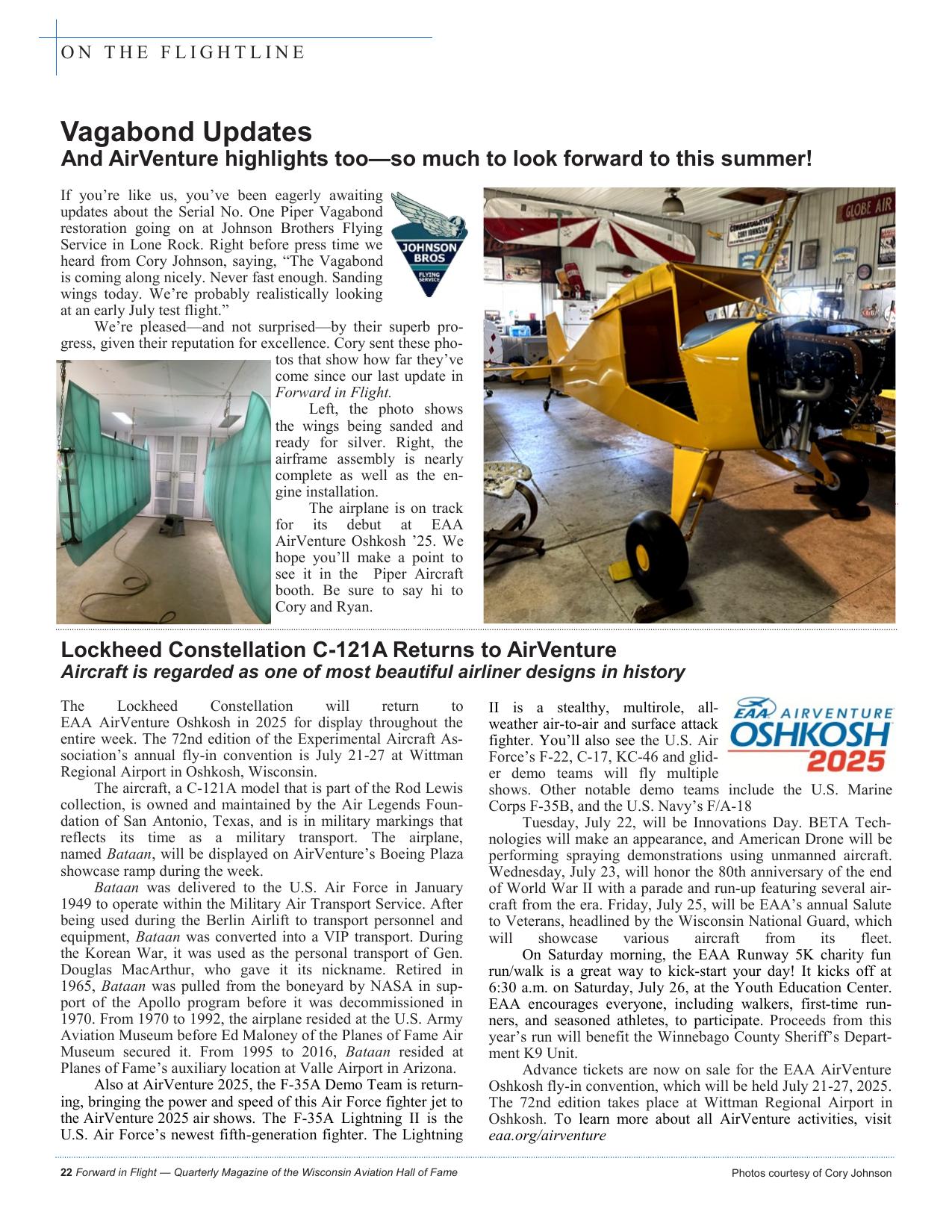
ON THE FLIGHTLINE Vagabond Updates And AirVenture highlights too—so much to look forward to this summer! If you’re like us, you’ve been eagerly awaiting updates about the Serial No. One Piper Vagabond restoration going on at Johnson Brothers Flying Service in Lone Rock. Right before press time we heard from Cory Johnson, saying, “The Vagabond is coming along nicely. Never fast enough. Sanding wings today. We’re probably realistically looking at an early July test flight.” We’re pleased—and not surprised—by their superb progress, given their reputation for excellence. Cory sent these photos that show how far they’ve come since our last update in Forward in Flight. Left, the photo shows the wings being sanded and ready for silver. Right, the airframe assembly is nearly complete as well as the engine installation. The airplane is on track for its debut at EAA AirVenture Oshkosh ’25. We hope you’ll make a point to see it in the Piper Aircraft booth. Be sure to say hi to Cory and Ryan. Lockheed Constellation C-121A Returns to AirVenture Aircraft is regarded as one of most beautiful airliner designs in history The Lockheed Constellation will return to EAA AirVenture Oshkosh in 2025 for display throughout the entire week. The 72nd edition of the Experimental Aircraft Association’s annual fly-in convention is July 21-27 at Wittman Regional Airport in Oshkosh, Wisconsin. The aircraft, a C-121A model that is part of the Rod Lewis collection, is owned and maintained by the Air Legends Foundation of San Antonio, Texas, and is in military markings that reflects its time as a military transport. The airplane, named Bataan, will be displayed on AirVenture’s Boeing Plaza showcase ramp during the week. Bataan was delivered to the U.S. Air Force in January 1949 to operate within the Military Air Transport Service. After being used during the Berlin Airlift to transport personnel and equipment, Bataan was converted into a VIP transport. During the Korean War, it was used as the personal transport of Gen. Douglas MacArthur, who gave it its nickname. Retired in 1965, Bataan was pulled from the boneyard by NASA in support of the Apollo program before it was decommissioned in 1970. From 1970 to 1992, the airplane resided at the U.S. Army Aviation Museum before Ed Maloney of the Planes of Fame Air Museum secured it. From 1995 to 2016, Bataan resided at Planes of Fame’s auxiliary location at Valle Airport in Arizona. Also at AirVenture 2025, the F-35A Demo Team is returning, bringing the power and speed of this Air Force fighter jet to the AirVenture 2025 air shows. The F-35A Lightning II is the U.S. Air Force’s newest fifth-generation fighter. The Lightning II is a stealthy, multirole, allweather air-to-air and surface attack fighter. You’ll also see the U.S. Air Force’s F-22, C-17, KC-46 and glider demo teams will fly multiple shows. Other notable demo teams include the U.S. Marine Corps F-35B, and the U.S. Navy’s F/A-18 Tuesday, July 22, will be Innovations Day. BETA Technologies will make an appearance, and American Drone will be performing spraying demonstrations using unmanned aircraft. Wednesday, July 23, will honor the 80th anniversary of the end of World War II with a parade and run-up featuring several aircraft from the era. Friday, July 25, will be EAA’s annual Salute to Veterans, headlined by the Wisconsin National Guard, which will showcase various aircraft from its fleet. On Saturday morning, the EAA Runway 5K charity fun run/walk is a great way to kick-start your day! It kicks off at 6:30 a.m. on Saturday, July 26, at the Youth Education Center. EAA encourages everyone, including walkers, first-time runners, and seasoned athletes, to participate. Proceeds from this year’s run will benefit the Winnebago County Sheriff’s Department K9 Unit. Advance tickets are now on sale for the EAA AirVenture Oshkosh fly-in convention, which will be held July 21-27, 2025. The 72nd edition takes place at Wittman Regional Airport in Oshkosh. To learn more about all AirVenture activities, visit eaa.org/airventure 22 Forward in Flight — Quarterly Magazine of the Wisconsin Aviation Hall of Fame Photos courtesy of Cory Johnson
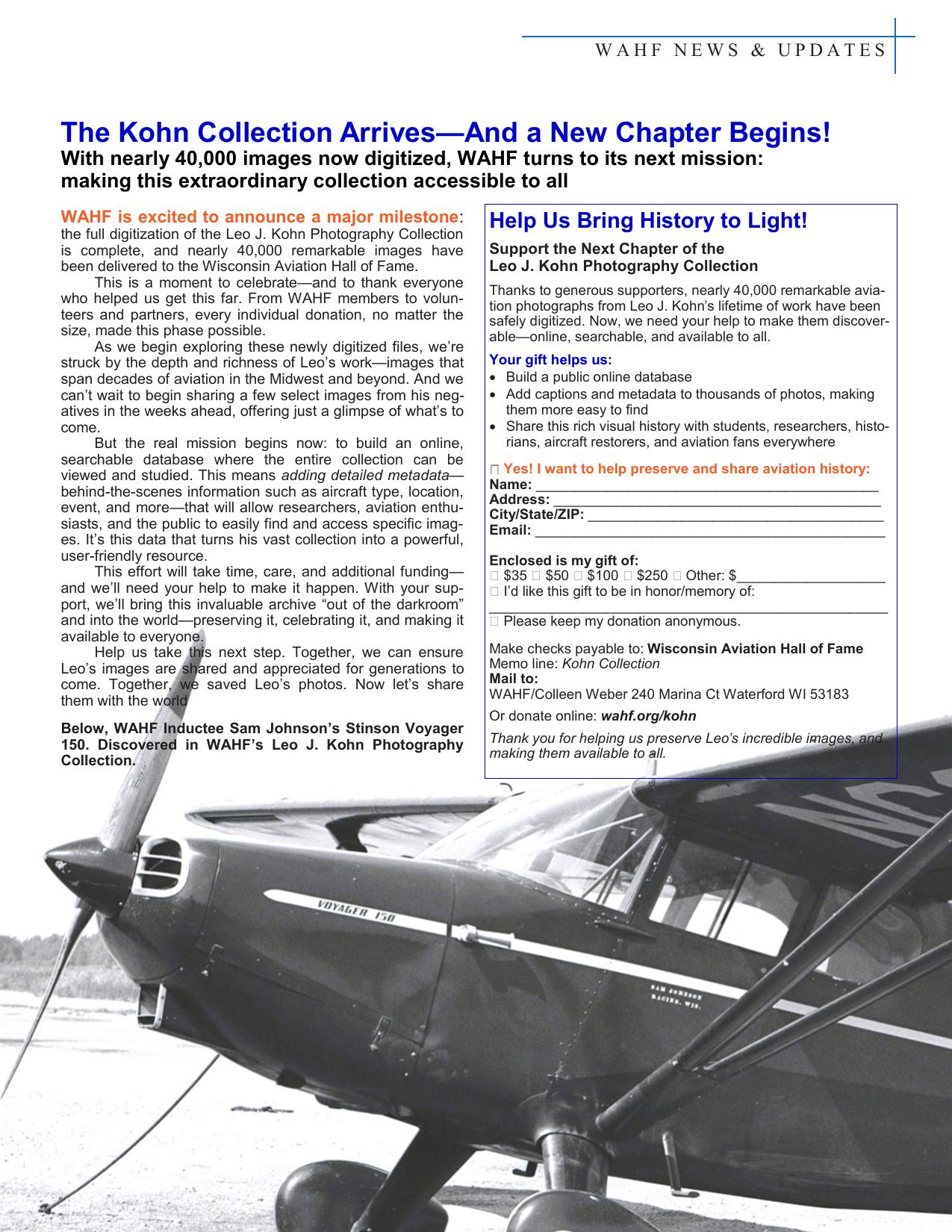
WAHF NEWS & UPDATES The Kohn Collection Arrives—And a New Chapter Begins! With nearly 40,000 images now digitized, WAHF turns to its next mission: making this extraordinary collection accessible to all WAHF is excited to announce a major milestone: the full digitization of the Leo J. Kohn Photography Collection is complete, and nearly 40,000 remarkable images have been delivered to the Wisconsin Aviation Hall of Fame. This is a moment to celebrate—and to thank everyone who helped us get this far. From WAHF members to volunteers and partners, every individual donation, no matter the size, made this phase possible. As we begin exploring these newly digitized files, we’re struck by the depth and richness of Leo’s work—images that span decades of aviation in the Midwest and beyond. And we can’t wait to begin sharing a few select images from his negatives in the weeks ahead, offering just a glimpse of what’s to come. But the real mission begins now: to build an online, searchable database where the entire collection can be viewed and studied. This means adding detailed metadata— behind-the-scenes information such as aircraft type, location, event, and more—that will allow researchers, aviation enthusiasts, and the public to easily find and access specific images. It’s this data that turns his vast collection into a powerful, user-friendly resource. This effort will take time, care, and additional funding— and we’ll need your help to make it happen. With your support, we’ll bring this invaluable archive “out of the darkroom” and into the world—preserving it, celebrating it, and making it available to everyone. Help us take this next step. Together, we can ensure Leo’s images are shared and appreciated for generations to come. Together, we saved Leo’s photos. Now let’s share them with the world Below, WAHF Inductee Sam Johnson’s Stinson Voyager 150. Discovered in WAHF’s Leo J. Kohn Photography Collection. Photo from WAHF’s Leo J Kohn Photography Collection Help Us Bring History to Light! Support the Next Chapter of the Leo J. Kohn Photography Collection Thanks to generous supporters, nearly 40,000 remarkable aviation photographs from Leo J. Kohn’s lifetime of work have been safely digitized. Now, we need your help to make them discoverable—online, searchable, and available to all. Your gift helps us: • Build a public online database • Add captions and metadata to thousands of photos, making them more easy to find • Share this rich visual history with students, researchers, historians, aircraft restorers, and aviation fans everywhere Yes! I want to help preserve and share aviation history: Name: ____________________________________________ Address: __________________________________________ City/State/ZIP: ______________________________________ Email: _____________________________________________ Enclosed is my gift of: ☐ $35 ☐ $50 ☐ $100 ☐ $250 ☐ Other: $___________________ ☐ I’d like this gift to be in honor/memory of: ___________________________________________________ ☐ Please keep my donation anonymous. Make checks payable to: Wisconsin Aviation Hall of Fame Memo line: Kohn Collection Mail to: WAHF/Colleen Weber 240 Marina Ct Waterford WI 53183 Or donate online: wahf.org/kohn Thank you for helping us preserve Leo’s incredible images, and making them available to all. 23 Forward in Flight — Summer 2025
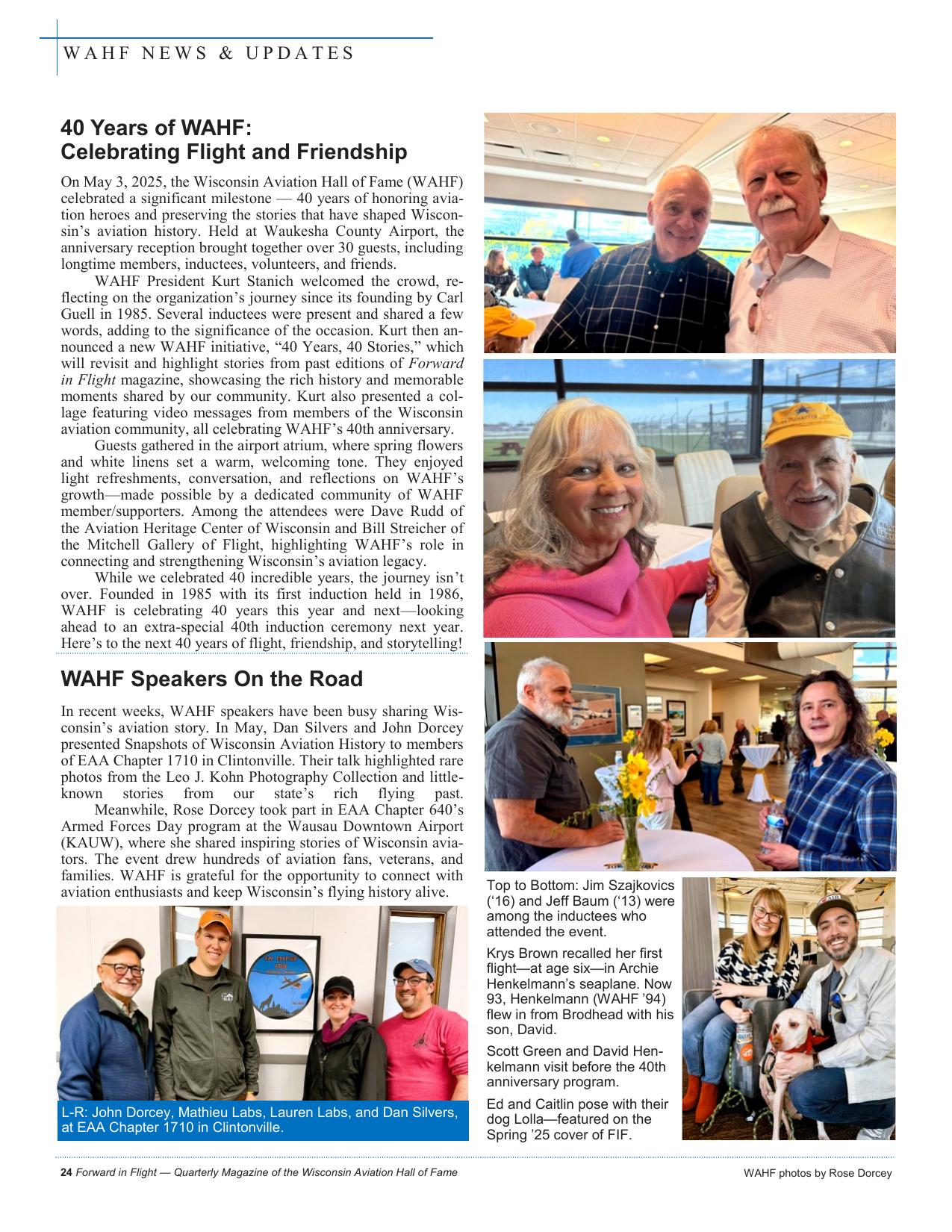
WAHF NEWS & UPDATES 40 Years of WAHF: Celebrating Flight and Friendship On May 3, 2025, the Wisconsin Aviation Hall of Fame (WAHF) celebrated a significant milestone — 40 years of honoring aviation heroes and preserving the stories that have shaped Wisconsin’s aviation history. Held at Waukesha County Airport, the anniversary reception brought together over 30 guests, including longtime members, inductees, volunteers, and friends. WAHF President Kurt Stanich welcomed the crowd, reflecting on the organization’s journey since its founding by Carl Guell in 1985. Several inductees were present and shared a few words, adding to the significance of the occasion. Kurt then announced a new WAHF initiative, “40 Years, 40 Stories,” which will revisit and highlight stories from past editions of Forward in Flight magazine, showcasing the rich history and memorable moments shared by our community. Kurt also presented a collage featuring video messages from members of the Wisconsin aviation community, all celebrating WAHF’s 40th anniversary. Guests gathered in the airport atrium, where spring flowers and white linens set a warm, welcoming tone. They enjoyed light refreshments, conversation, and reflections on WAHF’s growth—made possible by a dedicated community of WAHF member/supporters. Among the attendees were Dave Rudd of the Aviation Heritage Center of Wisconsin and Bill Streicher of the Mitchell Gallery of Flight, highlighting WAHF’s role in connecting and strengthening Wisconsin’s aviation legacy. While we celebrated 40 incredible years, the journey isn’t over. Founded in 1985 with its first induction held in 1986, WAHF is celebrating 40 years this year and next—looking ahead to an extra-special 40th induction ceremony next year. Here’s to the next 40 years of flight, friendship, and storytelling! WAHF Speakers On the Road In recent weeks, WAHF speakers have been busy sharing Wisconsin’s aviation story. In May, Dan Silvers and John Dorcey presented Snapshots of Wisconsin Aviation History to members of EAA Chapter 1710 in Clintonville. Their talk highlighted rare photos from the Leo J. Kohn Photography Collection and littleknown stories from our state’s rich flying past. Meanwhile, Rose Dorcey took part in EAA Chapter 640’s Armed Forces Day program at the Wausau Downtown Airport (KAUW), where she shared inspiring stories of Wisconsin aviators. The event drew hundreds of aviation fans, veterans, and families. WAHF is grateful for the opportunity to connect with aviation enthusiasts and keep Wisconsin’s flying history alive. Top to Bottom: Jim Szajkovics (‘16) and Jeff Baum (‘13) were among the inductees who attended the event. Krys Brown recalled her first flight—at age six—in Archie Henkelmann’s seaplane. Now 93, Henkelmann (WAHF ’94) flew in from Brodhead with his son, David. Scott Green and David Henkelmann visit before the 40th anniversary program. L-R: John Dorcey, Mathieu Labs, Lauren Labs, and Dan Silvers, at EAA Chapter 1710 in Clintonville. 24 Forward in Flight — Quarterly Magazine of the Wisconsin Aviation Hall of Fame Ed and Caitlin pose with their dog Lolla—featured on the Spring ’25 cover of FIF. WAHF photos by Rose Dorcey
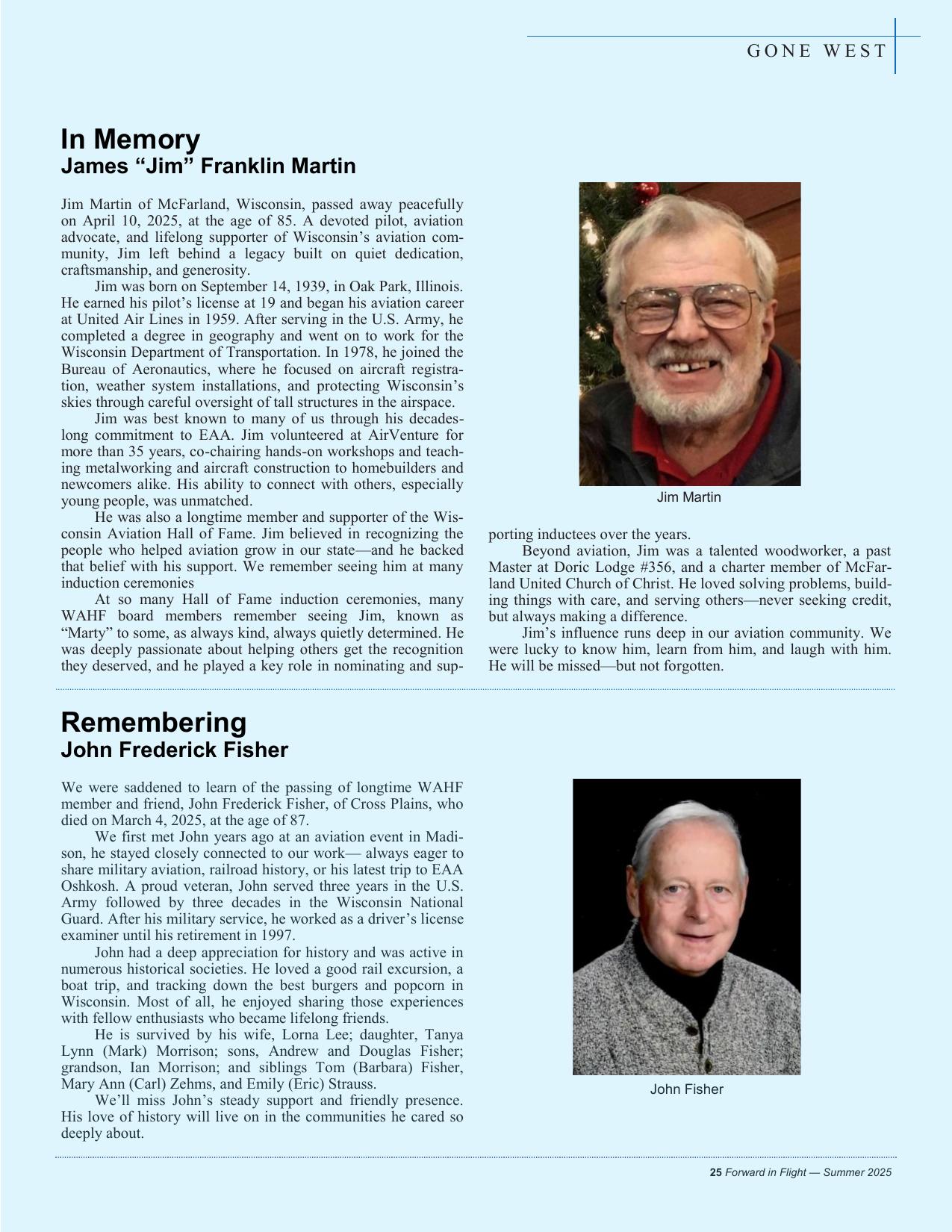
GONE WEST In Memory James “Jim” Franklin Martin Jim Martin of McFarland, Wisconsin, passed away peacefully on April 10, 2025, at the age of 85. A devoted pilot, aviation advocate, and lifelong supporter of Wisconsin’s aviation community, Jim left behind a legacy built on quiet dedication, craftsmanship, and generosity. Jim was born on September 14, 1939, in Oak Park, Illinois. He earned his pilot’s license at 19 and began his aviation career at United Air Lines in 1959. After serving in the U.S. Army, he completed a degree in geography and went on to work for the Wisconsin Department of Transportation. In 1978, he joined the Bureau of Aeronautics, where he focused on aircraft registration, weather system installations, and protecting Wisconsin’s skies through careful oversight of tall structures in the airspace. Jim was best known to many of us through his decadeslong commitment to EAA. Jim volunteered at AirVenture for more than 35 years, co-chairing hands-on workshops and teaching metalworking and aircraft construction to homebuilders and newcomers alike. His ability to connect with others, especially young people, was unmatched. He was also a longtime member and supporter of the Wisconsin Aviation Hall of Fame. Jim believed in recognizing the people who helped aviation grow in our state—and he backed that belief with his support. We remember seeing him at many induction ceremonies At so many Hall of Fame induction ceremonies, many WAHF board members remember seeing Jim, known as “Marty” to some, as always kind, always quietly determined. He was deeply passionate about helping others get the recognition they deserved, and he played a key role in nominating and sup- Jim Martin porting inductees over the years. Beyond aviation, Jim was a talented woodworker, a past Master at Doric Lodge #356, and a charter member of McFarland United Church of Christ. He loved solving problems, building things with care, and serving others—never seeking credit, but always making a difference. Jim’s influence runs deep in our aviation community. We were lucky to know him, learn from him, and laugh with him. He will be missed—but not forgotten. Remembering John Frederick Fisher We were saddened to learn of the passing of longtime WAHF member and friend, John Frederick Fisher, of Cross Plains, who died on March 4, 2025, at the age of 87. We first met John years ago at an aviation event in Madison, he stayed closely connected to our work— always eager to share military aviation, railroad history, or his latest trip to EAA Oshkosh. A proud veteran, John served three years in the U.S. Army followed by three decades in the Wisconsin National Guard. After his military service, he worked as a driver’s license examiner until his retirement in 1997. John had a deep appreciation for history and was active in numerous historical societies. He loved a good rail excursion, a boat trip, and tracking down the best burgers and popcorn in Wisconsin. Most of all, he enjoyed sharing those experiences with fellow enthusiasts who became lifelong friends. He is survived by his wife, Lorna Lee; daughter, Tanya Lynn (Mark) Morrison; sons, Andrew and Douglas Fisher; grandson, Ian Morrison; and siblings Tom (Barbara) Fisher, Mary Ann (Carl) Zehms, and Emily (Eric) Strauss. We’ll miss John’s steady support and friendly presence. His love of history will live on in the communities he cared so deeply about. John Fisher 25 Forward in Flight — Summer 2025
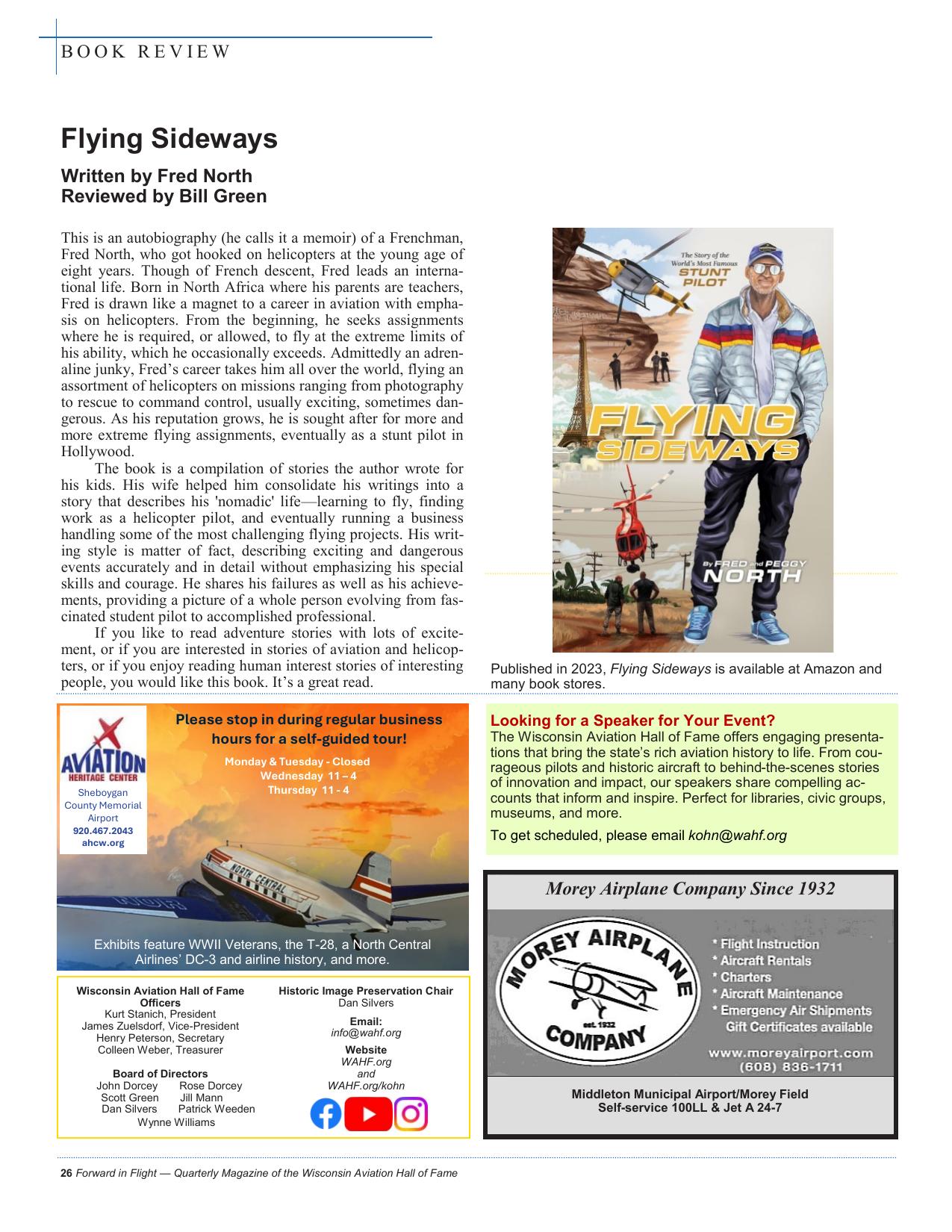
BOOK REVIEW Flying Sideways Written by Fred North Reviewed by Bill Green This is an autobiography (he calls it a memoir) of a Frenchman, Fred North, who got hooked on helicopters at the young age of eight years. Though of French descent, Fred leads an international life. Born in North Africa where his parents are teachers, Fred is drawn like a magnet to a career in aviation with emphasis on helicopters. From the beginning, he seeks assignments where he is required, or allowed, to fly at the extreme limits of his ability, which he occasionally exceeds. Admittedly an adrenaline junky, Fred’s career takes him all over the world, flying an assortment of helicopters on missions ranging from photography to rescue to command control, usually exciting, sometimes dangerous. As his reputation grows, he is sought after for more and more extreme flying assignments, eventually as a stunt pilot in Hollywood. The book is a compilation of stories the author wrote for his kids. His wife helped him consolidate his writings into a story that describes his 'nomadic' life—learning to fly, finding work as a helicopter pilot, and eventually running a business handling some of the most challenging flying projects. His writing style is matter of fact, describing exciting and dangerous events accurately and in detail without emphasizing his special skills and courage. He shares his failures as well as his achievements, providing a picture of a whole person evolving from fascinated student pilot to accomplished professional. If you like to read adventure stories with lots of excitement, or if you are interested in stories of aviation and helicopters, or if you enjoy reading human interest stories of interesting people, you would like this book. It’s a great read. Please stop in during regular business hours for a self-guided tour! Sheboygan County Memorial Airport 920.467.2043 ahcw.org Monday & Tuesday - Closed Wednesday 11 – 4 Thursday 11 - 4 Published in 2023, Flying Sideways is available at Amazon and many book stores. Looking for a Speaker for Your Event? The Wisconsin Aviation Hall of Fame offers engaging presentations that bring the state’s rich aviation history to life. From courageous pilots and historic aircraft to behind-the-scenes stories of innovation and impact, our speakers share compelling accounts that inform and inspire. Perfect for libraries, civic groups, museums, and more. To get scheduled, please email kohn@wahf.org Morey Airplane Company Since 1932 Exhibits feature WWII Veterans, the T-28, a North Central Airlines’ DC-3 and airline history, and more. Wisconsin Aviation Hall of Fame Officers Kurt Stanich, President James Zuelsdorf, Vice-President Henry Peterson, Secretary Colleen Weber, Treasurer Board of Directors John Dorcey Rose Dorcey Scott Green Jill Mann Dan Silvers Patrick Weeden Wynne Williams Historic Image Preservation Chair Dan Silvers Email: info@wahf.org Website WAHF.org and WAHF.org/kohn 26 Forward in Flight — Quarterly Magazine of the Wisconsin Aviation Hall of Fame Middleton Municipal Airport/Morey Field Self-service 100LL & Jet A 24-7
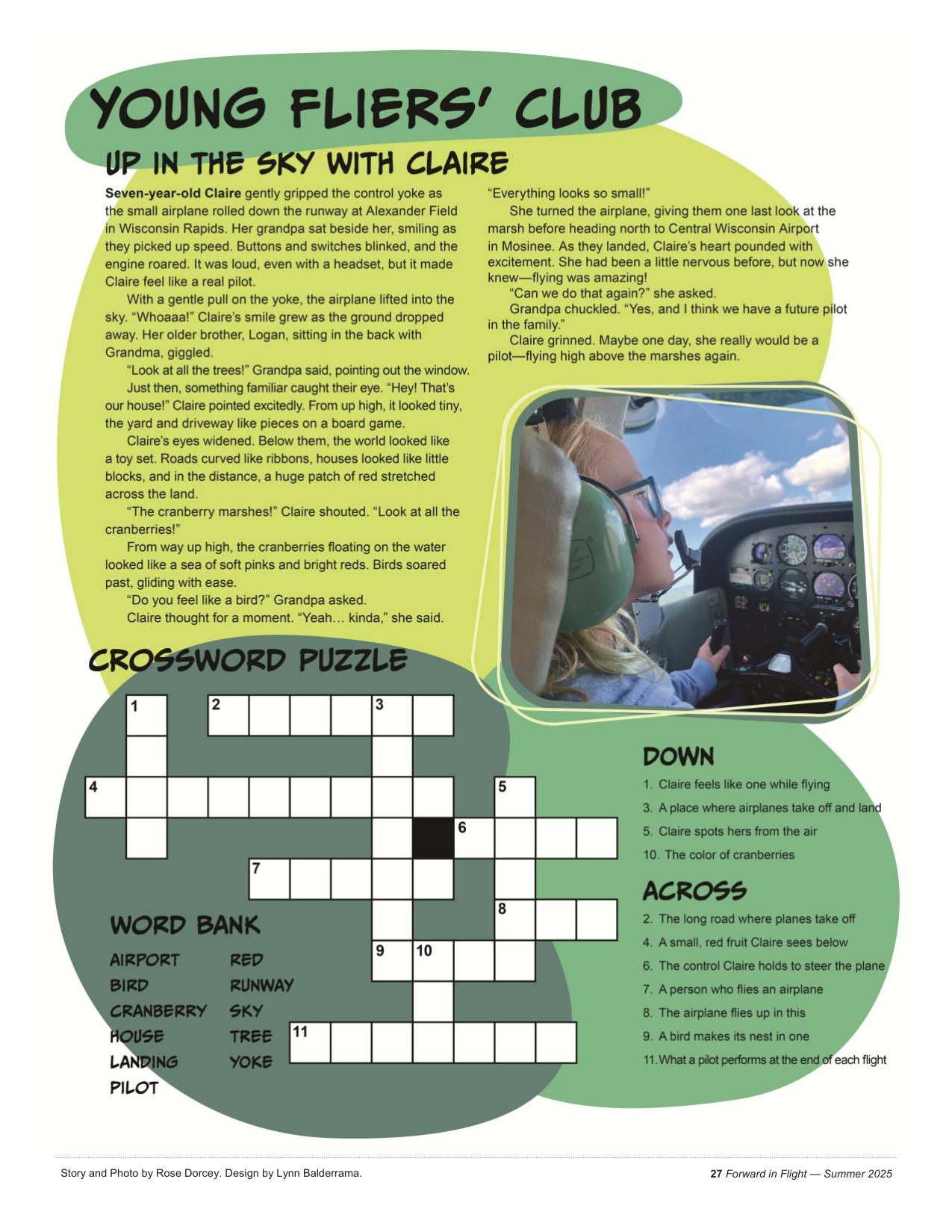
Story and Photo by Rose Dorcey. Design by Lynn Balderrama. 27 Forward in Flight — Summer 2025
EDITOR’S LOG Life has been a whirlwind lately—in the best possible way. As WAHF celebrates 40 years of honoring and preserving Wisconsin’s aviation history, there’s been a surge of events, connections, and inspiring ideas worth sharing. WAHF representatives have been out in the community— attending EAA chapter meetings, Women in Aviation gatherings, and Ninety-Nines events across the state. At some, attendees got a close look at EAA’s B-25 and B-17. At others, tower tours and presentations opened new windows into aviation careers and stories. Events like Girls on the Fly and Armed Forces Day at EAA Chapter 640 brought families, students, and veterans together around a shared passion for flight. What’s clear from all of it is how alive and vibrant aviation in Wisconsin truly is. The community includes both longtime and student pilots, restorers, educators, and kids just beginning to dream about flight. That energy is growing—and it’s taking new forms. One standout project is Learn Build Fly in Wausau, where students are trusted with specialized tools to help build an airplane under expert guidance. It’s more than a project—it’s a launchpad for future mechanics, engineers, and pilots. And in another kind of hands-on learning, three short documentaries created by high school students recently brought fresh heart and perspective to aviation history—including the story of the Night Witches, the all-female Soviet aircrew of WWII. WAHF’s mission also intersects with deeper moments. Honor in the Air, a professionally produced film about Vietnam helicopter pilot Capt. Scott Alwin, showcased history and heroism with lasting impact. So did hearing Kevin Hermening share 28 Forward in Flight — Quarterly Magazine of the Wisconsin Aviation Hall of Fame his powerful story of 444 days in captivity during the Iran hostage crisis—a lesson in resilience that stays with you. At WAHF’s recent 40th anniversary reception in Waukesha, the spirit of the organization was on full display— friends reconnecting, memories shared, and future ideas sparked. This issue of Forward in Flight captures that energy. It’s packed with history, but also momentum—from Leo Kohn’s rivet-level photos to stories from aviators still charting new paths. We’re preserving the past, yes—but also building something new. To those who’ve supported WAHF this year—thank you. Whether it was a donation, a membership, showing up at an event, or simply sharing our mission with someone new, it all moves us forward. And for anyone ready to jump in, opportunities abound. Join us at the June 19 presentation of the Leo J. Kohn Story at EAA or at the 2025 induction ceremony. Keep an eye out for upcoming talks and events. After four decades, WAHF is still growing, evolving, and finding new ways to honor those who’ve shaped our skies. If there’s a story you think we should tell—or someone who deserves recognition—don’t hesitate to reach out. We’re already working on fall events, new exhibits, and fresh ways to share Wisconsin’s aviation stories with the next generation. Every event, handshake, and shared memory reinforces what makes this aviation community so special. Aviation is always moving forward—and so is WAHF. Enjoy the stories inside, and maybe you’ll spot a few familiar faces. —Rose

WAHF Membership and Donation Form Use for New Memberships and Renewals ANNUAL MEMBERSHIP LEVELS _____ Youth (Under age 18) _____ Individual (Annual) _____ Couple (Annual) _____ Lifetime (Individual) _____ Lifetime (Couple) $10 $30 $40 $500 $750 TAX DEDUCTIBLE CONTRIBUTIONS Your contributions help ensure Wisconsin’s aviation pioneers and outstanding students in aviation education will continue to be recognized. Your contributions, in any amount, are appreciated. WAHF Supporting Contribution $___________ (General operating/programming fund) Leo J. Kohn Collection Preservation Fund $___________ WAHF Scholarship Fund* $___________ *for scholarship donations please write a separate check payable to: Community Foundation of North Central Wisconsin or visit www.CFONCW.org Name________________________________________ Address______________________________________ City__________________________________________ State, Zip_____________________________________ Phone_______________________________________ Email________________________________________ Members receive WAHF’s quarterly magazine Forward in Flight! Join Online! WAHF.org Donate Online WAHF.org or WAHF.org/kohn Or, mail this form, along with your check payable to: Wisconsin Aviation Hall of Fame, Inc. Send to: Rose Dorcey/WAHF 3980 Sharratt Drive Oshkosh WI 54901 The Wisconsin Aviation Hall of Fame is a 501(c)(3) organization. 29 Forward in Flight — Summer 2025
PRSRT STD US Postage Paid Wisc Rapids WI Permit 98 Forward in Flight c/o Rose Dorcey 3980 Sharratt Drive Oshkosh WI 54901-1276 Welcome New WAHF Member/Supporters! Ed Becerra Dan Bauknecht Ryan Dembroski Kurt Hartwig Jade Hofeldt Matt Hofeldt Ed Lachendro Joy Lachendro Chris Palmer Mike Vander Loop Thanks for coming onboard! Your support helps us continue our efforts of collecting, preserving, and sharing Wisconsin aviation history, and honoring those who make it. We also thank the many members who have recently renewed your memberships. We appreciate your support. The Wisconsin Ninety-Nines are hosting the Fall North Central Section Meeting in Oshkosh from October 3 - 5, 2025. The event invites members from a nine-state area to learn, grow, and interact with fellow members. WAHF Inductee Janis Sierra will be the keynote speaker. The Ninety-Nines are an international group of women pilots with a mission is to promote advancement of aviation through education, scholarships, and mutual support. http://wisconsin.ncs99s.org/ Thank you to Roland & Earlene Schable, and Bruce Botterman of NewView Technologies for your recent donations to the Leo J. Kohn Photography Preservation Project. We appreciate your support of preserving this valuable collection! Congratulations to EAA! On the recent delivery of its 2022 One Week Wonder, a Sonex Waiex-B built in seven days at AirVenture Oshkosh, to the Smithsonian’s Udvar-Hazy Center for permanent display. Built by over 2,200 volunteers, the aircraft represents the innovation and accessibility of amateur-built aviation and will be seen by millions of visitors each year. EVENTS: Thursday, June 19, 2025 - 7:00 p.m. EAA Aviation Museum Speakers Series 3000 Poberezny Road, Oshkosh The Leo J. Kohn Photo Collection - The Wisconsin Aviation Hall of Fame’s Dan Silvers and John Dorcey will speak on the remarkable photography of Leo J. Kohn, whose work captured aviation history in stunning detail. Learn about his vast collection — much of it shot in Wisconsin; the ongoing efforts to preserve, digitize, and share these images; and the stories behind some of his most iconic shots. Thursday, August 21, 2025 - 7:00 p.m. EAA Aviation Museum Speakers Series 3000 Poberezny Road, Oshkosh M*A*S*H - This lecture is about M*A*S*H. EAA Aviation Museum Manager Chris Henry returns to talk about the historical background of the real life-saving units that operated through multiple wars, and the role that the television show has had in keeping those stories alive. More info: https://www.eaa.org/eaa-museum/museum-events/aviation-adventure-speaker-series