Volume 6, Issue 4
🗞️ Download Issue (PDF)
Forward in Flight - Winter 2008
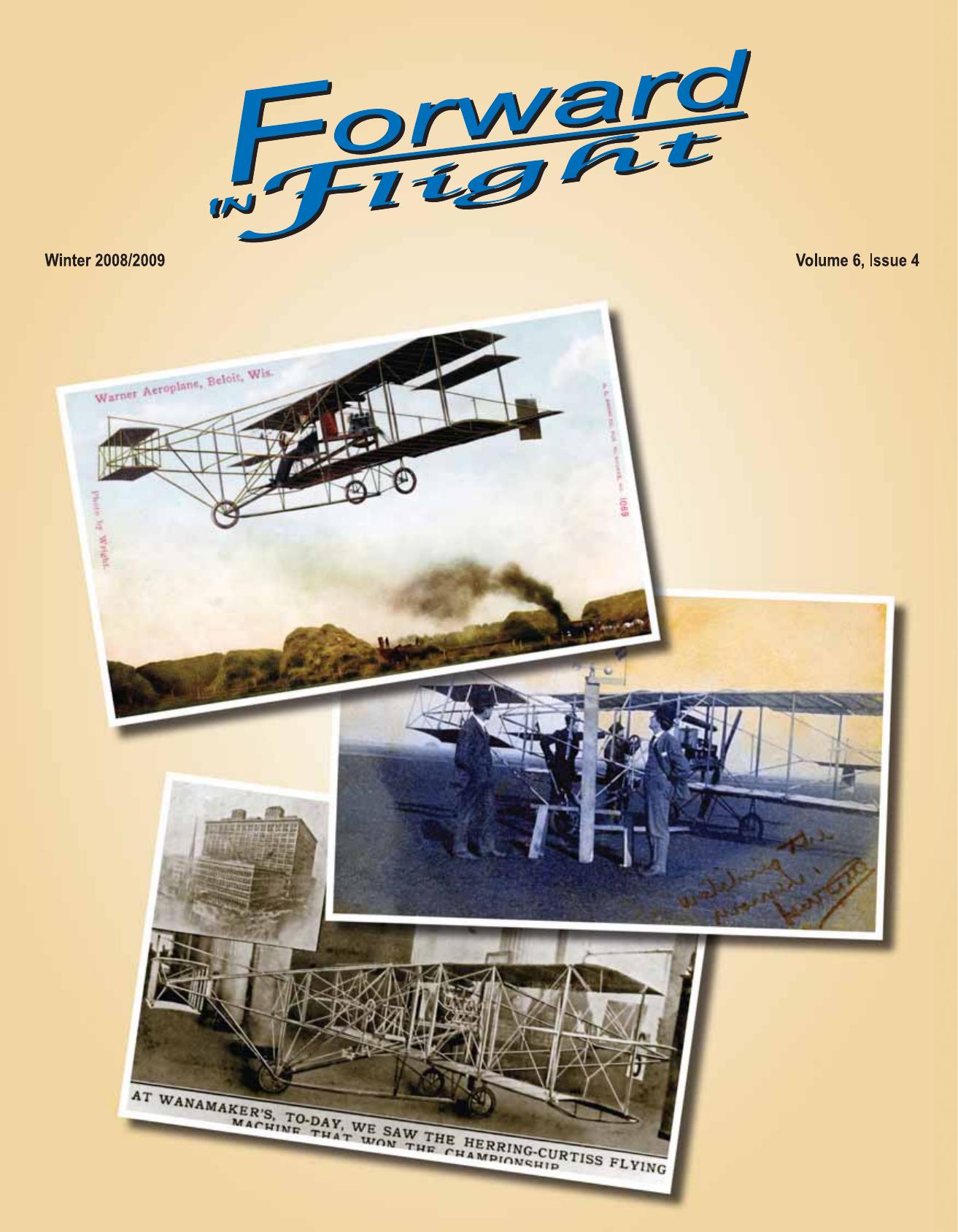
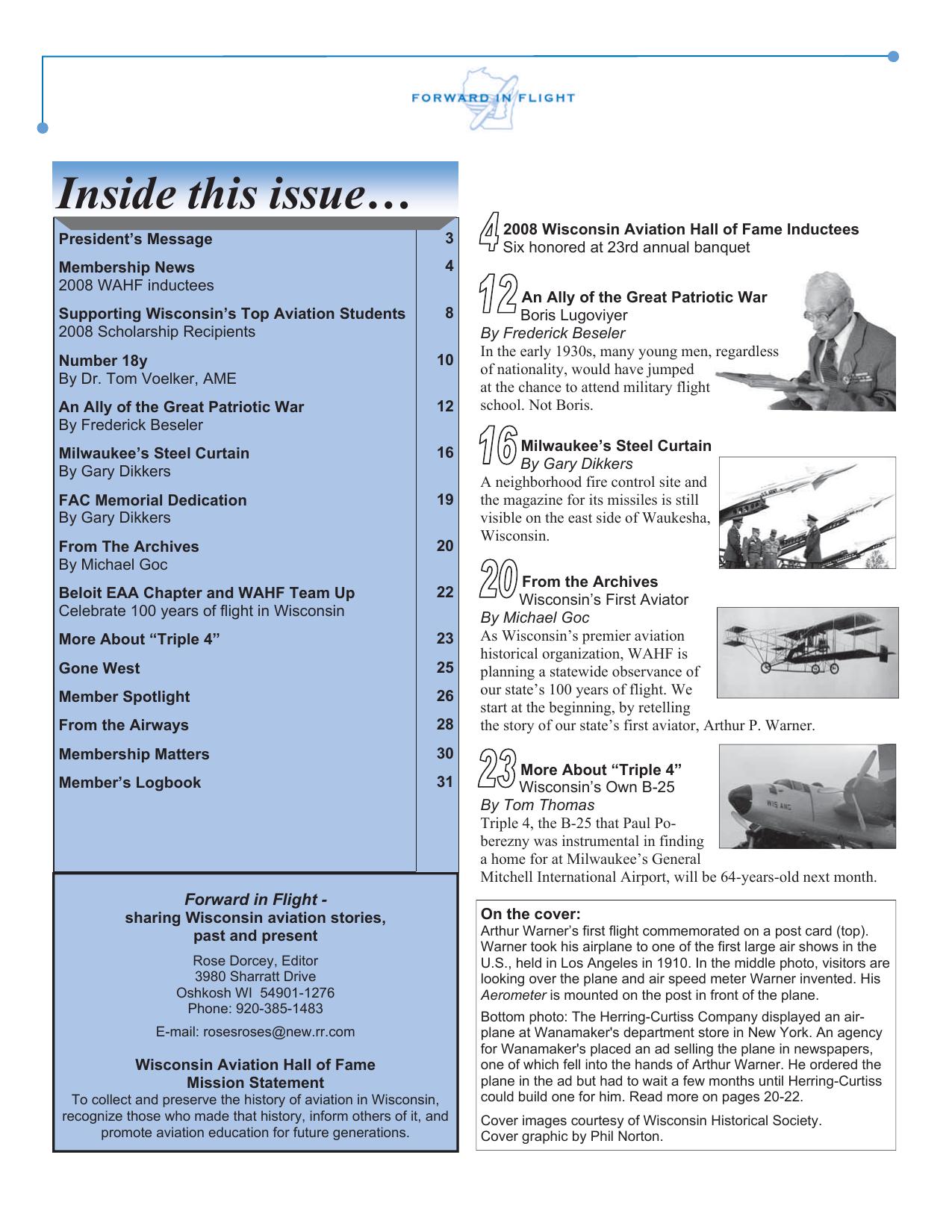
Inside this issue… President’s Message 3 Membership News 2008 WAHF inductees 4 Supporting Wisconsin’s Top Aviation Students 2008 Scholarship Recipients 8 Number 18y By Dr. Tom Voelker, AME 10 An Ally of the Great Patriotic War By Frederick Beseler 12 Milwaukee’s Steel Curtain By Gary Dikkers 16 FAC Memorial Dedication By Gary Dikkers 19 From The Archives By Michael Goc 20 Beloit EAA Chapter and WAHF Team Up Celebrate 100 years of flight in Wisconsin 22 More About “Triple 4” 23 Gone West 25 Member Spotlight 26 From the Airways 28 Membership Matters 30 Member’s Logbook 31 Forward in Flight sharing Wisconsin aviation stories, past and present Rose Dorcey, Editor 3980 Sharratt Drive Oshkosh WI 54901-1276 Phone: 920-385-1483 E-mail: rosesroses@new.rr.com Wisconsin Aviation Hall of Fame Mission Statement To collect and preserve the history of aviation in Wisconsin, recognize those who made that history, inform others of it, and promote aviation education for future generations. 2008 Wisconsin Aviation Hall of Fame Inductees Six honored at 23rd annual banquet An Ally of the Great Patriotic War Boris Lugoviyer By Frederick Beseler In the early 1930s, many young men, regardless of nationality, would have jumped at the chance to attend military flight school. Not Boris. Milwaukee’s Steel Curtain By Gary Dikkers A neighborhood fire control site and the magazine for its missiles is still visible on the east side of Waukesha, Wisconsin. From the Archives Wisconsin’s First Aviator By Michael Goc As Wisconsin’s premier aviation historical organization, WAHF is planning a statewide observance of our state’s 100 years of flight. We start at the beginning, by retelling the story of our state’s first aviator, Arthur P. Warner. More About “Triple 4” Wisconsin’s Own B-25 By Tom Thomas Triple 4, the B-25 that Paul Poberezny was instrumental in finding a home for at Milwaukee’s General Mitchell International Airport, will be 64-years-old next month. On the cover: Arthur Warner’s first flight commemorated on a post card (top). Warner took his airplane to one of the first large air shows in the U.S., held in Los Angeles in 1910. In the middle photo, visitors are looking over the plane and air speed meter Warner invented. His Aerometer is mounted on the post in front of the plane. Bottom photo: The Herring-Curtiss Company displayed an airplane at Wanamaker's department store in New York. An agency for Wanamaker's placed an ad selling the plane in newspapers, one of which fell into the hands of Arthur Warner. He ordered the plane in the ad but had to wait a few months until Herring-Curtiss could build one for him. Read more on pages 20-22. Cover images courtesy of Wisconsin Historical Society. Cover graphic by Phil Norton.
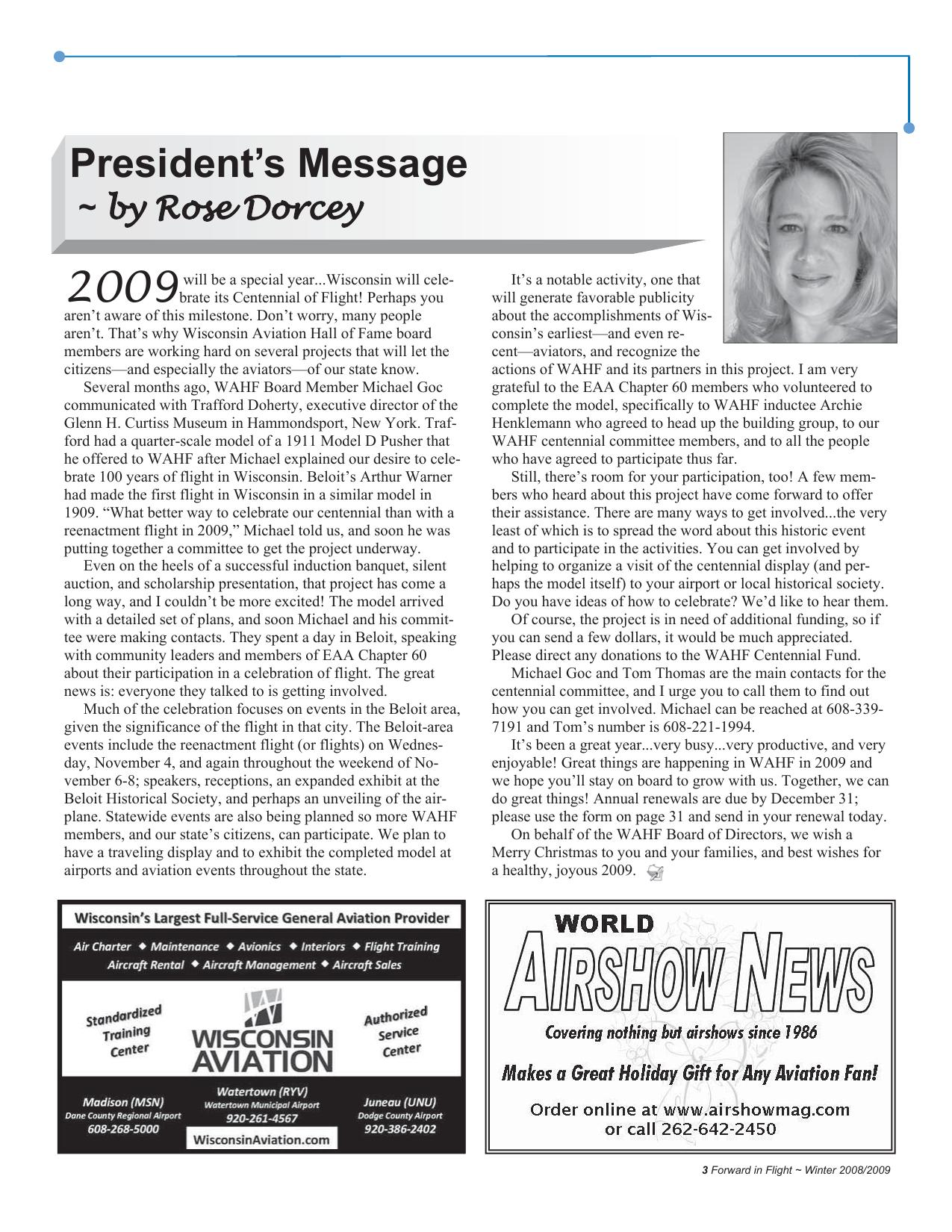
President’s Message ~ by Rose Dorcey 2009 will be a special year...Wisconsin will celebrate its Centennial of Flight! Perhaps you aren’t aware of this milestone. Don’t worry, many people aren’t. That’s why Wisconsin Aviation Hall of Fame board members are working hard on several projects that will let the citizens—and especially the aviators—of our state know. Several months ago, WAHF Board Member Michael Goc communicated with Trafford Doherty, executive director of the Glenn H. Curtiss Museum in Hammondsport, New York. Trafford had a quarter-scale model of a 1911 Model D Pusher that he offered to WAHF after Michael explained our desire to celebrate 100 years of flight in Wisconsin. Beloit’s Arthur Warner had made the first flight in Wisconsin in a similar model in 1909. “What better way to celebrate our centennial than with a reenactment flight in 2009,” Michael told us, and soon he was putting together a committee to get the project underway. Even on the heels of a successful induction banquet, silent auction, and scholarship presentation, that project has come a long way, and I couldn’t be more excited! The model arrived with a detailed set of plans, and soon Michael and his committee were making contacts. They spent a day in Beloit, speaking with community leaders and members of EAA Chapter 60 about their participation in a celebration of flight. The great news is: everyone they talked to is getting involved. Much of the celebration focuses on events in the Beloit area, given the significance of the flight in that city. The Beloit-area events include the reenactment flight (or flights) on Wednesday, November 4, and again throughout the weekend of November 6-8; speakers, receptions, an expanded exhibit at the Beloit Historical Society, and perhaps an unveiling of the airplane. Statewide events are also being planned so more WAHF members, and our state’s citizens, can participate. We plan to have a traveling display and to exhibit the completed model at airports and aviation events throughout the state. It’s a notable activity, one that will generate favorable publicity about the accomplishments of Wisconsin’s earliest—and even recent—aviators, and recognize the actions of WAHF and its partners in this project. I am very grateful to the EAA Chapter 60 members who volunteered to complete the model, specifically to WAHF inductee Archie Henklemann who agreed to head up the building group, to our WAHF centennial committee members, and to all the people who have agreed to participate thus far. Still, there’s room for your participation, too! A few members who heard about this project have come forward to offer their assistance. There are many ways to get involved...the very least of which is to spread the word about this historic event and to participate in the activities. You can get involved by helping to organize a visit of the centennial display (and perhaps the model itself) to your airport or local historical society. Do you have ideas of how to celebrate? We’d like to hear them. Of course, the project is in need of additional funding, so if you can send a few dollars, it would be much appreciated. Please direct any donations to the WAHF Centennial Fund. Michael Goc and Tom Thomas are the main contacts for the centennial committee, and I urge you to call them to find out how you can get involved. Michael can be reached at 608-3397191 and Tom’s number is 608-221-1994. It’s been a great year...very busy...very productive, and very enjoyable! Great things are happening in WAHF in 2009 and we hope you’ll stay on board to grow with us. Together, we can do great things! Annual renewals are due by December 31; please use the form on page 31 and send in your renewal today. On behalf of the WAHF Board of Directors, we wish a Merry Christmas to you and your families, and best wishes for a healthy, joyous 2009. 3 Forward in Flight ~ Winter 2008/2009
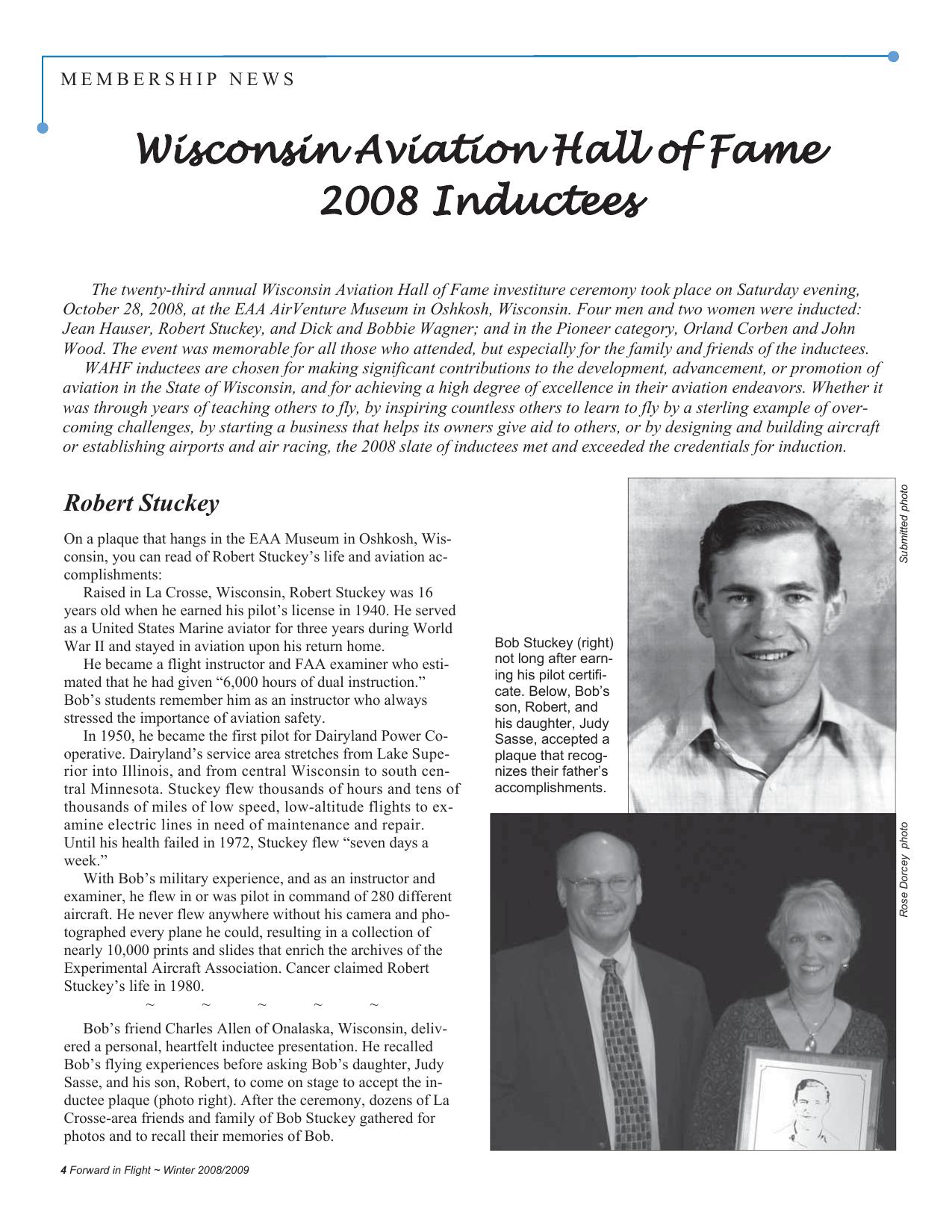
MEMBERSHIP NEWS Wisconsin Aviation Hall of Fame 2008 Inductees Submitted photo The twenty-third annual Wisconsin Aviation Hall of Fame investiture ceremony took place on Saturday evening, October 28, 2008, at the EAA AirVenture Museum in Oshkosh, Wisconsin. Four men and two women were inducted: Jean Hauser, Robert Stuckey, and Dick and Bobbie Wagner; and in the Pioneer category, Orland Corben and John Wood. The event was memorable for all those who attended, but especially for the family and friends of the inductees. WAHF inductees are chosen for making significant contributions to the development, advancement, or promotion of aviation in the State of Wisconsin, and for achieving a high degree of excellence in their aviation endeavors. Whether it was through years of teaching others to fly, by inspiring countless others to learn to fly by a sterling example of overcoming challenges, by starting a business that helps its owners give aid to others, or by designing and building aircraft or establishing airports and air racing, the 2008 slate of inductees met and exceeded the credentials for induction. Robert Stuckey Bob’s friend Charles Allen of Onalaska, Wisconsin, delivered a personal, heartfelt inductee presentation. He recalled Bob’s flying experiences before asking Bob’s daughter, Judy Sasse, and his son, Robert, to come on stage to accept the inductee plaque (photo right). After the ceremony, dozens of La Crosse-area friends and family of Bob Stuckey gathered for photos and to recall their memories of Bob. 4 Forward in Flight ~ Winter 2008/2009 Bob Stuckey (right) not long after earning his pilot certificate. Below, Bob’s son, Robert, and his daughter, Judy Sasse, accepted a plaque that recognizes their father’s accomplishments. Rose Dorcey photo On a plaque that hangs in the EAA Museum in Oshkosh, Wisconsin, you can read of Robert Stuckey’s life and aviation accomplishments: Raised in La Crosse, Wisconsin, Robert Stuckey was 16 years old when he earned his pilot’s license in 1940. He served as a United States Marine aviator for three years during World War II and stayed in aviation upon his return home. He became a flight instructor and FAA examiner who estimated that he had given “6,000 hours of dual instruction.” Bob’s students remember him as an instructor who always stressed the importance of aviation safety. In 1950, he became the first pilot for Dairyland Power Cooperative. Dairyland’s service area stretches from Lake Superior into Illinois, and from central Wisconsin to south central Minnesota. Stuckey flew thousands of hours and tens of thousands of miles of low speed, low-altitude flights to examine electric lines in need of maintenance and repair. Until his health failed in 1972, Stuckey flew “seven days a week.” With Bob’s military experience, and as an instructor and examiner, he flew in or was pilot in command of 280 different aircraft. He never flew anywhere without his camera and photographed every plane he could, resulting in a collection of nearly 10,000 prints and slides that enrich the archives of the Experimental Aircraft Association. Cancer claimed Robert Stuckey’s life in 1980. ~ ~ ~ ~ ~
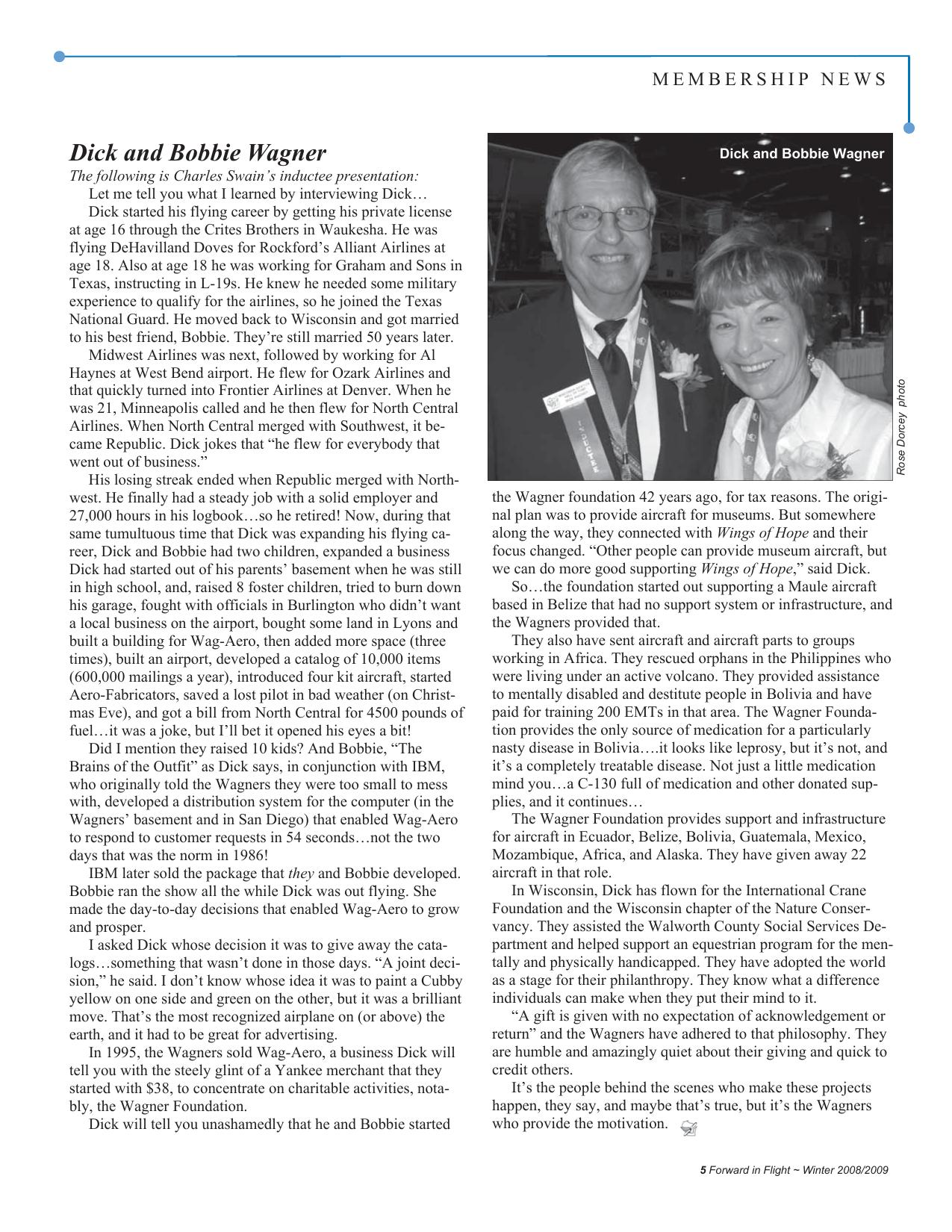
MEMBERSHIP NEWS The following is Charles Swain’s inductee presentation: Let me tell you what I learned by interviewing Dick… Dick started his flying career by getting his private license at age 16 through the Crites Brothers in Waukesha. He was flying DeHavilland Doves for Rockford’s Alliant Airlines at age 18. Also at age 18 he was working for Graham and Sons in Texas, instructing in L-19s. He knew he needed some military experience to qualify for the airlines, so he joined the Texas National Guard. He moved back to Wisconsin and got married to his best friend, Bobbie. They’re still married 50 years later. Midwest Airlines was next, followed by working for Al Haynes at West Bend airport. He flew for Ozark Airlines and that quickly turned into Frontier Airlines at Denver. When he was 21, Minneapolis called and he then flew for North Central Airlines. When North Central merged with Southwest, it became Republic. Dick jokes that “he flew for everybody that went out of business.” His losing streak ended when Republic merged with Northwest. He finally had a steady job with a solid employer and 27,000 hours in his logbook…so he retired! Now, during that same tumultuous time that Dick was expanding his flying career, Dick and Bobbie had two children, expanded a business Dick had started out of his parents’ basement when he was still in high school, and, raised 8 foster children, tried to burn down his garage, fought with officials in Burlington who didn’t want a local business on the airport, bought some land in Lyons and built a building for Wag-Aero, then added more space (three times), built an airport, developed a catalog of 10,000 items (600,000 mailings a year), introduced four kit aircraft, started Aero-Fabricators, saved a lost pilot in bad weather (on Christmas Eve), and got a bill from North Central for 4500 pounds of fuel…it was a joke, but I’ll bet it opened his eyes a bit! Did I mention they raised 10 kids? And Bobbie, “The Brains of the Outfit” as Dick says, in conjunction with IBM, who originally told the Wagners they were too small to mess with, developed a distribution system for the computer (in the Wagners’ basement and in San Diego) that enabled Wag-Aero to respond to customer requests in 54 seconds…not the two days that was the norm in 1986! IBM later sold the package that they and Bobbie developed. Bobbie ran the show all the while Dick was out flying. She made the day-to-day decisions that enabled Wag-Aero to grow and prosper. I asked Dick whose decision it was to give away the catalogs…something that wasn’t done in those days. “A joint decision,” he said. I don’t know whose idea it was to paint a Cubby yellow on one side and green on the other, but it was a brilliant move. That’s the most recognized airplane on (or above) the earth, and it had to be great for advertising. In 1995, the Wagners sold Wag-Aero, a business Dick will tell you with the steely glint of a Yankee merchant that they started with $38, to concentrate on charitable activities, notably, the Wagner Foundation. Dick will tell you unashamedly that he and Bobbie started Dick and Bobbie Wagner Rose Dorcey photo Dick and Bobbie Wagner the Wagner foundation 42 years ago, for tax reasons. The original plan was to provide aircraft for museums. But somewhere along the way, they connected with Wings of Hope and their focus changed. “Other people can provide museum aircraft, but we can do more good supporting Wings of Hope,” said Dick. So…the foundation started out supporting a Maule aircraft based in Belize that had no support system or infrastructure, and the Wagners provided that. They also have sent aircraft and aircraft parts to groups working in Africa. They rescued orphans in the Philippines who were living under an active volcano. They provided assistance to mentally disabled and destitute people in Bolivia and have paid for training 200 EMTs in that area. The Wagner Foundation provides the only source of medication for a particularly nasty disease in Bolivia….it looks like leprosy, but it’s not, and it’s a completely treatable disease. Not just a little medication mind you…a C-130 full of medication and other donated supplies, and it continues… The Wagner Foundation provides support and infrastructure for aircraft in Ecuador, Belize, Bolivia, Guatemala, Mexico, Mozambique, Africa, and Alaska. They have given away 22 aircraft in that role. In Wisconsin, Dick has flown for the International Crane Foundation and the Wisconsin chapter of the Nature Conservancy. They assisted the Walworth County Social Services Department and helped support an equestrian program for the mentally and physically handicapped. They have adopted the world as a stage for their philanthropy. They know what a difference individuals can make when they put their mind to it. “A gift is given with no expectation of acknowledgement or return” and the Wagners have adhered to that philosophy. They are humble and amazingly quiet about their giving and quick to credit others. It’s the people behind the scenes who make these projects happen, they say, and maybe that’s true, but it’s the Wagners who provide the motivation. 5 Forward in Flight ~ Winter 2008/2009
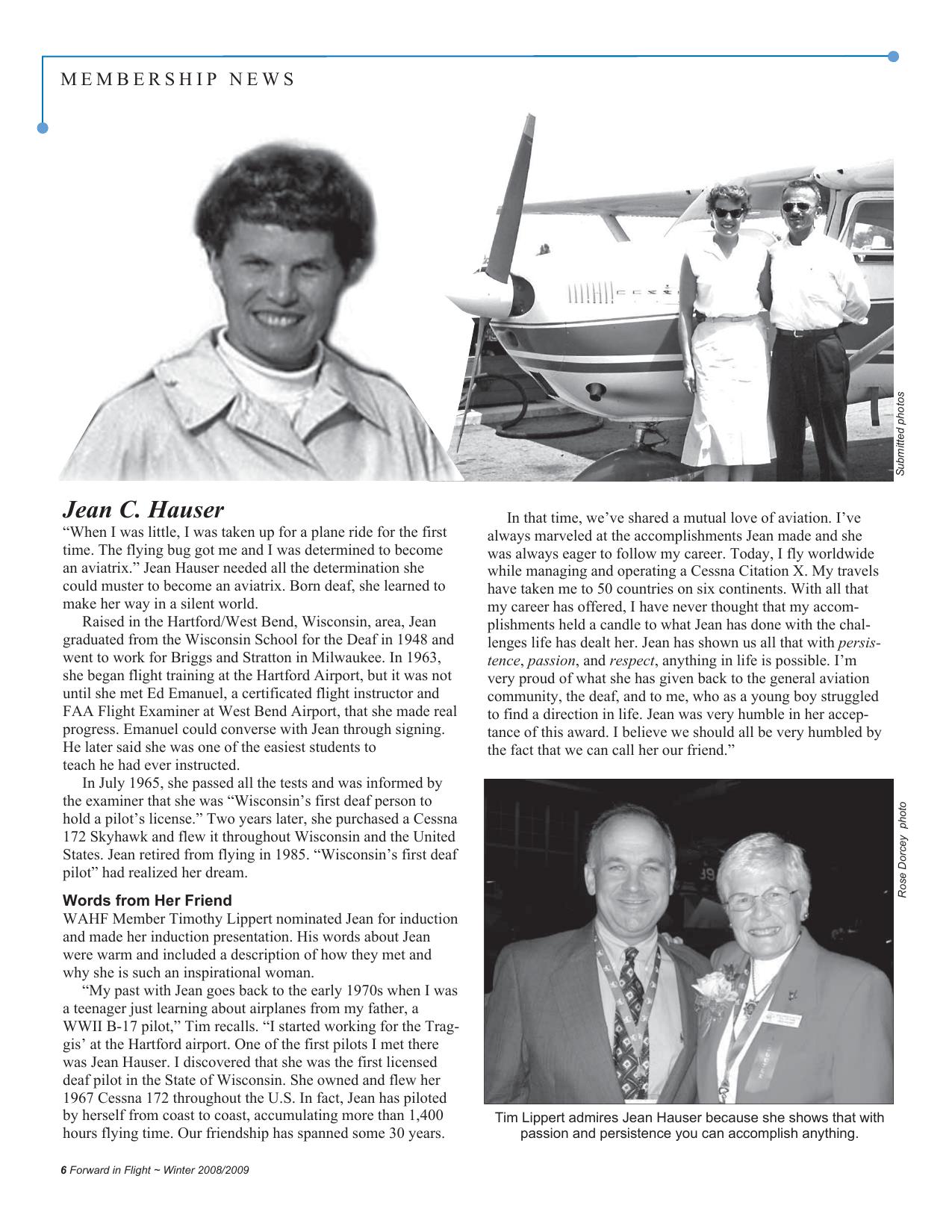
Submitted photos MEMBERSHIP NEWS “When I was little, I was taken up for a plane ride for the first time. The flying bug got me and I was determined to become an aviatrix.” Jean Hauser needed all the determination she could muster to become an aviatrix. Born deaf, she learned to make her way in a silent world. Raised in the Hartford/West Bend, Wisconsin, area, Jean graduated from the Wisconsin School for the Deaf in 1948 and went to work for Briggs and Stratton in Milwaukee. In 1963, she began flight training at the Hartford Airport, but it was not until she met Ed Emanuel, a certificated flight instructor and FAA Flight Examiner at West Bend Airport, that she made real progress. Emanuel could converse with Jean through signing. He later said she was one of the easiest students to teach he had ever instructed. In July 1965, she passed all the tests and was informed by the examiner that she was “Wisconsin’s first deaf person to hold a pilot’s license.” Two years later, she purchased a Cessna 172 Skyhawk and flew it throughout Wisconsin and the United States. Jean retired from flying in 1985. “Wisconsin’s first deaf pilot” had realized her dream. Words from Her Friend WAHF Member Timothy Lippert nominated Jean for induction and made her induction presentation. His words about Jean were warm and included a description of how they met and why she is such an inspirational woman. “My past with Jean goes back to the early 1970s when I was a teenager just learning about airplanes from my father, a WWII B-17 pilot,” Tim recalls. “I started working for the Traggis’ at the Hartford airport. One of the first pilots I met there was Jean Hauser. I discovered that she was the first licensed deaf pilot in the State of Wisconsin. She owned and flew her 1967 Cessna 172 throughout the U.S. In fact, Jean has piloted by herself from coast to coast, accumulating more than 1,400 hours flying time. Our friendship has spanned some 30 years. 6 Forward in Flight ~ Winter 2008/2009 In that time, we’ve shared a mutual love of aviation. I’ve always marveled at the accomplishments Jean made and she was always eager to follow my career. Today, I fly worldwide while managing and operating a Cessna Citation X. My travels have taken me to 50 countries on six continents. With all that my career has offered, I have never thought that my accomplishments held a candle to what Jean has done with the challenges life has dealt her. Jean has shown us all that with persistence, passion, and respect, anything in life is possible. I’m very proud of what she has given back to the general aviation community, the deaf, and to me, who as a young boy struggled to find a direction in life. Jean was very humble in her acceptance of this award. I believe we should all be very humbled by the fact that we can call her our friend.” Rose Dorcey photo Jean C. Hauser Tim Lippert admires Jean Hauser because she shows that with passion and persistence you can accomplish anything.
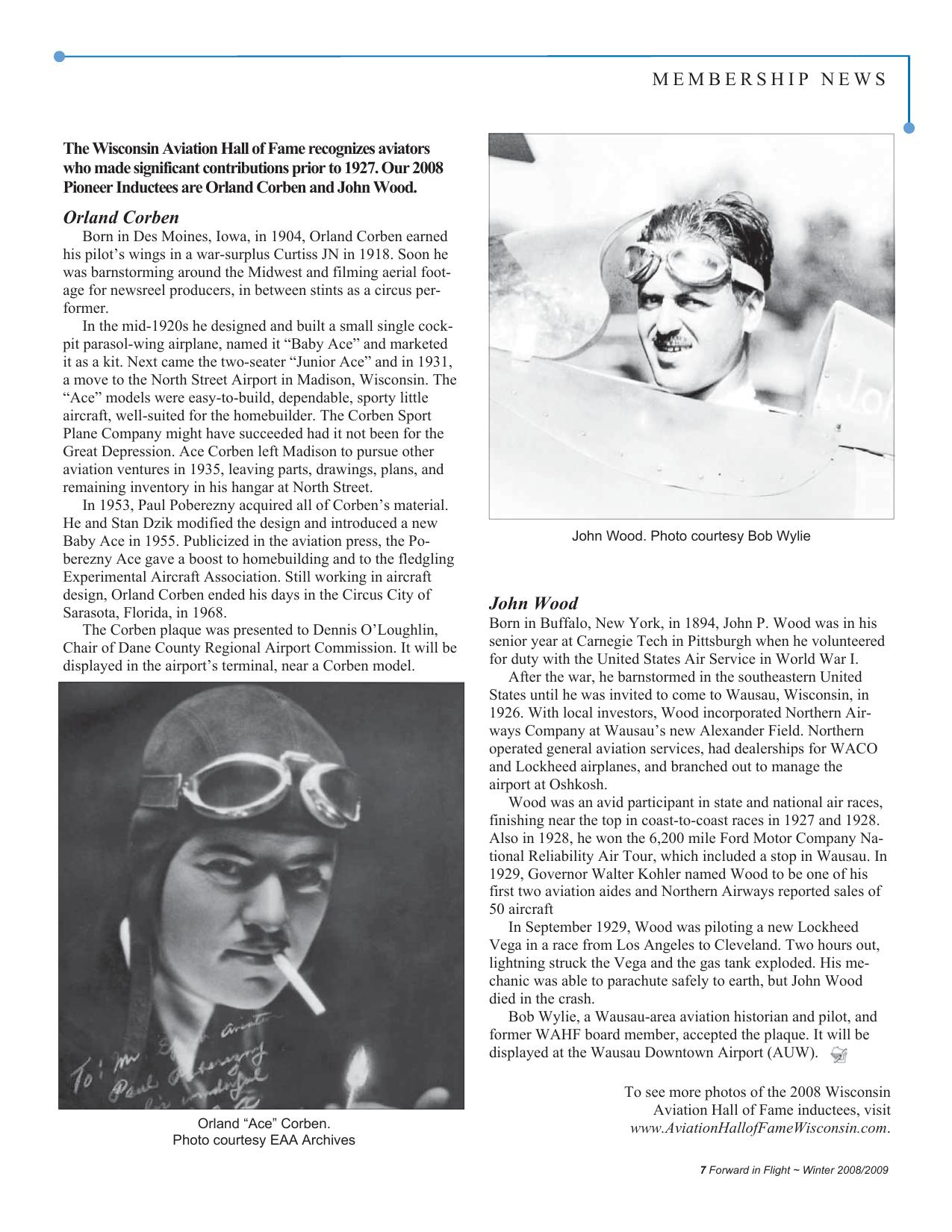
MEMBERSHIP NEWS The Wisconsin Aviation Hall of Fame recognizes aviators who made significant contributions prior to 1927. Our 2008 Pioneer Inductees are Orland Corben and John Wood. Orland Corben Born in Des Moines, Iowa, in 1904, Orland Corben earned his pilot’s wings in a war-surplus Curtiss JN in 1918. Soon he was barnstorming around the Midwest and filming aerial footage for newsreel producers, in between stints as a circus performer. In the mid-1920s he designed and built a small single cockpit parasol-wing airplane, named it “Baby Ace” and marketed it as a kit. Next came the two-seater “Junior Ace” and in 1931, a move to the North Street Airport in Madison, Wisconsin. The “Ace” models were easy-to-build, dependable, sporty little aircraft, well-suited for the homebuilder. The Corben Sport Plane Company might have succeeded had it not been for the Great Depression. Ace Corben left Madison to pursue other aviation ventures in 1935, leaving parts, drawings, plans, and remaining inventory in his hangar at North Street. In 1953, Paul Poberezny acquired all of Corben’s material. He and Stan Dzik modified the design and introduced a new Baby Ace in 1955. Publicized in the aviation press, the Poberezny Ace gave a boost to homebuilding and to the fledgling Experimental Aircraft Association. Still working in aircraft design, Orland Corben ended his days in the Circus City of Sarasota, Florida, in 1968. The Corben plaque was presented to Dennis O’Loughlin, Chair of Dane County Regional Airport Commission. It will be displayed in the airport’s terminal, near a Corben model. Orland “Ace” Corben. Photo courtesy EAA Archives John Wood. Photo courtesy Bob Wylie John Wood Born in Buffalo, New York, in 1894, John P. Wood was in his senior year at Carnegie Tech in Pittsburgh when he volunteered for duty with the United States Air Service in World War I. After the war, he barnstormed in the southeastern United States until he was invited to come to Wausau, Wisconsin, in 1926. With local investors, Wood incorporated Northern Airways Company at Wausau’s new Alexander Field. Northern operated general aviation services, had dealerships for WACO and Lockheed airplanes, and branched out to manage the airport at Oshkosh. Wood was an avid participant in state and national air races, finishing near the top in coast-to-coast races in 1927 and 1928. Also in 1928, he won the 6,200 mile Ford Motor Company National Reliability Air Tour, which included a stop in Wausau. In 1929, Governor Walter Kohler named Wood to be one of his first two aviation aides and Northern Airways reported sales of 50 aircraft In September 1929, Wood was piloting a new Lockheed Vega in a race from Los Angeles to Cleveland. Two hours out, lightning struck the Vega and the gas tank exploded. His mechanic was able to parachute safely to earth, but John Wood died in the crash. Bob Wylie, a Wausau-area aviation historian and pilot, and former WAHF board member, accepted the plaque. It will be displayed at the Wausau Downtown Airport (AUW). To see more photos of the 2008 Wisconsin Aviation Hall of Fame inductees, visit www.AviationHallofFameWisconsin.com. 7 Forward in Flight ~ Winter 2008/2009
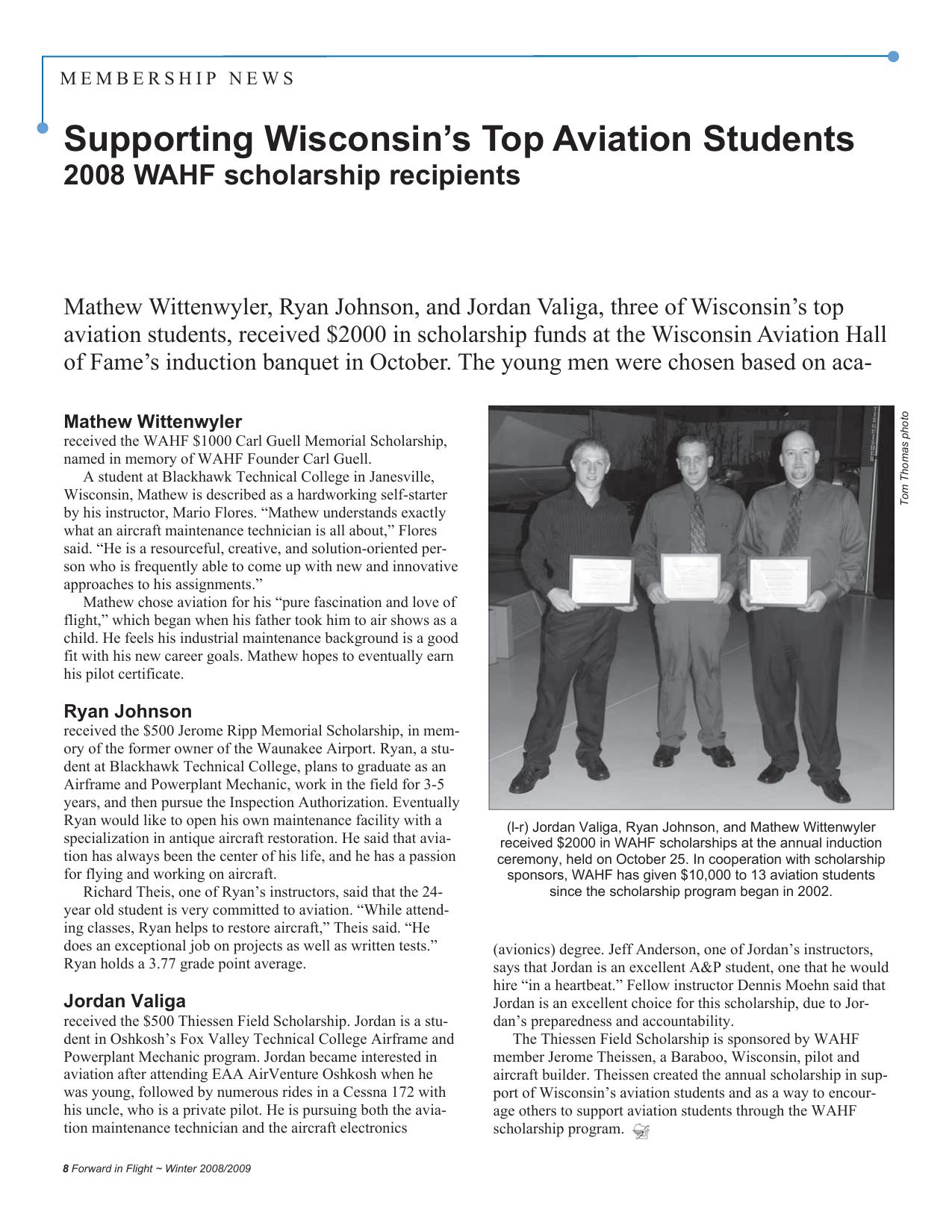
MEMBERSHIP NEWS Supporting Wisconsin’s Top Aviation Students 2008 WAHF scholarship recipients Mathew Wittenwyler, Ryan Johnson, and Jordan Valiga, three of Wisconsin’s top aviation students, received $2000 in scholarship funds at the Wisconsin Aviation Hall of Fame’s induction banquet in October. The young men were chosen based on acaTom Thomas photo Mathew Wittenwyler received the WAHF $1000 Carl Guell Memorial Scholarship, named in memory of WAHF Founder Carl Guell. A student at Blackhawk Technical College in Janesville, Wisconsin, Mathew is described as a hardworking self-starter by his instructor, Mario Flores. “Mathew understands exactly what an aircraft maintenance technician is all about,” Flores said. “He is a resourceful, creative, and solution-oriented person who is frequently able to come up with new and innovative approaches to his assignments.” Mathew chose aviation for his “pure fascination and love of flight,” which began when his father took him to air shows as a child. He feels his industrial maintenance background is a good fit with his new career goals. Mathew hopes to eventually earn his pilot certificate. Ryan Johnson received the $500 Jerome Ripp Memorial Scholarship, in memory of the former owner of the Waunakee Airport. Ryan, a student at Blackhawk Technical College, plans to graduate as an Airframe and Powerplant Mechanic, work in the field for 3-5 years, and then pursue the Inspection Authorization. Eventually Ryan would like to open his own maintenance facility with a specialization in antique aircraft restoration. He said that aviation has always been the center of his life, and he has a passion for flying and working on aircraft. Richard Theis, one of Ryan’s instructors, said that the 24year old student is very committed to aviation. “While attending classes, Ryan helps to restore aircraft,” Theis said. “He does an exceptional job on projects as well as written tests.” Ryan holds a 3.77 grade point average. Jordan Valiga received the $500 Thiessen Field Scholarship. Jordan is a student in Oshkosh’s Fox Valley Technical College Airframe and Powerplant Mechanic program. Jordan became interested in aviation after attending EAA AirVenture Oshkosh when he was young, followed by numerous rides in a Cessna 172 with his uncle, who is a private pilot. He is pursuing both the aviation maintenance technician and the aircraft electronics 8 Forward in Flight ~ Winter 2008/2009 (l-r) Jordan Valiga, Ryan Johnson, and Mathew Wittenwyler received $2000 in WAHF scholarships at the annual induction ceremony, held on October 25. In cooperation with scholarship sponsors, WAHF has given $10,000 to 13 aviation students since the scholarship program began in 2002. (avionics) degree. Jeff Anderson, one of Jordan’s instructors, says that Jordan is an excellent A&P student, one that he would hire “in a heartbeat.” Fellow instructor Dennis Moehn said that Jordan is an excellent choice for this scholarship, due to Jordan’s preparedness and accountability. The Thiessen Field Scholarship is sponsored by WAHF member Jerome Theissen, a Baraboo, Wisconsin, pilot and aircraft builder. Theissen created the annual scholarship in support of Wisconsin’s aviation students and as a way to encourage others to support aviation students through the WAHF scholarship program.
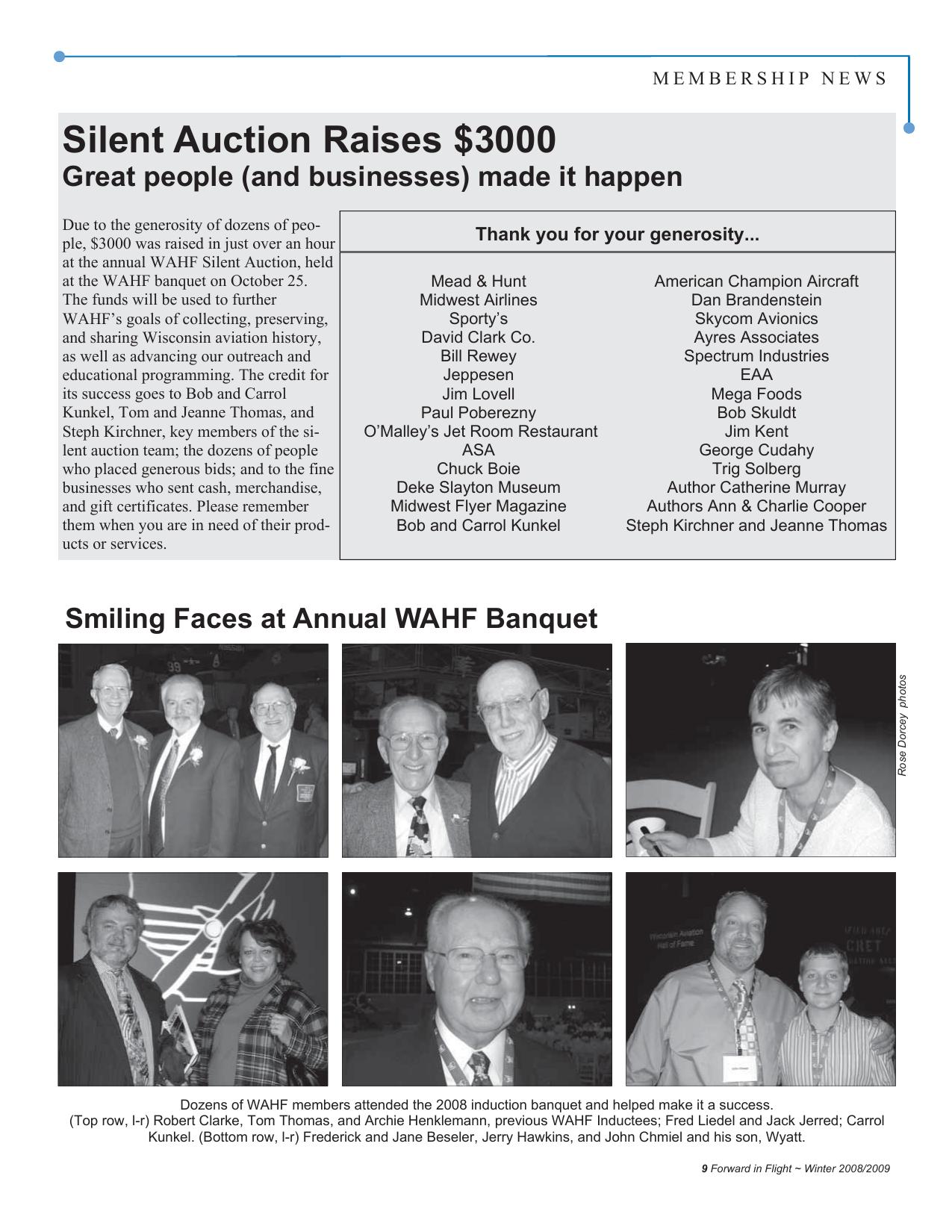
MEMBERSHIP NEWS Silent Auction Raises $3000 Great people (and businesses) made it happen Due to the generosity of dozens of people, $3000 was raised in just over an hour at the annual WAHF Silent Auction, held at the WAHF banquet on October 25. The funds will be used to further WAHF’s goals of collecting, preserving, and sharing Wisconsin aviation history, as well as advancing our outreach and educational programming. The credit for its success goes to Bob and Carrol Kunkel, Tom and Jeanne Thomas, and Steph Kirchner, key members of the silent auction team; the dozens of people who placed generous bids; and to the fine businesses who sent cash, merchandise, and gift certificates. Please remember them when you are in need of their products or services. Thank you for your generosity... Mead & Hunt Midwest Airlines Sporty’s David Clark Co. Bill Rewey Jeppesen Jim Lovell Paul Poberezny O’Malley’s Jet Room Restaurant ASA Chuck Boie Deke Slayton Museum Midwest Flyer Magazine Bob and Carrol Kunkel American Champion Aircraft Dan Brandenstein Skycom Avionics Ayres Associates Spectrum Industries EAA Mega Foods Bob Skuldt Jim Kent George Cudahy Trig Solberg Author Catherine Murray Authors Ann & Charlie Cooper Steph Kirchner and Jeanne Thomas Rose Dorcey photos Smiling Faces at Annual WAHF Banquet Dozens of WAHF members attended the 2008 induction banquet and helped make it a success. (Top row, l-r) Robert Clarke, Tom Thomas, and Archie Henklemann, previous WAHF Inductees; Fred Liedel and Jack Jerred; Carrol Kunkel. (Bottom row, l-r) Frederick and Jane Beseler, Jerry Hawkins, and John Chmiel and his son, Wyatt. 9 Forward in Flight ~ Winter 2008/2009
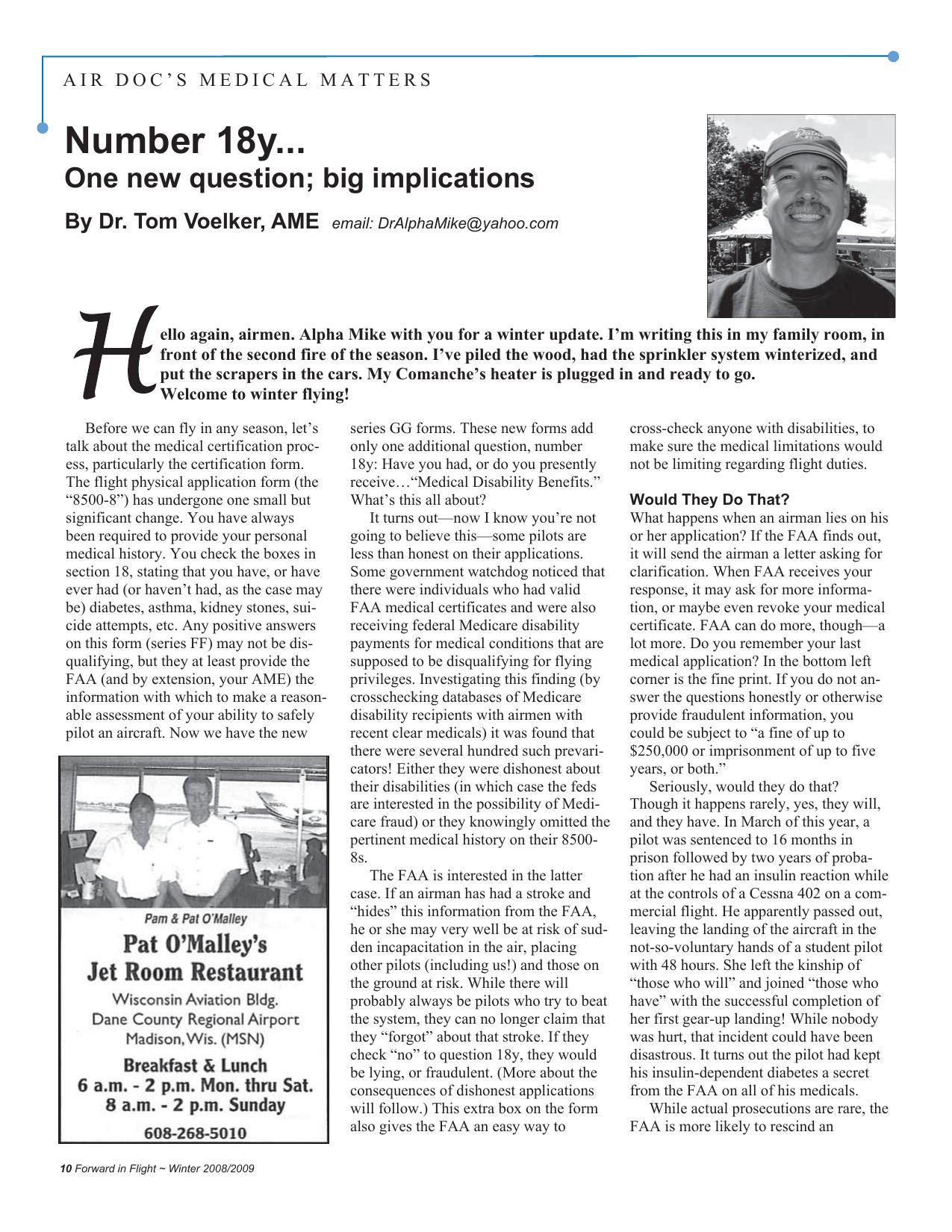
AIR DOC’S MEDICAL MATTERS Number 18y... One new question; big implications By Dr. Tom Voelker, AME email: DrAlphaMike@yahoo.com ello again, airmen. Alpha Mike with you for a winter update. I’m writing this in my family room, in front of the second fire of the season. I’ve piled the wood, had the sprinkler system winterized, and put the scrapers in the cars. My Comanche’s heater is plugged in and ready to go. Welcome to winter flying! Before we can fly in any season, let’s talk about the medical certification process, particularly the certification form. The flight physical application form (the “8500-8”) has undergone one small but significant change. You have always been required to provide your personal medical history. You check the boxes in section 18, stating that you have, or have ever had (or haven’t had, as the case may be) diabetes, asthma, kidney stones, suicide attempts, etc. Any positive answers on this form (series FF) may not be disqualifying, but they at least provide the FAA (and by extension, your AME) the information with which to make a reasonable assessment of your ability to safely pilot an aircraft. Now we have the new 10 Forward in Flight ~ Winter 2008/2009 series GG forms. These new forms add only one additional question, number 18y: Have you had, or do you presently receive…“Medical Disability Benefits.” What’s this all about? It turns out—now I know you’re not going to believe this—some pilots are less than honest on their applications. Some government watchdog noticed that there were individuals who had valid FAA medical certificates and were also receiving federal Medicare disability payments for medical conditions that are supposed to be disqualifying for flying privileges. Investigating this finding (by crosschecking databases of Medicare disability recipients with airmen with recent clear medicals) it was found that there were several hundred such prevaricators! Either they were dishonest about their disabilities (in which case the feds are interested in the possibility of Medicare fraud) or they knowingly omitted the pertinent medical history on their 85008s. The FAA is interested in the latter case. If an airman has had a stroke and “hides” this information from the FAA, he or she may very well be at risk of sudden incapacitation in the air, placing other pilots (including us!) and those on the ground at risk. While there will probably always be pilots who try to beat the system, they can no longer claim that they “forgot” about that stroke. If they check “no” to question 18y, they would be lying, or fraudulent. (More about the consequences of dishonest applications will follow.) This extra box on the form also gives the FAA an easy way to cross-check anyone with disabilities, to make sure the medical limitations would not be limiting regarding flight duties. Would They Do That? What happens when an airman lies on his or her application? If the FAA finds out, it will send the airman a letter asking for clarification. When FAA receives your response, it may ask for more information, or maybe even revoke your medical certificate. FAA can do more, though—a lot more. Do you remember your last medical application? In the bottom left corner is the fine print. If you do not answer the questions honestly or otherwise provide fraudulent information, you could be subject to “a fine of up to $250,000 or imprisonment of up to five years, or both.” Seriously, would they do that? Though it happens rarely, yes, they will, and they have. In March of this year, a pilot was sentenced to 16 months in prison followed by two years of probation after he had an insulin reaction while at the controls of a Cessna 402 on a commercial flight. He apparently passed out, leaving the landing of the aircraft in the not-so-voluntary hands of a student pilot with 48 hours. She left the kinship of “those who will” and joined “those who have” with the successful completion of her first gear-up landing! While nobody was hurt, that incident could have been disastrous. It turns out the pilot had kept his insulin-dependent diabetes a secret from the FAA on all of his medicals. While actual prosecutions are rare, the FAA is more likely to rescind an
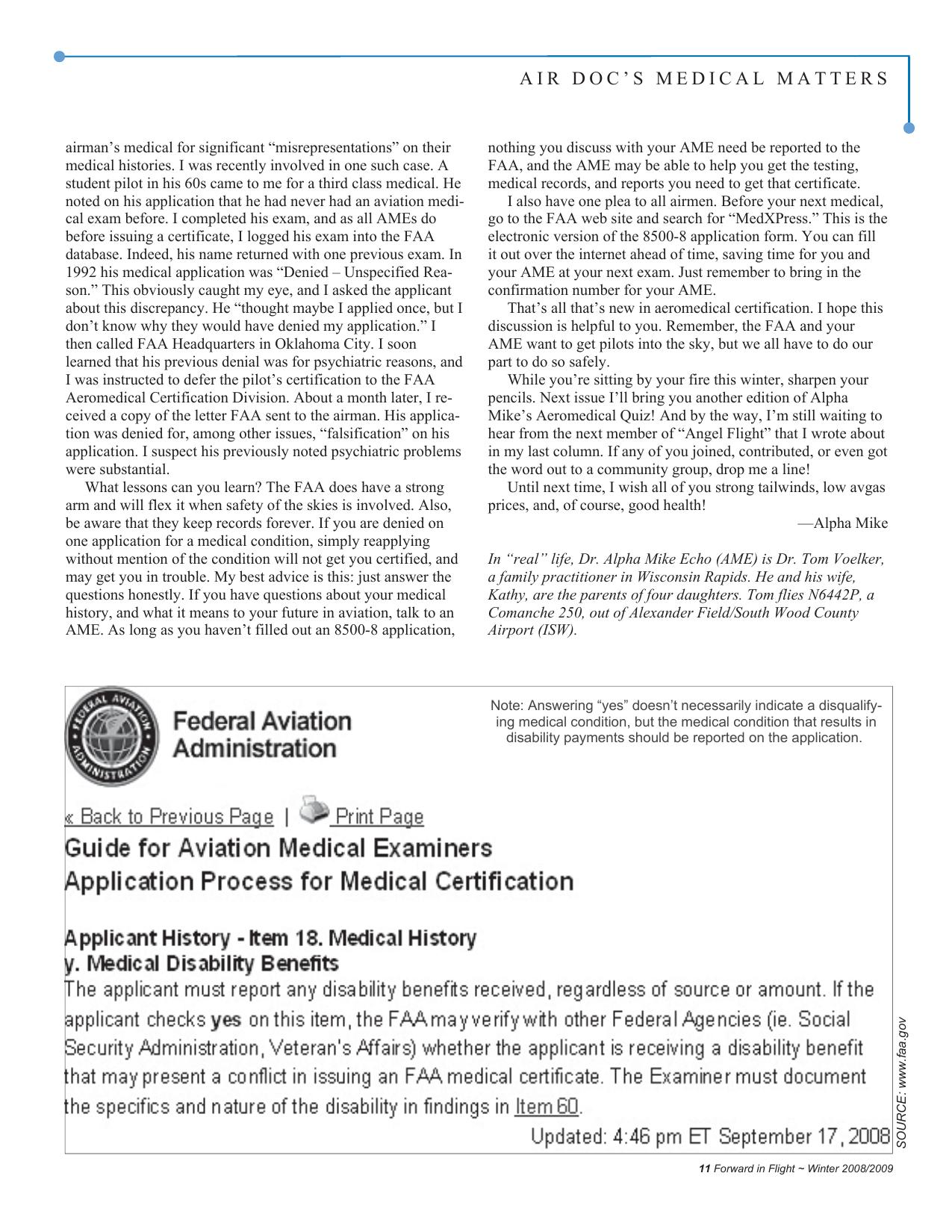
AIR DOC’S MEDICAL MATTERS nothing you discuss with your AME need be reported to the FAA, and the AME may be able to help you get the testing, medical records, and reports you need to get that certificate. I also have one plea to all airmen. Before your next medical, go to the FAA web site and search for “MedXPress.” This is the electronic version of the 8500-8 application form. You can fill it out over the internet ahead of time, saving time for you and your AME at your next exam. Just remember to bring in the confirmation number for your AME. That’s all that’s new in aeromedical certification. I hope this discussion is helpful to you. Remember, the FAA and your AME want to get pilots into the sky, but we all have to do our part to do so safely. While you’re sitting by your fire this winter, sharpen your pencils. Next issue I’ll bring you another edition of Alpha Mike’s Aeromedical Quiz! And by the way, I’m still waiting to hear from the next member of “Angel Flight” that I wrote about in my last column. If any of you joined, contributed, or even got the word out to a community group, drop me a line! Until next time, I wish all of you strong tailwinds, low avgas prices, and, of course, good health! —Alpha Mike In “real” life, Dr. Alpha Mike Echo (AME) is Dr. Tom Voelker, a family practitioner in Wisconsin Rapids. He and his wife, Kathy, are the parents of four daughters. Tom flies N6442P, a Comanche 250, out of Alexander Field/South Wood County Airport (ISW). Note: Answering “yes” doesn’t necessarily indicate a disqualifying medical condition, but the medical condition that results in disability payments should be reported on the application. SOURCE: www.faa.gov airman’s medical for significant “misrepresentations” on their medical histories. I was recently involved in one such case. A student pilot in his 60s came to me for a third class medical. He noted on his application that he had never had an aviation medical exam before. I completed his exam, and as all AMEs do before issuing a certificate, I logged his exam into the FAA database. Indeed, his name returned with one previous exam. In 1992 his medical application was “Denied – Unspecified Reason.” This obviously caught my eye, and I asked the applicant about this discrepancy. He “thought maybe I applied once, but I don’t know why they would have denied my application.” I then called FAA Headquarters in Oklahoma City. I soon learned that his previous denial was for psychiatric reasons, and I was instructed to defer the pilot’s certification to the FAA Aeromedical Certification Division. About a month later, I received a copy of the letter FAA sent to the airman. His application was denied for, among other issues, “falsification” on his application. I suspect his previously noted psychiatric problems were substantial. What lessons can you learn? The FAA does have a strong arm and will flex it when safety of the skies is involved. Also, be aware that they keep records forever. If you are denied on one application for a medical condition, simply reapplying without mention of the condition will not get you certified, and may get you in trouble. My best advice is this: just answer the questions honestly. If you have questions about your medical history, and what it means to your future in aviation, talk to an AME. As long as you haven’t filled out an 8500-8 application, 11 Forward in Flight ~ Winter 2008/2009
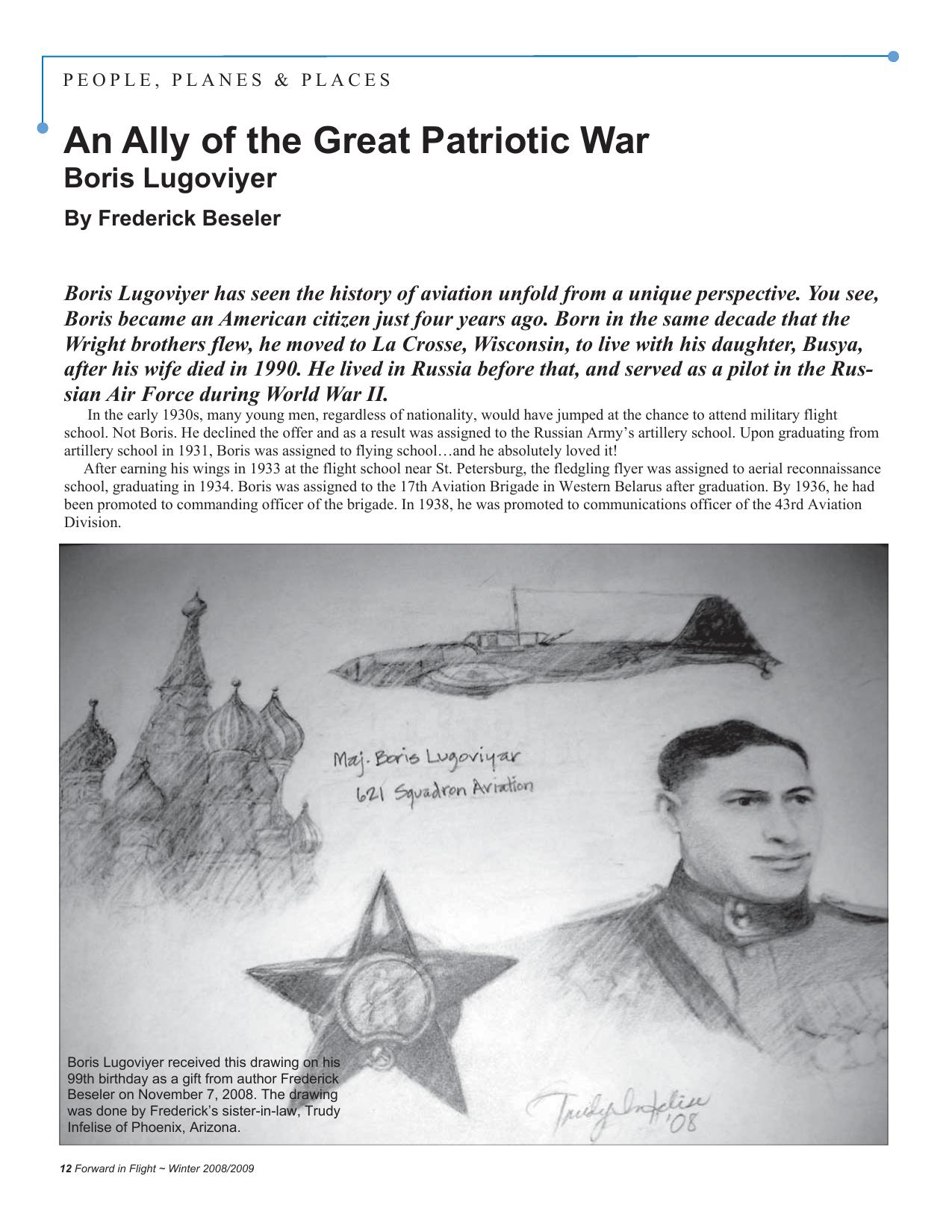
PEOPLE, PLANES & PLACES An Ally of the Great Patriotic War Boris Lugoviyer By Frederick Beseler Boris Lugoviyer has seen the history of aviation unfold from a unique perspective. You see, Boris became an American citizen just four years ago. Born in the same decade that the Wright brothers flew, he moved to La Crosse, Wisconsin, to live with his daughter, Busya, after his wife died in 1990. He lived in Russia before that, and served as a pilot in the Russian Air Force during World War II. In the early 1930s, many young men, regardless of nationality, would have jumped at the chance to attend military flight school. Not Boris. He declined the offer and as a result was assigned to the Russian Army’s artillery school. Upon graduating from artillery school in 1931, Boris was assigned to flying school…and he absolutely loved it! After earning his wings in 1933 at the flight school near St. Petersburg, the fledgling flyer was assigned to aerial reconnaissance school, graduating in 1934. Boris was assigned to the 17th Aviation Brigade in Western Belarus after graduation. By 1936, he had been promoted to commanding officer of the brigade. In 1938, he was promoted to communications officer of the 43rd Aviation Division. Boris Lugoviyer received this drawing on his 99th birthday as a gift from author Frederick Beseler on November 7, 2008. The drawing was done by Frederick’s sister-in-law, Trudy Infelise of Phoenix, Arizona. 12 Forward in Flight ~ Winter 2008/2009
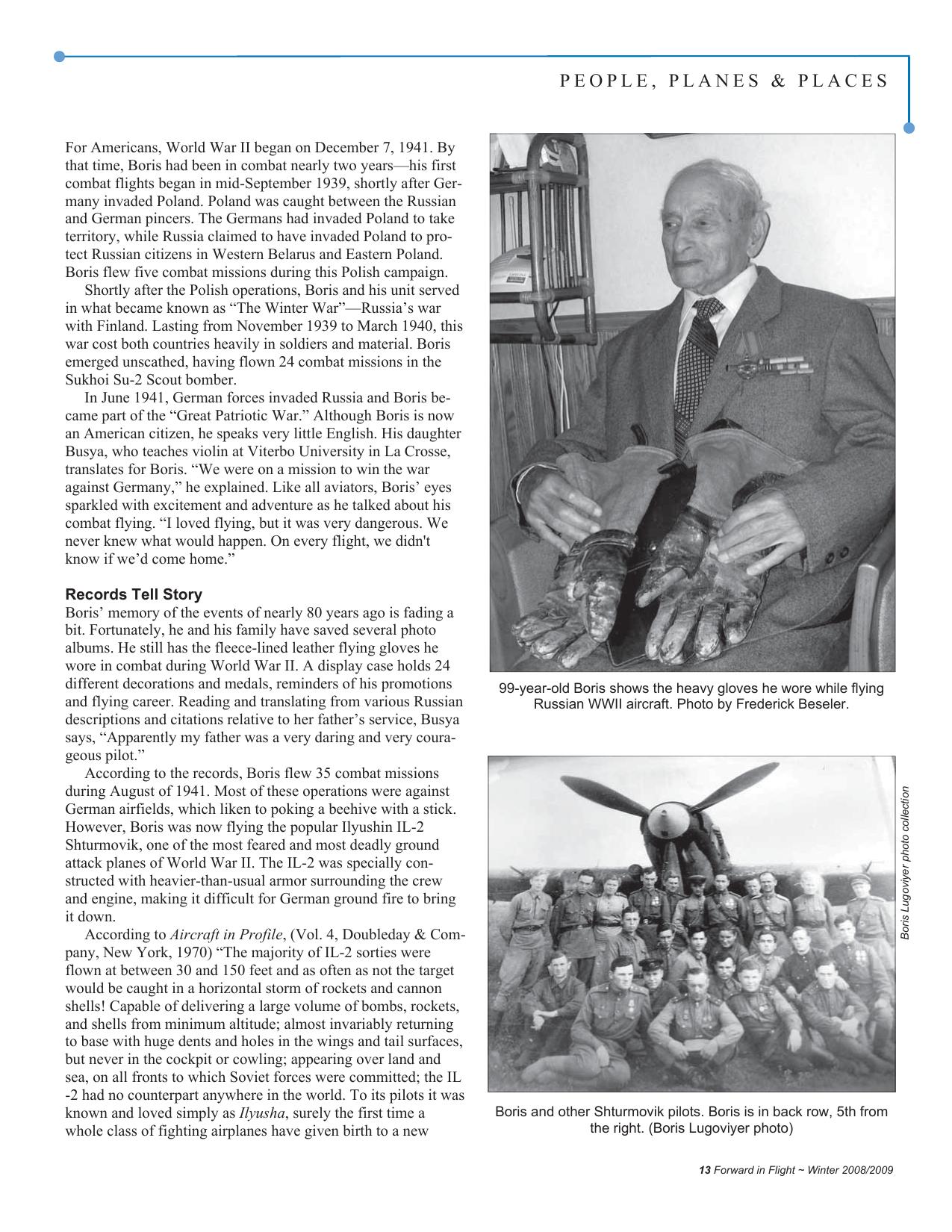
PEOPLE, PLANES & PLACES For Americans, World War II began on December 7, 1941. By that time, Boris had been in combat nearly two years—his first combat flights began in mid-September 1939, shortly after Germany invaded Poland. Poland was caught between the Russian and German pincers. The Germans had invaded Poland to take territory, while Russia claimed to have invaded Poland to protect Russian citizens in Western Belarus and Eastern Poland. Boris flew five combat missions during this Polish campaign. Shortly after the Polish operations, Boris and his unit served in what became known as “The Winter War”—Russia’s war with Finland. Lasting from November 1939 to March 1940, this war cost both countries heavily in soldiers and material. Boris emerged unscathed, having flown 24 combat missions in the Sukhoi Su-2 Scout bomber. In June 1941, German forces invaded Russia and Boris became part of the “Great Patriotic War.” Although Boris is now an American citizen, he speaks very little English. His daughter Busya, who teaches violin at Viterbo University in La Crosse, translates for Boris. “We were on a mission to win the war against Germany,” he explained. Like all aviators, Boris’ eyes sparkled with excitement and adventure as he talked about his combat flying. “I loved flying, but it was very dangerous. We never knew what would happen. On every flight, we didn't know if we’d come home.” 99-year-old Boris shows the heavy gloves he wore while flying Russian WWII aircraft. Photo by Frederick Beseler. Boris Lugoviyer photo collection Records Tell Story Boris’ memory of the events of nearly 80 years ago is fading a bit. Fortunately, he and his family have saved several photo albums. He still has the fleece-lined leather flying gloves he wore in combat during World War II. A display case holds 24 different decorations and medals, reminders of his promotions and flying career. Reading and translating from various Russian descriptions and citations relative to her father’s service, Busya says, “Apparently my father was a very daring and very courageous pilot.” According to the records, Boris flew 35 combat missions during August of 1941. Most of these operations were against German airfields, which liken to poking a beehive with a stick. However, Boris was now flying the popular Ilyushin IL-2 Shturmovik, one of the most feared and most deadly ground attack planes of World War II. The IL-2 was specially constructed with heavier-than-usual armor surrounding the crew and engine, making it difficult for German ground fire to bring it down. According to Aircraft in Profile, (Vol. 4, Doubleday & Company, New York, 1970) “The majority of IL-2 sorties were flown at between 30 and 150 feet and as often as not the target would be caught in a horizontal storm of rockets and cannon shells! Capable of delivering a large volume of bombs, rockets, and shells from minimum altitude; almost invariably returning to base with huge dents and holes in the wings and tail surfaces, but never in the cockpit or cowling; appearing over land and sea, on all fronts to which Soviet forces were committed; the IL -2 had no counterpart anywhere in the world. To its pilots it was known and loved simply as Ilyusha, surely the first time a whole class of fighting airplanes have given birth to a new Boris and other Shturmovik pilots. Boris is in back row, 5th from the right. (Boris Lugoviyer photo) 13 Forward in Flight ~ Winter 2008/2009
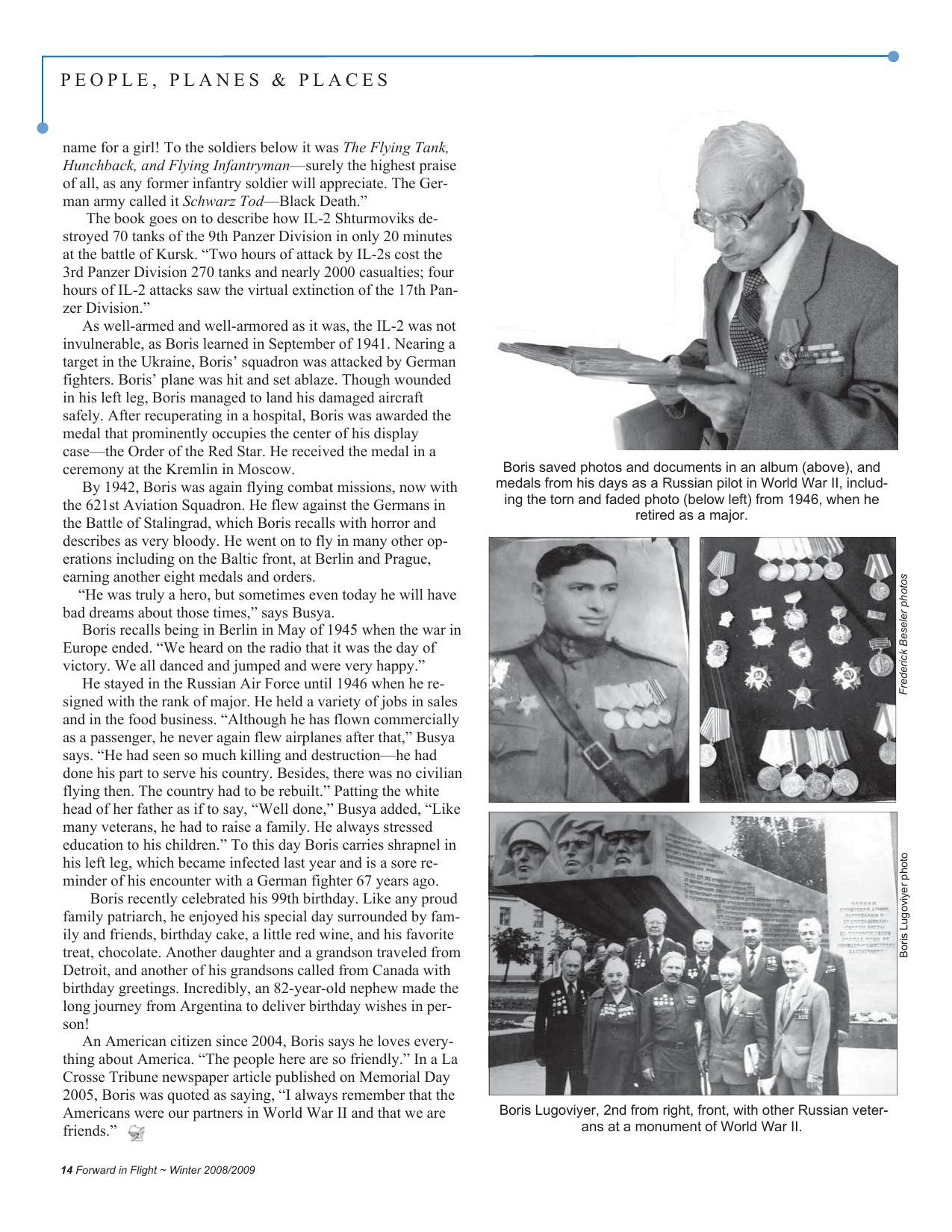
PEOPLE, PLANES & PLACES 14 Forward in Flight ~ Winter 2008/2009 Frederick Beseler photos Boris saved photos and documents in an album (above), and medals from his days as a Russian pilot in World War II, including the torn and faded photo (below left) from 1946, when he retired as a major. Boris Lugoviyer photo name for a girl! To the soldiers below it was The Flying Tank, Hunchback, and Flying Infantryman—surely the highest praise of all, as any former infantry soldier will appreciate. The German army called it Schwarz Tod—Black Death.” The book goes on to describe how IL-2 Shturmoviks destroyed 70 tanks of the 9th Panzer Division in only 20 minutes at the battle of Kursk. “Two hours of attack by IL-2s cost the 3rd Panzer Division 270 tanks and nearly 2000 casualties; four hours of IL-2 attacks saw the virtual extinction of the 17th Panzer Division.” As well-armed and well-armored as it was, the IL-2 was not invulnerable, as Boris learned in September of 1941. Nearing a target in the Ukraine, Boris’ squadron was attacked by German fighters. Boris’ plane was hit and set ablaze. Though wounded in his left leg, Boris managed to land his damaged aircraft safely. After recuperating in a hospital, Boris was awarded the medal that prominently occupies the center of his display case—the Order of the Red Star. He received the medal in a ceremony at the Kremlin in Moscow. By 1942, Boris was again flying combat missions, now with the 621st Aviation Squadron. He flew against the Germans in the Battle of Stalingrad, which Boris recalls with horror and describes as very bloody. He went on to fly in many other operations including on the Baltic front, at Berlin and Prague, earning another eight medals and orders. “He was truly a hero, but sometimes even today he will have bad dreams about those times,” says Busya. Boris recalls being in Berlin in May of 1945 when the war in Europe ended. “We heard on the radio that it was the day of victory. We all danced and jumped and were very happy.” He stayed in the Russian Air Force until 1946 when he resigned with the rank of major. He held a variety of jobs in sales and in the food business. “Although he has flown commercially as a passenger, he never again flew airplanes after that,” Busya says. “He had seen so much killing and destruction—he had done his part to serve his country. Besides, there was no civilian flying then. The country had to be rebuilt.” Patting the white head of her father as if to say, “Well done,” Busya added, “Like many veterans, he had to raise a family. He always stressed education to his children.” To this day Boris carries shrapnel in his left leg, which became infected last year and is a sore reminder of his encounter with a German fighter 67 years ago. Boris recently celebrated his 99th birthday. Like any proud family patriarch, he enjoyed his special day surrounded by family and friends, birthday cake, a little red wine, and his favorite treat, chocolate. Another daughter and a grandson traveled from Detroit, and another of his grandsons called from Canada with birthday greetings. Incredibly, an 82-year-old nephew made the long journey from Argentina to deliver birthday wishes in person! An American citizen since 2004, Boris says he loves everything about America. “The people here are so friendly.” In a La Crosse Tribune newspaper article published on Memorial Day 2005, Boris was quoted as saying, “I always remember that the Americans were our partners in World War II and that we are friends.” Boris Lugoviyer, 2nd from right, front, with other Russian veterans at a monument of World War II.
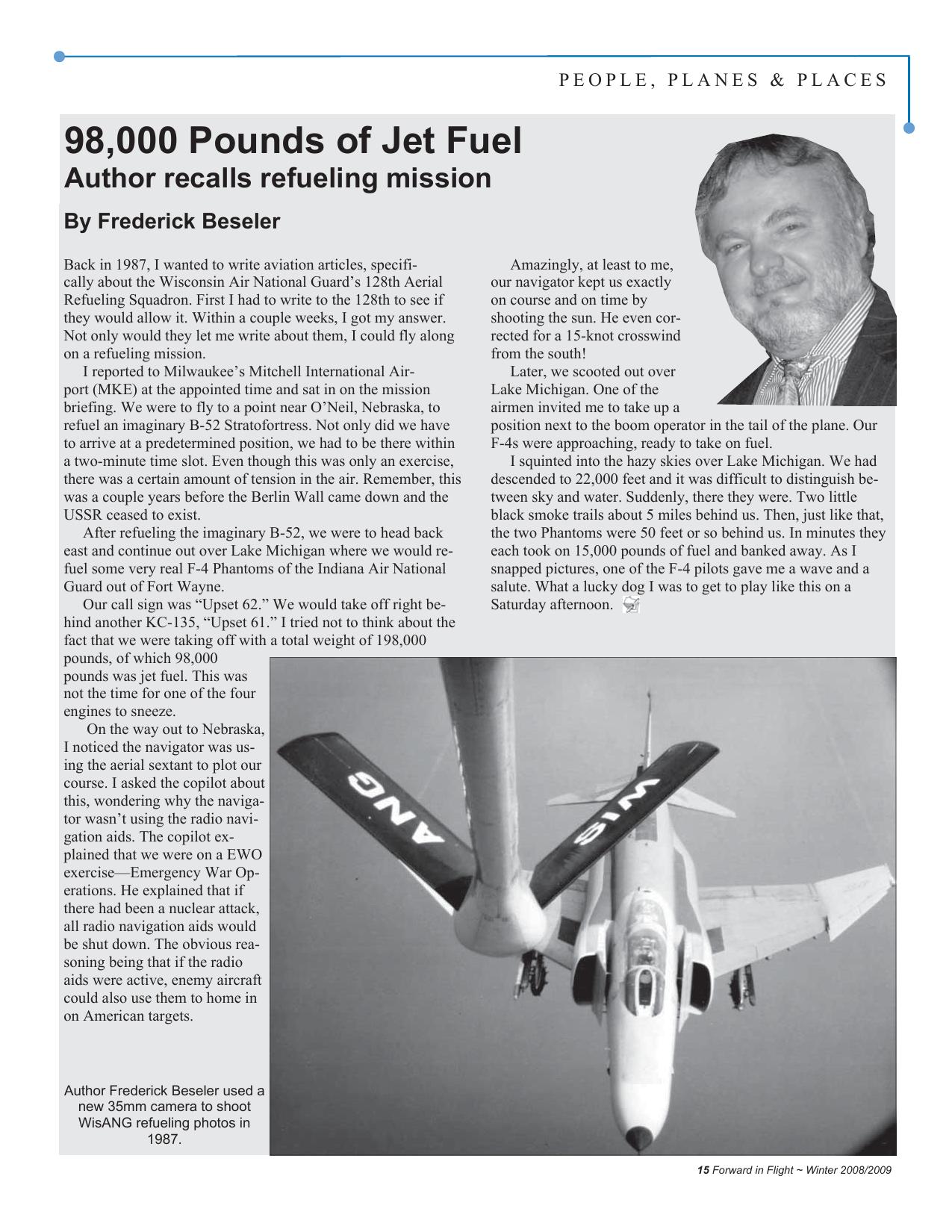
PEOPLE, PLANES & PLACES 98,000 Pounds of Jet Fuel Author recalls refueling mission By Frederick Beseler Back in 1987, I wanted to write aviation articles, specifically about the Wisconsin Air National Guard’s 128th Aerial Refueling Squadron. First I had to write to the 128th to see if they would allow it. Within a couple weeks, I got my answer. Not only would they let me write about them, I could fly along on a refueling mission. I reported to Milwaukee’s Mitchell International Airport (MKE) at the appointed time and sat in on the mission briefing. We were to fly to a point near O’Neil, Nebraska, to refuel an imaginary B-52 Stratofortress. Not only did we have to arrive at a predetermined position, we had to be there within a two-minute time slot. Even though this was only an exercise, there was a certain amount of tension in the air. Remember, this was a couple years before the Berlin Wall came down and the USSR ceased to exist. After refueling the imaginary B-52, we were to head back east and continue out over Lake Michigan where we would refuel some very real F-4 Phantoms of the Indiana Air National Guard out of Fort Wayne. Our call sign was “Upset 62.” We would take off right behind another KC-135, “Upset 61.” I tried not to think about the fact that we were taking off with a total weight of 198,000 pounds, of which 98,000 pounds was jet fuel. This was not the time for one of the four engines to sneeze. On the way out to Nebraska, I noticed the navigator was using the aerial sextant to plot our course. I asked the copilot about this, wondering why the navigator wasn’t using the radio navigation aids. The copilot explained that we were on a EWO exercise—Emergency War Operations. He explained that if there had been a nuclear attack, all radio navigation aids would be shut down. The obvious reasoning being that if the radio aids were active, enemy aircraft could also use them to home in on American targets. Amazingly, at least to me, our navigator kept us exactly on course and on time by shooting the sun. He even corrected for a 15-knot crosswind from the south! Later, we scooted out over Lake Michigan. One of the airmen invited me to take up a position next to the boom operator in the tail of the plane. Our F-4s were approaching, ready to take on fuel. I squinted into the hazy skies over Lake Michigan. We had descended to 22,000 feet and it was difficult to distinguish between sky and water. Suddenly, there they were. Two little black smoke trails about 5 miles behind us. Then, just like that, the two Phantoms were 50 feet or so behind us. In minutes they each took on 15,000 pounds of fuel and banked away. As I snapped pictures, one of the F-4 pilots gave me a wave and a salute. What a lucky dog I was to get to play like this on a Saturday afternoon. Author Frederick Beseler used a new 35mm camera to shoot WisANG refueling photos in 1987. 15 Forward in Flight ~ Winter 2008/2009
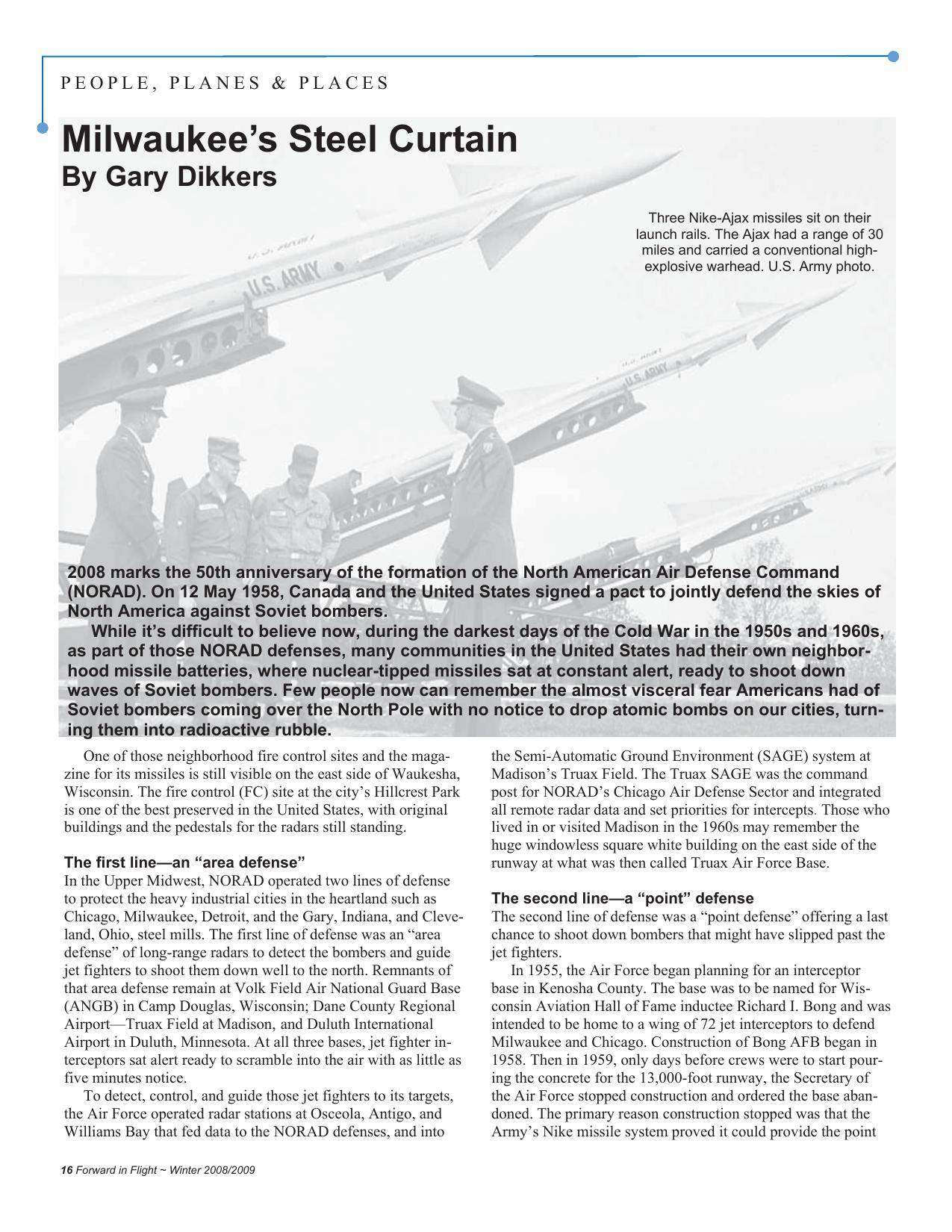
PEOPLE, PLANES & PLACES Milwaukee’s Steel Curtain By Gary Dikkers Three Nike-Ajax missiles sit on their launch rails. The Ajax had a range of 30 miles and carried a conventional highexplosive warhead. U.S. Army photo. 2008 marks the 50th anniversary of the formation of the North American Air Defense Command (NORAD). On 12 May 1958, Canada and the United States signed a pact to jointly defend the skies of North America against Soviet bombers. While it’s difficult to believe now, during the darkest days of the Cold War in the 1950s and 1960s, as part of those NORAD defenses, many communities in the United States had their own neighborhood missile batteries, where nuclear-tipped missiles sat at constant alert, ready to shoot down waves of Soviet bombers. Few people now can remember the almost visceral fear Americans had of Soviet bombers coming over the North Pole with no notice to drop atomic bombs on our cities, turning them into radioactive rubble. One of those neighborhood fire control sites and the magazine for its missiles is still visible on the east side of Waukesha, Wisconsin. The fire control (FC) site at the city’s Hillcrest Park is one of the best preserved in the United States, with original buildings and the pedestals for the radars still standing. The first line—an “area defense” In the Upper Midwest, NORAD operated two lines of defense to protect the heavy industrial cities in the heartland such as Chicago, Milwaukee, Detroit, and the Gary, Indiana, and Cleveland, Ohio, steel mills. The first line of defense was an “area defense” of long-range radars to detect the bombers and guide jet fighters to shoot them down well to the north. Remnants of that area defense remain at Volk Field Air National Guard Base (ANGB) in Camp Douglas, Wisconsin; Dane County Regional Airport—Truax Field at Madison, and Duluth International Airport in Duluth, Minnesota. At all three bases, jet fighter interceptors sat alert ready to scramble into the air with as little as five minutes notice. To detect, control, and guide those jet fighters to its targets, the Air Force operated radar stations at Osceola, Antigo, and Williams Bay that fed data to the NORAD defenses, and into 16 Forward in Flight ~ Winter 2008/2009 the Semi-Automatic Ground Environment (SAGE) system at Madison’s Truax Field. The Truax SAGE was the command post for NORAD’s Chicago Air Defense Sector and integrated all remote radar data and set priorities for intercepts. Those who lived in or visited Madison in the 1960s may remember the huge windowless square white building on the east side of the runway at what was then called Truax Air Force Base. The second line—a “point” defense The second line of defense was a “point defense” offering a last chance to shoot down bombers that might have slipped past the jet fighters. In 1955, the Air Force began planning for an interceptor base in Kenosha County. The base was to be named for Wisconsin Aviation Hall of Fame inductee Richard I. Bong and was intended to be home to a wing of 72 jet interceptors to defend Milwaukee and Chicago. Construction of Bong AFB began in 1958. Then in 1959, only days before crews were to start pouring the concrete for the 13,000-foot runway, the Secretary of the Air Force stopped construction and ordered the base abandoned. The primary reason construction stopped was that the Army’s Nike missile system proved it could provide the point
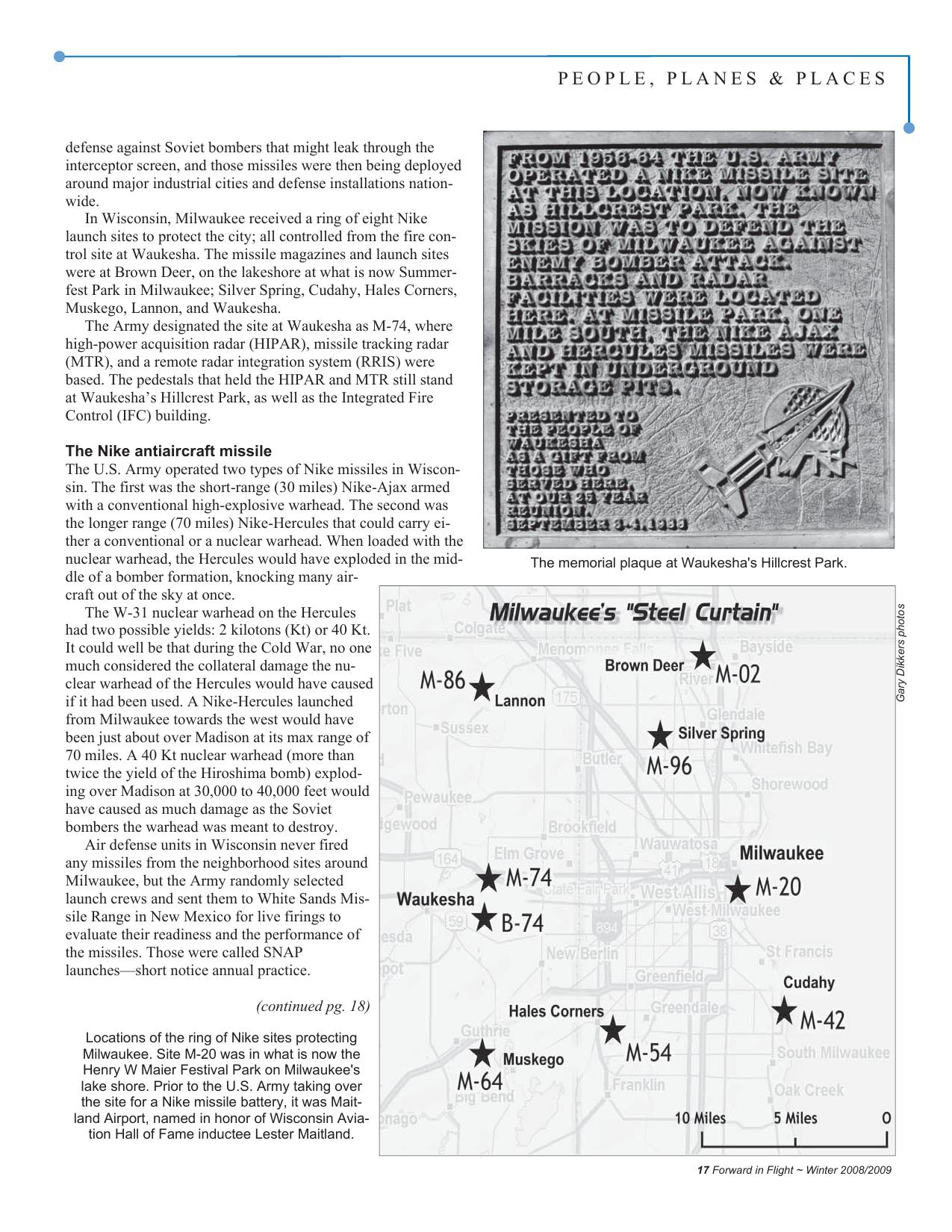
PEOPLE, PLANES & PLACES defense against Soviet bombers that might leak through the interceptor screen, and those missiles were then being deployed around major industrial cities and defense installations nationwide. In Wisconsin, Milwaukee received a ring of eight Nike launch sites to protect the city; all controlled from the fire control site at Waukesha. The missile magazines and launch sites were at Brown Deer, on the lakeshore at what is now Summerfest Park in Milwaukee; Silver Spring, Cudahy, Hales Corners, Muskego, Lannon, and Waukesha. The Army designated the site at Waukesha as M-74, where high-power acquisition radar (HIPAR), missile tracking radar (MTR), and a remote radar integration system (RRIS) were based. The pedestals that held the HIPAR and MTR still stand at Waukesha’s Hillcrest Park, as well as the Integrated Fire Control (IFC) building. The memorial plaque at Waukesha's Hillcrest Park. Gary Dikkers photos The Nike antiaircraft missile The U.S. Army operated two types of Nike missiles in Wisconsin. The first was the short-range (30 miles) Nike-Ajax armed with a conventional high-explosive warhead. The second was the longer range (70 miles) Nike-Hercules that could carry either a conventional or a nuclear warhead. When loaded with the nuclear warhead, the Hercules would have exploded in the middle of a bomber formation, knocking many aircraft out of the sky at once. The W-31 nuclear warhead on the Hercules had two possible yields: 2 kilotons (Kt) or 40 Kt. It could well be that during the Cold War, no one much considered the collateral damage the nuclear warhead of the Hercules would have caused if it had been used. A Nike-Hercules launched from Milwaukee towards the west would have been just about over Madison at its max range of 70 miles. A 40 Kt nuclear warhead (more than twice the yield of the Hiroshima bomb) exploding over Madison at 30,000 to 40,000 feet would have caused as much damage as the Soviet bombers the warhead was meant to destroy. Air defense units in Wisconsin never fired any missiles from the neighborhood sites around Milwaukee, but the Army randomly selected launch crews and sent them to White Sands Missile Range in New Mexico for live firings to evaluate their readiness and the performance of the missiles. Those were called SNAP launches—short notice annual practice. (continued pg. 18) Locations of the ring of Nike sites protecting Milwaukee. Site M-20 was in what is now the Henry W Maier Festival Park on Milwaukee's lake shore. Prior to the U.S. Army taking over the site for a Nike missile battery, it was Maitland Airport, named in honor of Wisconsin Aviation Hall of Fame inductee Lester Maitland. 17 Forward in Flight ~ Winter 2008/2009
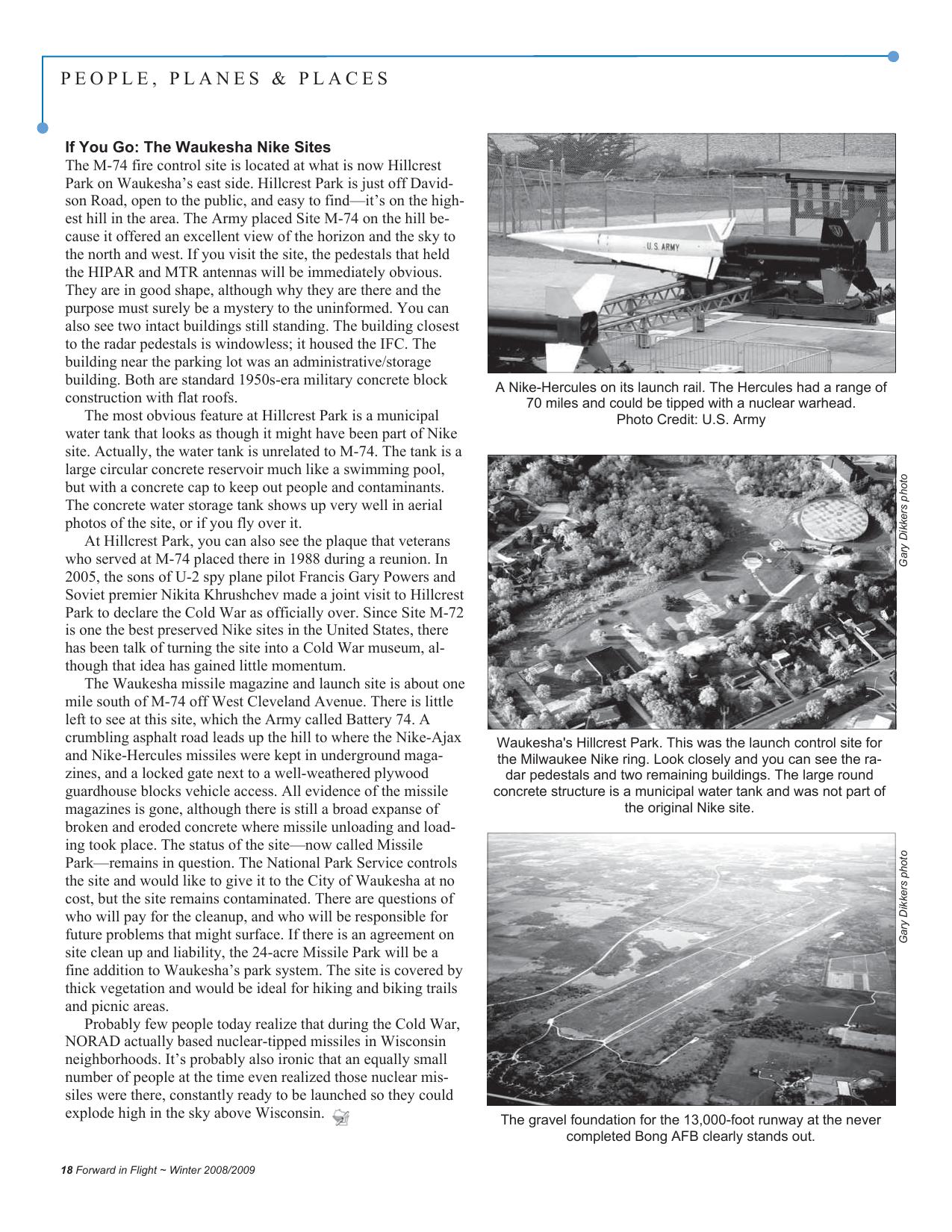
PEOPLE, PLANES & PLACES 18 Forward in Flight ~ Winter 2008/2009 Gary Dikkers photo A Nike-Hercules on its launch rail. The Hercules had a range of 70 miles and could be tipped with a nuclear warhead. Photo Credit: U.S. Army Waukesha's Hillcrest Park. This was the launch control site for the Milwaukee Nike ring. Look closely and you can see the radar pedestals and two remaining buildings. The large round concrete structure is a municipal water tank and was not part of the original Nike site. Gary Dikkers photo If You Go: The Waukesha Nike Sites The M-74 fire control site is located at what is now Hillcrest Park on Waukesha’s east side. Hillcrest Park is just off Davidson Road, open to the public, and easy to find—it’s on the highest hill in the area. The Army placed Site M-74 on the hill because it offered an excellent view of the horizon and the sky to the north and west. If you visit the site, the pedestals that held the HIPAR and MTR antennas will be immediately obvious. They are in good shape, although why they are there and the purpose must surely be a mystery to the uninformed. You can also see two intact buildings still standing. The building closest to the radar pedestals is windowless; it housed the IFC. The building near the parking lot was an administrative/storage building. Both are standard 1950s-era military concrete block construction with flat roofs. The most obvious feature at Hillcrest Park is a municipal water tank that looks as though it might have been part of Nike site. Actually, the water tank is unrelated to M-74. The tank is a large circular concrete reservoir much like a swimming pool, but with a concrete cap to keep out people and contaminants. The concrete water storage tank shows up very well in aerial photos of the site, or if you fly over it. At Hillcrest Park, you can also see the plaque that veterans who served at M-74 placed there in 1988 during a reunion. In 2005, the sons of U-2 spy plane pilot Francis Gary Powers and Soviet premier Nikita Khrushchev made a joint visit to Hillcrest Park to declare the Cold War as officially over. Since Site M-72 is one the best preserved Nike sites in the United States, there has been talk of turning the site into a Cold War museum, although that idea has gained little momentum. The Waukesha missile magazine and launch site is about one mile south of M-74 off West Cleveland Avenue. There is little left to see at this site, which the Army called Battery 74. A crumbling asphalt road leads up the hill to where the Nike-Ajax and Nike-Hercules missiles were kept in underground magazines, and a locked gate next to a well-weathered plywood guardhouse blocks vehicle access. All evidence of the missile magazines is gone, although there is still a broad expanse of broken and eroded concrete where missile unloading and loading took place. The status of the site—now called Missile Park—remains in question. The National Park Service controls the site and would like to give it to the City of Waukesha at no cost, but the site remains contaminated. There are questions of who will pay for the cleanup, and who will be responsible for future problems that might surface. If there is an agreement on site clean up and liability, the 24-acre Missile Park will be a fine addition to Waukesha’s park system. The site is covered by thick vegetation and would be ideal for hiking and biking trails and picnic areas. Probably few people today realize that during the Cold War, NORAD actually based nuclear-tipped missiles in Wisconsin neighborhoods. It’s probably also ironic that an equally small number of people at the time even realized those nuclear missiles were there, constantly ready to be launched so they could explode high in the sky above Wisconsin. The gravel foundation for the 13,000-foot runway at the never completed Bong AFB clearly stands out.
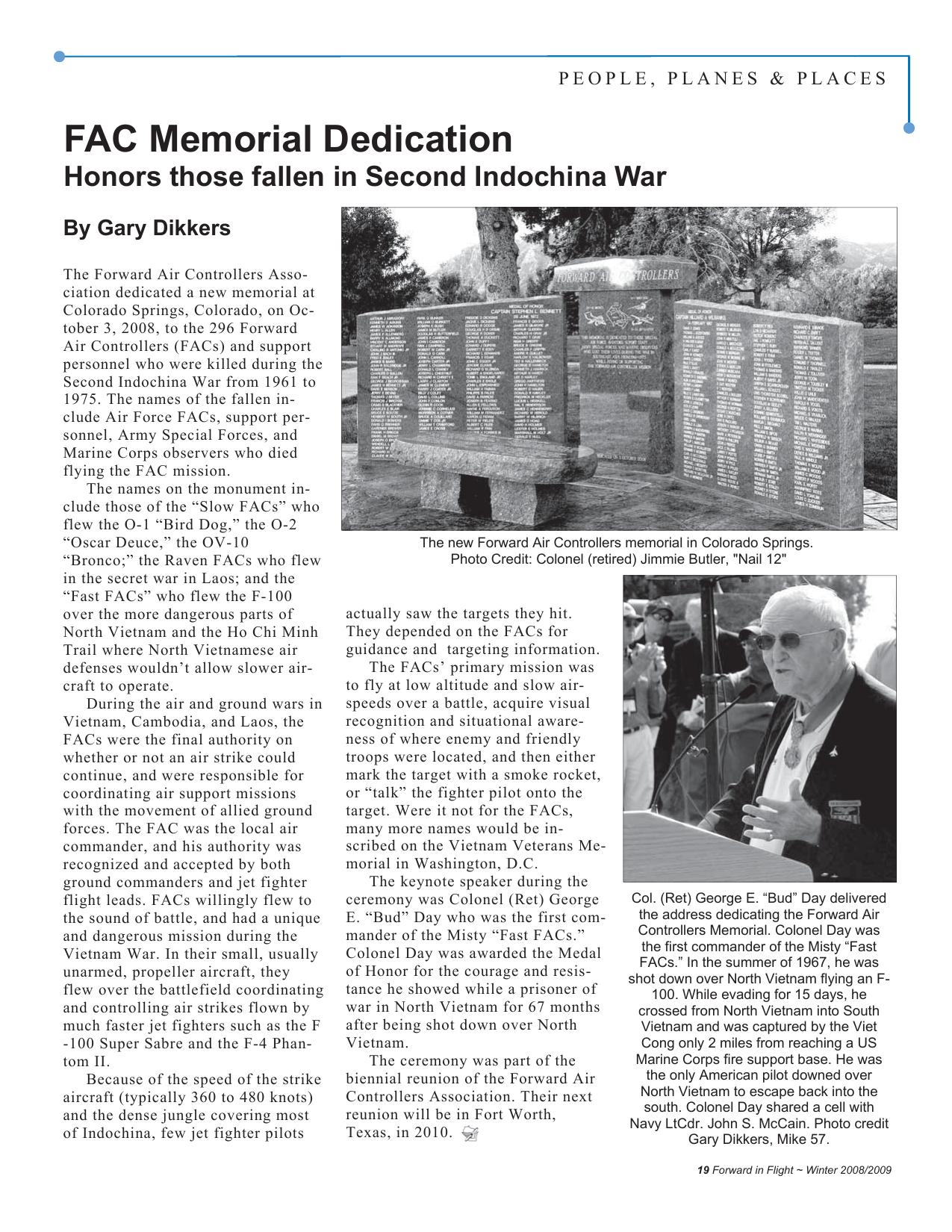
PEOPLE, PLANES & PLACES FAC Memorial Dedication Honors those fallen in Second Indochina War By Gary Dikkers The Forward Air Controllers Association dedicated a new memorial at Colorado Springs, Colorado, on October 3, 2008, to the 296 Forward Air Controllers (FACs) and support personnel who were killed during the Second Indochina War from 1961 to 1975. The names of the fallen include Air Force FACs, support personnel, Army Special Forces, and Marine Corps observers who died flying the FAC mission. The names on the monument include those of the “Slow FACs” who flew the O-1 “Bird Dog,” the O-2 “Oscar Deuce,” the OV-10 “Bronco;” the Raven FACs who flew in the secret war in Laos; and the “Fast FACs” who flew the F-100 over the more dangerous parts of North Vietnam and the Ho Chi Minh Trail where North Vietnamese air defenses wouldn’t allow slower aircraft to operate. During the air and ground wars in Vietnam, Cambodia, and Laos, the FACs were the final authority on whether or not an air strike could continue, and were responsible for coordinating air support missions with the movement of allied ground forces. The FAC was the local air commander, and his authority was recognized and accepted by both ground commanders and jet fighter flight leads. FACs willingly flew to the sound of battle, and had a unique and dangerous mission during the Vietnam War. In their small, usually unarmed, propeller aircraft, they flew over the battlefield coordinating and controlling air strikes flown by much faster jet fighters such as the F -100 Super Sabre and the F-4 Phantom II. Because of the speed of the strike aircraft (typically 360 to 480 knots) and the dense jungle covering most of Indochina, few jet fighter pilots The new Forward Air Controllers memorial in Colorado Springs. Photo Credit: Colonel (retired) Jimmie Butler, "Nail 12" actually saw the targets they hit. They depended on the FACs for guidance and targeting information. The FACs’ primary mission was to fly at low altitude and slow airspeeds over a battle, acquire visual recognition and situational awareness of where enemy and friendly troops were located, and then either mark the target with a smoke rocket, or “talk” the fighter pilot onto the target. Were it not for the FACs, many more names would be inscribed on the Vietnam Veterans Memorial in Washington, D.C. The keynote speaker during the ceremony was Colonel (Ret) George E. “Bud” Day who was the first commander of the Misty “Fast FACs.” Colonel Day was awarded the Medal of Honor for the courage and resistance he showed while a prisoner of war in North Vietnam for 67 months after being shot down over North Vietnam. The ceremony was part of the biennial reunion of the Forward Air Controllers Association. Their next reunion will be in Fort Worth, Texas, in 2010. Col. (Ret) George E. “Bud” Day delivered the address dedicating the Forward Air Controllers Memorial. Colonel Day was the first commander of the Misty “Fast FACs.” In the summer of 1967, he was shot down over North Vietnam flying an F100. While evading for 15 days, he crossed from North Vietnam into South Vietnam and was captured by the Viet Cong only 2 miles from reaching a US Marine Corps fire support base. He was the only American pilot downed over North Vietnam to escape back into the south. Colonel Day shared a cell with Navy LtCdr. John S. McCain. Photo credit Gary Dikkers, Mike 57. 19 Forward in Flight ~ Winter 2008/2009
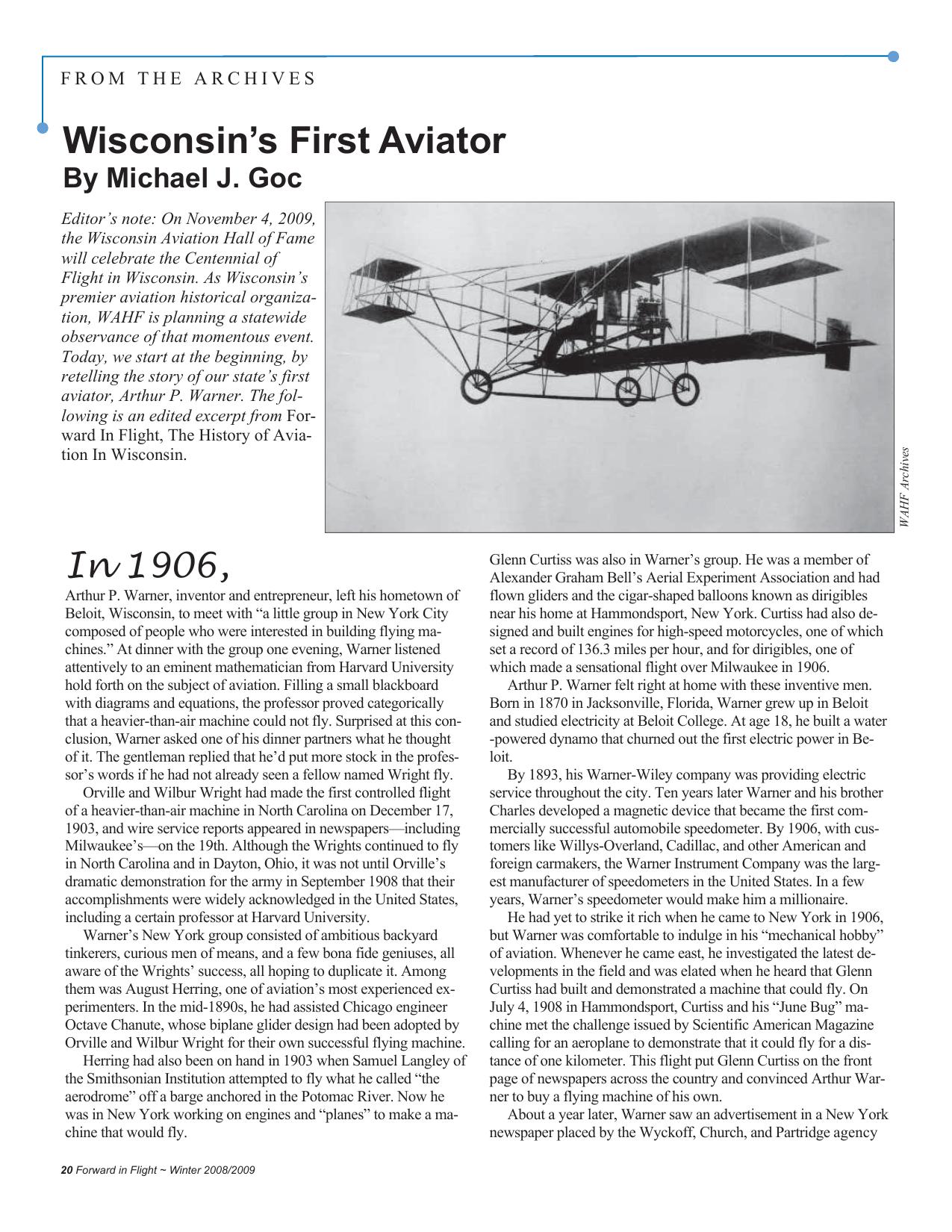
FROM THE ARCHIVES Wisconsin’s First Aviator By Michael J. Goc In 1906, Arthur P. Warner, inventor and entrepreneur, left his hometown of Beloit, Wisconsin, to meet with “a little group in New York City composed of people who were interested in building flying machines.” At dinner with the group one evening, Warner listened attentively to an eminent mathematician from Harvard University hold forth on the subject of aviation. Filling a small blackboard with diagrams and equations, the professor proved categorically that a heavier-than-air machine could not fly. Surprised at this conclusion, Warner asked one of his dinner partners what he thought of it. The gentleman replied that he’d put more stock in the professor’s words if he had not already seen a fellow named Wright fly. Orville and Wilbur Wright had made the first controlled flight of a heavier-than-air machine in North Carolina on December 17, 1903, and wire service reports appeared in newspapers—including Milwaukee’s—on the 19th. Although the Wrights continued to fly in North Carolina and in Dayton, Ohio, it was not until Orville’s dramatic demonstration for the army in September 1908 that their accomplishments were widely acknowledged in the United States, including a certain professor at Harvard University. Warner’s New York group consisted of ambitious backyard tinkerers, curious men of means, and a few bona fide geniuses, all aware of the Wrights’ success, all hoping to duplicate it. Among them was August Herring, one of aviation’s most experienced experimenters. In the mid-1890s, he had assisted Chicago engineer Octave Chanute, whose biplane glider design had been adopted by Orville and Wilbur Wright for their own successful flying machine. Herring had also been on hand in 1903 when Samuel Langley of the Smithsonian Institution attempted to fly what he called “the aerodrome” off a barge anchored in the Potomac River. Now he was in New York working on engines and “planes” to make a machine that would fly. 20 Forward in Flight ~ Winter 2008/2009 WAHF Archives Editor’s note: On November 4, 2009, the Wisconsin Aviation Hall of Fame will celebrate the Centennial of Flight in Wisconsin. As Wisconsin’s premier aviation historical organization, WAHF is planning a statewide observance of that momentous event. Today, we start at the beginning, by retelling the story of our state’s first aviator, Arthur P. Warner. The following is an edited excerpt from Forward In Flight, The History of Aviation In Wisconsin. Glenn Curtiss was also in Warner’s group. He was a member of Alexander Graham Bell’s Aerial Experiment Association and had flown gliders and the cigar-shaped balloons known as dirigibles near his home at Hammondsport, New York. Curtiss had also designed and built engines for high-speed motorcycles, one of which set a record of 136.3 miles per hour, and for dirigibles, one of which made a sensational flight over Milwaukee in 1906. Arthur P. Warner felt right at home with these inventive men. Born in 1870 in Jacksonville, Florida, Warner grew up in Beloit and studied electricity at Beloit College. At age 18, he built a water -powered dynamo that churned out the first electric power in Beloit. By 1893, his Warner-Wiley company was providing electric service throughout the city. Ten years later Warner and his brother Charles developed a magnetic device that became the first commercially successful automobile speedometer. By 1906, with customers like Willys-Overland, Cadillac, and other American and foreign carmakers, the Warner Instrument Company was the largest manufacturer of speedometers in the United States. In a few years, Warner’s speedometer would make him a millionaire. He had yet to strike it rich when he came to New York in 1906, but Warner was comfortable to indulge in his “mechanical hobby” of aviation. Whenever he came east, he investigated the latest developments in the field and was elated when he heard that Glenn Curtiss had built and demonstrated a machine that could fly. On July 4, 1908 in Hammondsport, Curtiss and his “June Bug” machine met the challenge issued by Scientific American Magazine calling for an aeroplane to demonstrate that it could fly for a distance of one kilometer. This flight put Glenn Curtiss on the front page of newspapers across the country and convinced Arthur Warner to buy a flying machine of his own. About a year later, Warner saw an advertisement in a New York newspaper placed by the Wyckoff, Church, and Partridge agency
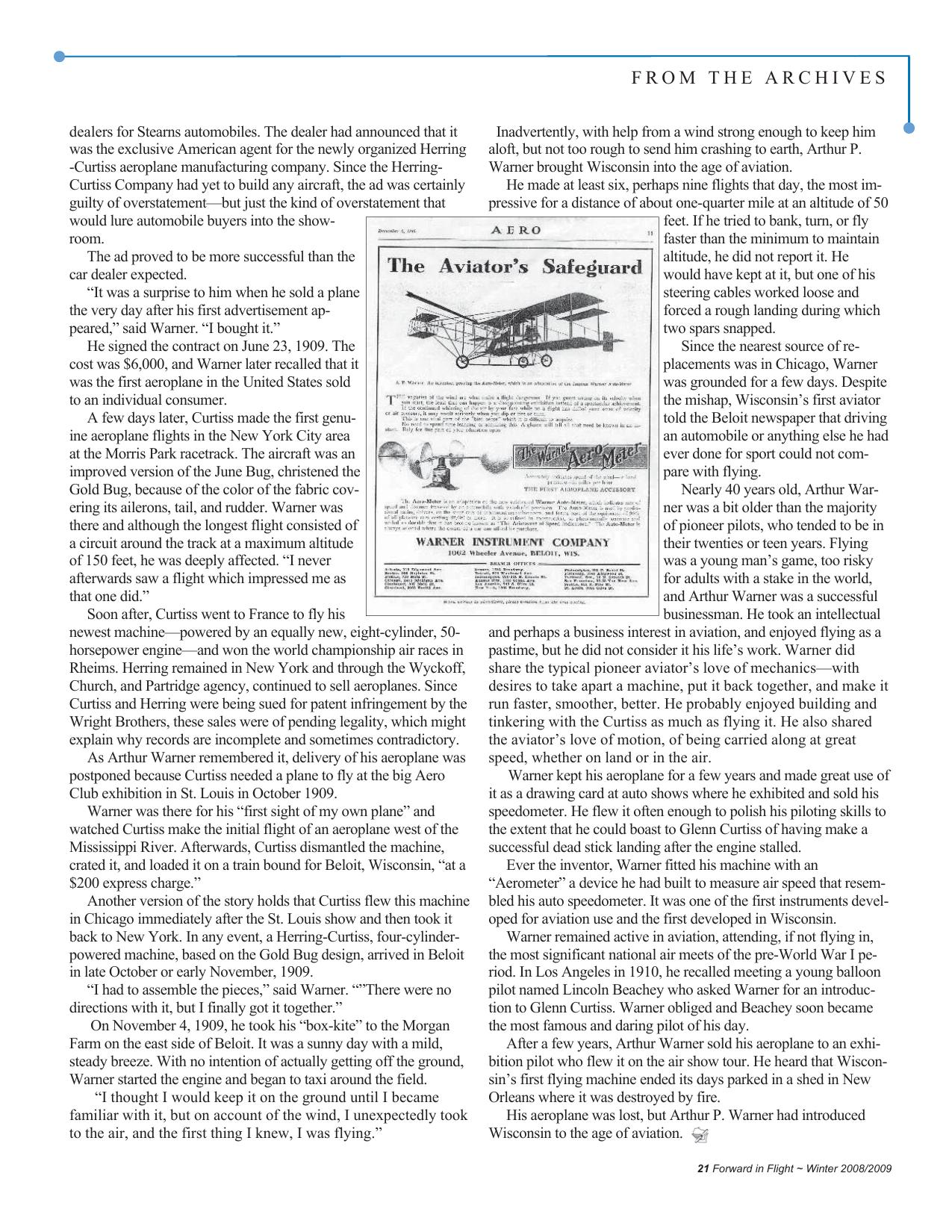
FROM THE ARCHIVES dealers for Stearns automobiles. The dealer had announced that it was the exclusive American agent for the newly organized Herring -Curtiss aeroplane manufacturing company. Since the HerringCurtiss Company had yet to build any aircraft, the ad was certainly guilty of overstatement—but just the kind of overstatement that would lure automobile buyers into the showroom. The ad proved to be more successful than the car dealer expected. “It was a surprise to him when he sold a plane the very day after his first advertisement appeared,” said Warner. “I bought it.” He signed the contract on June 23, 1909. The cost was $6,000, and Warner later recalled that it was the first aeroplane in the United States sold to an individual consumer. A few days later, Curtiss made the first genuine aeroplane flights in the New York City area at the Morris Park racetrack. The aircraft was an improved version of the June Bug, christened the Gold Bug, because of the color of the fabric covering its ailerons, tail, and rudder. Warner was there and although the longest flight consisted of a circuit around the track at a maximum altitude of 150 feet, he was deeply affected. “I never afterwards saw a flight which impressed me as that one did.” Soon after, Curtiss went to France to fly his newest machine—powered by an equally new, eight-cylinder, 50horsepower engine—and won the world championship air races in Rheims. Herring remained in New York and through the Wyckoff, Church, and Partridge agency, continued to sell aeroplanes. Since Curtiss and Herring were being sued for patent infringement by the Wright Brothers, these sales were of pending legality, which might explain why records are incomplete and sometimes contradictory. As Arthur Warner remembered it, delivery of his aeroplane was postponed because Curtiss needed a plane to fly at the big Aero Club exhibition in St. Louis in October 1909. Warner was there for his “first sight of my own plane” and watched Curtiss make the initial flight of an aeroplane west of the Mississippi River. Afterwards, Curtiss dismantled the machine, crated it, and loaded it on a train bound for Beloit, Wisconsin, “at a $200 express charge.” Another version of the story holds that Curtiss flew this machine in Chicago immediately after the St. Louis show and then took it back to New York. In any event, a Herring-Curtiss, four-cylinderpowered machine, based on the Gold Bug design, arrived in Beloit in late October or early November, 1909. “I had to assemble the pieces,” said Warner. “”There were no directions with it, but I finally got it together.” On November 4, 1909, he took his “box-kite” to the Morgan Farm on the east side of Beloit. It was a sunny day with a mild, steady breeze. With no intention of actually getting off the ground, Warner started the engine and began to taxi around the field. “I thought I would keep it on the ground until I became familiar with it, but on account of the wind, I unexpectedly took to the air, and the first thing I knew, I was flying.” Inadvertently, with help from a wind strong enough to keep him aloft, but not too rough to send him crashing to earth, Arthur P. Warner brought Wisconsin into the age of aviation. He made at least six, perhaps nine flights that day, the most impressive for a distance of about one-quarter mile at an altitude of 50 feet. If he tried to bank, turn, or fly faster than the minimum to maintain altitude, he did not report it. He would have kept at it, but one of his steering cables worked loose and forced a rough landing during which two spars snapped. Since the nearest source of replacements was in Chicago, Warner was grounded for a few days. Despite the mishap, Wisconsin’s first aviator told the Beloit newspaper that driving an automobile or anything else he had ever done for sport could not compare with flying. Nearly 40 years old, Arthur Warner was a bit older than the majority of pioneer pilots, who tended to be in their twenties or teen years. Flying was a young man’s game, too risky for adults with a stake in the world, and Arthur Warner was a successful businessman. He took an intellectual and perhaps a business interest in aviation, and enjoyed flying as a pastime, but he did not consider it his life’s work. Warner did share the typical pioneer aviator’s love of mechanics—with desires to take apart a machine, put it back together, and make it run faster, smoother, better. He probably enjoyed building and tinkering with the Curtiss as much as flying it. He also shared the aviator’s love of motion, of being carried along at great speed, whether on land or in the air. Warner kept his aeroplane for a few years and made great use of it as a drawing card at auto shows where he exhibited and sold his speedometer. He flew it often enough to polish his piloting skills to the extent that he could boast to Glenn Curtiss of having make a successful dead stick landing after the engine stalled. Ever the inventor, Warner fitted his machine with an “Aerometer” a device he had built to measure air speed that resembled his auto speedometer. It was one of the first instruments developed for aviation use and the first developed in Wisconsin. Warner remained active in aviation, attending, if not flying in, the most significant national air meets of the pre-World War I period. In Los Angeles in 1910, he recalled meeting a young balloon pilot named Lincoln Beachey who asked Warner for an introduction to Glenn Curtiss. Warner obliged and Beachey soon became the most famous and daring pilot of his day. After a few years, Arthur Warner sold his aeroplane to an exhibition pilot who flew it on the air show tour. He heard that Wisconsin’s first flying machine ended its days parked in a shed in New Orleans where it was destroyed by fire. His aeroplane was lost, but Arthur P. Warner had introduced Wisconsin to the age of aviation. 21 Forward in Flight ~ Winter 2008/2009
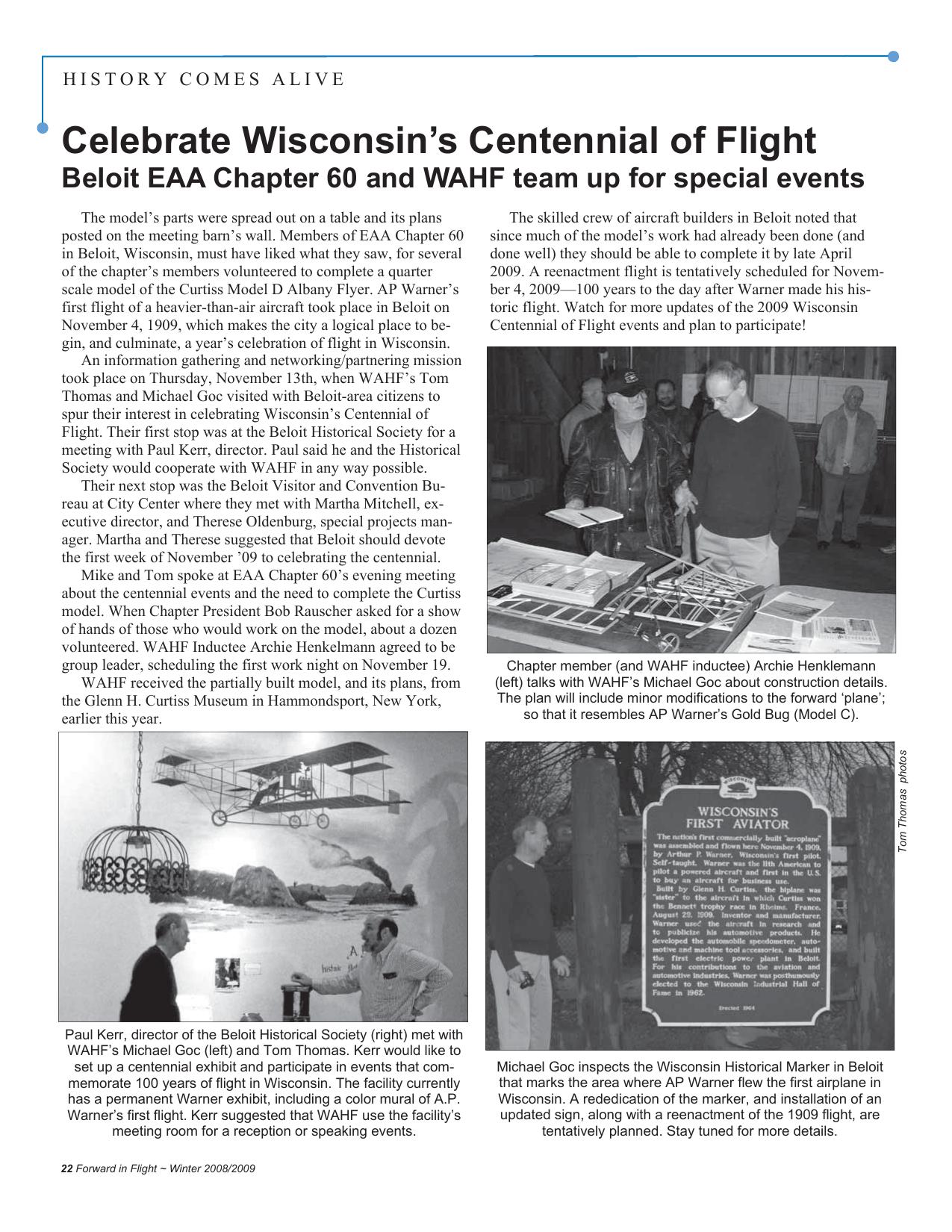
HISTORY COMES ALIVE Celebrate Wisconsin’s Centennial of Flight Beloit EAA Chapter 60 and WAHF team up for special events The skilled crew of aircraft builders in Beloit noted that since much of the model’s work had already been done (and done well) they should be able to complete it by late April 2009. A reenactment flight is tentatively scheduled for November 4, 2009—100 years to the day after Warner made his historic flight. Watch for more updates of the 2009 Wisconsin Centennial of Flight events and plan to participate! Chapter member (and WAHF inductee) Archie Henklemann (left) talks with WAHF’s Michael Goc about construction details. The plan will include minor modifications to the forward ‘plane’; so that it resembles AP Warner’s Gold Bug (Model C). Tom Thomas photos The model’s parts were spread out on a table and its plans posted on the meeting barn’s wall. Members of EAA Chapter 60 in Beloit, Wisconsin, must have liked what they saw, for several of the chapter’s members volunteered to complete a quarter scale model of the Curtiss Model D Albany Flyer. AP Warner’s first flight of a heavier-than-air aircraft took place in Beloit on November 4, 1909, which makes the city a logical place to begin, and culminate, a year’s celebration of flight in Wisconsin. An information gathering and networking/partnering mission took place on Thursday, November 13th, when WAHF’s Tom Thomas and Michael Goc visited with Beloit-area citizens to spur their interest in celebrating Wisconsin’s Centennial of Flight. Their first stop was at the Beloit Historical Society for a meeting with Paul Kerr, director. Paul said he and the Historical Society would cooperate with WAHF in any way possible. Their next stop was the Beloit Visitor and Convention Bureau at City Center where they met with Martha Mitchell, executive director, and Therese Oldenburg, special projects manager. Martha and Therese suggested that Beloit should devote the first week of November ’09 to celebrating the centennial. Mike and Tom spoke at EAA Chapter 60’s evening meeting about the centennial events and the need to complete the Curtiss model. When Chapter President Bob Rauscher asked for a show of hands of those who would work on the model, about a dozen volunteered. WAHF Inductee Archie Henkelmann agreed to be group leader, scheduling the first work night on November 19. WAHF received the partially built model, and its plans, from the Glenn H. Curtiss Museum in Hammondsport, New York, earlier this year. Paul Kerr, director of the Beloit Historical Society (right) met with WAHF’s Michael Goc (left) and Tom Thomas. Kerr would like to set up a centennial exhibit and participate in events that commemorate 100 years of flight in Wisconsin. The facility currently has a permanent Warner exhibit, including a color mural of A.P. Warner’s first flight. Kerr suggested that WAHF use the facility’s meeting room for a reception or speaking events. 22 Forward in Flight ~ Winter 2008/2009 Michael Goc inspects the Wisconsin Historical Marker in Beloit that marks the area where AP Warner flew the first airplane in Wisconsin. A rededication of the marker, and installation of an updated sign, along with a reenactment of the 1909 flight, are tentatively planned. Stay tuned for more details.
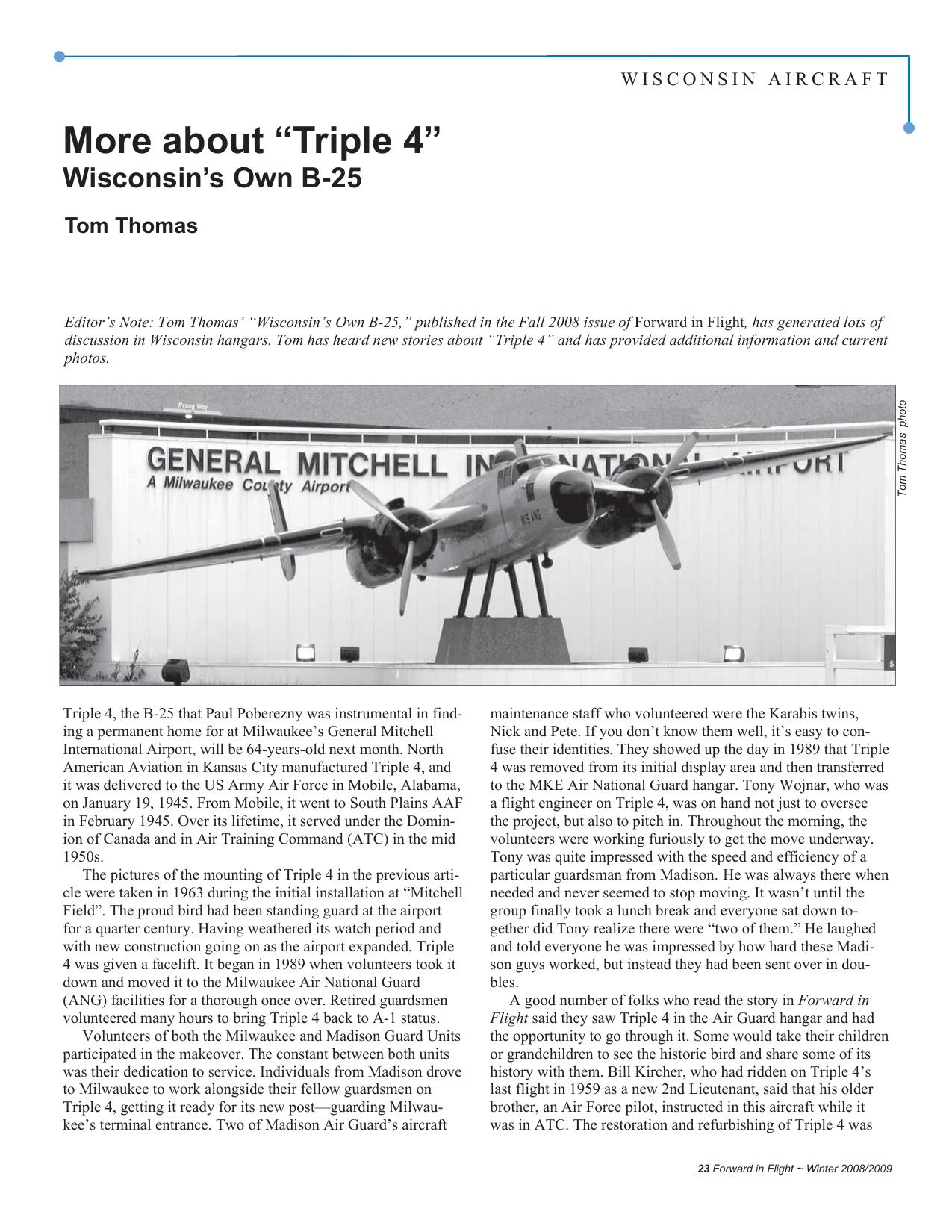
WISCONSIN AIRCRAFT More about “Triple 4” Wisconsin’s Own B-25 Tom Thomas Tom Thomas photo Editor’s Note: Tom Thomas’ “Wisconsin’s Own B-25,” published in the Fall 2008 issue of Forward in Flight, has generated lots of discussion in Wisconsin hangars. Tom has heard new stories about “Triple 4” and has provided additional information and current photos. Triple 4, the B-25 that Paul Poberezny was instrumental in finding a permanent home for at Milwaukee’s General Mitchell International Airport, will be 64-years-old next month. North American Aviation in Kansas City manufactured Triple 4, and it was delivered to the US Army Air Force in Mobile, Alabama, on January 19, 1945. From Mobile, it went to South Plains AAF in February 1945. Over its lifetime, it served under the Dominion of Canada and in Air Training Command (ATC) in the mid 1950s. The pictures of the mounting of Triple 4 in the previous article were taken in 1963 during the initial installation at “Mitchell Field”. The proud bird had been standing guard at the airport for a quarter century. Having weathered its watch period and with new construction going on as the airport expanded, Triple 4 was given a facelift. It began in 1989 when volunteers took it down and moved it to the Milwaukee Air National Guard (ANG) facilities for a thorough once over. Retired guardsmen volunteered many hours to bring Triple 4 back to A-1 status. Volunteers of both the Milwaukee and Madison Guard Units participated in the makeover. The constant between both units was their dedication to service. Individuals from Madison drove to Milwaukee to work alongside their fellow guardsmen on Triple 4, getting it ready for its new post—guarding Milwaukee’s terminal entrance. Two of Madison Air Guard’s aircraft maintenance staff who volunteered were the Karabis twins, Nick and Pete. If you don’t know them well, it’s easy to confuse their identities. They showed up the day in 1989 that Triple 4 was removed from its initial display area and then transferred to the MKE Air National Guard hangar. Tony Wojnar, who was a flight engineer on Triple 4, was on hand not just to oversee the project, but also to pitch in. Throughout the morning, the volunteers were working furiously to get the move underway. Tony was quite impressed with the speed and efficiency of a particular guardsman from Madison. He was always there when needed and never seemed to stop moving. It wasn’t until the group finally took a lunch break and everyone sat down together did Tony realize there were “two of them.” He laughed and told everyone he was impressed by how hard these Madison guys worked, but instead they had been sent over in doubles. A good number of folks who read the story in Forward in Flight said they saw Triple 4 in the Air Guard hangar and had the opportunity to go through it. Some would take their children or grandchildren to see the historic bird and share some of its history with them. Bill Kircher, who had ridden on Triple 4’s last flight in 1959 as a new 2nd Lieutenant, said that his older brother, an Air Force pilot, instructed in this aircraft while it was in ATC. The restoration and refurbishing of Triple 4 was 23 Forward in Flight ~ Winter 2008/2009
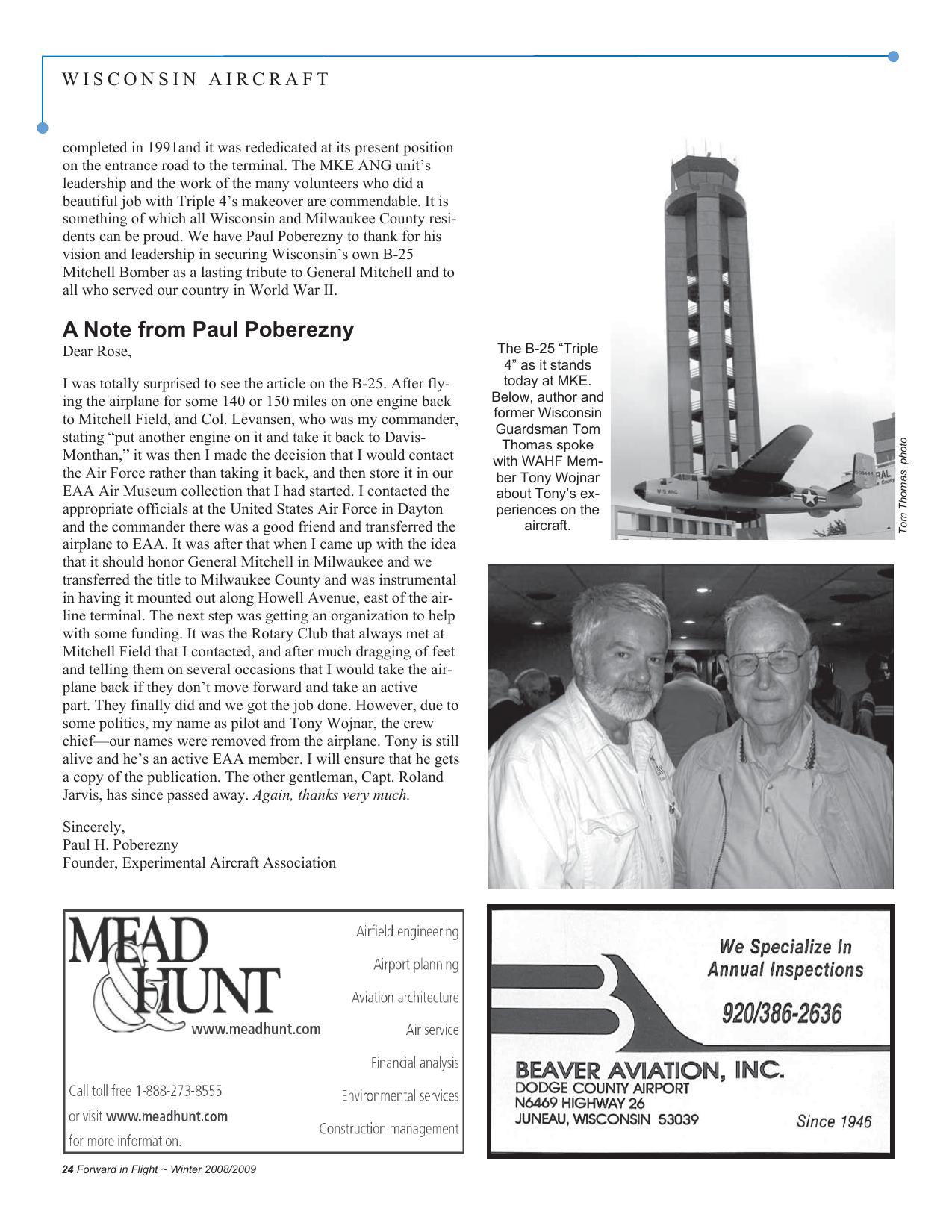
WISCONSIN AIRCRAFT A Note from Paul Poberezny Dear Rose, I was totally surprised to see the article on the B-25. After flying the airplane for some 140 or 150 miles on one engine back to Mitchell Field, and Col. Levansen, who was my commander, stating “put another engine on it and take it back to DavisMonthan,” it was then I made the decision that I would contact the Air Force rather than taking it back, and then store it in our EAA Air Museum collection that I had started. I contacted the appropriate officials at the United States Air Force in Dayton and the commander there was a good friend and transferred the airplane to EAA. It was after that when I came up with the idea that it should honor General Mitchell in Milwaukee and we transferred the title to Milwaukee County and was instrumental in having it mounted out along Howell Avenue, east of the airline terminal. The next step was getting an organization to help with some funding. It was the Rotary Club that always met at Mitchell Field that I contacted, and after much dragging of feet and telling them on several occasions that I would take the airplane back if they don’t move forward and take an active part. They finally did and we got the job done. However, due to some politics, my name as pilot and Tony Wojnar, the crew chief—our names were removed from the airplane. Tony is still alive and he’s an active EAA member. I will ensure that he gets a copy of the publication. The other gentleman, Capt. Roland Jarvis, has since passed away. Again, thanks very much. Sincerely, Paul H. Poberezny Founder, Experimental Aircraft Association 24 Forward in Flight ~ Winter 2008/2009 The B-25 “Triple 4” as it stands today at MKE. Below, author and former Wisconsin Guardsman Tom Thomas spoke with WAHF Member Tony Wojnar about Tony’s experiences on the aircraft. Tom Thomas photo completed in 1991and it was rededicated at its present position on the entrance road to the terminal. The MKE ANG unit’s leadership and the work of the many volunteers who did a beautiful job with Triple 4’s makeover are commendable. It is something of which all Wisconsin and Milwaukee County residents can be proud. We have Paul Poberezny to thank for his vision and leadership in securing Wisconsin’s own B-25 Mitchell Bomber as a lasting tribute to General Mitchell and to all who served our country in World War II.
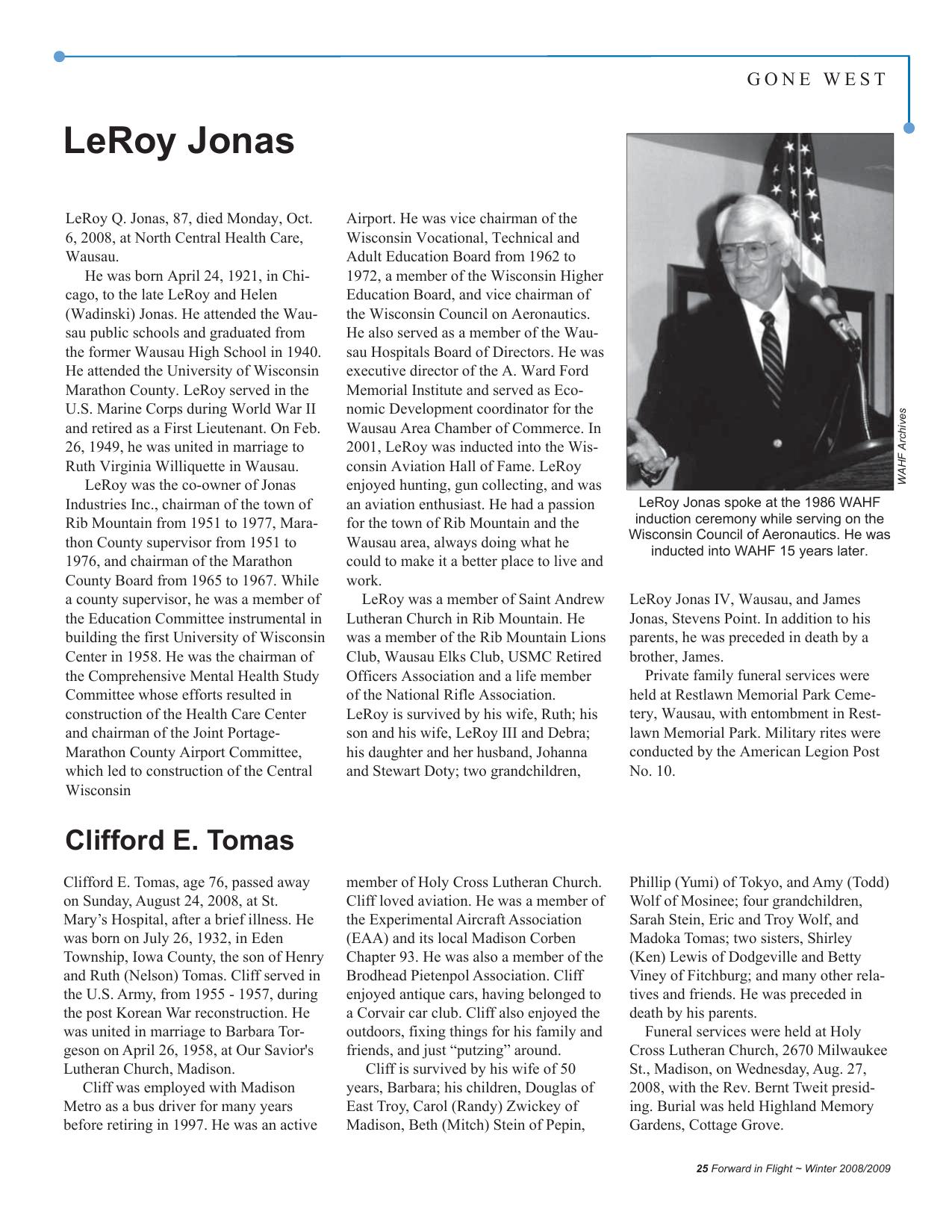
GONE WEST LeRoy Q. Jonas, 87, died Monday, Oct. 6, 2008, at North Central Health Care, Wausau. He was born April 24, 1921, in Chicago, to the late LeRoy and Helen (Wadinski) Jonas. He attended the Wausau public schools and graduated from the former Wausau High School in 1940. He attended the University of Wisconsin Marathon County. LeRoy served in the U.S. Marine Corps during World War II and retired as a First Lieutenant. On Feb. 26, 1949, he was united in marriage to Ruth Virginia Williquette in Wausau. LeRoy was the co-owner of Jonas Industries Inc., chairman of the town of Rib Mountain from 1951 to 1977, Marathon County supervisor from 1951 to 1976, and chairman of the Marathon County Board from 1965 to 1967. While a county supervisor, he was a member of the Education Committee instrumental in building the first University of Wisconsin Center in 1958. He was the chairman of the Comprehensive Mental Health Study Committee whose efforts resulted in construction of the Health Care Center and chairman of the Joint PortageMarathon County Airport Committee, which led to construction of the Central Wisconsin Airport. He was vice chairman of the Wisconsin Vocational, Technical and Adult Education Board from 1962 to 1972, a member of the Wisconsin Higher Education Board, and vice chairman of the Wisconsin Council on Aeronautics. He also served as a member of the Wausau Hospitals Board of Directors. He was executive director of the A. Ward Ford Memorial Institute and served as Economic Development coordinator for the Wausau Area Chamber of Commerce. In 2001, LeRoy was inducted into the Wisconsin Aviation Hall of Fame. LeRoy enjoyed hunting, gun collecting, and was an aviation enthusiast. He had a passion for the town of Rib Mountain and the Wausau area, always doing what he could to make it a better place to live and work. LeRoy was a member of Saint Andrew Lutheran Church in Rib Mountain. He was a member of the Rib Mountain Lions Club, Wausau Elks Club, USMC Retired Officers Association and a life member of the National Rifle Association. LeRoy is survived by his wife, Ruth; his son and his wife, LeRoy III and Debra; his daughter and her husband, Johanna and Stewart Doty; two grandchildren, WAHF Archives LeRoy Jonas LeRoy Jonas spoke at the 1986 WAHF induction ceremony while serving on the Wisconsin Council of Aeronautics. He was inducted into WAHF 15 years later. LeRoy Jonas IV, Wausau, and James Jonas, Stevens Point. In addition to his parents, he was preceded in death by a brother, James. Private family funeral services were held at Restlawn Memorial Park Cemetery, Wausau, with entombment in Restlawn Memorial Park. Military rites were conducted by the American Legion Post No. 10. Clifford E. Tomas Clifford E. Tomas, age 76, passed away on Sunday, August 24, 2008, at St. Mary’s Hospital, after a brief illness. He was born on July 26, 1932, in Eden Township, Iowa County, the son of Henry and Ruth (Nelson) Tomas. Cliff served in the U.S. Army, from 1955 - 1957, during the post Korean War reconstruction. He was united in marriage to Barbara Torgeson on April 26, 1958, at Our Savior's Lutheran Church, Madison. Cliff was employed with Madison Metro as a bus driver for many years before retiring in 1997. He was an active member of Holy Cross Lutheran Church. Cliff loved aviation. He was a member of the Experimental Aircraft Association (EAA) and its local Madison Corben Chapter 93. He was also a member of the Brodhead Pietenpol Association. Cliff enjoyed antique cars, having belonged to a Corvair car club. Cliff also enjoyed the outdoors, fixing things for his family and friends, and just “putzing” around. Cliff is survived by his wife of 50 years, Barbara; his children, Douglas of East Troy, Carol (Randy) Zwickey of Madison, Beth (Mitch) Stein of Pepin, Phillip (Yumi) of Tokyo, and Amy (Todd) Wolf of Mosinee; four grandchildren, Sarah Stein, Eric and Troy Wolf, and Madoka Tomas; two sisters, Shirley (Ken) Lewis of Dodgeville and Betty Viney of Fitchburg; and many other relatives and friends. He was preceded in death by his parents. Funeral services were held at Holy Cross Lutheran Church, 2670 Milwaukee St., Madison, on Wednesday, Aug. 27, 2008, with the Rev. Bernt Tweit presiding. Burial was held Highland Memory Gardens, Cottage Grove. 25 Forward in Flight ~ Winter 2008/2009
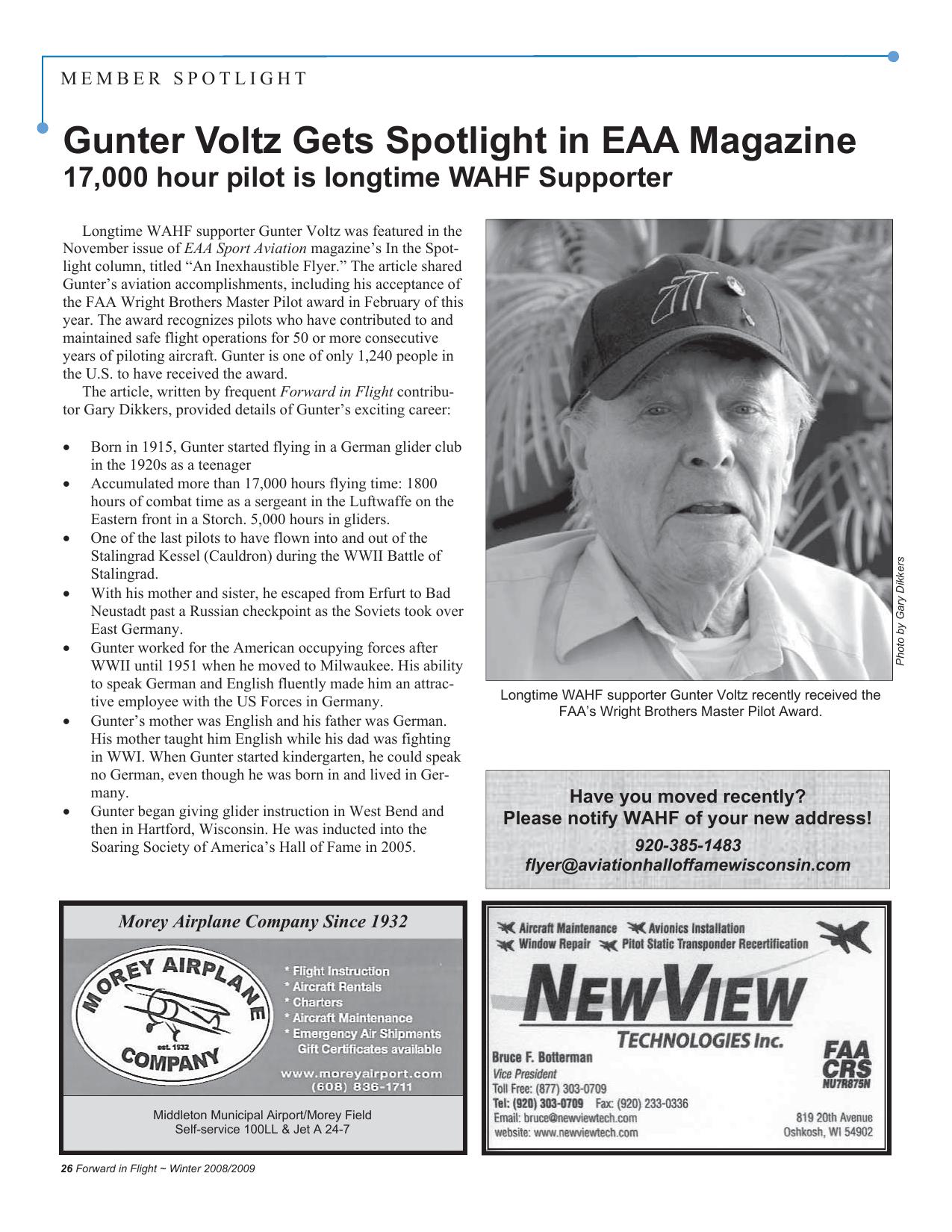
MEMBER SPOTLIGHT Gunter Voltz Gets Spotlight in EAA Magazine 17,000 hour pilot is longtime WAHF Supporter • • • • • • • Born in 1915, Gunter started flying in a German glider club in the 1920s as a teenager Accumulated more than 17,000 hours flying time: 1800 hours of combat time as a sergeant in the Luftwaffe on the Eastern front in a Storch. 5,000 hours in gliders. One of the last pilots to have flown into and out of the Stalingrad Kessel (Cauldron) during the WWII Battle of Stalingrad. With his mother and sister, he escaped from Erfurt to Bad Neustadt past a Russian checkpoint as the Soviets took over East Germany. Gunter worked for the American occupying forces after WWII until 1951 when he moved to Milwaukee. His ability to speak German and English fluently made him an attractive employee with the US Forces in Germany. Gunter’s mother was English and his father was German. His mother taught him English while his dad was fighting in WWI. When Gunter started kindergarten, he could speak no German, even though he was born in and lived in Germany. Gunter began giving glider instruction in West Bend and then in Hartford, Wisconsin. He was inducted into the Soaring Society of America’s Hall of Fame in 2005. Morey Airplane Company Since 1932 Middleton Municipal Airport/Morey Field Self-service 100LL & Jet A 24-7 26 Forward in Flight ~ Winter 2008/2009 Photo by Gary Dikkers Longtime WAHF supporter Gunter Voltz was featured in the November issue of EAA Sport Aviation magazine’s In the Spotlight column, titled “An Inexhaustible Flyer.” The article shared Gunter’s aviation accomplishments, including his acceptance of the FAA Wright Brothers Master Pilot award in February of this year. The award recognizes pilots who have contributed to and maintained safe flight operations for 50 or more consecutive years of piloting aircraft. Gunter is one of only 1,240 people in the U.S. to have received the award. The article, written by frequent Forward in Flight contributor Gary Dikkers, provided details of Gunter’s exciting career: Longtime WAHF supporter Gunter Voltz recently received the FAA’s Wright Brothers Master Pilot Award. Have you moved recently? Please notify WAHF of your new address! 920-385-1483 flyer@aviationhalloffamewisconsin.com
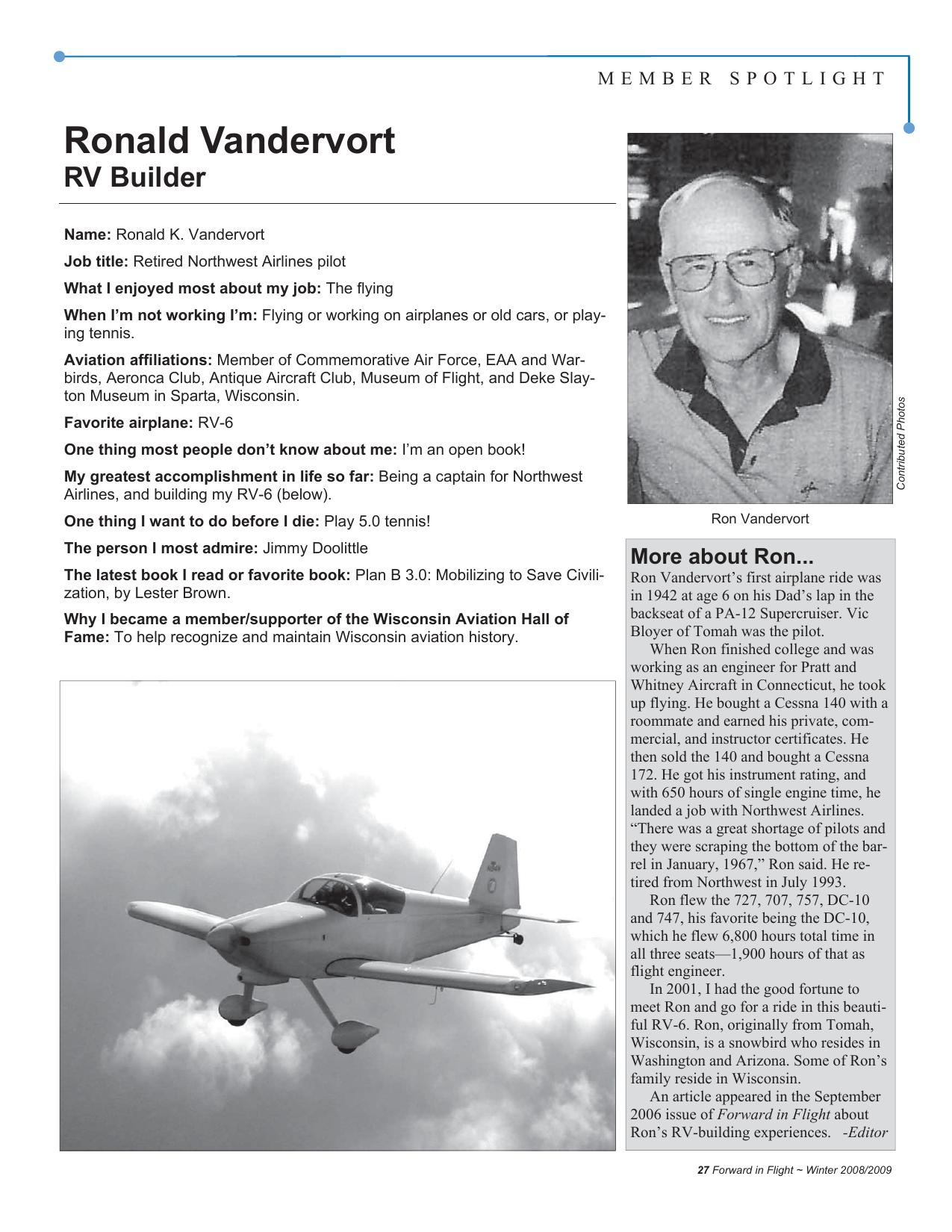
MEMBER SPOTLIGHT Ronald Vandervort RV Builder Name: Ronald K. Vandervort Job title: Retired Northwest Airlines pilot What I enjoyed most about my job: The flying When I’m not working I’m: Flying or working on airplanes or old cars, or playing tennis. Contributed Photos Aviation affiliations: Member of Commemorative Air Force, EAA and Warbirds, Aeronca Club, Antique Aircraft Club, Museum of Flight, and Deke Slayton Museum in Sparta, Wisconsin. Favorite airplane: RV-6 One thing most people don’t know about me: I’m an open book! My greatest accomplishment in life so far: Being a captain for Northwest Airlines, and building my RV-6 (below). One thing I want to do before I die: Play 5.0 tennis! The person I most admire: Jimmy Doolittle The latest book I read or favorite book: Plan B 3.0: Mobilizing to Save Civilization, by Lester Brown. Why I became a member/supporter of the Wisconsin Aviation Hall of Fame: To help recognize and maintain Wisconsin aviation history. Ron Vandervort More about Ron... Ron Vandervort’s first airplane ride was in 1942 at age 6 on his Dad’s lap in the backseat of a PA-12 Supercruiser. Vic Bloyer of Tomah was the pilot. When Ron finished college and was working as an engineer for Pratt and Whitney Aircraft in Connecticut, he took up flying. He bought a Cessna 140 with a roommate and earned his private, commercial, and instructor certificates. He then sold the 140 and bought a Cessna 172. He got his instrument rating, and with 650 hours of single engine time, he landed a job with Northwest Airlines. “There was a great shortage of pilots and they were scraping the bottom of the barrel in January, 1967,” Ron said. He retired from Northwest in July 1993. Ron flew the 727, 707, 757, DC-10 and 747, his favorite being the DC-10, which he flew 6,800 hours total time in all three seats—1,900 hours of that as flight engineer. In 2001, I had the good fortune to meet Ron and go for a ride in this beautiful RV-6. Ron, originally from Tomah, Wisconsin, is a snowbird who resides in Washington and Arizona. Some of Ron’s family reside in Wisconsin. An article appeared in the September 2006 issue of Forward in Flight about Ron’s RV-building experiences. -Editor 27 Forward in Flight ~ Winter 2008/2009
FROM THE AIRWAYS Aviation News WAI Selects 2009 Pioneer Hall of Fame Inductees Women in Aviation, International will welcome five new inductees into its Pioneer Hall of Fame during the closing banquet at its 20th annual Women in Aviation, International Conference in Atlanta. The Pioneer Hall of Fame Inductees for 2009 are Jacqueline Cochran, the first woman to break the sound barrier; Patricia Malone, a veteran of Delta Airline’s Pilot Ground Training program; Ruth Nichols, a record setting flyer and founder of Relief Wings; Dawn Seymour, the first woman accepted into the Civilian Pilot Training Program (CPTP) and a member of the Women Airforce Service Pilots; and Anna Timofeyeva-Yegorova, a Soviet World War II combat pilot. The Women in Aviation, International Pioneer Hall of Fame was established in 1992 to honor women who have made significant contributions as record setters, pioneers, or innovators. The conference will be held February 26-28, 2009, at the Atlanta Hyatt Regency. Registration is available online at www.WAI.org/09conference. Track Student’s Flight Training in ‘Earning My Wings’ Video Blog EAA’s new “Earning My Wings” video blog is now available, as it follows one student pilot’s journey from beginning to checkride, plus everything in between on the way to a sport pilot certificate. EAA multimedia journalist Brady Lane shares his learning-to-fly experiences while taking instruction from Jason Blair, executive director of the National Association of Flight Instructors. Lane is receiving instruction in a Remos G-3, a light-sport aircraft offered by Remos Aircraft. The blog, at www.EAA.org/Wings features videos from each of Lane’s lessons recorded by in-cockpit cameras. The project also includes personal thoughts about his experiences and an area for viewers to post comments and questions. Wisconsin Aviation Has New Avionics Service Hangar Wisconsin Aviation, Inc., headquartered in Watertown, Wisconsin, has recently relocated its aircraft avionics department at its Madison, Wisconsin, location into a new 10,800-square-foot facility. The facility is still located on the east side of the Dane County Regional Airport. The new avionics hangar is colocated with two other hangars, now comprising the Technical Service Complex. In the complex, aircraft maintenance and avionics are side by side, providing one-stop service for any technical need. Together, some 21 experienced technical and support personnel are ready to solve mechanical or avionics problems. For more information call 800-594-5359 or visit www.WisconsinAviation.com. DR. TOM VOELKER Aviation Medical Examiner 2nd and 3rd Class Aviation Medicals Phone 715-423-0122 Aspirus Doctor’s Clinic 420 Dewey Street Wisconsin Rapids WI 54494 Located at Riverview East Medical Office Bldg. 28 Forward in Flight ~ Winter 2008/2009 Art Contest for Kids In 2009, air sport athletes will compete in the World Air Games, the largest air sports event in the world, in Turin, Italy. The June 7-13 event is organized under the auspices of the Fédération Aéronautique Internationale (FAI) and includes all air sports, from aerobatics to gliding to helicopters, from parachuting to hang-gliding, and more. The event is the theme of the 2009 International Aviation Art Contest, sponsored by the National Aeronautic Association and the National Association of State Aviation Officials: “Create a Poster for the World Air Games.” Three age groups are eligible: Ages 6 to 9; ages 10 to 13; and ages 14 to 17. Mail entries (by January 16, 2009) to: Wisconsin Department of Transportation, Bureau of Aeronautics, PO Box 7914, Madison WI 53707-7914. Contact Karen Valley at 608266-8166 to learn more. For more information about the World Air Games, visit www.WorldAirGames.org/2009.
FROM THE AIRWAYS Hey KidsWant to build an airplane? 88CHARLIES is a new organization that has been formed with a goal giving students an opportunity to apply what they have learned in school to restoring real airplanes under the guidance of experienced mechanics and pilots. The Palmyra, Wisconsin, airport community formed the non-profit organization so that students will be exposed to the practical applications of science, technology, engineering, and mathematics. As a bonus, flight lessons will be made available in exchange for the hours worked on the project. The first project will be the restoration of a 1940 Porterfield. The program is open to ages 12 through 18; parents are encouraged to participate in the program. There is no cost and no obligation for the students or parents participating in this project. 88CHARLIES (the Palmyra Municipal Airport identifier - 88C) is looking for volunteers to mentor the students in the restoration of this aircraft. Donations of serviceable aircraft tools, supplies, and manuals are welcome and tax deductible. For more information contact Steve Sorge at 262-594-2226 or visit www.88Charlies.com. Recommended Reading Why They Fly: Nine Women, Nine Stories A Hunger for the Sky features the personal stories of nine women who are irresistibly drawn to the sky. Authored by Sparky Barnes Sargent, each chapter is devoted to one woman, including a professional skywriter, a DC-3 captain, an owner of an aerobatic school, and more. Learn who these women were as young girls, follow them into adulthood, share their attraction to aviation, and discover the skyways they have chosen. The 232-page paperback book includes nearly 200 black and white photographs. To order, write to DGA Enterprises, Inc., P.O. Box 649, Washington, OK 73093-0649, or visit http://home.windstream.net/av8terz/book.html. Aviation Adventure for Kids George Weinstein has written a motivational adventure story for kids. Jake and the Tiger Flight is a fictional story about 12-year-old Jake Skyler, who becomes obsessed with the twin-tailed, tiger-striped airplanes flown by the real-life Tiger Flight Formation Flight Team. Jake dreams of flying, but to make his dream a reality, he must learn focus and self-discipline. Jake and the Tiger Flight is the first in a series of aviation themed motivational adventure stories for youth. After reading the book, kids can take part in a two-step plan to earn an official Tiger Flight patch just like the pilots wear. To order visit www.JakeAndTheTigerFlight.com or www.TigerFlightFoundation.org. Christmas Reading… F rederick Forsyth’s book The Shepherd makes great Christmas Eve reading for any aviator. This very short novel is set on Christmas Eve, 1957, as a young RAF pilot takes off from Germany in a DeHavilland Vampire, headed for home in England. Out over the North Sea what should be a very routine flight begins to go terribly wrong and our pilot may be forced to bail out into the dark, icy waters below...but he is saved by a “Shepherd!” It’s a terrific tale—read it to your kids! Forsyth is the author of several bestsellers including The Odessa File, Day of the Jackal and The Dogs of War. He was also one of the RAF’s youngest pilots ever. Published in 1975, The Shepherd can be found at your library, used book store, or on E-Bay. —Frederick Beseler Merry Christmas - Happy New Year from the Wisconsin Aviation Hall of Fame 29 Forward in Flight ~ Winter 2008/2009
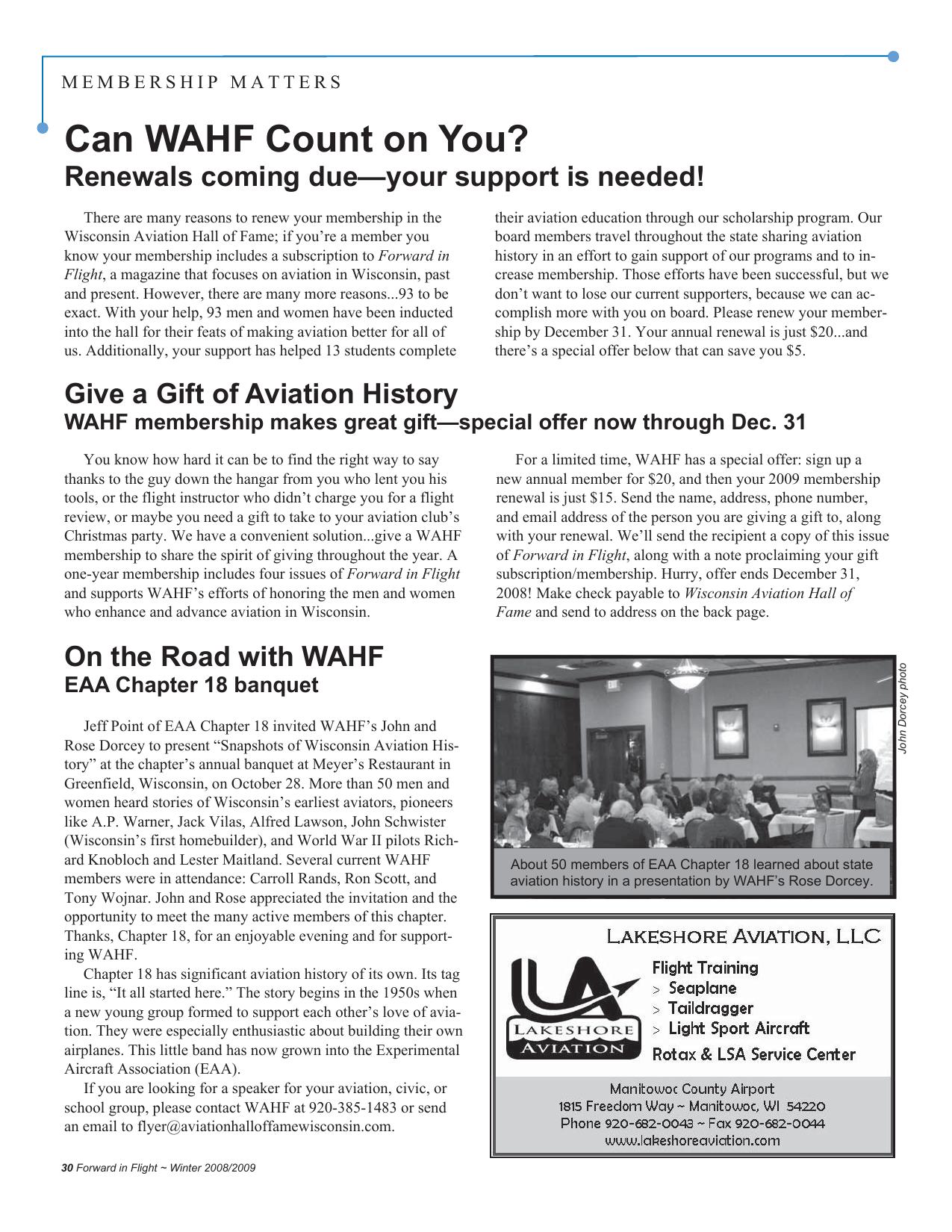
MEMBERSHIP MATTERS Can WAHF Count on You? Renewals coming due—your support is needed! There are many reasons to renew your membership in the Wisconsin Aviation Hall of Fame; if you’re a member you know your membership includes a subscription to Forward in Flight, a magazine that focuses on aviation in Wisconsin, past and present. However, there are many more reasons...93 to be exact. With your help, 93 men and women have been inducted into the hall for their feats of making aviation better for all of us. Additionally, your support has helped 13 students complete their aviation education through our scholarship program. Our board members travel throughout the state sharing aviation history in an effort to gain support of our programs and to increase membership. Those efforts have been successful, but we don’t want to lose our current supporters, because we can accomplish more with you on board. Please renew your membership by December 31. Your annual renewal is just $20...and there’s a special offer below that can save you $5. Give a Gift of Aviation History WAHF membership makes great gift—special offer now through Dec. 31 You know how hard it can be to find the right way to say thanks to the guy down the hangar from you who lent you his tools, or the flight instructor who didn’t charge you for a flight review, or maybe you need a gift to take to your aviation club’s Christmas party. We have a convenient solution...give a WAHF membership to share the spirit of giving throughout the year. A one-year membership includes four issues of Forward in Flight and supports WAHF’s efforts of honoring the men and women who enhance and advance aviation in Wisconsin. For a limited time, WAHF has a special offer: sign up a new annual member for $20, and then your 2009 membership renewal is just $15. Send the name, address, phone number, and email address of the person you are giving a gift to, along with your renewal. We’ll send the recipient a copy of this issue of Forward in Flight, along with a note proclaiming your gift subscription/membership. Hurry, offer ends December 31, 2008! Make check payable to Wisconsin Aviation Hall of Fame and send to address on the back page. John Dorcey photo On the Road with WAHF EAA Chapter 18 banquet Jeff Point of EAA Chapter 18 invited WAHF’s John and Rose Dorcey to present “Snapshots of Wisconsin Aviation History” at the chapter’s annual banquet at Meyer’s Restaurant in Greenfield, Wisconsin, on October 28. More than 50 men and women heard stories of Wisconsin’s earliest aviators, pioneers like A.P. Warner, Jack Vilas, Alfred Lawson, John Schwister (Wisconsin’s first homebuilder), and World War II pilots Richard Knobloch and Lester Maitland. Several current WAHF members were in attendance: Carroll Rands, Ron Scott, and Tony Wojnar. John and Rose appreciated the invitation and the opportunity to meet the many active members of this chapter. Thanks, Chapter 18, for an enjoyable evening and for supporting WAHF. Chapter 18 has significant aviation history of its own. Its tag line is, “It all started here.” The story begins in the 1950s when a new young group formed to support each other’s love of aviation. They were especially enthusiastic about building their own airplanes. This little band has now grown into the Experimental Aircraft Association (EAA). If you are looking for a speaker for your aviation, civic, or school group, please contact WAHF at 920-385-1483 or send an email to flyer@aviationhalloffamewisconsin.com. 30 Forward in Flight ~ Winter 2008/2009 About 50 members of EAA Chapter 18 learned about state aviation history in a presentation by WAHF’s Rose Dorcey.
MEMBER’S LOGBOOK Colbert’s Influence Wolf recalls talks with educator As I was paging through the Fall 2008 issue of Forward in Flight, my eye caught an article that was written by Duane Esse, “Faithful Servant, Faithful Friend.” What a coincidence. I was just talking to my wife and some of my students the other day about Ed Colbert, the gentleman Duane wrote about. Ed Colbert was my drafting instructor at West High when I was a senior. I had many long talks with him because like a lot of kids my age, I was not sure what I wanted to do for a career. I thought about being an architect but my math skills were not what they should be. He suggested that I should look into becoming an industrial education instructor. He put me in touch with Carl Rueter who had just graduated from Platteville in that area. I visited the school and the rest is history. If it wasn’t for him I would not be where I am today. I have always wondered what happened to him and I have always wanted to thank him. After reading this article, maybe I still have that chance. I remember Ed telling the class about how he got into the Navy and what he did to pass the height requirement...truly an interesting story. I never realized how much my dad, Fritz, and Ed had in common. Hopefully in the near future Ed and I can talk about these things. I also want to thank you for putting me in the member spotlight in your magazine. How ironic it is that Ed Colbert’s article appeared the same time as me. Thanks very much! Rick Wolf Sun Prairie, Wisconsin Ask your friends to become WAHF supporters. Give them the form below, or visit: www.aviationhalloffamewisconsin.com Advertise in Forward In Flight... Call 920-385-1483 or email flyer@aviationhalloffamewisconsin.com Subscribe to Forward…in Flight today! (Annual subscription includes one-year WAHF membership) Membership Benefits: Quarterly subscription (4 issues) of Forward in Flight, packed full of Wisconsin aviation news, events, state aviation history, and stories about your aviation colleagues Free pass to Deke Slayton Museum Invitation to annual induction banquet The opportunity to nominate aviation leaders for induction! Name Address City State Zip Phone Number Email Address Referred By Just $20, and you’ll be supporting an aviation organization dedicated to collecting, preserving, and sharing Wisconsin’s aviation history. With Forward in Flight, you’ll learn about aviation history makers—the people, places, and happenings that distinguish our state and also be in touch with current Wisconsin aviation news and events! This form can be used for renewals, as well. Send your check today! Please write check to: Wisconsin Aviation Hall of Fame, Inc. Mail to: John Dorcey, Treasurer Wisconsin Aviation Hall of Fame 3980 Sharratt Drive Oshkosh WI 54901-1276 Great Gift! 31 Forward in Flight ~ Winter 2008/2009
PRSRT STD US Postage Paid Wisc Rapids WI Permit 98 WISCONSIN AVIATION HALL OF FAME 3980 SHARRATT DRIVE OSHKOSH WI 54901-1276 Preserving Wisconsin’s Aviation History Return Service Requested Welcome New Members: Dee Becker Jeff Point —Thanks for coming on board! Congratulations to the La Crosse Municipal Airport (LSE) for receiving FAA’s 2008 safety award for the Great Lakes region, beating out 94 other commercial airports in cities including Chicago, Detroit, and Minneapolis. Airport Manager Dan Wruck credits a recently completed construction project for the award. The project extended a taxiway and separated two runways. Build-A-Plane is sponsoring a youth art competition where kids can compete to design the winning paint scheme for a Glasair Sportsman 2+2. The winner’s paint design will be applied to the aircraft. For more information, visit http://BuildAPlane.org. To learn about a Wisconsin aviation art competition for youth, see page 28. A new 2009 desktop calendar shares daily stories of the remarkable aviation accomplishments of female aviators. Visit www.PowderPuffPilot.com to order. Events: Don’t miss the Wausau Downtown Airport (AUW) Chili Fly-In on January 31 from 11:00 a.m. until the chili is gone. Wheels and skis welcome. Call ahead for snow conditions. 715-845-3400. Learn more at www.FlyWausau.com. Women in Aviation Conference Hyatt Regency Atlanta in Atlanta, Georgia, 20th Anniversary Conference. February 2628, 2009. Visit www.wai.org for more information. Wisconsin Aviation Conference May 4-6, 2009. Ramada Inn Convention Center, Eau Claire, Wisconsin. Learn more at www.wiama.org. Wisconsin Aviation Hall of Fame Officers and Board of Directors Rose Dorcey, President Michael Goc, Vice President John Dorcey, Secretary/Treasurer Duane Esse Keith Glasshof Tom Thomas Charles Swain LaFonda Kinnaman Staber “Bill” Reese Charles Marotske, Honorary Chairman of the Board Wisconsin Aviation Hall of Fame 3980 Sharratt Drive Oshkosh WI 54901-1276 Become a supporter today! For information call Rose Dorcey at 920-385-1483 www.aviationhalloffamewisconsin.com rosesroses@new.rr.com