Volume 8, Issue 4
🗞️ Download Issue (PDF)
Forward in Flight Winter 2010
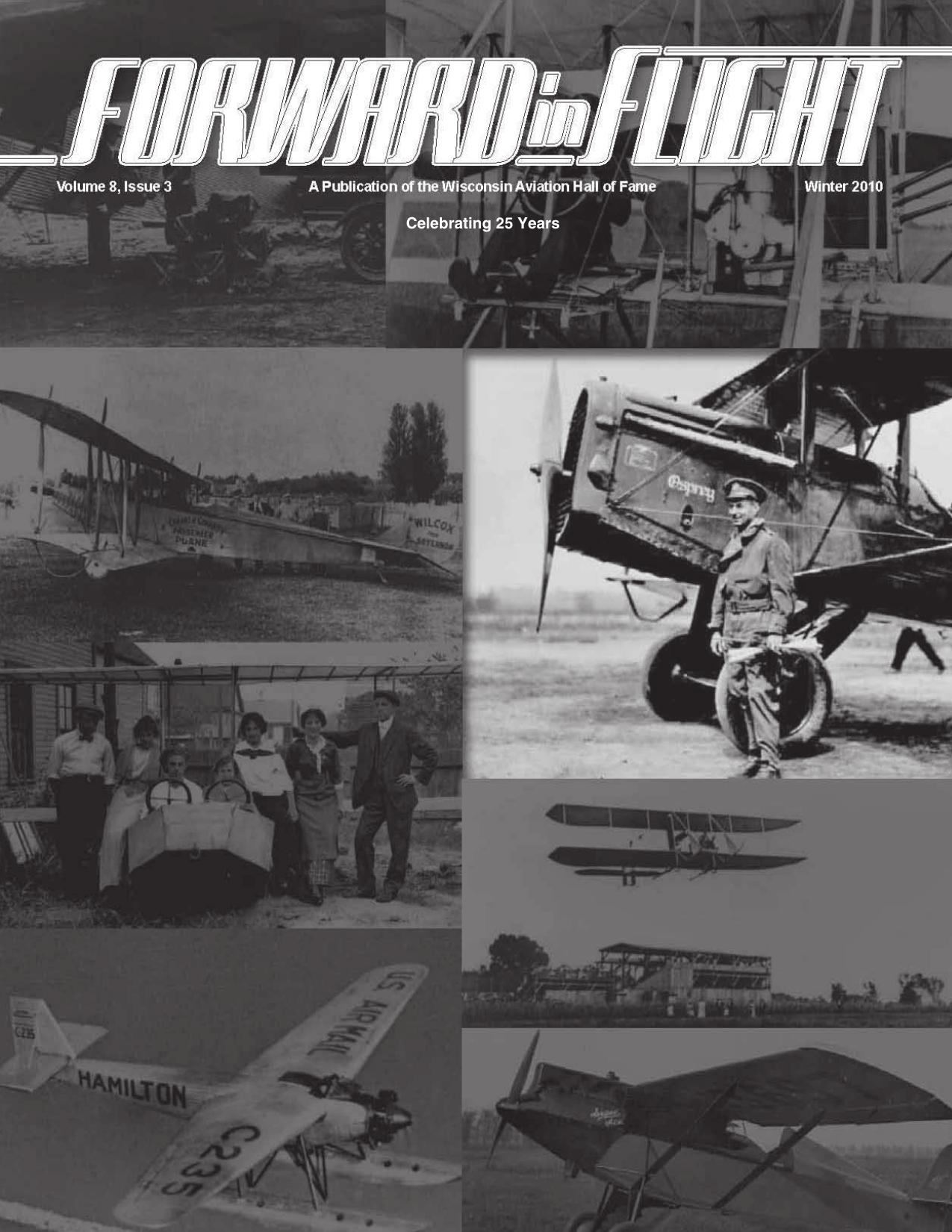
Celebrating 25 Years
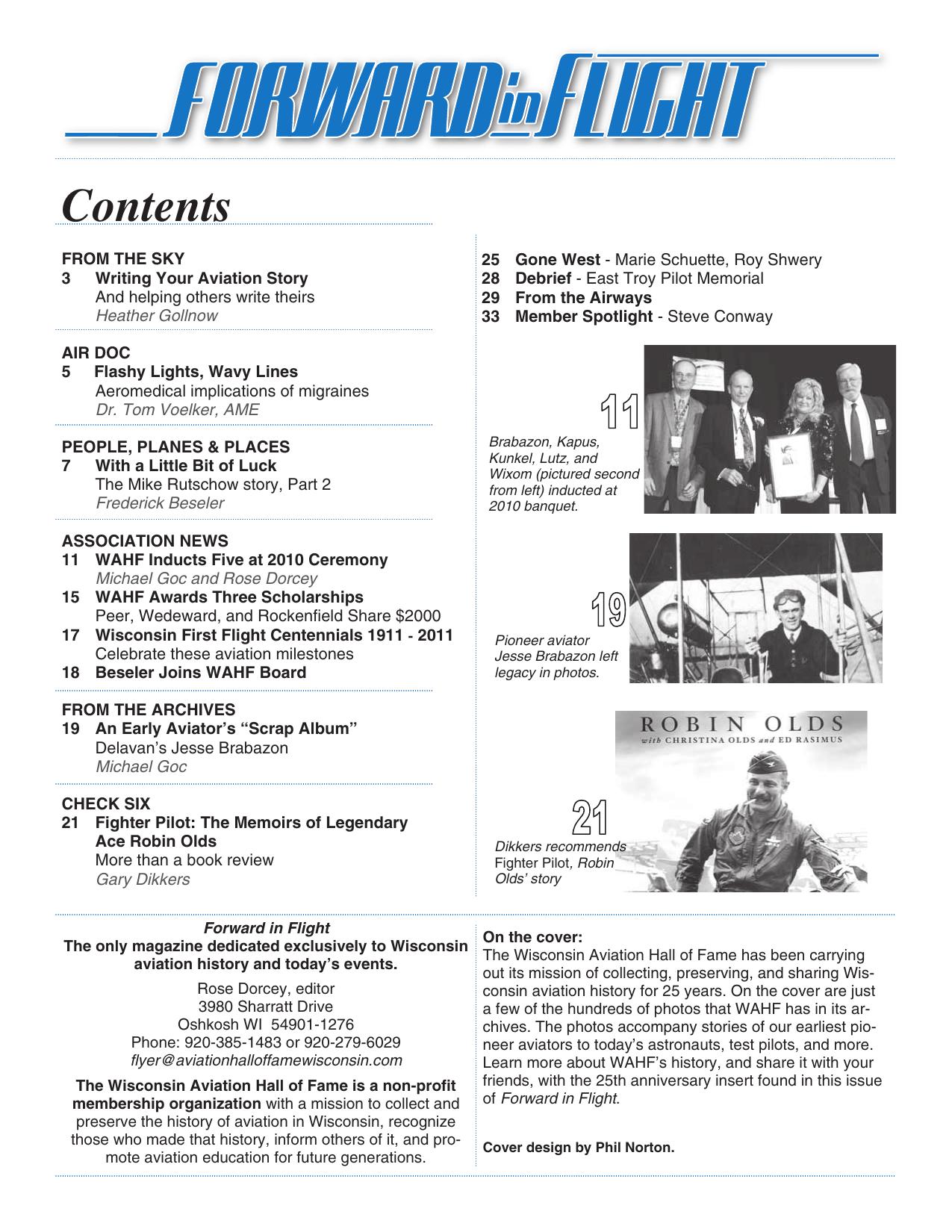
Contents FROM THE SKY 3 Writing Your Aviation Story And helping others write theirs Heather Gollnow 25 28 29 33 Gone West - Marie Schuette, Roy Shwery Debrief - East Troy Pilot Memorial From the Airways Member Spotlight - Steve Conway AIR DOC 5 Flashy Lights, Wavy Lines Aeromedical implications of migraines Dr. Tom Voelker, AME PEOPLE, PLANES & PLACES 7 With a Little Bit of Luck The Mike Rutschow story, Part 2 Frederick Beseler Brabazon, Kapus, Kunkel, Lutz, and Wixom (pictured second from left) inducted at 2010 banquet. ASSOCIATION NEWS 11 WAHF Inducts Five at 2010 Ceremony Michael Goc and Rose Dorcey 15 WAHF Awards Three Scholarships Peer, Wedeward, and Rockenfield Share $2000 17 Wisconsin First Flight Centennials 1911 - 2011 Celebrate these aviation milestones 18 Beseler Joins WAHF Board Pioneer aviator Jesse Brabazon left legacy in photos. FROM THE ARCHIVES 19 An Early Aviator’s “Scrap Album” Delavan’s Jesse Brabazon Michael Goc CHECK SIX 21 Fighter Pilot: The Memoirs of Legendary Ace Robin Olds More than a book review Gary Dikkers Dikkers recommends Fighter Pilot, Robin Olds’ story Forward in Flight On the cover: The only magazine dedicated exclusively to Wisconsin The Wisconsin Aviation Hall of Fame has been carrying aviation history and today’s events. out its mission of collecting, preserving, and sharing WisRose Dorcey, editor consin aviation history for 25 years. On the cover are just 3980 Sharratt Drive a few of the hundreds of photos that WAHF has in its arOshkosh WI 54901-1276 chives. The photos accompany stories of our earliest pioPhone: 920-385-1483 or 920-279-6029 neer aviators to today’s astronauts, test pilots, and more. flyer@aviationhalloffamewisconsin.com Learn more about WAHF’s history, and share it with your friends, with the 25th anniversary insert found in this issue The Wisconsin Aviation Hall of Fame is a non-profit membership organization with a mission to collect and of Forward in Flight. preserve the history of aviation in Wisconsin, recognize those who made that history, inform others of it, and pro- Cover design by Phil Norton. mote aviation education for future generations.
President’s Message ~ by Rose Dorcey T omorrow is Thanksgiving and John and I will be making our annual trip to my sister’s house in Rudolph, Wisconsin. While we’re there, we’ll no doubt express our thankfulness for the blessings of a large family that respects and gets along well with each other, while at the same time missing those who can’t be with us. Today, as I’m finishing this issue of Forward in Flight, I have similar feelings of thankfulness. WAHF is now 25 years old. The organization has been carrying out its mission for a quarter of a century. As I’ve looked back over WAHF’s history, I couldn’t help but be thankful for the work of our predecessors, especially that of our founder, Carl Guell. I wish he could be here to see the dedication of today’s board, who work diligently to carry on the work that he and the founding board members started in 1985. I think I can speak for all of our board members in saying that we honor the important legacy they created of honoring those who contribute greatly to the growth of aviation in our state, and that we take their mission statement very seriously. Today’s WAHF board is equally dedicated. I’m proud and thankful to work with each of them: Duane Esse, Rich Fischler, Michael Goc, LaFonda Kinnaman, John Dorcey, Bill Reese, Chuck Swain, Tom Thomas, and our honorary chairman of the board, and founding board member, Charles Marotske. LaFonda Kinnaman has been on the WAHF board for some 22 years, but in October LaFonda announced that it was time to step down. She will be missed, but we’re glad to know that she intends to continue her support of WAHF in other ways, and we look forward to working with her. Bill Reese, who has served for six years, has also stepped down. Residing in Minocqua, it was becoming increasingly difficult for Bill to attend board meetings, but we’re happy to know that he’ll continue to ring WAHF’s bell in the Northwoods. With Bill’s departure, Frederick Beseler was elected to the board at our October meeting. (Read more on page 18.) Both LaFonda and Bill were great assets on the board and they’ll be missed, and I’m happy to have had the opportunity to get to know them. In addition to the WAHF board of directors, I am so thankful for Rose Dorcey the wonderful writers who leave their mark in this publication with their professional articles. As Forward in Flight continues to grow, we must thank them, for without their efforts, you wouldn’t be reading so many fine articles. Gary Dikkers, Frederick Beseler, Dr. Tom Voelker, Michael Goc, Tom Thomas, Duane Esse, and in this issue, Heather Gollnow, spend a lot of time researching and writing their stories so that we can enjoy and learn from them in this magazine. Several of them have won awards for their outstanding work and we’re privileged to have them as a part of the Forward in Flight team. In this issue, you’ll find a commemorative 25th anniversary insert. This publication highlights the achievements of our inductees and the accomplishments WAHF has made in its short history. Michael Goc put together a fine history of the organization, and in his humble way, left out details about the important role he played in the realization of several WAHF goals. As an editor, it was a pleasure to rewrite it a bit so that all WAHF members would learn of his contributions. The 25th anniversary publication wouldn’t have been possible without those who placed ads in this issue, including Aircraft Propeller Service, Becher Hoppe, Central Wisconsin Airport (CWA), Mitchell Gallery of Flight, the Wisconsin Airport Management Association, and the Wisconsin Business Aviation Association. These advertisers, in addition to our regulars: Beaver Aviation, Jet Room Restaurant, Lakeshore Aviation, Mead & Hunt, Morey Airplane Co., NewView Technologies, Rapco, Dr. Tom Voelker, Wisconsin Aviation, and the Wisconsin Concrete Pavement Association, help defray the costs of your membership and of printing this publication each quarter. Please think of these advertisers when you’re in need of their products/services, and be thankful for their support of WAHF. And also be thankful for your family, friends, and all the WAHF board members who have served in the last 25 years. Morey Airplane Company Since 1932 Middleton Municipal Airport/Morey Field Self-service 100LL & Jet A 24-7 2 Forward in Flight ~ Winter 2010
FROM THE SKY Writing Your Own Aviation Story And helping others write theirs By Heather Gollnow N o one in my family is a pilot. There is no “my dad was a pilot” or “I grew up at the airport” kind of story in my past. As a young girl with a thirst for adventure, I went on a kindergarten field trip to Clintonville Municipal Airport (KCLI). That day would affect the rest of my life. As a Cessna 172 came in for a landing, several of us pressed our small hands and faces to the window in the FBO to watch the most awesome thing in the world. I fell in love with airplanes that moment. I had to break this little girl’s heart and tell her we could When I came home from school that spring day, I was not go flying even though it was a clear, sunny day. She obsessed with airplanes and made sure my mother knew it. Her boyfriend at the time had taken a few flying lessons cried. I cried inside. It was the toughest no-go decision and he offered to take me to the EAA Convention and FlyI’ve ever had to make. in a few years later, in 1985. It was heaven! The Concorde —Heather Gollnow was beautiful. According to my mother, I caressed the airplanes and would not leave at the end of the day. “Threw a temper tantrum” were the words she used to explain my reaction to the news that it was time to go. As part of an aviation explorers group in junior high school, a group of about 10 teenagers who got together every other month or so, we visited the Outagamie County Regional Airport (KATW). We toured the FBO (the former KC Aviation), visited the control tower, and saw the airport operations area upstairs in the terminal. I always looked forward to that day and would not have missed it for the world. My first flying lesson was in 1997, a week before I turned 20. I was finally doing what I had dreamed about for the past 15 years. When I passed my checkride four months later, I celebrated with two good friends over pancakes at Big Boy. I worked line service at an FBO for a few years in college, just so I could be around airplanes. I later went on to become a commercial pilot and certificated flight instructor (CFI). I now instruct part-time and love every minute of it. I was lucky for a number of things: the field trip back in 1982, having a mother who was dating a man who wanted to give me a day of nothing but airplanes, and that I lived only 20 miles away from the headquarters of the Experimental Aircraft Association. I was lucky to have people in my life to encourage me to follow a childhood dream. My favorite part of aviation is introducing young children to this amazing world. I give presentations to groups of children and young adults, I show kids around the air3 Forward in Flight ~ Quarterly Magazine of the Wisconsin Aviation Hall of Fame
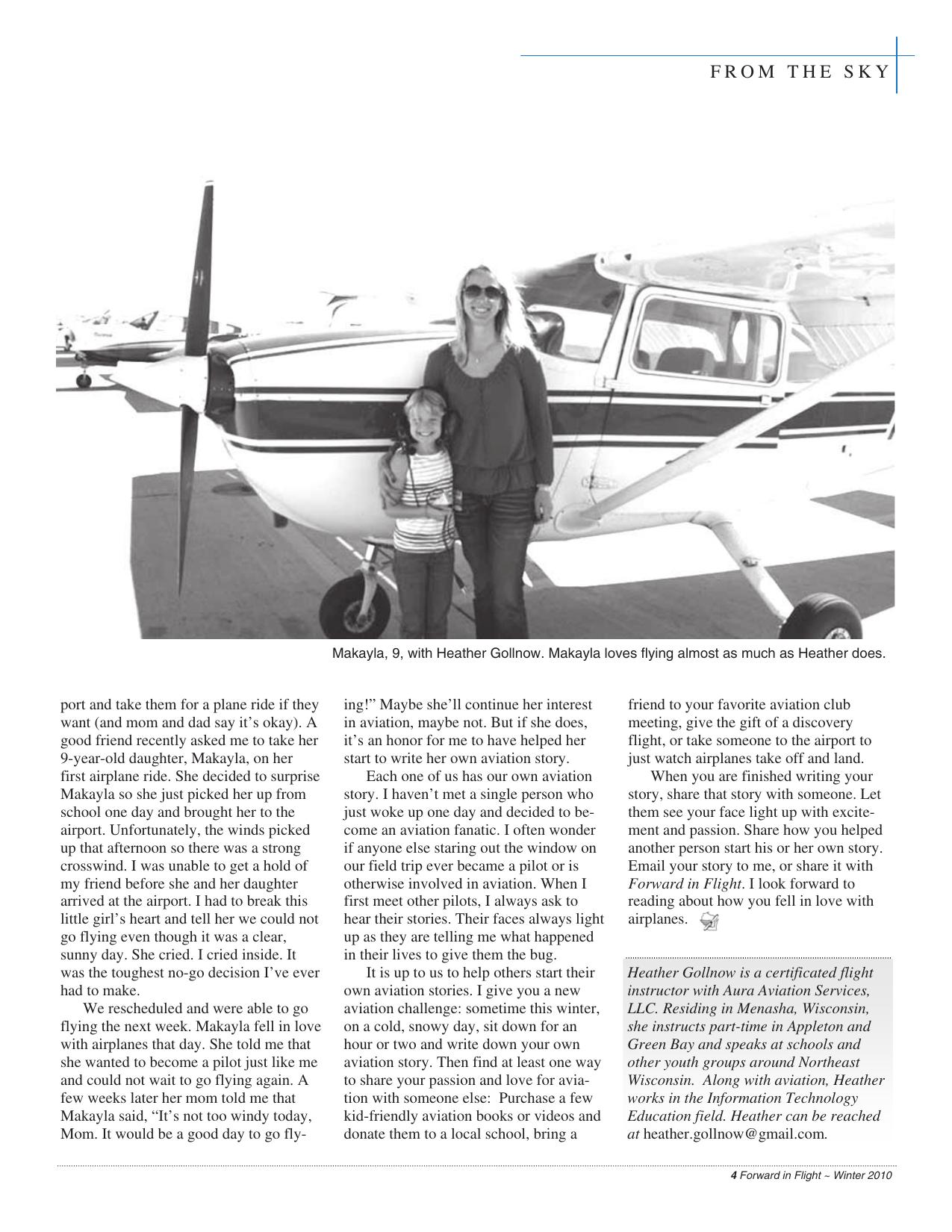
FROM THE SKY Makayla, 9, with Heather Gollnow. Makayla loves flying almost as much as Heather does. port and take them for a plane ride if they want (and mom and dad say it’s okay). A good friend recently asked me to take her 9-year-old daughter, Makayla, on her first airplane ride. She decided to surprise Makayla so she just picked her up from school one day and brought her to the airport. Unfortunately, the winds picked up that afternoon so there was a strong crosswind. I was unable to get a hold of my friend before she and her daughter arrived at the airport. I had to break this little girl’s heart and tell her we could not go flying even though it was a clear, sunny day. She cried. I cried inside. It was the toughest no-go decision I’ve ever had to make. We rescheduled and were able to go flying the next week. Makayla fell in love with airplanes that day. She told me that she wanted to become a pilot just like me and could not wait to go flying again. A few weeks later her mom told me that Makayla said, “It’s not too windy today, Mom. It would be a good day to go fly- ing!” Maybe she’ll continue her interest in aviation, maybe not. But if she does, it’s an honor for me to have helped her start to write her own aviation story. Each one of us has our own aviation story. I haven’t met a single person who just woke up one day and decided to become an aviation fanatic. I often wonder if anyone else staring out the window on our field trip ever became a pilot or is otherwise involved in aviation. When I first meet other pilots, I always ask to hear their stories. Their faces always light up as they are telling me what happened in their lives to give them the bug. It is up to us to help others start their own aviation stories. I give you a new aviation challenge: sometime this winter, on a cold, snowy day, sit down for an hour or two and write down your own aviation story. Then find at least one way to share your passion and love for aviation with someone else: Purchase a few kid-friendly aviation books or videos and donate them to a local school, bring a friend to your favorite aviation club meeting, give the gift of a discovery flight, or take someone to the airport to just watch airplanes take off and land. When you are finished writing your story, share that story with someone. Let them see your face light up with excitement and passion. Share how you helped another person start his or her own story. Email your story to me, or share it with Forward in Flight. I look forward to reading about how you fell in love with airplanes. Heather Gollnow is a certificated flight instructor with Aura Aviation Services, LLC. Residing in Menasha, Wisconsin, she instructs part-time in Appleton and Green Bay and speaks at schools and other youth groups around Northeast Wisconsin. Along with aviation, Heather works in the Information Technology Education field. Heather can be reached at heather.gollnow@gmail.com. 4 Forward in Flight ~ Winter 2010
AIR DOC Flashy Lights, Wavy Lines Aeromedical implications of migraines By Dr. Tom Voelker, AME DrAlphaMike@yahoo.com Hello again, airmen! Welcome to another edition of Air Doc, your gateway to aeromedical information. The cool of fall is definitely upon us, and with it, icing and those cold pre-flights. But the fall weather also brings great flying with outstanding visibility and terrific aircraft performance. I experienced half of a wonderful fall flight yesterday. It was a nice day. The preflight was no problem in the hangar, and there were mild winds out of the west. The Comanche leapt into the air and performance was great. The view, however, was terrible! The ceiling was unlimited, but the visibility couldn’t have been more than a few feet. How’s that, you ask? And what business did I have flying with only two or three feet of visibility? I was wearing foggles—practicing instrument approaches! My safety pilot told me the true visibility was fantastic— a wonderful day for flying. At one point during the flight, I found myself in need of some real glasses, not the frosted up foggle variety. The METAR weather report on my Garmin 396 GPS was in quite small print. I pulled a pair of reading glasses out of my flight bag. My third class medical certificate states the limitation “must have available glasses for near vision.” I always keep a pair of five-dollar “cheaters” in my flight bag so that I’m always “legal.” This was the first time I’ve used them in flight in a couple of years. I put on the glasses and I couldn’t read a thing! My first thought was, “what’s happening to my eyes?” Safety of flight didn’t enter my mind as I did have a safety pilot on board. I covered my left eye and everything was blurry. I covered my right eye, and I could see okay. With both eyes things were fuzzy, and I was getting a headache. Confused and concerned (but still complying with the number one rule of aviation—fly the airplane), I took off the glasses and I found the problem. One of the lenses had fallen out! Notice that I said my first thought was “what’s happening to my eyes?” The very next thought was that I was experiencing a migraine. I’ve never had a migraine, but I was concerned if that was what was happening, not just about the upcoming headache, but even more about what this would mean to my flying privileges. Let’s discuss the aeromedical implications of migraine headaches. NOT JUST A HEADACHE What is a migraine? A headache, right? Wrong! It’s the worst headache you could ever imagine. A friend of mine who gets these headaches all too frequently told me, “When a migraine hits, I 5 Forward in Flight ~ Quarterly Magazine of the Wisconsin Aviation Hall of Fame would give my firstborn to make it go away!” I think she was serious, and her son really isn’t a bad kid! Part of what makes migraines of interest to the FAA is the severity of the headache. They can be so severe that concentration can be difficult at best and impossible at worst. More important to the feds, however, are two other characteristics of migraines. They can come on suddenly and often unexpectedly. Moreover, the headache itself is often preceded by an aura, a constellation of symptoms that let the person know that a headache will be coming in the next 20 minutes or so. These symptoms are generally neurologic in nature, and therein lies the problem. The most common type of aura is an alteration in vision. Often this involves seeing flashing lights or wavy lines. These symptoms are usually on only one side of the vision, or one “visual field.” Not infrequently, though, the vision problem will be a complete loss of vision on one side or the other. You may recall that the NTSB recently determined that one contributor to a prominent accident was, as I remember, “the inherent limitation of ‘see and avoid’ in the prevention of midair collisions.” While I agree that in busy airspace it can be challenging to see all aircraft, and then avoid collisions, I think
AIR DOC If a migraine aura hits, however, and the pilot loses the entire left or right side of his or her vision, the process becomes simply “avoid!” we have generally done a good job of that. If a migraine aura hits, however, and the pilot loses the entire left or right side of his or her vision, the process becomes simply “avoid!” Now maybe you can see why the FAA has aeromedical concerns about airmen with a history of migraines! FULL DISCLOSURE So what is an airman with a history of migraines to do? First, be honest. I previously wrote of the consequences of falsifying the FAA medical application, the “form 8500-8.” While you may get away with hiding a serious medical condition, our friends in Oklahoma City have shown that if a dishonest applicant hides a condition that leads to or contributes to an accident, they will prosecute. And you may recall that the penalty can be up to a $250,000 fine, five years in prison, or both! When you do disclose your migrainous history to your AME, things will slow down a little bit. Your flight surgeon will ask questions about the nature of your migraines, including the type and severity of the aura. You may find it interesting that the aura can take on many other shapes than just abnormalities of vision. If you have hemiplegic migraines (fortunately a rare variety), when you are about to get your headache, half of your body goes limp, just as if you had experienced a stroke! I’ve seen patients with this condition, and at the time of the aura it is impossible to tell the difference between the hemiplegic migraine and a true stroke. If your migraines are of this variety, you might want to pursue another hobby. Your AME may also try to get records from your treating physician. He or she will also want to know what, if any, treatment you have had for your migraines. There are very good medications for the acute attack that can relieve the migraine, and other meds that are taken chronically to prevent the headaches in the first place. Some of these medications are allowed to take while flying and some are prohibited. After the exam and information gathering is completed, the AME might make a phone call. We AMEs have been instructed that we may not independently approve an airman’s medical certificate when there is a history of migraines. If it seems that the symptoms of the aura or the headache may compromise flight safety, your application will probably be deferred to the Aerospace Medical Certification Division (AMCD) in Oklahoma City. The AME sends in the application and any supporting information, and the FAA, along with their neurologic consultants, will evaluate the file. They will then contact you with an approval, a denial, or a request for more information. If the history is more complicated, or the migraines are severe and frequent, the application will be deferred. If the history is less concerning, however, the phone call occurs. For example, if you had migraines in your teens, they were mild, the aura consisted of only brief flashing lights, and you haven’t had an episode in 10 years, the AME can call OKC or the Regional Flight Surgeon to discuss the situation with a doctor at the FAA. If the FAA doc agrees, your AME can issue the medical on the spot. This is called an “AME-assisted special issuance.” It is a handy tool that allows the AME to issue your certificate at the time of your appointment—for a condition that would generally require a deferral, and therefore a delay, in issuance of the medical. If the history is more complicated, or the migraines are severe and frequent, the application will be deferred. You can then expect to hear from the FAA in about six weeks. (Yes, it’s getting better. The minimum wait used to be three months.) Either you will be issued your medical, denied, or more information will be requested. If the latter applies to you, get all of the requested information (which may include a neurologic consultation), and send it to the FAA. You will then hear from the FAA in another few weeks. TALK WITH YOUR AME For you aspiring airmen who have had migraines, don’t despair. My recommendation for you is to make an appointment with an AME to discuss your migraine history and treatment. He or she may be able to help you find a treatment regimen that will control your migraines with allowable medications, therefore perhaps giving you a key to the skies! Well, that about wraps up this edition of Air Doc. In two weeks, my wife, Kathy, and I will be taking the Comanche to Wheeler Airport in downtown Kansas City. It’s time for my periodic Aviation Medical Examiner update with the FAA, a three-day conference. I look forward to these conferences, and hopefully in the next issue I’ll be able to bring you the very latest in “all things aeromedical.” In the meantime, if you have a specific medical topic you would like me to write about, drop me an email. Stay warm and fly safely! —Alpha Mike In “real” life, Alpha Mike Echo is Dr. Tom Voelker, AME, a family practitioner in Wisconsin Rapids. He and his wife, Kathy, are the parents of four daughters. Tom flies N6224P, a Comanche 250, out of Alexander Field, South Wood County Airport (ISW). 6 Forward in Flight ~ Winter 2010
PEOPLE, PLANES & PLACES With a Little Bit of Luck The Mike Rutschow Story, Part 2 Photo by Frederick Beseler By Frederick Beseler After more than 110 combat sorties flying the A-1 Skyraider in Southeast Asia from March 1971 through March 1972, you would have thought that Mike Rutschow would have been happy to get out of there. Yes, he was happy to get home to Wisconsin, but it was tough. “If I hadn’t been married at the time, there’s no doubt in my mind that I would have signed up for another tour in Southeast Asia. Leaving my squadron mates was very difficult. They were like family. You know, you often hear in the movies or in books that men in combat don’t fight for some ideal or for their country or a flag—they fight for each other. I really believe that’s true. “It was really kind of tough for me leaving those guys behind. I stayed in the Air Force, had access to various intelligence, and so would often check on what was happening with my old squadron. I finally realized that I had to move on and put that behind me.” Mike did stay in the Air Force following his Skyraider days, but it looked like he’d be assigned to flying B-52 Stratofortress bombers out of K.I. Sawyer Air Force Base in Michigan. “I just couldn’t see that. In fact, my wife had already 7 Forward in Flight ~ Quarterly Magazine of the Wisconsin Aviation Hall of Fame bought a winter coat for Michigan, but I managed to get my orders changed.” Instead of flying eight-engine bombers out of cold, snowy Michigan, Mike got an assignment as a squadron FAC (Forward Air Controller) flying Cessna O -2s out of Wheeler Air Force Base in balmy Hawaii. This tour of duty stretched from March 1972 until February 1975. And he was promoted to Captain. From Hawaii, he returned to the Wisconsin Air National Guard at Truax Field in Madison—and tried to make a living as a full-time farmer. At Truax, Mike continued flying
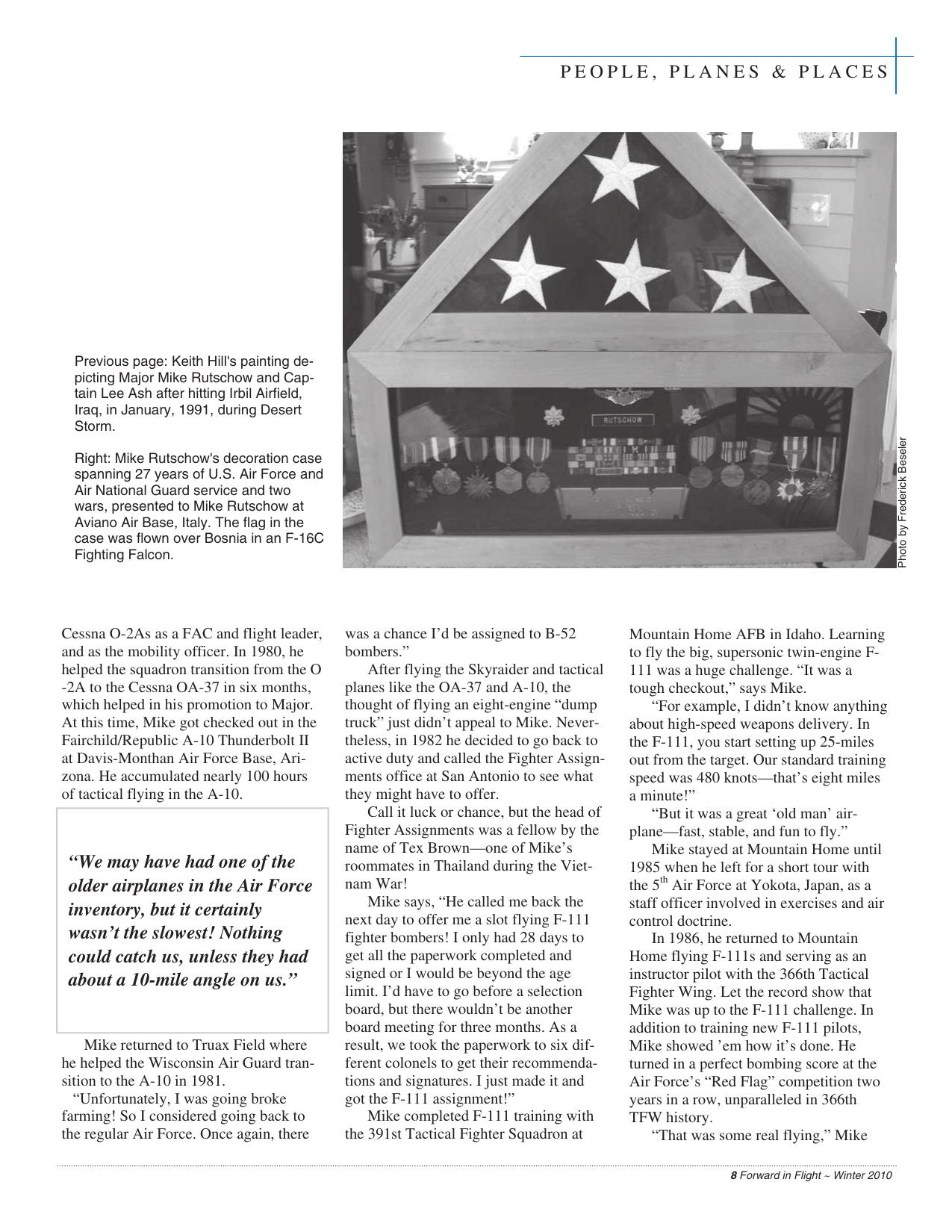
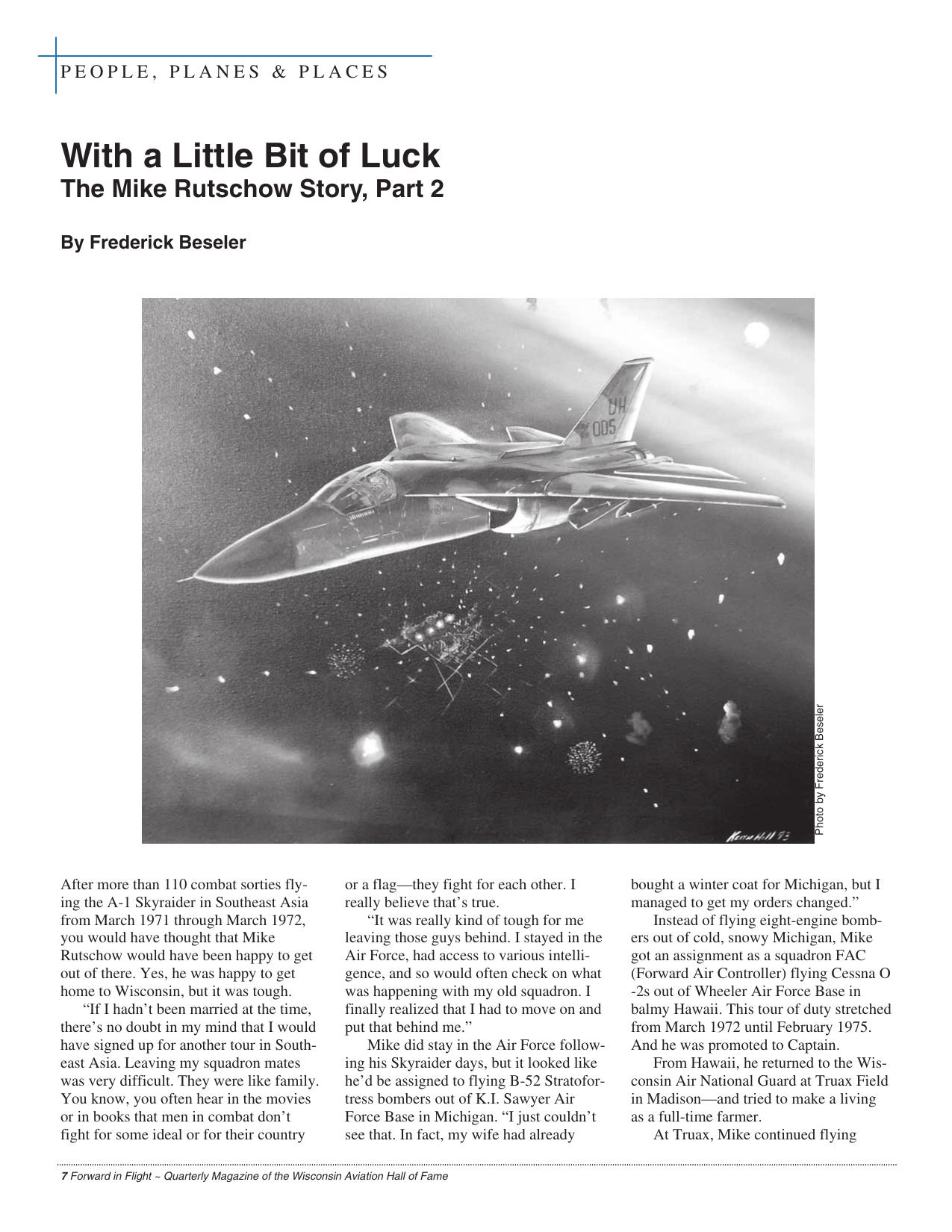
PEOPLE, PLANES & PLACES Photo by Frederick Beseler Previous page: Keith Hill's painting depicting Major Mike Rutschow and Captain Lee Ash after hitting Irbil Airfield, Iraq, in January, 1991, during Desert Storm. Right: Mike Rutschow's decoration case spanning 27 years of U.S. Air Force and Air National Guard service and two wars, presented to Mike Rutschow at Aviano Air Base, Italy. The flag in the case was flown over Bosnia in an F-16C Fighting Falcon. Cessna O-2As as a FAC and flight leader, and as the mobility officer. In 1980, he helped the squadron transition from the O -2A to the Cessna OA-37 in six months, which helped in his promotion to Major. At this time, Mike got checked out in the Fairchild/Republic A-10 Thunderbolt II at Davis-Monthan Air Force Base, Arizona. He accumulated nearly 100 hours of tactical flying in the A-10. “We may have had one of the older airplanes in the Air Force inventory, but it certainly wasn’t the slowest! Nothing could catch us, unless they had about a 10-mile angle on us.” Mike returned to Truax Field where he helped the Wisconsin Air Guard transition to the A-10 in 1981. “Unfortunately, I was going broke farming! So I considered going back to the regular Air Force. Once again, there was a chance I’d be assigned to B-52 bombers.” After flying the Skyraider and tactical planes like the OA-37 and A-10, the thought of flying an eight-engine “dump truck” just didn’t appeal to Mike. Nevertheless, in 1982 he decided to go back to active duty and called the Fighter Assignments office at San Antonio to see what they might have to offer. Call it luck or chance, but the head of Fighter Assignments was a fellow by the name of Tex Brown—one of Mike’s roommates in Thailand during the Vietnam War! Mike says, “He called me back the next day to offer me a slot flying F-111 fighter bombers! I only had 28 days to get all the paperwork completed and signed or I would be beyond the age limit. I’d have to go before a selection board, but there wouldn’t be another board meeting for three months. As a result, we took the paperwork to six different colonels to get their recommendations and signatures. I just made it and got the F-111 assignment!” Mike completed F-111 training with the 391st Tactical Fighter Squadron at Mountain Home AFB in Idaho. Learning to fly the big, supersonic twin-engine F111 was a huge challenge. “It was a tough checkout,” says Mike. “For example, I didn’t know anything about high-speed weapons delivery. In the F-111, you start setting up 25-miles out from the target. Our standard training speed was 480 knots—that’s eight miles a minute!” “But it was a great ‘old man’ airplane—fast, stable, and fun to fly.” Mike stayed at Mountain Home until 1985 when he left for a short tour with the 5th Air Force at Yokota, Japan, as a staff officer involved in exercises and air control doctrine. In 1986, he returned to Mountain Home flying F-111s and serving as an instructor pilot with the 366th Tactical Fighter Wing. Let the record show that Mike was up to the F-111 challenge. In addition to training new F-111 pilots, Mike showed ’em how it’s done. He turned in a perfect bombing score at the Air Force’s “Red Flag” competition two years in a row, unparalleled in 366th TFW history. “That was some real flying,” Mike 8 Forward in Flight ~ Winter 2010
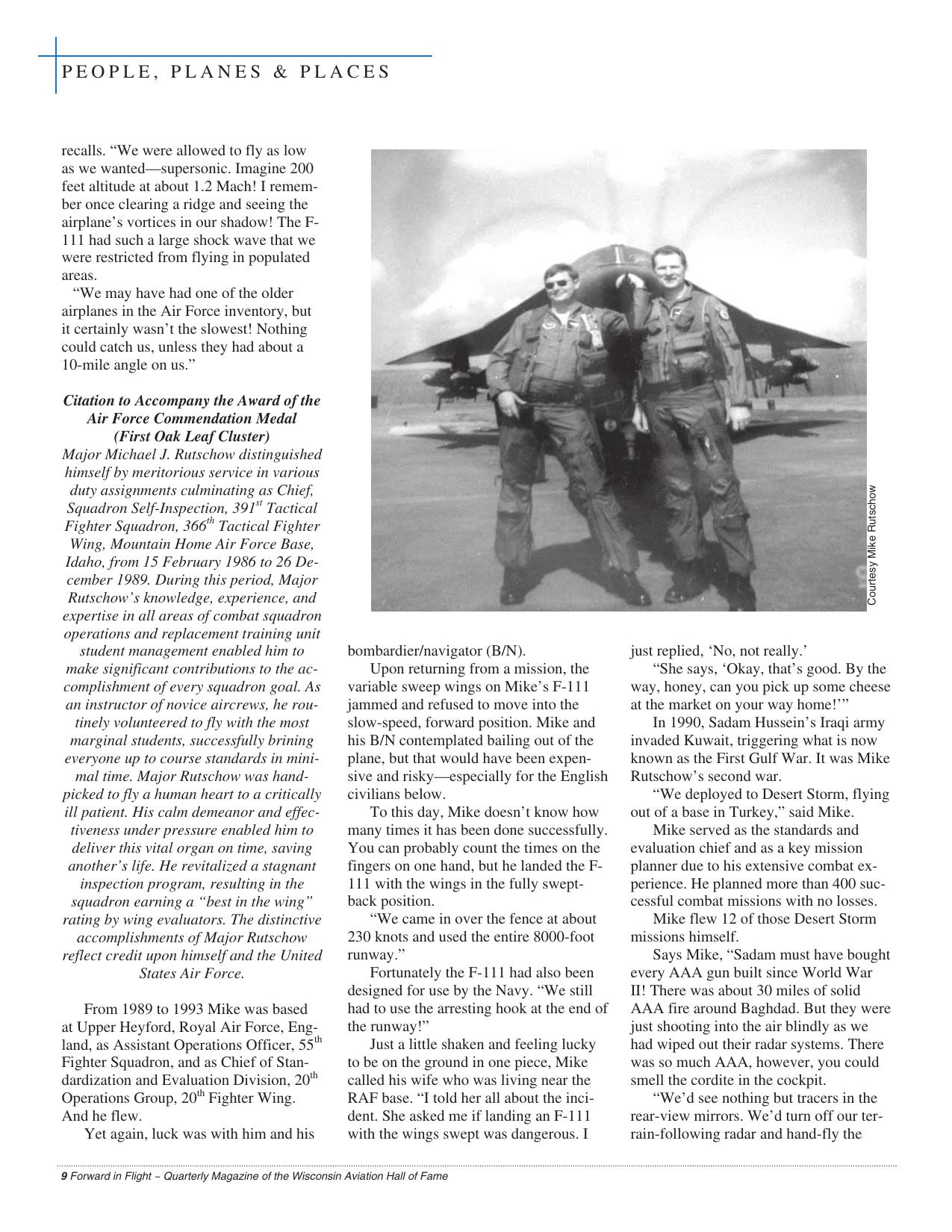
PEOPLE, PLANES & PLACES Citation to Accompany the Award of the Air Force Commendation Medal (First Oak Leaf Cluster) Major Michael J. Rutschow distinguished himself by meritorious service in various duty assignments culminating as Chief, Squadron Self-Inspection, 391st Tactical Fighter Squadron, 366th Tactical Fighter Wing, Mountain Home Air Force Base, Idaho, from 15 February 1986 to 26 December 1989. During this period, Major Rutschow’s knowledge, experience, and expertise in all areas of combat squadron operations and replacement training unit student management enabled him to make significant contributions to the accomplishment of every squadron goal. As an instructor of novice aircrews, he routinely volunteered to fly with the most marginal students, successfully brining everyone up to course standards in minimal time. Major Rutschow was handpicked to fly a human heart to a critically ill patient. His calm demeanor and effectiveness under pressure enabled him to deliver this vital organ on time, saving another’s life. He revitalized a stagnant inspection program, resulting in the squadron earning a “best in the wing” rating by wing evaluators. The distinctive accomplishments of Major Rutschow reflect credit upon himself and the United States Air Force. From 1989 to 1993 Mike was based at Upper Heyford, Royal Air Force, England, as Assistant Operations Officer, 55th Fighter Squadron, and as Chief of Standardization and Evaluation Division, 20th Operations Group, 20th Fighter Wing. And he flew. Yet again, luck was with him and his Courtesy Mike Rutschow recalls. “We were allowed to fly as low as we wanted—supersonic. Imagine 200 feet altitude at about 1.2 Mach! I remember once clearing a ridge and seeing the airplane’s vortices in our shadow! The F111 had such a large shock wave that we were restricted from flying in populated areas. “We may have had one of the older airplanes in the Air Force inventory, but it certainly wasn’t the slowest! Nothing could catch us, unless they had about a 10-mile angle on us.” bombardier/navigator (B/N). Upon returning from a mission, the variable sweep wings on Mike’s F-111 jammed and refused to move into the slow-speed, forward position. Mike and his B/N contemplated bailing out of the plane, but that would have been expensive and risky—especially for the English civilians below. To this day, Mike doesn’t know how many times it has been done successfully. You can probably count the times on the fingers on one hand, but he landed the F111 with the wings in the fully sweptback position. “We came in over the fence at about 230 knots and used the entire 8000-foot runway.” Fortunately the F-111 had also been designed for use by the Navy. “We still had to use the arresting hook at the end of the runway!” Just a little shaken and feeling lucky to be on the ground in one piece, Mike called his wife who was living near the RAF base. “I told her all about the incident. She asked me if landing an F-111 with the wings swept was dangerous. I 9 Forward in Flight ~ Quarterly Magazine of the Wisconsin Aviation Hall of Fame just replied, ‘No, not really.’ “She says, ‘Okay, that’s good. By the way, honey, can you pick up some cheese at the market on your way home!’” In 1990, Sadam Hussein’s Iraqi army invaded Kuwait, triggering what is now known as the First Gulf War. It was Mike Rutschow’s second war. “We deployed to Desert Storm, flying out of a base in Turkey,” said Mike. Mike served as the standards and evaluation chief and as a key mission planner due to his extensive combat experience. He planned more than 400 successful combat missions with no losses. Mike flew 12 of those Desert Storm missions himself. Says Mike, “Sadam must have bought every AAA gun built since World War II! There was about 30 miles of solid AAA fire around Baghdad. But they were just shooting into the air blindly as we had wiped out their radar systems. There was so much AAA, however, you could smell the cordite in the cockpit. “We’d see nothing but tracers in the rear-view mirrors. We’d turn off our terrain-following radar and hand-fly the
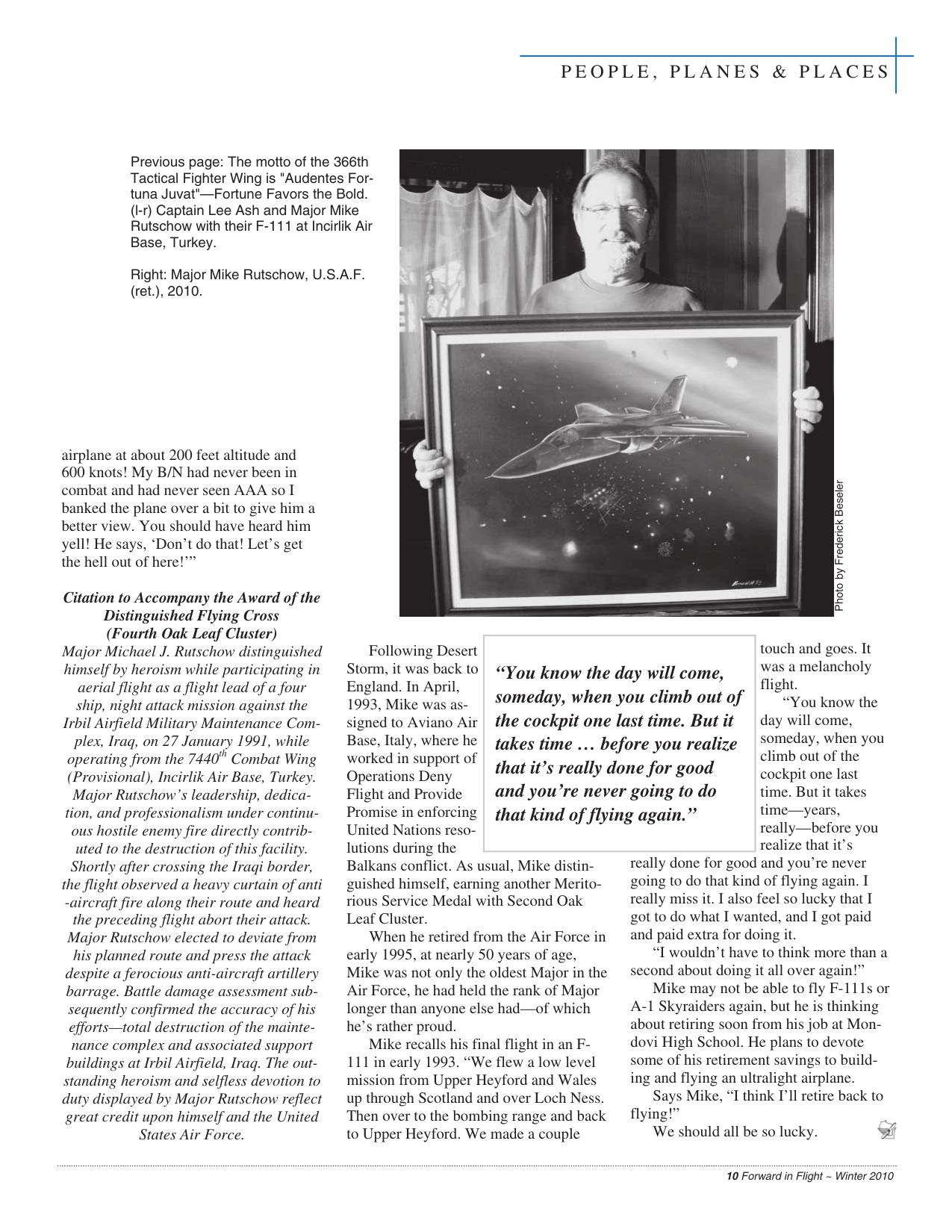
PEOPLE, PLANES & PLACES Previous page: The motto of the 366th Tactical Fighter Wing is "Audentes Fortuna Juvat"—Fortune Favors the Bold. (l-r) Captain Lee Ash and Major Mike Rutschow with their F-111 at Incirlik Air Base, Turkey. airplane at about 200 feet altitude and 600 knots! My B/N had never been in combat and had never seen AAA so I banked the plane over a bit to give him a better view. You should have heard him yell! He says, ‘Don’t do that! Let’s get the hell out of here!’” Citation to Accompany the Award of the Distinguished Flying Cross (Fourth Oak Leaf Cluster) Major Michael J. Rutschow distinguished himself by heroism while participating in aerial flight as a flight lead of a four ship, night attack mission against the Irbil Airfield Military Maintenance Complex, Iraq, on 27 January 1991, while operating from the 7440th Combat Wing (Provisional), Incirlik Air Base, Turkey. Major Rutschow’s leadership, dedication, and professionalism under continuous hostile enemy fire directly contributed to the destruction of this facility. Shortly after crossing the Iraqi border, the flight observed a heavy curtain of anti -aircraft fire along their route and heard the preceding flight abort their attack. Major Rutschow elected to deviate from his planned route and press the attack despite a ferocious anti-aircraft artillery barrage. Battle damage assessment subsequently confirmed the accuracy of his efforts—total destruction of the maintenance complex and associated support buildings at Irbil Airfield, Iraq. The outstanding heroism and selfless devotion to duty displayed by Major Rutschow reflect great credit upon himself and the United States Air Force. Photo by Frederick Beseler Right: Major Mike Rutschow, U.S.A.F. (ret.), 2010. touch and goes. It Following Desert was a melancholy Storm, it was back to “You know the day will come, flight. England. In April, someday, when you climb out of “You know the 1993, Mike was asday will come, signed to Aviano Air the cockpit one last time. But it Base, Italy, where he takes time … before you realize someday, when you climb out of the worked in support of that it’s really done for good cockpit one last Operations Deny time. But it takes and you’re never going to do Flight and Provide time—years, Promise in enforcing that kind of flying again.” really—before you United Nations resorealize that it’s lutions during the really done for good and you’re never Balkans conflict. As usual, Mike distingoing to do that kind of flying again. I guished himself, earning another Meritoreally miss it. I also feel so lucky that I rious Service Medal with Second Oak got to do what I wanted, and I got paid Leaf Cluster. and paid extra for doing it. When he retired from the Air Force in “I wouldn’t have to think more than a early 1995, at nearly 50 years of age, second about doing it all over again!” Mike was not only the oldest Major in the Mike may not be able to fly F-111s or Air Force, he had held the rank of Major A-1 Skyraiders again, but he is thinking longer than anyone else had—of which about retiring soon from his job at Monhe’s rather proud. dovi High School. He plans to devote Mike recalls his final flight in an Fsome of his retirement savings to build111 in early 1993. “We flew a low level ing and flying an ultralight airplane. mission from Upper Heyford and Wales Says Mike, “I think I’ll retire back to up through Scotland and over Loch Ness. flying!” Then over to the bombing range and back We should all be so lucky. to Upper Heyford. We made a couple 10 Forward in Flight ~ Winter 2010
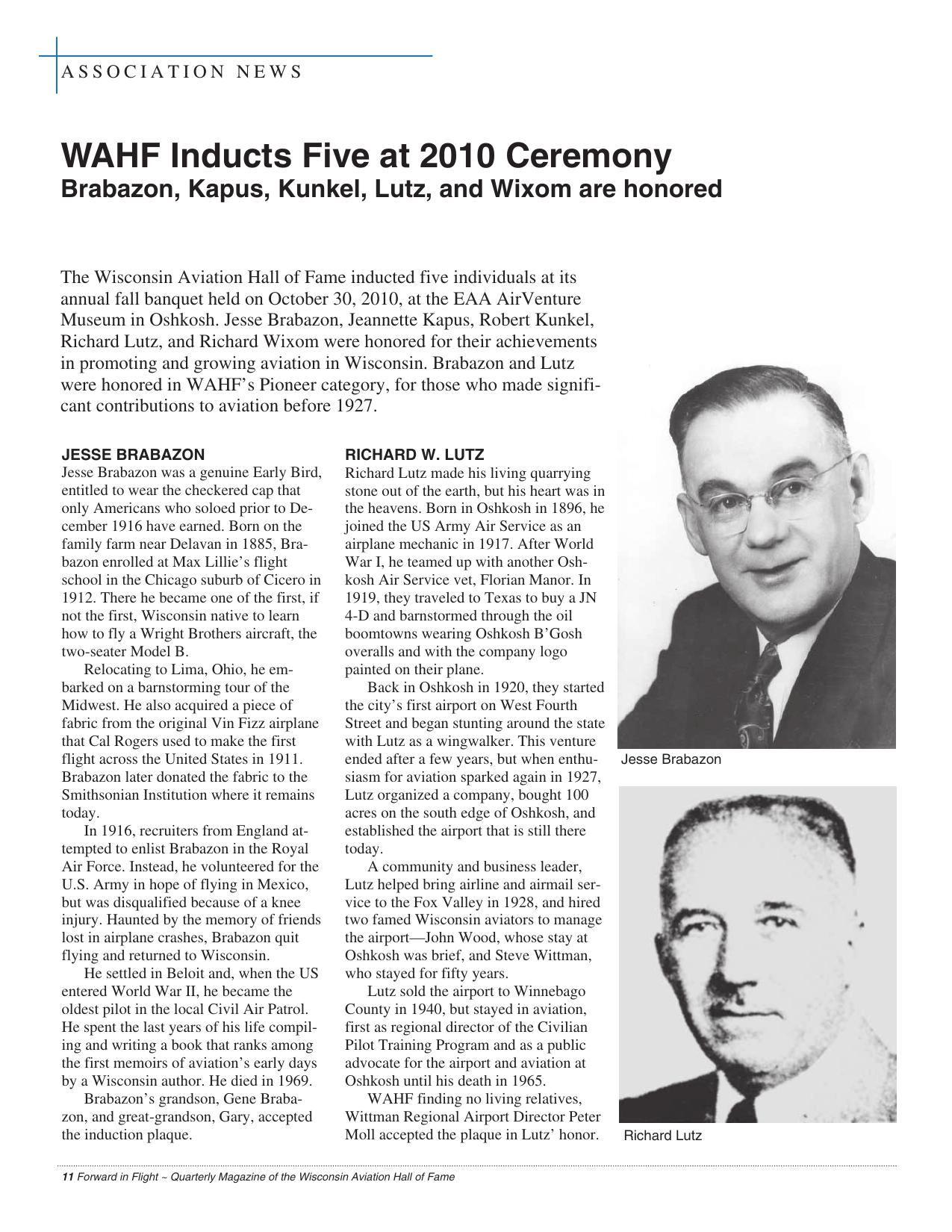
ASSOCIATION NEWS WAHF Inducts Five at 2010 Ceremony Brabazon, Kapus, Kunkel, Lutz, and Wixom are honored The Wisconsin Aviation Hall of Fame inducted five individuals at its annual fall banquet held on October 30, 2010, at the EAA AirVenture Museum in Oshkosh. Jesse Brabazon, Jeannette Kapus, Robert Kunkel, Richard Lutz, and Richard Wixom were honored for their achievements in promoting and growing aviation in Wisconsin. Brabazon and Lutz were honored in WAHF’s Pioneer category, for those who made significant contributions to aviation before 1927. JESSE BRABAZON Jesse Brabazon was a genuine Early Bird, entitled to wear the checkered cap that only Americans who soloed prior to December 1916 have earned. Born on the family farm near Delavan in 1885, Brabazon enrolled at Max Lillie’s flight school in the Chicago suburb of Cicero in 1912. There he became one of the first, if not the first, Wisconsin native to learn how to fly a Wright Brothers aircraft, the two-seater Model B. Relocating to Lima, Ohio, he embarked on a barnstorming tour of the Midwest. He also acquired a piece of fabric from the original Vin Fizz airplane that Cal Rogers used to make the first flight across the United States in 1911. Brabazon later donated the fabric to the Smithsonian Institution where it remains today. In 1916, recruiters from England attempted to enlist Brabazon in the Royal Air Force. Instead, he volunteered for the U.S. Army in hope of flying in Mexico, but was disqualified because of a knee injury. Haunted by the memory of friends lost in airplane crashes, Brabazon quit flying and returned to Wisconsin. He settled in Beloit and, when the US entered World War II, he became the oldest pilot in the local Civil Air Patrol. He spent the last years of his life compiling and writing a book that ranks among the first memoirs of aviation’s early days by a Wisconsin author. He died in 1969. Brabazon’s grandson, Gene Brabazon, and great-grandson, Gary, accepted the induction plaque. RICHARD W. LUTZ Richard Lutz made his living quarrying stone out of the earth, but his heart was in the heavens. Born in Oshkosh in 1896, he joined the US Army Air Service as an airplane mechanic in 1917. After World War I, he teamed up with another Oshkosh Air Service vet, Florian Manor. In 1919, they traveled to Texas to buy a JN 4-D and barnstormed through the oil boomtowns wearing Oshkosh B’Gosh overalls and with the company logo painted on their plane. Back in Oshkosh in 1920, they started the city’s first airport on West Fourth Street and began stunting around the state with Lutz as a wingwalker. This venture ended after a few years, but when enthusiasm for aviation sparked again in 1927, Lutz organized a company, bought 100 acres on the south edge of Oshkosh, and established the airport that is still there today. A community and business leader, Lutz helped bring airline and airmail service to the Fox Valley in 1928, and hired two famed Wisconsin aviators to manage the airport—John Wood, whose stay at Oshkosh was brief, and Steve Wittman, who stayed for fifty years. Lutz sold the airport to Winnebago County in 1940, but stayed in aviation, first as regional director of the Civilian Pilot Training Program and as a public advocate for the airport and aviation at Oshkosh until his death in 1965. WAHF finding no living relatives, Wittman Regional Airport Director Peter Moll accepted the plaque in Lutz’ honor. 11 Forward in Flight ~ Quarterly Magazine of the Wisconsin Aviation Hall of Fame Jesse Brabazon Richard Lutz
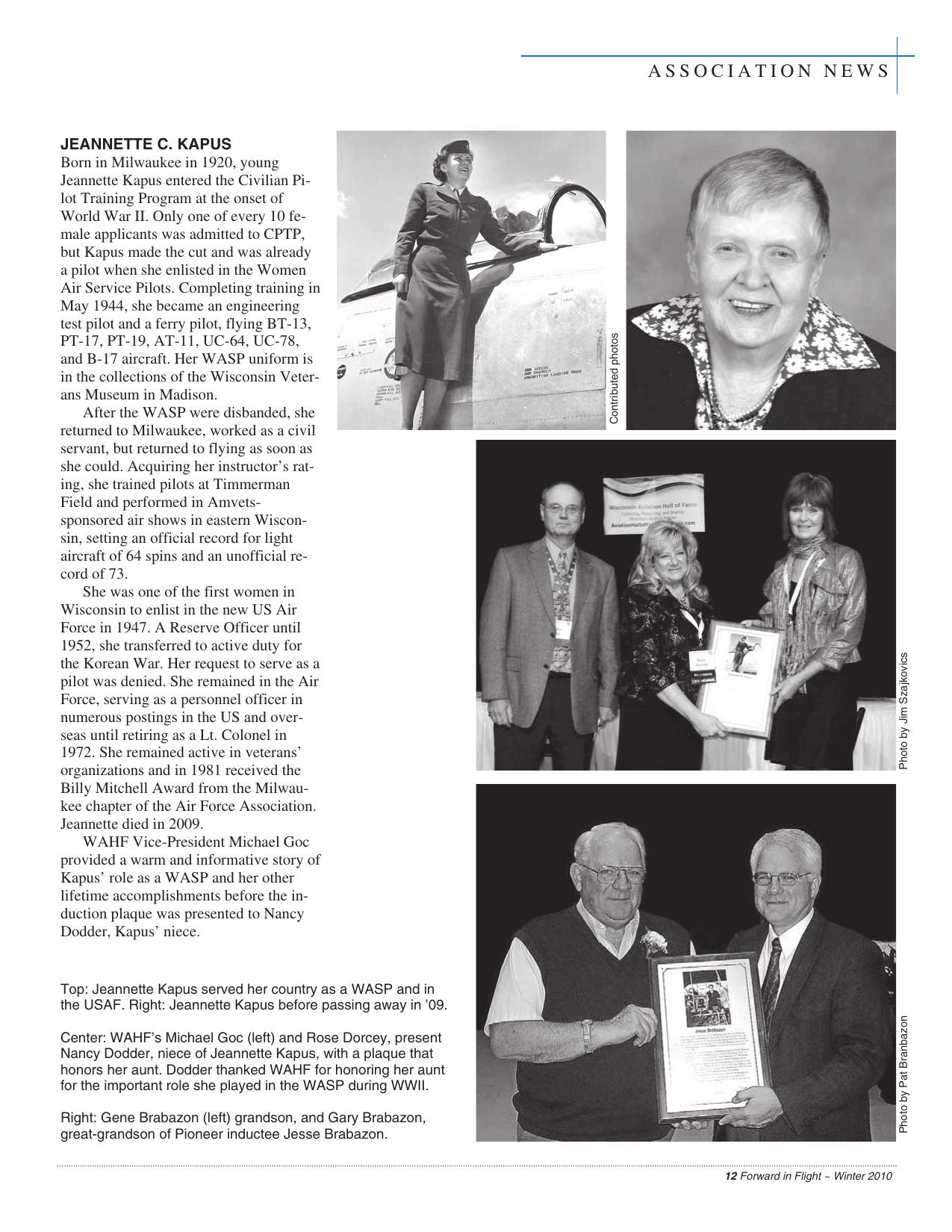
Photo by Jim Szajkovics JEANNETTE C. KAPUS Born in Milwaukee in 1920, young Jeannette Kapus entered the Civilian Pilot Training Program at the onset of World War II. Only one of every 10 female applicants was admitted to CPTP, but Kapus made the cut and was already a pilot when she enlisted in the Women Air Service Pilots. Completing training in May 1944, she became an engineering test pilot and a ferry pilot, flying BT-13, PT-17, PT-19, AT-11, UC-64, UC-78, and B-17 aircraft. Her WASP uniform is in the collections of the Wisconsin Veterans Museum in Madison. After the WASP were disbanded, she returned to Milwaukee, worked as a civil servant, but returned to flying as soon as she could. Acquiring her instructor’s rating, she trained pilots at Timmerman Field and performed in Amvetssponsored air shows in eastern Wisconsin, setting an official record for light aircraft of 64 spins and an unofficial record of 73. She was one of the first women in Wisconsin to enlist in the new US Air Force in 1947. A Reserve Officer until 1952, she transferred to active duty for the Korean War. Her request to serve as a pilot was denied. She remained in the Air Force, serving as a personnel officer in numerous postings in the US and overseas until retiring as a Lt. Colonel in 1972. She remained active in veterans’ organizations and in 1981 received the Billy Mitchell Award from the Milwaukee chapter of the Air Force Association. Jeannette died in 2009. WAHF Vice-President Michael Goc provided a warm and informative story of Kapus’ role as a WASP and her other lifetime accomplishments before the induction plaque was presented to Nancy Dodder, Kapus’ niece. Contributed photos ASSOCIATION NEWS Photo by Pat Branbazon Top: Jeannette Kapus served her country as a WASP and in the USAF. Right: Jeannette Kapus before passing away in ’09. Center: WAHF’s Michael Goc (left) and Rose Dorcey, present Nancy Dodder, niece of Jeannette Kapus, with a plaque that honors her aunt. Dodder thanked WAHF for honoring her aunt for the important role she played in the WASP during WWII. Right: Gene Brabazon (left) grandson, and Gary Brabazon, great-grandson of Pioneer inductee Jesse Brabazon. 12 Forward in Flight ~ Winter 2010
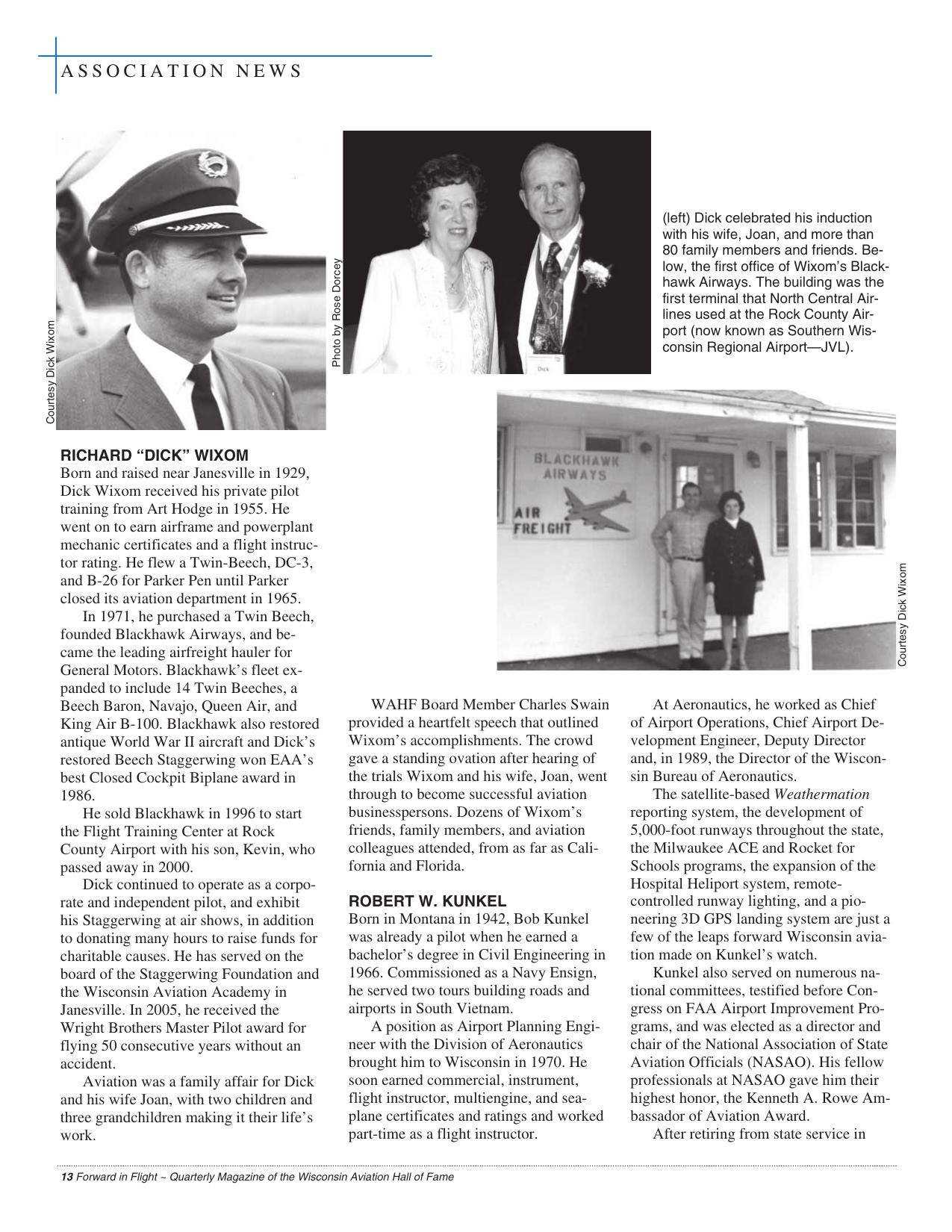
ASSOCIATION NEWS RICHARD “DICK” WIXOM Born and raised near Janesville in 1929, Dick Wixom received his private pilot training from Art Hodge in 1955. He went on to earn airframe and powerplant mechanic certificates and a flight instructor rating. He flew a Twin-Beech, DC-3, and B-26 for Parker Pen until Parker closed its aviation department in 1965. In 1971, he purchased a Twin Beech, founded Blackhawk Airways, and became the leading airfreight hauler for General Motors. Blackhawk’s fleet expanded to include 14 Twin Beeches, a Beech Baron, Navajo, Queen Air, and King Air B-100. Blackhawk also restored antique World War II aircraft and Dick’s restored Beech Staggerwing won EAA’s best Closed Cockpit Biplane award in 1986. He sold Blackhawk in 1996 to start the Flight Training Center at Rock County Airport with his son, Kevin, who passed away in 2000. Dick continued to operate as a corporate and independent pilot, and exhibit his Staggerwing at air shows, in addition to donating many hours to raise funds for charitable causes. He has served on the board of the Staggerwing Foundation and the Wisconsin Aviation Academy in Janesville. In 2005, he received the Wright Brothers Master Pilot award for flying 50 consecutive years without an accident. Aviation was a family affair for Dick and his wife Joan, with two children and three grandchildren making it their life’s work. Courtesy Dick Wixom Courtesy Dick Wixom Photo by Rose Dorcey (left) Dick celebrated his induction with his wife, Joan, and more than 80 family members and friends. Below, the first office of Wixom’s Blackhawk Airways. The building was the first terminal that North Central Airlines used at the Rock County Airport (now known as Southern Wisconsin Regional Airport—JVL). WAHF Board Member Charles Swain provided a heartfelt speech that outlined Wixom’s accomplishments. The crowd gave a standing ovation after hearing of the trials Wixom and his wife, Joan, went through to become successful aviation businesspersons. Dozens of Wixom’s friends, family members, and aviation colleagues attended, from as far as California and Florida. ROBERT W. KUNKEL Born in Montana in 1942, Bob Kunkel was already a pilot when he earned a bachelor’s degree in Civil Engineering in 1966. Commissioned as a Navy Ensign, he served two tours building roads and airports in South Vietnam. A position as Airport Planning Engineer with the Division of Aeronautics brought him to Wisconsin in 1970. He soon earned commercial, instrument, flight instructor, multiengine, and seaplane certificates and ratings and worked part-time as a flight instructor. 13 Forward in Flight ~ Quarterly Magazine of the Wisconsin Aviation Hall of Fame At Aeronautics, he worked as Chief of Airport Operations, Chief Airport Development Engineer, Deputy Director and, in 1989, the Director of the Wisconsin Bureau of Aeronautics. The satellite-based Weathermation reporting system, the development of 5,000-foot runways throughout the state, the Milwaukee ACE and Rocket for Schools programs, the expansion of the Hospital Heliport system, remotecontrolled runway lighting, and a pioneering 3D GPS landing system are just a few of the leaps forward Wisconsin aviation made on Kunkel’s watch. Kunkel also served on numerous national committees, testified before Congress on FAA Airport Improvement Programs, and was elected as a director and chair of the National Association of State Aviation Officials (NASAO). His fellow professionals at NASAO gave him their highest honor, the Kenneth A. Rowe Ambassador of Aviation Award. After retiring from state service in
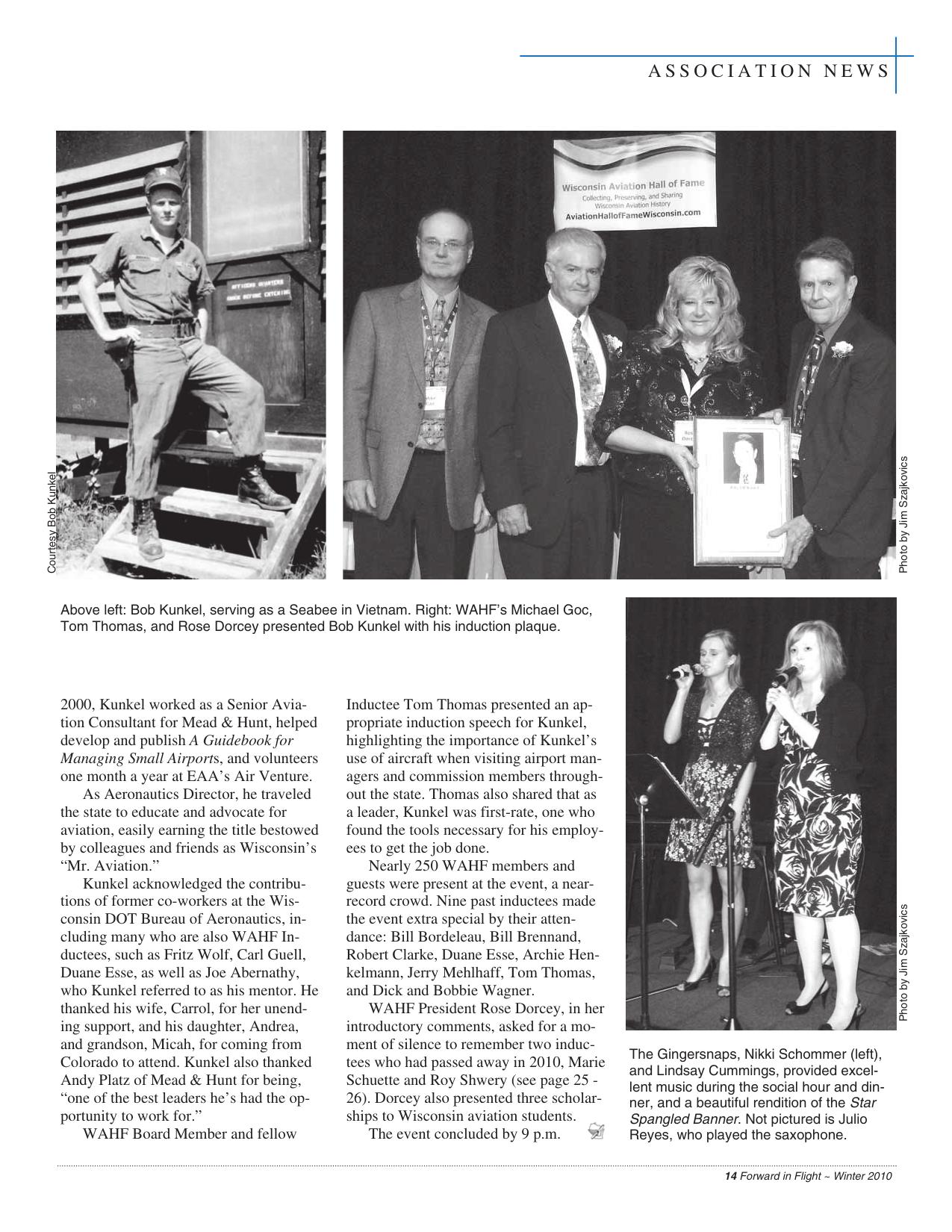
Courtesy Bob Kunkel Photo by Jim Szajkovics ASSOCIATION NEWS 2000, Kunkel worked as a Senior Aviation Consultant for Mead & Hunt, helped develop and publish A Guidebook for Managing Small Airports, and volunteers one month a year at EAA’s Air Venture. As Aeronautics Director, he traveled the state to educate and advocate for aviation, easily earning the title bestowed by colleagues and friends as Wisconsin’s “Mr. Aviation.” Kunkel acknowledged the contributions of former co-workers at the Wisconsin DOT Bureau of Aeronautics, including many who are also WAHF Inductees, such as Fritz Wolf, Carl Guell, Duane Esse, as well as Joe Abernathy, who Kunkel referred to as his mentor. He thanked his wife, Carrol, for her unending support, and his daughter, Andrea, and grandson, Micah, for coming from Colorado to attend. Kunkel also thanked Andy Platz of Mead & Hunt for being, “one of the best leaders he’s had the opportunity to work for.” WAHF Board Member and fellow Inductee Tom Thomas presented an appropriate induction speech for Kunkel, highlighting the importance of Kunkel’s use of aircraft when visiting airport managers and commission members throughout the state. Thomas also shared that as a leader, Kunkel was first-rate, one who found the tools necessary for his employees to get the job done. Nearly 250 WAHF members and guests were present at the event, a nearrecord crowd. Nine past inductees made the event extra special by their attendance: Bill Bordeleau, Bill Brennand, Robert Clarke, Duane Esse, Archie Henkelmann, Jerry Mehlhaff, Tom Thomas, and Dick and Bobbie Wagner. WAHF President Rose Dorcey, in her introductory comments, asked for a moment of silence to remember two inductees who had passed away in 2010, Marie Schuette and Roy Shwery (see page 25 26). Dorcey also presented three scholarships to Wisconsin aviation students. The event concluded by 9 p.m. Photo by Jim Szajkovics Above left: Bob Kunkel, serving as a Seabee in Vietnam. Right: WAHF’s Michael Goc, Tom Thomas, and Rose Dorcey presented Bob Kunkel with his induction plaque. The Gingersnaps, Nikki Schommer (left), and Lindsay Cummings, provided excellent music during the social hour and dinner, and a beautiful rendition of the Star Spangled Banner. Not pictured is Julio Reyes, who played the saxophone. 14 Forward in Flight ~ Winter 2010
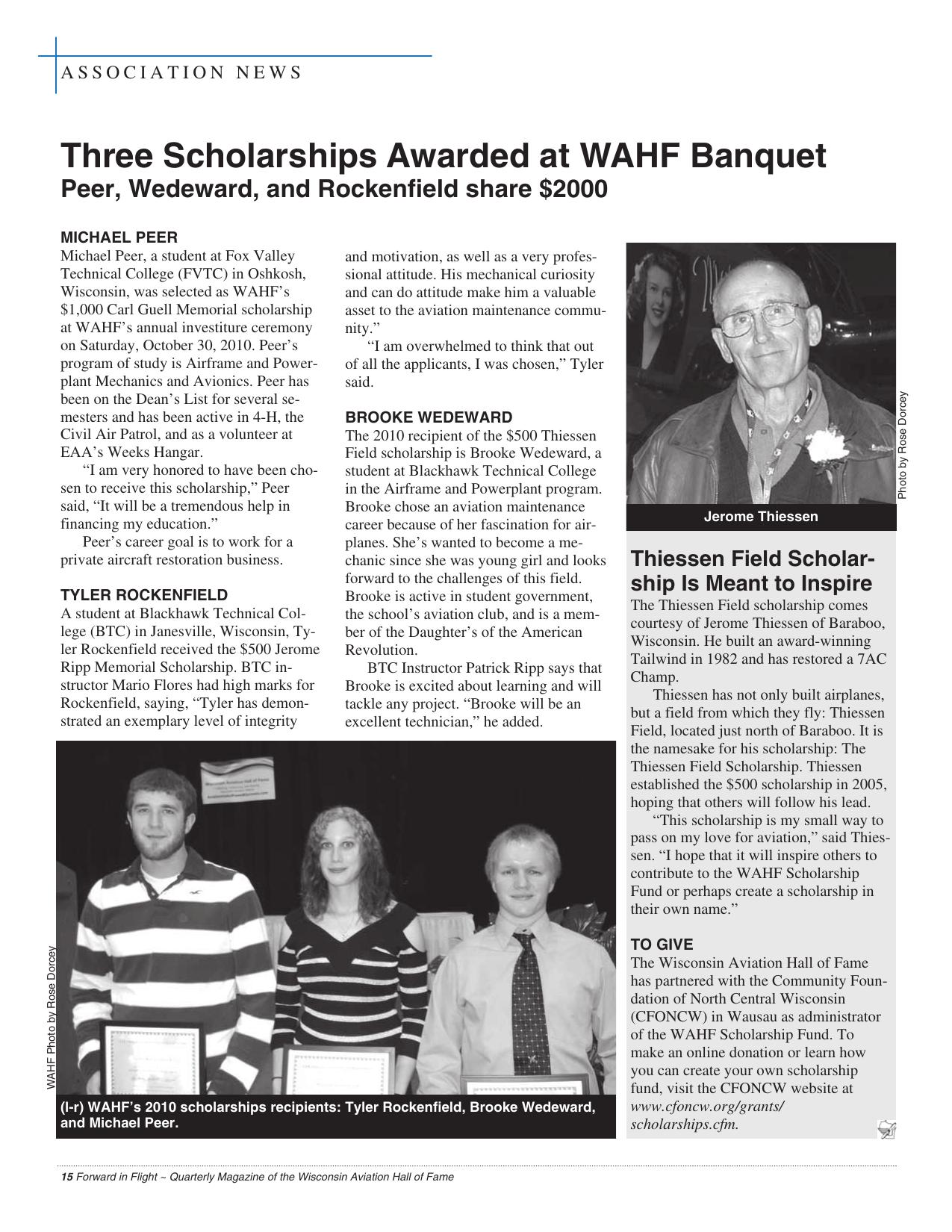
ASSOCIATION NEWS Three Scholarships Awarded at WAHF Banquet Peer, Wedeward, and Rockenfield share $2000 BROOKE WEDEWARD The 2010 recipient of the $500 Thiessen Field scholarship is Brooke Wedeward, a student at Blackhawk Technical College in the Airframe and Powerplant program. Brooke chose an aviation maintenance career because of her fascination for airplanes. She’s wanted to become a mechanic since she was young girl and looks forward to the challenges of this field. Brooke is active in student government, the school’s aviation club, and is a member of the Daughter’s of the American Revolution. BTC Instructor Patrick Ripp says that Brooke is excited about learning and will tackle any project. “Brooke will be an excellent technician,” he added. WAHF Photo by Rose Dorcey TYLER ROCKENFIELD A student at Blackhawk Technical College (BTC) in Janesville, Wisconsin, Tyler Rockenfield received the $500 Jerome Ripp Memorial Scholarship. BTC instructor Mario Flores had high marks for Rockenfield, saying, “Tyler has demonstrated an exemplary level of integrity and motivation, as well as a very professional attitude. His mechanical curiosity and can do attitude make him a valuable asset to the aviation maintenance community.” “I am overwhelmed to think that out of all the applicants, I was chosen,” Tyler said. (l-r) WAHF’s 2010 scholarships recipients: Tyler Rockenfield, Brooke Wedeward, and Michael Peer. 15 Forward in Flight ~ Quarterly Magazine of the Wisconsin Aviation Hall of Fame Photo by Rose Dorcey MICHAEL PEER Michael Peer, a student at Fox Valley Technical College (FVTC) in Oshkosh, Wisconsin, was selected as WAHF’s $1,000 Carl Guell Memorial scholarship at WAHF’s annual investiture ceremony on Saturday, October 30, 2010. Peer’s program of study is Airframe and Powerplant Mechanics and Avionics. Peer has been on the Dean’s List for several semesters and has been active in 4-H, the Civil Air Patrol, and as a volunteer at EAA’s Weeks Hangar. “I am very honored to have been chosen to receive this scholarship,” Peer said, “It will be a tremendous help in financing my education.” Peer’s career goal is to work for a private aircraft restoration business. Jerome Thiessen Thiessen Field Scholarship Is Meant to Inspire The Thiessen Field scholarship comes courtesy of Jerome Thiessen of Baraboo, Wisconsin. He built an award-winning Tailwind in 1982 and has restored a 7AC Champ. Thiessen has not only built airplanes, but a field from which they fly: Thiessen Field, located just north of Baraboo. It is the namesake for his scholarship: The Thiessen Field Scholarship. Thiessen established the $500 scholarship in 2005, hoping that others will follow his lead. “This scholarship is my small way to pass on my love for aviation,” said Thiessen. “I hope that it will inspire others to contribute to the WAHF Scholarship Fund or perhaps create a scholarship in their own name.” TO GIVE The Wisconsin Aviation Hall of Fame has partnered with the Community Foundation of North Central Wisconsin (CFONCW) in Wausau as administrator of the WAHF Scholarship Fund. To make an online donation or learn how you can create your own scholarship fund, visit the CFONCW website at www.cfoncw.org/grants/ scholarships.cfm.
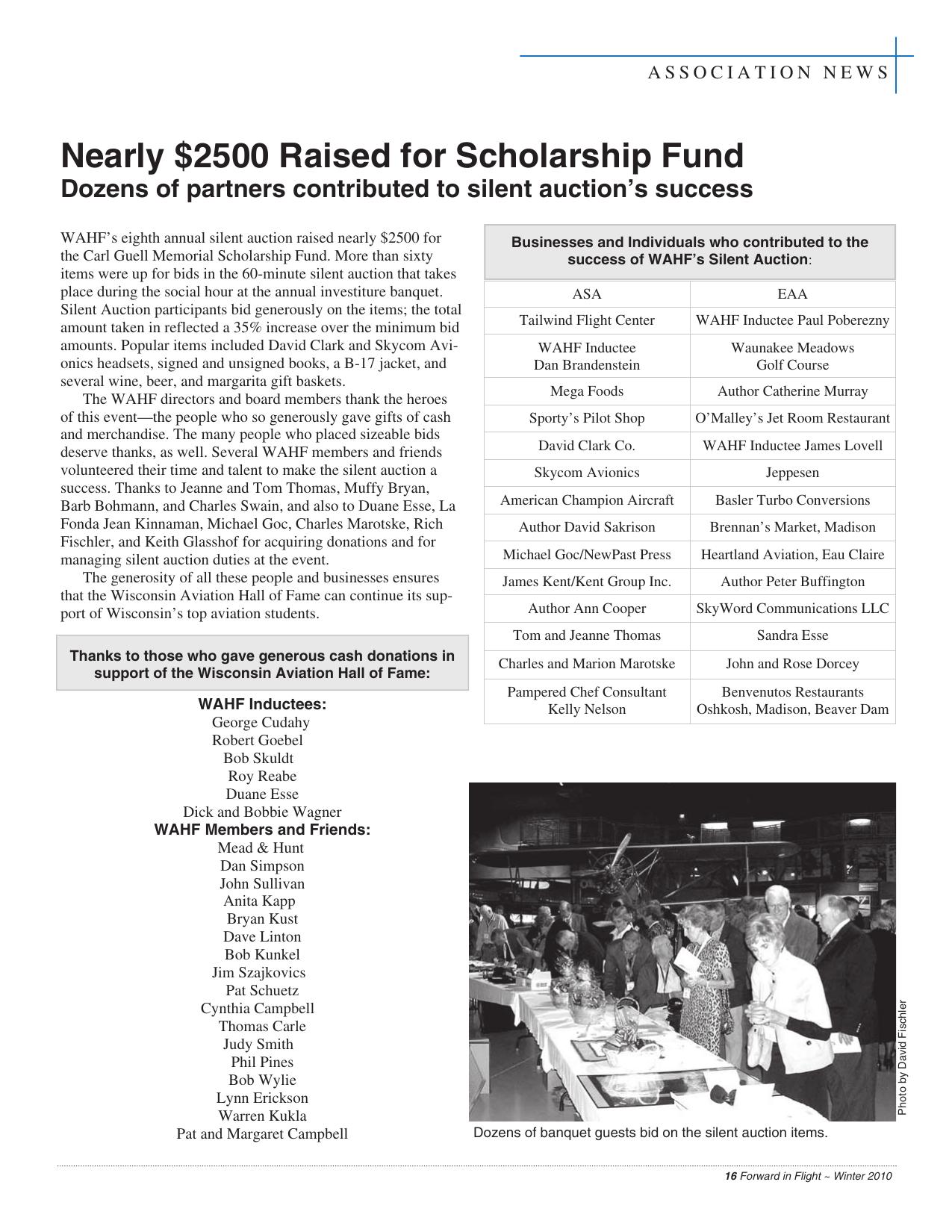
ASSOCIATION NEWS Nearly $2500 Raised for Scholarship Fund Dozens of partners contributed to silent auction’s success Thanks to those who gave generous cash donations in support of the Wisconsin Aviation Hall of Fame: WAHF Inductees: George Cudahy Robert Goebel Bob Skuldt Roy Reabe Duane Esse Dick and Bobbie Wagner WAHF Members and Friends: Mead & Hunt Dan Simpson John Sullivan Anita Kapp Bryan Kust Dave Linton Bob Kunkel Jim Szajkovics Pat Schuetz Cynthia Campbell Thomas Carle Judy Smith Phil Pines Bob Wylie Lynn Erickson Warren Kukla Pat and Margaret Campbell Businesses and Individuals who contributed to the success of WAHF’s Silent Auction: ASA EAA Tailwind Flight Center WAHF Inductee Paul Poberezny WAHF Inductee Dan Brandenstein Waunakee Meadows Golf Course Mega Foods Author Catherine Murray Sporty’s Pilot Shop O’Malley’s Jet Room Restaurant David Clark Co. WAHF Inductee James Lovell Skycom Avionics Jeppesen American Champion Aircraft Basler Turbo Conversions Author David Sakrison Brennan’s Market, Madison Michael Goc/NewPast Press Heartland Aviation, Eau Claire James Kent/Kent Group Inc. Author Peter Buffington Author Ann Cooper SkyWord Communications LLC Tom and Jeanne Thomas Sandra Esse Charles and Marion Marotske John and Rose Dorcey Pampered Chef Consultant Kelly Nelson Benvenutos Restaurants Oshkosh, Madison, Beaver Dam Photo by David Fischler WAHF’s eighth annual silent auction raised nearly $2500 for the Carl Guell Memorial Scholarship Fund. More than sixty items were up for bids in the 60-minute silent auction that takes place during the social hour at the annual investiture banquet. Silent Auction participants bid generously on the items; the total amount taken in reflected a 35% increase over the minimum bid amounts. Popular items included David Clark and Skycom Avionics headsets, signed and unsigned books, a B-17 jacket, and several wine, beer, and margarita gift baskets. The WAHF directors and board members thank the heroes of this event—the people who so generously gave gifts of cash and merchandise. The many people who placed sizeable bids deserve thanks, as well. Several WAHF members and friends volunteered their time and talent to make the silent auction a success. Thanks to Jeanne and Tom Thomas, Muffy Bryan, Barb Bohmann, and Charles Swain, and also to Duane Esse, La Fonda Jean Kinnaman, Michael Goc, Charles Marotske, Rich Fischler, and Keith Glasshof for acquiring donations and for managing silent auction duties at the event. The generosity of all these people and businesses ensures that the Wisconsin Aviation Hall of Fame can continue its support of Wisconsin’s top aviation students. Dozens of banquet guests bid on the silent auction items. 16 Forward in Flight ~ Winter 2010
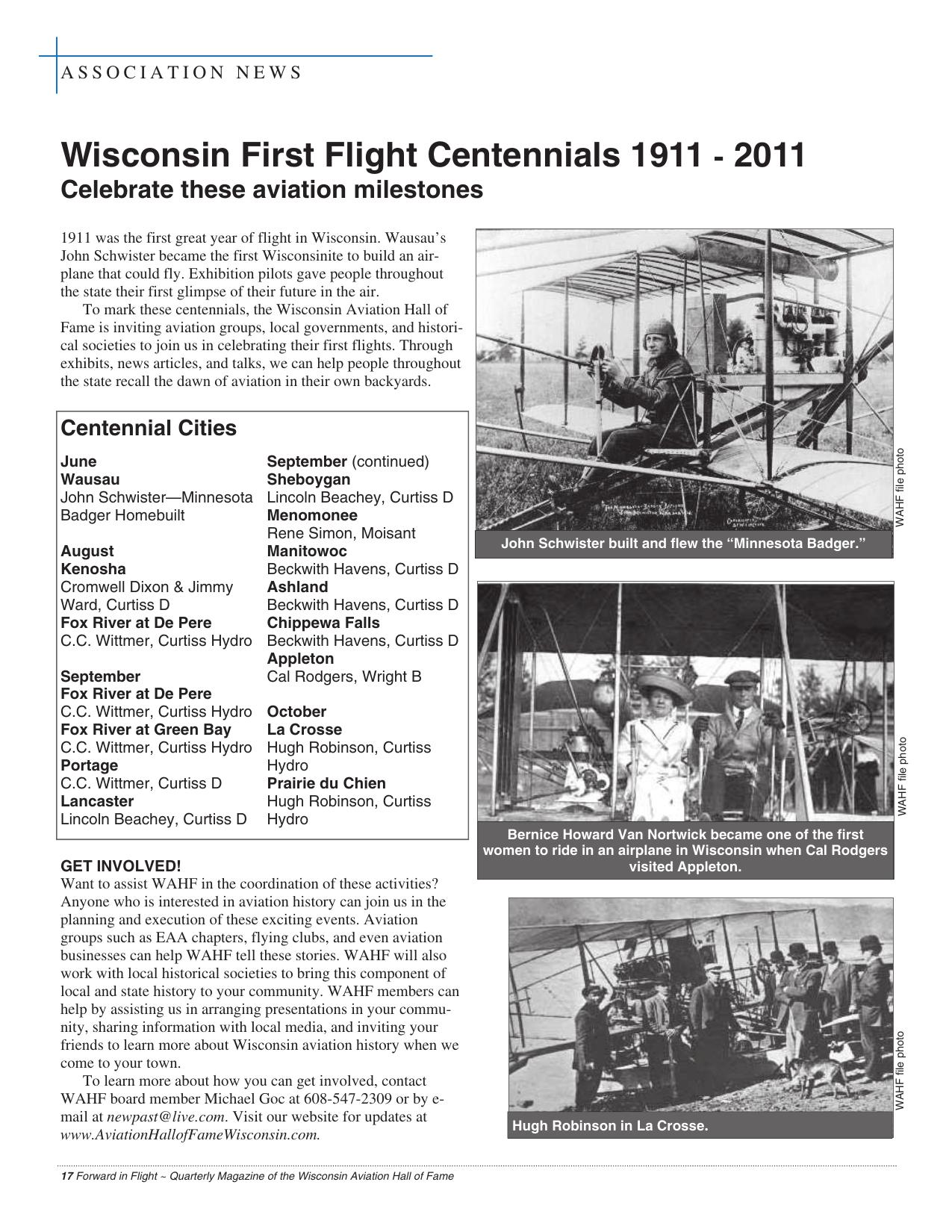
ASSOCIATION NEWS Wisconsin First Flight Centennials 1911 - 2011 Celebrate these aviation milestones 1911 was the first great year of flight in Wisconsin. Wausau’s John Schwister became the first Wisconsinite to build an airplane that could fly. Exhibition pilots gave people throughout the state their first glimpse of their future in the air. To mark these centennials, the Wisconsin Aviation Hall of Fame is inviting aviation groups, local governments, and historical societies to join us in celebrating their first flights. Through exhibits, news articles, and talks, we can help people throughout the state recall the dawn of aviation in their own backyards. WAHF file photo Centennial Cities June Wausau John Schwister—Minnesota Badger Homebuilt GET INVOLVED! Want to assist WAHF in the coordination of these activities? Anyone who is interested in aviation history can join us in the planning and execution of these exciting events. Aviation groups such as EAA chapters, flying clubs, and even aviation businesses can help WAHF tell these stories. WAHF will also work with local historical societies to bring this component of local and state history to your community. WAHF members can help by assisting us in arranging presentations in your community, sharing information with local media, and inviting your friends to learn more about Wisconsin aviation history when we come to your town. To learn more about how you can get involved, contact WAHF board member Michael Goc at 608-547-2309 or by email at newpast@live.com. Visit our website for updates at www.AviationHallofFameWisconsin.com. 17 Forward in Flight ~ Quarterly Magazine of the Wisconsin Aviation Hall of Fame WAHF file photo John Schwister built and flew the “Minnesota Badger.” Bernice Howard Van Nortwick became one of the first women to ride in an airplane in Wisconsin when Cal Rodgers visited Appleton. WAHF file photo September (continued) Sheboygan Lincoln Beachey, Curtiss D Menomonee Rene Simon, Moisant August Manitowoc Kenosha Beckwith Havens, Curtiss D Cromwell Dixon & Jimmy Ashland Ward, Curtiss D Beckwith Havens, Curtiss D Fox River at De Pere Chippewa Falls C.C. Wittmer, Curtiss Hydro Beckwith Havens, Curtiss D Appleton September Cal Rodgers, Wright B Fox River at De Pere C.C. Wittmer, Curtiss Hydro October Fox River at Green Bay La Crosse C.C. Wittmer, Curtiss Hydro Hugh Robinson, Curtiss Portage Hydro C.C. Wittmer, Curtiss D Prairie du Chien Lancaster Hugh Robinson, Curtiss Lincoln Beachey, Curtiss D Hydro Hugh Robinson in La Crosse.
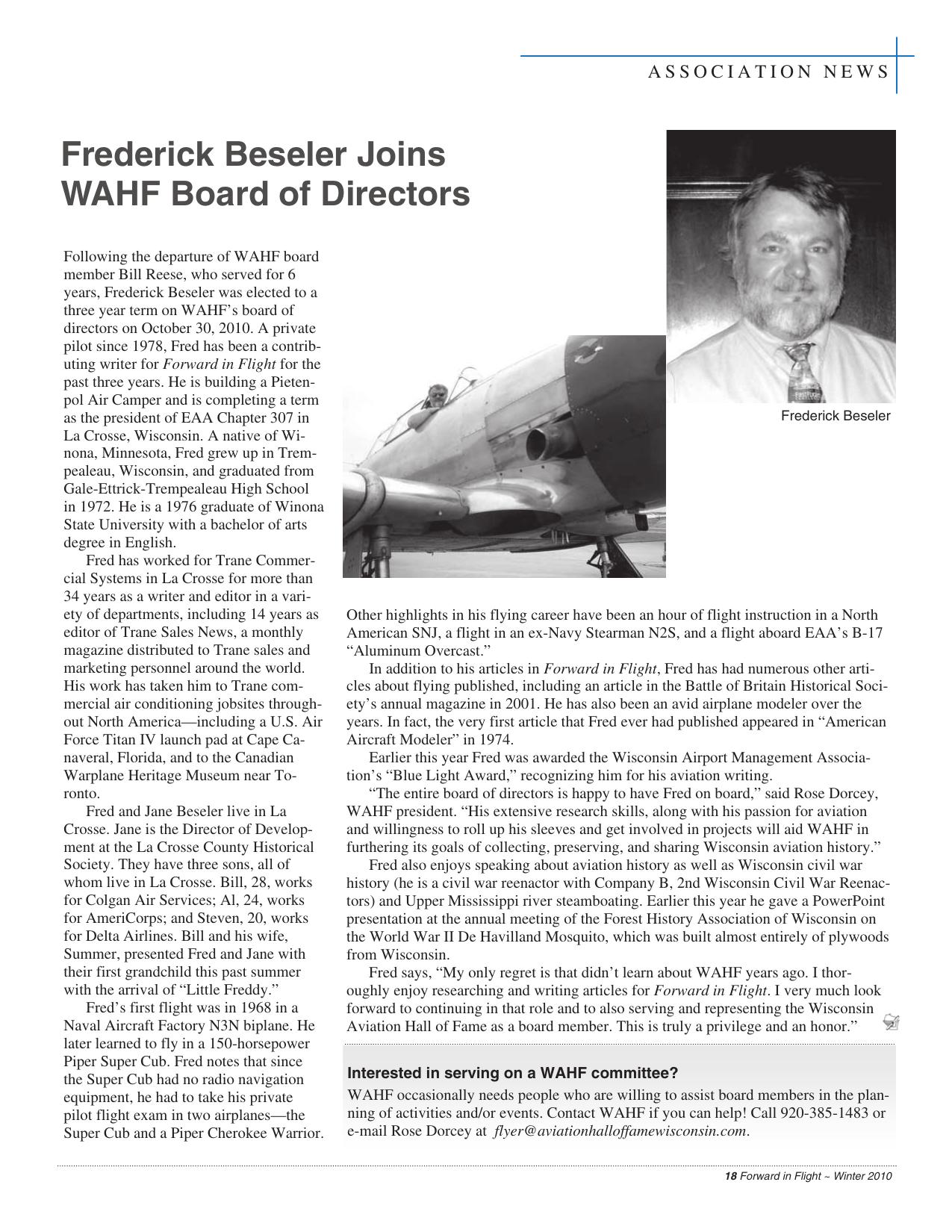
ASSOCIATION NEWS Frederick Beseler Joins WAHF Board of Directors Following the departure of WAHF board member Bill Reese, who served for 6 years, Frederick Beseler was elected to a three year term on WAHF’s board of directors on October 30, 2010. A private pilot since 1978, Fred has been a contributing writer for Forward in Flight for the past three years. He is building a Pietenpol Air Camper and is completing a term as the president of EAA Chapter 307 in La Crosse, Wisconsin. A native of Winona, Minnesota, Fred grew up in Trempealeau, Wisconsin, and graduated from Gale-Ettrick-Trempealeau High School in 1972. He is a 1976 graduate of Winona State University with a bachelor of arts degree in English. Fred has worked for Trane Commercial Systems in La Crosse for more than 34 years as a writer and editor in a variety of departments, including 14 years as editor of Trane Sales News, a monthly magazine distributed to Trane sales and marketing personnel around the world. His work has taken him to Trane commercial air conditioning jobsites throughout North America—including a U.S. Air Force Titan IV launch pad at Cape Canaveral, Florida, and to the Canadian Warplane Heritage Museum near Toronto. Fred and Jane Beseler live in La Crosse. Jane is the Director of Development at the La Crosse County Historical Society. They have three sons, all of whom live in La Crosse. Bill, 28, works for Colgan Air Services; Al, 24, works for AmeriCorps; and Steven, 20, works for Delta Airlines. Bill and his wife, Summer, presented Fred and Jane with their first grandchild this past summer with the arrival of “Little Freddy.” Fred’s first flight was in 1968 in a Naval Aircraft Factory N3N biplane. He later learned to fly in a 150-horsepower Piper Super Cub. Fred notes that since the Super Cub had no radio navigation equipment, he had to take his private pilot flight exam in two airplanes—the Super Cub and a Piper Cherokee Warrior. Frederick Beseler Other highlights in his flying career have been an hour of flight instruction in a North American SNJ, a flight in an ex-Navy Stearman N2S, and a flight aboard EAA’s B-17 “Aluminum Overcast.” In addition to his articles in Forward in Flight, Fred has had numerous other articles about flying published, including an article in the Battle of Britain Historical Society’s annual magazine in 2001. He has also been an avid airplane modeler over the years. In fact, the very first article that Fred ever had published appeared in “American Aircraft Modeler” in 1974. Earlier this year Fred was awarded the Wisconsin Airport Management Association’s “Blue Light Award,” recognizing him for his aviation writing. “The entire board of directors is happy to have Fred on board,” said Rose Dorcey, WAHF president. “His extensive research skills, along with his passion for aviation and willingness to roll up his sleeves and get involved in projects will aid WAHF in furthering its goals of collecting, preserving, and sharing Wisconsin aviation history.” Fred also enjoys speaking about aviation history as well as Wisconsin civil war history (he is a civil war reenactor with Company B, 2nd Wisconsin Civil War Reenactors) and Upper Mississippi river steamboating. Earlier this year he gave a PowerPoint presentation at the annual meeting of the Forest History Association of Wisconsin on the World War II De Havilland Mosquito, which was built almost entirely of plywoods from Wisconsin. Fred says, “My only regret is that didn’t learn about WAHF years ago. I thoroughly enjoy researching and writing articles for Forward in Flight. I very much look forward to continuing in that role and to also serving and representing the Wisconsin Aviation Hall of Fame as a board member. This is truly a privilege and an honor.” Interested in serving on a WAHF committee? WAHF occasionally needs people who are willing to assist board members in the planning of activities and/or events. Contact WAHF if you can help! Call 920-385-1483 or e-mail Rose Dorcey at flyer@aviationhalloffamewisconsin.com. 18 Forward in Flight ~ Winter 2010
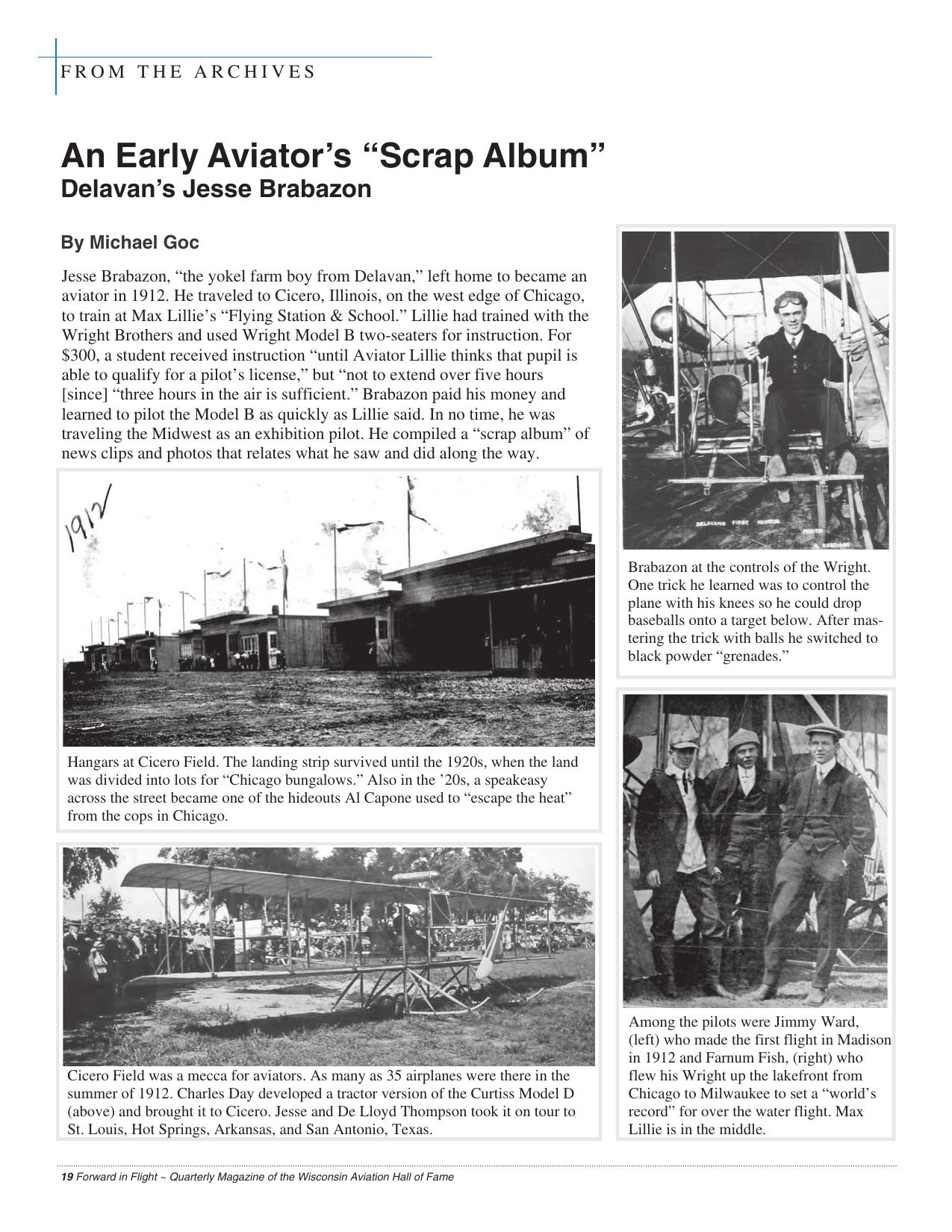
FROM THE ARCHIVES An Early Aviator’s “Scrap Album” Delavan’s Jesse Brabazon By Michael Goc Jesse Brabazon, “the yokel farm boy from Delavan,” left home to became an aviator in 1912. He traveled to Cicero, Illinois, on the west edge of Chicago, to train at Max Lillie’s “Flying Station & School.” Lillie had trained with the Wright Brothers and used Wright Model B two-seaters for instruction. For $300, a student received instruction “until Aviator Lillie thinks that pupil is able to qualify for a pilot’s license,” but “not to extend over five hours [since] “three hours in the air is sufficient.” Brabazon paid his money and learned to pilot the Model B as quickly as Lillie said. In no time, he was traveling the Midwest as an exhibition pilot. He compiled a “scrap album” of news clips and photos that relates what he saw and did along the way. Brabazon at the controls of the Wright. One trick he learned was to control the plane with his knees so he could drop baseballs onto a target below. After mastering the trick with balls he switched to black powder “grenades.” Hangars at Cicero Field. The landing strip survived until the 1920s, when the land was divided into lots for “Chicago bungalows.” Also in the ’20s, a speakeasy across the street became one of the hideouts Al Capone used to “escape the heat” from the cops in Chicago. Cicero Field was a mecca for aviators. As many as 35 airplanes were there in the summer of 1912. Charles Day developed a tractor version of the Curtiss Model D (above) and brought it to Cicero. Jesse and De Lloyd Thompson took it on tour to St. Louis, Hot Springs, Arkansas, and San Antonio, Texas. 19 Forward in Flight ~ Quarterly Magazine of the Wisconsin Aviation Hall of Fame Among the pilots were Jimmy Ward, (left) who made the first flight in Madison in 1912 and Farnum Fish, (right) who flew his Wright up the lakefront from Chicago to Milwaukee to set a “world’s record” for over the water flight. Max Lillie is in the middle.
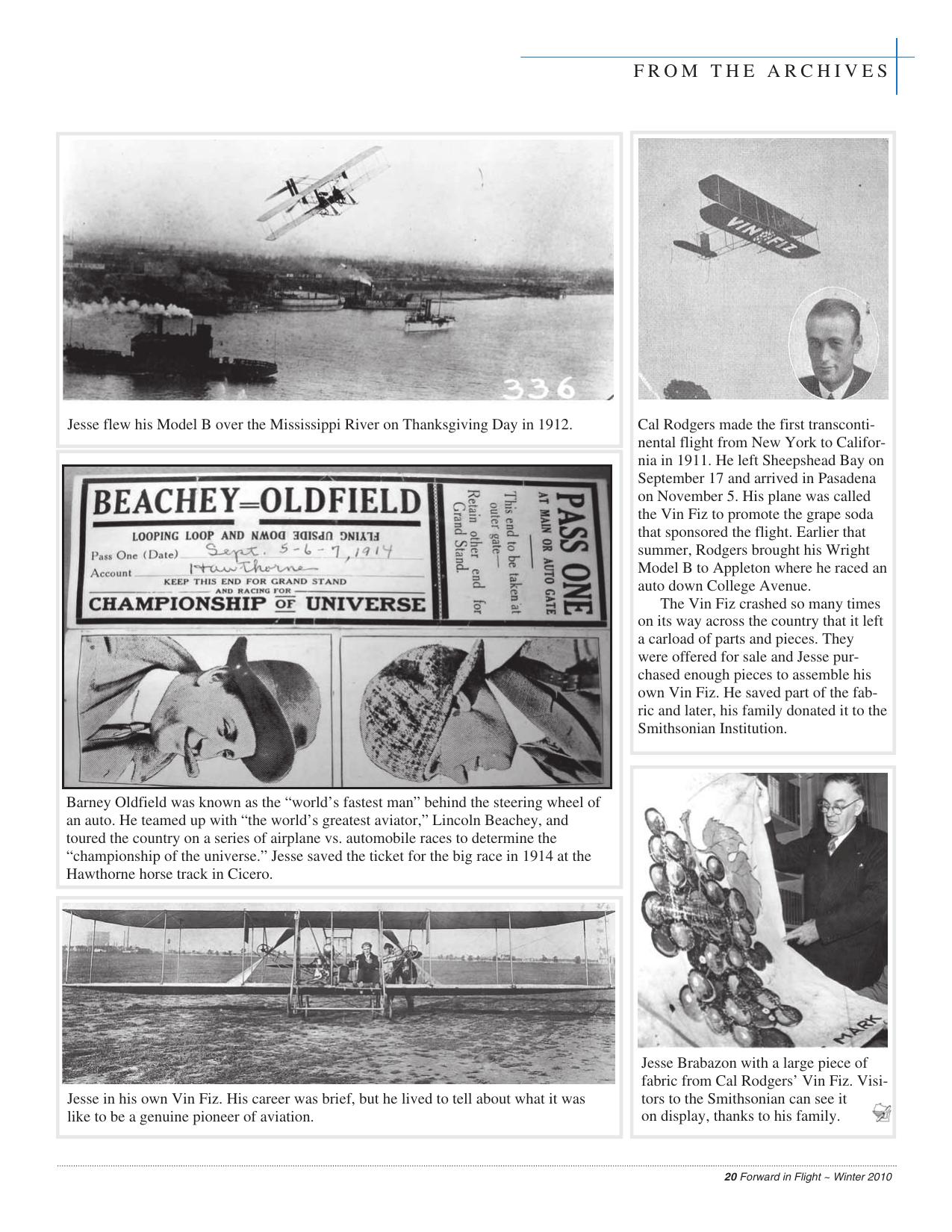
FROM THE ARCHIVES Jesse flew his Model B over the Mississippi River on Thanksgiving Day in 1912. Cal Rodgers made the first transcontinental flight from New York to California in 1911. He left Sheepshead Bay on September 17 and arrived in Pasadena on November 5. His plane was called the Vin Fiz to promote the grape soda that sponsored the flight. Earlier that summer, Rodgers brought his Wright Model B to Appleton where he raced an auto down College Avenue. The Vin Fiz crashed so many times on its way across the country that it left a carload of parts and pieces. They were offered for sale and Jesse purchased enough pieces to assemble his own Vin Fiz. He saved part of the fabric and later, his family donated it to the Smithsonian Institution. Barney Oldfield was known as the “world’s fastest man” behind the steering wheel of an auto. He teamed up with “the world’s greatest aviator,” Lincoln Beachey, and toured the country on a series of airplane vs. automobile races to determine the “championship of the universe.” Jesse saved the ticket for the big race in 1914 at the Hawthorne horse track in Cicero. Jesse in his own Vin Fiz. His career was brief, but he lived to tell about what it was like to be a genuine pioneer of aviation. Jesse Brabazon with a large piece of fabric from Cal Rodgers’ Vin Fiz. Visitors to the Smithsonian can see it on display, thanks to his family. 20 Forward in Flight ~ Winter 2010
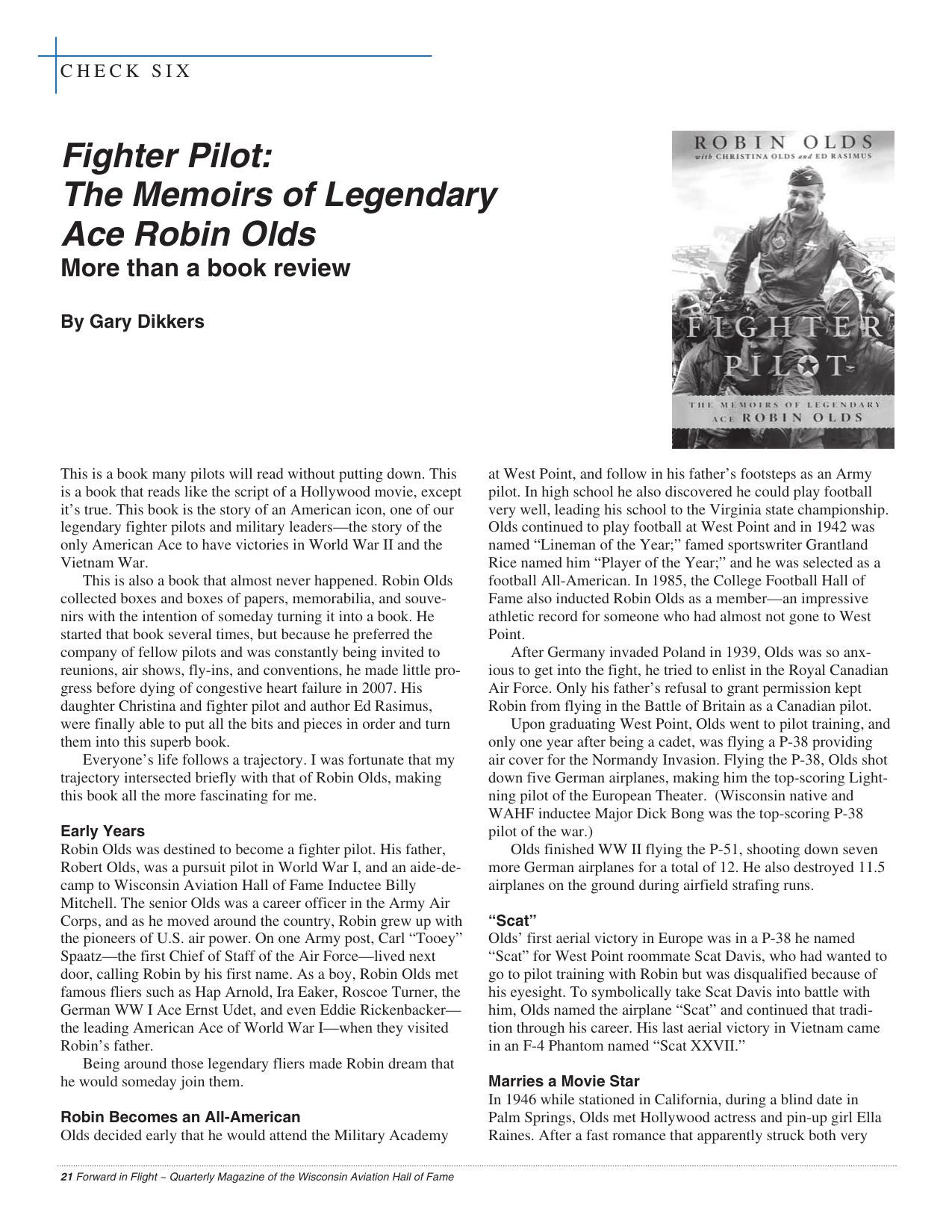
CHECK SIX Fighter Pilot: The Memoirs of Legendary Ace Robin Olds More than a book review By Gary Dikkers This is a book many pilots will read without putting down. This is a book that reads like the script of a Hollywood movie, except it’s true. This book is the story of an American icon, one of our legendary fighter pilots and military leaders—the story of the only American Ace to have victories in World War II and the Vietnam War. This is also a book that almost never happened. Robin Olds collected boxes and boxes of papers, memorabilia, and souvenirs with the intention of someday turning it into a book. He started that book several times, but because he preferred the company of fellow pilots and was constantly being invited to reunions, air shows, fly-ins, and conventions, he made little progress before dying of congestive heart failure in 2007. His daughter Christina and fighter pilot and author Ed Rasimus, were finally able to put all the bits and pieces in order and turn them into this superb book. Everyone’s life follows a trajectory. I was fortunate that my trajectory intersected briefly with that of Robin Olds, making this book all the more fascinating for me. Early Years Robin Olds was destined to become a fighter pilot. His father, Robert Olds, was a pursuit pilot in World War I, and an aide-decamp to Wisconsin Aviation Hall of Fame Inductee Billy Mitchell. The senior Olds was a career officer in the Army Air Corps, and as he moved around the country, Robin grew up with the pioneers of U.S. air power. On one Army post, Carl “Tooey” Spaatz—the first Chief of Staff of the Air Force—lived next door, calling Robin by his first name. As a boy, Robin Olds met famous fliers such as Hap Arnold, Ira Eaker, Roscoe Turner, the German WW I Ace Ernst Udet, and even Eddie Rickenbacker— the leading American Ace of World War I—when they visited Robin’s father. Being around those legendary fliers made Robin dream that he would someday join them. Robin Becomes an All-American Olds decided early that he would attend the Military Academy 21 Forward in Flight ~ Quarterly Magazine of the Wisconsin Aviation Hall of Fame at West Point, and follow in his father’s footsteps as an Army pilot. In high school he also discovered he could play football very well, leading his school to the Virginia state championship. Olds continued to play football at West Point and in 1942 was named “Lineman of the Year;” famed sportswriter Grantland Rice named him “Player of the Year;” and he was selected as a football All-American. In 1985, the College Football Hall of Fame also inducted Robin Olds as a member—an impressive athletic record for someone who had almost not gone to West Point. After Germany invaded Poland in 1939, Olds was so anxious to get into the fight, he tried to enlist in the Royal Canadian Air Force. Only his father’s refusal to grant permission kept Robin from flying in the Battle of Britain as a Canadian pilot. Upon graduating West Point, Olds went to pilot training, and only one year after being a cadet, was flying a P-38 providing air cover for the Normandy Invasion. Flying the P-38, Olds shot down five German airplanes, making him the top-scoring Lightning pilot of the European Theater. (Wisconsin native and WAHF inductee Major Dick Bong was the top-scoring P-38 pilot of the war.) Olds finished WW II flying the P-51, shooting down seven more German airplanes for a total of 12. He also destroyed 11.5 airplanes on the ground during airfield strafing runs. “Scat” Olds’ first aerial victory in Europe was in a P-38 he named “Scat” for West Point roommate Scat Davis, who had wanted to go to pilot training with Robin but was disqualified because of his eyesight. To symbolically take Scat Davis into battle with him, Olds named the airplane “Scat” and continued that tradition through his career. His last aerial victory in Vietnam came in an F-4 Phantom named “Scat XXVII.” Marries a Movie Star In 1946 while stationed in California, during a blind date in Palm Springs, Olds met Hollywood actress and pin-up girl Ella Raines. After a fast romance that apparently struck both very
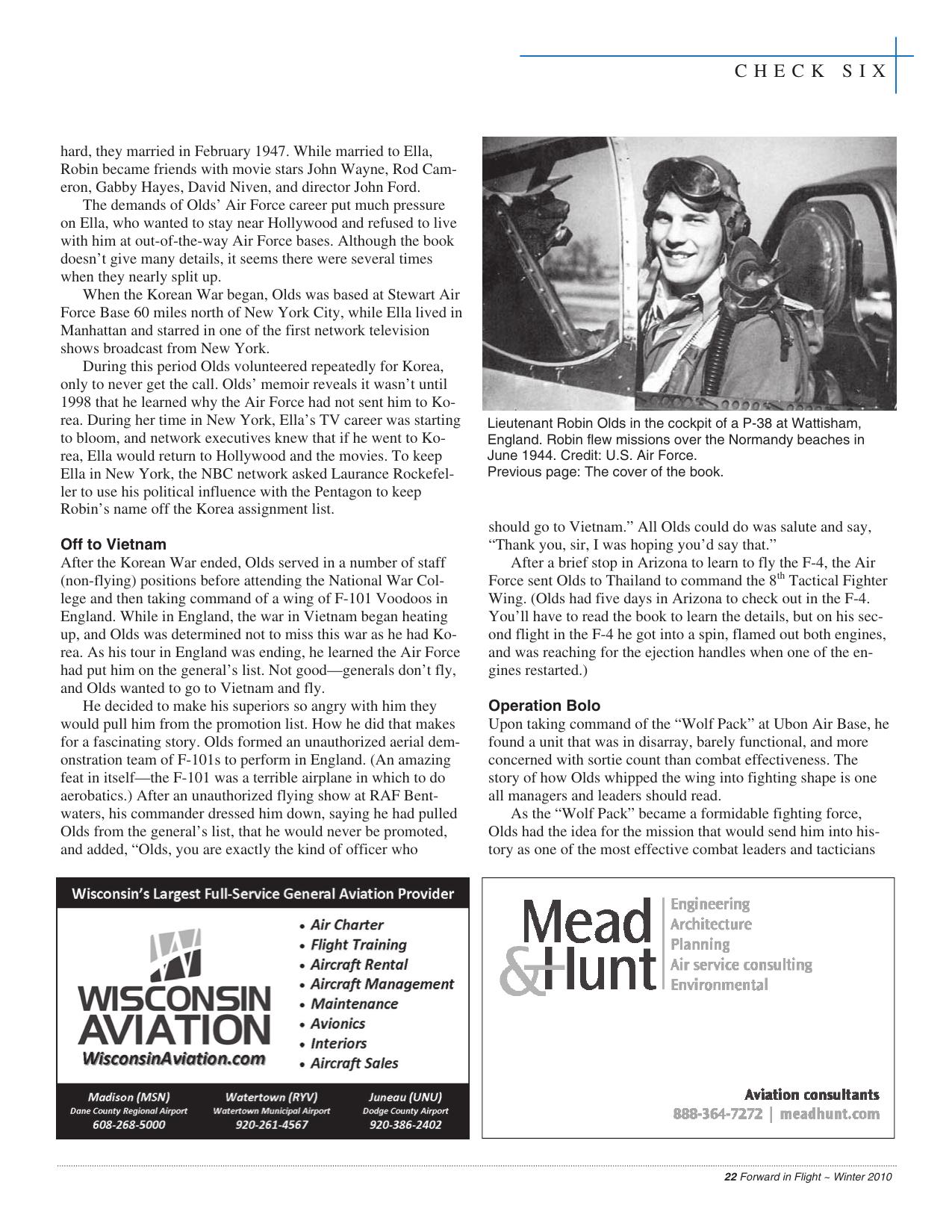
CHECK SIX hard, they married in February 1947. While married to Ella, Robin became friends with movie stars John Wayne, Rod Cameron, Gabby Hayes, David Niven, and director John Ford. The demands of Olds’ Air Force career put much pressure on Ella, who wanted to stay near Hollywood and refused to live with him at out-of-the-way Air Force bases. Although the book doesn’t give many details, it seems there were several times when they nearly split up. When the Korean War began, Olds was based at Stewart Air Force Base 60 miles north of New York City, while Ella lived in Manhattan and starred in one of the first network television shows broadcast from New York. During this period Olds volunteered repeatedly for Korea, only to never get the call. Olds’ memoir reveals it wasn’t until 1998 that he learned why the Air Force had not sent him to Korea. During her time in New York, Ella’s TV career was starting to bloom, and network executives knew that if he went to Korea, Ella would return to Hollywood and the movies. To keep Ella in New York, the NBC network asked Laurance Rockefeller to use his political influence with the Pentagon to keep Robin’s name off the Korea assignment list. Off to Vietnam After the Korean War ended, Olds served in a number of staff (non-flying) positions before attending the National War College and then taking command of a wing of F-101 Voodoos in England. While in England, the war in Vietnam began heating up, and Olds was determined not to miss this war as he had Korea. As his tour in England was ending, he learned the Air Force had put him on the general’s list. Not good—generals don’t fly, and Olds wanted to go to Vietnam and fly. He decided to make his superiors so angry with him they would pull him from the promotion list. How he did that makes for a fascinating story. Olds formed an unauthorized aerial demonstration team of F-101s to perform in England. (An amazing feat in itself—the F-101 was a terrible airplane in which to do aerobatics.) After an unauthorized flying show at RAF Bentwaters, his commander dressed him down, saying he had pulled Olds from the general’s list, that he would never be promoted, and added, “Olds, you are exactly the kind of officer who Lieutenant Robin Olds in the cockpit of a P-38 at Wattisham, England. Robin flew missions over the Normandy beaches in June 1944. Credit: U.S. Air Force. Previous page: The cover of the book. should go to Vietnam.” All Olds could do was salute and say, “Thank you, sir, I was hoping you’d say that.” After a brief stop in Arizona to learn to fly the F-4, the Air Force sent Olds to Thailand to command the 8th Tactical Fighter Wing. (Olds had five days in Arizona to check out in the F-4. You’ll have to read the book to learn the details, but on his second flight in the F-4 he got into a spin, flamed out both engines, and was reaching for the ejection handles when one of the engines restarted.) Operation Bolo Upon taking command of the “Wolf Pack” at Ubon Air Base, he found a unit that was in disarray, barely functional, and more concerned with sortie count than combat effectiveness. The story of how Olds whipped the wing into fighting shape is one all managers and leaders should read. As the “Wolf Pack” became a formidable fighting force, Olds had the idea for the mission that would send him into history as one of the most effective combat leaders and tacticians 22 Forward in Flight ~ Winter 2010
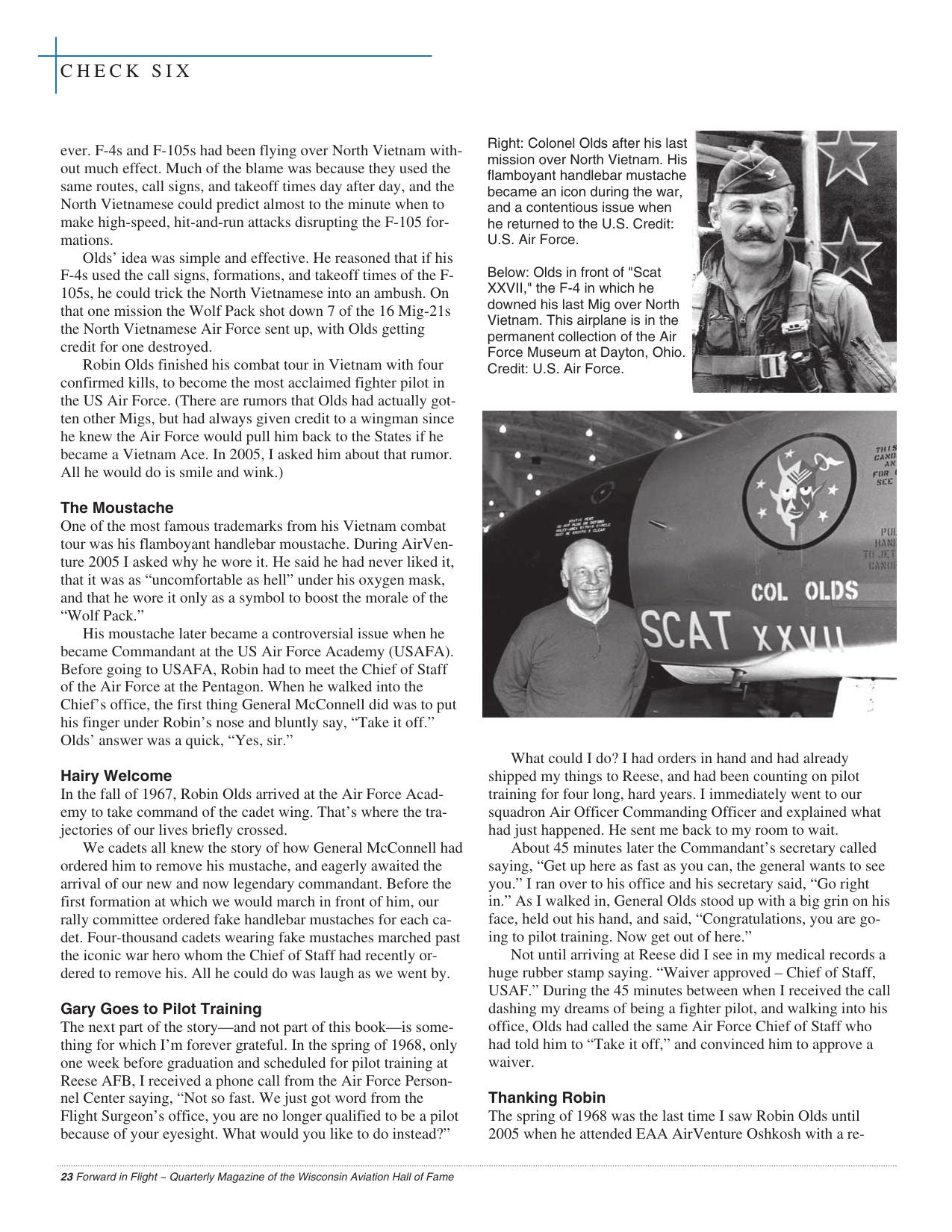
CHECK SIX ever. F-4s and F-105s had been flying over North Vietnam without much effect. Much of the blame was because they used the same routes, call signs, and takeoff times day after day, and the North Vietnamese could predict almost to the minute when to make high-speed, hit-and-run attacks disrupting the F-105 formations. Olds’ idea was simple and effective. He reasoned that if his F-4s used the call signs, formations, and takeoff times of the F105s, he could trick the North Vietnamese into an ambush. On that one mission the Wolf Pack shot down 7 of the 16 Mig-21s the North Vietnamese Air Force sent up, with Olds getting credit for one destroyed. Robin Olds finished his combat tour in Vietnam with four confirmed kills, to become the most acclaimed fighter pilot in the US Air Force. (There are rumors that Olds had actually gotten other Migs, but had always given credit to a wingman since he knew the Air Force would pull him back to the States if he became a Vietnam Ace. In 2005, I asked him about that rumor. All he would do is smile and wink.) Right: Colonel Olds after his last mission over North Vietnam. His flamboyant handlebar mustache became an icon during the war, and a contentious issue when he returned to the U.S. Credit: U.S. Air Force. Below: Olds in front of "Scat XXVII," the F-4 in which he downed his last Mig over North Vietnam. This airplane is in the permanent collection of the Air Force Museum at Dayton, Ohio. Credit: U.S. Air Force. The Moustache One of the most famous trademarks from his Vietnam combat tour was his flamboyant handlebar moustache. During AirVenture 2005 I asked why he wore it. He said he had never liked it, that it was as “uncomfortable as hell” under his oxygen mask, and that he wore it only as a symbol to boost the morale of the “Wolf Pack.” His moustache later became a controversial issue when he became Commandant at the US Air Force Academy (USAFA). Before going to USAFA, Robin had to meet the Chief of Staff of the Air Force at the Pentagon. When he walked into the Chief’s office, the first thing General McConnell did was to put his finger under Robin’s nose and bluntly say, “Take it off.” Olds’ answer was a quick, “Yes, sir.” Hairy Welcome In the fall of 1967, Robin Olds arrived at the Air Force Academy to take command of the cadet wing. That’s where the trajectories of our lives briefly crossed. We cadets all knew the story of how General McConnell had ordered him to remove his mustache, and eagerly awaited the arrival of our new and now legendary commandant. Before the first formation at which we would march in front of him, our rally committee ordered fake handlebar mustaches for each cadet. Four-thousand cadets wearing fake mustaches marched past the iconic war hero whom the Chief of Staff had recently ordered to remove his. All he could do was laugh as we went by. Gary Goes to Pilot Training The next part of the story—and not part of this book—is something for which I’m forever grateful. In the spring of 1968, only one week before graduation and scheduled for pilot training at Reese AFB, I received a phone call from the Air Force Personnel Center saying, “Not so fast. We just got word from the Flight Surgeon’s office, you are no longer qualified to be a pilot because of your eyesight. What would you like to do instead?” 23 Forward in Flight ~ Quarterly Magazine of the Wisconsin Aviation Hall of Fame What could I do? I had orders in hand and had already shipped my things to Reese, and had been counting on pilot training for four long, hard years. I immediately went to our squadron Air Officer Commanding Officer and explained what had just happened. He sent me back to my room to wait. About 45 minutes later the Commandant’s secretary called saying, “Get up here as fast as you can, the general wants to see you.” I ran over to his office and his secretary said, “Go right in.” As I walked in, General Olds stood up with a big grin on his face, held out his hand, and said, “Congratulations, you are going to pilot training. Now get out of here.” Not until arriving at Reese did I see in my medical records a huge rubber stamp saying. “Waiver approved – Chief of Staff, USAF.” During the 45 minutes between when I received the call dashing my dreams of being a fighter pilot, and walking into his office, Olds had called the same Air Force Chief of Staff who had told him to “Take it off,” and convinced him to approve a waiver. Thanking Robin The spring of 1968 was the last time I saw Robin Olds until 2005 when he attended EAA AirVenture Oshkosh with a re-
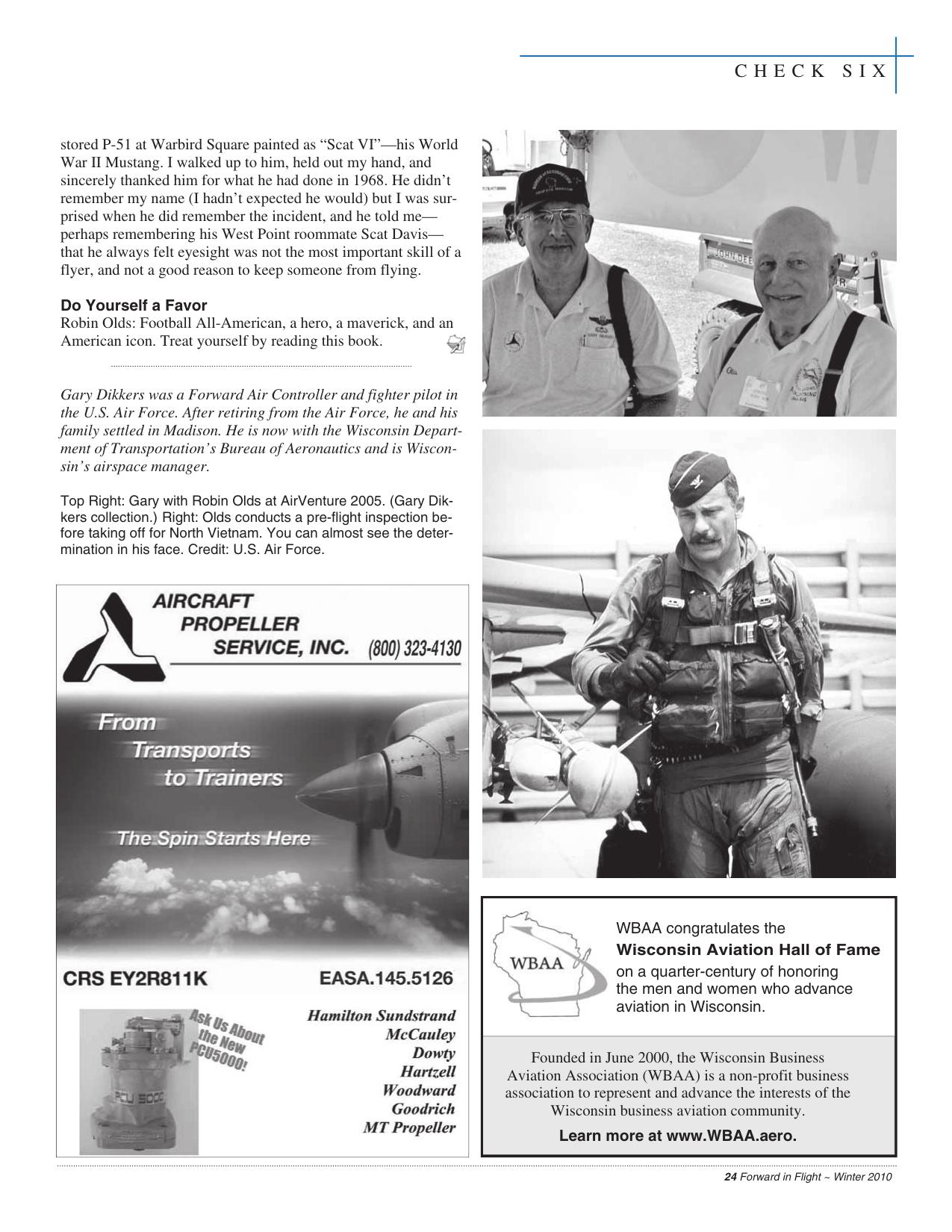
CHECK SIX stored P-51 at Warbird Square painted as “Scat VI”—his World War II Mustang. I walked up to him, held out my hand, and sincerely thanked him for what he had done in 1968. He didn’t remember my name (I hadn’t expected he would) but I was surprised when he did remember the incident, and he told me— perhaps remembering his West Point roommate Scat Davis— that he always felt eyesight was not the most important skill of a flyer, and not a good reason to keep someone from flying. Do Yourself a Favor Robin Olds: Football All-American, a hero, a maverick, and an American icon. Treat yourself by reading this book. Gary Dikkers was a Forward Air Controller and fighter pilot in the U.S. Air Force. After retiring from the Air Force, he and his family settled in Madison. He is now with the Wisconsin Department of Transportation’s Bureau of Aeronautics and is Wisconsin’s airspace manager. Top Right: Gary with Robin Olds at AirVenture 2005. (Gary Dikkers collection.) Right: Olds conducts a pre-flight inspection before taking off for North Vietnam. You can almost see the determination in his face. Credit: U.S. Air Force. WBAA congratulates the Wisconsin Aviation Hall of Fame on a quarter-century of honoring the men and women who advance aviation in Wisconsin. Founded in June 2000, the Wisconsin Business Aviation Association (WBAA) is a non-profit business association to represent and advance the interests of the Wisconsin business aviation community. Learn more at www.WBAA.aero. 24 Forward in Flight ~ Winter 2010
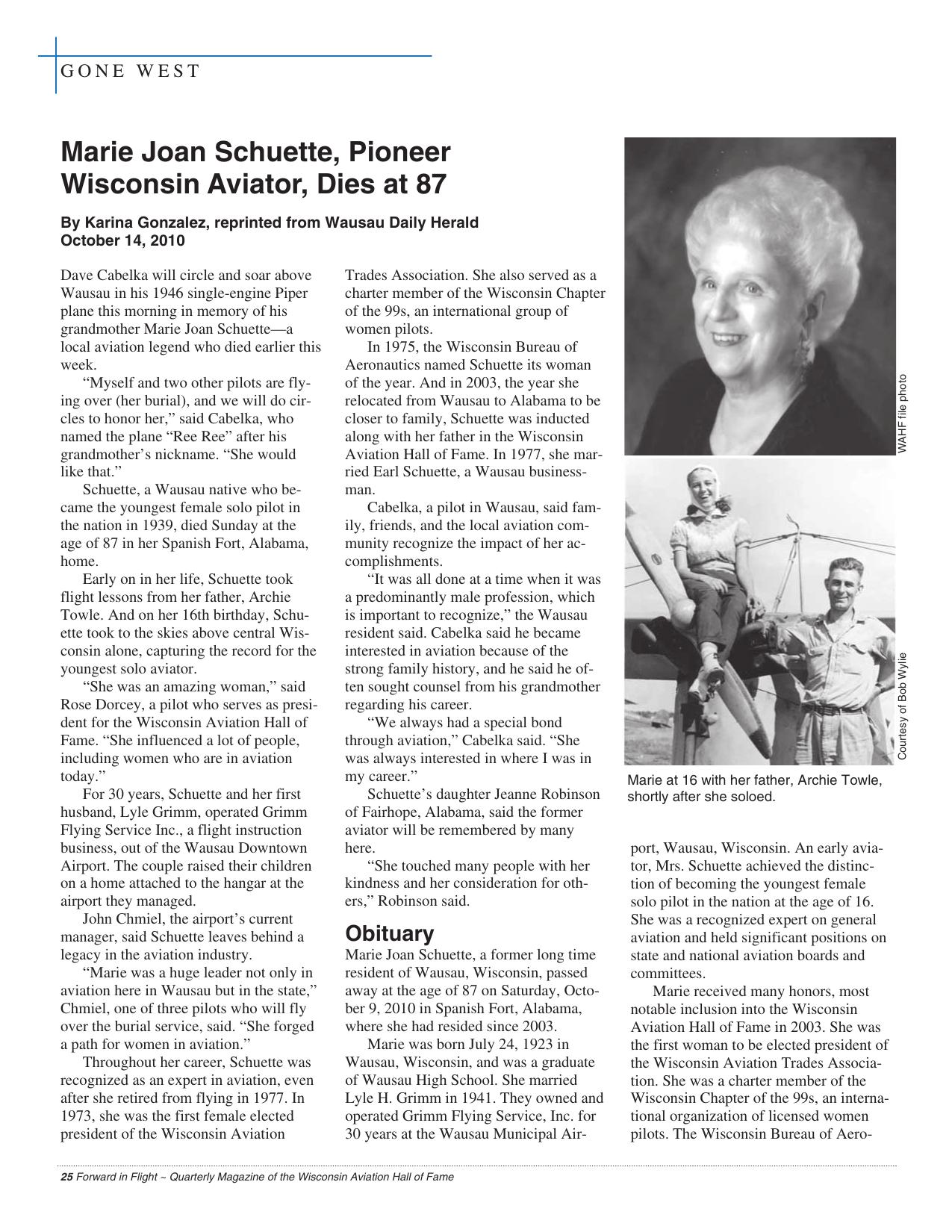
GONE WEST Marie Joan Schuette, Pioneer Wisconsin Aviator, Dies at 87 Trades Association. She also served as a charter member of the Wisconsin Chapter of the 99s, an international group of women pilots. In 1975, the Wisconsin Bureau of Aeronautics named Schuette its woman of the year. And in 2003, the year she relocated from Wausau to Alabama to be closer to family, Schuette was inducted along with her father in the Wisconsin Aviation Hall of Fame. In 1977, she married Earl Schuette, a Wausau businessman. Cabelka, a pilot in Wausau, said family, friends, and the local aviation community recognize the impact of her accomplishments. “It was all done at a time when it was a predominantly male profession, which is important to recognize,” the Wausau resident said. Cabelka said he became interested in aviation because of the strong family history, and he said he often sought counsel from his grandmother regarding his career. “We always had a special bond through aviation,” Cabelka said. “She was always interested in where I was in my career.” Schuette’s daughter Jeanne Robinson of Fairhope, Alabama, said the former aviator will be remembered by many here. “She touched many people with her kindness and her consideration for others,” Robinson said. Obituary Marie Joan Schuette, a former long time resident of Wausau, Wisconsin, passed away at the age of 87 on Saturday, October 9, 2010 in Spanish Fort, Alabama, where she had resided since 2003. Marie was born July 24, 1923 in Wausau, Wisconsin, and was a graduate of Wausau High School. She married Lyle H. Grimm in 1941. They owned and operated Grimm Flying Service, Inc. for 30 years at the Wausau Municipal Air- 25 Forward in Flight ~ Quarterly Magazine of the Wisconsin Aviation Hall of Fame Courtesy of Bob Wylie Dave Cabelka will circle and soar above Wausau in his 1946 single-engine Piper plane this morning in memory of his grandmother Marie Joan Schuette—a local aviation legend who died earlier this week. “Myself and two other pilots are flying over (her burial), and we will do circles to honor her,” said Cabelka, who named the plane “Ree Ree” after his grandmother’s nickname. “She would like that.” Schuette, a Wausau native who became the youngest female solo pilot in the nation in 1939, died Sunday at the age of 87 in her Spanish Fort, Alabama, home. Early on in her life, Schuette took flight lessons from her father, Archie Towle. And on her 16th birthday, Schuette took to the skies above central Wisconsin alone, capturing the record for the youngest solo aviator. “She was an amazing woman,” said Rose Dorcey, a pilot who serves as president for the Wisconsin Aviation Hall of Fame. “She influenced a lot of people, including women who are in aviation today.” For 30 years, Schuette and her first husband, Lyle Grimm, operated Grimm Flying Service Inc., a flight instruction business, out of the Wausau Downtown Airport. The couple raised their children on a home attached to the hangar at the airport they managed. John Chmiel, the airport’s current manager, said Schuette leaves behind a legacy in the aviation industry. “Marie was a huge leader not only in aviation here in Wausau but in the state,” Chmiel, one of three pilots who will fly over the burial service, said. “She forged a path for women in aviation.” Throughout her career, Schuette was recognized as an expert in aviation, even after she retired from flying in 1977. In 1973, she was the first female elected president of the Wisconsin Aviation WAHF file photo By Karina Gonzalez, reprinted from Wausau Daily Herald October 14, 2010 Marie at 16 with her father, Archie Towle, shortly after she soloed. port, Wausau, Wisconsin. An early aviator, Mrs. Schuette achieved the distinction of becoming the youngest female solo pilot in the nation at the age of 16. She was a recognized expert on general aviation and held significant positions on state and national aviation boards and committees. Marie received many honors, most notable inclusion into the Wisconsin Aviation Hall of Fame in 2003. She was the first woman to be elected president of the Wisconsin Aviation Trades Association. She was a charter member of the Wisconsin Chapter of the 99s, an international organization of licensed women pilots. The Wisconsin Bureau of Aero-
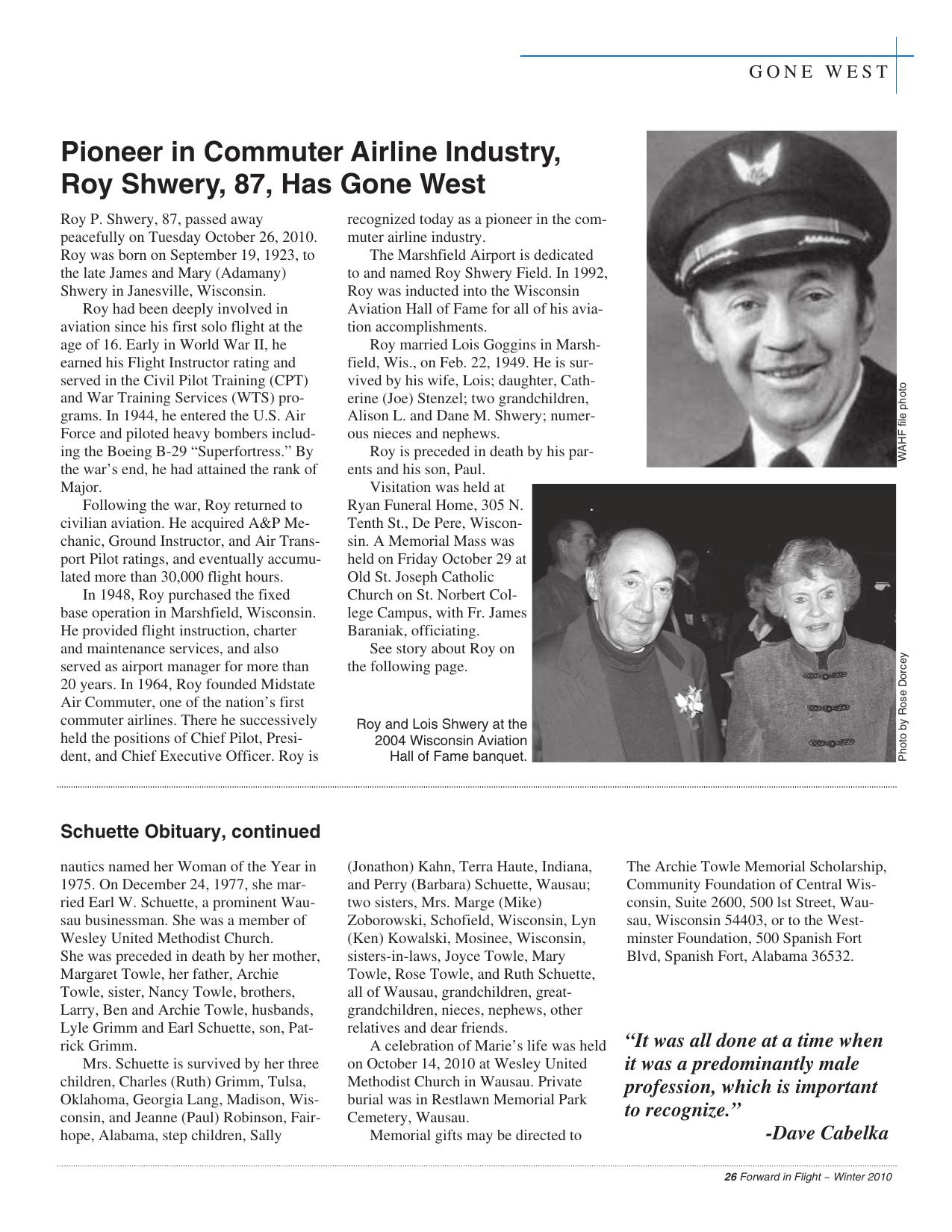
GONE WEST Pioneer in Commuter Airline Industry, Roy Shwery, 87, Has Gone West WAHF file photo recognized today as a pioneer in the commuter airline industry. The Marshfield Airport is dedicated to and named Roy Shwery Field. In 1992, Roy was inducted into the Wisconsin Aviation Hall of Fame for all of his aviation accomplishments. Roy married Lois Goggins in Marshfield, Wis., on Feb. 22, 1949. He is survived by his wife, Lois; daughter, Catherine (Joe) Stenzel; two grandchildren, Alison L. and Dane M. Shwery; numerous nieces and nephews. Roy is preceded in death by his parents and his son, Paul. Visitation was held at Ryan Funeral Home, 305 N. Tenth St., De Pere, Wisconsin. A Memorial Mass was held on Friday October 29 at Old St. Joseph Catholic Church on St. Norbert College Campus, with Fr. James Baraniak, officiating. See story about Roy on the following page. Photo by Rose Dorcey Roy P. Shwery, 87, passed away peacefully on Tuesday October 26, 2010. Roy was born on September 19, 1923, to the late James and Mary (Adamany) Shwery in Janesville, Wisconsin. Roy had been deeply involved in aviation since his first solo flight at the age of 16. Early in World War II, he earned his Flight Instructor rating and served in the Civil Pilot Training (CPT) and War Training Services (WTS) programs. In 1944, he entered the U.S. Air Force and piloted heavy bombers including the Boeing B-29 “Superfortress.” By the war’s end, he had attained the rank of Major. Following the war, Roy returned to civilian aviation. He acquired A&P Mechanic, Ground Instructor, and Air Transport Pilot ratings, and eventually accumulated more than 30,000 flight hours. In 1948, Roy purchased the fixed base operation in Marshfield, Wisconsin. He provided flight instruction, charter and maintenance services, and also served as airport manager for more than 20 years. In 1964, Roy founded Midstate Air Commuter, one of the nation’s first commuter airlines. There he successively held the positions of Chief Pilot, President, and Chief Executive Officer. Roy is Roy and Lois Shwery at the 2004 Wisconsin Aviation Hall of Fame banquet. Schuette Obituary, continued nautics named her Woman of the Year in 1975. On December 24, 1977, she married Earl W. Schuette, a prominent Wausau businessman. She was a member of Wesley United Methodist Church. She was preceded in death by her mother, Margaret Towle, her father, Archie Towle, sister, Nancy Towle, brothers, Larry, Ben and Archie Towle, husbands, Lyle Grimm and Earl Schuette, son, Patrick Grimm. Mrs. Schuette is survived by her three children, Charles (Ruth) Grimm, Tulsa, Oklahoma, Georgia Lang, Madison, Wisconsin, and Jeanne (Paul) Robinson, Fairhope, Alabama, step children, Sally (Jonathon) Kahn, Terra Haute, Indiana, and Perry (Barbara) Schuette, Wausau; two sisters, Mrs. Marge (Mike) Zoborowski, Schofield, Wisconsin, Lyn (Ken) Kowalski, Mosinee, Wisconsin, sisters-in-laws, Joyce Towle, Mary Towle, Rose Towle, and Ruth Schuette, all of Wausau, grandchildren, greatgrandchildren, nieces, nephews, other relatives and dear friends. A celebration of Marie’s life was held on October 14, 2010 at Wesley United Methodist Church in Wausau. Private burial was in Restlawn Memorial Park Cemetery, Wausau. Memorial gifts may be directed to The Archie Towle Memorial Scholarship, Community Foundation of Central Wisconsin, Suite 2600, 500 lst Street, Wausau, Wisconsin 54403, or to the Westminster Foundation, 500 Spanish Fort Blvd, Spanish Fort, Alabama 36532. “It was all done at a time when it was a predominantly male profession, which is important to recognize.” -Dave Cabelka 26 Forward in Flight ~ Winter 2010
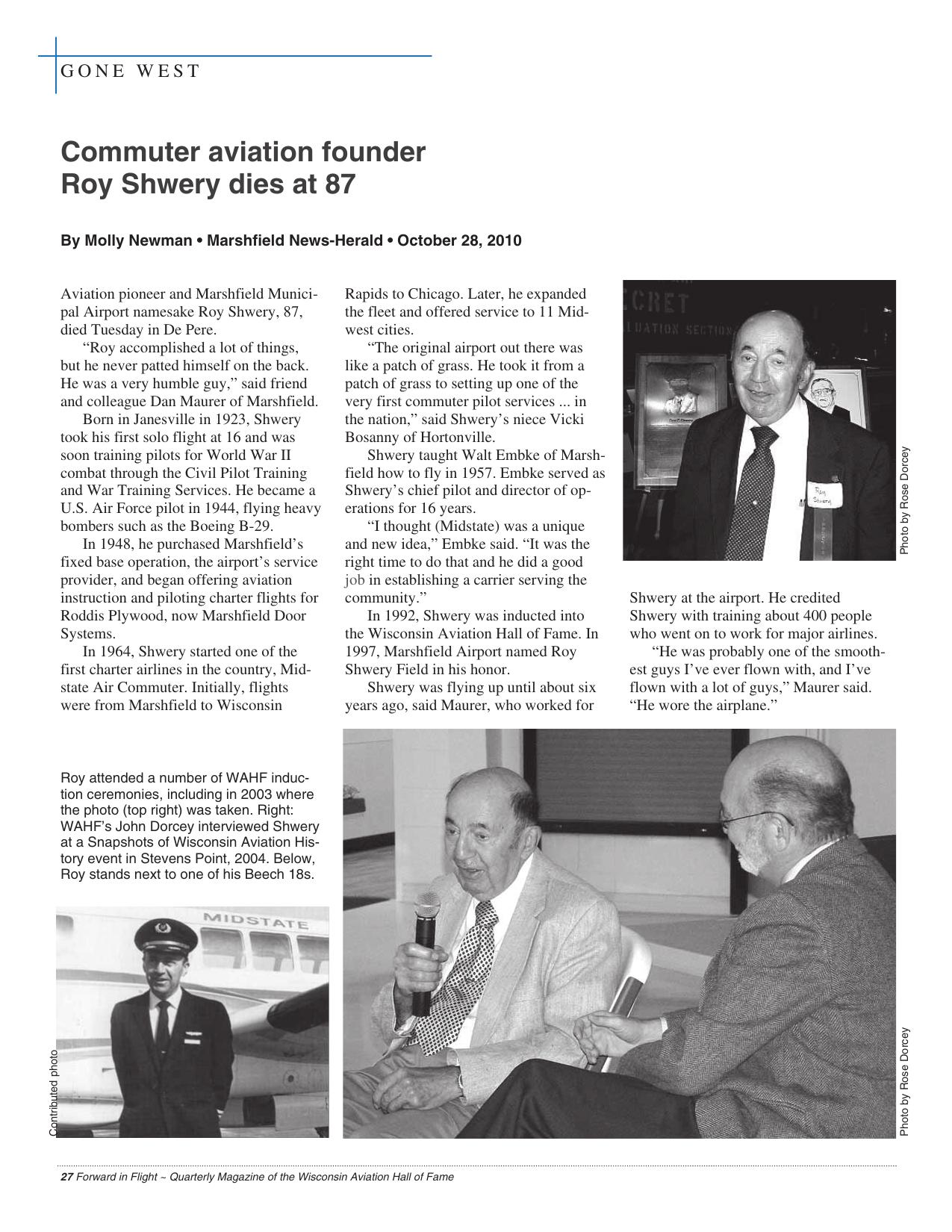
GONE WEST Commuter aviation founder Roy Shwery dies at 87 Aviation pioneer and Marshfield Municipal Airport namesake Roy Shwery, 87, died Tuesday in De Pere. “Roy accomplished a lot of things, but he never patted himself on the back. He was a very humble guy,” said friend and colleague Dan Maurer of Marshfield. Born in Janesville in 1923, Shwery took his first solo flight at 16 and was soon training pilots for World War II combat through the Civil Pilot Training and War Training Services. He became a U.S. Air Force pilot in 1944, flying heavy bombers such as the Boeing B-29. In 1948, he purchased Marshfield’s fixed base operation, the airport’s service provider, and began offering aviation instruction and piloting charter flights for Roddis Plywood, now Marshfield Door Systems. In 1964, Shwery started one of the first charter airlines in the country, Midstate Air Commuter. Initially, flights were from Marshfield to Wisconsin Rapids to Chicago. Later, he expanded the fleet and offered service to 11 Midwest cities. “The original airport out there was like a patch of grass. He took it from a patch of grass to setting up one of the very first commuter pilot services ... in the nation,” said Shwery’s niece Vicki Bosanny of Hortonville. Shwery taught Walt Embke of Marshfield how to fly in 1957. Embke served as Shwery’s chief pilot and director of operations for 16 years. “I thought (Midstate) was a unique and new idea,” Embke said. “It was the right time to do that and he did a good job in establishing a carrier serving the community.” In 1992, Shwery was inducted into the Wisconsin Aviation Hall of Fame. In 1997, Marshfield Airport named Roy Shwery Field in his honor. Shwery was flying up until about six years ago, said Maurer, who worked for Photo by Rose Dorcey By Molly Newman • Marshfield News-Herald • October 28, 2010 Shwery at the airport. He credited Shwery with training about 400 people who went on to work for major airlines. “He was probably one of the smoothest guys I’ve ever flown with, and I’ve flown with a lot of guys,” Maurer said. “He wore the airplane.” Contributed photo Photo by Rose Dorcey Roy attended a number of WAHF induction ceremonies, including in 2003 where the photo (top right) was taken. Right: WAHF’s John Dorcey interviewed Shwery at a Snapshots of Wisconsin Aviation History event in Stevens Point, 2004. Below, Roy stands next to one of his Beech 18s. 27 Forward in Flight ~ Quarterly Magazine of the Wisconsin Aviation Hall of Fame
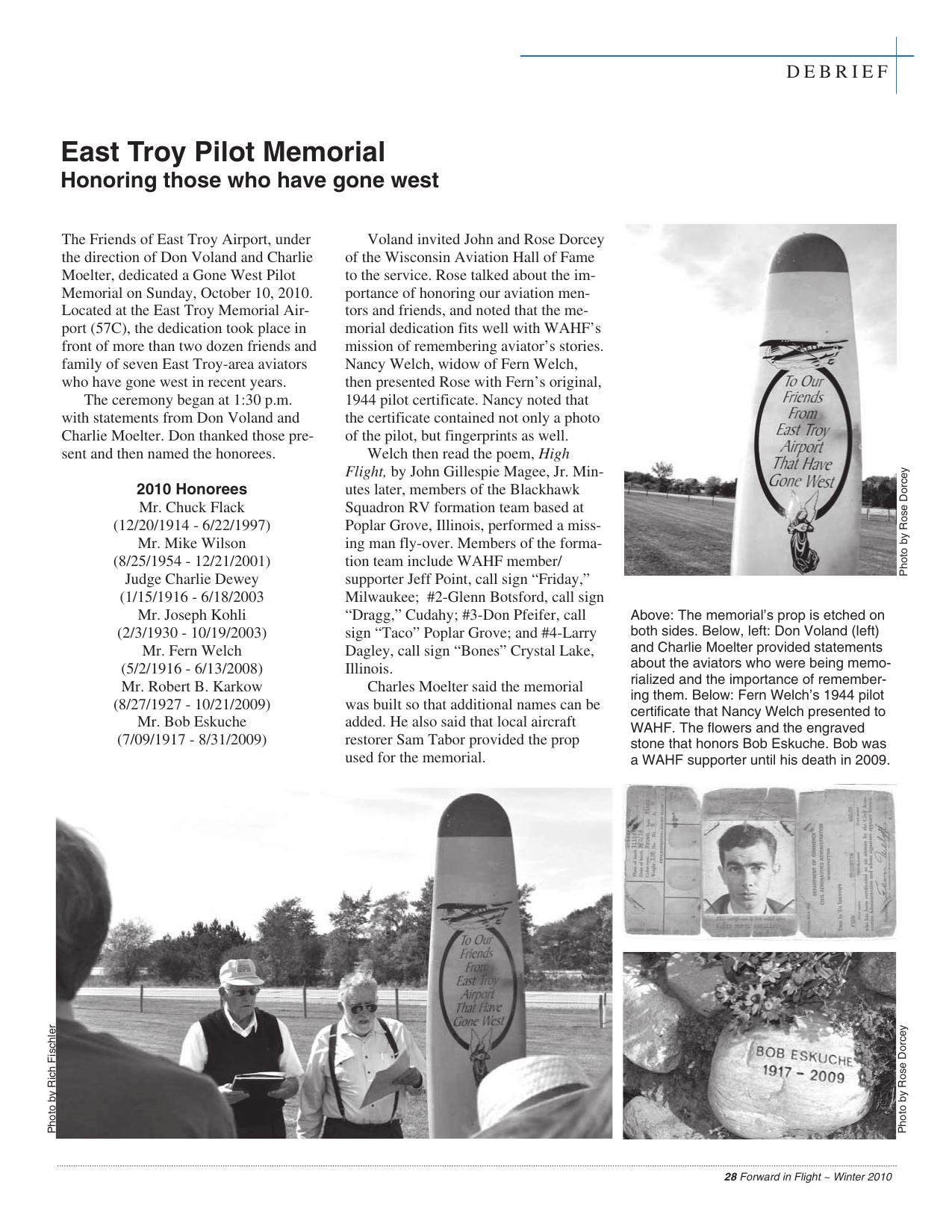
DEBRIEF East Troy Pilot Memorial Above: The memorial’s prop is etched on both sides. Below, left: Don Voland (left) and Charlie Moelter provided statements about the aviators who were being memorialized and the importance of remembering them. Below: Fern Welch’s 1944 pilot certificate that Nancy Welch presented to WAHF. The flowers and the engraved stone that honors Bob Eskuche. Bob was a WAHF supporter until his death in 2009. Photo by Rich Fischler 2010 Honorees Mr. Chuck Flack (12/20/1914 - 6/22/1997) Mr. Mike Wilson (8/25/1954 - 12/21/2001) Judge Charlie Dewey (1/15/1916 - 6/18/2003 Mr. Joseph Kohli (2/3/1930 - 10/19/2003) Mr. Fern Welch (5/2/1916 - 6/13/2008) Mr. Robert B. Karkow (8/27/1927 - 10/21/2009) Mr. Bob Eskuche (7/09/1917 - 8/31/2009) Voland invited John and Rose Dorcey of the Wisconsin Aviation Hall of Fame to the service. Rose talked about the importance of honoring our aviation mentors and friends, and noted that the memorial dedication fits well with WAHF’s mission of remembering aviator’s stories. Nancy Welch, widow of Fern Welch, then presented Rose with Fern’s original, 1944 pilot certificate. Nancy noted that the certificate contained not only a photo of the pilot, but fingerprints as well. Welch then read the poem, High Flight, by John Gillespie Magee, Jr. Minutes later, members of the Blackhawk Squadron RV formation team based at Poplar Grove, Illinois, performed a missing man fly-over. Members of the formation team include WAHF member/ supporter Jeff Point, call sign “Friday,” Milwaukee; #2-Glenn Botsford, call sign “Dragg,” Cudahy; #3-Don Pfeifer, call sign “Taco” Poplar Grove; and #4-Larry Dagley, call sign “Bones” Crystal Lake, Illinois. Charles Moelter said the memorial was built so that additional names can be added. He also said that local aircraft restorer Sam Tabor provided the prop used for the memorial. Photo by Rose Dorcey The Friends of East Troy Airport, under the direction of Don Voland and Charlie Moelter, dedicated a Gone West Pilot Memorial on Sunday, October 10, 2010. Located at the East Troy Memorial Airport (57C), the dedication took place in front of more than two dozen friends and family of seven East Troy-area aviators who have gone west in recent years. The ceremony began at 1:30 p.m. with statements from Don Voland and Charlie Moelter. Don thanked those present and then named the honorees. Photo by Rose Dorcey Honoring those who have gone west 28 Forward in Flight ~ Winter 2010
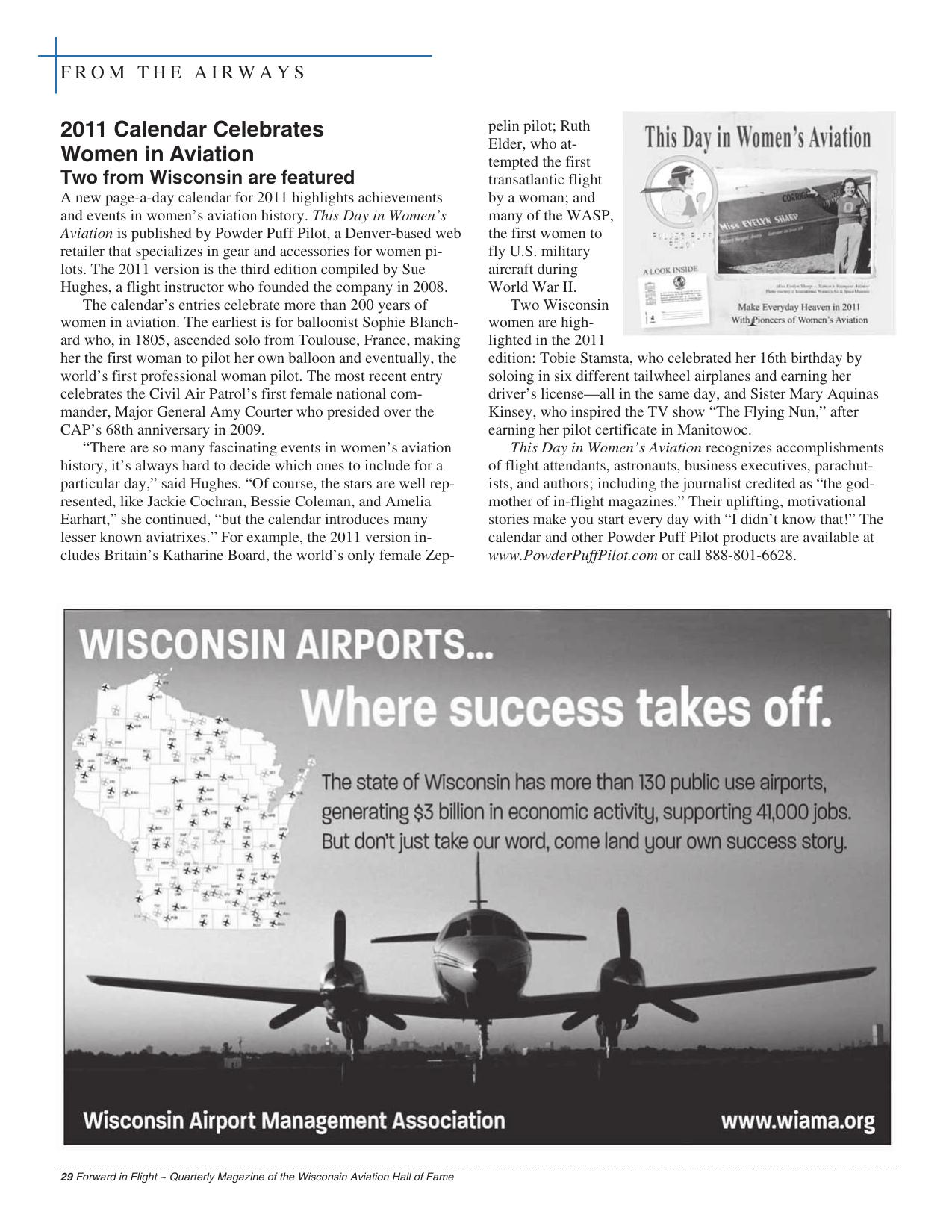
FROM THE AIRWAYS 2011 Calendar Celebrates Women in Aviation Two from Wisconsin are featured A new page-a-day calendar for 2011 highlights achievements and events in women’s aviation history. This Day in Women’s Aviation is published by Powder Puff Pilot, a Denver-based web retailer that specializes in gear and accessories for women pilots. The 2011 version is the third edition compiled by Sue Hughes, a flight instructor who founded the company in 2008. The calendar’s entries celebrate more than 200 years of women in aviation. The earliest is for balloonist Sophie Blanchard who, in 1805, ascended solo from Toulouse, France, making her the first woman to pilot her own balloon and eventually, the world’s first professional woman pilot. The most recent entry celebrates the Civil Air Patrol’s first female national commander, Major General Amy Courter who presided over the CAP’s 68th anniversary in 2009. “There are so many fascinating events in women’s aviation history, it’s always hard to decide which ones to include for a particular day,” said Hughes. “Of course, the stars are well represented, like Jackie Cochran, Bessie Coleman, and Amelia Earhart,” she continued, “but the calendar introduces many lesser known aviatrixes.” For example, the 2011 version includes Britain’s Katharine Board, the world’s only female Zep- 29 Forward in Flight ~ Quarterly Magazine of the Wisconsin Aviation Hall of Fame pelin pilot; Ruth Elder, who attempted the first transatlantic flight by a woman; and many of the WASP, the first women to fly U.S. military aircraft during World War II. Two Wisconsin women are highlighted in the 2011 edition: Tobie Stamsta, who celebrated her 16th birthday by soloing in six different tailwheel airplanes and earning her driver’s license—all in the same day, and Sister Mary Aquinas Kinsey, who inspired the TV show “The Flying Nun,” after earning her pilot certificate in Manitowoc. This Day in Women’s Aviation recognizes accomplishments of flight attendants, astronauts, business executives, parachutists, and authors; including the journalist credited as “the godmother of in-flight magazines.” Their uplifting, motivational stories make you start every day with “I didn’t know that!” The calendar and other Powder Puff Pilot products are available at www.PowderPuffPilot.com or call 888-801-6628.
FROM THE AIRWAYS Special Offer for WAHF Renewals/New Members To celebrate its 25th anniversary, the Wisconsin Aviation Hall of Fame has a special offer for new and renewing members: $50 for three years (paid through December 31, 2013). With a regular price of $20 per year, you’ll save money—and time—by sending a check today. And because we won’t have to send renewal reminders, you’ll reduce operational costs for WAHF. Use the form below, or just send a check noting the $50/3 years promotion. Need a Speaker for Your Next Event? Flying clubs and EAA chapter meetings and banquets are just some of the places WAHF Speakers Bureau members are willing to attend. WAHF speakers also share colorful stories from Wisconsin aviation history at service clubs, such as Rotary, and at historical museums throughout the state. If you’re interested in scheduling a WAHF speaker at your next event, send an email to speakers@aviationhalloffamewisconsin.com or call WAHF at 920-385-1483. Send your news and information to: Rose Dorcey, Editor · Forward in Flight · 3980 Sharratt Drive · Oshkosh, WI. 54901-1276. Subscribe to Forward in Flight today! (Annual subscription includes one-year WAHF membership) Membership Benefits: Quarterly subscription (4 issues) of Forward in Flight, packed full of Wisconsin aviation news, events, state aviation history, and stories about your aviation colleagues Free pass to Deke Slayton Museum Invitation to annual induction banquet The opportunity to nominate aviation leaders for induction! Name Address City State Zip Phone Number Email Address Referred By Just $20*, and you’ll be supporting an aviation organization dedicated to collecting, preserving, and sharing Wisconsin’s aviation history. With Forward in Flight, you’ll learn about aviation history makers—the people, places, and happenings that distinguish our state and also be in touch with current Wisconsin aviation news and events! This form can be used for renewals, as well. Send your check today! *SPECIAL OFFER! Please write check to: Wisconsin Aviation Hall of Fame, Inc. Mail to: John Dorcey, Treasurer Wisconsin Aviation Hall of Fame 3980 Sharratt Drive Oshkosh WI 54901-1276 $50 for 3 years! 30 Forward in Flight ~ Winter 2010
FROM THE AIRWAYS ‘Teaching Women to Fly’ Research Project Provides Answers Lakeland College Establishes Aviation Minor Program Why are there so few women pilots in America? Only 6% of those holding pilot certificates are female. Thanks to a research grant partially provided by the Wolf Aviation Fund, some of the answers can now be found. The volunteer director of this research project is Penny Rafferty Hamilton, Ph.D. Dr. Hamilton cast a wide net across the aviation community. Her 2-year study netted 296 completed surveys and/or personal interviews. Included within the sample are 54 female pilot-in-training (PIT) or others who started out to earn pilot certificates; however, for one reason or even several, did not complete their flight training. Also responding to her call were 157 women pilots, some with advanced ratings and experience in helicopters, soaring, commercial and military aviation. Fifty-two female and 33 male flight instructors shared their insights. After all the results of the survey and interviews were tabulated, 101 ideas on how to increase the number of women pilots were generated. These have been reduced to the Top 10 Things we should be doing to increase the number of women pilots (and the Top 10 Things we should stop doing!) Dr. Hamilton hopes that by sharing the survey results the female pilot numbers can be increased by at least 1% in 2011 and beyond. Read survey results at www.TeachingWomenToFly.com. As the airline industry braces for a shortage of pilots, Lakeland College has announced the establishment of Wisconsin’s only four-year college aviation program. In a partnership with Frontline Aviation, a flight school with locations at the Sheboygan County Memorial Airport (SBM) and Green Bay’s Austin Straubel International Airport (GRB), Lakeland will offer an aviation minor. The program will prepare students for professional careers in aviation and give them the added benefit of a four-year college degree. “Research suggests that the airline industry needs more pilots, but they want pilots with four-year college degrees,” said Kathy Rath Marr, chair of Lakeland’s Natural Science division. “Over the next 20 years, the demand for pilots will be as great as it’s ever been in the history of aviation,” said John Dorcey, operations manager at Winnebago County’s Wittman Regional Airport, a flight instructor for 35 years. Dorcey is part of Lakeland’s nine-member aviation advisory board, a talented collection of aviation industry experts that informed Lakeland’s program. “There is a higher demand for air travel, and people are waiting in longer lines in airports,” said Dorcey, who spent 22 years as an aviation consultant for the Wisconsin Department of Transportation. “The timing for the creation of this program is ideal.” Lakeland will offer aviation courses beginning in the fall of 2011. Since students must pursue a four-year degree, they can enroll at Lakeland and begin their general studies and major coursework as early as this spring. In considering this new program of study, Lakeland realized that is has two advantages— access to diverse airport facilities and airspaces, such as SBM and GRB, and Wisconsin’s dynamic weather. Sheboygan County has a long aviation history. The airport, located six miles south of the college, has been a base for flight instruction, air charter, aircraft sales and service, and fuel sales since its opening in 1960. While you might think Wisconsin’s always-changing weather would be too challenging for a flight school, officials said it makes for an ideal location for flight training. “We have it all—rain, snow, sleet, fog, high winds, thunderstorms,” Rath Marr said. “Obviously, learning how to make decisions based on the weather is an important factor in learning to be a professional pilot. Our students will be exposed to dynamic weather, which prepares them for the rigors of a professional aviation career.” Frontline, a division of Jet Air, will provide basic training aircraft to more advanced glass cockpit airplanes to multiengine aircraft. Lakeland’s aviation minor is 31 credits of coursework, which includes ground school courses at Lakeland’s main Sheboygan County campus, and flight training at the Sheboygan County Memorial Airport. For more information about Lakeland’s aviation program, including a list of courses and a video about the program, visit http://Lakeland.edu/aviation. Central Wisconsin Airport congratulates the Wisconsin Aviation Hall of Fame on celebrating its 25th anniversary. www.Fly-CWA.org 31 Forward in Flight ~ Quarterly Magazine of the Wisconsin Aviation Hall of Fame
BOOK REVIEW The Airplane: How Ideas Gave Us Wings by Jay Spenser, 310 pgs. This is an amazing book. It covers the changes in the airplane, from the Henson Aerial Steam Carriage concept of 1843 to the twodecked Airbus A380 and the Boeing 787 Dreamliner. It does so not in one smooth development of the whole airplane, but it dissects the airplane and follows the development of one part at a time, such as the configuration, the fuselage, the wings, the empennage, the controls, the cockpits, the propulsion, the landing gear, the cabin and the systems, each part from the beginning until the present. In the process of telling the story, Spenser weaves in the contributions of the people who made and flew them and the rise and fall of the companies and corporations involved. There’s also a very good 19-page index. My brother Don sent me the book. It has become an important part of my library. —Reviewed by Fred Leidel 32 Forward in Flight ~ Winter 2010
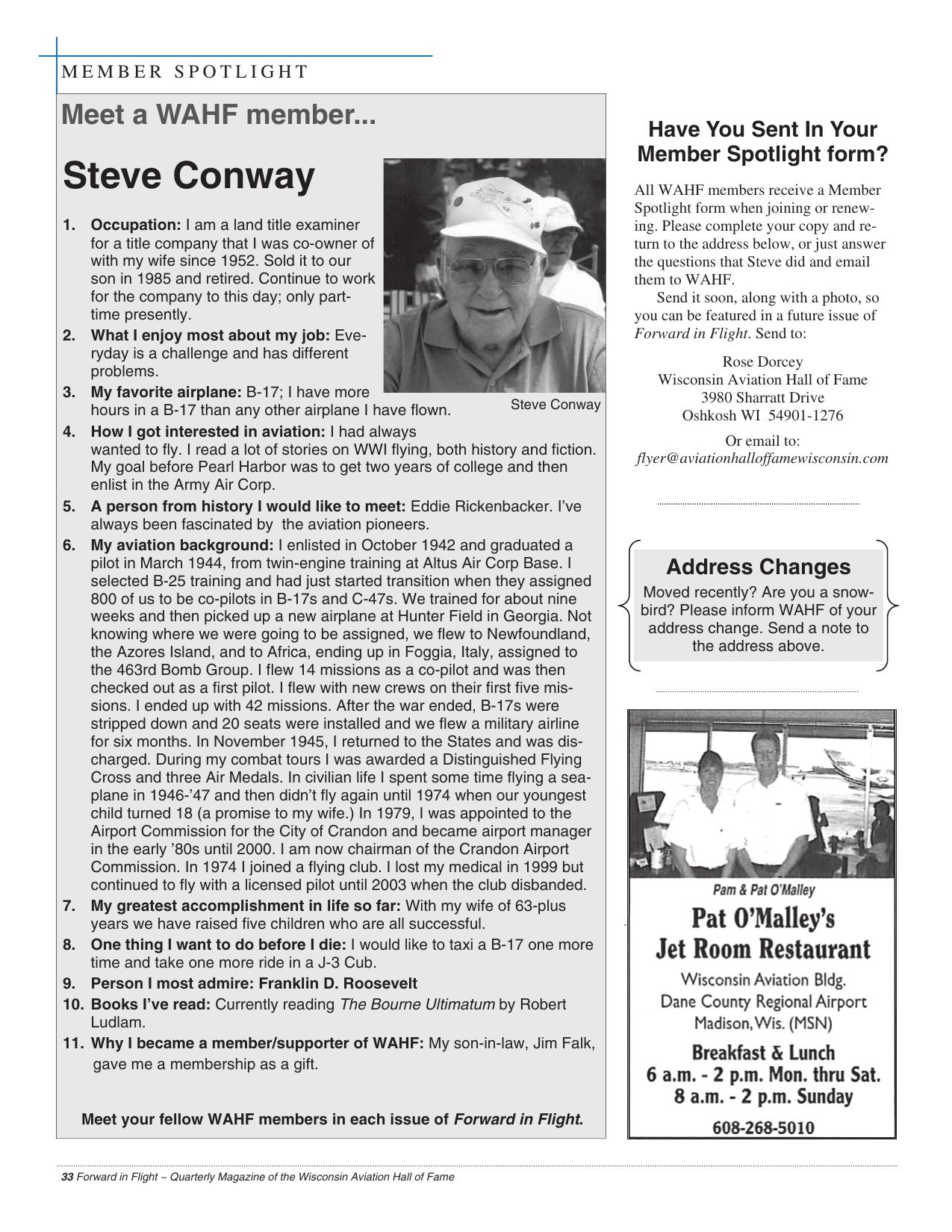
MEMBER SPOTLIGHT Meet a WAHF member... Steve Conway 1. Occupation: I am a land title examiner for a title company that I was co-owner of with my wife since 1952. Sold it to our son in 1985 and retired. Continue to work for the company to this day; only parttime presently. 2. What I enjoy most about my job: Everyday is a challenge and has different problems. 3. My favorite airplane: B-17; I have more Steve Conway hours in a B-17 than any other airplane I have flown. 4. How I got interested in aviation: I had always wanted to fly. I read a lot of stories on WWI flying, both history and fiction. My goal before Pearl Harbor was to get two years of college and then enlist in the Army Air Corp. 5. A person from history I would like to meet: Eddie Rickenbacker. I’ve always been fascinated by the aviation pioneers. 6. My aviation background: I enlisted in October 1942 and graduated a pilot in March 1944, from twin-engine training at Altus Air Corp Base. I selected B-25 training and had just started transition when they assigned 800 of us to be co-pilots in B-17s and C-47s. We trained for about nine weeks and then picked up a new airplane at Hunter Field in Georgia. Not knowing where we were going to be assigned, we flew to Newfoundland, the Azores Island, and to Africa, ending up in Foggia, Italy, assigned to the 463rd Bomb Group. I flew 14 missions as a co-pilot and was then checked out as a first pilot. I flew with new crews on their first five missions. I ended up with 42 missions. After the war ended, B-17s were stripped down and 20 seats were installed and we flew a military airline for six months. In November 1945, I returned to the States and was discharged. During my combat tours I was awarded a Distinguished Flying Cross and three Air Medals. In civilian life I spent some time flying a seaplane in 1946-’47 and then didn’t fly again until 1974 when our youngest child turned 18 (a promise to my wife.) In 1979, I was appointed to the Airport Commission for the City of Crandon and became airport manager in the early ’80s until 2000. I am now chairman of the Crandon Airport Commission. In 1974 I joined a flying club. I lost my medical in 1999 but continued to fly with a licensed pilot until 2003 when the club disbanded. 7. My greatest accomplishment in life so far: With my wife of 63-plus years we have raised five children who are all successful. 8. One thing I want to do before I die: I would like to taxi a B-17 one more time and take one more ride in a J-3 Cub. 9. Person I most admire: Franklin D. Roosevelt 10. Books I’ve read: Currently reading The Bourne Ultimatum by Robert Ludlam. 11. Why I became a member/supporter of WAHF: My son-in-law, Jim Falk, gave me a membership as a gift. Meet your fellow WAHF members in each issue of Forward in Flight. 33 Forward in Flight ~ Quarterly Magazine of the Wisconsin Aviation Hall of Fame Have You Sent In Your Member Spotlight form? All WAHF members receive a Member Spotlight form when joining or renewing. Please complete your copy and return to the address below, or just answer the questions that Steve did and email them to WAHF. Send it soon, along with a photo, so you can be featured in a future issue of Forward in Flight. Send to: Rose Dorcey Wisconsin Aviation Hall of Fame 3980 Sharratt Drive Oshkosh WI 54901-1276 Or email to: flyer@aviationhalloffamewisconsin.com Address Changes Moved recently? Are you a snowbird? Please inform WAHF of your address change. Send a note to the address above.
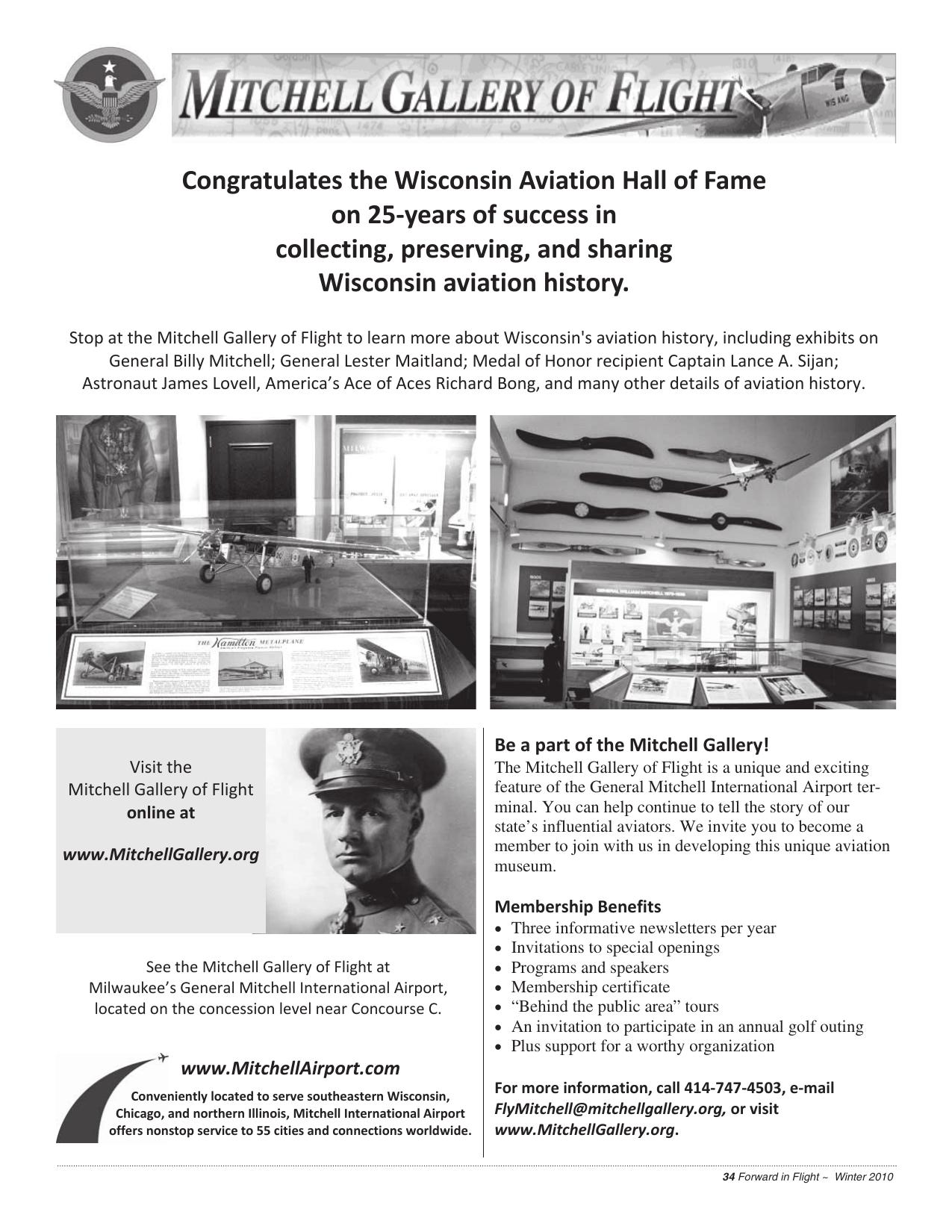
Congratulates the Wisconsin Aviation Hall of Fame on 25-years of success in collecting, preserving, and sharing Wisconsin aviation history. Stop at the Mitchell Gallery of Flight to learn more about Wisconsin's aviation history, including exhibits on General Billy Mitchell; General Lester Maitland; Medal of Honor recipient Captain Lance A. Sijan; Astronaut James Lovell, America’s Ace of Aces Richard Bong, and many other details of aviation history. Be a part of the Mitchell Gallery! Visit the Mitchell Gallery of Flight online at www.MitchellGallery.org The Mitchell Gallery of Flight is a unique and exciting feature of the General Mitchell International Airport terminal. You can help continue to tell the story of our state’s influential aviators. We invite you to become a member to join with us in developing this unique aviation museum. Membership Benefits See the Mitchell Gallery of Flight at Milwaukee’s General Mitchell International Airport, located on the concession level near Concourse C. Three informative newsletters per year Invitations to special openings Programs and speakers Membership certificate “Behind the public area” tours An invitation to participate in an annual golf outing Plus support for a worthy organization www.MitchellAirport.com Conveniently located to serve southeastern Wisconsin, Chicago, and northern Illinois, Mitchell International Airport offers nonstop service to 55 cities and connections worldwide. For more information, call 414-747-4503, e-mail FlyMitchell@mitchellgallery.org, or visit www.MitchellGallery.org. 34 Forward in Flight ~ Winter 2010
WISCONSIN AVIATION HALL OF FAME 3980 SHARRATT DRIVE OSHKOSH WI 54901-1276 PRSRT STD US Postage Paid Wisc Rapids WI Permit 98 Preserving and Sharing Wisconsin’s Aviation History Change Service Requested Welcome New WAHF Member/Supporters: Gene Brabazon Thomas Carle Mike Demulling* Neil Duresky Heather Gollnow Eric Oxendorf Earlene Schable Roland Schable Bernard Rhomberg Ralph Winrich —Thanks for coming on board! *Upgrade to Life Membership WAHF is on Facebook and Twitter! Follow WAHF on Facebook and Twitter to get information and updates on inductees, events, photos, video links, and Wisconsin aviation history trivia. www.Facebook.com/WisAviationHallofFame · Twitter @WAHF The 56th Annual Wisconsin Aviation Conference will be held May 2-4, 2011, at the Hotel Sierra in Green Bay. The conference committee is planning an exciting and informative conference of interest to all facets of the aviation community, from private pilots and corporate flight departments to general aviation and air carrier airport management, airport commissioners, fixed base operators, and other aviation service providers. To learn more, visit www.WIAMA.org. WAHF Renewals Don’t forget! All annual membership renewals are due by December 31, 2010. See page 30 of this issue for a special membership renewal offer. And, new members can take advantage of this offer! That means your Christmas shopping just got easier—give a WAHF membership to your favorite aviator. Wisconsin Aviation Hall of Fame Officers and Board of Directors Rose Dorcey, President Michael Goc, Vice President John Dorcey, Secretary/Treasurer Frederick Beseler Duane Esse Rich Fischler Tom Thomas Charles Swain Charles Marotske, Honorary Chairman of the Board Wisconsin Aviation Hall of Fame 3980 Sharratt Drive Oshkosh WI 54901-1276 Become a supporter today! For information call Rose Dorcey at 920-385-1483 www.aviationhalloffamewisconsin.com flyer@aviationhalloffamewisconsin.com