Volume 9, Issue 4
🗞️ Download Issue (PDF)
Forward in Flight - Winter 2011
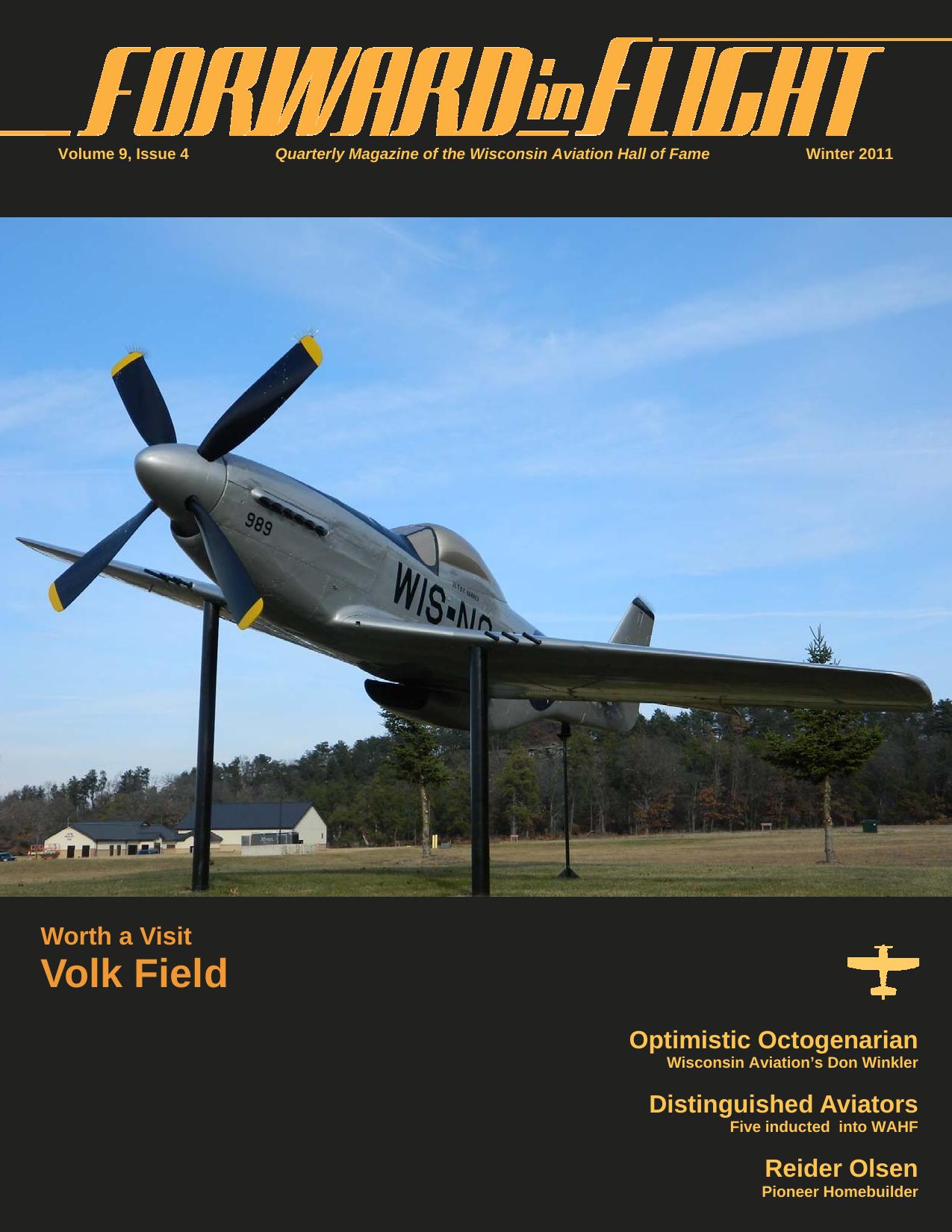
Volume 9, Issue 4 Quarterly Magazine of the Wisconsin Aviation Hall of Fame Winter 2011 Worth a Visit Volk Field Optimistic Octogenarian Wisconsin Aviation’s Don Winkler Distinguished Aviators Five inducted into WAHF Reider Olsen Pioneer Homebuilder
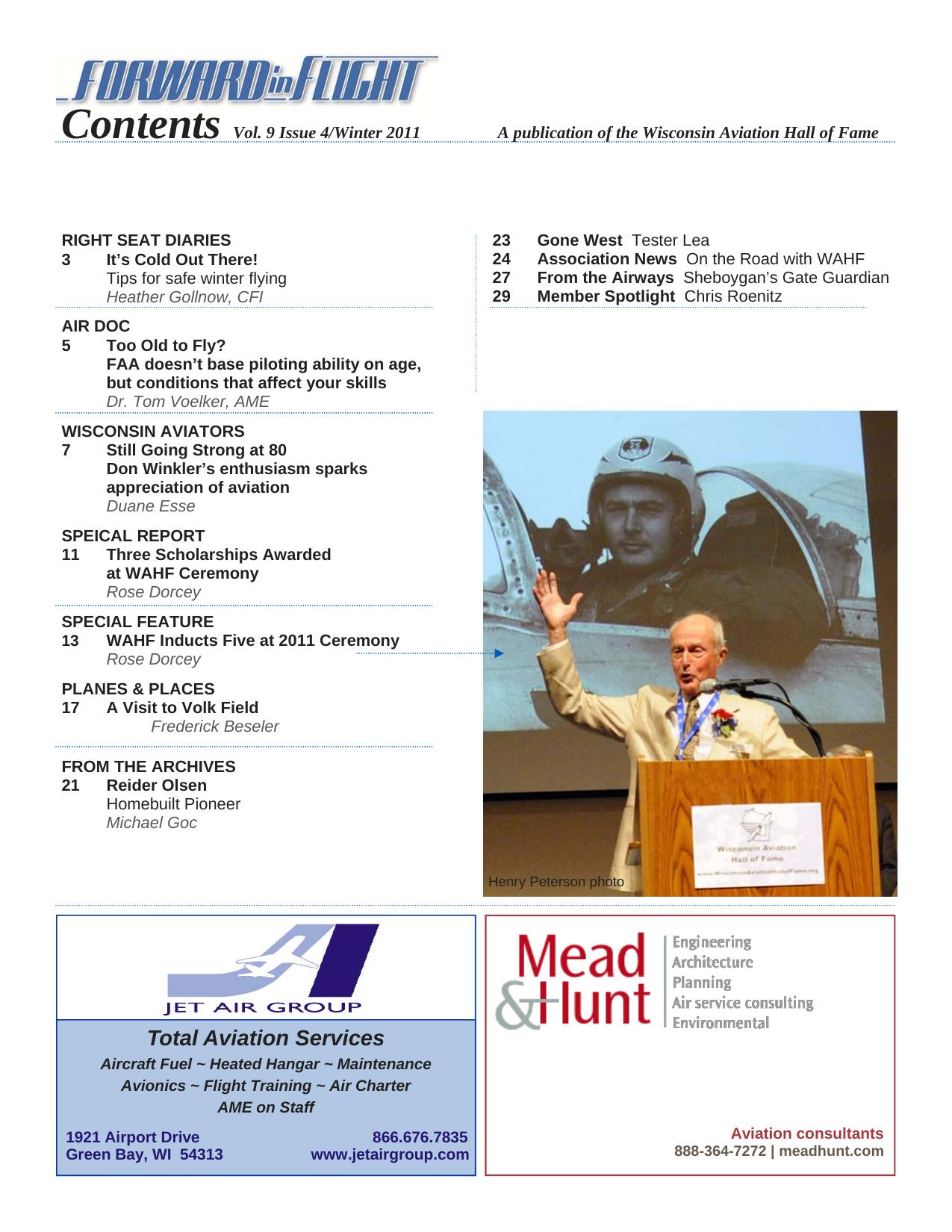
Contents Vol. 9 Issue 4/Winter 2011 A publication of the Wisconsin Aviation Hall of Fame 23 24 27 29 RIGHT SEAT DIARIES 3 It’s Cold Out There! Tips for safe winter flying Heather Gollnow, CFI Gone West Tester Lea Association News On the Road with WAHF From the Airways Sheboygan’s Gate Guardian Member Spotlight Chris Roenitz AIR DOC 5 Too Old to Fly? FAA doesn’t base piloting ability on age, but conditions that affect your skills Dr. Tom Voelker, AME WISCONSIN AVIATORS 7 Still Going Strong at 80 Don Winkler’s enthusiasm sparks appreciation of aviation Duane Esse SPEICAL REPORT 11 Three Scholarships Awarded at WAHF Ceremony Rose Dorcey SPECIAL FEATURE 13 WAHF Inducts Five at 2011 Ceremony Rose Dorcey PLANES & PLACES 17 A Visit to Volk Field Frederick Beseler FROM THE ARCHIVES 21 Reider Olsen Homebuilt Pioneer Michael Goc Henry Peterson photo Total Aviation Services Aircraft Fuel ~ Heated Hangar ~ Maintenance Avionics ~ Flight Training ~ Air Charter AME on Staff 1921 Airport Drive Green Bay, WI 54313 866.676.7835 www.jetairgroup.com Aviation consultants 888-364-7272 | meadhunt.com
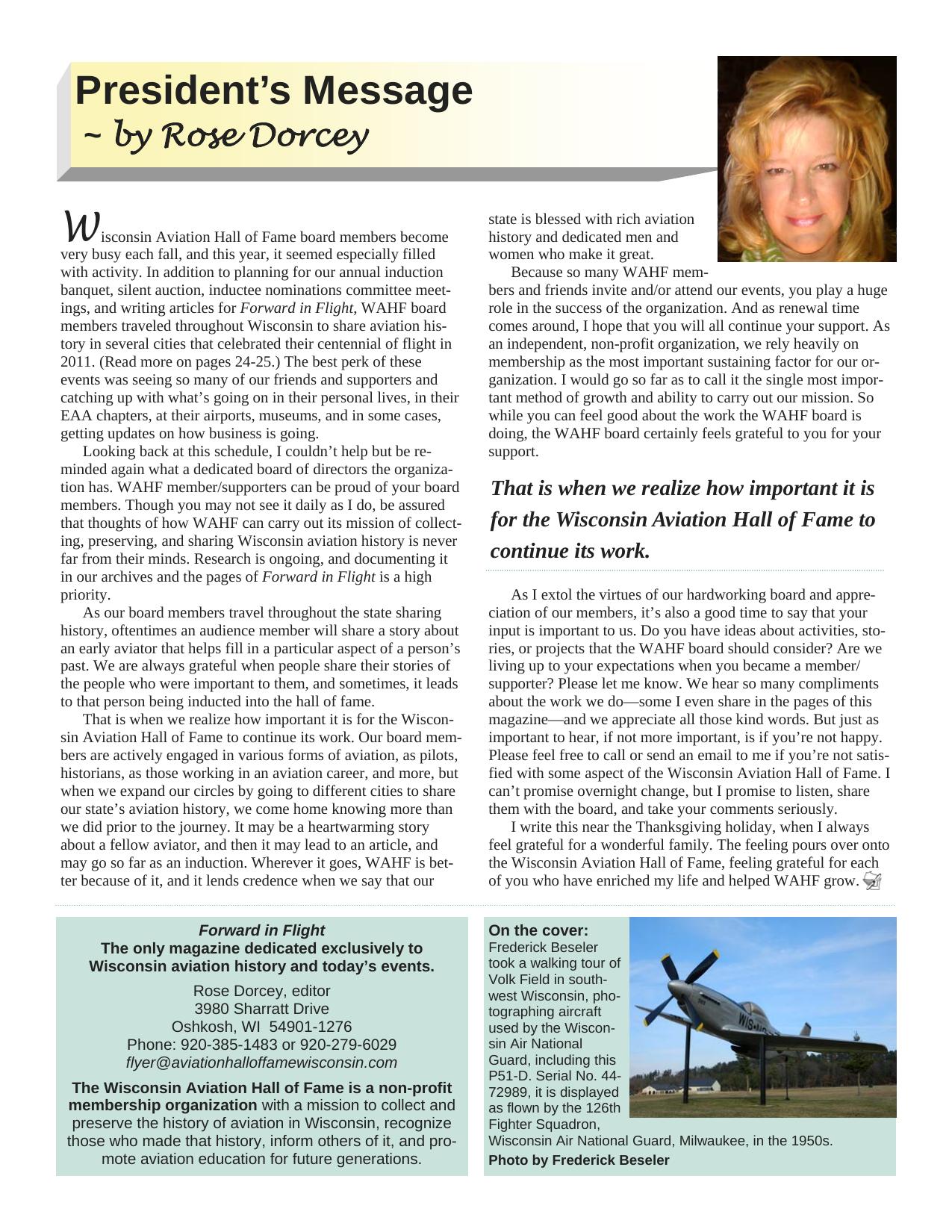
President’s Message ~ by Rose Dorcey W isconsin Aviation Hall of Fame board members become very busy each fall, and this year, it seemed especially filled with activity. In addition to planning for our annual induction banquet, silent auction, inductee nominations committee meetings, and writing articles for Forward in Flight, WAHF board members traveled throughout Wisconsin to share aviation history in several cities that celebrated their centennial of flight in 2011. (Read more on pages 24-25.) The best perk of these events was seeing so many of our friends and supporters and catching up with what’s going on in their personal lives, in their EAA chapters, at their airports, museums, and in some cases, getting updates on how business is going. Looking back at this schedule, I couldn’t help but be reminded again what a dedicated board of directors the organization has. WAHF member/supporters can be proud of your board members. Though you may not see it daily as I do, be assured that thoughts of how WAHF can carry out its mission of collecting, preserving, and sharing Wisconsin aviation history is never far from their minds. Research is ongoing, and documenting it in our archives and the pages of Forward in Flight is a high priority. As our board members travel throughout the state sharing history, oftentimes an audience member will share a story about an early aviator that helps fill in a particular aspect of a person’s past. We are always grateful when people share their stories of the people who were important to them, and sometimes, it leads to that person being inducted into the hall of fame. That is when we realize how important it is for the Wisconsin Aviation Hall of Fame to continue its work. Our board members are actively engaged in various forms of aviation, as pilots, historians, as those working in an aviation career, and more, but when we expand our circles by going to different cities to share our state’s aviation history, we come home knowing more than we did prior to the journey. It may be a heartwarming story about a fellow aviator, and then it may lead to an article, and may go so far as an induction. Wherever it goes, WAHF is better because of it, and it lends credence when we say that our Forward in Flight The only magazine dedicated exclusively to Wisconsin aviation history and today’s events. Rose Dorcey, editor 3980 Sharratt Drive Oshkosh, WI 54901-1276 Phone: 920-385-1483 or 920-279-6029 flyer@aviationhalloffamewisconsin.com The Wisconsin Aviation Hall of Fame is a non-profit membership organization with a mission to collect and preserve the history of aviation in Wisconsin, recognize those who made that history, inform others of it, and promote aviation education for future generations. state is blessed with rich aviation history and dedicated men and women who make it great. Because so many WAHF members and friends invite and/or attend our events, you play a huge role in the success of the organization. And as renewal time comes around, I hope that you will all continue your support. As an independent, non-profit organization, we rely heavily on membership as the most important sustaining factor for our organization. I would go so far as to call it the single most important method of growth and ability to carry out our mission. So while you can feel good about the work the WAHF board is doing, the WAHF board certainly feels grateful to you for your support. That is when we realize how important it is for the Wisconsin Aviation Hall of Fame to continue its work. As I extol the virtues of our hardworking board and appreciation of our members, it’s also a good time to say that your input is important to us. Do you have ideas about activities, stories, or projects that the WAHF board should consider? Are we living up to your expectations when you became a member/ supporter? Please let me know. We hear so many compliments about the work we do—some I even share in the pages of this magazine—and we appreciate all those kind words. But just as important to hear, if not more important, is if you’re not happy. Please feel free to call or send an email to me if you’re not satisfied with some aspect of the Wisconsin Aviation Hall of Fame. I can’t promise overnight change, but I promise to listen, share them with the board, and take your comments seriously. I write this near the Thanksgiving holiday, when I always feel grateful for a wonderful family. The feeling pours over onto the Wisconsin Aviation Hall of Fame, feeling grateful for each of you who have enriched my life and helped WAHF grow. On the cover: Frederick Beseler took a walking tour of Volk Field in southwest Wisconsin, photographing aircraft used by the Wisconsin Air National Guard, including this P51-D. Serial No. 4472989, it is displayed as flown by the 126th Fighter Squadron, Wisconsin Air National Guard, Milwaukee, in the 1950s. Photo by Frederick Beseler
RIGHT SEAT DIARIES It’s Cold Out There! Tips for safe winter flying By Heather Gollnow Winter is not my most favorite time of year. I don’t like dressing like Ralphie in A Christmas Story just to stop shivering. I dislike shoveling so much that I pay someone to do it. And I dread the months where I go to work—and come home—in the dark. But all is not doom and gloom, as my favorite part of the season is winter flying! The air is smooth and crisp. Each flight feels as though the airplane is sliding on glass. But while it’s my favorite time of year to fly, it can also be dangerous. The frigid temperatures and snow can create many hazards when preflighting, taxiing, and flying. So to help keep us safe, here are a few winter flying tips. 1. Know your personal minimums. Often times we talk about what our personal minimums are when it comes to ceilings, visibility, or wind velocity. I also have a personal minimum when it comes to outside temperatures. When the temperature dips below 20-degrees Fahrenheit, I will not fly. Flying is my hobby and should be enjoyable. It does not sound fun to me to have an off-airport landing and have to wait in a corn field is those frigid temperatures for someone to come pick me up. Of course you will probably have a different personal minimum when it comes to outside temperature, but the point is to set one. Be aware of what your minimum is. 2. File a flight plan. Let someone know where you are going, what you are doing, and when you expect to return. Filing a flight plan is one way to do this. When I first started flying, I used to file round-robin types of flight plans. I would take off from OSH, do a touch and go in MSN, and my final destination would be OSH. What if I had to do an offairport landing on my first leg to MSN? I might be waiting a while before anyone even came looking for me, much less find me! And then I would be shivering for quite a while as I wait. Another good habit is to let someone you know what your plans are. If I am planning a cross-country flight, I usually let my mother or a friend know what my plans are and when to expect my return. It’s like my own personal flight service! 3. Fill your fuel tanks post-flight. With temperature changes 3 Forward in Flight ~ Quarterly Magazine of the Wisconsin Aviation Hall of Fame and half-empty fuel tanks, there is the possibility of condensation forming inside the fuel tanks. Filling up the tanks reduces the chances of condensation. If you keep your airplane in a warm hangar, be careful of fuel expansion. 4. Fuel expansion. Fueling an aircraft outside in the cold air, then placing it in a warm hangar can cause the fuel to expand inside the fuel lines and tanks. Fuel can drain from the fuel vents onto the hangar floor. As a safety precaution, place buckets under the fuel vents to catch the vented fuel. Many years ago, I actually broke my elbow as a result of slipping in a puddle of Jet A that had vented onto a hangar floor in this exact situation. Jet A is pretty slippery on a glossy hangar floor! Two surgeries later, I have a scar and a story to share. 5. Look out for blowing snow! During pre-flight, check the fuel vents, carb intakes, pitot tubes, static ports, and flight controls for snow. If your airplane is stored outside in the elements, sometimes the snow can be so packed that the best way to remove it is to melt it in a heated hangar. 6. Beware of re-freezing frost, snow, ice. Should your aircraft sit outside and become covered with frost, snow, or ice, placing it in a warm, heated hangar makes it easier to remove these elements. When you take the airplane out of the hangar, pay attention to where the water is and
RIGHT SEAT DIARIES make efforts to remove the water so it does not refreeze. Pay attention to brake pads, flight controls, and wheels. 7. 8. 9. Preheat engine and cockpit. If you do not have the advantage of a heated hangar, take the time to preheat the engine and the cockpit. In cold temperatures, oil can thicken and make starting the engine difficult. Preheating the engine helps the oil to become more viscous and make starting easier. A cockpit preheat is not necessarily to keep you and your passengers comfortable. Instruments and radios also need time to warm up to function correctly and keep them from being damaged. Know the aircraft’s winter operating capabilities. Perhaps your aircraft has an oil pan heater and can be plugged in. Perhaps there is an approved winterization kit for your aircraft. It is crucial to understand what the specific cold weather operations are for your aircraft. Carbon monoxide (CO) poisoning. It’s a colorless, odorless gas, and can kill you. It’s a good idea to install CO detectors in the cockpit, but do not rely on them. If you are feeling dizzy, nauseous, lightheaded, or sleepy, take immediate action for suspected CO poisoning. Shut off the cabin heat. Open a fresh air source. Land the airplane. While doing some research for this article, I Googled “CO poisoning airplane”. I suggest doing this search as there are many articles recounting pilots’ experiences with CO poisoning in flight. It seems many pilots do not identify CO poisoning since confusion and disorientation are also symptoms. 10. Keep up with current weather information. Of course this is something we should be doing all of the time. Look for clues as to what might be ahead. Look at the cars on the road coming from the direction you are flying. Is there fresh snow on these cars? Obtain current weather infor- mation in-flight. Be proactive in preventing an inadvertent flight into Instrument Meteorological Conditions (IMC) and/or icing conditions. 11. Maintain night currency and proficiency. As we approach the dead of winter, where it’s dark before 4:30 p.m., night can creep up on us quickly. For myself, there are plenty of times I have flown into an airport for lunch, and after making new friends at the airport and talking all afternoon, the day gets away from me. With the later sunrise as well, we are limited in our daylight hours. Maintaining night currency and proficiency will help to ensure your safety if a night flight is needed. 12. Pack a survival kit. This will vary greatly depending on your personality and the type of flying you do. I do a lot of local flights and short cross-countries. During the winter, I always make sure to have an extra warm winter coat in the airplane, along with boots, warm gloves, and a hat. I do not usually wear all of these, but I make sure they are within arm’s reach if needed. Before my passengers even leave their homes, I tell them to dress for the weather. Bring extra clothing for a just-in-case scenario. I also pack a few granola bars and a bottle of water in my purse or flight bag. 13. Charge your cell phone before each flight. If I am in an area where I get an analog signal, my battery drains much quicker, so having a fully charged battery is crucial for me. Consider a personal locator beacon. This would work well in areas where there is little or no cell phone coverage. I also researched “winter survival kits for pilots” and found some great resources for creating my own survival kit. Think about the type of flying that you do, and create a survival kit that is appropriate for you and your passengers. There are more aspects to winter flying that pilots need to consider. These tips are things that I have learned over the years and make sure to point out to new pilots and pilots not familiar with winter flying. Although there are some aspects to winter flying that may be dangerous, there are steps pilots can take to ensure the safe completion of a winter flight. I would love to hear your winter flying tips! Heather Gollnow is a Certificated Flight Instructor in Appleton and Green Bay. Residing in Menasha, Wisconsin, she speaks at schools and other youth groups around northeast Wisconsin. Along with aviation, Heather works in the Information Technology Education field. Heather can reached by email at heather.gollnow@gmail.com or connect with her on Twitter: @aviatrixhg. 4 Forward in Flight ~ Winter 2011
AIR DOC Too Old to Fly? FAA doesn’t base piloting ability on age, but conditions that affect your skills Dr. Tom Voelker, AME DrAlphaMike@yahoo.com There are old pilots, and there are bold pilots, but there are no old, bold pilots. Many of you have heard this saying. I happen to agree with it, but that’s not what I want to write about in this issue. On these pages you have been able to read many stories about the bold pilots. Most prominent in my mind are stories about the selfless, highly skilled young men and women who flew in protection of our great nation. I will leave the telling of their stories to other contributors to Forward in Flight, as they tell the tales much more skillfully than I ever could. But what about the old pilots? What is an old pilot? Or perhaps more appropriately, how old is old? At what age is a pilot too old to fly safely, and what does the FAA have to say on the matter? I’ll get to that, but first, let me tell you what I did today. When we’re through, I hope you will know what old is, and I also hope that hearing what I am dealing with will help you wade through the aging process, either for yourself or someone you know. The last time I took my father for a flight in the Comanche was during the Final Alarm ceremony in Wisconsin Rapids about three years ago. This event is a silent procession of fire trucks from all around Wisconsin, at night with beacons and lights on, to the Firefighters Memorial Park. It is a moving event honoring firefighters who died in the line of duty. I thought this would be a great event to photograph from the air, and it was. I also thought it would be the last flight my dad took. And it was. At the time of the Final Alarm flight, dad was starting to have trouble moving around. He was also getting a little weak. Not noticed at the time was a very slowly developing loss of memory. It was a couple of years before we were able to put together the pieces and give a diagnosis At the end of 2010 there were about 61,000 active pilots over the age of 65, representing about 10 percent of the total pilot population. There were 4,000 active pilots over the age of 80, and one fourth of these were flight instructors! to his condition. He has a form of Parkinson’s disease, which is causing problems with both mobility and cognition. The condition progressed to the point that my parents moved into an assisted living facility in Stillwater, Minnesota. I have since moved a flivver (a great word I stumbled upon, meaning an old “beater” of a car) to Lake Elmo airport in the Twin Cities. I can now fly one hour to see my parents, and I have only a five minute drive from the airport. And that is 5 Forward in Flight ~ Quarterly Magazine of the Wisconsin Aviation Hall of Fame what I did today, visit my parents. What does this have to do with old pilots? Hang in there. I don’t know the age of the oldest active U.S. pilot, but I recall at my last Aviation Medical Examiner refresher course that he was about 93 years old. I was able to get current statistics on pilot age groups. This information comes directly from the FAA database. At the end of 2010 there were about 61,000 active pilots over the age of 65, representing about 10 percent of the total pilot population. There were 4,000 active pilots over the age of 80, and one fourth of these were flight instructors! The FAA clearly does not have an age above which a person is “unfit for flight duties.” Aging is a process that affects all of us. It also affects us all differently, and at different rates. Medical problems associated with aging include heart disease, cataracts, hearing loss, and arthritis, to name a few. All of these conditions can affect a person’s ability to fly, and therefore, his or her ability to get a medical certificate. The FAA’s decision regarding whether or not an airman with these conditions can be certified depend upon many factors, some of which are the severity of the condition, the symptoms caused, the medications or other treatments being used, and side effects from these treatments. One other condition that is often directly associated with aging is “cognitive
AIR DOC impairment.” You may be more familiar with one form of this condition, dementia. There are several types of dementia, which is a condition in which there is an impairment of memory and at least one other part of the thought process. The most common type is Alzheimer’s dementia. Other types could be due to “hardening of the arteries,” lupus, vitamin B12 deficiency, or one of several other causes. “Mild cognitive impairment” is a similar condition that is not quite as severe as dementia. To complicate things further (and as we learned with my father, these conditions can be very difficult to sort out), some degree of decline in memory and thought processes can be a normal part of aging. Have you ever had a “senior moment”? We use our memory and intellect all the time when we fly. If we get a clearance from the control tower we are expected to remember it. We need to remember to use our checklists, and then we need to be able to read and understand them, and perform the action required on the list. All of these steps require higher brain function. If we lose some of our brain function as we age, why doesn’t the FAA, in its quest for safety in the skies, simply prohibit flight after, say, age 65 or 70? Older pilots may have a slight loss in their memory or other cognitive function, but they are the ones blessed with the most experience. And it has been shown that pilots with more experience, especially when derived from obtaining higher proficiency ratings, such as an instrument rating or commercial certificate, tend to have better performance when flying. Therefore, the FAA will not keep a pilot from flying simply because of age, but rather because of significant problems with thought processes or memory. A person with dementia has sufficient limitations on his or her thought processes that flying would be quite a risky venture (or adventure). It may surprise you to hear that one in eight people over the age of 65 have dementia. Another condition, called “mild cognitive impairment,” or MCI, is somewhat similar to dementia, but much milder. Pilots with this condition may be able to fly well, but there may also be signs that some memory or thinking problems are developing. MCI affects up to 20 percent of all people over 65, and half of those with MCI will go on to develop Alzheimer’s disease in the next few years. If you can’t remember where you put your keys, that’s not dementia. If you find them and don’t know what to do with them, that’s dementia. One final condition is “normal aging.” As I mentioned earlier, some decline in memory is normal as we reach our golden years. I often hear concerns from my patients that they are afraid that they are developing Alzheimer’s disease, as they are having a lot of trouble remembering names. Having a problem with name recall is one specific part of memory that has been shown to be a normal part of aging and is not pathologic. I have explained the normal memory lapses of aging to patients as follows: If you can’t remember where you put your keys, that’s not dementia. If you find them and don’t know what to do with them, that’s dementia. So what can we do to help our friends and loved ones (or perhaps ourselves) who might have a cognitive impairment? And how can we determine if a pilot is developing enough memory problems that dementia is a consideration, and help keep an unsafe condition from developing? First of all, we can try to prevent these conditions from developing in the first place. Many vitamins and supplements have been tried, mostly without success. Taking Vitamin E or other “antioxidants” does not help (and may increase your risk of other health conditions). Similarly, Ginkgo biloba has not been shown to help. The only supplement that might help is Omega-3 fatty acids (fish oil), though the data on using this supplement is quite weak. The two treatments that do seem to help prevent dementia are physical exercise and intellectual stimulation (reading, crossword puzzles, taking advanced classes, etc.). Also helpful are other generally healthy habits, such as maintaining a healthy weight, not smoking, controlling blood pressure, and using alcohol only in moderation. As far as our pilot population goes, the key is for the rest of us to be observant. A pilot with developing dementia will probably not recognize it, or will deny it if he or she sees it. A flight instructor giving the biennial flight review may see some inconsistencies, as can other people who frequently fly with the particular pilot. If something seems “a little off” it probably is worth bringing up, first with the patient himself, then if necessary with his doctor. There is also one fairly strong sign of developing dementia. If a person suddenly is paying less attention to personal hygiene, washing clothes, and other “activities of daily living” as we in the medical profession call it, early dementia may very likely be present. My father is doing OK. His condition is slowly progressing. At least we now know what we are dealing with. He no longer has the strength or balance to climb up onto the wing of the Comanche and get safely in and out of the plane. So his flying days are over, but thanks to general aviation, I will be able to visit him often. But maybe I should leave a spare key to the old car with him—in case I can’t remember where I put mine! Fly safely, and stay warm! —Alpha Mike Echo In “real” life, Alpha Mike Echo is Dr. Tom Voelker, AME, a family practitioner in Wisconsin Rapids. He and his wife, Kathy, are the parents of four daughters. Tom flies N6224P, a Comanche 250, out of Alexander Field, South Wood County Airport (ISW). 6 Forward in Flight ~ Winter 2011
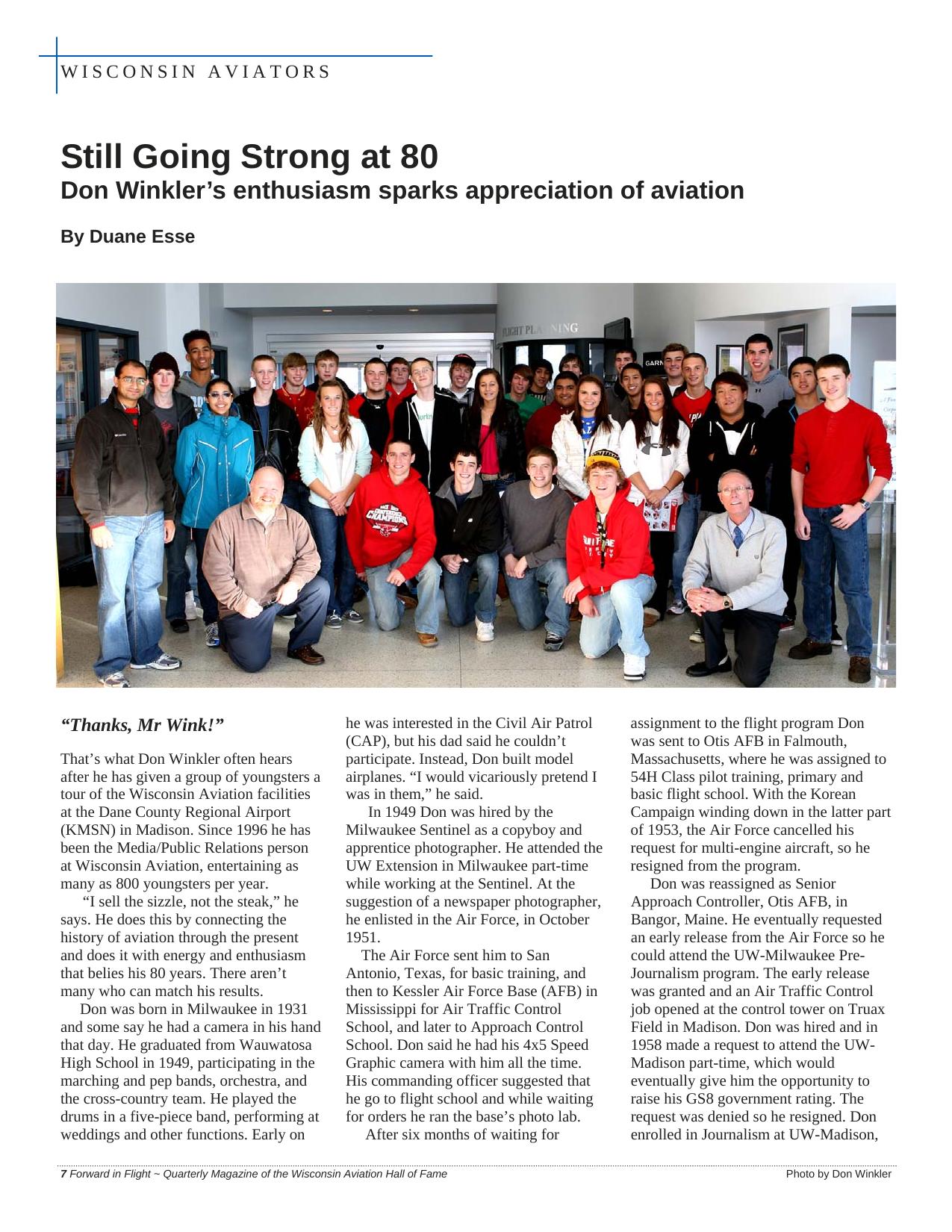
WISCONSIN AVIATORS Still Going Strong at 80 Don Winkler’s enthusiasm sparks appreciation of aviation By Duane Esse “Thanks, Mr Wink!” That’s what Don Winkler often hears after he has given a group of youngsters a tour of the Wisconsin Aviation facilities at the Dane County Regional Airport (KMSN) in Madison. Since 1996 he has been the Media/Public Relations person at Wisconsin Aviation, entertaining as many as 800 youngsters per year. “I sell the sizzle, not the steak,” he says. He does this by connecting the history of aviation through the present and does it with energy and enthusiasm that belies his 80 years. There aren’t many who can match his results. Don was born in Milwaukee in 1931 and some say he had a camera in his hand that day. He graduated from Wauwatosa High School in 1949, participating in the marching and pep bands, orchestra, and the cross-country team. He played the drums in a five-piece band, performing at weddings and other functions. Early on he was interested in the Civil Air Patrol (CAP), but his dad said he couldn’t participate. Instead, Don built model airplanes. “I would vicariously pretend I was in them,” he said. In 1949 Don was hired by the Milwaukee Sentinel as a copyboy and apprentice photographer. He attended the UW Extension in Milwaukee part-time while working at the Sentinel. At the suggestion of a newspaper photographer, he enlisted in the Air Force, in October 1951. The Air Force sent him to San Antonio, Texas, for basic training, and then to Kessler Air Force Base (AFB) in Mississippi for Air Traffic Control School, and later to Approach Control School. Don said he had his 4x5 Speed Graphic camera with him all the time. His commanding officer suggested that he go to flight school and while waiting for orders he ran the base’s photo lab. After six months of waiting for 7 Forward in Flight ~ Quarterly Magazine of the Wisconsin Aviation Hall of Fame assignment to the flight program Don was sent to Otis AFB in Falmouth, Massachusetts, where he was assigned to 54H Class pilot training, primary and basic flight school. With the Korean Campaign winding down in the latter part of 1953, the Air Force cancelled his request for multi-engine aircraft, so he resigned from the program. Don was reassigned as Senior Approach Controller, Otis AFB, in Bangor, Maine. He eventually requested an early release from the Air Force so he could attend the UW-Milwaukee PreJournalism program. The early release was granted and an Air Traffic Control job opened at the control tower on Truax Field in Madison. Don was hired and in 1958 made a request to attend the UWMadison part-time, which would eventually give him the opportunity to raise his GS8 government rating. The request was denied so he resigned. Don enrolled in Journalism at UW-Madison, Photo by Don Winkler
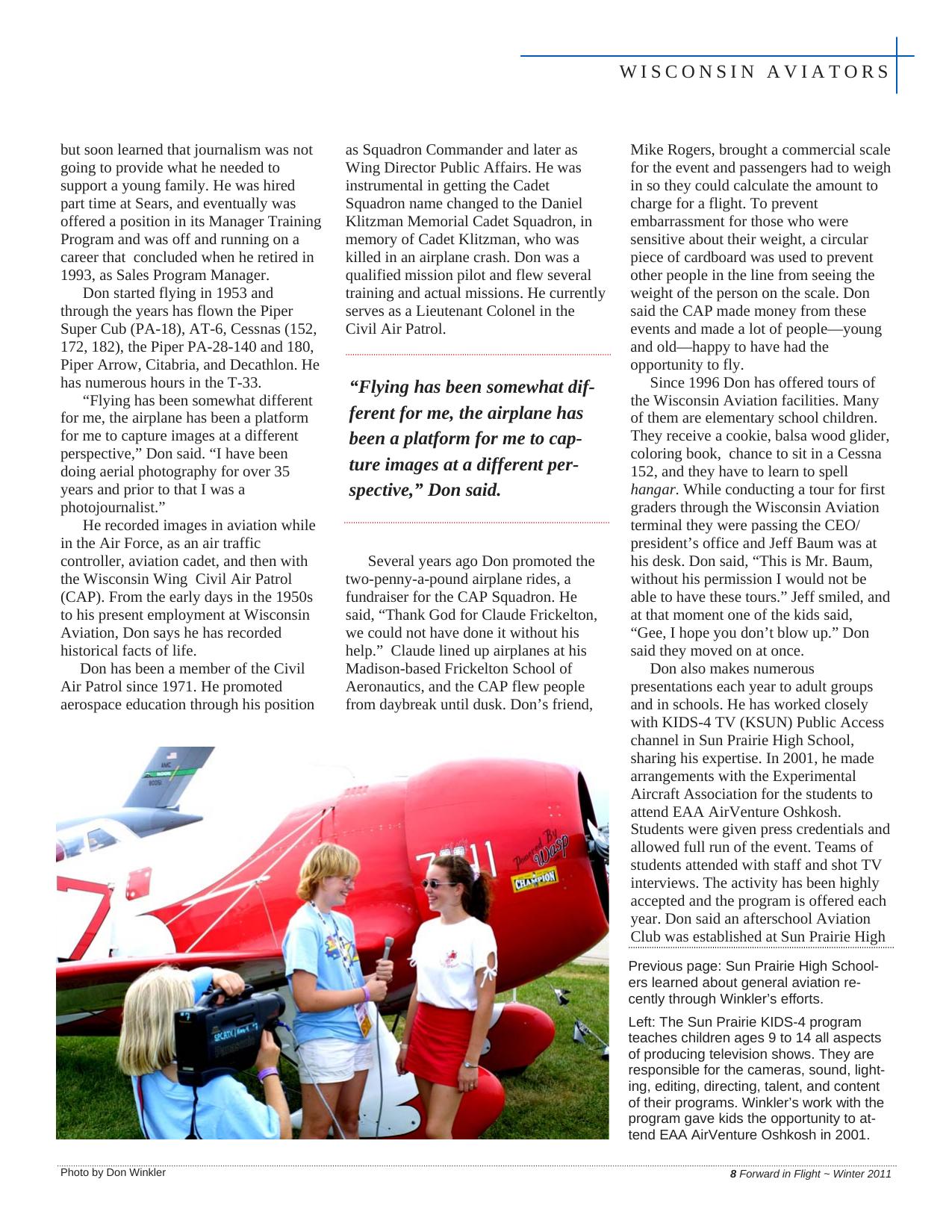
WISCONSIN AVIATORS but soon learned that journalism was not going to provide what he needed to support a young family. He was hired part time at Sears, and eventually was offered a position in its Manager Training Program and was off and running on a career that concluded when he retired in 1993, as Sales Program Manager. Don started flying in 1953 and through the years has flown the Piper Super Cub (PA-18), AT-6, Cessnas (152, 172, 182), the Piper PA-28-140 and 180, Piper Arrow, Citabria, and Decathlon. He has numerous hours in the T-33. “Flying has been somewhat different for me, the airplane has been a platform for me to capture images at a different perspective,” Don said. “I have been doing aerial photography for over 35 years and prior to that I was a photojournalist.” He recorded images in aviation while in the Air Force, as an air traffic controller, aviation cadet, and then with the Wisconsin Wing Civil Air Patrol (CAP). From the early days in the 1950s to his present employment at Wisconsin Aviation, Don says he has recorded historical facts of life. Don has been a member of the Civil Air Patrol since 1971. He promoted aerospace education through his position as Squadron Commander and later as Wing Director Public Affairs. He was instrumental in getting the Cadet Squadron name changed to the Daniel Klitzman Memorial Cadet Squadron, in memory of Cadet Klitzman, who was killed in an airplane crash. Don was a qualified mission pilot and flew several training and actual missions. He currently serves as a Lieutenant Colonel in the Civil Air Patrol. “Flying has been somewhat different for me, the airplane has been a platform for me to capture images at a different perspective,” Don said. Several years ago Don promoted the two-penny-a-pound airplane rides, a fundraiser for the CAP Squadron. He said, “Thank God for Claude Frickelton, we could not have done it without his help.” Claude lined up airplanes at his Madison-based Frickelton School of Aeronautics, and the CAP flew people from daybreak until dusk. Don’s friend, Mike Rogers, brought a commercial scale for the event and passengers had to weigh in so they could calculate the amount to charge for a flight. To prevent embarrassment for those who were sensitive about their weight, a circular piece of cardboard was used to prevent other people in the line from seeing the weight of the person on the scale. Don said the CAP made money from these events and made a lot of people—young and old—happy to have had the opportunity to fly. Since 1996 Don has offered tours of the Wisconsin Aviation facilities. Many of them are elementary school children. They receive a cookie, balsa wood glider, coloring book, chance to sit in a Cessna 152, and they have to learn to spell hangar. While conducting a tour for first graders through the Wisconsin Aviation terminal they were passing the CEO/ president’s office and Jeff Baum was at his desk. Don said, “This is Mr. Baum, without his permission I would not be able to have these tours.” Jeff smiled, and at that moment one of the kids said, “Gee, I hope you don’t blow up.” Don said they moved on at once. Don also makes numerous presentations each year to adult groups and in schools. He has worked closely with KIDS-4 TV (KSUN) Public Access channel in Sun Prairie High School, sharing his expertise. In 2001, he made arrangements with the Experimental Aircraft Association for the students to attend EAA AirVenture Oshkosh. Students were given press credentials and allowed full run of the event. Teams of students attended with staff and shot TV interviews. The activity has been highly accepted and the program is offered each year. Don said an afterschool Aviation Club was established at Sun Prairie High Previous page: Sun Prairie High Schoolers learned about general aviation recently through Winkler’s efforts. Left: The Sun Prairie KIDS-4 program teaches children ages 9 to 14 all aspects of producing television shows. They are responsible for the cameras, sound, lighting, editing, directing, talent, and content of their programs. Winkler’s work with the program gave kids the opportunity to attend EAA AirVenture Oshkosh in 2001. Photo by Don Winkler 8 Forward in Flight ~ Winter 2011
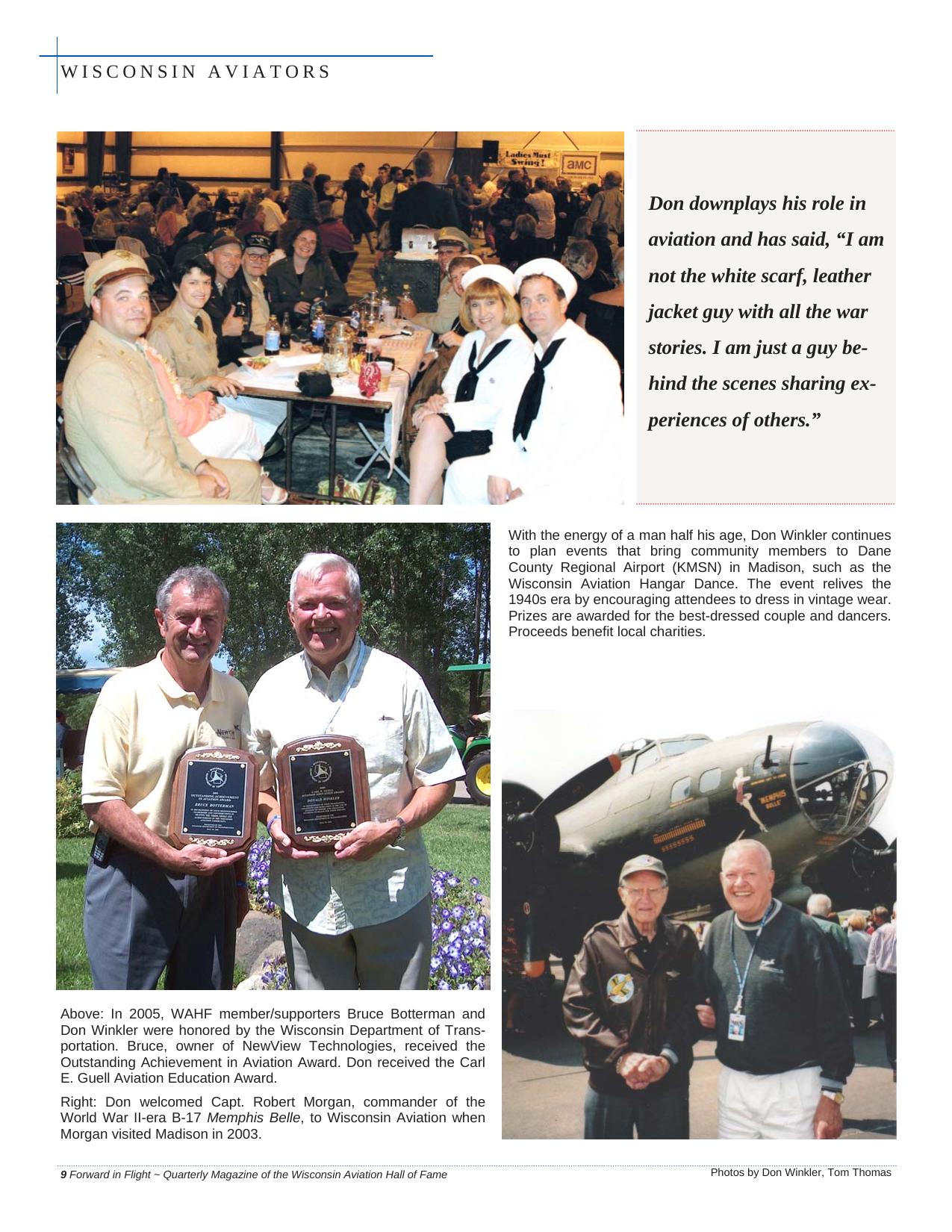
WISCONSIN AVIATORS Don downplays his role in aviation and has said, “I am not the white scarf, leather jacket guy with all the war stories. I am just a guy behind the scenes sharing experiences of others.” With the energy of a man half his age, Don Winkler continues to plan events that bring community members to Dane County Regional Airport (KMSN) in Madison, such as the Wisconsin Aviation Hangar Dance. The event relives the 1940s era by encouraging attendees to dress in vintage wear. Prizes are awarded for the best-dressed couple and dancers. Proceeds benefit local charities. Above: In 2005, WAHF member/supporters Bruce Botterman and Don Winkler were honored by the Wisconsin Department of Transportation. Bruce, owner of NewView Technologies, received the Outstanding Achievement in Aviation Award. Don received the Carl E. Guell Aviation Education Award. Right: Don welcomed Capt. Robert Morgan, commander of the World War II-era B-17 Memphis Belle, to Wisconsin Aviation when Morgan visited Madison in 2003. 9 Forward in Flight ~ Quarterly Magazine of the Wisconsin Aviation Hall of Fame Photos by Don Winkler, Tom Thomas
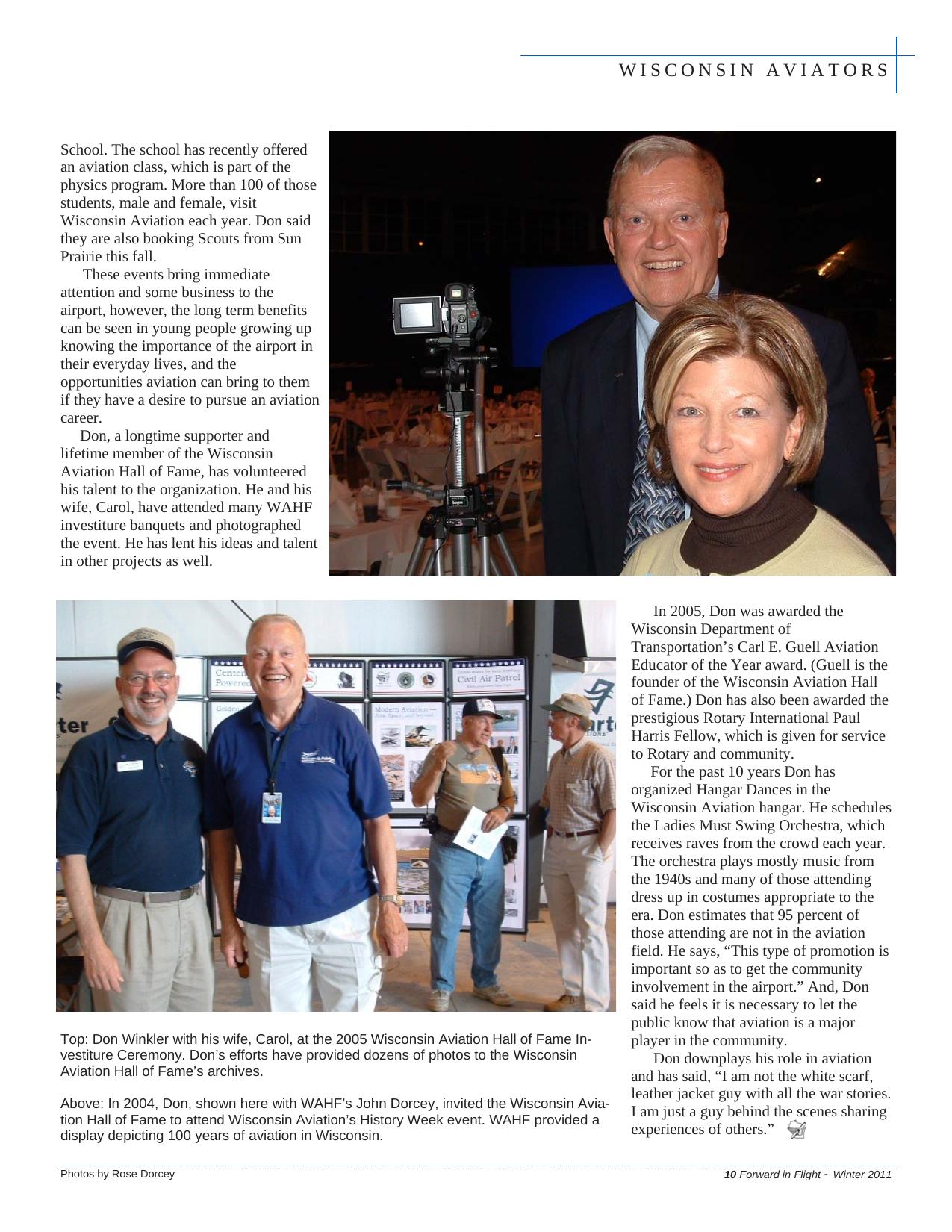
WISCONSIN AVIATORS School. The school has recently offered an aviation class, which is part of the physics program. More than 100 of those students, male and female, visit Wisconsin Aviation each year. Don said they are also booking Scouts from Sun Prairie this fall. These events bring immediate attention and some business to the airport, however, the long term benefits can be seen in young people growing up knowing the importance of the airport in their everyday lives, and the opportunities aviation can bring to them if they have a desire to pursue an aviation career. Don, a longtime supporter and lifetime member of the Wisconsin Aviation Hall of Fame, has volunteered his talent to the organization. He and his wife, Carol, have attended many WAHF investiture banquets and photographed the event. He has lent his ideas and talent in other projects as well. Top: Don Winkler with his wife, Carol, at the 2005 Wisconsin Aviation Hall of Fame Investiture Ceremony. Don’s efforts have provided dozens of photos to the Wisconsin Aviation Hall of Fame’s archives. Above: In 2004, Don, shown here with WAHF’s John Dorcey, invited the Wisconsin Aviation Hall of Fame to attend Wisconsin Aviation’s History Week event. WAHF provided a display depicting 100 years of aviation in Wisconsin. Photos by Rose Dorcey In 2005, Don was awarded the Wisconsin Department of Transportation’s Carl E. Guell Aviation Educator of the Year award. (Guell is the founder of the Wisconsin Aviation Hall of Fame.) Don has also been awarded the prestigious Rotary International Paul Harris Fellow, which is given for service to Rotary and community. For the past 10 years Don has organized Hangar Dances in the Wisconsin Aviation hangar. He schedules the Ladies Must Swing Orchestra, which receives raves from the crowd each year. The orchestra plays mostly music from the 1940s and many of those attending dress up in costumes appropriate to the era. Don estimates that 95 percent of those attending are not in the aviation field. He says, “This type of promotion is important so as to get the community involvement in the airport.” And, Don said he feels it is necessary to let the public know that aviation is a major player in the community. Don downplays his role in aviation and has said, “I am not the white scarf, leather jacket guy with all the war stories. I am just a guy behind the scenes sharing experiences of others.” 10 Forward in Flight ~ Winter 2011

SPECIAL REPORT Three Scholarships Awarded at WAHF Ceremony The Wisconsin Aviation Hall of Fame presented three scholarships to aviation students at its annual Investiture Ceremony held in Oshkosh on October 29. Chad Meyer of Beloit, Wisconsin, was awarded the $1,000 Carl Guell Memorial Scholarship. A student at Black- Henry Schnell thanks Jerome Thiessen for providing the scholarship that will help him complete his A & P certification. hawk Technical College (BTC) in the Aviation Maintenance program, Meyer is working toward obtaining his Airframe and Powerplant (A & P) Technician certificate. Concurrently, he is working on advanced flight certificates and ratings. “It’s a great honor for me to receive this award and it gives me a sense of accomplishment,” Meyer said as he thanked the WAHF board at the ceremony. Peter Waters, also of Beloit and an Aviation Maintenance student at BTC, received the $500 Jerome Ripp Memorial Scholarship. Waters has been active in the school’s aviation club and student government, and has served as a funeral honor guard for VFW Post 2306. Mario Flores, an instructor at Blackhawk Technical College, says that Peter’s professional in the classroom, lab, and airport environment has proven his dedication to the aviation field. “Peter is respected by his classmates 11 Forward in Flight ~ Quarterly Magazine of the Wisconsin Aviation Hall of Fame as well as by the operators of the aviation maintenance facilities at the Rock County Airport,” he went on to say. Henry Schnell, Oshkosh, an Airframe and Powerplant student at Fox Valley Technical College, was awarded $500 from the Jerome Thiessen Financial Assistance Fund. Henry said, “Receiving this scholarship has lightened my financial burden, Chad Meyer
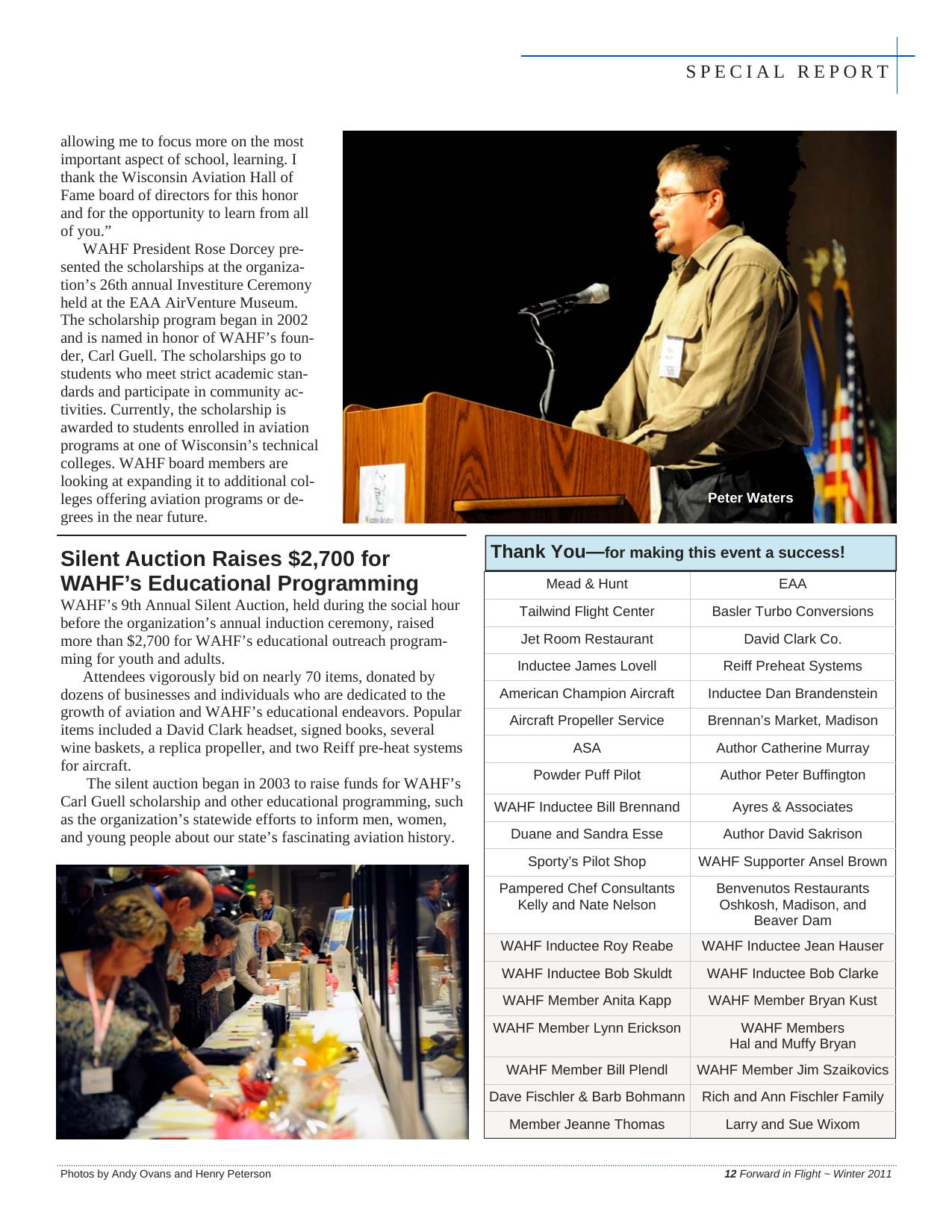
SPECIAL REPORT allowing me to focus more on the most important aspect of school, learning. I thank the Wisconsin Aviation Hall of Fame board of directors for this honor and for the opportunity to learn from all of you.” WAHF President Rose Dorcey presented the scholarships at the organization’s 26th annual Investiture Ceremony held at the EAA AirVenture Museum. The scholarship program began in 2002 and is named in honor of WAHF’s founder, Carl Guell. The scholarships go to students who meet strict academic standards and participate in community activities. Currently, the scholarship is awarded to students enrolled in aviation programs at one of Wisconsin’s technical colleges. WAHF board members are looking at expanding it to additional colleges offering aviation programs or degrees in the near future. Silent Auction Raises $2,700 for WAHF’s Educational Programming WAHF’s 9th Annual Silent Auction, held during the social hour before the organization’s annual induction ceremony, raised more than $2,700 for WAHF’s educational outreach programming for youth and adults. Attendees vigorously bid on nearly 70 items, donated by dozens of businesses and individuals who are dedicated to the growth of aviation and WAHF’s educational endeavors. Popular items included a David Clark headset, signed books, several wine baskets, a replica propeller, and two Reiff pre-heat systems for aircraft. The silent auction began in 2003 to raise funds for WAHF’s Carl Guell scholarship and other educational programming, such as the organization’s statewide efforts to inform men, women, and young people about our state’s fascinating aviation history. Photos by Andy Ovans and Henry Peterson Peter Waters Thank You—for making this event a success! Mead & Hunt EAA Tailwind Flight Center Basler Turbo Conversions Jet Room Restaurant David Clark Co. Inductee James Lovell Reiff Preheat Systems American Champion Aircraft Inductee Dan Brandenstein Aircraft Propeller Service Brennan’s Market, Madison ASA Author Catherine Murray Powder Puff Pilot Author Peter Buffington WAHF Inductee Bill Brennand Ayres & Associates Duane and Sandra Esse Author David Sakrison Sporty’s Pilot Shop WAHF Supporter Ansel Brown Pampered Chef Consultants Kelly and Nate Nelson Benvenutos Restaurants Oshkosh, Madison, and Beaver Dam WAHF Inductee Roy Reabe WAHF Inductee Jean Hauser WAHF Inductee Bob Skuldt WAHF Inductee Bob Clarke WAHF Member Anita Kapp WAHF Member Bryan Kust WAHF Member Lynn Erickson WAHF Members Hal and Muffy Bryan WAHF Member Bill Plendl WAHF Member Jim Szaikovics Dave Fischler & Barb Bohmann Rich and Ann Fischler Family Member Jeanne Thomas Larry and Sue Wixom 12 Forward in Flight ~ Winter 2011
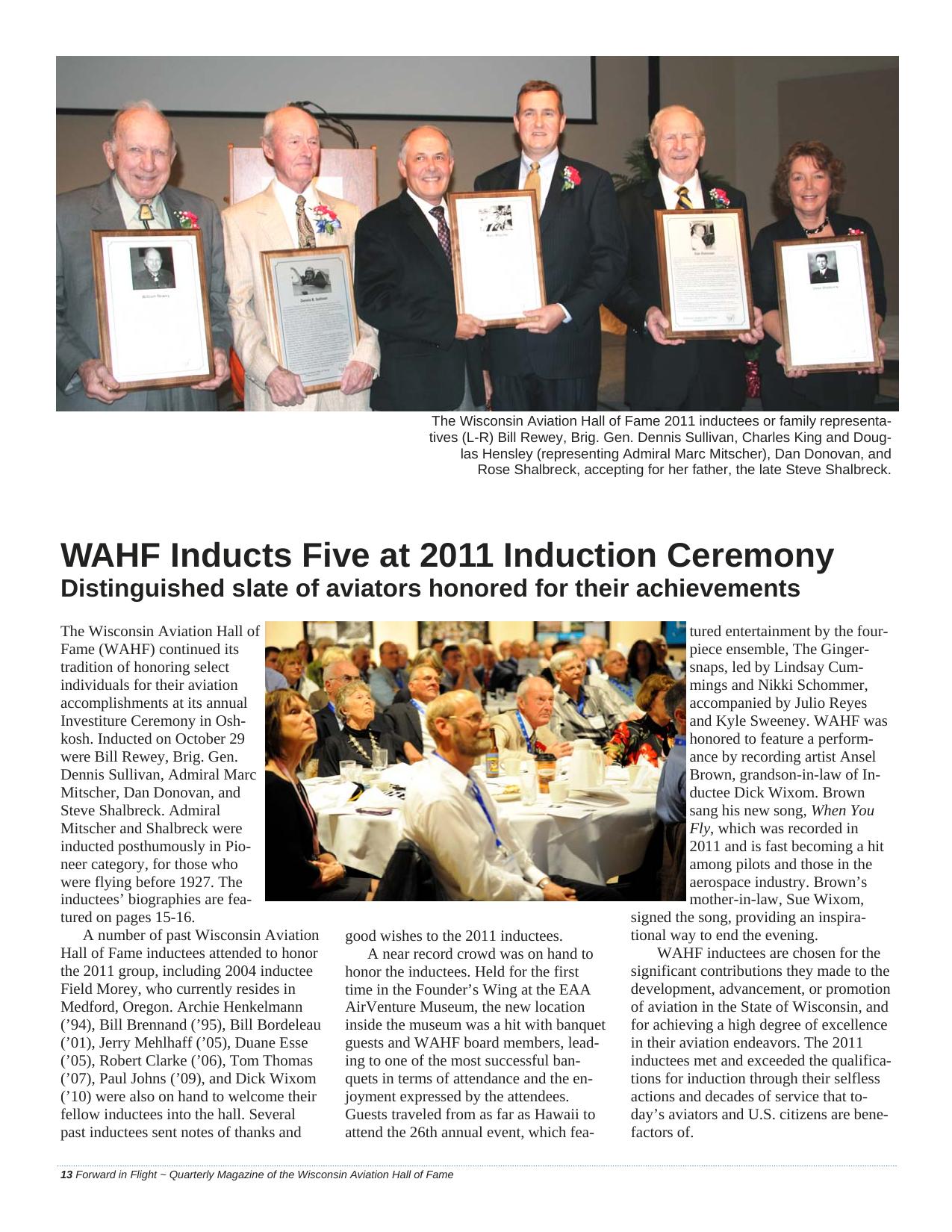
The Wisconsin Aviation Hall of Fame 2011 inductees or family representatives (L-R) Bill Rewey, Brig. Gen. Dennis Sullivan, Charles King and Douglas Hensley (representing Admiral Marc Mitscher), Dan Donovan, and Rose Shalbreck, accepting for her father, the late Steve Shalbreck. WAHF Inducts Five at 2011 Induction Ceremony Distinguished slate of aviators honored for their achievements The Wisconsin Aviation Hall of Fame (WAHF) continued its tradition of honoring select individuals for their aviation accomplishments at its annual Investiture Ceremony in Oshkosh. Inducted on October 29 were Bill Rewey, Brig. Gen. Dennis Sullivan, Admiral Marc Mitscher, Dan Donovan, and Steve Shalbreck. Admiral Mitscher and Shalbreck were inducted posthumously in Pioneer category, for those who were flying before 1927. The inductees’ biographies are featured on pages 15-16. A number of past Wisconsin Aviation Hall of Fame inductees attended to honor the 2011 group, including 2004 inductee Field Morey, who currently resides in Medford, Oregon. Archie Henkelmann (’94), Bill Brennand (’95), Bill Bordeleau (’01), Jerry Mehlhaff (’05), Duane Esse (’05), Robert Clarke (’06), Tom Thomas (’07), Paul Johns (’09), and Dick Wixom (’10) were also on hand to welcome their fellow inductees into the hall. Several past inductees sent notes of thanks and good wishes to the 2011 inductees. A near record crowd was on hand to honor the inductees. Held for the first time in the Founder’s Wing at the EAA AirVenture Museum, the new location inside the museum was a hit with banquet guests and WAHF board members, leading to one of the most successful banquets in terms of attendance and the enjoyment expressed by the attendees. Guests traveled from as far as Hawaii to attend the 26th annual event, which fea- 13 Forward in Flight ~ Quarterly Magazine of the Wisconsin Aviation Hall of Fame tured entertainment by the fourpiece ensemble, The Gingersnaps, led by Lindsay Cummings and Nikki Schommer, accompanied by Julio Reyes and Kyle Sweeney. WAHF was honored to feature a performance by recording artist Ansel Brown, grandson-in-law of Inductee Dick Wixom. Brown sang his new song, When You Fly, which was recorded in 2011 and is fast becoming a hit among pilots and those in the aerospace industry. Brown’s mother-in-law, Sue Wixom, signed the song, providing an inspirational way to end the evening. WAHF inductees are chosen for the significant contributions they made to the development, advancement, or promotion of aviation in the State of Wisconsin, and for achieving a high degree of excellence in their aviation endeavors. The 2011 inductees met and exceeded the qualifications for induction through their selfless actions and decades of service that today’s aviators and U.S. citizens are benefactors of.
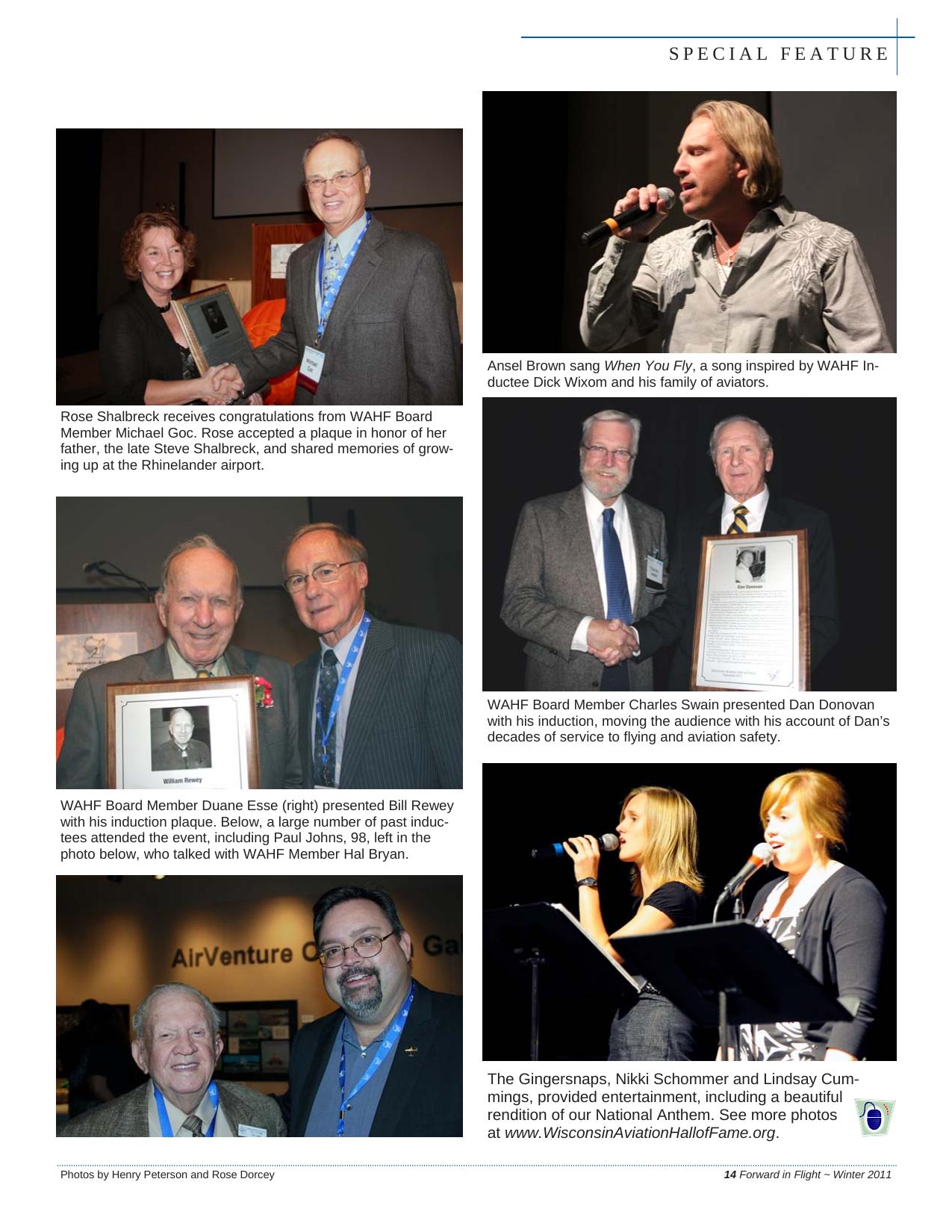
SPECIAL FEATURE Ansel Brown sang When You Fly, a song inspired by WAHF Inductee Dick Wixom and his family of aviators. Rose Shalbreck receives congratulations from WAHF Board Member Michael Goc. Rose accepted a plaque in honor of her father, the late Steve Shalbreck, and shared memories of growing up at the Rhinelander airport. WAHF Board Member Charles Swain presented Dan Donovan with his induction, moving the audience with his account of Dan’s decades of service to flying and aviation safety. WAHF Board Member Duane Esse (right) presented Bill Rewey with his induction plaque. Below, a large number of past inductees attended the event, including Paul Johns, 98, left in the photo below, who talked with WAHF Member Hal Bryan. The Gingersnaps, Nikki Schommer and Lindsay Cummings, provided entertainment, including a beautiful rendition of our National Anthem. See more photos at www.WisconsinAviationHallofFame.org. Photos by Henry Peterson and Rose Dorcey 14 Forward in Flight ~ Winter 2011
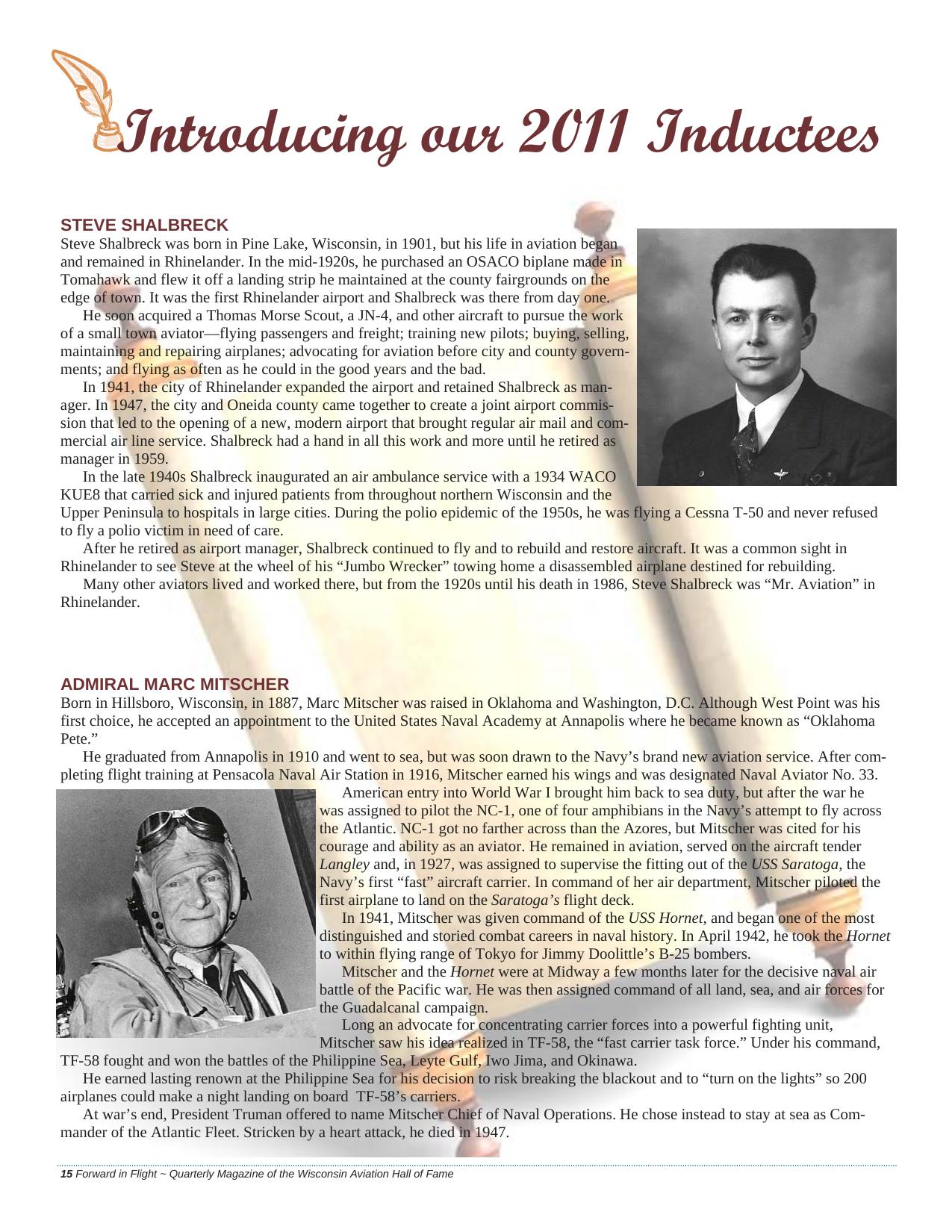
Introducing our 2011 Inductees STEVE SHALBRECK Steve Shalbreck was born in Pine Lake, Wisconsin, in 1901, but his life in aviation began and remained in Rhinelander. In the mid-1920s, he purchased an OSACO biplane made in Tomahawk and flew it off a landing strip he maintained at the county fairgrounds on the edge of town. It was the first Rhinelander airport and Shalbreck was there from day one. He soon acquired a Thomas Morse Scout, a JN-4, and other aircraft to pursue the work of a small town aviator—flying passengers and freight; training new pilots; buying, selling, maintaining and repairing airplanes; advocating for aviation before city and county governments; and flying as often as he could in the good years and the bad. In 1941, the city of Rhinelander expanded the airport and retained Shalbreck as manager. In 1947, the city and Oneida county came together to create a joint airport commission that led to the opening of a new, modern airport that brought regular air mail and commercial air line service. Shalbreck had a hand in all this work and more until he retired as manager in 1959. In the late 1940s Shalbreck inaugurated an air ambulance service with a 1934 WACO KUE8 that carried sick and injured patients from throughout northern Wisconsin and the Upper Peninsula to hospitals in large cities. During the polio epidemic of the 1950s, he was flying a Cessna T-50 and never refused to fly a polio victim in need of care. After he retired as airport manager, Shalbreck continued to fly and to rebuild and restore aircraft. It was a common sight in Rhinelander to see Steve at the wheel of his “Jumbo Wrecker” towing home a disassembled airplane destined for rebuilding. Many other aviators lived and worked there, but from the 1920s until his death in 1986, Steve Shalbreck was “Mr. Aviation” in Rhinelander. ADMIRAL MARC MITSCHER Born in Hillsboro, Wisconsin, in 1887, Marc Mitscher was raised in Oklahoma and Washington, D.C. Although West Point was his first choice, he accepted an appointment to the United States Naval Academy at Annapolis where he became known as “Oklahoma Pete.” He graduated from Annapolis in 1910 and went to sea, but was soon drawn to the Navy’s brand new aviation service. After completing flight training at Pensacola Naval Air Station in 1916, Mitscher earned his wings and was designated Naval Aviator No. 33. American entry into World War I brought him back to sea duty, but after the war he was assigned to pilot the NC-1, one of four amphibians in the Navy’s attempt to fly across the Atlantic. NC-1 got no farther across than the Azores, but Mitscher was cited for his courage and ability as an aviator. He remained in aviation, served on the aircraft tender Langley and, in 1927, was assigned to supervise the fitting out of the USS Saratoga, the Navy’s first “fast” aircraft carrier. In command of her air department, Mitscher piloted the first airplane to land on the Saratoga’s flight deck. In 1941, Mitscher was given command of the USS Hornet, and began one of the most distinguished and storied combat careers in naval history. In April 1942, he took the Hornet to within flying range of Tokyo for Jimmy Doolittle’s B-25 bombers. Mitscher and the Hornet were at Midway a few months later for the decisive naval air battle of the Pacific war. He was then assigned command of all land, sea, and air forces for the Guadalcanal campaign. Long an advocate for concentrating carrier forces into a powerful fighting unit, Mitscher saw his idea realized in TF-58, the “fast carrier task force.” Under his command, TF-58 fought and won the battles of the Philippine Sea, Leyte Gulf, Iwo Jima, and Okinawa. He earned lasting renown at the Philippine Sea for his decision to risk breaking the blackout and to “turn on the lights” so 200 airplanes could make a night landing on board TF-58’s carriers. At war’s end, President Truman offered to name Mitscher Chief of Naval Operations. He chose instead to stay at sea as Commander of the Atlantic Fleet. Stricken by a heart attack, he died in 1947. 15 Forward in Flight ~ Quarterly Magazine of the Wisconsin Aviation Hall of Fame
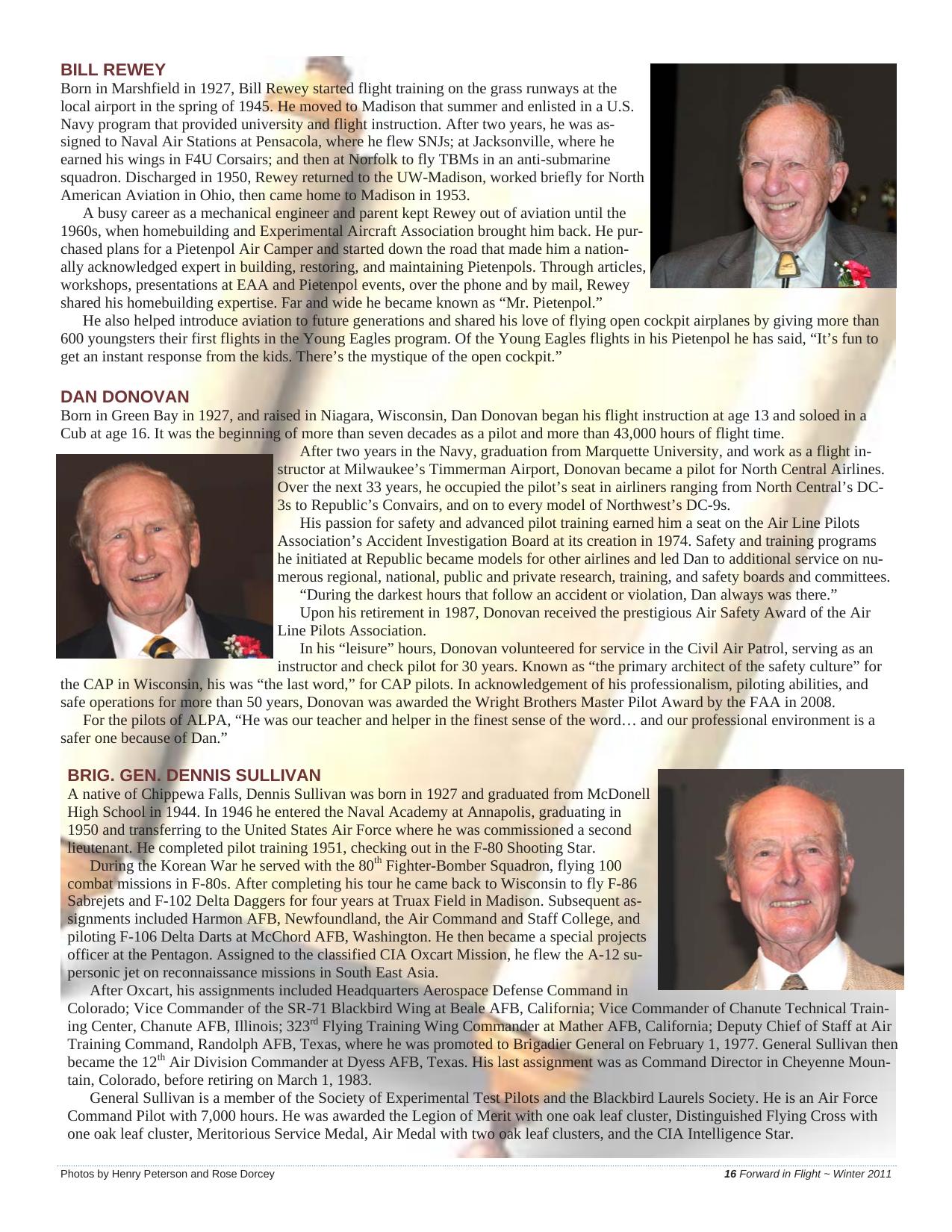
BILL REWEY Born in Marshfield in 1927, Bill Rewey started flight training on the grass runways at the local airport in the spring of 1945. He moved to Madison that summer and enlisted in a U.S. Navy program that provided university and flight instruction. After two years, he was assigned to Naval Air Stations at Pensacola, where he flew SNJs; at Jacksonville, where he earned his wings in F4U Corsairs; and then at Norfolk to fly TBMs in an anti-submarine squadron. Discharged in 1950, Rewey returned to the UW-Madison, worked briefly for North American Aviation in Ohio, then came home to Madison in 1953. A busy career as a mechanical engineer and parent kept Rewey out of aviation until the 1960s, when homebuilding and Experimental Aircraft Association brought him back. He purchased plans for a Pietenpol Air Camper and started down the road that made him a nationally acknowledged expert in building, restoring, and maintaining Pietenpols. Through articles, workshops, presentations at EAA and Pietenpol events, over the phone and by mail, Rewey shared his homebuilding expertise. Far and wide he became known as “Mr. Pietenpol.” He also helped introduce aviation to future generations and shared his love of flying open cockpit airplanes by giving more than 600 youngsters their first flights in the Young Eagles program. Of the Young Eagles flights in his Pietenpol he has said, “It’s fun to get an instant response from the kids. There’s the mystique of the open cockpit.” DAN DONOVAN Born in Green Bay in 1927, and raised in Niagara, Wisconsin, Dan Donovan began his flight instruction at age 13 and soloed in a Cub at age 16. It was the beginning of more than seven decades as a pilot and more than 43,000 hours of flight time. After two years in the Navy, graduation from Marquette University, and work as a flight instructor at Milwaukee’s Timmerman Airport, Donovan became a pilot for North Central Airlines. Over the next 33 years, he occupied the pilot’s seat in airliners ranging from North Central’s DC3s to Republic’s Convairs, and on to every model of Northwest’s DC-9s. His passion for safety and advanced pilot training earned him a seat on the Air Line Pilots Association’s Accident Investigation Board at its creation in 1974. Safety and training programs he initiated at Republic became models for other airlines and led Dan to additional service on numerous regional, national, public and private research, training, and safety boards and committees. “During the darkest hours that follow an accident or violation, Dan always was there.” Upon his retirement in 1987, Donovan received the prestigious Air Safety Award of the Air Line Pilots Association. In his “leisure” hours, Donovan volunteered for service in the Civil Air Patrol, serving as an instructor and check pilot for 30 years. Known as “the primary architect of the safety culture” for the CAP in Wisconsin, his was “the last word,” for CAP pilots. In acknowledgement of his professionalism, piloting abilities, and safe operations for more than 50 years, Donovan was awarded the Wright Brothers Master Pilot Award by the FAA in 2008. For the pilots of ALPA, “He was our teacher and helper in the finest sense of the word… and our professional environment is a safer one because of Dan.” BRIG. GEN. DENNIS SULLIVAN A native of Chippewa Falls, Dennis Sullivan was born in 1927 and graduated from McDonell High School in 1944. In 1946 he entered the Naval Academy at Annapolis, graduating in 1950 and transferring to the United States Air Force where he was commissioned a second lieutenant. He completed pilot training 1951, checking out in the F-80 Shooting Star. During the Korean War he served with the 80th Fighter-Bomber Squadron, flying 100 combat missions in F-80s. After completing his tour he came back to Wisconsin to fly F-86 Sabrejets and F-102 Delta Daggers for four years at Truax Field in Madison. Subsequent assignments included Harmon AFB, Newfoundland, the Air Command and Staff College, and piloting F-106 Delta Darts at McChord AFB, Washington. He then became a special projects officer at the Pentagon. Assigned to the classified CIA Oxcart Mission, he flew the A-12 supersonic jet on reconnaissance missions in South East Asia. After Oxcart, his assignments included Headquarters Aerospace Defense Command in Colorado; Vice Commander of the SR-71 Blackbird Wing at Beale AFB, California; Vice Commander of Chanute Technical Training Center, Chanute AFB, Illinois; 323rd Flying Training Wing Commander at Mather AFB, California; Deputy Chief of Staff at Air Training Command, Randolph AFB, Texas, where he was promoted to Brigadier General on February 1, 1977. General Sullivan then became the 12th Air Division Commander at Dyess AFB, Texas. His last assignment was as Command Director in Cheyenne Mountain, Colorado, before retiring on March 1, 1983. General Sullivan is a member of the Society of Experimental Test Pilots and the Blackbird Laurels Society. He is an Air Force Command Pilot with 7,000 hours. He was awarded the Legion of Merit with one oak leaf cluster, Distinguished Flying Cross with one oak leaf cluster, Meritorious Service Medal, Air Medal with two oak leaf clusters, and the CIA Intelligence Star. Photos by Henry Peterson and Rose Dorcey 16 Forward in Flight ~ Winter 2011
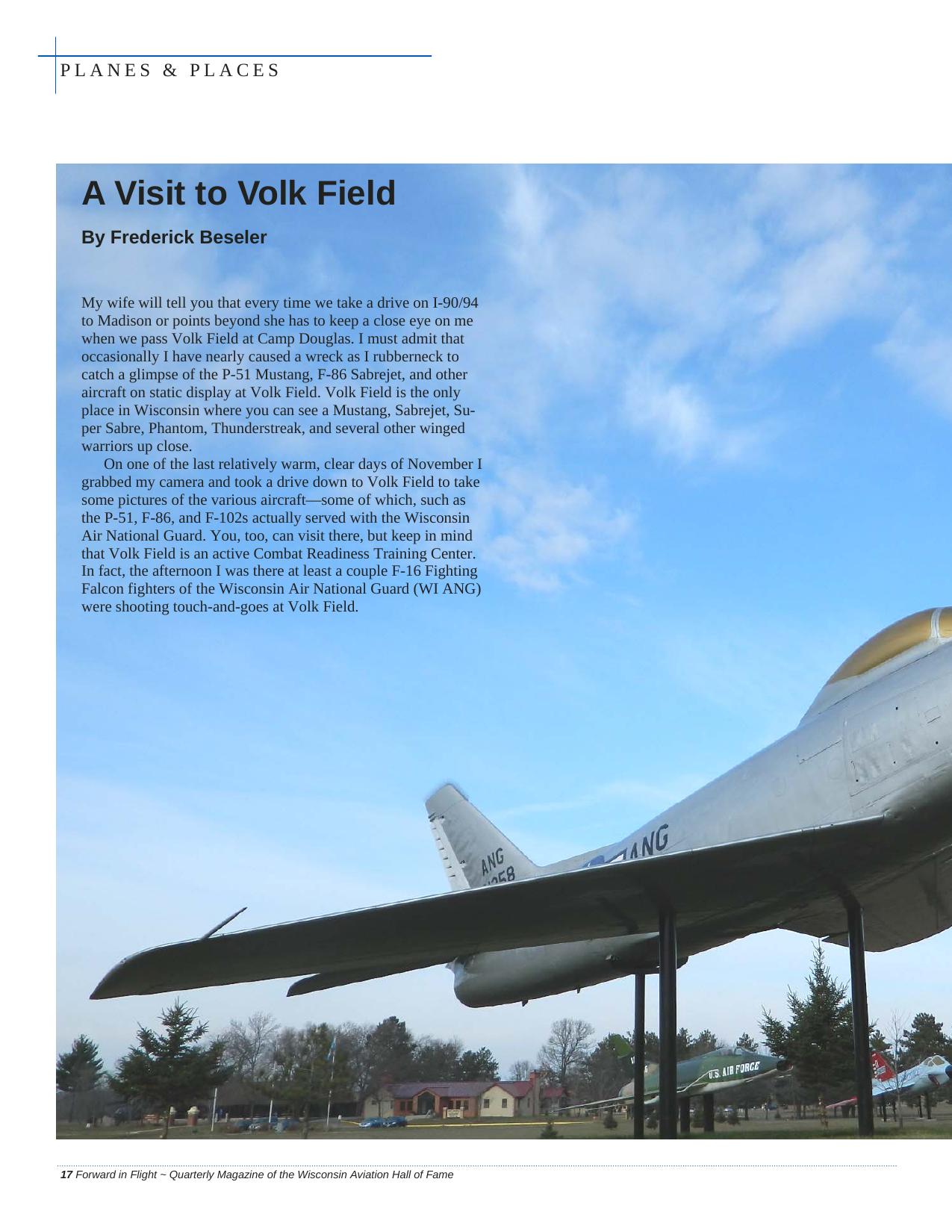
PLANES & PLACES A Visit to Volk Field By Frederick Beseler My wife will tell you that every time we take a drive on I-90/94 to Madison or points beyond she has to keep a close eye on me when we pass Volk Field at Camp Douglas. I must admit that occasionally I have nearly caused a wreck as I rubberneck to catch a glimpse of the P-51 Mustang, F-86 Sabrejet, and other aircraft on static display at Volk Field. Volk Field is the only place in Wisconsin where you can see a Mustang, Sabrejet, Super Sabre, Phantom, Thunderstreak, and several other winged warriors up close. On one of the last relatively warm, clear days of November I grabbed my camera and took a drive down to Volk Field to take some pictures of the various aircraft—some of which, such as the P-51, F-86, and F-102s actually served with the Wisconsin Air National Guard. You, too, can visit there, but keep in mind that Volk Field is an active Combat Readiness Training Center. In fact, the afternoon I was there at least a couple F-16 Fighting Falcon fighters of the Wisconsin Air National Guard (WI ANG) were shooting touch-and-goes at Volk Field. 17 Forward in Flight ~ Quarterly Magazine of the Wisconsin Aviation Hall of Fame
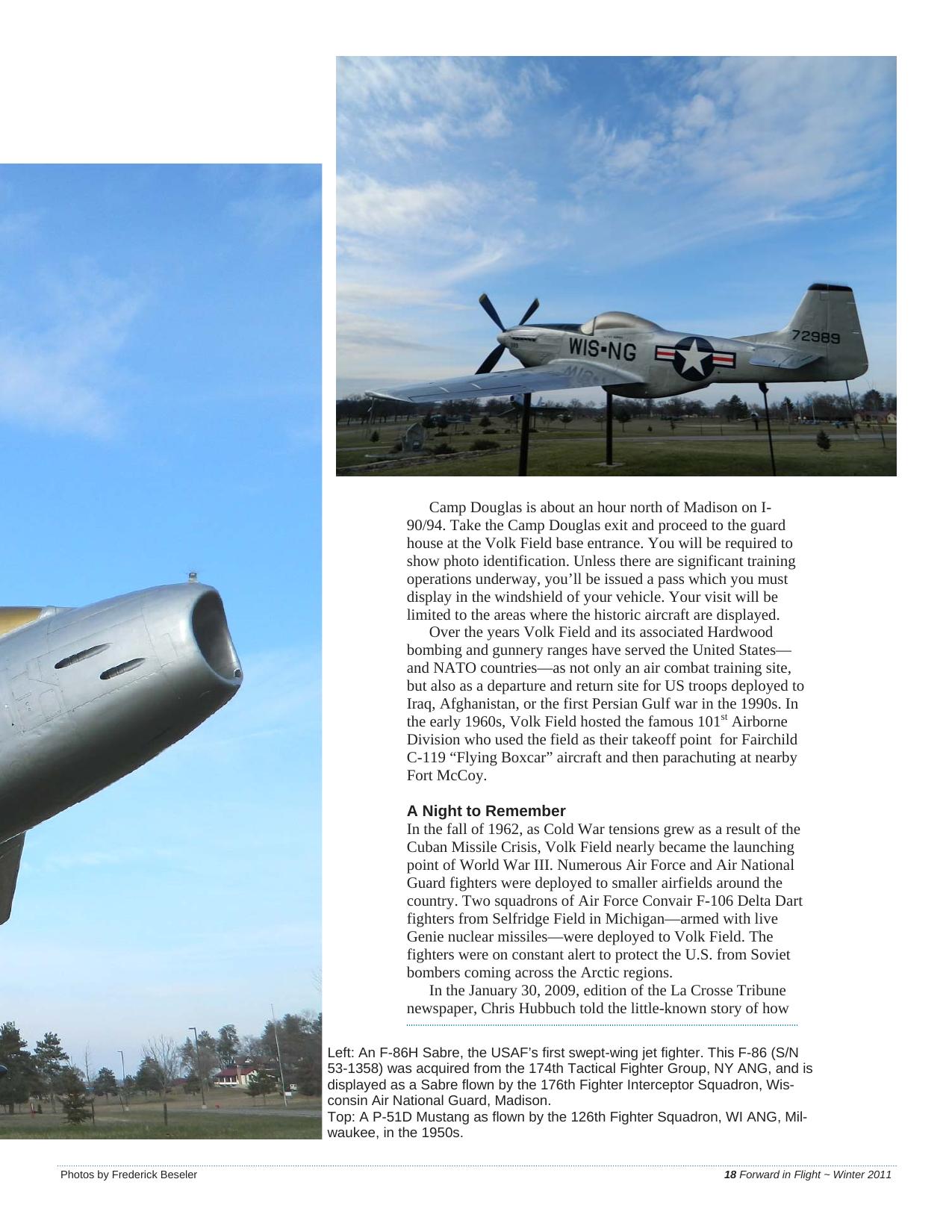
Camp Douglas is about an hour north of Madison on I90/94. Take the Camp Douglas exit and proceed to the guard house at the Volk Field base entrance. You will be required to show photo identification. Unless there are significant training operations underway, you’ll be issued a pass which you must display in the windshield of your vehicle. Your visit will be limited to the areas where the historic aircraft are displayed. Over the years Volk Field and its associated Hardwood bombing and gunnery ranges have served the United States— and NATO countries—as not only an air combat training site, but also as a departure and return site for US troops deployed to Iraq, Afghanistan, or the first Persian Gulf war in the 1990s. In the early 1960s, Volk Field hosted the famous 101st Airborne Division who used the field as their takeoff point for Fairchild C-119 “Flying Boxcar” aircraft and then parachuting at nearby Fort McCoy. A Night to Remember In the fall of 1962, as Cold War tensions grew as a result of the Cuban Missile Crisis, Volk Field nearly became the launching point of World War III. Numerous Air Force and Air National Guard fighters were deployed to smaller airfields around the country. Two squadrons of Air Force Convair F-106 Delta Dart fighters from Selfridge Field in Michigan—armed with live Genie nuclear missiles—were deployed to Volk Field. The fighters were on constant alert to protect the U.S. from Soviet bombers coming across the Arctic regions. In the January 30, 2009, edition of the La Crosse Tribune newspaper, Chris Hubbuch told the little-known story of how Left: An F-86H Sabre, the USAF’s first swept-wing jet fighter. This F-86 (S/N 53-1358) was acquired from the 174th Tactical Fighter Group, NY ANG, and is displayed as a Sabre flown by the 176th Fighter Interceptor Squadron, Wisconsin Air National Guard, Madison. Top: A P-51D Mustang as flown by the 126th Fighter Squadron, WI ANG, Milwaukee, in the 1950s. Photos by Frederick Beseler 18 Forward in Flight ~ Winter 2011
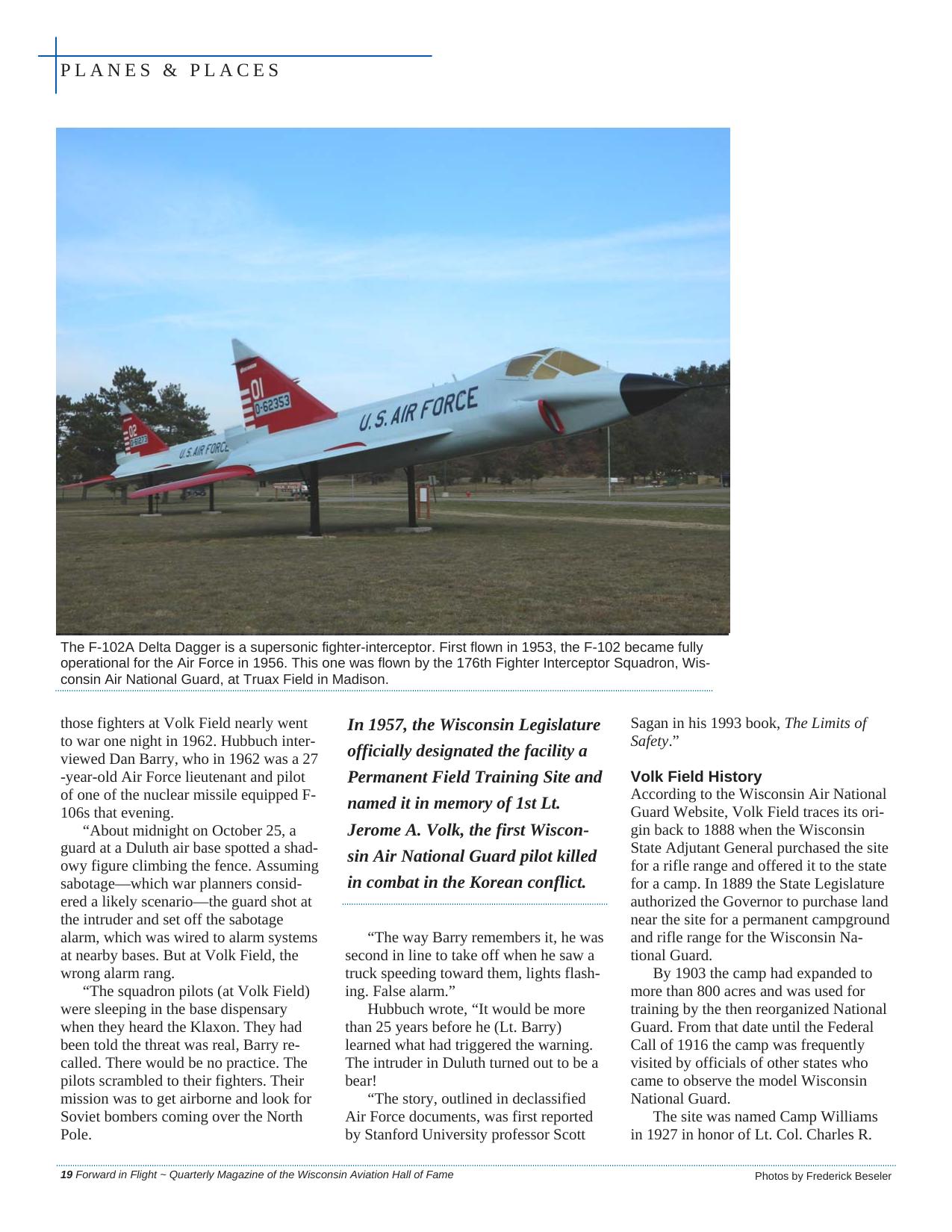
PLANES & PLACES The F-102A Delta Dagger is a supersonic fighter-interceptor. First flown in 1953, the F-102 became fully operational for the Air Force in 1956. This one was flown by the 176th Fighter Interceptor Squadron, Wisconsin Air National Guard, at Truax Field in Madison. those fighters at Volk Field nearly went to war one night in 1962. Hubbuch interviewed Dan Barry, who in 1962 was a 27 -year-old Air Force lieutenant and pilot of one of the nuclear missile equipped F106s that evening. “About midnight on October 25, a guard at a Duluth air base spotted a shadowy figure climbing the fence. Assuming sabotage—which war planners considered a likely scenario—the guard shot at the intruder and set off the sabotage alarm, which was wired to alarm systems at nearby bases. But at Volk Field, the wrong alarm rang. “The squadron pilots (at Volk Field) were sleeping in the base dispensary when they heard the Klaxon. They had been told the threat was real, Barry recalled. There would be no practice. The pilots scrambled to their fighters. Their mission was to get airborne and look for Soviet bombers coming over the North Pole. In 1957, the Wisconsin Legislature officially designated the facility a Permanent Field Training Site and named it in memory of 1st Lt. Jerome A. Volk, the first Wisconsin Air National Guard pilot killed in combat in the Korean conflict. “The way Barry remembers it, he was second in line to take off when he saw a truck speeding toward them, lights flashing. False alarm.” Hubbuch wrote, “It would be more than 25 years before he (Lt. Barry) learned what had triggered the warning. The intruder in Duluth turned out to be a bear! “The story, outlined in declassified Air Force documents, was first reported by Stanford University professor Scott 19 Forward in Flight ~ Quarterly Magazine of the Wisconsin Aviation Hall of Fame Sagan in his 1993 book, The Limits of Safety.” Volk Field History According to the Wisconsin Air National Guard Website, Volk Field traces its origin back to 1888 when the Wisconsin State Adjutant General purchased the site for a rifle range and offered it to the state for a camp. In 1889 the State Legislature authorized the Governor to purchase land near the site for a permanent campground and rifle range for the Wisconsin National Guard. By 1903 the camp had expanded to more than 800 acres and was used for training by the then reorganized National Guard. From that date until the Federal Call of 1916 the camp was frequently visited by officials of other states who came to observe the model Wisconsin National Guard. The site was named Camp Williams in 1927 in honor of Lt. Col. Charles R. Photos by Frederick Beseler
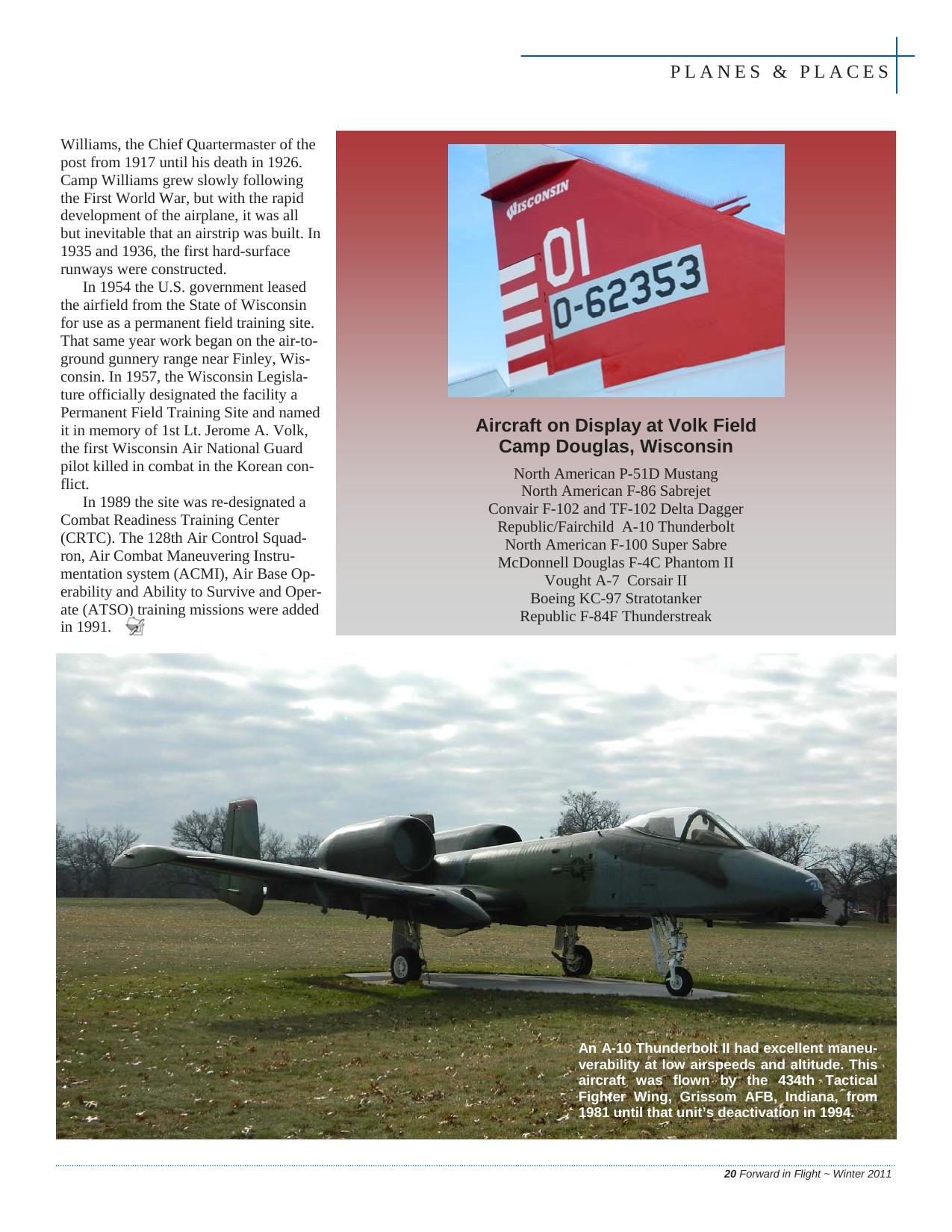
PLANES & PLACES Williams, the Chief Quartermaster of the post from 1917 until his death in 1926. Camp Williams grew slowly following the First World War, but with the rapid development of the airplane, it was all but inevitable that an airstrip was built. In 1935 and 1936, the first hard-surface runways were constructed. In 1954 the U.S. government leased the airfield from the State of Wisconsin for use as a permanent field training site. That same year work began on the air-toground gunnery range near Finley, Wisconsin. In 1957, the Wisconsin Legislature officially designated the facility a Permanent Field Training Site and named it in memory of 1st Lt. Jerome A. Volk, the first Wisconsin Air National Guard pilot killed in combat in the Korean conflict. In 1989 the site was re-designated a Combat Readiness Training Center (CRTC). The 128th Air Control Squadron, Air Combat Maneuvering Instrumentation system (ACMI), Air Base Operability and Ability to Survive and Operate (ATSO) training missions were added in 1991. Aircraft on Display at Volk Field Camp Douglas, Wisconsin North American P-51D Mustang North American F-86 Sabrejet Convair F-102 and TF-102 Delta Dagger Republic/Fairchild A-10 Thunderbolt North American F-100 Super Sabre McDonnell Douglas F-4C Phantom II Vought A-7 Corsair II Boeing KC-97 Stratotanker Republic F-84F Thunderstreak An A-10 Thunderbolt II had excellent maneuverability at low airspeeds and altitude. This aircraft was flown by the 434th Tactical Fighter Wing, Grissom AFB, Indiana, from 1981 until that unit’s deactivation in 1994. 20 Forward in Flight ~ Winter 2011
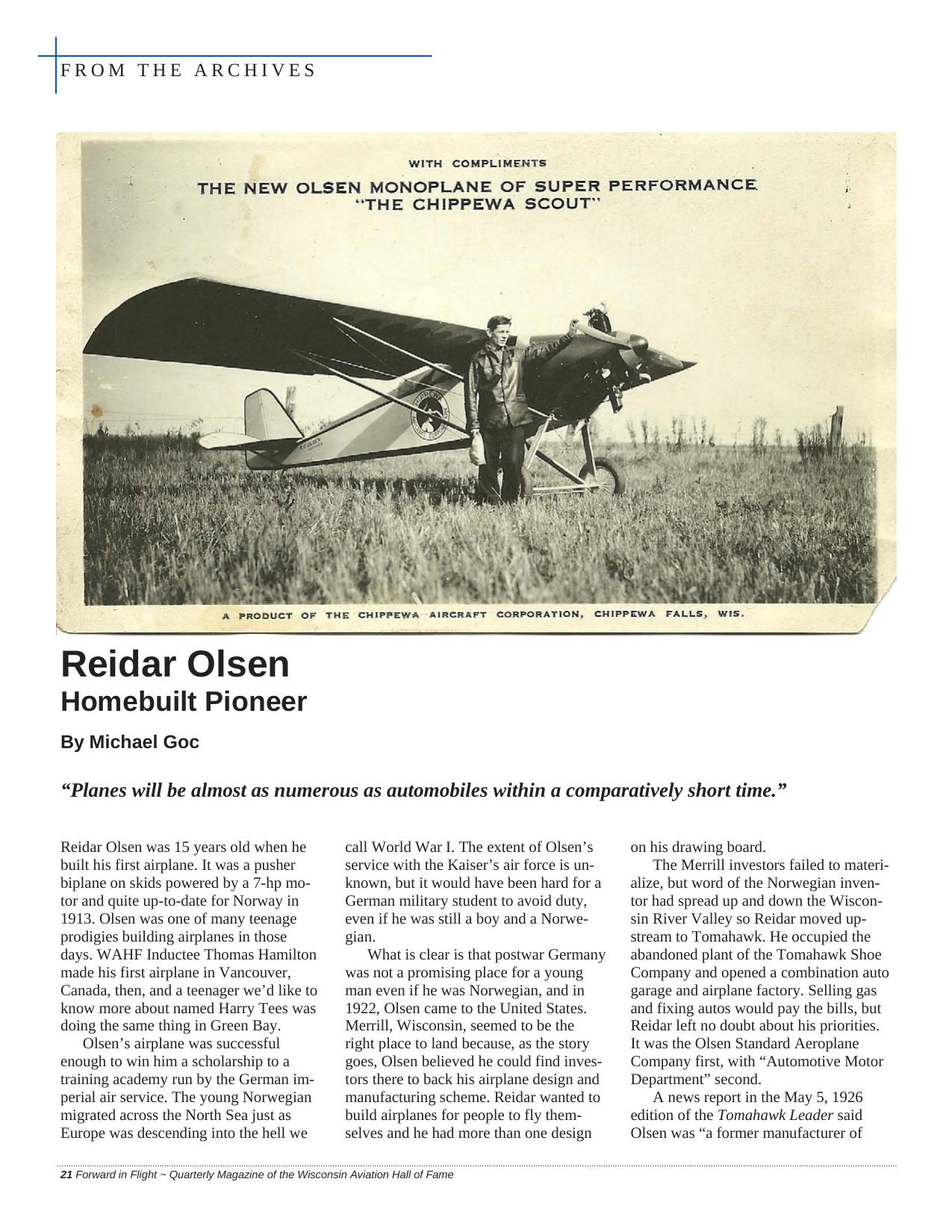
FROM THE ARCHIVES Reidar Olsen Homebuilt Pioneer By Michael Goc “Planes will be almost as numerous as automobiles within a comparatively short time.” Reidar Olsen was 15 years old when he built his first airplane. It was a pusher biplane on skids powered by a 7-hp motor and quite up-to-date for Norway in 1913. Olsen was one of many teenage prodigies building airplanes in those days. WAHF Inductee Thomas Hamilton made his first airplane in Vancouver, Canada, then, and a teenager we’d like to know more about named Harry Tees was doing the same thing in Green Bay. Olsen’s airplane was successful enough to win him a scholarship to a training academy run by the German imperial air service. The young Norwegian migrated across the North Sea just as Europe was descending into the hell we call World War I. The extent of Olsen’s service with the Kaiser’s air force is unknown, but it would have been hard for a German military student to avoid duty, even if he was still a boy and a Norwegian. What is clear is that postwar Germany was not a promising place for a young man even if he was Norwegian, and in 1922, Olsen came to the United States. Merrill, Wisconsin, seemed to be the right place to land because, as the story goes, Olsen believed he could find investors there to back his airplane design and manufacturing scheme. Reidar wanted to build airplanes for people to fly themselves and he had more than one design 21 Forward in Flight ~ Quarterly Magazine of the Wisconsin Aviation Hall of Fame on his drawing board. The Merrill investors failed to materialize, but word of the Norwegian inventor had spread up and down the Wisconsin River Valley so Reidar moved upstream to Tomahawk. He occupied the abandoned plant of the Tomahawk Shoe Company and opened a combination auto garage and airplane factory. Selling gas and fixing autos would pay the bills, but Reidar left no doubt about his priorities. It was the Olsen Standard Aeroplane Company first, with “Automotive Motor Department” second. A news report in the May 5, 1926 edition of the Tomahawk Leader said Olsen was “a former manufacturer of
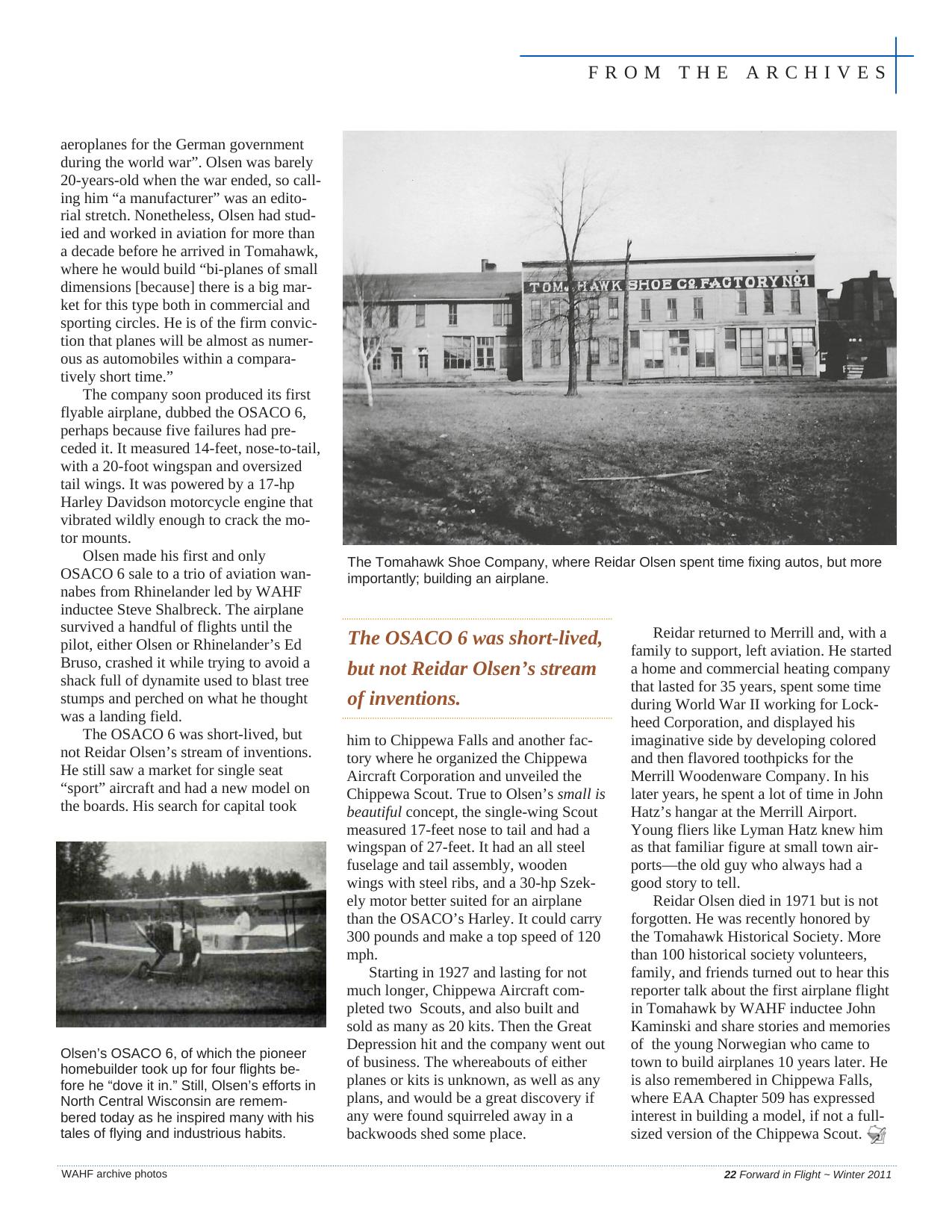
FROM THE ARCHIVES aeroplanes for the German government during the world war”. Olsen was barely 20-years-old when the war ended, so calling him “a manufacturer” was an editorial stretch. Nonetheless, Olsen had studied and worked in aviation for more than a decade before he arrived in Tomahawk, where he would build “bi-planes of small dimensions [because] there is a big market for this type both in commercial and sporting circles. He is of the firm conviction that planes will be almost as numerous as automobiles within a comparatively short time.” The company soon produced its first flyable airplane, dubbed the OSACO 6, perhaps because five failures had preceded it. It measured 14-feet, nose-to-tail, with a 20-foot wingspan and oversized tail wings. It was powered by a 17-hp Harley Davidson motorcycle engine that vibrated wildly enough to crack the motor mounts. Olsen made his first and only OSACO 6 sale to a trio of aviation wannabes from Rhinelander led by WAHF inductee Steve Shalbreck. The airplane survived a handful of flights until the pilot, either Olsen or Rhinelander’s Ed Bruso, crashed it while trying to avoid a shack full of dynamite used to blast tree stumps and perched on what he thought was a landing field. The OSACO 6 was short-lived, but not Reidar Olsen’s stream of inventions. He still saw a market for single seat “sport” aircraft and had a new model on the boards. His search for capital took Olsen’s OSACO 6, of which the pioneer homebuilder took up for four flights before he “dove it in.” Still, Olsen’s efforts in North Central Wisconsin are remembered today as he inspired many with his tales of flying and industrious habits. WAHF archive photos The Tomahawk Shoe Company, where Reidar Olsen spent time fixing autos, but more importantly; building an airplane. The OSACO 6 was short-lived, but not Reidar Olsen’s stream of inventions. him to Chippewa Falls and another factory where he organized the Chippewa Aircraft Corporation and unveiled the Chippewa Scout. True to Olsen’s small is beautiful concept, the single-wing Scout measured 17-feet nose to tail and had a wingspan of 27-feet. It had an all steel fuselage and tail assembly, wooden wings with steel ribs, and a 30-hp Szekely motor better suited for an airplane than the OSACO’s Harley. It could carry 300 pounds and make a top speed of 120 mph. Starting in 1927 and lasting for not much longer, Chippewa Aircraft completed two Scouts, and also built and sold as many as 20 kits. Then the Great Depression hit and the company went out of business. The whereabouts of either planes or kits is unknown, as well as any plans, and would be a great discovery if any were found squirreled away in a backwoods shed some place. Reidar returned to Merrill and, with a family to support, left aviation. He started a home and commercial heating company that lasted for 35 years, spent some time during World War II working for Lockheed Corporation, and displayed his imaginative side by developing colored and then flavored toothpicks for the Merrill Woodenware Company. In his later years, he spent a lot of time in John Hatz’s hangar at the Merrill Airport. Young fliers like Lyman Hatz knew him as that familiar figure at small town airports—the old guy who always had a good story to tell. Reidar Olsen died in 1971 but is not forgotten. He was recently honored by the Tomahawk Historical Society. More than 100 historical society volunteers, family, and friends turned out to hear this reporter talk about the first airplane flight in Tomahawk by WAHF inductee John Kaminski and share stories and memories of the young Norwegian who came to town to build airplanes 10 years later. He is also remembered in Chippewa Falls, where EAA Chapter 509 has expressed interest in building a model, if not a fullsized version of the Chippewa Scout. 22 Forward in Flight ~ Winter 2011
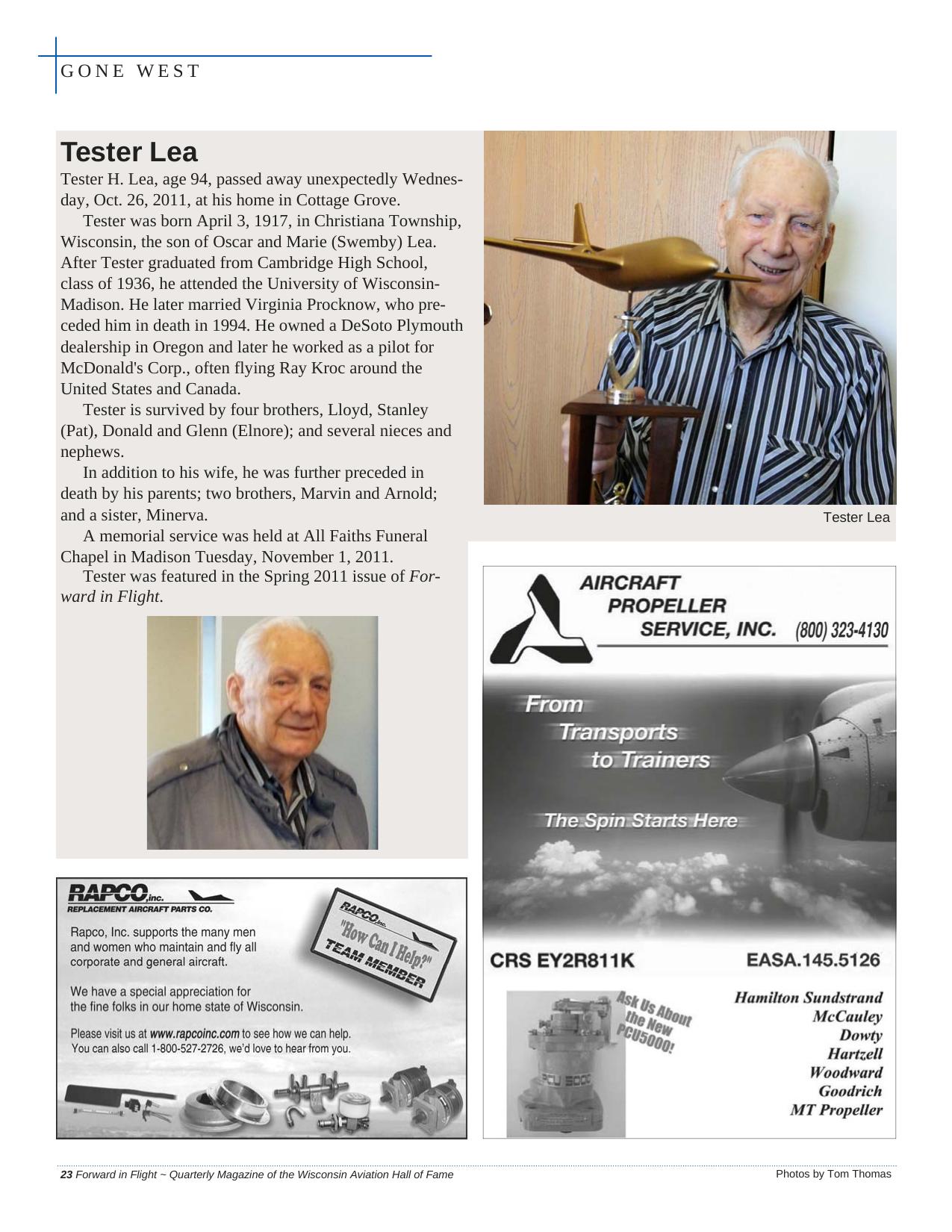
GONE WEST Tester Lea Tester H. Lea, age 94, passed away unexpectedly Wednesday, Oct. 26, 2011, at his home in Cottage Grove. Tester was born April 3, 1917, in Christiana Township, Wisconsin, the son of Oscar and Marie (Swemby) Lea. After Tester graduated from Cambridge High School, class of 1936, he attended the University of WisconsinMadison. He later married Virginia Procknow, who preceded him in death in 1994. He owned a DeSoto Plymouth dealership in Oregon and later he worked as a pilot for McDonald's Corp., often flying Ray Kroc around the United States and Canada. Tester is survived by four brothers, Lloyd, Stanley (Pat), Donald and Glenn (Elnore); and several nieces and nephews. In addition to his wife, he was further preceded in death by his parents; two brothers, Marvin and Arnold; and a sister, Minerva. A memorial service was held at All Faiths Funeral Chapel in Madison Tuesday, November 1, 2011. Tester was featured in the Spring 2011 issue of Forward in Flight. 23 Forward in Flight ~ Quarterly Magazine of the Wisconsin Aviation Hall of Fame Tester Lea Photos by Tom Thomas
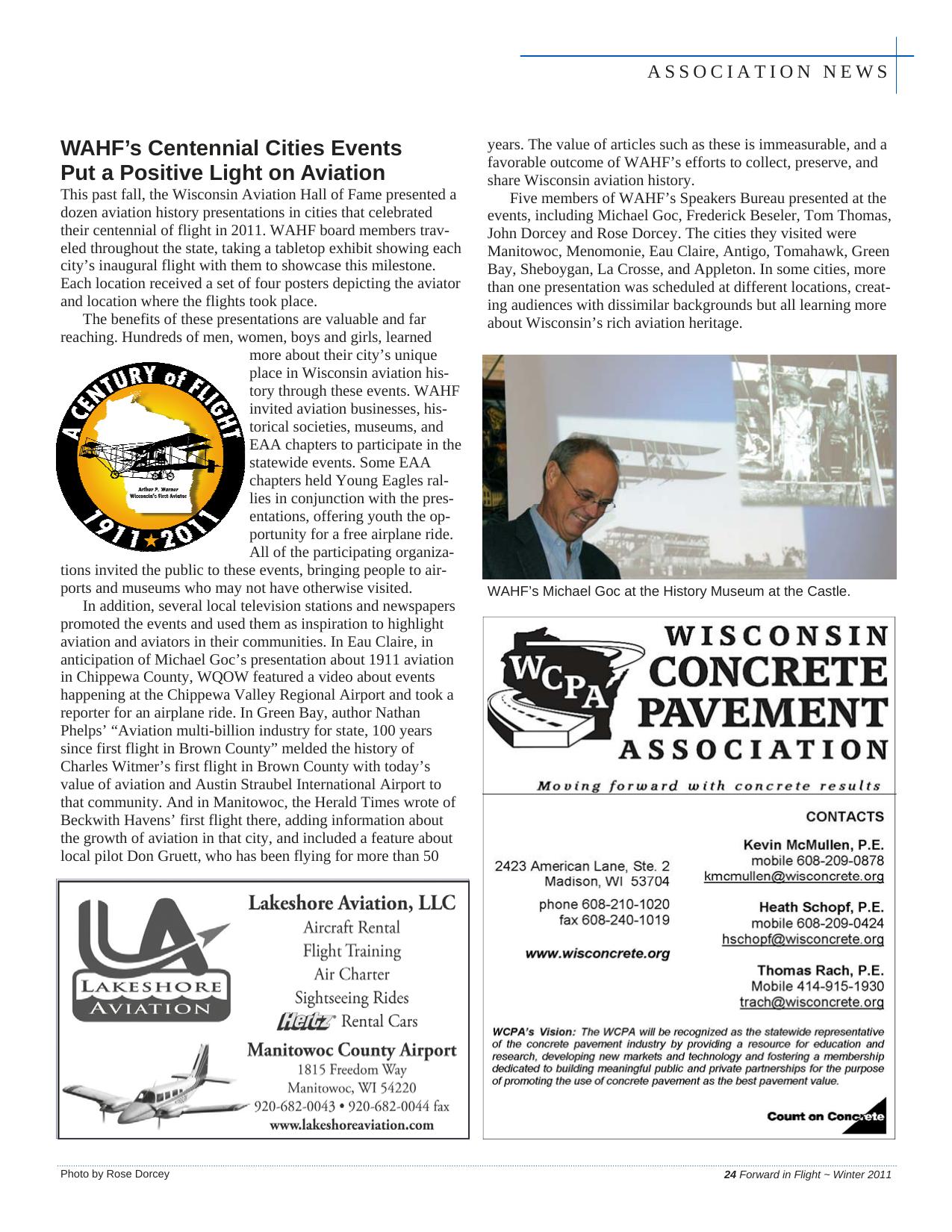
ASSOCIATION NEWS WAHF’s Centennial Cities Events Put a Positive Light on Aviation This past fall, the Wisconsin Aviation Hall of Fame presented a dozen aviation history presentations in cities that celebrated their centennial of flight in 2011. WAHF board members traveled throughout the state, taking a tabletop exhibit showing each city’s inaugural flight with them to showcase this milestone. Each location received a set of four posters depicting the aviator and location where the flights took place. The benefits of these presentations are valuable and far reaching. Hundreds of men, women, boys and girls, learned more about their city’s unique place in Wisconsin aviation history through these events. WAHF invited aviation businesses, historical societies, museums, and EAA chapters to participate in the statewide events. Some EAA chapters held Young Eagles rallies in conjunction with the presentations, offering youth the opportunity for a free airplane ride. All of the participating organizations invited the public to these events, bringing people to airports and museums who may not have otherwise visited. In addition, several local television stations and newspapers promoted the events and used them as inspiration to highlight aviation and aviators in their communities. In Eau Claire, in anticipation of Michael Goc’s presentation about 1911 aviation in Chippewa County, WQOW featured a video about events happening at the Chippewa Valley Regional Airport and took a reporter for an airplane ride. In Green Bay, author Nathan Phelps’ “Aviation multi-billion industry for state, 100 years since first flight in Brown County” melded the history of Charles Witmer’s first flight in Brown County with today’s value of aviation and Austin Straubel International Airport to that community. And in Manitowoc, the Herald Times wrote of Beckwith Havens’ first flight there, adding information about the growth of aviation in that city, and included a feature about local pilot Don Gruett, who has been flying for more than 50 Photo by Rose Dorcey years. The value of articles such as these is immeasurable, and a favorable outcome of WAHF’s efforts to collect, preserve, and share Wisconsin aviation history. Five members of WAHF’s Speakers Bureau presented at the events, including Michael Goc, Frederick Beseler, Tom Thomas, John Dorcey and Rose Dorcey. The cities they visited were Manitowoc, Menomonie, Eau Claire, Antigo, Tomahawk, Green Bay, Sheboygan, La Crosse, and Appleton. In some cities, more than one presentation was scheduled at different locations, creating audiences with dissimilar backgrounds but all learning more about Wisconsin’s rich aviation heritage. WAHF’s Michael Goc at the History Museum at the Castle. 24 Forward in Flight ~ Winter 2011
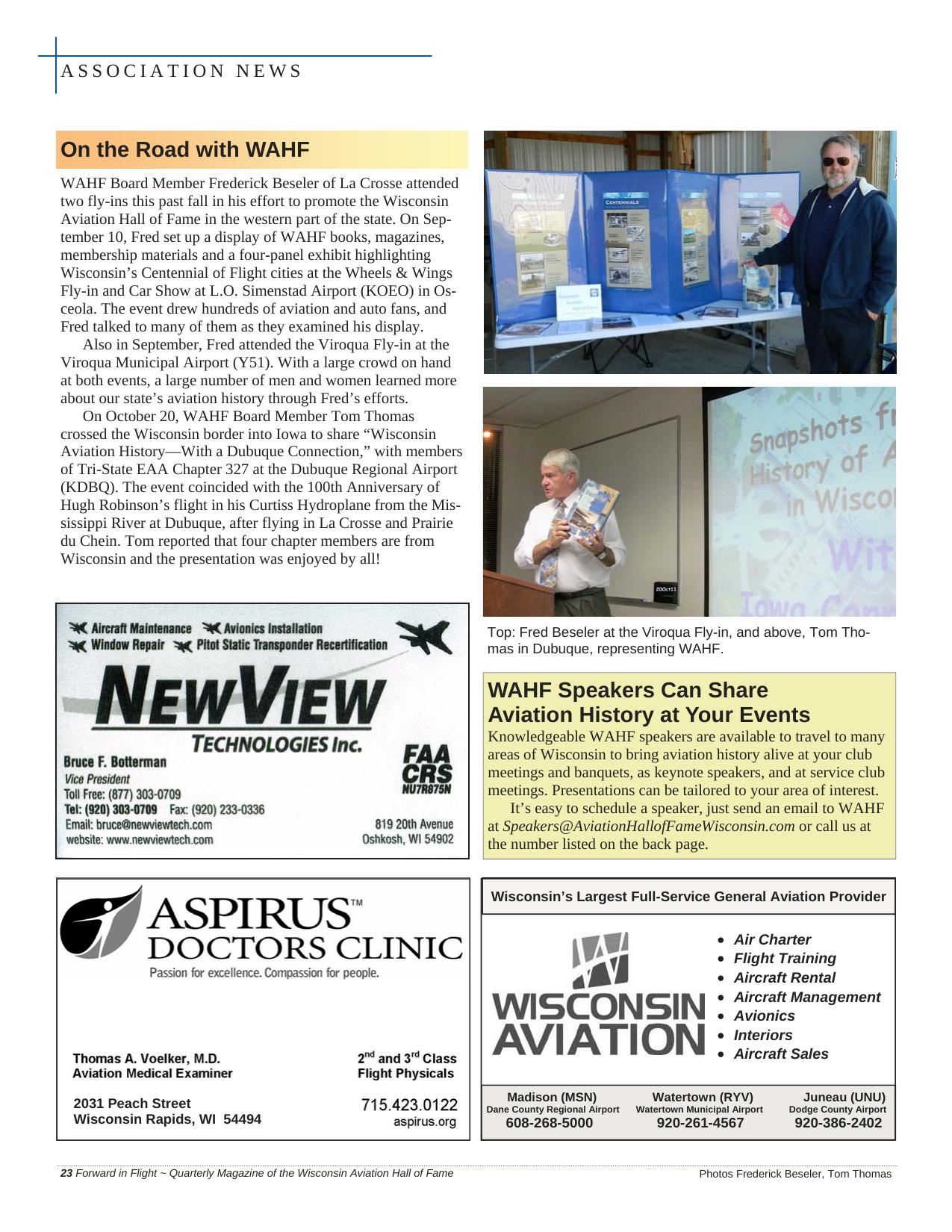
ASSOCIATION NEWS On the Road with WAHF WAHF Board Member Frederick Beseler of La Crosse attended two fly-ins this past fall in his effort to promote the Wisconsin Aviation Hall of Fame in the western part of the state. On September 10, Fred set up a display of WAHF books, magazines, membership materials and a four-panel exhibit highlighting Wisconsin’s Centennial of Flight cities at the Wheels & Wings Fly-in and Car Show at L.O. Simenstad Airport (KOEO) in Osceola. The event drew hundreds of aviation and auto fans, and Fred talked to many of them as they examined his display. Also in September, Fred attended the Viroqua Fly-in at the Viroqua Municipal Airport (Y51). With a large crowd on hand at both events, a large number of men and women learned more about our state’s aviation history through Fred’s efforts. On October 20, WAHF Board Member Tom Thomas crossed the Wisconsin border into Iowa to share “Wisconsin Aviation History—With a Dubuque Connection,” with members of Tri-State EAA Chapter 327 at the Dubuque Regional Airport (KDBQ). The event coincided with the 100th Anniversary of Hugh Robinson’s flight in his Curtiss Hydroplane from the Mississippi River at Dubuque, after flying in La Crosse and Prairie du Chein. Tom reported that four chapter members are from Wisconsin and the presentation was enjoyed by all! Top: Fred Beseler at the Viroqua Fly-in, and above, Tom Thomas in Dubuque, representing WAHF. WAHF Speakers Can Share Aviation History at Your Events Knowledgeable WAHF speakers are available to travel to many areas of Wisconsin to bring aviation history alive at your club meetings and banquets, as keynote speakers, and at service club meetings. Presentations can be tailored to your area of interest. It’s easy to schedule a speaker, just send an email to WAHF at Speakers@AviationHallofFameWisconsin.com or call us at the number listed on the back page. Wisconsin’s Largest Full-Service General Aviation Provider Air Charter Flight Training Aircraft Rental Aircraft Management Avionics Interiors Aircraft Sales 2031 Peach Street Wisconsin Rapids, WI 54494 23 Forward in Flight ~ Quarterly Magazine of the Wisconsin Aviation Hall of Fame Madison (MSN) Watertown (RYV) Dane County Regional Airport Watertown Municipal Airport Dodge County Airport Juneau (UNU) 608-268-5000 920-261-4567 920-386-2402 Photos Frederick Beseler, Tom Thomas
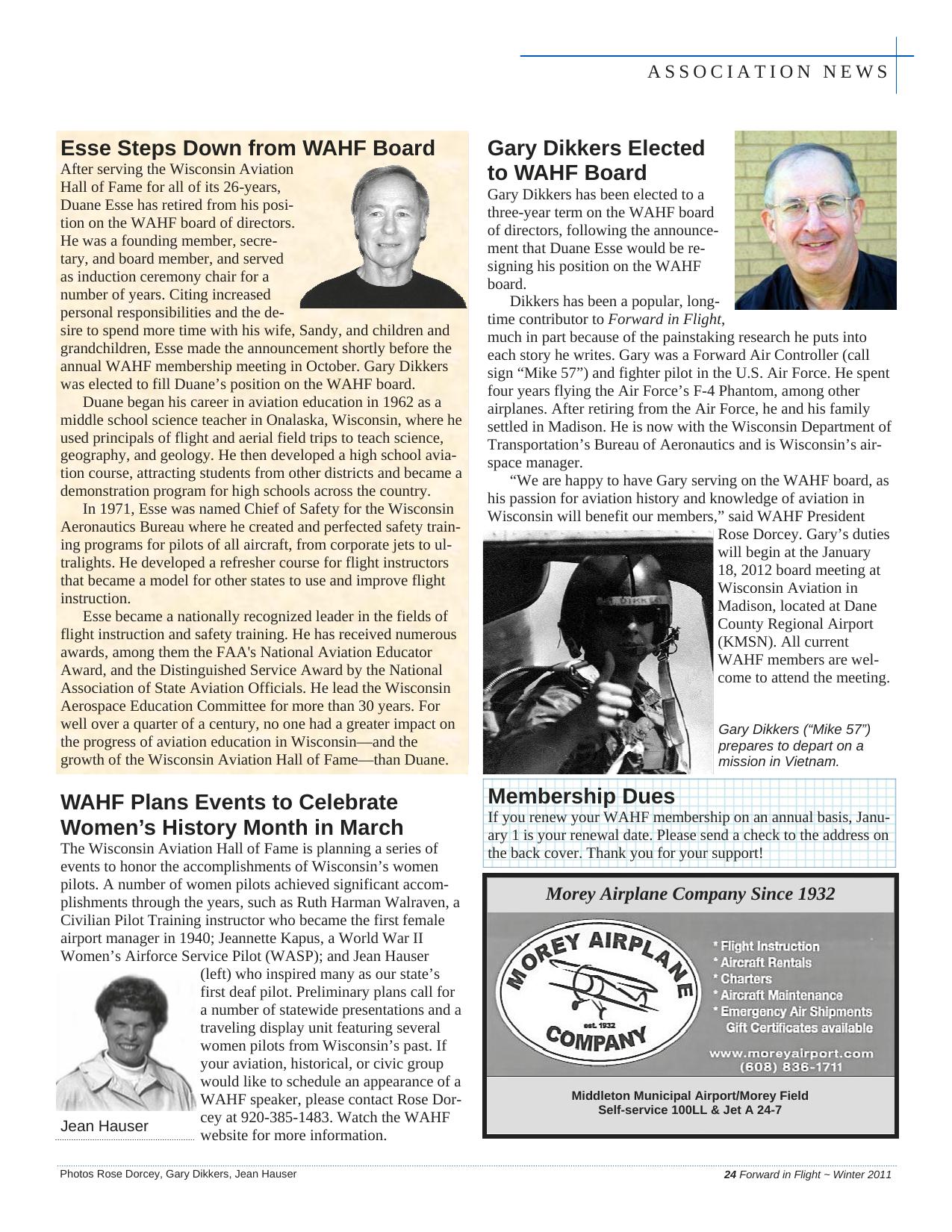
ASSOCIATION NEWS Esse Steps Down from WAHF Board After serving the Wisconsin Aviation Hall of Fame for all of its 26-years, Duane Esse has retired from his position on the WAHF board of directors. He was a founding member, secretary, and board member, and served as induction ceremony chair for a number of years. Citing increased personal responsibilities and the desire to spend more time with his wife, Sandy, and children and grandchildren, Esse made the announcement shortly before the annual WAHF membership meeting in October. Gary Dikkers was elected to fill Duane’s position on the WAHF board. Duane began his career in aviation education in 1962 as a middle school science teacher in Onalaska, Wisconsin, where he used principals of flight and aerial field trips to teach science, geography, and geology. He then developed a high school aviation course, attracting students from other districts and became a demonstration program for high schools across the country. In 1971, Esse was named Chief of Safety for the Wisconsin Aeronautics Bureau where he created and perfected safety training programs for pilots of all aircraft, from corporate jets to ultralights. He developed a refresher course for flight instructors that became a model for other states to use and improve flight instruction. Esse became a nationally recognized leader in the fields of flight instruction and safety training. He has received numerous awards, among them the FAA's National Aviation Educator Award, and the Distinguished Service Award by the National Association of State Aviation Officials. He lead the Wisconsin Aerospace Education Committee for more than 30 years. For well over a quarter of a century, no one had a greater impact on the progress of aviation education in Wisconsin—and the growth of the Wisconsin Aviation Hall of Fame—than Duane. WAHF Plans Events to Celebrate Women’s History Month in March The Wisconsin Aviation Hall of Fame is planning a series of events to honor the accomplishments of Wisconsin’s women pilots. A number of women pilots achieved significant accomplishments through the years, such as Ruth Harman Walraven, a Civilian Pilot Training instructor who became the first female airport manager in 1940; Jeannette Kapus, a World War II Women’s Airforce Service Pilot (WASP); and Jean Hauser (left) who inspired many as our state’s first deaf pilot. Preliminary plans call for a number of statewide presentations and a traveling display unit featuring several women pilots from Wisconsin’s past. If your aviation, historical, or civic group would like to schedule an appearance of a WAHF speaker, please contact Rose Dorcey at 920-385-1483. Watch the WAHF Jean Hauser website for more information. Photos Rose Dorcey, Gary Dikkers, Jean Hauser Gary Dikkers Elected to WAHF Board Gary Dikkers has been elected to a three-year term on the WAHF board of directors, following the announcement that Duane Esse would be resigning his position on the WAHF board. Dikkers has been a popular, longtime contributor to Forward in Flight, much in part because of the painstaking research he puts into each story he writes. Gary was a Forward Air Controller (call sign “Mike 57”) and fighter pilot in the U.S. Air Force. He spent four years flying the Air Force’s F-4 Phantom, among other airplanes. After retiring from the Air Force, he and his family settled in Madison. He is now with the Wisconsin Department of Transportation’s Bureau of Aeronautics and is Wisconsin’s airspace manager. “We are happy to have Gary serving on the WAHF board, as his passion for aviation history and knowledge of aviation in Wisconsin will benefit our members,” said WAHF President Rose Dorcey. Gary’s duties will begin at the January 18, 2012 board meeting at Wisconsin Aviation in Madison, located at Dane County Regional Airport (KMSN). All current WAHF members are welcome to attend the meeting. Gary Dikkers (“Mike 57”) prepares to depart on a mission in Vietnam. Membership Dues If you renew your WAHF membership on an annual basis, January 1 is your renewal date. Please send a check to the address on the back cover. Thank you for your support! Morey Airplane Company Since 1932 Middleton Municipal Airport/Morey Field Self-service 100LL & Jet A 24-7 24 Forward in Flight ~ Winter 2011
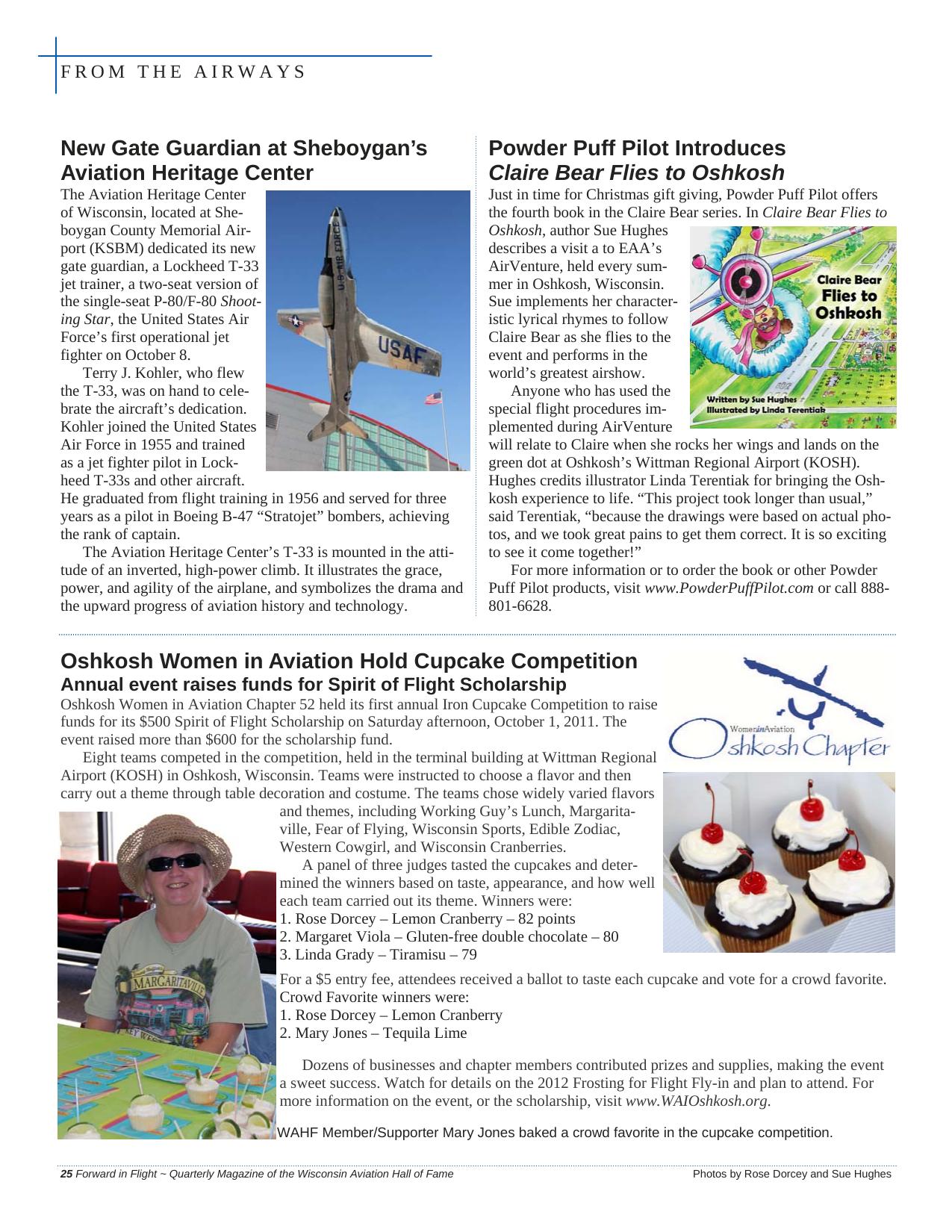
FROM THE AIRWAYS New Gate Guardian at Sheboygan’s Aviation Heritage Center Powder Puff Pilot Introduces Claire Bear Flies to Oshkosh The Aviation Heritage Center of Wisconsin, located at Sheboygan County Memorial Airport (KSBM) dedicated its new gate guardian, a Lockheed T-33 jet trainer, a two-seat version of the single-seat P-80/F-80 Shooting Star, the United States Air Force’s first operational jet fighter on October 8. Terry J. Kohler, who flew the T-33, was on hand to celebrate the aircraft’s dedication. Kohler joined the United States Air Force in 1955 and trained as a jet fighter pilot in Lockheed T-33s and other aircraft. He graduated from flight training in 1956 and served for three years as a pilot in Boeing B-47 “Stratojet” bombers, achieving the rank of captain. The Aviation Heritage Center’s T-33 is mounted in the attitude of an inverted, high-power climb. It illustrates the grace, power, and agility of the airplane, and symbolizes the drama and the upward progress of aviation history and technology. Just in time for Christmas gift giving, Powder Puff Pilot offers the fourth book in the Claire Bear series. In Claire Bear Flies to Oshkosh, author Sue Hughes describes a visit a to EAA’s AirVenture, held every summer in Oshkosh, Wisconsin. Sue implements her characteristic lyrical rhymes to follow Claire Bear as she flies to the event and performs in the world’s greatest airshow. Anyone who has used the special flight procedures implemented during AirVenture will relate to Claire when she rocks her wings and lands on the green dot at Oshkosh’s Wittman Regional Airport (KOSH). Hughes credits illustrator Linda Terentiak for bringing the Oshkosh experience to life. “This project took longer than usual,” said Terentiak, “because the drawings were based on actual photos, and we took great pains to get them correct. It is so exciting to see it come together!” For more information or to order the book or other Powder Puff Pilot products, visit www.PowderPuffPilot.com or call 888801-6628. Oshkosh Women in Aviation Hold Cupcake Competition Annual event raises funds for Spirit of Flight Scholarship Oshkosh Women in Aviation Chapter 52 held its first annual Iron Cupcake Competition to raise funds for its $500 Spirit of Flight Scholarship on Saturday afternoon, October 1, 2011. The event raised more than $600 for the scholarship fund. Eight teams competed in the competition, held in the terminal building at Wittman Regional Airport (KOSH) in Oshkosh, Wisconsin. Teams were instructed to choose a flavor and then carry out a theme through table decoration and costume. The teams chose widely varied flavors and themes, including Working Guy’s Lunch, Margaritaville, Fear of Flying, Wisconsin Sports, Edible Zodiac, Western Cowgirl, and Wisconsin Cranberries. A panel of three judges tasted the cupcakes and determined the winners based on taste, appearance, and how well each team carried out its theme. Winners were: 1. Rose Dorcey – Lemon Cranberry – 82 points 2. Margaret Viola – Gluten-free double chocolate – 80 3. Linda Grady – Tiramisu – 79 For a $5 entry fee, attendees received a ballot to taste each cupcake and vote for a crowd favorite. Crowd Favorite winners were: 1. Rose Dorcey – Lemon Cranberry 2. Mary Jones – Tequila Lime Dozens of businesses and chapter members contributed prizes and supplies, making the event a sweet success. Watch for details on the 2012 Frosting for Flight Fly-in and plan to attend. For more information on the event, or the scholarship, visit www.WAIOshkosh.org. WAHF Member/Supporter Mary Jones baked a crowd favorite in the cupcake competition. 25 Forward in Flight ~ Quarterly Magazine of the Wisconsin Aviation Hall of Fame Photos by Rose Dorcey and Sue Hughes
FROM THE AIRWAYS Midwest Husky is New Aviat Dealer New Bill Brennand Book Available Aviat Aircraft has signed an agreement with Midwest Husky Sales and Service, LLC, which operates from the Rice Lake Air Center to offer sales and service for all three versions of the Husky A-1C aircraft. The new dealership will be responsible for Husky sales in Wisconsin, Minnesota, Iowa, Illinois, and Michigan. The Husky A-1C is available with 160-, 180-, and 200hp horsepower engines. Huskys have two seats, STOL performance, a 2,200-pound gross weight capacity, and a cruising range of 55-140 mph. Rice Lake Air Center is located at Rice Lake Municipal Airport (RPD) in northwestern Wisconsin. Visit www.MidwestHusky.com for more information or call 612-619-5782. While working for air racing legend Steve Wittman in 1947, Bill Brennand won the Goodyear Trophy at the National Air Races without ever flying a practice course. In the years that followed Bill flew more races and was in the winner’s circle more than half the time. Later Bill built and ran his own airport north of Oshkosh, Wisconsin. You can read about all this and more in Bill’s new book, Bill Brennand, Air Racing and Other Aerial Adventures. The book sells for $24.95 plus $4 shipping. To order, send a check or money order to Airship International Press, P.O. Box 1543, Bloomington, IL 61702-1543. Make check payable to Airship International Press. Mary Gasper Appointed Wisconsin Aviation Manager at Dodge County Wisconsin Aviation Inc. has appointed Mary Gasper as the new facility manager at the Dodge County Airport (KUNU) in Juneau, Wisconsin. Gasper brings with her experience as interim manager and several aviation aeronautical ratings as well as an owner of a general aviation single engine aircraft. With the appointment of Gasper, Wisconsin Aviation will focus on its commitment to providing competent professional service with an emphasis on customer service. Visit www.WisconsinAviation.com or more information. Send Your News to Forward in Flight Get noticed in the only magazine dedicated exclusively to Wisconsin aviation news and information. Send to WAHF at: 3980 Sharratt Drive · Oshkosh, WI · 54901-1276 Photos Aviat Aircraft, Wisconsin Aviation, Bill Brennand Call For Award Nominations The Wisconsin Airport Management Association is seeking nominations for the 2012 WAMA Aviation Awards. Award winners will be recognized at the annual Wisconsin Aviation Conference to be held May 7 - 9, 2012 at the Chula Vista Resort in Wisconsin Dells. Please consider nominating qualified men and women in the following categories: Distinguished Service Award – Awarded to persons who have made an outstanding contribution to aviation. Blue Light Award – Awarded to persons in the media who have distinguished themselves by their excellent reporting on Wisconsin aviation. Person of the Year Award – Awarded to persons who have distinguished themselves in Wisconsin aviation during the past calendar year. Lifetime Service Award – Awarded to persons who have devoted themselves to promoting and serving Wisconsin aviation for at least 10 years. Airport Engineering Award – Awarded to persons who have made significant professional contributions in the airport engineering or architecture fields in Wisconsin. Nomination deadline is March 12, 2012. Please note that deceased persons are not eligible for awards. A nomination form is available at www.WIAMA.org/Awards.htm, or by calling WAMA Executive Director Peter Drahn at 715-358-2802. 26 Forward in Flight ~ Winter 2011
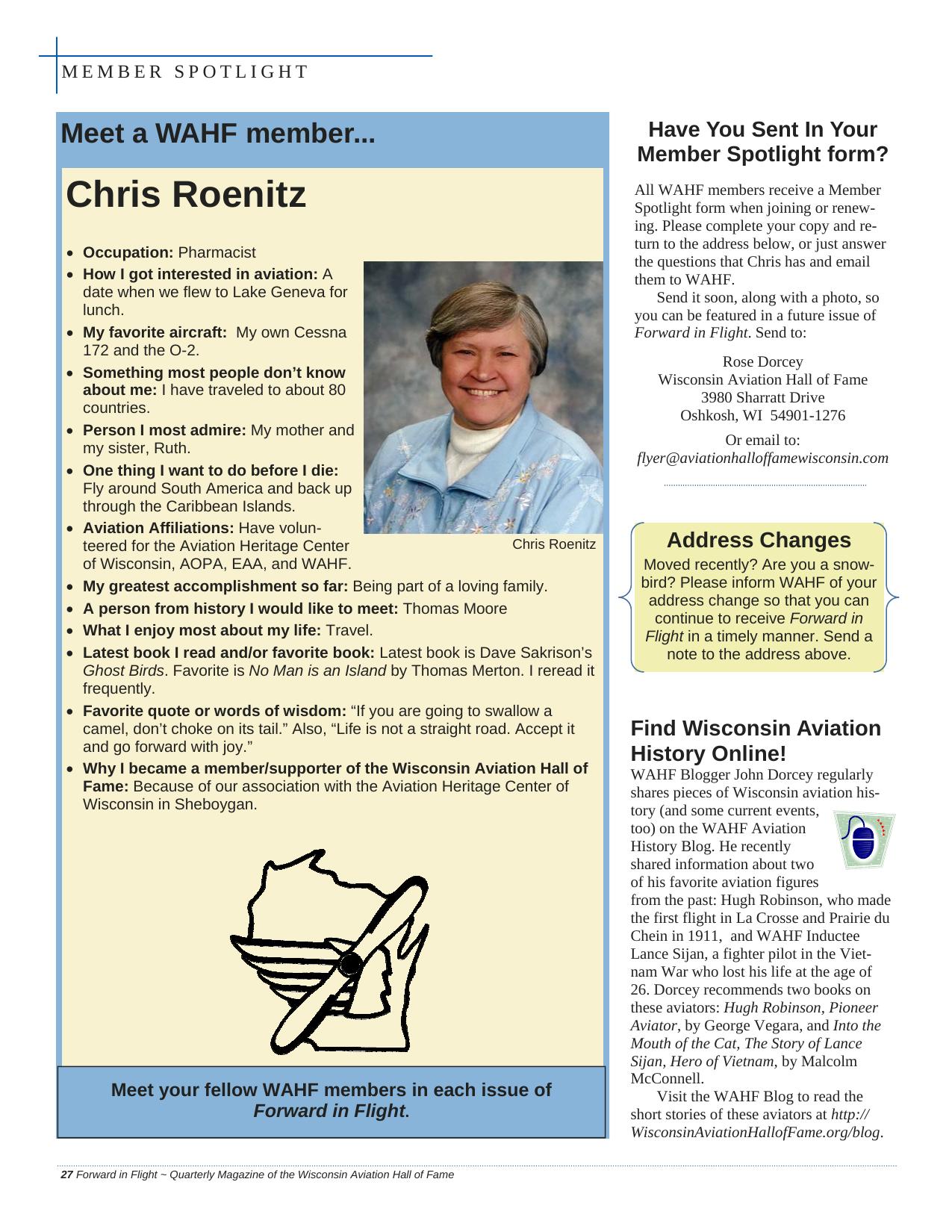
MEMBER SPOTLIGHT Meet a WAHF member... Have You Sent In Your Member Spotlight form? Chris Roenitz All WAHF members receive a Member Spotlight form when joining or renewing. Please complete your copy and return to the address below, or just answer the questions that Chris has and email them to WAHF. Send it soon, along with a photo, so you can be featured in a future issue of Forward in Flight. Send to: Occupation: Pharmacist How I got interested in aviation: A date when we flew to Lake Geneva for lunch. My favorite aircraft: My own Cessna 172 and the O-2. Something most people don’t know about me: I have traveled to about 80 countries. Person I most admire: My mother and my sister, Ruth. One thing I want to do before I die: Fly around South America and back up through the Caribbean Islands. Aviation Affiliations: Have volunChris Roenitz teered for the Aviation Heritage Center of Wisconsin, AOPA, EAA, and WAHF. My greatest accomplishment so far: Being part of a loving family. A person from history I would like to meet: Thomas Moore What I enjoy most about my life: Travel. Latest book I read and/or favorite book: Latest book is Dave Sakrison’s Ghost Birds. Favorite is No Man is an Island by Thomas Merton. I reread it frequently. Favorite quote or words of wisdom: “If you are going to swallow a camel, don’t choke on its tail.” Also, “Life is not a straight road. Accept it and go forward with joy.” Why I became a member/supporter of the Wisconsin Aviation Hall of Fame: Because of our association with the Aviation Heritage Center of Wisconsin in Sheboygan. Meet your fellow WAHF members in each issue of Forward in Flight. 27 Forward in Flight ~ Quarterly Magazine of the Wisconsin Aviation Hall of Fame Rose Dorcey Wisconsin Aviation Hall of Fame 3980 Sharratt Drive Oshkosh, WI 54901-1276 Or email to: flyer@aviationhalloffamewisconsin.com Address Changes Moved recently? Are you a snowbird? Please inform WAHF of your address change so that you can continue to receive Forward in Flight in a timely manner. Send a note to the address above. Find Wisconsin Aviation History Online! WAHF Blogger John Dorcey regularly shares pieces of Wisconsin aviation history (and some current events, too) on the WAHF Aviation History Blog. He recently shared information about two of his favorite aviation figures from the past: Hugh Robinson, who made the first flight in La Crosse and Prairie du Chein in 1911, and WAHF Inductee Lance Sijan, a fighter pilot in the Vietnam War who lost his life at the age of 26. Dorcey recommends two books on these aviators: Hugh Robinson, Pioneer Aviator, by George Vegara, and Into the Mouth of the Cat, The Story of Lance Sijan, Hero of Vietnam, by Malcolm McConnell. Visit the WAHF Blog to read the short stories of these aviators at http:// WisconsinAviationHallofFame.org/blog.
Subscribe to Forward in Flight today! Annual subscription includes one-year WAHF membership Membership Benefits: Quarterly subscription (4 issues) of Forward in Flight, packed full of Wisconsin aviation news, events, state aviation history, and stories about your aviation colleagues Free pass to Deke Slayton Museum Invitation to annual induction banquet Name Address City State Zip Pam & Pat O’Malley Phone Number Pat O’Malley’s Email Jet Room Restaurant Referred By Just $20, and you’ll be supporting an aviation organization dedicated to collecting, preserving, and sharing Wisconsin’s aviation history. With Forward in Flight, you’ll learn about aviation history makers—the people, places, and events that distinguish our state and also be in touch with current Wisconsin aviation news and information. Send your check today! Please write check to: Wisconsin Aviation Hall of Fame, Inc. Mail to: John Dorcey, Treasurer Wisconsin Aviation Hall of Fame 3980 Sharratt Drive Oshkosh WI 54901-1276 Wisconsin Aviation Bldg. Dane County Regional Airport Madison, Wis. (MSN) Breakfast & Lunch 6 a.m. - 2 p.m. Mon. thru Sat. 8 a.m. - 2 p.m. Sunday 608-268-5010 www.JetRoomRestaurant.com Plan to attend the 2012 WISCONSIN AVIATION CONFERENCE 2012 Wisconsin Aviation Conference May 7 - 9 Chula Vista Resort Wisconsin Dells More information: www.WIAMA.org Whether you’re a pilot, airport manager, airport commission member, fixed base operator or other aviation service provider, you’ll want to attend. Educational sessions, from social me- Hear from state and federal aviation reps dia marketing to student pilot retention Networking opportunities to airport/FBO insurance. Vendor exhibits and aviation awards Sponsored by the Wisconsin Airport Management Association, Wisconsin Aviation Trades Association, Wisconsin Business Aviation Association, consultants and suppliers. Register Online Or call Pete Drahn at 715-358-2802 for more information. Welcome Activities Golf Tournament Sporting Clays Shoot Don’t miss it! 28 Forward in Flight ~ Winter 2011
WISCONSIN AVIATION HALL OF FAME 3980 SHARRATT DRIVE OSHKOSH WI 54901-1276 PRSRT STD US Postage Paid Wisc Rapids WI Permit 98 Wisconsin Aviation Hall of Fame A Membership Organization Dedicated to Preserving the Past Fostering the Future of Flight Change Service Requested Welcome WAHF Member/Supporters: Jay Baeten Dorothy Fredrickson* Gergory Gorak* Maria Gorak* Lavern Griffin Eugene Jacobus Fred Jahnke Len Knitter Bill Matchefts Ryan McCarthy Lyle McCullough Tom Olson Dave Ripp Randy Ripp Marvin Schumacher Lawrence Stys JoAnne Stys Susan Vergeront Jerome Washicheck William Webster Sherwood Williams *Lifetime Member —Thanks for coming on board CONGRATULATIONS! To WAHF Inductee Tom Poberezny on being inducted into the San Diego Air & Space Museum’s Hall of Fame on November 5, 2011. Tom served as president of the Experimental Aircraft Association, was a world-class air show performer, and instrumental in the creation of the EAA Young Eagles program that encourages youth involvement in aviation. “The Airplane Comes to La Crosse, 1911” has been rescheduled for 2 p.m. Saturday, December 17, at the Main Auditorium of the La Crosse Public Library, 8th and Main Streets, La Crosse. WAHF’s Frederick Beseler will describe Hugh Robinson’s attempt to fly from Minneapolis to New Orleans in a Curtiss Hydroaeroplane in October, 1911 and more. Free and open to the public. Merry Christmas to our WAHF inductees, family, friends, and supporters. Best wishes for a joyous season. May the blessings of the season stay with you. Wisconsin Aviation Hall of Fame Officers and Board of Directors Rose Dorcey, President Michael Goc, Vice President John Dorcey, Secretary/Treasurer Frederick Beseler Gary Dikkers Rich Fischler Andrew Ovans Charles Swain Tom Thomas Charles Marotske, Honorary Chairman of the Board Wisconsin Aviation Hall of Fame 3980 Sharratt Drive Oshkosh WI 54901-1276 Become a supporter today! For information call Rose Dorcey at 920-385-1483 www.aviationhalloffamewisconsin.com flyer@aviationhalloffamewisconsin.com