Volume 9, Issue 4
🗞️ Download Issue (PDF)
Forward in Flight - Winter 2012
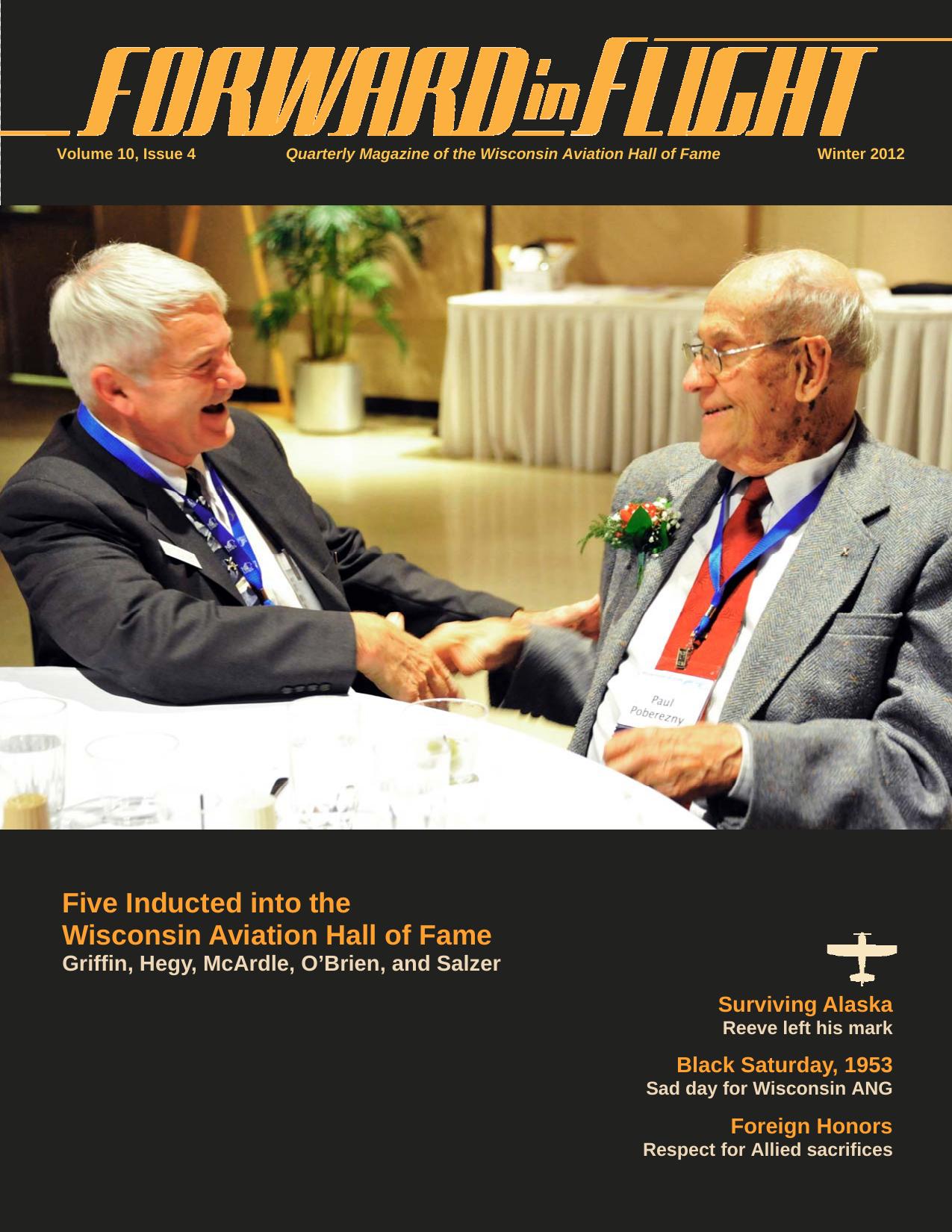
Volume 10, Issue 4 Quarterly Magazine of the Wisconsin Aviation Hall of Fame Winter 2012 Five Inducted into the Wisconsin Aviation Hall of Fame Griffin, Hegy, McArdle, O’Brien, and Salzer Surviving Alaska Reeve left his mark Black Saturday, 1953 Sad day for Wisconsin ANG Foreign Honors Respect for Allied sacrifices
Contents Vol. 10 Issue 4/Winter 2012 A publication of the Wisconsin Aviation Hall of Fame RIGHT SEAT DIARIES 3 Practicing What I Teach Even a CFI gets a bit off track sometimes Heather Gollnow, CFI PLANES & PEOPLE 17 The Air Racer from Wisconsin Rapids Lois Truchinski competed in four races John Dorcey AIR DOC 5 After the Crash Survival Dr. Tom Voelker, AME FROM THE ARCHIVES 19 Robert Reeve The Glacier Pilot from Waunakee Michael Goc TALESPINS 8 Black Saturday January 31, 1953 Tom “Talespin” Thomas ASSOCIATION NEWS 25 Five Inducted into WAHF Griffin, Hegy, McArdle, O’Brien, and Salzer 29 Botterman, Williams Elected to WAHF Board 30 Dikkers Receives WAHF’s Presidential Award FIRST FLIGHTS 9 Farm Fields to Floating Airfields James J. Davidson, U.S. Navy Pilot Frederick Beseler 31 Gone West John Schunk 32 From the Airways Gorak, Geldermann 33 Member Spotlight Virginia Gallenberger WISCONSINITES IN WARS 13 Ready, Willing, and… ...Off to Italy to honor my Great-Uncle Doug Tomas • Photo by Michael Goc Total Aviation Services Aircraft Fuel ~ Heated Hangar ~ Maintenance Avionics ~ Flight Training ~ Air Charter AME on Staff 1921 Airport Drive Green Bay, WI 54313 866.676.7835 www.jetairgroup.com
President’s Message ~ by Rose Dorcey It’s the day after Thanksgiving as I write this message, it’s cold outside, and the wind is howling. However, I have a warm feeling inside as I recall this year’s wonderful holiday, feeling so fortunate to be part of a large, loving family. The day was blessed with God’s goodness in the form of kindhearted fellowship, delicious food, and fantastic weather. Thanksgiving blessings came in another way; in the form of an email, which I received on Thanksgiving morning from one of our 2012 scholarship recipients: “Every holiday I send messages to those who are special to me,” the message read. “I am thankful for the blessing you brought to me this year.” Knowing how thankful the recipient was for receiving the scholarship and helping to continue his aviation education was a welcome addition to an already perfect day. And it certainly makes the WAHF board feel good about giving scholarships and the other work we do. The 2012 induction ceremony on October 27 was well attended. Dozens of family and friends of the inductees were there to share in the honor their loved ones received. Many WAHF members were present as well, many who come year after year with their friends to learn of the history of each year’s inductees. I thank all of you for being there. I think you know how meaningful it is to me to see each of you there and how grateful the entire WAHF board is that you support the organization through your attendance. More importantly, you being there is an honor for each inductee, for which I know they are grateful. Another thank you goes to the past Wisconsin Aviation Hall of Fame inductees who attended. It truly makes the event extra special when you are there. This issue’s cover photo is a great example of that. Tom Thomas and Paul Poberezny shared a few minutes together, perhaps telling a flying story or two, as did many of our inductees. Going through the hundreds of photos taken at the event, I see images of past inductees welcoming the new, and members congratulating all of the inductees. Admiration for the work they have done is evident. Everywhere I looked during the evening I saw smiles, affectionate embraces, and genuine respect for each other. People volunteered to help (one even sang our National Anthem) and we heard messages of thanks and joyous celebration. In our siForward in Flight The only magazine dedicated exclusively to Wisconsin aviation history and today’s events. Rose Dorcey, editor 3980 Sharratt Drive Oshkosh, WI 54901-1276 Phone: 920-385-1483 · 920-279-6029 rdorcey@wisconsinaviationhallofame.org The Wisconsin Aviation Hall of Fame is a non-profit membership organization with a mission to collect and preserve the history of aviation in Wisconsin, recognize those who made that history, inform others of it, and promote aviation education for future generations. Rose Dorcey lent auction, attendees bid generously to help our education initiatives grow. You can see how thankful I am for having had the pleasure of sharing the evening with such a friendly, generous, and considerate group of people. Admiration for the work the inductees have done is evident. Everywhere I looked I saw smiles, affectionate embraces, and genuine respect for each other. As we look back on this past year, we feel we have accomplished much in carrying out our mission of collecting, preserving, and sharing Wisconsin aviation history, and honoring those who have made it. In addition to the induction ceremony, WAHF board members made nearly 20 aviation presentations throughout the state (many of them to honor Wisconsin women in aviation, a special project this year.) We attended ceremonies to honor FAA Wright Brothers Master Pilot award recipients, and Civil Air Patrol and Wisconsin Veteran’s Museum events. The organization continues to grow, more advertisers have come on board, we’ve received a number of inductee nominations, and more. We now offer online memberships and renewals (of which I hope many of you will soon take advantage), have upgraded our website, redesigned our logo, and offer new logo merchandise. Sadly, we’ve had to say goodbye to two key board members, Rich Fischler and Gary Dikkers. However, we are happy to welcome Bruce Botterman and Wynne Williams, who are sure to contribute greatly to your organization. As 2012 winds down, I thank you for your support of WAHF. On behalf of your WAHF board, we wish you a Merry Christmas and the greatest of blessings throughout 2013. On the cover: Photographer Henry Peterson captured this great image of WAHF Inductees Tom Thomas and Paul Poberezny at the 2012 WAHF induction ceremony, held on October 27. We chose it for the cover because it epitomizes what the ceremony is about, honoring those who have made aviation in Wisconsin better, and these two have definitely done that. In addition, it shows the respect, camaraderie, and good times shared between WAHF inductees, members, and friends who attend the annual event. Photo by Henry Peterson
RIGHT SEAT DIARIES Practicing What I Teach Even a CFI gets a bit off track sometimes By Heather Gollnow, CFI It’s been nearly five months since I have flown an airplane. I suppose this is how it starts—one busy week turns into a busy month, which turns into two busy months. Before you know it, it’s been several months—or even years—since you’ve found yourself behind the flight controls. And now I find myself in this situation. Last winter, I wrote an article for Forward in Flight about getting back into flying, and the winter before that, an article about setting aviation goals. It seems I’m at the point where I need to re-read my articles and take my own advice! My story is not unusual. I gave a flight review over the summer. Then I had a job interview in a different city, which ultimately led to a job in a different state. Anyone who’s moved knows exactly how stressful and extremely time consuming it is to accomplish this feat. It’s not an excuse for not staying up-todate on my flying skills; it’s an opportunity to recognize that I need to practice what I preach. Asking questions and listening to what other pilots had to say gave me some valuable information for making a decision on a flying club. My two biggest issues right now are access to an airplane and time, which are no different from anyone else. I recently moved to the East coast and live right in the middle of a large city. It’s Class B airspace here, so there aren’t many general aviation airports nearby. I spent a grand total of one day in this city before moving, so I’m definitely working on finding things, including an airplane. I’m not interested in buying an airplane just yet, so to get access to an airplane I am looking at flying clubs or rentals. There are pros and cons to both. A flying club is just that, a club. Through events or meetings, you get to meet other people who share your airplane. The downside to a club is that they can be difficult to find. At home, I knew of several flying clubs just 3 Forward in Flight ~ Quarterly Magazine of the Wisconsin Aviation Hall of Fame through word of mouth. In my new town, I Googled flying clubs and quite a few popped up in the results. The trouble is that websites don’t give you an impression of what it’s like to be a club member. In just a few short conversations with local pilots, I was able to determine which flying clubs probably had too many members, thus making the airplane difficult to schedule. Asking some questions and listening to what other pilots had to say gave me some valuable information for making a decision on a flying club. The benefits of aircraft rental are that there is often no initial signup fee nor any fixed monthly dues. Of course the hourly rate will usually be a bit higher as a result. Many flight schools will have a fleet of aircraft so pilots will have their choice. On the other hand, you’ll be sharing the rentals with many more pilots than a flying club. There isn’t the camaraderie of a club when renting an airplane either. I’m a social person and enjoy the social aspects of a flying club. Time is the other obstacle I am facing right now. Most of us know how incredibly taxing it is to start a new job. I’m
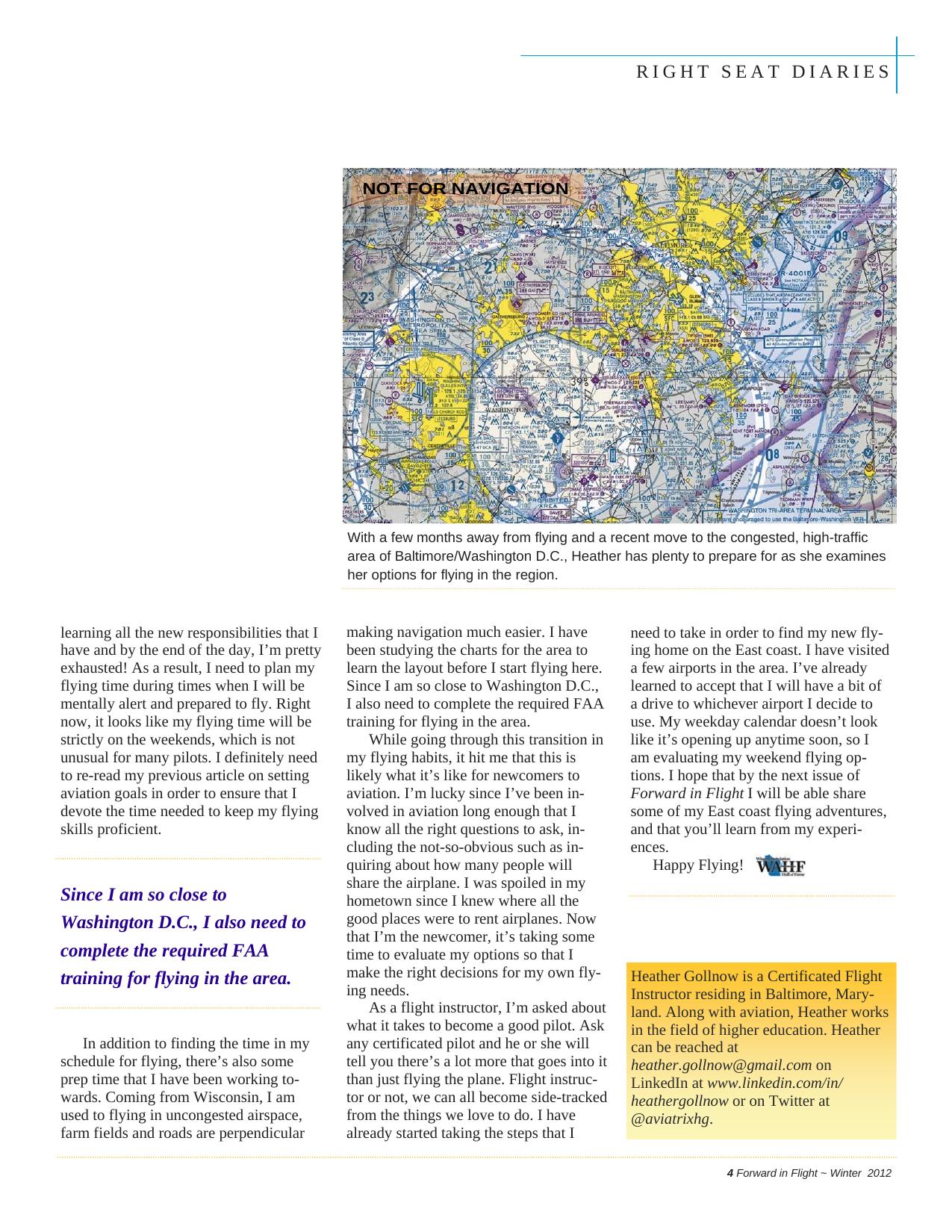
RIGHT SEAT DIARIES NOT FOR NAVIGATION With a few months away from flying and a recent move to the congested, high-traffic area of Baltimore/Washington D.C., Heather has plenty to prepare for as she examines her options for flying in the region. learning all the new responsibilities that I have and by the end of the day, I’m pretty exhausted! As a result, I need to plan my flying time during times when I will be mentally alert and prepared to fly. Right now, it looks like my flying time will be strictly on the weekends, which is not unusual for many pilots. I definitely need to re-read my previous article on setting aviation goals in order to ensure that I devote the time needed to keep my flying skills proficient. Since I am so close to Washington D.C., I also need to complete the required FAA training for flying in the area. In addition to finding the time in my schedule for flying, there’s also some prep time that I have been working towards. Coming from Wisconsin, I am used to flying in uncongested airspace, farm fields and roads are perpendicular making navigation much easier. I have been studying the charts for the area to learn the layout before I start flying here. Since I am so close to Washington D.C., I also need to complete the required FAA training for flying in the area. While going through this transition in my flying habits, it hit me that this is likely what it’s like for newcomers to aviation. I’m lucky since I’ve been involved in aviation long enough that I know all the right questions to ask, including the not-so-obvious such as inquiring about how many people will share the airplane. I was spoiled in my hometown since I knew where all the good places were to rent airplanes. Now that I’m the newcomer, it’s taking some time to evaluate my options so that I make the right decisions for my own flying needs. As a flight instructor, I’m asked about what it takes to become a good pilot. Ask any certificated pilot and he or she will tell you there’s a lot more that goes into it than just flying the plane. Flight instructor or not, we can all become side-tracked from the things we love to do. I have already started taking the steps that I need to take in order to find my new flying home on the East coast. I have visited a few airports in the area. I’ve already learned to accept that I will have a bit of a drive to whichever airport I decide to use. My weekday calendar doesn’t look like it’s opening up anytime soon, so I am evaluating my weekend flying options. I hope that by the next issue of Forward in Flight I will be able share some of my East coast flying adventures, and that you’ll learn from my experiences. Happy Flying! Heather Gollnow is a Certificated Flight Instructor residing in Baltimore, Maryland. Along with aviation, Heather works in the field of higher education. Heather can be reached at heather.gollnow@gmail.com on LinkedIn at www.linkedin.com/in/ heathergollnow or on Twitter at @aviatrixhg. 4 Forward in Flight ~ Winter 2012
AIR DOC After the Crash Survival Dr. Tom Voelker, AME DrAlphaMike@yahoo.com Greetings, Airmen! Welcome to the annual “oh, no, winter’s coming” edition of our quarterly chat. As I write this, I have a fire blazing in the fire ring in my backyard, and you’re welcome to pull up a chair! Winter flying is upon us. That means great performance, low density altitudes, and less congested airports. Oh, I almost forgot the cold preflights, icing airmets, and survival! Yes, survival. Last winter a Skyhawk crashed on approach to an airport in one of our neighboring states. I had the opportunity to talk to the fixed base operator at the accident airport about the accident and subsequent rescue. Several interesting topics came up in that conversation and I want to discuss two of them with you: how to make sure you are found in the event of a crash, and what to do if you are not found (at least right away). I have changed some of the details of the accident to protect the privacy of the pilot involved. I understand that he is doing well, but I have not talked to him about the events of that early morning. The weather was marginal IFR, and the instrument pilot was on an IFR flight plan, performing a non-precision approach from the west. The FBO had just opened, and because a rental car was being dropped off at this uncontrolled field, Jim, the owner of the FBO, checked FlightAware to see who was arriving. A Cessna 172 was coming in from the west, and its flight path could be seen on the radar track, which FlightAware provides. (This is a free website, and is worth looking into, both for safety, as we will see, and simply to see where your friends are as they fly—assuming they are using air traffic control services.) The plane was due in about five minutes, and the pilot would be calling on the local frequency any minute. The call never came. Jim hadn’t been concerned. The pilot probably couldn’t see the airport, and executed a missed approach, going to another airport. This is a routine procedure that instrument-rated pilots practice frequently. However, the Air Force called the airport, noting that an ELT was heard in the area. (An ELT is a transmitter that goes off in an accident and emits an emergency code.) Jim sent one of his coworkers to look around the airport, and no plane was found. A few minutes later, ATC (air traffic control) called, asking if the Cessna had arrived. When they heard that it was not at the airport, and noting that the pilot had not called ATC with a “missed approach,” a search was initiated. The ambulance crew had already been sent to the airport, and they were directed to the accident site. With some difficulty, the pilot was brought out on a stretcher, about an hour after the crash. The weather at the field was improving, and an aircraft took off, looking in the area where the radar returns on FlightAware had stopped. He spotted the crash site, only a couple hundred feet short of the airport fence! The ambulance crew had already been sent to the airport, and they were directed to the accident site. With some difficulty, the pilot was brought out on a stretcher, about an hour after the crash. 5 Forward in Flight ~ Quarterly Magazine of the Wisconsin Aviation Hall of Fame This pilot was lucky, in two ways. First, he was found fairly quickly. However, an hour is a long time, and in the event of an aircraft accident, many bad things could happen during those 60 minutes. Had he planned to arrive 30 minutes earlier, the airport would have been unattended, and his rescue would have been considerably delayed. And if he had not filed a flight plan, nobody would have been looking! Second, the pilot’s injuries, though substantial, were not immediately life threatening. What if there had been severe bleeding, or had suffered a penetrating chest or head injury? What would he do then? Similarly, there was no post crash fire, though I understand aviation fuel was spilled at the site. A fire would certainly change the priorities of the pilot and the rescue personnel. I don’t know the temperature at the time of the accident, but this time of year, frostbite and exposure are real possibilities. We will discuss both of these issues. Namely, how to hasten discovery and rescue in the event of a crash, and what to do if you are in a crash and rescue is not coming! So, fellow pilots, how can we make sure somebody knows we are in trouble? There is a lot of technology to help in this area, and there are several procedures to assist us. Here are some of my ideas. Fly the Airplane We pilots have a primary rule in any emergency: fly the airplane! If we lose control of the plane, the chance of surviving a plane crash goes down dramatically. While this rule will not get you found, it may make you worth finding! Once the plane is controlled, however, the pilot should tell somebody he or she is in trouble. If you are talking to ATC, simply tell them. And do not be afraid to
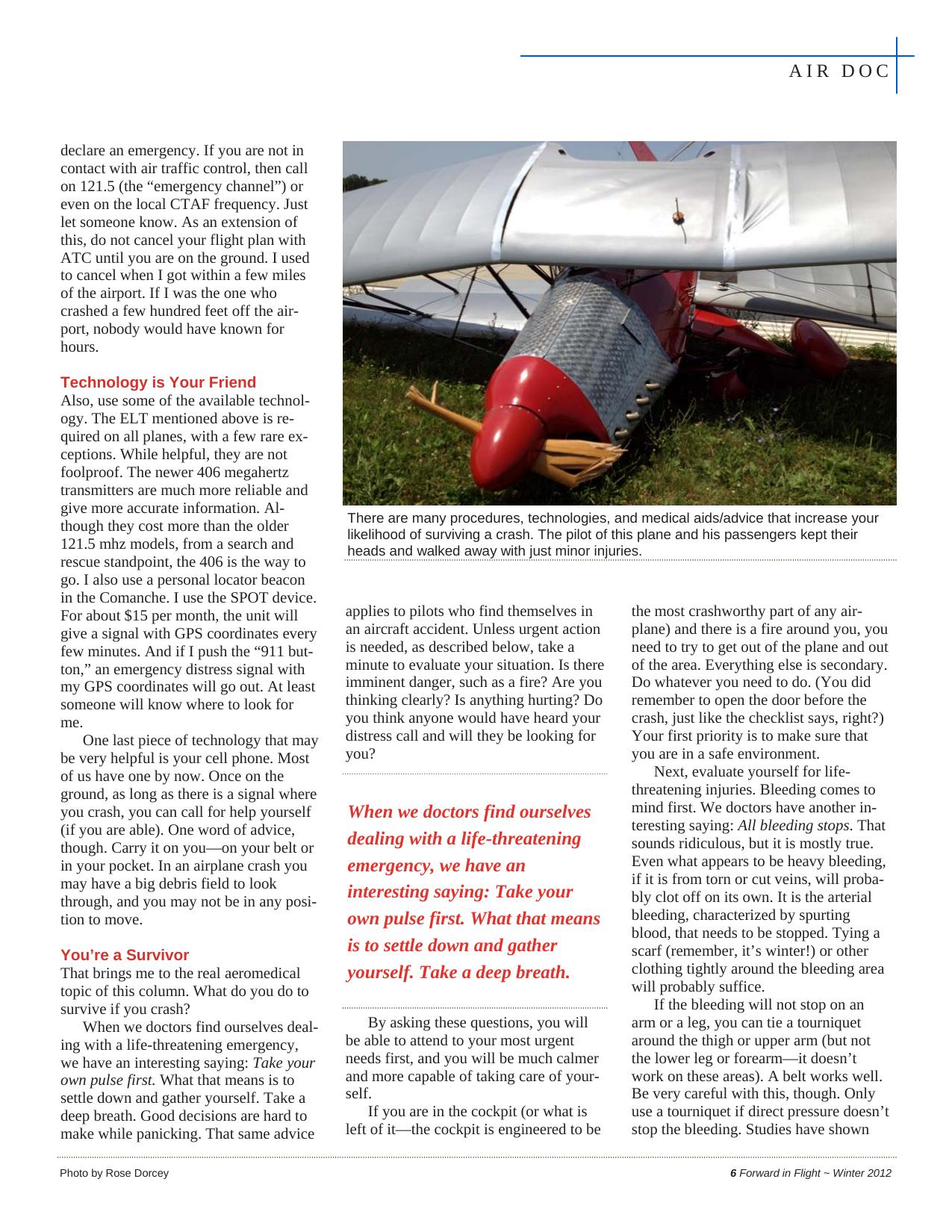
AIR DOC declare an emergency. If you are not in contact with air traffic control, then call on 121.5 (the “emergency channel”) or even on the local CTAF frequency. Just let someone know. As an extension of this, do not cancel your flight plan with ATC until you are on the ground. I used to cancel when I got within a few miles of the airport. If I was the one who crashed a few hundred feet off the airport, nobody would have known for hours. Technology is Your Friend Also, use some of the available technology. The ELT mentioned above is required on all planes, with a few rare exceptions. While helpful, they are not foolproof. The newer 406 megahertz transmitters are much more reliable and give more accurate information. Although they cost more than the older 121.5 mhz models, from a search and rescue standpoint, the 406 is the way to go. I also use a personal locator beacon in the Comanche. I use the SPOT device. For about $15 per month, the unit will give a signal with GPS coordinates every few minutes. And if I push the “911 button,” an emergency distress signal with my GPS coordinates will go out. At least someone will know where to look for me. One last piece of technology that may be very helpful is your cell phone. Most of us have one by now. Once on the ground, as long as there is a signal where you crash, you can call for help yourself (if you are able). One word of advice, though. Carry it on you—on your belt or in your pocket. In an airplane crash you may have a big debris field to look through, and you may not be in any position to move. You’re a Survivor That brings me to the real aeromedical topic of this column. What do you do to survive if you crash? When we doctors find ourselves dealing with a life-threatening emergency, we have an interesting saying: Take your own pulse first. What that means is to settle down and gather yourself. Take a deep breath. Good decisions are hard to make while panicking. That same advice Photo by Rose Dorcey There are many procedures, technologies, and medical aids/advice that increase your likelihood of surviving a crash. The pilot of this plane and his passengers kept their heads and walked away with just minor injuries. applies to pilots who find themselves in an aircraft accident. Unless urgent action is needed, as described below, take a minute to evaluate your situation. Is there imminent danger, such as a fire? Are you thinking clearly? Is anything hurting? Do you think anyone would have heard your distress call and will they be looking for you? When we doctors find ourselves dealing with a life-threatening emergency, we have an interesting saying: Take your own pulse first. What that means is to settle down and gather yourself. Take a deep breath. By asking these questions, you will be able to attend to your most urgent needs first, and you will be much calmer and more capable of taking care of yourself. If you are in the cockpit (or what is left of it—the cockpit is engineered to be the most crashworthy part of any airplane) and there is a fire around you, you need to try to get out of the plane and out of the area. Everything else is secondary. Do whatever you need to do. (You did remember to open the door before the crash, just like the checklist says, right?) Your first priority is to make sure that you are in a safe environment. Next, evaluate yourself for lifethreatening injuries. Bleeding comes to mind first. We doctors have another interesting saying: All bleeding stops. That sounds ridiculous, but it is mostly true. Even what appears to be heavy bleeding, if it is from torn or cut veins, will probably clot off on its own. It is the arterial bleeding, characterized by spurting blood, that needs to be stopped. Tying a scarf (remember, it’s winter!) or other clothing tightly around the bleeding area will probably suffice. If the bleeding will not stop on an arm or a leg, you can tie a tourniquet around the thigh or upper arm (but not the lower leg or forearm—it doesn’t work on these areas). A belt works well. Be very careful with this, though. Only use a tourniquet if direct pressure doesn’t stop the bleeding. Studies have shown 6 Forward in Flight ~ Winter 2012
AIRDOC that untrained people usually cause more harm than good with tourniquets, usually because they weren’t needed in the first place. A good rule of thumb: Use the tourniquet to save the life, not the limb. If a tourniquet is placed, you will probably lose the limb! The other serious injuries are head and chest injuries. Other than direct pressure on areas of bleeding, there is not much you can do for yourself with these injuries. If you suspect you have such an injury, try to sit up, perhaps against a tree. This can use gravity to minimize the pressure in your head or your chest cavity. The most common injury in aircraft accidents is fractures. Most of these are not life threatening, and you do not need to specifically treat them. Splinting can help with the pain, but will probably not affect survivability. Find a position that is most comfortable and wait for help. The final situation I want to address is exposure. If you are on a long trip across Nebraska, you may not be found for awhile, even if you called for help. A survival kit can go a long way. This should include an emergency blanket. (One of the Mylar “astronaut blankets” that we saw growing up takes almost no space and can really help.) You should also have a signaling mirror and a lighter or waterproof matches. Take advantage of the fact that the TSA (Transportation Security Administration) hasn’t banned them from the cockpit of general aviation aircraft (yet). A rudimentary first-aid kit should also be included. The specifics of a survival kit are beyond the confines of these pages, but you can find this information on the Internet. There are prepackaged kits at Sporty’s and other pilot supply shops. The kits at Sporty’s start at about $40 and go up to several hundred dol- 7 Forward in Flight ~ Quarterly Magazine of the Wisconsin Aviation Hall of Fame lars. I think you can do well on your own with a little work. If at all possible, carry the kit on you, perhaps in a fanny pack. If you are ejected from your cockpit and unable to move, that neat kit on the back seat won’t do you much good. Finally, dress for the weather you may encounter on the entire route of your flight. After all, accidents are indeed accidental, and not planned. Therefore, you can’t predict when or where your number might be called. If you are dressed properly you will have one less thing to worry about. As I close this column I wish you one thing: May you never need any of the information you’ve just read. Until next spring, fly safely, and stay warm! —Alpha Mike Echo In “real” life, Alpha Mike Echo is Dr. Tom Voelker, AME, a family practitioner in Wisconsin Rapids. He and his wife, Kathy, are the parents of four daughters. Tom flies N6224P, a Comanche 250, out of Alexander Field, South Wood County Airport (ISW).
TALESPINS Black Saturday January 31, 1953 By Tom Thomas It was 60 years ago this January when an unidentified airplane was reported in the air between Madison and Milwaukee. The Cold War was going on and Air Force F-86E Interceptors were on alert 24/7 at Truax Air Force Base, Madison, Wisconsin. The Air Base was activated because of the Korean War, which began in June 1950. Although southern Wisconsin was being hit by a winter storm with high wind and heavy snow, the threat appeared real. The decision was made to launch the F-86s on Alert Status from Madison to intercept the unidentified radar return and neutralize the potential threat. There were six aircraft on alert at the time and protocol dictated they all be launched. The weather had deteriorated throughout the day and when they took off at 5 p.m., snow squalls were getting heavier across the area. It was dark when the jets blasted off into blowing snow. The interceptors were vectored toward Milwaukee and the unknown airplane. Their search lasted short of an hour and was unsuccessful. Upon returning to Madison, the flight lead, who was also the Squadron Commander, Lt. Col. Harry Shoup, directed the second and third elements to land first as the weather had gotten worse. WAHF Member Ethel Christensen, a meteorologist at Madison’s National Weather Service, was working that evening and had been monitoring the snow squalls. Ethel was a private pilot and aircraft owner and knew many of the military pilots. They had a receiver tuned to Madison tower in their facility to monitor local air traffic arriving and departing. Ethel’s husband, Capt. Donald Christensen, was a pilot with the Wisconsin Air Guard flying F-89s at the time. The weather was so bad, he’d gone to the airport to pick up Ethel when she got off work, knowing the intensity of the snow was increasing. The calls were becoming more frustrating between the pilots and the tower as their fuel level was becom- ing a problem. Ethel still recalls the frustration of the pilots during their attempts to land and the tragic events that followed. For Ethel, tragedy at work was a fact of life in those days of limited instrument weather flying capabilities. After several unsuccessful approaches, the fuel state of the third, fourth, fifth, and sixth aircraft were down to the point where they had departed the area for Milwaukee. This snowstorm was widespread from west of the Mississippi to across Lake Michigan. They didn’t have precision radar approaches available at Truax until the summer of 1953, so Milwaukee became their closest alternate. Once they departed, Lt. Col. Shoup and his wingman, Capt. Howard Mates, dropped down to make approaches. Fortunately, they hit a time between squalls and both made it down safely. The lead aircraft made it on the first attempt and No. 2 on his second. The remaining four aircraft were in two flights heading east toward Mitchell Field. The second element (No. 3 and 4) was lead by Major Otto Kemp with Lt. T. Booth Holker as his wingman. Major Kemp was a WWII veteran who’d flown P-40s and P-38s in the China-BurmaIndian theater, where he became an Ace shooting down nine enemy aircraft. He was awarded a Distinguished Flying Cross for shooting down three enemy aircraft in one day. Lt. Holker had spent a year in Korea flying F-86s before being assigned to Truax Field and had shot down two Mig 15s during his tour. Between these two pilots, they’d shot down 11 enemy aircraft. But now their enemy was Mother Nature, in the form of a cold, windy snowstorm on a dark Wisconsin night. When leaving Madison for Milwaukee, Maj. Kemp took his flight up to 16,000-feet climbing eastbound. Shortly after arriving at altitude, both jets flamed out. They ejected over eastern Dane County between Edgerton and Stoughton. On landing, Maj. Kemp got tangled in telephone lines in the front yard of a local doctor’s house, who bundled him up in blankets after checking him over to make certain he hadn’t broken anything. Lt. Holker landed in the middle of a field south of Stoughton about 300-feet from a farmhouse. He said he was a little stiff from the experience but suffered no other ill effects. The remaining two pilots didn’t fare as well. They’d stretched their dwindling fuel hoping to make Mitchell Field, but also flamed out. The fifth pilot, Capt. Hampton Boggs, was found on February 2, covered with snow in Genesee Depot. He’d stayed with his aircraft a little too long and had ejected too late for his parachute to fully open. Continued on page 24 Pam & Pat O’Malley Pat O’Malley’s Jet Room Restaurant Wisconsin Aviation Bldg. Dane County Regional Airport Madison, Wis. (MSN) Breakfast & Lunch 6 a.m. - 2 p.m. Mon. thru Sat. 8 a.m. - 2 p.m. Sunday 608-268-5010 www.JetRoomRestaurant.com 8 Forward in Flight ~ Winter 2012
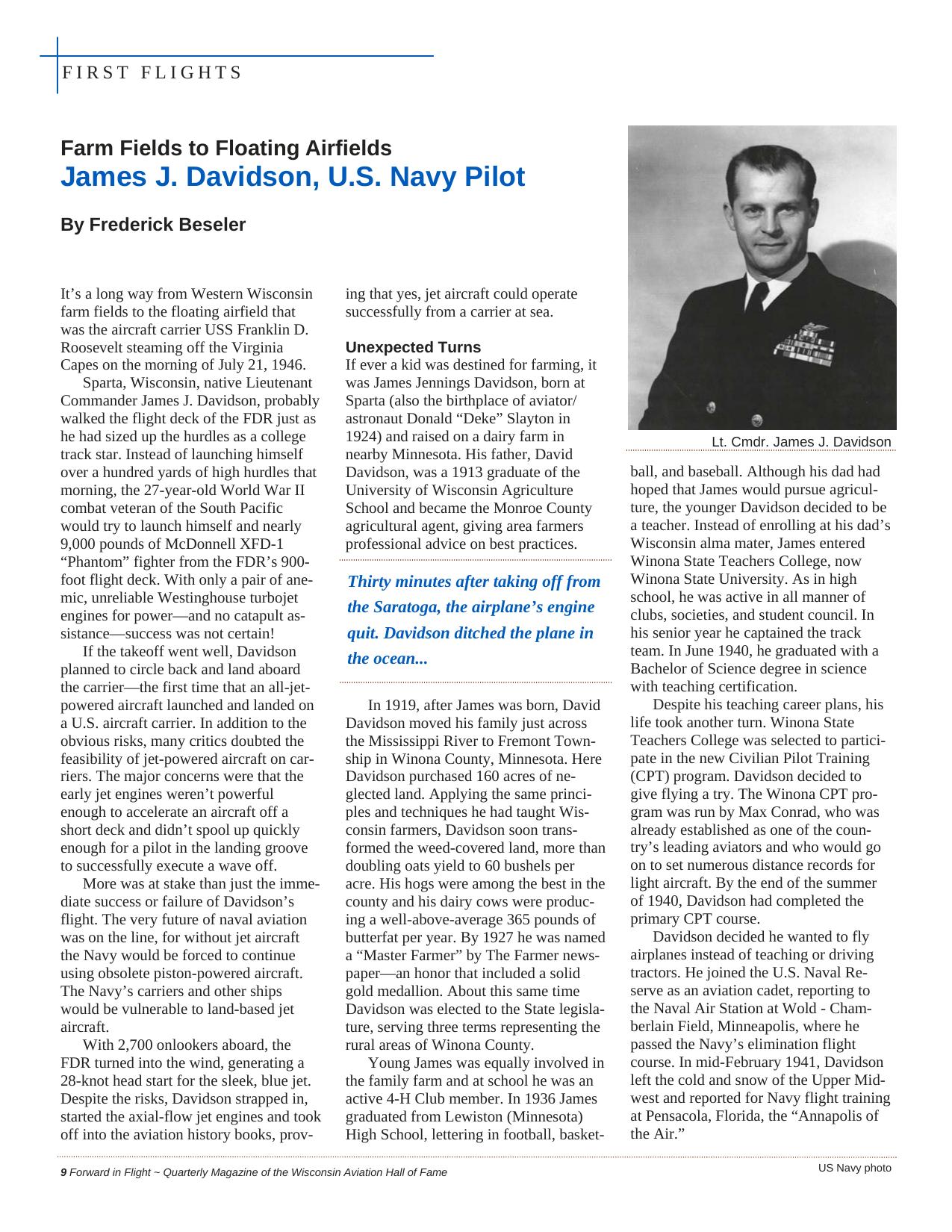
FIRST FLIGHTS Farm Fields to Floating Airfields James J. Davidson, U.S. Navy Pilot By Frederick Beseler It’s a long way from Western Wisconsin farm fields to the floating airfield that was the aircraft carrier USS Franklin D. Roosevelt steaming off the Virginia Capes on the morning of July 21, 1946. Sparta, Wisconsin, native Lieutenant Commander James J. Davidson, probably walked the flight deck of the FDR just as he had sized up the hurdles as a college track star. Instead of launching himself over a hundred yards of high hurdles that morning, the 27-year-old World War II combat veteran of the South Pacific would try to launch himself and nearly 9,000 pounds of McDonnell XFD-1 “Phantom” fighter from the FDR’s 900foot flight deck. With only a pair of anemic, unreliable Westinghouse turbojet engines for power—and no catapult assistance—success was not certain! If the takeoff went well, Davidson planned to circle back and land aboard the carrier—the first time that an all-jetpowered aircraft launched and landed on a U.S. aircraft carrier. In addition to the obvious risks, many critics doubted the feasibility of jet-powered aircraft on carriers. The major concerns were that the early jet engines weren’t powerful enough to accelerate an aircraft off a short deck and didn’t spool up quickly enough for a pilot in the landing groove to successfully execute a wave off. More was at stake than just the immediate success or failure of Davidson’s flight. The very future of naval aviation was on the line, for without jet aircraft the Navy would be forced to continue using obsolete piston-powered aircraft. The Navy’s carriers and other ships would be vulnerable to land-based jet aircraft. With 2,700 onlookers aboard, the FDR turned into the wind, generating a 28-knot head start for the sleek, blue jet. Despite the risks, Davidson strapped in, started the axial-flow jet engines and took off into the aviation history books, prov- ing that yes, jet aircraft could operate successfully from a carrier at sea. Unexpected Turns If ever a kid was destined for farming, it was James Jennings Davidson, born at Sparta (also the birthplace of aviator/ astronaut Donald “Deke” Slayton in 1924) and raised on a dairy farm in nearby Minnesota. His father, David Davidson, was a 1913 graduate of the University of Wisconsin Agriculture School and became the Monroe County agricultural agent, giving area farmers professional advice on best practices. Thirty minutes after taking off from the Saratoga, the airplane’s engine quit. Davidson ditched the plane in the ocean... In 1919, after James was born, David Davidson moved his family just across the Mississippi River to Fremont Township in Winona County, Minnesota. Here Davidson purchased 160 acres of neglected land. Applying the same principles and techniques he had taught Wisconsin farmers, Davidson soon transformed the weed-covered land, more than doubling oats yield to 60 bushels per acre. His hogs were among the best in the county and his dairy cows were producing a well-above-average 365 pounds of butterfat per year. By 1927 he was named a “Master Farmer” by The Farmer newspaper—an honor that included a solid gold medallion. About this same time Davidson was elected to the State legislature, serving three terms representing the rural areas of Winona County. Young James was equally involved in the family farm and at school he was an active 4-H Club member. In 1936 James graduated from Lewiston (Minnesota) High School, lettering in football, basket- 9 Forward in Flight ~ Quarterly Magazine of the Wisconsin Aviation Hall of Fame Lt. Cmdr. James J. Davidson ball, and baseball. Although his dad had hoped that James would pursue agriculture, the younger Davidson decided to be a teacher. Instead of enrolling at his dad’s Wisconsin alma mater, James entered Winona State Teachers College, now Winona State University. As in high school, he was active in all manner of clubs, societies, and student council. In his senior year he captained the track team. In June 1940, he graduated with a Bachelor of Science degree in science with teaching certification. Despite his teaching career plans, his life took another turn. Winona State Teachers College was selected to participate in the new Civilian Pilot Training (CPT) program. Davidson decided to give flying a try. The Winona CPT program was run by Max Conrad, who was already established as one of the country’s leading aviators and who would go on to set numerous distance records for light aircraft. By the end of the summer of 1940, Davidson had completed the primary CPT course. Davidson decided he wanted to fly airplanes instead of teaching or driving tractors. He joined the U.S. Naval Reserve as an aviation cadet, reporting to the Naval Air Station at Wold - Chamberlain Field, Minneapolis, where he passed the Navy’s elimination flight course. In mid-February 1941, Davidson left the cold and snow of the Upper Midwest and reported for Navy flight training at Pensacola, Florida, the “Annapolis of the Air.” US Navy photo
FIRST FLIGHTS After training at Pensacola, Davidson was one of seven in his class selected for advanced training in fleet combat type aircraft at Opa Locka, Florida. Upon completion he was commissioned as an Ensign in the United States Naval Reserve and designated a Naval Aviator. For a few weeks he remained at Opa Locka ferrying aircraft to the naval air station at Corpus Christi, Texas. In October 1941, Davidson received orders to report to Naval Air Station North Island, San Diego, for operational training in dive bombers. He never finished the operational training due to the events of December 7, 1941. On December 8, 1941, Davidson was ordered to Scouting Squadron 3 (VS-3), which was equipped with 22 Douglas SBD-3 Dauntless dive bombers aboard the USS Saratoga. The Saratoga was to deliver the SBDs to Wake Island but after receiving reports of Japanese carrier aircraft over Wake Island and Japanese troop landings, the Saratoga was recalled on December 22. Wake Island fell the next day. “I was fortunate enough to get out without being hit but my wingman was shot up quite badly.” Davidson remained aboard Saratoga, which continued operations in the Hawaiian Island region. On January 11, 1942, while heading for a rendezvous with USS Enterprise, 500-miles southwest of Oahu, Saratoga was hit by a torpedo fired by a Japanese submarine. Six men were killed and three fire rooms were flooded. Saratoga reached Oahu under her own power. The carrier then sailed to Bremerton Navy Yard, Washington, for permanent repairs and installation of modern anti-aircraft weapons. At Bremerton, Davidson was assigned to Fleet Air Detachment at San Diego. He continued building his flying experience by ferrying aircraft from the West Coast to the East Coast. He rejoined VS-3 and the Saratoga in late May, 1942. The Saratoga returned to the Pacific and in August her aircraft participated in attacks on Japanese forces at Guadalcanal. In late August she was once again damaged by Japanese torpedoes. VS-3 and Davidson immediately launched and flew to the Pacific airfield at Espiritu Santo. The next day, September 2, Ensign Davidson was flown back to the Saratoga to retrieve the squadron’s spare airplane that had been left aboard the carrier. Thirty minutes after taking off from the Saratoga, the airplane’s engine quit. Davidson ditched the plane in the ocean and after eight hours in his life raft, he was rescued by a U.S. Navy seagoing tug and then transferred to the cruiser USS Minneapolis. He worked his way back to Guadalcanal where his squadron was now based on shore. He flew nine missions in support of the Guadalcanal operations. By Thanksgiving 1942, Davidson was home on leave. According to a Winona Republican-Herald newspaper article of November 30, 1942, while on Guadalcanal Davidson spent some nights only 50 yards from Japanese lines. “It was there that he learned about the Marines and also about lizards and flies and other unwelcome island companions.” Davidson’s own notes list nine missions that he flew at Guadalcanal: 1 August 7, 1942 – Guadalcanal attack August 31 – Saratoga torpedoed Sept. 2 – Water landing 1 Oct. 5 – Attacked 6 destroyers, 2 sunk 1 Oct. 8 – Attacked 4 destroyers, 4 Japanese fighters, 1 destroyed, 1 probable 1 Oct. 17 – Attacked Japanese transports, 1 direct hit 5 Search and attack shore installations The article reported that Davidson, recently promoted to Lieutenant (Junior Grade) and home on leave, “has been in the battle of the Solomon Islands from the very start of activities… And he has lived, eaten, slept, fought, and scurried for cover with the Marines on Guadalcanal.” Quoted in the article, Davidson said, “Every pilot will admit that he is a little scared diving through anti-aircraft fire, but a bomb hit and a ship sinking are reward for it.” Davidson added, “It’s very thrilling, but the nasty part of war turns up only too often—such as the loss of buddies.” The article described an instance when Davidson was leading a two-plane search and spotted several Japanese destroyers. Said Davidson, “Before we could attack we were jumped by four Japanese fighter planes from above us. Two of them made a run on me and I made a run on them. I don’t know if I got them or not. “I was fortunate enough to get out without being hit but my wingman was shot up quite badly. He got back to the base okay though.” After his well-deserved leave, Davidson was reassigned to Bombing Squadron 4 at El Centro, California, and designated squadron flight officer responsible for transition training into the new Curtiss SB2C Helldiver. The squadron moved to Norfolk, Virginia, in April 1943. Re-designated Bombing Squadron 5, VB-5 embarked aboard the new carrier USS Yorktown bound for the Pacific Ocean in July 1943. From August 1943 through April 1944, Lt. (j.g.) Davidson flew 27 more combat missions against Japanese land fortifications and shipping at Marcus, Wake, Mille, Kwajalein, Wotje, Tarawa, Truk, Saipan, Palau, and Waleai islands. He also flew missions in support of U.S. troop landings on Makin, Kwajalein, and Hollandia islands. After returning to San Francisco in May 1944, Davidson was promoted to Lieutenant and he applied for the highly sought after assignment as a Navy test pilot. With his extensive flight experience and combat record, Davidson received orders to the Flight Test Division of the Naval Air Test Center at Patuxent River, Maryland. One of his more interesting assignments was as test pilot for the first rocket assisted takeoff (RATO) of conventionally powered aircraft. In November 1944, Lt. Davidson became the 21st Navy pilot to fly a jet-powered aircraft, the Bell YP-59A Airacomet. While at “Pax River”, Davidson became one of two Navy pilots selected to attend the Royal Air Force’s Empire Test Pilot School at Boscombe Down, England. He reported to the school 10 Forward in Flight ~ Winter 2012
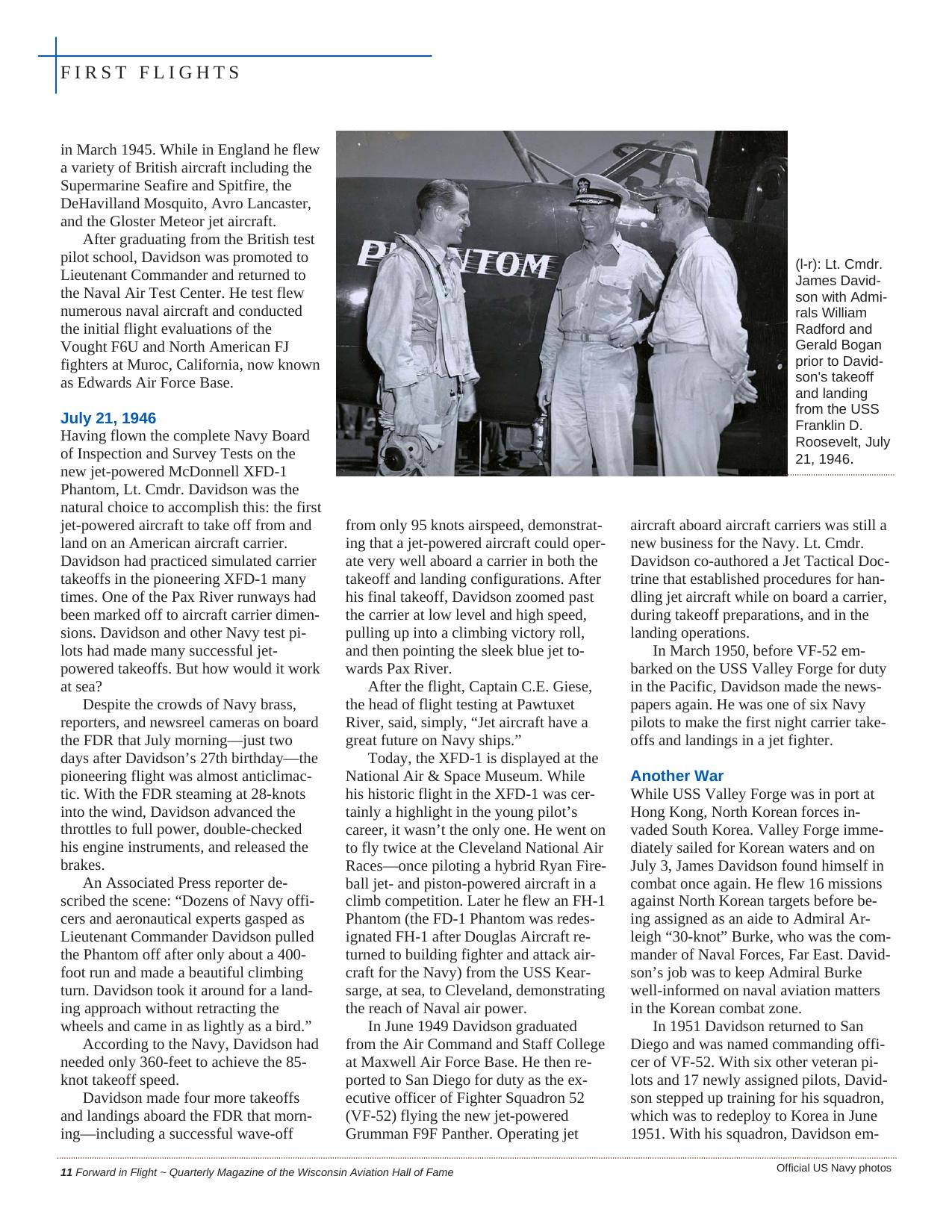
FIRST FLIGHTS in March 1945. While in England he flew a variety of British aircraft including the Supermarine Seafire and Spitfire, the DeHavilland Mosquito, Avro Lancaster, and the Gloster Meteor jet aircraft. After graduating from the British test pilot school, Davidson was promoted to Lieutenant Commander and returned to the Naval Air Test Center. He test flew numerous naval aircraft and conducted the initial flight evaluations of the Vought F6U and North American FJ fighters at Muroc, California, now known as Edwards Air Force Base. July 21, 1946 Having flown the complete Navy Board of Inspection and Survey Tests on the new jet-powered McDonnell XFD-1 Phantom, Lt. Cmdr. Davidson was the natural choice to accomplish this: the first jet-powered aircraft to take off from and land on an American aircraft carrier. Davidson had practiced simulated carrier takeoffs in the pioneering XFD-1 many times. One of the Pax River runways had been marked off to aircraft carrier dimensions. Davidson and other Navy test pilots had made many successful jetpowered takeoffs. But how would it work at sea? Despite the crowds of Navy brass, reporters, and newsreel cameras on board the FDR that July morning—just two days after Davidson’s 27th birthday—the pioneering flight was almost anticlimactic. With the FDR steaming at 28-knots into the wind, Davidson advanced the throttles to full power, double-checked his engine instruments, and released the brakes. An Associated Press reporter described the scene: “Dozens of Navy officers and aeronautical experts gasped as Lieutenant Commander Davidson pulled the Phantom off after only about a 400foot run and made a beautiful climbing turn. Davidson took it around for a landing approach without retracting the wheels and came in as lightly as a bird.” According to the Navy, Davidson had needed only 360-feet to achieve the 85knot takeoff speed. Davidson made four more takeoffs and landings aboard the FDR that morning—including a successful wave-off (l-r): Lt. Cmdr. James Davidson with Admirals William Radford and Gerald Bogan prior to Davidson's takeoff and landing from the USS Franklin D. Roosevelt, July 21, 1946. from only 95 knots airspeed, demonstrating that a jet-powered aircraft could operate very well aboard a carrier in both the takeoff and landing configurations. After his final takeoff, Davidson zoomed past the carrier at low level and high speed, pulling up into a climbing victory roll, and then pointing the sleek blue jet towards Pax River. After the flight, Captain C.E. Giese, the head of flight testing at Pawtuxet River, said, simply, “Jet aircraft have a great future on Navy ships.” Today, the XFD-1 is displayed at the National Air & Space Museum. While his historic flight in the XFD-1 was certainly a highlight in the young pilot’s career, it wasn’t the only one. He went on to fly twice at the Cleveland National Air Races—once piloting a hybrid Ryan Fireball jet- and piston-powered aircraft in a climb competition. Later he flew an FH-1 Phantom (the FD-1 Phantom was redesignated FH-1 after Douglas Aircraft returned to building fighter and attack aircraft for the Navy) from the USS Kearsarge, at sea, to Cleveland, demonstrating the reach of Naval air power. In June 1949 Davidson graduated from the Air Command and Staff College at Maxwell Air Force Base. He then reported to San Diego for duty as the executive officer of Fighter Squadron 52 (VF-52) flying the new jet-powered Grumman F9F Panther. Operating jet 11 Forward in Flight ~ Quarterly Magazine of the Wisconsin Aviation Hall of Fame aircraft aboard aircraft carriers was still a new business for the Navy. Lt. Cmdr. Davidson co-authored a Jet Tactical Doctrine that established procedures for handling jet aircraft while on board a carrier, during takeoff preparations, and in the landing operations. In March 1950, before VF-52 embarked on the USS Valley Forge for duty in the Pacific, Davidson made the newspapers again. He was one of six Navy pilots to make the first night carrier takeoffs and landings in a jet fighter. Another War While USS Valley Forge was in port at Hong Kong, North Korean forces invaded South Korea. Valley Forge immediately sailed for Korean waters and on July 3, James Davidson found himself in combat once again. He flew 16 missions against North Korean targets before being assigned as an aide to Admiral Arleigh “30-knot” Burke, who was the commander of Naval Forces, Far East. Davidson’s job was to keep Admiral Burke well-informed on naval aviation matters in the Korean combat zone. In 1951 Davidson returned to San Diego and was named commanding officer of VF-52. With six other veteran pilots and 17 newly assigned pilots, Davidson stepped up training for his squadron, which was to redeploy to Korea in June 1951. With his squadron, Davidson emOfficial US Navy photos
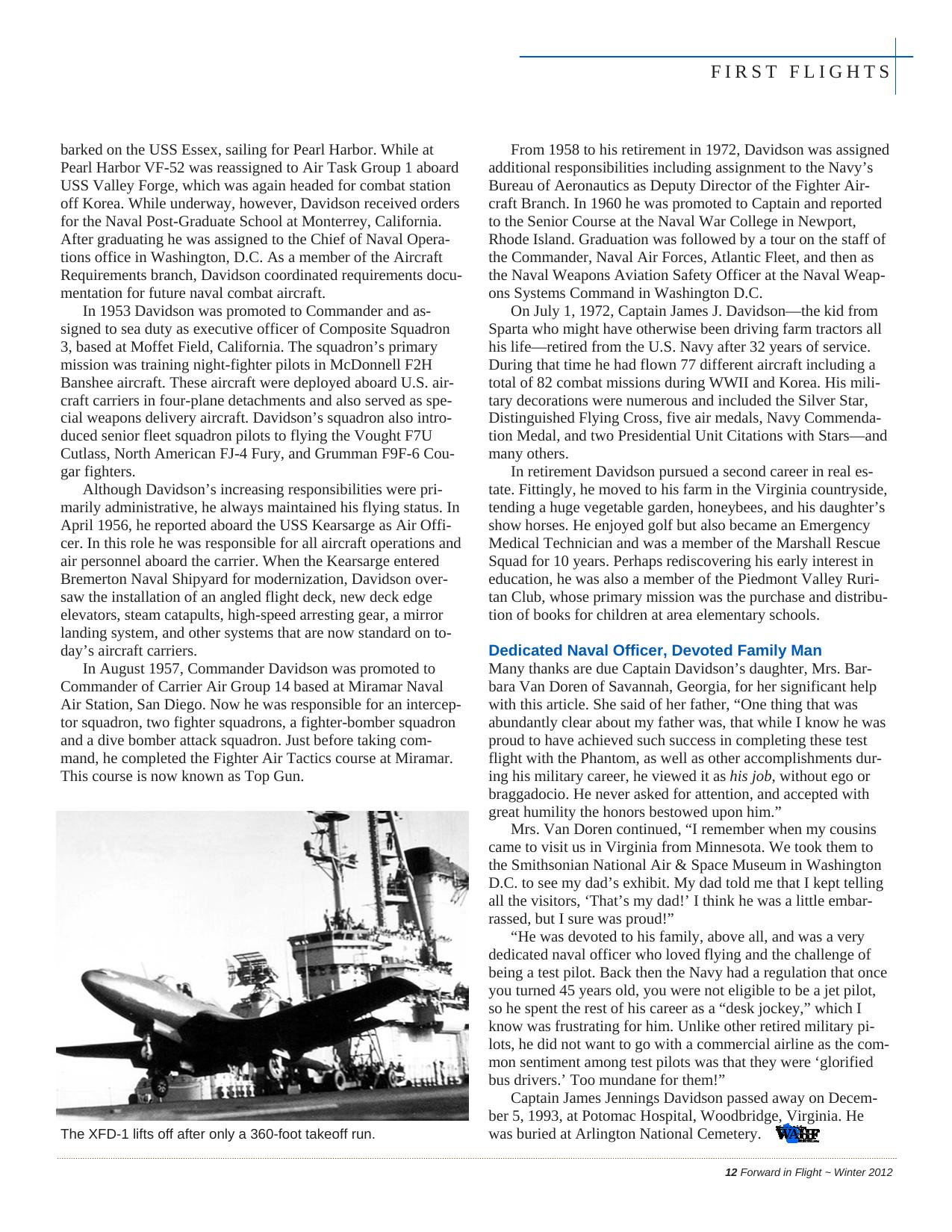
FIRST FLIGHTS barked on the USS Essex, sailing for Pearl Harbor. While at Pearl Harbor VF-52 was reassigned to Air Task Group 1 aboard USS Valley Forge, which was again headed for combat station off Korea. While underway, however, Davidson received orders for the Naval Post-Graduate School at Monterrey, California. After graduating he was assigned to the Chief of Naval Operations office in Washington, D.C. As a member of the Aircraft Requirements branch, Davidson coordinated requirements documentation for future naval combat aircraft. In 1953 Davidson was promoted to Commander and assigned to sea duty as executive officer of Composite Squadron 3, based at Moffet Field, California. The squadron’s primary mission was training night-fighter pilots in McDonnell F2H Banshee aircraft. These aircraft were deployed aboard U.S. aircraft carriers in four-plane detachments and also served as special weapons delivery aircraft. Davidson’s squadron also introduced senior fleet squadron pilots to flying the Vought F7U Cutlass, North American FJ-4 Fury, and Grumman F9F-6 Cougar fighters. Although Davidson’s increasing responsibilities were primarily administrative, he always maintained his flying status. In April 1956, he reported aboard the USS Kearsarge as Air Officer. In this role he was responsible for all aircraft operations and air personnel aboard the carrier. When the Kearsarge entered Bremerton Naval Shipyard for modernization, Davidson oversaw the installation of an angled flight deck, new deck edge elevators, steam catapults, high-speed arresting gear, a mirror landing system, and other systems that are now standard on today’s aircraft carriers. In August 1957, Commander Davidson was promoted to Commander of Carrier Air Group 14 based at Miramar Naval Air Station, San Diego. Now he was responsible for an interceptor squadron, two fighter squadrons, a fighter-bomber squadron and a dive bomber attack squadron. Just before taking command, he completed the Fighter Air Tactics course at Miramar. This course is now known as Top Gun. The XFD-1 lifts off after only a 360-foot takeoff run. From 1958 to his retirement in 1972, Davidson was assigned additional responsibilities including assignment to the Navy’s Bureau of Aeronautics as Deputy Director of the Fighter Aircraft Branch. In 1960 he was promoted to Captain and reported to the Senior Course at the Naval War College in Newport, Rhode Island. Graduation was followed by a tour on the staff of the Commander, Naval Air Forces, Atlantic Fleet, and then as the Naval Weapons Aviation Safety Officer at the Naval Weapons Systems Command in Washington D.C. On July 1, 1972, Captain James J. Davidson—the kid from Sparta who might have otherwise been driving farm tractors all his life—retired from the U.S. Navy after 32 years of service. During that time he had flown 77 different aircraft including a total of 82 combat missions during WWII and Korea. His military decorations were numerous and included the Silver Star, Distinguished Flying Cross, five air medals, Navy Commendation Medal, and two Presidential Unit Citations with Stars—and many others. In retirement Davidson pursued a second career in real estate. Fittingly, he moved to his farm in the Virginia countryside, tending a huge vegetable garden, honeybees, and his daughter’s show horses. He enjoyed golf but also became an Emergency Medical Technician and was a member of the Marshall Rescue Squad for 10 years. Perhaps rediscovering his early interest in education, he was also a member of the Piedmont Valley Ruritan Club, whose primary mission was the purchase and distribution of books for children at area elementary schools. Dedicated Naval Officer, Devoted Family Man Many thanks are due Captain Davidson’s daughter, Mrs. Barbara Van Doren of Savannah, Georgia, for her significant help with this article. She said of her father, “One thing that was abundantly clear about my father was, that while I know he was proud to have achieved such success in completing these test flight with the Phantom, as well as other accomplishments during his military career, he viewed it as his job, without ego or braggadocio. He never asked for attention, and accepted with great humility the honors bestowed upon him.” Mrs. Van Doren continued, “I remember when my cousins came to visit us in Virginia from Minnesota. We took them to the Smithsonian National Air & Space Museum in Washington D.C. to see my dad’s exhibit. My dad told me that I kept telling all the visitors, ‘That’s my dad!’ I think he was a little embarrassed, but I sure was proud!” “He was devoted to his family, above all, and was a very dedicated naval officer who loved flying and the challenge of being a test pilot. Back then the Navy had a regulation that once you turned 45 years old, you were not eligible to be a jet pilot, so he spent the rest of his career as a “desk jockey,” which I know was frustrating for him. Unlike other retired military pilots, he did not want to go with a commercial airline as the common sentiment among test pilots was that they were ‘glorified bus drivers.’ Too mundane for them!” Captain James Jennings Davidson passed away on December 5, 1993, at Potomac Hospital, Woodbridge, Virginia. He was buried at Arlington National Cemetery. 12 Forward in Flight ~ Winter 2012
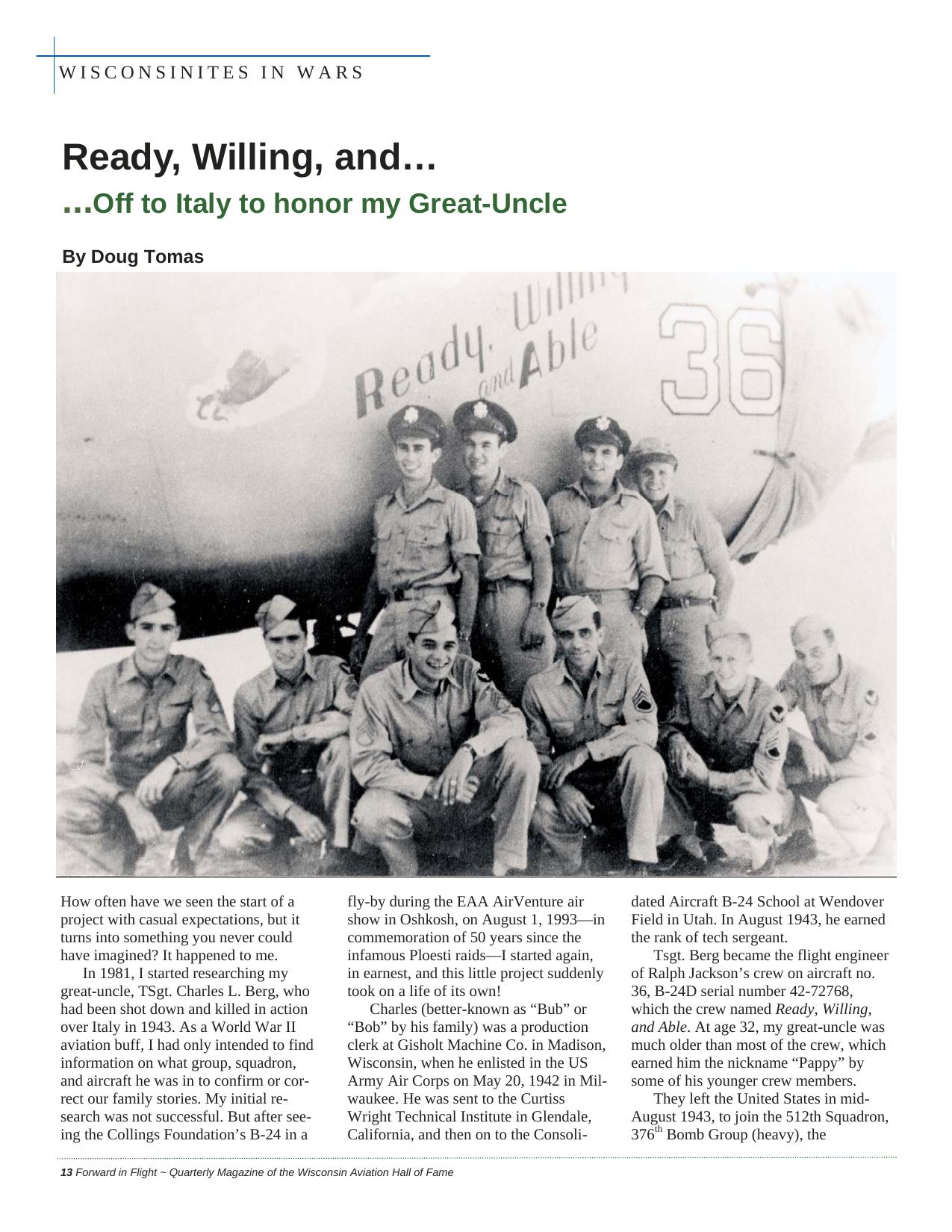
WISCONSINITES IN WARS Ready, Willing, and… ...Off to Italy to honor my Great-Uncle By Doug Tomas How often have we seen the start of a project with casual expectations, but it turns into something you never could have imagined? It happened to me. In 1981, I started researching my great-uncle, TSgt. Charles L. Berg, who had been shot down and killed in action over Italy in 1943. As a World War II aviation buff, I had only intended to find information on what group, squadron, and aircraft he was in to confirm or correct our family stories. My initial research was not successful. But after seeing the Collings Foundation’s B-24 in a fly-by during the EAA AirVenture air show in Oshkosh, on August 1, 1993—in commemoration of 50 years since the infamous Ploesti raids—I started again, in earnest, and this little project suddenly took on a life of its own! Charles (better-known as “Bub” or “Bob” by his family) was a production clerk at Gisholt Machine Co. in Madison, Wisconsin, when he enlisted in the US Army Air Corps on May 20, 1942 in Milwaukee. He was sent to the Curtiss Wright Technical Institute in Glendale, California, and then on to the Consoli- 13 Forward in Flight ~ Quarterly Magazine of the Wisconsin Aviation Hall of Fame dated Aircraft B-24 School at Wendover Field in Utah. In August 1943, he earned the rank of tech sergeant. Tsgt. Berg became the flight engineer of Ralph Jackson’s crew on aircraft no. 36, B-24D serial number 42-72768, which the crew named Ready, Willing, and Able. At age 32, my great-uncle was much older than most of the crew, which earned him the nickname “Pappy” by some of his younger crew members. They left the United States in midAugust 1943, to join the 512th Squadron, 376th Bomb Group (heavy), the
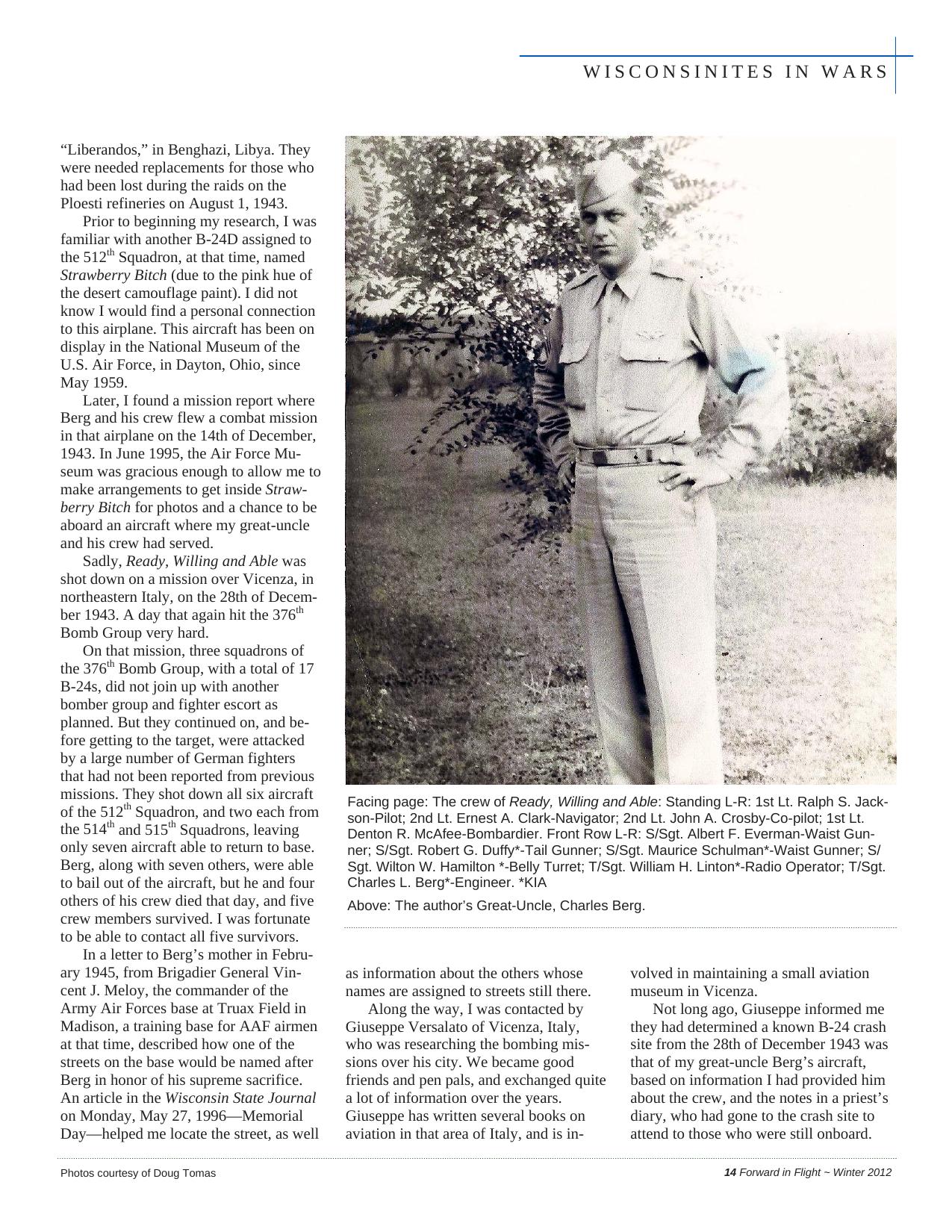
WISCONSINITES IN WARS “Liberandos,” in Benghazi, Libya. They were needed replacements for those who had been lost during the raids on the Ploesti refineries on August 1, 1943. Prior to beginning my research, I was familiar with another B-24D assigned to the 512th Squadron, at that time, named Strawberry Bitch (due to the pink hue of the desert camouflage paint). I did not know I would find a personal connection to this airplane. This aircraft has been on display in the National Museum of the U.S. Air Force, in Dayton, Ohio, since May 1959. Later, I found a mission report where Berg and his crew flew a combat mission in that airplane on the 14th of December, 1943. In June 1995, the Air Force Museum was gracious enough to allow me to make arrangements to get inside Strawberry Bitch for photos and a chance to be aboard an aircraft where my great-uncle and his crew had served. Sadly, Ready, Willing and Able was shot down on a mission over Vicenza, in northeastern Italy, on the 28th of December 1943. A day that again hit the 376th Bomb Group very hard. On that mission, three squadrons of the 376th Bomb Group, with a total of 17 B-24s, did not join up with another bomber group and fighter escort as planned. But they continued on, and before getting to the target, were attacked by a large number of German fighters that had not been reported from previous missions. They shot down all six aircraft of the 512th Squadron, and two each from the 514th and 515th Squadrons, leaving only seven aircraft able to return to base. Berg, along with seven others, were able to bail out of the aircraft, but he and four others of his crew died that day, and five crew members survived. I was fortunate to be able to contact all five survivors. In a letter to Berg’s mother in February 1945, from Brigadier General Vincent J. Meloy, the commander of the Army Air Forces base at Truax Field in Madison, a training base for AAF airmen at that time, described how one of the streets on the base would be named after Berg in honor of his supreme sacrifice. An article in the Wisconsin State Journal on Monday, May 27, 1996—Memorial Day—helped me locate the street, as well Photos courtesy of Doug Tomas Facing page: The crew of Ready, Willing and Able: Standing L-R: 1st Lt. Ralph S. Jackson-Pilot; 2nd Lt. Ernest A. Clark-Navigator; 2nd Lt. John A. Crosby-Co-pilot; 1st Lt. Denton R. McAfee-Bombardier. Front Row L-R: S/Sgt. Albert F. Everman-Waist Gunner; S/Sgt. Robert G. Duffy*-Tail Gunner; S/Sgt. Maurice Schulman*-Waist Gunner; S/ Sgt. Wilton W. Hamilton *-Belly Turret; T/Sgt. William H. Linton*-Radio Operator; T/Sgt. Charles L. Berg*-Engineer. *KIA Above: The author’s Great-Uncle, Charles Berg. as information about the others whose names are assigned to streets still there. Along the way, I was contacted by Giuseppe Versalato of Vicenza, Italy, who was researching the bombing missions over his city. We became good friends and pen pals, and exchanged quite a lot of information over the years. Giuseppe has written several books on aviation in that area of Italy, and is in- volved in maintaining a small aviation museum in Vicenza. Not long ago, Giuseppe informed me they had determined a known B-24 crash site from the 28th of December 1943 was that of my great-uncle Berg’s aircraft, based on information I had provided him about the crew, and the notes in a priest’s diary, who had gone to the crash site to attend to those who were still onboard. 14 Forward in Flight ~ Winter 2012
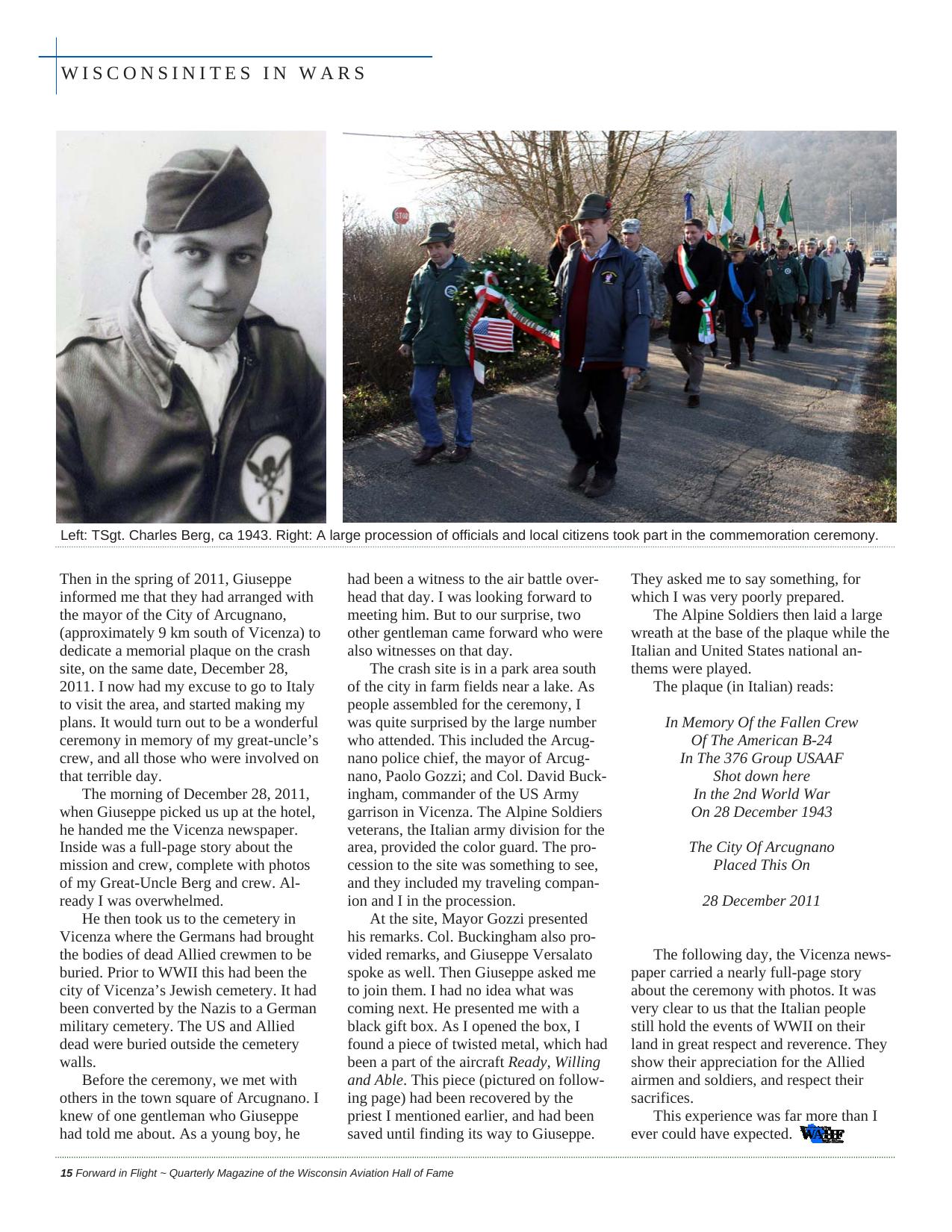
WISCONSINITES IN WARS Left: TSgt. Charles Berg, ca 1943. Right: A large procession of officials and local citizens took part in the commemoration ceremony. Then in the spring of 2011, Giuseppe informed me that they had arranged with the mayor of the City of Arcugnano, (approximately 9 km south of Vicenza) to dedicate a memorial plaque on the crash site, on the same date, December 28, 2011. I now had my excuse to go to Italy to visit the area, and started making my plans. It would turn out to be a wonderful ceremony in memory of my great-uncle’s crew, and all those who were involved on that terrible day. The morning of December 28, 2011, when Giuseppe picked us up at the hotel, he handed me the Vicenza newspaper. Inside was a full-page story about the mission and crew, complete with photos of my Great-Uncle Berg and crew. Already I was overwhelmed. He then took us to the cemetery in Vicenza where the Germans had brought the bodies of dead Allied crewmen to be buried. Prior to WWII this had been the city of Vicenza’s Jewish cemetery. It had been converted by the Nazis to a German military cemetery. The US and Allied dead were buried outside the cemetery walls. Before the ceremony, we met with others in the town square of Arcugnano. I knew of one gentleman who Giuseppe had told me about. As a young boy, he had been a witness to the air battle overhead that day. I was looking forward to meeting him. But to our surprise, two other gentleman came forward who were also witnesses on that day. The crash site is in a park area south of the city in farm fields near a lake. As people assembled for the ceremony, I was quite surprised by the large number who attended. This included the Arcugnano police chief, the mayor of Arcugnano, Paolo Gozzi; and Col. David Buckingham, commander of the US Army garrison in Vicenza. The Alpine Soldiers veterans, the Italian army division for the area, provided the color guard. The procession to the site was something to see, and they included my traveling companion and I in the procession. At the site, Mayor Gozzi presented his remarks. Col. Buckingham also provided remarks, and Giuseppe Versalato spoke as well. Then Giuseppe asked me to join them. I had no idea what was coming next. He presented me with a black gift box. As I opened the box, I found a piece of twisted metal, which had been a part of the aircraft Ready, Willing and Able. This piece (pictured on following page) had been recovered by the priest I mentioned earlier, and had been saved until finding its way to Giuseppe. 15 Forward in Flight ~ Quarterly Magazine of the Wisconsin Aviation Hall of Fame They asked me to say something, for which I was very poorly prepared. The Alpine Soldiers then laid a large wreath at the base of the plaque while the Italian and United States national anthems were played. The plaque (in Italian) reads: In Memory Of the Fallen Crew Of The American B-24 In The 376 Group USAAF Shot down here In the 2nd World War On 28 December 1943 The City Of Arcugnano Placed This On 28 December 2011 The following day, the Vicenza newspaper carried a nearly full-page story about the ceremony with photos. It was very clear to us that the Italian people still hold the events of WWII on their land in great respect and reverence. They show their appreciation for the Allied airmen and soldiers, and respect their sacrifices. This experience was far more than I ever could have expected.
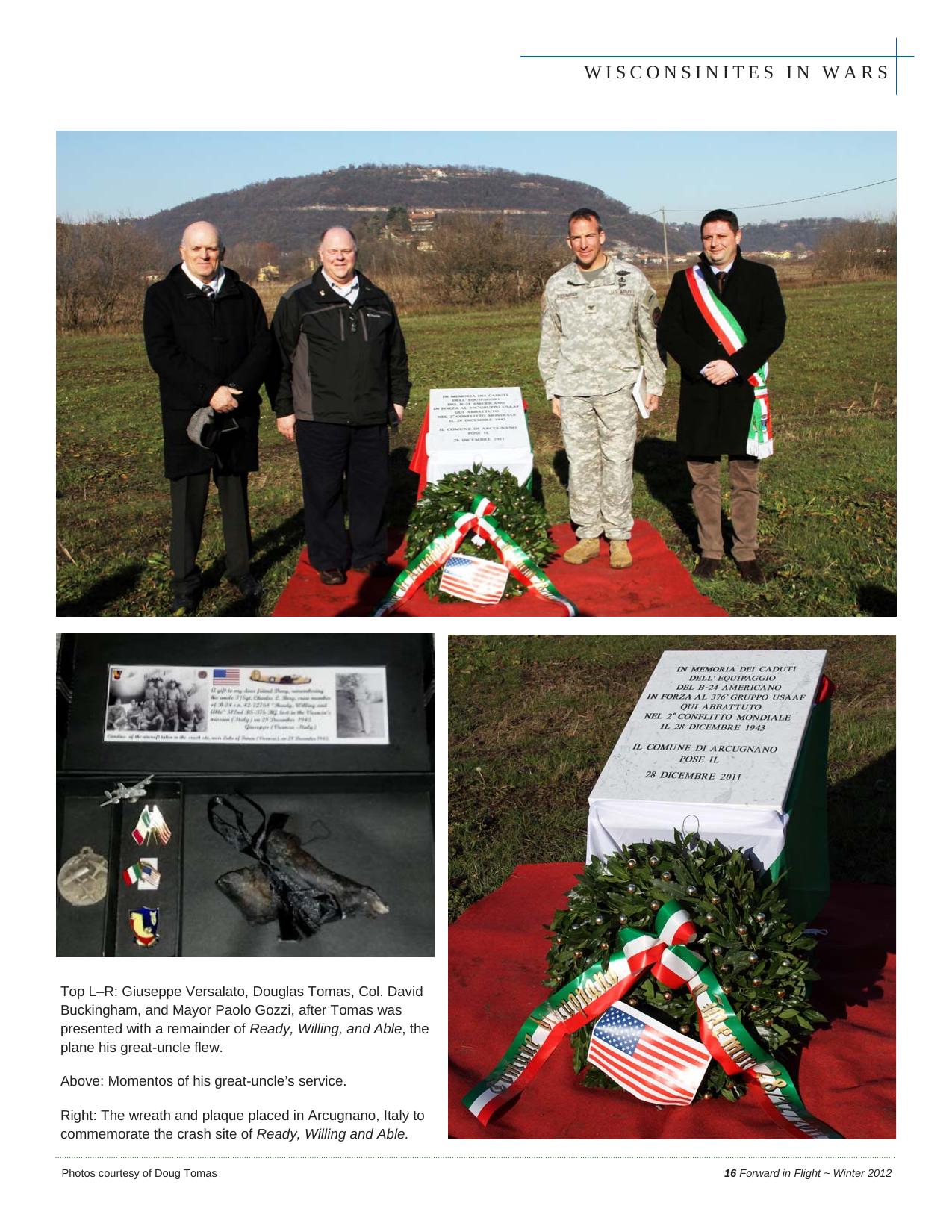
WISCONSINITES IN WARS Top L–R: Giuseppe Versalato, Douglas Tomas, Col. David Buckingham, and Mayor Paolo Gozzi, after Tomas was presented with a remainder of Ready, Willing, and Able, the plane his great-uncle flew. Above: Momentos of his great-uncle’s service. Right: The wreath and plaque placed in Arcugnano, Italy to commemorate the crash site of Ready, Willing and Able. Photos courtesy of Doug Tomas 16 Forward in Flight ~ Winter 2012
PLANES & PEOPLE The Air Racer from Wisconsin Rapids Lois Truchinski competed in four cross-country races By John Dorcey A viation has been recognized as a passion, some may call it a disease, for longer than man (and woman) has flown. Leonardo da Vinci spoke of it in the 15th century, “When once you have tasted flight, you will forever walk the earth with your eyes turned skyward, for there you have been, and there you will always long to return.” Lois Truchinski of Wisconsin Rapids, Wisconsin, today an active octogenarian, is living proof. Lois earned her private pilot certificate in 1968 and became involved with the Wisconsin Ninety-Nines. A working mother of four active teenagers, Lois stretched her wings in the late 1970s and became an air race pilot. This is her story. Lois Lee grew up on the south side of Wisconsin Rapids where her father ran a welding shop. She tells how his love of aviation made every landing at nearby Alexander Field an adventure. “It was a big deal, he would load us all up into the car and off we would go to watch them land.” Her father’s health prevented him from obtaining a pilot certificate but not from flying. She continued, “Dad really loved flying, so much so that he joined the local flying club.” He became friends with fellow club member Larry Truchinski and together they would fly the club’s Piper Super Cruiser. Truchinski became more than a friend of the Lee family. Lois and Larry married in 1951 just before he shipped out to Korea. Lois went to school in Milwaukee for a year before returning home to work in the offices of Nekoosa Papers. Larry was discharged in 1953 and began his career in aviation. Lois worked next to Larry in a nomadic journey across the country. They always worked in aviation, Larry as a pilot and mechanic, Lois in the office. She worked for the Civil Aviation Administration for a few years, first in South Carolina, then briefly in Indianapolis, and then back home to Wisconsin Rapids. It wasn’t long and Larry was drawn to California by an offer from Lockheed. Off they went, together, as a team. Along the way they had four children. Flying and family were two important elements of life for Lois. While in California, Larry developed health challenges that took him out of the cockpit. The family packed up and moved again, returning home to Wisconsin Rapids, this time to stay. Lois went back to work at Nekoosa Papers and Larry began building houses. The aviation portion of the story may well have ended there for some, but not for Lois. She remembered how Larry had helped her Dad experience flying, and with encouragement from Larry, she began flying lessons. It was the spring of 1968, Lois was back in the cockpit, and this time she was flying. Lois earned her private certificate in August of that year. She and Larry bought a Piper Cherokee 160 shortly thereafter and they began cross-country flying in earnest. Lois added an instrument rating in March 1976 and her commercial certificate in November of that year. She added a multi-engine rating in February 1978. Along the way, Lois learned of the Wisconsin Chapter of the Ninety-Nines, the international organization of women pilots. She joined the group and served as its chapter chairman for several years. The Ninety-Nines have been involved in women’s air racing since 1929 and the first Women’s Air Derby. It is not surprising then that Lois took her love of flying and passion for flying cross country and became an air race pilot. Lois competed in four races, one each in 1977, 1978, 1979, and 1980. In these races nearly every team consisted of two pilots, one acting as pilot and the other serving as a navigator and backup pilot. Lois had three team mates: Jane Kriah from Oshkosh, Caroline Morey from 17 Forward in Flight ~ Quarterly Magazine of the Wisconsin Aviation Hall of Fame Middleton, and Pat Weir of Marshfield. Officially termed the All Women’s International Air Race, the 1977 Angel Derby started at the Ohio University Airport in Columbus, Ohio, and concluded at the Freeport International Airport in Freeport, Bahamas. This, the 27th annual race, began appropriately enough on Mother’s Day, Sunday, May 8. Sixty-one airplanes were flown by 106 pilots representing 26 states and five countries. The race’s route was 1,600 miles in length with the racers flying over eight states and about 100 miles of open water. Caroline Morey served as copilot for Lois. Races were handicapped; an estimated speed based on aircraft type and equipment was used as a baseline. Teams raced against themselves, attempting to be faster than the baseline speed. All aircraft were impounded for four days before race start. During that time, each aircraft underwent a safety and rules compliance inspection. Flight crews spent that time planning their flight, reviewing terrain and airspace along each leg, calculating fuel consumption, and researching mandatory fly-by points and refueling stops. Down time was spent getting to know each other. The 1978 Angel Derby began at Love Field in Dallas, Texas. Lois and her copilot, Jane Kriah, flew a Cessna 172 in this race. Departures began at 0930 on Saturday, May 6. After departing Dallas the route went north to Hot Springs, Arkansas, east to Memphis, Tennessee, then on to Nashville, and then Athens, Georgia. Turning south the route continued to Lake City, Florida, and a mandatory stop and RON (Remain Over Night) at Fort Meyers, Florida. All competitors had to arrive at Fort Meyers before 1900 on May 7. That equated to a challenging 1,182 miles of race course in less than 36 hours, all under Visual Flight Rules (VFR). The race continued mid-morning the next day with a group departure from
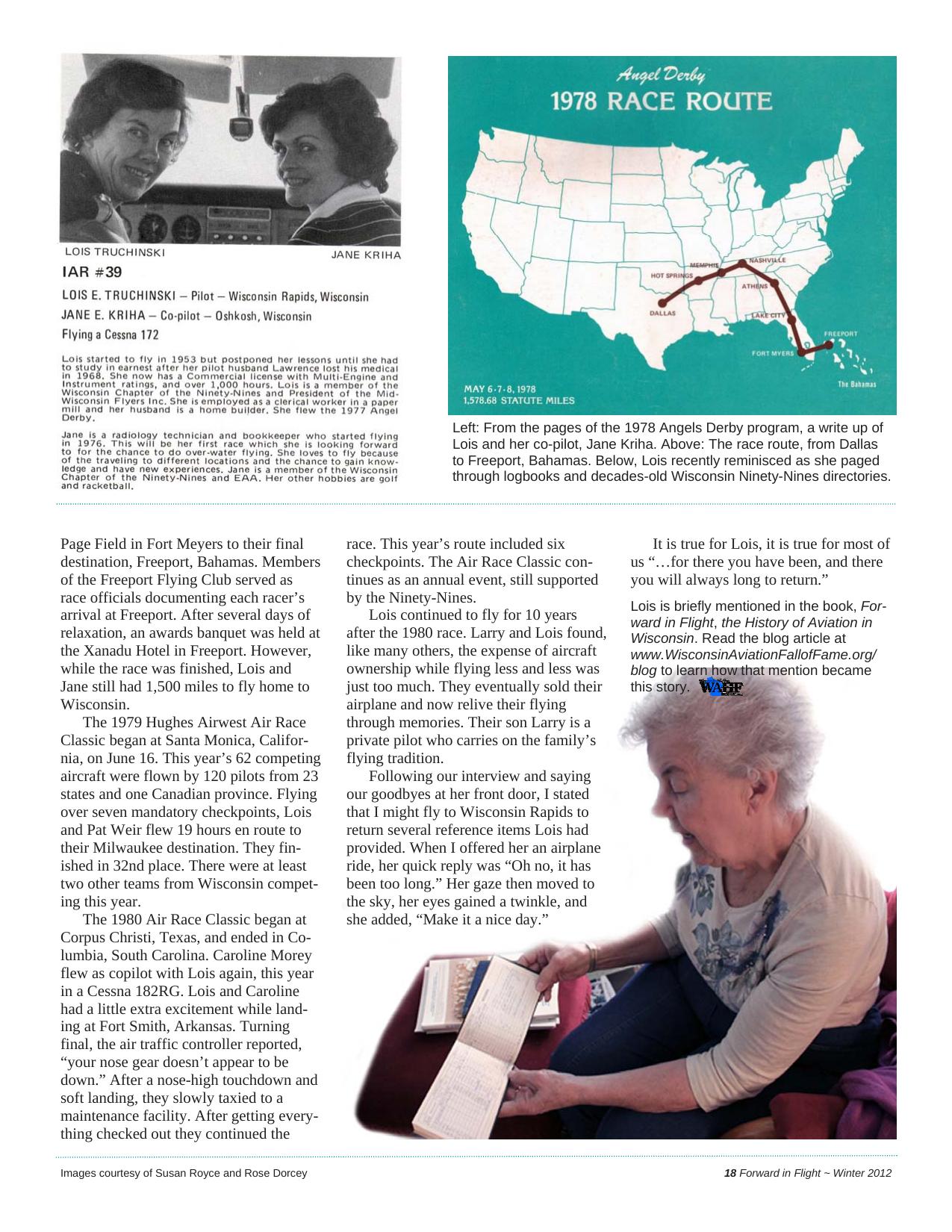
Left: From the pages of the 1978 Angels Derby program, a write up of Lois and her co-pilot, Jane Kriha. Above: The race route, from Dallas to Freeport, Bahamas. Below, Lois recently reminisced as she paged through logbooks and decades-old Wisconsin Ninety-Nines directories. Page Field in Fort Meyers to their final destination, Freeport, Bahamas. Members of the Freeport Flying Club served as race officials documenting each racer’s arrival at Freeport. After several days of relaxation, an awards banquet was held at the Xanadu Hotel in Freeport. However, while the race was finished, Lois and Jane still had 1,500 miles to fly home to Wisconsin. The 1979 Hughes Airwest Air Race Classic began at Santa Monica, California, on June 16. This year’s 62 competing aircraft were flown by 120 pilots from 23 states and one Canadian province. Flying over seven mandatory checkpoints, Lois and Pat Weir flew 19 hours en route to their Milwaukee destination. They finished in 32nd place. There were at least two other teams from Wisconsin competing this year. The 1980 Air Race Classic began at Corpus Christi, Texas, and ended in Columbia, South Carolina. Caroline Morey flew as copilot with Lois again, this year in a Cessna 182RG. Lois and Caroline had a little extra excitement while landing at Fort Smith, Arkansas. Turning final, the air traffic controller reported, “your nose gear doesn’t appear to be down.” After a nose-high touchdown and soft landing, they slowly taxied to a maintenance facility. After getting everything checked out they continued the Images courtesy of Susan Royce and Rose Dorcey race. This year’s route included six checkpoints. The Air Race Classic continues as an annual event, still supported by the Ninety-Nines. Lois continued to fly for 10 years after the 1980 race. Larry and Lois found, like many others, the expense of aircraft ownership while flying less and less was just too much. They eventually sold their airplane and now relive their flying through memories. Their son Larry is a private pilot who carries on the family’s flying tradition. Following our interview and saying our goodbyes at her front door, I stated that I might fly to Wisconsin Rapids to return several reference items Lois had provided. When I offered her an airplane ride, her quick reply was “Oh no, it has been too long.” Her gaze then moved to the sky, her eyes gained a twinkle, and she added, “Make it a nice day.” It is true for Lois, it is true for most of us “…for there you have been, and there you will always long to return.” Lois is briefly mentioned in the book, Forward in Flight, the History of Aviation in Wisconsin. Read the blog article at www.WisconsinAviationFallofFame.org/ blog to learn how that mention became this story. 18 Forward in Flight ~ Winter 2012
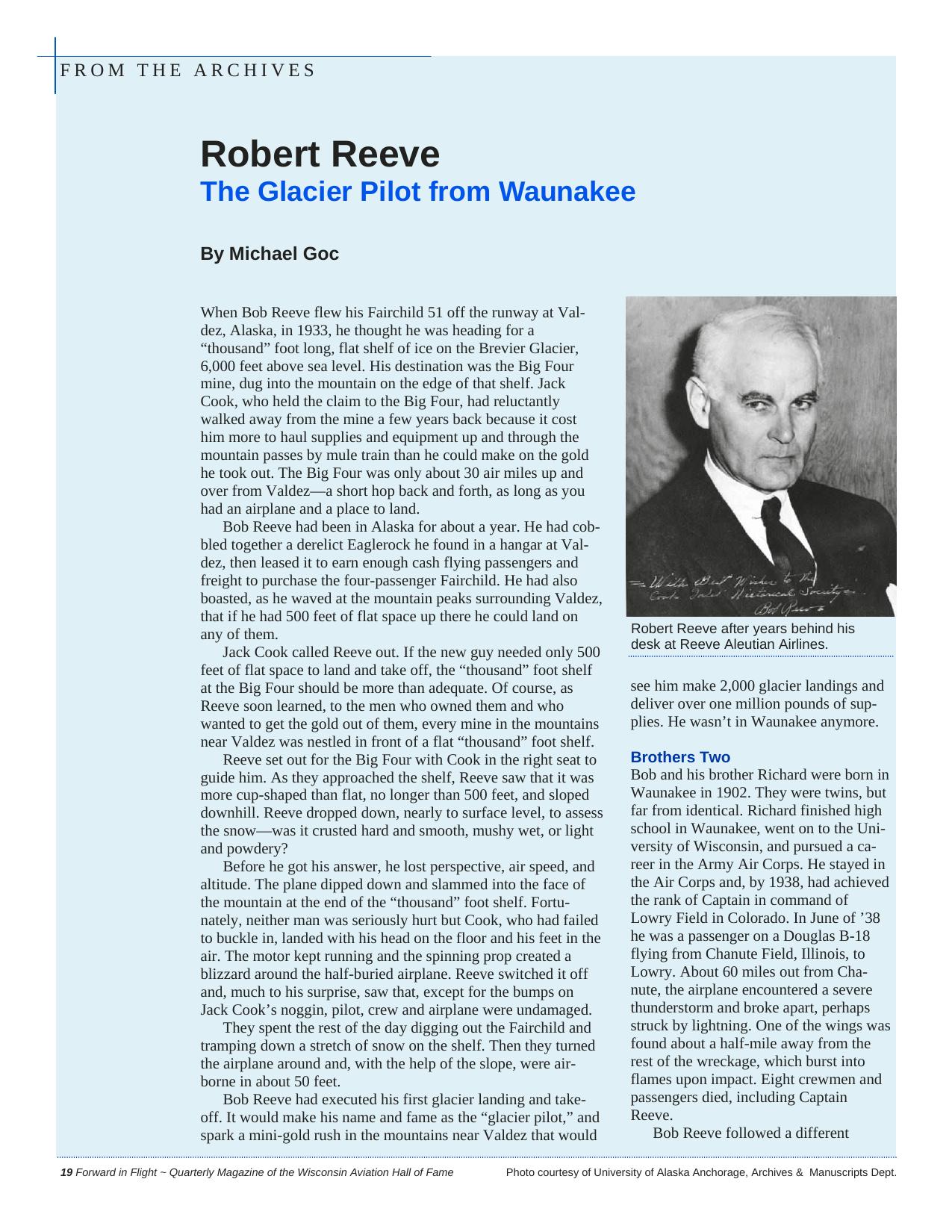
FROM THE ARCHIVES Robert Reeve The Glacier Pilot from Waunakee By Michael Goc When Bob Reeve flew his Fairchild 51 off the runway at Valdez, Alaska, in 1933, he thought he was heading for a “thousand” foot long, flat shelf of ice on the Brevier Glacier, 6,000 feet above sea level. His destination was the Big Four mine, dug into the mountain on the edge of that shelf. Jack Cook, who held the claim to the Big Four, had reluctantly walked away from the mine a few years back because it cost him more to haul supplies and equipment up and through the mountain passes by mule train than he could make on the gold he took out. The Big Four was only about 30 air miles up and over from Valdez—a short hop back and forth, as long as you had an airplane and a place to land. Bob Reeve had been in Alaska for about a year. He had cobbled together a derelict Eaglerock he found in a hangar at Valdez, then leased it to earn enough cash flying passengers and freight to purchase the four-passenger Fairchild. He had also boasted, as he waved at the mountain peaks surrounding Valdez, that if he had 500 feet of flat space up there he could land on any of them. Jack Cook called Reeve out. If the new guy needed only 500 feet of flat space to land and take off, the “thousand” foot shelf at the Big Four should be more than adequate. Of course, as Reeve soon learned, to the men who owned them and who wanted to get the gold out of them, every mine in the mountains near Valdez was nestled in front of a flat “thousand” foot shelf. Reeve set out for the Big Four with Cook in the right seat to guide him. As they approached the shelf, Reeve saw that it was more cup-shaped than flat, no longer than 500 feet, and sloped downhill. Reeve dropped down, nearly to surface level, to assess the snow—was it crusted hard and smooth, mushy wet, or light and powdery? Before he got his answer, he lost perspective, air speed, and altitude. The plane dipped down and slammed into the face of the mountain at the end of the “thousand” foot shelf. Fortunately, neither man was seriously hurt but Cook, who had failed to buckle in, landed with his head on the floor and his feet in the air. The motor kept running and the spinning prop created a blizzard around the half-buried airplane. Reeve switched it off and, much to his surprise, saw that, except for the bumps on Jack Cook’s noggin, pilot, crew and airplane were undamaged. They spent the rest of the day digging out the Fairchild and tramping down a stretch of snow on the shelf. Then they turned the airplane around and, with the help of the slope, were airborne in about 50 feet. Bob Reeve had executed his first glacier landing and takeoff. It would make his name and fame as the “glacier pilot,” and spark a mini-gold rush in the mountains near Valdez that would 19 Forward in Flight ~ Quarterly Magazine of the Wisconsin Aviation Hall of Fame Robert Reeve after years behind his desk at Reeve Aleutian Airlines. see him make 2,000 glacier landings and deliver over one million pounds of supplies. He wasn’t in Waunakee anymore. Brothers Two Bob and his brother Richard were born in Waunakee in 1902. They were twins, but far from identical. Richard finished high school in Waunakee, went on to the University of Wisconsin, and pursued a career in the Army Air Corps. He stayed in the Air Corps and, by 1938, had achieved the rank of Captain in command of Lowry Field in Colorado. In June of ’38 he was a passenger on a Douglas B-18 flying from Chanute Field, Illinois, to Lowry. About 60 miles out from Chanute, the airplane encountered a severe thunderstorm and broke apart, perhaps struck by lightning. One of the wings was found about a half-mile away from the rest of the wreckage, which burst into flames upon impact. Eight crewmen and passengers died, including Captain Reeve. Bob Reeve followed a different Photo courtesy of University of Alaska Anchorage, Archives & Manuscripts Dept.
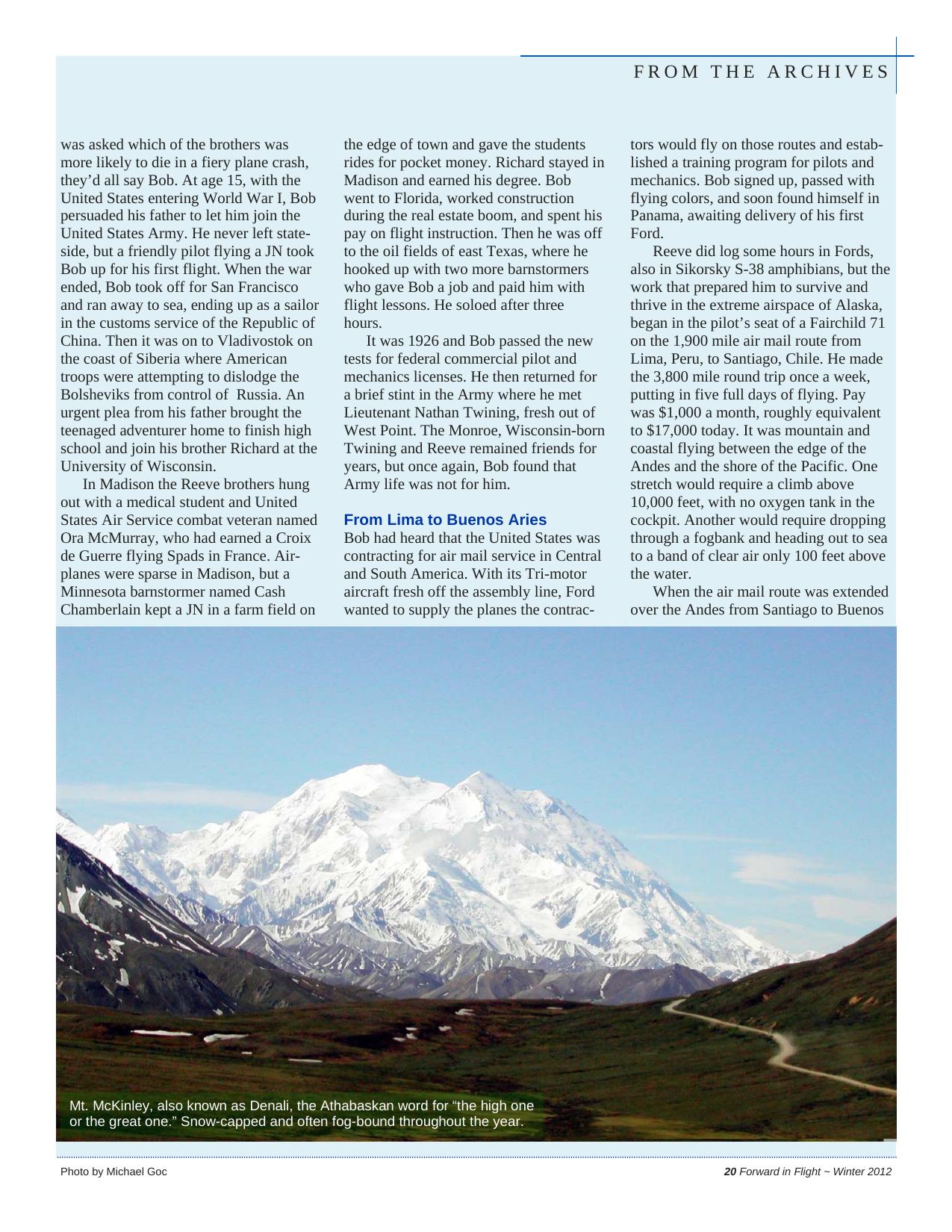
FROM THE ARCHIVES was asked which of the brothers was more likely to die in a fiery plane crash, they’d all say Bob. At age 15, with the United States entering World War I, Bob persuaded his father to let him join the United States Army. He never left stateside, but a friendly pilot flying a JN took Bob up for his first flight. When the war ended, Bob took off for San Francisco and ran away to sea, ending up as a sailor in the customs service of the Republic of China. Then it was on to Vladivostok on the coast of Siberia where American troops were attempting to dislodge the Bolsheviks from control of Russia. An urgent plea from his father brought the teenaged adventurer home to finish high school and join his brother Richard at the University of Wisconsin. In Madison the Reeve brothers hung out with a medical student and United States Air Service combat veteran named Ora McMurray, who had earned a Croix de Guerre flying Spads in France. Airplanes were sparse in Madison, but a Minnesota barnstormer named Cash Chamberlain kept a JN in a farm field on the edge of town and gave the students rides for pocket money. Richard stayed in Madison and earned his degree. Bob went to Florida, worked construction during the real estate boom, and spent his pay on flight instruction. Then he was off to the oil fields of east Texas, where he hooked up with two more barnstormers who gave Bob a job and paid him with flight lessons. He soloed after three hours. It was 1926 and Bob passed the new tests for federal commercial pilot and mechanics licenses. He then returned for a brief stint in the Army where he met Lieutenant Nathan Twining, fresh out of West Point. The Monroe, Wisconsin-born Twining and Reeve remained friends for years, but once again, Bob found that Army life was not for him. From Lima to Buenos Aries Bob had heard that the United States was contracting for air mail service in Central and South America. With its Tri-motor aircraft fresh off the assembly line, Ford wanted to supply the planes the contrac- tors would fly on those routes and established a training program for pilots and mechanics. Bob signed up, passed with flying colors, and soon found himself in Panama, awaiting delivery of his first Ford. Reeve did log some hours in Fords, also in Sikorsky S-38 amphibians, but the work that prepared him to survive and thrive in the extreme airspace of Alaska, began in the pilot’s seat of a Fairchild 71 on the 1,900 mile air mail route from Lima, Peru, to Santiago, Chile. He made the 3,800 mile round trip once a week, putting in five full days of flying. Pay was $1,000 a month, roughly equivalent to $17,000 today. It was mountain and coastal flying between the edge of the Andes and the shore of the Pacific. One stretch would require a climb above 10,000 feet, with no oxygen tank in the cockpit. Another would require dropping through a fogbank and heading out to sea to a band of clear air only 100 feet above the water. When the air mail route was extended over the Andes from Santiago to Buenos Mt. McKinley, also known as Denali, the Athabaskan word for “the high one or the great one.” Snow-capped and often fog-bound throughout the year. Photo by Michael Goc 20 Forward in Flight ~ Winter 2012
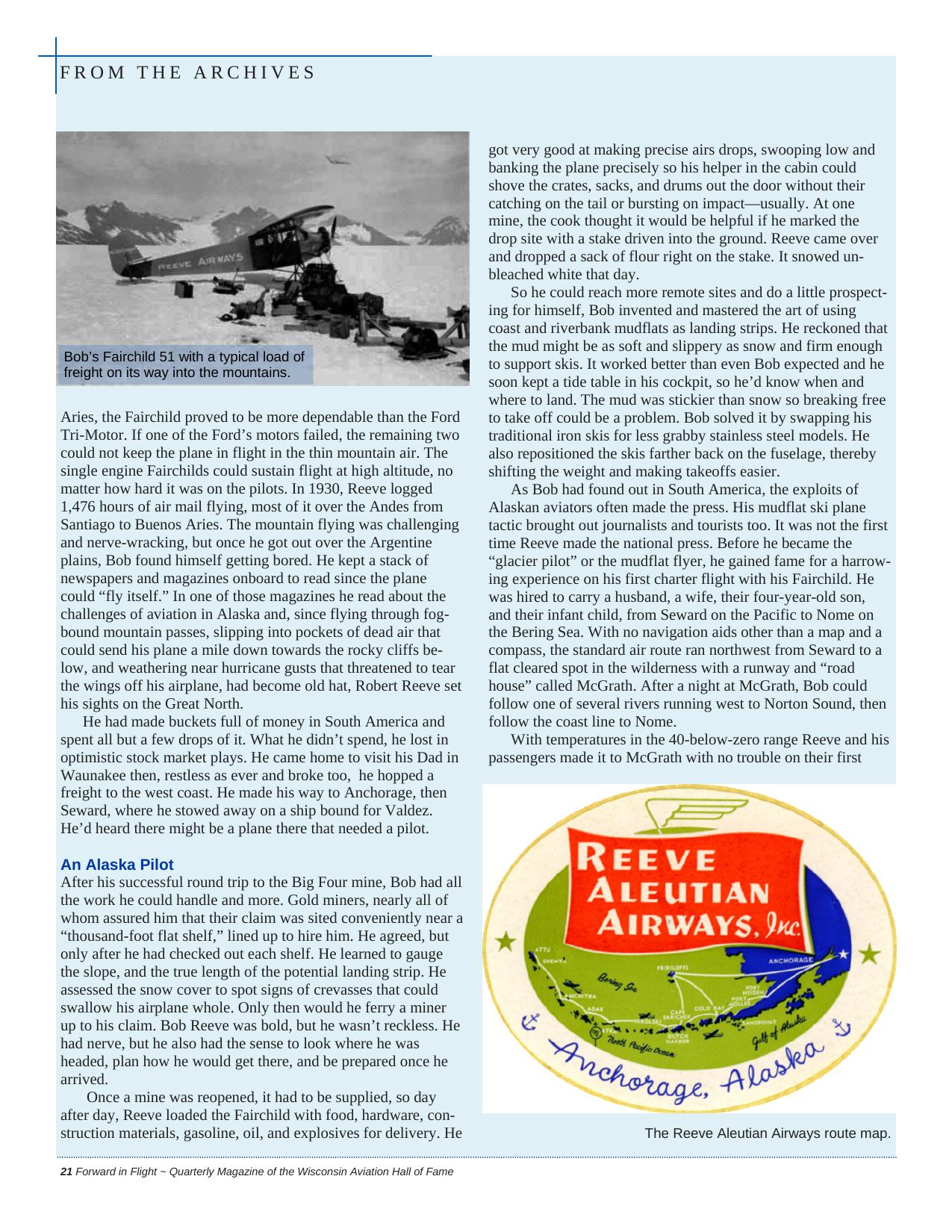
FROM THE ARCHIVES Bob’s Fairchild 51 with a typical load of freight on its way into the mountains. Aries, the Fairchild proved to be more dependable than the Ford Tri-Motor. If one of the Ford’s motors failed, the remaining two could not keep the plane in flight in the thin mountain air. The single engine Fairchilds could sustain flight at high altitude, no matter how hard it was on the pilots. In 1930, Reeve logged 1,476 hours of air mail flying, most of it over the Andes from Santiago to Buenos Aries. The mountain flying was challenging and nerve-wracking, but once he got out over the Argentine plains, Bob found himself getting bored. He kept a stack of newspapers and magazines onboard to read since the plane could “fly itself.” In one of those magazines he read about the challenges of aviation in Alaska and, since flying through fogbound mountain passes, slipping into pockets of dead air that could send his plane a mile down towards the rocky cliffs below, and weathering near hurricane gusts that threatened to tear the wings off his airplane, had become old hat, Robert Reeve set his sights on the Great North. He had made buckets full of money in South America and spent all but a few drops of it. What he didn’t spend, he lost in optimistic stock market plays. He came home to visit his Dad in Waunakee then, restless as ever and broke too, he hopped a freight to the west coast. He made his way to Anchorage, then Seward, where he stowed away on a ship bound for Valdez. He’d heard there might be a plane there that needed a pilot. An Alaska Pilot After his successful round trip to the Big Four mine, Bob had all the work he could handle and more. Gold miners, nearly all of whom assured him that their claim was sited conveniently near a “thousand-foot flat shelf,” lined up to hire him. He agreed, but only after he had checked out each shelf. He learned to gauge the slope, and the true length of the potential landing strip. He assessed the snow cover to spot signs of crevasses that could swallow his airplane whole. Only then would he ferry a miner up to his claim. Bob Reeve was bold, but he wasn’t reckless. He had nerve, but he also had the sense to look where he was headed, plan how he would get there, and be prepared once he arrived. Once a mine was reopened, it had to be supplied, so day after day, Reeve loaded the Fairchild with food, hardware, construction materials, gasoline, oil, and explosives for delivery. He 21 Forward in Flight ~ Quarterly Magazine of the Wisconsin Aviation Hall of Fame got very good at making precise airs drops, swooping low and banking the plane precisely so his helper in the cabin could shove the crates, sacks, and drums out the door without their catching on the tail or bursting on impact—usually. At one mine, the cook thought it would be helpful if he marked the drop site with a stake driven into the ground. Reeve came over and dropped a sack of flour right on the stake. It snowed unbleached white that day. So he could reach more remote sites and do a little prospecting for himself, Bob invented and mastered the art of using coast and riverbank mudflats as landing strips. He reckoned that the mud might be as soft and slippery as snow and firm enough to support skis. It worked better than even Bob expected and he soon kept a tide table in his cockpit, so he’d know when and where to land. The mud was stickier than snow so breaking free to take off could be a problem. Bob solved it by swapping his traditional iron skis for less grabby stainless steel models. He also repositioned the skis farther back on the fuselage, thereby shifting the weight and making takeoffs easier. As Bob had found out in South America, the exploits of Alaskan aviators often made the press. His mudflat ski plane tactic brought out journalists and tourists too. It was not the first time Reeve made the national press. Before he became the “glacier pilot” or the mudflat flyer, he gained fame for a harrowing experience on his first charter flight with his Fairchild. He was hired to carry a husband, a wife, their four-year-old son, and their infant child, from Seward on the Pacific to Nome on the Bering Sea. With no navigation aids other than a map and a compass, the standard air route ran northwest from Seward to a flat cleared spot in the wilderness with a runway and “road house” called McGrath. After a night at McGrath, Bob could follow one of several rivers running west to Norton Sound, then follow the coast line to Nome. With temperatures in the 40-below-zero range Reeve and his passengers made it to McGrath with no trouble on their first The Reeve Aleutian Airways route map.
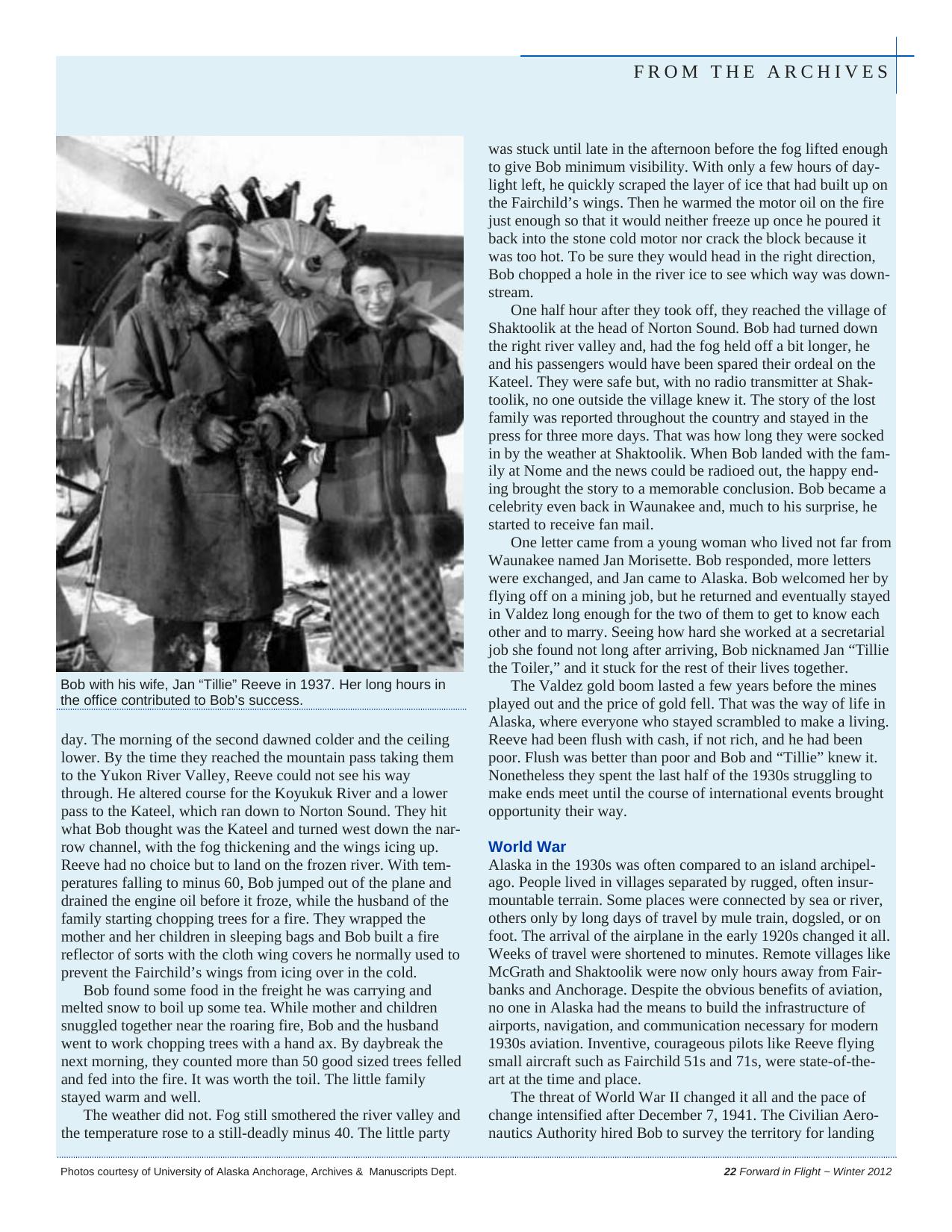
FROM THE ARCHIVES Bob with his wife, Jan “Tillie” Reeve in 1937. Her long hours in the office contributed to Bob’s success. was stuck until late in the afternoon before the fog lifted enough to give Bob minimum visibility. With only a few hours of daylight left, he quickly scraped the layer of ice that had built up on the Fairchild’s wings. Then he warmed the motor oil on the fire just enough so that it would neither freeze up once he poured it back into the stone cold motor nor crack the block because it was too hot. To be sure they would head in the right direction, Bob chopped a hole in the river ice to see which way was downstream. One half hour after they took off, they reached the village of Shaktoolik at the head of Norton Sound. Bob had turned down the right river valley and, had the fog held off a bit longer, he and his passengers would have been spared their ordeal on the Kateel. They were safe but, with no radio transmitter at Shaktoolik, no one outside the village knew it. The story of the lost family was reported throughout the country and stayed in the press for three more days. That was how long they were socked in by the weather at Shaktoolik. When Bob landed with the family at Nome and the news could be radioed out, the happy ending brought the story to a memorable conclusion. Bob became a celebrity even back in Waunakee and, much to his surprise, he started to receive fan mail. One letter came from a young woman who lived not far from Waunakee named Jan Morisette. Bob responded, more letters were exchanged, and Jan came to Alaska. Bob welcomed her by flying off on a mining job, but he returned and eventually stayed in Valdez long enough for the two of them to get to know each other and to marry. Seeing how hard she worked at a secretarial job she found not long after arriving, Bob nicknamed Jan “Tillie the Toiler,” and it stuck for the rest of their lives together. The Valdez gold boom lasted a few years before the mines played out and the price of gold fell. That was the way of life in Alaska, where everyone who stayed scrambled to make a living. Reeve had been flush with cash, if not rich, and he had been poor. Flush was better than poor and Bob and “Tillie” knew it. Nonetheless they spent the last half of the 1930s struggling to make ends meet until the course of international events brought opportunity their way. day. The morning of the second dawned colder and the ceiling lower. By the time they reached the mountain pass taking them to the Yukon River Valley, Reeve could not see his way through. He altered course for the Koyukuk River and a lower pass to the Kateel, which ran down to Norton Sound. They hit what Bob thought was the Kateel and turned west down the narrow channel, with the fog thickening and the wings icing up. Reeve had no choice but to land on the frozen river. With temperatures falling to minus 60, Bob jumped out of the plane and drained the engine oil before it froze, while the husband of the family starting chopping trees for a fire. They wrapped the mother and her children in sleeping bags and Bob built a fire reflector of sorts with the cloth wing covers he normally used to prevent the Fairchild’s wings from icing over in the cold. Bob found some food in the freight he was carrying and melted snow to boil up some tea. While mother and children snuggled together near the roaring fire, Bob and the husband went to work chopping trees with a hand ax. By daybreak the next morning, they counted more than 50 good sized trees felled and fed into the fire. It was worth the toil. The little family stayed warm and well. The weather did not. Fog still smothered the river valley and the temperature rose to a still-deadly minus 40. The little party World War Alaska in the 1930s was often compared to an island archipelago. People lived in villages separated by rugged, often insurmountable terrain. Some places were connected by sea or river, others only by long days of travel by mule train, dogsled, or on foot. The arrival of the airplane in the early 1920s changed it all. Weeks of travel were shortened to minutes. Remote villages like McGrath and Shaktoolik were now only hours away from Fairbanks and Anchorage. Despite the obvious benefits of aviation, no one in Alaska had the means to build the infrastructure of airports, navigation, and communication necessary for modern 1930s aviation. Inventive, courageous pilots like Reeve flying small aircraft such as Fairchild 51s and 71s, were state-of-theart at the time and place. The threat of World War II changed it all and the pace of change intensified after December 7, 1941. The Civilian Aeronautics Authority hired Bob to survey the territory for landing Photos courtesy of University of Alaska Anchorage, Archives & Manuscripts Dept. 22 Forward in Flight ~ Winter 2012
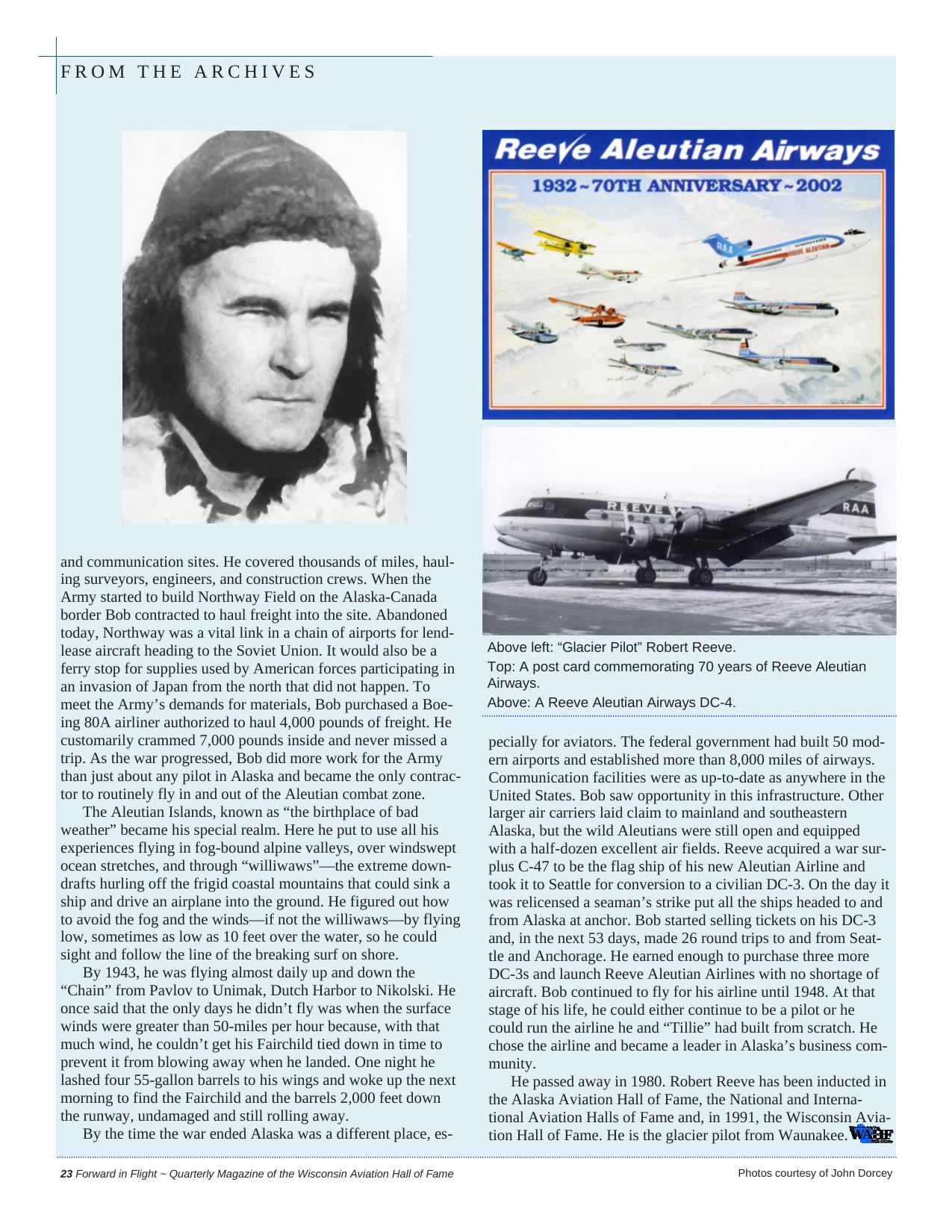
FROM THE ARCHIVES and communication sites. He covered thousands of miles, hauling surveyors, engineers, and construction crews. When the Army started to build Northway Field on the Alaska-Canada border Bob contracted to haul freight into the site. Abandoned today, Northway was a vital link in a chain of airports for lendlease aircraft heading to the Soviet Union. It would also be a ferry stop for supplies used by American forces participating in an invasion of Japan from the north that did not happen. To meet the Army’s demands for materials, Bob purchased a Boeing 80A airliner authorized to haul 4,000 pounds of freight. He customarily crammed 7,000 pounds inside and never missed a trip. As the war progressed, Bob did more work for the Army than just about any pilot in Alaska and became the only contractor to routinely fly in and out of the Aleutian combat zone. The Aleutian Islands, known as “the birthplace of bad weather” became his special realm. Here he put to use all his experiences flying in fog-bound alpine valleys, over windswept ocean stretches, and through “williwaws”—the extreme downdrafts hurling off the frigid coastal mountains that could sink a ship and drive an airplane into the ground. He figured out how to avoid the fog and the winds—if not the williwaws—by flying low, sometimes as low as 10 feet over the water, so he could sight and follow the line of the breaking surf on shore. By 1943, he was flying almost daily up and down the “Chain” from Pavlov to Unimak, Dutch Harbor to Nikolski. He once said that the only days he didn’t fly was when the surface winds were greater than 50-miles per hour because, with that much wind, he couldn’t get his Fairchild tied down in time to prevent it from blowing away when he landed. One night he lashed four 55-gallon barrels to his wings and woke up the next morning to find the Fairchild and the barrels 2,000 feet down the runway, undamaged and still rolling away. By the time the war ended Alaska was a different place, es23 Forward in Flight ~ Quarterly Magazine of the Wisconsin Aviation Hall of Fame Above left: “Glacier Pilot” Robert Reeve. Top: A post card commemorating 70 years of Reeve Aleutian Airways. Above: A Reeve Aleutian Airways DC-4. pecially for aviators. The federal government had built 50 modern airports and established more than 8,000 miles of airways. Communication facilities were as up-to-date as anywhere in the United States. Bob saw opportunity in this infrastructure. Other larger air carriers laid claim to mainland and southeastern Alaska, but the wild Aleutians were still open and equipped with a half-dozen excellent air fields. Reeve acquired a war surplus C-47 to be the flag ship of his new Aleutian Airline and took it to Seattle for conversion to a civilian DC-3. On the day it was relicensed a seaman’s strike put all the ships headed to and from Alaska at anchor. Bob started selling tickets on his DC-3 and, in the next 53 days, made 26 round trips to and from Seattle and Anchorage. He earned enough to purchase three more DC-3s and launch Reeve Aleutian Airlines with no shortage of aircraft. Bob continued to fly for his airline until 1948. At that stage of his life, he could either continue to be a pilot or he could run the airline he and “Tillie” had built from scratch. He chose the airline and became a leader in Alaska’s business community. He passed away in 1980. Robert Reeve has been inducted in the Alaska Aviation Hall of Fame, the National and International Aviation Halls of Fame and, in 1991, the Wisconsin Aviation Hall of Fame. He is the glacier pilot from Waunakee. Photos courtesy of John Dorcey
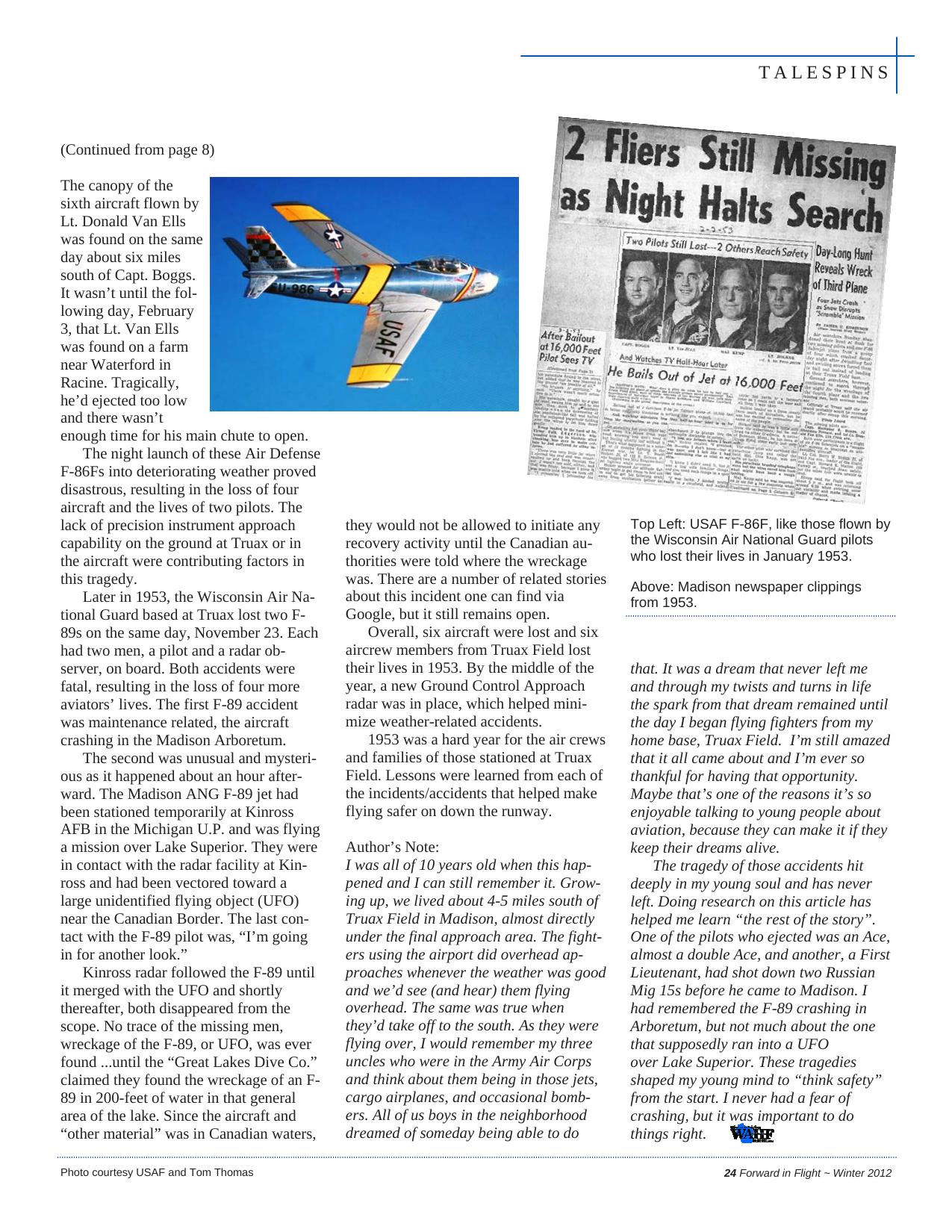
TALESPINS (Continued from page 8) The canopy of the sixth aircraft flown by Lt. Donald Van Ells was found on the same day about six miles south of Capt. Boggs. It wasn’t until the following day, February 3, that Lt. Van Ells was found on a farm near Waterford in Racine. Tragically, he’d ejected too low and there wasn’t enough time for his main chute to open. The night launch of these Air Defense F-86Fs into deteriorating weather proved disastrous, resulting in the loss of four aircraft and the lives of two pilots. The lack of precision instrument approach capability on the ground at Truax or in the aircraft were contributing factors in this tragedy. Later in 1953, the Wisconsin Air National Guard based at Truax lost two F89s on the same day, November 23. Each had two men, a pilot and a radar observer, on board. Both accidents were fatal, resulting in the loss of four more aviators’ lives. The first F-89 accident was maintenance related, the aircraft crashing in the Madison Arboretum. The second was unusual and mysterious as it happened about an hour afterward. The Madison ANG F-89 jet had been stationed temporarily at Kinross AFB in the Michigan U.P. and was flying a mission over Lake Superior. They were in contact with the radar facility at Kinross and had been vectored toward a large unidentified flying object (UFO) near the Canadian Border. The last contact with the F-89 pilot was, “I’m going in for another look.” Kinross radar followed the F-89 until it merged with the UFO and shortly thereafter, both disappeared from the scope. No trace of the missing men, wreckage of the F-89, or UFO, was ever found ...until the “Great Lakes Dive Co.” claimed they found the wreckage of an F89 in 200-feet of water in that general area of the lake. Since the aircraft and “other material” was in Canadian waters, Photo courtesy USAF and Tom Thomas they would not be allowed to initiate any recovery activity until the Canadian authorities were told where the wreckage was. There are a number of related stories about this incident one can find via Google, but it still remains open. Overall, six aircraft were lost and six aircrew members from Truax Field lost their lives in 1953. By the middle of the year, a new Ground Control Approach radar was in place, which helped minimize weather-related accidents. 1953 was a hard year for the air crews and families of those stationed at Truax Field. Lessons were learned from each of the incidents/accidents that helped make flying safer on down the runway. Author’s Note: I was all of 10 years old when this happened and I can still remember it. Growing up, we lived about 4-5 miles south of Truax Field in Madison, almost directly under the final approach area. The fighters using the airport did overhead approaches whenever the weather was good and we’d see (and hear) them flying overhead. The same was true when they’d take off to the south. As they were flying over, I would remember my three uncles who were in the Army Air Corps and think about them being in those jets, cargo airplanes, and occasional bombers. All of us boys in the neighborhood dreamed of someday being able to do Top Left: USAF F-86F, like those flown by the Wisconsin Air National Guard pilots who lost their lives in January 1953. Above: Madison newspaper clippings from 1953. that. It was a dream that never left me and through my twists and turns in life the spark from that dream remained until the day I began flying fighters from my home base, Truax Field. I’m still amazed that it all came about and I’m ever so thankful for having that opportunity. Maybe that’s one of the reasons it’s so enjoyable talking to young people about aviation, because they can make it if they keep their dreams alive. The tragedy of those accidents hit deeply in my young soul and has never left. Doing research on this article has helped me learn “the rest of the story”. One of the pilots who ejected was an Ace, almost a double Ace, and another, a First Lieutenant, had shot down two Russian Mig 15s before he came to Madison. I had remembered the F-89 crashing in Arboretum, but not much about the one that supposedly ran into a UFO over Lake Superior. These tragedies shaped my young mind to “think safety” from the start. I never had a fear of crashing, but it was important to do things right. 24 Forward in Flight ~ Winter 2012
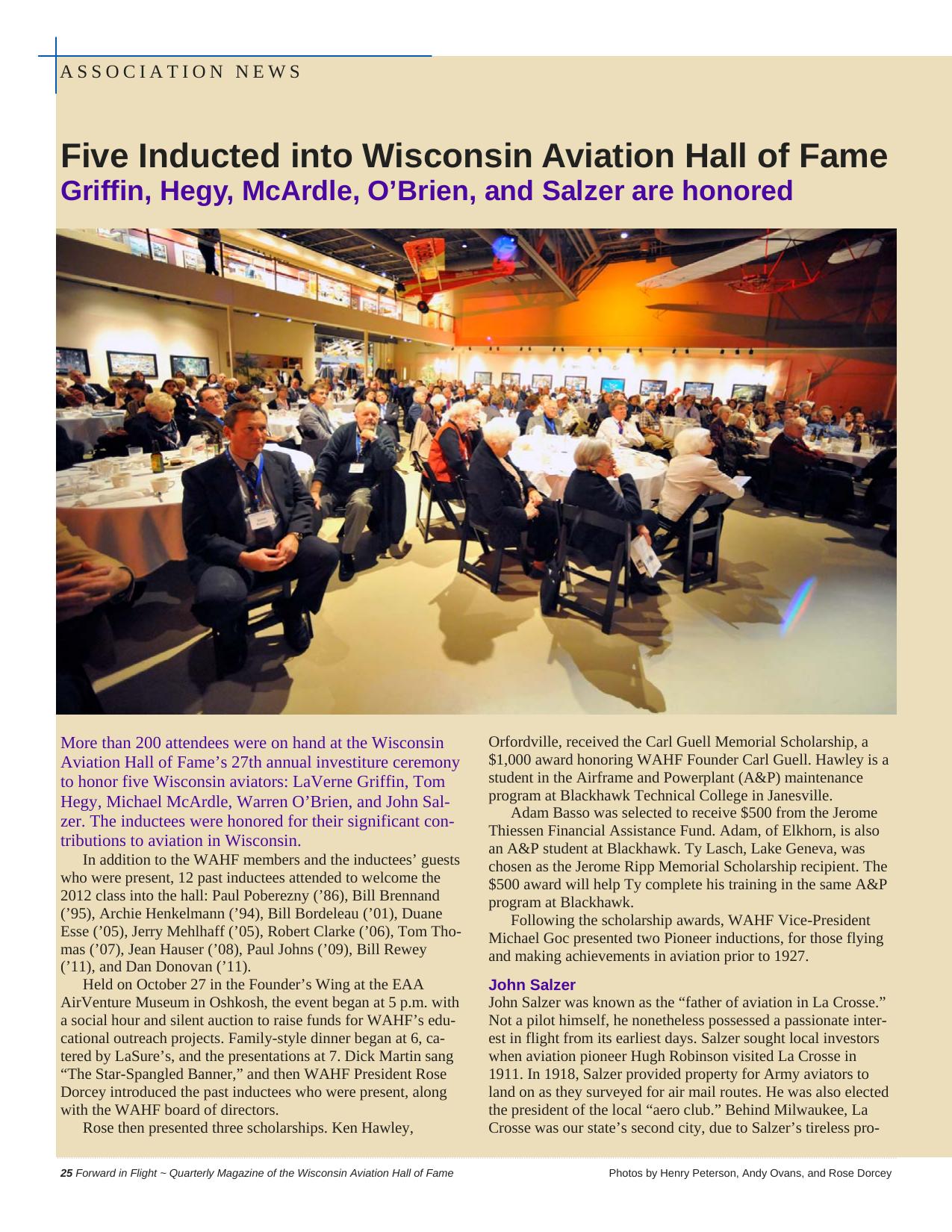
ASSOCIATION NEWS Five Inducted into Wisconsin Aviation Hall of Fame Griffin, Hegy, McArdle, O’Brien, and Salzer are honored More than 200 attendees were on hand at the Wisconsin Aviation Hall of Fame’s 27th annual investiture ceremony to honor five Wisconsin aviators: LaVerne Griffin, Tom Hegy, Michael McArdle, Warren O’Brien, and John Salzer. The inductees were honored for their significant contributions to aviation in Wisconsin. In addition to the WAHF members and the inductees’ guests who were present, 12 past inductees attended to welcome the 2012 class into the hall: Paul Poberezny (’86), Bill Brennand (’95), Archie Henkelmann (’94), Bill Bordeleau (’01), Duane Esse (’05), Jerry Mehlhaff (’05), Robert Clarke (’06), Tom Thomas (’07), Jean Hauser (’08), Paul Johns (’09), Bill Rewey (’11), and Dan Donovan (’11). Held on October 27 in the Founder’s Wing at the EAA AirVenture Museum in Oshkosh, the event began at 5 p.m. with a social hour and silent auction to raise funds for WAHF’s educational outreach projects. Family-style dinner began at 6, catered by LaSure’s, and the presentations at 7. Dick Martin sang “The Star-Spangled Banner,” and then WAHF President Rose Dorcey introduced the past inductees who were present, along with the WAHF board of directors. Rose then presented three scholarships. Ken Hawley, 25 Forward in Flight ~ Quarterly Magazine of the Wisconsin Aviation Hall of Fame Orfordville, received the Carl Guell Memorial Scholarship, a $1,000 award honoring WAHF Founder Carl Guell. Hawley is a student in the Airframe and Powerplant (A&P) maintenance program at Blackhawk Technical College in Janesville. Adam Basso was selected to receive $500 from the Jerome Thiessen Financial Assistance Fund. Adam, of Elkhorn, is also an A&P student at Blackhawk. Ty Lasch, Lake Geneva, was chosen as the Jerome Ripp Memorial Scholarship recipient. The $500 award will help Ty complete his training in the same A&P program at Blackhawk. Following the scholarship awards, WAHF Vice-President Michael Goc presented two Pioneer inductions, for those flying and making achievements in aviation prior to 1927. John Salzer John Salzer was known as the “father of aviation in La Crosse.” Not a pilot himself, he nonetheless possessed a passionate interest in flight from its earliest days. Salzer sought local investors when aviation pioneer Hugh Robinson visited La Crosse in 1911. In 1918, Salzer provided property for Army aviators to land on as they surveyed for air mail routes. He was also elected the president of the local “aero club.” Behind Milwaukee, La Crosse was our state’s second city, due to Salzer’s tireless proPhotos by Henry Peterson, Andy Ovans, and Rose Dorcey
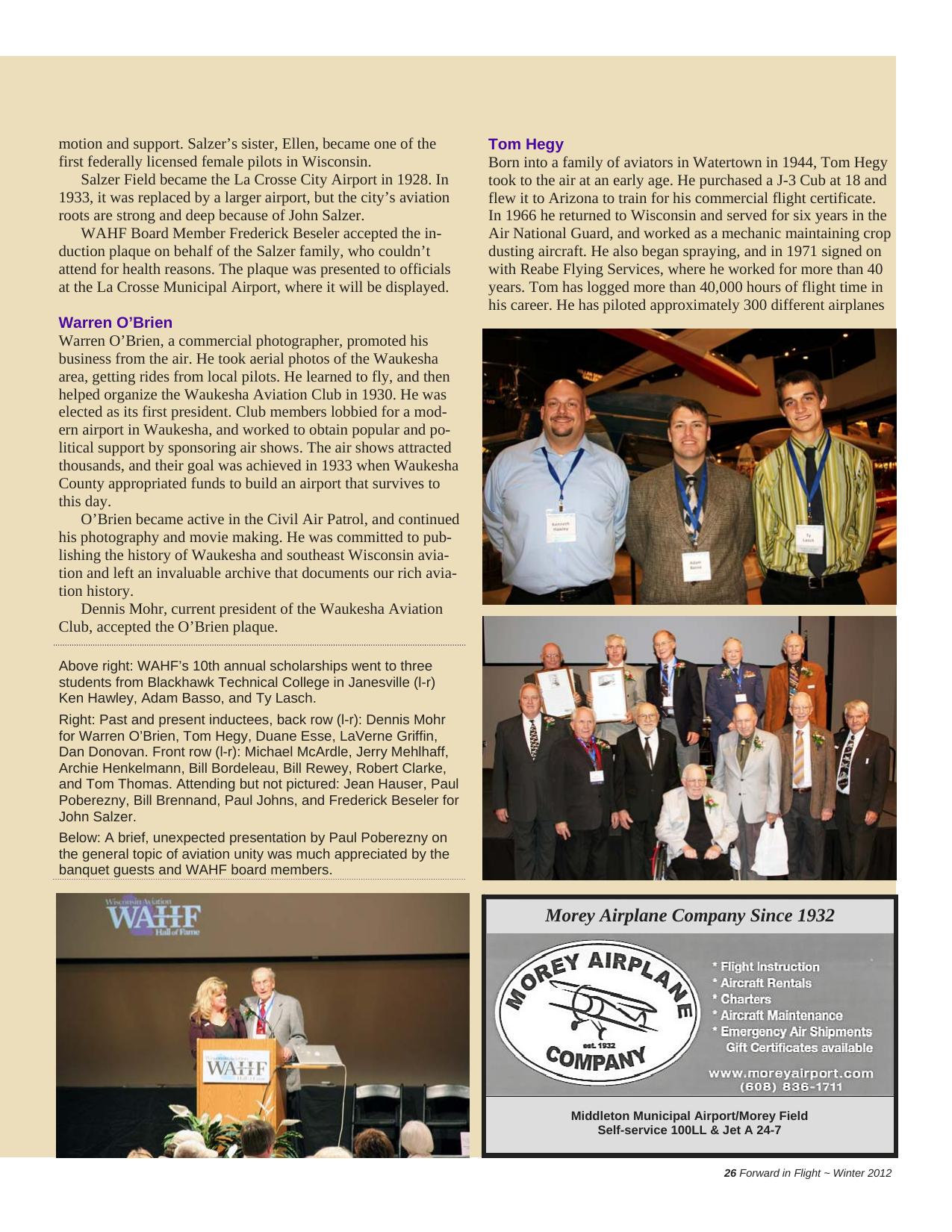
motion and support. Salzer’s sister, Ellen, became one of the first federally licensed female pilots in Wisconsin. Salzer Field became the La Crosse City Airport in 1928. In 1933, it was replaced by a larger airport, but the city’s aviation roots are strong and deep because of John Salzer. WAHF Board Member Frederick Beseler accepted the induction plaque on behalf of the Salzer family, who couldn’t attend for health reasons. The plaque was presented to officials at the La Crosse Municipal Airport, where it will be displayed. Tom Hegy Born into a family of aviators in Watertown in 1944, Tom Hegy took to the air at an early age. He purchased a J-3 Cub at 18 and flew it to Arizona to train for his commercial flight certificate. In 1966 he returned to Wisconsin and served for six years in the Air National Guard, and worked as a mechanic maintaining crop dusting aircraft. He also began spraying, and in 1971 signed on with Reabe Flying Services, where he worked for more than 40 years. Tom has logged more than 40,000 hours of flight time in his career. He has piloted approximately 300 different airplanes Warren O’Brien Warren O’Brien, a commercial photographer, promoted his business from the air. He took aerial photos of the Waukesha area, getting rides from local pilots. He learned to fly, and then helped organize the Waukesha Aviation Club in 1930. He was elected as its first president. Club members lobbied for a modern airport in Waukesha, and worked to obtain popular and political support by sponsoring air shows. The air shows attracted thousands, and their goal was achieved in 1933 when Waukesha County appropriated funds to build an airport that survives to this day. O’Brien became active in the Civil Air Patrol, and continued his photography and movie making. He was committed to publishing the history of Waukesha and southeast Wisconsin aviation and left an invaluable archive that documents our rich aviation history. Dennis Mohr, current president of the Waukesha Aviation Club, accepted the O’Brien plaque. Above right: WAHF’s 10th annual scholarships went to three students from Blackhawk Technical College in Janesville (l-r) Ken Hawley, Adam Basso, and Ty Lasch. Right: Past and present inductees, back row (l-r): Dennis Mohr for Warren O’Brien, Tom Hegy, Duane Esse, LaVerne Griffin, Dan Donovan. Front row (l-r): Michael McArdle, Jerry Mehlhaff, Archie Henkelmann, Bill Bordeleau, Bill Rewey, Robert Clarke, and Tom Thomas. Attending but not pictured: Jean Hauser, Paul Poberezny, Bill Brennand, Paul Johns, and Frederick Beseler for John Salzer. Below: A brief, unexpected presentation by Paul Poberezny on the general topic of aviation unity was much appreciated by the banquet guests and WAHF board members. Morey Airplane Company Since 1932 Middleton Municipal Airport/Morey Field Self-service 100LL & Jet A 24-7 26 Forward in Flight ~ Winter 2012
ASSOCIATION NEWS over nearly five decades. When he’s not flying, he builds and restores airplanes, improving performance and comfort where ever he can. He’s a participant in EAA’s Young Eagles program and flew EAA’s 1911 Bleriot aircraft replica in 2011. WAHF’s Charles Swain presented Hegy’s induction. Michael McArdle An aviation educator, pilot, leader in the Civil Air Patrol, and a friend to aviation enthusiasts throughout the state, McArdle is not a typical flight instructor. He used aviation to work more effectively and teach students, from junior high through the military, lessons for their professions and lives. He put aviation to work when he was hired by the UW system to supervise teaching interns throughout the state. To save travel time, he purchased a Cessna 175 to reach teachers and administrators more effectively. He used flight again when the Madison schools hired him to teach geography and ecology. He flew students to see from the air what they learned on the ground. He also revised and expanded the aviation curriculum at Madison’s East and La Follette High Schools, and administered the WisDOT Bureau of Aeronautics’ Aviation Careers Education program. McArdle earned a commercial pilot, single engine land and sea, with an instrument rating, and then took up hot air ballooning. In his balloon, Flower Power, he provided students with 27 Forward in Flight ~ Quarterly Magazine of the Wisconsin Aviation Hall of Fame balloon flights. While still teaching fulltime, McArdle served in the Army Reserves for 30 years, working in intelligence and education. He held leadership positions in the Civil Air Patrol and retired with the rank of colonel and holds the title of National Aerospace Education Advisor. Mike is a recipient of numerous awards as an aerospace educator. His greatest reward is the knowledge that he has helped thousands of men and women learn and understand aviation’s life skills. WAHF’s Tom Thomas presented the induction. Photos by Henry Peterson, Andy Ovans, and Rose Dorcey
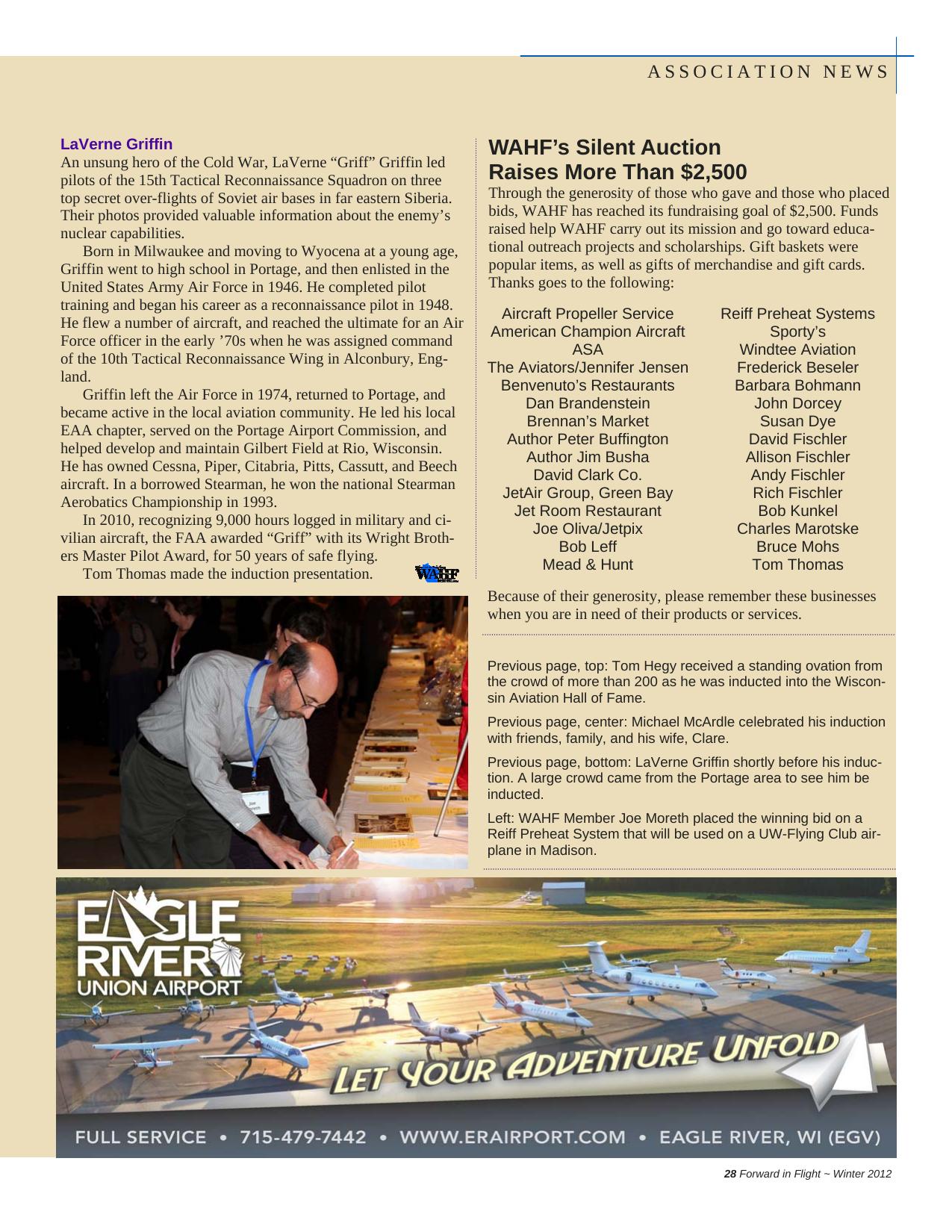
ASSOCIATION NEWS LaVerne Griffin An unsung hero of the Cold War, LaVerne “Griff” Griffin led pilots of the 15th Tactical Reconnaissance Squadron on three top secret over-flights of Soviet air bases in far eastern Siberia. Their photos provided valuable information about the enemy’s nuclear capabilities. Born in Milwaukee and moving to Wyocena at a young age, Griffin went to high school in Portage, and then enlisted in the United States Army Air Force in 1946. He completed pilot training and began his career as a reconnaissance pilot in 1948. He flew a number of aircraft, and reached the ultimate for an Air Force officer in the early ’70s when he was assigned command of the 10th Tactical Reconnaissance Wing in Alconbury, England. Griffin left the Air Force in 1974, returned to Portage, and became active in the local aviation community. He led his local EAA chapter, served on the Portage Airport Commission, and helped develop and maintain Gilbert Field at Rio, Wisconsin. He has owned Cessna, Piper, Citabria, Pitts, Cassutt, and Beech aircraft. In a borrowed Stearman, he won the national Stearman Aerobatics Championship in 1993. In 2010, recognizing 9,000 hours logged in military and civilian aircraft, the FAA awarded “Griff” with its Wright Brothers Master Pilot Award, for 50 years of safe flying. Tom Thomas made the induction presentation. WAHF’s Silent Auction Raises More Than $2,500 Through the generosity of those who gave and those who placed bids, WAHF has reached its fundraising goal of $2,500. Funds raised help WAHF carry out its mission and go toward educational outreach projects and scholarships. Gift baskets were popular items, as well as gifts of merchandise and gift cards. Thanks goes to the following: Aircraft Propeller Service American Champion Aircraft ASA The Aviators/Jennifer Jensen Benvenuto’s Restaurants Dan Brandenstein Brennan’s Market Author Peter Buffington Author Jim Busha David Clark Co. JetAir Group, Green Bay Jet Room Restaurant Joe Oliva/Jetpix Bob Leff Mead & Hunt Reiff Preheat Systems Sporty’s Windtee Aviation Frederick Beseler Barbara Bohmann John Dorcey Susan Dye David Fischler Allison Fischler Andy Fischler Rich Fischler Bob Kunkel Charles Marotske Bruce Mohs Tom Thomas Because of their generosity, please remember these businesses when you are in need of their products or services. Previous page, top: Tom Hegy received a standing ovation from the crowd of more than 200 as he was inducted into the Wisconsin Aviation Hall of Fame. Previous page, center: Michael McArdle celebrated his induction with friends, family, and his wife, Clare. Previous page, bottom: LaVerne Griffin shortly before his induction. A large crowd came from the Portage area to see him be inducted. Left: WAHF Member Joe Moreth placed the winning bid on a Reiff Preheat System that will be used on a UW-Flying Club airplane in Madison. 28 Forward in Flight ~ Winter 2012
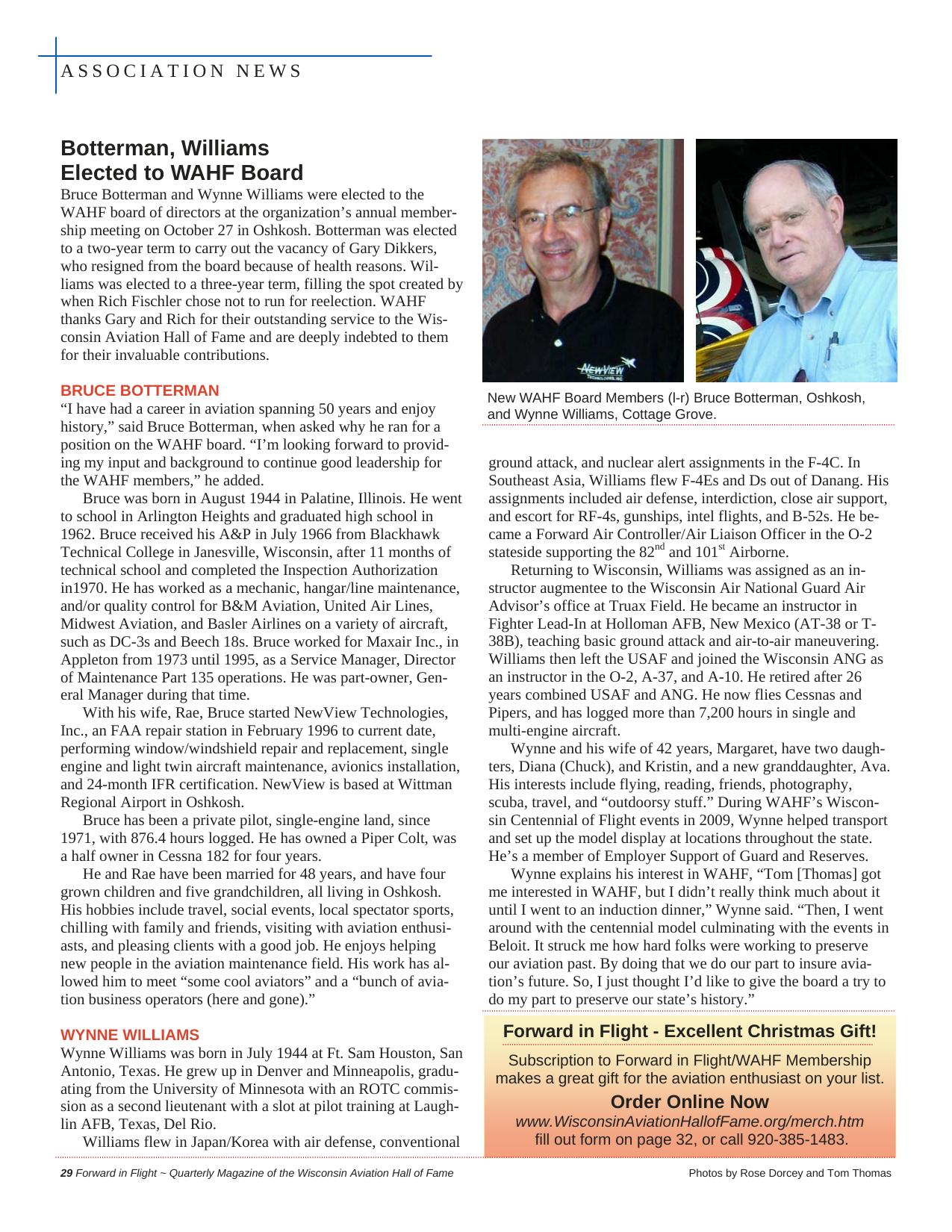
ASSOCIATION NEWS Botterman, Williams Elected to WAHF Board Bruce Botterman and Wynne Williams were elected to the WAHF board of directors at the organization’s annual membership meeting on October 27 in Oshkosh. Botterman was elected to a two-year term to carry out the vacancy of Gary Dikkers, who resigned from the board because of health reasons. Williams was elected to a three-year term, filling the spot created by when Rich Fischler chose not to run for reelection. WAHF thanks Gary and Rich for their outstanding service to the Wisconsin Aviation Hall of Fame and are deeply indebted to them for their invaluable contributions. BRUCE BOTTERMAN “I have had a career in aviation spanning 50 years and enjoy history,” said Bruce Botterman, when asked why he ran for a position on the WAHF board. “I’m looking forward to providing my input and background to continue good leadership for the WAHF members,” he added. Bruce was born in August 1944 in Palatine, Illinois. He went to school in Arlington Heights and graduated high school in 1962. Bruce received his A&P in July 1966 from Blackhawk Technical College in Janesville, Wisconsin, after 11 months of technical school and completed the Inspection Authorization in1970. He has worked as a mechanic, hangar/line maintenance, and/or quality control for B&M Aviation, United Air Lines, Midwest Aviation, and Basler Airlines on a variety of aircraft, such as DC-3s and Beech 18s. Bruce worked for Maxair Inc., in Appleton from 1973 until 1995, as a Service Manager, Director of Maintenance Part 135 operations. He was part-owner, General Manager during that time. With his wife, Rae, Bruce started NewView Technologies, Inc., an FAA repair station in February 1996 to current date, performing window/windshield repair and replacement, single engine and light twin aircraft maintenance, avionics installation, and 24-month IFR certification. NewView is based at Wittman Regional Airport in Oshkosh. Bruce has been a private pilot, single-engine land, since 1971, with 876.4 hours logged. He has owned a Piper Colt, was a half owner in Cessna 182 for four years. He and Rae have been married for 48 years, and have four grown children and five grandchildren, all living in Oshkosh. His hobbies include travel, social events, local spectator sports, chilling with family and friends, visiting with aviation enthusiasts, and pleasing clients with a good job. He enjoys helping new people in the aviation maintenance field. His work has allowed him to meet “some cool aviators” and a “bunch of aviation business operators (here and gone).” WYNNE WILLIAMS Wynne Williams was born in July 1944 at Ft. Sam Houston, San Antonio, Texas. He grew up in Denver and Minneapolis, graduating from the University of Minnesota with an ROTC commission as a second lieutenant with a slot at pilot training at Laughlin AFB, Texas, Del Rio. Williams flew in Japan/Korea with air defense, conventional 29 Forward in Flight ~ Quarterly Magazine of the Wisconsin Aviation Hall of Fame New WAHF Board Members (l-r) Bruce Botterman, Oshkosh, and Wynne Williams, Cottage Grove. ground attack, and nuclear alert assignments in the F-4C. In Southeast Asia, Williams flew F-4Es and Ds out of Danang. His assignments included air defense, interdiction, close air support, and escort for RF-4s, gunships, intel flights, and B-52s. He became a Forward Air Controller/Air Liaison Officer in the O-2 stateside supporting the 82nd and 101st Airborne. Returning to Wisconsin, Williams was assigned as an instructor augmentee to the Wisconsin Air National Guard Air Advisor’s office at Truax Field. He became an instructor in Fighter Lead-In at Holloman AFB, New Mexico (AT-38 or T38B), teaching basic ground attack and air-to-air maneuvering. Williams then left the USAF and joined the Wisconsin ANG as an instructor in the O-2, A-37, and A-10. He retired after 26 years combined USAF and ANG. He now flies Cessnas and Pipers, and has logged more than 7,200 hours in single and multi-engine aircraft. Wynne and his wife of 42 years, Margaret, have two daughters, Diana (Chuck), and Kristin, and a new granddaughter, Ava. His interests include flying, reading, friends, photography, scuba, travel, and “outdoorsy stuff.” During WAHF’s Wisconsin Centennial of Flight events in 2009, Wynne helped transport and set up the model display at locations throughout the state. He’s a member of Employer Support of Guard and Reserves. Wynne explains his interest in WAHF, “Tom [Thomas] got me interested in WAHF, but I didn’t really think much about it until I went to an induction dinner,” Wynne said. “Then, I went around with the centennial model culminating with the events in Beloit. It struck me how hard folks were working to preserve our aviation past. By doing that we do our part to insure aviation’s future. So, I just thought I’d like to give the board a try to do my part to preserve our state’s history.” Forward in Flight - Excellent Christmas Gift! Subscription to Forward in Flight/WAHF Membership makes a great gift for the aviation enthusiast on your list. Order Online Now www.WisconsinAviationHallofFame.org/merch.htm fill out form on page 32, or call 920-385-1483. Photos by Rose Dorcey and Tom Thomas
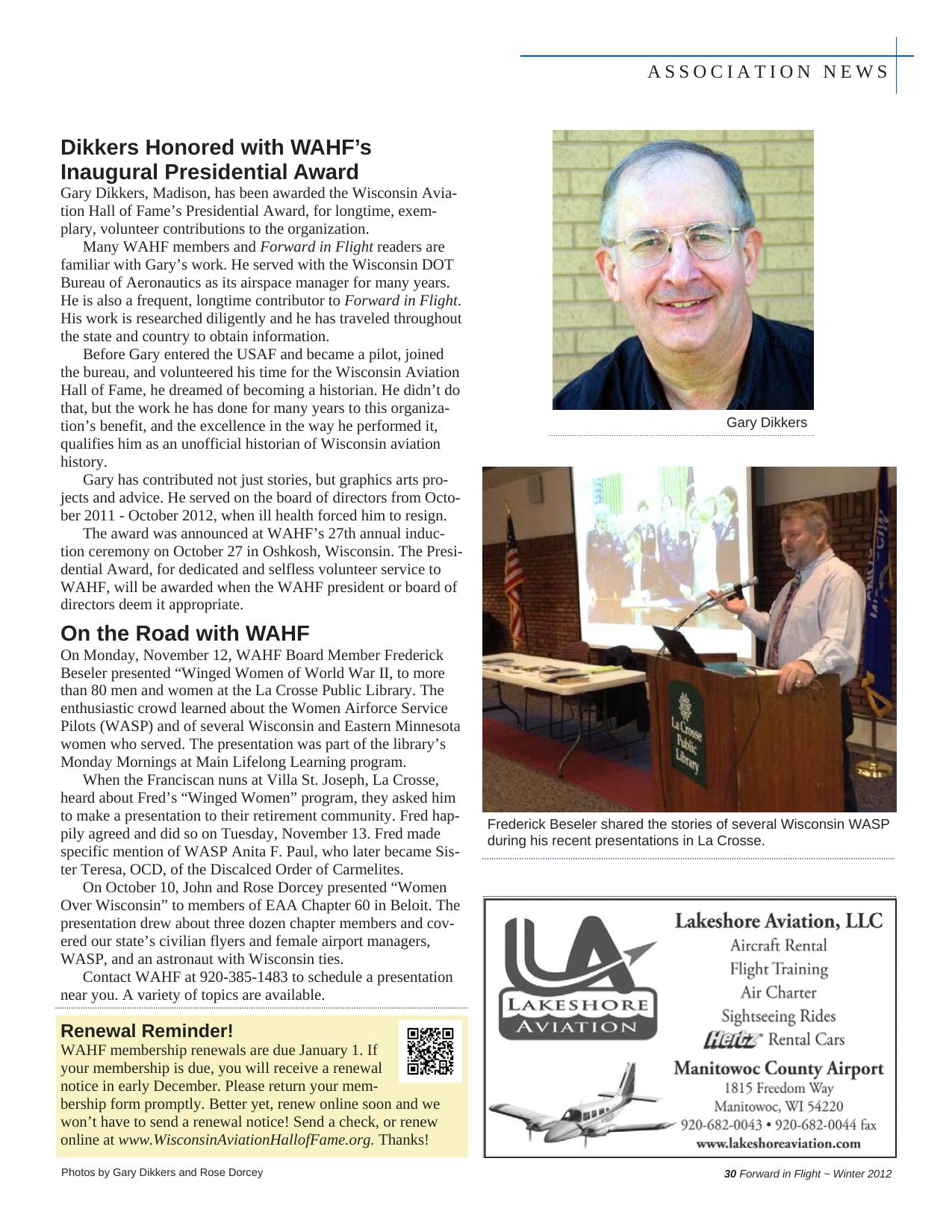
ASSOCIATION NEWS Dikkers Honored with WAHF’s Inaugural Presidential Award Gary Dikkers, Madison, has been awarded the Wisconsin Aviation Hall of Fame’s Presidential Award, for longtime, exemplary, volunteer contributions to the organization. Many WAHF members and Forward in Flight readers are familiar with Gary’s work. He served with the Wisconsin DOT Bureau of Aeronautics as its airspace manager for many years. He is also a frequent, longtime contributor to Forward in Flight. His work is researched diligently and he has traveled throughout the state and country to obtain information. Before Gary entered the USAF and became a pilot, joined the bureau, and volunteered his time for the Wisconsin Aviation Hall of Fame, he dreamed of becoming a historian. He didn’t do that, but the work he has done for many years to this organization’s benefit, and the excellence in the way he performed it, qualifies him as an unofficial historian of Wisconsin aviation history. Gary has contributed not just stories, but graphics arts projects and advice. He served on the board of directors from October 2011 - October 2012, when ill health forced him to resign. The award was announced at WAHF’s 27th annual induction ceremony on October 27 in Oshkosh, Wisconsin. The Presidential Award, for dedicated and selfless volunteer service to WAHF, will be awarded when the WAHF president or board of directors deem it appropriate. Gary Dikkers On the Road with WAHF On Monday, November 12, WAHF Board Member Frederick Beseler presented “Winged Women of World War II, to more than 80 men and women at the La Crosse Public Library. The enthusiastic crowd learned about the Women Airforce Service Pilots (WASP) and of several Wisconsin and Eastern Minnesota women who served. The presentation was part of the library’s Monday Mornings at Main Lifelong Learning program. When the Franciscan nuns at Villa St. Joseph, La Crosse, heard about Fred’s “Winged Women” program, they asked him to make a presentation to their retirement community. Fred happily agreed and did so on Tuesday, November 13. Fred made specific mention of WASP Anita F. Paul, who later became Sister Teresa, OCD, of the Discalced Order of Carmelites. On October 10, John and Rose Dorcey presented “Women Over Wisconsin” to members of EAA Chapter 60 in Beloit. The presentation drew about three dozen chapter members and covered our state’s civilian flyers and female airport managers, WASP, and an astronaut with Wisconsin ties. Contact WAHF at 920-385-1483 to schedule a presentation near you. A variety of topics are available. Frederick Beseler shared the stories of several Wisconsin WASP during his recent presentations in La Crosse. Renewal Reminder! WAHF membership renewals are due January 1. If your membership is due, you will receive a renewal notice in early December. Please return your membership form promptly. Better yet, renew online soon and we won’t have to send a renewal notice! Send a check, or renew online at www.WisconsinAviationHallofFame.org. Thanks! Photos by Gary Dikkers and Rose Dorcey 30 Forward in Flight ~ Winter 2012
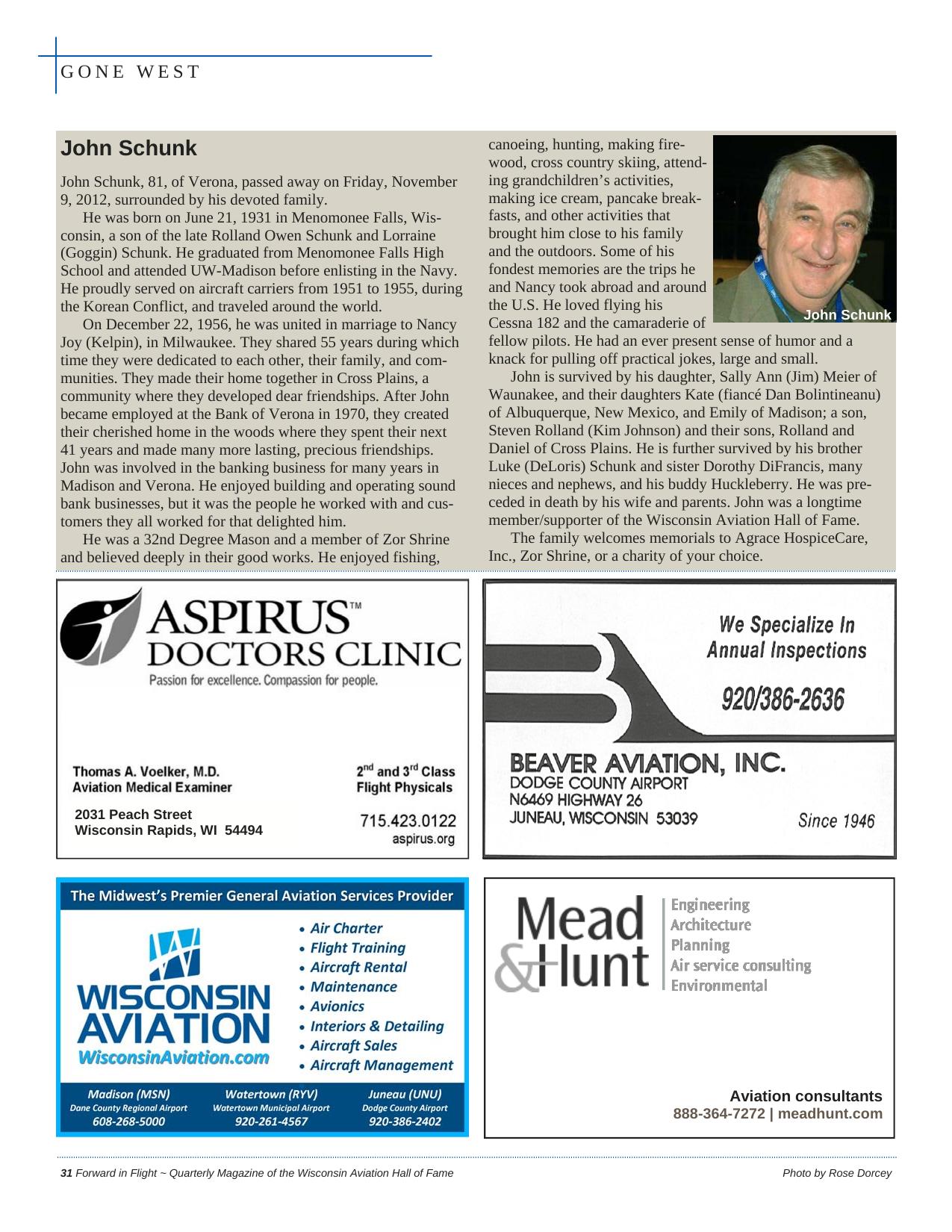
GONE WEST John Schunk John Schunk, 81, of Verona, passed away on Friday, November 9, 2012, surrounded by his devoted family. He was born on June 21, 1931 in Menomonee Falls, Wisconsin, a son of the late Rolland Owen Schunk and Lorraine (Goggin) Schunk. He graduated from Menomonee Falls High School and attended UW-Madison before enlisting in the Navy. He proudly served on aircraft carriers from 1951 to 1955, during the Korean Conflict, and traveled around the world. On December 22, 1956, he was united in marriage to Nancy Joy (Kelpin), in Milwaukee. They shared 55 years during which time they were dedicated to each other, their family, and communities. They made their home together in Cross Plains, a community where they developed dear friendships. After John became employed at the Bank of Verona in 1970, they created their cherished home in the woods where they spent their next 41 years and made many more lasting, precious friendships. John was involved in the banking business for many years in Madison and Verona. He enjoyed building and operating sound bank businesses, but it was the people he worked with and customers they all worked for that delighted him. He was a 32nd Degree Mason and a member of Zor Shrine and believed deeply in their good works. He enjoyed fishing, canoeing, hunting, making firewood, cross country skiing, attending grandchildren’s activities, making ice cream, pancake breakfasts, and other activities that brought him close to his family and the outdoors. Some of his fondest memories are the trips he and Nancy took abroad and around the U.S. He loved flying his John Schunk Cessna 182 and the camaraderie of fellow pilots. He had an ever present sense of humor and a knack for pulling off practical jokes, large and small. John is survived by his daughter, Sally Ann (Jim) Meier of Waunakee, and their daughters Kate (fiancé Dan Bolintineanu) of Albuquerque, New Mexico, and Emily of Madison; a son, Steven Rolland (Kim Johnson) and their sons, Rolland and Daniel of Cross Plains. He is further survived by his brother Luke (DeLoris) Schunk and sister Dorothy DiFrancis, many nieces and nephews, and his buddy Huckleberry. He was preceded in death by his wife and parents. John was a longtime member/supporter of the Wisconsin Aviation Hall of Fame. The family welcomes memorials to Agrace HospiceCare, Inc., Zor Shrine, or a charity of your choice. 2031 Peach Street Wisconsin Rapids, WI 54494 Aviation consultants 888-364-7272 | meadhunt.com 31 Forward in Flight ~ Quarterly Magazine of the Wisconsin Aviation Hall of Fame Photo by Rose Dorcey
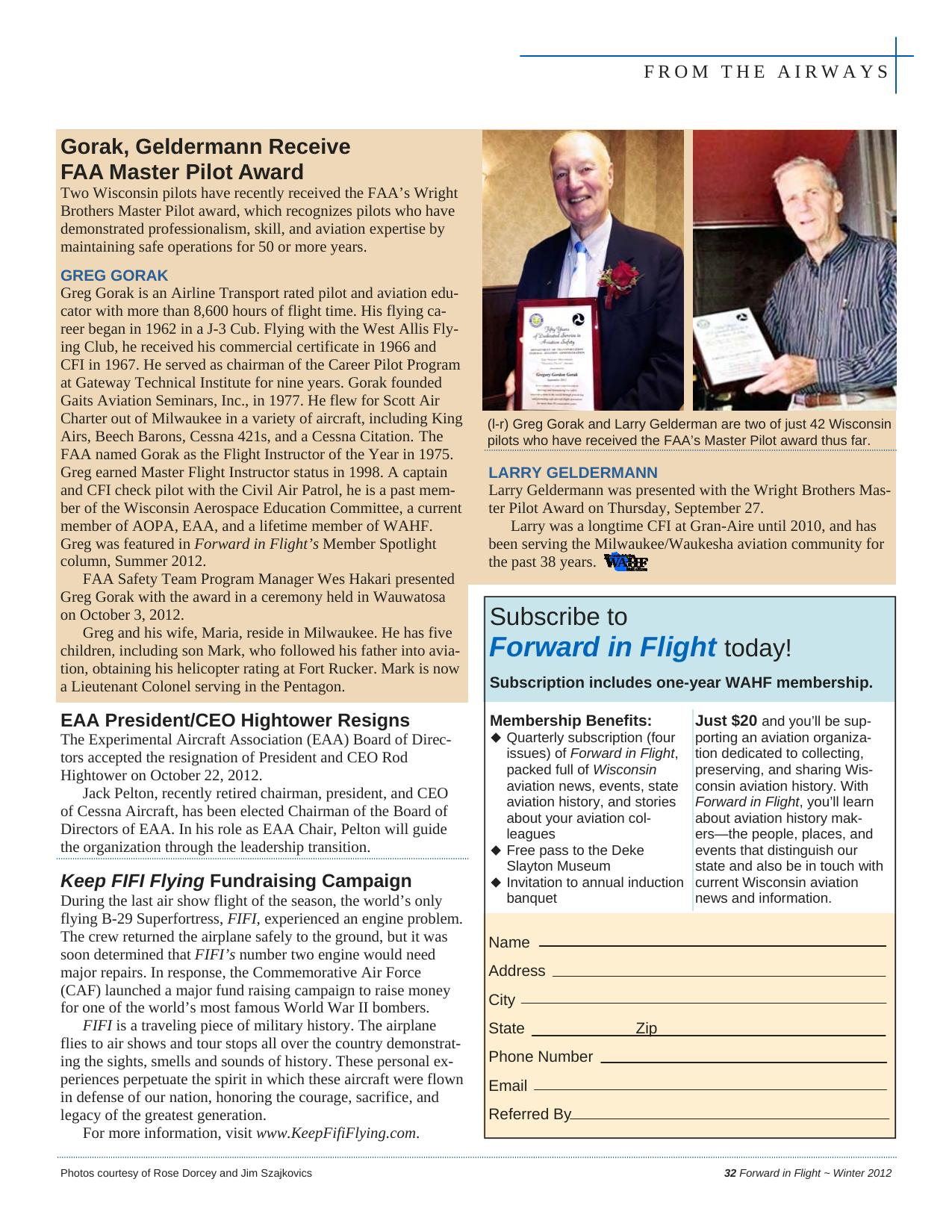
FROM THE AIRWAYS Gorak, Geldermann Receive FAA Master Pilot Award Two Wisconsin pilots have recently received the FAA’s Wright Brothers Master Pilot award, which recognizes pilots who have demonstrated professionalism, skill, and aviation expertise by maintaining safe operations for 50 or more years. GREG GORAK Greg Gorak is an Airline Transport rated pilot and aviation educator with more than 8,600 hours of flight time. His flying career began in 1962 in a J-3 Cub. Flying with the West Allis Flying Club, he received his commercial certificate in 1966 and CFI in 1967. He served as chairman of the Career Pilot Program at Gateway Technical Institute for nine years. Gorak founded Gaits Aviation Seminars, Inc., in 1977. He flew for Scott Air Charter out of Milwaukee in a variety of aircraft, including King Airs, Beech Barons, Cessna 421s, and a Cessna Citation. The FAA named Gorak as the Flight Instructor of the Year in 1975. Greg earned Master Flight Instructor status in 1998. A captain and CFI check pilot with the Civil Air Patrol, he is a past member of the Wisconsin Aerospace Education Committee, a current member of AOPA, EAA, and a lifetime member of WAHF. Greg was featured in Forward in Flight’s Member Spotlight column, Summer 2012. FAA Safety Team Program Manager Wes Hakari presented Greg Gorak with the award in a ceremony held in Wauwatosa on October 3, 2012. Greg and his wife, Maria, reside in Milwaukee. He has five children, including son Mark, who followed his father into aviation, obtaining his helicopter rating at Fort Rucker. Mark is now a Lieutenant Colonel serving in the Pentagon. (l-r) Greg Gorak and Larry Gelderman are two of just 42 Wisconsin pilots who have received the FAA’s Master Pilot award thus far. LARRY GELDERMANN Larry Geldermann was presented with the Wright Brothers Master Pilot Award on Thursday, September 27. Larry was a longtime CFI at Gran-Aire until 2010, and has been serving the Milwaukee/Waukesha aviation community for the past 38 years. Subscribe to Forward in Flight today! Subscription includes one-year WAHF membership. EAA President/CEO Hightower Resigns Membership Benefits: Just $20 and you’ll be sup- The Experimental Aircraft Association (EAA) Board of Directors accepted the resignation of President and CEO Rod Hightower on October 22, 2012. Jack Pelton, recently retired chairman, president, and CEO of Cessna Aircraft, has been elected Chairman of the Board of Directors of EAA. In his role as EAA Chair, Pelton will guide the organization through the leadership transition. Quarterly subscription (four porting an aviation organization dedicated to collecting, preserving, and sharing Wisconsin aviation history. With Forward in Flight, you’ll learn about aviation history makers—the people, places, and events that distinguish our state and also be in touch with current Wisconsin aviation news and information. Keep FIFI Flying Fundraising Campaign During the last air show flight of the season, the world’s only flying B-29 Superfortress, FIFI, experienced an engine problem. The crew returned the airplane safely to the ground, but it was soon determined that FIFI’s number two engine would need major repairs. In response, the Commemorative Air Force (CAF) launched a major fund raising campaign to raise money for one of the world’s most famous World War II bombers. FIFI is a traveling piece of military history. The airplane flies to air shows and tour stops all over the country demonstrating the sights, smells and sounds of history. These personal experiences perpetuate the spirit in which these aircraft were flown in defense of our nation, honoring the courage, sacrifice, and legacy of the greatest generation. For more information, visit www.KeepFifiFlying.com. Photos courtesy of Rose Dorcey and Jim Szajkovics issues) of Forward in Flight, packed full of Wisconsin aviation news, events, state aviation history, and stories about your aviation colleagues Free pass to the Deke Slayton Museum Invitation to annual induction banquet Name Address City State Zip Phone Number Email Referred By 32 Forward in Flight ~ Winter 2012
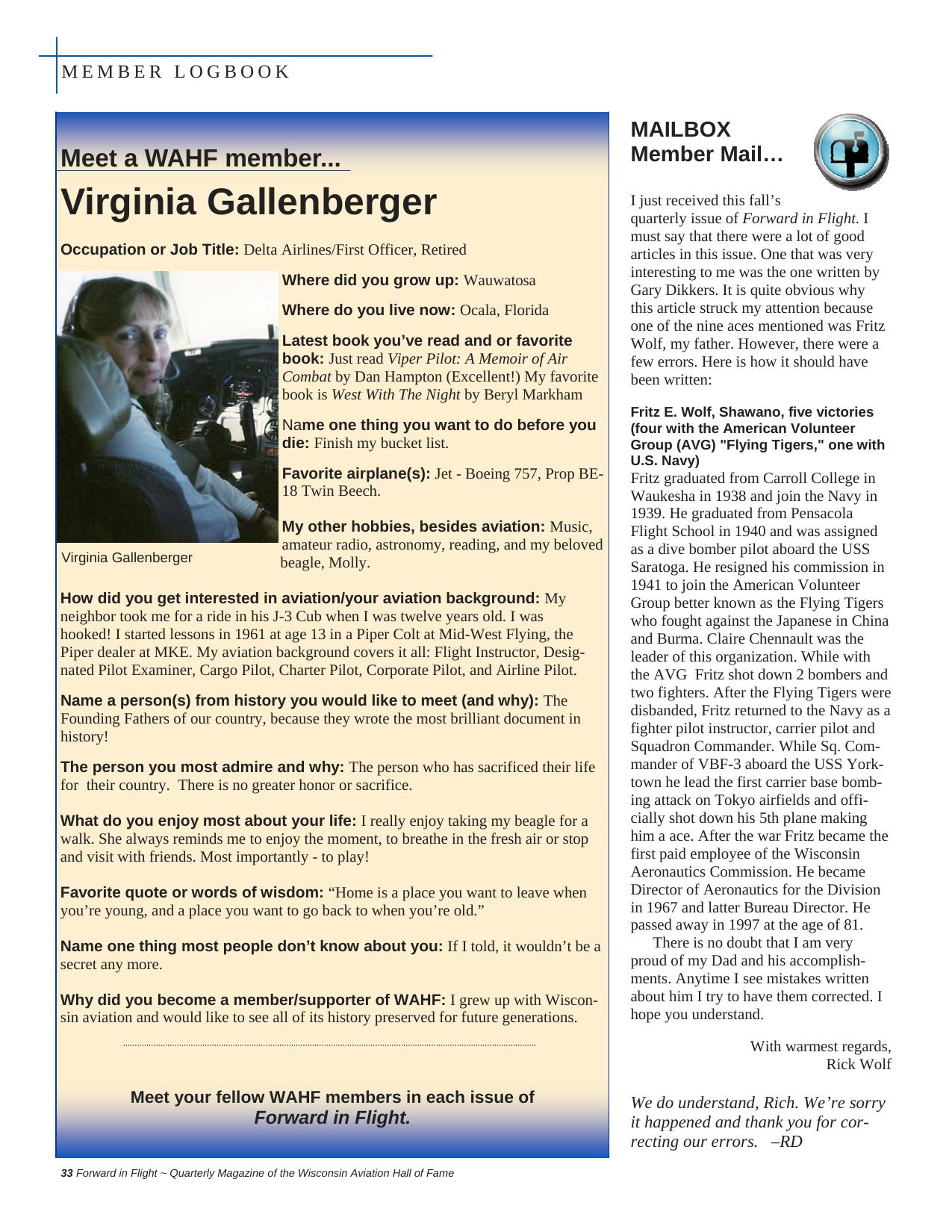
MEMBER LOGBOOK Meet a WAHF member... Virginia Gallenberger Occupation or Job Title: Delta Airlines/First Officer, Retired Where did you grow up: Wauwatosa Where do you live now: Ocala, Florida Latest book you’ve read and or favorite book: Just read Viper Pilot: A Memoir of Air Combat by Dan Hampton (Excellent!) My favorite book is West With The Night by Beryl Markham Name one thing you want to do before you die: Finish my bucket list. Favorite airplane(s): Jet - Boeing 757, Prop BE18 Twin Beech. Virginia Gallenberger My other hobbies, besides aviation: Music, amateur radio, astronomy, reading, and my beloved beagle, Molly. How did you get interested in aviation/your aviation background: My neighbor took me for a ride in his J-3 Cub when I was twelve years old. I was hooked! I started lessons in 1961 at age 13 in a Piper Colt at Mid-West Flying, the Piper dealer at MKE. My aviation background covers it all: Flight Instructor, Designated Pilot Examiner, Cargo Pilot, Charter Pilot, Corporate Pilot, and Airline Pilot. Name a person(s) from history you would like to meet (and why): The Founding Fathers of our country, because they wrote the most brilliant document in history! The person you most admire and why: The person who has sacrificed their life for their country. There is no greater honor or sacrifice. What do you enjoy most about your life: I really enjoy taking my beagle for a walk. She always reminds me to enjoy the moment, to breathe in the fresh air or stop and visit with friends. Most importantly - to play! Favorite quote or words of wisdom: “Home is a place you want to leave when you’re young, and a place you want to go back to when you’re old.” Name one thing most people don’t know about you: If I told, it wouldn’t be a secret any more. Why did you become a member/supporter of WAHF: I grew up with Wisconsin aviation and would like to see all of its history preserved for future generations. MAILBOX Member Mail… I just received this fall’s quarterly issue of Forward in Flight. I must say that there were a lot of good articles in this issue. One that was very interesting to me was the one written by Gary Dikkers. It is quite obvious why this article struck my attention because one of the nine aces mentioned was Fritz Wolf, my father. However, there were a few errors. Here is how it should have been written: Fritz E. Wolf, Shawano, five victories (four with the American Volunteer Group (AVG) "Flying Tigers," one with U.S. Navy) Fritz graduated from Carroll College in Waukesha in 1938 and join the Navy in 1939. He graduated from Pensacola Flight School in 1940 and was assigned as a dive bomber pilot aboard the USS Saratoga. He resigned his commission in 1941 to join the American Volunteer Group better known as the Flying Tigers who fought against the Japanese in China and Burma. Claire Chennault was the leader of this organization. While with the AVG Fritz shot down 2 bombers and two fighters. After the Flying Tigers were disbanded, Fritz returned to the Navy as a fighter pilot instructor, carrier pilot and Squadron Commander. While Sq. Commander of VBF-3 aboard the USS Yorktown he lead the first carrier base bombing attack on Tokyo airfields and officially shot down his 5th plane making him a ace. After the war Fritz became the first paid employee of the Wisconsin Aeronautics Commission. He became Director of Aeronautics for the Division in 1967 and latter Bureau Director. He passed away in 1997 at the age of 81. There is no doubt that I am very proud of my Dad and his accomplishments. Anytime I see mistakes written about him I try to have them corrected. I hope you understand. With warmest regards, Rick Wolf Meet your fellow WAHF members in each issue of Forward in Flight. 33 Forward in Flight ~ Quarterly Magazine of the Wisconsin Aviation Hall of Fame We do understand, Rich. We’re sorry it happened and thank you for correcting our errors. –RD

Wittman Regional Airport Oshkosh So much history ...and still making it! From the legacy of Steve Wittman to Warren Basler’s DC-3 conversions, we’re proud to support and contribute to Wisconsin aviation history. FLY TO OSHKOSH wittmanairport.com @wittmanairport 34 Forward in Flight ~ Winter 2012

PRSRT STD US Postage Paid Wisc Rapids WI Permit 98 3980 SHARRATT DRIVE OSHKOSH WI 54901-1276 The Wisconsin Aviation Hall of Fame is a non-profit membership organization dedicated to preserving the past and fostering the future of flight. Welcome WAHF Member/Supporters: Jim Beckman Doug Benjamin Scott Blixt William Coleman Dennis Denman Jason Draheim Susan Dye Bernie Flatley Timothy Flatley Ron Gabrys Virginia Gallenberger* Carol Kirkland Garry Kirkland Rick Leyes Melissa May Holly Moreth Joe Moreth Richard Pedersen* Walt Pontell Harvey Salveski E.J. Smith Michael Steineke Marcea Weiss *Lifetime Member —Thanks for coming on board. We hope to see you at a WAHF event soon! Congratulations to WAHF Member Henry Peterson, who passed his check-ride for Instrument Instructor, Airplane Single-Engine-Land on June 6, 2012 out of Dane County Regional Airport (KMSN) in Madison, with Designated Examiner Jim Notstad. Winnebago Flying Club, based at Wittman Regional Airport in Oshkosh, has produced a series of videos to help reach potential members and promote general aviation. Flying Club Member Sam Wiltzius (also a WAHF lifetime member) filmed and produced the videos. We’ve watched and enjoyed them, enough to recommend a look. “Cleared for Fall Color” is our favorite, it features footage from a recent flight in the Door County/Sturgeon Bay area. Scan the QR code, or view it on YouTube at http://www.youtube.com/watch?v=Iqb7mC-nYJo. Wisconsin Aviation Hall of Fame Officers and Board of Directors Rose Dorcey, President Michael Goc, Vice President John Dorcey, Secretary/Treasurer Frederick Beseler Bruce Botterman Andrew Ovans Charles Swain Tom Thomas Wynne Williams Charles Marotske, Honorary Chairman of the Board Wisconsin Aviation Hall of Fame 3980 Sharratt Drive Oshkosh, WI 54901-1276 Become a supporter today! For information call Rose Dorcey at 920-385-1483 For two kinds of delicious chili, great camaraderie, and if there’s snow on the ground, a chance to see ski-planes, attend a favorite January event, the annual Chili Ski-plane Fly-in at www.wisconsinaviationhalloffame.org Wausau Downtown Airport (KAUW). There’s no charge for the chili (though donations are welcome) and you’re sure to have a wonderful time! Saturday, January 26 from 11 a.m. until rdorcey@wisconsinaviationhalloffame.org chili is gone. Tip: Arrive early—it’s that good!