Volume 11, Issue 4
🗞️ Download Issue (PDF)
Forward in Flight - Winter 2013
Volume 11, Issue 4 Quarterly Magazine of the Wisconsin Aviation Hall of Fame Winter 2013 WAHF Inducts Five Our Distinguished Wisconsin Aviators A Different Kind of Dogfight A Japanese Mavis and a B-17 Brothers Three Knaups knew how to deliver Airport Celebration Alexander Field is 85
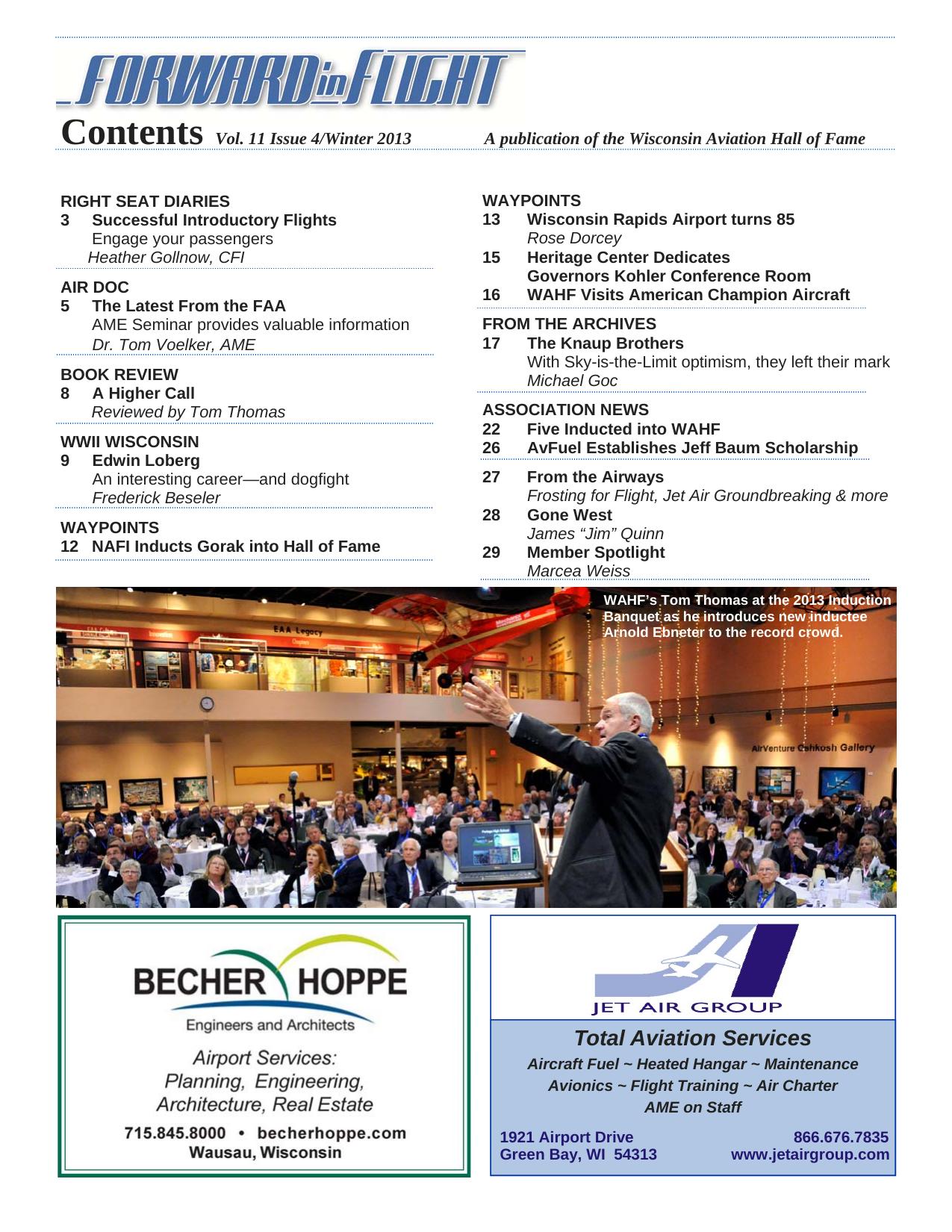
Contents Vol. 11 Issue 4/Winter 2013 RIGHT SEAT DIARIES 3 Successful Introductory Flights Engage your passengers Heather Gollnow, CFI AIR DOC 5 The Latest From the FAA AME Seminar provides valuable information Dr. Tom Voelker, AME BOOK REVIEW 8 A Higher Call Reviewed by Tom Thomas WWII WISCONSIN 9 Edwin Loberg An interesting career—and dogfight Frederick Beseler WAYPOINTS 12 NAFI Inducts Gorak into Hall of Fame A publication of the Wisconsin Aviation Hall of Fame WAYPOINTS 13 Wisconsin Rapids Airport turns 85 Rose Dorcey 15 Heritage Center Dedicates Governors Kohler Conference Room 16 WAHF Visits American Champion Aircraft FROM THE ARCHIVES 17 The Knaup Brothers With Sky-is-the-Limit optimism, they left their mark Michael Goc ASSOCIATION NEWS 22 Five Inducted into WAHF 26 AvFuel Establishes Jeff Baum Scholarship 27 28 29 From the Airways Frosting for Flight, Jet Air Groundbreaking & more Gone West James “Jim” Quinn Member Spotlight Marcea Weiss WAHF’s Tom Thomas at the 2013 Induction Banquet as he introduces new inductee Arnold Ebneter to the record crowd. Total Aviation Services Aircraft Fuel ~ Heated Hangar ~ Maintenance Avionics ~ Flight Training ~ Air Charter AME on Staff 1921 Airport Drive Green Bay, WI 54313 866.676.7835 www.jetairgroup.com
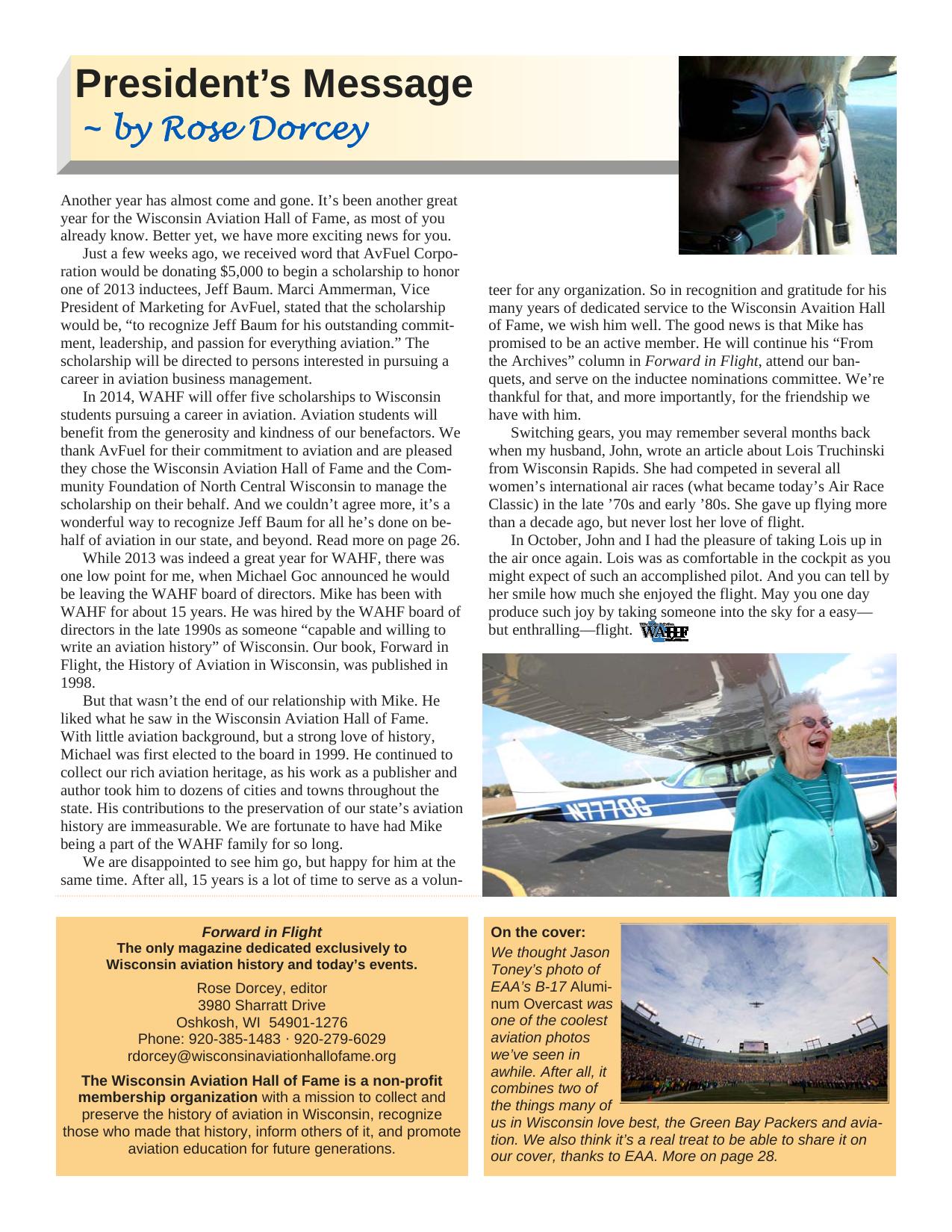
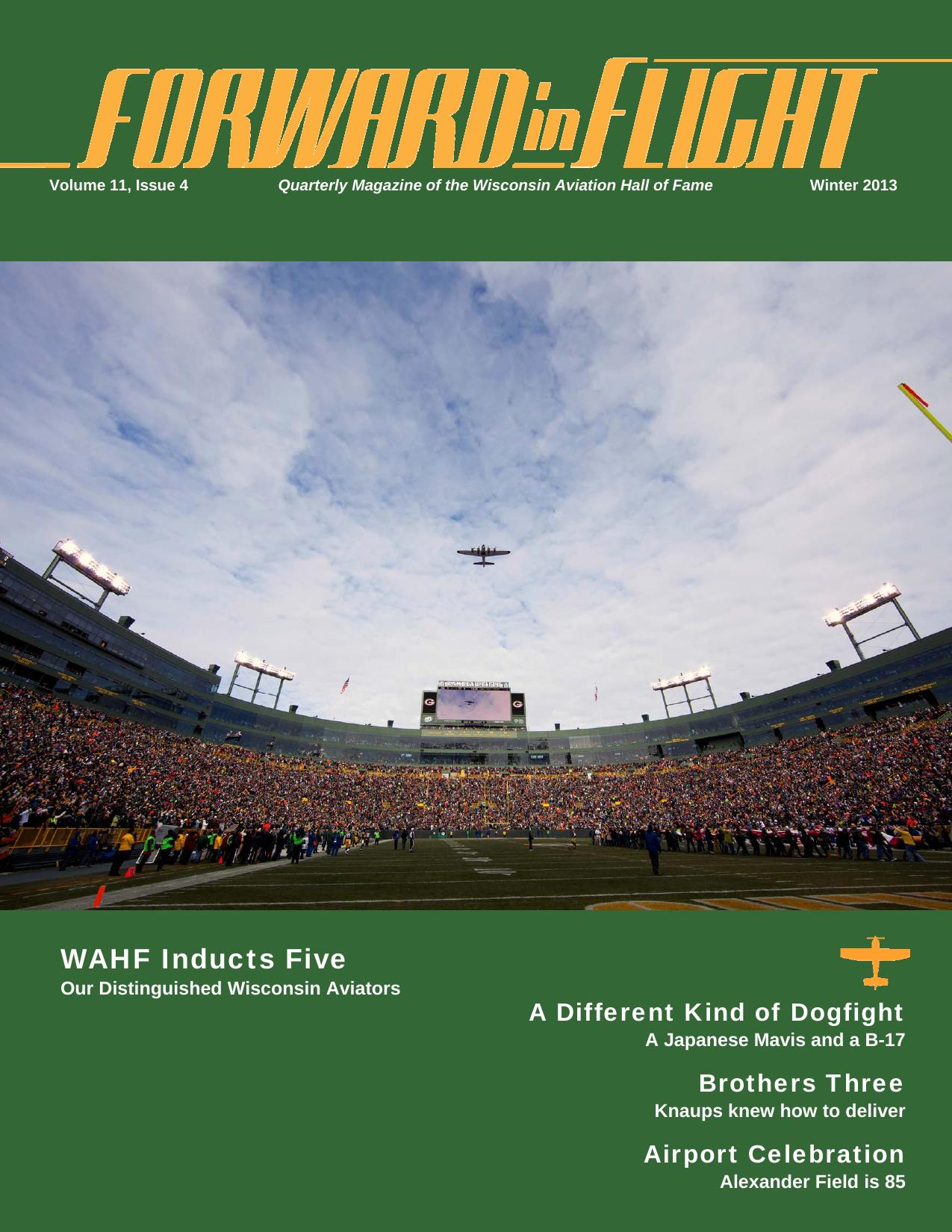
President’s Message ~ by Rose Dorcey Another year has almost come and gone. It’s been another great year for the Wisconsin Aviation Hall of Fame, as most of you already know. Better yet, we have more exciting news for you. Just a few weeks ago, we received word that AvFuel Corporation would be donating $5,000 to begin a scholarship to honor one of 2013 inductees, Jeff Baum. Marci Ammerman, Vice President of Marketing for AvFuel, stated that the scholarship would be, “to recognize Jeff Baum for his outstanding commitment, leadership, and passion for everything aviation.” The scholarship will be directed to persons interested in pursuing a career in aviation business management. In 2014, WAHF will offer five scholarships to Wisconsin students pursuing a career in aviation. Aviation students will benefit from the generosity and kindness of our benefactors. We thank AvFuel for their commitment to aviation and are pleased they chose the Wisconsin Aviation Hall of Fame and the Community Foundation of North Central Wisconsin to manage the scholarship on their behalf. And we couldn’t agree more, it’s a wonderful way to recognize Jeff Baum for all he’s done on behalf of aviation in our state, and beyond. Read more on page 26. While 2013 was indeed a great year for WAHF, there was one low point for me, when Michael Goc announced he would be leaving the WAHF board of directors. Mike has been with WAHF for about 15 years. He was hired by the WAHF board of directors in the late 1990s as someone “capable and willing to write an aviation history” of Wisconsin. Our book, Forward in Flight, the History of Aviation in Wisconsin, was published in 1998. But that wasn’t the end of our relationship with Mike. He liked what he saw in the Wisconsin Aviation Hall of Fame. With little aviation background, but a strong love of history, Michael was first elected to the board in 1999. He continued to collect our rich aviation heritage, as his work as a publisher and author took him to dozens of cities and towns throughout the state. His contributions to the preservation of our state’s aviation history are immeasurable. We are fortunate to have had Mike being a part of the WAHF family for so long. We are disappointed to see him go, but happy for him at the same time. After all, 15 years is a lot of time to serve as a volunForward in Flight The only magazine dedicated exclusively to Wisconsin aviation history and today’s events. Rose Dorcey, editor 3980 Sharratt Drive Oshkosh, WI 54901-1276 Phone: 920-385-1483 · 920-279-6029 rdorcey@wisconsinaviationhallofame.org The Wisconsin Aviation Hall of Fame is a non-profit membership organization with a mission to collect and preserve the history of aviation in Wisconsin, recognize those who made that history, inform others of it, and promote aviation education for future generations. teer for any organization. So in recognition and gratitude for his many years of dedicated service to the Wisconsin Avaition Hall of Fame, we wish him well. The good news is that Mike has promised to be an active member. He will continue his “From the Archives” column in Forward in Flight, attend our banquets, and serve on the inductee nominations committee. We’re thankful for that, and more importantly, for the friendship we have with him. Switching gears, you may remember several months back when my husband, John, wrote an article about Lois Truchinski from Wisconsin Rapids. She had competed in several all women’s international air races (what became today’s Air Race Classic) in the late ’70s and early ’80s. She gave up flying more than a decade ago, but never lost her love of flight. In October, John and I had the pleasure of taking Lois up in the air once again. Lois was as comfortable in the cockpit as you might expect of such an accomplished pilot. And you can tell by her smile how much she enjoyed the flight. May you one day produce such joy by taking someone into the sky for a easy— but enthralling—flight. On the cover: We thought Jason Toney’s photo of EAA’s B-17 Aluminum Overcast was one of the coolest aviation photos we’ve seen in awhile. After all, it combines two of the things many of us in Wisconsin love best, the Green Bay Packers and aviation. We also think it’s a real treat to be able to share it on our cover, thanks to EAA. More on page 28.
RIGHT SEAT DIARIES Successful Introductory Flights Engage your passengers By Heather Gollnow, CFI A big part of being a pilot is sharing our love of flight with others. One way we do this is by giving our friends, family, even complete strangers their first ride in a general aviation aircraft. As an instructor, these kinds of flights have become second nature to me. I love giving intro flights to just about anyone who wants to go. Recently, I was having a conversation with a friend about giving an introductory flight and realized how many of us do things differently when giving a first flight. Out of curiosity, I took an informal poll of fellow pilots to see what their routine is for an introductory flight. What I learned is that the key to a successful introductory flight is engaging your passenger so he or she feels like they are contributing to the flight. I’m writing this from the perspective of a flight instructor who has given many intro flights and I’d like to share some of my ideas with you for your own flying! Pre-Pre-flight This is the phase when someone tells you they think it would be cool to take a flight in an airplane. Or maybe you’re at an airport pancake breakfast waiting for potential Young Eagles to drop in. There’s likely a few different ways this can go. Anyone who has had this experience knows what I mean. You’ll have the kids who have no fear and can’t wait to go, but mom or dad is hesitant. You might have a child who is obviously interested but has some reservations. Airplanes are new to them; they don’t understand how they work. What about the teenager who thinks it’s really cool to fly a plane and asks a ton of great questions? Before you even go to the ramp, talk with your passengers to judge how they may react to the flight. I’ve encountered adults who have had a childhood dream to learn to fly, but as we all know, life gets in the way. Sometimes they just want to go up for one flight to learn a little more just to satisfy that itch. I like to gauge the comfort level of my passenger before deciding when to take them up. For example, my mother gets motion sickness. Obviously 2 p.m. on a hot July afternoon is probably not a good time to take her up. I took her for her first flight at sunset on a cool October evening. The last thing I want to do is to scare anyone with a turbulent flight! Pre-flight All too often, we skip over explaining the pre-flight when giving an introductory flight. Our passenger is usually excited and wants to just get going and isn’t interested in what you’re doing. I’ve also given flights to individuals who want to know absolutely everything about the aircraft. It’s important to figure out the level of curiosity of your passenger so that you can build in additional time to go over the pre-flight in detail if needed. If my passenger isn’t interested, I normally explain that I need some time to pre3 Forward in Flight ~ Quarterly Magazine of the Wisconsin Aviation Hall of Fame flight the aircraft and they just end up plane-watching. If your passenger is curious about the aircraft, make sure you take the time to explain the flight controls and how they impact your flight. This is also a good time to give an introduction to the instrument panel. Do this now rather than during the flight so your passenger can watch as you taxi and take off. You can use this time to show your passenger aviation weather. I like to explain how aviation weather differs from the weather we see on TV or read on weather.com. Normally, I’ll show them a METAR/TAF reading (I’m still old school and look at the un-translated version.) I’ll explain that I’m looking at the wind direction as well as speed and explain the implications of wind during taxi, takeoff, and landing. I also show them how to check weather at altitude. In my experience the winds aloft forecast seems to always be a hit. The weather person on TV doesn’t talk about the temperature at 18,000 feet! Start-up and Taxi Since I’m a CFI, I normally sit in the right seat, even if my passenger has said that he or she doesn’t want to fly. I often have to explain that my airplane isn’t set up like a car where the driver has to sit on one side. I explain that it’s like a driver’s ed car where the instructor could steer, brake, etc. from the right side. Depending on the airplane, if it’s difficult to start from the right side, I’ll have the passenger help me fire it up. If you’re not a CFI, you’ll likely sit in your normal spot. You can still find ways in your aircraft to engage your passenger in engine start-up. Give them a job to do. You could tell them their job is to watch the static port gauge or engine oil pressure. As long as your passenger is willing and able, let them taxi a bit. Hopefully their legs are long enough to reach the rudder pedals! Let them get a feel for the rudders. The natural tendency is to
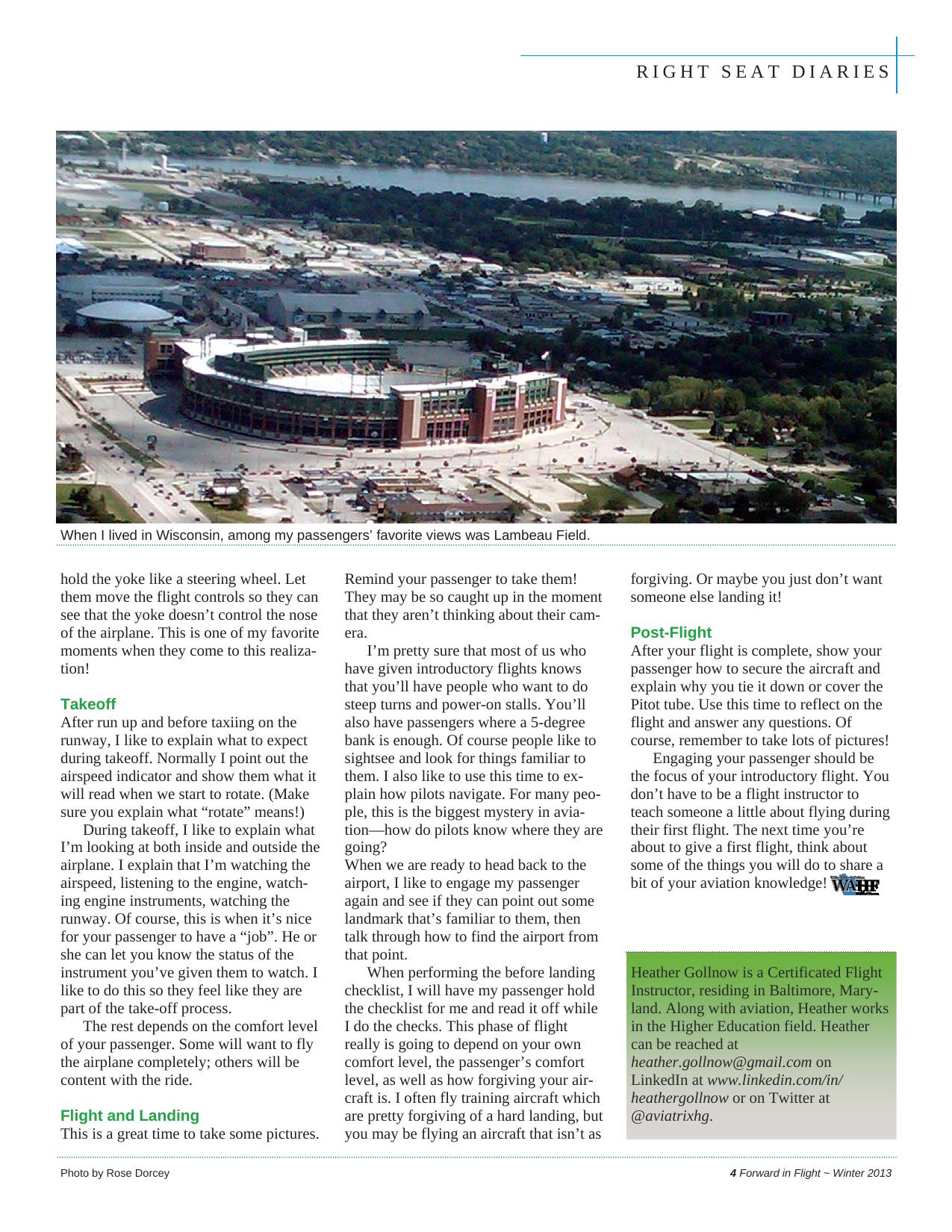
RIGHT SEAT DIARIES When I lived in Wisconsin, among my passengers’ favorite views was Lambeau Field. hold the yoke like a steering wheel. Let them move the flight controls so they can see that the yoke doesn’t control the nose of the airplane. This is one of my favorite moments when they come to this realization! Takeoff After run up and before taxiing on the runway, I like to explain what to expect during takeoff. Normally I point out the airspeed indicator and show them what it will read when we start to rotate. (Make sure you explain what “rotate” means!) During takeoff, I like to explain what I’m looking at both inside and outside the airplane. I explain that I’m watching the airspeed, listening to the engine, watching engine instruments, watching the runway. Of course, this is when it’s nice for your passenger to have a “job”. He or she can let you know the status of the instrument you’ve given them to watch. I like to do this so they feel like they are part of the take-off process. The rest depends on the comfort level of your passenger. Some will want to fly the airplane completely; others will be content with the ride. Flight and Landing This is a great time to take some pictures. Photo by Rose Dorcey Remind your passenger to take them! They may be so caught up in the moment that they aren’t thinking about their camera. I’m pretty sure that most of us who have given introductory flights knows that you’ll have people who want to do steep turns and power-on stalls. You’ll also have passengers where a 5-degree bank is enough. Of course people like to sightsee and look for things familiar to them. I also like to use this time to explain how pilots navigate. For many people, this is the biggest mystery in aviation—how do pilots know where they are going? When we are ready to head back to the airport, I like to engage my passenger again and see if they can point out some landmark that’s familiar to them, then talk through how to find the airport from that point. When performing the before landing checklist, I will have my passenger hold the checklist for me and read it off while I do the checks. This phase of flight really is going to depend on your own comfort level, the passenger’s comfort level, as well as how forgiving your aircraft is. I often fly training aircraft which are pretty forgiving of a hard landing, but you may be flying an aircraft that isn’t as forgiving. Or maybe you just don’t want someone else landing it! Post-Flight After your flight is complete, show your passenger how to secure the aircraft and explain why you tie it down or cover the Pitot tube. Use this time to reflect on the flight and answer any questions. Of course, remember to take lots of pictures! Engaging your passenger should be the focus of your introductory flight. You don’t have to be a flight instructor to teach someone a little about flying during their first flight. The next time you’re about to give a first flight, think about some of the things you will do to share a bit of your aviation knowledge! Heather Gollnow is a Certificated Flight Instructor, residing in Baltimore, Maryland. Along with aviation, Heather works in the Higher Education field. Heather can be reached at heather.gollnow@gmail.com on LinkedIn at www.linkedin.com/in/ heathergollnow or on Twitter at @aviatrixhg. 4 Forward in Flight ~ Winter 2013
AIR DOC The Latest from the FAA AME seminar provides valuable information Dr. Tom Voelker, AME DrAlphaMike@yahoo.com Greetings, airmen. Hello from sunny California! I’m here on a CME (Continuing Medical Education) trip. This time I am in Sacramento attending an FAA AME conference. And it so happens that my deadline for this edition of Air Doc is this evening. I thought I would take the opportunity to bring you the very latest from the FAA aeromedical folks. Here it is, as fresh as can be. The best news isn’t news at all. It is a reaffirmation of the attitude of the FAA aeromedical division. I have written about this issue before, but it is worth repeating. You might not see this in other areas of your flying life, but when it comes to medical issues, particularly certification for flight, “the FAA is your friend.” Dr. Fred Tilton, the Federal Air Surgeon and the number one man in the medical side of the FAA, led off the conference. I really like Fred. He is open and honest, and he is an advocate of the airmen he serves. Fred began with a recap of the success of the aeromedical certification process. I’ve mentioned this before, but it is worth repeating, and the data is up-to-date. He noted that the primary role of the FAA Aeromedical Division is to achieve and maintain safety in flight. There can be no doubt about that. The secondary purpose of his group, in Fred’s words, is “to get everybody we possibly can into the air!” The AMCD (Aeromedical Certification Division) is ultimately responsible for the decision to issue or deny an applicant his or her medical certificate. Dr. Tilton is rightfully proud that only 0.80% of all applications are denied, and after the applicant provides needed medical information to support their medical condition, that number drops to 0.08%. This means only eight of every 10,000 applicants for a medical certificate is ultimately denied the medical. That means only eight of every 10,000 applicants for a medical certificate is ultimately denied the medical. Similarly impressive are the type of medical problems that Dr. Tilton’s people are certifying. While the numbers are small, and the amount of work needed (on the part of AMCD as well as the airman) is great, there are several pilots flying, with medicals in their pockets, who have conditions most people would not even think of certifying. These include pilots with heart transplants, insulin-dependent diabetics, and even one airman with a cardiac defibrillator (although the defibrillation feature is turned off!) Certification We spent a lot of time talking about the changes in the certification process, especially in the handling of “paperwork.” I put that word in quotes intentionally. The use of the paper form 8500-8—the medical application—is no longer allowed. All pilots must use the 5 Forward in Flight ~ Quarterly Magazine of the Wisconsin Aviation Hall of Fame MedXpress computerized form. I have mentioned the MedXpress program several times previously. One glitch with the MedXpress process was identified. If you do not have a middle name (and therefore no middle initial), leave the middle initial spot blank. Some people have entered “NMI” (for no middle initial) and that has messed up the whole process. The biggest change, however, is the new CACI (Conditions AME Can Issue) program which I mentioned in the last edition of this column. There are now quite a few medical conditions for which your AME can issue your medical directly, at the time of the flight physical, assuming your exam is OK and the paperwork is in order. I’ll mention how you can access this list, as well as an accounting of the information you will need to gather from your treating physician, in a little bit. Be Honest We did hear a plea from the certifying docs at OKC. They want you to be sure you are honest on your application. That should go without saying, but they did say it, so I’ll repeat it here. We had a fairly active conversation regarding the confidentiality of a patient’s medical records and the responsibility of the AME to ensure that the skies are safe. If you “hide” a serious medical condition from your AME you are putting him or her in a very difficult ethical situation. The other request of the reviewing doctors is this. When you are asked by the FAA to provide information from your regular doctor about your medical condition, please send everything that is
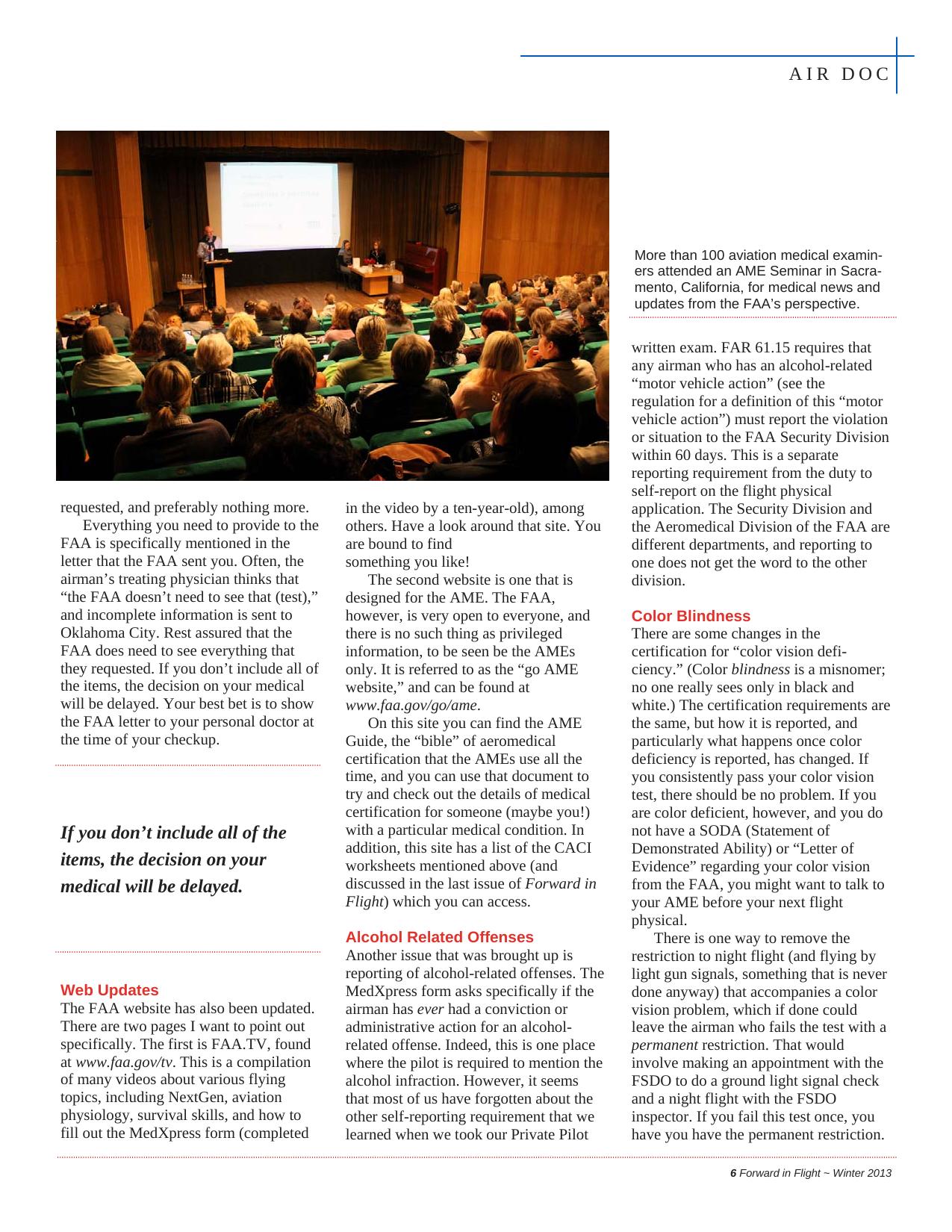
AIR DOC More than 100 aviation medical examiners attended an AME Seminar in Sacramento, California, for medical news and updates from the FAA’s perspective. requested, and preferably nothing more. Everything you need to provide to the FAA is specifically mentioned in the letter that the FAA sent you. Often, the airman’s treating physician thinks that “the FAA doesn’t need to see that (test),” and incomplete information is sent to Oklahoma City. Rest assured that the FAA does need to see everything that they requested. If you don’t include all of the items, the decision on your medical will be delayed. Your best bet is to show the FAA letter to your personal doctor at the time of your checkup. If you don’t include all of the items, the decision on your medical will be delayed. Web Updates The FAA website has also been updated. There are two pages I want to point out specifically. The first is FAA.TV, found at www.faa.gov/tv. This is a compilation of many videos about various flying topics, including NextGen, aviation physiology, survival skills, and how to fill out the MedXpress form (completed in the video by a ten-year-old), among others. Have a look around that site. You are bound to find something you like! The second website is one that is designed for the AME. The FAA, however, is very open to everyone, and there is no such thing as privileged information, to be seen be the AMEs only. It is referred to as the “go AME website,” and can be found at www.faa.gov/go/ame. On this site you can find the AME Guide, the “bible” of aeromedical certification that the AMEs use all the time, and you can use that document to try and check out the details of medical certification for someone (maybe you!) with a particular medical condition. In addition, this site has a list of the CACI worksheets mentioned above (and discussed in the last issue of Forward in Flight) which you can access. Alcohol Related Offenses Another issue that was brought up is reporting of alcohol-related offenses. The MedXpress form asks specifically if the airman has ever had a conviction or administrative action for an alcoholrelated offense. Indeed, this is one place where the pilot is required to mention the alcohol infraction. However, it seems that most of us have forgotten about the other self-reporting requirement that we learned when we took our Private Pilot written exam. FAR 61.15 requires that any airman who has an alcohol-related “motor vehicle action” (see the regulation for a definition of this “motor vehicle action”) must report the violation or situation to the FAA Security Division within 60 days. This is a separate reporting requirement from the duty to self-report on the flight physical application. The Security Division and the Aeromedical Division of the FAA are different departments, and reporting to one does not get the word to the other division. Color Blindness There are some changes in the certification for “color vision deficiency.” (Color blindness is a misnomer; no one really sees only in black and white.) The certification requirements are the same, but how it is reported, and particularly what happens once color deficiency is reported, has changed. If you consistently pass your color vision test, there should be no problem. If you are color deficient, however, and you do not have a SODA (Statement of Demonstrated Ability) or “Letter of Evidence” regarding your color vision from the FAA, you might want to talk to your AME before your next flight physical. There is one way to remove the restriction to night flight (and flying by light gun signals, something that is never done anyway) that accompanies a color vision problem, which if done could leave the airman who fails the test with a permanent restriction. That would involve making an appointment with the FSDO to do a ground light signal check and a night flight with the FSDO inspector. If you fail this test once, you have you have the permanent restriction. 6 Forward in Flight ~ Winter 2013
AIR DOC Sleep Apnea Oh, and here’s the very latest from the FAA. Those of you with sleep apnea, and any of you aviators who are on the particularly heavy side, may want to take note. The FAA is paying particular attention to sleep apnea, which is the newest “disqualifying condition” in aeromedical terms. If you have this condition you cannot fly, at least not until it is being adequately treated and you get a “special issuance” after a satisfactory review of your treating doctor’s report and a review of the use of your “CPAP” machine. (Don’t worry about the terms now. I will devote my entire next issue to this condition, both from a medical approach, and as viewed from the eyes of the FAA.) The group of people at highest risk of sleep apnea is the very obese (although anyone can be affected). Because of this, Oklahoma City is going to require that AMEs defer the medical application of all airmen who have a body mass index (BMI) of more than 40. You can calculate your BMI very easily. Get your height and weight and simply Google “BMI.” You will get a calculator that rapidly gives you your number. As an example of what a BMI of 40 means, a 5’8” pilot (male or female) who weighs 263 pounds, or a 6’0” airman would clock in at 295 pounds. If your BMI exceeds 40 at your next flight physical, you will need to get a “sleep study” (or get a statement from a board-certified sleep specialty doctor) showing that you do not have sleep apnea. 2031 Peach Street Wisconsin Rapids, WI 54494 7 Forward in Flight ~ Quarterly Magazine of the Wisconsin Aviation Hall of Fame If you are in this category, you may want to call your AME before your next medical is due to discuss your options. Remember, I don’t write the rules, I just report them. More on this topic next time. Well, you might think I’ve been having fun relaxing in the heat this weekend. Sorry, folks, but that’s not the case. This conference is an 8 – 5:30 gig, and there is no spare time. The weather is indeed sunny, but I’m indoors the whole day. And the temperature is only about 65, down to about 50 degrees by the time I’m “out of class.” No, it’s definitely not a vacation, but it is very informative, and I do think the five-hour flight will prove worthwhile as you and I work our way through the medical certification process. I’ll keep all of you posted as new programs come along. I wish you all a short winter full of clear, smooth air wherever your flying takes you. Fly often, and fly safely. —Alpha Mike Echo “Alpha Mike Echo” is Dr. Tom V oelker, AME, a family practitioner in Wisconsin Rapids. He and his wife, Kathy, are the parents of four daughters. Tom flies N6224P, a Comanche 250, out of Alexander Field, South Wood County Airport (ISW).
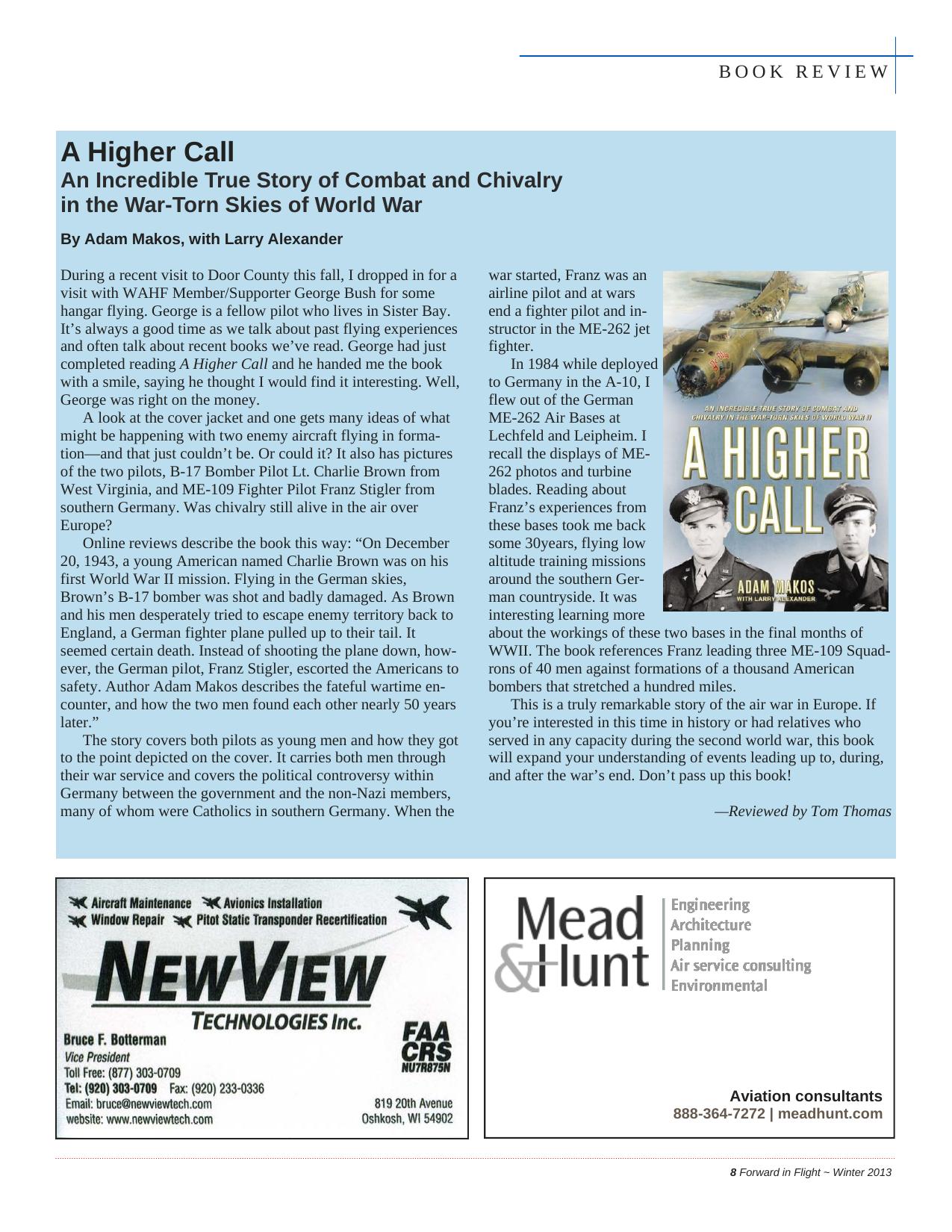
BOOK REVIEW A Higher Call An Incredible True Story of Combat and Chivalry in the War-Torn Skies of World War By Adam Makos, with Larry Alexander During a recent visit to Door County this fall, I dropped in for a visit with WAHF Member/Supporter George Bush for some hangar flying. George is a fellow pilot who lives in Sister Bay. It’s always a good time as we talk about past flying experiences and often talk about recent books we’ve read. George had just completed reading A Higher Call and he handed me the book with a smile, saying he thought I would find it interesting. Well, George was right on the money. A look at the cover jacket and one gets many ideas of what might be happening with two enemy aircraft flying in formation—and that just couldn’t be. Or could it? It also has pictures of the two pilots, B-17 Bomber Pilot Lt. Charlie Brown from West Virginia, and ME-109 Fighter Pilot Franz Stigler from southern Germany. Was chivalry still alive in the air over Europe? Online reviews describe the book this way: “On December 20, 1943, a young American named Charlie Brown was on his first World War II mission. Flying in the German skies, Brown’s B-17 bomber was shot and badly damaged. As Brown and his men desperately tried to escape enemy territory back to England, a German fighter plane pulled up to their tail. It seemed certain death. Instead of shooting the plane down, however, the German pilot, Franz Stigler, escorted the Americans to safety. Author Adam Makos describes the fateful wartime encounter, and how the two men found each other nearly 50 years later.” The story covers both pilots as young men and how they got to the point depicted on the cover. It carries both men through their war service and covers the political controversy within Germany between the government and the non-Nazi members, many of whom were Catholics in southern Germany. When the war started, Franz was an airline pilot and at wars end a fighter pilot and instructor in the ME-262 jet fighter. In 1984 while deployed to Germany in the A-10, I flew out of the German ME-262 Air Bases at Lechfeld and Leipheim. I recall the displays of ME262 photos and turbine blades. Reading about Franz’s experiences from these bases took me back some 30years, flying low altitude training missions around the southern German countryside. It was interesting learning more about the workings of these two bases in the final months of WWII. The book references Franz leading three ME-109 Squadrons of 40 men against formations of a thousand American bombers that stretched a hundred miles. This is a truly remarkable story of the air war in Europe. If you’re interested in this time in history or had relatives who served in any capacity during the second world war, this book will expand your understanding of events leading up to, during, and after the war’s end. Don’t pass up this book! —Reviewed by Tom Thomas Aviation consultants 888-364-7272 | meadhunt.com 8 Forward in Flight ~ Winter 2013
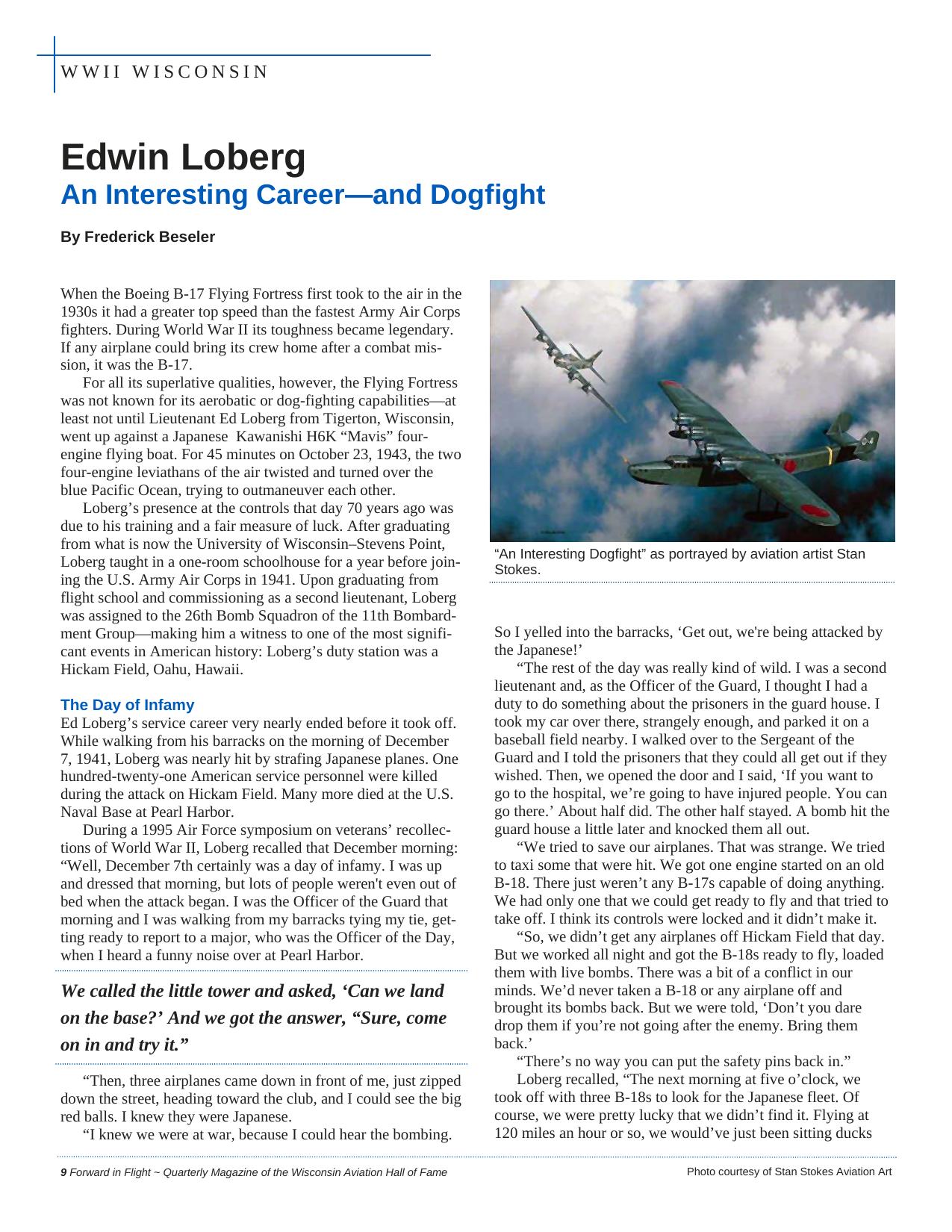
WWII WISCONSIN Edwin Loberg An Interesting Career—and Dogfight By Frederick Beseler When the Boeing B-17 Flying Fortress first took to the air in the 1930s it had a greater top speed than the fastest Army Air Corps fighters. During World War II its toughness became legendary. If any airplane could bring its crew home after a combat mission, it was the B-17. For all its superlative qualities, however, the Flying Fortress was not known for its aerobatic or dog-fighting capabilities—at least not until Lieutenant Ed Loberg from Tigerton, Wisconsin, went up against a Japanese Kawanishi H6K “Mavis” fourengine flying boat. For 45 minutes on October 23, 1943, the two four-engine leviathans of the air twisted and turned over the blue Pacific Ocean, trying to outmaneuver each other. Loberg’s presence at the controls that day 70 years ago was due to his training and a fair measure of luck. After graduating from what is now the University of Wisconsin–Stevens Point, Loberg taught in a one-room schoolhouse for a year before joining the U.S. Army Air Corps in 1941. Upon graduating from flight school and commissioning as a second lieutenant, Loberg was assigned to the 26th Bomb Squadron of the 11th Bombardment Group—making him a witness to one of the most significant events in American history: Loberg’s duty station was a Hickam Field, Oahu, Hawaii. The Day of Infamy Ed Loberg’s service career very nearly ended before it took off. While walking from his barracks on the morning of December 7, 1941, Loberg was nearly hit by strafing Japanese planes. One hundred-twenty-one American service personnel were killed during the attack on Hickam Field. Many more died at the U.S. Naval Base at Pearl Harbor. During a 1995 Air Force symposium on veterans’ recollections of World War II, Loberg recalled that December morning: “Well, December 7th certainly was a day of infamy. I was up and dressed that morning, but lots of people weren't even out of bed when the attack began. I was the Officer of the Guard that morning and I was walking from my barracks tying my tie, getting ready to report to a major, who was the Officer of the Day, when I heard a funny noise over at Pearl Harbor. We called the little tower and asked, ‘Can we land on the base?’ And we got the answer, “Sure, come on in and try it.” “Then, three airplanes came down in front of me, just zipped down the street, heading toward the club, and I could see the big red balls. I knew they were Japanese. “I knew we were at war, because I could hear the bombing. 9 Forward in Flight ~ Quarterly Magazine of the Wisconsin Aviation Hall of Fame “An Interesting Dogfight” as portrayed by aviation artist Stan Stokes. So I yelled into the barracks, ‘Get out, we're being attacked by the Japanese!’ “The rest of the day was really kind of wild. I was a second lieutenant and, as the Officer of the Guard, I thought I had a duty to do something about the prisoners in the guard house. I took my car over there, strangely enough, and parked it on a baseball field nearby. I walked over to the Sergeant of the Guard and I told the prisoners that they could all get out if they wished. Then, we opened the door and I said, ‘If you want to go to the hospital, we’re going to have injured people. You can go there.’ About half did. The other half stayed. A bomb hit the guard house a little later and knocked them all out. “We tried to save our airplanes. That was strange. We tried to taxi some that were hit. We got one engine started on an old B-18. There just weren’t any B-17s capable of doing anything. We had only one that we could get ready to fly and that tried to take off. I think its controls were locked and it didn’t make it. “So, we didn’t get any airplanes off Hickam Field that day. But we worked all night and got the B-18s ready to fly, loaded them with live bombs. There was a bit of a conflict in our minds. We’d never taken a B-18 or any airplane off and brought its bombs back. But we were told, ‘Don’t you dare drop them if you’re not going after the enemy. Bring them back.’ “There’s no way you can put the safety pins back in.” Loberg recalled, “The next morning at five o’clock, we took off with three B-18s to look for the Japanese fleet. Of course, we were pretty lucky that we didn’t find it. Flying at 120 miles an hour or so, we would’ve just been sitting ducks Photo courtesy of Stan Stokes Aviation Art
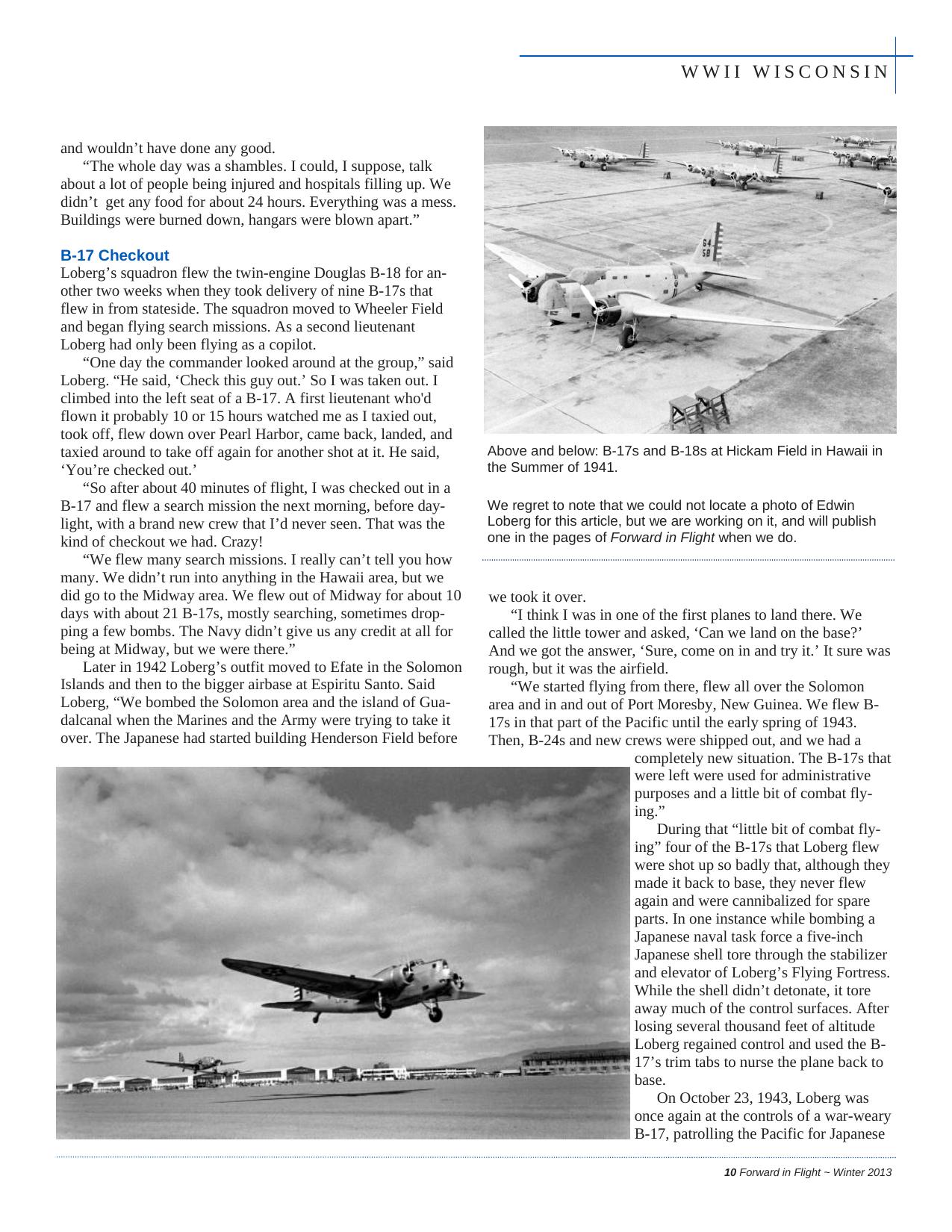
WWII WISCONSIN and wouldn’t have done any good. “The whole day was a shambles. I could, I suppose, talk about a lot of people being injured and hospitals filling up. We didn’t get any food for about 24 hours. Everything was a mess. Buildings were burned down, hangars were blown apart.” B-17 Checkout Loberg’s squadron flew the twin-engine Douglas B-18 for another two weeks when they took delivery of nine B-17s that flew in from stateside. The squadron moved to Wheeler Field and began flying search missions. As a second lieutenant Loberg had only been flying as a copilot. “One day the commander looked around at the group,” said Loberg. “He said, ‘Check this guy out.’ So I was taken out. I climbed into the left seat of a B-17. A first lieutenant who'd flown it probably 10 or 15 hours watched me as I taxied out, took off, flew down over Pearl Harbor, came back, landed, and taxied around to take off again for another shot at it. He said, ‘You’re checked out.’ “So after about 40 minutes of flight, I was checked out in a B-17 and flew a search mission the next morning, before daylight, with a brand new crew that I’d never seen. That was the kind of checkout we had. Crazy! “We flew many search missions. I really can’t tell you how many. We didn’t run into anything in the Hawaii area, but we did go to the Midway area. We flew out of Midway for about 10 days with about 21 B-17s, mostly searching, sometimes dropping a few bombs. The Navy didn’t give us any credit at all for being at Midway, but we were there.” Later in 1942 Loberg’s outfit moved to Efate in the Solomon Islands and then to the bigger airbase at Espiritu Santo. Said Loberg, “We bombed the Solomon area and the island of Guadalcanal when the Marines and the Army were trying to take it over. The Japanese had started building Henderson Field before Above and below: B-17s and B-18s at Hickam Field in Hawaii in the Summer of 1941. We regret to note that we could not locate a photo of Edwin Loberg for this article, but we are working on it, and will publish one in the pages of Forward in Flight when we do. we took it over. “I think I was in one of the first planes to land there. We called the little tower and asked, ‘Can we land on the base?’ And we got the answer, ‘Sure, come on in and try it.’ It sure was rough, but it was the airfield. “We started flying from there, flew all over the Solomon area and in and out of Port Moresby, New Guinea. We flew B17s in that part of the Pacific until the early spring of 1943. Then, B-24s and new crews were shipped out, and we had a completely new situation. The B-17s that were left were used for administrative purposes and a little bit of combat flying.” During that “little bit of combat flying” four of the B-17s that Loberg flew were shot up so badly that, although they made it back to base, they never flew again and were cannibalized for spare parts. In one instance while bombing a Japanese naval task force a five-inch Japanese shell tore through the stabilizer and elevator of Loberg’s Flying Fortress. While the shell didn’t detonate, it tore away much of the control surfaces. After losing several thousand feet of altitude Loberg regained control and used the B17’s trim tabs to nurse the plane back to base. On October 23, 1943, Loberg was once again at the controls of a war-weary B-17, patrolling the Pacific for Japanese 10 Forward in Flight ~ Winter 2013
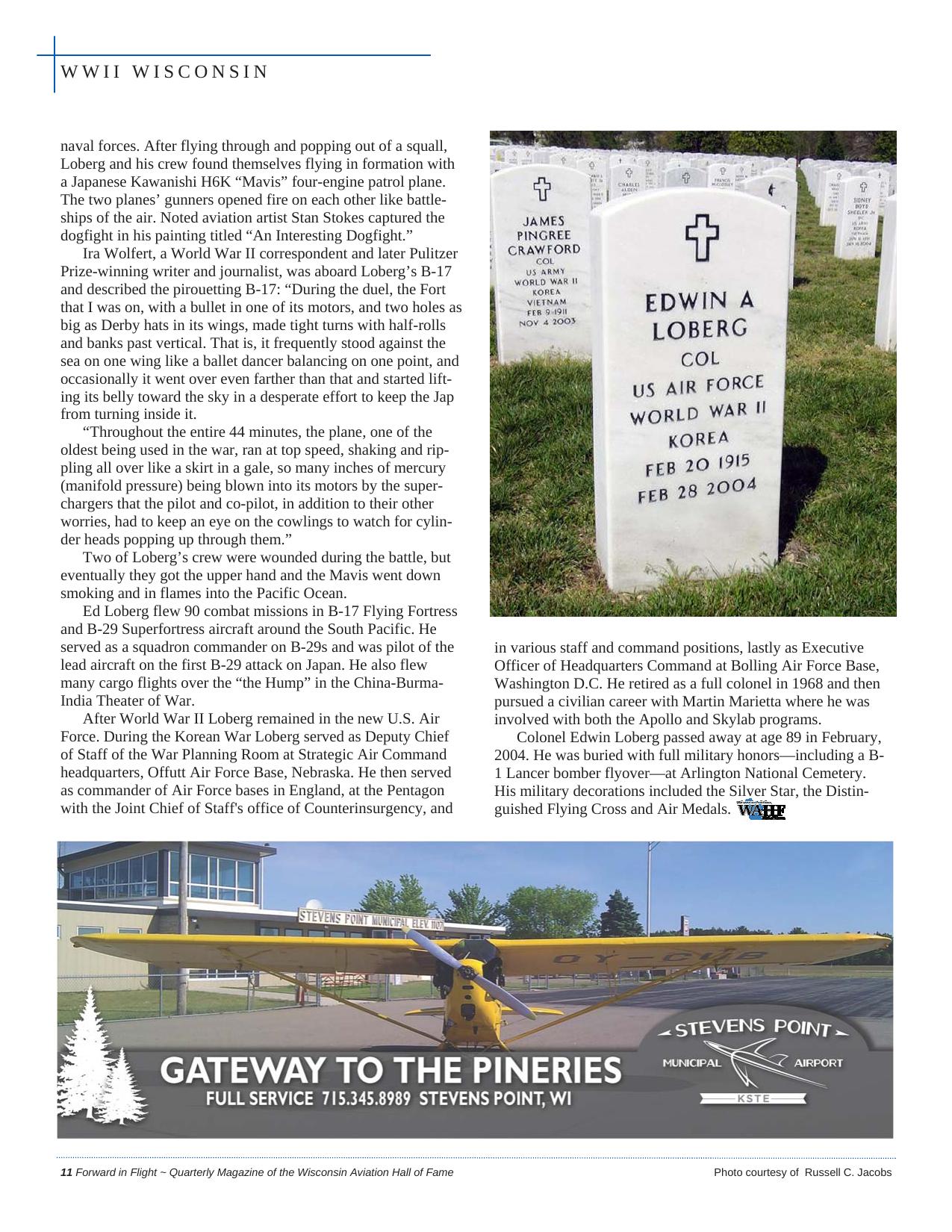
WWII WISCONSIN naval forces. After flying through and popping out of a squall, Loberg and his crew found themselves flying in formation with a Japanese Kawanishi H6K “Mavis” four-engine patrol plane. The two planes’ gunners opened fire on each other like battleships of the air. Noted aviation artist Stan Stokes captured the dogfight in his painting titled “An Interesting Dogfight.” Ira Wolfert, a World War II correspondent and later Pulitzer Prize-winning writer and journalist, was aboard Loberg’s B-17 and described the pirouetting B-17: “During the duel, the Fort that I was on, with a bullet in one of its motors, and two holes as big as Derby hats in its wings, made tight turns with half-rolls and banks past vertical. That is, it frequently stood against the sea on one wing like a ballet dancer balancing on one point, and occasionally it went over even farther than that and started lifting its belly toward the sky in a desperate effort to keep the Jap from turning inside it. “Throughout the entire 44 minutes, the plane, one of the oldest being used in the war, ran at top speed, shaking and rippling all over like a skirt in a gale, so many inches of mercury (manifold pressure) being blown into its motors by the superchargers that the pilot and co-pilot, in addition to their other worries, had to keep an eye on the cowlings to watch for cylinder heads popping up through them.” Two of Loberg’s crew were wounded during the battle, but eventually they got the upper hand and the Mavis went down smoking and in flames into the Pacific Ocean. Ed Loberg flew 90 combat missions in B-17 Flying Fortress and B-29 Superfortress aircraft around the South Pacific. He served as a squadron commander on B-29s and was pilot of the lead aircraft on the first B-29 attack on Japan. He also flew many cargo flights over the “the Hump” in the China-BurmaIndia Theater of War. After World War II Loberg remained in the new U.S. Air Force. During the Korean War Loberg served as Deputy Chief of Staff of the War Planning Room at Strategic Air Command headquarters, Offutt Air Force Base, Nebraska. He then served as commander of Air Force bases in England, at the Pentagon with the Joint Chief of Staff's office of Counterinsurgency, and 11 Forward in Flight ~ Quarterly Magazine of the Wisconsin Aviation Hall of Fame in various staff and command positions, lastly as Executive Officer of Headquarters Command at Bolling Air Force Base, Washington D.C. He retired as a full colonel in 1968 and then pursued a civilian career with Martin Marietta where he was involved with both the Apollo and Skylab programs. Colonel Edwin Loberg passed away at age 89 in February, 2004. He was buried with full military honors—including a B1 Lancer bomber flyover—at Arlington National Cemetery. His military decorations included the Silver Star, the Distinguished Flying Cross and Air Medals. Photo courtesy of Russell C. Jacobs
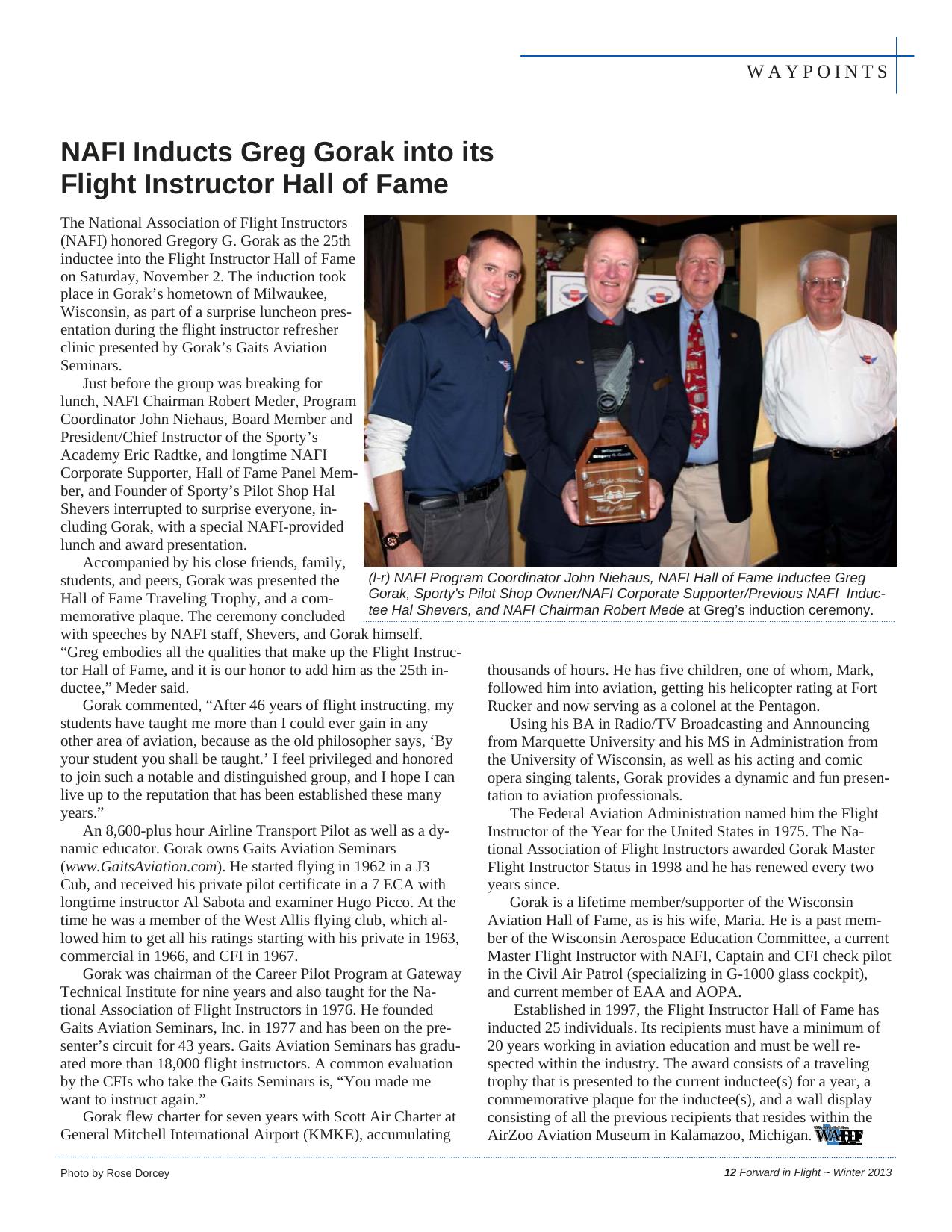
WAYPOINTS NAFI Inducts Greg Gorak into its Flight Instructor Hall of Fame The National Association of Flight Instructors (NAFI) honored Gregory G. Gorak as the 25th inductee into the Flight Instructor Hall of Fame on Saturday, November 2. The induction took place in Gorak’s hometown of Milwaukee, Wisconsin, as part of a surprise luncheon presentation during the flight instructor refresher clinic presented by Gorak’s Gaits Aviation Seminars. Just before the group was breaking for lunch, NAFI Chairman Robert Meder, Program Coordinator John Niehaus, Board Member and President/Chief Instructor of the Sporty’s Academy Eric Radtke, and longtime NAFI Corporate Supporter, Hall of Fame Panel Member, and Founder of Sporty’s Pilot Shop Hal Shevers interrupted to surprise everyone, including Gorak, with a special NAFI-provided lunch and award presentation. Accompanied by his close friends, family, (l-r) NAFI Program Coordinator John Niehaus, NAFI Hall of Fame Inductee Greg students, and peers, Gorak was presented the Gorak, Sporty's Pilot Shop Owner/NAFI Corporate Supporter/Previous NAFI InducHall of Fame Traveling Trophy, and a commemorative plaque. The ceremony concluded tee Hal Shevers, and NAFI Chairman Robert Mede at Greg’s induction ceremony. with speeches by NAFI staff, Shevers, and Gorak himself. “Greg embodies all the qualities that make up the Flight Instructor Hall of Fame, and it is our honor to add him as the 25th inthousands of hours. He has five children, one of whom, Mark, ductee,” Meder said. followed him into aviation, getting his helicopter rating at Fort Gorak commented, “After 46 years of flight instructing, my Rucker and now serving as a colonel at the Pentagon. students have taught me more than I could ever gain in any Using his BA in Radio/TV Broadcasting and Announcing other area of aviation, because as the old philosopher says, ‘By from Marquette University and his MS in Administration from your student you shall be taught.’ I feel privileged and honored the University of Wisconsin, as well as his acting and comic to join such a notable and distinguished group, and I hope I can opera singing talents, Gorak provides a dynamic and fun presenlive up to the reputation that has been established these many tation to aviation professionals. years.” The Federal Aviation Administration named him the Flight An 8,600-plus hour Airline Transport Pilot as well as a dyInstructor of the Year for the United States in 1975. The Nanamic educator. Gorak owns Gaits Aviation Seminars tional Association of Flight Instructors awarded Gorak Master (www.GaitsAviation.com). He started flying in 1962 in a J3 Flight Instructor Status in 1998 and he has renewed every two Cub, and received his private pilot certificate in a 7 ECA with years since. longtime instructor Al Sabota and examiner Hugo Picco. At the Gorak is a lifetime member/supporter of the Wisconsin time he was a member of the West Allis flying club, which alAviation Hall of Fame, as is his wife, Maria. He is a past memlowed him to get all his ratings starting with his private in 1963, ber of the Wisconsin Aerospace Education Committee, a current commercial in 1966, and CFI in 1967. Master Flight Instructor with NAFI, Captain and CFI check pilot Gorak was chairman of the Career Pilot Program at Gateway in the Civil Air Patrol (specializing in G-1000 glass cockpit), Technical Institute for nine years and also taught for the Naand current member of EAA and AOPA. tional Association of Flight Instructors in 1976. He founded Established in 1997, the Flight Instructor Hall of Fame has Gaits Aviation Seminars, Inc. in 1977 and has been on the preinducted 25 individuals. Its recipients must have a minimum of senter’s circuit for 43 years. Gaits Aviation Seminars has gradu20 years working in aviation education and must be well reated more than 18,000 flight instructors. A common evaluation spected within the industry. The award consists of a traveling by the CFIs who take the Gaits Seminars is, “You made me trophy that is presented to the current inductee(s) for a year, a want to instruct again.” commemorative plaque for the inductee(s), and a wall display Gorak flew charter for seven years with Scott Air Charter at consisting of all the previous recipients that resides within the General Mitchell International Airport (KMKE), accumulating AirZoo Aviation Museum in Kalamazoo, Michigan. Photo by Rose Dorcey 12 Forward in Flight ~ Winter 2013
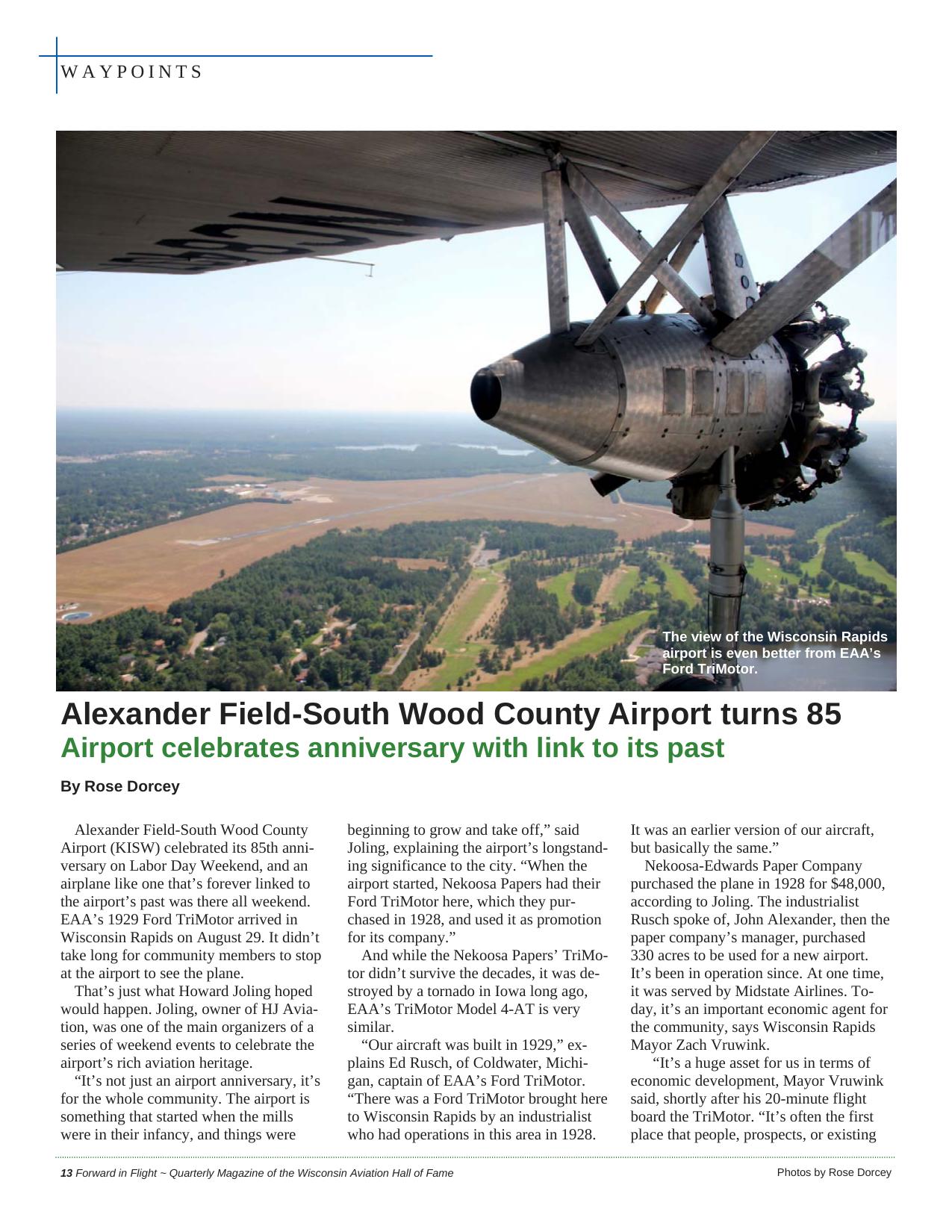
WAYPOINTS The view of the Wisconsin Rapids airport is even better from EAA’s Ford TriMotor. Alexander Field-South Wood County Airport turns 85 Airport celebrates anniversary with link to its past By Rose Dorcey Alexander Field-South Wood County Airport (KISW) celebrated its 85th anniversary on Labor Day Weekend, and an airplane like one that’s forever linked to the airport’s past was there all weekend. EAA’s 1929 Ford TriMotor arrived in Wisconsin Rapids on August 29. It didn’t take long for community members to stop at the airport to see the plane. That’s just what Howard Joling hoped would happen. Joling, owner of HJ Aviation, was one of the main organizers of a series of weekend events to celebrate the airport’s rich aviation heritage. “It’s not just an airport anniversary, it’s for the whole community. The airport is something that started when the mills were in their infancy, and things were beginning to grow and take off,” said Joling, explaining the airport’s longstanding significance to the city. “When the airport started, Nekoosa Papers had their Ford TriMotor here, which they purchased in 1928, and used it as promotion for its company.” And while the Nekoosa Papers’ TriMotor didn’t survive the decades, it was destroyed by a tornado in Iowa long ago, EAA’s TriMotor Model 4-AT is very similar. “Our aircraft was built in 1929,” explains Ed Rusch, of Coldwater, Michigan, captain of EAA’s Ford TriMotor. “There was a Ford TriMotor brought here to Wisconsin Rapids by an industrialist who had operations in this area in 1928. 13 Forward in Flight ~ Quarterly Magazine of the Wisconsin Aviation Hall of Fame It was an earlier version of our aircraft, but basically the same.” Nekoosa-Edwards Paper Company purchased the plane in 1928 for $48,000, according to Joling. The industrialist Rusch spoke of, John Alexander, then the paper company’s manager, purchased 330 acres to be used for a new airport. It’s been in operation since. At one time, it was served by Midstate Airlines. Today, it’s an important economic agent for the community, says Wisconsin Rapids Mayor Zach Vruwink. “It’s a huge asset for us in terms of economic development, Mayor Vruwink said, shortly after his 20-minute flight board the TriMotor. “It’s often the first place that people, prospects, or existing Photos by Rose Dorcey
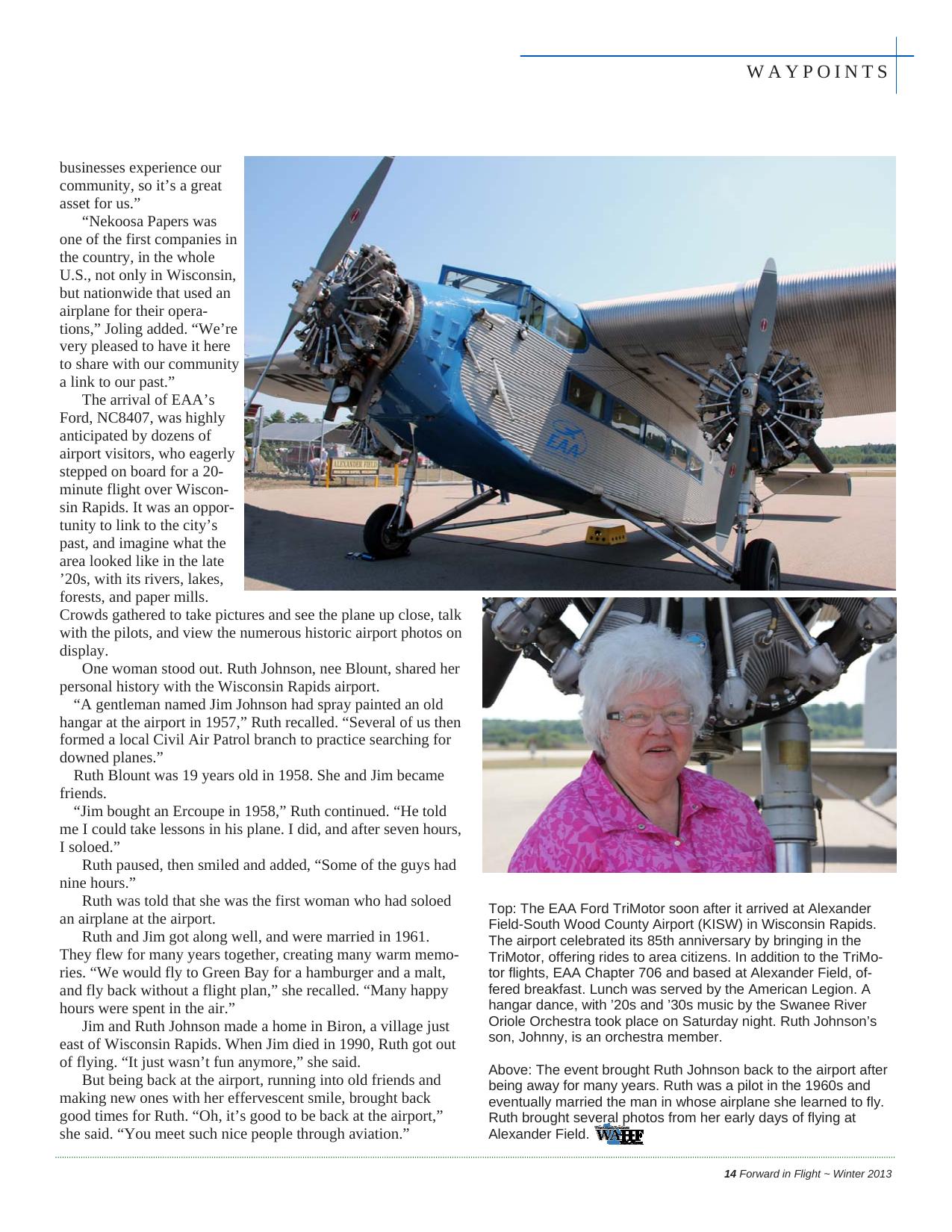
WAYPOINTS businesses experience our community, so it’s a great asset for us.” “Nekoosa Papers was one of the first companies in the country, in the whole U.S., not only in Wisconsin, but nationwide that used an airplane for their operations,” Joling added. “We’re very pleased to have it here to share with our community a link to our past.” The arrival of EAA’s Ford, NC8407, was highly anticipated by dozens of airport visitors, who eagerly stepped on board for a 20minute flight over Wisconsin Rapids. It was an opportunity to link to the city’s past, and imagine what the area looked like in the late ’20s, with its rivers, lakes, forests, and paper mills. Crowds gathered to take pictures and see the plane up close, talk with the pilots, and view the numerous historic airport photos on display. One woman stood out. Ruth Johnson, nee Blount, shared her personal history with the Wisconsin Rapids airport. “A gentleman named Jim Johnson had spray painted an old hangar at the airport in 1957,” Ruth recalled. “Several of us then formed a local Civil Air Patrol branch to practice searching for downed planes.” Ruth Blount was 19 years old in 1958. She and Jim became friends. “Jim bought an Ercoupe in 1958,” Ruth continued. “He told me I could take lessons in his plane. I did, and after seven hours, I soloed.” Ruth paused, then smiled and added, “Some of the guys had nine hours.” Ruth was told that she was the first woman who had soloed an airplane at the airport. Ruth and Jim got along well, and were married in 1961. They flew for many years together, creating many warm memories. “We would fly to Green Bay for a hamburger and a malt, and fly back without a flight plan,” she recalled. “Many happy hours were spent in the air.” Jim and Ruth Johnson made a home in Biron, a village just east of Wisconsin Rapids. When Jim died in 1990, Ruth got out of flying. “It just wasn’t fun anymore,” she said. But being back at the airport, running into old friends and making new ones with her effervescent smile, brought back good times for Ruth. “Oh, it’s good to be back at the airport,” she said. “You meet such nice people through aviation.” Top: The EAA Ford TriMotor soon after it arrived at Alexander Field-South Wood County Airport (KISW) in Wisconsin Rapids. The airport celebrated its 85th anniversary by bringing in the TriMotor, offering rides to area citizens. In addition to the TriMotor flights, EAA Chapter 706 and based at Alexander Field, offered breakfast. Lunch was served by the American Legion. A hangar dance, with ’20s and ’30s music by the Swanee River Oriole Orchestra took place on Saturday night. Ruth Johnson’s son, Johnny, is an orchestra member. Above: The event brought Ruth Johnson back to the airport after being away for many years. Ruth was a pilot in the 1960s and eventually married the man in whose airplane she learned to fly. Ruth brought several photos from her early days of flying at Alexander Field. 14 Forward in Flight ~ Winter 2013
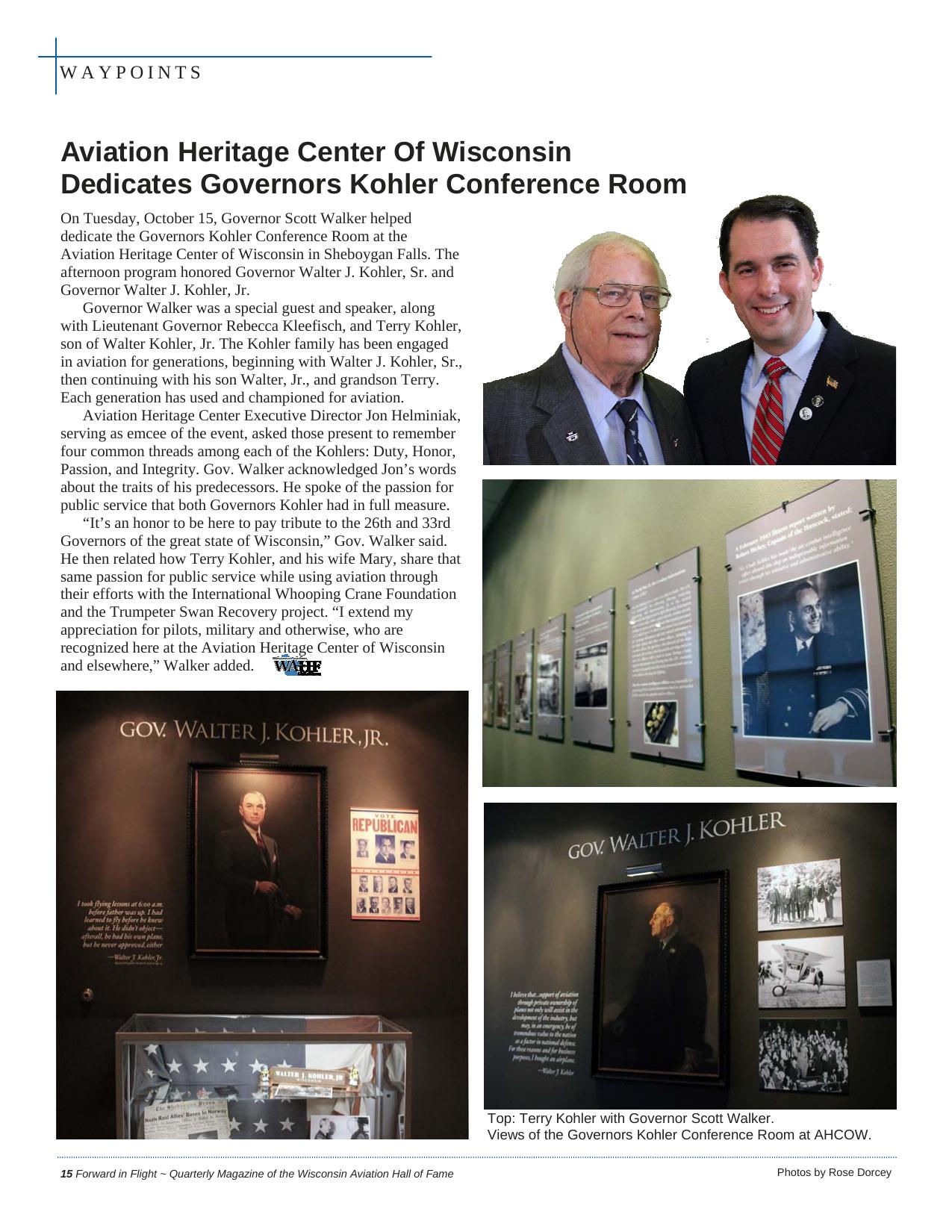
WAYPOINTS Aviation Heritage Center Of Wisconsin Dedicates Governors Kohler Conference Room On Tuesday, October 15, Governor Scott Walker helped dedicate the Governors Kohler Conference Room at the Aviation Heritage Center of Wisconsin in Sheboygan Falls. The afternoon program honored Governor Walter J. Kohler, Sr. and Governor Walter J. Kohler, Jr. Governor Walker was a special guest and speaker, along with Lieutenant Governor Rebecca Kleefisch, and Terry Kohler, son of Walter Kohler, Jr. The Kohler family has been engaged in aviation for generations, beginning with Walter J. Kohler, Sr., then continuing with his son Walter, Jr., and grandson Terry. Each generation has used and championed for aviation. Aviation Heritage Center Executive Director Jon Helminiak, serving as emcee of the event, asked those present to remember four common threads among each of the Kohlers: Duty, Honor, Passion, and Integrity. Gov. Walker acknowledged Jon’s words about the traits of his predecessors. He spoke of the passion for public service that both Governors Kohler had in full measure. “It’s an honor to be here to pay tribute to the 26th and 33rd Governors of the great state of Wisconsin,” Gov. Walker said. He then related how Terry Kohler, and his wife Mary, share that same passion for public service while using aviation through their efforts with the International Whooping Crane Foundation and the Trumpeter Swan Recovery project. “I extend my appreciation for pilots, military and otherwise, who are recognized here at the Aviation Heritage Center of Wisconsin and elsewhere,” Walker added. Top: Terry Kohler with Governor Scott Walker. Views of the Governors Kohler Conference Room at AHCOW. 15 Forward in Flight ~ Quarterly Magazine of the Wisconsin Aviation Hall of Fame Photos by Rose Dorcey
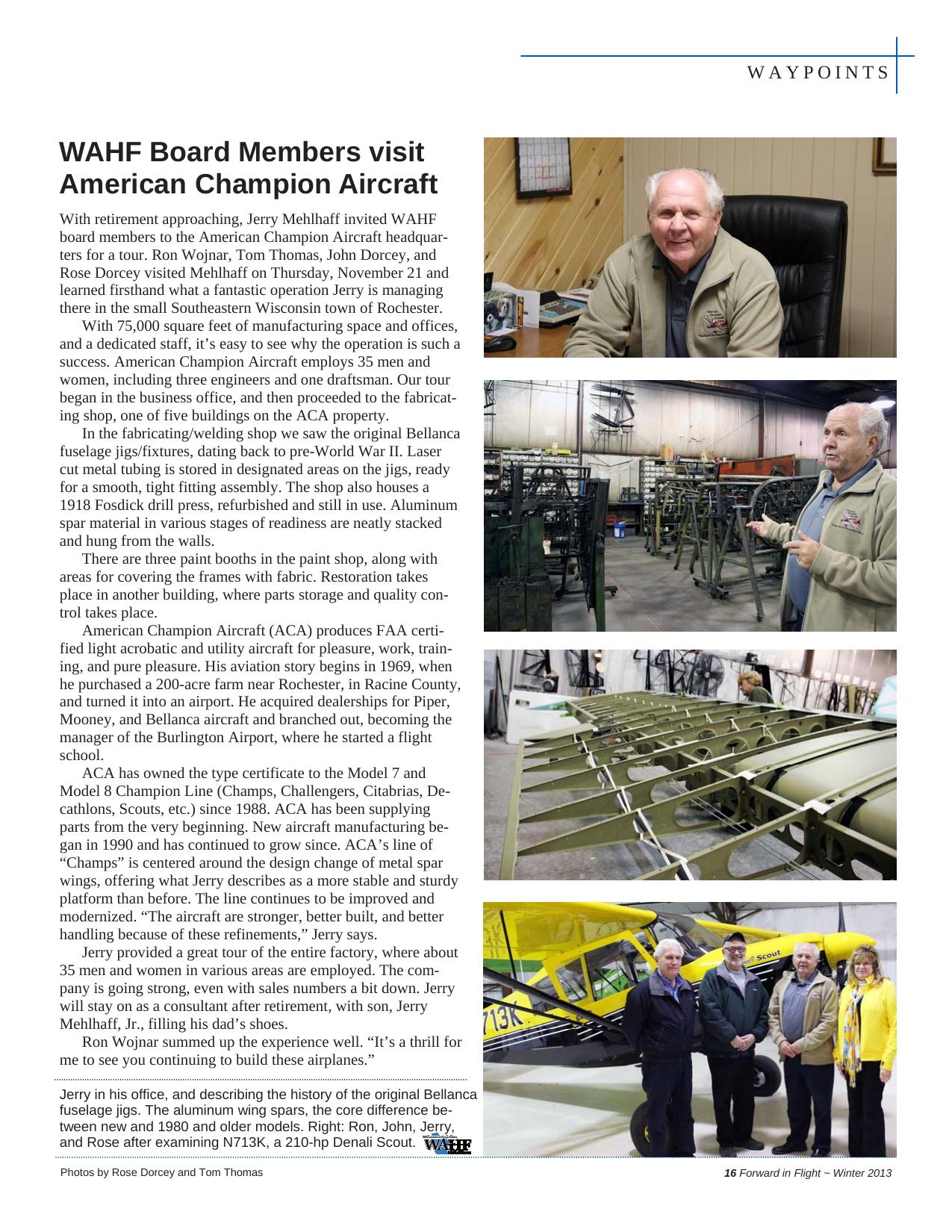
WAYPOINTS WAHF Board Members visit American Champion Aircraft With retirement approaching, Jerry Mehlhaff invited WAHF board members to the American Champion Aircraft headquarters for a tour. Ron Wojnar, Tom Thomas, John Dorcey, and Rose Dorcey visited Mehlhaff on Thursday, November 21 and learned firsthand what a fantastic operation Jerry is managing there in the small Southeastern Wisconsin town of Rochester. With 75,000 square feet of manufacturing space and offices, and a dedicated staff, it’s easy to see why the operation is such a success. American Champion Aircraft employs 35 men and women, including three engineers and one draftsman. Our tour began in the business office, and then proceeded to the fabricating shop, one of five buildings on the ACA property. In the fabricating/welding shop we saw the original Bellanca fuselage jigs/fixtures, dating back to pre-World War II. Laser cut metal tubing is stored in designated areas on the jigs, ready for a smooth, tight fitting assembly. The shop also houses a 1918 Fosdick drill press, refurbished and still in use. Aluminum spar material in various stages of readiness are neatly stacked and hung from the walls. There are three paint booths in the paint shop, along with areas for covering the frames with fabric. Restoration takes place in another building, where parts storage and quality control takes place. American Champion Aircraft (ACA) produces FAA certified light acrobatic and utility aircraft for pleasure, work, training, and pure pleasure. His aviation story begins in 1969, when he purchased a 200-acre farm near Rochester, in Racine County, and turned it into an airport. He acquired dealerships for Piper, Mooney, and Bellanca aircraft and branched out, becoming the manager of the Burlington Airport, where he started a flight school. ACA has owned the type certificate to the Model 7 and Model 8 Champion Line (Champs, Challengers, Citabrias, Decathlons, Scouts, etc.) since 1988. ACA has been supplying parts from the very beginning. New aircraft manufacturing began in 1990 and has continued to grow since. ACA’s line of “Champs” is centered around the design change of metal spar wings, offering what Jerry describes as a more stable and sturdy platform than before. The line continues to be improved and modernized. “The aircraft are stronger, better built, and better handling because of these refinements,” Jerry says. Jerry provided a great tour of the entire factory, where about 35 men and women in various areas are employed. The company is going strong, even with sales numbers a bit down. Jerry will stay on as a consultant after retirement, with son, Jerry Mehlhaff, Jr., filling his dad’s shoes. Ron Wojnar summed up the experience well. “It’s a thrill for me to see you continuing to build these airplanes.” Jerry in his office, and describing the history of the original Bellanca fuselage jigs. The aluminum wing spars, the core difference between new and 1980 and older models. Right: Ron, John, Jerry, and Rose after examining N713K, a 210-hp Denali Scout. Photos by Rose Dorcey and Tom Thomas 16 Forward in Flight ~ Winter 2013
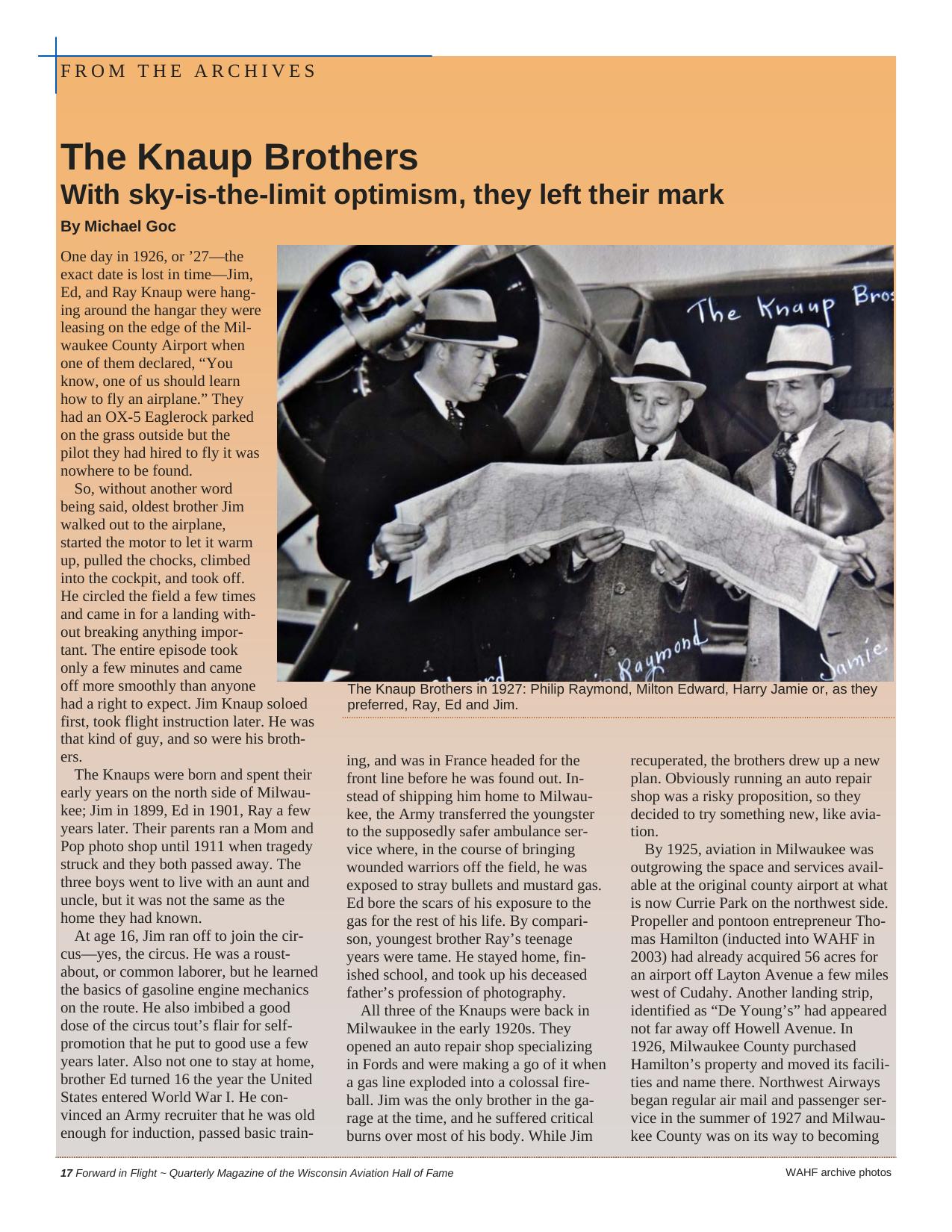
FROM THE ARCHIVES The Knaup Brothers With sky-is-the-limit optimism, they left their mark By Michael Goc One day in 1926, or ’27—the exact date is lost in time—Jim, Ed, and Ray Knaup were hanging around the hangar they were leasing on the edge of the Milwaukee County Airport when one of them declared, “You know, one of us should learn how to fly an airplane.” They had an OX-5 Eaglerock parked on the grass outside but the pilot they had hired to fly it was nowhere to be found. So, without another word being said, oldest brother Jim walked out to the airplane, started the motor to let it warm up, pulled the chocks, climbed into the cockpit, and took off. He circled the field a few times and came in for a landing without breaking anything important. The entire episode took only a few minutes and came off more smoothly than anyone had a right to expect. Jim Knaup soloed first, took flight instruction later. He was that kind of guy, and so were his brothers. The Knaups were born and spent their early years on the north side of Milwaukee; Jim in 1899, Ed in 1901, Ray a few years later. Their parents ran a Mom and Pop photo shop until 1911 when tragedy struck and they both passed away. The three boys went to live with an aunt and uncle, but it was not the same as the home they had known. At age 16, Jim ran off to join the circus—yes, the circus. He was a roustabout, or common laborer, but he learned the basics of gasoline engine mechanics on the route. He also imbibed a good dose of the circus tout’s flair for selfpromotion that he put to good use a few years later. Also not one to stay at home, brother Ed turned 16 the year the United States entered World War I. He convinced an Army recruiter that he was old enough for induction, passed basic train- The Knaup Brothers in 1927: Philip Raymond, Milton Edward, Harry Jamie or, as they preferred, Ray, Ed and Jim. ing, and was in France headed for the front line before he was found out. Instead of shipping him home to Milwaukee, the Army transferred the youngster to the supposedly safer ambulance service where, in the course of bringing wounded warriors off the field, he was exposed to stray bullets and mustard gas. Ed bore the scars of his exposure to the gas for the rest of his life. By comparison, youngest brother Ray’s teenage years were tame. He stayed home, finished school, and took up his deceased father’s profession of photography. All three of the Knaups were back in Milwaukee in the early 1920s. They opened an auto repair shop specializing in Fords and were making a go of it when a gas line exploded into a colossal fireball. Jim was the only brother in the garage at the time, and he suffered critical burns over most of his body. While Jim 17 Forward in Flight ~ Quarterly Magazine of the Wisconsin Aviation Hall of Fame recuperated, the brothers drew up a new plan. Obviously running an auto repair shop was a risky proposition, so they decided to try something new, like aviation. By 1925, aviation in Milwaukee was outgrowing the space and services available at the original county airport at what is now Currie Park on the northwest side. Propeller and pontoon entrepreneur Thomas Hamilton (inducted into WAHF in 2003) had already acquired 56 acres for an airport off Layton Avenue a few miles west of Cudahy. Another landing strip, identified as “De Young’s” had appeared not far away off Howell Avenue. In 1926, Milwaukee County purchased Hamilton’s property and moved its facilities and name there. Northwest Airways began regular air mail and passenger service in the summer of 1927 and Milwaukee County was on its way to becoming WAHF archive photos
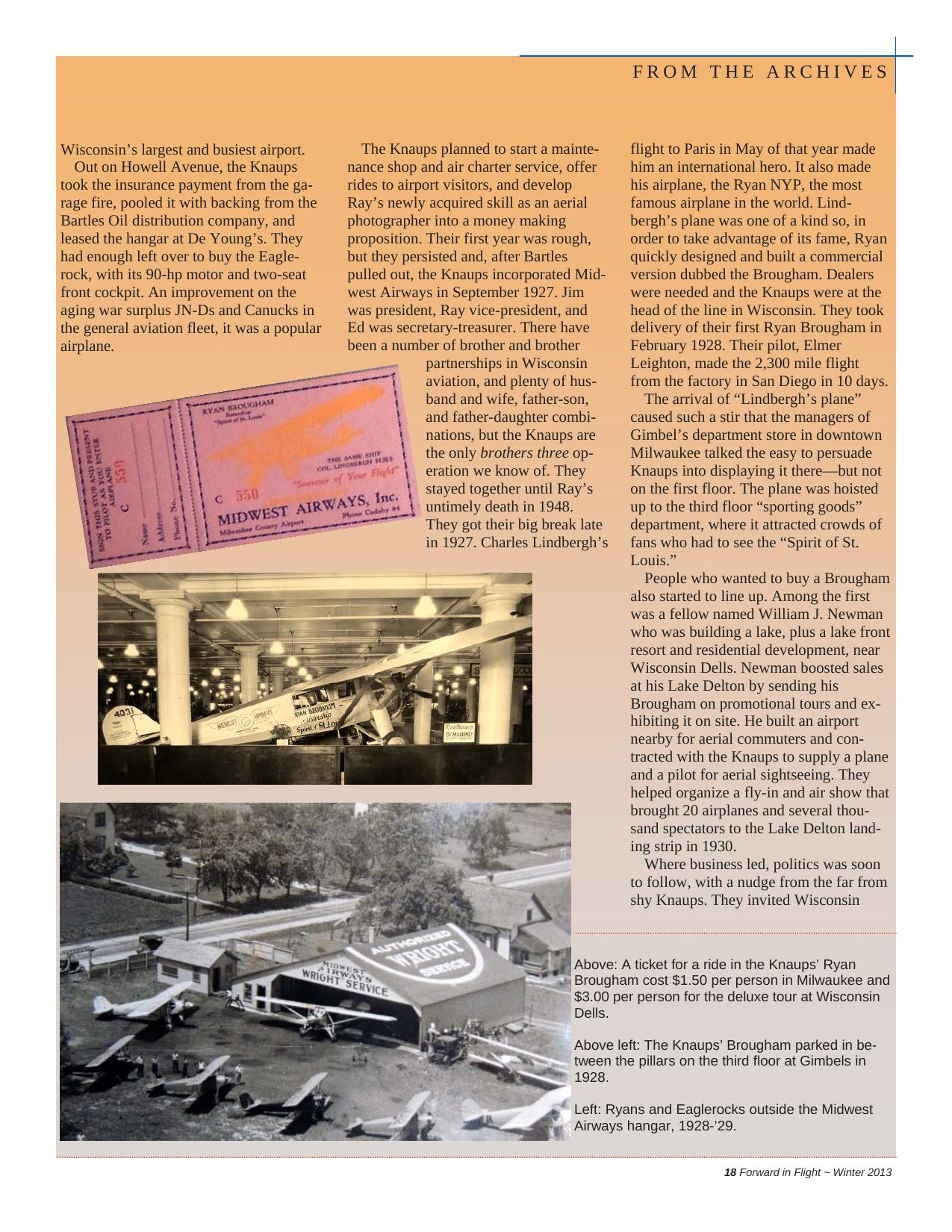
FROM THE ARCHIVES Wisconsin’s largest and busiest airport. Out on Howell Avenue, the Knaups took the insurance payment from the garage fire, pooled it with backing from the Bartles Oil distribution company, and leased the hangar at De Young’s. They had enough left over to buy the Eaglerock, with its 90-hp motor and two-seat front cockpit. An improvement on the aging war surplus JN-Ds and Canucks in the general aviation fleet, it was a popular airplane. The Knaups planned to start a maintenance shop and air charter service, offer rides to airport visitors, and develop Ray’s newly acquired skill as an aerial photographer into a money making proposition. Their first year was rough, but they persisted and, after Bartles pulled out, the Knaups incorporated Midwest Airways in September 1927. Jim was president, Ray vice-president, and Ed was secretary-treasurer. There have been a number of brother and brother partnerships in Wisconsin aviation, and plenty of husband and wife, father-son, and father-daughter combinations, but the Knaups are the only brothers three operation we know of. They stayed together until Ray’s untimely death in 1948. They got their big break late in 1927. Charles Lindbergh’s flight to Paris in May of that year made him an international hero. It also made his airplane, the Ryan NYP, the most famous airplane in the world. Lindbergh’s plane was one of a kind so, in order to take advantage of its fame, Ryan quickly designed and built a commercial version dubbed the Brougham. Dealers were needed and the Knaups were at the head of the line in Wisconsin. They took delivery of their first Ryan Brougham in February 1928. Their pilot, Elmer Leighton, made the 2,300 mile flight from the factory in San Diego in 10 days. The arrival of “Lindbergh’s plane” caused such a stir that the managers of Gimbel’s department store in downtown Milwaukee talked the easy to persuade Knaups into displaying it there—but not on the first floor. The plane was hoisted up to the third floor “sporting goods” department, where it attracted crowds of fans who had to see the “Spirit of St. Louis.” People who wanted to buy a Brougham also started to line up. Among the first was a fellow named William J. Newman who was building a lake, plus a lake front resort and residential development, near Wisconsin Dells. Newman boosted sales at his Lake Delton by sending his Brougham on promotional tours and exhibiting it on site. He built an airport nearby for aerial commuters and contracted with the Knaups to supply a plane and a pilot for aerial sightseeing. They helped organize a fly-in and air show that brought 20 airplanes and several thousand spectators to the Lake Delton landing strip in 1930. Where business led, politics was soon to follow, with a nudge from the far from shy Knaups. They invited Wisconsin Above: A ticket for a ride in the Knaups’ Ryan Brougham cost $1.50 per person in Milwaukee and $3.00 per person for the deluxe tour at Wisconsin Dells. Above left: The Knaups’ Brougham parked in between the pillars on the third floor at Gimbels in 1928. Left: Ryans and Eaglerocks outside the Midwest Airways hangar, 1928-’29. 18 Forward in Flight ~ Winter 2013
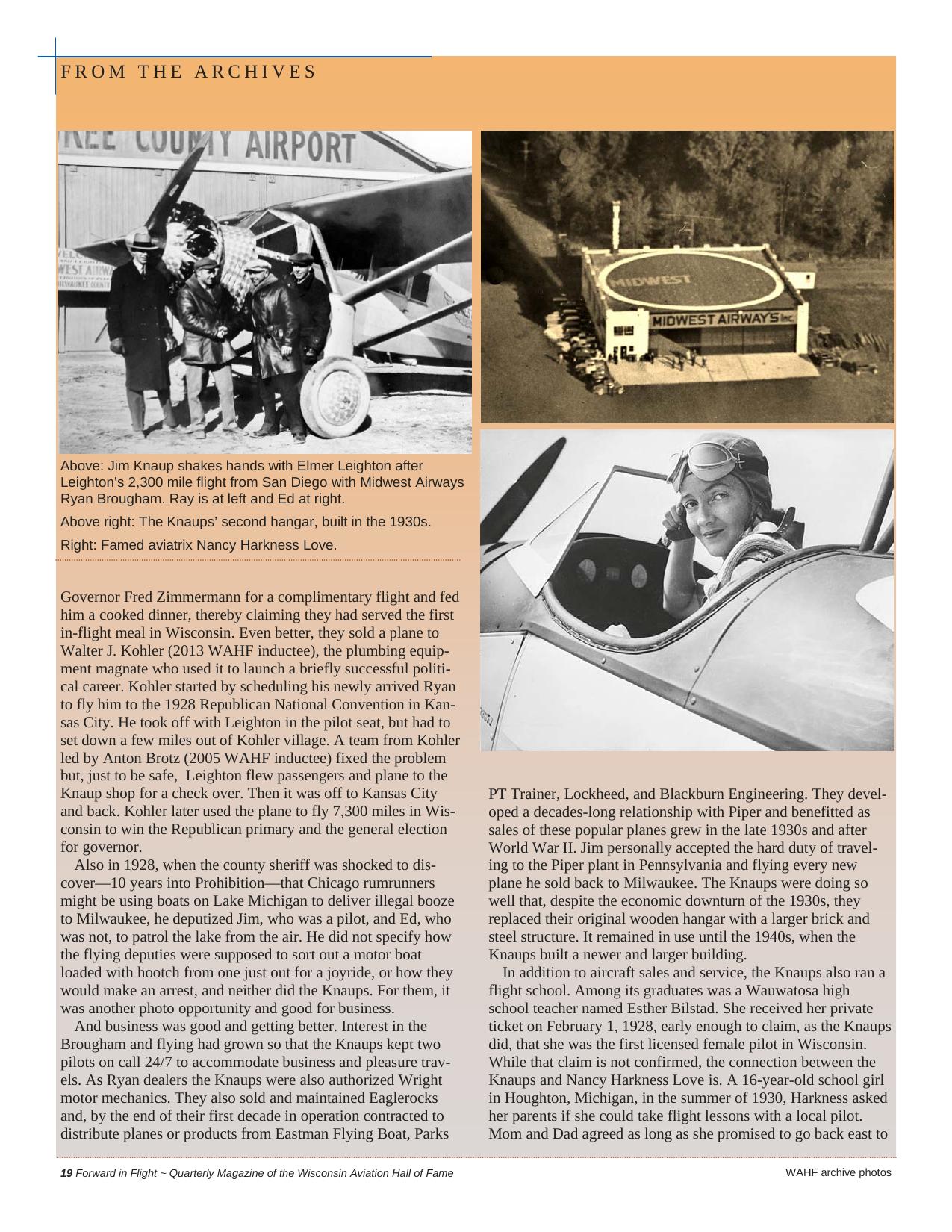
FROM THE ARCHIVES Above: Jim Knaup shakes hands with Elmer Leighton after Leighton’s 2,300 mile flight from San Diego with Midwest Airways Ryan Brougham. Ray is at left and Ed at right. Above right: The Knaups’ second hangar, built in the 1930s. Right: Famed aviatrix Nancy Harkness Love. Governor Fred Zimmermann for a complimentary flight and fed him a cooked dinner, thereby claiming they had served the first in-flight meal in Wisconsin. Even better, they sold a plane to Walter J. Kohler (2013 WAHF inductee), the plumbing equipment magnate who used it to launch a briefly successful political career. Kohler started by scheduling his newly arrived Ryan to fly him to the 1928 Republican National Convention in Kansas City. He took off with Leighton in the pilot seat, but had to set down a few miles out of Kohler village. A team from Kohler led by Anton Brotz (2005 WAHF inductee) fixed the problem but, just to be safe, Leighton flew passengers and plane to the Knaup shop for a check over. Then it was off to Kansas City and back. Kohler later used the plane to fly 7,300 miles in Wisconsin to win the Republican primary and the general election for governor. Also in 1928, when the county sheriff was shocked to discover—10 years into Prohibition—that Chicago rumrunners might be using boats on Lake Michigan to deliver illegal booze to Milwaukee, he deputized Jim, who was a pilot, and Ed, who was not, to patrol the lake from the air. He did not specify how the flying deputies were supposed to sort out a motor boat loaded with hootch from one just out for a joyride, or how they would make an arrest, and neither did the Knaups. For them, it was another photo opportunity and good for business. And business was good and getting better. Interest in the Brougham and flying had grown so that the Knaups kept two pilots on call 24/7 to accommodate business and pleasure travels. As Ryan dealers the Knaups were also authorized Wright motor mechanics. They also sold and maintained Eaglerocks and, by the end of their first decade in operation contracted to distribute planes or products from Eastman Flying Boat, Parks PT Trainer, Lockheed, and Blackburn Engineering. They developed a decades-long relationship with Piper and benefitted as sales of these popular planes grew in the late 1930s and after World War II. Jim personally accepted the hard duty of traveling to the Piper plant in Pennsylvania and flying every new plane he sold back to Milwaukee. The Knaups were doing so well that, despite the economic downturn of the 1930s, they replaced their original wooden hangar with a larger brick and steel structure. It remained in use until the 1940s, when the Knaups built a newer and larger building. In addition to aircraft sales and service, the Knaups also ran a flight school. Among its graduates was a Wauwatosa high school teacher named Esther Bilstad. She received her private ticket on February 1, 1928, early enough to claim, as the Knaups did, that she was the first licensed female pilot in Wisconsin. While that claim is not confirmed, the connection between the Knaups and Nancy Harkness Love is. A 16-year-old school girl in Houghton, Michigan, in the summer of 1930, Harkness asked her parents if she could take flight lessons with a local pilot. Mom and Dad agreed as long as she promised to go back east to 19 Forward in Flight ~ Quarterly Magazine of the Wisconsin Aviation Hall of Fame WAHF archive photos
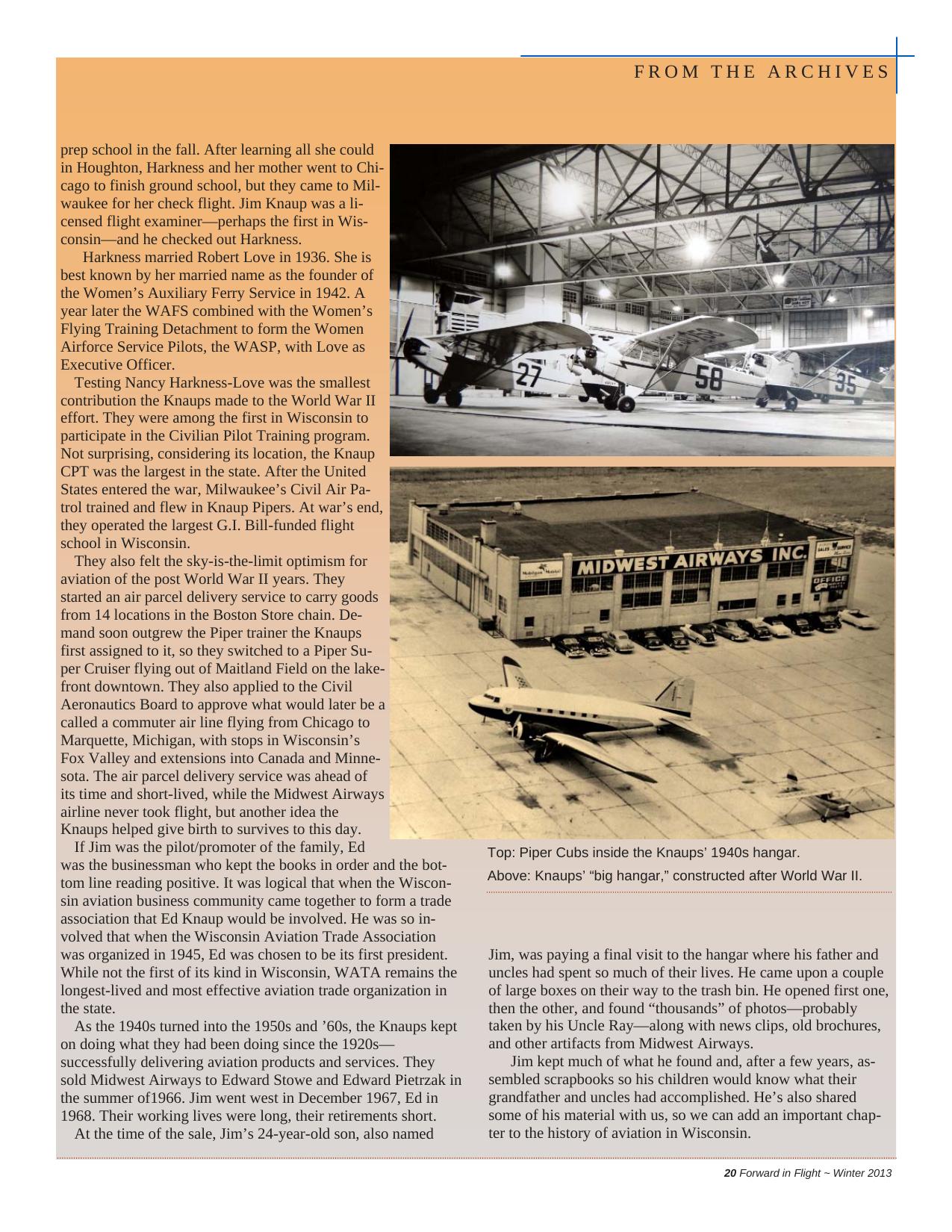
FROM THE ARCHIVES prep school in the fall. After learning all she could in Houghton, Harkness and her mother went to Chicago to finish ground school, but they came to Milwaukee for her check flight. Jim Knaup was a licensed flight examiner—perhaps the first in Wisconsin—and he checked out Harkness. Harkness married Robert Love in 1936. She is best known by her married name as the founder of the Women’s Auxiliary Ferry Service in 1942. A year later the WAFS combined with the Women’s Flying Training Detachment to form the Women Airforce Service Pilots, the WASP, with Love as Executive Officer. Testing Nancy Harkness-Love was the smallest contribution the Knaups made to the World War II effort. They were among the first in Wisconsin to participate in the Civilian Pilot Training program. Not surprising, considering its location, the Knaup CPT was the largest in the state. After the United States entered the war, Milwaukee’s Civil Air Patrol trained and flew in Knaup Pipers. At war’s end, they operated the largest G.I. Bill-funded flight school in Wisconsin. They also felt the sky-is-the-limit optimism for aviation of the post World War II years. They started an air parcel delivery service to carry goods from 14 locations in the Boston Store chain. Demand soon outgrew the Piper trainer the Knaups first assigned to it, so they switched to a Piper Super Cruiser flying out of Maitland Field on the lakefront downtown. They also applied to the Civil Aeronautics Board to approve what would later be a called a commuter air line flying from Chicago to Marquette, Michigan, with stops in Wisconsin’s Fox Valley and extensions into Canada and Minnesota. The air parcel delivery service was ahead of its time and short-lived, while the Midwest Airways airline never took flight, but another idea the Knaups helped give birth to survives to this day. If Jim was the pilot/promoter of the family, Ed was the businessman who kept the books in order and the bottom line reading positive. It was logical that when the Wisconsin aviation business community came together to form a trade association that Ed Knaup would be involved. He was so involved that when the Wisconsin Aviation Trade Association was organized in 1945, Ed was chosen to be its first president. While not the first of its kind in Wisconsin, WATA remains the longest-lived and most effective aviation trade organization in the state. As the 1940s turned into the 1950s and ’60s, the Knaups kept on doing what they had been doing since the 1920s— successfully delivering aviation products and services. They sold Midwest Airways to Edward Stowe and Edward Pietrzak in the summer of1966. Jim went west in December 1967, Ed in 1968. Their working lives were long, their retirements short. At the time of the sale, Jim’s 24-year-old son, also named Top: Piper Cubs inside the Knaups’ 1940s hangar. Above: Knaups’ “big hangar,” constructed after World War II. Jim, was paying a final visit to the hangar where his father and uncles had spent so much of their lives. He came upon a couple of large boxes on their way to the trash bin. He opened first one, then the other, and found “thousands” of photos—probably taken by his Uncle Ray—along with news clips, old brochures, and other artifacts from Midwest Airways. Jim kept much of what he found and, after a few years, assembled scrapbooks so his children would know what their grandfather and uncles had accomplished. He’s also shared some of his material with us, so we can add an important chapter to the history of aviation in Wisconsin. 20 Forward in Flight ~ Winter 2013
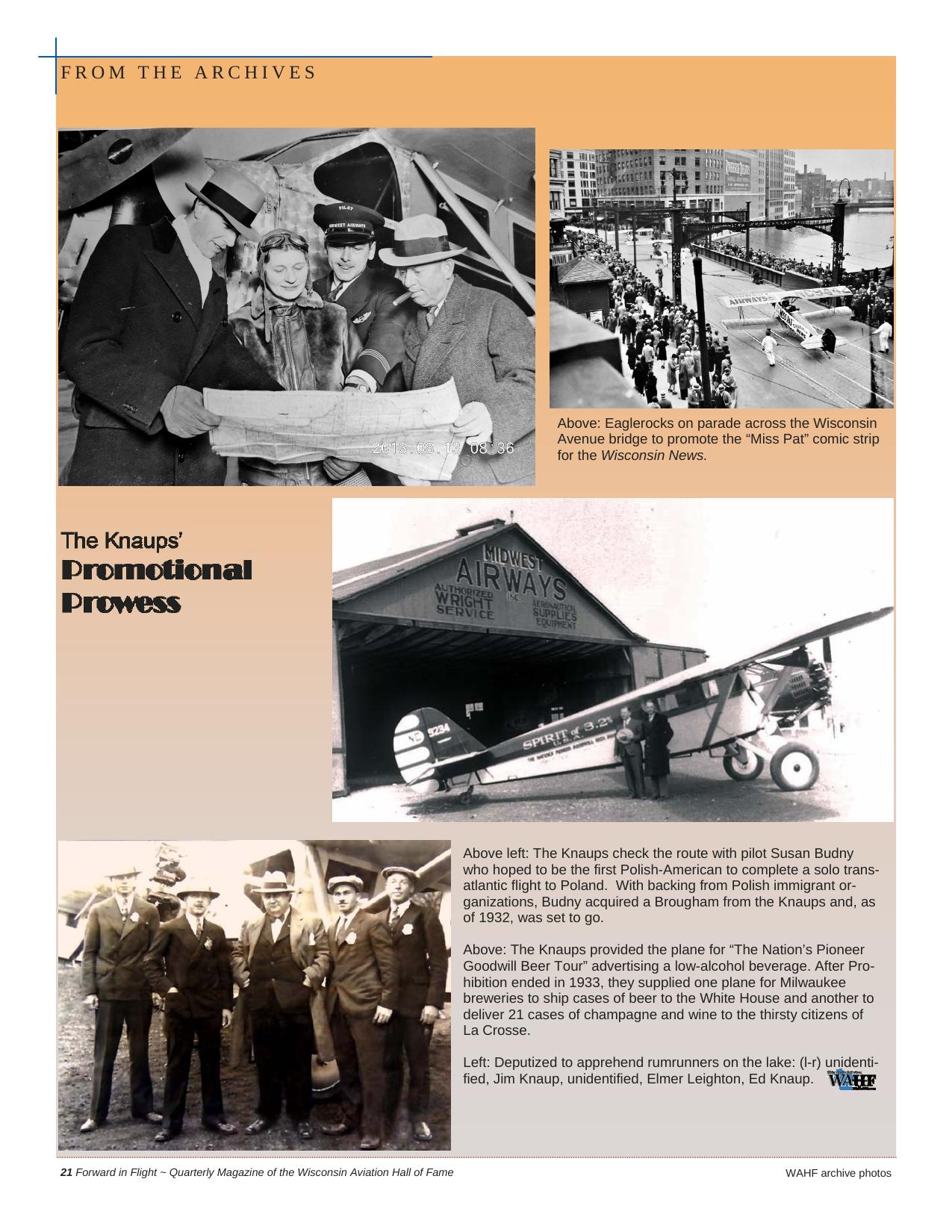
FROM THE ARCHIVES Above: Eaglerocks on parade across the Wisconsin Avenue bridge to promote the “Miss Pat” comic strip for the Wisconsin News. Above left: The Knaups check the route with pilot Susan Budny who hoped to be the first Polish-American to complete a solo transatlantic flight to Poland. With backing from Polish immigrant organizations, Budny acquired a Brougham from the Knaups and, as of 1932, was set to go. Above: The Knaups provided the plane for “The Nation’s Pioneer Goodwill Beer Tour” advertising a low-alcohol beverage. After Prohibition ended in 1933, they supplied one plane for Milwaukee breweries to ship cases of beer to the White House and another to deliver 21 cases of champagne and wine to the thirsty citizens of La Crosse. Left: Deputized to apprehend rumrunners on the lake: (l-r) unidentified, Jim Knaup, unidentified, Elmer Leighton, Ed Knaup. 21 Forward in Flight ~ Quarterly Magazine of the Wisconsin Aviation Hall of Fame WAHF archive photos
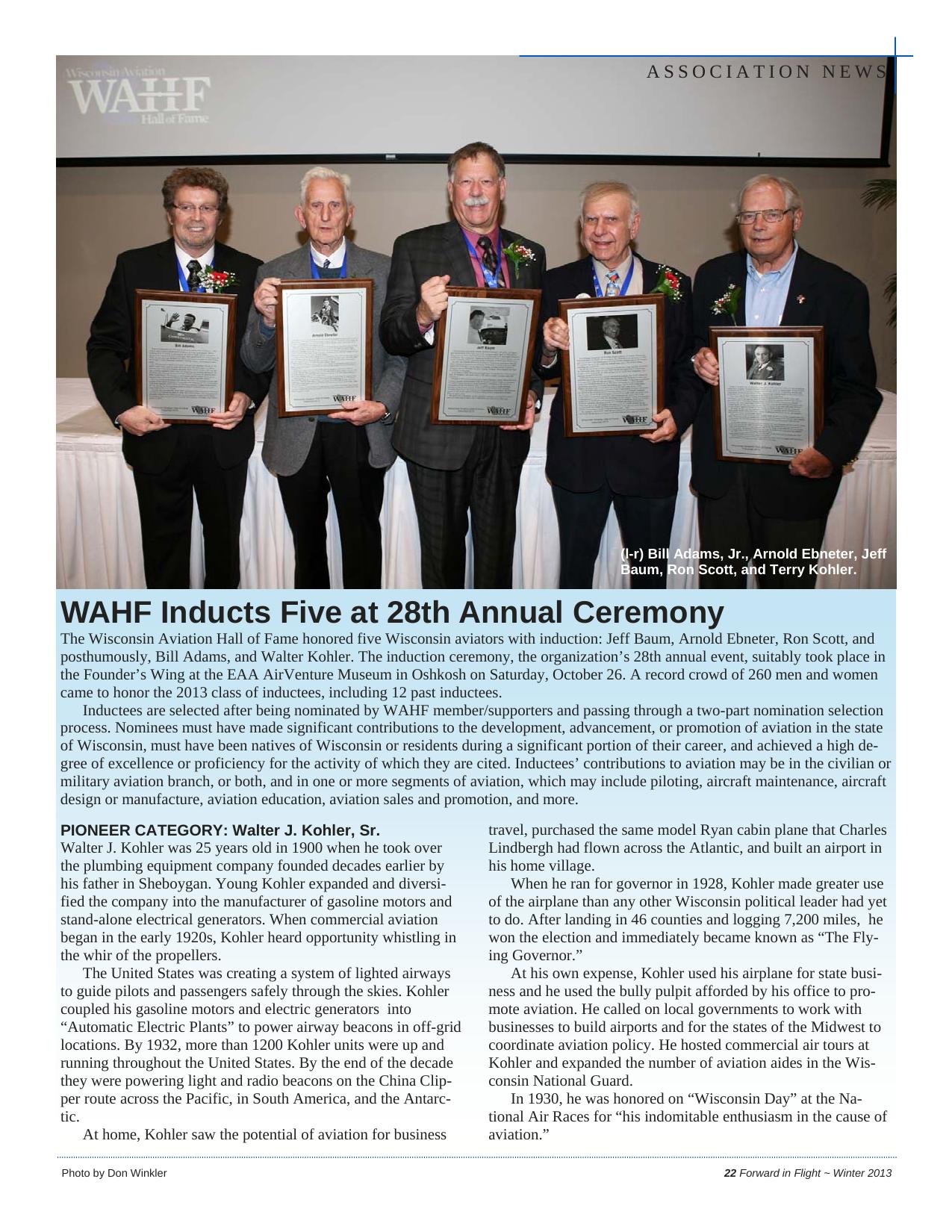
ASSOCIATION NEWS (l-r) Bill Adams, Jr., Arnold Ebneter, Jeff Baum, Ron Scott, and Terry Kohler. WAHF Inducts Five at 28th Annual Ceremony The Wisconsin Aviation Hall of Fame honored five Wisconsin aviators with induction: Jeff Baum, Arnold Ebneter, Ron Scott, and posthumously, Bill Adams, and Walter Kohler. The induction ceremony, the organization’s 28th annual event, suitably took place in the Founder’s Wing at the EAA AirVenture Museum in Oshkosh on Saturday, October 26. A record crowd of 260 men and women came to honor the 2013 class of inductees, including 12 past inductees. Inductees are selected after being nominated by WAHF member/supporters and passing through a two-part nomination selection process. Nominees must have made significant contributions to the development, advancement, or promotion of aviation in the state of Wisconsin, must have been natives of Wisconsin or residents during a significant portion of their career, and achieved a high degree of excellence or proficiency for the activity of which they are cited. Inductees’ contributions to aviation may be in the civilian or military aviation branch, or both, and in one or more segments of aviation, which may include piloting, aircraft maintenance, aircraft design or manufacture, aviation education, aviation sales and promotion, and more. PIONEER CATEGORY: Walter J. Kohler, Sr. Walter J. Kohler was 25 years old in 1900 when he took over the plumbing equipment company founded decades earlier by his father in Sheboygan. Young Kohler expanded and diversified the company into the manufacturer of gasoline motors and stand-alone electrical generators. When commercial aviation began in the early 1920s, Kohler heard opportunity whistling in the whir of the propellers. The United States was creating a system of lighted airways to guide pilots and passengers safely through the skies. Kohler coupled his gasoline motors and electric generators into “Automatic Electric Plants” to power airway beacons in off-grid locations. By 1932, more than 1200 Kohler units were up and running throughout the United States. By the end of the decade they were powering light and radio beacons on the China Clipper route across the Pacific, in South America, and the Antarctic. At home, Kohler saw the potential of aviation for business Photo by Don Winkler travel, purchased the same model Ryan cabin plane that Charles Lindbergh had flown across the Atlantic, and built an airport in his home village. When he ran for governor in 1928, Kohler made greater use of the airplane than any other Wisconsin political leader had yet to do. After landing in 46 counties and logging 7,200 miles, he won the election and immediately became known as “The Flying Governor.” At his own expense, Kohler used his airplane for state business and he used the bully pulpit afforded by his office to promote aviation. He called on local governments to work with businesses to build airports and for the states of the Midwest to coordinate aviation policy. He hosted commercial air tours at Kohler and expanded the number of aviation aides in the Wisconsin National Guard. In 1930, he was honored on “Wisconsin Day” at the National Air Races for “his indomitable enthusiasm in the cause of aviation.” 22 Forward in Flight ~ Winter 2013
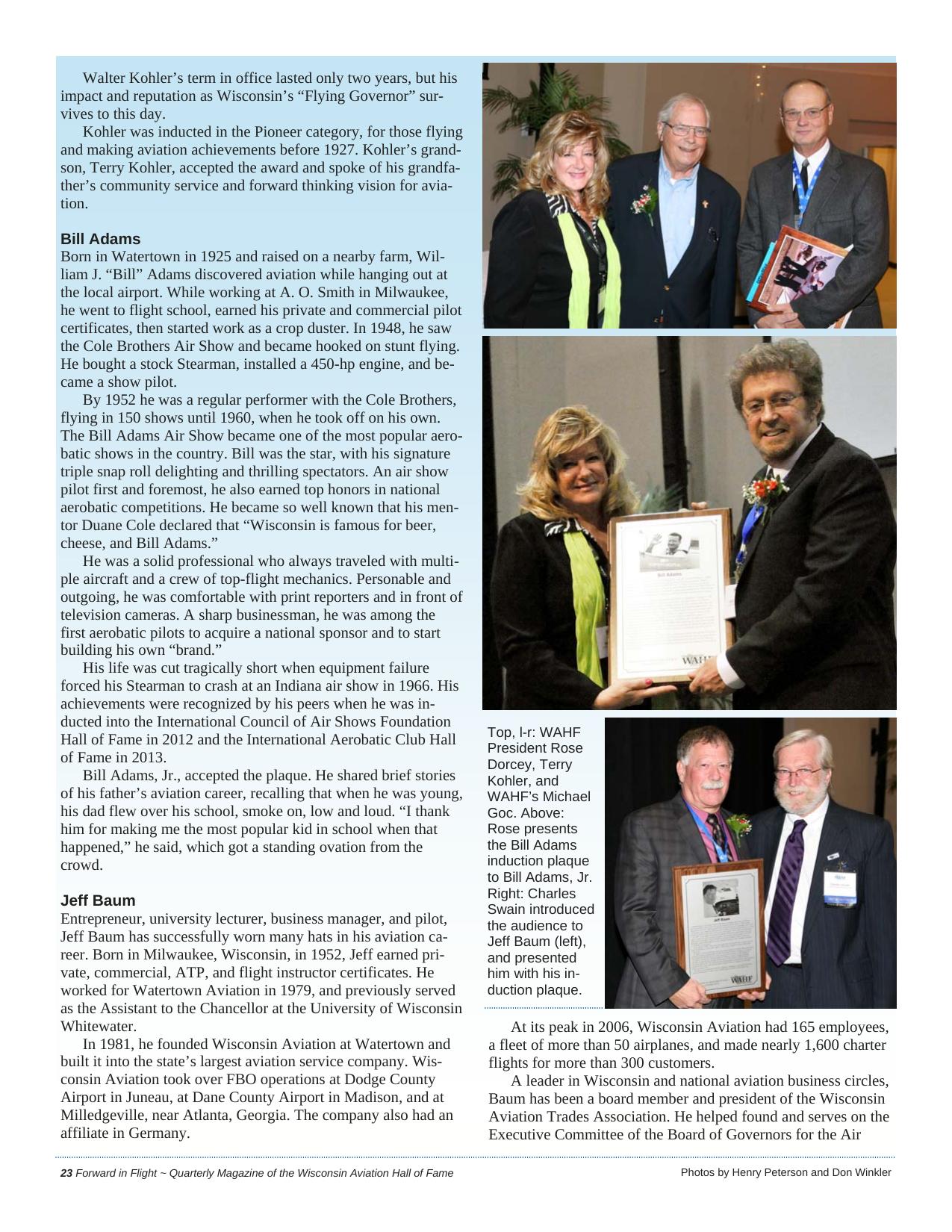
Walter Kohler’s term in office lasted only two years, but his impact and reputation as Wisconsin’s “Flying Governor” survives to this day. Kohler was inducted in the Pioneer category, for those flying and making aviation achievements before 1927. Kohler’s grandson, Terry Kohler, accepted the award and spoke of his grandfather’s community service and forward thinking vision for aviation. Bill Adams Born in Watertown in 1925 and raised on a nearby farm, William J. “Bill” Adams discovered aviation while hanging out at the local airport. While working at A. O. Smith in Milwaukee, he went to flight school, earned his private and commercial pilot certificates, then started work as a crop duster. In 1948, he saw the Cole Brothers Air Show and became hooked on stunt flying. He bought a stock Stearman, installed a 450-hp engine, and became a show pilot. By 1952 he was a regular performer with the Cole Brothers, flying in 150 shows until 1960, when he took off on his own. The Bill Adams Air Show became one of the most popular aerobatic shows in the country. Bill was the star, with his signature triple snap roll delighting and thrilling spectators. An air show pilot first and foremost, he also earned top honors in national aerobatic competitions. He became so well known that his mentor Duane Cole declared that “Wisconsin is famous for beer, cheese, and Bill Adams.” He was a solid professional who always traveled with multiple aircraft and a crew of top-flight mechanics. Personable and outgoing, he was comfortable with print reporters and in front of television cameras. A sharp businessman, he was among the first aerobatic pilots to acquire a national sponsor and to start building his own “brand.” His life was cut tragically short when equipment failure forced his Stearman to crash at an Indiana air show in 1966. His achievements were recognized by his peers when he was inducted into the International Council of Air Shows Foundation Hall of Fame in 2012 and the International Aerobatic Club Hall of Fame in 2013. Bill Adams, Jr., accepted the plaque. He shared brief stories of his father’s aviation career, recalling that when he was young, his dad flew over his school, smoke on, low and loud. “I thank him for making me the most popular kid in school when that happened,” he said, which got a standing ovation from the crowd. Jeff Baum Entrepreneur, university lecturer, business manager, and pilot, Jeff Baum has successfully worn many hats in his aviation career. Born in Milwaukee, Wisconsin, in 1952, Jeff earned private, commercial, ATP, and flight instructor certificates. He worked for Watertown Aviation in 1979, and previously served as the Assistant to the Chancellor at the University of Wisconsin Whitewater. In 1981, he founded Wisconsin Aviation at Watertown and built it into the state’s largest aviation service company. Wisconsin Aviation took over FBO operations at Dodge County Airport in Juneau, at Dane County Airport in Madison, and at Milledgeville, near Atlanta, Georgia. The company also had an affiliate in Germany. 23 Forward in Flight ~ Quarterly Magazine of the Wisconsin Aviation Hall of Fame Top, l-r: WAHF President Rose Dorcey, Terry Kohler, and WAHF’s Michael Goc. Above: Rose presents the Bill Adams induction plaque to Bill Adams, Jr. Right: Charles Swain introduced the audience to Jeff Baum (left), and presented him with his induction plaque. At its peak in 2006, Wisconsin Aviation had 165 employees, a fleet of more than 50 airplanes, and made nearly 1,600 charter flights for more than 300 customers. A leader in Wisconsin and national aviation business circles, Baum has been a board member and president of the Wisconsin Aviation Trades Association. He helped found and serves on the Executive Committee of the Board of Governors for the Air Photos by Henry Peterson and Don Winkler
Charter Safety Foundation, and is a longstanding member of the Twenty Group. He has been on the board of the General Aviation Task Force, the National Air Transportation Association, the National Learn To Fly Team, and the General Aviation Market Expansion (GAME) Plan, to name a few. He serves his community and industry, manages a successful business, and still finds time to add to the 17,000 hours recorded in his logbook. Baum spoke eloquently of his career in aviation, and was thankful to those who helped him on his path, many of whom were in the audience. He encouraged those in the audience to “share our stories” to help grow and strengthen the industry. Baum commented, “...the greatest lesson I learned is what a fantastically rewarding career general aviation can be and how we as an industry fail to tell this story. Yes, there are easier ways to make more money, easier lifestyles, less responsibility, fewer calls in the middle of the night. But as Pete Schroeder, our director of maintenance once said, ‘We probably see more in a year than a lot of people see in a lifetime.’ I think he is probably right. “The problem is, we don’t tell our story. We don’t tell what an exciting, memory-filled life experience it can be for young people embarking on a career—the places you can go, the machines you can fly, the incredible people you will meet—that there’s just nothing like it on earth!” Arnold Ebneter On July 25, 2010, Arnold Ebneter flew the airplane he designed and built himself nonstop from Everett, Washington, to Fredericksburg, Virginia. He set a record of 2,327.85 miles for a Class C-1a landplane with a takeoff weight of 300 to 500 kg., a new world mark for the longest nonstop flight in a homebuilt aircraft. Born on a farm in Mount Horeb, Wisconsin, his preparation for that flight began in 1936 when a barnstormer took sevenyear-old Arnold up for his first flight. He started flight training as a teenager in Portage in 1943, receiving his private pilot certificate in a PT-23 while a senior in high school. At the University of Minnesota, he earned his commercial and instructor certificates, plus A&P mechanic ratings. Arnold entered USAF pilot training in 1953, graduating at the head of his air cadet class in 1954. He then climbed into the cockpit of U.S. Air Force F-86 Saber and F-100 Super Sabre jets. His squadron was among the first to develop in-flight refueling tactics, linking their F-100s to KB-50 tankers on 4,000 mile trans-Atlantic flights. The Air Force sent him to Texas A&M to earn a degree in aeronautical engineering and there, as part of his degree requirement, he conceived and designed the record-breaking E-1 (Ebneter-One). In between, Ebneter served a four-month tour as a squadron maintenance officer in Vietnam, and also flew 25 combat missions. He came home to earn a master’s degree at the Air Force Institute of Technology, then returned to Vietnam to fly 300 combat missions in the F-100, logging a total of 427 combat hours. After leaving the Air Force he signed on with Boeing to work on the 767 airliner, while also restoring a beat up J-3, piloting a B35 Bonanza, and redesigning the E-1. He started building in 1995 and rolled the E-1 out of the hangar for its first flight in 2005. After five more years of fine-tuning and testing, Ebneter took off on his 18.5 hour cross-country flight into the 24 Forward in Flight ~ Winter 2013
record books. The FAA has awarded Ebneter its Wright Brothers Master Pilot and Charles Taylor Master Mechanic awards. He is also the recipient of the Federation Aeronautique’s prestigious Louis Bleriot Medal for Flight. WAHF’s Tom Thomas presented Ebneter’s history. Ebneter then shared stories from his fascinating career, which were appreciated by the audience. Ronald Scott As a teenager designing and building model airplanes in Tomah, Wisconsin, Ron Scott knew his future was in aviation. He joined the U.S. Air Force in 1952 and crewed on C-124 Globemasters ferrying nuclear weapons across the Atlantic to England, and on C-54s supplying isolated bases above the Arctic Circle, including the North Pole. He left the Air Force in 1956, returned to Tomah for a year, and then moved to the Milwaukee area. There, he took flight lessons at Capitol Drive Airport and bought a 1941 Taylorcraft. In 1959, he met EAA Founder Paul Poberezny. The meeting changed Scott’s life. Poberezny inspired Scott to design and build an airplane, but Scott’s choice of materials was all his own. He started experimenting with fiberglass in 1964 and, five years later, made his first test flight in “Old Ironsides.” It has been recognized as the first homebuilt aircraft to use fiberglass structurally in a skin-stressed application, including all framing and landing gear. Old Ironsides made many flights, including eight excursions to the east and west coasts in the 1990s. Scott devoted a half-century and more to the Experimental Aircraft Association. He served as the communications chairman during EAA AirVenture Oshkosh for 52 years, served on the EAA board of directors for eight years, served as chair of the board’s nominating committee, and coordinated the Spirit of St. Louis Commemorative Tour in 1977. He advocated for rule changes aiding homebuilders at the FAA in Washington and Aeronautics Bureau in Madison. Scott was an EAA technical counselor, spending decades as a volunteer advising homebuilders, inspecting their work, and helping with paperwork. As a flight advisor, he has monitored the first flights of fifteen homebuilders. Scott also served on the Sport Aviation Association’s board of directors from 2003 – 2009. WAHF’s John Dorcey presented Ron’s induction. Ron spoke of the value of having been mentored when he began in aviation, and he encouraged the audience to become mentors to others. In addition to the inductions, a silent auction was held to raise funds for WAHF’s educational outreach programs, expertly managed by WAHF Members Linda Grady, Brendan Stormo, Julie Ovans, and Andy Ovans. More than $2,000 was raised. Top: Arnold Ebneter. Center, Ron Scott enjoyed his induction presentation. Right: Past and current inductees (l-r): Robert Clarke, Jeff Baum, Duane Esse, Bill Adams, Jr., Dan Donovan, Michael McArdle, Arnold Ebneter, Tom Hegy, LaVerne Griffin, Paul Johns, Terry Kohler, Ron Scott, Richard Wixom, Archie Henkelmann, and Tom Thomas. Present but missing from photo: Bobbie Wagner and Bill Bordeleau. 25 Forward in Flight ~ Quarterly Magazine of the Wisconsin Aviation Hall of Fame Photos by Henry Peterson
ASSOCIATION NEWS WAHF Awards Three Scholarships at 2013 Banquet The Wisconsin Aviation Hall of Fame awarded scholarships valued at $2,000 to three Wisconsin students. The scholarships were awarded at the organization’s 28th annual induction banquet in Oshkosh on October 26, 2013. Alex Adduci was awarded the $1,000 Carl Guell Memorial scholarship. Alex, from Eagle, Wisconsin, is an aeronautical engineering major at Purdue University in West Lafayette, Indiana. Alex was unable to attend as he’s completing an internship with Gulfstream in Savannah, Georgia. Rich Conrad, of Kiel, Wisconsin, received the $500 Thiessen Field scholarship. He is an Airframe and Powerplant/ Aircraft Avionics student at Fox Valley Technical College in Oshkosh. Jerome Thiessen, Baraboo, funds the scholarship and was present to meet and congratulate Conrad on the award. Heather Behrent, Appleton, is the recipient of the $500 Jerome Ripp Memorial scholarship. Heather is an AirHeather Behrent and Rich Conrad. frame and Powerplant Mechanics/Aircraft Avionics student, also at FVTC. For more information on all five of WAHF’s aviation scholarships, visit www.CFONCW.org. AvFuel Establishes Scholarship to Honor Jeff Baum WAHF to distribute scholarship beginning in 2014 In celebration of longtime customer Jeff Baum of Wisconsin Aviation’s recent induction into the Wisconsin Aviation Hall of Fame (WAHF), Avfuel Corp. has established the Jeff Baum Scholarship, which will be geared toward candidates interested in pursuing a career in aviation business management. The scholarship will be held by the Community Foundation of North Central Wisconsin in Wausau and WAHF. It will be available beginning in 2014. Baum founded Wisconsin Aviation in 1981. The company has since grown to the state’s largest full-service FBO/aviation service provider and operates at three locations: Dane County Regional Airport (KMSN) in Madison, Watertown Municipal Airport (KRYV), and Dodge County Airport (KUNU) in Juneau. Baum partnered with Avfuel for the provision of fuel and services early in the company’s existence and has been a valued friend to and champion of the fuel supplier ever since, Avfuel officials said. “Jeff Baum is much more to Avfuel than simply a customer,” said Craig R. Sincock, Avfuel president and CEO. “He’s been a trusted advisor when we’ve solicited his feedback. He’s been an advocate for the Avfuel brand and our programs. Most importantly, he shares the same passion for and commitment to aviation that we embrace at Avfuel. We could not be more proud to call Jeff Baum our friend, and we are thrilled to see him recognized by the WAHF.” The $250 scholarship will go to Wisconsin students enrolled in an aviation management program at any U.S. college or university. To apply for or learn more about the scholarship, visit the Community Foundation of North Central Wisconsin’s website at www.CFONCW.org after January 1, 2014. Morey Airplane Company Since 1932 Middleton Municipal Airport/Morey Field Self-service 100LL & Jet A 24-7 Join the smart business people who put their names in front of the pilots and aircraft owners who regularly read Forward in Flight. Call Rose for your ad at 920-385-1483 or email rdorcey@wisconsinaviationhalloffame.org 26 Forward in Flight ~ Winter 2013
FROM THE AIRWAYS EAA’s Speaker Series 2014 Presentations Begin January 16 EAA’s speaker series focusing on unique and historic aviation experiences returns for its fall/winter season, with free admission and a “beyond the ropes” museum tour immediately following the free public presentations. All presentations begin at 7 p.m. in the museum Founders’ Wing, with no cost for admission. Scheduled presentations in early 2014 include: January 16: “Miracle on the Hudson” with Jeff Skiles February 20: “The Story of Lady Be Good” w/Dick Campbell March 20: “Bob Shank – Pioneer American Pilot” w/Fred Stadler April 17: “History of the B-17” with Sean Elliott May 15: “Landing a C-97 at Dodgeville” with WAHF Board Member/Inductee Tom Thomas. The EAA AirVenture Museum is located just off Highway 41 at the Highway 44 Jeff Skiles will present “Miracle on the Hudexit in Oshkosh. The museum is open Monday -Saturday from 8:30 a.m. to 5 p.m. and son” at EAA on January 16. Skiles spoke Sundays 10 a.m. to 5 p.m. EAA members receive free museum admission. on the same subject at the annual WAHF induction banquet in 2009 (above). Call 920-426-6108 or visit www.AirVentureMuseum.org for more information. WAHF Board Member Tom Thomas Presented WisANG History at EAA On November 7, Tom Thomas presented “Flying in the Wisconsin Air National Guard,” a look at the Badger State’s military flying unit from its inception through today at the EAA AirVenture Museum as part of its fall/winter speaker series. Tom shared the history of the Air National Guard, its planes and people, and some of his personal experiences with the Wisconsin Air National Guard. Following the presentation, guests were allowed to sit in the cockpit of several muTom Thomas shared WisANG history in his seum aircraft, including its B-25, Mosquito, and P-51. presentation on November 7. Ground Breaking at Jet Air Jet Air, located at Austin Straubel International Airport (KGRB) has a new hangar coming in early 2014. A ground breaking for the 34,000 square foot hangar was held on October 21. Governor Scott Walker attended, as did Green Bay Mayor Schmidt, and Brown County Exec Troy Streckenbach. Alan Timmerman, Jet Air CEO, says the hangar, which will be home to several aircraft and an aircraft refurbishment business, should be completed by February 2014. Gov. Walker added that investment in transportation infrastructure is important to our state to attract and retain businesses and jobs. Jet Air’s growth will initially bring six new jobs to Green Bay. Call Alan Timmerman at 866-676-7835 for more information. Right: Jet Air’s Alan Timmerman with Governor Scott Walker. 27 Forward in Flight ~ Quarterly Magazine of the Wisconsin Aviation Hall of Fame Cupcake Competition Raises Funds for Flight Scholarship The Oshkosh Women in Aviation Chapter has named the top three winners for its Frosting for Flight cupcake competition. First place went to “Team Sweet Treats” Laura Redeker and Tiffany Schmidt (right). Their Feed the Animals/ Zookeeper theme and Double Chocolate Panda Bear cupcakes with cream cheese frosting were a hit with the judges and the attendees— they also won the crowd favorite judging. The sale was a fantastic success, with more than 425 cupcakes sold in two hours, and raising more than $600 for the chapter’s Spirit of Flight scholarship fund. Six teams competed, with unique themes and flavors. Oshkosh Women in Aviation chapter members and friends brought equally delicious flavors for the cupcake sale to supplement those of the contestants. Visit www.OshkoshWAI.org for more information. Photos by Rose Dorcey
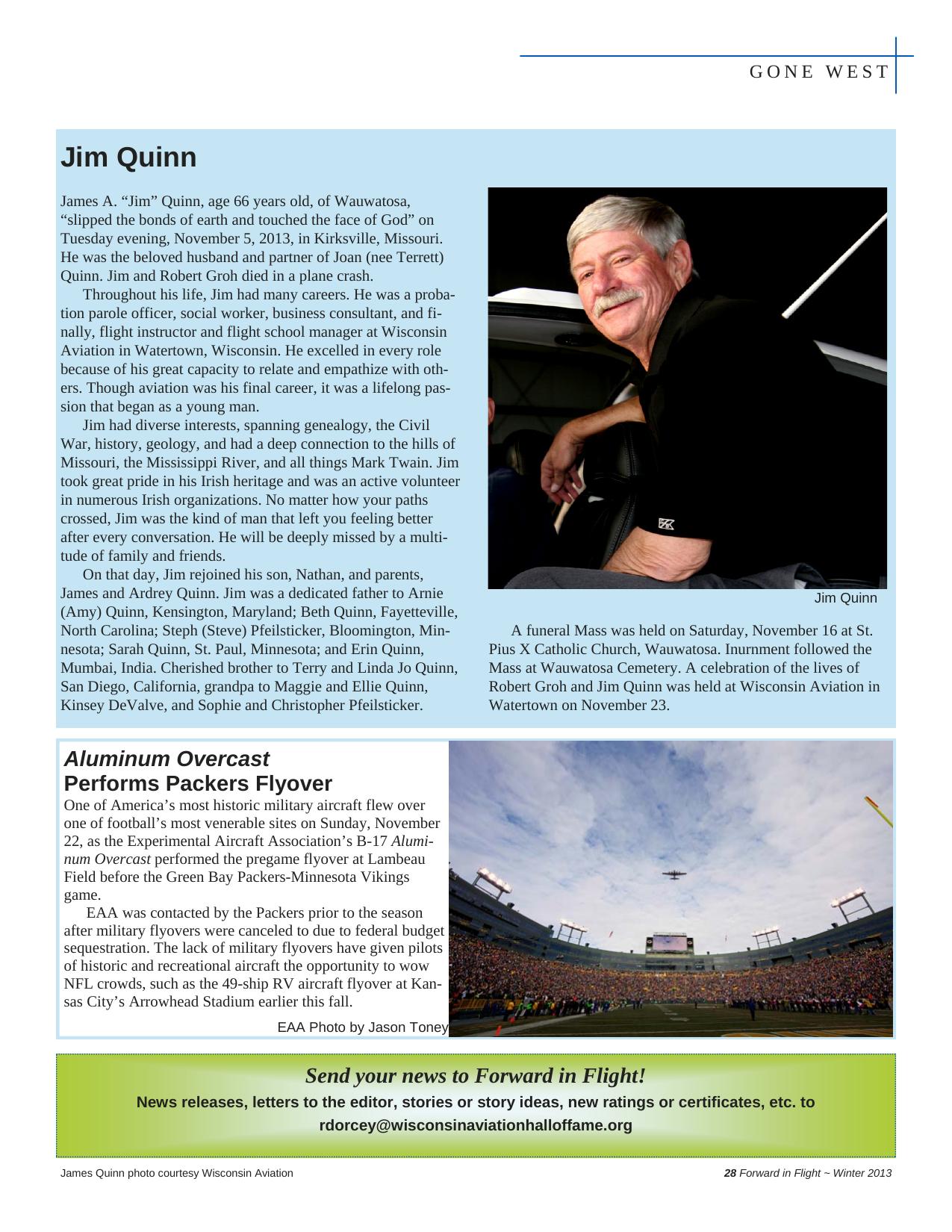
GONE WEST Jim Quinn James A. “Jim” Quinn, age 66 years old, of Wauwatosa, “slipped the bonds of earth and touched the face of God” on Tuesday evening, November 5, 2013, in Kirksville, Missouri. He was the beloved husband and partner of Joan (nee Terrett) Quinn. Jim and Robert Groh died in a plane crash. Throughout his life, Jim had many careers. He was a probation parole officer, social worker, business consultant, and finally, flight instructor and flight school manager at Wisconsin Aviation in Watertown, Wisconsin. He excelled in every role because of his great capacity to relate and empathize with others. Though aviation was his final career, it was a lifelong passion that began as a young man. Jim had diverse interests, spanning genealogy, the Civil War, history, geology, and had a deep connection to the hills of Missouri, the Mississippi River, and all things Mark Twain. Jim took great pride in his Irish heritage and was an active volunteer in numerous Irish organizations. No matter how your paths crossed, Jim was the kind of man that left you feeling better after every conversation. He will be deeply missed by a multitude of family and friends. On that day, Jim rejoined his son, Nathan, and parents, James and Ardrey Quinn. Jim was a dedicated father to Arnie (Amy) Quinn, Kensington, Maryland; Beth Quinn, Fayetteville, North Carolina; Steph (Steve) Pfeilsticker, Bloomington, Minnesota; Sarah Quinn, St. Paul, Minnesota; and Erin Quinn, Mumbai, India. Cherished brother to Terry and Linda Jo Quinn, San Diego, California, grandpa to Maggie and Ellie Quinn, Kinsey DeValve, and Sophie and Christopher Pfeilsticker. Jim Quinn A funeral Mass was held on Saturday, November 16 at St. Pius X Catholic Church, Wauwatosa. Inurnment followed the Mass at Wauwatosa Cemetery. A celebration of the lives of Robert Groh and Jim Quinn was held at Wisconsin Aviation in Watertown on November 23. Aluminum Overcast Performs Packers Flyover One of America’s most historic military aircraft flew over one of football’s most venerable sites on Sunday, November 22, as the Experimental Aircraft Association’s B-17 Aluminum Overcast performed the pregame flyover at Lambeau Field before the Green Bay Packers-Minnesota Vikings game. EAA was contacted by the Packers prior to the season after military flyovers were canceled to due to federal budget sequestration. The lack of military flyovers have given pilots of historic and recreational aircraft the opportunity to wow NFL crowds, such as the 49-ship RV aircraft flyover at Kansas City’s Arrowhead Stadium earlier this fall. EAA Photo by Jason Toney Send your news to Forward in Flight! News releases, letters to the editor, stories or story ideas, new ratings or certificates, etc. to rdorcey@wisconsinaviationhalloffame.org James Quinn photo courtesy Wisconsin Aviation 28 Forward in Flight ~ Winter 2013

MEMBER LOGBOOK Your Member Spotlight Have you sent in your Member Spotlight form yet? If not, please do, so we can feature you in a future issue of Forward in Flight. All members receive a form when joining or renewing their membership, so please fill it out and return it today. Or, just answer the questions Marcea did, and email them to the editor. Meet a WAHF member... Marcea Weiss Occupation: Branch Manager, Merendino Cemetery Care What I enjoy most about my life: Family, continuing improvement, adventure, making a difference, and technology. Send to Rose Dorcey Forward in Flight 3980 Sharratt Drive Oshkosh, WI 54901-1276 The latest book I’ve read: Cross Roads, by William Paul Young. What do you enjoy most about your life? Family, continuous improvement, adventure, making a difference, and technology. Email rdorcey@wisconsinaviationhalloffame.org Thank you! One thing I want to do before I die: Travel to India. Favorite aircraft: VH-60 Blackhawk Helicopter. Marcea Weiss How I got interested in aviation/aviation background: Ten years in the Army as a VH-60 pilot and maintenance test pilot. One thing most people don’t know about me: I have a twin sister, Mary, who was a fixed wing, C-130 pilot in the U.S. Air Force. A person from history I would like to meet: General Joshua L. Chamberlain. He seems like he was the perfect example of a quiet professional. The person I most admire: My Mom! I don’t know how she did it all (and still does!) Favorite quote: Avoid the status quo and have fun doing it. Learn or do something new every day. Why I became a WAHF member: I want to support and grow aviation and the number of young aviators in Wisconsin. Meet your fellow WAHF members in each issue of Forward in Flight. 29 Forward in Flight ~ Quarterly Magazine of the Wisconsin Aviation Hall of Fame
Wittman Regional Airport Oshkosh So much history ...and still making it! From the legacy of Steve Wittman to Warren Basler’s DC-3 conversions, we’re proud to support and contribute to Wisconsin aviation history. FLY TO OSHKOSH wittmanairport.com @wittmanairport 30 Forward in Flight ~ Winter 2013
PRSRT STD US Postage Paid Wisc Rapids WI Permit 98 3980 SHARRATT DRIVE OSHKOSH WI 54901-1276 The Wisconsin Aviation Hall of Fame is a non-profit membership organization dedicated to preserving the past and fostering the future of flight. Welcome WAHF Member/Supporters: Eileen Bjorkman Pat Brabazon Bonnie Fitzsimmons Craig Fitzsimmons Allan Hatz Jon Helminiak Calvin Pitts Brad Preissel Don Stark Brendan Stormo Gary Buettner Darrel Gibson Patricia Horn Roger Ridings Johns Dodds Linda Grady Don Kiel James Rothschadl —Thanks for coming aboard. We hope to see you at a WAHF event soon! CONGRATULATIONS …to WAHF Member/Supporter Brian Rupnow, who passed his private pilot checkride on Wednesday, November 20. Brian is a member of Winnebago Flying Club in Oshkosh who took his checkride with Pilot Examiner (and WAHF Inductee) Harold “Duffy” Gaier. Brian had just over the minimum 40 hours of flight time when he arrived at Marshfield Municipal Airport–Roy Shwery Field (KMFI) for his flight test. Brian’s flight instructor was WAHF Board Member John Dorcey. Great job, Brian! MEMBERSHIP DUES ARE DUE! If your membership expires at the end of December, you’ll be receiving a renewal notice soon. We sincerely hope you’ll stay on board for another trip through the calendar year. Because of your support, we’ve been able to grow our membership, expand our scholarship program, offer a great membership magazine, receive more inductee nominations, and share more of our state’s rich aviation history with men and women, boys and girls throughout the state. Your nominal $20 membership fee helps cover our day-to-day costs and the production of this magazine. To save postage costs, for you and us, you can easily and safely renew online at: www.WisconsinAviationHallofFame.org. Thank you! Wisconsin Aviation Hall of Fame Officers Rose Dorcey, President Tom Thomas, Vice President John Dorcey, Secretary/Treasurer Board of Directors Bruce Botterman Andrew Ovans Charles Swain Tom Thomas Wynne Williams Ron Wojnar Wisconsin Aviation Hall of Fame 3980 Sharratt Drive Oshkosh, WI 54901-1276 Become a supporter today! Join or renew online. www.wisconsinaviationhalloffame.org For information contact: Rose Dorcey 920-385-1483 rdorcey@wisconsinaviationhalloffame.org