Volume 12, Issue 4
🗞️ Download Issue (PDF)
Forward in Flight - Winter 2014
Volume 12, Issue 4 Quarterly Magazine of the Wisconsin Aviation Hall of Fame Winter 2014/2015
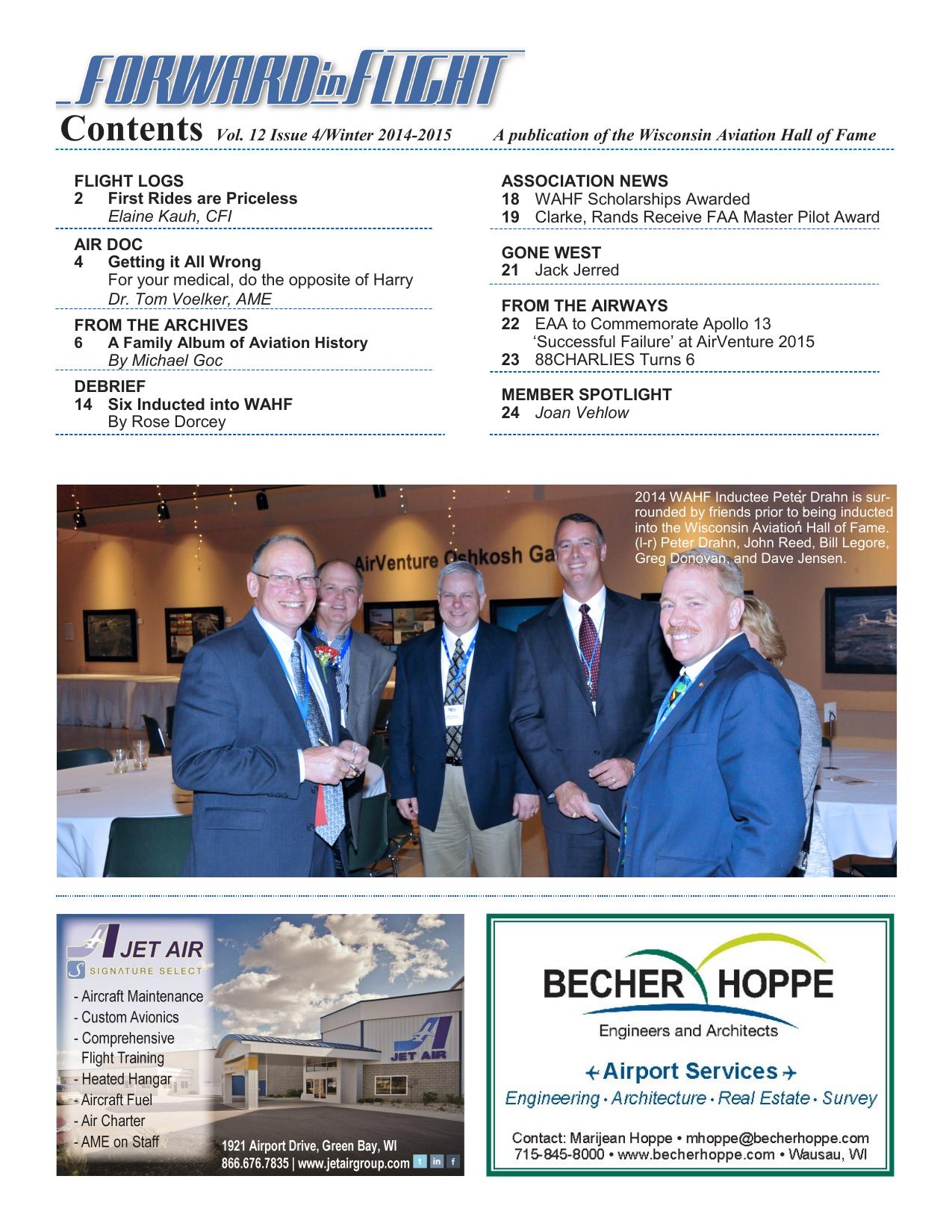
Contents Vol. 12 Issue 4/Winter 2014-2015 A publication of the Wisconsin Aviation Hall of Fame FLIGHT LOGS 2 First Rides are Priceless Elaine Kauh, CFI ASSOCIATION NEWS 18 WAHF Scholarships Awarded 19 Clarke, Rands Receive FAA Master Pilot Award AIR DOC 4 Getting it All Wrong For your medical, do the opposite of Harry Dr. Tom Voelker, AME GONE WEST 21 Jack Jerred FROM THE ARCHIVES 6 A Family Album of Aviation History By Michael Goc DEBRIEF 14 Six Inducted into WAHF By Rose Dorcey FROM THE AIRWAYS 22 EAA to Commemorate Apollo 13 ‘Successful Failure’ at AirVenture 2015 23 88CHARLIES Turns 6 MEMBER SPOTLIGHT 24 Joan Vehlow 2014 WAHF Inductee Peter Drahn is surrounded by friends prior to being inducted into the Wisconsin Aviation Hall of Fame. (l-r) Peter Drahn, John Reed, Bill Legore, Greg Donovan, and Dave Jensen.
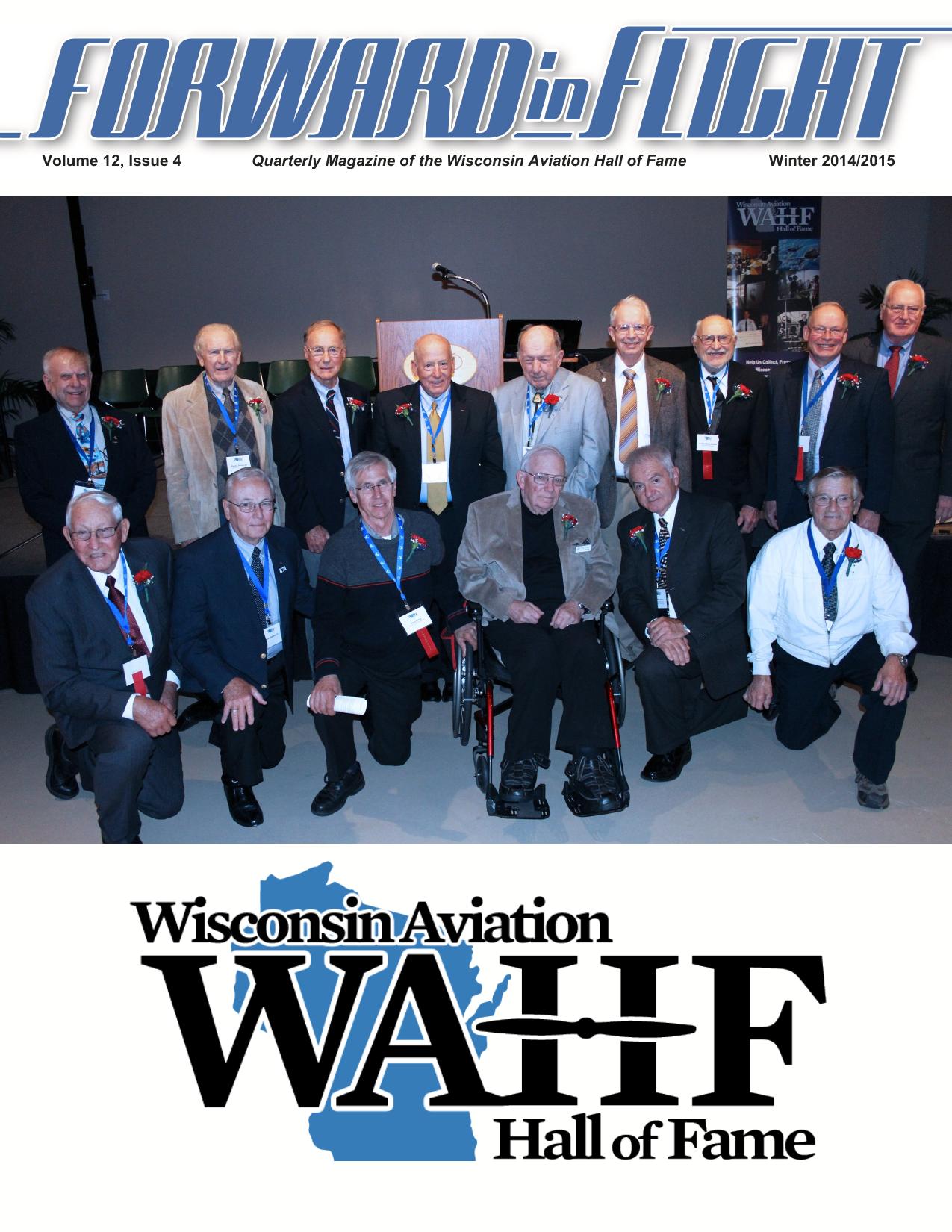
President’s Message ~ by Rose Dorcey As many of you know, 2014 was the 70th anniversary year of Richard I. Bong receiving the Congressional Medal of Honor, and the WAHF board members felt strongly enough about it to tour the state to tell Bong’s story. And as usually happens when we’re giving presentations, we may learn as much as we share. Three WAHF board members, Tom Thomas, Henry Peterson, and John Dorcey, gave 25 presentations this last year in 24 cities. Well over 1,200 men, women, and youth heard the presentations, and learned more about one of our nation’s heroes. We have to thank Tom, Henry, and John for giving of their time to make this happen. More importantly, we want to thank all those who attended. Several years ago, WAHF began a bigger push to get out in front of audiences to share stories from Wisconsin’s rich aviation history. It didn’t take long to learn that the audience members often had stories to tell as well. This year, we learned something that not one of the WAHF board members knew; that Wisconsin was home to a member of the famed Tuskegee Airmen. The Tuskegee Airmen, as most of you know, were determined young men who enlisted to become America’s first black military airmen. When John visited the Waukesha County Historical Society in September to give the Bong presentation, David Isabell was in the audience. David came up to John afterward and asked if WAHF was aware of Alfred Gorham. And this is what John learned... Wisconsin’s only Tuskegee Airman, Alfred Gorham, was born November 24, 1920 in South Dakota, and grew up in Waukesha, Wisconsin. He graduated from Waukesha High School in 1938 and attended Carroll College until entering the USAAF. Gorham was a cadet in pilot class 44-B-SE, earning his commission as a 2nd Lieutenant and his wings at Tuskegee AAF on February 8, 1944. On July 27, 1944, Gorham, as a member of the 301st FS/332FG, scored victories against two FW190s in a North American P-51 Mustang. On August 7, 1944, returning from a combat mission his P-51C, 43-25111, Alfred undershot the runway during a night approach to a strange airport not equipped with airfield lights, crashing into Lake Lesina. The aircraft caught fire after impact. Gorham, though injured, survived the accident. Forward in Flight The only magazine dedicated exclusively to Wisconsin aviation history and today’s events. Rose Dorcey, editor 3980 Sharratt Drive Oshkosh, WI 54901-1276 Phone: 920-385-1483 920-279-6029 rdorcey@wisconsinaviationhallofame.org The Wisconsin Aviation Hall of Fame is a non-profit membership organization with a mission to collect and preserve the history of aviation in Wisconsin, recognize those who made that history, inform others of it, and promote aviation education for future generations. Rose Dorcey While on a combat mission east of Munich, Germany, on February 25, 1945, 1st Lt. Gorham was reported lost at about 1145 hours. He had reported mechanical difficulties. Gorham was captured later that day and confined at Stalag VIIA until the end of the war. Gorham returned home to Waukesha after the war, retiring from AC Sparkplug in Oak Creek after many years. He and his wife moved to Ocala, Florida, where he died in 2009. Alfred Gorham is interred at Arlington National Cemetery. This is the reason WAHF board members are so willing to travel throughout the state to talk about Wisconsin aviation history. We enjoy telling the stories, but get just as much enjoyment as we learn about Wisconsin aviation heroes, like Alfred Gorham, and then share their stories here, in Forward in Flight. And you can bet that as we travel to communities in 2015, Alfred’s name, and those of others we learned about this past year, will become part of new presentations. The Wisconsin Aviation Hall of Fame is celebrating its 30th birthday in 2015! Thirty years of collecting, preserving, and sharing Wisconsin aviation history. We have some fun things planned and we’ll share that news with you in our next issue. Surely part of what we’ll do is continue to get out there and share more aviation history, because in doing so we’re likely to learn about more people like Alfred. And in doing so, we’re carrying out all facets of our mission (in box, below left) ...we just don’t always know which form that will take when we step in front of a new audience, but are delighted when it turns out to be a “collection” mission, by learning about another distinguished Wisconsin aviator. On the cover: The 2014 Wisconsin Aviation Hall of Fame induction banquet brought together some of the most influential and highly respected Wisconsin aviators and their families, including a large group of WAHF inductees. Front (l-r): Don Voland, James Knaup, Jr., Tom Hegy, Bill Bordeleau, Tom Thomas, and Harold “Duffy” Gaier. Back row: Ron Scott, Dan Donovan, Duane Esse, James Flatley III, Bill Rewey, Robert Clarke, Archie Henkelmann, Peter Drahn, and Mike McArdle. Absent from photo: Paul Johns. Photo by Rose Dorcey
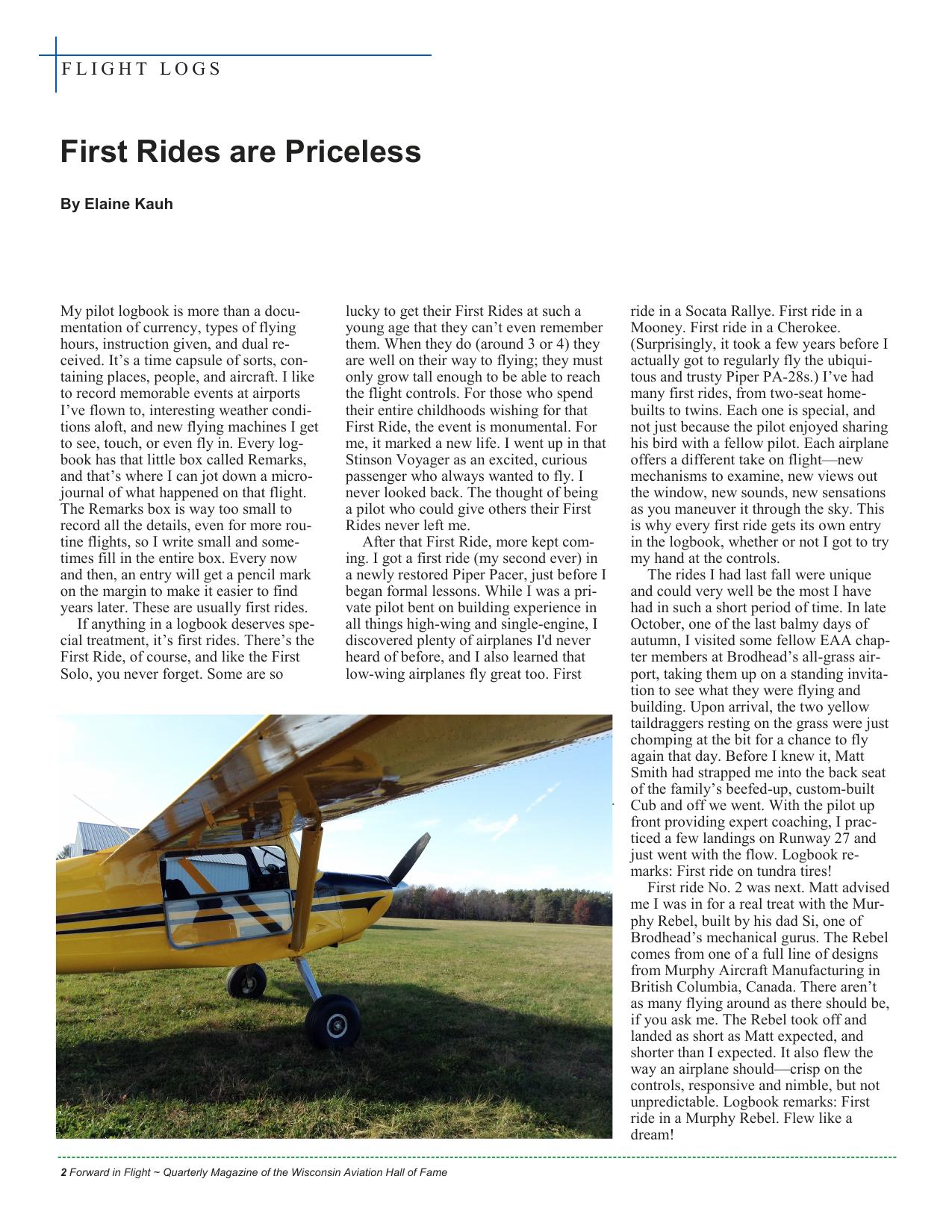
FLIGHT LOGS First Rides are Priceless By Elaine Kauh My pilot logbook is more than a documentation of currency, types of flying hours, instruction given, and dual received. It’s a time capsule of sorts, containing places, people, and aircraft. I like to record memorable events at airports I’ve flown to, interesting weather conditions aloft, and new flying machines I get to see, touch, or even fly in. Every logbook has that little box called Remarks, and that’s where I can jot down a microjournal of what happened on that flight. The Remarks box is way too small to record all the details, even for more routine flights, so I write small and sometimes fill in the entire box. Every now and then, an entry will get a pencil mark on the margin to make it easier to find years later. These are usually first rides. If anything in a logbook deserves special treatment, it’s first rides. There’s the First Ride, of course, and like the First Solo, you never forget. Some are so lucky to get their First Rides at such a young age that they can’t even remember them. When they do (around 3 or 4) they are well on their way to flying; they must only grow tall enough to be able to reach the flight controls. For those who spend their entire childhoods wishing for that First Ride, the event is monumental. For me, it marked a new life. I went up in that Stinson Voyager as an excited, curious passenger who always wanted to fly. I never looked back. The thought of being a pilot who could give others their First Rides never left me. After that First Ride, more kept coming. I got a first ride (my second ever) in a newly restored Piper Pacer, just before I began formal lessons. While I was a private pilot bent on building experience in all things high-wing and single-engine, I discovered plenty of airplanes I'd never heard of before, and I also learned that low-wing airplanes fly great too. First 2 Forward in Flight ~ Quarterly Magazine of the Wisconsin Aviation Hall of Fame ride in a Socata Rallye. First ride in a Mooney. First ride in a Cherokee. (Surprisingly, it took a few years before I actually got to regularly fly the ubiquitous and trusty Piper PA-28s.) I’ve had many first rides, from two-seat homebuilts to twins. Each one is special, and not just because the pilot enjoyed sharing his bird with a fellow pilot. Each airplane offers a different take on flight—new mechanisms to examine, new views out the window, new sounds, new sensations as you maneuver it through the sky. This is why every first ride gets its own entry in the logbook, whether or not I got to try my hand at the controls. The rides I had last fall were unique and could very well be the most I have had in such a short period of time. In late October, one of the last balmy days of autumn, I visited some fellow EAA chapter members at Brodhead’s all-grass airport, taking them up on a standing invitation to see what they were flying and building. Upon arrival, the two yellow taildraggers resting on the grass were just chomping at the bit for a chance to fly again that day. Before I knew it, Matt Smith had strapped me into the back seat of the family’s beefed-up, custom-built Cub and off we went. With the pilot up front providing expert coaching, I practiced a few landings on Runway 27 and just went with the flow. Logbook remarks: First ride on tundra tires! First ride No. 2 was next. Matt advised me I was in for a real treat with the Murphy Rebel, built by his dad Si, one of Brodhead’s mechanical gurus. The Rebel comes from one of a full line of designs from Murphy Aircraft Manufacturing in British Columbia, Canada. There aren’t as many flying around as there should be, if you ask me. The Rebel took off and landed as short as Matt expected, and shorter than I expected. It also flew the way an airplane should—crisp on the controls, responsive and nimble, but not unpredictable. Logbook remarks: First ride in a Murphy Rebel. Flew like a dream!
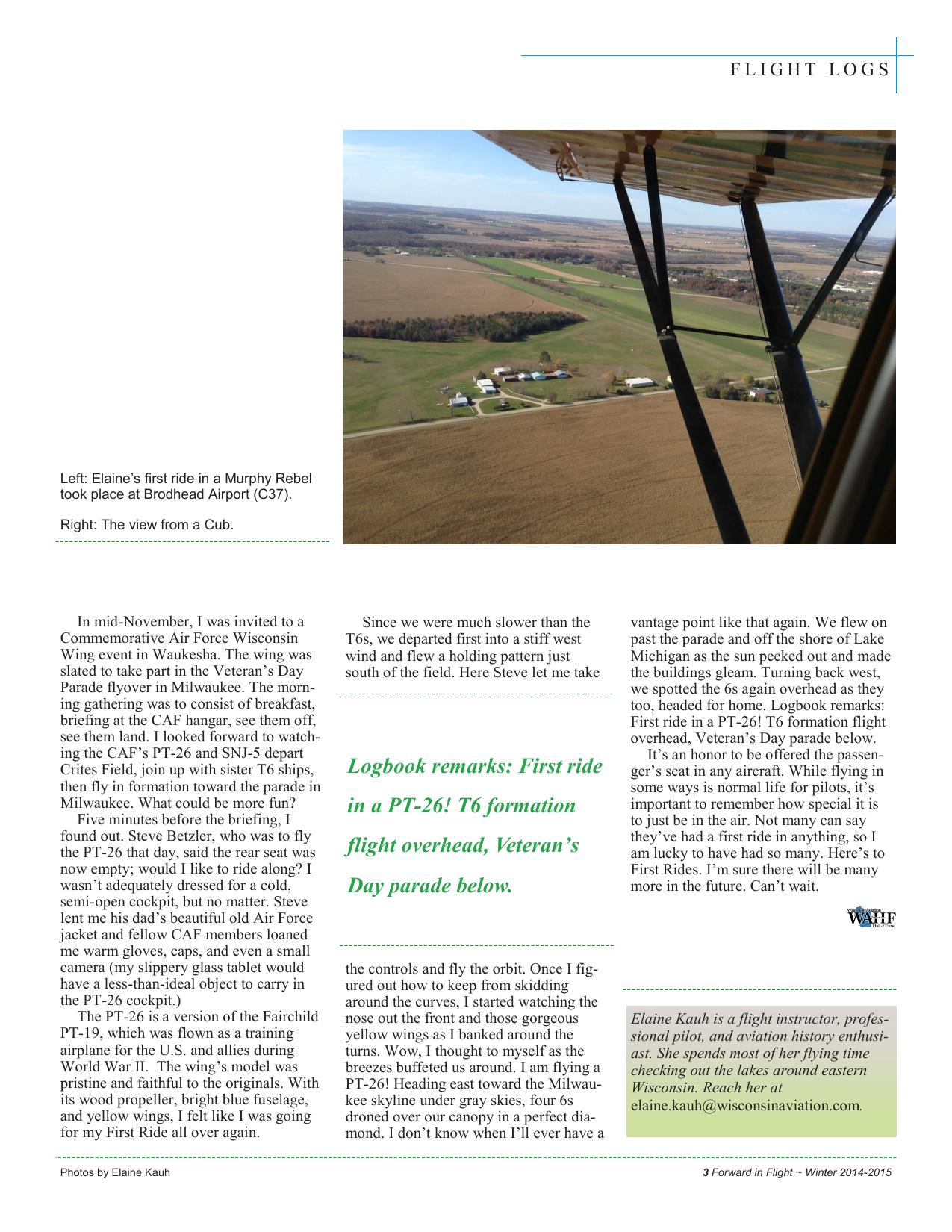
FLIGHT LOGS Left: Elaine’s first ride in a Murphy Rebel took place at Brodhead Airport (C37). Right: The view from a Cub. In mid-November, I was invited to a Commemorative Air Force Wisconsin Wing event in Waukesha. The wing was slated to take part in the Veteran’s Day Parade flyover in Milwaukee. The morning gathering was to consist of breakfast, briefing at the CAF hangar, see them off, see them land. I looked forward to watching the CAF’s PT-26 and SNJ-5 depart Crites Field, join up with sister T6 ships, then fly in formation toward the parade in Milwaukee. What could be more fun? Five minutes before the briefing, I found out. Steve Betzler, who was to fly the PT-26 that day, said the rear seat was now empty; would I like to ride along? I wasn’t adequately dressed for a cold, semi-open cockpit, but no matter. Steve lent me his dad’s beautiful old Air Force jacket and fellow CAF members loaned me warm gloves, caps, and even a small camera (my slippery glass tablet would have a less-than-ideal object to carry in the PT-26 cockpit.) The PT-26 is a version of the Fairchild PT-19, which was flown as a training airplane for the U.S. and allies during World War II. The wing’s model was pristine and faithful to the originals. With its wood propeller, bright blue fuselage, and yellow wings, I felt like I was going for my First Ride all over again. Photos by Elaine Kauh Since we were much slower than the T6s, we departed first into a stiff west wind and flew a holding pattern just south of the field. Here Steve let me take Logbook remarks: First ride in a PT-26! T6 formation flight overhead, Veteran’s Day parade below. the controls and fly the orbit. Once I figured out how to keep from skidding around the curves, I started watching the nose out the front and those gorgeous yellow wings as I banked around the turns. Wow, I thought to myself as the breezes buffeted us around. I am flying a PT-26! Heading east toward the Milwaukee skyline under gray skies, four 6s droned over our canopy in a perfect diamond. I don’t know when I’ll ever have a vantage point like that again. We flew on past the parade and off the shore of Lake Michigan as the sun peeked out and made the buildings gleam. Turning back west, we spotted the 6s again overhead as they too, headed for home. Logbook remarks: First ride in a PT-26! T6 formation flight overhead, Veteran’s Day parade below. It’s an honor to be offered the passenger’s seat in any aircraft. While flying in some ways is normal life for pilots, it’s important to remember how special it is to just be in the air. Not many can say they’ve had a first ride in anything, so I am lucky to have had so many. Here’s to First Rides. I’m sure there will be many more in the future. Can’t wait. Elaine Kauh is a flight instructor, professional pilot, and aviation history enthusiast. She spends most of her flying time checking out the lakes around eastern Wisconsin. Reach her at elaine.kauh@wisconsinaviation.com. 3 Forward in Flight ~ Winter 2014-2015
AIR DOC Getting it All Wrong For your medical, do the opposite of Harry Dr. Tom Voelker, AME DrAlphaMike@yahoo.com Greetings, airmen! I hope this issue of Air Doc finds you safe and sound—and warm. As I write this issue’s column I am looking outside at the first “Winter Storm Warning” of the season. As usually happens once or twice this time of year, one of my partners caught me on my way out of the clinic this evening, and he jokingly asked, “Wanna go fly some approaches?” With visibility of less than one-half mile and blowing wet snow (in addition to being miserably cold outside), I politely bowed out. That offer did give me an idea for this column, though. Let’s talk about the approach to getting a flight physical. Or for a little more fun, let’s talk about how not to get a medical. I have performed lots of medicals—well over 500. With that many encounters, there were bound to be some that didn’t go as smoothly as they could have. In fact, some of them have been like “hard landings.” Just as we learn from the bad landings, we can all learn a thing or two about the right way—and the wrong way—to complete a flight physical. Today we’ll watch Harry futz his way through the application process, making quite a few goofs along the way. Harry represents a fictional compilation of several real pilot applicants, duplicating errors I have seen over the years. Hopefully, when these mishaps are all combined, you can at least have some entertaining reading. And maybe we can all learn something as well. MedXpress The first thing Pam, my Medical Assistant, asked for from Harry was his confirmation number. “What’s that?” he asked. As all of you pilots should know by now, the only way to complete your medical application (the 8500-8 form we AMEs refer to all the time) is on the internet, with the FAA program called MedXpress. This is an easy-to-complete form. When you are done, you submit the form and are issued a Confirmation Number. The only way I can start a flight physical application is by entering this number on the FAA website. Until it is entered by the AME, the FAA doesn’t even know your application exists. (Until the AME calls up the exam, the application resides in the computer system of another government agency.) It turns out Pam had a few minutes to spare that afternoon, and she helped Harry fill out an application on the exam room computer, so we were able to proceed with the exam. I need to warn you, though; this probably won’t work for you. By the time you would complete a flight physical application in the exam room, your time slot would be long gone, and I would ask you to reschedule. I Need it Now! When I suggested to Harry that he might need to reschedule his physical, he got quite upset. “I need that medical by tomorrow. My medical expires the end of Any “mismatch” of the history to the exam can lead to questions in OKC, and just between you and me, you don’t want the FAA asking questions! this month! And it’s the 30th today!” All of the sudden, Harry’s poor planning becomes my problem! I generally try hard to accommodate pilots. I do enjoy flight physicals, primarily because I get to shoot the breeze with other pilots. But when this causes me to get behind in my clinic schedule, the flight physical gets a lot less fun. Harry certainly could have planned better. The FAA is nice enough to expire our medical certificates at the end of the anniversary month of the ex- 4 Forward in Flight ~ Quarterly Magazine of the Wisconsin Aviation Hall of Fame am—six months for first class, 12 months for second class, 24 months for third class (if the airman is over 40 years old). If you schedule your next physical at the beginning of the last month of your current medical’s authorization, you give yourself (as well as your AME) more time to complete the exam and paperwork. Existing Conditions Harry did get his MedXpress form completed and supplied his Confirmation Number. He convinced me to go ahead with the exam, even though by now I was running behind. And now I need to hurry. Harry has hypertension (high blood pressure). That alone is not necessarily a big problem. I just need to see notes from his recent visit to his personal doctor to verify that his blood pressure is well controlled and that he is not having side effects from his medications (among other things) and that any appropriate lab tests are satisfactory. You guessed it—Harry hadn’t seen his doctor in almost a year. Sorry, Harry, but I don’t think you’re getting your medical this month. I scheduled an additional visit for him with me, where I would see him as a personal physician (instead of being his AME). And yes, Harry, there will be another charge for this additional visit. Where is the Letter? To complicate things even more, Harry has diabetes. This by itself should not be terribly problematic, especially since he has previously been issued an AASI (AME-assisted Special Issuance) by the FAA for diabetes. With the AASI in my hand, I am still able to issue a medical on the spot—as long as I can verify the conditions stipulated in the letter. What letter, you ask? When you are issued an AASI, you receive a letter from the FAA that lists the requirements for issuance of subsequent medical certificates for conditions such as diabetes and heart disease that are generally “disqualifying.” Without this letter I do not know exactly what
AIR DOC information the FAA needs. Of course—you guessed it—Harry didn’t have his letter. He thought he had it at home, and I had to tell him that we would not be able to finish the exam today. (I was wondering if I would ever complete the process!) I did contact the Regional Flight Surgeon’s office in Des Plaines, Illinois, to get a copy of the letter faxed to me. Two Weeks Harry did contact his personal doctor who had seen him for his diabetes. He would be able to get those records to me, but Harry would still need to schedule a visit with me to evaluate his hypertension. While arranging the appointment and getting his diabetic records, I reminded Harry that I need to be completely done with his application within two weeks of the examination (one week for student pilots) or I will need to defer the application to Oklahoma City. I also suggested that it was in his interest to avoid the deferral. While deferring the application almost always (>98 per cent of the time) results in ultimate issuance of the medical, the act of deferring the application almost guarantees a delay of at least three months in issuing the medical, and he won’t be flying for awhile. And the two-week rule is one that’s hard and fast. I am not able to extend the process beyond that date, at least not if I want to keep my AME designation! Don’t Lie! This is the one “error” that airmen make in their application that bothers me the most. More often than you could imagine, an airman omits some piece of medical history from the MedXpress application. Often the applicant omits relatively minor information, such as an appendectomy in childhood. That can cause problems when I see and report the surgical scar on the abdomen. Any “mismatch” of the history to the exam can lead to questions in OKC, and just between you and me, you don’t want the FAA asking questions! In Harry’s case, however, the omission was a little more serious. It turns out that on the diabetic records we had received from Harry’s diabetes doctor there was mention of a tumor in the pancreas. That condition was being evaluated, and he had recently had a biopsy of his pancreas (something which would be impossible to forget!) No definitive diagnosis had yet been made, so Harry thought it wasn’t worth mentioning. WRONG! Any tumor is disqualifying, and when I heard of the condition, I had no choice but to defer the application. The FAA will now be asking Harry for more records regarding the tumor, including the CT scan and biopsy results. As I told Harry, I do hope that his certification comes out well. Even more, though, I hope all comes out well with the biopsy. Sometimes we need help keeping everything in perspective. We all want to continue to fly, but that desire isn’t the most important thing in our lives. I hope you have picked up some useful information that can help you “fly” through your next aviation medical exam. If you have trouble remembering the right way to go about this endeavor, think of someone like Harry, think of what he would do, and do the opposite. Or better yet, ask your AME. That’s what we are here for! Until next time, fly high, fly safe, and don’t forget to drop your gear. —Alpha Mike Just as we learn from the bad landings, we can all learn a thing or two about the right way—and the wrong way—to complete a flight physical. “Alpha Mike” is Dr. Tom Voelker, AME, a family practitioner in Wisconsin Rapids. He and his wife, Kathy, are the parents of four daughters. Tom flies N6224P, a Comanche 250, out of Alexander Field, South Wood County Airport (ISW). 2031 Peach Street Wisconsin Rapids, WI 54494 5 Forward in Flight ~ Winter 2014-2015
6 Forward in Flight ~ Quarterly Magazine of the Wisconsin Aviation Hall of Fame
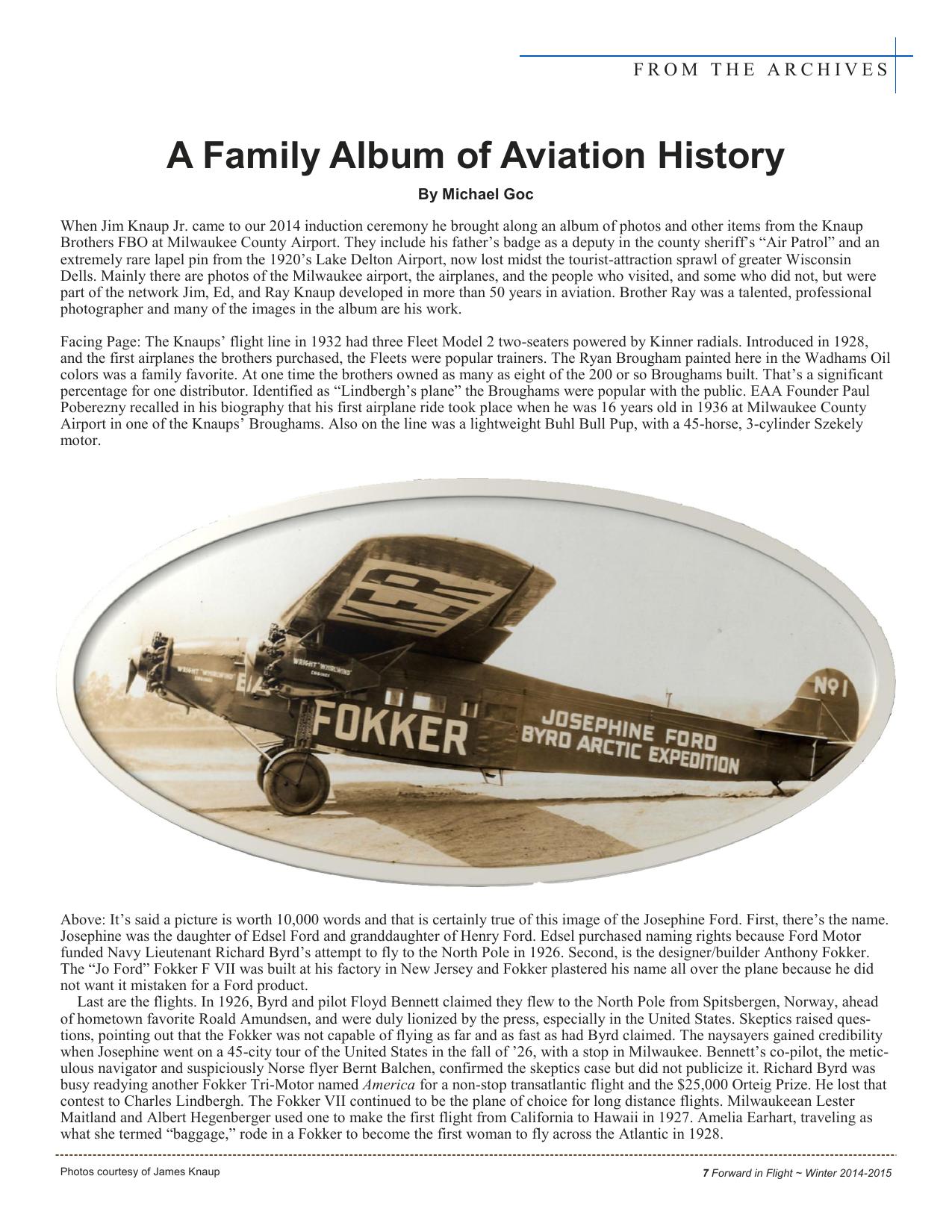
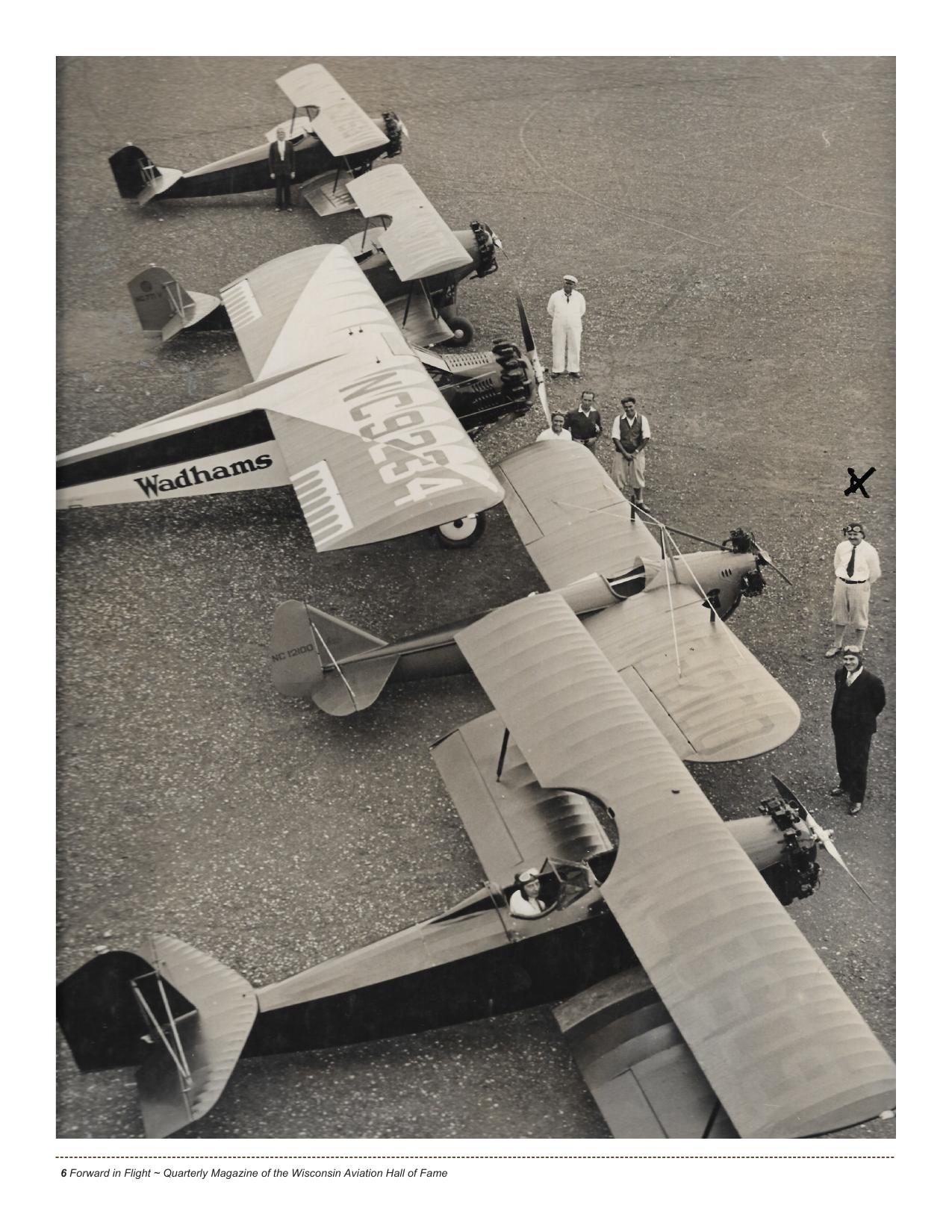
FROM THE ARCHIVES A Family Album of Aviation History By Michael Goc When Jim Knaup Jr. came to our 2014 induction ceremony he brought along an album of photos and other items from the Knaup Brothers FBO at Milwaukee County Airport. They include his father’s badge as a deputy in the county sheriff’s “Air Patrol” and an extremely rare lapel pin from the 1920’s Lake Delton Airport, now lost midst the tourist-attraction sprawl of greater Wisconsin Dells. Mainly there are photos of the Milwaukee airport, the airplanes, and the people who visited, and some who did not, but were part of the network Jim, Ed, and Ray Knaup developed in more than 50 years in aviation. Brother Ray was a talented, professional photographer and many of the images in the album are his work. Facing Page: The Knaups’ flight line in 1932 had three Fleet Model 2 two-seaters powered by Kinner radials. Introduced in 1928, and the first airplanes the brothers purchased, the Fleets were popular trainers. The Ryan Brougham painted here in the Wadhams Oil colors was a family favorite. At one time the brothers owned as many as eight of the 200 or so Broughams built. That’s a significant percentage for one distributor. Identified as “Lindbergh’s plane” the Broughams were popular with the public. EAA Founder Paul Poberezny recalled in his biography that his first airplane ride took place when he was 16 years old in 1936 at Milwaukee County Airport in one of the Knaups’ Broughams. Also on the line was a lightweight Buhl Bull Pup, with a 45-horse, 3-cylinder Szekely motor. Above: It’s said a picture is worth 10,000 words and that is certainly true of this image of the Josephine Ford. First, there’s the name. Josephine was the daughter of Edsel Ford and granddaughter of Henry Ford. Edsel purchased naming rights because Ford Motor funded Navy Lieutenant Richard Byrd’s attempt to fly to the North Pole in 1926. Second, is the designer/builder Anthony Fokker. The “Jo Ford” Fokker F VII was built at his factory in New Jersey and Fokker plastered his name all over the plane because he did not want it mistaken for a Ford product. Last are the flights. In 1926, Byrd and pilot Floyd Bennett claimed they flew to the North Pole from Spitsbergen, Norway, ahead of hometown favorite Roald Amundsen, and were duly lionized by the press, especially in the United States. Skeptics raised questions, pointing out that the Fokker was not capable of flying as far and as fast as had Byrd claimed. The naysayers gained credibility when Josephine went on a 45-city tour of the United States in the fall of ’26, with a stop in Milwaukee. Bennett’s co-pilot, the meticulous navigator and suspiciously Norse flyer Bernt Balchen, confirmed the skeptics case but did not publicize it. Richard Byrd was busy readying another Fokker Tri-Motor named America for a non-stop transatlantic flight and the $25,000 Orteig Prize. He lost that contest to Charles Lindbergh. The Fokker VII continued to be the plane of choice for long distance flights. Milwaukeean Lester Maitland and Albert Hegenberger used one to make the first flight from California to Hawaii in 1927. Amelia Earhart, traveling as what she termed “baggage,” rode in a Fokker to become the first woman to fly across the Atlantic in 1928. Photos courtesy of James Knaup 7 Forward in Flight ~ Winter 2014-2015
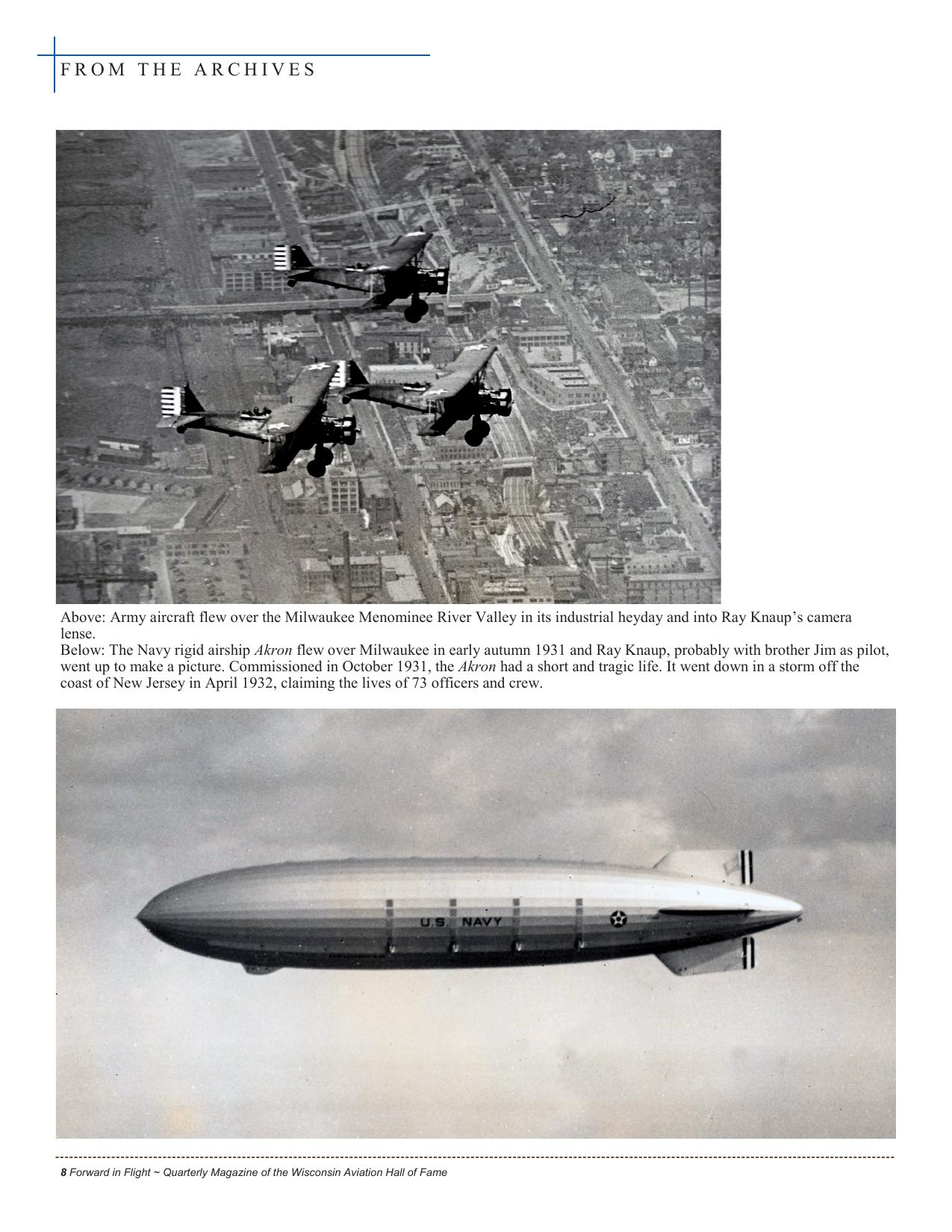
FROM THE ARCHIVES Above: Army aircraft flew over the Milwaukee Menominee River Valley in its industrial heyday and into Ray Knaup’s camera lense. Below: The Navy rigid airship Akron flew over Milwaukee in early autumn 1931 and Ray Knaup, probably with brother Jim as pilot, went up to make a picture. Commissioned in October 1931, the Akron had a short and tragic life. It went down in a storm off the coast of New Jersey in April 1932, claiming the lives of 73 officers and crew. 8 Forward in Flight ~ Quarterly Magazine of the Wisconsin Aviation Hall of Fame
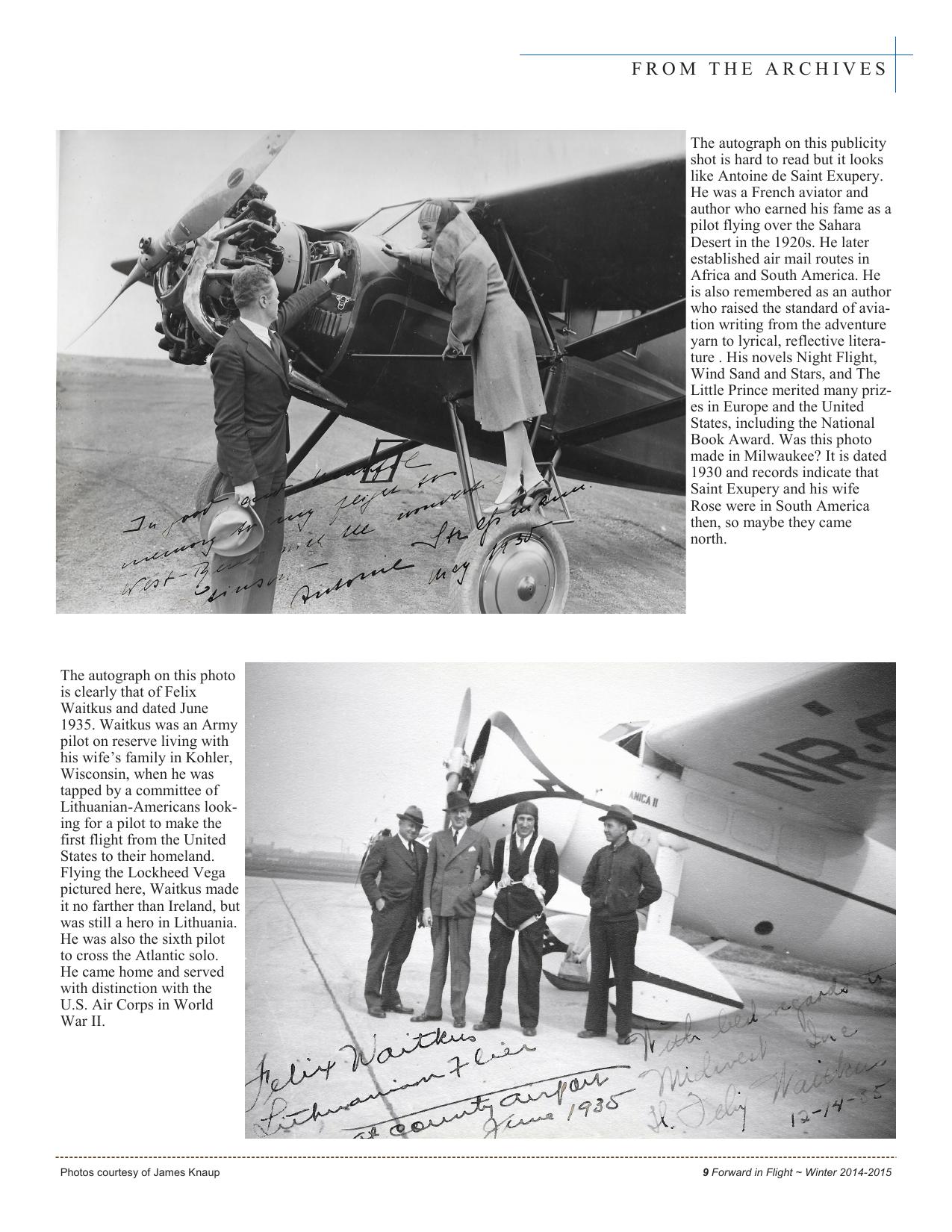
FROM THE ARCHIVES The autograph on this publicity shot is hard to read but it looks like Antoine de Saint Exupery. He was a French aviator and author who earned his fame as a pilot flying over the Sahara Desert in the 1920s. He later established air mail routes in Africa and South America. He is also remembered as an author who raised the standard of aviation writing from the adventure yarn to lyrical, reflective literature . His novels Night Flight, Wind Sand and Stars, and The Little Prince merited many prizes in Europe and the United States, including the National Book Award. Was this photo made in Milwaukee? It is dated 1930 and records indicate that Saint Exupery and his wife Rose were in South America then, so maybe they came north. The autograph on this photo is clearly that of Felix Waitkus and dated June 1935. Waitkus was an Army pilot on reserve living with his wife’s family in Kohler, Wisconsin, when he was tapped by a committee of Lithuanian-Americans looking for a pilot to make the first flight from the United States to their homeland. Flying the Lockheed Vega pictured here, Waitkus made it no farther than Ireland, but was still a hero in Lithuania. He was also the sixth pilot to cross the Atlantic solo. He came home and served with distinction with the U.S. Air Corps in World War II. Photos courtesy of James Knaup 9 Forward in Flight ~ Winter 2014-2015
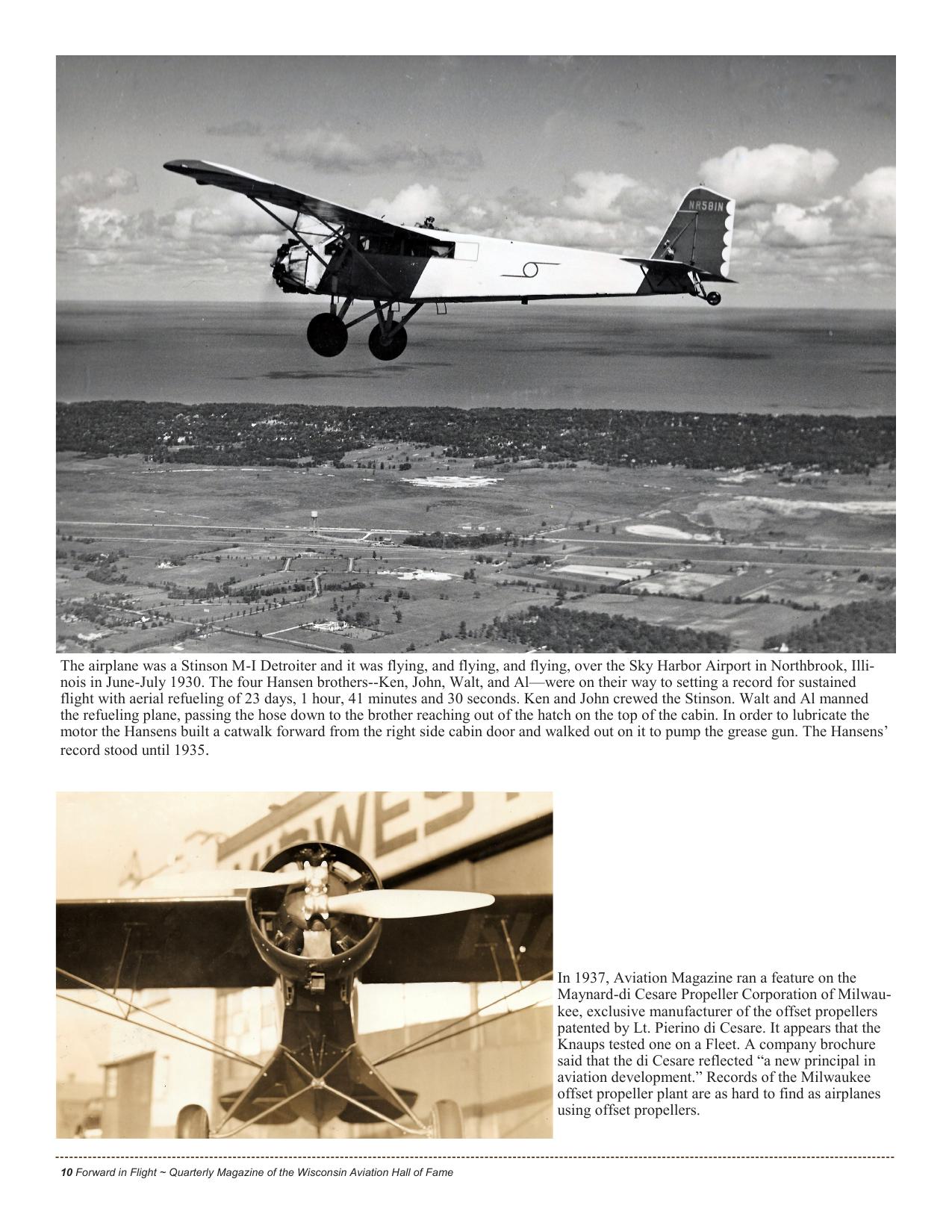
The airplane was a Stinson M-I Detroiter and it was flying, and flying, and flying, over the Sky Harbor Airport in Northbrook, Illinois in June-July 1930. The four Hansen brothers--Ken, John, Walt, and Al—were on their way to setting a record for sustained flight with aerial refueling of 23 days, 1 hour, 41 minutes and 30 seconds. Ken and John crewed the Stinson. Walt and Al manned the refueling plane, passing the hose down to the brother reaching out of the hatch on the top of the cabin. In order to lubricate the motor the Hansens built a catwalk forward from the right side cabin door and walked out on it to pump the grease gun. The Hansens’ record stood until 1935. In 1937, Aviation Magazine ran a feature on the Maynard-di Cesare Propeller Corporation of Milwaukee, exclusive manufacturer of the offset propellers patented by Lt. Pierino di Cesare. It appears that the Knaups tested one on a Fleet. A company brochure said that the di Cesare reflected “a new principal in aviation development.” Records of the Milwaukee offset propeller plant are as hard to find as airplanes using offset propellers. 10 Forward in Flight ~ Quarterly Magazine of the Wisconsin Aviation Hall of Fame
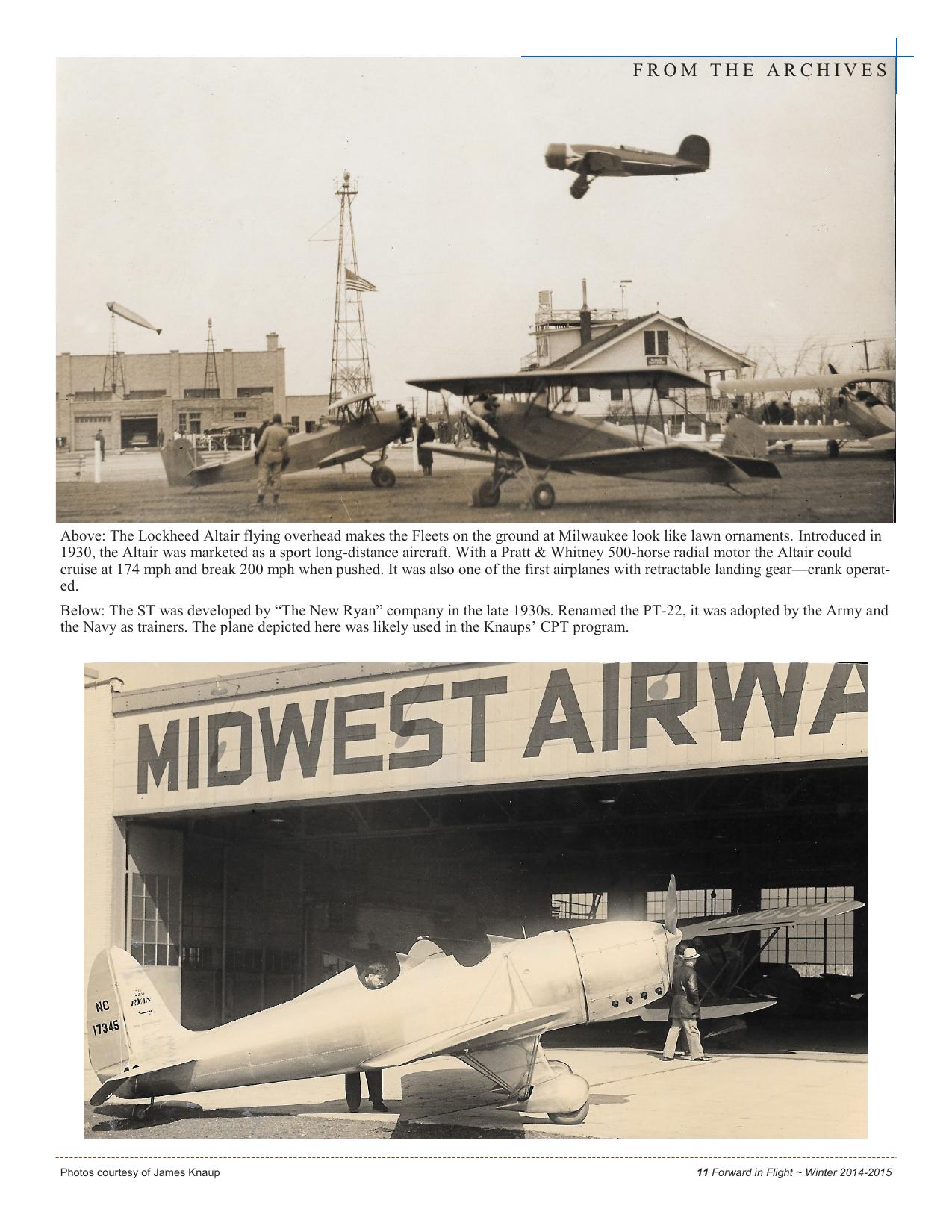
FROM THE ARCHIVES Above: The Lockheed Altair flying overhead makes the Fleets on the ground at Milwaukee look like lawn ornaments. Introduced in 1930, the Altair was marketed as a sport long-distance aircraft. With a Pratt & Whitney 500-horse radial motor the Altair could cruise at 174 mph and break 200 mph when pushed. It was also one of the first airplanes with retractable landing gear—crank operated. Below: The ST was developed by “The New Ryan” company in the late 1930s. Renamed the PT-22, it was adopted by the Army and the Navy as trainers. The plane depicted here was likely used in the Knaups’ CPT program. Photos courtesy of James Knaup 11 Forward in Flight ~ Winter 2014-2015
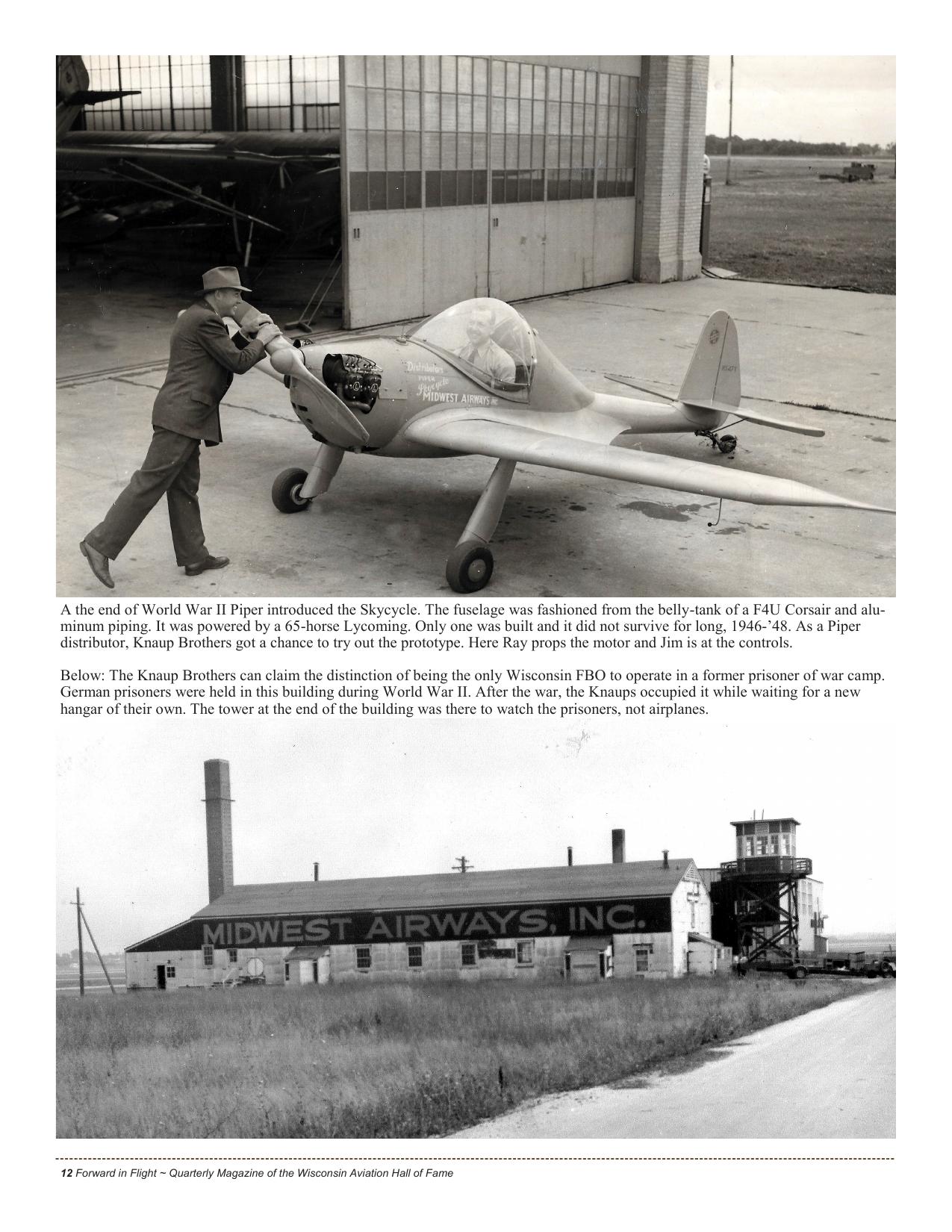
A the end of World War II Piper introduced the Skycycle. The fuselage was fashioned from the belly-tank of a F4U Corsair and aluminum piping. It was powered by a 65-horse Lycoming. Only one was built and it did not survive for long, 1946-’48. As a Piper distributor, Knaup Brothers got a chance to try out the prototype. Here Ray props the motor and Jim is at the controls. Below: The Knaup Brothers can claim the distinction of being the only Wisconsin FBO to operate in a former prisoner of war camp. German prisoners were held in this building during World War II. After the war, the Knaups occupied it while waiting for a new hangar of their own. The tower at the end of the building was there to watch the prisoners, not airplanes. 12 Forward in Flight ~ Quarterly Magazine of the Wisconsin Aviation Hall of Fame
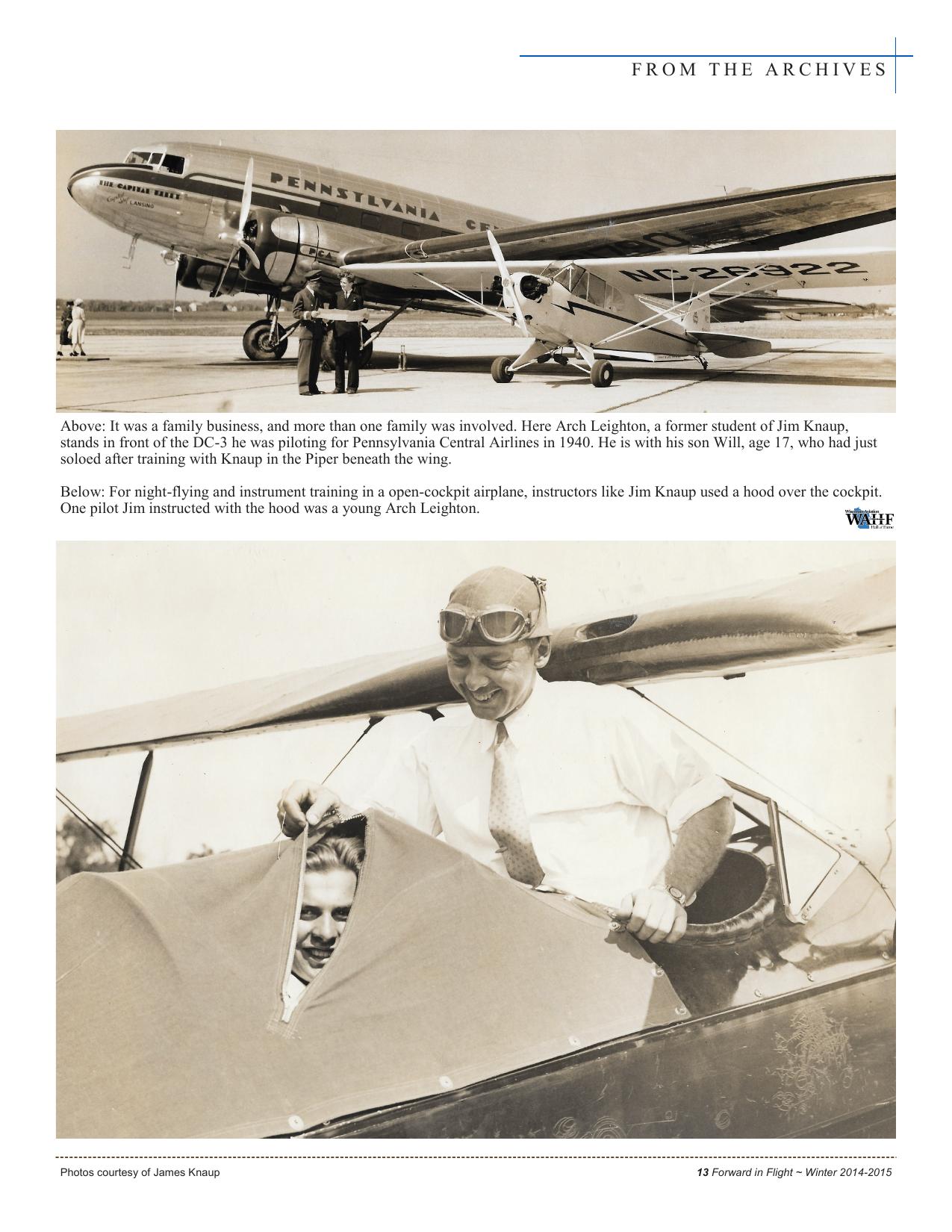
FROM THE ARCHIVES Above: It was a family business, and more than one family was involved. Here Arch Leighton, a former student of Jim Knaup, stands in front of the DC-3 he was piloting for Pennsylvania Central Airlines in 1940. He is with his son Will, age 17, who had just soloed after training with Knaup in the Piper beneath the wing. Below: For night-flying and instrument training in a open-cockpit airplane, instructors like Jim Knaup used a hood over the cockpit. One pilot Jim instructed with the hood was a young Arch Leighton. Photos courtesy of James Knaup 13 Forward in Flight ~ Winter 2014-2015
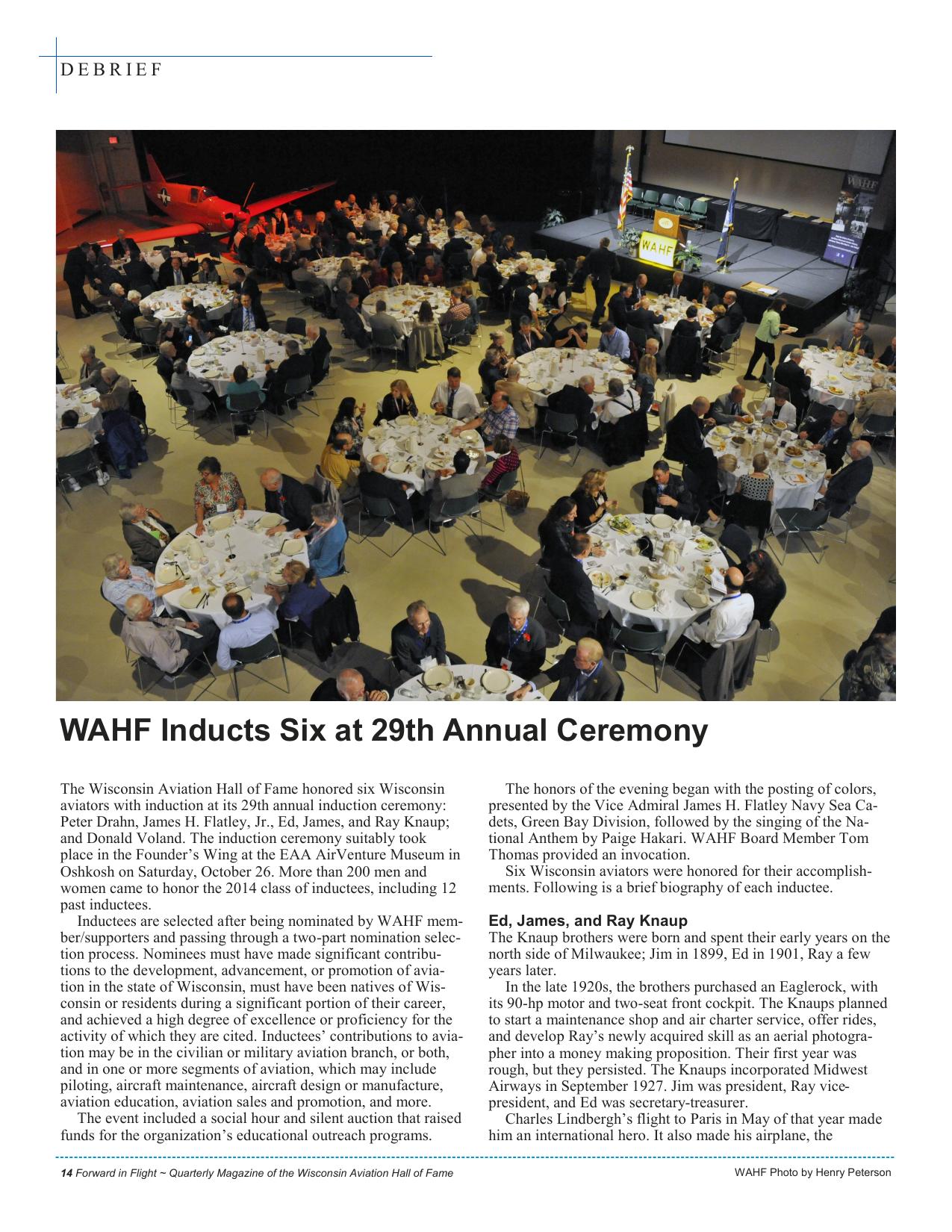
DEBRIEF WAHF Inducts Six at 29th Annual Ceremony The Wisconsin Aviation Hall of Fame honored six Wisconsin aviators with induction at its 29th annual induction ceremony: Peter Drahn, James H. Flatley, Jr., Ed, James, and Ray Knaup; and Donald Voland. The induction ceremony suitably took place in the Founder’s Wing at the EAA AirVenture Museum in Oshkosh on Saturday, October 26. More than 200 men and women came to honor the 2014 class of inductees, including 12 past inductees. Inductees are selected after being nominated by WAHF member/supporters and passing through a two-part nomination selection process. Nominees must have made significant contributions to the development, advancement, or promotion of aviation in the state of Wisconsin, must have been natives of Wisconsin or residents during a significant portion of their career, and achieved a high degree of excellence or proficiency for the activity of which they are cited. Inductees’ contributions to aviation may be in the civilian or military aviation branch, or both, and in one or more segments of aviation, which may include piloting, aircraft maintenance, aircraft design or manufacture, aviation education, aviation sales and promotion, and more. The event included a social hour and silent auction that raised funds for the organization’s educational outreach programs. 14 Forward in Flight ~ Quarterly Magazine of the Wisconsin Aviation Hall of Fame The honors of the evening began with the posting of colors, presented by the Vice Admiral James H. Flatley Navy Sea Cadets, Green Bay Division, followed by the singing of the National Anthem by Paige Hakari. WAHF Board Member Tom Thomas provided an invocation. Six Wisconsin aviators were honored for their accomplishments. Following is a brief biography of each inductee. Ed, James, and Ray Knaup The Knaup brothers were born and spent their early years on the north side of Milwaukee; Jim in 1899, Ed in 1901, Ray a few years later. In the late 1920s, the brothers purchased an Eaglerock, with its 90-hp motor and two-seat front cockpit. The Knaups planned to start a maintenance shop and air charter service, offer rides, and develop Ray’s newly acquired skill as an aerial photographer into a money making proposition. Their first year was rough, but they persisted. The Knaups incorporated Midwest Airways in September 1927. Jim was president, Ray vicepresident, and Ed was secretary-treasurer. Charles Lindbergh’s flight to Paris in May of that year made him an international hero. It also made his airplane, the WAHF Photo by Henry Peterson
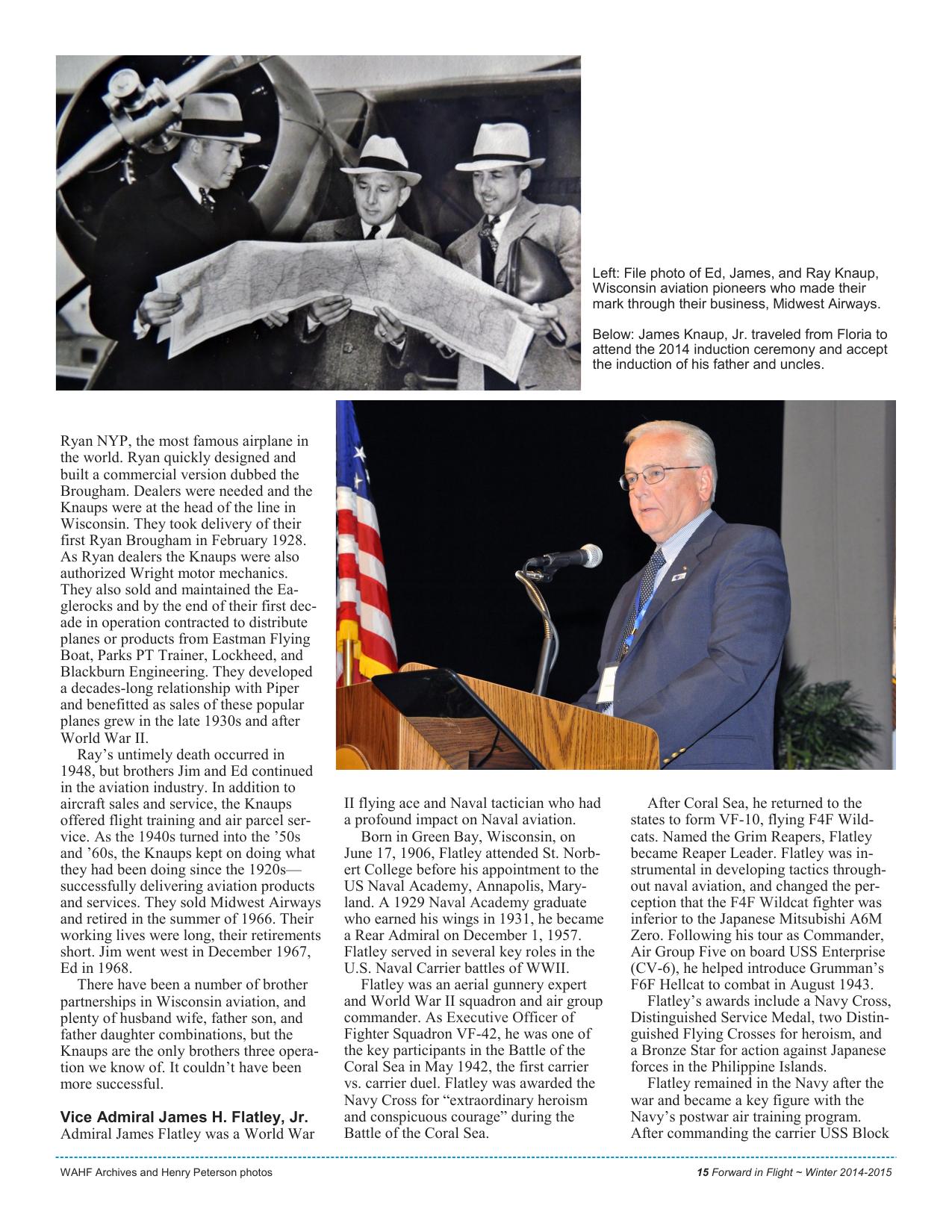
Left: File photo of Ed, James, and Ray Knaup, Wisconsin aviation pioneers who made their mark through their business, Midwest Airways. Below: James Knaup, Jr. traveled from Floria to attend the 2014 induction ceremony and accept the induction of his father and uncles. Ryan NYP, the most famous airplane in the world. Ryan quickly designed and built a commercial version dubbed the Brougham. Dealers were needed and the Knaups were at the head of the line in Wisconsin. They took delivery of their first Ryan Brougham in February 1928. As Ryan dealers the Knaups were also authorized Wright motor mechanics. They also sold and maintained the Eaglerocks and by the end of their first decade in operation contracted to distribute planes or products from Eastman Flying Boat, Parks PT Trainer, Lockheed, and Blackburn Engineering. They developed a decades-long relationship with Piper and benefitted as sales of these popular planes grew in the late 1930s and after World War II. Ray’s untimely death occurred in 1948, but brothers Jim and Ed continued in the aviation industry. In addition to aircraft sales and service, the Knaups offered flight training and air parcel service. As the 1940s turned into the ’50s and ’60s, the Knaups kept on doing what they had been doing since the 1920s— successfully delivering aviation products and services. They sold Midwest Airways and retired in the summer of 1966. Their working lives were long, their retirements short. Jim went west in December 1967, Ed in 1968. There have been a number of brother partnerships in Wisconsin aviation, and plenty of husband wife, father son, and father daughter combinations, but the Knaups are the only brothers three operation we know of. It couldn’t have been more successful. Vice Admiral James H. Flatley, Jr. Admiral James Flatley was a World War WAHF Archives and Henry Peterson photos II flying ace and Naval tactician who had a profound impact on Naval aviation. Born in Green Bay, Wisconsin, on June 17, 1906, Flatley attended St. Norbert College before his appointment to the US Naval Academy, Annapolis, Maryland. A 1929 Naval Academy graduate who earned his wings in 1931, he became a Rear Admiral on December 1, 1957. Flatley served in several key roles in the U.S. Naval Carrier battles of WWII. Flatley was an aerial gunnery expert and World War II squadron and air group commander. As Executive Officer of Fighter Squadron VF-42, he was one of the key participants in the Battle of the Coral Sea in May 1942, the first carrier vs. carrier duel. Flatley was awarded the Navy Cross for “extraordinary heroism and conspicuous courage” during the Battle of the Coral Sea. After Coral Sea, he returned to the states to form VF-10, flying F4F Wildcats. Named the Grim Reapers, Flatley became Reaper Leader. Flatley was instrumental in developing tactics throughout naval aviation, and changed the perception that the F4F Wildcat fighter was inferior to the Japanese Mitsubishi A6M Zero. Following his tour as Commander, Air Group Five on board USS Enterprise (CV-6), he helped introduce Grumman’s F6F Hellcat to combat in August 1943. Flatley’s awards include a Navy Cross, Distinguished Service Medal, two Distinguished Flying Crosses for heroism, and a Bronze Star for action against Japanese forces in the Philippine Islands. Flatley remained in the Navy after the war and became a key figure with the Navy’s postwar air training program. After commanding the carrier USS Block 15 Forward in Flight ~ Winter 2014-2015
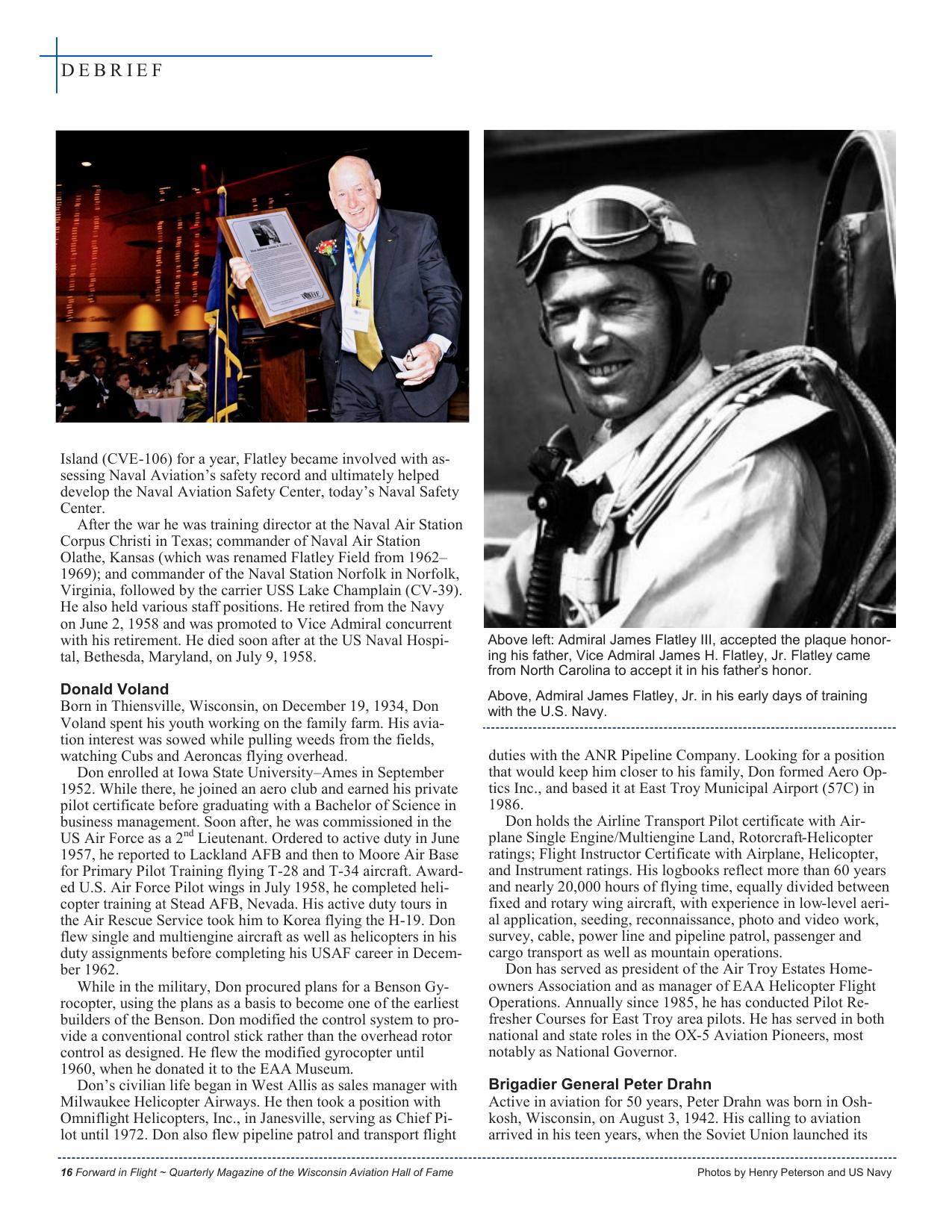
DEBRIEF Island (CVE-106) for a year, Flatley became involved with assessing Naval Aviation’s safety record and ultimately helped develop the Naval Aviation Safety Center, today’s Naval Safety Center. After the war he was training director at the Naval Air Station Corpus Christi in Texas; commander of Naval Air Station Olathe, Kansas (which was renamed Flatley Field from 1962– 1969); and commander of the Naval Station Norfolk in Norfolk, Virginia, followed by the carrier USS Lake Champlain (CV-39). He also held various staff positions. He retired from the Navy on June 2, 1958 and was promoted to Vice Admiral concurrent with his retirement. He died soon after at the US Naval Hospital, Bethesda, Maryland, on July 9, 1958. Donald Voland Born in Thiensville, Wisconsin, on December 19, 1934, Don Voland spent his youth working on the family farm. His aviation interest was sowed while pulling weeds from the fields, watching Cubs and Aeroncas flying overhead. Don enrolled at Iowa State University–Ames in September 1952. While there, he joined an aero club and earned his private pilot certificate before graduating with a Bachelor of Science in business management. Soon after, he was commissioned in the US Air Force as a 2nd Lieutenant. Ordered to active duty in June 1957, he reported to Lackland AFB and then to Moore Air Base for Primary Pilot Training flying T-28 and T-34 aircraft. Awarded U.S. Air Force Pilot wings in July 1958, he completed helicopter training at Stead AFB, Nevada. His active duty tours in the Air Rescue Service took him to Korea flying the H-19. Don flew single and multiengine aircraft as well as helicopters in his duty assignments before completing his USAF career in December 1962. While in the military, Don procured plans for a Benson Gyrocopter, using the plans as a basis to become one of the earliest builders of the Benson. Don modified the control system to provide a conventional control stick rather than the overhead rotor control as designed. He flew the modified gyrocopter until 1960, when he donated it to the EAA Museum. Don’s civilian life began in West Allis as sales manager with Milwaukee Helicopter Airways. He then took a position with Omniflight Helicopters, Inc., in Janesville, serving as Chief Pilot until 1972. Don also flew pipeline patrol and transport flight 16 Forward in Flight ~ Quarterly Magazine of the Wisconsin Aviation Hall of Fame Above left: Admiral James Flatley III, accepted the plaque honoring his father, Vice Admiral James H. Flatley, Jr. Flatley came from North Carolina to accept it in his father’s honor. Above, Admiral James Flatley, Jr. in his early days of training with the U.S. Navy. duties with the ANR Pipeline Company. Looking for a position that would keep him closer to his family, Don formed Aero Optics Inc., and based it at East Troy Municipal Airport (57C) in 1986. Don holds the Airline Transport Pilot certificate with Airplane Single Engine/Multiengine Land, Rotorcraft-Helicopter ratings; Flight Instructor Certificate with Airplane, Helicopter, and Instrument ratings. His logbooks reflect more than 60 years and nearly 20,000 hours of flying time, equally divided between fixed and rotary wing aircraft, with experience in low-level aerial application, seeding, reconnaissance, photo and video work, survey, cable, power line and pipeline patrol, passenger and cargo transport as well as mountain operations. Don has served as president of the Air Troy Estates Homeowners Association and as manager of EAA Helicopter Flight Operations. Annually since 1985, he has conducted Pilot Refresher Courses for East Troy area pilots. He has served in both national and state roles in the OX-5 Aviation Pioneers, most notably as National Governor. Brigadier General Peter Drahn Active in aviation for 50 years, Peter Drahn was born in Oshkosh, Wisconsin, on August 3, 1942. His calling to aviation arrived in his teen years, when the Soviet Union launched its Photos by Henry Peterson and US Navy
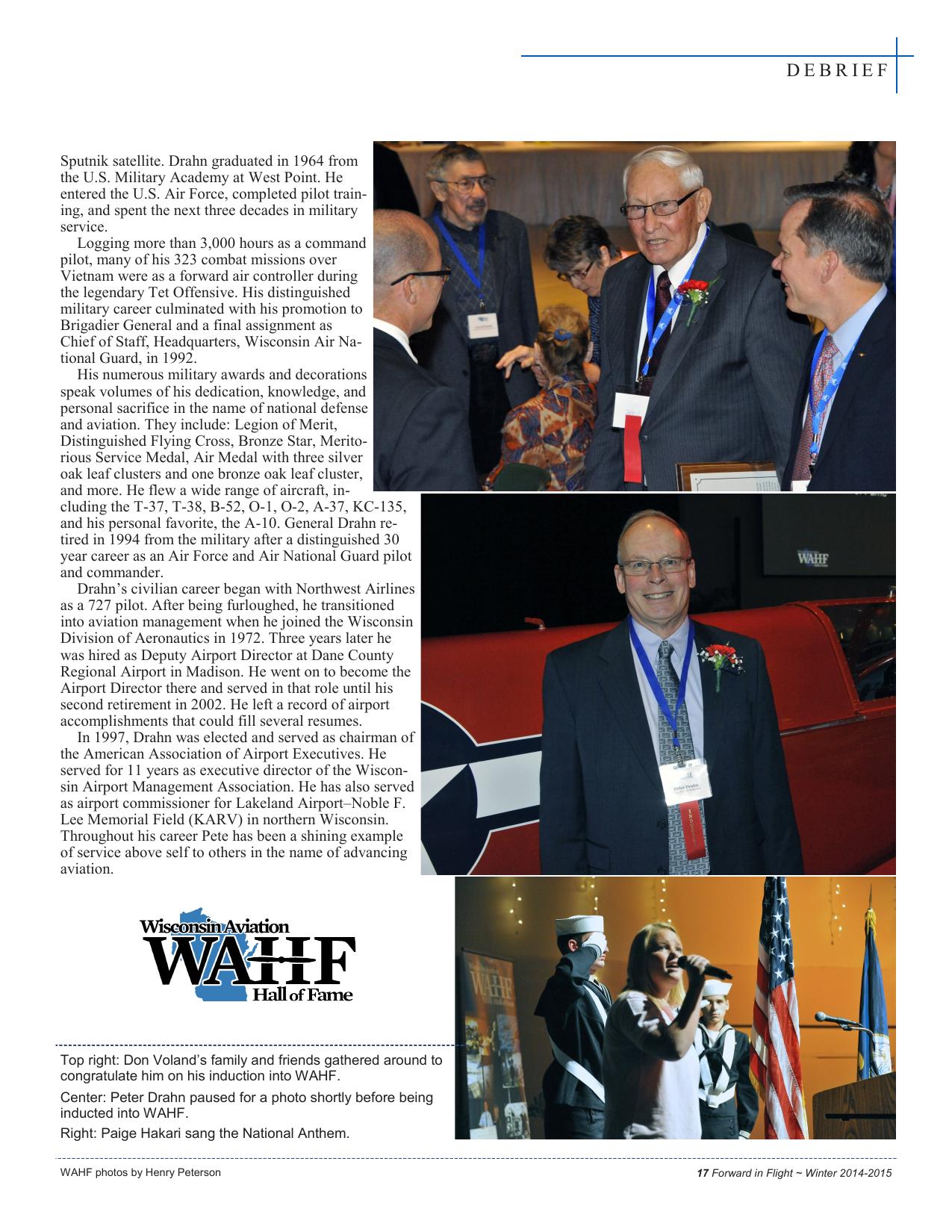
DEBRIEF Sputnik satellite. Drahn graduated in 1964 from the U.S. Military Academy at West Point. He entered the U.S. Air Force, completed pilot training, and spent the next three decades in military service. Logging more than 3,000 hours as a command pilot, many of his 323 combat missions over Vietnam were as a forward air controller during the legendary Tet Offensive. His distinguished military career culminated with his promotion to Brigadier General and a final assignment as Chief of Staff, Headquarters, Wisconsin Air National Guard, in 1992. His numerous military awards and decorations speak volumes of his dedication, knowledge, and personal sacrifice in the name of national defense and aviation. They include: Legion of Merit, Distinguished Flying Cross, Bronze Star, Meritorious Service Medal, Air Medal with three silver oak leaf clusters and one bronze oak leaf cluster, and more. He flew a wide range of aircraft, including the T-37, T-38, B-52, O-1, O-2, A-37, KC-135, and his personal favorite, the A-10. General Drahn retired in 1994 from the military after a distinguished 30 year career as an Air Force and Air National Guard pilot and commander. Drahn’s civilian career began with Northwest Airlines as a 727 pilot. After being furloughed, he transitioned into aviation management when he joined the Wisconsin Division of Aeronautics in 1972. Three years later he was hired as Deputy Airport Director at Dane County Regional Airport in Madison. He went on to become the Airport Director there and served in that role until his second retirement in 2002. He left a record of airport accomplishments that could fill several resumes. In 1997, Drahn was elected and served as chairman of the American Association of Airport Executives. He served for 11 years as executive director of the Wisconsin Airport Management Association. He has also served as airport commissioner for Lakeland Airport–Noble F. Lee Memorial Field (KARV) in northern Wisconsin. Throughout his career Pete has been a shining example of service above self to others in the name of advancing aviation. Top right: Don Voland’s family and friends gathered around to congratulate him on his induction into WAHF. Center: Peter Drahn paused for a photo shortly before being inducted into WAHF. Right: Paige Hakari sang the National Anthem. WAHF photos by Henry Peterson 17 Forward in Flight ~ Winter 2014-2015
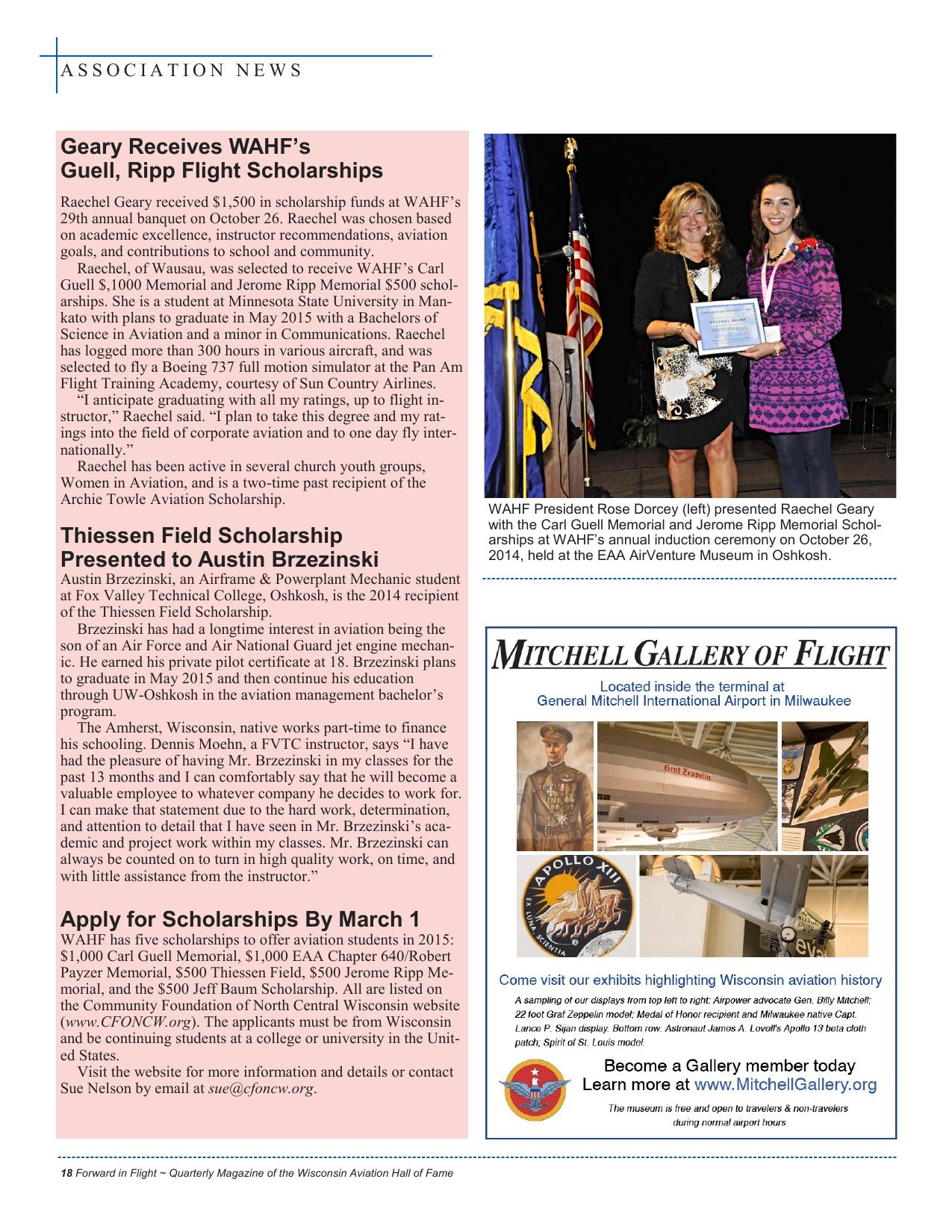
ASSOCIATION NEWS Geary Receives WAHF’s Guell, Ripp Flight Scholarships Raechel Geary received $1,500 in scholarship funds at WAHF’s 29th annual banquet on October 26. Raechel was chosen based on academic excellence, instructor recommendations, aviation goals, and contributions to school and community. Raechel, of Wausau, was selected to receive WAHF’s Carl Guell $,1000 Memorial and Jerome Ripp Memorial $500 scholarships. She is a student at Minnesota State University in Mankato with plans to graduate in May 2015 with a Bachelors of Science in Aviation and a minor in Communications. Raechel has logged more than 300 hours in various aircraft, and was selected to fly a Boeing 737 full motion simulator at the Pan Am Flight Training Academy, courtesy of Sun Country Airlines. “I anticipate graduating with all my ratings, up to flight instructor,” Raechel said. “I plan to take this degree and my ratings into the field of corporate aviation and to one day fly internationally.” Raechel has been active in several church youth groups, Women in Aviation, and is a two-time past recipient of the Archie Towle Aviation Scholarship. Thiessen Field Scholarship Presented to Austin Brzezinski Austin Brzezinski, an Airframe & Powerplant Mechanic student at Fox Valley Technical College, Oshkosh, is the 2014 recipient of the Thiessen Field Scholarship. Brzezinski has had a longtime interest in aviation being the son of an Air Force and Air National Guard jet engine mechanic. He earned his private pilot certificate at 18. Brzezinski plans to graduate in May 2015 and then continue his education through UW-Oshkosh in the aviation management bachelor’s program. The Amherst, Wisconsin, native works part-time to finance his schooling. Dennis Moehn, a FVTC instructor, says “I have had the pleasure of having Mr. Brzezinski in my classes for the past 13 months and I can comfortably say that he will become a valuable employee to whatever company he decides to work for. I can make that statement due to the hard work, determination, and attention to detail that I have seen in Mr. Brzezinski’s academic and project work within my classes. Mr. Brzezinski can always be counted on to turn in high quality work, on time, and with little assistance from the instructor.” Apply for Scholarships By March 1 WAHF has five scholarships to offer aviation students in 2015: $1,000 Carl Guell Memorial, $1,000 EAA Chapter 640/Robert Payzer Memorial, $500 Thiessen Field, $500 Jerome Ripp Memorial, and the $500 Jeff Baum Scholarship. All are listed on the Community Foundation of North Central Wisconsin website (www.CFONCW.org). The applicants must be from Wisconsin and be continuing students at a college or university in the United States. Visit the website for more information and details or contact Sue Nelson by email at sue@cfoncw.org. 18 Forward in Flight ~ Quarterly Magazine of the Wisconsin Aviation Hall of Fame WAHF President Rose Dorcey (left) presented Raechel Geary with the Carl Guell Memorial and Jerome Ripp Memorial Scholarships at WAHF’s annual induction ceremony on October 26, 2014, held at the EAA AirVenture Museum in Oshkosh.
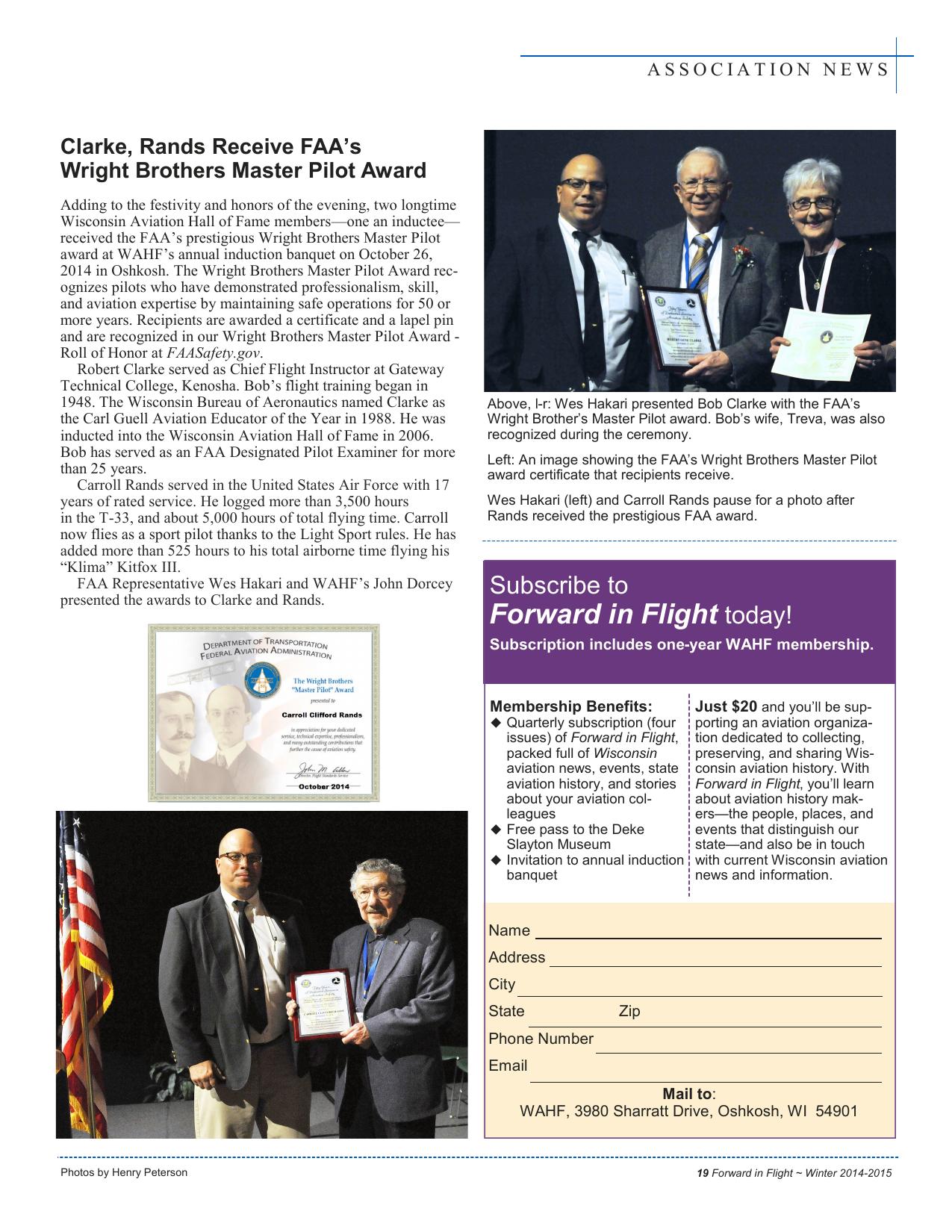
ASSOCIATION NEWS Clarke, Rands Receive FAA’s Wright Brothers Master Pilot Award Adding to the festivity and honors of the evening, two longtime Wisconsin Aviation Hall of Fame members—one an inductee— received the FAA’s prestigious Wright Brothers Master Pilot award at WAHF’s annual induction banquet on October 26, 2014 in Oshkosh. The Wright Brothers Master Pilot Award recognizes pilots who have demonstrated professionalism, skill, and aviation expertise by maintaining safe operations for 50 or more years. Recipients are awarded a certificate and a lapel pin and are recognized in our Wright Brothers Master Pilot Award Roll of Honor at FAASafety.gov. Robert Clarke served as Chief Flight Instructor at Gateway Technical College, Kenosha. Bob’s flight training began in 1948. The Wisconsin Bureau of Aeronautics named Clarke as the Carl Guell Aviation Educator of the Year in 1988. He was inducted into the Wisconsin Aviation Hall of Fame in 2006. Bob has served as an FAA Designated Pilot Examiner for more than 25 years. Carroll Rands served in the United States Air Force with 17 years of rated service. He logged more than 3,500 hours in the T-33, and about 5,000 hours of total flying time. Carroll now flies as a sport pilot thanks to the Light Sport rules. He has added more than 525 hours to his total airborne time flying his “Klima” Kitfox III. FAA Representative Wes Hakari and WAHF’s John Dorcey presented the awards to Clarke and Rands. Above, l-r: Wes Hakari presented Bob Clarke with the FAA’s Wright Brother’s Master Pilot award. Bob’s wife, Treva, was also recognized during the ceremony. Left: An image showing the FAA’s Wright Brothers Master Pilot award certificate that recipients receive. Wes Hakari (left) and Carroll Rands pause for a photo after Rands received the prestigious FAA award. Subscribe to Forward in Flight today! Subscription includes one-year WAHF membership. Membership Benefits: u Quarterly subscription (four issues) of Forward in Flight, packed full of Wisconsin aviation news, events, state aviation history, and stories about your aviation colleagues u Free pass to the Deke Slayton Museum u Invitation to annual induction banquet Just $20 and you’ll be sup- porting an aviation organization dedicated to collecting, preserving, and sharing Wisconsin aviation history. With Forward in Flight, you’ll learn about aviation history makers—the people, places, and events that distinguish our state—and also be in touch with current Wisconsin aviation news and information. Name Address City State Zip Phone Number Email Mail to: WAHF, 3980 Sharratt Drive, Oshkosh, WI 54901 Photos by Henry Peterson 19 Forward in Flight ~ Winter 2014-2015
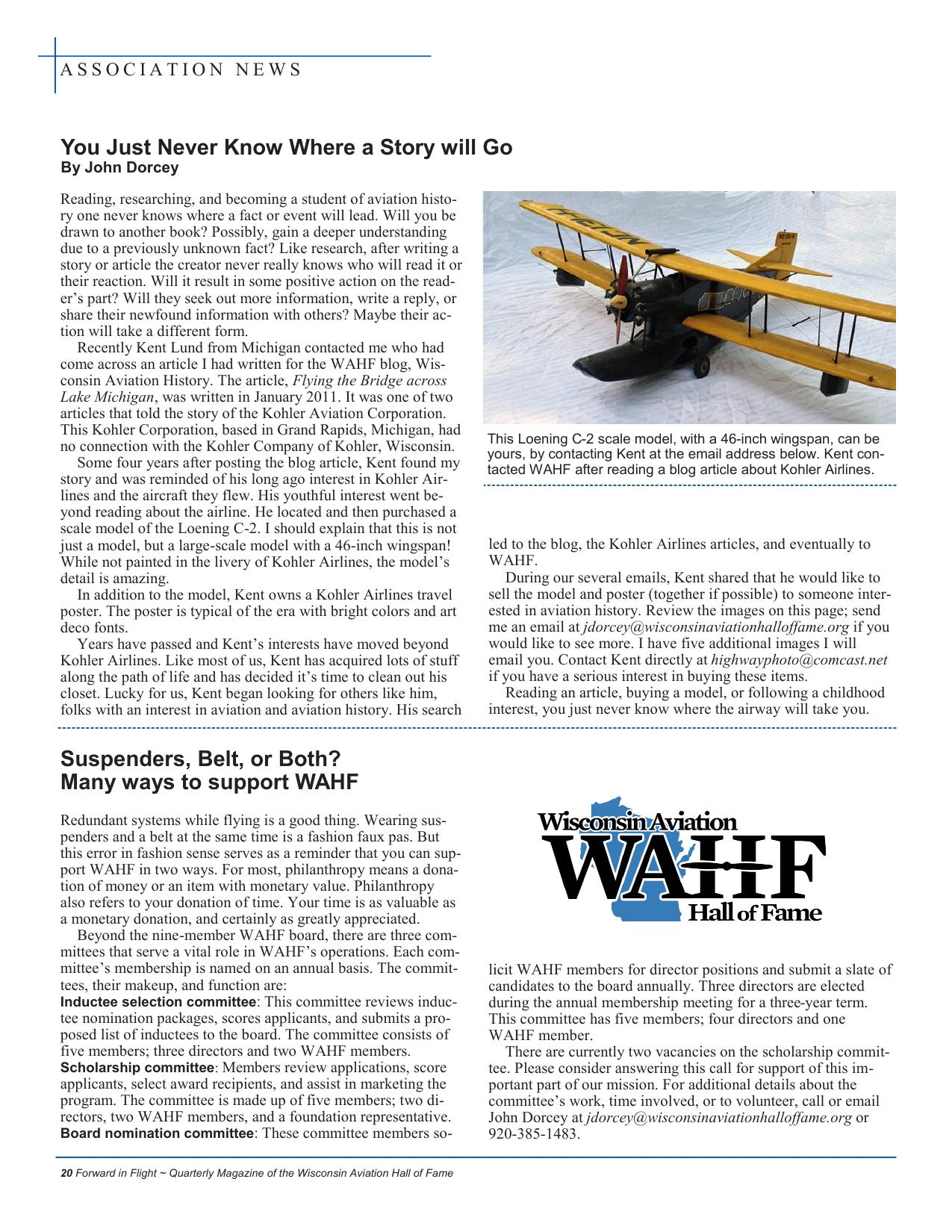
ASSOCIATION NEWS You Just Never Know Where a Story will Go By John Dorcey Reading, researching, and becoming a student of aviation history one never knows where a fact or event will lead. Will you be drawn to another book? Possibly, gain a deeper understanding due to a previously unknown fact? Like research, after writing a story or article the creator never really knows who will read it or their reaction. Will it result in some positive action on the reader’s part? Will they seek out more information, write a reply, or share their newfound information with others? Maybe their action will take a different form. Recently Kent Lund from Michigan contacted me who had come across an article I had written for the WAHF blog, Wisconsin Aviation History. The article, Flying the Bridge across Lake Michigan, was written in January 2011. It was one of two articles that told the story of the Kohler Aviation Corporation. This Kohler Corporation, based in Grand Rapids, Michigan, had no connection with the Kohler Company of Kohler, Wisconsin. Some four years after posting the blog article, Kent found my story and was reminded of his long ago interest in Kohler Airlines and the aircraft they flew. His youthful interest went beyond reading about the airline. He located and then purchased a scale model of the Loening C-2. I should explain that this is not just a model, but a large-scale model with a 46-inch wingspan! While not painted in the livery of Kohler Airlines, the model’s detail is amazing. In addition to the model, Kent owns a Kohler Airlines travel poster. The poster is typical of the era with bright colors and art deco fonts. Years have passed and Kent’s interests have moved beyond Kohler Airlines. Like most of us, Kent has acquired lots of stuff along the path of life and has decided it’s time to clean out his closet. Lucky for us, Kent began looking for others like him, folks with an interest in aviation and aviation history. His search This Loening C-2 scale model, with a 46-inch wingspan, can be yours, by contacting Kent at the email address below. Kent contacted WAHF after reading a blog article about Kohler Airlines. led to the blog, the Kohler Airlines articles, and eventually to WAHF. During our several emails, Kent shared that he would like to sell the model and poster (together if possible) to someone interested in aviation history. Review the images on this page; send me an email at jdorcey@wisconsinaviationhalloffame.org if you would like to see more. I have five additional images I will email you. Contact Kent directly at highwayphoto@comcast.net if you have a serious interest in buying these items. Reading an article, buying a model, or following a childhood interest, you just never know where the airway will take you. Suspenders, Belt, or Both? Many ways to support WAHF Redundant systems while flying is a good thing. Wearing suspenders and a belt at the same time is a fashion faux pas. But this error in fashion sense serves as a reminder that you can support WAHF in two ways. For most, philanthropy means a donation of money or an item with monetary value. Philanthropy also refers to your donation of time. Your time is as valuable as a monetary donation, and certainly as greatly appreciated. Beyond the nine-member WAHF board, there are three committees that serve a vital role in WAHF’s operations. Each committee’s membership is named on an annual basis. The committees, their makeup, and function are: Inductee selection committee: This committee reviews inductee nomination packages, scores applicants, and submits a proposed list of inductees to the board. The committee consists of five members; three directors and two WAHF members. Scholarship committee: Members review applications, score applicants, select award recipients, and assist in marketing the program. The committee is made up of five members; two directors, two WAHF members, and a foundation representative. Board nomination committee: These committee members so20 Forward in Flight ~ Quarterly Magazine of the Wisconsin Aviation Hall of Fame licit WAHF members for director positions and submit a slate of candidates to the board annually. Three directors are elected during the annual membership meeting for a three-year term. This committee has five members; four directors and one WAHF member. There are currently two vacancies on the scholarship committee. Please consider answering this call for support of this important part of our mission. For additional details about the committee’s work, time involved, or to volunteer, call or email John Dorcey at jdorcey@wisconsinaviationhalloffame.org or 920-385-1483.
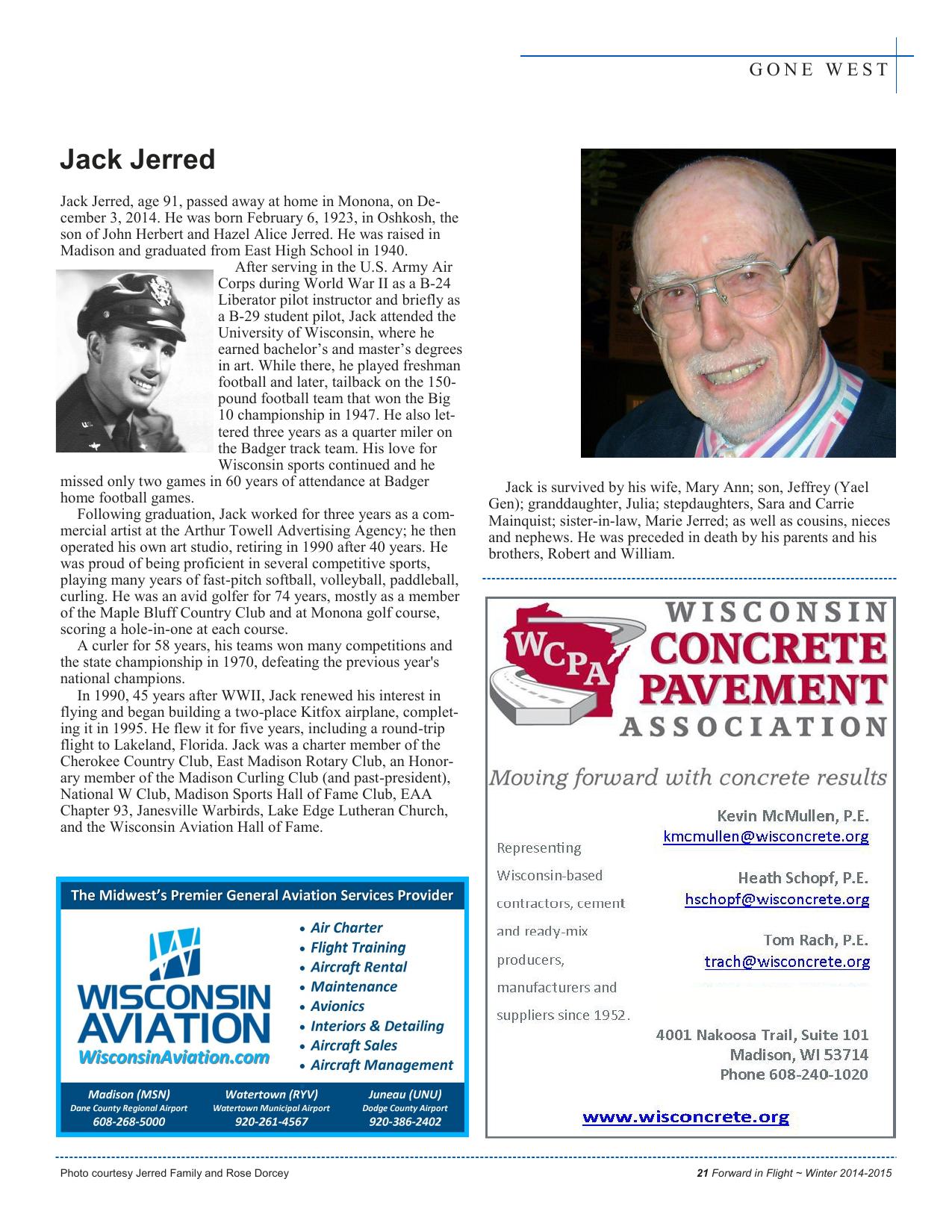
GONE WEST Jack Jerred Jack Jerred, age 91, passed away at home in Monona, on December 3, 2014. He was born February 6, 1923, in Oshkosh, the son of John Herbert and Hazel Alice Jerred. He was raised in Madison and graduated from East High School in 1940. After serving in the U.S. Army Air Corps during World War II as a B-24 Liberator pilot instructor and briefly as a B-29 student pilot, Jack attended the University of Wisconsin, where he earned bachelor’s and master’s degrees in art. While there, he played freshman football and later, tailback on the 150pound football team that won the Big 10 championship in 1947. He also lettered three years as a quarter miler on the Badger track team. His love for Wisconsin sports continued and he missed only two games in 60 years of attendance at Badger home football games. Following graduation, Jack worked for three years as a commercial artist at the Arthur Towell Advertising Agency; he then operated his own art studio, retiring in 1990 after 40 years. He was proud of being proficient in several competitive sports, playing many years of fast-pitch softball, volleyball, paddleball, curling. He was an avid golfer for 74 years, mostly as a member of the Maple Bluff Country Club and at Monona golf course, scoring a hole-in-one at each course. A curler for 58 years, his teams won many competitions and the state championship in 1970, defeating the previous year's national champions. In 1990, 45 years after WWII, Jack renewed his interest in flying and began building a two-place Kitfox airplane, completing it in 1995. He flew it for five years, including a round-trip flight to Lakeland, Florida. Jack was a charter member of the Cherokee Country Club, East Madison Rotary Club, an Honorary member of the Madison Curling Club (and past-president), National W Club, Madison Sports Hall of Fame Club, EAA Chapter 93, Janesville Warbirds, Lake Edge Lutheran Church, and the Wisconsin Aviation Hall of Fame. Photo courtesy Jerred Family and Rose Dorcey Jack is survived by his wife, Mary Ann; son, Jeffrey (Yael Gen); granddaughter, Julia; stepdaughters, Sara and Carrie Mainquist; sister-in-law, Marie Jerred; as well as cousins, nieces and nephews. He was preceded in death by his parents and his brothers, Robert and William. 21 Forward in Flight ~ Winter 2014-2015
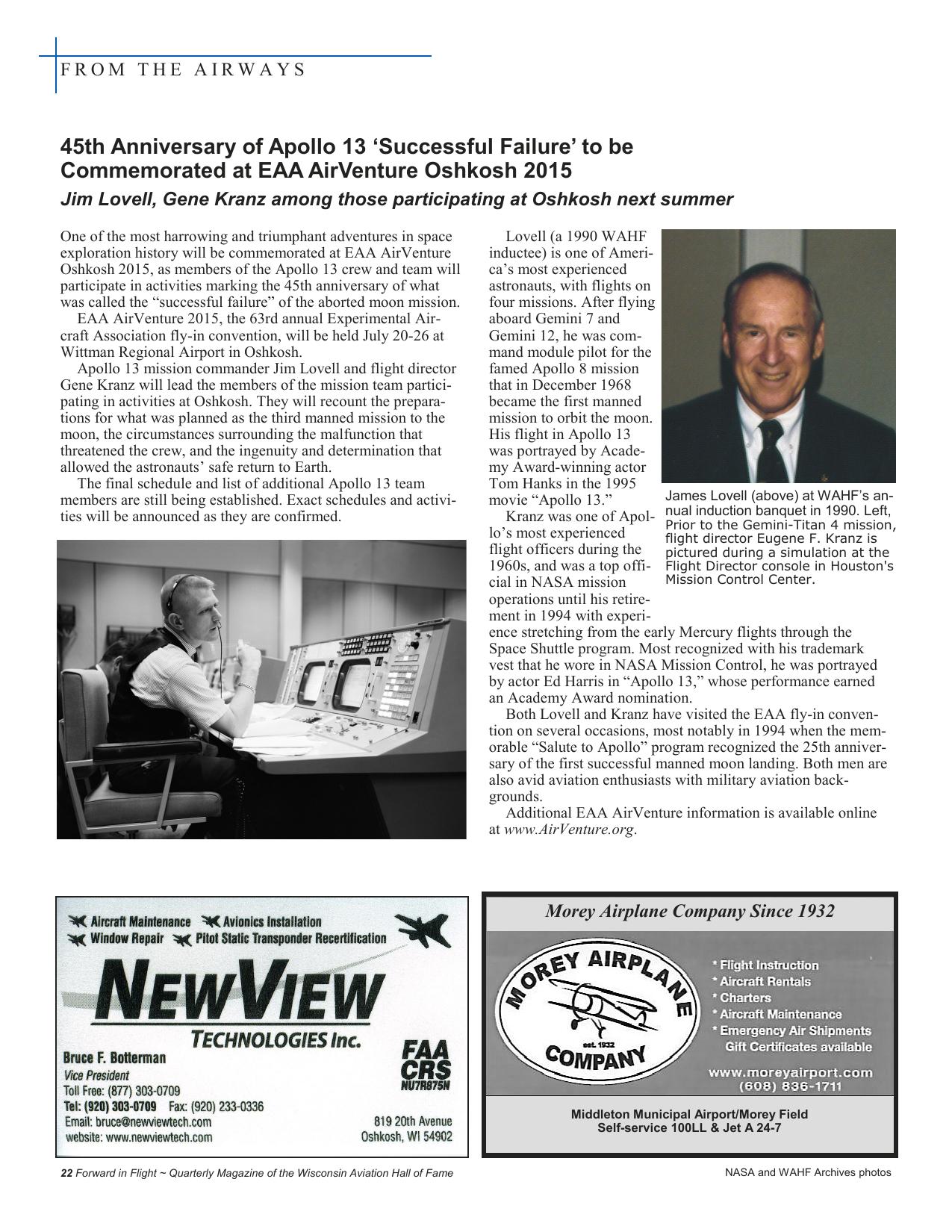
FROM THE AIRWAYS 45th Anniversary of Apollo 13 ‘Successful Failure’ to be Commemorated at EAA AirVenture Oshkosh 2015 Jim Lovell, Gene Kranz among those participating at Oshkosh next summer One of the most harrowing and triumphant adventures in space exploration history will be commemorated at EAA AirVenture Oshkosh 2015, as members of the Apollo 13 crew and team will participate in activities marking the 45th anniversary of what was called the “successful failure” of the aborted moon mission. EAA AirVenture 2015, the 63rd annual Experimental Aircraft Association fly-in convention, will be held July 20-26 at Wittman Regional Airport in Oshkosh. Apollo 13 mission commander Jim Lovell and flight director Gene Kranz will lead the members of the mission team participating in activities at Oshkosh. They will recount the preparations for what was planned as the third manned mission to the moon, the circumstances surrounding the malfunction that threatened the crew, and the ingenuity and determination that allowed the astronauts’ safe return to Earth. The final schedule and list of additional Apollo 13 team members are still being established. Exact schedules and activities will be announced as they are confirmed. Lovell (a 1990 WAHF inductee) is one of America’s most experienced astronauts, with flights on four missions. After flying aboard Gemini 7 and Gemini 12, he was command module pilot for the famed Apollo 8 mission that in December 1968 became the first manned mission to orbit the moon. His flight in Apollo 13 was portrayed by Academy Award-winning actor Tom Hanks in the 1995 James Lovell (above) at WAHF’s anmovie “Apollo 13.” Kranz was one of Apol- nual induction banquet in 1990. Left, Prior to the Gemini-Titan 4 mission, lo’s most experienced flight director Eugene F. Kranz is flight officers during the pictured during a simulation at the 1960s, and was a top offi- Flight Director console in Houston's Mission Control Center. cial in NASA mission operations until his retirement in 1994 with experience stretching from the early Mercury flights through the Space Shuttle program. Most recognized with his trademark vest that he wore in NASA Mission Control, he was portrayed by actor Ed Harris in “Apollo 13,” whose performance earned an Academy Award nomination. Both Lovell and Kranz have visited the EAA fly-in convention on several occasions, most notably in 1994 when the memorable “Salute to Apollo” program recognized the 25th anniversary of the first successful manned moon landing. Both men are also avid aviation enthusiasts with military aviation backgrounds. Additional EAA AirVenture information is available online at www.AirVenture.org. Morey Airplane Company Since 1932 Middleton Municipal Airport/Morey Field Self-service 100LL & Jet A 24-7 22 Forward in Flight ~ Quarterly Magazine of the Wisconsin Aviation Hall of Fame NASA and WAHF Archives photos
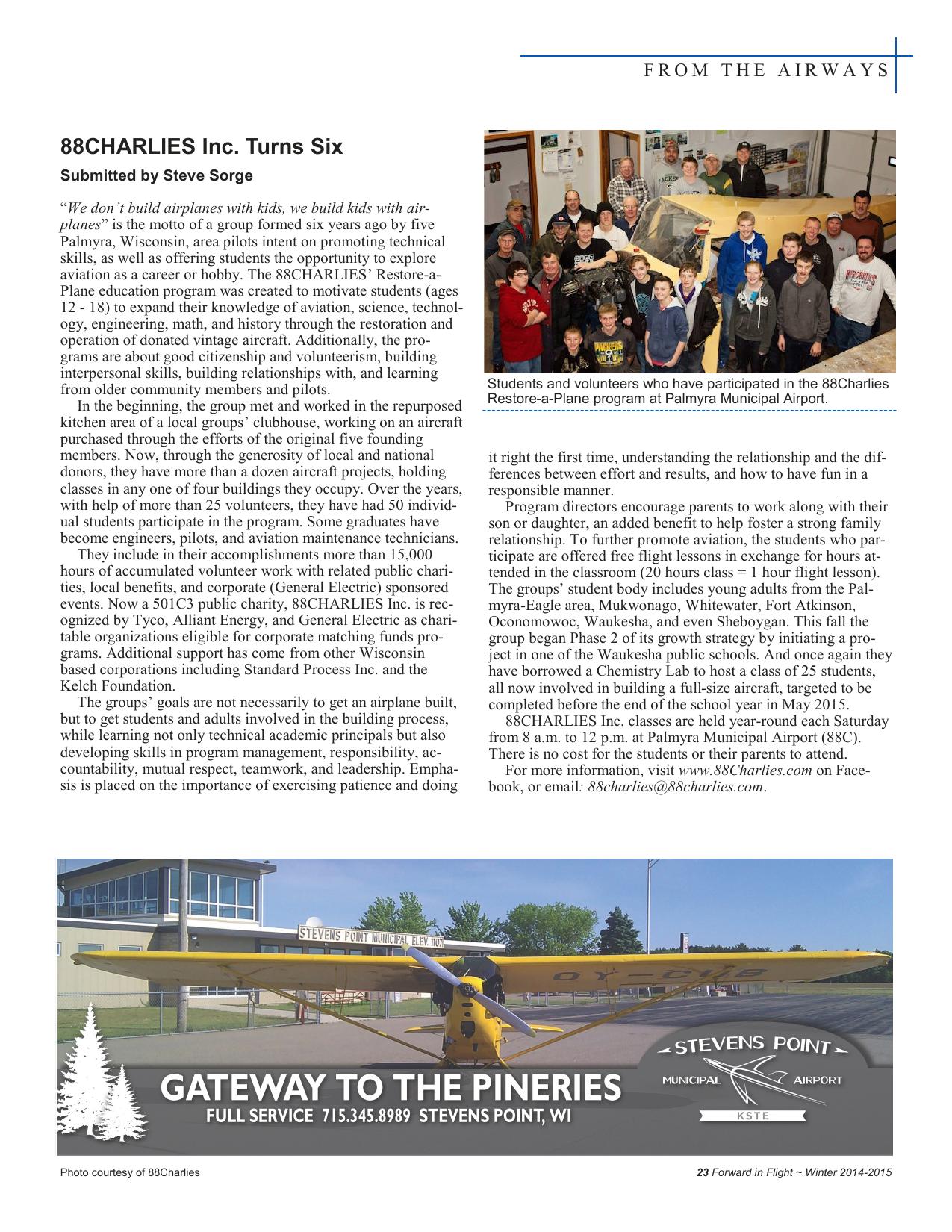
FROM THE AIRWAYS 88CHARLIES Inc. Turns Six Submitted by Steve Sorge “We don’t build airplanes with kids, we build kids with airplanes” is the motto of a group formed six years ago by five Palmyra, Wisconsin, area pilots intent on promoting technical skills, as well as offering students the opportunity to explore aviation as a career or hobby. The 88CHARLIES’ Restore-aPlane education program was created to motivate students (ages 12 - 18) to expand their knowledge of aviation, science, technology, engineering, math, and history through the restoration and operation of donated vintage aircraft. Additionally, the programs are about good citizenship and volunteerism, building interpersonal skills, building relationships with, and learning from older community members and pilots. In the beginning, the group met and worked in the repurposed kitchen area of a local groups’ clubhouse, working on an aircraft purchased through the efforts of the original five founding members. Now, through the generosity of local and national donors, they have more than a dozen aircraft projects, holding classes in any one of four buildings they occupy. Over the years, with help of more than 25 volunteers, they have had 50 individual students participate in the program. Some graduates have become engineers, pilots, and aviation maintenance technicians. They include in their accomplishments more than 15,000 hours of accumulated volunteer work with related public charities, local benefits, and corporate (General Electric) sponsored events. Now a 501C3 public charity, 88CHARLIES Inc. is recognized by Tyco, Alliant Energy, and General Electric as charitable organizations eligible for corporate matching funds programs. Additional support has come from other Wisconsin based corporations including Standard Process Inc. and the Kelch Foundation. The groups’ goals are not necessarily to get an airplane built, but to get students and adults involved in the building process, while learning not only technical academic principals but also developing skills in program management, responsibility, accountability, mutual respect, teamwork, and leadership. Emphasis is placed on the importance of exercising patience and doing Photo courtesy of 88Charlies Students and volunteers who have participated in the 88Charlies Restore-a-Plane program at Palmyra Municipal Airport. it right the first time, understanding the relationship and the differences between effort and results, and how to have fun in a responsible manner. Program directors encourage parents to work along with their son or daughter, an added benefit to help foster a strong family relationship. To further promote aviation, the students who participate are offered free flight lessons in exchange for hours attended in the classroom (20 hours class = 1 hour flight lesson). The groups’ student body includes young adults from the Palmyra-Eagle area, Mukwonago, Whitewater, Fort Atkinson, Oconomowoc, Waukesha, and even Sheboygan. This fall the group began Phase 2 of its growth strategy by initiating a project in one of the Waukesha public schools. And once again they have borrowed a Chemistry Lab to host a class of 25 students, all now involved in building a full-size aircraft, targeted to be completed before the end of the school year in May 2015. 88CHARLIES Inc. classes are held year-round each Saturday from 8 a.m. to 12 p.m. at Palmyra Municipal Airport (88C). There is no cost for the students or their parents to attend. For more information, visit www.88Charlies.com on Facebook, or email: 88charlies@88charlies.com. 23 Forward in Flight ~ Winter 2014-2015
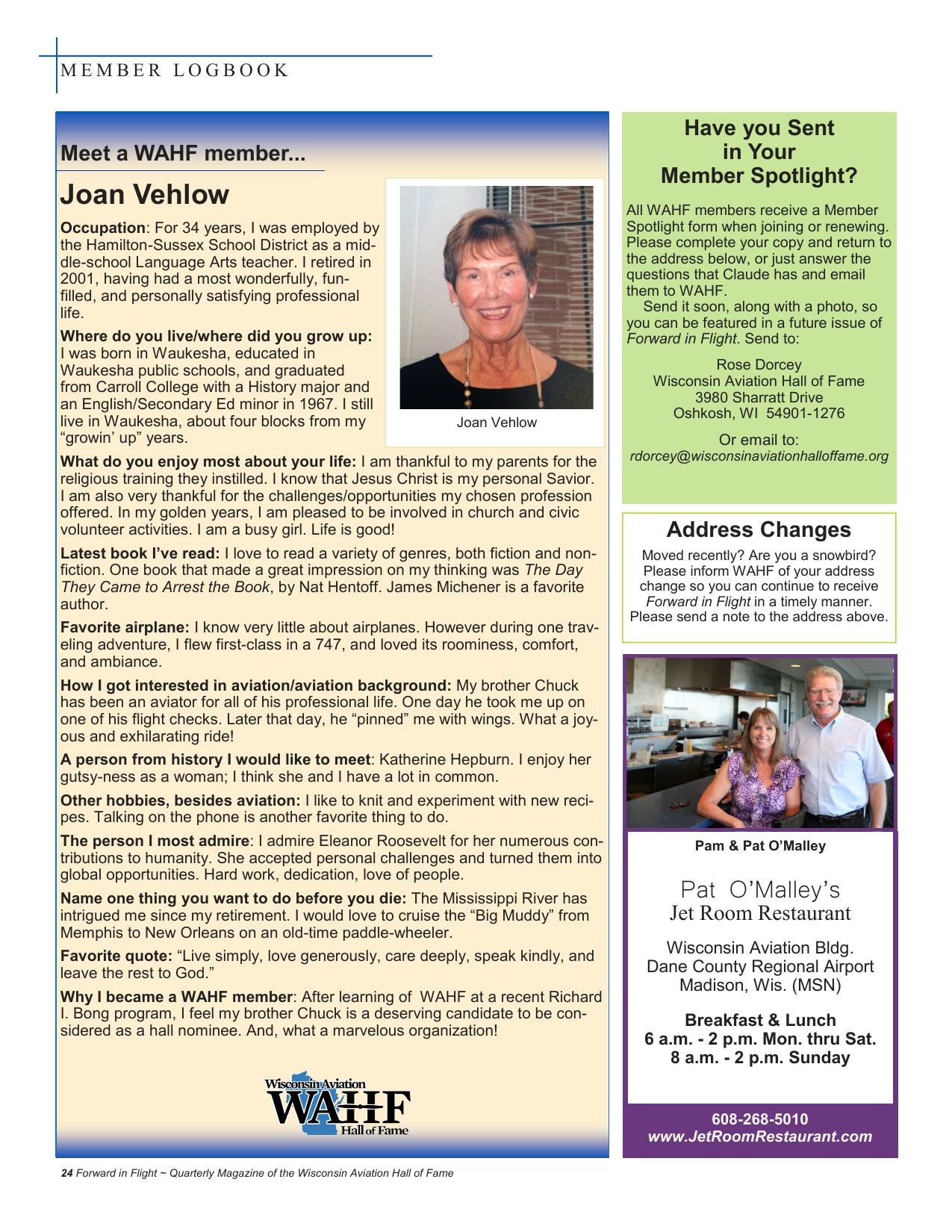
MEMBER LOGBOOK Have you Sent in Your Member Spotlight? Meet a WAHF member... Joan Vehlow All WAHF members receive a Member Spotlight form when joining or renewing. Please complete your copy and return to the address below, or just answer the questions that Claude has and email them to WAHF. Send it soon, along with a photo, so you can be featured in a future issue of Forward in Flight. Send to: Occupation: For 34 years, I was employed by the Hamilton-Sussex School District as a middle-school Language Arts teacher. I retired in 2001, having had a most wonderfully, funfilled, and personally satisfying professional life. Where do you live/where did you grow up: I was born in Waukesha, educated in Waukesha public schools, and graduated from Carroll College with a History major and an English/Secondary Ed minor in 1967. I still live in Waukesha, about four blocks from my “growin’ up” years. Joan Vehlow Rose Dorcey Wisconsin Aviation Hall of Fame 3980 Sharratt Drive Oshkosh, WI 54901-1276 Or email to: What do you enjoy most about your life: I am thankful to my parents for the religious training they instilled. I know that Jesus Christ is my personal Savior. I am also very thankful for the challenges/opportunities my chosen profession offered. In my golden years, I am pleased to be involved in church and civic volunteer activities. I am a busy girl. Life is good! rdorcey@wisconsinaviationhalloffame.org Latest book I’ve read: I love to read a variety of genres, both fiction and nonfiction. One book that made a great impression on my thinking was The Day They Came to Arrest the Book, by Nat Hentoff. James Michener is a favorite author. Moved recently? Are you a snowbird? Please inform WAHF of your address change so you can continue to receive Forward in Flight in a timely manner. Please send a note to the address above. Favorite airplane: I know very little about airplanes. However during one traveling adventure, I flew first-class in a 747, and loved its roominess, comfort, and ambiance. Address Changes How I got interested in aviation/aviation background: My brother Chuck has been an aviator for all of his professional life. One day he took me up on one of his flight checks. Later that day, he “pinned” me with wings. What a joyous and exhilarating ride! A person from history I would like to meet: Katherine Hepburn. I enjoy her gutsy-ness as a woman; I think she and I have a lot in common. Other hobbies, besides aviation: I like to knit and experiment with new recipes. Talking on the phone is another favorite thing to do. The person I most admire: I admire Eleanor Roosevelt for her numerous contributions to humanity. She accepted personal challenges and turned them into global opportunities. Hard work, dedication, love of people. Name one thing you want to do before you die: The Mississippi River has intrigued me since my retirement. I would love to cruise the “Big Muddy” from Memphis to New Orleans on an old-time paddle-wheeler. Favorite quote: “Live simply, love generously, care deeply, speak kindly, and leave the rest to God.” Why I became a WAHF member: After learning of WAHF at a recent Richard I. Bong program, I feel my brother Chuck is a deserving candidate to be considered as a hall nominee. And, what a marvelous organization! Pam & Pat O’Malley Pat O’Malley’s Jet Room Restaurant Wisconsin Aviation Bldg. Dane County Regional Airport Madison, Wis. (MSN) Breakfast & Lunch 6 a.m. - 2 p.m. Mon. thru Sat. 8 a.m. - 2 p.m. Sunday 608-268-5010 www.JetRoomRestaurant.com 24 Forward in Flight ~ Quarterly Magazine of the Wisconsin Aviation Hall of Fame

Wittman Regional Airport Oshkosh So much history ...and still making it! From the legacy of Steve Wittman to Warren Basler’s DC-3 conversions, we’re proud to support and contribute to Wisconsin aviation history. FLY TO OSHKOSH wittmanairport.com @wittmanairport
PRSRT STD US Postage Paid Wisc Rapids WI Permit 98 3980 SHARRATT DRIVE OSHKOSH WI 54901-1276 The Wisconsin Aviation Hall of Fame is a non-profit membership organization dedicated to preserving the past and fostering the future of flight. Welcome WAHF Member/Supporters: Holly Brazee Dave Conrad Chris Campbell Sune Ericson Liz Gaier Jeff Gaier Pam Hamman Karen Kalishek Judy Kukla Seth Minster Jim O’Connor Paul Richardson Bill Sanford Josh Sanford family Scott Sellers Michael Stopar Teri Conrad James Flatley III* Joanne Gasperik Lynn Kiel Charles Mueller Sharyn Richardson Maureen Sanford Peter Vercouteren —Thanks for coming on board. We hope to see you at a WAHF event soon! *Life Membership AVIATION EVENTS: Saturday, January 31, Wausau’s 2015 Chili Fun Day. Serving begins at 11 a.m. until chili is gone. Ski-planes welcome. Call for conditions: 715-848-6000. Wausau Downtown Airport (KAUW). Saturday, February 7, EAA Skiplane Fly-in. Free admission to the public. Complimentary chili and cake. 10 a.m. - 1:30 p.m. at Pioneer Airport, Oshkosh; Serving begins at 10:30 a.m. Skiplanes will arrive mid-morning and stay until mid-afternoon (weather and runway conditions permitting). Pilots who wish to participate must receive approval and flight briefings from EAA prior to landing at Pioneer Airport. Contact EAA’s Olivia Rasmus at 920-426-6599 or at orasmus@eaa.org for more details. Wisconsin Aviation Hall of Fame Officers Rose Dorcey, President Tom Thomas, Vice-President John Dorcey, Secretary/Treasurer Board of Directors Elaine Kauh Henry Peterson Brendan Stormo Charles Swain Wynne Williams Ron Wojnar Charles Marotske, Honorary Chairman of the Board Wisconsin Aviation Hall of Fame 3980 Sharratt Drive Oshkosh, WI 54901-1276 Become a supporter today! For information call Rose Dorcey at 920-385-1483 Saturday, February 21—Third Annual Sandhill Flyer’s Veto Chili Challenge, Palmyra Municipal Airport (88C). Do you have a “killer” chili recipe? Then make up a batch and join the fun—prizes will be awarded to the top three favorites. Can’t cook? They need someone to eat it and vote. Begins at 1 p.m. For more information: Mike Dean at mdean@lavelle.com or www.wisconsinaviationhalloffame.org call 262-279-3270. rdorcey@wisconsinaviationhalloffame.org