Volume 13, Issue 4
🗞️ Download Issue (PDF)
Forward in Flight - Winter 2015
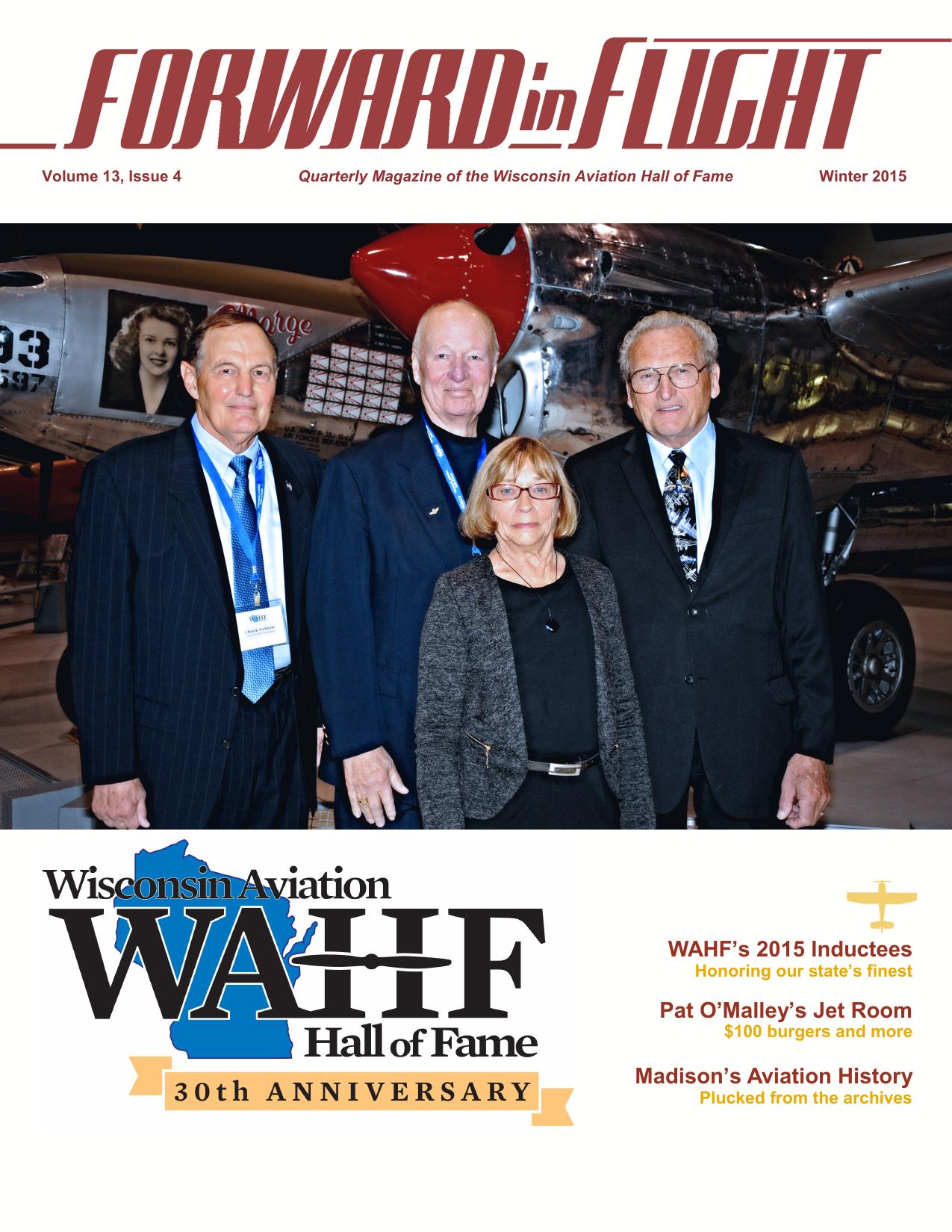
Volume 13, Issue 4 Quarterly Magazine of the Wisconsin Aviation Hall of Fame Winter 2015 WAHF’s 2015 Inductees Honoring our state’s finest Pat O’Malley’s Jet Room $100 burgers and more Madison’s Aviation History Plucked from the archives
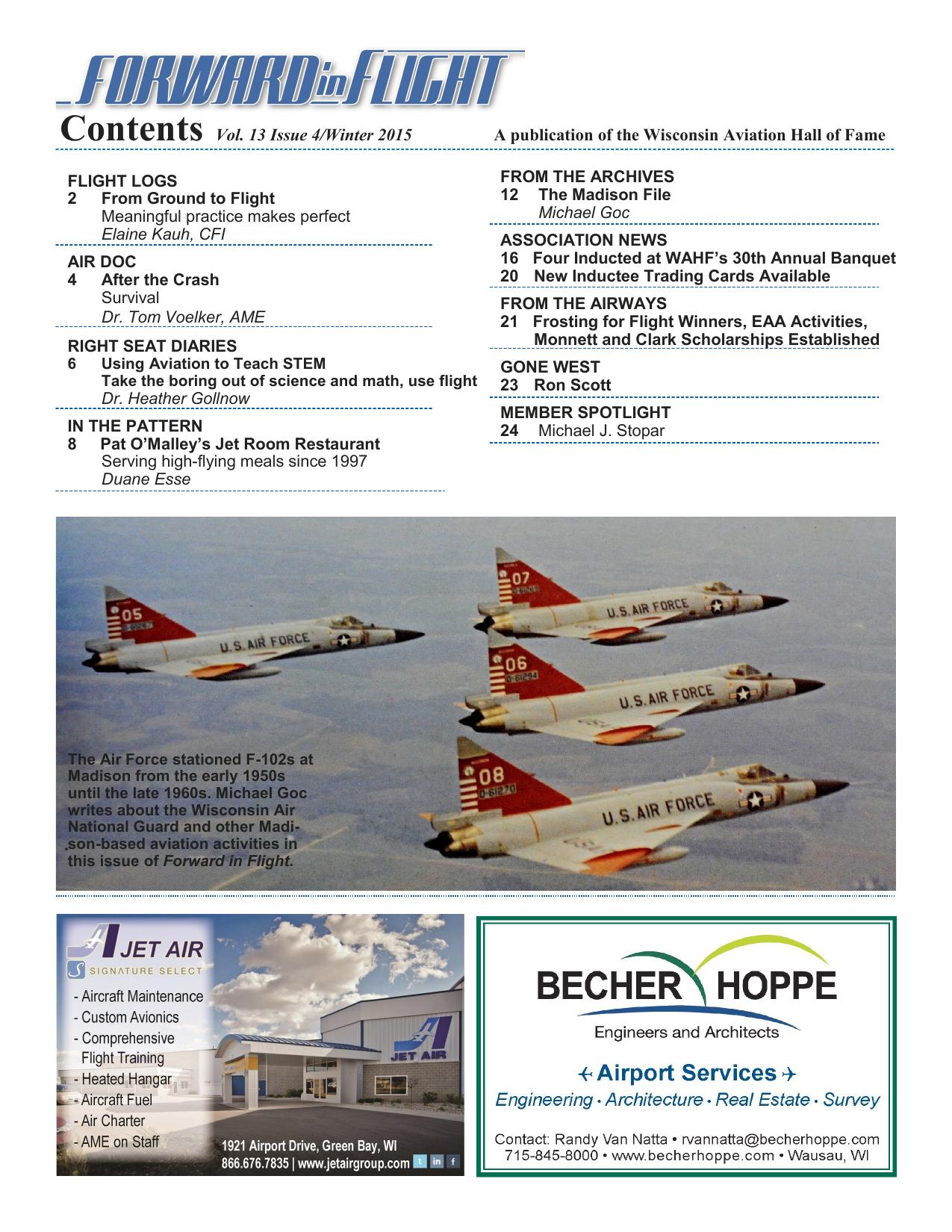
Contents Vol. 13 Issue 4/Winter 2015 FLIGHT LOGS 2 From Ground to Flight Meaningful practice makes perfect Elaine Kauh, CFI AIR DOC 4 After the Crash Survival Dr. Tom Voelker, AME RIGHT SEAT DIARIES 6 Using Aviation to Teach STEM Take the boring out of science and math, use flight Dr. Heather Gollnow IN THE PATTERN 8 Pat O’Malley’s Jet Room Restaurant Serving high-flying meals since 1997 Duane Esse The Air Force stationed F-102s at Madison from the early 1950s until the late 1960s. Michael Goc writes about the Wisconsin Air National Guard and other Madison-based aviation activities in this issue of Forward in Flight. A publication of the Wisconsin Aviation Hall of Fame FROM THE ARCHIVES 12 The Madison File Michael Goc ASSOCIATION NEWS 16 Four Inducted at WAHF’s 30th Annual Banquet 20 New Inductee Trading Cards Available FROM THE AIRWAYS 21 Frosting for Flight Winners, EAA Activities, Monnett and Clark Scholarships Established GONE WEST 23 Ron Scott MEMBER SPOTLIGHT 24 Michael J. Stopar
President’s Message ~ by Rose Dorcey Last month we wrapped up our 30th annual induction ceremony and it left me with many reasons for feeling thankful. Every banquet is special, but this year was especially so. We met some really great people and several new friends. I can’t help but think of Paul Poberezny’s comment, that he considered himself a millionaire because through aviation he made a million friends. Same with me...I’m so grateful for being able to meet such wonderful people through aviation and the Wisconsin Aviation Hall of Fame. Our 2015 banquet brought together a record crowd of nearly 265 men and women who were there to honor and celebrate the accomplishments of our distinguished class of inductees. While the majority of the guests were friends and family of the inductees, I was also happy to see several new faces in attendance, faces that belonged to WAHF members. It’s very gratifying for me and the WAHF board members to meet and talk with our member/supporters throughout the year, and especially at the banquet. We thank you for attending, and hope you enjoyed it. Please feel free to share your thoughts about the event with us. For those who have never attended, please consider doing so in 2016. We think you’ll enjoy it! This time of year I’m busy with several tasks pertaining to membership. It won’t be long until many of you receive a renewal notice, asking that you recommit to being a WAHF member/supporter in 2016. It’s difficult to describe how important your membership is to WAHF. And that’s not just about the financial side. I think it’s safe to say that all our volunteer board members (and I) are greatly buoyed by your support...we feel our work is respected and appreciated when we see our membership numbers growing. It’s also a great sign that you feel our work and mission are important. Through the friendships we’ve made, we know how much it means to friends and family of inductees to see their loved ones honored. Many are honored through induction, and many more receive recognition when we share their stories in Forward in Flight. Sometimes we share their stories—with youth and adults—at speaking events throughout the state. Those things happen because of your support. Your $20 goes a long way! We hope you will remain a member in 2016. Forward in Flight The only magazine dedicated exclusively to Wisconsin aviation history and today’s events. Rose Dorcey, editor 3980 Sharratt Drive Oshkosh, WI 54901-1276 Phone: 920-385-1483 920-279-6029 rdorcey@wisconsinaviationhallofame.org The Wisconsin Aviation Hall of Fame is a non-profit membership organization with a mission to collect and preserve the history of aviation in Wisconsin, recognize those who made that history, inform others of it, and promote aviation education for future generations. In my last column I wrote about flying a Cub with WAHF Member/Supporter Steve Krog at Cub Air Flight in Hartford. Shortly after Forward in Flight was delivered, I received a poem, “Ode to a Taildragger” (author unknown) from WAHF Inductee Dan Donovan (thanks again, Dan.) When a poem begins, “Taildragger, I hate your guts,” you know it will be good. I laughed as I read it, because I related to its frustration and humor. Taildragger, I hate your guts, I’ve licenses, ratings, and such, but to make you go straight is driving me nuts. With hours of teaching and the controls in my clutch, it takes a little rudder (No, less. Wait, too much.) ….This wicked little plane is just too much. Give her more rudder. Oops, that’s too much. With a lot of zigzagging and words obscene, I think I’ve mastered this slippery machine. In fact, I think I like this thing. It’s not so bad if you’ve got the touch, Just a little rudder (easy, easy, not too much.) I relax for a second and from the corner of my eye, I suddenly see, with a gasp and a cry, that’s my own tail I see swinging by. You ground-looping wreck, I hate your guts. Give her rudder, great Scott, that’s way too much. Yes, it’s quite a transition from the Cessnas I’ve flown, but it’s still been the best flying I’ve ever done! Merry Christmas to our friends, and many blessings to you in the New Year. On the cover: Four aviators were honored at WAHF’s 30th annual induction banquet on October 24 in Oshkosh: Charles Vehlow, Greg Gorak, Jim Igou (posthumously), and Darrel Gibson, pictured left to right. Dixie Igou accepted on Jim’s behalf. WAHF Photo by Henry Peterson.
FLIGHT LOGS From Ground to Flight Meaningful practice makes perfect By Elaine Kauh Seventeen, give or take. That’s about right—my personal record for consecutive trips around a traffic pattern in an airplane. And really, since I wasn’t the one at the controls for all those miniflights, I won’t take all the credit. When you’re wearing your flight instructor hat, it can be surprising how little time you spend actually flying the airplane. For most of this extra-long session providing landing instruction, I myself performed just two flights around, mainly to give the pilot flying a break (which I insisted on) and to talk through a few pointers. And in any case, it was a blue-sky, balmy day with light wind, and that only adds to the fun of flying low and slow in a little twoseater. To get in the air and have that kind of fun, we had worked long and hard on the ground. More on that later. To be clear, it was a mutual decision to continue flying as long as we did. The average session for pattern work sees six to 10 landings, which for most pilots is plenty. I’m sure that most instructors wouldn’t like to go around and around the same runway for two-plus hours, but this pilot was patient and tenacious and once told me this was his favorite part of his lessons. I for one have always enjoyed pattern work, whether I’m doing the flying or just coaching, so I was happy to oblige. Maybe it’s because I view maneuvering practice in a different way. Along with the mechanics of takeoffs and landings, we reinforced two essential concepts on that 17-trip day: First, no two flights are alike. Each circuit around the pattern varied in its size, height, shape, speed, and quality. Every little difference made for a good cause-and-effect discussion while taxiing back for takeoff, and sometimes I created a difference by saying something like: “This time, you only have half your flaps to use” or—a favor- ite—“Fly the pattern at 600 feet instead of 1,000. And land it right there.” Second, maneuvering an airplane requires most of the body, including a good portion of the brain. For the airplane, it’s all mechanical. For the pilot, it’s much more than that. There are hands and feet and arms, all moving in harmony, and not in a mechanical way. You’re keeping your eyes outside and your head on a swivel, mainly to see what the airplane is doing, as well as to watch for other airplanes. You’re constantly thinking about several things at once, and acting and reacting. And if you or I can’t tell how hard your brain is working to keep it all together, you’re on your way to truly understanding what the quest of stick-and -rudder mastery is all about. Simulation has long been the best method of making ground study more meaningful, fun, and easier to get through. Those who recognize this will learn to grasp the intangible concepts of flight and in doing so, enjoy whatever tasks they’re performing in an airplane, no matter how many times they do it. They can see and sense even the most subtle differences each time, and adjust accordingly. And they always want to get better at what they do. That’s called meaningful practice—a must for anyone who wants to fly and fly well. 2 Forward in Flight ~ Quarterly Magazine of the Wisconsin Aviation Hall of Fame Meaningful practice starts long before climbing into the airplane. To really understand what’s going on in-flight (and to make a productive flight lesson), we have to be able to study the mechanics of the aircraft as it’s maneuvered, then explain them, then get an idea of how we execute them—along with what we’re supposed to see, hear, and feel. If this sounds a bit boring and tedious to you, it is. I don’t begrudge my beginning students’ honest assessments of their textbooks and manuals. They are, for the most part, dry in their language and no number of full-color diagrams can add much excitement. Just to drive home this point, think about how exciting it would be to open a typical textbook and read page after page about climbs, descents, turns, and level flight—known in training as “the four fundamentals.” For some, this is fun to think about—taking a friend flying and taking photos while circling the family farm, for instance, or flying s-turns while keeping up with the cars driving on the highway below. That’s the reward for making it through the bookwork, but it can detract from the real goal: Learning how to maneuver an airplane well without having to think so hard about what’s happening. Fortunately, there are ways of making ground lessons more meaningful. Videos are the game-changer. You can easily find on the Web real-life videos of people flying the same two-seat airplane you’re learning to fly. I’ve found videos of everything from how to start a Cessna 172 to how to land a Citabria in a 20-knot crosswind, along with “how-not-to” videos that are just as educational. Even if they don’t teach you everything you need to know about a topic, many offer tips not found in any book, and they make the ground lessons much easier to complete. And there’s nothing like taking your own
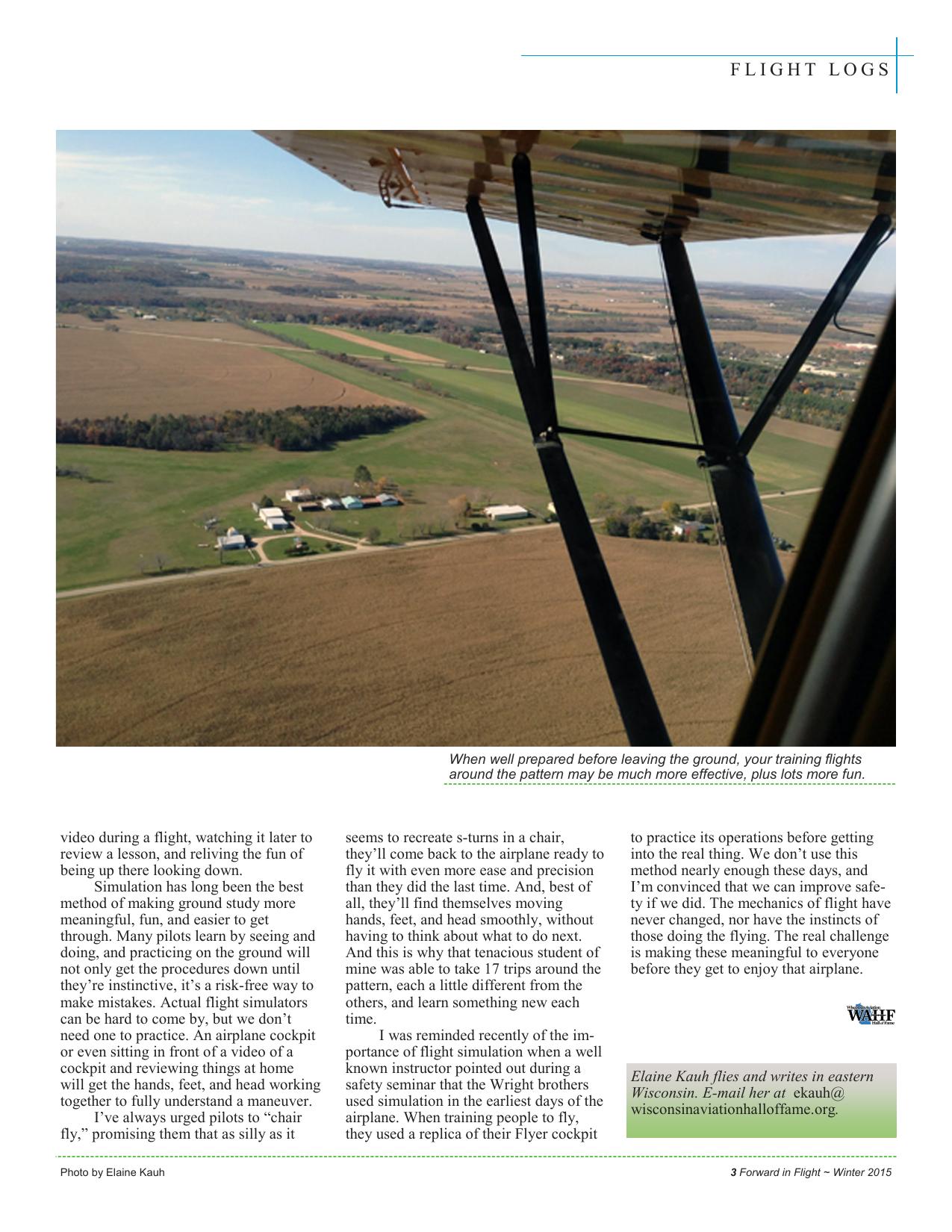
FLIGHT LOGS When well prepared before leaving the ground, your training flights around the pattern may be much more effective, plus lots more fun. video during a flight, watching it later to review a lesson, and reliving the fun of being up there looking down. Simulation has long been the best method of making ground study more meaningful, fun, and easier to get through. Many pilots learn by seeing and doing, and practicing on the ground will not only get the procedures down until they’re instinctive, it’s a risk-free way to make mistakes. Actual flight simulators can be hard to come by, but we don’t need one to practice. An airplane cockpit or even sitting in front of a video of a cockpit and reviewing things at home will get the hands, feet, and head working together to fully understand a maneuver. I’ve always urged pilots to “chair fly,” promising them that as silly as it Photo by Elaine Kauh seems to recreate s-turns in a chair, they’ll come back to the airplane ready to fly it with even more ease and precision than they did the last time. And, best of all, they’ll find themselves moving hands, feet, and head smoothly, without having to think about what to do next. And this is why that tenacious student of mine was able to take 17 trips around the pattern, each a little different from the others, and learn something new each time. I was reminded recently of the importance of flight simulation when a well known instructor pointed out during a safety seminar that the Wright brothers used simulation in the earliest days of the airplane. When training people to fly, they used a replica of their Flyer cockpit to practice its operations before getting into the real thing. We don’t use this method nearly enough these days, and I’m convinced that we can improve safety if we did. The mechanics of flight have never changed, nor have the instincts of those doing the flying. The real challenge is making these meaningful to everyone before they get to enjoy that airplane. Elaine Kauh flies and writes in eastern Wisconsin. E-mail her at ekauh@ wisconsinaviationhalloffame.org. 3 Forward in Flight ~ Winter 2015
AIR DOC After the Crash Survival Dr. Tom Voelker, AME Voelkerta@yahoo.com Greetings, airmen! Welcome to the annual “oh, no, winter’s coming” edition of our quarterly chat. As I write this, I have a fire blazing in the fire ring in my backyard, and you’re welcome to pull up a chair! Winter flying is upon us. That means great performance, low density altitudes, and less congested airports. Oh, I almost forgot the cold preflights, icing airmets, and survival! Yes, survival. Last winter a Skyhawk crashed on approach to an airport in one of our neighboring states. I had the opportunity to talk to the fixed base operator at the accident airport about the accident and subsequent rescue. Several interesting topics came up in that conversation and I want to discuss two of them with you: how to make sure you are found in the event of a crash, and what to do if you are not found (at least right away). I have changed some of the details of the accident to protect the privacy of the pilot involved. I understand that he is doing well, but I have not talked to him about the events of that early morning. The weather was marginal IFR, and the instrument pilot was on an IFR flight plan, performing a non-precision approach from the west. The FBO had just opened, and because a rental car was being dropped off at this uncontrolled field, Jim, the owner of the FBO, checked Flight Aware to see who was arriving. A Cessna 172 was coming in from the west, and its flight path could be seen on the radar track, which FlightAware provides. (This is a free website, and is worth looking into, both for safety, as we will see, and simply to see where your friends are as they fly—assuming they are using air traffic control services.) The plane was due in about five minutes, and the pilot would be calling on the local frequency any minute. The call never came. Jim didn’t seem concerned. The pilot probably couldn’t see the airport, and executed a missed approach, going to another airport. This is a routine procedure that instrument-rated pilots practice frequently. However, the Air Force called the airport, noting that an ELT was heard in the area. (An ELT is a transmitter that goes off in an accident and emits an emergency code.) Jim sent one of his coworkers to look around the airport, and no plane was found. A few minutes later, ATC (air traffic control) called, asking if the Cessna had arrived. When they heard that it was not at the airport, and noting that the pilot had not called ATC with a “missed approach,” a search was initiated. The weather at the field was improving, and an aircraft took off, looking in the area where the radar returns on FlightAware had stopped. He spotted the crash site, only a couple hundred feet short of the airport fence! The ambulance crew had already been sent to the airport, and they were directed to the accident site. With some difficulty, the pilot was brought out on a stretcher, about an hour after the crash. This pilot was lucky, in two ways. First, he was found fairly quickly. However, an hour is a long time, and in the event of an aircraft accident, many bad things could happen during those 4 Forward in Flight ~ Quarterly Magazine of the Wisconsin Aviation Hall of Fame 60 minutes. Had he planned to arrive 30 minutes earlier, the airport would have been unattended, and his rescue would have been considerably delayed. And if he had not filed a flight plan, nobody would have been looking! Second, the pilot’s injuries, though substantial, were not immediately life threatening. What if there had been severe bleeding, or had suffered a penetrating chest or head injury? What would he do then? Similarly, there was no post crash fire, though I understand aviation fuel was spilled at the site. A fire would certainly change the priorities of the pilot and the rescue personnel. I don’t know the temperature at the time of the accident, but this time of year, frostbite and exposure are real possibilities. We will discuss both of these issues. Namely, how to hasten discovery and rescue in the event of a crash, and what to do if you are in a crash and rescue is not coming! So, fellow pilots, how can we make sure somebody knows we are in trouble? There is a lot of technology to help in this area, and there are several procedures to assist us. Here are some of my ideas. We pilots have a primary rule in any emergency: fly the airplane! If we lose control of the plane, the chance of surviving a plane crash goes down dramatically. While this rule will not get you found, it may make you worth finding! Once the plane is controlled, however, the pilot should tell somebody he or she is in trouble. If you are talking to ATC, simply tell them. And When we doctors find ourselves dealing with a life-threatening emergency, we have an interesting saying: Take your own pulse first. do not be afraid to declare an emergency. If you are not in contact with air traffic control, then call on 121.5 (the “emergency channel”) or even on the local CTAF frequency. Just let someone know. As an extension of this, do not cancel your flight plan with ATC until you are on the ground. I used to cancel when I got within a few miles of the airport. If I was the one who crashed a few hundred feet off the airport, nobody would have known for hours! Also, use some of the available technology. The ELT mentioned above is required on all planes, with a few rare exceptions. While helpful, they are not foolproof. The newer 406 megahertz transmitters are much more reliable and give more accurate information. Although they cost more than the older 121.5 mhz models, from a search and rescue standpoint, the 406 is the way to go. I also use a personal locator beacon in the Comanche. I use the SPOT device. For about $15 per month, the
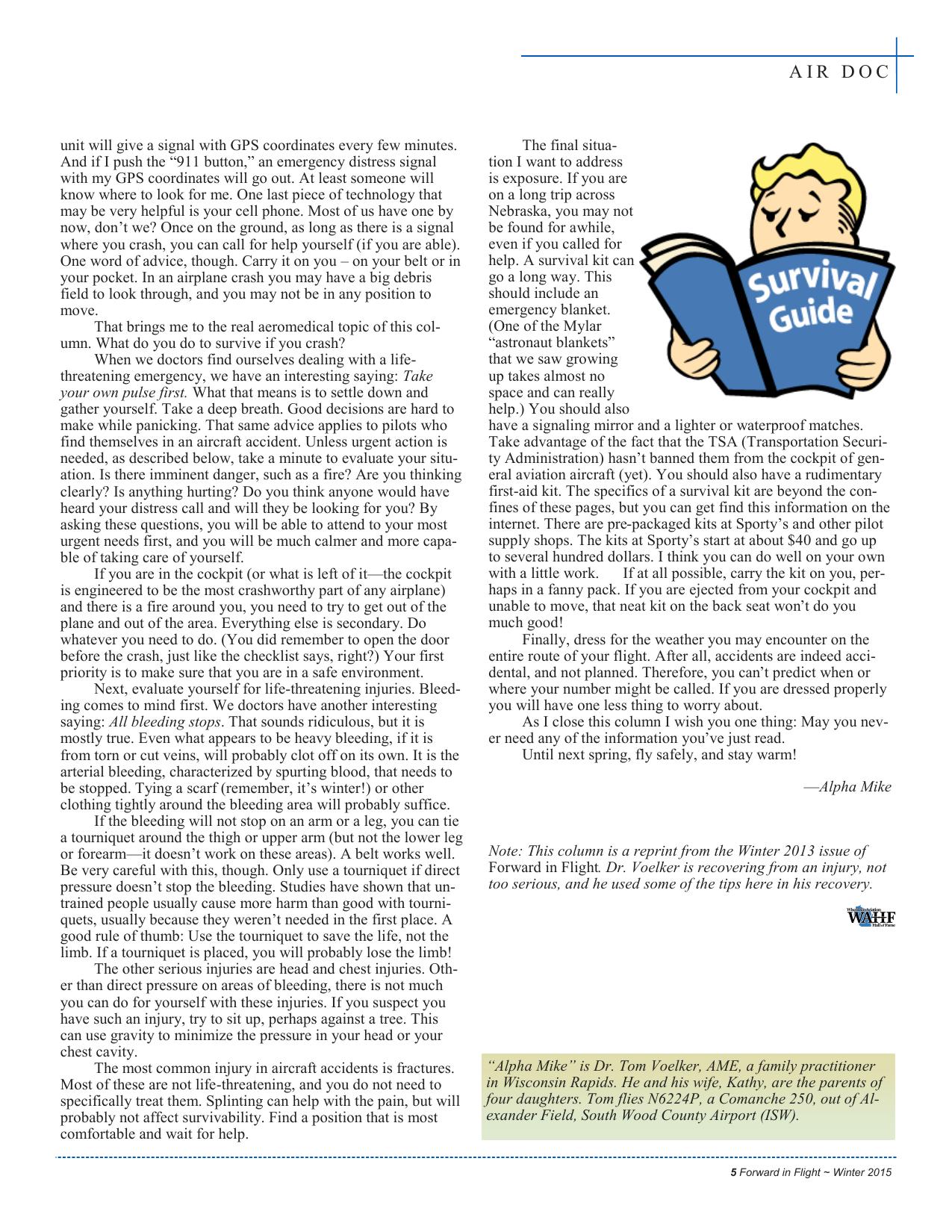
AIR DOC unit will give a signal with GPS coordinates every few minutes. And if I push the “911 button,” an emergency distress signal with my GPS coordinates will go out. At least someone will know where to look for me. One last piece of technology that may be very helpful is your cell phone. Most of us have one by now, don’t we? Once on the ground, as long as there is a signal where you crash, you can call for help yourself (if you are able). One word of advice, though. Carry it on you – on your belt or in your pocket. In an airplane crash you may have a big debris field to look through, and you may not be in any position to move. That brings me to the real aeromedical topic of this column. What do you do to survive if you crash? When we doctors find ourselves dealing with a lifethreatening emergency, we have an interesting saying: Take your own pulse first. What that means is to settle down and gather yourself. Take a deep breath. Good decisions are hard to make while panicking. That same advice applies to pilots who find themselves in an aircraft accident. Unless urgent action is needed, as described below, take a minute to evaluate your situation. Is there imminent danger, such as a fire? Are you thinking clearly? Is anything hurting? Do you think anyone would have heard your distress call and will they be looking for you? By asking these questions, you will be able to attend to your most urgent needs first, and you will be much calmer and more capable of taking care of yourself. If you are in the cockpit (or what is left of it—the cockpit is engineered to be the most crashworthy part of any airplane) and there is a fire around you, you need to try to get out of the plane and out of the area. Everything else is secondary. Do whatever you need to do. (You did remember to open the door before the crash, just like the checklist says, right?) Your first priority is to make sure that you are in a safe environment. Next, evaluate yourself for life-threatening injuries. Bleeding comes to mind first. We doctors have another interesting saying: All bleeding stops. That sounds ridiculous, but it is mostly true. Even what appears to be heavy bleeding, if it is from torn or cut veins, will probably clot off on its own. It is the arterial bleeding, characterized by spurting blood, that needs to be stopped. Tying a scarf (remember, it’s winter!) or other clothing tightly around the bleeding area will probably suffice. If the bleeding will not stop on an arm or a leg, you can tie a tourniquet around the thigh or upper arm (but not the lower leg or forearm—it doesn’t work on these areas). A belt works well. Be very careful with this, though. Only use a tourniquet if direct pressure doesn’t stop the bleeding. Studies have shown that untrained people usually cause more harm than good with tourniquets, usually because they weren’t needed in the first place. A good rule of thumb: Use the tourniquet to save the life, not the limb. If a tourniquet is placed, you will probably lose the limb! The other serious injuries are head and chest injuries. Other than direct pressure on areas of bleeding, there is not much you can do for yourself with these injuries. If you suspect you have such an injury, try to sit up, perhaps against a tree. This can use gravity to minimize the pressure in your head or your chest cavity. The most common injury in aircraft accidents is fractures. Most of these are not life-threatening, and you do not need to specifically treat them. Splinting can help with the pain, but will probably not affect survivability. Find a position that is most comfortable and wait for help. The final situation I want to address is exposure. If you are on a long trip across Nebraska, you may not be found for awhile, even if you called for help. A survival kit can go a long way. This should include an emergency blanket. (One of the Mylar “astronaut blankets” that we saw growing up takes almost no space and can really help.) You should also have a signaling mirror and a lighter or waterproof matches. Take advantage of the fact that the TSA (Transportation Security Administration) hasn’t banned them from the cockpit of general aviation aircraft (yet). You should also have a rudimentary first-aid kit. The specifics of a survival kit are beyond the confines of these pages, but you can get find this information on the internet. There are pre-packaged kits at Sporty’s and other pilot supply shops. The kits at Sporty’s start at about $40 and go up to several hundred dollars. I think you can do well on your own with a little work. If at all possible, carry the kit on you, perhaps in a fanny pack. If you are ejected from your cockpit and unable to move, that neat kit on the back seat won’t do you much good! Finally, dress for the weather you may encounter on the entire route of your flight. After all, accidents are indeed accidental, and not planned. Therefore, you can’t predict when or where your number might be called. If you are dressed properly you will have one less thing to worry about. As I close this column I wish you one thing: May you never need any of the information you’ve just read. Until next spring, fly safely, and stay warm! —Alpha Mike Note: This column is a reprint from the Winter 2013 issue of Forward in Flight. Dr. Voelker is recovering from an injury, not too serious, and he used some of the tips here in his recovery. “Alpha Mike” is Dr. Tom Voelker, AME, a family practitioner in Wisconsin Rapids. He and his wife, Kathy, are the parents of four daughters. Tom flies N6224P, a Comanche 250, out of Alexander Field, South Wood County Airport (ISW). 5 Forward in Flight ~ Winter 2015
RIGHT SEAT DIARIES Using Aviation to Teach STEM Take the boring out of science and math, use flight! By Dr. Heather Gollnow Over the years, I have done a ton of different activities to help promote aviation to the next generation. Promoting aviation has always been important to me. A big part of the reason I personally enjoy doing some of the activities I do is because I am a huge fan of science and math. Aviation is a natural fit for these subjects. Since I have a pretty strong background in education as well as science, math, and technology, I am often asked to help plan activities for school age children and young adults to learn more about flying and being a pilot. Most of the time, I turn it around and use aviation as a means to teach kids about the importance of science, technology, engineering, and math (STEM). I would like for you to consider this approach when you are out in your own community, sharing aviation with others. Use aviation as an opportunity to get kids excited about STEM careers. Show adults how they can be a part of aviation using the skills they already have. I am not going to cite any statistics here, but I am sure many of you have seen the need for highly skilled technical professionals in the very near future. Aviation is an exciting means to get kids excited about subjects that can sometimes be boring or difficult to understand. Please use some of these activities that I have provided as examples of how you can use aviation as a means to promote STEM careers in your community. Use aviation as an opportunity to get kids excited about STEM careers. and why it can change to red or orange during sunrise and sunset. You simply need a flashlight, clear two-liter pop bottle, a little milk, and water. First you need to fill the bottle about ¾ full of water along with a teaspoon of milk and shake well. Prop up the flashlight so that it shines through the mixture in the bottle. Keep adding more milk until you see a blue light emitting from the mixture. Once you see the blue, you can keep adding milk until there’s a red or orange light shining through the mixture. You can explain to kids that the mixture is like the earth’s atmosphere and the flashlight is like the sun. The particles that are in our atmosphere scatters the light so we see different colors at different times of the day. This is a fun activity that teaches kids a little about the atmosphere and that we need scientists to study and understand the atmosphere in order to keep people safe when flying! Technology Technology is absolutely everywhere in this day and age. There are probably very few career choices left where technology is not a large piece of it. Aviation is no exception. When you talk about technology in aviation, it’s not just what websites you go to for weather reports, or using DUATS to file a flight plan. It’s about advancing aviation and making aviation even better through technology. Yes, the Internet is a great asset to promoting and learning about aviation. Social media allows student pilots to connect with flight instructors and more seasoned pilots all over the world. There are websites you can go to for weather reports, catch up on the latest FARs, and find an airplane to buy. These certainly are aspects of technology in aviation that can and should be shared. What I am referring to here with regards to technology is the development of some new technological tool that can be Science There are a lot of different activities you can do with children, young adults, and even adults to use aviation as a means to teach about science. It’s probably natural to think about the physical sciences when teaching about aviation—things like Bernoulli’s Principle or Newton’s Third Law when exploring the principles of flight. There are many different areas of science that are involved in aviation than just the physical sciences. For example, aviation is a great way to explore atmospheric sciences and meteorology. Learning the different cloud types, or different forms of precipitation might seem a little dull on the surface to some kids. Put some of these topics within the context of aviation and it may attract more attention. Activity It’s safe to say that when you think about aviation, you think about the sky. One fun activity teaches kids why the sky is blue 6 Forward in Flight ~ Quarterly Magazine of the Wisconsin Aviation Hall of Fame Photo by Rose Dorcey
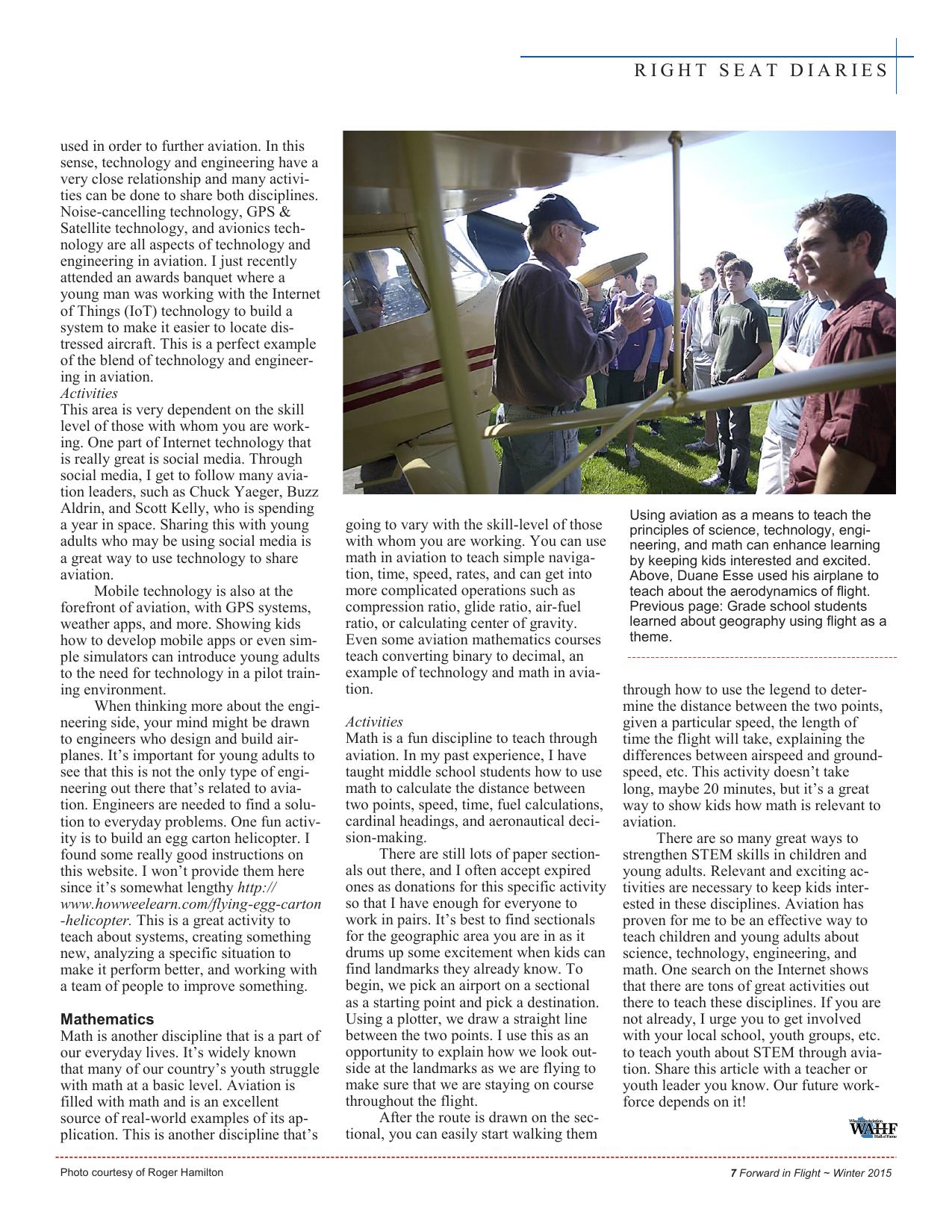
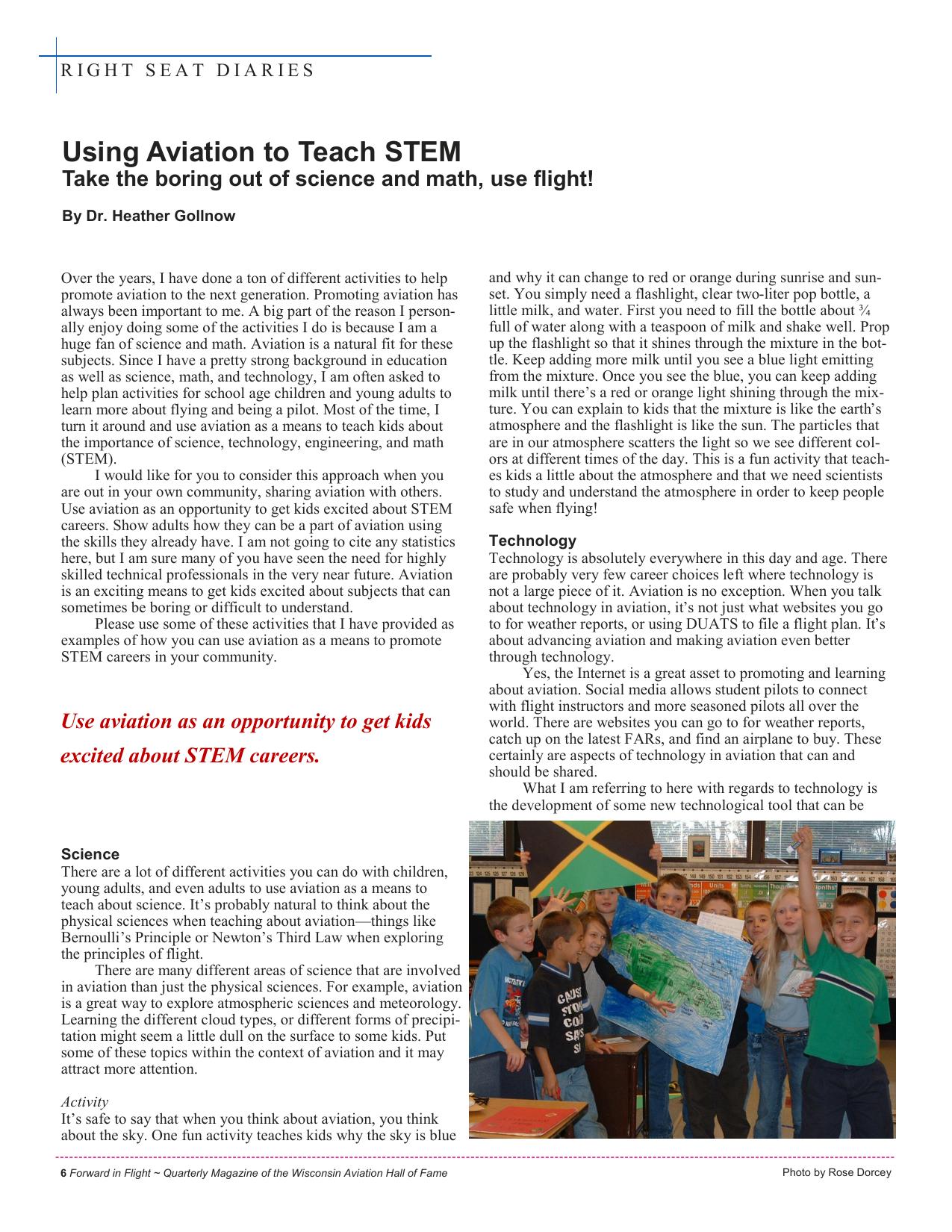
RIGHT SEAT DIARIES used in order to further aviation. In this sense, technology and engineering have a very close relationship and many activities can be done to share both disciplines. Noise-cancelling technology, GPS & Satellite technology, and avionics technology are all aspects of technology and engineering in aviation. I just recently attended an awards banquet where a young man was working with the Internet of Things (IoT) technology to build a system to make it easier to locate distressed aircraft. This is a perfect example of the blend of technology and engineering in aviation. Activities This area is very dependent on the skill level of those with whom you are working. One part of Internet technology that is really great is social media. Through social media, I get to follow many aviation leaders, such as Chuck Yaeger, Buzz Aldrin, and Scott Kelly, who is spending a year in space. Sharing this with young adults who may be using social media is a great way to use technology to share aviation. Mobile technology is also at the forefront of aviation, with GPS systems, weather apps, and more. Showing kids how to develop mobile apps or even simple simulators can introduce young adults to the need for technology in a pilot training environment. When thinking more about the engineering side, your mind might be drawn to engineers who design and build airplanes. It’s important for young adults to see that this is not the only type of engineering out there that’s related to aviation. Engineers are needed to find a solution to everyday problems. One fun activity is to build an egg carton helicopter. I found some really good instructions on this website. I won’t provide them here since it’s somewhat lengthy http:// www.howweelearn.com/flying-egg-carton -helicopter. This is a great activity to teach about systems, creating something new, analyzing a specific situation to make it perform better, and working with a team of people to improve something. Mathematics Math is another discipline that is a part of our everyday lives. It’s widely known that many of our country’s youth struggle with math at a basic level. Aviation is filled with math and is an excellent source of real-world examples of its application. This is another discipline that’s Photo courtesy of Roger Hamilton going to vary with the skill-level of those with whom you are working. You can use math in aviation to teach simple navigation, time, speed, rates, and can get into more complicated operations such as compression ratio, glide ratio, air-fuel ratio, or calculating center of gravity. Even some aviation mathematics courses teach converting binary to decimal, an example of technology and math in aviation. Activities Math is a fun discipline to teach through aviation. In my past experience, I have taught middle school students how to use math to calculate the distance between two points, speed, time, fuel calculations, cardinal headings, and aeronautical decision-making. There are still lots of paper sectionals out there, and I often accept expired ones as donations for this specific activity so that I have enough for everyone to work in pairs. It’s best to find sectionals for the geographic area you are in as it drums up some excitement when kids can find landmarks they already know. To begin, we pick an airport on a sectional as a starting point and pick a destination. Using a plotter, we draw a straight line between the two points. I use this as an opportunity to explain how we look outside at the landmarks as we are flying to make sure that we are staying on course throughout the flight. After the route is drawn on the sectional, you can easily start walking them Using aviation as a means to teach the principles of science, technology, engineering, and math can enhance learning by keeping kids interested and excited. Above, Duane Esse used his airplane to teach about the aerodynamics of flight. Previous page: Grade school students learned about geography using flight as a theme. through how to use the legend to determine the distance between the two points, given a particular speed, the length of time the flight will take, explaining the differences between airspeed and groundspeed, etc. This activity doesn’t take long, maybe 20 minutes, but it’s a great way to show kids how math is relevant to aviation. There are so many great ways to strengthen STEM skills in children and young adults. Relevant and exciting activities are necessary to keep kids interested in these disciplines. Aviation has proven for me to be an effective way to teach children and young adults about science, technology, engineering, and math. One search on the Internet shows that there are tons of great activities out there to teach these disciplines. If you are not already, I urge you to get involved with your local school, youth groups, etc. to teach youth about STEM through aviation. Share this article with a teacher or youth leader you know. Our future workforce depends on it! 7 Forward in Flight ~ Winter 2015
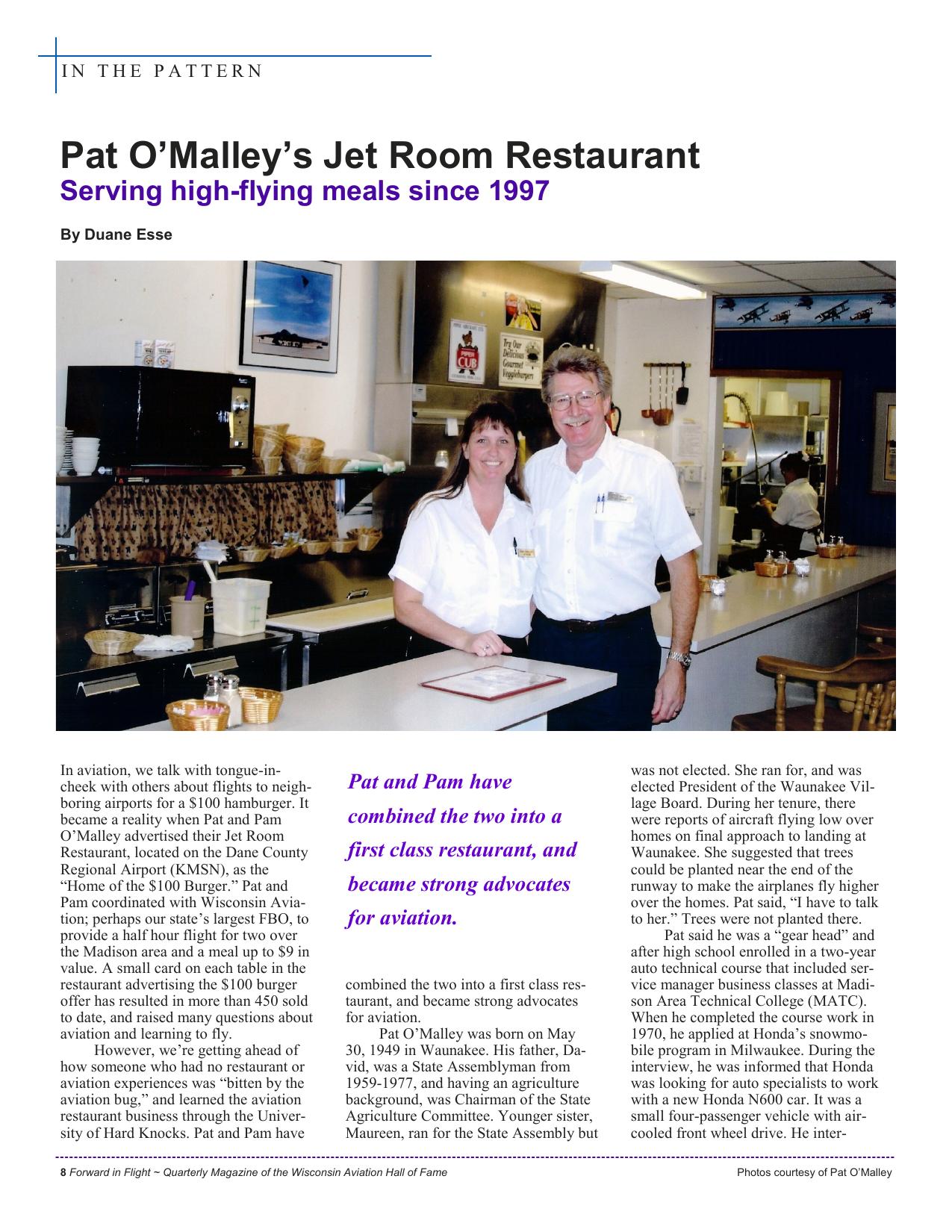
IN THE PATTERN Pat O’Malley’s Jet Room Restaurant Serving high-flying meals since 1997 By Duane Esse In aviation, we talk with tongue-incheek with others about flights to neighboring airports for a $100 hamburger. It became a reality when Pat and Pam O’Malley advertised their Jet Room Restaurant, located on the Dane County Regional Airport (KMSN), as the “Home of the $100 Burger.” Pat and Pam coordinated with Wisconsin Aviation; perhaps our state’s largest FBO, to provide a half hour flight for two over the Madison area and a meal up to $9 in value. A small card on each table in the restaurant advertising the $100 burger offer has resulted in more than 450 sold to date, and raised many questions about aviation and learning to fly. However, we’re getting ahead of how someone who had no restaurant or aviation experiences was “bitten by the aviation bug,” and learned the aviation restaurant business through the University of Hard Knocks. Pat and Pam have Pat and Pam have combined the two into a first class restaurant, and became strong advocates for aviation. combined the two into a first class restaurant, and became strong advocates for aviation. Pat O’Malley was born on May 30, 1949 in Waunakee. His father, David, was a State Assemblyman from 1959-1977, and having an agriculture background, was Chairman of the State Agriculture Committee. Younger sister, Maureen, ran for the State Assembly but 8 Forward in Flight ~ Quarterly Magazine of the Wisconsin Aviation Hall of Fame was not elected. She ran for, and was elected President of the Waunakee Village Board. During her tenure, there were reports of aircraft flying low over homes on final approach to landing at Waunakee. She suggested that trees could be planted near the end of the runway to make the airplanes fly higher over the homes. Pat said, “I have to talk to her.” Trees were not planted there. Pat said he was a “gear head” and after high school enrolled in a two-year auto technical course that included service manager business classes at Madison Area Technical College (MATC). When he completed the course work in 1970, he applied at Honda’s snowmobile program in Milwaukee. During the interview, he was informed that Honda was looking for auto specialists to work with a new Honda N600 car. It was a small four-passenger vehicle with aircooled front wheel drive. He interPhotos courtesy of Pat O’Malley
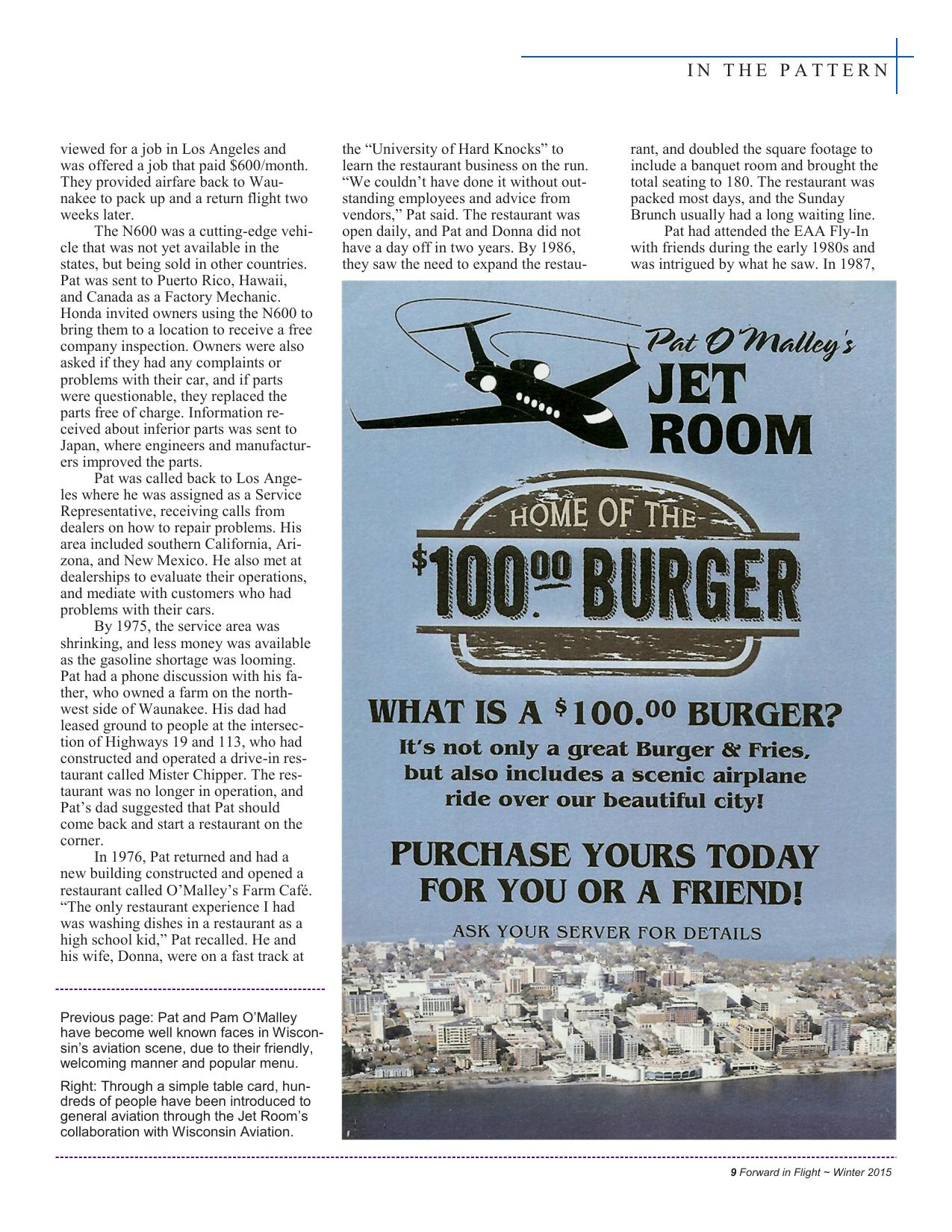
IN THE PATTERN viewed for a job in Los Angeles and was offered a job that paid $600/month. They provided airfare back to Waunakee to pack up and a return flight two weeks later. The N600 was a cutting-edge vehicle that was not yet available in the states, but being sold in other countries. Pat was sent to Puerto Rico, Hawaii, and Canada as a Factory Mechanic. Honda invited owners using the N600 to bring them to a location to receive a free company inspection. Owners were also asked if they had any complaints or problems with their car, and if parts were questionable, they replaced the parts free of charge. Information received about inferior parts was sent to Japan, where engineers and manufacturers improved the parts. Pat was called back to Los Angeles where he was assigned as a Service Representative, receiving calls from dealers on how to repair problems. His area included southern California, Arizona, and New Mexico. He also met at dealerships to evaluate their operations, and mediate with customers who had problems with their cars. By 1975, the service area was shrinking, and less money was available as the gasoline shortage was looming. Pat had a phone discussion with his father, who owned a farm on the northwest side of Waunakee. His dad had leased ground to people at the intersection of Highways 19 and 113, who had constructed and operated a drive-in restaurant called Mister Chipper. The restaurant was no longer in operation, and Pat’s dad suggested that Pat should come back and start a restaurant on the corner. In 1976, Pat returned and had a new building constructed and opened a restaurant called O’Malley’s Farm Café. “The only restaurant experience I had was washing dishes in a restaurant as a high school kid,” Pat recalled. He and his wife, Donna, were on a fast track at the “University of Hard Knocks” to learn the restaurant business on the run. “We couldn’t have done it without outstanding employees and advice from vendors,” Pat said. The restaurant was open daily, and Pat and Donna did not have a day off in two years. By 1986, they saw the need to expand the restau- rant, and doubled the square footage to include a banquet room and brought the total seating to 180. The restaurant was packed most days, and the Sunday Brunch usually had a long waiting line. Pat had attended the EAA Fly-In with friends during the early 1980s and was intrigued by what he saw. In 1987, Previous page: Pat and Pam O’Malley have become well known faces in Wisconsin’s aviation scene, due to their friendly, welcoming manner and popular menu. Right: Through a simple table card, hundreds of people have been introduced to general aviation through the Jet Room’s collaboration with Wisconsin Aviation. 9 Forward in Flight ~ Winter 2015
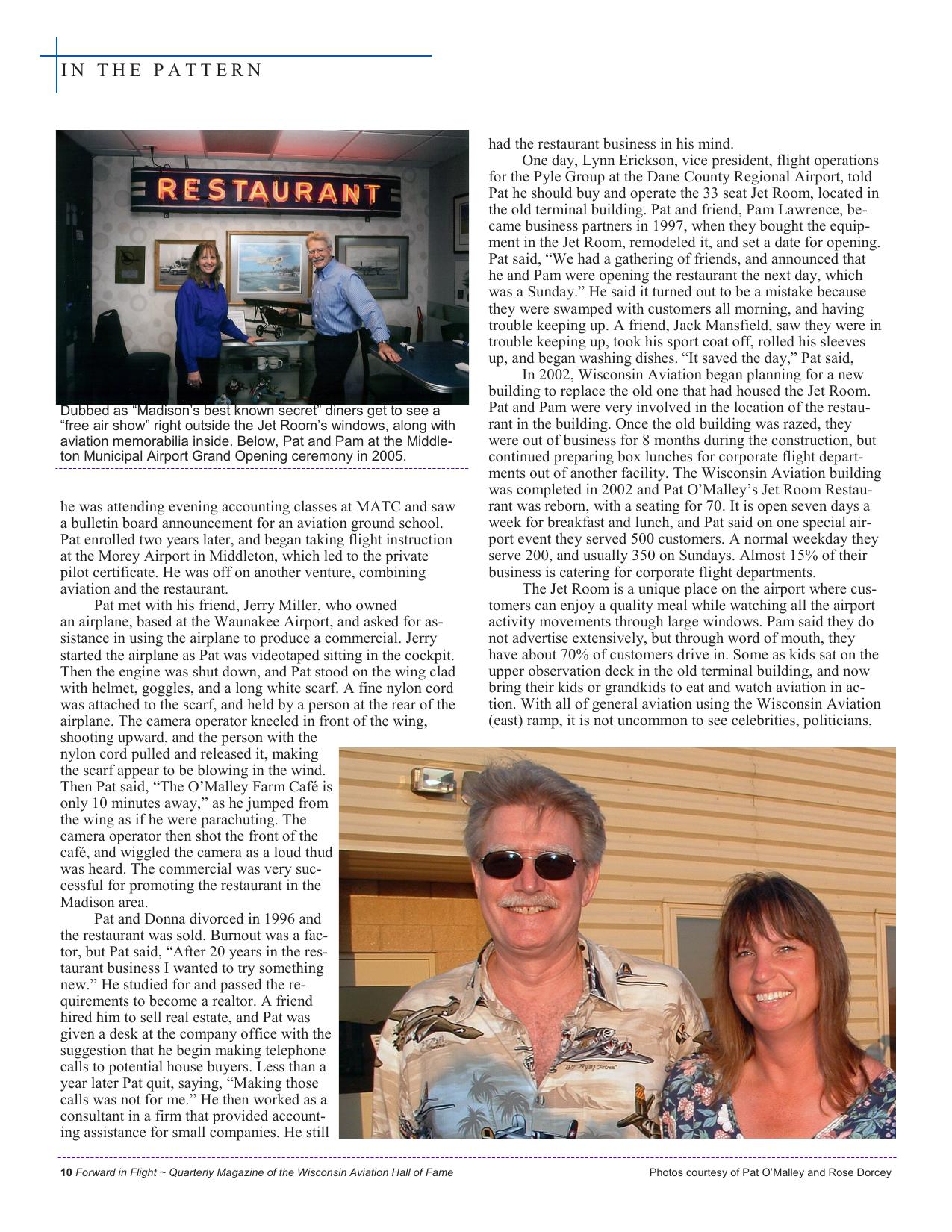
IN THE PATTERN Dubbed as “Madison’s best known secret” diners get to see a “free air show” right outside the Jet Room’s windows, along with aviation memorabilia inside. Below, Pat and Pam at the Middleton Municipal Airport Grand Opening ceremony in 2005. he was attending evening accounting classes at MATC and saw a bulletin board announcement for an aviation ground school. Pat enrolled two years later, and began taking flight instruction at the Morey Airport in Middleton, which led to the private pilot certificate. He was off on another venture, combining aviation and the restaurant. Pat met with his friend, Jerry Miller, who owned an airplane, based at the Waunakee Airport, and asked for assistance in using the airplane to produce a commercial. Jerry started the airplane as Pat was videotaped sitting in the cockpit. Then the engine was shut down, and Pat stood on the wing clad with helmet, goggles, and a long white scarf. A fine nylon cord was attached to the scarf, and held by a person at the rear of the airplane. The camera operator kneeled in front of the wing, shooting upward, and the person with the nylon cord pulled and released it, making the scarf appear to be blowing in the wind. Then Pat said, “The O’Malley Farm Café is only 10 minutes away,” as he jumped from the wing as if he were parachuting. The camera operator then shot the front of the café, and wiggled the camera as a loud thud was heard. The commercial was very successful for promoting the restaurant in the Madison area. Pat and Donna divorced in 1996 and the restaurant was sold. Burnout was a factor, but Pat said, “After 20 years in the restaurant business I wanted to try something new.” He studied for and passed the requirements to become a realtor. A friend hired him to sell real estate, and Pat was given a desk at the company office with the suggestion that he begin making telephone calls to potential house buyers. Less than a year later Pat quit, saying, “Making those calls was not for me.” He then worked as a consultant in a firm that provided accounting assistance for small companies. He still 10 Forward in Flight ~ Quarterly Magazine of the Wisconsin Aviation Hall of Fame had the restaurant business in his mind. One day, Lynn Erickson, vice president, flight operations for the Pyle Group at the Dane County Regional Airport, told Pat he should buy and operate the 33 seat Jet Room, located in the old terminal building. Pat and friend, Pam Lawrence, became business partners in 1997, when they bought the equipment in the Jet Room, remodeled it, and set a date for opening. Pat said, “We had a gathering of friends, and announced that he and Pam were opening the restaurant the next day, which was a Sunday.” He said it turned out to be a mistake because they were swamped with customers all morning, and having trouble keeping up. A friend, Jack Mansfield, saw they were in trouble keeping up, took his sport coat off, rolled his sleeves up, and began washing dishes. “It saved the day,” Pat said, In 2002, Wisconsin Aviation began planning for a new building to replace the old one that had housed the Jet Room. Pat and Pam were very involved in the location of the restaurant in the building. Once the old building was razed, they were out of business for 8 months during the construction, but continued preparing box lunches for corporate flight departments out of another facility. The Wisconsin Aviation building was completed in 2002 and Pat O’Malley’s Jet Room Restaurant was reborn, with a seating for 70. It is open seven days a week for breakfast and lunch, and Pat said on one special airport event they served 500 customers. A normal weekday they serve 200, and usually 350 on Sundays. Almost 15% of their business is catering for corporate flight departments. The Jet Room is a unique place on the airport where customers can enjoy a quality meal while watching all the airport activity movements through large windows. Pam said they do not advertise extensively, but through word of mouth, they have about 70% of customers drive in. Some as kids sat on the upper observation deck in the old terminal building, and now bring their kids or grandkids to eat and watch aviation in action. With all of general aviation using the Wisconsin Aviation (east) ramp, it is not uncommon to see celebrities, politicians, Photos courtesy of Pat O’Malley and Rose Dorcey
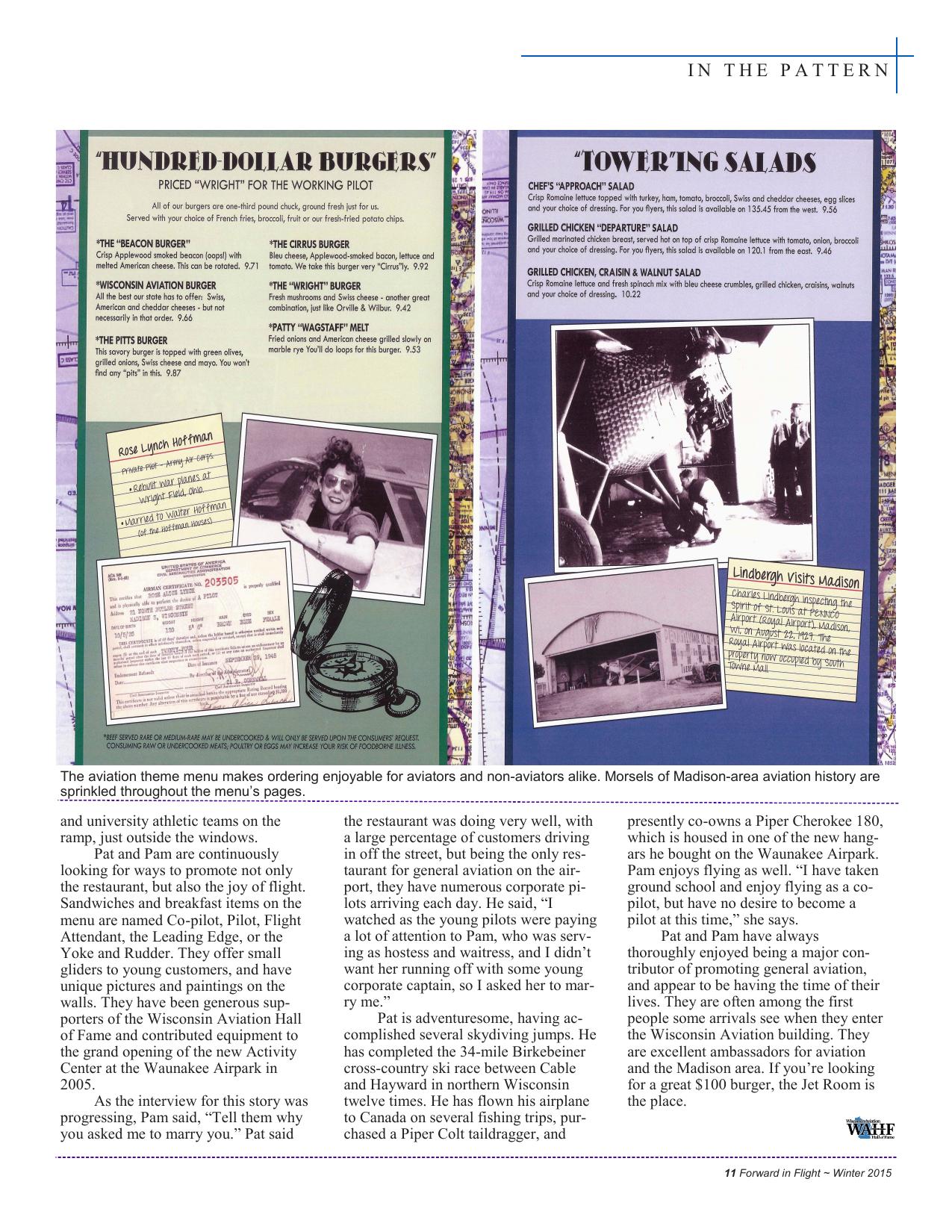
IN THE PATTERN The aviation theme menu makes ordering enjoyable for aviators and non-aviators alike. Morsels of Madison-area aviation history are sprinkled throughout the menu’s pages. and university athletic teams on the ramp, just outside the windows. Pat and Pam are continuously looking for ways to promote not only the restaurant, but also the joy of flight. Sandwiches and breakfast items on the menu are named Co-pilot, Pilot, Flight Attendant, the Leading Edge, or the Yoke and Rudder. They offer small gliders to young customers, and have unique pictures and paintings on the walls. They have been generous supporters of the Wisconsin Aviation Hall of Fame and contributed equipment to the grand opening of the new Activity Center at the Waunakee Airpark in 2005. As the interview for this story was progressing, Pam said, “Tell them why you asked me to marry you.” Pat said the restaurant was doing very well, with a large percentage of customers driving in off the street, but being the only restaurant for general aviation on the airport, they have numerous corporate pilots arriving each day. He said, “I watched as the young pilots were paying a lot of attention to Pam, who was serving as hostess and waitress, and I didn’t want her running off with some young corporate captain, so I asked her to marry me.” Pat is adventuresome, having accomplished several skydiving jumps. He has completed the 34-mile Birkebeiner cross-country ski race between Cable and Hayward in northern Wisconsin twelve times. He has flown his airplane to Canada on several fishing trips, purchased a Piper Colt taildragger, and presently co-owns a Piper Cherokee 180, which is housed in one of the new hangars he bought on the Waunakee Airpark. Pam enjoys flying as well. “I have taken ground school and enjoy flying as a copilot, but have no desire to become a pilot at this time,” she says. Pat and Pam have always thoroughly enjoyed being a major contributor of promoting general aviation, and appear to be having the time of their lives. They are often among the first people some arrivals see when they enter the Wisconsin Aviation building. They are excellent ambassadors for aviation and the Madison area. If you’re looking for a great $100 burger, the Jet Room is the place. 11 Forward in Flight ~ Winter 2015
FROM THE ARCHIVES The Madison File By Michael Goc WAHF’s mission statement starts by saying our goal is to collect the history of aviation in our state. The work did not begin with us, although our founder, Carl Guell, was the first Wisconsinite to purposely collect aviation history on a statewide basis. He began in the run up to the 50th anniversary of the Wright brothers’ flight in 1953. Clifford Lord, the director of the State Historical Society encouraged Guell and gave the stamp of professional legitimacy to Carl’s work. Other people were at work on the local level. George Hardie in Milwaukee county, and Warren O’Brien in Waukesha, were building two of the largest collections of aviation history of any communities in the state. Their efforts merited their induction into our hall of fame, along with Carl Guell. Other communities had bits and pieces of aviation information in local historical societies, libraries, air terminals, and individual collections. For our 1990s book project, we collected and organized information from all over the state, added it to Guell’s files, and created the WAHF archive we have today. One outcome of the book project and of the growth and higher public profile of WAHF in the years since, is that aviation history is recognized as just as much a part of Wisconsin’s story as the history of railroading, Great Lakes shipping, or the highway system. The work continues today. One of our most active and fruitful collecting efforts is our nomination/induction process. Over the years, family, friends, local historians, and our own board members, have compiled information to support the induction of aviation history makers. In addition to the some 120 people whose plaques hang on the wall at the EAA AirVenture Museum, we have files on more than 80 nominees. Some may not be inducted, but the information in their files adds to what we know about Wisconsin aviation history and what we preserve in our archives. The more nominations we receive, the better our archive. To present an example of what we have in our collections I grabbed a fat file labeled Madison. The capital city has been home to many inductees, from Howard Morey to Fritz Wolf, Bob Skuldt to Pete Drahn, to name a few. Like other places, Madison has its own story to tell and I plucked a few items from our file to share today. If we are looking for impact beyond local boundaries, Madison can claim a few honors. It was the place where the first woman to pilot an airplane in our state made her flight. Blanche Stuart Scott flew a Curtiss on the outskirts of Madison in 1915. Six years later, an indifferent scholar from the University of Wisconsin at Madison made his first flight. Charles Lindbergh occupied the front cockpit of a Jenny piloted by a touring barnstormer named Russ Overley in 1919. Their landing strip was a stretch of what is now Highway 151 in the sticks on the way to Sun Prairie. It was the push Lindbergh needed to drop out of the university and enroll in flight school. In the early 1950s, a veteran Air Force pilot from Hales Corners, Paul Poberezny, learned about a set of airplane plans and other material left behind at Madison’s abandoned North Street airport. He took them home and used them to build his own version of a Corben Baby Ace and, by the way, launch the Experimental Aircraft Association. In aviation, as elsewhere, all history is local. Sometimes it grows into something much larger. Madison has had three airports worthy of the name. The first was Howard Morey’s grass strip south of Lake Monona on 12 Forward in Flight ~ Quarterly Magazine of the Wisconsin Aviation Hall of Fame WAHF Archives photos
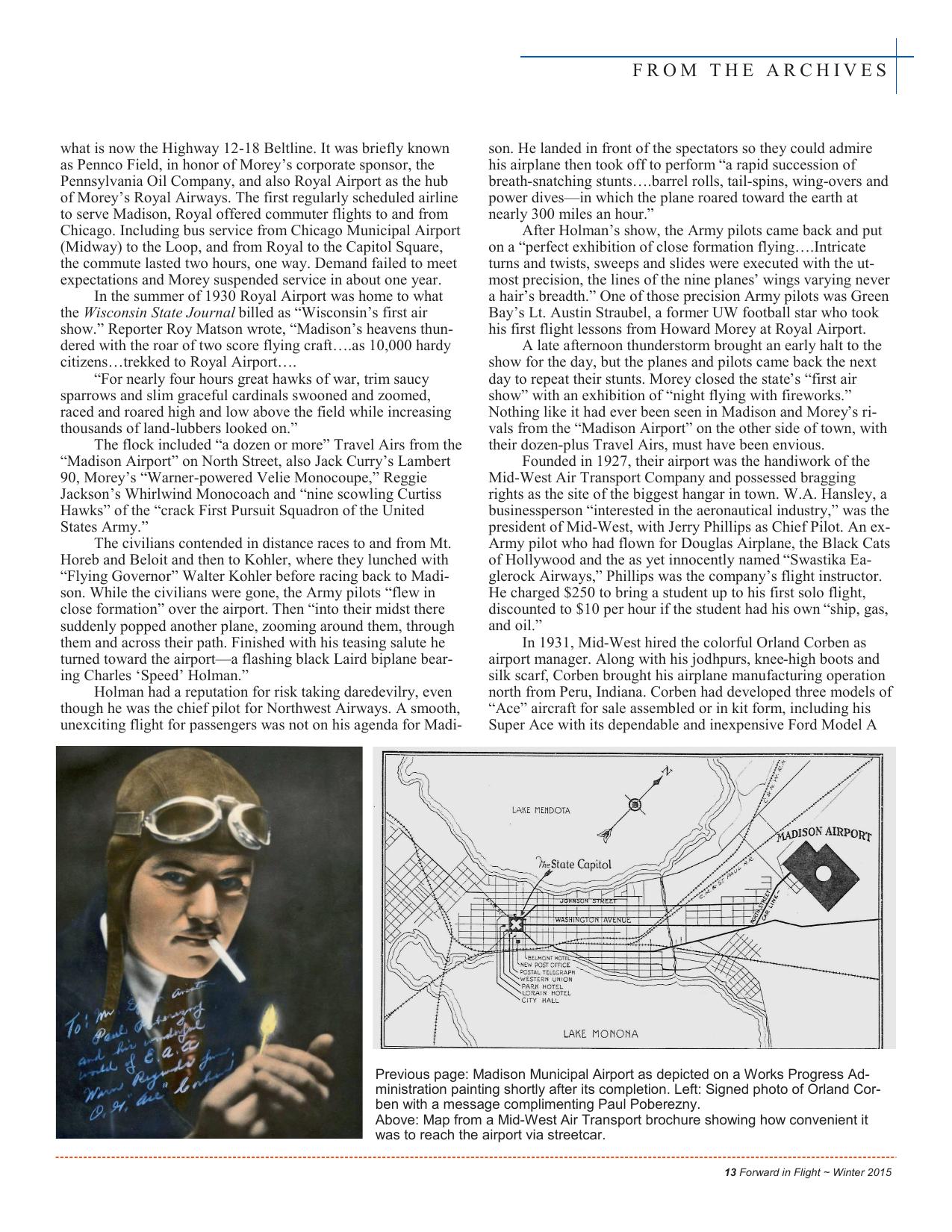
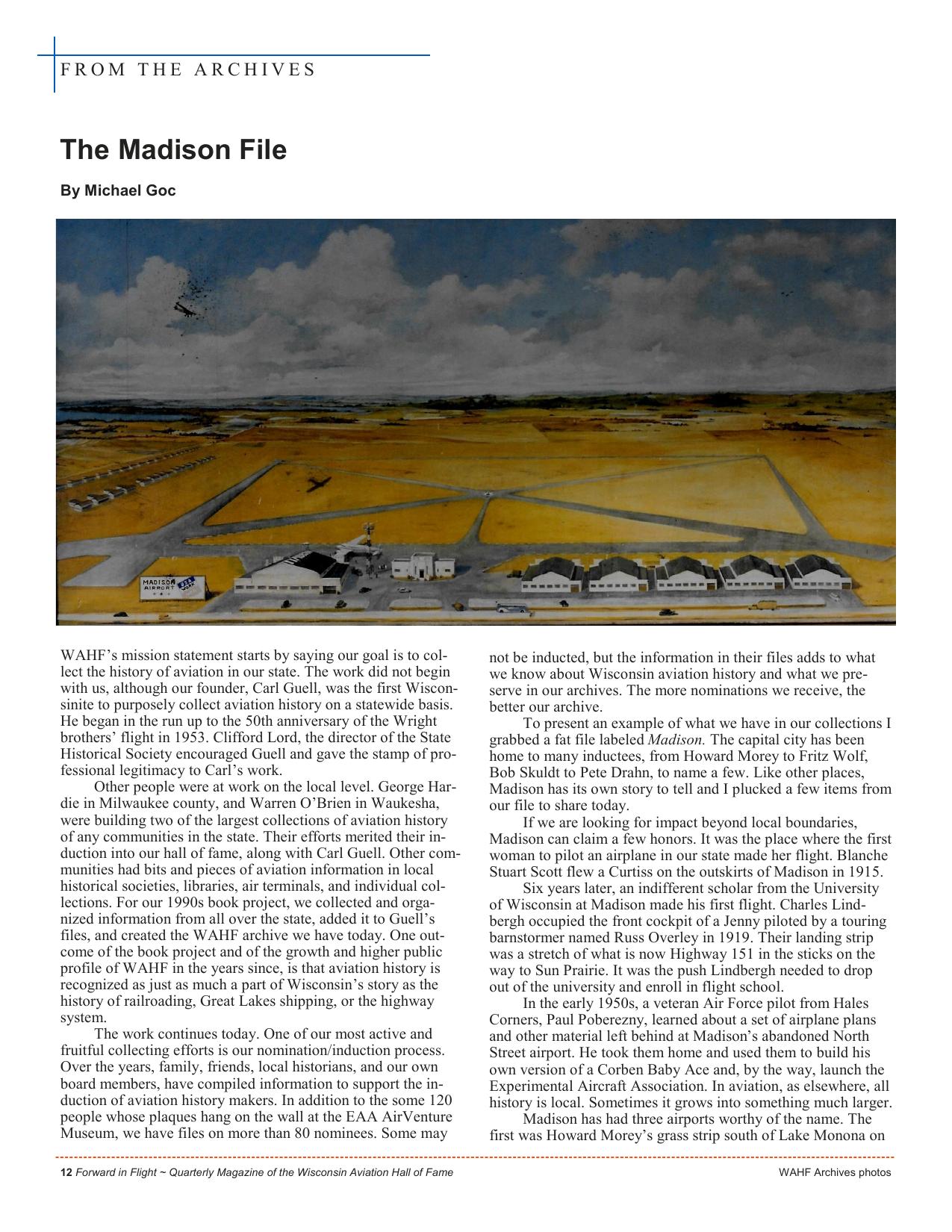
FROM THE ARCHIVES what is now the Highway 12-18 Beltline. It was briefly known as Pennco Field, in honor of Morey’s corporate sponsor, the Pennsylvania Oil Company, and also Royal Airport as the hub of Morey’s Royal Airways. The first regularly scheduled airline to serve Madison, Royal offered commuter flights to and from Chicago. Including bus service from Chicago Municipal Airport (Midway) to the Loop, and from Royal to the Capitol Square, the commute lasted two hours, one way. Demand failed to meet expectations and Morey suspended service in about one year. In the summer of 1930 Royal Airport was home to what the Wisconsin State Journal billed as “Wisconsin’s first air show.” Reporter Roy Matson wrote, “Madison’s heavens thundered with the roar of two score flying craft….as 10,000 hardy citizens…trekked to Royal Airport…. “For nearly four hours great hawks of war, trim saucy sparrows and slim graceful cardinals swooned and zoomed, raced and roared high and low above the field while increasing thousands of land-lubbers looked on.” The flock included “a dozen or more” Travel Airs from the “Madison Airport” on North Street, also Jack Curry’s Lambert 90, Morey’s “Warner-powered Velie Monocoupe,” Reggie Jackson’s Whirlwind Monocoach and “nine scowling Curtiss Hawks” of the “crack First Pursuit Squadron of the United States Army.” The civilians contended in distance races to and from Mt. Horeb and Beloit and then to Kohler, where they lunched with “Flying Governor” Walter Kohler before racing back to Madison. While the civilians were gone, the Army pilots “flew in close formation” over the airport. Then “into their midst there suddenly popped another plane, zooming around them, through them and across their path. Finished with his teasing salute he turned toward the airport—a flashing black Laird biplane bearing Charles ‘Speed’ Holman.” Holman had a reputation for risk taking daredevilry, even though he was the chief pilot for Northwest Airways. A smooth, unexciting flight for passengers was not on his agenda for Madi- son. He landed in front of the spectators so they could admire his airplane then took off to perform “a rapid succession of breath-snatching stunts….barrel rolls, tail-spins, wing-overs and power dives—in which the plane roared toward the earth at nearly 300 miles an hour.” After Holman’s show, the Army pilots came back and put on a “perfect exhibition of close formation flying….Intricate turns and twists, sweeps and slides were executed with the utmost precision, the lines of the nine planes’ wings varying never a hair’s breadth.” One of those precision Army pilots was Green Bay’s Lt. Austin Straubel, a former UW football star who took his first flight lessons from Howard Morey at Royal Airport. A late afternoon thunderstorm brought an early halt to the show for the day, but the planes and pilots came back the next day to repeat their stunts. Morey closed the state’s “first air show” with an exhibition of “night flying with fireworks.” Nothing like it had ever been seen in Madison and Morey’s rivals from the “Madison Airport” on the other side of town, with their dozen-plus Travel Airs, must have been envious. Founded in 1927, their airport was the handiwork of the Mid-West Air Transport Company and possessed bragging rights as the site of the biggest hangar in town. W.A. Hansley, a businessperson “interested in the aeronautical industry,” was the president of Mid-West, with Jerry Phillips as Chief Pilot. An exArmy pilot who had flown for Douglas Airplane, the Black Cats of Hollywood and the as yet innocently named “Swastika Eaglerock Airways,” Phillips was the company’s flight instructor. He charged $250 to bring a student up to his first solo flight, discounted to $10 per hour if the student had his own “ship, gas, and oil.” In 1931, Mid-West hired the colorful Orland Corben as airport manager. Along with his jodhpurs, knee-high boots and silk scarf, Corben brought his airplane manufacturing operation north from Peru, Indiana. Corben had developed three models of “Ace” aircraft for sale assembled or in kit form, including his Super Ace with its dependable and inexpensive Ford Model A Previous page: Madison Municipal Airport as depicted on a Works Progress Administration painting shortly after its completion. Left: Signed photo of Orland Corben with a message complimenting Paul Poberezny. Above: Map from a Mid-West Air Transport brochure showing how convenient it was to reach the airport via streetcar. 13 Forward in Flight ~ Winter 2015
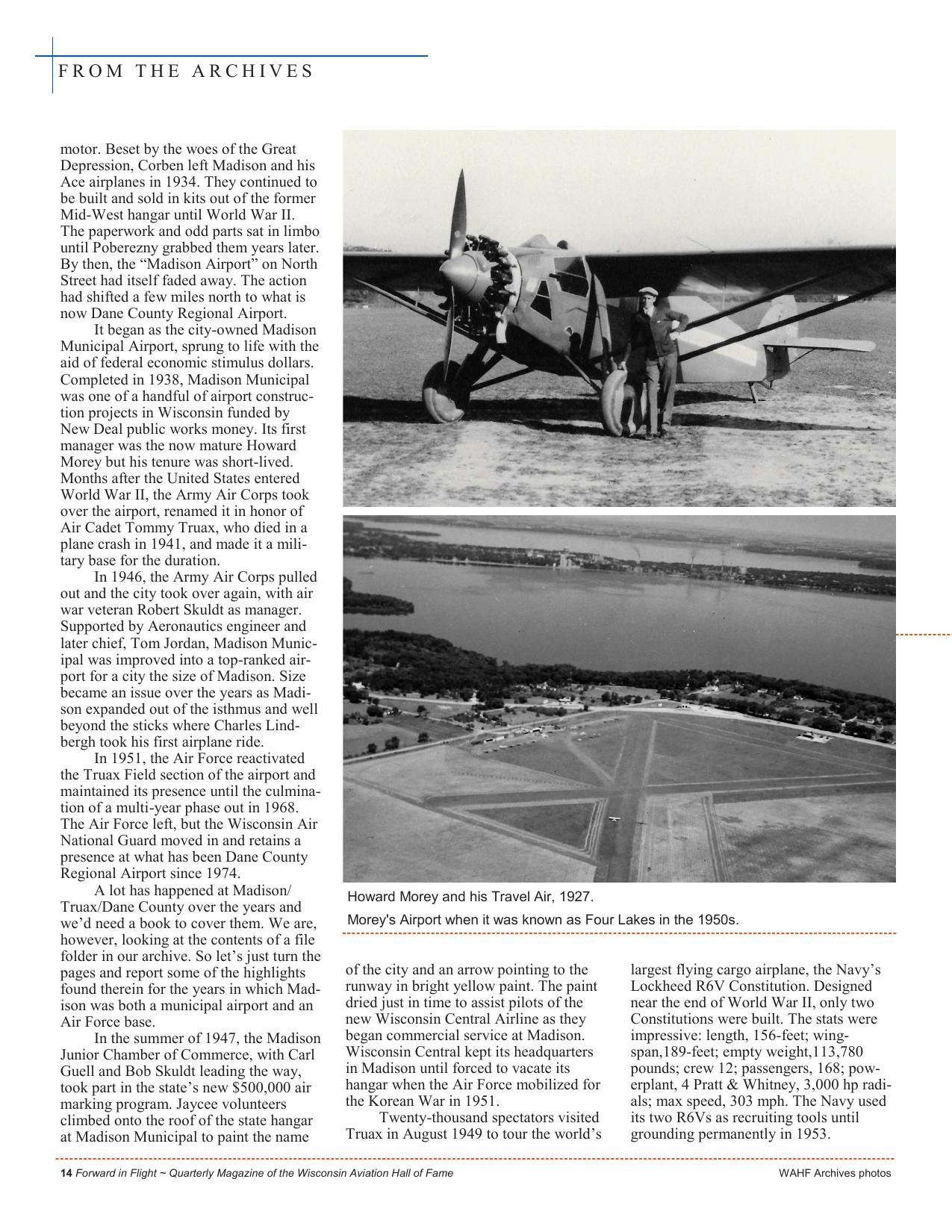
FROM THE ARCHIVES motor. Beset by the woes of the Great Depression, Corben left Madison and his Ace airplanes in 1934. They continued to be built and sold in kits out of the former Mid-West hangar until World War II. The paperwork and odd parts sat in limbo until Poberezny grabbed them years later. By then, the “Madison Airport” on North Street had itself faded away. The action had shifted a few miles north to what is now Dane County Regional Airport. It began as the city-owned Madison Municipal Airport, sprung to life with the aid of federal economic stimulus dollars. Completed in 1938, Madison Municipal was one of a handful of airport construction projects in Wisconsin funded by New Deal public works money. Its first manager was the now mature Howard Morey but his tenure was short-lived. Months after the United States entered World War II, the Army Air Corps took over the airport, renamed it in honor of Air Cadet Tommy Truax, who died in a plane crash in 1941, and made it a military base for the duration. In 1946, the Army Air Corps pulled out and the city took over again, with air war veteran Robert Skuldt as manager. Supported by Aeronautics engineer and later chief, Tom Jordan, Madison Municipal was improved into a top-ranked airport for a city the size of Madison. Size became an issue over the years as Madison expanded out of the isthmus and well beyond the sticks where Charles Lindbergh took his first airplane ride. In 1951, the Air Force reactivated the Truax Field section of the airport and maintained its presence until the culmination of a multi-year phase out in 1968. The Air Force left, but the Wisconsin Air National Guard moved in and retains a presence at what has been Dane County Regional Airport since 1974. A lot has happened at Madison/ Truax/Dane County over the years and we’d need a book to cover them. We are, however, looking at the contents of a file folder in our archive. So let’s just turn the pages and report some of the highlights found therein for the years in which Madison was both a municipal airport and an Air Force base. In the summer of 1947, the Madison Junior Chamber of Commerce, with Carl Guell and Bob Skuldt leading the way, took part in the state’s new $500,000 air marking program. Jaycee volunteers climbed onto the roof of the state hangar at Madison Municipal to paint the name Howard Morey and his Travel Air, 1927. Morey's Airport when it was known as Four Lakes in the 1950s. of the city and an arrow pointing to the runway in bright yellow paint. The paint dried just in time to assist pilots of the new Wisconsin Central Airline as they began commercial service at Madison. Wisconsin Central kept its headquarters in Madison until forced to vacate its hangar when the Air Force mobilized for the Korean War in 1951. Twenty-thousand spectators visited Truax in August 1949 to tour the world’s 14 Forward in Flight ~ Quarterly Magazine of the Wisconsin Aviation Hall of Fame largest flying cargo airplane, the Navy’s Lockheed R6V Constitution. Designed near the end of World War II, only two Constitutions were built. The stats were impressive: length, 156-feet; wingspan,189-feet; empty weight,113,780 pounds; crew 12; passengers, 168; powerplant, 4 Pratt & Whitney, 3,000 hp radials; max speed, 303 mph. The Navy used its two R6Vs as recruiting tools until grounding permanently in 1953. WAHF Archives photos
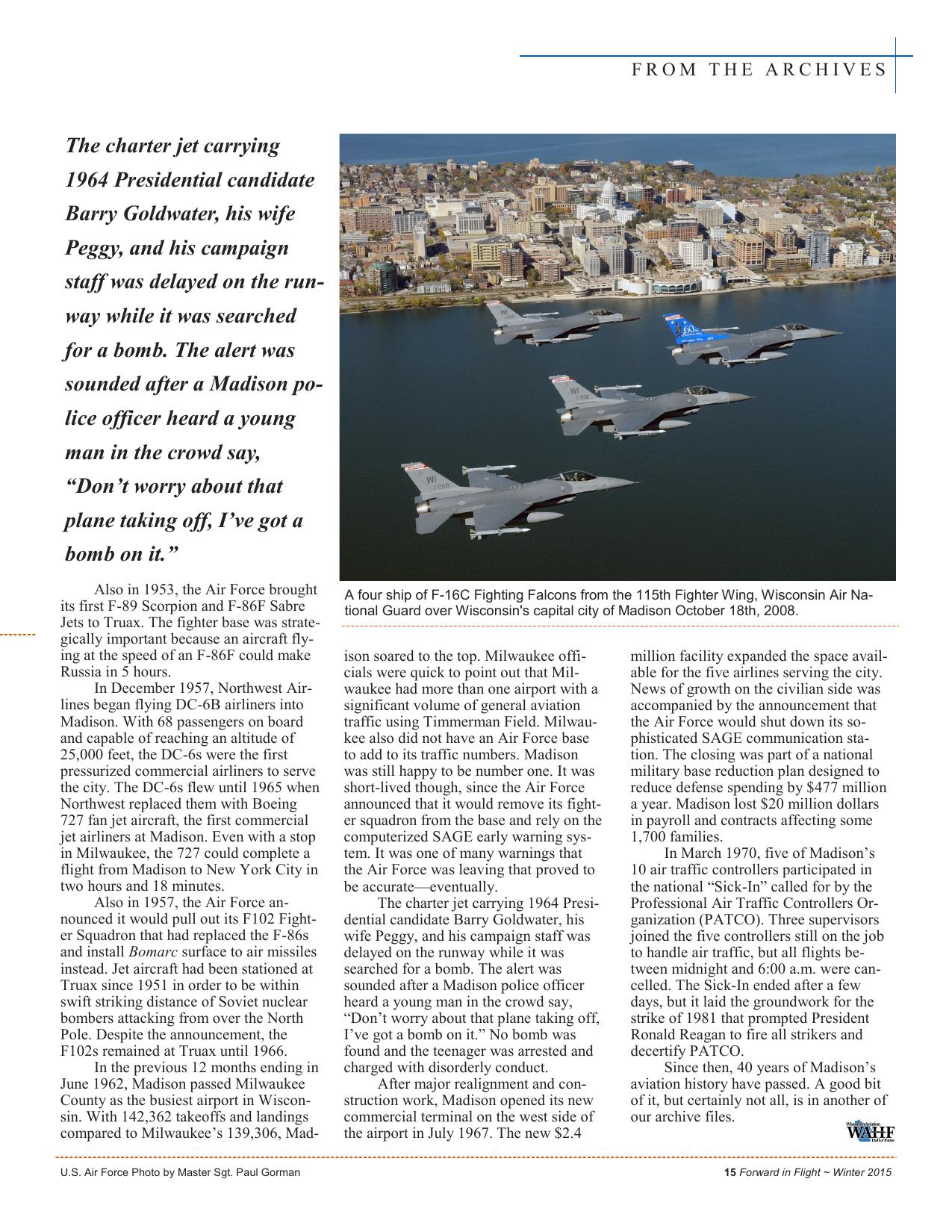
FROM THE ARCHIVES The charter jet carrying 1964 Presidential candidate Barry Goldwater, his wife Peggy, and his campaign staff was delayed on the runway while it was searched for a bomb. The alert was sounded after a Madison police officer heard a young man in the crowd say, “Don’t worry about that plane taking off, I’ve got a bomb on it.” Also in 1953, the Air Force brought its first F-89 Scorpion and F-86F Sabre Jets to Truax. The fighter base was strategically important because an aircraft flying at the speed of an F-86F could make Russia in 5 hours. In December 1957, Northwest Airlines began flying DC-6B airliners into Madison. With 68 passengers on board and capable of reaching an altitude of 25,000 feet, the DC-6s were the first pressurized commercial airliners to serve the city. The DC-6s flew until 1965 when Northwest replaced them with Boeing 727 fan jet aircraft, the first commercial jet airliners at Madison. Even with a stop in Milwaukee, the 727 could complete a flight from Madison to New York City in two hours and 18 minutes. Also in 1957, the Air Force announced it would pull out its F102 Fighter Squadron that had replaced the F-86s and install Bomarc surface to air missiles instead. Jet aircraft had been stationed at Truax since 1951 in order to be within swift striking distance of Soviet nuclear bombers attacking from over the North Pole. Despite the announcement, the F102s remained at Truax until 1966. In the previous 12 months ending in June 1962, Madison passed Milwaukee County as the busiest airport in Wisconsin. With 142,362 takeoffs and landings compared to Milwaukee’s 139,306, MadU.S. Air Force Photo by Master Sgt. Paul Gorman A four ship of F-16C Fighting Falcons from the 115th Fighter Wing, Wisconsin Air National Guard over Wisconsin's capital city of Madison October 18th, 2008. ison soared to the top. Milwaukee officials were quick to point out that Milwaukee had more than one airport with a significant volume of general aviation traffic using Timmerman Field. Milwaukee also did not have an Air Force base to add to its traffic numbers. Madison was still happy to be number one. It was short-lived though, since the Air Force announced that it would remove its fighter squadron from the base and rely on the computerized SAGE early warning system. It was one of many warnings that the Air Force was leaving that proved to be accurate—eventually. The charter jet carrying 1964 Presidential candidate Barry Goldwater, his wife Peggy, and his campaign staff was delayed on the runway while it was searched for a bomb. The alert was sounded after a Madison police officer heard a young man in the crowd say, “Don’t worry about that plane taking off, I’ve got a bomb on it.” No bomb was found and the teenager was arrested and charged with disorderly conduct. After major realignment and construction work, Madison opened its new commercial terminal on the west side of the airport in July 1967. The new $2.4 million facility expanded the space available for the five airlines serving the city. News of growth on the civilian side was accompanied by the announcement that the Air Force would shut down its sophisticated SAGE communication station. The closing was part of a national military base reduction plan designed to reduce defense spending by $477 million a year. Madison lost $20 million dollars in payroll and contracts affecting some 1,700 families. In March 1970, five of Madison’s 10 air traffic controllers participated in the national “Sick-In” called for by the Professional Air Traffic Controllers Organization (PATCO). Three supervisors joined the five controllers still on the job to handle air traffic, but all flights between midnight and 6:00 a.m. were cancelled. The Sick-In ended after a few days, but it laid the groundwork for the strike of 1981 that prompted President Ronald Reagan to fire all strikers and decertify PATCO. Since then, 40 years of Madison’s aviation history have passed. A good bit of it, but certainly not all, is in another of our archive files. 15 Forward in Flight ~ Winter 2015
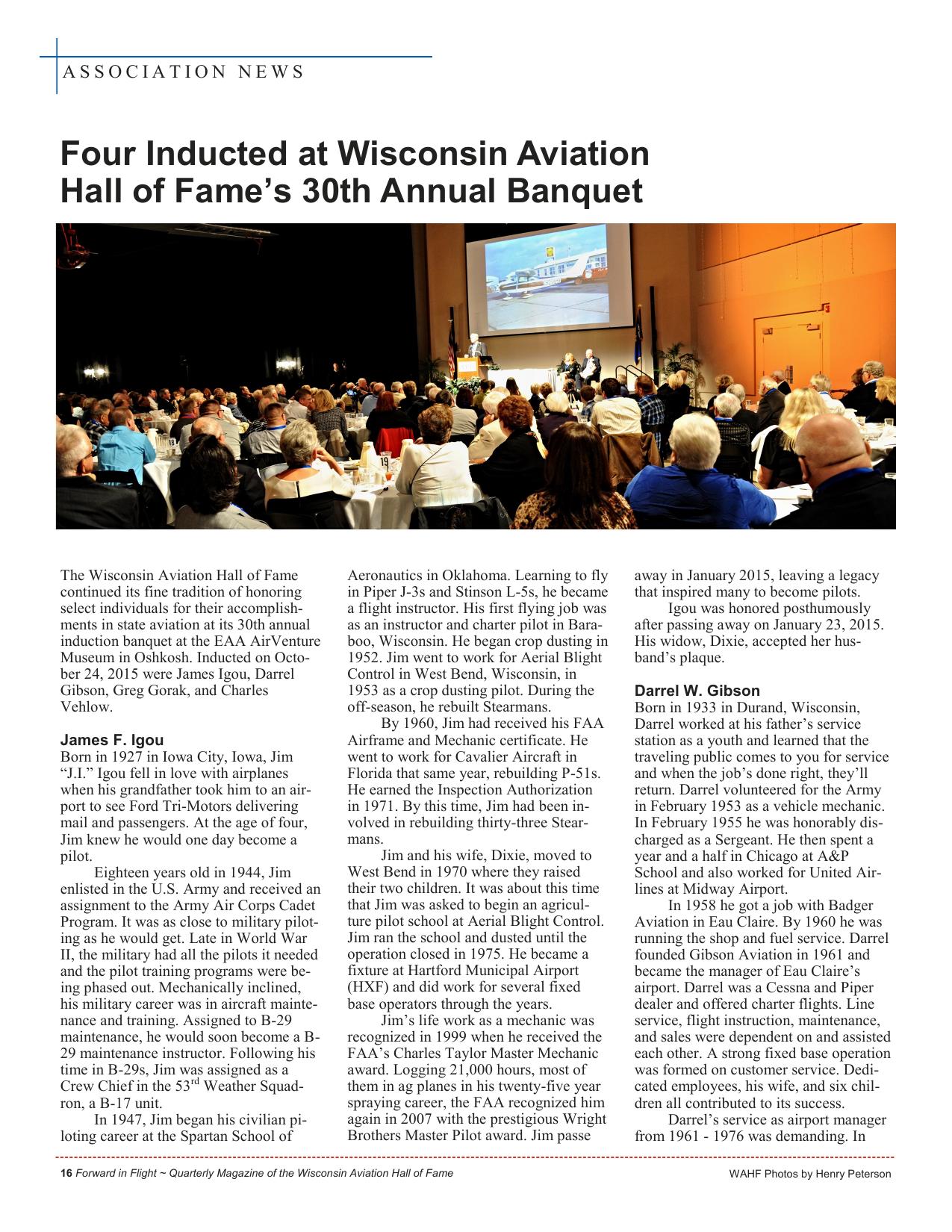
ASSOCIATION NEWS Four Inducted at Wisconsin Aviation Hall of Fame’s 30th Annual Banquet The Wisconsin Aviation Hall of Fame continued its fine tradition of honoring select individuals for their accomplishments in state aviation at its 30th annual induction banquet at the EAA AirVenture Museum in Oshkosh. Inducted on October 24, 2015 were James Igou, Darrel Gibson, Greg Gorak, and Charles Vehlow. James F. Igou Born in 1927 in Iowa City, Iowa, Jim “J.I.” Igou fell in love with airplanes when his grandfather took him to an airport to see Ford Tri-Motors delivering mail and passengers. At the age of four, Jim knew he would one day become a pilot. Eighteen years old in 1944, Jim enlisted in the U.S. Army and received an assignment to the Army Air Corps Cadet Program. It was as close to military piloting as he would get. Late in World War II, the military had all the pilots it needed and the pilot training programs were being phased out. Mechanically inclined, his military career was in aircraft maintenance and training. Assigned to B-29 maintenance, he would soon become a B29 maintenance instructor. Following his time in B-29s, Jim was assigned as a Crew Chief in the 53rd Weather Squadron, a B-17 unit. In 1947, Jim began his civilian piloting career at the Spartan School of Aeronautics in Oklahoma. Learning to fly in Piper J-3s and Stinson L-5s, he became a flight instructor. His first flying job was as an instructor and charter pilot in Baraboo, Wisconsin. He began crop dusting in 1952. Jim went to work for Aerial Blight Control in West Bend, Wisconsin, in 1953 as a crop dusting pilot. During the off-season, he rebuilt Stearmans. By 1960, Jim had received his FAA Airframe and Mechanic certificate. He went to work for Cavalier Aircraft in Florida that same year, rebuilding P-51s. He earned the Inspection Authorization in 1971. By this time, Jim had been involved in rebuilding thirty-three Stearmans. Jim and his wife, Dixie, moved to West Bend in 1970 where they raised their two children. It was about this time that Jim was asked to begin an agriculture pilot school at Aerial Blight Control. Jim ran the school and dusted until the operation closed in 1975. He became a fixture at Hartford Municipal Airport (HXF) and did work for several fixed base operators through the years. Jim’s life work as a mechanic was recognized in 1999 when he received the FAA’s Charles Taylor Master Mechanic award. Logging 21,000 hours, most of them in ag planes in his twenty-five year spraying career, the FAA recognized him again in 2007 with the prestigious Wright Brothers Master Pilot award. Jim passe 16 Forward in Flight ~ Quarterly Magazine of the Wisconsin Aviation Hall of Fame away in January 2015, leaving a legacy that inspired many to become pilots. Igou was honored posthumously after passing away on January 23, 2015. His widow, Dixie, accepted her husband’s plaque. Darrel W. Gibson Born in 1933 in Durand, Wisconsin, Darrel worked at his father’s service station as a youth and learned that the traveling public comes to you for service and when the job’s done right, they’ll return. Darrel volunteered for the Army in February 1953 as a vehicle mechanic. In February 1955 he was honorably discharged as a Sergeant. He then spent a year and a half in Chicago at A&P School and also worked for United Airlines at Midway Airport. In 1958 he got a job with Badger Aviation in Eau Claire. By 1960 he was running the shop and fuel service. Darrel founded Gibson Aviation in 1961 and became the manager of Eau Claire’s airport. Darrel was a Cessna and Piper dealer and offered charter flights. Line service, flight instruction, maintenance, and sales were dependent on and assisted each other. A strong fixed base operation was formed on customer service. Dedicated employees, his wife, and six children all contributed to its success. Darrel’s service as airport manager from 1961 - 1976 was demanding. In WAHF Photos by Henry Peterson
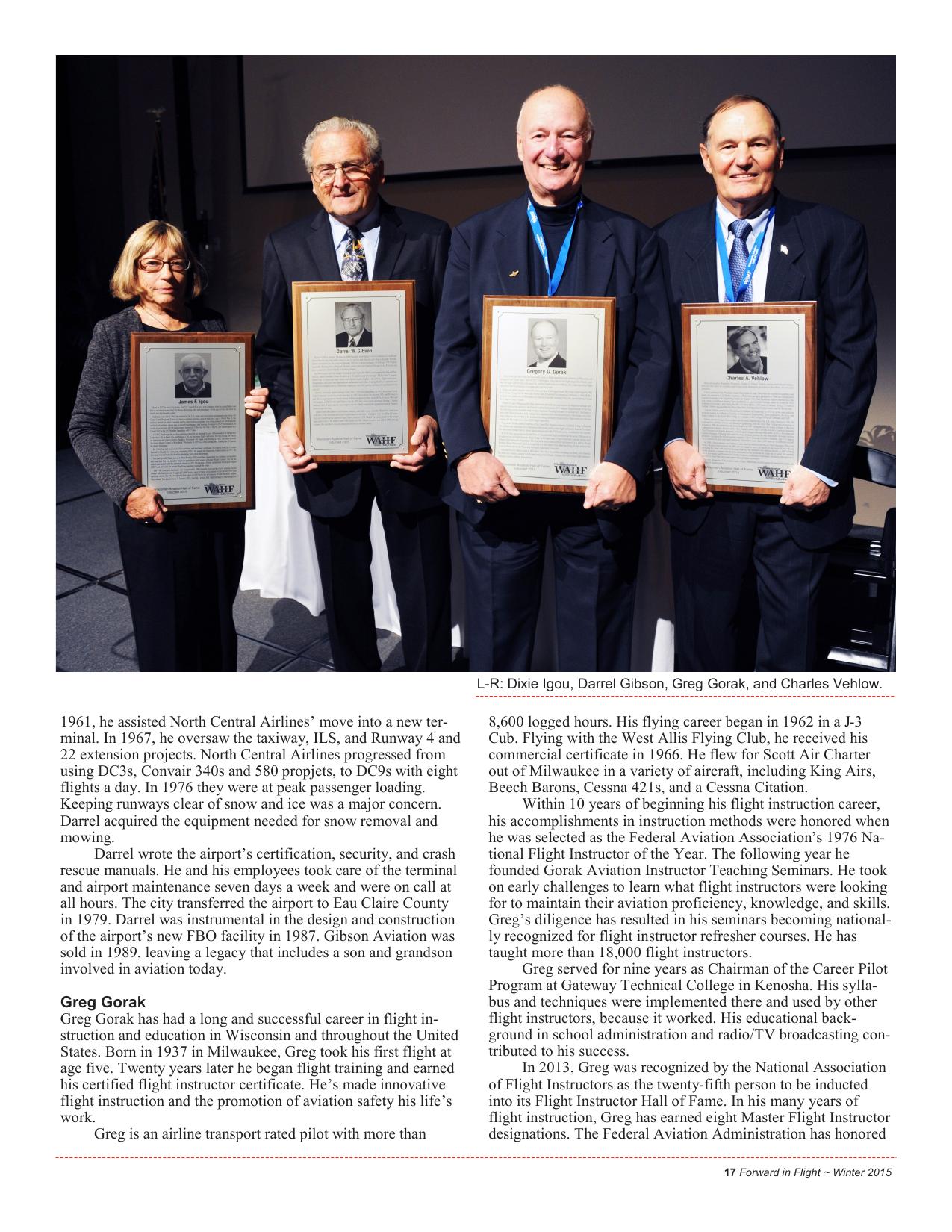
L-R: Dixie Igou, Darrel Gibson, Greg Gorak, and Charles Vehlow. 1961, he assisted North Central Airlines’ move into a new terminal. In 1967, he oversaw the taxiway, ILS, and Runway 4 and 22 extension projects. North Central Airlines progressed from using DC3s, Convair 340s and 580 propjets, to DC9s with eight flights a day. In 1976 they were at peak passenger loading. Keeping runways clear of snow and ice was a major concern. Darrel acquired the equipment needed for snow removal and mowing. Darrel wrote the airport’s certification, security, and crash rescue manuals. He and his employees took care of the terminal and airport maintenance seven days a week and were on call at all hours. The city transferred the airport to Eau Claire County in 1979. Darrel was instrumental in the design and construction of the airport’s new FBO facility in 1987. Gibson Aviation was sold in 1989, leaving a legacy that includes a son and grandson involved in aviation today. Greg Gorak Greg Gorak has had a long and successful career in flight instruction and education in Wisconsin and throughout the United States. Born in 1937 in Milwaukee, Greg took his first flight at age five. Twenty years later he began flight training and earned his certified flight instructor certificate. He’s made innovative flight instruction and the promotion of aviation safety his life’s work. Greg is an airline transport rated pilot with more than 8,600 logged hours. His flying career began in 1962 in a J-3 Cub. Flying with the West Allis Flying Club, he received his commercial certificate in 1966. He flew for Scott Air Charter out of Milwaukee in a variety of aircraft, including King Airs, Beech Barons, Cessna 421s, and a Cessna Citation. Within 10 years of beginning his flight instruction career, his accomplishments in instruction methods were honored when he was selected as the Federal Aviation Association’s 1976 National Flight Instructor of the Year. The following year he founded Gorak Aviation Instructor Teaching Seminars. He took on early challenges to learn what flight instructors were looking for to maintain their aviation proficiency, knowledge, and skills. Greg’s diligence has resulted in his seminars becoming nationally recognized for flight instructor refresher courses. He has taught more than 18,000 flight instructors. Greg served for nine years as Chairman of the Career Pilot Program at Gateway Technical College in Kenosha. His syllabus and techniques were implemented there and used by other flight instructors, because it worked. His educational background in school administration and radio/TV broadcasting contributed to his success. In 2013, Greg was recognized by the National Association of Flight Instructors as the twenty-fifth person to be inducted into its Flight Instructor Hall of Fame. In his many years of flight instruction, Greg has earned eight Master Flight Instructor designations. The Federal Aviation Administration has honored 17 Forward in Flight ~ Winter 2015
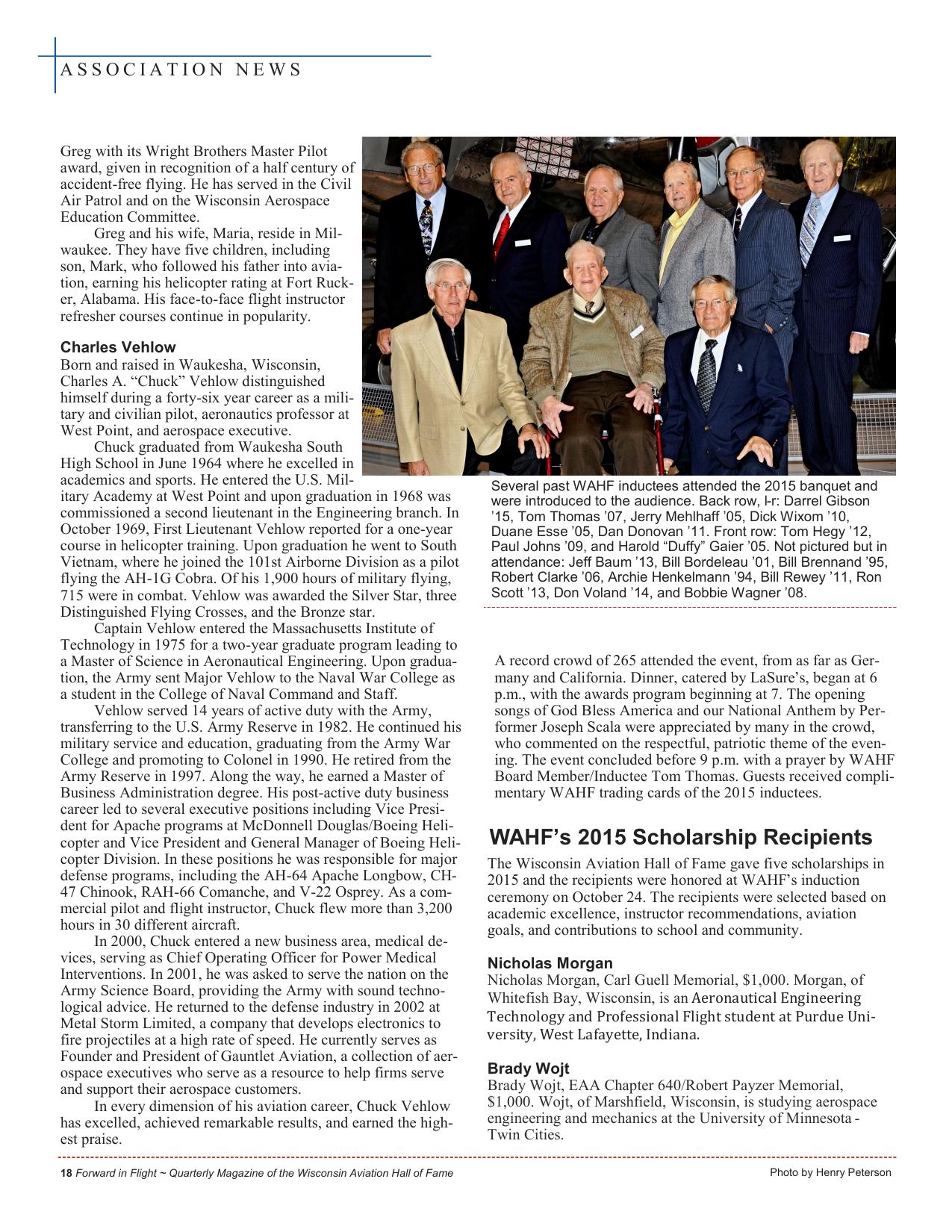
ASSOCIATION NEWS Greg with its Wright Brothers Master Pilot award, given in recognition of a half century of accident-free flying. He has served in the Civil Air Patrol and on the Wisconsin Aerospace Education Committee. Greg and his wife, Maria, reside in Milwaukee. They have five children, including son, Mark, who followed his father into aviation, earning his helicopter rating at Fort Rucker, Alabama. His face-to-face flight instructor refresher courses continue in popularity. Charles Vehlow Born and raised in Waukesha, Wisconsin, Charles A. “Chuck” Vehlow distinguished himself during a forty-six year career as a military and civilian pilot, aeronautics professor at West Point, and aerospace executive. Chuck graduated from Waukesha South High School in June 1964 where he excelled in academics and sports. He entered the U.S. Military Academy at West Point and upon graduation in 1968 was commissioned a second lieutenant in the Engineering branch. In October 1969, First Lieutenant Vehlow reported for a one-year course in helicopter training. Upon graduation he went to South Vietnam, where he joined the 101st Airborne Division as a pilot flying the AH-1G Cobra. Of his 1,900 hours of military flying, 715 were in combat. Vehlow was awarded the Silver Star, three Distinguished Flying Crosses, and the Bronze star. Captain Vehlow entered the Massachusetts Institute of Technology in 1975 for a two-year graduate program leading to a Master of Science in Aeronautical Engineering. Upon graduation, the Army sent Major Vehlow to the Naval War College as a student in the College of Naval Command and Staff. Vehlow served 14 years of active duty with the Army, transferring to the U.S. Army Reserve in 1982. He continued his military service and education, graduating from the Army War College and promoting to Colonel in 1990. He retired from the Army Reserve in 1997. Along the way, he earned a Master of Business Administration degree. His post-active duty business career led to several executive positions including Vice President for Apache programs at McDonnell Douglas/Boeing Helicopter and Vice President and General Manager of Boeing Helicopter Division. In these positions he was responsible for major defense programs, including the AH-64 Apache Longbow, CH47 Chinook, RAH-66 Comanche, and V-22 Osprey. As a commercial pilot and flight instructor, Chuck flew more than 3,200 hours in 30 different aircraft. In 2000, Chuck entered a new business area, medical devices, serving as Chief Operating Officer for Power Medical Interventions. In 2001, he was asked to serve the nation on the Army Science Board, providing the Army with sound technological advice. He returned to the defense industry in 2002 at Metal Storm Limited, a company that develops electronics to fire projectiles at a high rate of speed. He currently serves as Founder and President of Gauntlet Aviation, a collection of aerospace executives who serve as a resource to help firms serve and support their aerospace customers. In every dimension of his aviation career, Chuck Vehlow has excelled, achieved remarkable results, and earned the highest praise. 18 Forward in Flight ~ Quarterly Magazine of the Wisconsin Aviation Hall of Fame Several past WAHF inductees attended the 2015 banquet and were introduced to the audience. Back row, l-r: Darrel Gibson ’15, Tom Thomas ’07, Jerry Mehlhaff ’05, Dick Wixom ’10, Duane Esse ’05, Dan Donovan ’11. Front row: Tom Hegy ’12, Paul Johns ’09, and Harold “Duffy” Gaier ’05. Not pictured but in attendance: Jeff Baum ’13, Bill Bordeleau ’01, Bill Brennand ’95, Robert Clarke ’06, Archie Henkelmann ’94, Bill Rewey ’11, Ron Scott ’13, Don Voland ’14, and Bobbie Wagner ’08. A record crowd of 265 attended the event, from as far as Germany and California. Dinner, catered by LaSure’s, began at 6 p.m., with the awards program beginning at 7. The opening songs of God Bless America and our National Anthem by Performer Joseph Scala were appreciated by many in the crowd, who commented on the respectful, patriotic theme of the evening. The event concluded before 9 p.m. with a prayer by WAHF Board Member/Inductee Tom Thomas. Guests received complimentary WAHF trading cards of the 2015 inductees. WAHF’s 2015 Scholarship Recipients The Wisconsin Aviation Hall of Fame gave five scholarships in 2015 and the recipients were honored at WAHF’s induction ceremony on October 24. The recipients were selected based on academic excellence, instructor recommendations, aviation goals, and contributions to school and community. Nicholas Morgan Nicholas Morgan, Carl Guell Memorial, $1,000. Morgan, of Whitefish Bay, Wisconsin, is an Aeronautical Engineering Technology and Professional Flight student at Purdue University, West Lafayette, Indiana. Brady Wojt Brady Wojt, EAA Chapter 640/Robert Payzer Memorial, $1,000. Wojt, of Marshfield, Wisconsin, is studying aerospace engineering and mechanics at the University of Minnesota Twin Cities. Photo by Henry Peterson
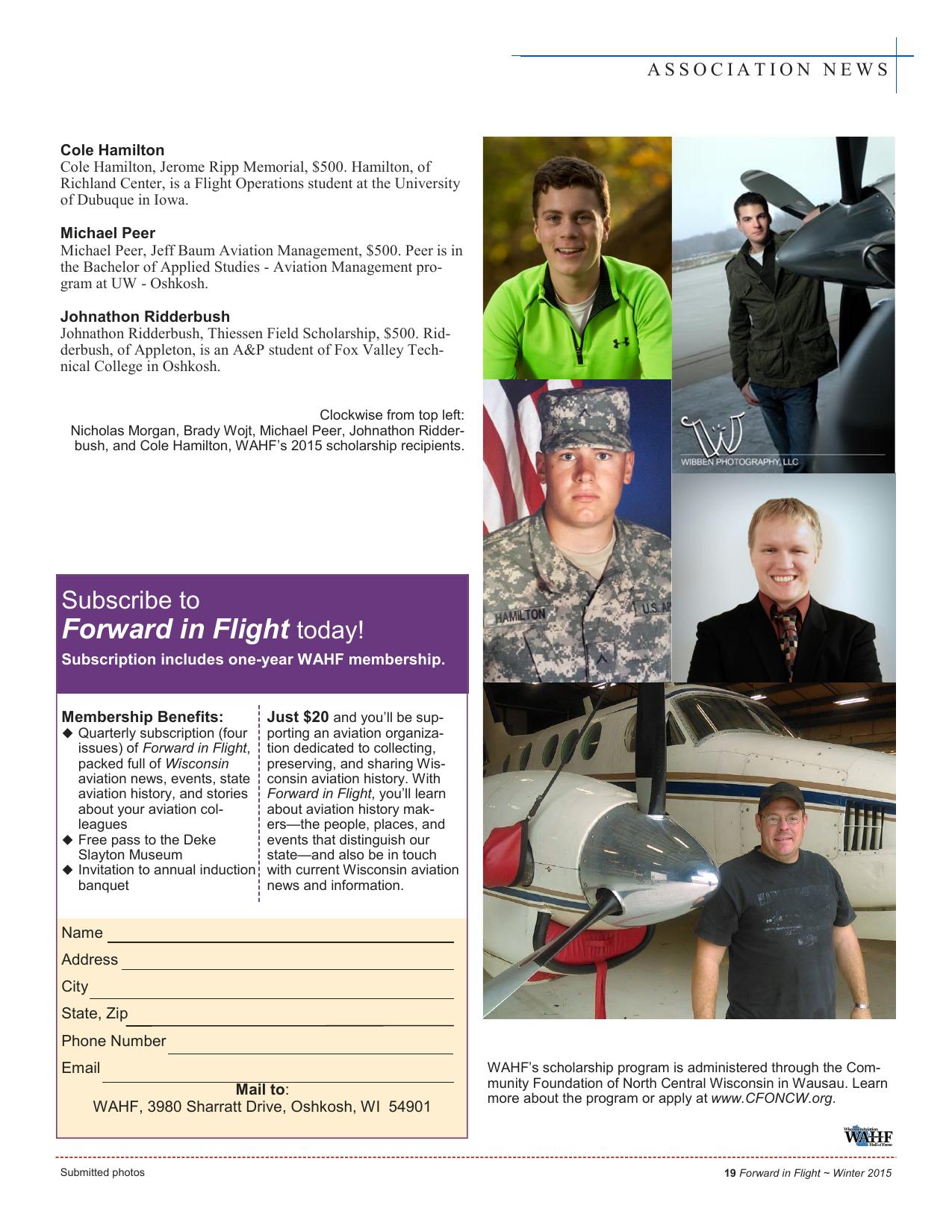
ASSOCIATION NEWS Cole Hamilton Cole Hamilton, Jerome Ripp Memorial, $500. Hamilton, of Richland Center, is a Flight Operations student at the University of Dubuque in Iowa. Michael Peer Michael Peer, Jeff Baum Aviation Management, $500. Peer is in the Bachelor of Applied Studies - Aviation Management program at UW - Oshkosh. Johnathon Ridderbush Johnathon Ridderbush, Thiessen Field Scholarship, $500. Ridderbush, of Appleton, is an A&P student of Fox Valley Technical College in Oshkosh. Clockwise from top left: Nicholas Morgan, Brady Wojt, Michael Peer, Johnathon Ridderbush, and Cole Hamilton, WAHF’s 2015 scholarship recipients. Subscribe to Forward in Flight today! Subscription includes one-year WAHF membership. Membership Benefits: u Quarterly subscription (four issues) of Forward in Flight, packed full of Wisconsin aviation news, events, state aviation history, and stories about your aviation colleagues u Free pass to the Deke Slayton Museum u Invitation to annual induction banquet Just $20 and you’ll be sup- porting an aviation organization dedicated to collecting, preserving, and sharing Wisconsin aviation history. With Forward in Flight, you’ll learn about aviation history makers—the people, places, and events that distinguish our state—and also be in touch with current Wisconsin aviation news and information. Name Address City State, Zip Phone Number Email Mail to: WAHF, 3980 Sharratt Drive, Oshkosh, WI 54901 Submitted photos WAHF’s scholarship program is administered through the Community Foundation of North Central Wisconsin in Wausau. Learn more about the program or apply at www.CFONCW.org. 19 Forward in Flight ~ Winter 2015
ASSOCIATION NEWS New Inductee Trading Cards Available WAHF adds eight cards to series; seeks additional sponsors The Wisconsin Aviation Hall of Fame began producing inductee trading cards in 2014. It’s an effort that honors our inductees and promotes aviation education. The cards are given to youth and adults as our board members travel the state sharing our state’s aviation history. Sets are also available to WAHF members for a minimum donation of $5. The cards wouldn’t be possible without the donors who sponsor them. With more than 120 men and women inducted into WAHF, many sponsorship opportunities remain. These past few months several people/businesses became sponsors of new cards. The entire list of those that have been produced include: 1. Richard Bong, sponsor WAHF 2. Peter Drahn, sponsor WAMA 3. James H. Flatley, Jr., sponsor Navy League 4. Ed, Ray, and James Knaup, sponsor RAPCO, Inc. 5. Don Voland, sponsor OX-5 Pioneers 6. Bill Adams, sponsor Crown Screw & Bolt, Corp. 7. Tom Hegy, sponsor Crown Screw & Bolt, Corp. 8. Paul Poberezny, sponsor Norm Poberezny 20 Forward in Flight ~ Quarterly Magazine of the Wisconsin Aviation Hall of Fame 9. Ron Scott, sponsor, a friend of Ron Scott. 10. Steve Wittman, sponsor Wittman Regional Airport. 11. Richard Lutz, sponsor Wittman Regional Airport 12. Preston Wilbourne, sponsor Air Wisconsin 13. Charles Vehlow, sponsor Joanie Vehlow 14. Darrel Gibson, sponsor Chippewa Valley Regional Airport 15. Greg Gorak, sponsor Jim and Donean Szajkovics 16. James Igou, sponsor Tom Hegy and Ron Wojnar 17. Paul Johns, sponsor Aviators by Design If you’re a businessperson, friend, or family member of an inductee, please consider sponsorship of a card. The investment is $300. We’ll produce 2,500 cards, and your name/business name and website will be noted on the card as its sponsor. Sponsors receive up to 500 cards and the remainder are retained to be distributed by WAHF. Please contact Rose Dorcey at 920-279-6029 or one of WAHF’s board members to learn more. It’s a great program to be associated with for the cards’ collectible and historical value.
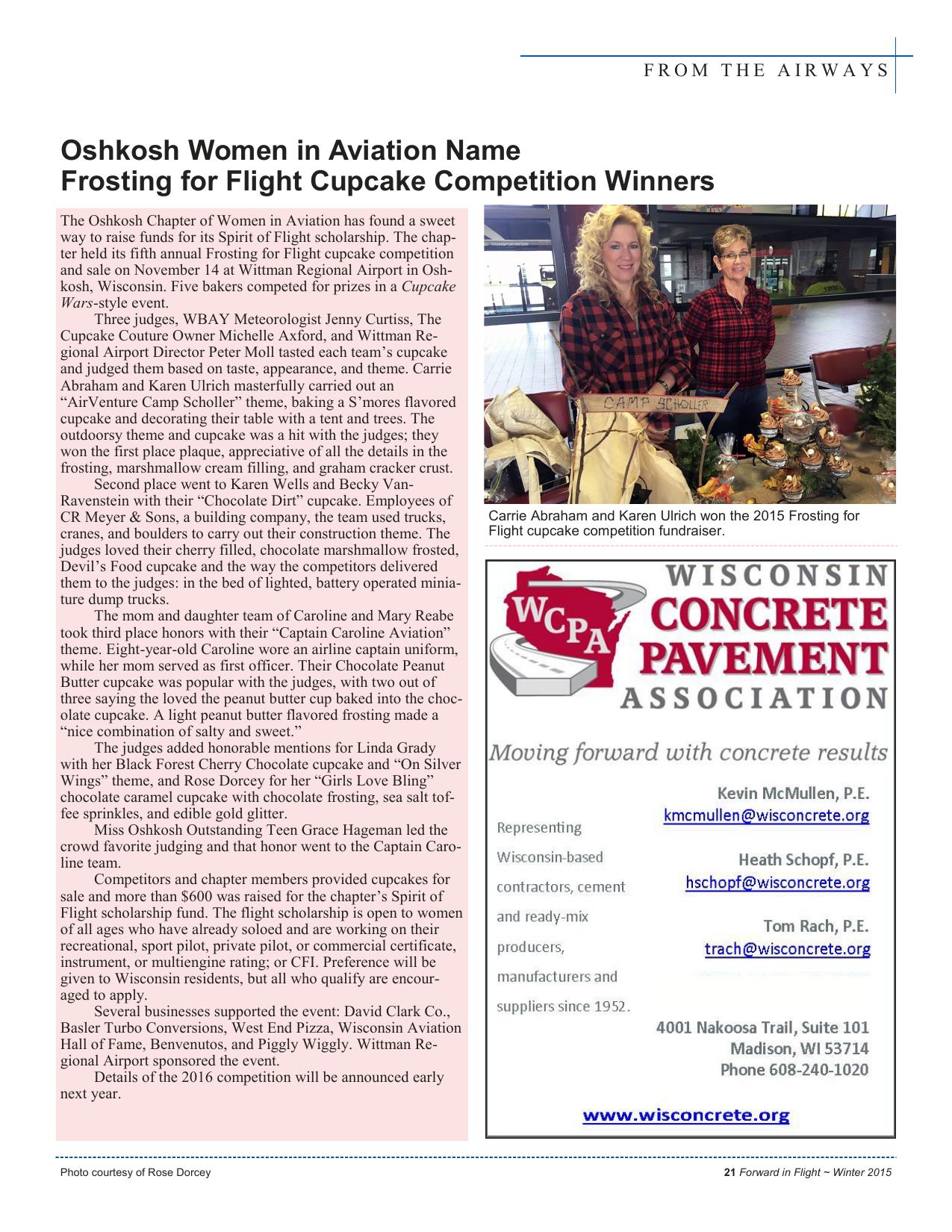
FROM THE AIRWAYS Oshkosh Women in Aviation Name Frosting for Flight Cupcake Competition Winners The Oshkosh Chapter of Women in Aviation has found a sweet way to raise funds for its Spirit of Flight scholarship. The chapter held its fifth annual Frosting for Flight cupcake competition and sale on November 14 at Wittman Regional Airport in Oshkosh, Wisconsin. Five bakers competed for prizes in a Cupcake Wars-style event. Three judges, WBAY Meteorologist Jenny Curtiss, The Cupcake Couture Owner Michelle Axford, and Wittman Regional Airport Director Peter Moll tasted each team’s cupcake and judged them based on taste, appearance, and theme. Carrie Abraham and Karen Ulrich masterfully carried out an “AirVenture Camp Scholler” theme, baking a S’mores flavored cupcake and decorating their table with a tent and trees. The outdoorsy theme and cupcake was a hit with the judges; they won the first place plaque, appreciative of all the details in the frosting, marshmallow cream filling, and graham cracker crust. Second place went to Karen Wells and Becky VanRavenstein with their “Chocolate Dirt” cupcake. Employees of CR Meyer & Sons, a building company, the team used trucks, cranes, and boulders to carry out their construction theme. The judges loved their cherry filled, chocolate marshmallow frosted, Devil’s Food cupcake and the way the competitors delivered them to the judges: in the bed of lighted, battery operated miniature dump trucks. The mom and daughter team of Caroline and Mary Reabe took third place honors with their “Captain Caroline Aviation” theme. Eight-year-old Caroline wore an airline captain uniform, while her mom served as first officer. Their Chocolate Peanut Butter cupcake was popular with the judges, with two out of three saying the loved the peanut butter cup baked into the chocolate cupcake. A light peanut butter flavored frosting made a “nice combination of salty and sweet.” The judges added honorable mentions for Linda Grady with her Black Forest Cherry Chocolate cupcake and “On Silver Wings” theme, and Rose Dorcey for her “Girls Love Bling” chocolate caramel cupcake with chocolate frosting, sea salt toffee sprinkles, and edible gold glitter. Miss Oshkosh Outstanding Teen Grace Hageman led the crowd favorite judging and that honor went to the Captain Caroline team. Competitors and chapter members provided cupcakes for sale and more than $600 was raised for the chapter’s Spirit of Flight scholarship fund. The flight scholarship is open to women of all ages who have already soloed and are working on their recreational, sport pilot, private pilot, or commercial certificate, instrument, or multiengine rating; or CFI. Preference will be given to Wisconsin residents, but all who qualify are encouraged to apply. Several businesses supported the event: David Clark Co., Basler Turbo Conversions, West End Pizza, Wisconsin Aviation Hall of Fame, Benvenutos, and Piggly Wiggly. Wittman Regional Airport sponsored the event. Details of the 2016 competition will be announced early next year. Photo courtesy of Rose Dorcey Carrie Abraham and Karen Ulrich won the 2015 Frosting for Flight cupcake competition fundraiser. 21 Forward in Flight ~ Winter 2015
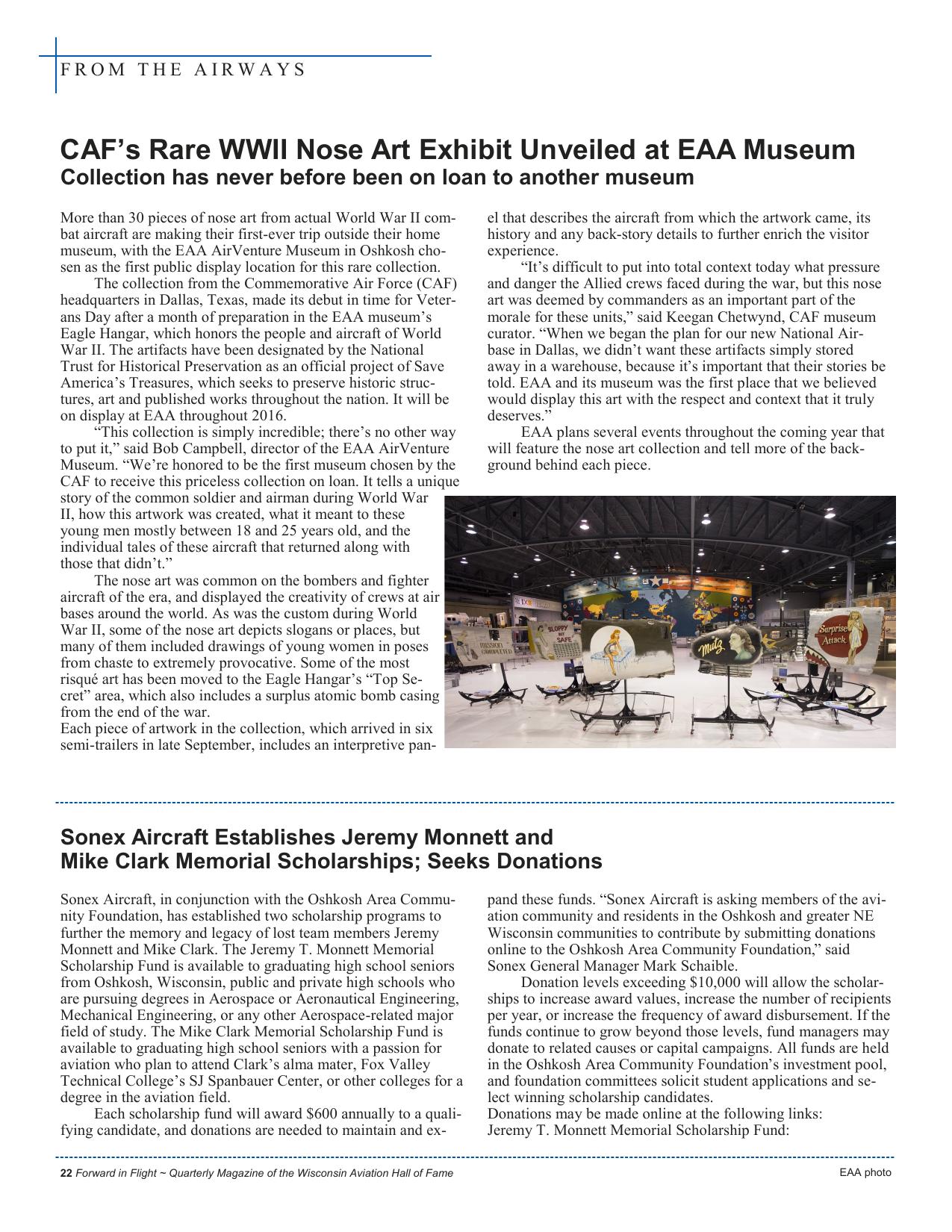
FROM THE AIRWAYS CAF’s Rare WWII Nose Art Exhibit Unveiled at EAA Museum Collection has never before been on loan to another museum More than 30 pieces of nose art from actual World War II combat aircraft are making their first-ever trip outside their home museum, with the EAA AirVenture Museum in Oshkosh chosen as the first public display location for this rare collection. The collection from the Commemorative Air Force (CAF) headquarters in Dallas, Texas, made its debut in time for Veterans Day after a month of preparation in the EAA museum’s Eagle Hangar, which honors the people and aircraft of World War II. The artifacts have been designated by the National Trust for Historical Preservation as an official project of Save America’s Treasures, which seeks to preserve historic structures, art and published works throughout the nation. It will be on display at EAA throughout 2016. “This collection is simply incredible; there’s no other way to put it,” said Bob Campbell, director of the EAA AirVenture Museum. “We’re honored to be the first museum chosen by the CAF to receive this priceless collection on loan. It tells a unique story of the common soldier and airman during World War II, how this artwork was created, what it meant to these young men mostly between 18 and 25 years old, and the individual tales of these aircraft that returned along with those that didn’t.” The nose art was common on the bombers and fighter aircraft of the era, and displayed the creativity of crews at air bases around the world. As was the custom during World War II, some of the nose art depicts slogans or places, but many of them included drawings of young women in poses from chaste to extremely provocative. Some of the most risqué art has been moved to the Eagle Hangar’s “Top Secret” area, which also includes a surplus atomic bomb casing from the end of the war. Each piece of artwork in the collection, which arrived in six semi-trailers in late September, includes an interpretive pan- el that describes the aircraft from which the artwork came, its history and any back-story details to further enrich the visitor experience. “It’s difficult to put into total context today what pressure and danger the Allied crews faced during the war, but this nose art was deemed by commanders as an important part of the morale for these units,” said Keegan Chetwynd, CAF museum curator. “When we began the plan for our new National Airbase in Dallas, we didn’t want these artifacts simply stored away in a warehouse, because it’s important that their stories be told. EAA and its museum was the first place that we believed would display this art with the respect and context that it truly deserves.” EAA plans several events throughout the coming year that will feature the nose art collection and tell more of the background behind each piece. Sonex Aircraft Establishes Jeremy Monnett and Mike Clark Memorial Scholarships; Seeks Donations Sonex Aircraft, in conjunction with the Oshkosh Area Community Foundation, has established two scholarship programs to further the memory and legacy of lost team members Jeremy Monnett and Mike Clark. The Jeremy T. Monnett Memorial Scholarship Fund is available to graduating high school seniors from Oshkosh, Wisconsin, public and private high schools who are pursuing degrees in Aerospace or Aeronautical Engineering, Mechanical Engineering, or any other Aerospace-related major field of study. The Mike Clark Memorial Scholarship Fund is available to graduating high school seniors with a passion for aviation who plan to attend Clark’s alma mater, Fox Valley Technical College’s SJ Spanbauer Center, or other colleges for a degree in the aviation field. Each scholarship fund will award $600 annually to a qualifying candidate, and donations are needed to maintain and ex22 Forward in Flight ~ Quarterly Magazine of the Wisconsin Aviation Hall of Fame pand these funds. “Sonex Aircraft is asking members of the aviation community and residents in the Oshkosh and greater NE Wisconsin communities to contribute by submitting donations online to the Oshkosh Area Community Foundation,” said Sonex General Manager Mark Schaible. Donation levels exceeding $10,000 will allow the scholarships to increase award values, increase the number of recipients per year, or increase the frequency of award disbursement. If the funds continue to grow beyond those levels, fund managers may donate to related causes or capital campaigns. All funds are held in the Oshkosh Area Community Foundation’s investment pool, and foundation committees solicit student applications and select winning scholarship candidates. Donations may be made online at the following links: Jeremy T. Monnett Memorial Scholarship Fund: EAA photo
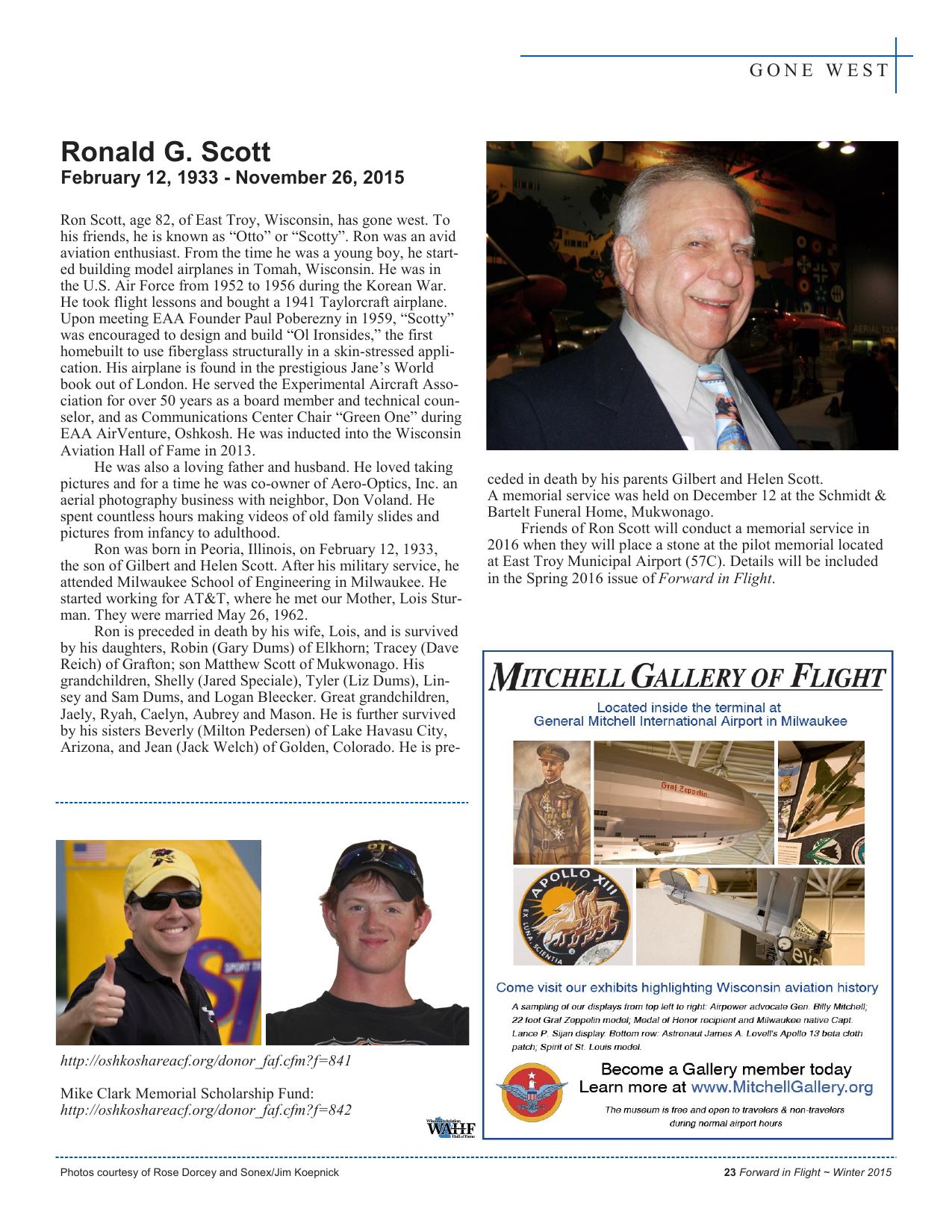
GONE WEST Ronald G. Scott February 12, 1933 - November 26, 2015 Ron Scott, age 82, of East Troy, Wisconsin, has gone west. To his friends, he is known as “Otto” or “Scotty”. Ron was an avid aviation enthusiast. From the time he was a young boy, he started building model airplanes in Tomah, Wisconsin. He was in the U.S. Air Force from 1952 to 1956 during the Korean War. He took flight lessons and bought a 1941 Taylorcraft airplane. Upon meeting EAA Founder Paul Poberezny in 1959, “Scotty” was encouraged to design and build “Ol Ironsides,” the first homebuilt to use fiberglass structurally in a skin-stressed application. His airplane is found in the prestigious Jane’s World book out of London. He served the Experimental Aircraft Association for over 50 years as a board member and technical counselor, and as Communications Center Chair “Green One” during EAA AirVenture, Oshkosh. He was inducted into the Wisconsin Aviation Hall of Fame in 2013. He was also a loving father and husband. He loved taking pictures and for a time he was co-owner of Aero-Optics, Inc. an aerial photography business with neighbor, Don Voland. He spent countless hours making videos of old family slides and pictures from infancy to adulthood. Ron was born in Peoria, Illinois, on February 12, 1933, the son of Gilbert and Helen Scott. After his military service, he attended Milwaukee School of Engineering in Milwaukee. He started working for AT&T, where he met our Mother, Lois Sturman. They were married May 26, 1962. Ron is preceded in death by his wife, Lois, and is survived by his daughters, Robin (Gary Dums) of Elkhorn; Tracey (Dave Reich) of Grafton; son Matthew Scott of Mukwonago. His grandchildren, Shelly (Jared Speciale), Tyler (Liz Dums), Linsey and Sam Dums, and Logan Bleecker. Great grandchildren, Jaely, Ryah, Caelyn, Aubrey and Mason. He is further survived by his sisters Beverly (Milton Pedersen) of Lake Havasu City, Arizona, and Jean (Jack Welch) of Golden, Colorado. He is pre- ceded in death by his parents Gilbert and Helen Scott. A memorial service was held on December 12 at the Schmidt & Bartelt Funeral Home, Mukwonago. Friends of Ron Scott will conduct a memorial service in 2016 when they will place a stone at the pilot memorial located at East Troy Municipal Airport (57C). Details will be included in the Spring 2016 issue of Forward in Flight. http://oshkoshareacf.org/donor_faf.cfm?f=841 Mike Clark Memorial Scholarship Fund: http://oshkoshareacf.org/donor_faf.cfm?f=842 Photos courtesy of Rose Dorcey and Sonex/Jim Koepnick 23 Forward in Flight ~ Winter 2015
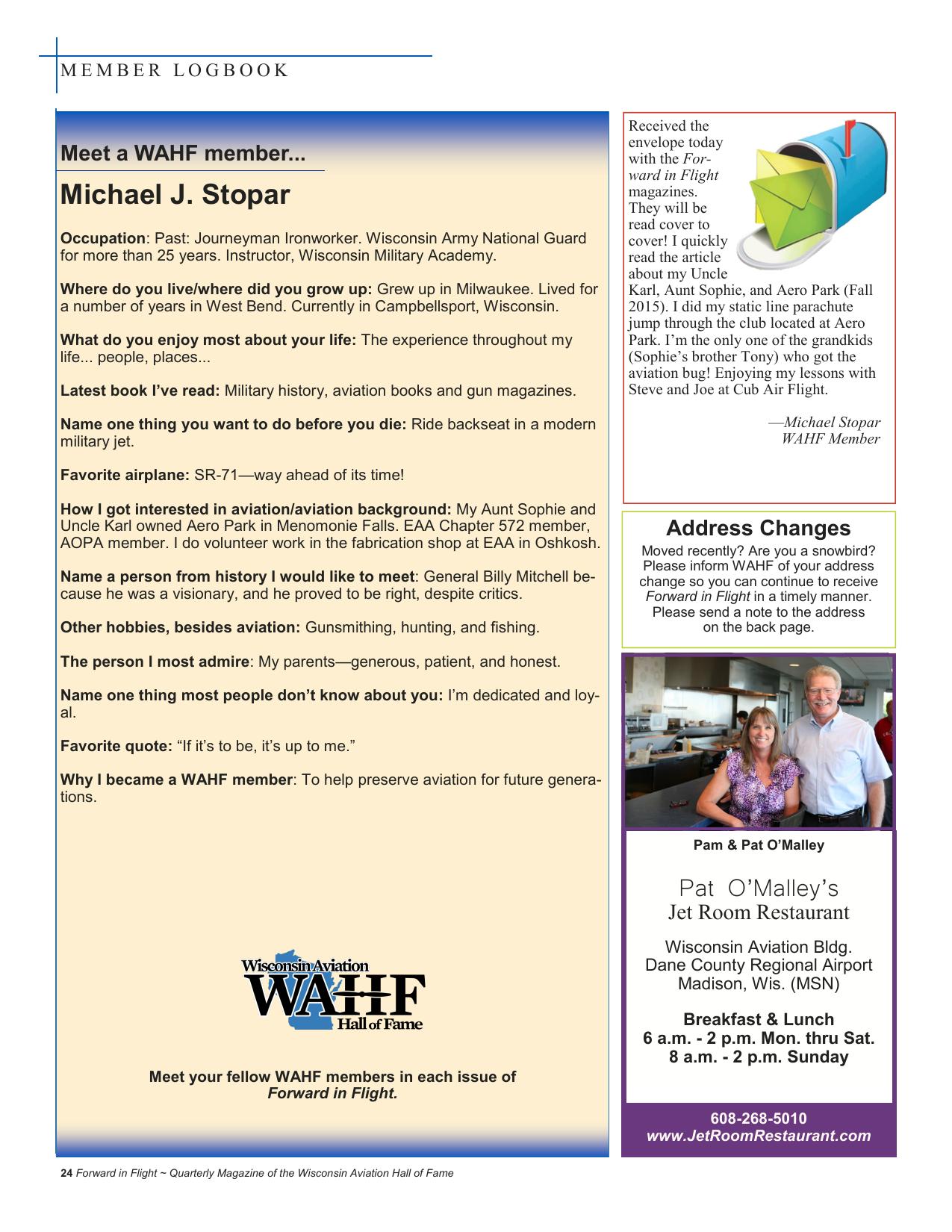
MEMBER LOGBOOK Meet a WAHF member... Michael J. Stopar Occupation: Past: Journeyman Ironworker. Wisconsin Army National Guard for more than 25 years. Instructor, Wisconsin Military Academy. Where do you live/where did you grow up: Grew up in Milwaukee. Lived for a number of years in West Bend. Currently in Campbellsport, Wisconsin. Roger Small What do you enjoy most about your life: The experience throughout my life... people, places... Latest book I’ve read: Military history, aviation books and gun magazines. Name one thing you want to do before you die: Ride backseat in a modern military jet. Received the envelope today with the Forward in Flight magazines. They will be read cover to cover! I quickly read the article about my Uncle Karl, Aunt Sophie, and Aero Park (Fall 2015). I did my static line parachute jump through the club located at Aero Park. I’m the only one of the grandkids (Sophie’s brother Tony) who got the aviation bug! Enjoying my lessons with Steve and Joe at Cub Air Flight. —Michael Stopar WAHF Member Favorite airplane: SR-71—way ahead of its time! How I got interested in aviation/aviation background: My Aunt Sophie and Uncle Karl owned Aero Park in Menomonie Falls. EAA Chapter 572 member, AOPA member. I do volunteer work in the fabrication shop at EAA in Oshkosh. Name a person from history I would like to meet: General Billy Mitchell because he was a visionary, and he proved to be right, despite critics. Other hobbies, besides aviation: Gunsmithing, hunting, and fishing. Address Changes Moved recently? Are you a snowbird? Please inform WAHF of your address change so you can continue to receive Forward in Flight in a timely manner. Please send a note to the address on the back page. The person I most admire: My parents—generous, patient, and honest. Name one thing most people don’t know about you: I’m dedicated and loyal. Favorite quote: “If it’s to be, it’s up to me.” Why I became a WAHF member: To help preserve aviation for future generations. Pam & Pat O’Malley Pat O’Malley’s Jet Room Restaurant Wisconsin Aviation Bldg. Dane County Regional Airport Madison, Wis. (MSN) Breakfast & Lunch 6 a.m. - 2 p.m. Mon. thru Sat. 8 a.m. - 2 p.m. Sunday Meet your fellow WAHF members in each issue of Forward in Flight. 608-268-5010 www.JetRoomRestaurant.com 24 Forward in Flight ~ Quarterly Magazine of the Wisconsin Aviation Hall of Fame
Wittman Regional Airport Oshkosh So much history ...and still making it! From the legacy of Steve Wittman to Warren Basler’s DC-3 conversions, we’re proud to support and contribute to Wisconsin aviation history. FLY TO OSHKOSH wittmanairport.com @wittmanairport
PRSRT STD US Postage Paid Wisc Rapids WI Permit 98 3980 SHARRATT DRIVE OSHKOSH WI 54901-1276 The Wisconsin Aviation Hall of Fame is a non-profit membership organization dedicated to preserving the past and fostering the future of flight. CHANGE SERVICE REQUESTED Welcome WAHF Member/Supporters Larry Fitzgerald John C. Meyer Brad Pedersen Bruce Ringelmann Thanks for coming on board. We hope to see you at a WAHF event soon! *Lifetime Member 2015 Banquet Video Available Soon The Wisconsin Aviation Hall of Fame has contracted with Front Room Photography to produce a video of our 2015 banquet. The approximate 30-minute video will be available soon. This is a wonderful keepsake item and many friends and family members who were inducted or attended would enjoy receiving it. The cost is $35 per DVD. Please contact Rose Dorcey at rdorcey@wisconsinaviationhalloffame.org or call 920-385-1483 for details on how to order. Membership Dues are Due! If your membership expires at the end of December, you’ll be receiving a renewal notice soon. We sincerely hope you’ll stay on board for another year. Because of your support, we’ve been able to grow our membership, expand our scholarship program, offer a great membership magazine, receive more inductee nominations, and share more of our state’s rich aviation history with men and women, boys and girls, throughout the state. Your nominal $20 membership fee helps cover our dayto-day costs and the production of this magazine. To save postage costs, for you and us, renew easily and safely online at: www.WisconsinAviationHallofFame.org. Thank you! Wisconsin Aviation Hall of Fame Officers Rose Dorcey, President Tom Thomas, Vice-President John Dorcey, Secretary/Treasurer Board of Directors Elaine Kauh Kurt Stanich Brendan Stormo Charles Swain Wynne Williams Ron Wojnar Charles Marotske, Honorary Chairman of the Board Wisconsin Aviation Hall of Fame 3980 Sharratt Drive Oshkosh, WI 54901-1276 Become a supporter today! For information call Rose Dorcey at 920-385-1483 www.wisconsinaviationhalloffame.org rdorcey@wisconsinaviationhalloffame.org