Volume 21, Issue 4
🗞️ Download Issue (PDF)
Forward in Flight - Winter 2023
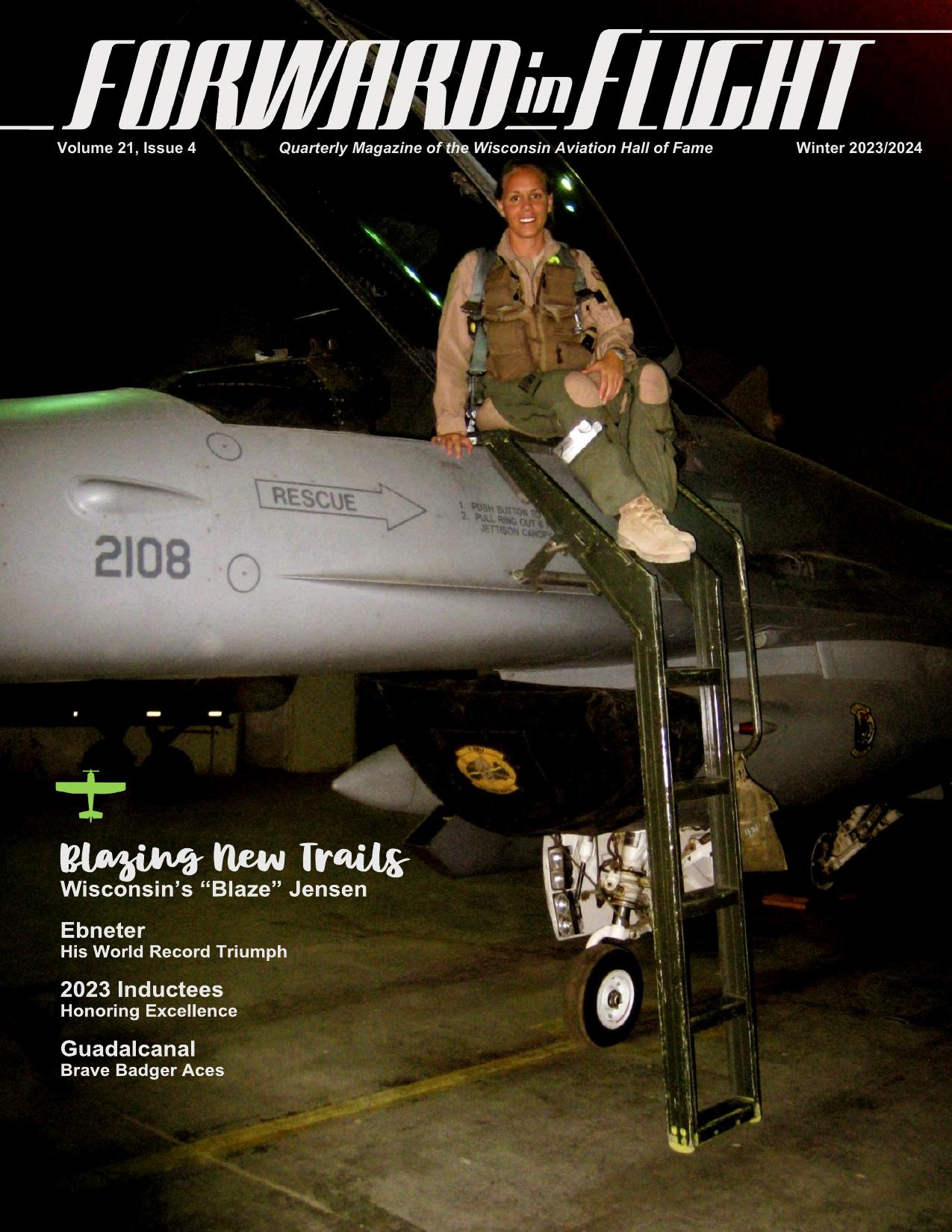
Volume 21, Issue 4 Quarterly Magazine of the Wisconsin Aviation Hall of Fame Winter 2023/2024
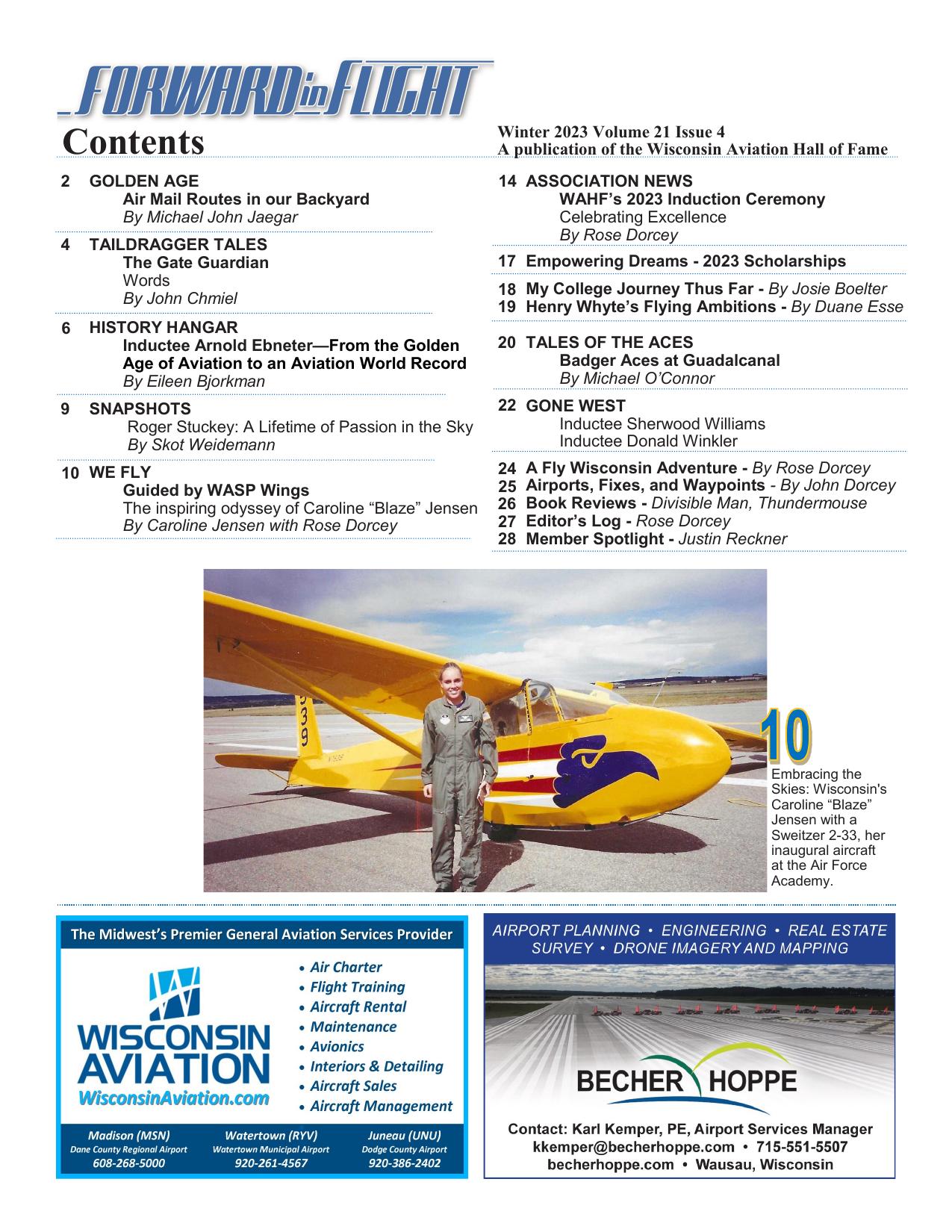
Contents Winter 2023 Volume 21 Issue 4 A publication of the Wisconsin Aviation Hall of Fame 2 GOLDEN AGE Air Mail Routes in our Backyard By Michael John Jaegar 4 TAILDRAGGER TALES The Gate Guardian Words By John Chmiel 14 ASSOCIATION NEWS WAHF’s 2023 Induction Ceremony Celebrating Excellence By Rose Dorcey 17 Empowering Dreams - 2023 Scholarships 18 My College Journey Thus Far - By Josie Boelter 19 Henry Whyte’s Flying Ambitions - By Duane Esse 6 HISTORY HANGAR Inductee Arnold Ebneter—From the Golden Age of Aviation to an Aviation World Record By Eileen Bjorkman 20 TALES OF THE ACES Badger Aces at Guadalcanal By Michael O’Connor 9 SNAPSHOTS Roger Stuckey: A Lifetime of Passion in the Sky By Skot Weidemann 22 GONE WEST Inductee Sherwood Williams Inductee Donald Winkler 10 WE FLY Guided by WASP Wings The inspiring odyssey of Caroline “Blaze” Jensen By Caroline Jensen with Rose Dorcey 24 A Fly Wisconsin Adventure - By Rose Dorcey 25 Airports, Fixes, and Waypoints - By John Dorcey 26 Book Reviews - Divisible Man, Thundermouse 27 Editor’s Log - Rose Dorcey 28 Member Spotlight - Justin Reckner Embracing the Skies: Wisconsin's Caroline “Blaze” Jensen with a Sweitzer 2-33, her inaugural aircraft at the Air Force Academy.
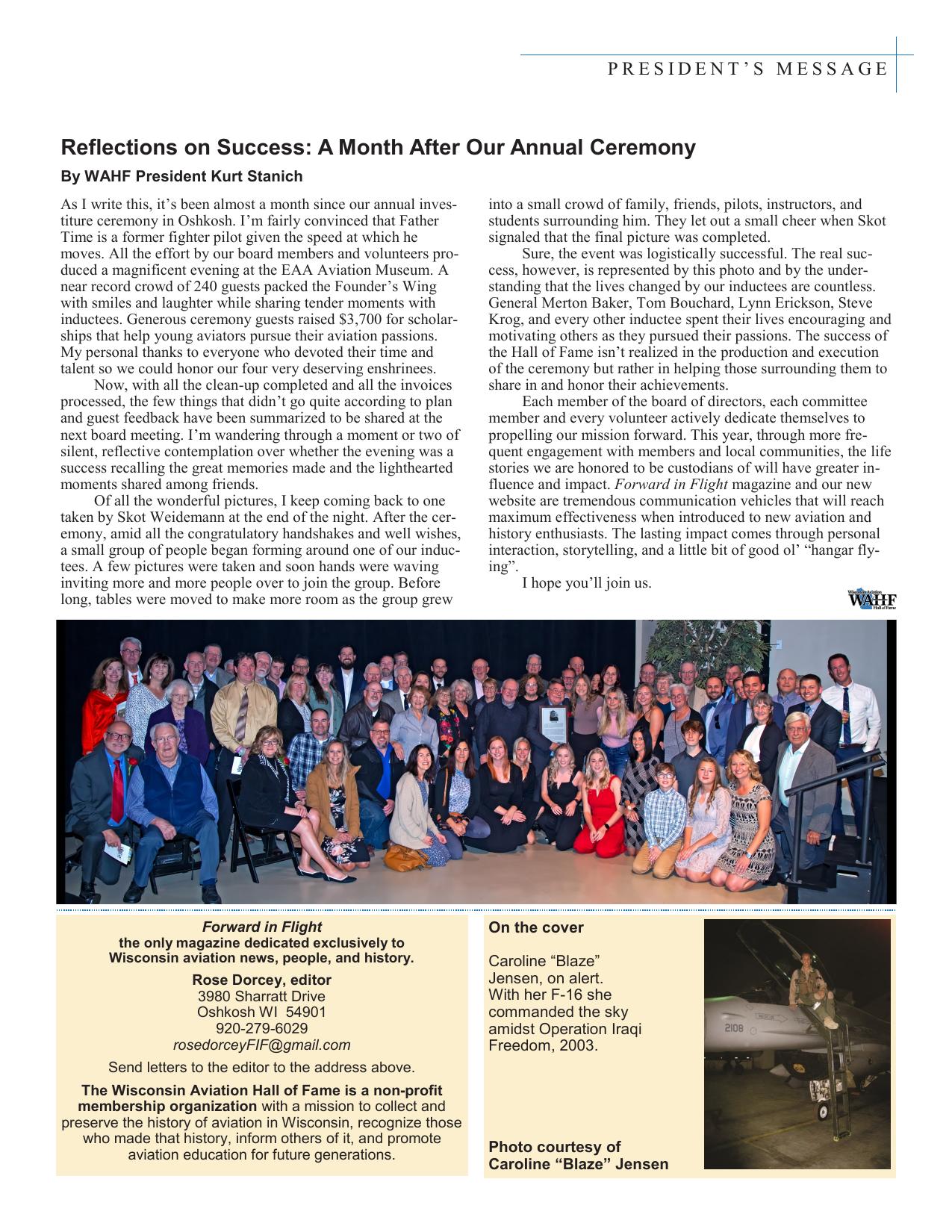
PRESIDENT’S MESSAGE Reflections on Success: A Month After Our Annual Ceremony By WAHF President Kurt Stanich As I write this, it’s been almost a month since our annual investiture ceremony in Oshkosh. I’m fairly convinced that Father Time is a former fighter pilot given the speed at which he moves. All the effort by our board members and volunteers produced a magnificent evening at the EAA Aviation Museum. A near record crowd of 240 guests packed the Founder’s Wing with smiles and laughter while sharing tender moments with inductees. Generous ceremony guests raised $3,700 for scholarships that help young aviators pursue their aviation passions. My personal thanks to everyone who devoted their time and talent so we could honor our four very deserving enshrinees. Now, with all the clean-up completed and all the invoices processed, the few things that didn’t go quite according to plan and guest feedback have been summarized to be shared at the next board meeting. I’m wandering through a moment or two of silent, reflective contemplation over whether the evening was a success recalling the great memories made and the lighthearted moments shared among friends. Of all the wonderful pictures, I keep coming back to one taken by Skot Weidemann at the end of the night. After the ceremony, amid all the congratulatory handshakes and well wishes, a small group of people began forming around one of our inductees. A few pictures were taken and soon hands were waving inviting more and more people over to join the group. Before long, tables were moved to make more room as the group grew Forward in Flight the only magazine dedicated exclusively to Wisconsin aviation news, people, and history. Rose Dorcey, editor 3980 Sharratt Drive Oshkosh WI 54901 920-279-6029 rosedorceyFIF@gmail.com into a small crowd of family, friends, pilots, instructors, and students surrounding him. They let out a small cheer when Skot signaled that the final picture was completed. Sure, the event was logistically successful. The real success, however, is represented by this photo and by the understanding that the lives changed by our inductees are countless. General Merton Baker, Tom Bouchard, Lynn Erickson, Steve Krog, and every other inductee spent their lives encouraging and motivating others as they pursued their passions. The success of the Hall of Fame isn’t realized in the production and execution of the ceremony but rather in helping those surrounding them to share in and honor their achievements. Each member of the board of directors, each committee member and every volunteer actively dedicate themselves to propelling our mission forward. This year, through more frequent engagement with members and local communities, the life stories we are honored to be custodians of will have greater influence and impact. Forward in Flight magazine and our new website are tremendous communication vehicles that will reach maximum effectiveness when introduced to new aviation and history enthusiasts. The lasting impact comes through personal interaction, storytelling, and a little bit of good ol’ “hangar flying”. I hope you’ll join us. On the cover Caroline “Blaze” Jensen, on alert. With her F-16 she commanded the sky amidst Operation Iraqi Freedom, 2003. Send letters to the editor to the address above. The Wisconsin Aviation Hall of Fame is a non-profit membership organization with a mission to collect and preserve the history of aviation in Wisconsin, recognize those who made that history, inform others of it, and promote aviation education for future generations. Photo courtesy of Caroline “Blaze” Jensen
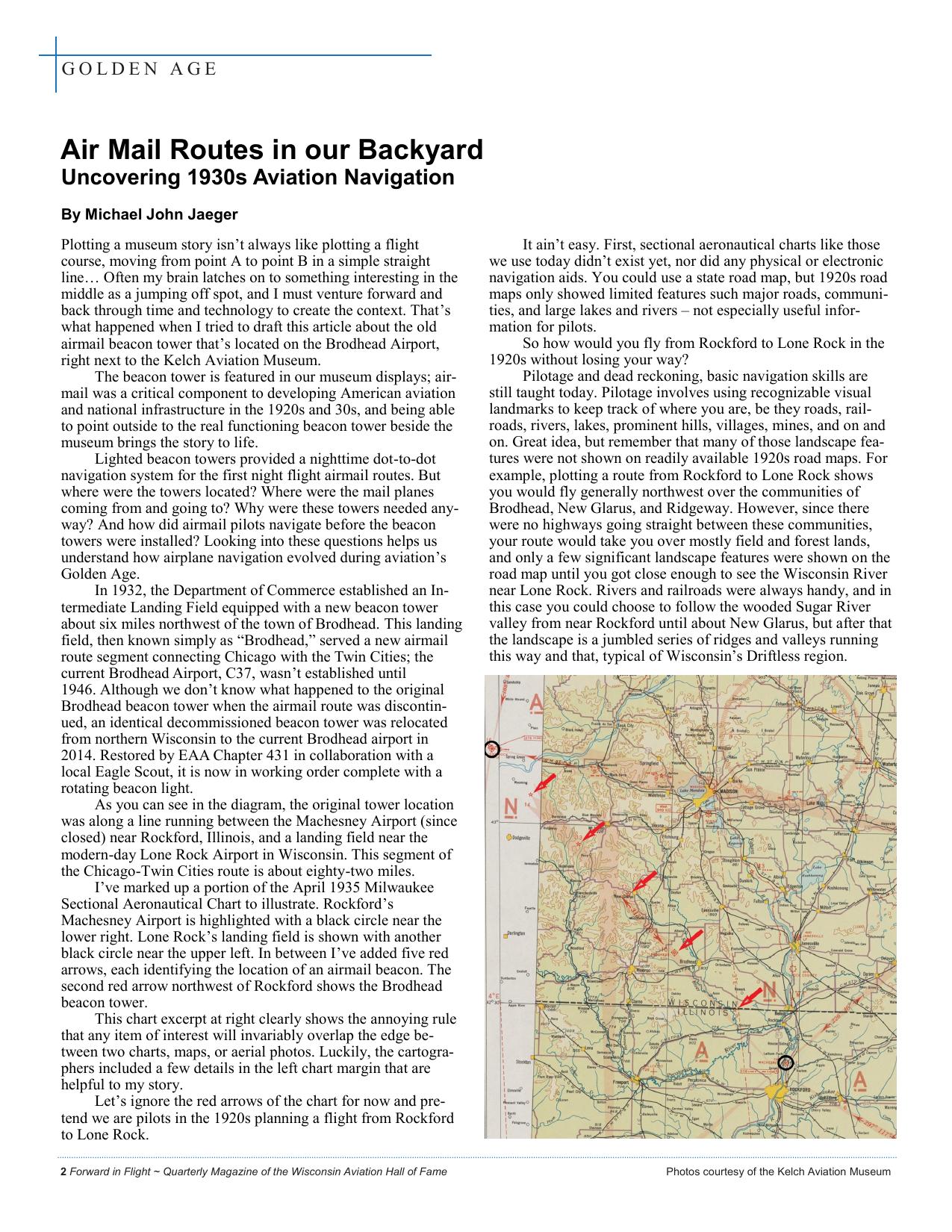
GOLDEN AGE Air Mail Routes in our Backyard Uncovering 1930s Aviation Navigation By Michael John Jaeger Plotting a museum story isn’t always like plotting a flight course, moving from point A to point B in a simple straight line… Often my brain latches on to something interesting in the middle as a jumping off spot, and I must venture forward and back through time and technology to create the context. That’s what happened when I tried to draft this article about the old airmail beacon tower that’s located on the Brodhead Airport, right next to the Kelch Aviation Museum. The beacon tower is featured in our museum displays; airmail was a critical component to developing American aviation and national infrastructure in the 1920s and 30s, and being able to point outside to the real functioning beacon tower beside the museum brings the story to life. Lighted beacon towers provided a nighttime dot-to-dot navigation system for the first night flight airmail routes. But where were the towers located? Where were the mail planes coming from and going to? Why were these towers needed anyway? And how did airmail pilots navigate before the beacon towers were installed? Looking into these questions helps us understand how airplane navigation evolved during aviation’s Golden Age. In 1932, the Department of Commerce established an Intermediate Landing Field equipped with a new beacon tower about six miles northwest of the town of Brodhead. This landing field, then known simply as “Brodhead,” served a new airmail route segment connecting Chicago with the Twin Cities; the current Brodhead Airport, C37, wasn’t established until 1946. Although we don’t know what happened to the original Brodhead beacon tower when the airmail route was discontinued, an identical decommissioned beacon tower was relocated from northern Wisconsin to the current Brodhead airport in 2014. Restored by EAA Chapter 431 in collaboration with a local Eagle Scout, it is now in working order complete with a rotating beacon light. As you can see in the diagram, the original tower location was along a line running between the Machesney Airport (since closed) near Rockford, Illinois, and a landing field near the modern-day Lone Rock Airport in Wisconsin. This segment of the Chicago-Twin Cities route is about eighty-two miles. I’ve marked up a portion of the April 1935 Milwaukee Sectional Aeronautical Chart to illustrate. Rockford’s Machesney Airport is highlighted with a black circle near the lower right. Lone Rock’s landing field is shown with another black circle near the upper left. In between I’ve added five red arrows, each identifying the location of an airmail beacon. The second red arrow northwest of Rockford shows the Brodhead beacon tower. This chart excerpt at right clearly shows the annoying rule that any item of interest will invariably overlap the edge between two charts, maps, or aerial photos. Luckily, the cartographers included a few details in the left chart margin that are helpful to my story. Let’s ignore the red arrows of the chart for now and pretend we are pilots in the 1920s planning a flight from Rockford to Lone Rock. 2 Forward in Flight ~ Quarterly Magazine of the Wisconsin Aviation Hall of Fame It ain’t easy. First, sectional aeronautical charts like those we use today didn’t exist yet, nor did any physical or electronic navigation aids. You could use a state road map, but 1920s road maps only showed limited features such major roads, communities, and large lakes and rivers – not especially useful information for pilots. So how would you fly from Rockford to Lone Rock in the 1920s without losing your way? Pilotage and dead reckoning, basic navigation skills are still taught today. Pilotage involves using recognizable visual landmarks to keep track of where you are, be they roads, railroads, rivers, lakes, prominent hills, villages, mines, and on and on. Great idea, but remember that many of those landscape features were not shown on readily available 1920s road maps. For example, plotting a route from Rockford to Lone Rock shows you would fly generally northwest over the communities of Brodhead, New Glarus, and Ridgeway. However, since there were no highways going straight between these communities, your route would take you over mostly field and forest lands, and only a few significant landscape features were shown on the road map until you got close enough to see the Wisconsin River near Lone Rock. Rivers and railroads were always handy, and in this case you could choose to follow the wooded Sugar River valley from near Rockford until about New Glarus, but after that the landscape is a jumbled series of ridges and valleys running this way and that, typical of Wisconsin’s Driftless region. Photos courtesy of the Kelch Aviation Museum
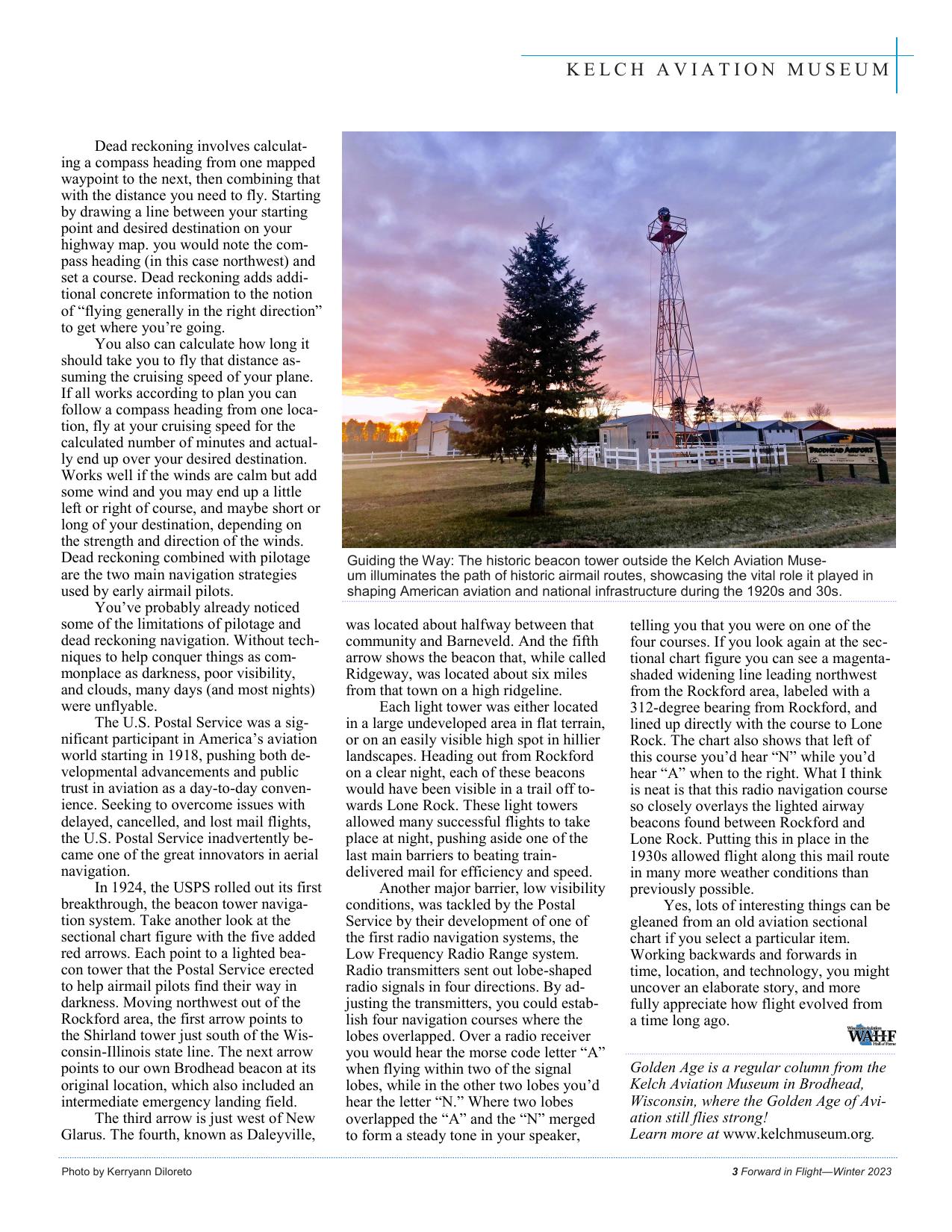
KELCH AVIATION MUSEUM Dead reckoning involves calculating a compass heading from one mapped waypoint to the next, then combining that with the distance you need to fly. Starting by drawing a line between your starting point and desired destination on your highway map. you would note the compass heading (in this case northwest) and set a course. Dead reckoning adds additional concrete information to the notion of “flying generally in the right direction” to get where you’re going. You also can calculate how long it should take you to fly that distance assuming the cruising speed of your plane. If all works according to plan you can follow a compass heading from one location, fly at your cruising speed for the calculated number of minutes and actually end up over your desired destination. Works well if the winds are calm but add some wind and you may end up a little left or right of course, and maybe short or long of your destination, depending on the strength and direction of the winds. Dead reckoning combined with pilotage are the two main navigation strategies used by early airmail pilots. You’ve probably already noticed some of the limitations of pilotage and dead reckoning navigation. Without techniques to help conquer things as commonplace as darkness, poor visibility, and clouds, many days (and most nights) were unflyable. The U.S. Postal Service was a significant participant in America’s aviation world starting in 1918, pushing both developmental advancements and public trust in aviation as a day-to-day convenience. Seeking to overcome issues with delayed, cancelled, and lost mail flights, the U.S. Postal Service inadvertently became one of the great innovators in aerial navigation. In 1924, the USPS rolled out its first breakthrough, the beacon tower navigation system. Take another look at the sectional chart figure with the five added red arrows. Each point to a lighted beacon tower that the Postal Service erected to help airmail pilots find their way in darkness. Moving northwest out of the Rockford area, the first arrow points to the Shirland tower just south of the Wisconsin-Illinois state line. The next arrow points to our own Brodhead beacon at its original location, which also included an intermediate emergency landing field. The third arrow is just west of New Glarus. The fourth, known as Daleyville, Photo by Kerryann Diloreto Guiding the Way: The historic beacon tower outside the Kelch Aviation Museum illuminates the path of historic airmail routes, showcasing the vital role it played in shaping American aviation and national infrastructure during the 1920s and 30s. was located about halfway between that community and Barneveld. And the fifth arrow shows the beacon that, while called Ridgeway, was located about six miles from that town on a high ridgeline. Each light tower was either located in a large undeveloped area in flat terrain, or on an easily visible high spot in hillier landscapes. Heading out from Rockford on a clear night, each of these beacons would have been visible in a trail off towards Lone Rock. These light towers allowed many successful flights to take place at night, pushing aside one of the last main barriers to beating traindelivered mail for efficiency and speed. Another major barrier, low visibility conditions, was tackled by the Postal Service by their development of one of the first radio navigation systems, the Low Frequency Radio Range system. Radio transmitters sent out lobe-shaped radio signals in four directions. By adjusting the transmitters, you could establish four navigation courses where the lobes overlapped. Over a radio receiver you would hear the morse code letter “A” when flying within two of the signal lobes, while in the other two lobes you’d hear the letter “N.” Where two lobes overlapped the “A” and the “N” merged to form a steady tone in your speaker, telling you that you were on one of the four courses. If you look again at the sectional chart figure you can see a magentashaded widening line leading northwest from the Rockford area, labeled with a 312-degree bearing from Rockford, and lined up directly with the course to Lone Rock. The chart also shows that left of this course you’d hear “N” while you’d hear “A” when to the right. What I think is neat is that this radio navigation course so closely overlays the lighted airway beacons found between Rockford and Lone Rock. Putting this in place in the 1930s allowed flight along this mail route in many more weather conditions than previously possible. Yes, lots of interesting things can be gleaned from an old aviation sectional chart if you select a particular item. Working backwards and forwards in time, location, and technology, you might uncover an elaborate story, and more fully appreciate how flight evolved from a time long ago. Golden Age is a regular column from the Kelch Aviation Museum in Brodhead, Wisconsin, where the Golden Age of Aviation still flies strong! Learn more at www.kelchmuseum.org. 3 Forward in Flight—Winter 2023
TAILDRAGGER TALES The Gate Guardian Adding reverence and distinction to the Wausau Downtown Airport By John Chmiel Gate Guardian - “A gate guardian or gate guard is a withdrawn piece of equipment, often an aircraft, mounted on a plinth and used as a static display near to and forming a symbolic display of ‘guarding’ the main entrance to the site.” Wausau Downtown Airport (KAUW) is one of a few GA airports lucky enough to have a gate guardian to alert the passing public that the hallowed ground they are about to enter is an airport. I say “hallowed” because Wausau is one of the oldest airports in Wisconsin. Established in 1927, it has a long, successful history. Our guardian didn’t arrive until just a few years ago. The story of Wausau Downtown Airport’s gate guardian and how it arrived at its current location is multifaceted and nearly divine in nature. When Angela Uhl and I established Wausau Flying Service, Inc. in October 1992, we arrived at an airport that was on life support. Wausau airport tenants had been keeping the historic airport alive since 1976 after Wisconsin Aviation Hall of Famers Marie and Lyle Grimm retired Grimm’s Flying Service after 32 years of aviation service to the community. What happened in the years between 1976 and 1992 were a series of FBO failures that couldn’t live up to the quality of service of their predecessors. The city was also losing enthusiasm for the on again - off again responsibilities of airport management. There was even talk of closing the airport and creating a riverfront housing development on the land instead and there seemed to be growing public support for that idea. After 16 years of lackluster airport performance we discovered that many nonaviation citizens we spoke to didn’t even know there was an airport located in Wausau. We immediately realized we had an uphill battle ahead of us working to improve the airport’s image. Our daily commute from the north side of town to work would take us past the local VFW. Located on that River Drive property along the Wisconsin River was an Air Force A-7 Corsair II on static display. This jet aircraft and Wausau Flying Service had arrived in Wausau simultaneously in 1992. The jet fighter was painted to represent an aircraft flown during the Vietnam war by a pilot awarded the Distinguished Flying Cross, Major Colin A. “Arnie” Clarke. Every time we drove by that airplane I would think to myself, “That airplane shouldn’t be here! It should be displayed on the corner near the entry to the airport! Then people would really know where the airport is located.” For those who haven’t visited Wausau, our airport is in the middle of a quiet neighborhood, not along a busy traffic-ridden thoroughfare where people can easily see it. Even when giving directions to people over the phone (this was before the “Googler”) the airport location was not obvious to those arriving via automobile. I longed to have something that could draw attention to our airport and make people want to stop by for no reason other than to explore. Then we could pounce and infect them with the illness known as the aviation lifestyle. We just needed something like a gate guardian to get them here. Years went by while we tirelessly promoted aviation activities at the airport to increase attendance and support for the airport. Airshows, chili fly-ins, spot landing contests, EAA meetings, kite flying, model airplane activities, and learn-to-fly activities were just some of the annual events. We worked with City leaders and politicians to spread the aviation doctrine and announce successes and growth at the airport. Slowly the airport image and support began to improve as growth and activity increased. Hangars were built and airport improvements were made with no objections from taxpayers. The next stage of our plan was to no longer be an airport within the neighbor- 4 Forward in Flight ~ Quarterly Magazine of the Wisconsin Aviation Hall of Fame hood. We wanted the airport to be part of the neighborhood. So we forged friendships with our next-door neighbors. We invited the Southeast Side Neighborhood Group (SES Neighborhood Group) to hold their monthly meetings in our terminal. This allowed us a monthly opportunity to update them on current and future plans and invite them to airport activities. Making the airport part of the neighborhood has turned into one of the highlights of our tenure. The support of our neighbors has paid dividends in so many ways: political support, support on social media, and education of the public. In 2017, the SES Neighborhood Group leaders approached Wausau Flying Service to assist with making improvements in a park located on airport property. The plan was to create an aviation themed park to attract elementary school kids to the neighborhood. The plan included education stations throughout the park and seemed logical since the park is located on the corner to the entry to the airport parking lot. Improvements to the park were presented to City leaders, with the help of Becher Hoppe Engineering, and finally to our southeast side neighbors. There was overwhelming support, which was good since it wasn’t going to be an inexpensive project. Alexander Field was the original name of the Wausau Downtown Airport. The Walter Alexander Foundation and the Judd S. Alexander Foundation were major contributors to the park project since the airport would not have existed in 1927 had it not been for their family’s support through donation of property and improvements to the City for an airport. The neighborhood quickly worked to raise the remaining funds to complete the project. During the early park planning meetings the subject of having a “real” airplane on display at the new Alexander Airport Park arose constantly. But where could we get one?! I had long given up
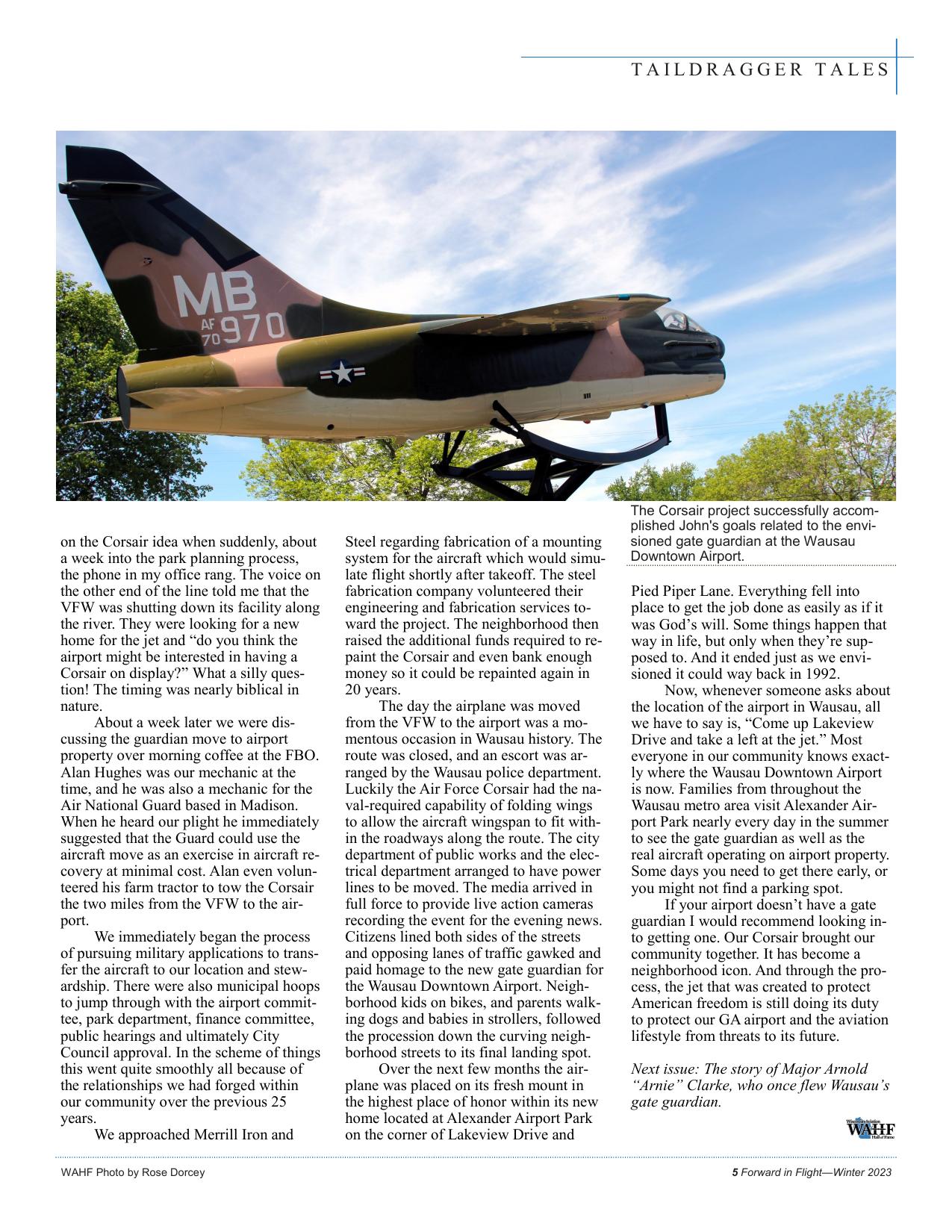
TAILDRAGGER TALES on the Corsair idea when suddenly, about a week into the park planning process, the phone in my office rang. The voice on the other end of the line told me that the VFW was shutting down its facility along the river. They were looking for a new home for the jet and “do you think the airport might be interested in having a Corsair on display?” What a silly question! The timing was nearly biblical in nature. About a week later we were discussing the guardian move to airport property over morning coffee at the FBO. Alan Hughes was our mechanic at the time, and he was also a mechanic for the Air National Guard based in Madison. When he heard our plight he immediately suggested that the Guard could use the aircraft move as an exercise in aircraft recovery at minimal cost. Alan even volunteered his farm tractor to tow the Corsair the two miles from the VFW to the airport. We immediately began the process of pursuing military applications to transfer the aircraft to our location and stewardship. There were also municipal hoops to jump through with the airport committee, park department, finance committee, public hearings and ultimately City Council approval. In the scheme of things this went quite smoothly all because of the relationships we had forged within our community over the previous 25 years. We approached Merrill Iron and WAHF Photo by Rose Dorcey Steel regarding fabrication of a mounting system for the aircraft which would simulate flight shortly after takeoff. The steel fabrication company volunteered their engineering and fabrication services toward the project. The neighborhood then raised the additional funds required to repaint the Corsair and even bank enough money so it could be repainted again in 20 years. The day the airplane was moved from the VFW to the airport was a momentous occasion in Wausau history. The route was closed, and an escort was arranged by the Wausau police department. Luckily the Air Force Corsair had the naval-required capability of folding wings to allow the aircraft wingspan to fit within the roadways along the route. The city department of public works and the electrical department arranged to have power lines to be moved. The media arrived in full force to provide live action cameras recording the event for the evening news. Citizens lined both sides of the streets and opposing lanes of traffic gawked and paid homage to the new gate guardian for the Wausau Downtown Airport. Neighborhood kids on bikes, and parents walking dogs and babies in strollers, followed the procession down the curving neighborhood streets to its final landing spot. Over the next few months the airplane was placed on its fresh mount in the highest place of honor within its new home located at Alexander Airport Park on the corner of Lakeview Drive and The Corsair project successfully accomplished John's goals related to the envisioned gate guardian at the Wausau Downtown Airport. Pied Piper Lane. Everything fell into place to get the job done as easily as if it was God’s will. Some things happen that way in life, but only when they’re supposed to. And it ended just as we envisioned it could way back in 1992. Now, whenever someone asks about the location of the airport in Wausau, all we have to say is, “Come up Lakeview Drive and take a left at the jet.” Most everyone in our community knows exactly where the Wausau Downtown Airport is now. Families from throughout the Wausau metro area visit Alexander Airport Park nearly every day in the summer to see the gate guardian as well as the real aircraft operating on airport property. Some days you need to get there early, or you might not find a parking spot. If your airport doesn’t have a gate guardian I would recommend looking into getting one. Our Corsair brought our community together. It has become a neighborhood icon. And through the process, the jet that was created to protect American freedom is still doing its duty to protect our GA airport and the aviation lifestyle from threats to its future. Next issue: The story of Major Arnold “Arnie” Clarke, who once flew Wausau’s gate guardian. 5 Forward in Flight—Winter 2023
HISTORY HANGAR Inductee Arnold Ebneter From the Golden Age of Aviation to an Aviation World Record By Eileen Bjorkman Growing up near Mount Horeb, Wisconsin, in the 1930s, my father, Arnold Ebneter, saw at least 10 airplanes flying overhead every day, a coincidence of geography and geology. Flights between Chicago and Minneapolis passed close to the dairy farm where he lived, and the farm contained Donald Rock, a monolith that dominated the countryside and made for an attractive waypoint for pilots in the days before electronic navigation. Arnold seemed destined to be a pilot from the day he was born. By age six, he and his cousin Carl sported small versions of the leather helmets and goggles that Charles Lindbergh wore during his famous transatlantic crossing in 1927, which occurred exactly nine months prior to Arnold’s birth on February 21, 1928. Arnold’s first flight occurred at the annual Fall Frolic in Mount Horeb when he was eight. Two barnstormers in biplanes were offering rides for one dollar per person, and, despite the steep price, Arnold’s father wanted a ride, too. The flight was 6 Forward in Flight ~ Quarterly Magazine of the Wisconsin Aviation Hall of Fame only 15 minutes, but Arnold was thrilled at the sight of the ground receding as they climbed and marveled at the tiny houses from 1,000 feet above the ground. He was hooked for life. Too young to take lessons, Arnold built model airplanes and devoured aviation magazines and books for the next several years. Building the models and learning what the different parts of an airplane did made him decide that he didn’t want to just be a pilot, he also wanted to design and build airplanes. When Arnold was 11, his family gave up farming and moved to Portage, which from Arnold’s point of view had a crown jewel: a small airport. It wasn’t much in those days, just a little grass field about half-mile square, with a pilot lounge about the size of a two-car garage. The owners, Chet and Bob Mael, mowed two runways into the grass and bought a handful of small airplanes for flight instruction. By the time he was 14, Arnold spent many Saturdays at the airport, watching pilots take off and land and tagging after Chet as he prepared for a flight or
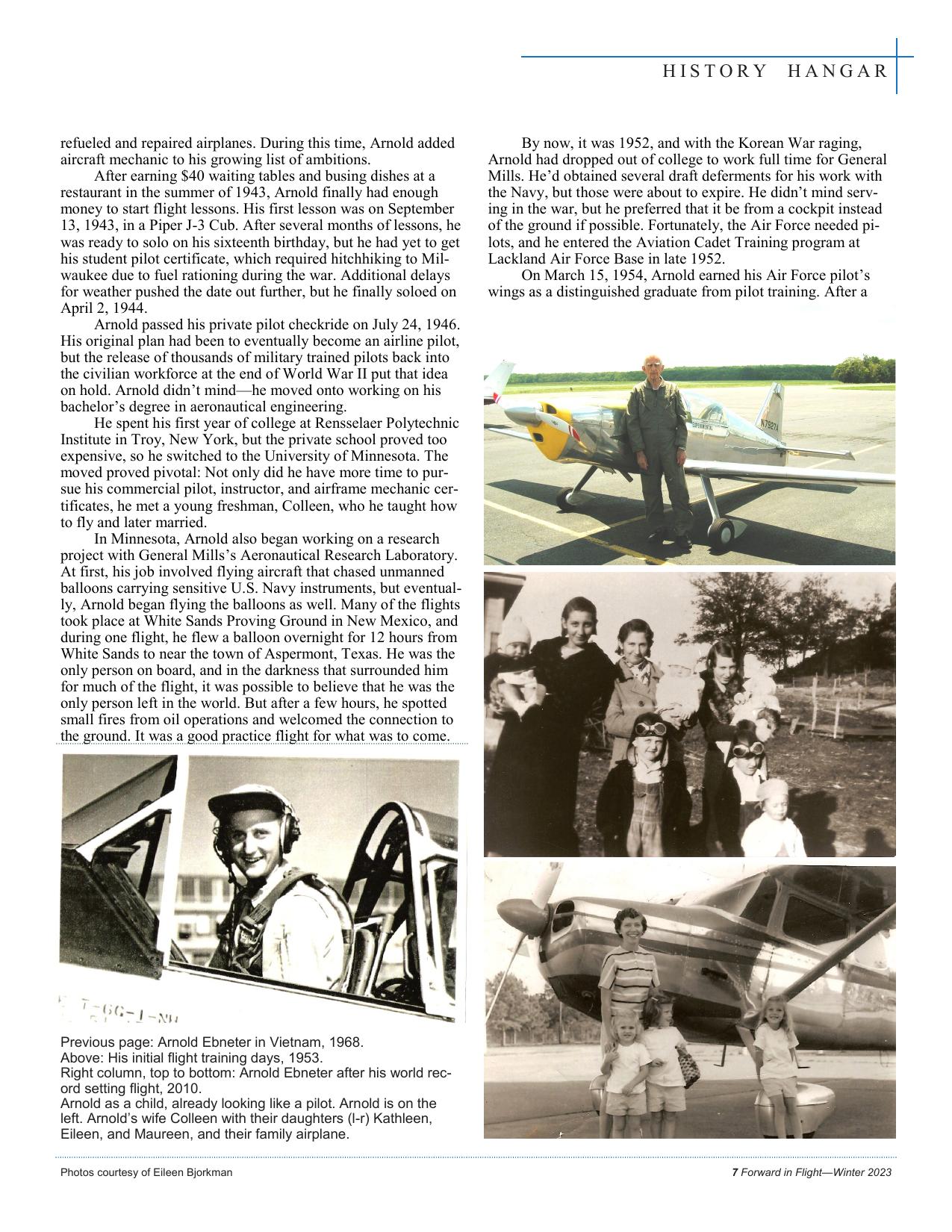
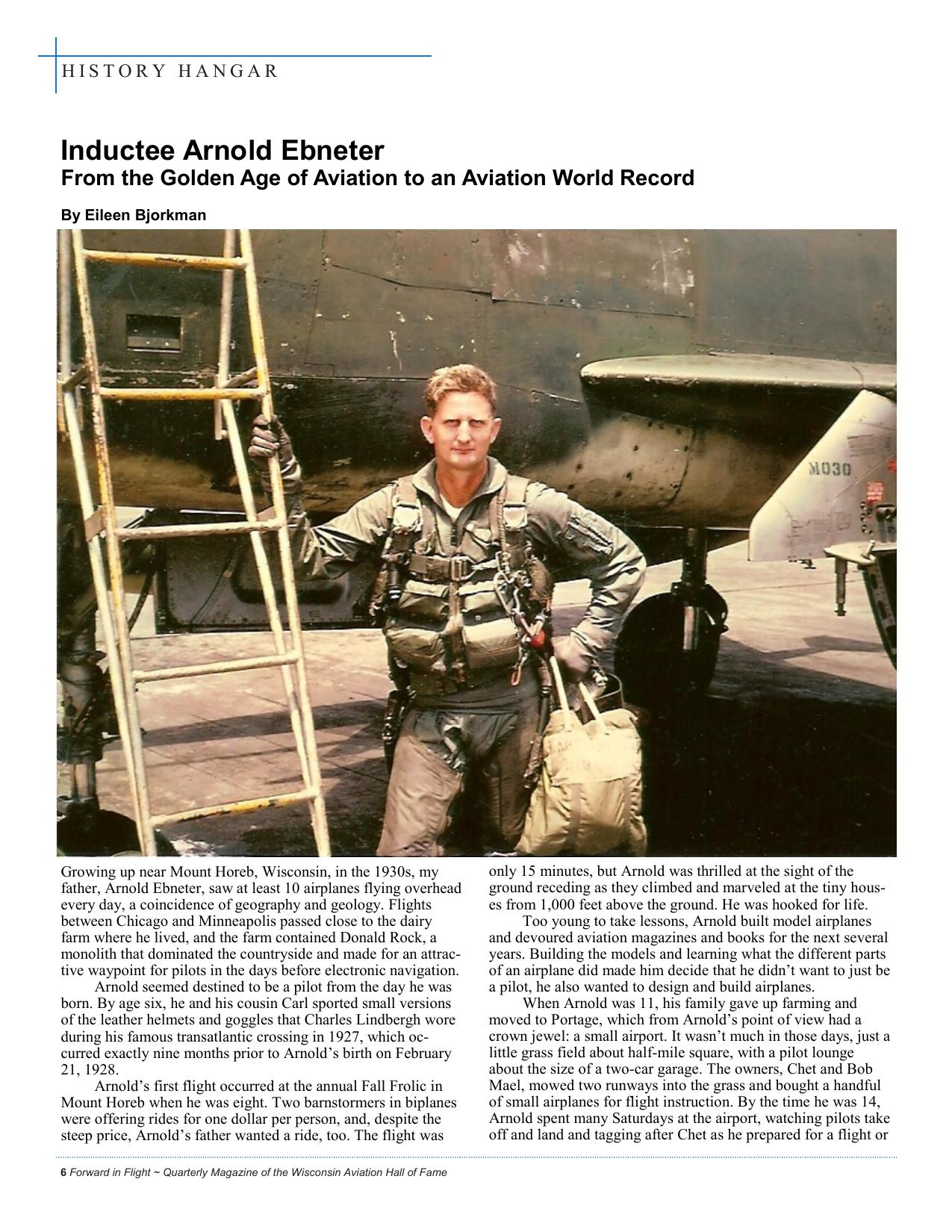
HISTORY refueled and repaired airplanes. During this time, Arnold added aircraft mechanic to his growing list of ambitions. After earning $40 waiting tables and busing dishes at a restaurant in the summer of 1943, Arnold finally had enough money to start flight lessons. His first lesson was on September 13, 1943, in a Piper J-3 Cub. After several months of lessons, he was ready to solo on his sixteenth birthday, but he had yet to get his student pilot certificate, which required hitchhiking to Milwaukee due to fuel rationing during the war. Additional delays for weather pushed the date out further, but he finally soloed on April 2, 1944. Arnold passed his private pilot checkride on July 24, 1946. His original plan had been to eventually become an airline pilot, but the release of thousands of military trained pilots back into the civilian workforce at the end of World War II put that idea on hold. Arnold didn’t mind—he moved onto working on his bachelor’s degree in aeronautical engineering. He spent his first year of college at Rensselaer Polytechnic Institute in Troy, New York, but the private school proved too expensive, so he switched to the University of Minnesota. The moved proved pivotal: Not only did he have more time to pursue his commercial pilot, instructor, and airframe mechanic certificates, he met a young freshman, Colleen, who he taught how to fly and later married. In Minnesota, Arnold also began working on a research project with General Mills’s Aeronautical Research Laboratory. At first, his job involved flying aircraft that chased unmanned balloons carrying sensitive U.S. Navy instruments, but eventually, Arnold began flying the balloons as well. Many of the flights took place at White Sands Proving Ground in New Mexico, and during one flight, he flew a balloon overnight for 12 hours from White Sands to near the town of Aspermont, Texas. He was the only person on board, and in the darkness that surrounded him for much of the flight, it was possible to believe that he was the only person left in the world. But after a few hours, he spotted small fires from oil operations and welcomed the connection to the ground. It was a good practice flight for what was to come. HANGAR By now, it was 1952, and with the Korean War raging, Arnold had dropped out of college to work full time for General Mills. He’d obtained several draft deferments for his work with the Navy, but those were about to expire. He didn’t mind serving in the war, but he preferred that it be from a cockpit instead of the ground if possible. Fortunately, the Air Force needed pilots, and he entered the Aviation Cadet Training program at Lackland Air Force Base in late 1952. On March 15, 1954, Arnold earned his Air Force pilot’s wings as a distinguished graduate from pilot training. After a Previous page: Arnold Ebneter in Vietnam, 1968. Above: His initial flight training days, 1953. Right column, top to bottom: Arnold Ebneter after his world record setting flight, 2010. Arnold as a child, already looking like a pilot. Arnold is on the left. Arnold’s wife Colleen with their daughters (l-r) Kathleen, Eileen, and Maureen, and their family airplane. Photos courtesy of Eileen Bjorkman 7 Forward in Flight—Winter 2023
HISTORY HANGAR quick dash north to marry Colleen, he reported to Nellis Air Force Base, Nevada, for fighter pilot training in the F-86, then the Air Force’s most advanced fighter. From there, he went to Foster Air Force Base near Victoria, Texas, and joined an operational fighter wing. A year later, his wing transitioned to flying the F-100, the Air Force’s first supersonic jet fighter. Arnold’s wing was involved in demonstrating how to deploy fighter aircraft all over the world on short notice, something that is routine today, but was unheard of in the early 1950s. But before the wing could start to deploy, the pilots first had to learn how to refuel the F-100, which used a “probe-anddrogue” system commonly used later by the Navy. Arnold and the other pilots couldn’t see the probe, which was attached under the right wing of the F-100, leading to many cracked canopies and gouged fuselages before they figured things out. Once they had mastered the basics of refueling, Arnold and five other pilots in his squadron participated in a simulated attack on the Panama Canal in the fall of 1956. The flight took eight hours and involved two aerial refuelings. By the time he landed, Arnold had been awake for more than 30 hours, and he had never been more exhausted. But like his 12-hour balloon flight, it was good practice for later. After a few years of flying the F-100, Arnold entered an Air Force program that sent him to Texas A&M to complete his aeronautical engineering degree. As he considered a topic for his senior project, he stumbled over a short article about Juhani Heinonen, a Finnish pilot and engineer who in 1957 had set a world distance record for the C-1a class—an airplane using a combustion engine (as opposed to a rocket) and weighing no more than 500 kilograms. Heinonen had designed and built the record-setting airplane himself. The record of 1,767 miles seemed pretty pedestrian, and his faculty advisor agreed that Arnold could try to design an airplane that would beat that distance. Arnold predicted his design would more than double the current record, and his paper that described the airplane’s major characteristics, such as wing layout, landing gear, and engine, won a student paper first place award from the organization that later became the American Institute of Aeronautics and Astronautics. The first-place prize included $300 that Arnold planned to use to start building his record-setting airplane right away. But Arnold had plenty of distractions. The first was his growing family, with four daughters by 1962, which required the purchase of a Beechcraft Bonanza to replace the family’s Cessna 170. The second was his busy career as an F-100 pilot at England Air Force Base, Louisiana, where he again deployed all over the world, including Turkey and Vietnam. Then, after attending the Air Force Institute of Technology in Ohio for his master’s degree in aeronautical engineering, he requalified in the F-100 and deployed to Tuy Hoa, South Vietnam, in early 1968, where he flew 224 combat missions. After Vietnam, Arnold was stationed at Eglin Air Force Base in the Florida Panhandle. While in Florida, Arnold fiddled with his record setter’s design and acquired some parts to use for the airplane. In 1973, he had his final assignment as an ROTC instructor at Parks College in Cahokia, Illinois, where he finally completed the powerplant portion of his mechanic’s certificate. In 1974, Arnold retired from the Air Force and moved to 8 Forward in Flight ~ Quarterly Magazine of the Wisconsin Aviation Hall of Fame Seattle to work for Boeing as a safety expert. But Seattle held new distractions to building his record-setter, which he began calling the E-1. Arnold began flying part-time as chief instructor pilot at a local airport, Harvey Airfield, and later became an FAA designated pilot examiner. During the 1980s, he restored a J-3 Cub for Colleen and transported fish in Alaska. During the 1990s, he flew a thunderstorm research aircraft in New Mexico. Finally, in the mid-1990s, Arnold retired from Boeing to focus on completing the E-1. In 1999, with the E-1 about half finished, Colleen died unexpectedly. After recovering from that setback, Arnold began working on the E-1 in earnest, and in July 2005, the E-1 finally made its first flight. He then spent four years making refinements to increase the E-1’s speed. By then, the record set in 1957 had been extended twice. In 1975, Edgar Lesher, a professor at the University of Michigan, used a pusher aircraft of his own design to extend the record to 1,835 miles. In 1984, Gary Hertzler, an engineer with Allied Signal (now Honeywell), used another pusher, a VariEze, to further extend the record to 2,214 miles. The E-1 was ready in 2009, but the weather didn’t cooperate. A year later, everything came together. On July 25, 2010, at 2:15 p.m., Arnold took off from Paine Field in Everett, Washington, carrying only essentials—59 gallons of fuel, two energy bars, and a quart of water. Since thunderstorms in the Midwest usually die down at night, he chose an afternoon takeoff so he could cross the Midwest overnight and then land the next morning in Fredericksburg, Virginia. During his climb to 9,500 feet to cross the Cascade Mountains, his fuel flow meter and total fuel gauge failed. For the next 18 hours, he would have to guess how much fuel he had used by multiplying estimated burn rate and airborne time. As he crossed the Cascades, the radio in his cramped cockpit seemed to have failed as well, but he finally contacted an air traffic controller in Eastern Washington. In Montana, a line of thunderstorms at a safe distance provided a spectacular light show as the sun set behind him. As the night wore on, a full moon rose, and the radio fell silent. Passing through North Dakota, a headwind slowed Arnold’s progress and wasted precious fuel. Near Columbus, Ohio, not long after sunrise, the E-1’s engine burned the last remnants of fuel in the wings. The only fuel was now in the nine-gallon fuselage tank, but Arnold calculated he needed more than that to break the record. He chose not to surrender. With clearer weather forecast ahead, he climbed up to 7,500 feet and found a tailwind that carried him the rest of the way to Fredericksburg, Virginia, where he landed after covering 2,328 miles in 18 hours and 15 minutes. In addition to breaking the record, Arnold’s feat was chosen by the National Aeronautic Association as one of the “Ten Most Notable Aviation Records of 2010,” and the Fédération Aéronautique Internationale bestowed the 2011 Louis Blériot medal on him, which may be given annually to pilots of the highest distance, speed, and altitude records in aircraft weighing less than 1,000 kilograms. In 2013, Arnold was inducted into the Wisconsin Aviation Hall of Fame. The E-1 is now on display at the EAA Aviation Museum. Arnold retired from flying in 2019 and continues to reside in the Seattle area.
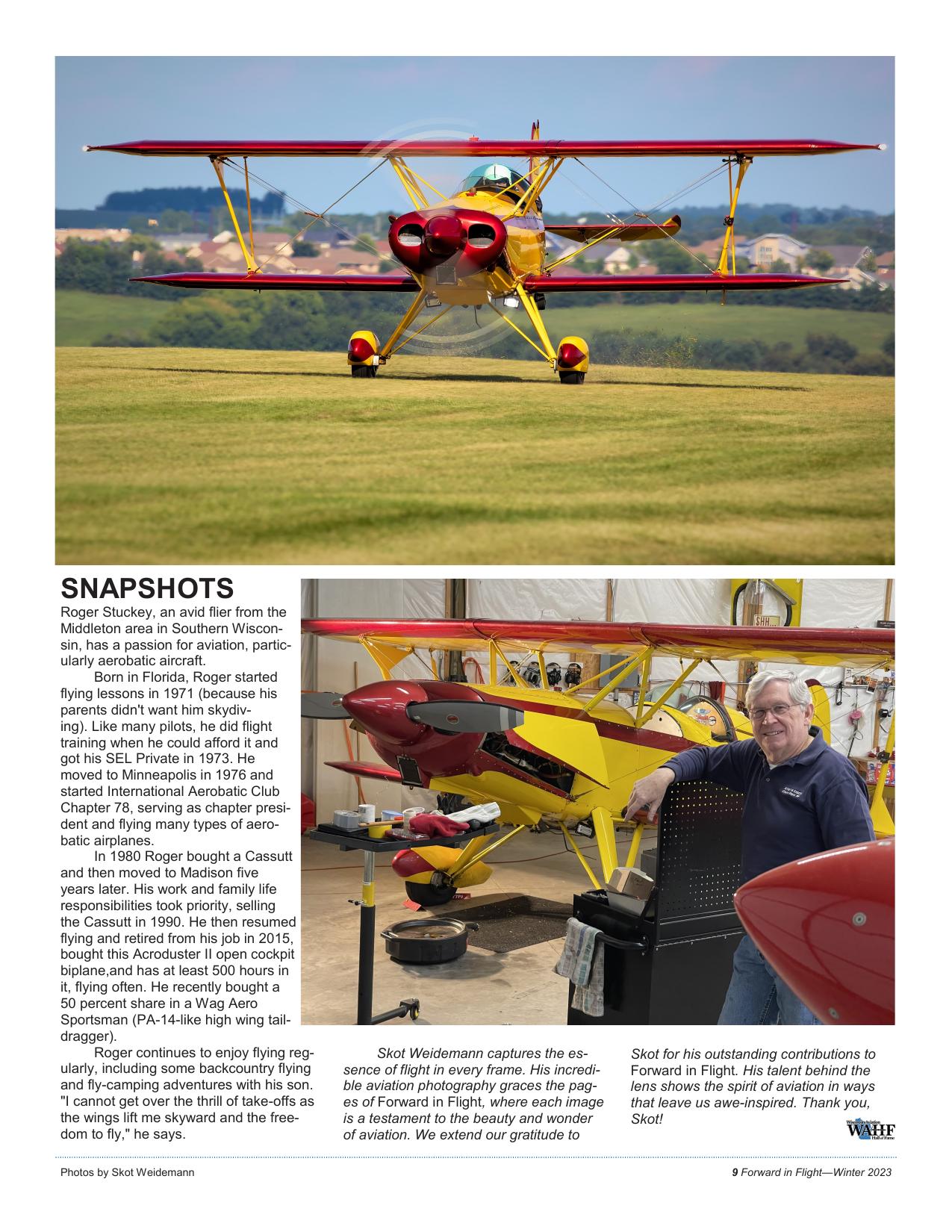
SNAPSHOTS Roger Stuckey, an avid flier from the Middleton area in Southern Wisconsin, has a passion for aviation, particularly aerobatic aircraft. Born in Florida, Roger started flying lessons in 1971 (because his parents didn't want him skydiving). Like many pilots, he did flight training when he could afford it and got his SEL Private in 1973. He moved to Minneapolis in 1976 and started International Aerobatic Club Chapter 78, serving as chapter president and flying many types of aerobatic airplanes. In 1980 Roger bought a Cassutt and then moved to Madison five years later. His work and family life responsibilities took priority, selling the Cassutt in 1990. He then resumed flying and retired from his job in 2015, bought this Acroduster II open cockpit biplane,and has at least 500 hours in it, flying often. He recently bought a 50 percent share in a Wag Aero Sportsman (PA-14-like high wing taildragger). Roger continues to enjoy flying regularly, including some backcountry flying and fly-camping adventures with his son. "I cannot get over the thrill of take-offs as the wings lift me skyward and the freedom to fly," he says. Photos by Skot Weidemann Skot Weidemann captures the essence of flight in every frame. His incredible aviation photography graces the pages of Forward in Flight, where each image is a testament to the beauty and wonder of aviation. We extend our gratitude to Skot for his outstanding contributions to Forward in Flight. His talent behind the lens shows the spirit of aviation in ways that leave us awe-inspired. Thank you, Skot! 9 Forward in Flight—Winter 2023
WE FLY Guided by WASP Wings The Inspiring Odyssey of Caroline “Blaze” Jensen By Caroline “Blaze” Jensen with Rose Dorcey It’s mid-morning in River Falls, Wisconsin, and Caroline Bong “Blaze” Jensen has already taken her teenage son, Finn, to school, walked her dog, Gunner; and answered dozens of business emails. The avid swimmer gets ready for a workout, before preparing a healthy lunch. During the season, you’ll find her behind the wheel of her Jeep, accompanied by Gunner as her copilot, as they make their way to a nearby farmer’s market to select fresh produce. The retired US Air Force Lt. Col. and active board member at the National WASP World War II Museum at Avenger Field in Sweetwater, Texas, keeps her weekends free to spend time with Finn. After her 26-year military career, it’s a life she loves in western Wisconsin. It’s a long way from the little girl born in New Richmond who saw a biplane flying around the clouds to the woman who became the first mom to fly with the U.S. Air Force Thunderbirds. Her career choice was inspired by her grandparents and her father; growing up with patriots willing to sacrifice their personal safety and comfort to defend our country significantly influenced her life. “My grandmother on my mom’s side was very proud of her service as a U.S. Coast Guard SPAR (Coast Guard Women’s Reserve),” Caroline says. “My Dad’s father saw combat on the Coast Guard cutter Duane in the North Atlantic during World War II,” she adds. Her Marine Corps father, Tom Bong, flew 660 combat missions in H-34s during Vietnam. Fueled by Heritage and Mentorship Growing up in the state of Wisconsin with the last name Bong meant it was inevitable that Caroline would become steeped in the rich aviation history of our state. While her father was in the Minnesota National Guard he was frequently asked if he was any relation to the highest scoring American ace of all time, Richard Ira Bong. Despite not being a blood relative of Bong, she likes sharing that Billy Mitchell, another aviator with Wisconsin ties, is known as the Father of the U.S. Air Force. During her freshman year at the United States Air Force Academy, she was assigned to Cadet Squadron 21 (CS-21), the very same squadron to which Milwaukee’s Lance Sijan belonged. Lance’s family gifted CS-21 his cadet artifacts and Caroline was honored to be a part of designing and setting up an artifact display case in the squadron. Malcolm McConnell’s book that tells Sijan’s story, Into the Mouth of the Cat, was required reading there. Sijan Hall, named after the Wisconsin Medal of Honor recipient, is a huge dormitory that houses over half of the cadets at the Air Force Academy in Colorado Springs. “I had a lot to be proud of and attempt to live up to,” Caroline says. Blaze’s father supported his daughter’s choice of entering the U.S. Air Force, with a caveat that she should fly something “higher and faster” than a helicopter. He not only supported her, but also found a mentor for Caroline like no other, one of the former Women’s Airforce Service Pilots (WASP). It’s a story that lights up Caroline’s beautiful face. “My father worked for the Minnesota National Guard at the time. He worked in civil engineering and did site visits to armories throughout Minnesota. When he was in Faribault, Minnesota, he 10 Forward in Flight ~ Quarterly Magazine of the Wisconsin Aviation Hall of Fame learned that a former WASP lived there named Elizabeth ‘Betty’ Wall Strohfus. Back in those days, there was no Internet or cell phones. My father looked her up in the phone book and decided to knock on her door. My father is a big physical presence, especially compared to Betty Strohfus, a tiny ball of energy with a 10-foot-tall personality. When she answered the door, my father introduced himself and said, ‘My daughter wants to be an Air Force pilot.’ Betty didn’t hesitate and immediately invited him in for coffee. After a long talk, she sent him home with things to motivate me on my way through high school and to become an Air Force pilot.” Caroline has been inspired by the WASP throughout her entire career and daily life, and Betty was the first of the WASP she’s been fortunate to know—as mentors and friends. Their experiences influenced her greatly as she rose through the ranks. A 1998 graduate of the USAF Academy, Blaze went from one general aviation flight in a Cessna 172 at age 15 before flying on an airliner to the academy, to becoming a fighter pilot; an experienced command pilot, instructor pilot, and evaluator with more than 3,500 hours in Schwitzer 2-33 gliders, Cessna 172, T37B Tweet, T-38 Talon, and the F-16 Fighting Falcon, including 200 hours of combat time. She was the first female reserve officer to fly for the U.S. Air Force Air Demonstration Squadron (Thunderbirds) and is the first woman qualified to fly in the Air Force’s jet trainer, the T-7A Red Hawk. “Blaze” fondly remembers flying in the #3 right wing position for the Thunderbirds. Her time in OPERATION IRAQI FREEDOM supporting the U.S. troops and U.S. allies on the ground is memorable. Her Air Force adventure also took her to an assignment as a Legislative Fellow in the Secretary of the Air Force Legislative Liaison Senate office and later as a member of the Senate Armed Services Committee.
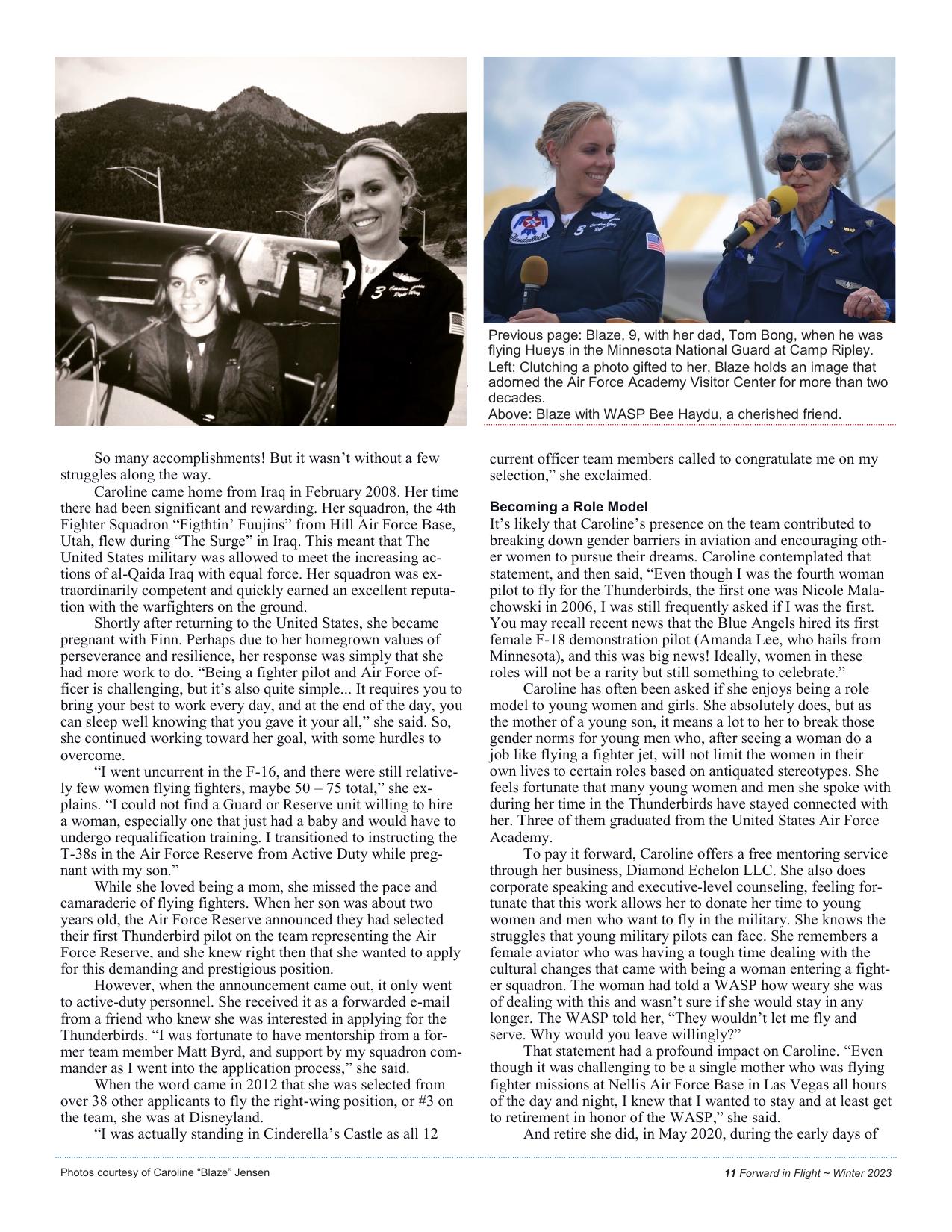
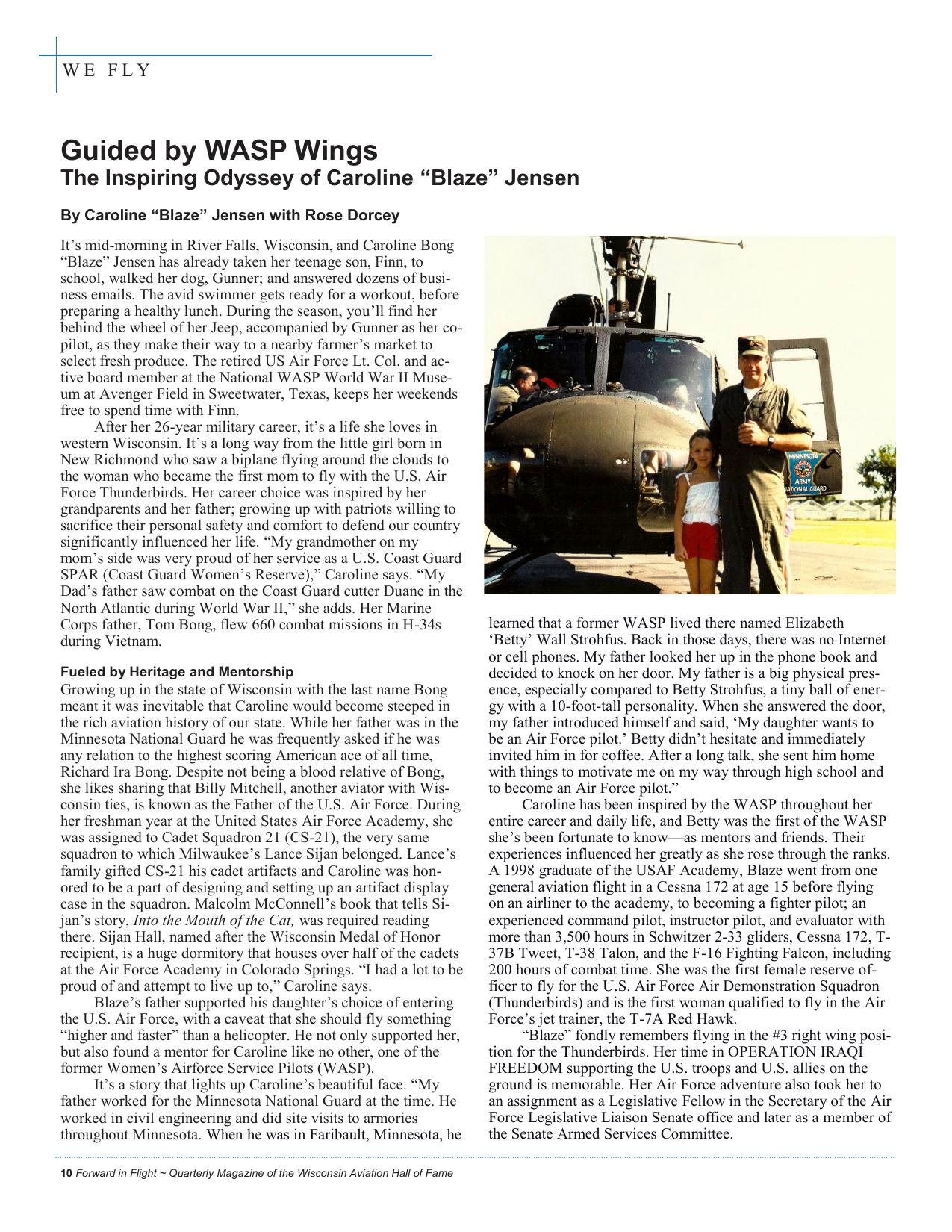
Previous page: Blaze, 9, with her dad, Tom Bong, when he was flying Hueys in the Minnesota National Guard at Camp Ripley. Left: Clutching a photo gifted to her, Blaze holds an image that adorned the Air Force Academy Visitor Center for more than two decades. Above: Blaze with WASP Bee Haydu, a cherished friend. So many accomplishments! But it wasn’t without a few struggles along the way. Caroline came home from Iraq in February 2008. Her time there had been significant and rewarding. Her squadron, the 4th Fighter Squadron “Figthtin’ Fuujins” from Hill Air Force Base, Utah, flew during “The Surge” in Iraq. This meant that The United States military was allowed to meet the increasing actions of al-Qaida Iraq with equal force. Her squadron was extraordinarily competent and quickly earned an excellent reputation with the warfighters on the ground. Shortly after returning to the United States, she became pregnant with Finn. Perhaps due to her homegrown values of perseverance and resilience, her response was simply that she had more work to do. “Being a fighter pilot and Air Force officer is challenging, but it’s also quite simple... It requires you to bring your best to work every day, and at the end of the day, you can sleep well knowing that you gave it your all,” she said. So, she continued working toward her goal, with some hurdles to overcome. “I went uncurrent in the F-16, and there were still relatively few women flying fighters, maybe 50 – 75 total,” she explains. “I could not find a Guard or Reserve unit willing to hire a woman, especially one that just had a baby and would have to undergo requalification training. I transitioned to instructing the T-38s in the Air Force Reserve from Active Duty while pregnant with my son.” While she loved being a mom, she missed the pace and camaraderie of flying fighters. When her son was about two years old, the Air Force Reserve announced they had selected their first Thunderbird pilot on the team representing the Air Force Reserve, and she knew right then that she wanted to apply for this demanding and prestigious position. However, when the announcement came out, it only went to active-duty personnel. She received it as a forwarded e-mail from a friend who knew she was interested in applying for the Thunderbirds. “I was fortunate to have mentorship from a former team member Matt Byrd, and support by my squadron commander as I went into the application process,” she said. When the word came in 2012 that she was selected from over 38 other applicants to fly the right-wing position, or #3 on the team, she was at Disneyland. “I was actually standing in Cinderella’s Castle as all 12 Photos courtesy of Caroline “Blaze” Jensen current officer team members called to congratulate me on my selection,” she exclaimed. Becoming a Role Model It’s likely that Caroline’s presence on the team contributed to breaking down gender barriers in aviation and encouraging other women to pursue their dreams. Caroline contemplated that statement, and then said, “Even though I was the fourth woman pilot to fly for the Thunderbirds, the first one was Nicole Malachowski in 2006, I was still frequently asked if I was the first. You may recall recent news that the Blue Angels hired its first female F-18 demonstration pilot (Amanda Lee, who hails from Minnesota), and this was big news! Ideally, women in these roles will not be a rarity but still something to celebrate.” Caroline has often been asked if she enjoys being a role model to young women and girls. She absolutely does, but as the mother of a young son, it means a lot to her to break those gender norms for young men who, after seeing a woman do a job like flying a fighter jet, will not limit the women in their own lives to certain roles based on antiquated stereotypes. She feels fortunate that many young women and men she spoke with during her time in the Thunderbirds have stayed connected with her. Three of them graduated from the United States Air Force Academy. To pay it forward, Caroline offers a free mentoring service through her business, Diamond Echelon LLC. She also does corporate speaking and executive-level counseling, feeling fortunate that this work allows her to donate her time to young women and men who want to fly in the military. She knows the struggles that young military pilots can face. She remembers a female aviator who was having a tough time dealing with the cultural changes that came with being a woman entering a fighter squadron. The woman had told a WASP how weary she was of dealing with this and wasn’t sure if she would stay in any longer. The WASP told her, “They wouldn’t let me fly and serve. Why would you leave willingly?” That statement had a profound impact on Caroline. “Even though it was challenging to be a single mother who was flying fighter missions at Nellis Air Force Base in Las Vegas all hours of the day and night, I knew that I wanted to stay and at least get to retirement in honor of the WASP,” she said. And retire she did, in May 2020, during the early days of 11 Forward in Flight ~ Winter 2023
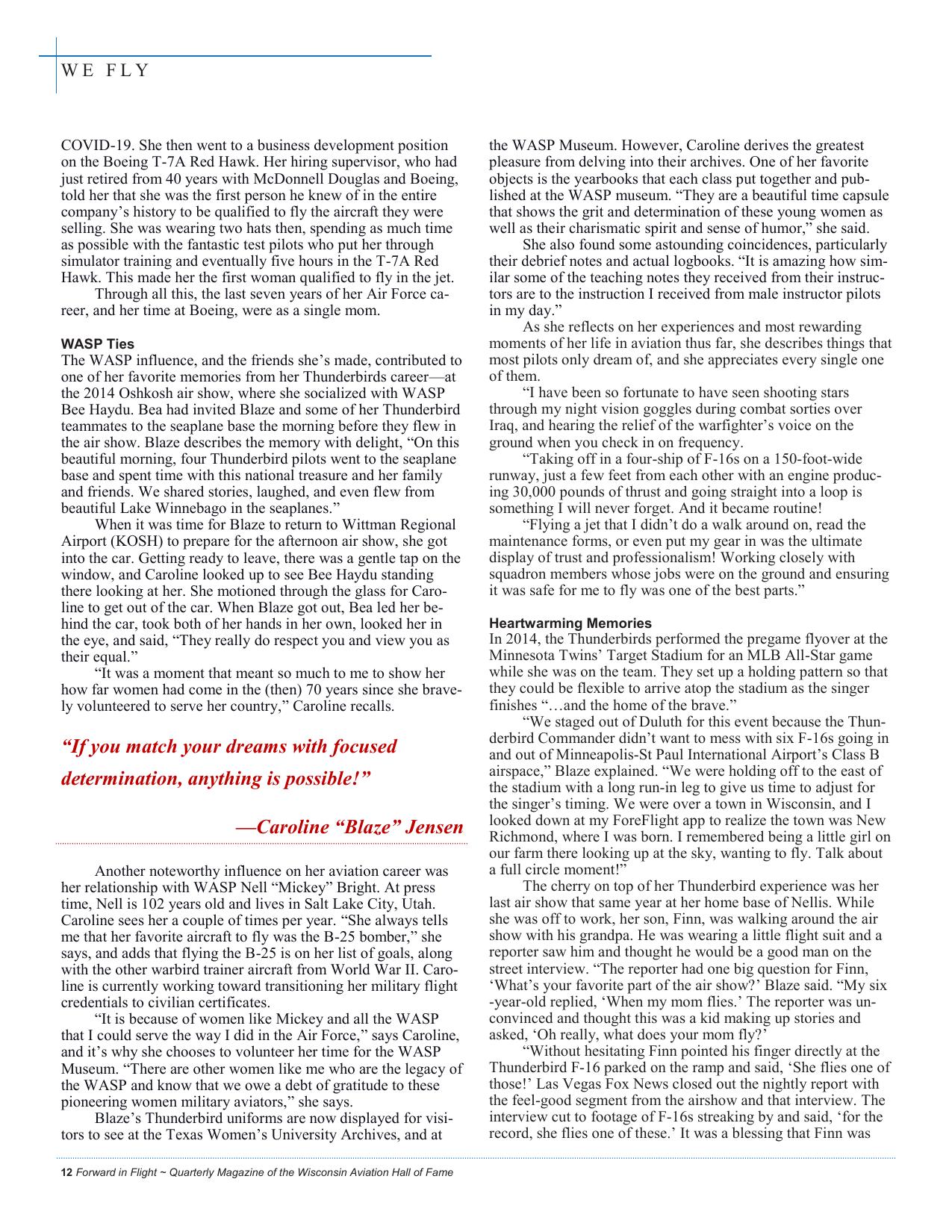
WE FLY COVID-19. She then went to a business development position on the Boeing T-7A Red Hawk. Her hiring supervisor, who had just retired from 40 years with McDonnell Douglas and Boeing, told her that she was the first person he knew of in the entire company’s history to be qualified to fly the aircraft they were selling. She was wearing two hats then, spending as much time as possible with the fantastic test pilots who put her through simulator training and eventually five hours in the T-7A Red Hawk. This made her the first woman qualified to fly in the jet. Through all this, the last seven years of her Air Force career, and her time at Boeing, were as a single mom. WASP Ties The WASP influence, and the friends she’s made, contributed to one of her favorite memories from her Thunderbirds career—at the 2014 Oshkosh air show, where she socialized with WASP Bee Haydu. Bea had invited Blaze and some of her Thunderbird teammates to the seaplane base the morning before they flew in the air show. Blaze describes the memory with delight, “On this beautiful morning, four Thunderbird pilots went to the seaplane base and spent time with this national treasure and her family and friends. We shared stories, laughed, and even flew from beautiful Lake Winnebago in the seaplanes.” When it was time for Blaze to return to Wittman Regional Airport (KOSH) to prepare for the afternoon air show, she got into the car. Getting ready to leave, there was a gentle tap on the window, and Caroline looked up to see Bee Haydu standing there looking at her. She motioned through the glass for Caroline to get out of the car. When Blaze got out, Bea led her behind the car, took both of her hands in her own, looked her in the eye, and said, “They really do respect you and view you as their equal.” “It was a moment that meant so much to me to show her how far women had come in the (then) 70 years since she bravely volunteered to serve her country,” Caroline recalls. “If you match your dreams with focused determination, anything is possible!” —Caroline “Blaze” Jensen Another noteworthy influence on her aviation career was her relationship with WASP Nell “Mickey” Bright. At press time, Nell is 102 years old and lives in Salt Lake City, Utah. Caroline sees her a couple of times per year. “She always tells me that her favorite aircraft to fly was the B-25 bomber,” she says, and adds that flying the B-25 is on her list of goals, along with the other warbird trainer aircraft from World War II. Caroline is currently working toward transitioning her military flight credentials to civilian certificates. “It is because of women like Mickey and all the WASP that I could serve the way I did in the Air Force,” says Caroline, and it’s why she chooses to volunteer her time for the WASP Museum. “There are other women like me who are the legacy of the WASP and know that we owe a debt of gratitude to these pioneering women military aviators,” she says. Blaze’s Thunderbird uniforms are now displayed for visitors to see at the Texas Women’s University Archives, and at 12 Forward in Flight ~ Quarterly Magazine of the Wisconsin Aviation Hall of Fame the WASP Museum. However, Caroline derives the greatest pleasure from delving into their archives. One of her favorite objects is the yearbooks that each class put together and published at the WASP museum. “They are a beautiful time capsule that shows the grit and determination of these young women as well as their charismatic spirit and sense of humor,” she said. She also found some astounding coincidences, particularly their debrief notes and actual logbooks. “It is amazing how similar some of the teaching notes they received from their instructors are to the instruction I received from male instructor pilots in my day.” As she reflects on her experiences and most rewarding moments of her life in aviation thus far, she describes things that most pilots only dream of, and she appreciates every single one of them. “I have been so fortunate to have seen shooting stars through my night vision goggles during combat sorties over Iraq, and hearing the relief of the warfighter’s voice on the ground when you check in on frequency. “Taking off in a four-ship of F-16s on a 150-foot-wide runway, just a few feet from each other with an engine producing 30,000 pounds of thrust and going straight into a loop is something I will never forget. And it became routine! “Flying a jet that I didn’t do a walk around on, read the maintenance forms, or even put my gear in was the ultimate display of trust and professionalism! Working closely with squadron members whose jobs were on the ground and ensuring it was safe for me to fly was one of the best parts.” Heartwarming Memories In 2014, the Thunderbirds performed the pregame flyover at the Minnesota Twins’ Target Stadium for an MLB All-Star game while she was on the team. They set up a holding pattern so that they could be flexible to arrive atop the stadium as the singer finishes “…and the home of the brave.” “We staged out of Duluth for this event because the Thunderbird Commander didn’t want to mess with six F-16s going in and out of Minneapolis-St Paul International Airport’s Class B airspace,” Blaze explained. “We were holding off to the east of the stadium with a long run-in leg to give us time to adjust for the singer’s timing. We were over a town in Wisconsin, and I looked down at my ForeFlight app to realize the town was New Richmond, where I was born. I remembered being a little girl on our farm there looking up at the sky, wanting to fly. Talk about a full circle moment!” The cherry on top of her Thunderbird experience was her last air show that same year at her home base of Nellis. While she was off to work, her son, Finn, was walking around the air show with his grandpa. He was wearing a little flight suit and a reporter saw him and thought he would be a good man on the street interview. “The reporter had one big question for Finn, ‘What’s your favorite part of the air show?’ Blaze said. “My six -year-old replied, ‘When my mom flies.’ The reporter was unconvinced and thought this was a kid making up stories and asked, ‘Oh really, what does your mom fly?’ “Without hesitating Finn pointed his finger directly at the Thunderbird F-16 parked on the ramp and said, ‘She flies one of those!’ Las Vegas Fox News closed out the nightly report with the feel-good segment from the airshow and that interview. The interview cut to footage of F-16s streaking by and said, ‘for the record, she flies one of these.’ It was a blessing that Finn was
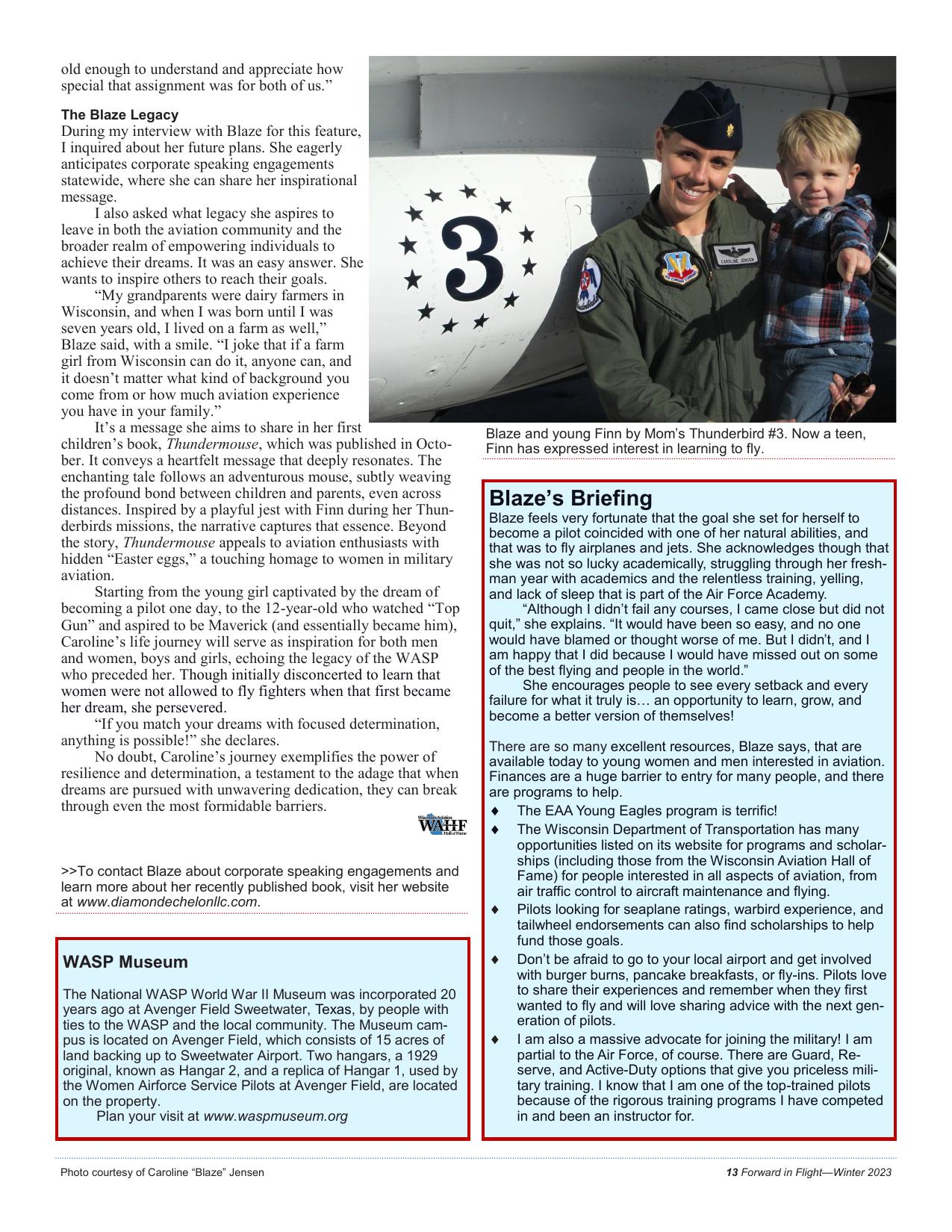
old enough to understand and appreciate how special that assignment was for both of us.” The Blaze Legacy During my interview with Blaze for this feature, I inquired about her future plans. She eagerly anticipates corporate speaking engagements statewide, where she can share her inspirational message. I also asked what legacy she aspires to leave in both the aviation community and the broader realm of empowering individuals to achieve their dreams. It was an easy answer. She wants to inspire others to reach their goals. “My grandparents were dairy farmers in Wisconsin, and when I was born until I was seven years old, I lived on a farm as well,” Blaze said, with a smile. “I joke that if a farm girl from Wisconsin can do it, anyone can, and it doesn’t matter what kind of background you come from or how much aviation experience you have in your family.” It’s a message she aims to share in her first children’s book, Thundermouse, which was published in October. It conveys a heartfelt message that deeply resonates. The enchanting tale follows an adventurous mouse, subtly weaving the profound bond between children and parents, even across distances. Inspired by a playful jest with Finn during her Thunderbirds missions, the narrative captures that essence. Beyond the story, Thundermouse appeals to aviation enthusiasts with hidden “Easter eggs,” a touching homage to women in military aviation. Starting from the young girl captivated by the dream of becoming a pilot one day, to the 12-year-old who watched “Top Gun” and aspired to be Maverick (and essentially became him), Caroline’s life journey will serve as inspiration for both men and women, boys and girls, echoing the legacy of the WASP who preceded her. Though initially disconcerted to learn that women were not allowed to fly fighters when that first became her dream, she persevered. “If you match your dreams with focused determination, anything is possible!” she declares. No doubt, Caroline’s journey exemplifies the power of resilience and determination, a testament to the adage that when dreams are pursued with unwavering dedication, they can break through even the most formidable barriers. >>To contact Blaze about corporate speaking engagements and learn more about her recently published book, visit her website at www.diamondechelonllc.com. WASP Museum The National WASP World War II Museum was incorporated 20 years ago at Avenger Field Sweetwater, Texas, by people with ties to the WASP and the local community. The Museum campus is located on Avenger Field, which consists of 15 acres of land backing up to Sweetwater Airport. Two hangars, a 1929 original, known as Hangar 2, and a replica of Hangar 1, used by the Women Airforce Service Pilots at Avenger Field, are located on the property. Plan your visit at www.waspmuseum.org Photo courtesy of Caroline “Blaze” Jensen Blaze and young Finn by Mom’s Thunderbird #3. Now a teen, Finn has expressed interest in learning to fly. Blaze’s Briefing Blaze feels very fortunate that the goal she set for herself to become a pilot coincided with one of her natural abilities, and that was to fly airplanes and jets. She acknowledges though that she was not so lucky academically, struggling through her freshman year with academics and the relentless training, yelling, and lack of sleep that is part of the Air Force Academy. “Although I didn’t fail any courses, I came close but did not quit,” she explains. “It would have been so easy, and no one would have blamed or thought worse of me. But I didn’t, and I am happy that I did because I would have missed out on some of the best flying and people in the world.” She encourages people to see every setback and every failure for what it truly is… an opportunity to learn, grow, and become a better version of themselves! There are so many excellent resources, Blaze says, that are available today to young women and men interested in aviation. Finances are a huge barrier to entry for many people, and there are programs to help. The EAA Young Eagles program is terrific! The Wisconsin Department of Transportation has many opportunities listed on its website for programs and scholarships (including those from the Wisconsin Aviation Hall of Fame) for people interested in all aspects of aviation, from air traffic control to aircraft maintenance and flying. Pilots looking for seaplane ratings, warbird experience, and tailwheel endorsements can also find scholarships to help fund those goals. Don’t be afraid to go to your local airport and get involved with burger burns, pancake breakfasts, or fly-ins. Pilots love to share their experiences and remember when they first wanted to fly and will love sharing advice with the next generation of pilots. I am also a massive advocate for joining the military! I am partial to the Air Force, of course. There are Guard, Reserve, and Active-Duty options that give you priceless military training. I know that I am one of the top-trained pilots because of the rigorous training programs I have competed in and been an instructor for. 13 Forward in Flight—Winter 2023
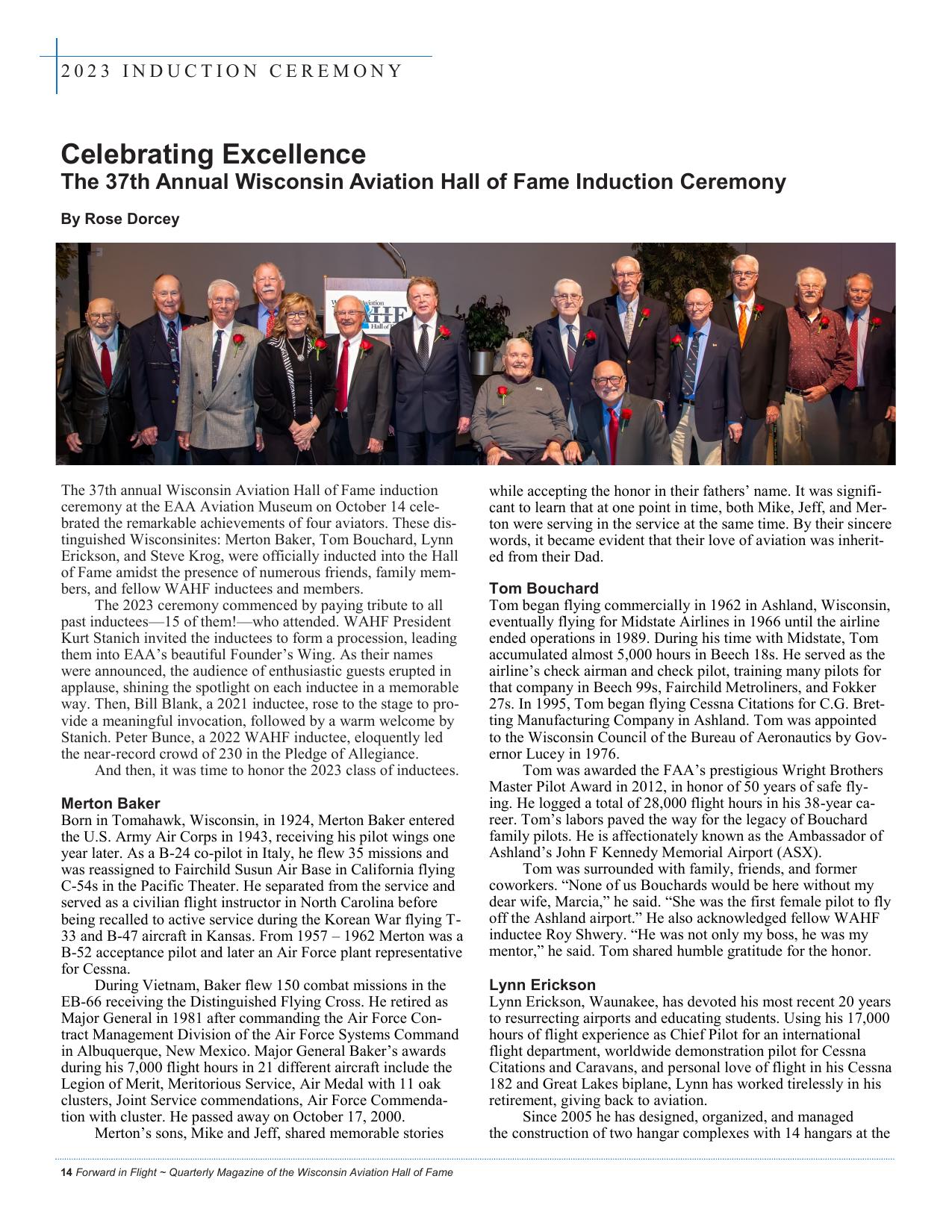
2023 INDUCTION CEREMONY Celebrating Excellence The 37th Annual Wisconsin Aviation Hall of Fame Induction Ceremony By Rose Dorcey The 37th annual Wisconsin Aviation Hall of Fame induction ceremony at the EAA Aviation Museum on October 14 celebrated the remarkable achievements of four aviators. These distinguished Wisconsinites: Merton Baker, Tom Bouchard, Lynn Erickson, and Steve Krog, were officially inducted into the Hall of Fame amidst the presence of numerous friends, family members, and fellow WAHF inductees and members. The 2023 ceremony commenced by paying tribute to all past inductees—15 of them!—who attended. WAHF President Kurt Stanich invited the inductees to form a procession, leading them into EAA’s beautiful Founder’s Wing. As their names were announced, the audience of enthusiastic guests erupted in applause, shining the spotlight on each inductee in a memorable way. Then, Bill Blank, a 2021 inductee, rose to the stage to provide a meaningful invocation, followed by a warm welcome by Stanich. Peter Bunce, a 2022 WAHF inductee, eloquently led the near-record crowd of 230 in the Pledge of Allegiance. And then, it was time to honor the 2023 class of inductees. Merton Baker Born in Tomahawk, Wisconsin, in 1924, Merton Baker entered the U.S. Army Air Corps in 1943, receiving his pilot wings one year later. As a B-24 co-pilot in Italy, he flew 35 missions and was reassigned to Fairchild Susun Air Base in California flying C-54s in the Pacific Theater. He separated from the service and served as a civilian flight instructor in North Carolina before being recalled to active service during the Korean War flying T33 and B-47 aircraft in Kansas. From 1957 – 1962 Merton was a B-52 acceptance pilot and later an Air Force plant representative for Cessna. During Vietnam, Baker flew 150 combat missions in the EB-66 receiving the Distinguished Flying Cross. He retired as Major General in 1981 after commanding the Air Force Contract Management Division of the Air Force Systems Command in Albuquerque, New Mexico. Major General Baker’s awards during his 7,000 flight hours in 21 different aircraft include the Legion of Merit, Meritorious Service, Air Medal with 11 oak clusters, Joint Service commendations, Air Force Commendation with cluster. He passed away on October 17, 2000. Merton’s sons, Mike and Jeff, shared memorable stories 14 Forward in Flight ~ Quarterly Magazine of the Wisconsin Aviation Hall of Fame while accepting the honor in their fathers’ name. It was significant to learn that at one point in time, both Mike, Jeff, and Merton were serving in the service at the same time. By their sincere words, it became evident that their love of aviation was inherited from their Dad. Tom Bouchard Tom began flying commercially in 1962 in Ashland, Wisconsin, eventually flying for Midstate Airlines in 1966 until the airline ended operations in 1989. During his time with Midstate, Tom accumulated almost 5,000 hours in Beech 18s. He served as the airline’s check airman and check pilot, training many pilots for that company in Beech 99s, Fairchild Metroliners, and Fokker 27s. In 1995, Tom began flying Cessna Citations for C.G. Bretting Manufacturing Company in Ashland. Tom was appointed to the Wisconsin Council of the Bureau of Aeronautics by Governor Lucey in 1976. Tom was awarded the FAA’s prestigious Wright Brothers Master Pilot Award in 2012, in honor of 50 years of safe flying. He logged a total of 28,000 flight hours in his 38-year career. Tom’s labors paved the way for the legacy of Bouchard family pilots. He is affectionately known as the Ambassador of Ashland’s John F Kennedy Memorial Airport (ASX). Tom was surrounded with family, friends, and former coworkers. “None of us Bouchards would be here without my dear wife, Marcia,” he said. “She was the first female pilot to fly off the Ashland airport.” He also acknowledged fellow WAHF inductee Roy Shwery. “He was not only my boss, he was my mentor,” he said. Tom shared humble gratitude for the honor. Lynn Erickson Lynn Erickson, Waunakee, has devoted his most recent 20 years to resurrecting airports and educating students. Using his 17,000 hours of flight experience as Chief Pilot for an international flight department, worldwide demonstration pilot for Cessna Citations and Caravans, and personal love of flight in his Cessna 182 and Great Lakes biplane, Lynn has worked tirelessly in his retirement, giving back to aviation. Since 2005 he has designed, organized, and managed the construction of two hangar complexes with 14 hangars at the
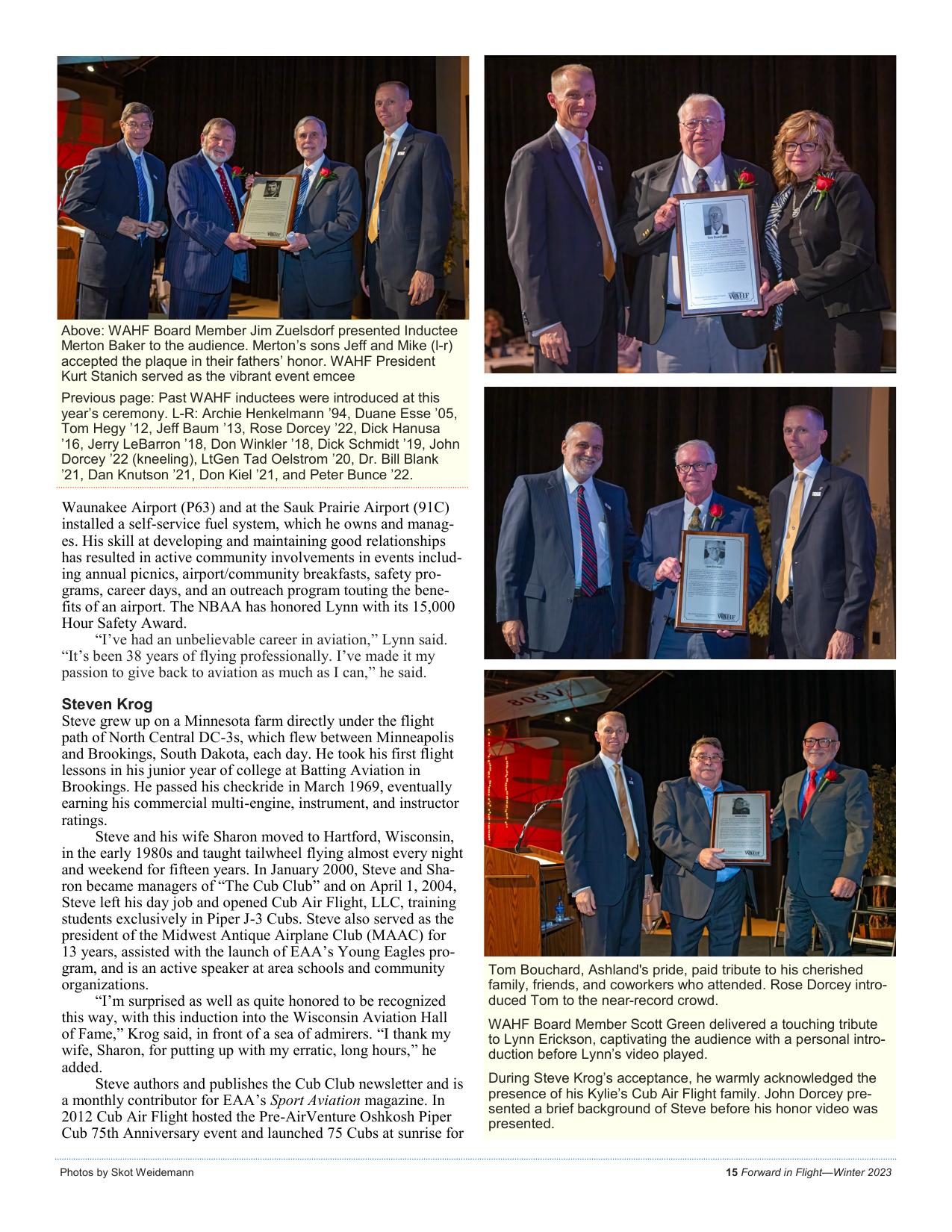
Above: WAHF Board Member Jim Zuelsdorf presented Inductee Merton Baker to the audience. Merton’s sons Jeff and Mike (l-r) accepted the plaque in their fathers’ honor. WAHF President Kurt Stanich served as the vibrant event emcee Previous page: Past WAHF inductees were introduced at this year’s ceremony. L-R: Archie Henkelmann ’94, Duane Esse ’05, Tom Hegy ’12, Jeff Baum ’13, Rose Dorcey ’22, Dick Hanusa ’16, Jerry LeBarron ’18, Don Winkler ’18, Dick Schmidt ’19, John Dorcey ’22 (kneeling), LtGen Tad Oelstrom ’20, Dr. Bill Blank ’21, Dan Knutson ’21, Don Kiel ’21, and Peter Bunce ’22. Waunakee Airport (P63) and at the Sauk Prairie Airport (91C) installed a self-service fuel system, which he owns and manages. His skill at developing and maintaining good relationships has resulted in active community involvements in events including annual picnics, airport/community breakfasts, safety programs, career days, and an outreach program touting the benefits of an airport. The NBAA has honored Lynn with its 15,000 Hour Safety Award. “I’ve had an unbelievable career in aviation,” Lynn said. “It’s been 38 years of flying professionally. I’ve made it my passion to give back to aviation as much as I can,” he said. Steven Krog Steve grew up on a Minnesota farm directly under the flight path of North Central DC-3s, which flew between Minneapolis and Brookings, South Dakota, each day. He took his first flight lessons in his junior year of college at Batting Aviation in Brookings. He passed his checkride in March 1969, eventually earning his commercial multi-engine, instrument, and instructor ratings. Steve and his wife Sharon moved to Hartford, Wisconsin, in the early 1980s and taught tailwheel flying almost every night and weekend for fifteen years. In January 2000, Steve and Sharon became managers of “The Cub Club” and on April 1, 2004, Steve left his day job and opened Cub Air Flight, LLC, training students exclusively in Piper J-3 Cubs. Steve also served as the president of the Midwest Antique Airplane Club (MAAC) for 13 years, assisted with the launch of EAA’s Young Eagles program, and is an active speaker at area schools and community organizations. “I’m surprised as well as quite honored to be recognized this way, with this induction into the Wisconsin Aviation Hall of Fame,” Krog said, in front of a sea of admirers. “I thank my wife, Sharon, for putting up with my erratic, long hours,” he added. Steve authors and publishes the Cub Club newsletter and is a monthly contributor for EAA’s Sport Aviation magazine. In 2012 Cub Air Flight hosted the Pre-AirVenture Oshkosh Piper Cub 75th Anniversary event and launched 75 Cubs at sunrise for Photos by Skot Weidemann Tom Bouchard, Ashland's pride, paid tribute to his cherished family, friends, and coworkers who attended. Rose Dorcey introduced Tom to the near-record crowd. WAHF Board Member Scott Green delivered a touching tribute to Lynn Erickson, captivating the audience with a personal introduction before Lynn’s video played. During Steve Krog’s acceptance, he warmly acknowledged the presence of his Kylie’s Cub Air Flight family. John Dorcey presented a brief background of Steve before his honor video was presented. 15 Forward in Flight—Winter 2023
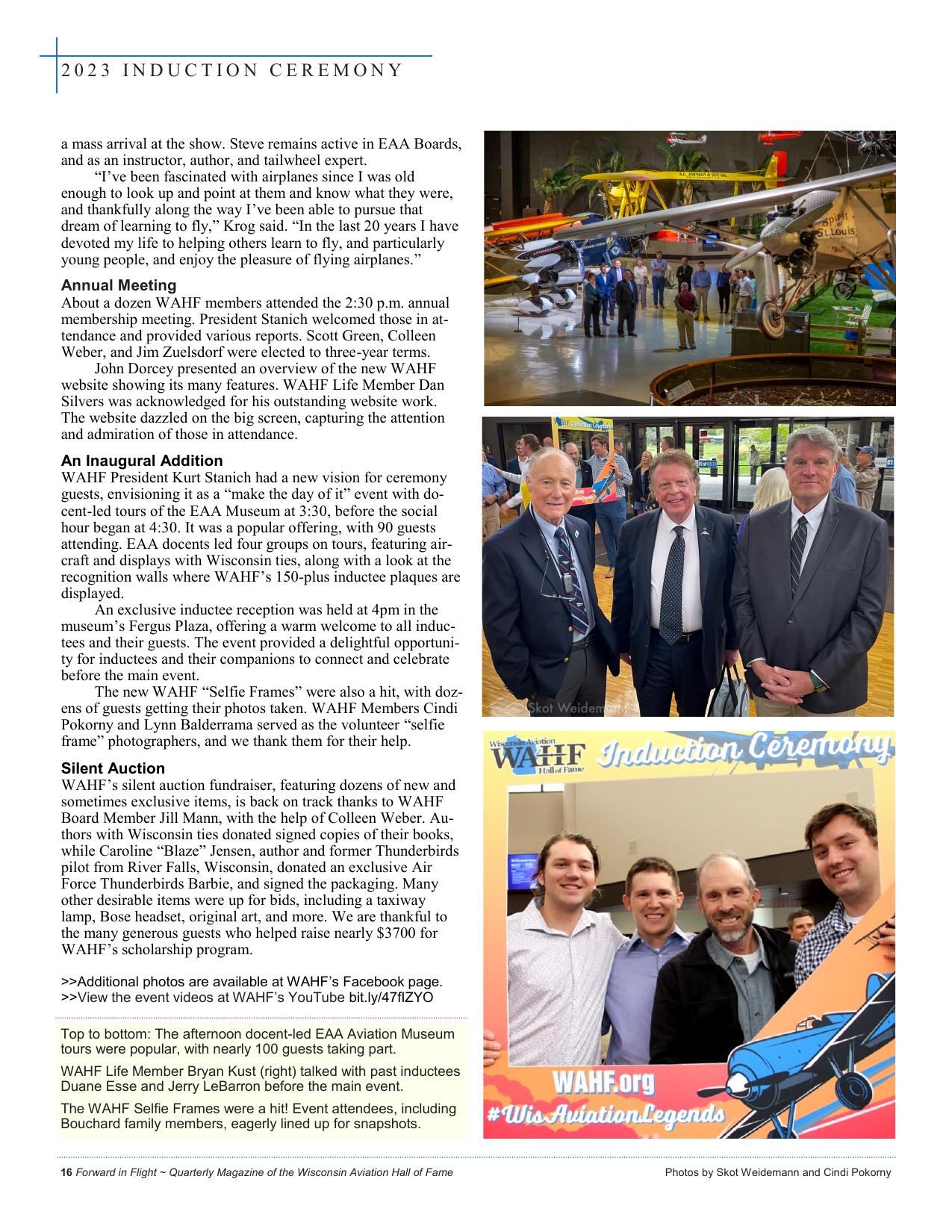
2023 INDUCTION CEREMONY a mass arrival at the show. Steve remains active in EAA Boards, and as an instructor, author, and tailwheel expert. “I’ve been fascinated with airplanes since I was old enough to look up and point at them and know what they were, and thankfully along the way I’ve been able to pursue that dream of learning to fly,” Krog said. “In the last 20 years I have devoted my life to helping others learn to fly, and particularly young people, and enjoy the pleasure of flying airplanes.” Annual Meeting About a dozen WAHF members attended the 2:30 p.m. annual membership meeting. President Stanich welcomed those in attendance and provided various reports. Scott Green, Colleen Weber, and Jim Zuelsdorf were elected to three-year terms. John Dorcey presented an overview of the new WAHF website showing its many features. WAHF Life Member Dan Silvers was acknowledged for his outstanding website work. The website dazzled on the big screen, capturing the attention and admiration of those in attendance. An Inaugural Addition WAHF President Kurt Stanich had a new vision for ceremony guests, envisioning it as a “make the day of it” event with docent-led tours of the EAA Museum at 3:30, before the social hour began at 4:30. It was a popular offering, with 90 guests attending. EAA docents led four groups on tours, featuring aircraft and displays with Wisconsin ties, along with a look at the recognition walls where WAHF’s 150-plus inductee plaques are displayed. An exclusive inductee reception was held at 4pm in the museum’s Fergus Plaza, offering a warm welcome to all inductees and their guests. The event provided a delightful opportunity for inductees and their companions to connect and celebrate before the main event. The new WAHF “Selfie Frames” were also a hit, with dozens of guests getting their photos taken. WAHF Members Cindi Pokorny and Lynn Balderrama served as the volunteer “selfie frame” photographers, and we thank them for their help. Silent Auction WAHF’s silent auction fundraiser, featuring dozens of new and sometimes exclusive items, is back on track thanks to WAHF Board Member Jill Mann, with the help of Colleen Weber. Authors with Wisconsin ties donated signed copies of their books, while Caroline “Blaze” Jensen, author and former Thunderbirds pilot from River Falls, Wisconsin, donated an exclusive Air Force Thunderbirds Barbie, and signed the packaging. Many other desirable items were up for bids, including a taxiway lamp, Bose headset, original art, and more. We are thankful to the many generous guests who helped raise nearly $3700 for WAHF’s scholarship program. >>Additional photos are available at WAHF’s Facebook page. >>View the event videos at WAHF’s YouTube bit.ly/47fIZYO Top to bottom: The afternoon docent-led EAA Aviation Museum tours were popular, with nearly 100 guests taking part. WAHF Life Member Bryan Kust (right) talked with past inductees Duane Esse and Jerry LeBarron before the main event. The WAHF Selfie Frames were a hit! Event attendees, including Bouchard family members, eagerly lined up for snapshots. 16 Forward in Flight ~ Quarterly Magazine of the Wisconsin Aviation Hall of Fame Photos by Skot Weidemann and Cindi Pokorny
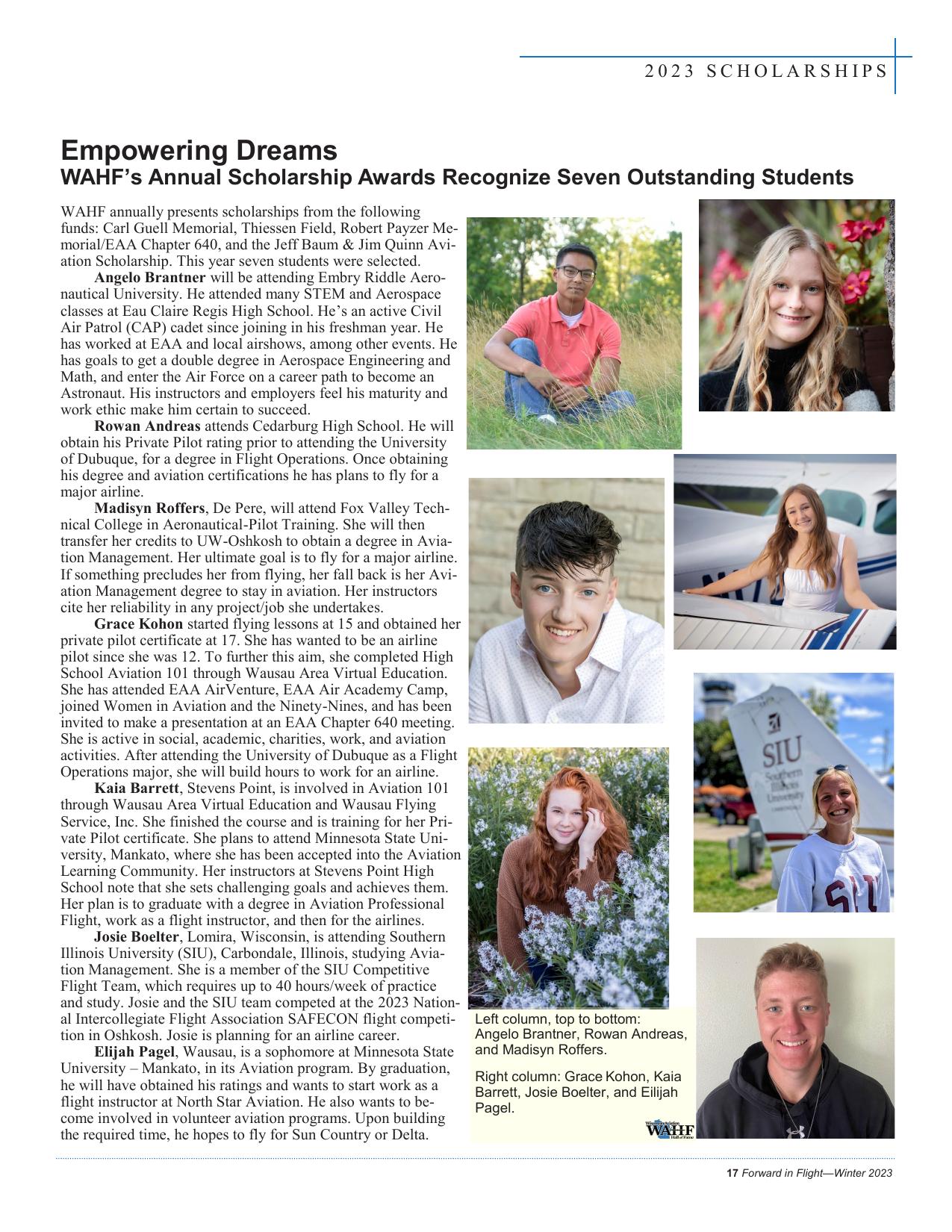
2023 SCHOLARSHIPS Empowering Dreams WAHF’s Annual Scholarship Awards Recognize Seven Outstanding Students WAHF annually presents scholarships from the following funds: Carl Guell Memorial, Thiessen Field, Robert Payzer Memorial/EAA Chapter 640, and the Jeff Baum & Jim Quinn Aviation Scholarship. This year seven students were selected. Angelo Brantner will be attending Embry Riddle Aeronautical University. He attended many STEM and Aerospace classes at Eau Claire Regis High School. He’s an active Civil Air Patrol (CAP) cadet since joining in his freshman year. He has worked at EAA and local airshows, among other events. He has goals to get a double degree in Aerospace Engineering and Math, and enter the Air Force on a career path to become an Astronaut. His instructors and employers feel his maturity and work ethic make him certain to succeed. Rowan Andreas attends Cedarburg High School. He will obtain his Private Pilot rating prior to attending the University of Dubuque, for a degree in Flight Operations. Once obtaining his degree and aviation certifications he has plans to fly for a major airline. Madisyn Roffers, De Pere, will attend Fox Valley Technical College in Aeronautical-Pilot Training. She will then transfer her credits to UW-Oshkosh to obtain a degree in Aviation Management. Her ultimate goal is to fly for a major airline. If something precludes her from flying, her fall back is her Aviation Management degree to stay in aviation. Her instructors cite her reliability in any project/job she undertakes. Grace Kohon started flying lessons at 15 and obtained her private pilot certificate at 17. She has wanted to be an airline pilot since she was 12. To further this aim, she completed High School Aviation 101 through Wausau Area Virtual Education. She has attended EAA AirVenture, EAA Air Academy Camp, joined Women in Aviation and the Ninety-Nines, and has been invited to make a presentation at an EAA Chapter 640 meeting. She is active in social, academic, charities, work, and aviation activities. After attending the University of Dubuque as a Flight Operations major, she will build hours to work for an airline. Kaia Barrett, Stevens Point, is involved in Aviation 101 through Wausau Area Virtual Education and Wausau Flying Service, Inc. She finished the course and is training for her Private Pilot certificate. She plans to attend Minnesota State University, Mankato, where she has been accepted into the Aviation Learning Community. Her instructors at Stevens Point High School note that she sets challenging goals and achieves them. Her plan is to graduate with a degree in Aviation Professional Flight, work as a flight instructor, and then for the airlines. Josie Boelter, Lomira, Wisconsin, is attending Southern Illinois University (SIU), Carbondale, Illinois, studying Aviation Management. She is a member of the SIU Competitive Flight Team, which requires up to 40 hours/week of practice and study. Josie and the SIU team competed at the 2023 National Intercollegiate Flight Association SAFECON flight competition in Oshkosh. Josie is planning for an airline career. Elijah Pagel, Wausau, is a sophomore at Minnesota State University – Mankato, in its Aviation program. By graduation, he will have obtained his ratings and wants to start work as a flight instructor at North Star Aviation. He also wants to become involved in volunteer aviation programs. Upon building the required time, he hopes to fly for Sun Country or Delta. Left column, top to bottom: Angelo Brantner, Rowan Andreas, and Madisyn Roffers. Right column: Grace Kohon, Kaia Barrett, Josie Boelter, and Eilijah Pagel. 17 Forward in Flight—Winter 2023
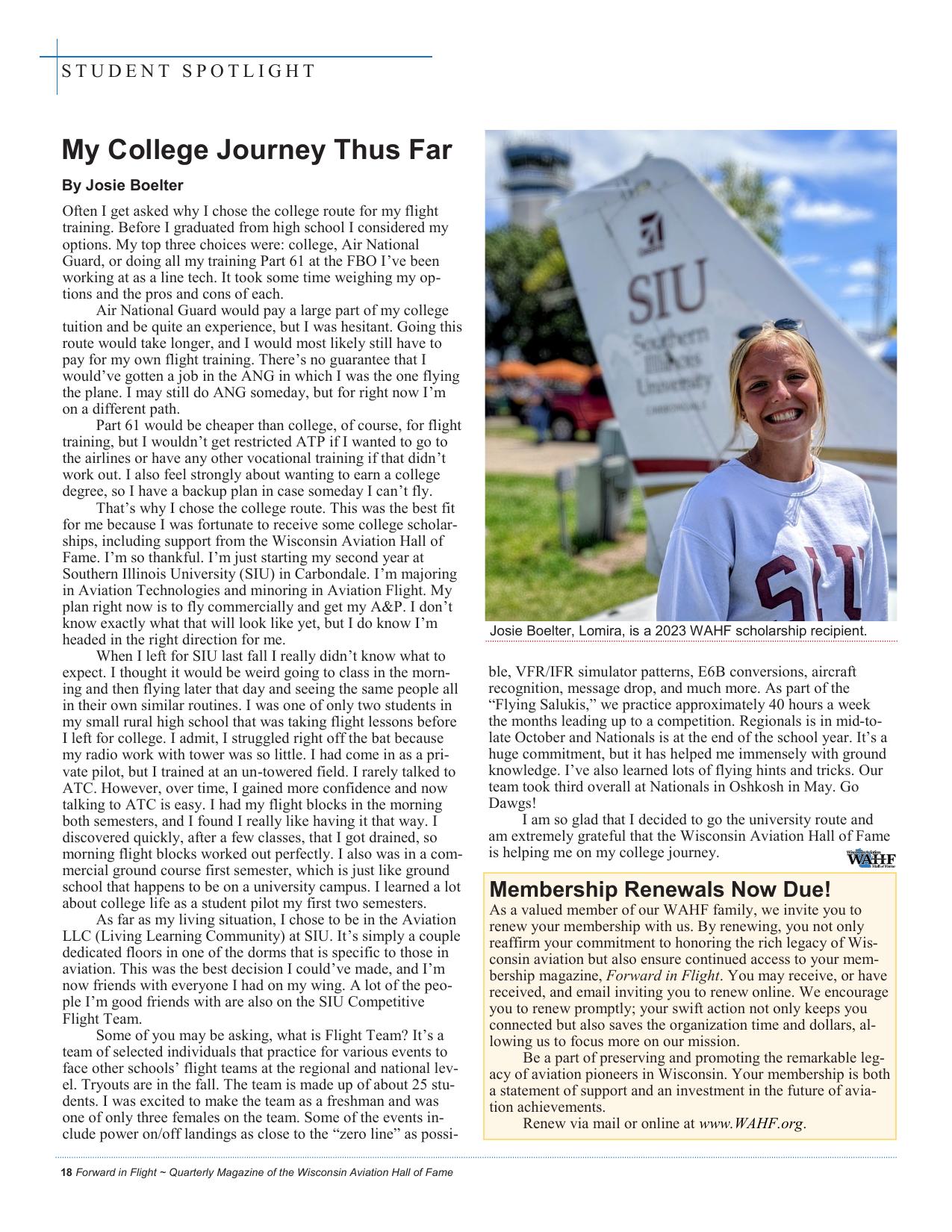
STUDENT SPOTLIGHT My College Journey Thus Far By Josie Boelter Often I get asked why I chose the college route for my flight training. Before I graduated from high school I considered my options. My top three choices were: college, Air National Guard, or doing all my training Part 61 at the FBO I’ve been working at as a line tech. It took some time weighing my options and the pros and cons of each. Air National Guard would pay a large part of my college tuition and be quite an experience, but I was hesitant. Going this route would take longer, and I would most likely still have to pay for my own flight training. There’s no guarantee that I would’ve gotten a job in the ANG in which I was the one flying the plane. I may still do ANG someday, but for right now I’m on a different path. Part 61 would be cheaper than college, of course, for flight training, but I wouldn’t get restricted ATP if I wanted to go to the airlines or have any other vocational training if that didn’t work out. I also feel strongly about wanting to earn a college degree, so I have a backup plan in case someday I can’t fly. That’s why I chose the college route. This was the best fit for me because I was fortunate to receive some college scholarships, including support from the Wisconsin Aviation Hall of Fame. I’m so thankful. I’m just starting my second year at Southern Illinois University (SIU) in Carbondale. I’m majoring in Aviation Technologies and minoring in Aviation Flight. My plan right now is to fly commercially and get my A&P. I don’t know exactly what that will look like yet, but I do know I’m headed in the right direction for me. When I left for SIU last fall I really didn’t know what to expect. I thought it would be weird going to class in the morning and then flying later that day and seeing the same people all in their own similar routines. I was one of only two students in my small rural high school that was taking flight lessons before I left for college. I admit, I struggled right off the bat because my radio work with tower was so little. I had come in as a private pilot, but I trained at an un-towered field. I rarely talked to ATC. However, over time, I gained more confidence and now talking to ATC is easy. I had my flight blocks in the morning both semesters, and I found I really like having it that way. I discovered quickly, after a few classes, that I got drained, so morning flight blocks worked out perfectly. I also was in a commercial ground course first semester, which is just like ground school that happens to be on a university campus. I learned a lot about college life as a student pilot my first two semesters. As far as my living situation, I chose to be in the Aviation LLC (Living Learning Community) at SIU. It’s simply a couple dedicated floors in one of the dorms that is specific to those in aviation. This was the best decision I could’ve made, and I’m now friends with everyone I had on my wing. A lot of the people I’m good friends with are also on the SIU Competitive Flight Team. Some of you may be asking, what is Flight Team? It’s a team of selected individuals that practice for various events to face other schools’ flight teams at the regional and national level. Tryouts are in the fall. The team is made up of about 25 students. I was excited to make the team as a freshman and was one of only three females on the team. Some of the events include power on/off landings as close to the “zero line” as possi18 Forward in Flight ~ Quarterly Magazine of the Wisconsin Aviation Hall of Fame Josie Boelter, Lomira, is a 2023 WAHF scholarship recipient. ble, VFR/IFR simulator patterns, E6B conversions, aircraft recognition, message drop, and much more. As part of the “Flying Salukis,” we practice approximately 40 hours a week the months leading up to a competition. Regionals is in mid-tolate October and Nationals is at the end of the school year. It’s a huge commitment, but it has helped me immensely with ground knowledge. I’ve also learned lots of flying hints and tricks. Our team took third overall at Nationals in Oshkosh in May. Go Dawgs! I am so glad that I decided to go the university route and am extremely grateful that the Wisconsin Aviation Hall of Fame is helping me on my college journey. Membership Renewals Now Due! As a valued member of our WAHF family, we invite you to renew your membership with us. By renewing, you not only reaffirm your commitment to honoring the rich legacy of Wisconsin aviation but also ensure continued access to your membership magazine, Forward in Flight. You may receive, or have received, and email inviting you to renew online. We encourage you to renew promptly; your swift action not only keeps you connected but also saves the organization time and dollars, allowing us to focus more on our mission. Be a part of preserving and promoting the remarkable legacy of aviation pioneers in Wisconsin. Your membership is both a statement of support and an investment in the future of aviation achievements. Renew via mail or online at www.WAHF.org.
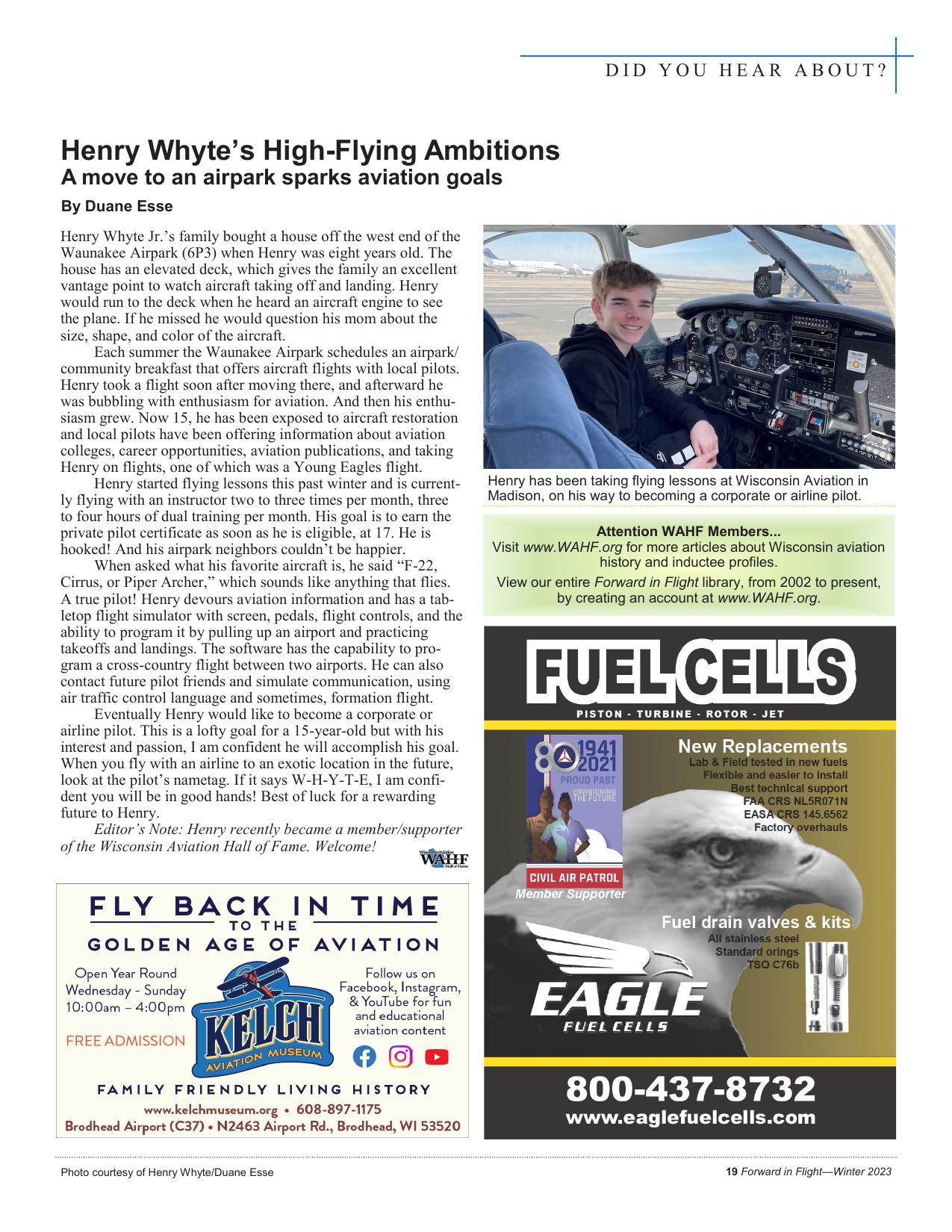
DID YOU HEAR ABOUT? Henry Whyte’s High-Flying Ambitions A move to an airpark sparks aviation goals By Duane Esse Henry Whyte Jr.’s family bought a house off the west end of the Waunakee Airpark (6P3) when Henry was eight years old. The house has an elevated deck, which gives the family an excellent vantage point to watch aircraft taking off and landing. Henry would run to the deck when he heard an aircraft engine to see the plane. If he missed he would question his mom about the size, shape, and color of the aircraft. Each summer the Waunakee Airpark schedules an airpark/ community breakfast that offers aircraft flights with local pilots. Henry took a flight soon after moving there, and afterward he was bubbling with enthusiasm for aviation. And then his enthusiasm grew. Now 15, he has been exposed to aircraft restoration and local pilots have been offering information about aviation colleges, career opportunities, aviation publications, and taking Henry on flights, one of which was a Young Eagles flight. Henry started flying lessons this past winter and is currently flying with an instructor two to three times per month, three to four hours of dual training per month. His goal is to earn the private pilot certificate as soon as he is eligible, at 17. He is hooked! And his airpark neighbors couldn’t be happier. When asked what his favorite aircraft is, he said “F-22, Cirrus, or Piper Archer,” which sounds like anything that flies. A true pilot! Henry devours aviation information and has a tabletop flight simulator with screen, pedals, flight controls, and the ability to program it by pulling up an airport and practicing takeoffs and landings. The software has the capability to program a cross-country flight between two airports. He can also contact future pilot friends and simulate communication, using air traffic control language and sometimes, formation flight. Eventually Henry would like to become a corporate or airline pilot. This is a lofty goal for a 15-year-old but with his interest and passion, I am confident he will accomplish his goal. When you fly with an airline to an exotic location in the future, look at the pilot’s nametag. If it says W-H-Y-T-E, I am confident you will be in good hands! Best of luck for a rewarding future to Henry. Editor’s Note: Henry recently became a member/supporter of the Wisconsin Aviation Hall of Fame. Welcome! Photo courtesy of Henry Whyte/Duane Esse Henry has been taking flying lessons at Wisconsin Aviation in Madison, on his way to becoming a corporate or airline pilot. Attention WAHF Members... Visit www.WAHF.org for more articles about Wisconsin aviation history and inductee profiles. View our entire Forward in Flight library, from 2002 to present, by creating an account at www.WAHF.org. 19 Forward in Flight—Winter 2023
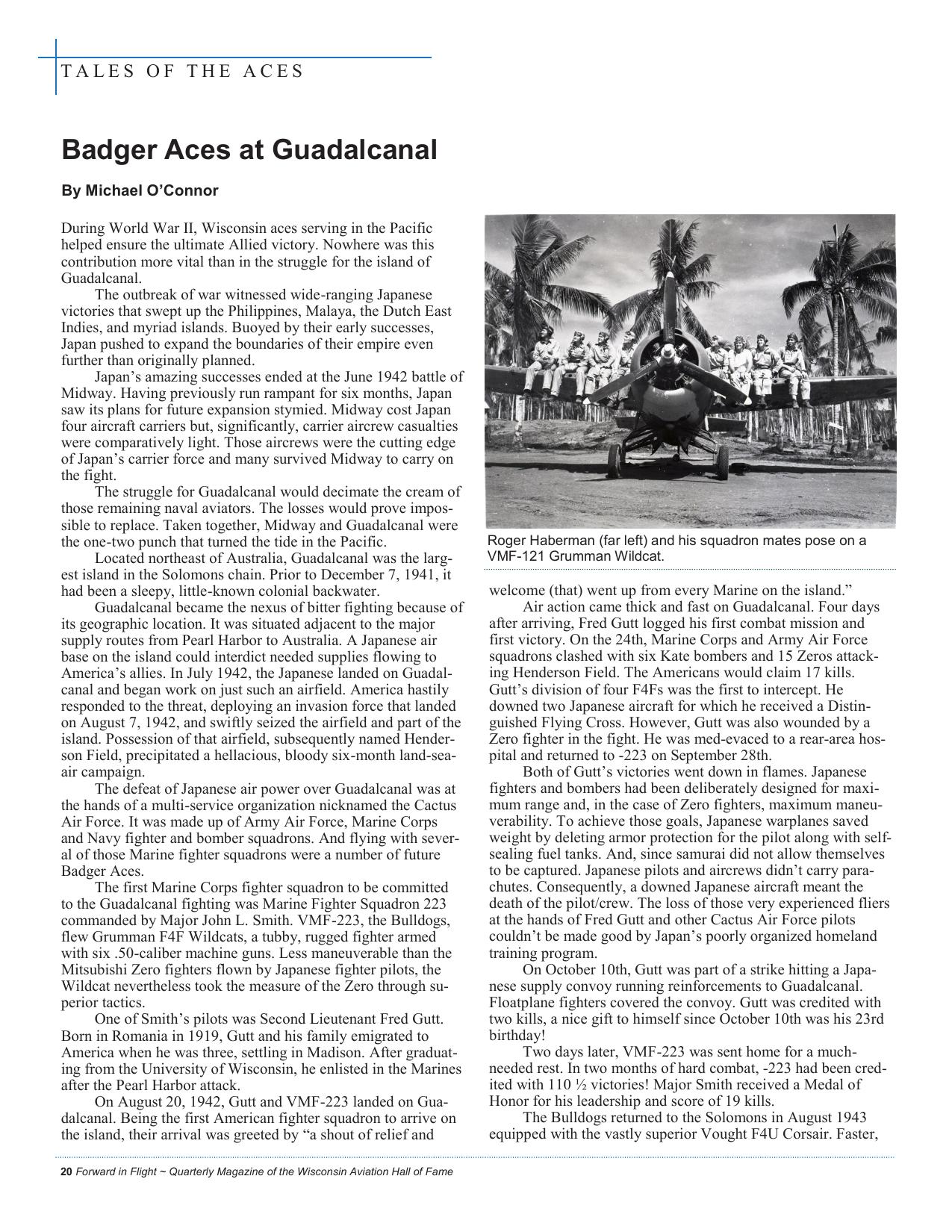
TALES OF THE ACES Badger Aces at Guadalcanal By Michael O’Connor During World War II, Wisconsin aces serving in the Pacific helped ensure the ultimate Allied victory. Nowhere was this contribution more vital than in the struggle for the island of Guadalcanal. The outbreak of war witnessed wide-ranging Japanese victories that swept up the Philippines, Malaya, the Dutch East Indies, and myriad islands. Buoyed by their early successes, Japan pushed to expand the boundaries of their empire even further than originally planned. Japan’s amazing successes ended at the June 1942 battle of Midway. Having previously run rampant for six months, Japan saw its plans for future expansion stymied. Midway cost Japan four aircraft carriers but, significantly, carrier aircrew casualties were comparatively light. Those aircrews were the cutting edge of Japan’s carrier force and many survived Midway to carry on the fight. The struggle for Guadalcanal would decimate the cream of those remaining naval aviators. The losses would prove impossible to replace. Taken together, Midway and Guadalcanal were the one-two punch that turned the tide in the Pacific. Located northeast of Australia, Guadalcanal was the largest island in the Solomons chain. Prior to December 7, 1941, it had been a sleepy, little-known colonial backwater. Guadalcanal became the nexus of bitter fighting because of its geographic location. It was situated adjacent to the major supply routes from Pearl Harbor to Australia. A Japanese air base on the island could interdict needed supplies flowing to America’s allies. In July 1942, the Japanese landed on Guadalcanal and began work on just such an airfield. America hastily responded to the threat, deploying an invasion force that landed on August 7, 1942, and swiftly seized the airfield and part of the island. Possession of that airfield, subsequently named Henderson Field, precipitated a hellacious, bloody six-month land-seaair campaign. The defeat of Japanese air power over Guadalcanal was at the hands of a multi-service organization nicknamed the Cactus Air Force. It was made up of Army Air Force, Marine Corps and Navy fighter and bomber squadrons. And flying with several of those Marine fighter squadrons were a number of future Badger Aces. The first Marine Corps fighter squadron to be committed to the Guadalcanal fighting was Marine Fighter Squadron 223 commanded by Major John L. Smith. VMF-223, the Bulldogs, flew Grumman F4F Wildcats, a tubby, rugged fighter armed with six .50-caliber machine guns. Less maneuverable than the Mitsubishi Zero fighters flown by Japanese fighter pilots, the Wildcat nevertheless took the measure of the Zero through superior tactics. One of Smith’s pilots was Second Lieutenant Fred Gutt. Born in Romania in 1919, Gutt and his family emigrated to America when he was three, settling in Madison. After graduating from the University of Wisconsin, he enlisted in the Marines after the Pearl Harbor attack. On August 20, 1942, Gutt and VMF-223 landed on Guadalcanal. Being the first American fighter squadron to arrive on the island, their arrival was greeted by “a shout of relief and 20 Forward in Flight ~ Quarterly Magazine of the Wisconsin Aviation Hall of Fame Roger Haberman (far left) and his squadron mates pose on a VMF-121 Grumman Wildcat. welcome (that) went up from every Marine on the island.” Air action came thick and fast on Guadalcanal. Four days after arriving, Fred Gutt logged his first combat mission and first victory. On the 24th, Marine Corps and Army Air Force squadrons clashed with six Kate bombers and 15 Zeros attacking Henderson Field. The Americans would claim 17 kills. Gutt’s division of four F4Fs was the first to intercept. He downed two Japanese aircraft for which he received a Distinguished Flying Cross. However, Gutt was also wounded by a Zero fighter in the fight. He was med-evaced to a rear-area hospital and returned to -223 on September 28th. Both of Gutt’s victories went down in flames. Japanese fighters and bombers had been deliberately designed for maximum range and, in the case of Zero fighters, maximum maneuverability. To achieve those goals, Japanese warplanes saved weight by deleting armor protection for the pilot along with selfsealing fuel tanks. And, since samurai did not allow themselves to be captured. Japanese pilots and aircrews didn’t carry parachutes. Consequently, a downed Japanese aircraft meant the death of the pilot/crew. The loss of those very experienced fliers at the hands of Fred Gutt and other Cactus Air Force pilots couldn’t be made good by Japan’s poorly organized homeland training program. On October 10th, Gutt was part of a strike hitting a Japanese supply convoy running reinforcements to Guadalcanal. Floatplane fighters covered the convoy. Gutt was credited with two kills, a nice gift to himself since October 10th was his 23rd birthday! Two days later, VMF-223 was sent home for a muchneeded rest. In two months of hard combat, -223 had been credited with 110 ½ victories! Major Smith received a Medal of Honor for his leadership and score of 19 kills. The Bulldogs returned to the Solomons in August 1943 equipped with the vastly superior Vought F4U Corsair. Faster,
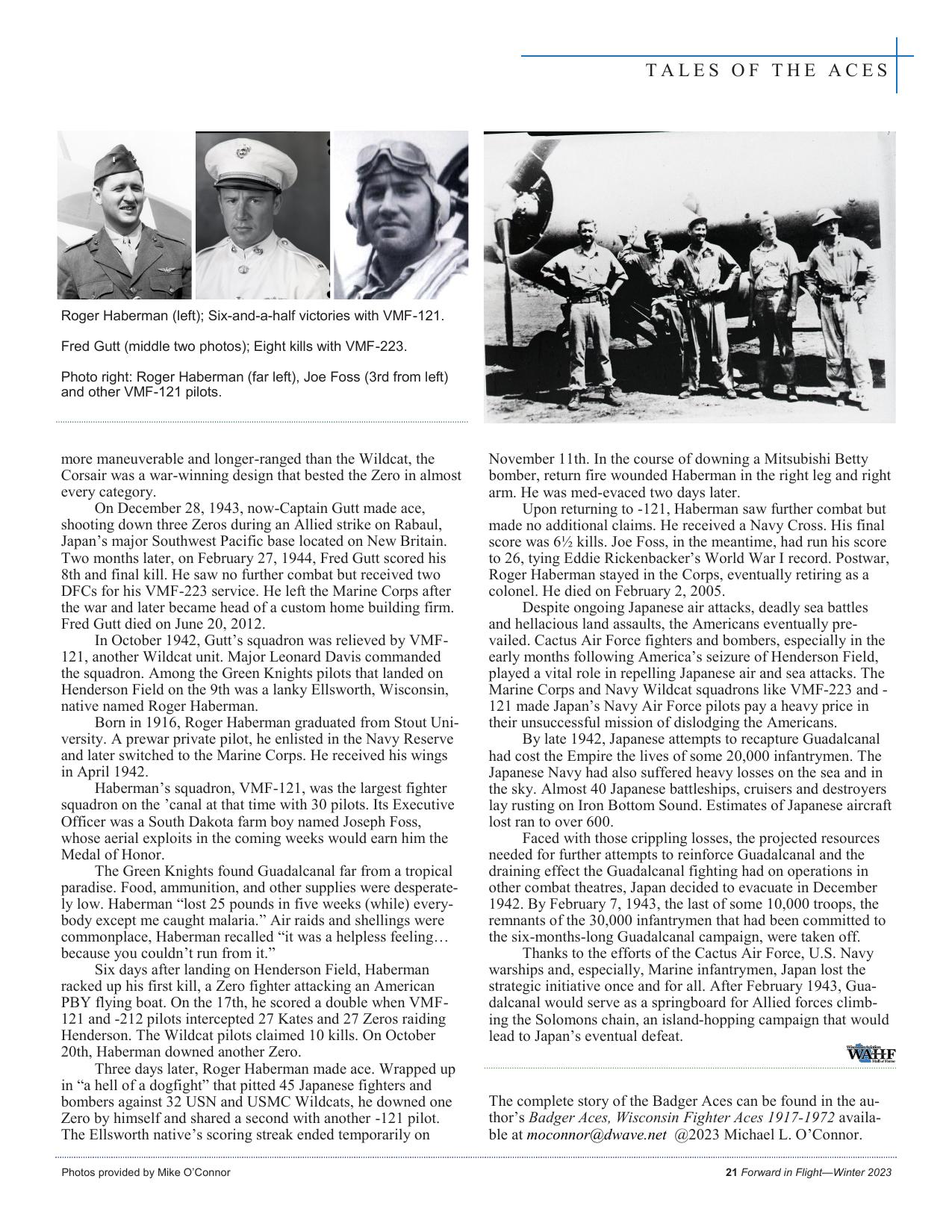
TALES OF THE ACES Roger Haberman (left); Six-and-a-half victories with VMF-121. Fred Gutt (middle two photos); Eight kills with VMF-223. Photo right: Roger Haberman (far left), Joe Foss (3rd from left) and other VMF-121 pilots. more maneuverable and longer-ranged than the Wildcat, the Corsair was a war-winning design that bested the Zero in almost every category. On December 28, 1943, now-Captain Gutt made ace, shooting down three Zeros during an Allied strike on Rabaul, Japan’s major Southwest Pacific base located on New Britain. Two months later, on February 27, 1944, Fred Gutt scored his 8th and final kill. He saw no further combat but received two DFCs for his VMF-223 service. He left the Marine Corps after the war and later became head of a custom home building firm. Fred Gutt died on June 20, 2012. In October 1942, Gutt’s squadron was relieved by VMF121, another Wildcat unit. Major Leonard Davis commanded the squadron. Among the Green Knights pilots that landed on Henderson Field on the 9th was a lanky Ellsworth, Wisconsin, native named Roger Haberman. Born in 1916, Roger Haberman graduated from Stout University. A prewar private pilot, he enlisted in the Navy Reserve and later switched to the Marine Corps. He received his wings in April 1942. Haberman’s squadron, VMF-121, was the largest fighter squadron on the ’canal at that time with 30 pilots. Its Executive Officer was a South Dakota farm boy named Joseph Foss, whose aerial exploits in the coming weeks would earn him the Medal of Honor. The Green Knights found Guadalcanal far from a tropical paradise. Food, ammunition, and other supplies were desperately low. Haberman “lost 25 pounds in five weeks (while) everybody except me caught malaria.” Air raids and shellings were commonplace, Haberman recalled “it was a helpless feeling… because you couldn’t run from it.” Six days after landing on Henderson Field, Haberman racked up his first kill, a Zero fighter attacking an American PBY flying boat. On the 17th, he scored a double when VMF121 and -212 pilots intercepted 27 Kates and 27 Zeros raiding Henderson. The Wildcat pilots claimed 10 kills. On October 20th, Haberman downed another Zero. Three days later, Roger Haberman made ace. Wrapped up in “a hell of a dogfight” that pitted 45 Japanese fighters and bombers against 32 USN and USMC Wildcats, he downed one Zero by himself and shared a second with another -121 pilot. The Ellsworth native’s scoring streak ended temporarily on Photos provided by Mike O’Connor November 11th. In the course of downing a Mitsubishi Betty bomber, return fire wounded Haberman in the right leg and right arm. He was med-evaced two days later. Upon returning to -121, Haberman saw further combat but made no additional claims. He received a Navy Cross. His final score was 6½ kills. Joe Foss, in the meantime, had run his score to 26, tying Eddie Rickenbacker’s World War I record. Postwar, Roger Haberman stayed in the Corps, eventually retiring as a colonel. He died on February 2, 2005. Despite ongoing Japanese air attacks, deadly sea battles and hellacious land assaults, the Americans eventually prevailed. Cactus Air Force fighters and bombers, especially in the early months following America’s seizure of Henderson Field, played a vital role in repelling Japanese air and sea attacks. The Marine Corps and Navy Wildcat squadrons like VMF-223 and 121 made Japan’s Navy Air Force pilots pay a heavy price in their unsuccessful mission of dislodging the Americans. By late 1942, Japanese attempts to recapture Guadalcanal had cost the Empire the lives of some 20,000 infantrymen. The Japanese Navy had also suffered heavy losses on the sea and in the sky. Almost 40 Japanese battleships, cruisers and destroyers lay rusting on Iron Bottom Sound. Estimates of Japanese aircraft lost ran to over 600. Faced with those crippling losses, the projected resources needed for further attempts to reinforce Guadalcanal and the draining effect the Guadalcanal fighting had on operations in other combat theatres, Japan decided to evacuate in December 1942. By February 7, 1943, the last of some 10,000 troops, the remnants of the 30,000 infantrymen that had been committed to the six-months-long Guadalcanal campaign, were taken off. Thanks to the efforts of the Cactus Air Force, U.S. Navy warships and, especially, Marine infantrymen, Japan lost the strategic initiative once and for all. After February 1943, Guadalcanal would serve as a springboard for Allied forces climbing the Solomons chain, an island-hopping campaign that would lead to Japan’s eventual defeat. The complete story of the Badger Aces can be found in the author’s Badger Aces, Wisconsin Fighter Aces 1917-1972 available at moconnor@dwave.net @2023 Michael L. O’Connor. 21 Forward in Flight—Winter 2023
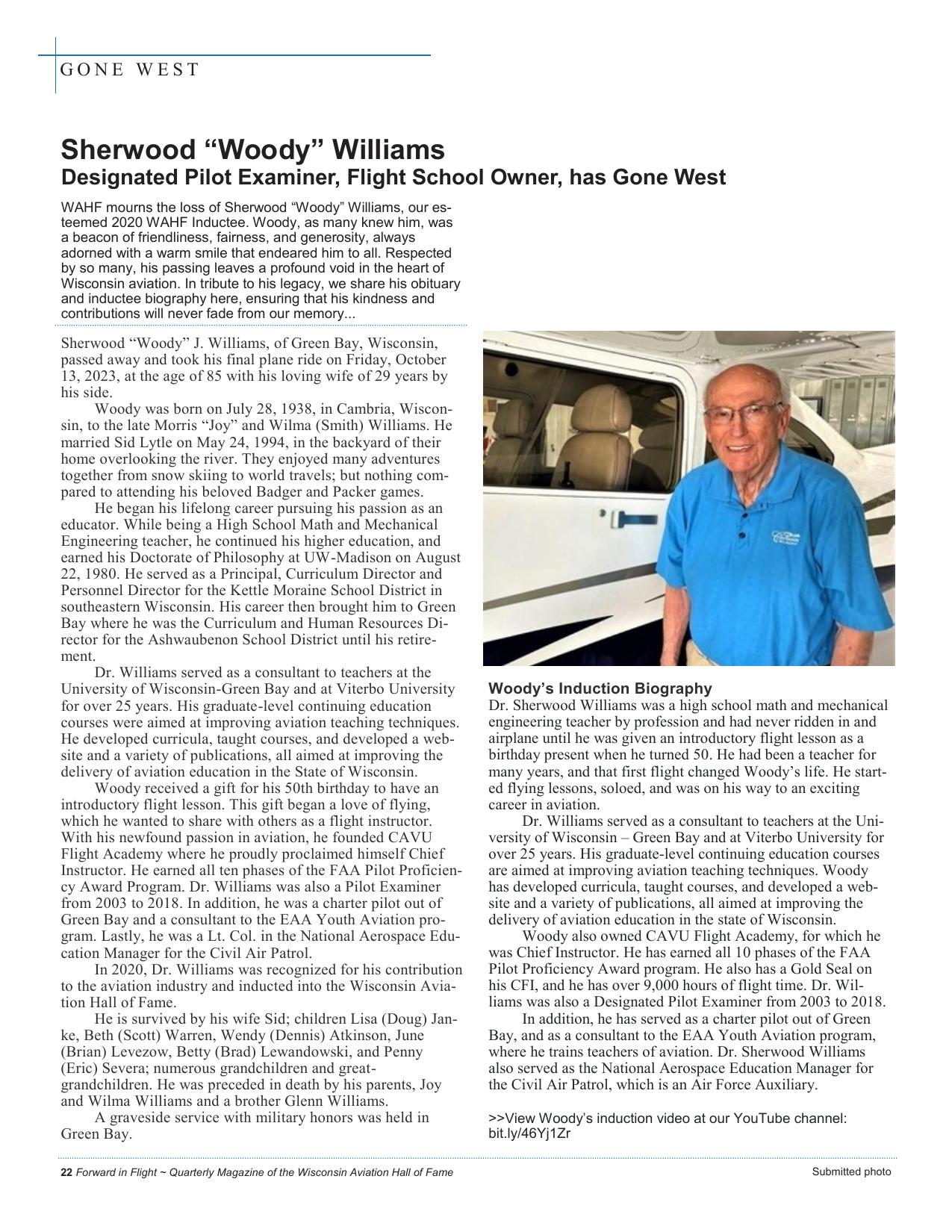
GONE WEST Sherwood “Woody” Williams Designated Pilot Examiner, Flight School Owner, has Gone West WAHF mourns the loss of Sherwood “Woody” Williams, our esteemed 2020 WAHF Inductee. Woody, as many knew him, was a beacon of friendliness, fairness, and generosity, always adorned with a warm smile that endeared him to all. Respected by so many, his passing leaves a profound void in the heart of Wisconsin aviation. In tribute to his legacy, we share his obituary and inductee biography here, ensuring that his kindness and contributions will never fade from our memory... Sherwood “Woody” J. Williams, of Green Bay, Wisconsin, passed away and took his final plane ride on Friday, October 13, 2023, at the age of 85 with his loving wife of 29 years by his side. Woody was born on July 28, 1938, in Cambria, Wisconsin, to the late Morris “Joy” and Wilma (Smith) Williams. He married Sid Lytle on May 24, 1994, in the backyard of their home overlooking the river. They enjoyed many adventures together from snow skiing to world travels; but nothing compared to attending his beloved Badger and Packer games. He began his lifelong career pursuing his passion as an educator. While being a High School Math and Mechanical Engineering teacher, he continued his higher education, and earned his Doctorate of Philosophy at UW-Madison on August 22, 1980. He served as a Principal, Curriculum Director and Personnel Director for the Kettle Moraine School District in southeastern Wisconsin. His career then brought him to Green Bay where he was the Curriculum and Human Resources Director for the Ashwaubenon School District until his retirement. Dr. Williams served as a consultant to teachers at the University of Wisconsin-Green Bay and at Viterbo University for over 25 years. His graduate-level continuing education courses were aimed at improving aviation teaching techniques. He developed curricula, taught courses, and developed a website and a variety of publications, all aimed at improving the delivery of aviation education in the State of Wisconsin. Woody received a gift for his 50th birthday to have an introductory flight lesson. This gift began a love of flying, which he wanted to share with others as a flight instructor. With his newfound passion in aviation, he founded CAVU Flight Academy where he proudly proclaimed himself Chief Instructor. He earned all ten phases of the FAA Pilot Proficiency Award Program. Dr. Williams was also a Pilot Examiner from 2003 to 2018. In addition, he was a charter pilot out of Green Bay and a consultant to the EAA Youth Aviation program. Lastly, he was a Lt. Col. in the National Aerospace Education Manager for the Civil Air Patrol. In 2020, Dr. Williams was recognized for his contribution to the aviation industry and inducted into the Wisconsin Aviation Hall of Fame. He is survived by his wife Sid; children Lisa (Doug) Janke, Beth (Scott) Warren, Wendy (Dennis) Atkinson, June (Brian) Levezow, Betty (Brad) Lewandowski, and Penny (Eric) Severa; numerous grandchildren and greatgrandchildren. He was preceded in death by his parents, Joy and Wilma Williams and a brother Glenn Williams. A graveside service with military honors was held in Green Bay. 22 Forward in Flight ~ Quarterly Magazine of the Wisconsin Aviation Hall of Fame Woody’s Induction Biography Dr. Sherwood Williams was a high school math and mechanical engineering teacher by profession and had never ridden in and airplane until he was given an introductory flight lesson as a birthday present when he turned 50. He had been a teacher for many years, and that first flight changed Woody’s life. He started flying lessons, soloed, and was on his way to an exciting career in aviation. Dr. Williams served as a consultant to teachers at the University of Wisconsin – Green Bay and at Viterbo University for over 25 years. His graduate-level continuing education courses are aimed at improving aviation teaching techniques. Woody has developed curricula, taught courses, and developed a website and a variety of publications, all aimed at improving the delivery of aviation education in the state of Wisconsin. Woody also owned CAVU Flight Academy, for which he was Chief Instructor. He has earned all 10 phases of the FAA Pilot Proficiency Award program. He also has a Gold Seal on his CFI, and he has over 9,000 hours of flight time. Dr. Williams was also a Designated Pilot Examiner from 2003 to 2018. In addition, he has served as a charter pilot out of Green Bay, and as a consultant to the EAA Youth Aviation program, where he trains teachers of aviation. Dr. Sherwood Williams also served as the National Aerospace Education Manager for the Civil Air Patrol, which is an Air Force Auxiliary. >>View Woody’s induction video at our YouTube channel: bit.ly/46Yj1Zr Submitted photo
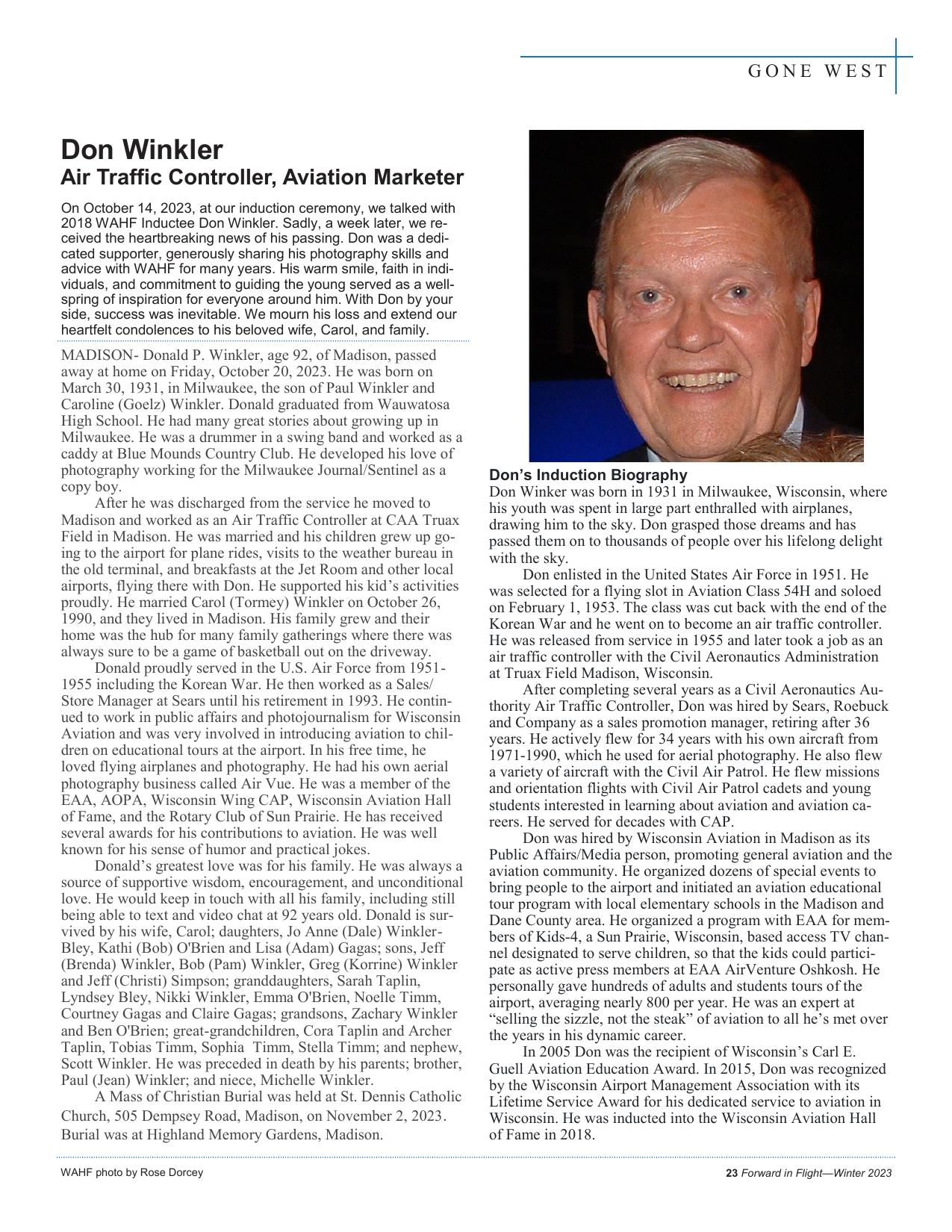
GONE WEST Don Winkler Air Traffic Controller, Aviation Marketer On October 14, 2023, at our induction ceremony, we talked with 2018 WAHF Inductee Don Winkler. Sadly, a week later, we received the heartbreaking news of his passing. Don was a dedicated supporter, generously sharing his photography skills and advice with WAHF for many years. His warm smile, faith in individuals, and commitment to guiding the young served as a wellspring of inspiration for everyone around him. With Don by your side, success was inevitable. We mourn his loss and extend our heartfelt condolences to his beloved wife, Carol, and family. MADISON- Donald P. Winkler, age 92, of Madison, passed away at home on Friday, October 20, 2023. He was born on March 30, 1931, in Milwaukee, the son of Paul Winkler and Caroline (Goelz) Winkler. Donald graduated from Wauwatosa High School. He had many great stories about growing up in Milwaukee. He was a drummer in a swing band and worked as a caddy at Blue Mounds Country Club. He developed his love of photography working for the Milwaukee Journal/Sentinel as a copy boy. After he was discharged from the service he moved to Madison and worked as an Air Traffic Controller at CAA Truax Field in Madison. He was married and his children grew up going to the airport for plane rides, visits to the weather bureau in the old terminal, and breakfasts at the Jet Room and other local airports, flying there with Don. He supported his kid’s activities proudly. He married Carol (Tormey) Winkler on October 26, 1990, and they lived in Madison. His family grew and their home was the hub for many family gatherings where there was always sure to be a game of basketball out on the driveway. Donald proudly served in the U.S. Air Force from 19511955 including the Korean War. He then worked as a Sales/ Store Manager at Sears until his retirement in 1993. He continued to work in public affairs and photojournalism for Wisconsin Aviation and was very involved in introducing aviation to children on educational tours at the airport. In his free time, he loved flying airplanes and photography. He had his own aerial photography business called Air Vue. He was a member of the EAA, AOPA, Wisconsin Wing CAP, Wisconsin Aviation Hall of Fame, and the Rotary Club of Sun Prairie. He has received several awards for his contributions to aviation. He was well known for his sense of humor and practical jokes. Donald’s greatest love was for his family. He was always a source of supportive wisdom, encouragement, and unconditional love. He would keep in touch with all his family, including still being able to text and video chat at 92 years old. Donald is survived by his wife, Carol; daughters, Jo Anne (Dale) WinklerBley, Kathi (Bob) O'Brien and Lisa (Adam) Gagas; sons, Jeff (Brenda) Winkler, Bob (Pam) Winkler, Greg (Korrine) Winkler and Jeff (Christi) Simpson; granddaughters, Sarah Taplin, Lyndsey Bley, Nikki Winkler, Emma O'Brien, Noelle Timm, Courtney Gagas and Claire Gagas; grandsons, Zachary Winkler and Ben O'Brien; great-grandchildren, Cora Taplin and Archer Taplin, Tobias Timm, Sophia Timm, Stella Timm; and nephew, Scott Winkler. He was preceded in death by his parents; brother, Paul (Jean) Winkler; and niece, Michelle Winkler. A Mass of Christian Burial was held at St. Dennis Catholic Church, 505 Dempsey Road, Madison, on November 2, 2023. Burial was at Highland Memory Gardens, Madison. WAHF photo by Rose Dorcey Don’s Induction Biography Don Winker was born in 1931 in Milwaukee, Wisconsin, where his youth was spent in large part enthralled with airplanes, drawing him to the sky. Don grasped those dreams and has passed them on to thousands of people over his lifelong delight with the sky. Don enlisted in the United States Air Force in 1951. He was selected for a flying slot in Aviation Class 54H and soloed on February 1, 1953. The class was cut back with the end of the Korean War and he went on to become an air traffic controller. He was released from service in 1955 and later took a job as an air traffic controller with the Civil Aeronautics Administration at Truax Field Madison, Wisconsin. After completing several years as a Civil Aeronautics Authority Air Traffic Controller, Don was hired by Sears, Roebuck and Company as a sales promotion manager, retiring after 36 years. He actively flew for 34 years with his own aircraft from 1971-1990, which he used for aerial photography. He also flew a variety of aircraft with the Civil Air Patrol. He flew missions and orientation flights with Civil Air Patrol cadets and young students interested in learning about aviation and aviation careers. He served for decades with CAP. Don was hired by Wisconsin Aviation in Madison as its Public Affairs/Media person, promoting general aviation and the aviation community. He organized dozens of special events to bring people to the airport and initiated an aviation educational tour program with local elementary schools in the Madison and Dane County area. He organized a program with EAA for members of Kids-4, a Sun Prairie, Wisconsin, based access TV channel designated to serve children, so that the kids could participate as active press members at EAA AirVenture Oshkosh. He personally gave hundreds of adults and students tours of the airport, averaging nearly 800 per year. He was an expert at “selling the sizzle, not the steak” of aviation to all he’s met over the years in his dynamic career. In 2005 Don was the recipient of Wisconsin’s Carl E. Guell Aviation Education Award. In 2015, Don was recognized by the Wisconsin Airport Management Association with its Lifetime Service Award for his dedicated service to aviation in Wisconsin. He was inducted into the Wisconsin Aviation Hall of Fame in 2018. 23 Forward in Flight—Winter 2023
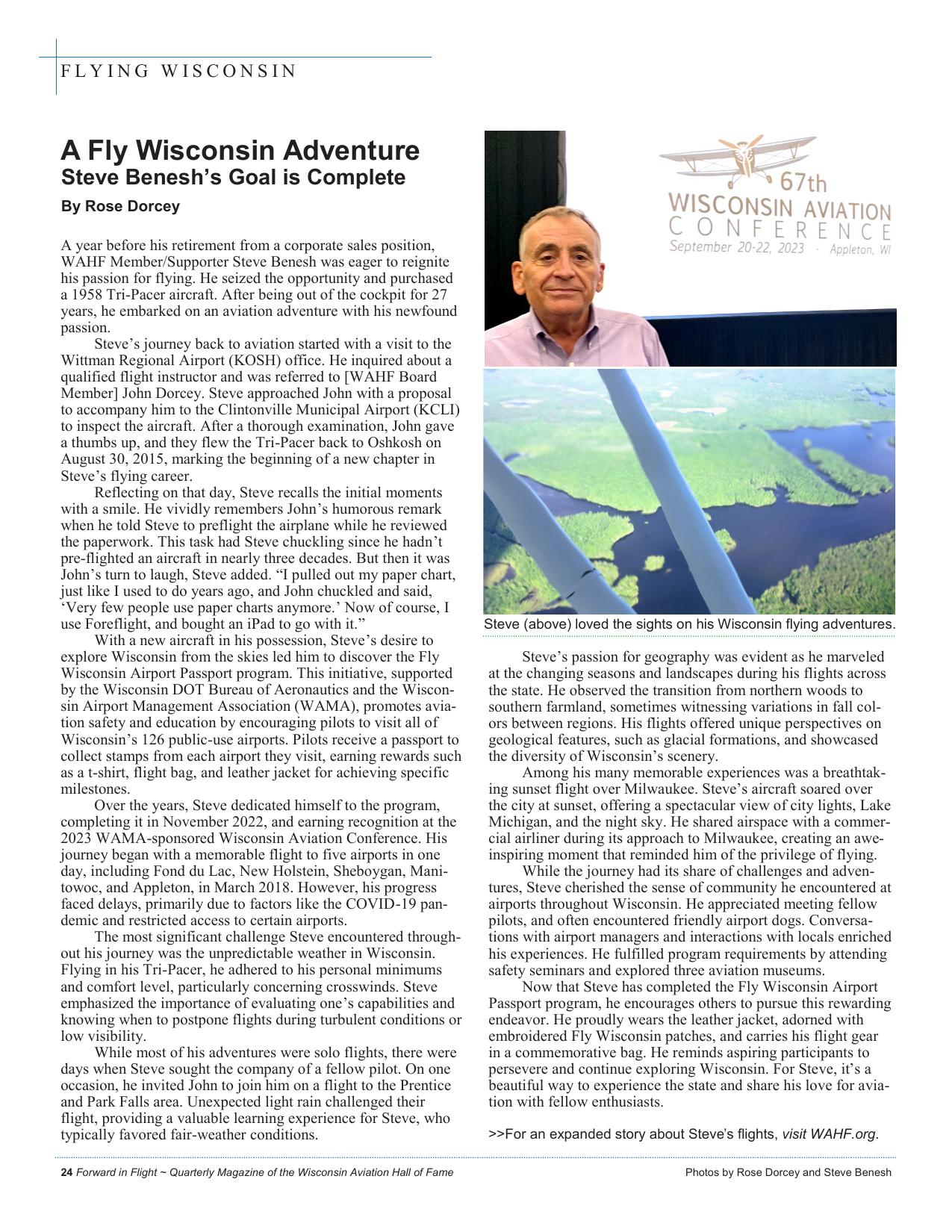
FLYING WISCONSIN A Fly Wisconsin Adventure Steve Benesh’s Goal is Complete By Rose Dorcey A year before his retirement from a corporate sales position, WAHF Member/Supporter Steve Benesh was eager to reignite his passion for flying. He seized the opportunity and purchased a 1958 Tri-Pacer aircraft. After being out of the cockpit for 27 years, he embarked on an aviation adventure with his newfound passion. Steve’s journey back to aviation started with a visit to the Wittman Regional Airport (KOSH) office. He inquired about a qualified flight instructor and was referred to [WAHF Board Member] John Dorcey. Steve approached John with a proposal to accompany him to the Clintonville Municipal Airport (KCLI) to inspect the aircraft. After a thorough examination, John gave a thumbs up, and they flew the Tri-Pacer back to Oshkosh on August 30, 2015, marking the beginning of a new chapter in Steve’s flying career. Reflecting on that day, Steve recalls the initial moments with a smile. He vividly remembers John’s humorous remark when he told Steve to preflight the airplane while he reviewed the paperwork. This task had Steve chuckling since he hadn’t pre-flighted an aircraft in nearly three decades. But then it was John’s turn to laugh, Steve added. “I pulled out my paper chart, just like I used to do years ago, and John chuckled and said, ‘Very few people use paper charts anymore.’ Now of course, I use Foreflight, and bought an iPad to go with it.” With a new aircraft in his possession, Steve’s desire to explore Wisconsin from the skies led him to discover the Fly Wisconsin Airport Passport program. This initiative, supported by the Wisconsin DOT Bureau of Aeronautics and the Wisconsin Airport Management Association (WAMA), promotes aviation safety and education by encouraging pilots to visit all of Wisconsin’s 126 public-use airports. Pilots receive a passport to collect stamps from each airport they visit, earning rewards such as a t-shirt, flight bag, and leather jacket for achieving specific milestones. Over the years, Steve dedicated himself to the program, completing it in November 2022, and earning recognition at the 2023 WAMA-sponsored Wisconsin Aviation Conference. His journey began with a memorable flight to five airports in one day, including Fond du Lac, New Holstein, Sheboygan, Manitowoc, and Appleton, in March 2018. However, his progress faced delays, primarily due to factors like the COVID-19 pandemic and restricted access to certain airports. The most significant challenge Steve encountered throughout his journey was the unpredictable weather in Wisconsin. Flying in his Tri-Pacer, he adhered to his personal minimums and comfort level, particularly concerning crosswinds. Steve emphasized the importance of evaluating one’s capabilities and knowing when to postpone flights during turbulent conditions or low visibility. While most of his adventures were solo flights, there were days when Steve sought the company of a fellow pilot. On one occasion, he invited John to join him on a flight to the Prentice and Park Falls area. Unexpected light rain challenged their flight, providing a valuable learning experience for Steve, who typically favored fair-weather conditions. 24 Forward in Flight ~ Quarterly Magazine of the Wisconsin Aviation Hall of Fame Steve (above) loved the sights on his Wisconsin flying adventures. Steve’s passion for geography was evident as he marveled at the changing seasons and landscapes during his flights across the state. He observed the transition from northern woods to southern farmland, sometimes witnessing variations in fall colors between regions. His flights offered unique perspectives on geological features, such as glacial formations, and showcased the diversity of Wisconsin’s scenery. Among his many memorable experiences was a breathtaking sunset flight over Milwaukee. Steve’s aircraft soared over the city at sunset, offering a spectacular view of city lights, Lake Michigan, and the night sky. He shared airspace with a commercial airliner during its approach to Milwaukee, creating an aweinspiring moment that reminded him of the privilege of flying. While the journey had its share of challenges and adventures, Steve cherished the sense of community he encountered at airports throughout Wisconsin. He appreciated meeting fellow pilots, and often encountered friendly airport dogs. Conversations with airport managers and interactions with locals enriched his experiences. He fulfilled program requirements by attending safety seminars and explored three aviation museums. Now that Steve has completed the Fly Wisconsin Airport Passport program, he encourages others to pursue this rewarding endeavor. He proudly wears the leather jacket, adorned with embroidered Fly Wisconsin patches, and carries his flight gear in a commemorative bag. He reminds aspiring participants to persevere and continue exploring Wisconsin. For Steve, it’s a beautiful way to experience the state and share his love for aviation with fellow enthusiasts. >>For an expanded story about Steve’s flights, visit WAHF.org. Photos by Rose Dorcey and Steve Benesh
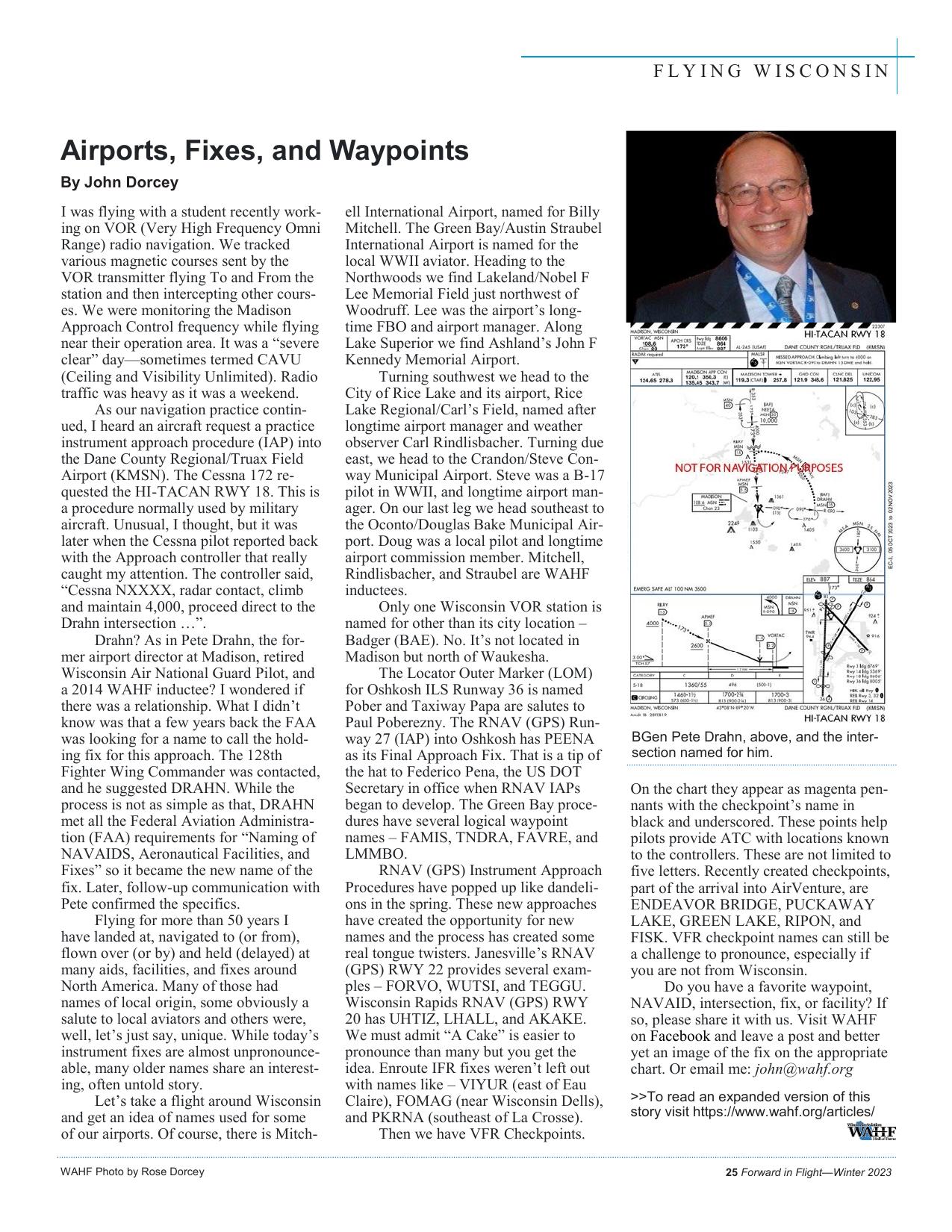
FLYING WISCONSIN Airports, Fixes, and Waypoints By John Dorcey I was flying with a student recently working on VOR (Very High Frequency Omni Range) radio navigation. We tracked various magnetic courses sent by the VOR transmitter flying To and From the station and then intercepting other courses. We were monitoring the Madison Approach Control frequency while flying near their operation area. It was a “severe clear” day—sometimes termed CAVU (Ceiling and Visibility Unlimited). Radio traffic was heavy as it was a weekend. As our navigation practice continued, I heard an aircraft request a practice instrument approach procedure (IAP) into the Dane County Regional/Truax Field Airport (KMSN). The Cessna 172 requested the HI-TACAN RWY 18. This is a procedure normally used by military aircraft. Unusual, I thought, but it was later when the Cessna pilot reported back with the Approach controller that really caught my attention. The controller said, “Cessna NXXXX, radar contact, climb and maintain 4,000, proceed direct to the Drahn intersection …”. Drahn? As in Pete Drahn, the former airport director at Madison, retired Wisconsin Air National Guard Pilot, and a 2014 WAHF inductee? I wondered if there was a relationship. What I didn’t know was that a few years back the FAA was looking for a name to call the holding fix for this approach. The 128th Fighter Wing Commander was contacted, and he suggested DRAHN. While the process is not as simple as that, DRAHN met all the Federal Aviation Administration (FAA) requirements for “Naming of NAVAIDS, Aeronautical Facilities, and Fixes” so it became the new name of the fix. Later, follow-up communication with Pete confirmed the specifics. Flying for more than 50 years I have landed at, navigated to (or from), flown over (or by) and held (delayed) at many aids, facilities, and fixes around North America. Many of those had names of local origin, some obviously a salute to local aviators and others were, well, let’s just say, unique. While today’s instrument fixes are almost unpronounceable, many older names share an interesting, often untold story. Let’s take a flight around Wisconsin and get an idea of names used for some of our airports. Of course, there is MitchWAHF Photo by Rose Dorcey ell International Airport, named for Billy Mitchell. The Green Bay/Austin Straubel International Airport is named for the local WWII aviator. Heading to the Northwoods we find Lakeland/Nobel F Lee Memorial Field just northwest of Woodruff. Lee was the airport’s longtime FBO and airport manager. Along Lake Superior we find Ashland’s John F Kennedy Memorial Airport. Turning southwest we head to the City of Rice Lake and its airport, Rice Lake Regional/Carl’s Field, named after longtime airport manager and weather observer Carl Rindlisbacher. Turning due east, we head to the Crandon/Steve Conway Municipal Airport. Steve was a B-17 pilot in WWII, and longtime airport manager. On our last leg we head southeast to the Oconto/Douglas Bake Municipal Airport. Doug was a local pilot and longtime airport commission member. Mitchell, Rindlisbacher, and Straubel are WAHF inductees. Only one Wisconsin VOR station is named for other than its city location – Badger (BAE). No. It’s not located in Madison but north of Waukesha. The Locator Outer Marker (LOM) for Oshkosh ILS Runway 36 is named Pober and Taxiway Papa are salutes to Paul Poberezny. The RNAV (GPS) Runway 27 (IAP) into Oshkosh has PEENA as its Final Approach Fix. That is a tip of the hat to Federico Pena, the US DOT Secretary in office when RNAV IAPs began to develop. The Green Bay procedures have several logical waypoint names – FAMIS, TNDRA, FAVRE, and LMMBO. RNAV (GPS) Instrument Approach Procedures have popped up like dandelions in the spring. These new approaches have created the opportunity for new names and the process has created some real tongue twisters. Janesville’s RNAV (GPS) RWY 22 provides several examples – FORVO, WUTSI, and TEGGU. Wisconsin Rapids RNAV (GPS) RWY 20 has UHTIZ, LHALL, and AKAKE. We must admit “A Cake” is easier to pronounce than many but you get the idea. Enroute IFR fixes weren’t left out with names like – VIYUR (east of Eau Claire), FOMAG (near Wisconsin Dells), and PKRNA (southeast of La Crosse). Then we have VFR Checkpoints. BGen Pete Drahn, above, and the intersection named for him. On the chart they appear as magenta pennants with the checkpoint’s name in black and underscored. These points help pilots provide ATC with locations known to the controllers. These are not limited to five letters. Recently created checkpoints, part of the arrival into AirVenture, are ENDEAVOR BRIDGE, PUCKAWAY LAKE, GREEN LAKE, RIPON, and FISK. VFR checkpoint names can still be a challenge to pronounce, especially if you are not from Wisconsin. Do you have a favorite waypoint, NAVAID, intersection, fix, or facility? If so, please share it with us. Visit WAHF on Facebook and leave a post and better yet an image of the fix on the appropriate chart. Or email me: john@wahf.org >>To read an expanded version of this story visit https://www.wahf.org/articles/ 25 Forward in Flight—Winter 2023
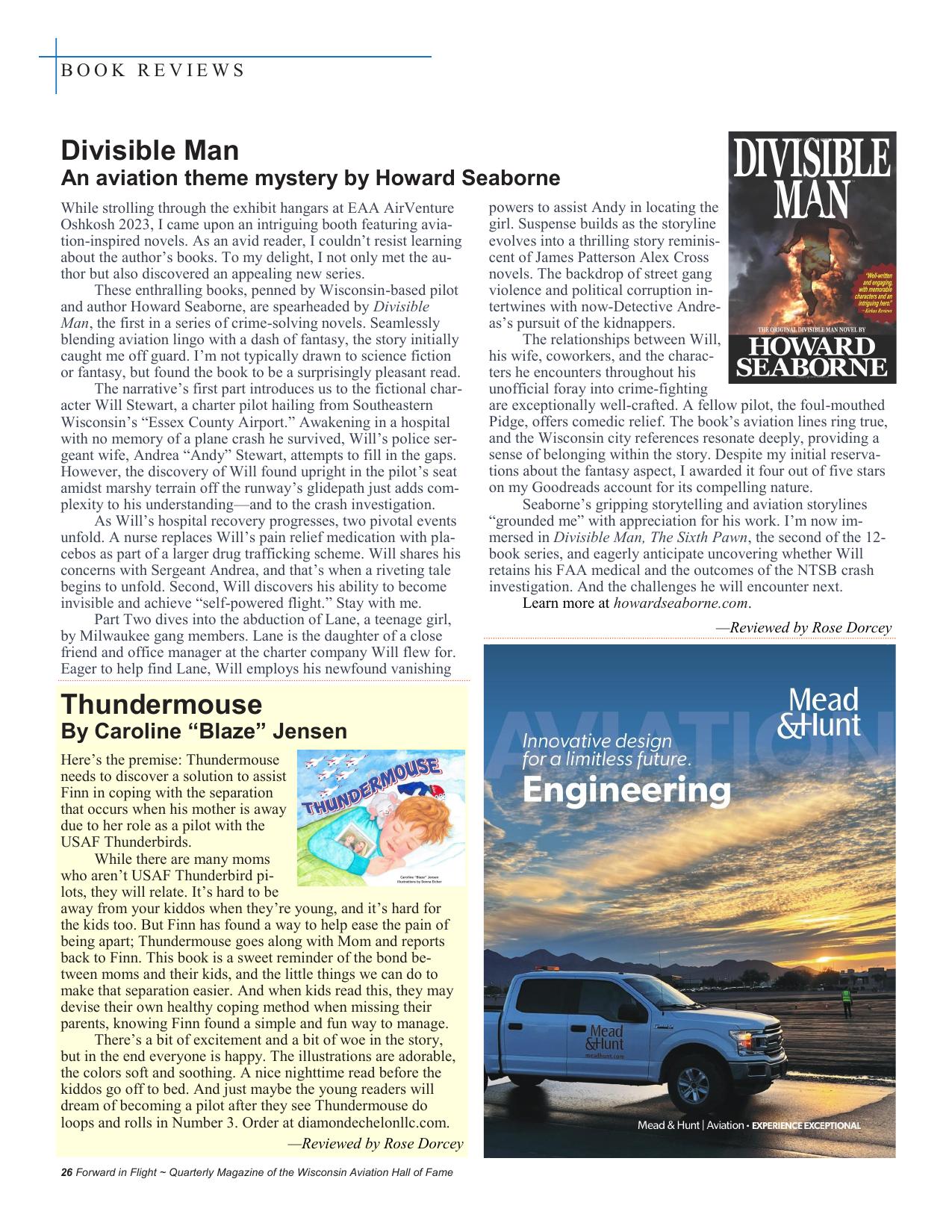
BOOK REVIEWS Divisible Man An aviation theme mystery by Howard Seaborne While strolling through the exhibit hangars at EAA AirVenture Oshkosh 2023, I came upon an intriguing booth featuring aviation-inspired novels. As an avid reader, I couldn’t resist learning about the author’s books. To my delight, I not only met the author but also discovered an appealing new series. These enthralling books, penned by Wisconsin-based pilot and author Howard Seaborne, are spearheaded by Divisible Man, the first in a series of crime-solving novels. Seamlessly blending aviation lingo with a dash of fantasy, the story initially caught me off guard. I’m not typically drawn to science fiction or fantasy, but found the book to be a surprisingly pleasant read. The narrative’s first part introduces us to the fictional character Will Stewart, a charter pilot hailing from Southeastern Wisconsin’s “Essex County Airport.” Awakening in a hospital with no memory of a plane crash he survived, Will’s police sergeant wife, Andrea “Andy” Stewart, attempts to fill in the gaps. However, the discovery of Will found upright in the pilot’s seat amidst marshy terrain off the runway’s glidepath just adds complexity to his understanding—and to the crash investigation. As Will’s hospital recovery progresses, two pivotal events unfold. A nurse replaces Will’s pain relief medication with placebos as part of a larger drug trafficking scheme. Will shares his concerns with Sergeant Andrea, and that’s when a riveting tale begins to unfold. Second, Will discovers his ability to become invisible and achieve “self-powered flight.” Stay with me. Part Two dives into the abduction of Lane, a teenage girl, by Milwaukee gang members. Lane is the daughter of a close friend and office manager at the charter company Will flew for. Eager to help find Lane, Will employs his newfound vanishing Thundermouse By Caroline “Blaze” Jensen Here’s the premise: Thundermouse needs to discover a solution to assist Finn in coping with the separation that occurs when his mother is away due to her role as a pilot with the USAF Thunderbirds. While there are many moms who aren’t USAF Thunderbird pilots, they will relate. It’s hard to be away from your kiddos when they’re young, and it’s hard for the kids too. But Finn has found a way to help ease the pain of being apart; Thundermouse goes along with Mom and reports back to Finn. This book is a sweet reminder of the bond between moms and their kids, and the little things we can do to make that separation easier. And when kids read this, they may devise their own healthy coping method when missing their parents, knowing Finn found a simple and fun way to manage. There’s a bit of excitement and a bit of woe in the story, but in the end everyone is happy. The illustrations are adorable, the colors soft and soothing. A nice nighttime read before the kiddos go off to bed. And just maybe the young readers will dream of becoming a pilot after they see Thundermouse do loops and rolls in Number 3. Order at diamondechelonllc.com. —Reviewed by Rose Dorcey 26 Forward in Flight ~ Quarterly Magazine of the Wisconsin Aviation Hall of Fame powers to assist Andy in locating the girl. Suspense builds as the storyline evolves into a thrilling story reminiscent of James Patterson Alex Cross novels. The backdrop of street gang violence and political corruption intertwines with now-Detective Andreas’s pursuit of the kidnappers. The relationships between Will, his wife, coworkers, and the characters he encounters throughout his unofficial foray into crime-fighting are exceptionally well-crafted. A fellow pilot, the foul-mouthed Pidge, offers comedic relief. The book’s aviation lines ring true, and the Wisconsin city references resonate deeply, providing a sense of belonging within the story. Despite my initial reservations about the fantasy aspect, I awarded it four out of five stars on my Goodreads account for its compelling nature. Seaborne’s gripping storytelling and aviation storylines “grounded me” with appreciation for his work. I’m now immersed in Divisible Man, The Sixth Pawn, the second of the 12book series, and eagerly anticipate uncovering whether Will retains his FAA medical and the outcomes of the NTSB crash investigation. And the challenges he will encounter next. Learn more at howardseaborne.com. —Reviewed by Rose Dorcey
EDITOR’S LOG Reflecting on an Editor’s Journey Discovering stories, meeting aviation legends, and the joy of reconnection I’m now four issues into my return as the editor of Forward in Flight, and I’m just as excited today as I was back in January when I accepted this role. Reconnecting with the magazine has been an incredible journey, especially after a several year “leave of absence.” I’m so grateful for the unwavering support of our writers, advertisers (and here’s a grateful welcome back to Eagle Fuel Cells) and the WAHF officers and board of directors. Ya’ll make this journey so enjoyable to me. My enthusiasm for this magazine and my commitment to delivering the best aviation stories from the world of Wisconsin aviation continues to grow. I trust that you sense that enthusiasm. Reflecting on the past provides me with an opportunity to recall the remarkable individuals I’ve had the privilege to connect with, even if our interactions have mostly been through emails, phone calls, or video chats. It began with Wisconsin native and pioneering female airline captain Virginia Gallenberger (Spring 2023). Exploring her diverse aviation career was so fascinating, and discovering her passion for glider flying added an extra layer of interest. Soon after, WAHF board member Jill Mann introduced me to the wonderful Marie Spear, whose Stearman flying adventures we highlighted in the Summer 2023 issue. I remain in awe of her Stearman feats to this day! And then, my journey led me to the remarkable Caroline “Blaze” Jensen, whose talents, drive, and generosity you’ve discovered in this issue. Her inspiring story has compelled me to reconsider my role as a mentor to others. I can’t forget to mention 2023 Inductee Tom Bouchard. What a privilege to meet Tom and learn of his family’s aviation history. It’s been a pleas- ure getting to know these exceptional people, and many more, all thanks to WAHF and Forward in Flight. Returning to the WAHF team has deepened my connections with numerous members and inductees and those in the industry. The encouraging messages I’ve received from you are so meaningful to me; they strengthen my commitment to delivering top-notch content for you, the WAHF members. Your satisfaction with FIF is my utmost priority; please share your delight or suggestions for improvement with me. Thank you! In the Summer ’23 issue of FIF you read about Cindi Pokorny, a youth educator at EAA and a WAHF member. She invited John and I to teach at an EAA Girls On The Fly event recently. About 50 teenage girls attended. John taught them about airspace and communications by leading them in mock pilot exchanges, and showed aviation sectionals to indicate various classes of airspace. I had the best part—taking them to the Wittman Regional Airport (KOSH) air traffic control tower. The girls were interested in the views, equipment, planes, runways, and hearing the controllers, Chip and Dena, talking with the pilots. What started as a VFR day became IFR, and they thought “it was cool” to see a small plane disappear into the clouds at about 500-feet above the ground. So did I! Clearly, an event like this can do a lot to encourage the young to consider aviation as a career choice, or as recreation. And, inspired by the aviators’ stories in Forward in Flight it was an easy “yes” when Cindi asked us to participate. I’m looking forward to more opportunities like these. —Rose Dorcey 27 Forward in Flight—Winter 2023
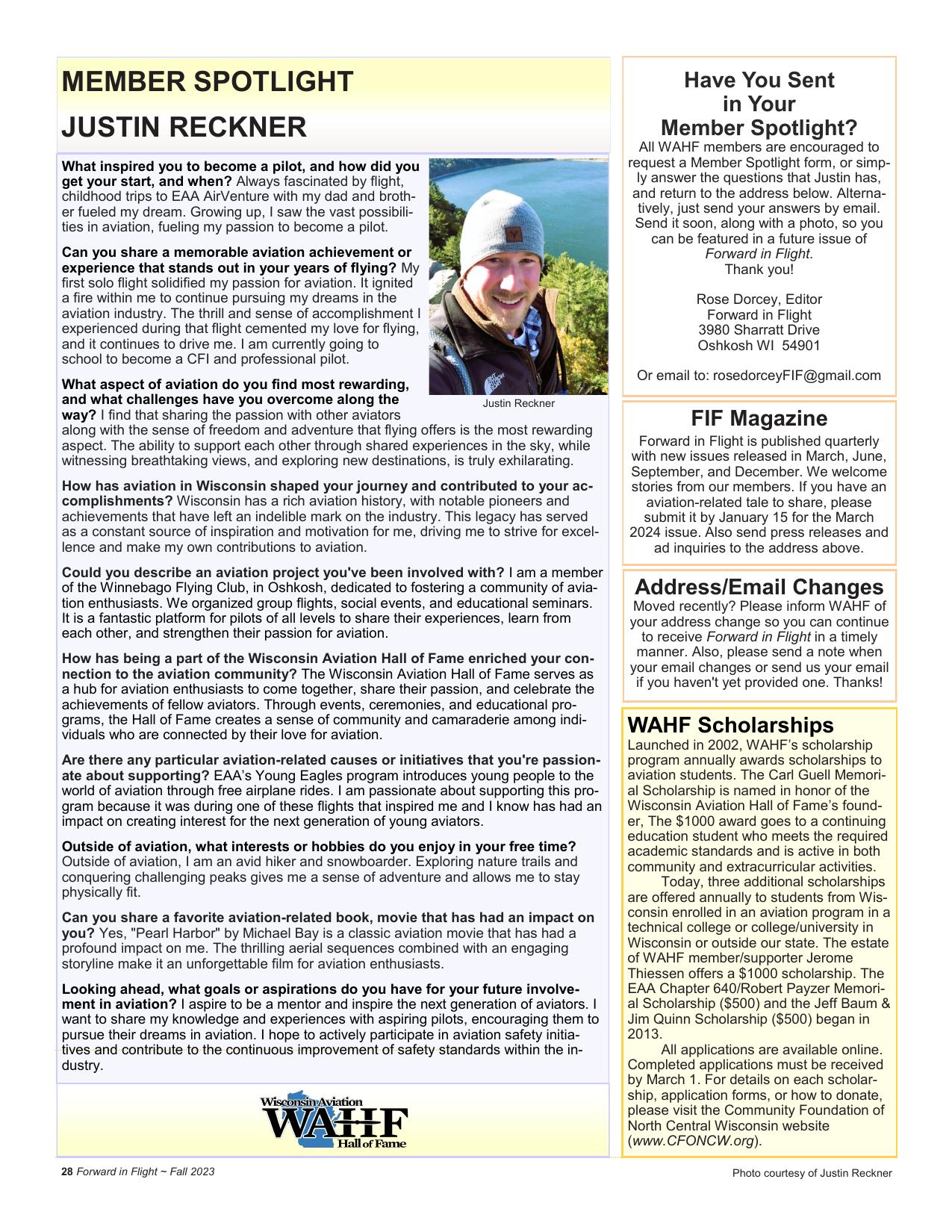
MEMBER SPOTLIGHT JUSTIN RECKNER What inspired you to become a pilot, and how did you get your start, and when? Always fascinated by flight, childhood trips to EAA AirVenture with my dad and brother fueled my dream. Growing up, I saw the vast possibilities in aviation, fueling my passion to become a pilot. Can you share a memorable aviation achievement or experience that stands out in your years of flying? My first solo flight solidified my passion for aviation. It ignited a fire within me to continue pursuing my dreams in the aviation industry. The thrill and sense of accomplishment I experienced during that flight cemented my love for flying, and it continues to drive me. I am currently going to school to become a CFI and professional pilot. What aspect of aviation do you find most rewarding, and what challenges have you overcome along the Justin Reckner way? I find that sharing the passion with other aviators along with the sense of freedom and adventure that flying offers is the most rewarding aspect. The ability to support each other through shared experiences in the sky, while witnessing breathtaking views, and exploring new destinations, is truly exhilarating. How has aviation in Wisconsin shaped your journey and contributed to your accomplishments? Wisconsin has a rich aviation history, with notable pioneers and achievements that have left an indelible mark on the industry. This legacy has served as a constant source of inspiration and motivation for me, driving me to strive for excellence and make my own contributions to aviation. Could you describe an aviation project you've been involved with? I am a member of the Winnebago Flying Club, in Oshkosh, dedicated to fostering a community of aviation enthusiasts. We organized group flights, social events, and educational seminars. It is a fantastic platform for pilots of all levels to share their experiences, learn from each other, and strengthen their passion for aviation. How has being a part of the Wisconsin Aviation Hall of Fame enriched your connection to the aviation community? The Wisconsin Aviation Hall of Fame serves as a hub for aviation enthusiasts to come together, share their passion, and celebrate the achievements of fellow aviators. Through events, ceremonies, and educational programs, the Hall of Fame creates a sense of community and camaraderie among individuals who are connected by their love for aviation. Are there any particular aviation-related causes or initiatives that you're passionate about supporting? EAA’s Young Eagles program introduces young people to the world of aviation through free airplane rides. I am passionate about supporting this program because it was during one of these flights that inspired me and I know has had an impact on creating interest for the next generation of young aviators. Outside of aviation, what interests or hobbies do you enjoy in your free time? Outside of aviation, I am an avid hiker and snowboarder. Exploring nature trails and conquering challenging peaks gives me a sense of adventure and allows me to stay physically fit. Can you share a favorite aviation-related book, movie that has had an impact on you? Yes, "Pearl Harbor" by Michael Bay is a classic aviation movie that has had a profound impact on me. The thrilling aerial sequences combined with an engaging storyline make it an unforgettable film for aviation enthusiasts. Looking ahead, what goals or aspirations do you have for your future involvement in aviation? I aspire to be a mentor and inspire the next generation of aviators. I want to share my knowledge and experiences with aspiring pilots, encouraging them to pursue their dreams in aviation. I hope to actively participate in aviation safety initiatives and contribute to the continuous improvement of safety standards within the industry. 28 Forward in Flight ~ Fall 2023 Have You Sent in Your Member Spotlight? All WAHF members are encouraged to request a Member Spotlight form, or simply answer the questions that Justin has, and return to the address below. Alternatively, just send your answers by email. Send it soon, along with a photo, so you can be featured in a future issue of Forward in Flight. Thank you! Rose Dorcey, Editor Forward in Flight 3980 Sharratt Drive Oshkosh WI 54901 Or email to: rosedorceyFIF@gmail.com FIF Magazine Forward in Flight is published quarterly with new issues released in March, June, September, and December. We welcome stories from our members. If you have an aviation-related tale to share, please submit it by January 15 for the March 2024 issue. Also send press releases and ad inquiries to the address above. Address/Email Changes Moved recently? Please inform WAHF of your address change so you can continue to receive Forward in Flight in a timely manner. Also, please send a note when your email changes or send us your email if you haven't yet provided one. Thanks! WAHF Scholarships Launched in 2002, WAHF’s scholarship program annually awards scholarships to aviation students. The Carl Guell Memorial Scholarship is named in honor of the Wisconsin Aviation Hall of Fame’s founder, The $1000 award goes to a continuing education student who meets the required academic standards and is active in both community and extracurricular activities. Today, three additional scholarships are offered annually to students from Wisconsin enrolled in an aviation program in a technical college or college/university in Wisconsin or outside our state. The estate of WAHF member/supporter Jerome Thiessen offers a $1000 scholarship. The EAA Chapter 640/Robert Payzer Memorial Scholarship ($500) and the Jeff Baum & Jim Quinn Scholarship ($500) began in 2013. All applications are available online. Completed applications must be received by March 1. For details on each scholarship, application forms, or how to donate, please visit the Community Foundation of North Central Wisconsin website (www.CFONCW.org). Photo courtesy of Justin Reckner

The time is right to join, renew, or give a gift membership to the Wisconsin Aviation Hall of Fame! ANNUAL MEMBERSHIP LEVELS Name________________________________________ _____ Youth (Under age 18) _____ Individual (Annual) _____ Couple (Annual) _____ Lifetime (Individual) _____ Lifetime (Couple) Address______________________________________ $10 $30 $40 $500 $750 City__________________________________________ State, Zip_____________________________________ Phone_______________________________________ TAX DEDUCTIBLE CONTRIBUTIONS Your contributions help ensure Wisconsin’s aviation pioneers and outstanding students in aviation education will continue to be recognized. Your contributions, in any amount, are appreciated. WAHF Supporting Contribution $___________ (General operating/events programming fund) WAHF Scholarship Fund* $___________ *for scholarship donations please make a separate check payable to Community Foundation of North Central Wisconsin or visit www.CFONCW.org. Exciting News... WAHF now offers a new online newsletter through Constant Contact. We promise good content! If your email address has changed or you haven't provided one, please let us know. Morey Airplane Company Since 1932 Middleton Municipal Airport/Morey Field Self-service 100LL & Jet A 24-7 Email________________________________________ Members receive WAHF’s quarterly magazine Forward in Flight! Join or Donate Online! www.WAHF.org Or, mail this form, along with your check payable to: Wisconsin Aviation Hall of Fame, Inc. to: Rose Dorcey/WAHF 3980 Sharratt Drive Oshkosh WI 54901 The Wisconsin Aviation Hall of Fame is a 501(c)(3) organization. You can become known as a WAHF Supporter! > YOUR AD HERE < Email for Details - rose@wahf.org
PRSRT STD US Postage Paid Wisc Rapids WI Permit 98 Forward in Flight c/o Rose Dorcey 3980 Sharratt Drive Oshkosh WI 54901-1276 The Wisconsin Aviation Hall of Fame is a non-profit membership organization dedicated to preserving the past and fostering the future of flight. New WAHF Member/Supporters Jaylin Breuer Dave Bryant David Godec Michael Hudgins Sandra Krueger Bob Lussow Mike & Lora Sauer* Mike & Kristin Selwa Thank you for coming onboard! Margaret & Larry Burton Ann Coyne Caroline “Blaze” Jensen Laurel Kitslaar* Billy Parker Laurie Probst Pete Tallarita Phil & Darlene Yazbak *Life Member Thank you to WAHF Member/Supporters Greg Anderson, Jeff Baker, David Boelter, Jaylin Breuer, Anita Cassiman, Lynn Erickson, Peter Halbauer, Laurel Kitslaar, Keith Mathews, LtGen Tad Oelstrom, Janis Sierra, Jim Szajkovics, Dan Simpson, Charles Swain, Brad Volker, Dale Walker, and Wynne Williams for your generous monetary donations to WAHF’s general operating fund; directed toward essential needs that enable us to further our mission. Thank you to Inductee/Board Member John Dorcey, benefactor of the new WAHF website. Wisconsin Aviation Hall of Fame Officers Kurt Stanich, President James Zuelsdorf, Vice-President Henry Peterson, Secretary Colleen Weber, Treasurer Board of Directors John Dorcey Scott Green Jill Mann Patrick Weeden Wynne Williams The Wisconsin Aviation Hall of Fame extends its gratitude to the generous donors who made our Silent Auction a success. We encourage FIF readers to consider these businessMembership Chair es/enterprises for your future product, service, or literary needs: FIF Editor Eileen Bjorkman Jim Busha Michelle Curran Miller Clock Rose Dorcey Kelch Aviation Museum “Blaze” Jensen Discover Oshkosh Howard Seaborne 920-279-6029 Pete & Marie Spear Stein Aircraft Inc Brennan’s Market Jordyn Jacobson rose@wahf.org Skycom Avionics Jill Mann Westosha Flying Club Jet Out Kenosha Aviation Steve Krog Rose Dorcey Aviation Soul 4ever Creations Studio Tom Wildenberg Rich/Morey Airplane Wagner’s Market Become a member/supporter today! Congratulations! WAHF Member Darlene Yazbak on earning your private pilot certificate! Use form on the inside back cover and mail it in, or join Gone West—we mourn the recent passing of WAHF Life Member David Mann. securely online at Dear WAHF Members - We invite you to renew your membership with the Wisconsin Aviawww.WAHF.org tion Hall of Fame and continue your journey with us. By renewing, you reaffirm your commitment to honoring Wisconsin's aviation legacy. Note: You may have received an email requesting that you renew online at www.WAHF.org. We thank all the current WAHF members for your invaluable support and those who have already renewed. Your dedication to furtherJoin the ing our mission and inspiring future generations is deeply appreciated. Thank you! conversation… Wishing Our Amazing Wisconsin Aviation Hall of Fame Community a Merry Christmas! As we soar through the holiday season, we want to express our heartfelt gratitude to each and every one of you. Your passionate support of aviation and dedication to preserving its legacy truly makes our sky brighter. May your holidays be filled with joy, laughter, and the warmth of loved ones. As we look ahead to the new year, may it bring new horizons and exciting adventures in the world of flight. Thank you for being a part of our incredible aviation family. Merry Christmas from all of us at the Wisconsin Aviation Hall of Fame! WAHF Online! Like. Subscribe. Follow.