Volume 22, Issue 4
🗞️ Download Issue (PDF)
Forward in Flight - Winter 2024/2025
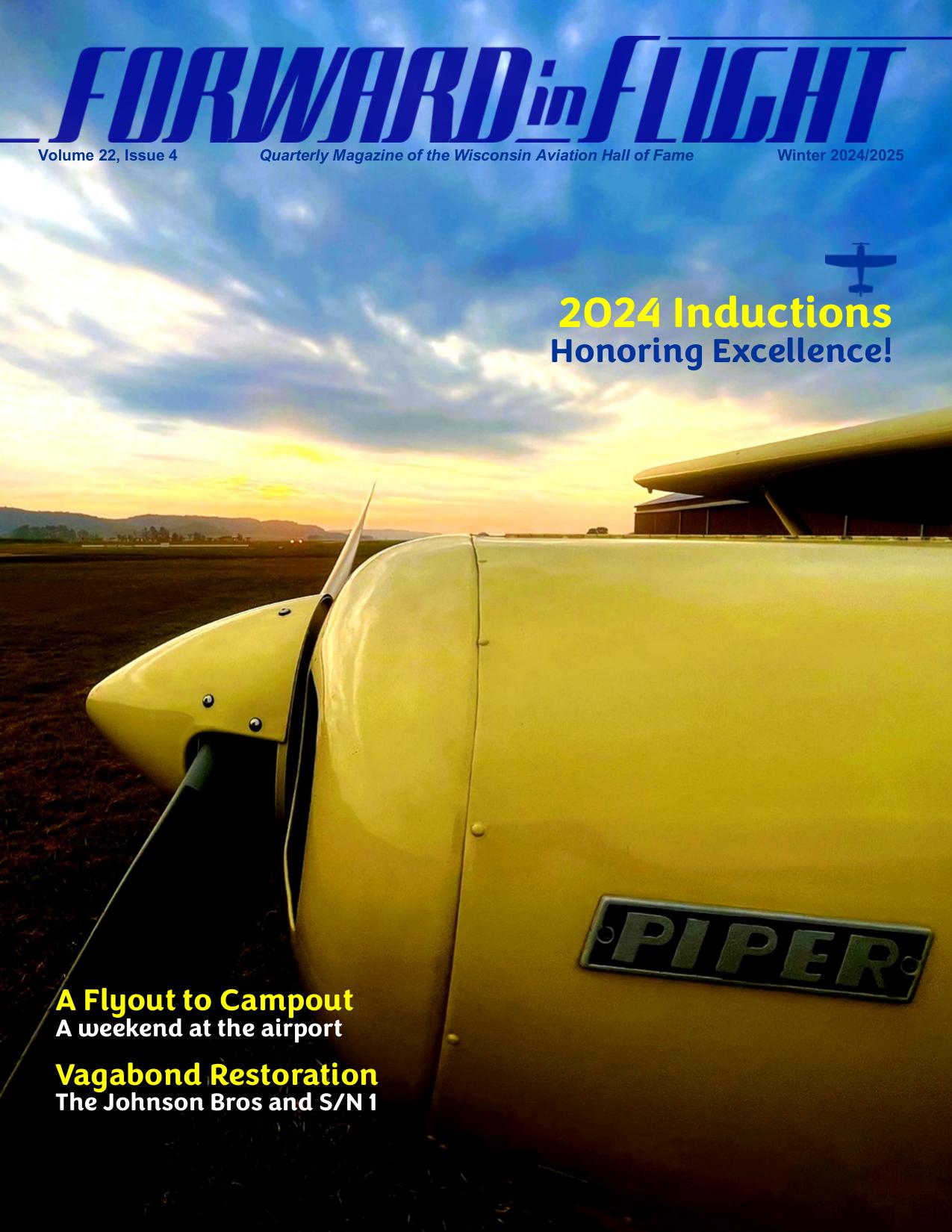
Volume 22, Issue 4 Quarterly Magazine of the Wisconsin Aviation Hall of Fame Winter 2024/2025 2024 Inductions Honoring Excellence! A Flyout to Campout A weekend at the airport Vagabond Restoration The Johnson Bros and S/N 1
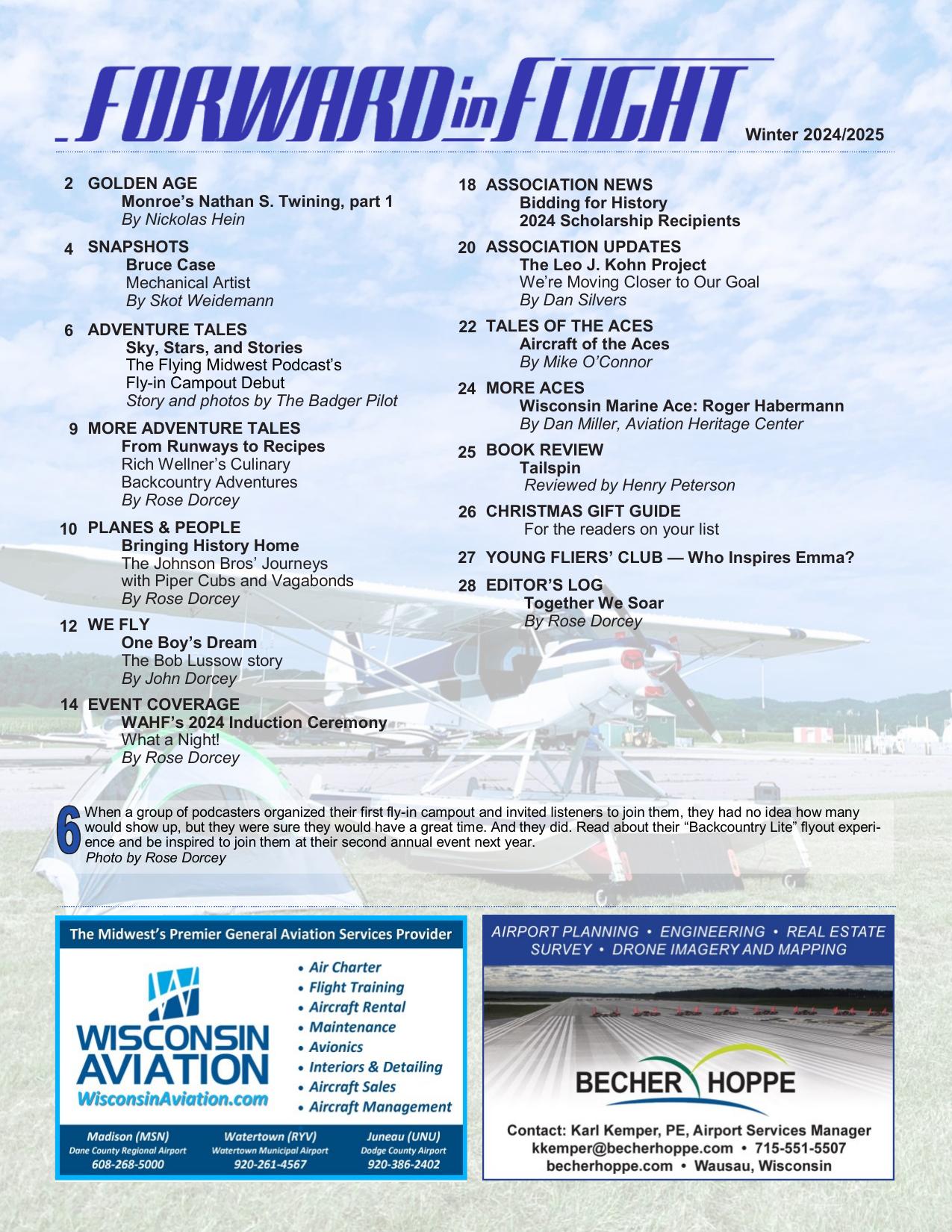
Winter 2024/2025 2 GOLDEN AGE Monroe’s Nathan S. Twining, part 1 By Nickolas Hein 18 ASSOCIATION NEWS Bidding for History 2024 Scholarship Recipients 4 SNAPSHOTS Bruce Case Mechanical Artist By Skot Weidemann 20 ASSOCIATION UPDATES The Leo J. Kohn Project We’re Moving Closer to Our Goal By Dan Silvers 6 ADVENTURE TALES Sky, Stars, and Stories The Flying Midwest Podcast’s Fly-in Campout Debut Story and photos by The Badger Pilot 22 TALES OF THE ACES Aircraft of the Aces By Mike O’Connor 9 MORE ADVENTURE TALES From Runways to Recipes Rich Wellner’s Culinary Backcountry Adventures By Rose Dorcey 10 PLANES & PEOPLE Bringing History Home The Johnson Bros’ Journeys with Piper Cubs and Vagabonds By Rose Dorcey 12 WE FLY One Boy’s Dream The Bob Lussow story By John Dorcey 24 MORE ACES Wisconsin Marine Ace: Roger Habermann By Dan Miller, Aviation Heritage Center 25 BOOK REVIEW Tailspin Reviewed by Henry Peterson 26 CHRISTMAS GIFT GUIDE For the readers on your list 27 YOUNG FLIERS’ CLUB — Who Inspires Emma? 28 EDITOR’S LOG Together We Soar By Rose Dorcey 14 EVENT COVERAGE WAHF’s 2024 Induction Ceremony What a Night! By Rose Dorcey When a group of podcasters organized their first fly-in campout and invited listeners to join them, they had no idea how many would show up, but they were sure they would have a great time. And they did. Read about their “Backcountry Lite” flyout experience and be inspired to join them at their second annual event next year. Photo by Rose Dorcey
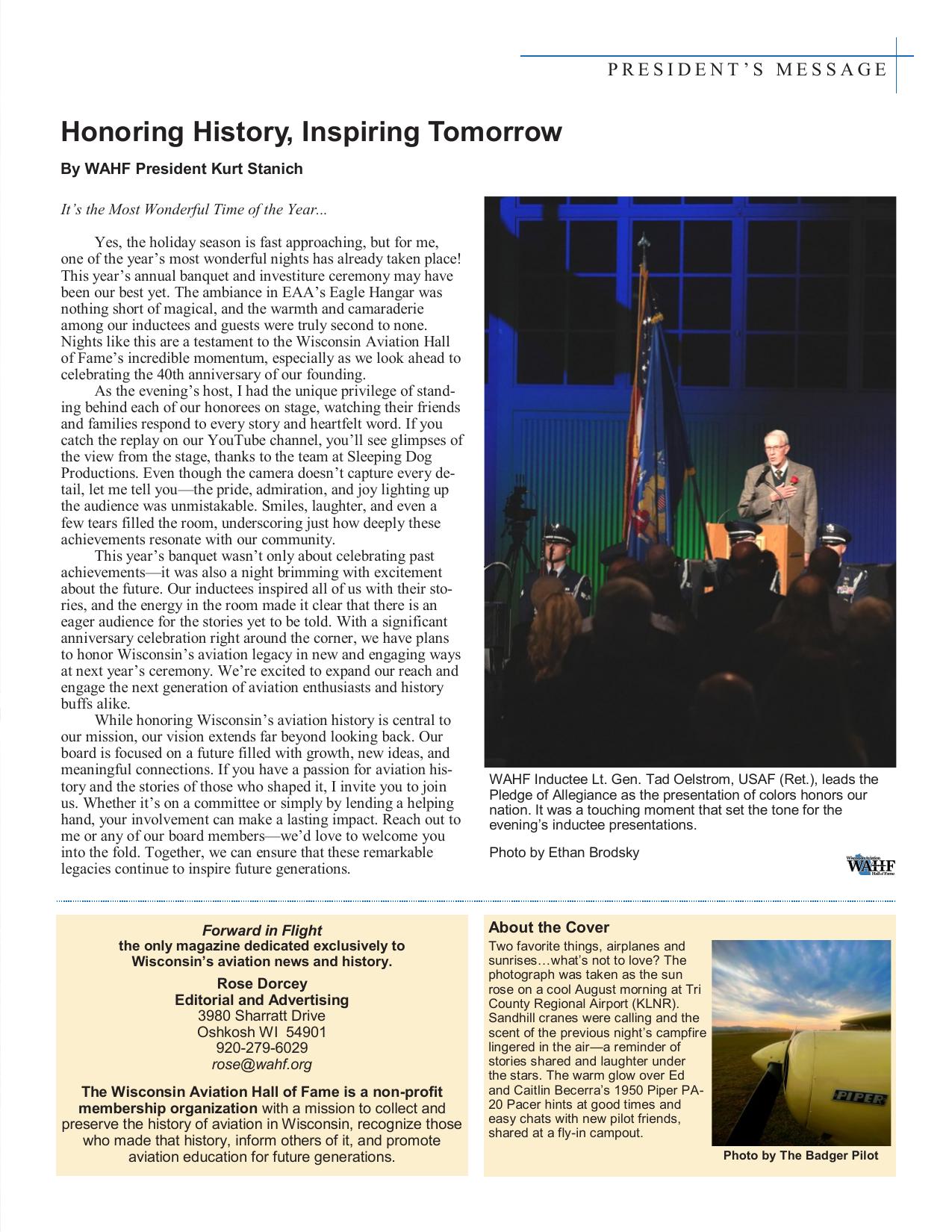
PRESIDENT’S MESSAGE Honoring History, Inspiring Tomorrow By WAHF President Kurt Stanich It’s the Most Wonderful Time of the Year... Yes, the holiday season is fast approaching, but for me, one of the year’s most wonderful nights has already taken place! This year’s annual banquet and investiture ceremony may have been our best yet. The ambiance in EAA’s Eagle Hangar was nothing short of magical, and the warmth and camaraderie among our inductees and guests were truly second to none. Nights like this are a testament to the Wisconsin Aviation Hall of Fame’s incredible momentum, especially as we look ahead to celebrating the 40th anniversary of our founding. As the evening’s host, I had the unique privilege of standing behind each of our honorees on stage, watching their friends and families respond to every story and heartfelt word. If you catch the replay on our YouTube channel, you’ll see glimpses of the view from the stage, thanks to the team at Sleeping Dog Productions. Even though the camera doesn’t capture every detail, let me tell you—the pride, admiration, and joy lighting up the audience was unmistakable. Smiles, laughter, and even a few tears filled the room, underscoring just how deeply these achievements resonate with our community. This year’s banquet wasn’t only about celebrating past achievements—it was also a night brimming with excitement about the future. Our inductees inspired all of us with their stories, and the energy in the room made it clear that there is an eager audience for the stories yet to be told. With a significant anniversary celebration right around the corner, we have plans to honor Wisconsin’s aviation legacy in new and engaging ways at next year’s ceremony. We’re excited to expand our reach and engage the next generation of aviation enthusiasts and history buffs alike. While honoring Wisconsin’s aviation history is central to our mission, our vision extends far beyond looking back. Our board is focused on a future filled with growth, new ideas, and meaningful connections. If you have a passion for aviation history and the stories of those who shaped it, I invite you to join us. Whether it’s on a committee or simply by lending a helping hand, your involvement can make a lasting impact. Reach out to me or any of our board members—we’d love to welcome you into the fold. Together, we can ensure that these remarkable legacies continue to inspire future generations. Forward in Flight the only magazine dedicated exclusively to Wisconsin’s aviation news and history. Rose Dorcey Editorial and Advertising 3980 Sharratt Drive Oshkosh WI 54901 920-279-6029 rose@wahf.org The Wisconsin Aviation Hall of Fame is a non-profit membership organization with a mission to collect and preserve the history of aviation in Wisconsin, recognize those who made that history, inform others of it, and promote aviation education for future generations. WAHF Inductee Lt. Gen. Tad Oelstrom, USAF (Ret.), leads the Pledge of Allegiance as the presentation of colors honors our nation. It was a touching moment that set the tone for the evening’s inductee presentations. Photo by Ethan Brodsky About the Cover Two favorite things, airplanes and sunrises…what’s not to love? The photograph was taken as the sun rose on a cool August morning at Tri County Regional Airport (KLNR). Sandhill cranes were calling and the scent of the previous night’s campfire lingered in the air—a reminder of stories shared and laughter under the stars. The warm glow over Ed and Caitlin Becerra’s 1950 Piper PA20 Pacer hints at good times and easy chats with new pilot friends, shared at a fly-in campout. Photo by The Badger Pilot
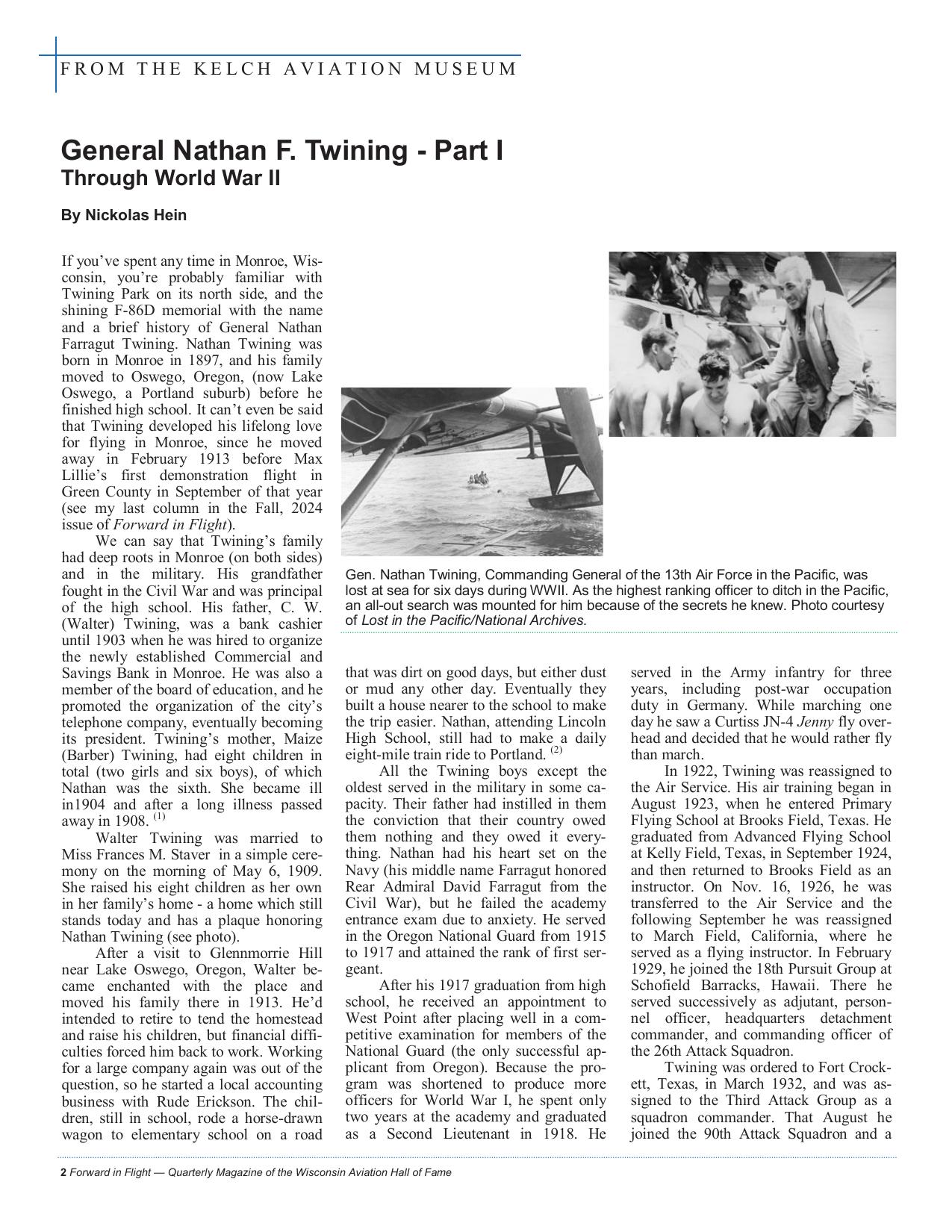
FROM THE KELCH AVIATION MUSEUM General Nathan F. Twining - Part I Through World War II By Nickolas Hein If you’ve spent any time in Monroe, Wisconsin, you’re probably familiar with Twining Park on its north side, and the shining F-86D memorial with the name and a brief history of General Nathan Farragut Twining. Nathan Twining was born in Monroe in 1897, and his family moved to Oswego, Oregon, (now Lake Oswego, a Portland suburb) before he finished high school. It can’t even be said that Twining developed his lifelong love for flying in Monroe, since he moved away in February 1913 before Max Lillie’s first demonstration flight in Green County in September of that year (see my last column in the Fall, 2024 issue of Forward in Flight). We can say that Twining’s family had deep roots in Monroe (on both sides) and in the military. His grandfather fought in the Civil War and was principal of the high school. His father, C. W. (Walter) Twining, was a bank cashier until 1903 when he was hired to organize the newly established Commercial and Savings Bank in Monroe. He was also a member of the board of education, and he promoted the organization of the city’s telephone company, eventually becoming its president. Twining’s mother, Maize (Barber) Twining, had eight children in total (two girls and six boys), of which Nathan was the sixth. She became ill in1904 and after a long illness passed away in 1908. (1) Walter Twining was married to Miss Frances M. Staver in a simple ceremony on the morning of May 6, 1909. She raised his eight children as her own in her family’s home - a home which still stands today and has a plaque honoring Nathan Twining (see photo). After a visit to Glennmorrie Hill near Lake Oswego, Oregon, Walter became enchanted with the place and moved his family there in 1913. He’d intended to retire to tend the homestead and raise his children, but financial difficulties forced him back to work. Working for a large company again was out of the question, so he started a local accounting business with Rude Erickson. The children, still in school, rode a horse-drawn wagon to elementary school on a road Gen. Nathan Twining, Commanding General of the 13th Air Force in the Pacific, was lost at sea for six days during WWII. As the highest ranking officer to ditch in the Pacific, an all-out search was mounted for him because of the secrets he knew. Photo courtesy of Lost in the Pacific/National Archives. that was dirt on good days, but either dust or mud any other day. Eventually they built a house nearer to the school to make the trip easier. Nathan, attending Lincoln High School, still had to make a daily eight-mile train ride to Portland. (2) All the Twining boys except the oldest served in the military in some capacity. Their father had instilled in them the conviction that their country owed them nothing and they owed it everything. Nathan had his heart set on the Navy (his middle name Farragut honored Rear Admiral David Farragut from the Civil War), but he failed the academy entrance exam due to anxiety. He served in the Oregon National Guard from 1915 to 1917 and attained the rank of first sergeant. After his 1917 graduation from high school, he received an appointment to West Point after placing well in a competitive examination for members of the National Guard (the only successful applicant from Oregon). Because the program was shortened to produce more officers for World War I, he spent only two years at the academy and graduated as a Second Lieutenant in 1918. He 2 Forward in Flight — Quarterly Magazine of the Wisconsin Aviation Hall of Fame served in the Army infantry for three years, including post-war occupation duty in Germany. While marching one day he saw a Curtiss JN-4 Jenny fly overhead and decided that he would rather fly than march. In 1922, Twining was reassigned to the Air Service. His air training began in August 1923, when he entered Primary Flying School at Brooks Field, Texas. He graduated from Advanced Flying School at Kelly Field, Texas, in September 1924, and then returned to Brooks Field as an instructor. On Nov. 16, 1926, he was transferred to the Air Service and the following September he was reassigned to March Field, California, where he served as a flying instructor. In February 1929, he joined the 18th Pursuit Group at Schofield Barracks, Hawaii. There he served successively as adjutant, personnel officer, headquarters detachment commander, and commanding officer of the 26th Attack Squadron. Twining was ordered to Fort Crockett, Texas, in March 1932, and was assigned to the Third Attack Group as a squadron commander. That August he joined the 90th Attack Squadron and a
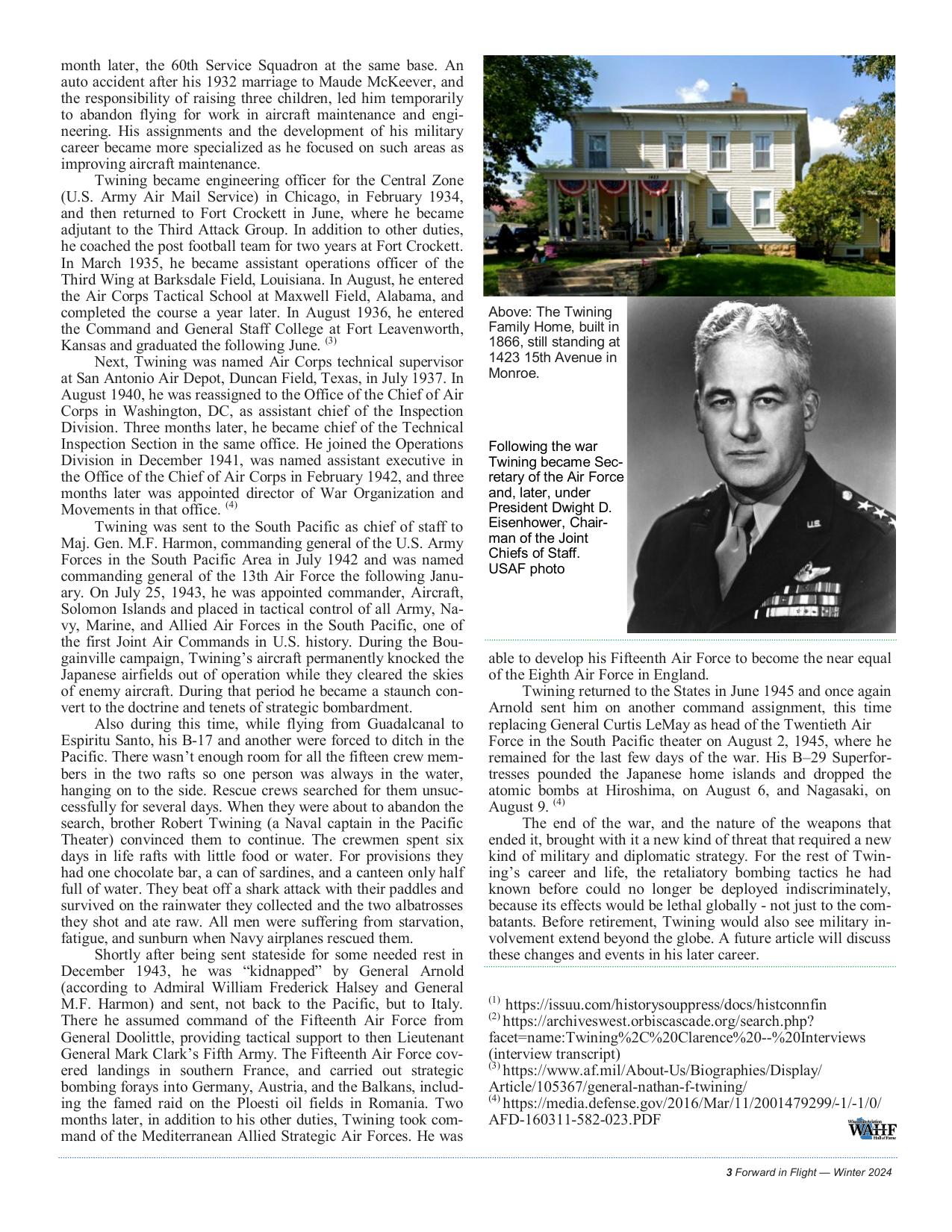
month later, the 60th Service Squadron at the same base. An auto accident after his 1932 marriage to Maude McKeever, and the responsibility of raising three children, led him temporarily to abandon flying for work in aircraft maintenance and engineering. His assignments and the development of his military career became more specialized as he focused on such areas as improving aircraft maintenance. Twining became engineering officer for the Central Zone (U.S. Army Air Mail Service) in Chicago, in February 1934, and then returned to Fort Crockett in June, where he became adjutant to the Third Attack Group. In addition to other duties, he coached the post football team for two years at Fort Crockett. In March 1935, he became assistant operations officer of the Third Wing at Barksdale Field, Louisiana. In August, he entered the Air Corps Tactical School at Maxwell Field, Alabama, and completed the course a year later. In August 1936, he entered the Command and General Staff College at Fort Leavenworth, Kansas and graduated the following June. (3) Next, Twining was named Air Corps technical supervisor at San Antonio Air Depot, Duncan Field, Texas, in July 1937. In August 1940, he was reassigned to the Office of the Chief of Air Corps in Washington, DC, as assistant chief of the Inspection Division. Three months later, he became chief of the Technical Inspection Section in the same office. He joined the Operations Division in December 1941, was named assistant executive in the Office of the Chief of Air Corps in February 1942, and three months later was appointed director of War Organization and Movements in that office. (4) Twining was sent to the South Pacific as chief of staff to Maj. Gen. M.F. Harmon, commanding general of the U.S. Army Forces in the South Pacific Area in July 1942 and was named commanding general of the 13th Air Force the following January. On July 25, 1943, he was appointed commander, Aircraft, Solomon Islands and placed in tactical control of all Army, Navy, Marine, and Allied Air Forces in the South Pacific, one of the first Joint Air Commands in U.S. history. During the Bougainville campaign, Twining’s aircraft permanently knocked the Japanese airfields out of operation while they cleared the skies of enemy aircraft. During that period he became a staunch convert to the doctrine and tenets of strategic bombardment. Also during this time, while flying from Guadalcanal to Espiritu Santo, his B-17 and another were forced to ditch in the Pacific. There wasn’t enough room for all the fifteen crew members in the two rafts so one person was always in the water, hanging on to the side. Rescue crews searched for them unsuccessfully for several days. When they were about to abandon the search, brother Robert Twining (a Naval captain in the Pacific Theater) convinced them to continue. The crewmen spent six days in life rafts with little food or water. For provisions they had one chocolate bar, a can of sardines, and a canteen only half full of water. They beat off a shark attack with their paddles and survived on the rainwater they collected and the two albatrosses they shot and ate raw. All men were suffering from starvation, fatigue, and sunburn when Navy airplanes rescued them. Shortly after being sent stateside for some needed rest in December 1943, he was “kidnapped” by General Arnold (according to Admiral William Frederick Halsey and General M.F. Harmon) and sent, not back to the Pacific, but to Italy. There he assumed command of the Fifteenth Air Force from General Doolittle, providing tactical support to then Lieutenant General Mark Clark’s Fifth Army. The Fifteenth Air Force covered landings in southern France, and carried out strategic bombing forays into Germany, Austria, and the Balkans, including the famed raid on the Ploesti oil fields in Romania. Two months later, in addition to his other duties, Twining took command of the Mediterranean Allied Strategic Air Forces. He was Above: The Twining Family Home, built in 1866, still standing at 1423 15th Avenue in Monroe. Following the war Twining became Secretary of the Air Force and, later, under President Dwight D. Eisenhower, Chairman of the Joint Chiefs of Staff. USAF photo able to develop his Fifteenth Air Force to become the near equal of the Eighth Air Force in England. Twining returned to the States in June 1945 and once again Arnold sent him on another command assignment, this time replacing General Curtis LeMay as head of the Twentieth Air Force in the South Pacific theater on August 2, 1945, where he remained for the last few days of the war. His B–29 Superfortresses pounded the Japanese home islands and dropped the atomic bombs at Hiroshima, on August 6, and Nagasaki, on August 9. (4) The end of the war, and the nature of the weapons that ended it, brought with it a new kind of threat that required a new kind of military and diplomatic strategy. For the rest of Twining’s career and life, the retaliatory bombing tactics he had known before could no longer be deployed indiscriminately, because its effects would be lethal globally - not just to the combatants. Before retirement, Twining would also see military involvement extend beyond the globe. A future article will discuss these changes and events in his later career. (1) https://issuu.com/historysouppress/docs/histconnfin https://archiveswest.orbiscascade.org/search.php? facet=name:Twining%2C%20Clarence%20--%20Interviews (interview transcript) (3) https://www.af.mil/About-Us/Biographies/Display/ Article/105367/general-nathan-f-twining/ (4) https://media.defense.gov/2016/Mar/11/2001479299/-1/-1/0/ AFD-160311-582-023.PDF (2) 3 Forward in Flight — Winter 2024
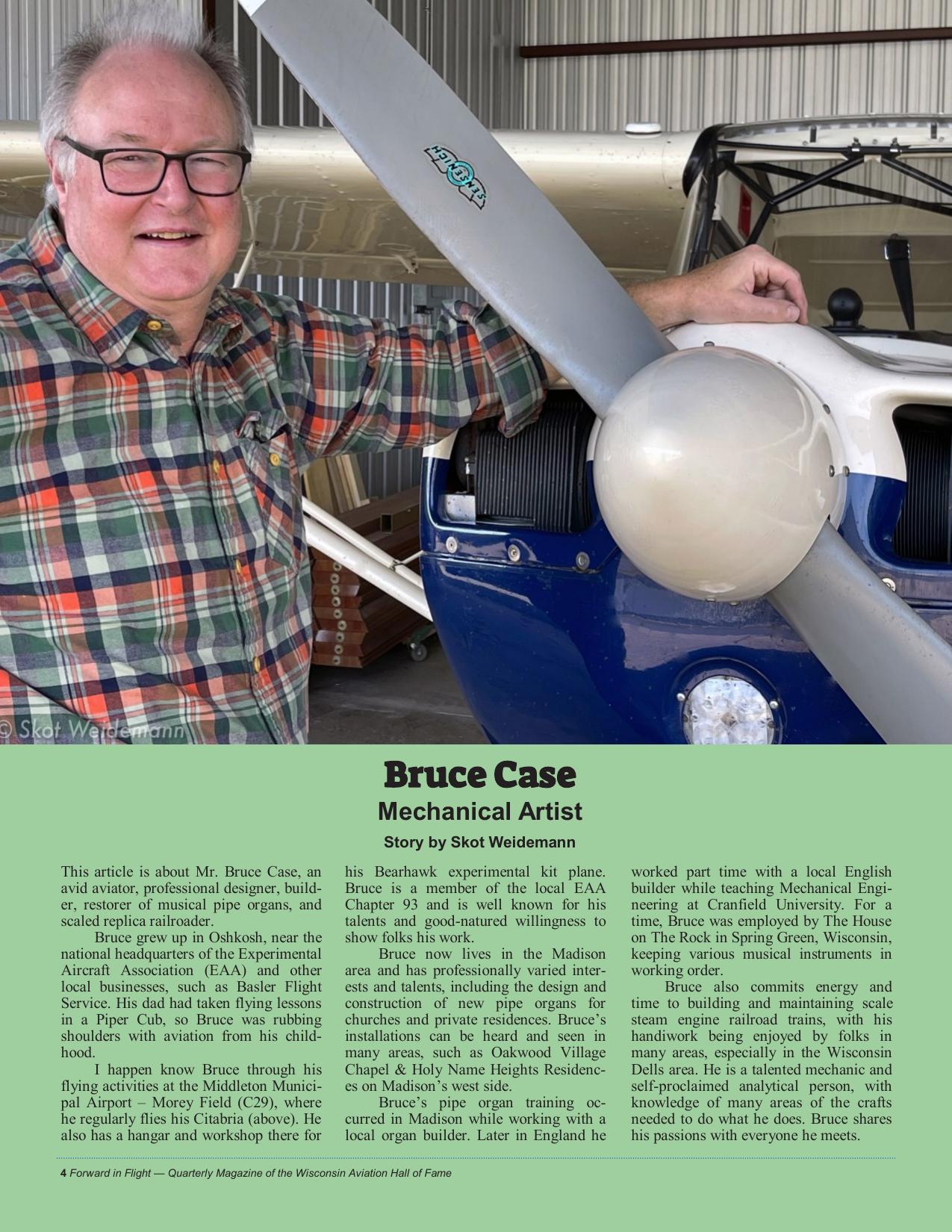
SNAPSHOTS Bruce Case Mechanical Artist Story by Skot Weidemann This article is about Mr. Bruce Case, an avid aviator, professional designer, builder, restorer of musical pipe organs, and scaled replica railroader. Bruce grew up in Oshkosh, near the national headquarters of the Experimental Aircraft Association (EAA) and other local businesses, such as Basler Flight Service. His dad had taken flying lessons in a Piper Cub, so Bruce was rubbing shoulders with aviation from his childhood. I happen know Bruce through his flying activities at the Middleton Municipal Airport – Morey Field (C29), where he regularly flies his Citabria (above). He also has a hangar and workshop there for his Bearhawk experimental kit plane. Bruce is a member of the local EAA Chapter 93 and is well known for his talents and good-natured willingness to show folks his work. Bruce now lives in the Madison area and has professionally varied interests and talents, including the design and construction of new pipe organs for churches and private residences. Bruce’s installations can be heard and seen in many areas, such as Oakwood Village Chapel & Holy Name Heights Residences on Madison’s west side. Bruce’s pipe organ training occurred in Madison while working with a local organ builder. Later in England he 4 Forward in Flight — Quarterly Magazine of the Wisconsin Aviation Hall of Fame worked part time with a local English builder while teaching Mechanical Engineering at Cranfield University. For a time, Bruce was employed by The House on The Rock in Spring Green, Wisconsin, keeping various musical instruments in working order. Bruce also commits energy and time to building and maintaining scale steam engine railroad trains, with his handiwork being enjoyed by folks in many areas, especially in the Wisconsin Dells area. He is a talented mechanic and self-proclaimed analytical person, with knowledge of many areas of the crafts needed to do what he does. Bruce shares his passions with everyone he meets.
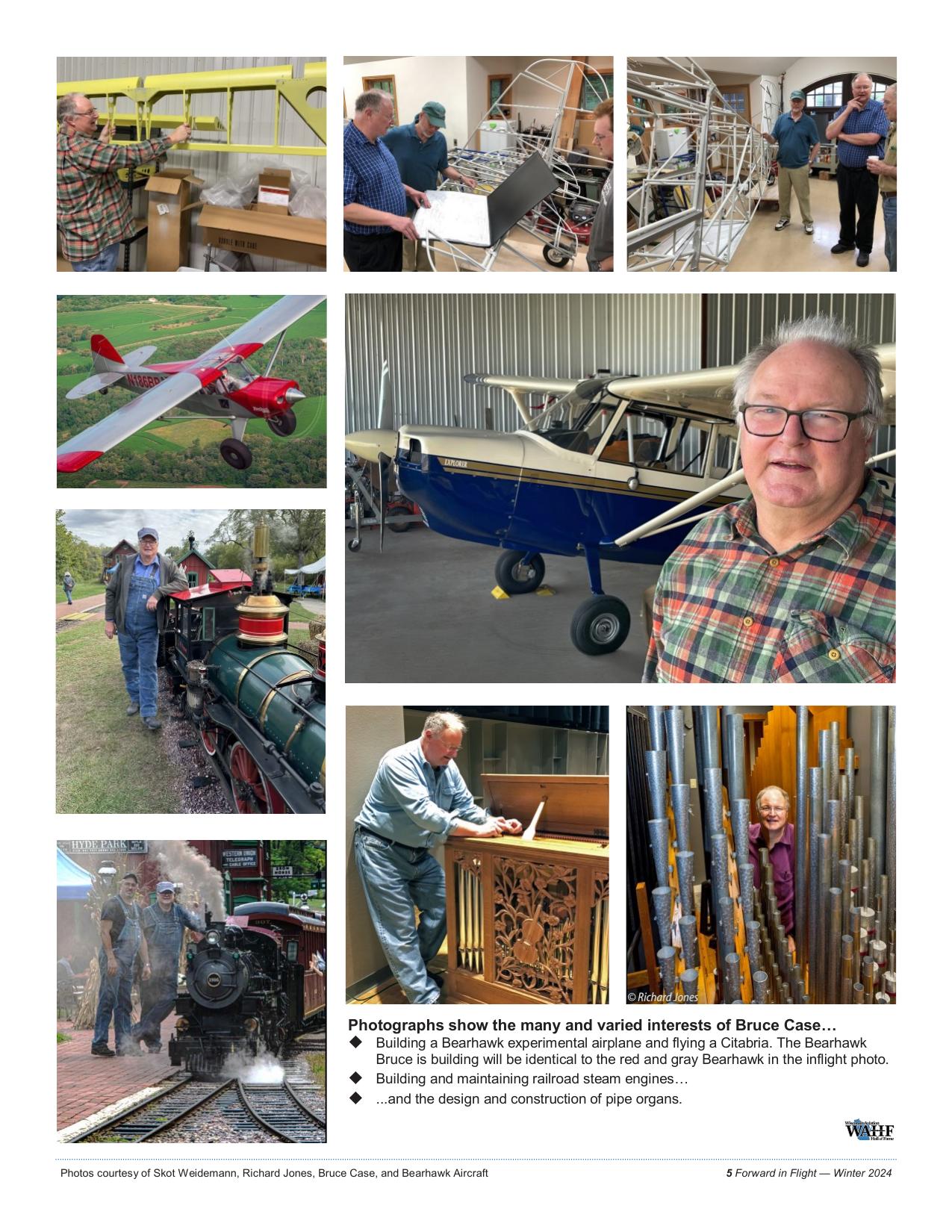
Photographs show the many and varied interests of Bruce Case… ◆ Building a Bearhawk experimental airplane and flying a Citabria. The Bearhawk Bruce is building will be identical to the red and gray Bearhawk in the inflight photo. ◆ Building and maintaining railroad steam engines… ◆ ...and the design and construction of pipe organs. Photos courtesy of Skot Weidemann, Richard Jones, Bruce Case, and Bearhawk Aircraft 5 Forward in Flight — Winter 2024
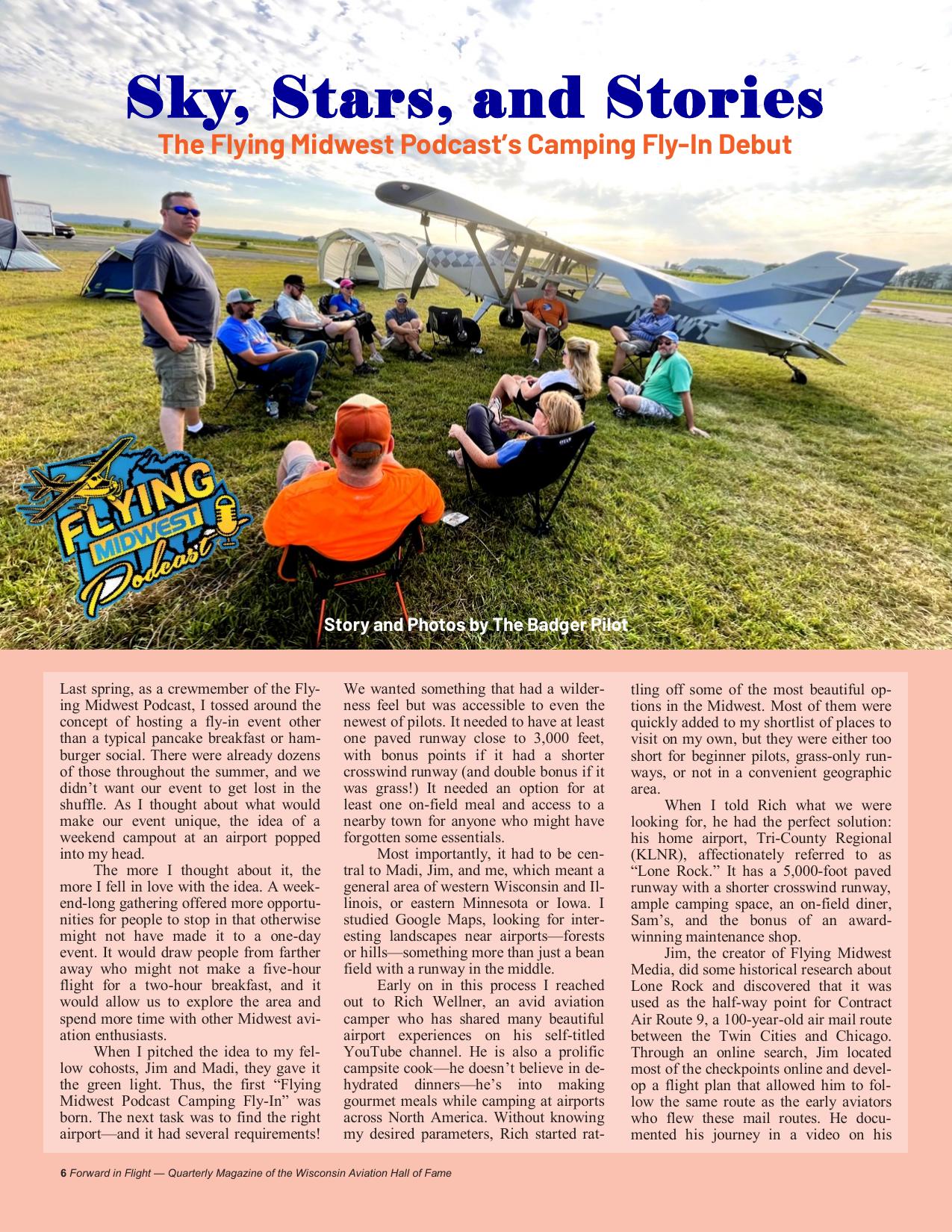
Sky, Stars, and Stories The Flying Midwest Podcast’s Camping Fly-In Debut Story and Photos by The Badger Pilot Last spring, as a crewmember of the Flying Midwest Podcast, I tossed around the concept of hosting a fly-in event other than a typical pancake breakfast or hamburger social. There were already dozens of those throughout the summer, and we didn’t want our event to get lost in the shuffle. As I thought about what would make our event unique, the idea of a weekend campout at an airport popped into my head. The more I thought about it, the more I fell in love with the idea. A weekend-long gathering offered more opportunities for people to stop in that otherwise might not have made it to a one-day event. It would draw people from farther away who might not make a five-hour flight for a two-hour breakfast, and it would allow us to explore the area and spend more time with other Midwest aviation enthusiasts. When I pitched the idea to my fellow cohosts, Jim and Madi, they gave it the green light. Thus, the first “Flying Midwest Podcast Camping Fly-In” was born. The next task was to find the right airport—and it had several requirements! We wanted something that had a wilderness feel but was accessible to even the newest of pilots. It needed to have at least one paved runway close to 3,000 feet, with bonus points if it had a shorter crosswind runway (and double bonus if it was grass!) It needed an option for at least one on-field meal and access to a nearby town for anyone who might have forgotten some essentials. Most importantly, it had to be central to Madi, Jim, and me, which meant a general area of western Wisconsin and Illinois, or eastern Minnesota or Iowa. I studied Google Maps, looking for interesting landscapes near airports—forests or hills—something more than just a bean field with a runway in the middle. Early on in this process I reached out to Rich Wellner, an avid aviation camper who has shared many beautiful airport experiences on his self-titled YouTube channel. He is also a prolific campsite cook—he doesn’t believe in dehydrated dinners—he’s into making gourmet meals while camping at airports across North America. Without knowing my desired parameters, Rich started rat- 6 Forward in Flight — Quarterly Magazine of the Wisconsin Aviation Hall of Fame tling off some of the most beautiful options in the Midwest. Most of them were quickly added to my shortlist of places to visit on my own, but they were either too short for beginner pilots, grass-only runways, or not in a convenient geographic area. When I told Rich what we were looking for, he had the perfect solution: his home airport, Tri-County Regional (KLNR), affectionately referred to as “Lone Rock.” It has a 5,000-foot paved runway with a shorter crosswind runway, ample camping space, an on-field diner, Sam’s, and the bonus of an awardwinning maintenance shop. Jim, the creator of Flying Midwest Media, did some historical research about Lone Rock and discovered that it was used as the half-way point for Contract Air Route 9, a 100-year-old air mail route between the Twin Cities and Chicago. Through an online search, Jim located most of the checkpoints online and develop a flight plan that allowed him to follow the same route as the early aviators who flew these mail routes. He documented his journey in a video on his
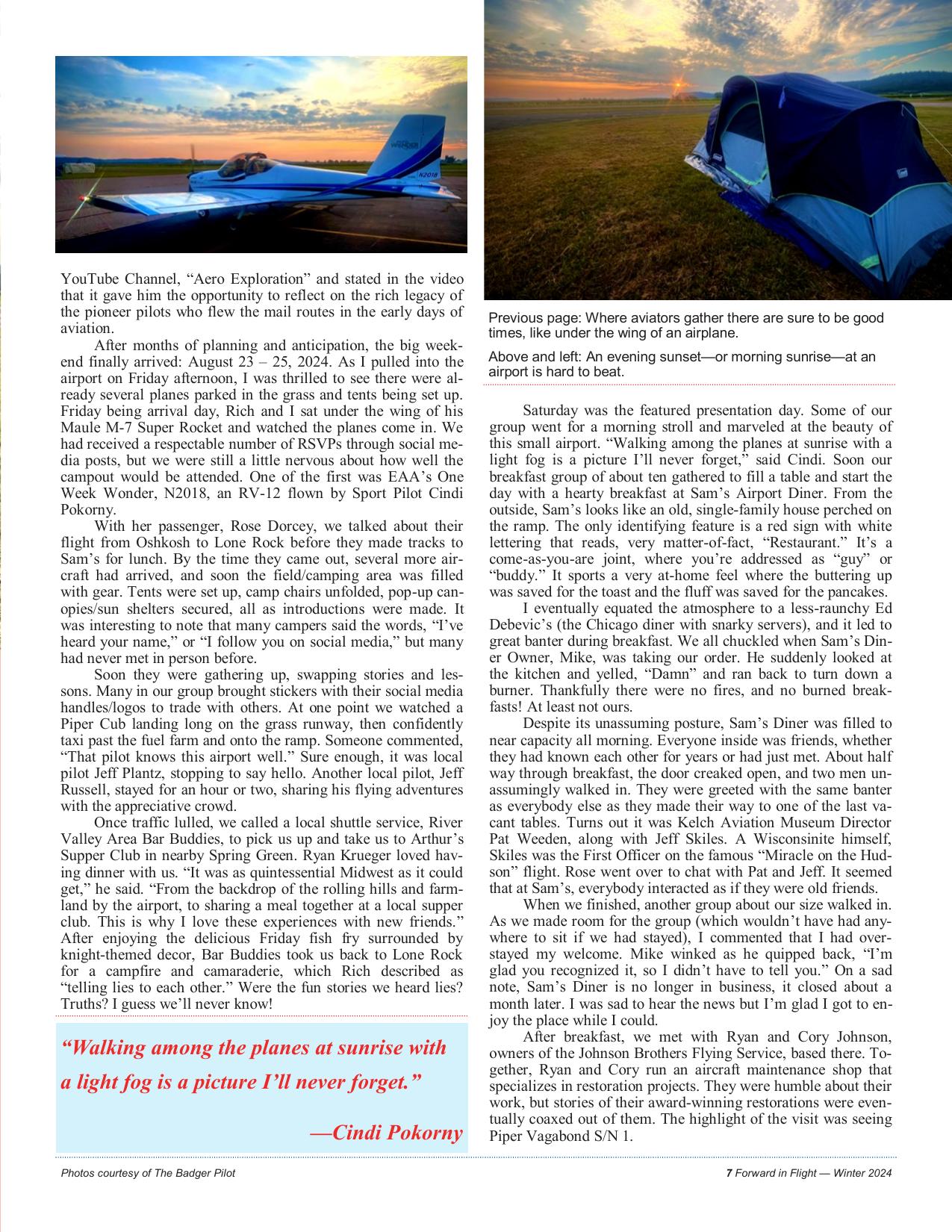
YouTube Channel, “Aero Exploration” and stated in the video that it gave him the opportunity to reflect on the rich legacy of the pioneer pilots who flew the mail routes in the early days of aviation. After months of planning and anticipation, the big weekend finally arrived: August 23 – 25, 2024. As I pulled into the airport on Friday afternoon, I was thrilled to see there were already several planes parked in the grass and tents being set up. Friday being arrival day, Rich and I sat under the wing of his Maule M-7 Super Rocket and watched the planes come in. We had received a respectable number of RSVPs through social media posts, but we were still a little nervous about how well the campout would be attended. One of the first was EAA’s One Week Wonder, N2018, an RV-12 flown by Sport Pilot Cindi Pokorny. With her passenger, Rose Dorcey, we talked about their flight from Oshkosh to Lone Rock before they made tracks to Sam’s for lunch. By the time they came out, several more aircraft had arrived, and soon the field/camping area was filled with gear. Tents were set up, camp chairs unfolded, pop-up canopies/sun shelters secured, all as introductions were made. It was interesting to note that many campers said the words, “I’ve heard your name,” or “I follow you on social media,” but many had never met in person before. Soon they were gathering up, swapping stories and lessons. Many in our group brought stickers with their social media handles/logos to trade with others. At one point we watched a Piper Cub landing long on the grass runway, then confidently taxi past the fuel farm and onto the ramp. Someone commented, “That pilot knows this airport well.” Sure enough, it was local pilot Jeff Plantz, stopping to say hello. Another local pilot, Jeff Russell, stayed for an hour or two, sharing his flying adventures with the appreciative crowd. Once traffic lulled, we called a local shuttle service, River Valley Area Bar Buddies, to pick us up and take us to Arthur’s Supper Club in nearby Spring Green. Ryan Krueger loved having dinner with us. “It was as quintessential Midwest as it could get,” he said. “From the backdrop of the rolling hills and farmland by the airport, to sharing a meal together at a local supper club. This is why I love these experiences with new friends.” After enjoying the delicious Friday fish fry surrounded by knight-themed decor, Bar Buddies took us back to Lone Rock for a campfire and camaraderie, which Rich described as “telling lies to each other.” Were the fun stories we heard lies? Truths? I guess we’ll never know! “Walking among the planes at sunrise with a light fog is a picture I’ll never forget.” —Cindi Pokorny Photos courtesy of The Badger Pilot Previous page: Where aviators gather there are sure to be good times, like under the wing of an airplane. Above and left: An evening sunset—or morning sunrise—at an airport is hard to beat. Saturday was the featured presentation day. Some of our group went for a morning stroll and marveled at the beauty of this small airport. “Walking among the planes at sunrise with a light fog is a picture I’ll never forget,” said Cindi. Soon our breakfast group of about ten gathered to fill a table and start the day with a hearty breakfast at Sam’s Airport Diner. From the outside, Sam’s looks like an old, single-family house perched on the ramp. The only identifying feature is a red sign with white lettering that reads, very matter-of-fact, “Restaurant.” It’s a come-as-you-are joint, where you’re addressed as “guy” or “buddy.” It sports a very at-home feel where the buttering up was saved for the toast and the fluff was saved for the pancakes. I eventually equated the atmosphere to a less-raunchy Ed Debevic’s (the Chicago diner with snarky servers), and it led to great banter during breakfast. We all chuckled when Sam’s Diner Owner, Mike, was taking our order. He suddenly looked at the kitchen and yelled, “Damn” and ran back to turn down a burner. Thankfully there were no fires, and no burned breakfasts! At least not ours. Despite its unassuming posture, Sam’s Diner was filled to near capacity all morning. Everyone inside was friends, whether they had known each other for years or had just met. About half way through breakfast, the door creaked open, and two men unassumingly walked in. They were greeted with the same banter as everybody else as they made their way to one of the last vacant tables. Turns out it was Kelch Aviation Museum Director Pat Weeden, along with Jeff Skiles. A Wisconsinite himself, Skiles was the First Officer on the famous “Miracle on the Hudson” flight. Rose went over to chat with Pat and Jeff. It seemed that at Sam’s, everybody interacted as if they were old friends. When we finished, another group about our size walked in. As we made room for the group (which wouldn’t have had anywhere to sit if we had stayed), I commented that I had overstayed my welcome. Mike winked as he quipped back, “I’m glad you recognized it, so I didn’t have to tell you.” On a sad note, Sam’s Diner is no longer in business, it closed about a month later. I was sad to hear the news but I’m glad I got to enjoy the place while I could. After breakfast, we met with Ryan and Cory Johnson, owners of the Johnson Brothers Flying Service, based there. Together, Ryan and Cory run an aircraft maintenance shop that specializes in restoration projects. They were humble about their work, but stories of their award-winning restorations were eventually coaxed out of them. The highlight of the visit was seeing Piper Vagabond S/N 1. 7 Forward in Flight — Winter 2024
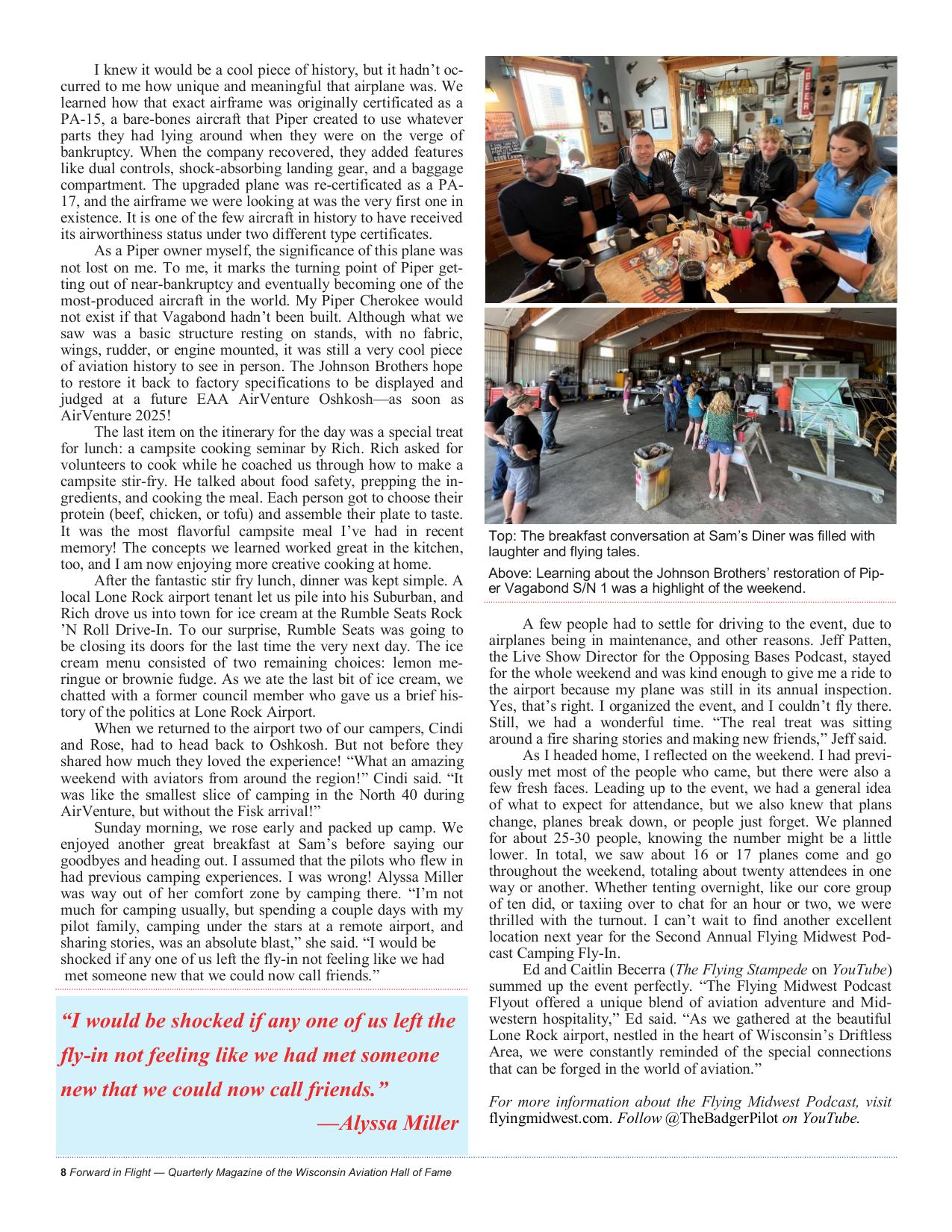
I knew it would be a cool piece of history, but it hadn’t occurred to me how unique and meaningful that airplane was. We learned how that exact airframe was originally certificated as a PA-15, a bare-bones aircraft that Piper created to use whatever parts they had lying around when they were on the verge of bankruptcy. When the company recovered, they added features like dual controls, shock-absorbing landing gear, and a baggage compartment. The upgraded plane was re-certificated as a PA17, and the airframe we were looking at was the very first one in existence. It is one of the few aircraft in history to have received its airworthiness status under two different type certificates. As a Piper owner myself, the significance of this plane was not lost on me. To me, it marks the turning point of Piper getting out of near-bankruptcy and eventually becoming one of the most-produced aircraft in the world. My Piper Cherokee would not exist if that Vagabond hadn’t been built. Although what we saw was a basic structure resting on stands, with no fabric, wings, rudder, or engine mounted, it was still a very cool piece of aviation history to see in person. The Johnson Brothers hope to restore it back to factory specifications to be displayed and judged at a future EAA AirVenture Oshkosh—as soon as AirVenture 2025! The last item on the itinerary for the day was a special treat for lunch: a campsite cooking seminar by Rich. Rich asked for volunteers to cook while he coached us through how to make a campsite stir-fry. He talked about food safety, prepping the ingredients, and cooking the meal. Each person got to choose their protein (beef, chicken, or tofu) and assemble their plate to taste. It was the most flavorful campsite meal I’ve had in recent memory! The concepts we learned worked great in the kitchen, too, and I am now enjoying more creative cooking at home. After the fantastic stir fry lunch, dinner was kept simple. A local Lone Rock airport tenant let us pile into his Suburban, and Rich drove us into town for ice cream at the Rumble Seats Rock ’N Roll Drive-In. To our surprise, Rumble Seats was going to be closing its doors for the last time the very next day. The ice cream menu consisted of two remaining choices: lemon meringue or brownie fudge. As we ate the last bit of ice cream, we chatted with a former council member who gave us a brief history of the politics at Lone Rock Airport. When we returned to the airport two of our campers, Cindi and Rose, had to head back to Oshkosh. But not before they shared how much they loved the experience! “What an amazing weekend with aviators from around the region!” Cindi said. “It was like the smallest slice of camping in the North 40 during AirVenture, but without the Fisk arrival!” Sunday morning, we rose early and packed up camp. We enjoyed another great breakfast at Sam’s before saying our goodbyes and heading out. I assumed that the pilots who flew in had previous camping experiences. I was wrong! Alyssa Miller was way out of her comfort zone by camping there. “I’m not much for camping usually, but spending a couple days with my pilot family, camping under the stars at a remote airport, and sharing stories, was an absolute blast,” she said. “I would be shocked if any one of us left the fly-in not feeling like we had met someone new that we could now call friends.” “I would be shocked if any one of us left the fly-in not feeling like we had met someone new that we could now call friends.” —Alyssa Miller 8 Forward in Flight — Quarterly Magazine of the Wisconsin Aviation Hall of Fame Top: The breakfast conversation at Sam’s Diner was filled with laughter and flying tales. Above: Learning about the Johnson Brothers’ restoration of Piper Vagabond S/N 1 was a highlight of the weekend. A few people had to settle for driving to the event, due to airplanes being in maintenance, and other reasons. Jeff Patten, the Live Show Director for the Opposing Bases Podcast, stayed for the whole weekend and was kind enough to give me a ride to the airport because my plane was still in its annual inspection. Yes, that’s right. I organized the event, and I couldn’t fly there. Still, we had a wonderful time. “The real treat was sitting around a fire sharing stories and making new friends,” Jeff said. As I headed home, I reflected on the weekend. I had previously met most of the people who came, but there were also a few fresh faces. Leading up to the event, we had a general idea of what to expect for attendance, but we also knew that plans change, planes break down, or people just forget. We planned for about 25-30 people, knowing the number might be a little lower. In total, we saw about 16 or 17 planes come and go throughout the weekend, totaling about twenty attendees in one way or another. Whether tenting overnight, like our core group of ten did, or taxiing over to chat for an hour or two, we were thrilled with the turnout. I can’t wait to find another excellent location next year for the Second Annual Flying Midwest Podcast Camping Fly-In. Ed and Caitlin Becerra (The Flying Stampede on YouTube) summed up the event perfectly. “The Flying Midwest Podcast Flyout offered a unique blend of aviation adventure and Midwestern hospitality,” Ed said. “As we gathered at the beautiful Lone Rock airport, nestled in the heart of Wisconsin’s Driftless Area, we were constantly reminded of the special connections that can be forged in the world of aviation.” For more information about the Flying Midwest Podcast, visit flyingmidwest.com. Follow @TheBadgerPilot on YouTube.
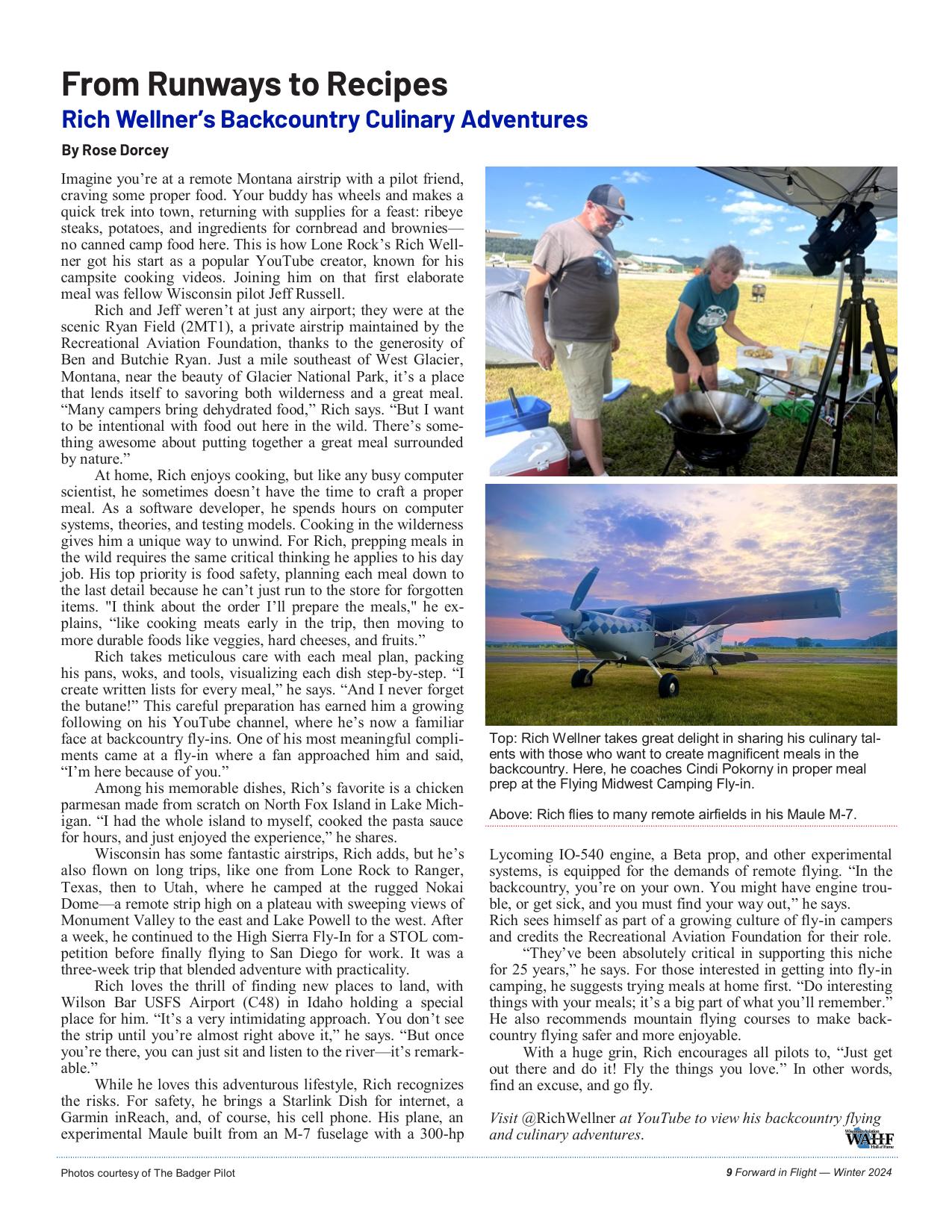
From Runways to Recipes Rich Wellner’s Backcountry Culinary Adventures By Rose Dorcey Imagine you’re at a remote Montana airstrip with a pilot friend, craving some proper food. Your buddy has wheels and makes a quick trek into town, returning with supplies for a feast: ribeye steaks, potatoes, and ingredients for cornbread and brownies— no canned camp food here. This is how Lone Rock’s Rich Wellner got his start as a popular YouTube creator, known for his campsite cooking videos. Joining him on that first elaborate meal was fellow Wisconsin pilot Jeff Russell. Rich and Jeff weren’t at just any airport; they were at the scenic Ryan Field (2MT1), a private airstrip maintained by the Recreational Aviation Foundation, thanks to the generosity of Ben and Butchie Ryan. Just a mile southeast of West Glacier, Montana, near the beauty of Glacier National Park, it’s a place that lends itself to savoring both wilderness and a great meal. “Many campers bring dehydrated food,” Rich says. “But I want to be intentional with food out here in the wild. There’s something awesome about putting together a great meal surrounded by nature.” At home, Rich enjoys cooking, but like any busy computer scientist, he sometimes doesn’t have the time to craft a proper meal. As a software developer, he spends hours on computer systems, theories, and testing models. Cooking in the wilderness gives him a unique way to unwind. For Rich, prepping meals in the wild requires the same critical thinking he applies to his day job. His top priority is food safety, planning each meal down to the last detail because he can’t just run to the store for forgotten items. "I think about the order I’ll prepare the meals," he explains, “like cooking meats early in the trip, then moving to more durable foods like veggies, hard cheeses, and fruits.” Rich takes meticulous care with each meal plan, packing his pans, woks, and tools, visualizing each dish step-by-step. “I create written lists for every meal,” he says. “And I never forget the butane!” This careful preparation has earned him a growing following on his YouTube channel, where he’s now a familiar face at backcountry fly-ins. One of his most meaningful compliments came at a fly-in where a fan approached him and said, “I’m here because of you.” Among his memorable dishes, Rich’s favorite is a chicken parmesan made from scratch on North Fox Island in Lake Michigan. “I had the whole island to myself, cooked the pasta sauce for hours, and just enjoyed the experience,” he shares. Wisconsin has some fantastic airstrips, Rich adds, but he’s also flown on long trips, like one from Lone Rock to Ranger, Texas, then to Utah, where he camped at the rugged Nokai Dome—a remote strip high on a plateau with sweeping views of Monument Valley to the east and Lake Powell to the west. After a week, he continued to the High Sierra Fly-In for a STOL competition before finally flying to San Diego for work. It was a three-week trip that blended adventure with practicality. Rich loves the thrill of finding new places to land, with Wilson Bar USFS Airport (C48) in Idaho holding a special place for him. “It’s a very intimidating approach. You don’t see the strip until you’re almost right above it,” he says. “But once you’re there, you can just sit and listen to the river—it’s remarkable.” While he loves this adventurous lifestyle, Rich recognizes the risks. For safety, he brings a Starlink Dish for internet, a Garmin inReach, and, of course, his cell phone. His plane, an experimental Maule built from an M-7 fuselage with a 300-hp Photos courtesy of The Badger Pilot Top: Rich Wellner takes great delight in sharing his culinary talents with those who want to create magnificent meals in the backcountry. Here, he coaches Cindi Pokorny in proper meal prep at the Flying Midwest Camping Fly-in. Above: Rich flies to many remote airfields in his Maule M-7. Lycoming IO-540 engine, a Beta prop, and other experimental systems, is equipped for the demands of remote flying. “In the backcountry, you’re on your own. You might have engine trouble, or get sick, and you must find your way out,” he says. Rich sees himself as part of a growing culture of fly-in campers and credits the Recreational Aviation Foundation for their role. “They’ve been absolutely critical in supporting this niche for 25 years,” he says. For those interested in getting into fly-in camping, he suggests trying meals at home first. “Do interesting things with your meals; it’s a big part of what you’ll remember.” He also recommends mountain flying courses to make backcountry flying safer and more enjoyable. With a huge grin, Rich encourages all pilots to, “Just get out there and do it! Fly the things you love.” In other words, find an excuse, and go fly. Visit @RichWellner at YouTube to view his backcountry flying and culinary adventures. 9 Forward in Flight — Winter 2024
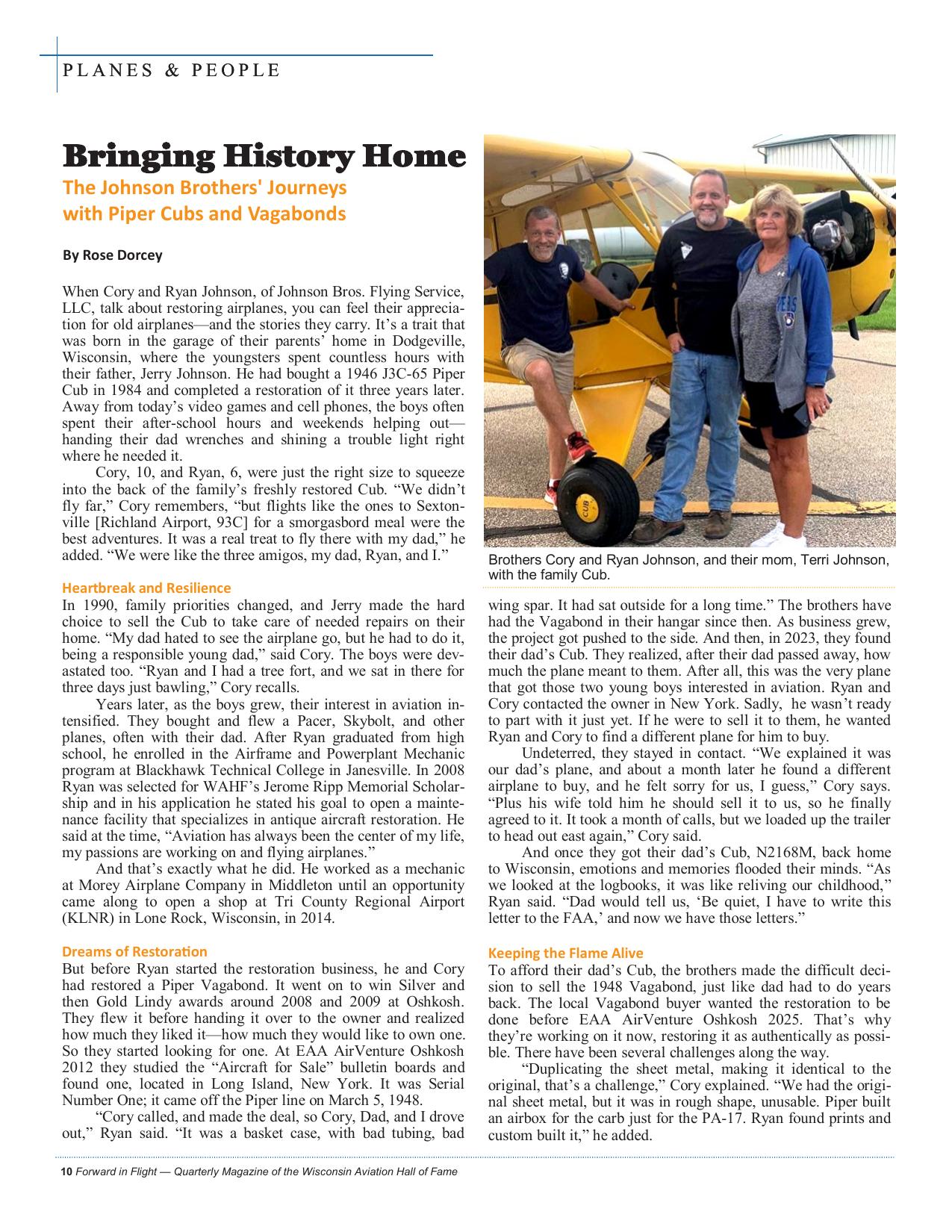
PLANES & PEOPLE Bringing History Home The Johnson Brothers' Journeys with Piper Cubs and Vagabonds By Rose Dorcey When Cory and Ryan Johnson, of Johnson Bros. Flying Service, LLC, talk about restoring airplanes, you can feel their appreciation for old airplanes—and the stories they carry. It’s a trait that was born in the garage of their parents’ home in Dodgeville, Wisconsin, where the youngsters spent countless hours with their father, Jerry Johnson. He had bought a 1946 J3C-65 Piper Cub in 1984 and completed a restoration of it three years later. Away from today’s video games and cell phones, the boys often spent their after-school hours and weekends helping out— handing their dad wrenches and shining a trouble light right where he needed it. Cory, 10, and Ryan, 6, were just the right size to squeeze into the back of the family’s freshly restored Cub. “We didn’t fly far,” Cory remembers, “but flights like the ones to Sextonville [Richland Airport, 93C] for a smorgasbord meal were the best adventures. It was a real treat to fly there with my dad,” he added. “We were like the three amigos, my dad, Ryan, and I.” Brothers Cory and Ryan Johnson, and their mom, Terri Johnson, with the family Cub. Heartbreak and Resilience In 1990, family priorities changed, and Jerry made the hard choice to sell the Cub to take care of needed repairs on their home. “My dad hated to see the airplane go, but he had to do it, being a responsible young dad,” said Cory. The boys were devastated too. “Ryan and I had a tree fort, and we sat in there for three days just bawling,” Cory recalls. Years later, as the boys grew, their interest in aviation intensified. They bought and flew a Pacer, Skybolt, and other planes, often with their dad. After Ryan graduated from high school, he enrolled in the Airframe and Powerplant Mechanic program at Blackhawk Technical College in Janesville. In 2008 Ryan was selected for WAHF’s Jerome Ripp Memorial Scholarship and in his application he stated his goal to open a maintenance facility that specializes in antique aircraft restoration. He said at the time, “Aviation has always been the center of my life, my passions are working on and flying airplanes.” And that’s exactly what he did. He worked as a mechanic at Morey Airplane Company in Middleton until an opportunity came along to open a shop at Tri County Regional Airport (KLNR) in Lone Rock, Wisconsin, in 2014. wing spar. It had sat outside for a long time.” The brothers have had the Vagabond in their hangar since then. As business grew, the project got pushed to the side. And then, in 2023, they found their dad’s Cub. They realized, after their dad passed away, how much the plane meant to them. After all, this was the very plane that got those two young boys interested in aviation. Ryan and Cory contacted the owner in New York. Sadly, he wasn’t ready to part with it just yet. If he were to sell it to them, he wanted Ryan and Cory to find a different plane for him to buy. Undeterred, they stayed in contact. “We explained it was our dad’s plane, and about a month later he found a different airplane to buy, and he felt sorry for us, I guess,” Cory says. “Plus his wife told him he should sell it to us, so he finally agreed to it. It took a month of calls, but we loaded up the trailer to head out east again,” Cory said. And once they got their dad’s Cub, N2168M, back home to Wisconsin, emotions and memories flooded their minds. “As we looked at the logbooks, it was like reliving our childhood,” Ryan said. “Dad would tell us, ‘Be quiet, I have to write this letter to the FAA,’ and now we have those letters.” Dreams of Restoration But before Ryan started the restoration business, he and Cory had restored a Piper Vagabond. It went on to win Silver and then Gold Lindy awards around 2008 and 2009 at Oshkosh. They flew it before handing it over to the owner and realized how much they liked it—how much they would like to own one. So they started looking for one. At EAA AirVenture Oshkosh 2012 they studied the “Aircraft for Sale” bulletin boards and found one, located in Long Island, New York. It was Serial Number One; it came off the Piper line on March 5, 1948. “Cory called, and made the deal, so Cory, Dad, and I drove out,” Ryan said. “It was a basket case, with bad tubing, bad Keeping the Flame Alive To afford their dad’s Cub, the brothers made the difficult decision to sell the 1948 Vagabond, just like dad had to do years back. The local Vagabond buyer wanted the restoration to be done before EAA AirVenture Oshkosh 2025. That’s why they’re working on it now, restoring it as authentically as possible. There have been several challenges along the way. “Duplicating the sheet metal, making it identical to the original, that’s a challenge,” Cory explained. “We had the original sheet metal, but it was in rough shape, unusable. Piper built an airbox for the carb just for the PA-17. Ryan found prints and custom built it,” he added. 10 Forward in Flight — Quarterly Magazine of the Wisconsin Aviation Hall of Fame
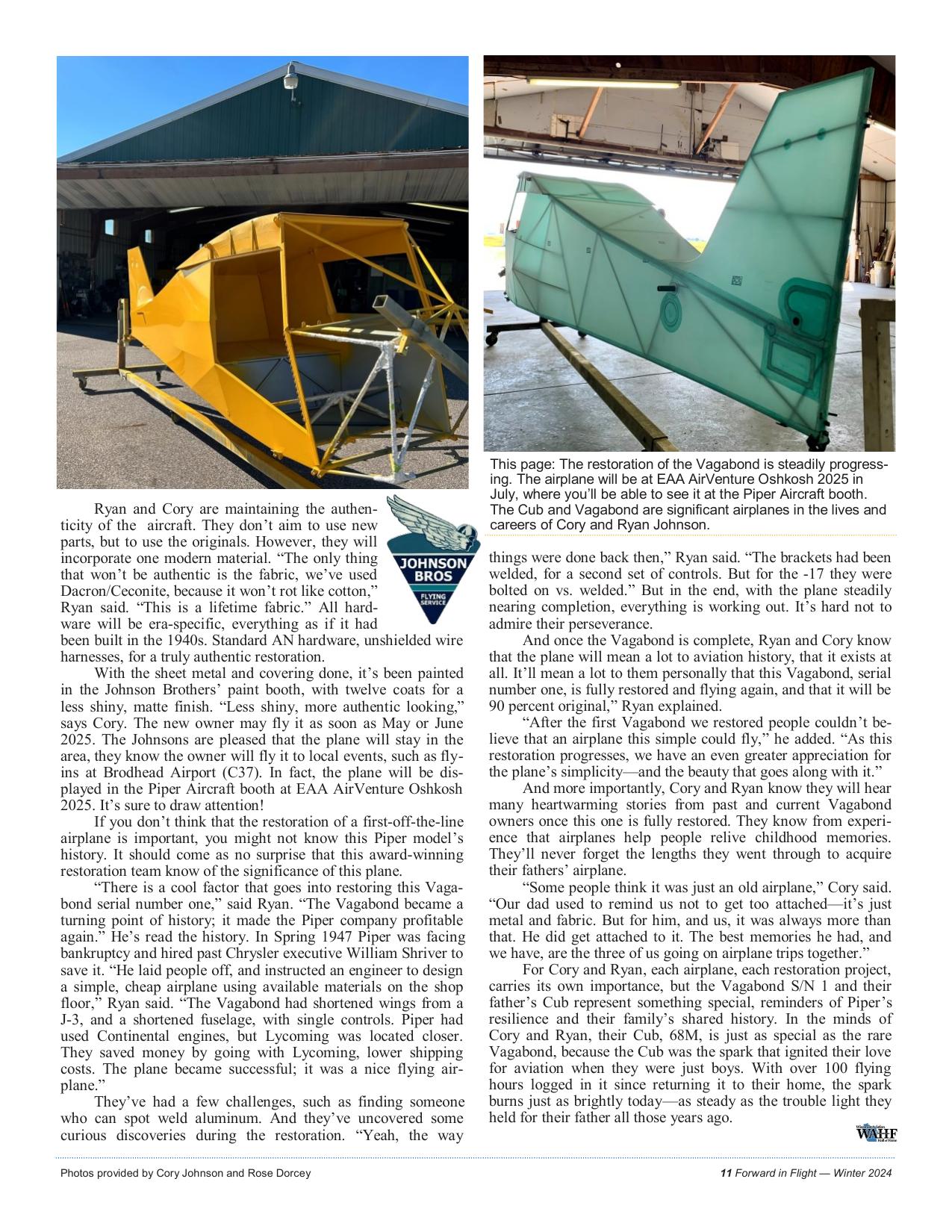
Ryan and Cory are maintaining the authenticity of the aircraft. They don’t aim to use new parts, but to use the originals. However, they will incorporate one modern material. “The only thing that won’t be authentic is the fabric, we’ve used Dacron/Ceconite, because it won’t rot like cotton,” Ryan said. “This is a lifetime fabric.” All hardware will be era-specific, everything as if it had been built in the 1940s. Standard AN hardware, unshielded wire harnesses, for a truly authentic restoration. With the sheet metal and covering done, it’s been painted in the Johnson Brothers’ paint booth, with twelve coats for a less shiny, matte finish. “Less shiny, more authentic looking,” says Cory. The new owner may fly it as soon as May or June 2025. The Johnsons are pleased that the plane will stay in the area, they know the owner will fly it to local events, such as flyins at Brodhead Airport (C37). In fact, the plane will be displayed in the Piper Aircraft booth at EAA AirVenture Oshkosh 2025. It’s sure to draw attention! If you don’t think that the restoration of a first-off-the-line airplane is important, you might not know this Piper model’s history. It should come as no surprise that this award-winning restoration team know of the significance of this plane. “There is a cool factor that goes into restoring this Vagabond serial number one,” said Ryan. “The Vagabond became a turning point of history; it made the Piper company profitable again.” He’s read the history. In Spring 1947 Piper was facing bankruptcy and hired past Chrysler executive William Shriver to save it. “He laid people off, and instructed an engineer to design a simple, cheap airplane using available materials on the shop floor,” Ryan said. “The Vagabond had shortened wings from a J-3, and a shortened fuselage, with single controls. Piper had used Continental engines, but Lycoming was located closer. They saved money by going with Lycoming, lower shipping costs. The plane became successful; it was a nice flying airplane.” They’ve had a few challenges, such as finding someone who can spot weld aluminum. And they’ve uncovered some curious discoveries during the restoration. “Yeah, the way Photos provided by Cory Johnson and Rose Dorcey This page: The restoration of the Vagabond is steadily progressing. The airplane will be at EAA AirVenture Oshkosh 2025 in July, where you’ll be able to see it at the Piper Aircraft booth. The Cub and Vagabond are significant airplanes in the lives and careers of Cory and Ryan Johnson. things were done back then,” Ryan said. “The brackets had been welded, for a second set of controls. But for the -17 they were bolted on vs. welded.” But in the end, with the plane steadily nearing completion, everything is working out. It’s hard not to admire their perseverance. And once the Vagabond is complete, Ryan and Cory know that the plane will mean a lot to aviation history, that it exists at all. It’ll mean a lot to them personally that this Vagabond, serial number one, is fully restored and flying again, and that it will be 90 percent original,” Ryan explained. “After the first Vagabond we restored people couldn’t believe that an airplane this simple could fly,” he added. “As this restoration progresses, we have an even greater appreciation for the plane’s simplicity—and the beauty that goes along with it.” And more importantly, Cory and Ryan know they will hear many heartwarming stories from past and current Vagabond owners once this one is fully restored. They know from experience that airplanes help people relive childhood memories. They’ll never forget the lengths they went through to acquire their fathers’ airplane. “Some people think it was just an old airplane,” Cory said. “Our dad used to remind us not to get too attached—it’s just metal and fabric. But for him, and us, it was always more than that. He did get attached to it. The best memories he had, and we have, are the three of us going on airplane trips together.” For Cory and Ryan, each airplane, each restoration project, carries its own importance, but the Vagabond S/N 1 and their father’s Cub represent something special, reminders of Piper’s resilience and their family’s shared history. In the minds of Cory and Ryan, their Cub, 68M, is just as special as the rare Vagabond, because the Cub was the spark that ignited their love for aviation when they were just boys. With over 100 flying hours logged in it since returning it to their home, the spark burns just as brightly today—as steady as the trouble light they held for their father all those years ago. 11 Forward in Flight — Winter 2024
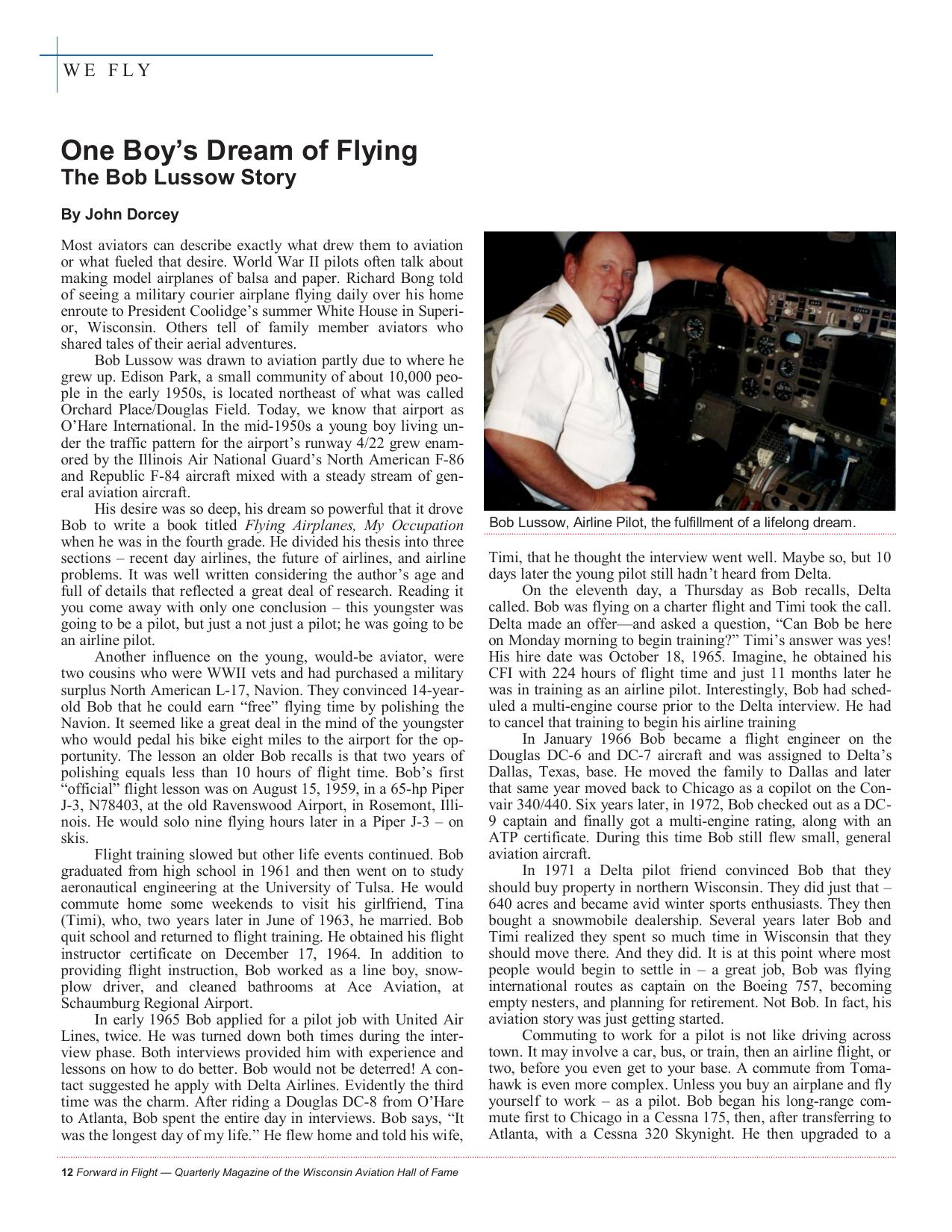
WE FLY One Boy’s Dream of Flying The Bob Lussow Story By John Dorcey Most aviators can describe exactly what drew them to aviation or what fueled that desire. World War II pilots often talk about making model airplanes of balsa and paper. Richard Bong told of seeing a military courier airplane flying daily over his home enroute to President Coolidge’s summer White House in Superior, Wisconsin. Others tell of family member aviators who shared tales of their aerial adventures. Bob Lussow was drawn to aviation partly due to where he grew up. Edison Park, a small community of about 10,000 people in the early 1950s, is located northeast of what was called Orchard Place/Douglas Field. Today, we know that airport as O’Hare International. In the mid-1950s a young boy living under the traffic pattern for the airport’s runway 4/22 grew enamored by the Illinois Air National Guard’s North American F-86 and Republic F-84 aircraft mixed with a steady stream of general aviation aircraft. His desire was so deep, his dream so powerful that it drove Bob to write a book titled Flying Airplanes, My Occupation when he was in the fourth grade. He divided his thesis into three sections – recent day airlines, the future of airlines, and airline problems. It was well written considering the author’s age and full of details that reflected a great deal of research. Reading it you come away with only one conclusion – this youngster was going to be a pilot, but just a not just a pilot; he was going to be an airline pilot. Another influence on the young, would-be aviator, were two cousins who were WWII vets and had purchased a military surplus North American L-17, Navion. They convinced 14-yearold Bob that he could earn “free” flying time by polishing the Navion. It seemed like a great deal in the mind of the youngster who would pedal his bike eight miles to the airport for the opportunity. The lesson an older Bob recalls is that two years of polishing equals less than 10 hours of flight time. Bob’s first “official” flight lesson was on August 15, 1959, in a 65-hp Piper J-3, N78403, at the old Ravenswood Airport, in Rosemont, Illinois. He would solo nine flying hours later in a Piper J-3 – on skis. Flight training slowed but other life events continued. Bob graduated from high school in 1961 and then went on to study aeronautical engineering at the University of Tulsa. He would commute home some weekends to visit his girlfriend, Tina (Timi), who, two years later in June of 1963, he married. Bob quit school and returned to flight training. He obtained his flight instructor certificate on December 17, 1964. In addition to providing flight instruction, Bob worked as a line boy, snowplow driver, and cleaned bathrooms at Ace Aviation, at Schaumburg Regional Airport. In early 1965 Bob applied for a pilot job with United Air Lines, twice. He was turned down both times during the interview phase. Both interviews provided him with experience and lessons on how to do better. Bob would not be deterred! A contact suggested he apply with Delta Airlines. Evidently the third time was the charm. After riding a Douglas DC-8 from O’Hare to Atlanta, Bob spent the entire day in interviews. Bob says, “It was the longest day of my life.” He flew home and told his wife, 12 Forward in Flight — Quarterly Magazine of the Wisconsin Aviation Hall of Fame Bob Lussow, Airline Pilot, the fulfillment of a lifelong dream. Timi, that he thought the interview went well. Maybe so, but 10 days later the young pilot still hadn’t heard from Delta. On the eleventh day, a Thursday as Bob recalls, Delta called. Bob was flying on a charter flight and Timi took the call. Delta made an offer—and asked a question, “Can Bob be here on Monday morning to begin training?” Timi’s answer was yes! His hire date was October 18, 1965. Imagine, he obtained his CFI with 224 hours of flight time and just 11 months later he was in training as an airline pilot. Interestingly, Bob had scheduled a multi-engine course prior to the Delta interview. He had to cancel that training to begin his airline training In January 1966 Bob became a flight engineer on the Douglas DC-6 and DC-7 aircraft and was assigned to Delta’s Dallas, Texas, base. He moved the family to Dallas and later that same year moved back to Chicago as a copilot on the Convair 340/440. Six years later, in 1972, Bob checked out as a DC9 captain and finally got a multi-engine rating, along with an ATP certificate. During this time Bob still flew small, general aviation aircraft. In 1971 a Delta pilot friend convinced Bob that they should buy property in northern Wisconsin. They did just that – 640 acres and became avid winter sports enthusiasts. They then bought a snowmobile dealership. Several years later Bob and Timi realized they spent so much time in Wisconsin that they should move there. And they did. It is at this point where most people would begin to settle in – a great job, Bob was flying international routes as captain on the Boeing 757, becoming empty nesters, and planning for retirement. Not Bob. In fact, his aviation story was just getting started. Commuting to work for a pilot is not like driving across town. It may involve a car, bus, or train, then an airline flight, or two, before you even get to your base. A commute from Tomahawk is even more complex. Unless you buy an airplane and fly yourself to work – as a pilot. Bob began his long-range commute first to Chicago in a Cessna 175, then, after transferring to Atlanta, with a Cessna 320 Skynight. He then upgraded to a
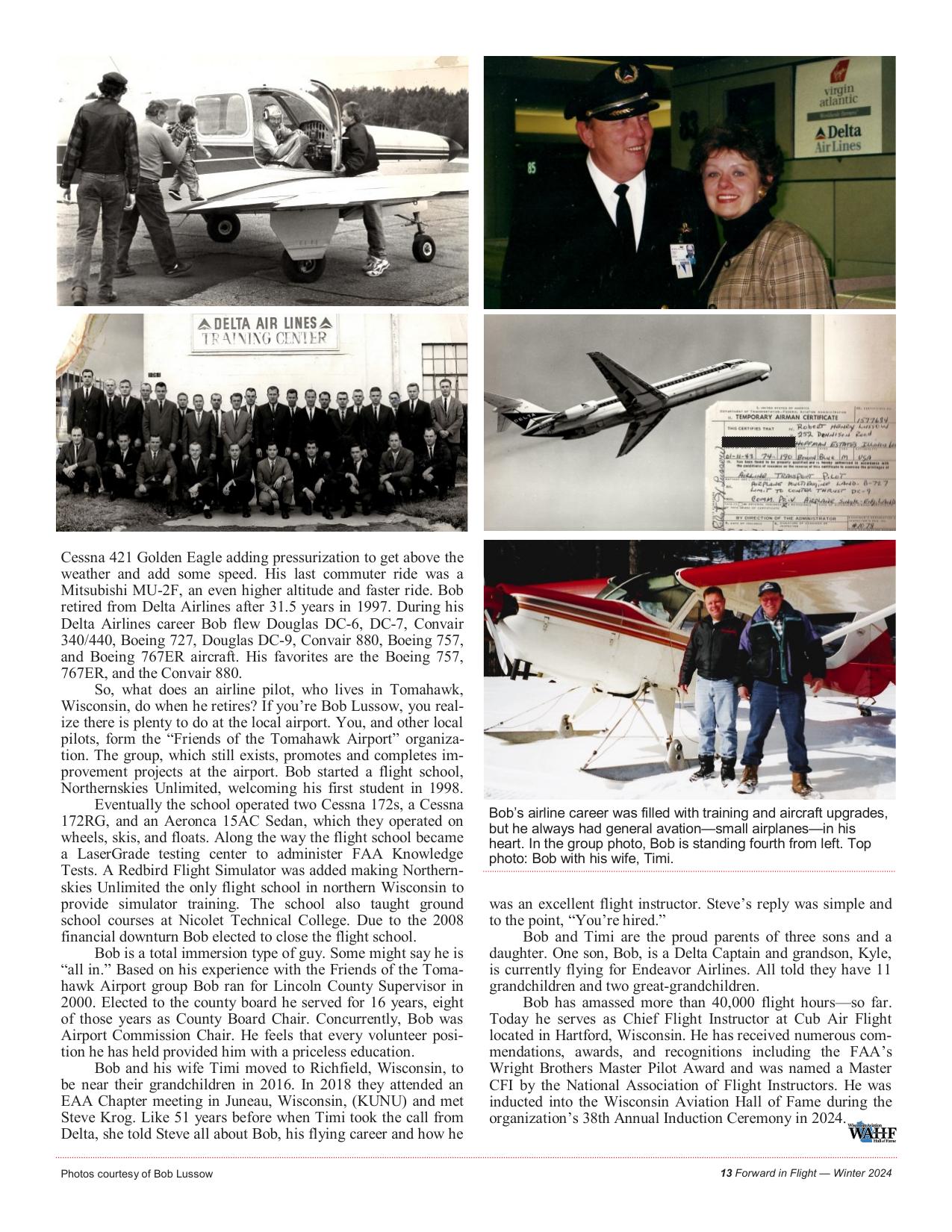
Cessna 421 Golden Eagle adding pressurization to get above the weather and add some speed. His last commuter ride was a Mitsubishi MU-2F, an even higher altitude and faster ride. Bob retired from Delta Airlines after 31.5 years in 1997. During his Delta Airlines career Bob flew Douglas DC-6, DC-7, Convair 340/440, Boeing 727, Douglas DC-9, Convair 880, Boeing 757, and Boeing 767ER aircraft. His favorites are the Boeing 757, 767ER, and the Convair 880. So, what does an airline pilot, who lives in Tomahawk, Wisconsin, do when he retires? If you’re Bob Lussow, you realize there is plenty to do at the local airport. You, and other local pilots, form the “Friends of the Tomahawk Airport” organization. The group, which still exists, promotes and completes improvement projects at the airport. Bob started a flight school, Northernskies Unlimited, welcoming his first student in 1998. Eventually the school operated two Cessna 172s, a Cessna 172RG, and an Aeronca 15AC Sedan, which they operated on wheels, skis, and floats. Along the way the flight school became a LaserGrade testing center to administer FAA Knowledge Tests. A Redbird Flight Simulator was added making Northernskies Unlimited the only flight school in northern Wisconsin to provide simulator training. The school also taught ground school courses at Nicolet Technical College. Due to the 2008 financial downturn Bob elected to close the flight school. Bob is a total immersion type of guy. Some might say he is “all in.” Based on his experience with the Friends of the Tomahawk Airport group Bob ran for Lincoln County Supervisor in 2000. Elected to the county board he served for 16 years, eight of those years as County Board Chair. Concurrently, Bob was Airport Commission Chair. He feels that every volunteer position he has held provided him with a priceless education. Bob and his wife Timi moved to Richfield, Wisconsin, to be near their grandchildren in 2016. In 2018 they attended an EAA Chapter meeting in Juneau, Wisconsin, (KUNU) and met Steve Krog. Like 51 years before when Timi took the call from Delta, she told Steve all about Bob, his flying career and how he Photos courtesy of Bob Lussow Bob’s airline career was filled with training and aircraft upgrades, but he always had general avation—small airplanes—in his heart. In the group photo, Bob is standing fourth from left. Top photo: Bob with his wife, Timi. was an excellent flight instructor. Steve’s reply was simple and to the point, “You’re hired.” Bob and Timi are the proud parents of three sons and a daughter. One son, Bob, is a Delta Captain and grandson, Kyle, is currently flying for Endeavor Airlines. All told they have 11 grandchildren and two great-grandchildren. Bob has amassed more than 40,000 flight hours—so far. Today he serves as Chief Flight Instructor at Cub Air Flight located in Hartford, Wisconsin. He has received numerous commendations, awards, and recognitions including the FAA’s Wright Brothers Master Pilot Award and was named a Master CFI by the National Association of Flight Instructors. He was inducted into the Wisconsin Aviation Hall of Fame during the organization’s 38th Annual Induction Ceremony in 2024. 13 Forward in Flight — Winter 2024
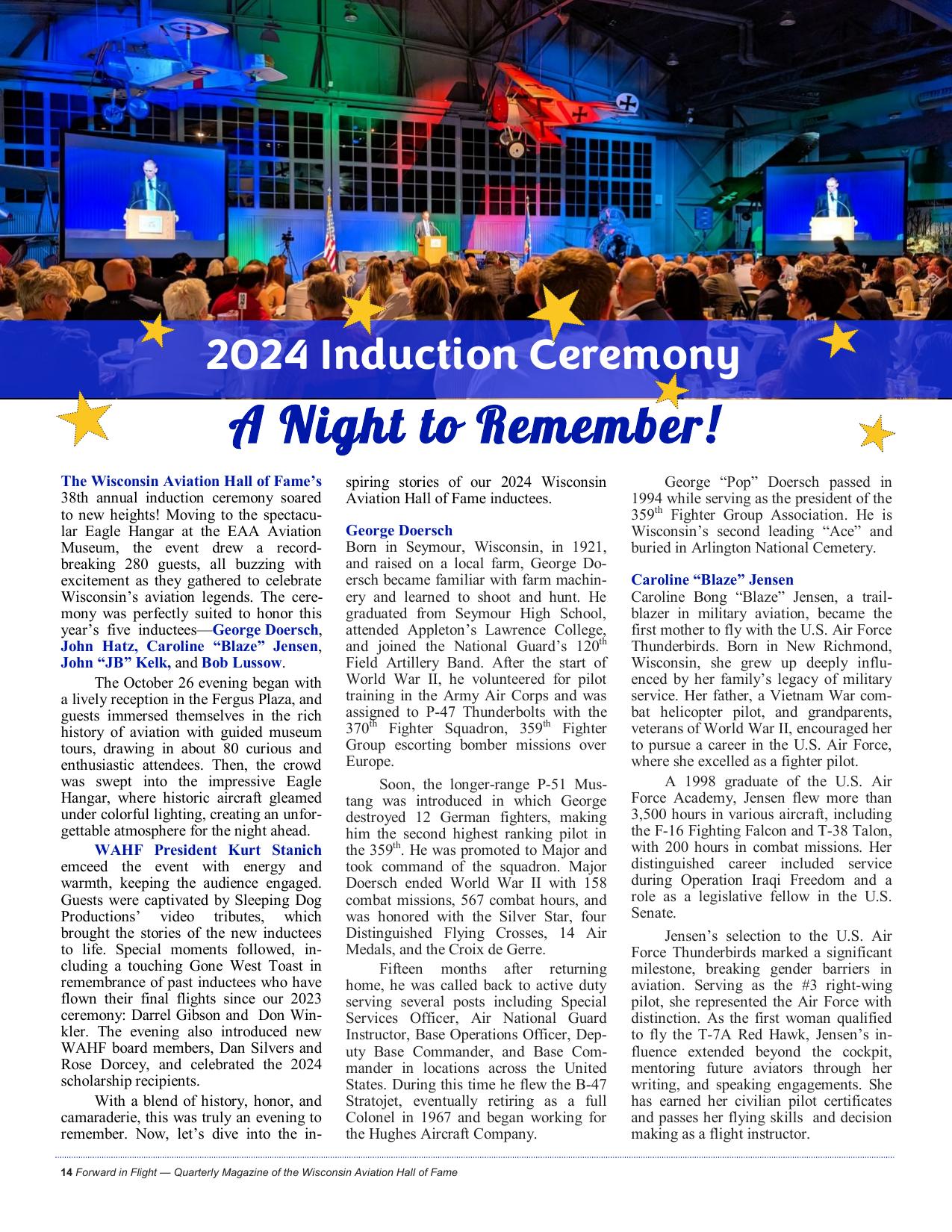
2024 Induction Ceremony A Night to Remember! The Wisconsin Aviation Hall of Fame’s 38th annual induction ceremony soared to new heights! Moving to the spectacular Eagle Hangar at the EAA Aviation Museum, the event drew a recordbreaking 280 guests, all buzzing with excitement as they gathered to celebrate Wisconsin’s aviation legends. The ceremony was perfectly suited to honor this year’s five inductees—George Doersch, John Hatz, Caroline “Blaze” Jensen, John “JB” Kelk, and Bob Lussow. The October 26 evening began with a lively reception in the Fergus Plaza, and guests immersed themselves in the rich history of aviation with guided museum tours, drawing in about 80 curious and enthusiastic attendees. Then, the crowd was swept into the impressive Eagle Hangar, where historic aircraft gleamed under colorful lighting, creating an unforgettable atmosphere for the night ahead. WAHF President Kurt Stanich emceed the event with energy and warmth, keeping the audience engaged. Guests were captivated by Sleeping Dog Productions’ video tributes, which brought the stories of the new inductees to life. Special moments followed, including a touching Gone West Toast in remembrance of past inductees who have flown their final flights since our 2023 ceremony: Darrel Gibson and Don Winkler. The evening also introduced new WAHF board members, Dan Silvers and Rose Dorcey, and celebrated the 2024 scholarship recipients. With a blend of history, honor, and camaraderie, this was truly an evening to remember. Now, let’s dive into the in- spiring stories of our 2024 Wisconsin Aviation Hall of Fame inductees. George Doersch Born in Seymour, Wisconsin, in 1921, and raised on a local farm, George Doersch became familiar with farm machinery and learned to shoot and hunt. He graduated from Seymour High School, attended Appleton’s Lawrence College, and joined the National Guard’s 120th Field Artillery Band. After the start of World War II, he volunteered for pilot training in the Army Air Corps and was assigned to P-47 Thunderbolts with the 370th Fighter Squadron, 359th Fighter Group escorting bomber missions over Europe. Soon, the longer-range P-51 Mustang was introduced in which George destroyed 12 German fighters, making him the second highest ranking pilot in the 359th. He was promoted to Major and took command of the squadron. Major Doersch ended World War II with 158 combat missions, 567 combat hours, and was honored with the Silver Star, four Distinguished Flying Crosses, 14 Air Medals, and the Croix de Gerre. Fifteen months after returning home, he was called back to active duty serving several posts including Special Services Officer, Air National Guard Instructor, Base Operations Officer, Deputy Base Commander, and Base Commander in locations across the United States. During this time he flew the B-47 Stratojet, eventually retiring as a full Colonel in 1967 and began working for the Hughes Aircraft Company. 14 Forward in Flight — Quarterly Magazine of the Wisconsin Aviation Hall of Fame George “Pop” Doersch passed in 1994 while serving as the president of the 359th Fighter Group Association. He is Wisconsin’s second leading “Ace” and buried in Arlington National Cemetery. Caroline “Blaze” Jensen Caroline Bong “Blaze” Jensen, a trailblazer in military aviation, became the first mother to fly with the U.S. Air Force Thunderbirds. Born in New Richmond, Wisconsin, she grew up deeply influenced by her family’s legacy of military service. Her father, a Vietnam War combat helicopter pilot, and grandparents, veterans of World War II, encouraged her to pursue a career in the U.S. Air Force, where she excelled as a fighter pilot. A 1998 graduate of the U.S. Air Force Academy, Jensen flew more than 3,500 hours in various aircraft, including the F-16 Fighting Falcon and T-38 Talon, with 200 hours in combat missions. Her distinguished career included service during Operation Iraqi Freedom and a role as a legislative fellow in the U.S. Senate. Jensen’s selection to the U.S. Air Force Thunderbirds marked a significant milestone, breaking gender barriers in aviation. Serving as the #3 right-wing pilot, she represented the Air Force with distinction. As the first woman qualified to fly the T-7A Red Hawk, Jensen’s influence extended beyond the cockpit, mentoring future aviators through her writing, and speaking engagements. She has earned her civilian pilot certificates and passes her flying skills and decision making as a flight instructor.
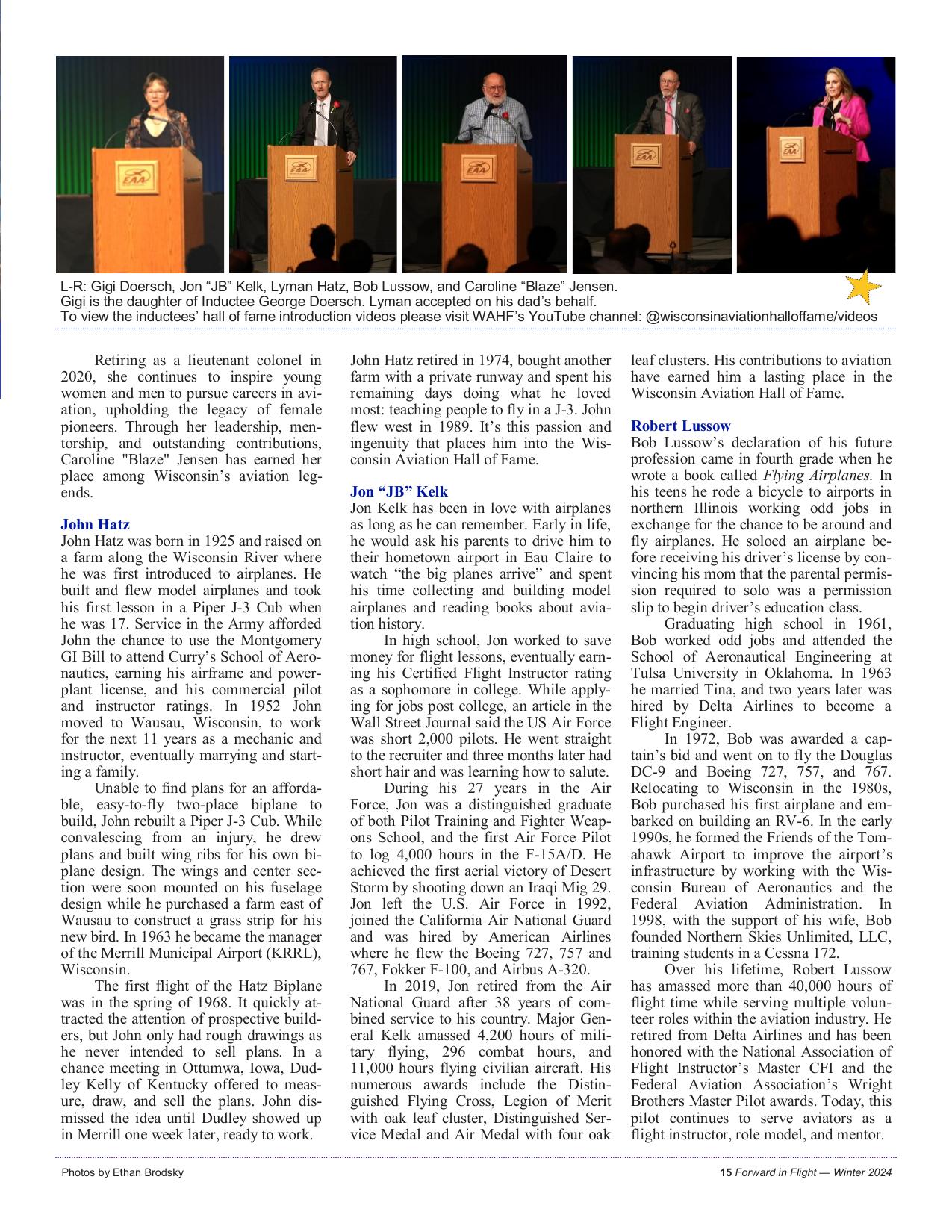
L-R: Gigi Doersch, Jon “JB” Kelk, Lyman Hatz, Bob Lussow, and Caroline “Blaze” Jensen. Gigi is the daughter of Inductee George Doersch. Lyman accepted on his dad’s behalf. To view the inductees’ hall of fame introduction videos please visit WAHF’s YouTube channel: @wisconsinaviationhalloffame/videos Retiring as a lieutenant colonel in 2020, she continues to inspire young women and men to pursue careers in aviation, upholding the legacy of female pioneers. Through her leadership, mentorship, and outstanding contributions, Caroline "Blaze" Jensen has earned her place among Wisconsin’s aviation legends. John Hatz John Hatz was born in 1925 and raised on a farm along the Wisconsin River where he was first introduced to airplanes. He built and flew model airplanes and took his first lesson in a Piper J-3 Cub when he was 17. Service in the Army afforded John the chance to use the Montgomery GI Bill to attend Curry’s School of Aeronautics, earning his airframe and powerplant license, and his commercial pilot and instructor ratings. In 1952 John moved to Wausau, Wisconsin, to work for the next 11 years as a mechanic and instructor, eventually marrying and starting a family. Unable to find plans for an affordable, easy-to-fly two-place biplane to build, John rebuilt a Piper J-3 Cub. While convalescing from an injury, he drew plans and built wing ribs for his own biplane design. The wings and center section were soon mounted on his fuselage design while he purchased a farm east of Wausau to construct a grass strip for his new bird. In 1963 he became the manager of the Merrill Municipal Airport (KRRL), Wisconsin. The first flight of the Hatz Biplane was in the spring of 1968. It quickly attracted the attention of prospective builders, but John only had rough drawings as he never intended to sell plans. In a chance meeting in Ottumwa, Iowa, Dudley Kelly of Kentucky offered to measure, draw, and sell the plans. John dismissed the idea until Dudley showed up in Merrill one week later, ready to work. Photos by Ethan Brodsky John Hatz retired in 1974, bought another farm with a private runway and spent his remaining days doing what he loved most: teaching people to fly in a J-3. John flew west in 1989. It’s this passion and ingenuity that places him into the Wisconsin Aviation Hall of Fame. Jon “JB” Kelk Jon Kelk has been in love with airplanes as long as he can remember. Early in life, he would ask his parents to drive him to their hometown airport in Eau Claire to watch “the big planes arrive” and spent his time collecting and building model airplanes and reading books about aviation history. In high school, Jon worked to save money for flight lessons, eventually earning his Certified Flight Instructor rating as a sophomore in college. While applying for jobs post college, an article in the Wall Street Journal said the US Air Force was short 2,000 pilots. He went straight to the recruiter and three months later had short hair and was learning how to salute. During his 27 years in the Air Force, Jon was a distinguished graduate of both Pilot Training and Fighter Weapons School, and the first Air Force Pilot to log 4,000 hours in the F-15A/D. He achieved the first aerial victory of Desert Storm by shooting down an Iraqi Mig 29. Jon left the U.S. Air Force in 1992, joined the California Air National Guard and was hired by American Airlines where he flew the Boeing 727, 757 and 767, Fokker F-100, and Airbus A-320. In 2019, Jon retired from the Air National Guard after 38 years of combined service to his country. Major General Kelk amassed 4,200 hours of military flying, 296 combat hours, and 11,000 hours flying civilian aircraft. His numerous awards include the Distinguished Flying Cross, Legion of Merit with oak leaf cluster, Distinguished Service Medal and Air Medal with four oak leaf clusters. His contributions to aviation have earned him a lasting place in the Wisconsin Aviation Hall of Fame. Robert Lussow Bob Lussow’s declaration of his future profession came in fourth grade when he wrote a book called Flying Airplanes. In his teens he rode a bicycle to airports in northern Illinois working odd jobs in exchange for the chance to be around and fly airplanes. He soloed an airplane before receiving his driver’s license by convincing his mom that the parental permission required to solo was a permission slip to begin driver’s education class. Graduating high school in 1961, Bob worked odd jobs and attended the School of Aeronautical Engineering at Tulsa University in Oklahoma. In 1963 he married Tina, and two years later was hired by Delta Airlines to become a Flight Engineer. In 1972, Bob was awarded a captain’s bid and went on to fly the Douglas DC-9 and Boeing 727, 757, and 767. Relocating to Wisconsin in the 1980s, Bob purchased his first airplane and embarked on building an RV-6. In the early 1990s, he formed the Friends of the Tomahawk Airport to improve the airport’s infrastructure by working with the Wisconsin Bureau of Aeronautics and the Federal Aviation Administration. In 1998, with the support of his wife, Bob founded Northern Skies Unlimited, LLC, training students in a Cessna 172. Over his lifetime, Robert Lussow has amassed more than 40,000 hours of flight time while serving multiple volunteer roles within the aviation industry. He retired from Delta Airlines and has been honored with the National Association of Flight Instructor’s Master CFI and the Federal Aviation Association’s Wright Brothers Master Pilot awards. Today, this pilot continues to serve aviators as a flight instructor, role model, and mentor. 15 Forward in Flight — Winter 2024
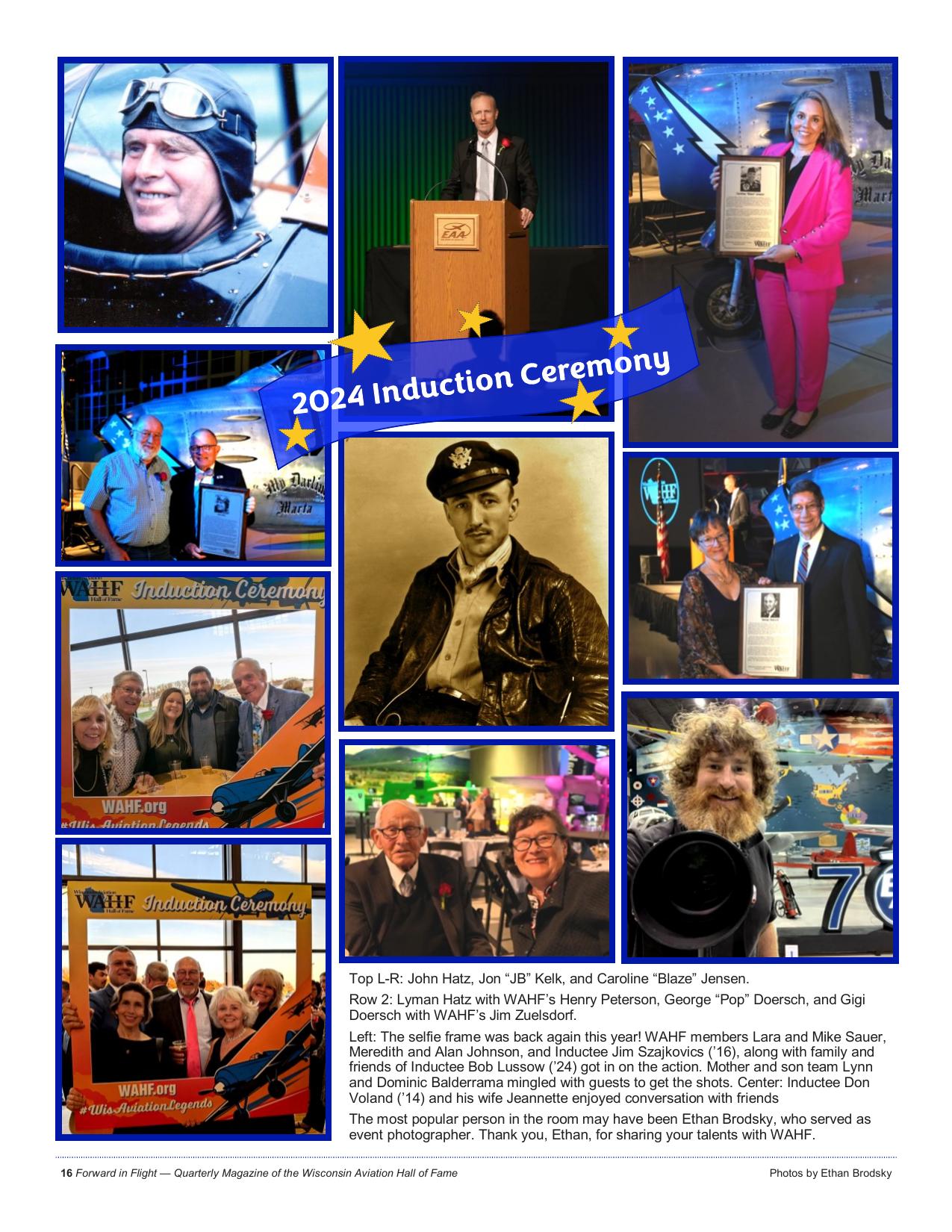
Top L-R: John Hatz, Jon “JB” Kelk, and Caroline “Blaze” Jensen. Row 2: Lyman Hatz with WAHF’s Henry Peterson, George “Pop” Doersch, and Gigi Doersch with WAHF’s Jim Zuelsdorf. Left: The selfie frame was back again this year! WAHF members Lara and Mike Sauer, Meredith and Alan Johnson, and Inductee Jim Szajkovics (’16), along with family and friends of Inductee Bob Lussow (’24) got in on the action. Mother and son team Lynn and Dominic Balderrama mingled with guests to get the shots. Center: Inductee Don Voland (’14) and his wife Jeannette enjoyed conversation with friends The most popular person in the room may have been Ethan Brodsky, who served as event photographer. Thank you, Ethan, for sharing your talents with WAHF. 16 Forward in Flight — Quarterly Magazine of the Wisconsin Aviation Hall of Fame Photos by Ethan Brodsky
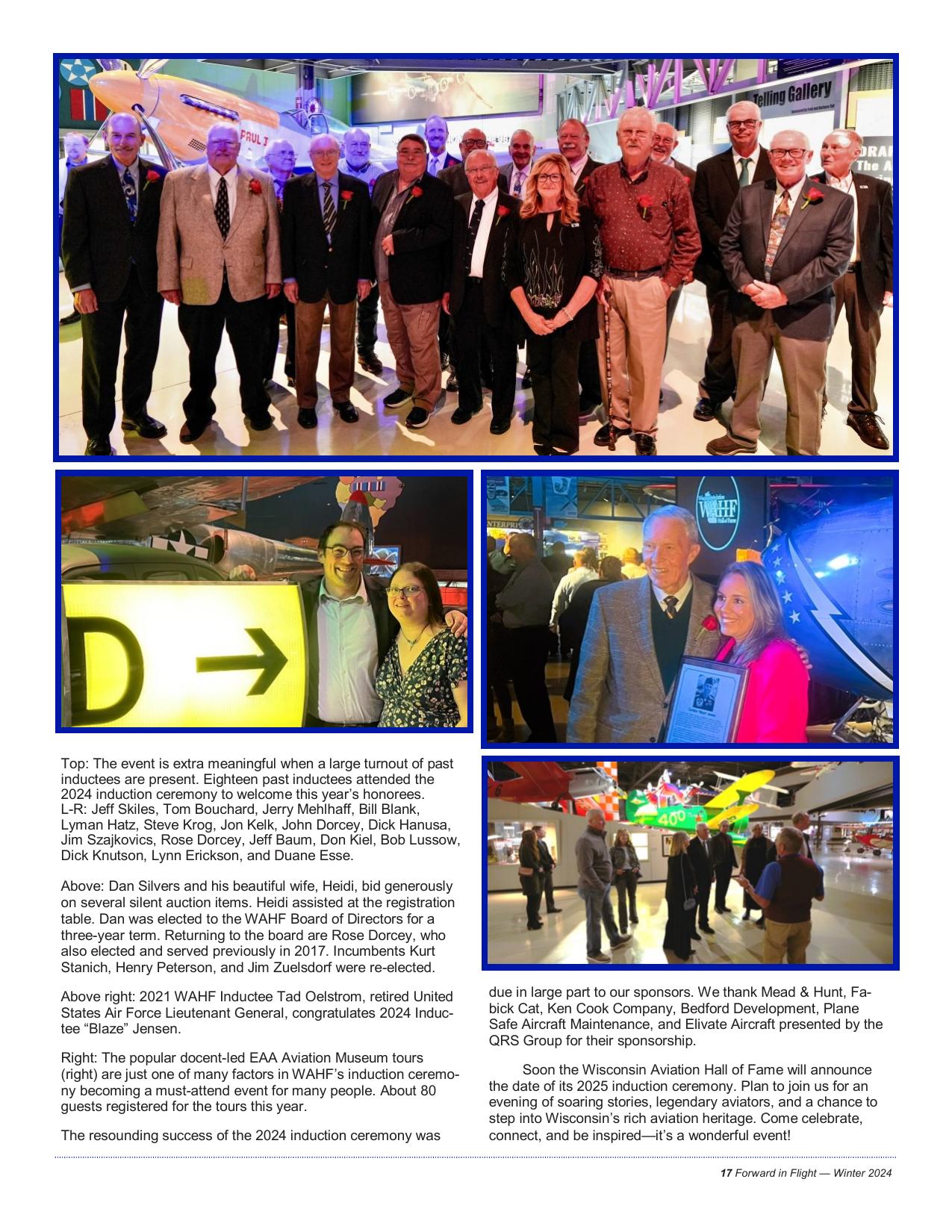
Top: The event is extra meaningful when a large turnout of past inductees are present. Eighteen past inductees attended the 2024 induction ceremony to welcome this year’s honorees. L-R: Jeff Skiles, Tom Bouchard, Jerry Mehlhaff, Bill Blank, Lyman Hatz, Steve Krog, Jon Kelk, John Dorcey, Dick Hanusa, Jim Szajkovics, Rose Dorcey, Jeff Baum, Don Kiel, Bob Lussow, Dick Knutson, Lynn Erickson, and Duane Esse. Above: Dan Silvers and his beautiful wife, Heidi, bid generously on several silent auction items. Heidi assisted at the registration table. Dan was elected to the WAHF Board of Directors for a three-year term. Returning to the board are Rose Dorcey, who also elected and served previously in 2017. Incumbents Kurt Stanich, Henry Peterson, and Jim Zuelsdorf were re-elected. Above right: 2021 WAHF Inductee Tad Oelstrom, retired United States Air Force Lieutenant General, congratulates 2024 Inductee “Blaze” Jensen. Right: The popular docent-led EAA Aviation Museum tours (right) are just one of many factors in WAHF’s induction ceremony becoming a must-attend event for many people. About 80 guests registered for the tours this year. The resounding success of the 2024 induction ceremony was due in large part to our sponsors. We thank Mead & Hunt, Fabick Cat, Ken Cook Company, Bedford Development, Plane Safe Aircraft Maintenance, and Elivate Aircraft presented by the QRS Group for their sponsorship. Soon the Wisconsin Aviation Hall of Fame will announce the date of its 2025 induction ceremony. Plan to join us for an evening of soaring stories, legendary aviators, and a chance to step into Wisconsin’s rich aviation heritage. Come celebrate, connect, and be inspired—it’s a wonderful event! 17 Forward in Flight — Winter 2024
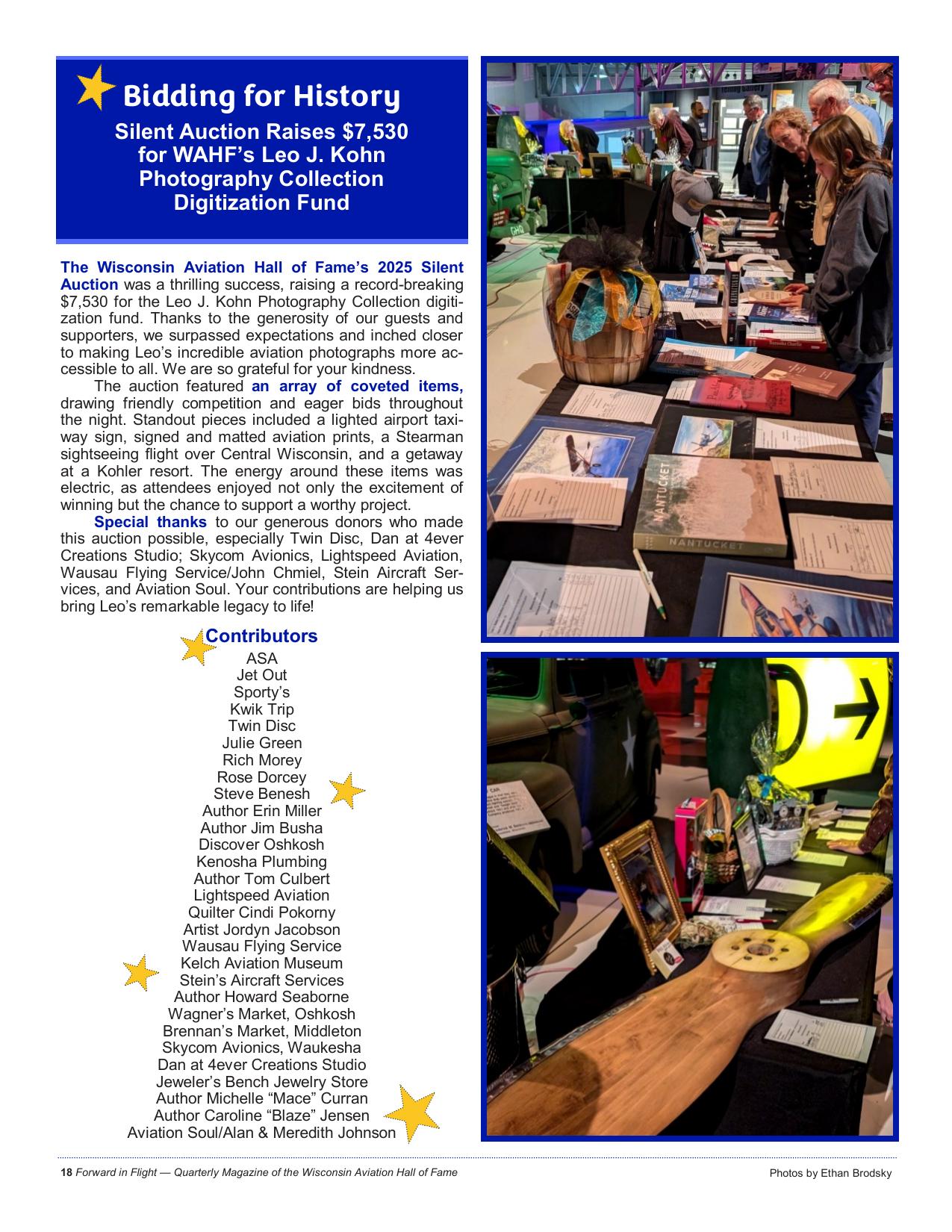
Bidding for History Silent Auction Raises $7,530 for WAHF’s Leo J. Kohn Photography Collection Digitization Fund The Wisconsin Aviation Hall of Fame’s 2025 Silent Auction was a thrilling success, raising a record-breaking $7,530 for the Leo J. Kohn Photography Collection digitization fund. Thanks to the generosity of our guests and supporters, we surpassed expectations and inched closer to making Leo’s incredible aviation photographs more accessible to all. We are so grateful for your kindness. The auction featured an array of coveted items, drawing friendly competition and eager bids throughout the night. Standout pieces included a lighted airport taxiway sign, signed and matted aviation prints, a Stearman sightseeing flight over Central Wisconsin, and a getaway at a Kohler resort. The energy around these items was electric, as attendees enjoyed not only the excitement of winning but the chance to support a worthy project. Special thanks to our generous donors who made this auction possible, especially Twin Disc, Dan at 4ever Creations Studio; Skycom Avionics, Lightspeed Aviation, Wausau Flying Service/John Chmiel, Stein Aircraft Services, and Aviation Soul. Your contributions are helping us bring Leo’s remarkable legacy to life! Contributors ASA Jet Out Sporty’s Kwik Trip Twin Disc Julie Green Rich Morey Rose Dorcey Steve Benesh Author Erin Miller Author Jim Busha Discover Oshkosh Kenosha Plumbing Author Tom Culbert Lightspeed Aviation Quilter Cindi Pokorny Artist Jordyn Jacobson Wausau Flying Service Kelch Aviation Museum Stein’s Aircraft Services Author Howard Seaborne Wagner’s Market, Oshkosh Brennan’s Market, Middleton Skycom Avionics, Waukesha Dan at 4ever Creations Studio Jeweler’s Bench Jewelry Store Author Michelle “Mace” Curran Author Caroline “Blaze” Jensen Aviation Soul/Alan & Meredith Johnson 18 Forward in Flight — Quarterly Magazine of the Wisconsin Aviation Hall of Fame Photos by Ethan Brodsky
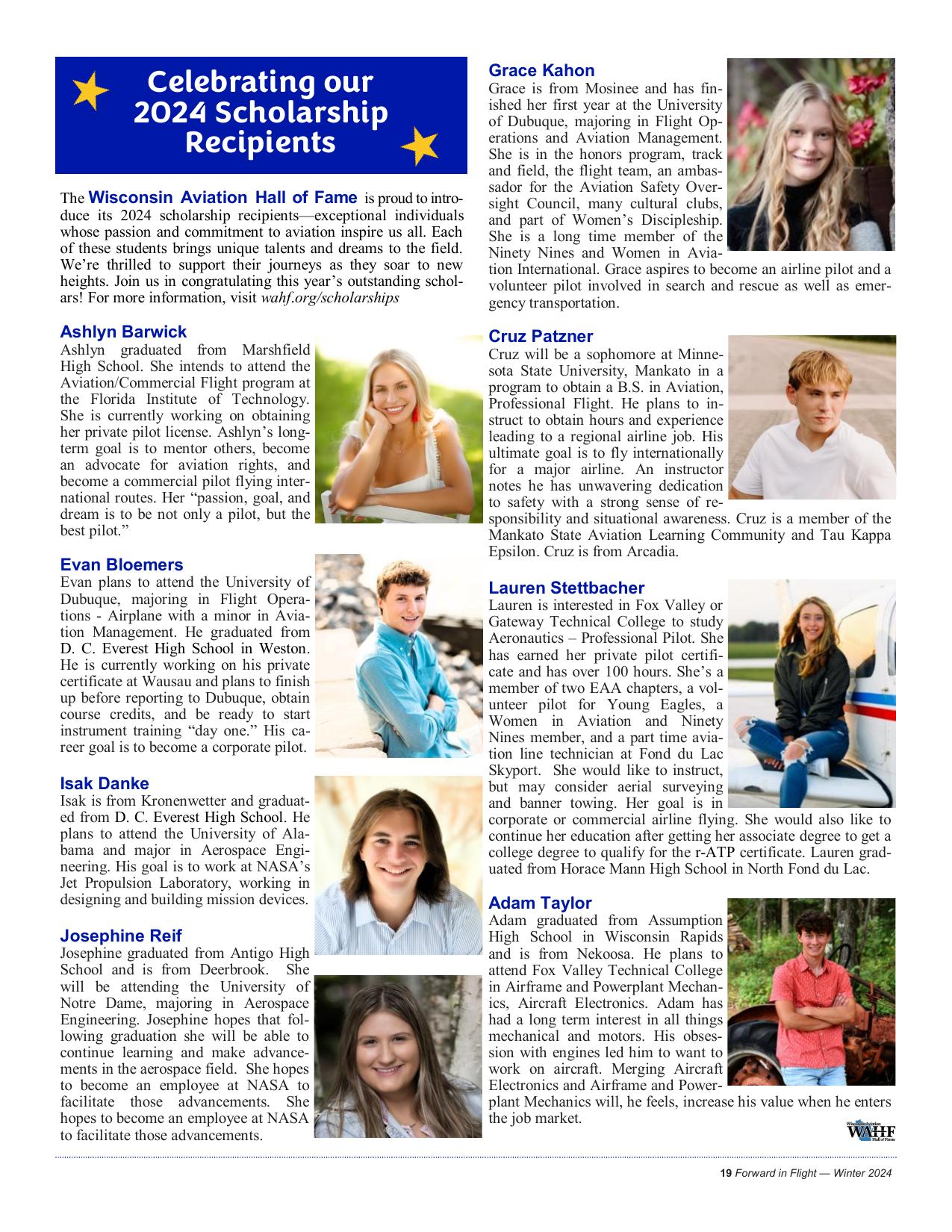
Celebrating our 2024 Scholarship Recipients Grace Kahon The Wisconsin Aviation Hall of Fame is proud to introduce its 2024 scholarship recipients—exceptional individuals whose passion and commitment to aviation inspire us all. Each of these students brings unique talents and dreams to the field. We’re thrilled to support their journeys as they soar to new heights. Join us in congratulating this year’s outstanding scholars! For more information, visit wahf.org/scholarships Grace is from Mosinee and has finished her first year at the University of Dubuque, majoring in Flight Operations and Aviation Management. She is in the honors program, track and field, the flight team, an ambassador for the Aviation Safety Oversight Council, many cultural clubs, and part of Women’s Discipleship. She is a long time member of the Ninety Nines and Women in Aviation International. Grace aspires to become an airline pilot and a volunteer pilot involved in search and rescue as well as emergency transportation. Ashlyn Barwick Cruz Patzner Ashlyn graduated from Marshfield High School. She intends to attend the Aviation/Commercial Flight program at the Florida Institute of Technology. She is currently working on obtaining her private pilot license. Ashlyn’s longterm goal is to mentor others, become an advocate for aviation rights, and become a commercial pilot flying international routes. Her “passion, goal, and dream is to be not only a pilot, but the best pilot.” Evan Bloemers Evan plans to attend the University of Dubuque, majoring in Flight Operations - Airplane with a minor in Aviation Management. He graduated from D. C. Everest High School in Weston. He is currently working on his private certificate at Wausau and plans to finish up before reporting to Dubuque, obtain course credits, and be ready to start instrument training “day one.” His career goal is to become a corporate pilot. Isak Danke Isak is from Kronenwetter and graduated from D. C. Everest High School. He plans to attend the University of Alabama and major in Aerospace Engineering. His goal is to work at NASA’s Jet Propulsion Laboratory, working in designing and building mission devices. Josephine Reif Josephine graduated from Antigo High School and is from Deerbrook. She will be attending the University of Notre Dame, majoring in Aerospace Engineering. Josephine hopes that following graduation she will be able to continue learning and make advancements in the aerospace field. She hopes to become an employee at NASA to facilitate those advancements. She hopes to become an employee at NASA to facilitate those advancements. Cruz will be a sophomore at Minnesota State University, Mankato in a program to obtain a B.S. in Aviation, Professional Flight. He plans to instruct to obtain hours and experience leading to a regional airline job. His ultimate goal is to fly internationally for a major airline. An instructor notes he has unwavering dedication to safety with a strong sense of responsibility and situational awareness. Cruz is a member of the Mankato State Aviation Learning Community and Tau Kappa Epsilon. Cruz is from Arcadia. Lauren Stettbacher Lauren is interested in Fox Valley or Gateway Technical College to study Aeronautics – Professional Pilot. She has earned her private pilot certificate and has over 100 hours. She’s a member of two EAA chapters, a volunteer pilot for Young Eagles, a Women in Aviation and Ninety Nines member, and a part time aviation line technician at Fond du Lac Skyport. She would like to instruct, but may consider aerial surveying and banner towing. Her goal is in corporate or commercial airline flying. She would also like to continue her education after getting her associate degree to get a college degree to qualify for the r-ATP certificate. Lauren graduated from Horace Mann High School in North Fond du Lac. Adam Taylor Adam graduated from Assumption High School in Wisconsin Rapids and is from Nekoosa. He plans to attend Fox Valley Technical College in Airframe and Powerplant Mechanics, Aircraft Electronics. Adam has had a long term interest in all things mechanical and motors. His obsession with engines led him to want to work on aircraft. Merging Aircraft Electronics and Airframe and Powerplant Mechanics will, he feels, increase his value when he enters the job market. 19 Forward in Flight — Winter 2024
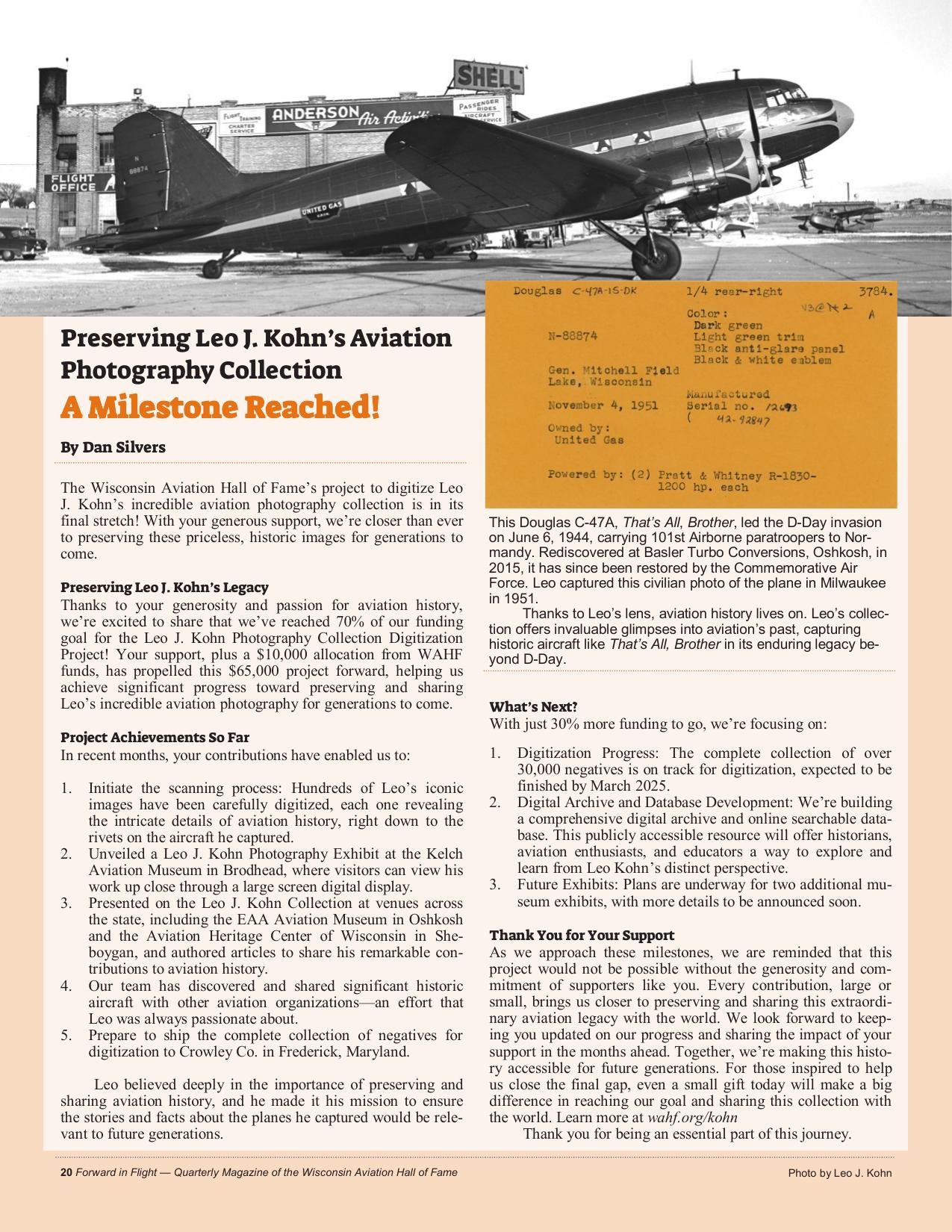
Preserving Leo J. Kohn’s Aviation Photography Collection A Milestone Reached! By Dan Silvers The Wisconsin Aviation Hall of Fame’s project to digitize Leo J. Kohn’s incredible aviation photography collection is in its final stretch! With your generous support, we’re closer than ever to preserving these priceless, historic images for generations to come. Preserving Leo J. Kohn’s Legacy Thanks to your generosity and passion for aviation history, we’re excited to share that we’ve reached 70% of our funding goal for the Leo J. Kohn Photography Collection Digitization Project! Your support, plus a $10,000 allocation from WAHF funds, has propelled this $65,000 project forward, helping us achieve significant progress toward preserving and sharing Leo’s incredible aviation photography for generations to come. Project Achievements So Far In recent months, your contributions have enabled us to: 1. 2. 3. Initiate the scanning process: Hundreds of Leo’s iconic images have been carefully digitized, each one revealing the intricate details of aviation history, right down to the rivets on the aircraft he captured. Unveiled a Leo J. Kohn Photography Exhibit at the Kelch Aviation Museum in Brodhead, where visitors can view his work up close through a large screen digital display. Presented on the Leo J. Kohn Collection at venues across the state, including the EAA Aviation Museum in Oshkosh and the Aviation Heritage Center of Wisconsin in Sheboygan, and authored articles to share his remarkable contributions to aviation history. Our team has discovered and shared significant historic aircraft with other aviation organizations—an effort that Leo was always passionate about. Prepare to ship the complete collection of negatives for digitization to Crowley Co. in Frederick, Maryland. This Douglas C-47A, That’s All, Brother, led the D-Day invasion on June 6, 1944, carrying 101st Airborne paratroopers to Normandy. Rediscovered at Basler Turbo Conversions, Oshkosh, in 2015, it has since been restored by the Commemorative Air Force. Leo captured this civilian photo of the plane in Milwaukee in 1951. Thanks to Leo’s lens, aviation history lives on. Leo’s collection offers invaluable glimpses into aviation’s past, capturing historic aircraft like That’s All, Brother in its enduring legacy beyond D-Day. What’s Next? With just 30% more funding to go, we’re focusing on: 1. 2. 3. Digitization Progress: The complete collection of over 30,000 negatives is on track for digitization, expected to be finished by March 2025. Digital Archive and Database Development: We’re building a comprehensive digital archive and online searchable database. This publicly accessible resource will offer historians, aviation enthusiasts, and educators a way to explore and learn from Leo Kohn’s distinct perspective. Future Exhibits: Plans are underway for two additional museum exhibits, with more details to be announced soon. Thank You for Your Support Leo believed deeply in the importance of preserving and sharing aviation history, and he made it his mission to ensure the stories and facts about the planes he captured would be relevant to future generations. As we approach these milestones, we are reminded that this project would not be possible without the generosity and commitment of supporters like you. Every contribution, large or small, brings us closer to preserving and sharing this extraordinary aviation legacy with the world. We look forward to keeping you updated on our progress and sharing the impact of your support in the months ahead. Together, we’re making this history accessible for future generations. For those inspired to help us close the final gap, even a small gift today will make a big difference in reaching our goal and sharing this collection with the world. Learn more at wahf.org/kohn Thank you for being an essential part of this journey. 20 Forward in Flight — Quarterly Magazine of the Wisconsin Aviation Hall of Fame Photo by Leo J. Kohn 4. 5.
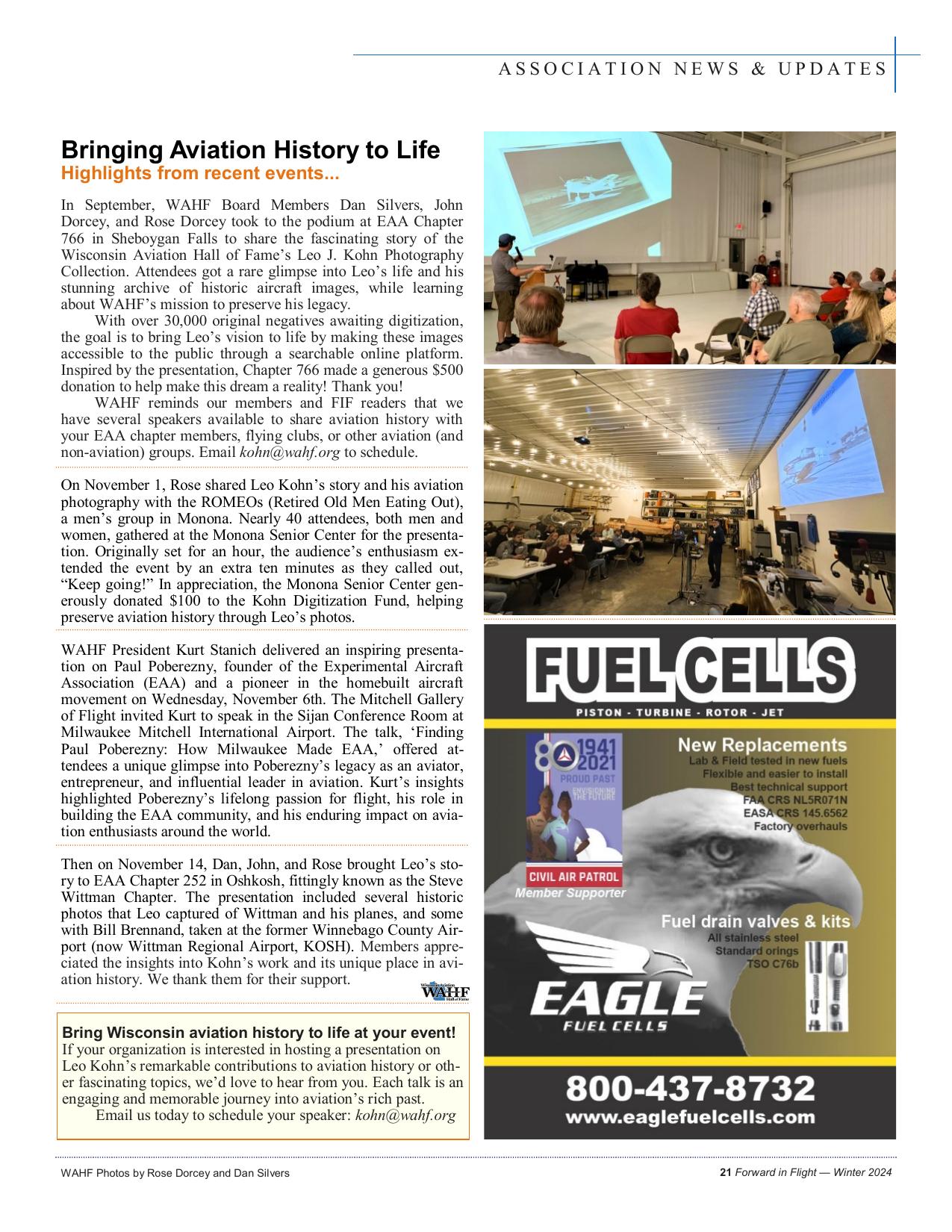
ASSOCIATION NEWS & UPDATES Bringing Aviation History to Life Highlights from recent events... In September, WAHF Board Members Dan Silvers, John Dorcey, and Rose Dorcey took to the podium at EAA Chapter 766 in Sheboygan Falls to share the fascinating story of the Wisconsin Aviation Hall of Fame’s Leo J. Kohn Photography Collection. Attendees got a rare glimpse into Leo’s life and his stunning archive of historic aircraft images, while learning about WAHF’s mission to preserve his legacy. With over 30,000 original negatives awaiting digitization, the goal is to bring Leo’s vision to life by making these images accessible to the public through a searchable online platform. Inspired by the presentation, Chapter 766 made a generous $500 donation to help make this dream a reality! Thank you! WAHF reminds our members and FIF readers that we have several speakers available to share aviation history with your EAA chapter members, flying clubs, or other aviation (and non-aviation) groups. Email kohn@wahf.org to schedule. On November 1, Rose shared Leo Kohn’s story and his aviation photography with the ROMEOs (Retired Old Men Eating Out), a men’s group in Monona. Nearly 40 attendees, both men and women, gathered at the Monona Senior Center for the presentation. Originally set for an hour, the audience’s enthusiasm extended the event by an extra ten minutes as they called out, “Keep going!” In appreciation, the Monona Senior Center generously donated $100 to the Kohn Digitization Fund, helping preserve aviation history through Leo’s photos. WAHF President Kurt Stanich delivered an inspiring presentation on Paul Poberezny, founder of the Experimental Aircraft Association (EAA) and a pioneer in the homebuilt aircraft movement on Wednesday, November 6th. The Mitchell Gallery of Flight invited Kurt to speak in the Sijan Conference Room at Milwaukee Mitchell International Airport. The talk, ‘Finding Paul Poberezny: How Milwaukee Made EAA,’ offered attendees a unique glimpse into Poberezny’s legacy as an aviator, entrepreneur, and influential leader in aviation. Kurt’s insights highlighted Poberezny’s lifelong passion for flight, his role in building the EAA community, and his enduring impact on aviation enthusiasts around the world. Then on November 14, Dan, John, and Rose brought Leo’s story to EAA Chapter 252 in Oshkosh, fittingly known as the Steve Wittman Chapter. The presentation included several historic photos that Leo captured of Wittman and his planes, and some with Bill Brennand, taken at the former Winnebago County Airport (now Wittman Regional Airport, KOSH). Members appreciated the insights into Kohn’s work and its unique place in aviation history. We thank them for their support. Bring Wisconsin aviation history to life at your event! If your organization is interested in hosting a presentation on Leo Kohn’s remarkable contributions to aviation history or other fascinating topics, we’d love to hear from you. Each talk is an engaging and memorable journey into aviation’s rich past. Email us today to schedule your speaker: kohn@wahf.org WAHF Photos by Rose Dorcey and Dan Silvers 21 Forward in Flight — Winter 2024
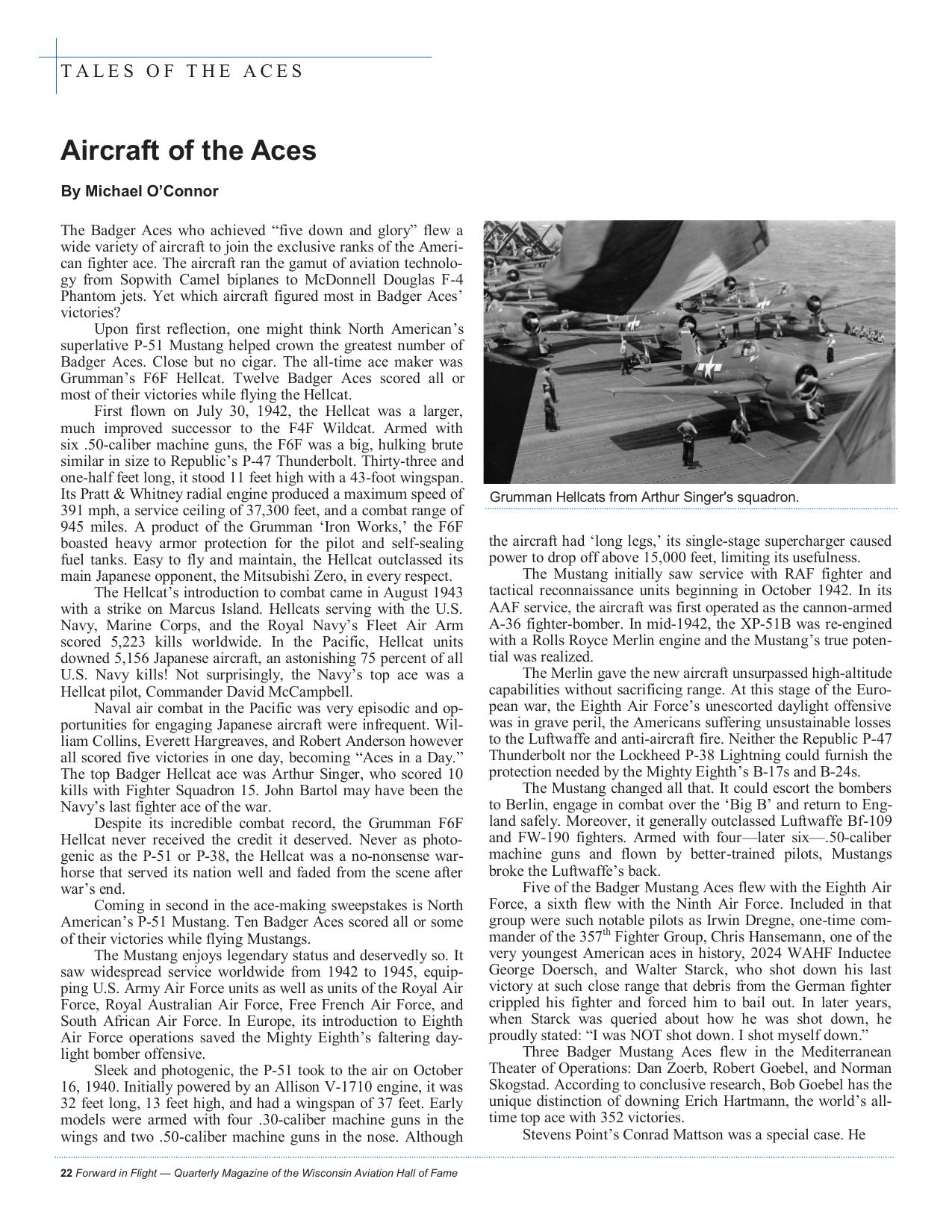
TALES OF THE ACES Aircraft of the Aces By Michael O’Connor The Badger Aces who achieved “five down and glory” flew a wide variety of aircraft to join the exclusive ranks of the American fighter ace. The aircraft ran the gamut of aviation technology from Sopwith Camel biplanes to McDonnell Douglas F-4 Phantom jets. Yet which aircraft figured most in Badger Aces’ victories? Upon first reflection, one might think North American’s superlative P-51 Mustang helped crown the greatest number of Badger Aces. Close but no cigar. The all-time ace maker was Grumman’s F6F Hellcat. Twelve Badger Aces scored all or most of their victories while flying the Hellcat. First flown on July 30, 1942, the Hellcat was a larger, much improved successor to the F4F Wildcat. Armed with six .50-caliber machine guns, the F6F was a big, hulking brute similar in size to Republic’s P-47 Thunderbolt. Thirty-three and one-half feet long, it stood 11 feet high with a 43-foot wingspan. Its Pratt & Whitney radial engine produced a maximum speed of 391 mph, a service ceiling of 37,300 feet, and a combat range of 945 miles. A product of the Grumman ‘Iron Works,’ the F6F boasted heavy armor protection for the pilot and self-sealing fuel tanks. Easy to fly and maintain, the Hellcat outclassed its main Japanese opponent, the Mitsubishi Zero, in every respect. The Hellcat’s introduction to combat came in August 1943 with a strike on Marcus Island. Hellcats serving with the U.S. Navy, Marine Corps, and the Royal Navy’s Fleet Air Arm scored 5,223 kills worldwide. In the Pacific, Hellcat units downed 5,156 Japanese aircraft, an astonishing 75 percent of all U.S. Navy kills! Not surprisingly, the Navy’s top ace was a Hellcat pilot, Commander David McCampbell. Naval air combat in the Pacific was very episodic and opportunities for engaging Japanese aircraft were infrequent. William Collins, Everett Hargreaves, and Robert Anderson however all scored five victories in one day, becoming “Aces in a Day.” The top Badger Hellcat ace was Arthur Singer, who scored 10 kills with Fighter Squadron 15. John Bartol may have been the Navy’s last fighter ace of the war. Despite its incredible combat record, the Grumman F6F Hellcat never received the credit it deserved. Never as photogenic as the P-51 or P-38, the Hellcat was a no-nonsense warhorse that served its nation well and faded from the scene after war’s end. Coming in second in the ace-making sweepstakes is North American’s P-51 Mustang. Ten Badger Aces scored all or some of their victories while flying Mustangs. The Mustang enjoys legendary status and deservedly so. It saw widespread service worldwide from 1942 to 1945, equipping U.S. Army Air Force units as well as units of the Royal Air Force, Royal Australian Air Force, Free French Air Force, and South African Air Force. In Europe, its introduction to Eighth Air Force operations saved the Mighty Eighth’s faltering daylight bomber offensive. Sleek and photogenic, the P-51 took to the air on October 16, 1940. Initially powered by an Allison V-1710 engine, it was 32 feet long, 13 feet high, and had a wingspan of 37 feet. Early models were armed with four .30-caliber machine guns in the wings and two .50-caliber machine guns in the nose. Although 22 Forward in Flight — Quarterly Magazine of the Wisconsin Aviation Hall of Fame Grumman Hellcats from Arthur Singer's squadron. the aircraft had ‘long legs,’ its single-stage supercharger caused power to drop off above 15,000 feet, limiting its usefulness. The Mustang initially saw service with RAF fighter and tactical reconnaissance units beginning in October 1942. In its AAF service, the aircraft was first operated as the cannon-armed A-36 fighter-bomber. In mid-1942, the XP-51B was re-engined with a Rolls Royce Merlin engine and the Mustang’s true potential was realized. The Merlin gave the new aircraft unsurpassed high-altitude capabilities without sacrificing range. At this stage of the European war, the Eighth Air Force’s unescorted daylight offensive was in grave peril, the Americans suffering unsustainable losses to the Luftwaffe and anti-aircraft fire. Neither the Republic P-47 Thunderbolt nor the Lockheed P-38 Lightning could furnish the protection needed by the Mighty Eighth’s B-17s and B-24s. The Mustang changed all that. It could escort the bombers to Berlin, engage in combat over the ‘Big B’ and return to England safely. Moreover, it generally outclassed Luftwaffe Bf-109 and FW-190 fighters. Armed with four—later six—.50-caliber machine guns and flown by better-trained pilots, Mustangs broke the Luftwaffe’s back. Five of the Badger Mustang Aces flew with the Eighth Air Force, a sixth flew with the Ninth Air Force. Included in that group were such notable pilots as Irwin Dregne, one-time commander of the 357th Fighter Group, Chris Hansemann, one of the very youngest American aces in history, 2024 WAHF Inductee George Doersch, and Walter Starck, who shot down his last victory at such close range that debris from the German fighter crippled his fighter and forced him to bail out. In later years, when Starck was queried about how he was shot down, he proudly stated: “I was NOT shot down. I shot myself down.” Three Badger Mustang Aces flew in the Mediterranean Theater of Operations: Dan Zoerb, Robert Goebel, and Norman Skogstad. According to conclusive research, Bob Goebel has the unique distinction of downing Erich Hartmann, the world’s alltime top ace with 352 victories. Stevens Point’s Conrad Mattson was a special case. He
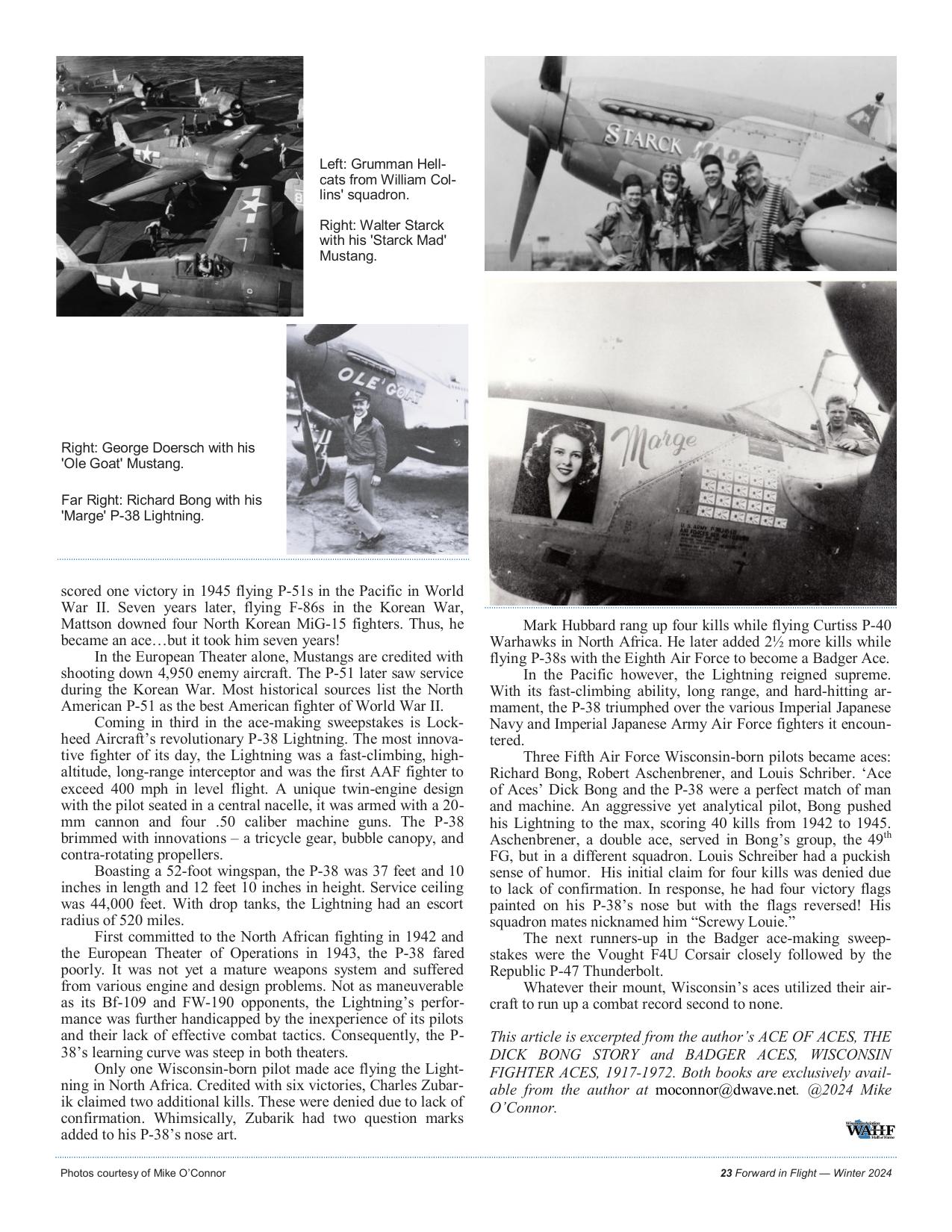
Left: Grumman Hellcats from William Collins' squadron. Right: Walter Starck with his 'Starck Mad' Mustang. Right: George Doersch with his 'Ole Goat' Mustang. Far Right: Richard Bong with his 'Marge' P-38 Lightning. scored one victory in 1945 flying P-51s in the Pacific in World War II. Seven years later, flying F-86s in the Korean War, Mattson downed four North Korean MiG-15 fighters. Thus, he became an ace…but it took him seven years! In the European Theater alone, Mustangs are credited with shooting down 4,950 enemy aircraft. The P-51 later saw service during the Korean War. Most historical sources list the North American P-51 as the best American fighter of World War II. Coming in third in the ace-making sweepstakes is Lockheed Aircraft’s revolutionary P-38 Lightning. The most innovative fighter of its day, the Lightning was a fast-climbing, highaltitude, long-range interceptor and was the first AAF fighter to exceed 400 mph in level flight. A unique twin-engine design with the pilot seated in a central nacelle, it was armed with a 20mm cannon and four .50 caliber machine guns. The P-38 brimmed with innovations – a tricycle gear, bubble canopy, and contra-rotating propellers. Boasting a 52-foot wingspan, the P-38 was 37 feet and 10 inches in length and 12 feet 10 inches in height. Service ceiling was 44,000 feet. With drop tanks, the Lightning had an escort radius of 520 miles. First committed to the North African fighting in 1942 and the European Theater of Operations in 1943, the P-38 fared poorly. It was not yet a mature weapons system and suffered from various engine and design problems. Not as maneuverable as its Bf-109 and FW-190 opponents, the Lightning’s performance was further handicapped by the inexperience of its pilots and their lack of effective combat tactics. Consequently, the P38’s learning curve was steep in both theaters. Only one Wisconsin-born pilot made ace flying the Lightning in North Africa. Credited with six victories, Charles Zubarik claimed two additional kills. These were denied due to lack of confirmation. Whimsically, Zubarik had two question marks added to his P-38’s nose art. Photos courtesy of Mike O’Connor Mark Hubbard rang up four kills while flying Curtiss P-40 Warhawks in North Africa. He later added 2½ more kills while flying P-38s with the Eighth Air Force to become a Badger Ace. In the Pacific however, the Lightning reigned supreme. With its fast-climbing ability, long range, and hard-hitting armament, the P-38 triumphed over the various Imperial Japanese Navy and Imperial Japanese Army Air Force fighters it encountered. Three Fifth Air Force Wisconsin-born pilots became aces: Richard Bong, Robert Aschenbrener, and Louis Schriber. ‘Ace of Aces’ Dick Bong and the P-38 were a perfect match of man and machine. An aggressive yet analytical pilot, Bong pushed his Lightning to the max, scoring 40 kills from 1942 to 1945. Aschenbrener, a double ace, served in Bong’s group, the 49th FG, but in a different squadron. Louis Schreiber had a puckish sense of humor. His initial claim for four kills was denied due to lack of confirmation. In response, he had four victory flags painted on his P-38’s nose but with the flags reversed! His squadron mates nicknamed him “Screwy Louie.” The next runners-up in the Badger ace-making sweepstakes were the Vought F4U Corsair closely followed by the Republic P-47 Thunderbolt. Whatever their mount, Wisconsin’s aces utilized their aircraft to run up a combat record second to none. This article is excerpted from the author’s ACE OF ACES, THE DICK BONG STORY and BADGER ACES, WISCONSIN FIGHTER ACES, 1917-1972. Both books are exclusively available from the author at moconnor@dwave.net. @2024 Mike O’Connor. 23 Forward in Flight — Winter 2024
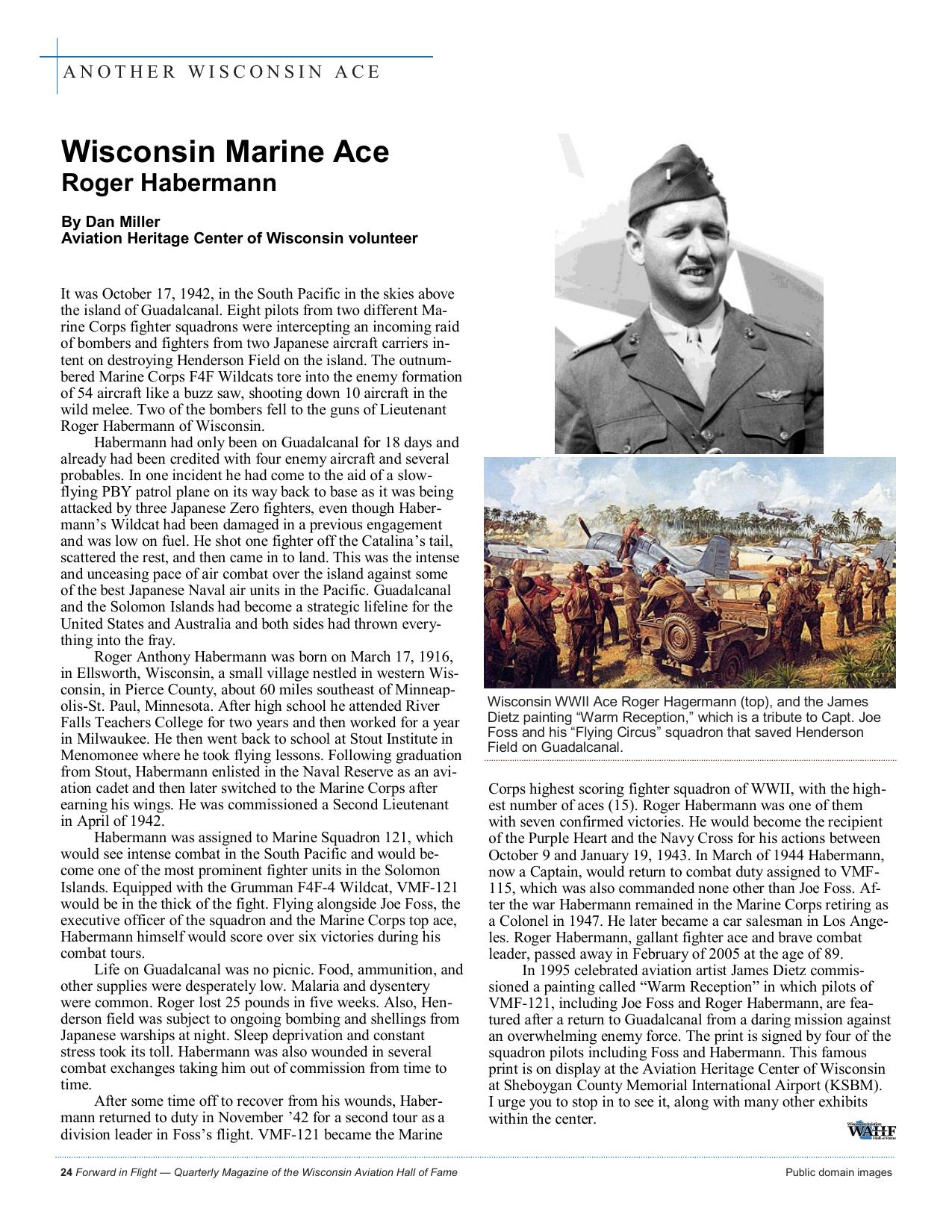
ANOTHE R WISCONSIN ACE Wisconsin Marine Ace Roger Habermann By Dan Miller Aviation Heritage Center of Wisconsin volunteer It was October 17, 1942, in the South Pacific in the skies above the island of Guadalcanal. Eight pilots from two different Marine Corps fighter squadrons were intercepting an incoming raid of bombers and fighters from two Japanese aircraft carriers intent on destroying Henderson Field on the island. The outnumbered Marine Corps F4F Wildcats tore into the enemy formation of 54 aircraft like a buzz saw, shooting down 10 aircraft in the wild melee. Two of the bombers fell to the guns of Lieutenant Roger Habermann of Wisconsin. Habermann had only been on Guadalcanal for 18 days and already had been credited with four enemy aircraft and several probables. In one incident he had come to the aid of a slowflying PBY patrol plane on its way back to base as it was being attacked by three Japanese Zero fighters, even though Habermann’s Wildcat had been damaged in a previous engagement and was low on fuel. He shot one fighter off the Catalina’s tail, scattered the rest, and then came in to land. This was the intense and unceasing pace of air combat over the island against some of the best Japanese Naval air units in the Pacific. Guadalcanal and the Solomon Islands had become a strategic lifeline for the United States and Australia and both sides had thrown everything into the fray. Roger Anthony Habermann was born on March 17, 1916, in Ellsworth, Wisconsin, a small village nestled in western Wisconsin, in Pierce County, about 60 miles southeast of Minneapolis-St. Paul, Minnesota. After high school he attended River Falls Teachers College for two years and then worked for a year in Milwaukee. He then went back to school at Stout Institute in Menomonee where he took flying lessons. Following graduation from Stout, Habermann enlisted in the Naval Reserve as an aviation cadet and then later switched to the Marine Corps after earning his wings. He was commissioned a Second Lieutenant in April of 1942. Habermann was assigned to Marine Squadron 121, which would see intense combat in the South Pacific and would become one of the most prominent fighter units in the Solomon Islands. Equipped with the Grumman F4F-4 Wildcat, VMF-121 would be in the thick of the fight. Flying alongside Joe Foss, the executive officer of the squadron and the Marine Corps top ace, Habermann himself would score over six victories during his combat tours. Life on Guadalcanal was no picnic. Food, ammunition, and other supplies were desperately low. Malaria and dysentery were common. Roger lost 25 pounds in five weeks. Also, Henderson field was subject to ongoing bombing and shellings from Japanese warships at night. Sleep deprivation and constant stress took its toll. Habermann was also wounded in several combat exchanges taking him out of commission from time to time. After some time off to recover from his wounds, Habermann returned to duty in November ’42 for a second tour as a division leader in Foss’s flight. VMF-121 became the Marine 24 Forward in Flight — Quarterly Magazine of the Wisconsin Aviation Hall of Fame Wisconsin WWII Ace Roger Hagermann (top), and the James Dietz painting “Warm Reception,” which is a tribute to Capt. Joe Foss and his “Flying Circus” squadron that saved Henderson Field on Guadalcanal. Corps highest scoring fighter squadron of WWII, with the highest number of aces (15). Roger Habermann was one of them with seven confirmed victories. He would become the recipient of the Purple Heart and the Navy Cross for his actions between October 9 and January 19, 1943. In March of 1944 Habermann, now a Captain, would return to combat duty assigned to VMF115, which was also commanded none other than Joe Foss. After the war Habermann remained in the Marine Corps retiring as a Colonel in 1947. He later became a car salesman in Los Angeles. Roger Habermann, gallant fighter ace and brave combat leader, passed away in February of 2005 at the age of 89. In 1995 celebrated aviation artist James Dietz commissioned a painting called “Warm Reception” in which pilots of VMF-121, including Joe Foss and Roger Habermann, are featured after a return to Guadalcanal from a daring mission against an overwhelming enemy force. The print is signed by four of the squadron pilots including Foss and Habermann. This famous print is on display at the Aviation Heritage Center of Wisconsin at Sheboygan County Memorial International Airport (KSBM). I urge you to stop in to see it, along with many other exhibits within the center. Public domain images
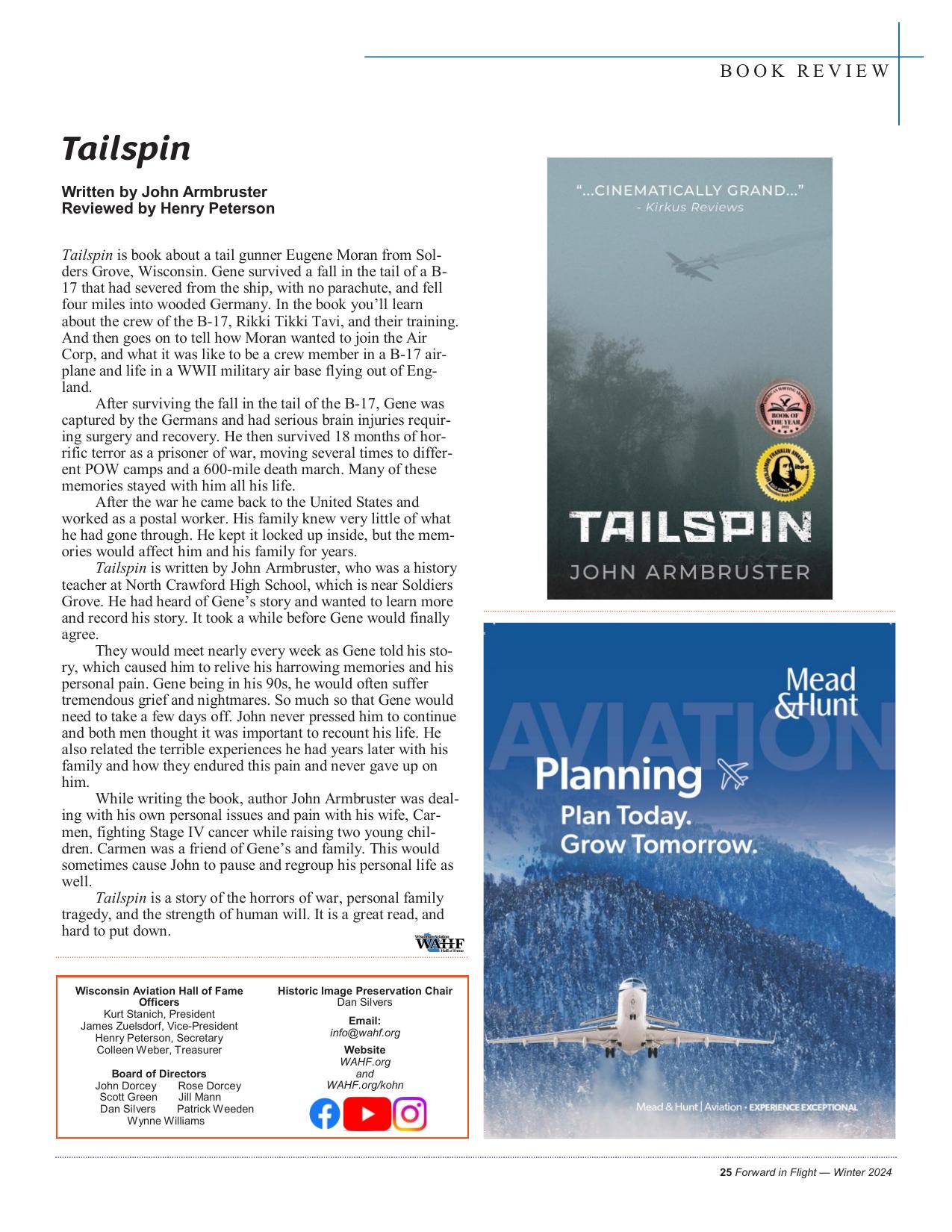
BOOK REVIEW Tailspin Written by John Armbruster Reviewed by Henry Peterson Tailspin is book about a tail gunner Eugene Moran from Solders Grove, Wisconsin. Gene survived a fall in the tail of a B17 that had severed from the ship, with no parachute, and fell four miles into wooded Germany. In the book you’ll learn about the crew of the B-17, Rikki Tikki Tavi, and their training. And then goes on to tell how Moran wanted to join the Air Corp, and what it was like to be a crew member in a B-17 airplane and life in a WWII military air base flying out of England. After surviving the fall in the tail of the B-17, Gene was captured by the Germans and had serious brain injuries requiring surgery and recovery. He then survived 18 months of horrific terror as a prisoner of war, moving several times to different POW camps and a 600-mile death march. Many of these memories stayed with him all his life. After the war he came back to the United States and worked as a postal worker. His family knew very little of what he had gone through. He kept it locked up inside, but the memories would affect him and his family for years. Tailspin is written by John Armbruster, who was a history teacher at North Crawford High School, which is near Soldiers Grove. He had heard of Gene’s story and wanted to learn more and record his story. It took a while before Gene would finally agree. They would meet nearly every week as Gene told his story, which caused him to relive his harrowing memories and his personal pain. Gene being in his 90s, he would often suffer tremendous grief and nightmares. So much so that Gene would need to take a few days off. John never pressed him to continue and both men thought it was important to recount his life. He also related the terrible experiences he had years later with his family and how they endured this pain and never gave up on him. While writing the book, author John Armbruster was dealing with his own personal issues and pain with his wife, Carmen, fighting Stage IV cancer while raising two young children. Carmen was a friend of Gene’s and family. This would sometimes cause John to pause and regroup his personal life as well. Tailspin is a story of the horrors of war, personal family tragedy, and the strength of human will. It is a great read, and hard to put down. Wisconsin Aviation Hall of Fame Officers Kurt Stanich, President James Zuelsdorf, Vice-President Henry Peterson, Secretary Colleen Weber, Treasurer Board of Directors John Dorcey Rose Dorcey Scott Green Jill Mann Dan Silvers Patrick Weeden Wynne Williams Historic Image Preservation Chair Dan Silvers Email: info@wahf.org Website WAHF.org and WAHF.org/kohn 25 Forward in Flight — Winter 2024
Christmas Gift Guide For the readers on your list... Books are great for the young and young at heart, and they make great gifts for Christmas—or any holiday. We’ve assembled a few that we’re sure you, your kids, and grandkids will enjoy. What Grandma Did How much do you know about your grandmother? A young girl learns about the Women Airforce Service Pilots, the WASP, who flew during World War II. Grandma tells how she was one of the first women to fly for the US Army. It’s a story that teaches history, leadership, and courage through intergenerational learning. Ages 5 - 8, 48 pages. Order online at Amazon. Bazooka Charlie During World War II, Major Charles Carpenter made headlines by mounting six bazookas onto his small Piper L-4 observation plane to launch attacks on German tanks. This revealing biography of the famous pilot was created with the help of aviation author Jim Busha and Carpenter’s daughter, Carol Apacki, who contributed memories and wartime letters between her parents. Available through shop.eaa.org. Loving’s Love is the uplifting autobiography of a remarkable aviator who was the first African American and first double amputee licensed as a racing pilot. In 1926, a young Neal Loving saw a de Havilland DH-4 biplane that propelled his dreams of taking to the sky. Loving’s Love is the inspiring autobiography about his journey to get there. It captures the candid life story of a courageous man who defied the odds. 320 pages. Order online at shop.eaa.org Forward in Flight Makes a Great Gift, too! A Wisconsin Aviation Hall of Fame membership delivers inspiring stories, access to special events, and our magazine, Forward in Flight, celebrating the people who shaped our aviation world. Use the form on the inside back cover, or visit wahf.org/membership to order a gift membership. New from 2024 WAHF Inductee Caroline “Blaze” Jensen is Curious About Fighter Jets, which helps early elementary readers learn how fighter jets work. This inquiry-based, nonfiction book is all about jet sizes, speeds, and battle strengths. It includes infographics to support research skills. For readers ages 8-14, 24 pgs. Find it at Thundermouse.shop Your Membership is Appreciated The WAHF board is truly grateful for every member who supports us. Your commitment helps us preserve and celebrate Wisconsin’s aviation heritage—thank you for being an essential part of our mission! Together, we can continue to keep our state’s aviation history alive. Please stop in during regular business hours for a self-guided tour! Morey Airplane Company Since 1932 Sheboygan County Memorial Airport 920.467.2043 ahcw.org Middleton Municipal Airport/Morey Field Self-service 100LL & Jet A 24-7 26 Forward in Flight — Quarterly Magazine of the Wisconsin Aviation Hall of Fame Monday & Tuesday - Closed Wednesday 11 – 4 Thursday 11 - 4 Friday 11 – 4 Saturday 9 – 4 Sunday 11 – 4 Exhibits feature WWII Veterans, the T-28, a North Central Airlines’ DC-3 and airline history, and more.
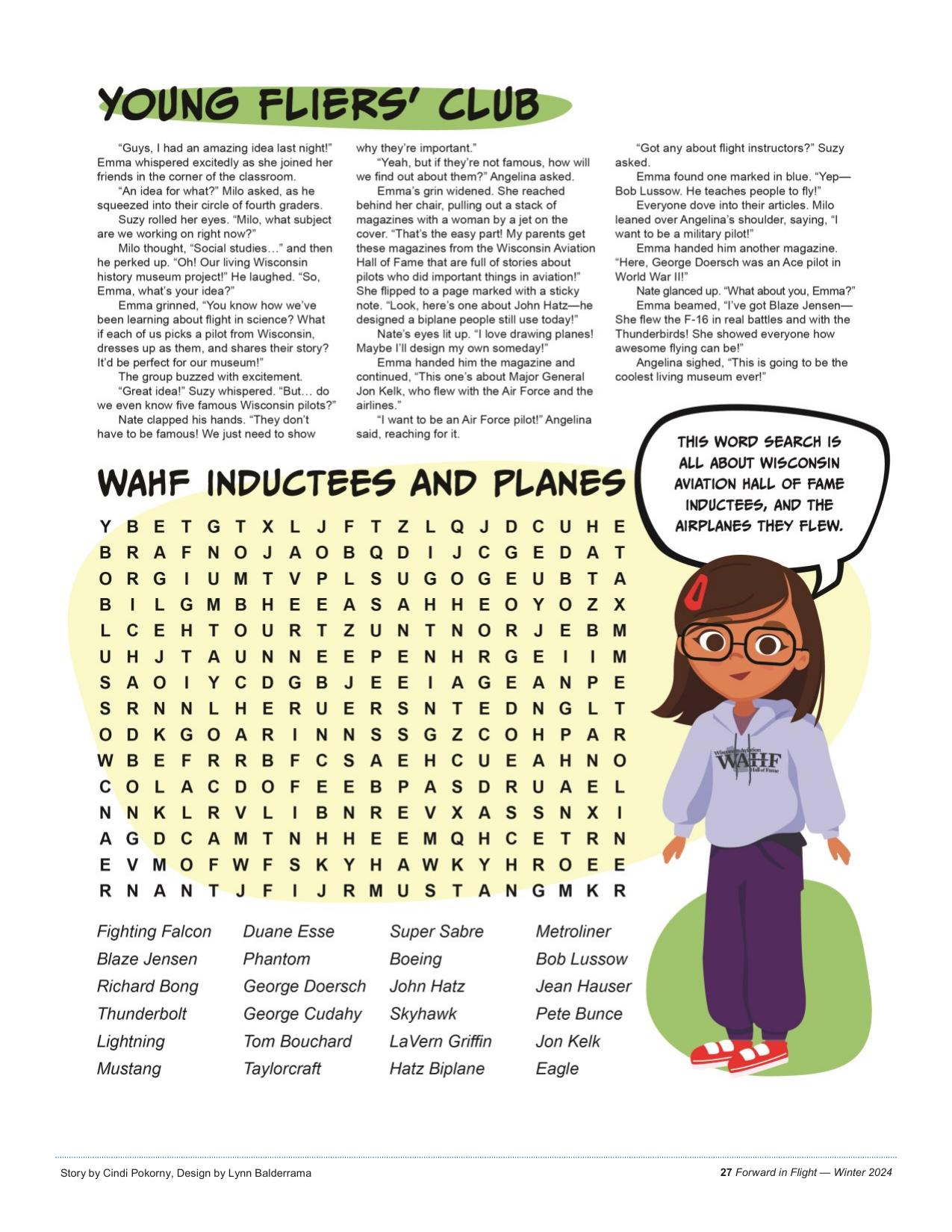
Story by Cindi Pokorny, Design by Lynn Balderrama 27 Forward in Flight — Winter 2024
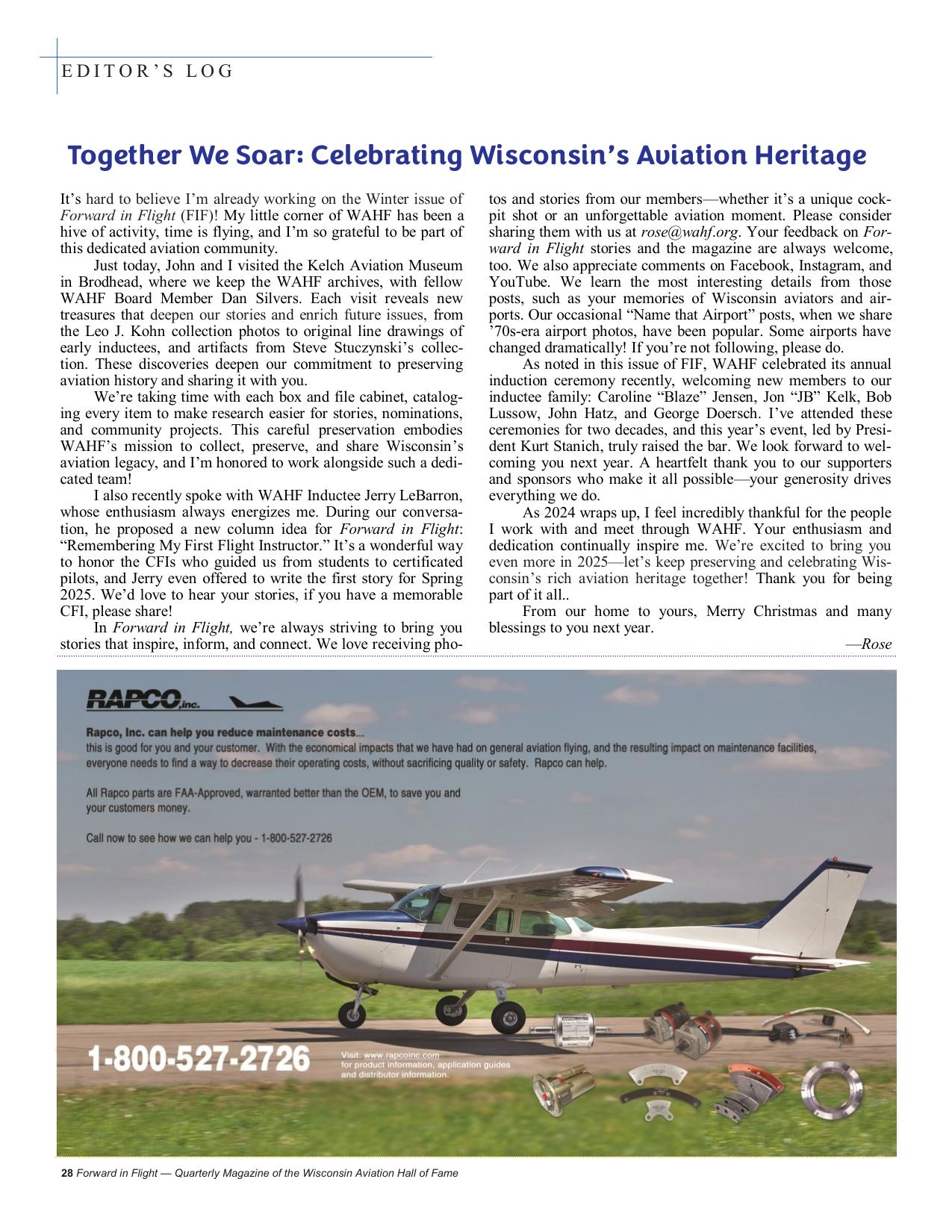
EDITOR’S LOG Together We Soar: Celebrating Wisconsin’s Aviation Heritage It’s hard to believe I’m already working on the Winter issue of Forward in Flight (FIF)! My little corner of WAHF has been a hive of activity, time is flying, and I’m so grateful to be part of this dedicated aviation community. Just today, John and I visited the Kelch Aviation Museum in Brodhead, where we keep the WAHF archives, with fellow WAHF Board Member Dan Silvers. Each visit reveals new treasures that deepen our stories and enrich future issues, from the Leo J. Kohn collection photos to original line drawings of early inductees, and artifacts from Steve Stuczynski’s collection. These discoveries deepen our commitment to preserving aviation history and sharing it with you. We’re taking time with each box and file cabinet, cataloging every item to make research easier for stories, nominations, and community projects. This careful preservation embodies WAHF’s mission to collect, preserve, and share Wisconsin’s aviation legacy, and I’m honored to work alongside such a dedicated team! I also recently spoke with WAHF Inductee Jerry LeBarron, whose enthusiasm always energizes me. During our conversation, he proposed a new column idea for Forward in Flight: “Remembering My First Flight Instructor.” It’s a wonderful way to honor the CFIs who guided us from students to certificated pilots, and Jerry even offered to write the first story for Spring 2025. We’d love to hear your stories, if you have a memorable CFI, please share! In Forward in Flight, we’re always striving to bring you stories that inspire, inform, and connect. We love receiving pho- 28 Forward in Flight — Quarterly Magazine of the Wisconsin Aviation Hall of Fame tos and stories from our members—whether it’s a unique cockpit shot or an unforgettable aviation moment. Please consider sharing them with us at rose@wahf.org. Your feedback on Forward in Flight stories and the magazine are always welcome, too. We also appreciate comments on Facebook, Instagram, and YouTube. We learn the most interesting details from those posts, such as your memories of Wisconsin aviators and airports. Our occasional “Name that Airport” posts, when we share ’70s-era airport photos, have been popular. Some airports have changed dramatically! If you’re not following, please do. As noted in this issue of FIF, WAHF celebrated its annual induction ceremony recently, welcoming new members to our inductee family: Caroline “Blaze” Jensen, Jon “JB” Kelk, Bob Lussow, John Hatz, and George Doersch. I’ve attended these ceremonies for two decades, and this year’s event, led by President Kurt Stanich, truly raised the bar. We look forward to welcoming you next year. A heartfelt thank you to our supporters and sponsors who make it all possible—your generosity drives everything we do. As 2024 wraps up, I feel incredibly thankful for the people I work with and meet through WAHF. Your enthusiasm and dedication continually inspire me. We’re excited to bring you even more in 2025—let’s keep preserving and celebrating Wisconsin’s rich aviation heritage together! Thank you for being part of it all.. From our home to yours, Merry Christmas and many blessings to you next year. —Rose
Gift a WAHF membership this season! Membership includes a subscription to Forward in Flight! ANNUAL MEMBERSHIP LEVELS _____ Youth (Under age 18) _____ Individual (Annual) _____ Couple (Annual) _____ Lifetime (Individual) _____ Lifetime (Couple) $10 $30 $40 $500 $750 TAX DEDUCTIBLE CONTRIBUTIONS Your contributions help ensure Wisconsin’s aviation pioneers and outstanding students in aviation education will continue to be recognized. Your contributions, in any amount, are appreciated. WAHF Supporting Contribution $___________ (General operating/events programming fund) Leo J. Kohn Collection Preservation Fund $___________ WAHF Scholarship Fund* $___________ *for scholarship donations please make a separate check payable to Community Foundation of North Central Wisconsin or visit www.CFONCW.org. Name________________________________________ Address______________________________________ City__________________________________________ State, Zip_____________________________________ Phone_______________________________________ Email________________________________________ Members receive WAHF’s quarterly magazine Forward in Flight! Join Online! WAHF.org Donate Online WAHF.org/kohn Or, mail this form, along with your check payable to: Wisconsin Aviation Hall of Fame, Inc. to: Rose Dorcey/WAHF 3980 Sharratt Drive Oshkosh WI 54901 The Wisconsin Aviation Hall of Fame is a 501(c)(3) organization. 29 Forward in Flight— Winter 2024
PRSRT STD US Postage Paid Wisc Rapids WI Permit 98 Forward in Flight c/o Rose Dorcey 3980 Sharratt Drive Oshkosh WI 54901 -1276 The Wisconsin Aviation Hall of Fame is a non-profit membership organization dedicated to preserving the past and fostering the future of flight. Welcome New WAHF Member/Supporters! Marcia Bouchard Kory Cornum Dan Coyne Mark Fischer Jim Hamman Carl Hilgendorf Joe Norris Jeri Norris Gary Olsen Kelly Engleke Kyle Hokel Justin Rohrer Joanne Erickson Alan Johnson Mitch Wild Mike Felske Meredith Johnson Alyssa Young Thanks for coming onboard! We also thank the many members who have recently renewed your memberships. Your support helps us continue our efforts of collecting, preserving, and sharing Wisconsin aviation history, and honoring those who make it. The Aviation Heritage Center of Wisconsin invites the public to its 2025 Movie Nights, on the second Friday of every month. They have a nice variety of aviation movies on tap, such as the classic, Casablanca, with Humphrey Bogart, on January 10; Wisconsin From the Air, a breathtaking aerial journey across Wisconsin, on February 14; and Sink the Bismarck, about the British Navy’s effort to track and destroy the German Battleship Bismarck, on March 14. View the entire movie schedule online. Doors open at 6pm, an aviation historian introduces the movie at 6:45, movie begins at 7. Just $2 per person. Snacks available for purchase. More information at www.ahcw.org/movie-nights.html Our Gratitude… We thank the many induction ceremony attendees who bid so generously during our silent auction. The event raised $7,530 to benefit our Leo J. Kohn Photography Collection Digitization effort, bringing us another step closer to reaching our goal. LEO J. KOHN COLLECTION DONORS WALL OF FAME Thank you to the many people who have recently given generously to our Leo J. Kohn Collection Digitization Project thus far. We appreciate you! Your gift will play a crucial role in preserving this astounding collection of historic aviation images, and making it available to the public. Greg Anderson Tom Bouchard Kim Davis John & Rose Dorcey Dave Rudd Ann Meyer Schmidt Howard Seaborne Dan & Mary Knutson Gari Kohlhoff Claude McFarlane Bill Streicher Samantha Stolp Jerry Mehlhaff Monona Senior Center Dale & Nancy Walker Jeff & Barbara Skiles Peter & Carolyn Halbauer Jim & Donean Szajkovics Wynne & Margaret Williams Keith Mathews EAA Chapter 766 Kyle Hokel Hang Li