Volume 23, Issue 4
🗞️ Download Issue (PDF)
Forward in Flight - Winter 2025/2026
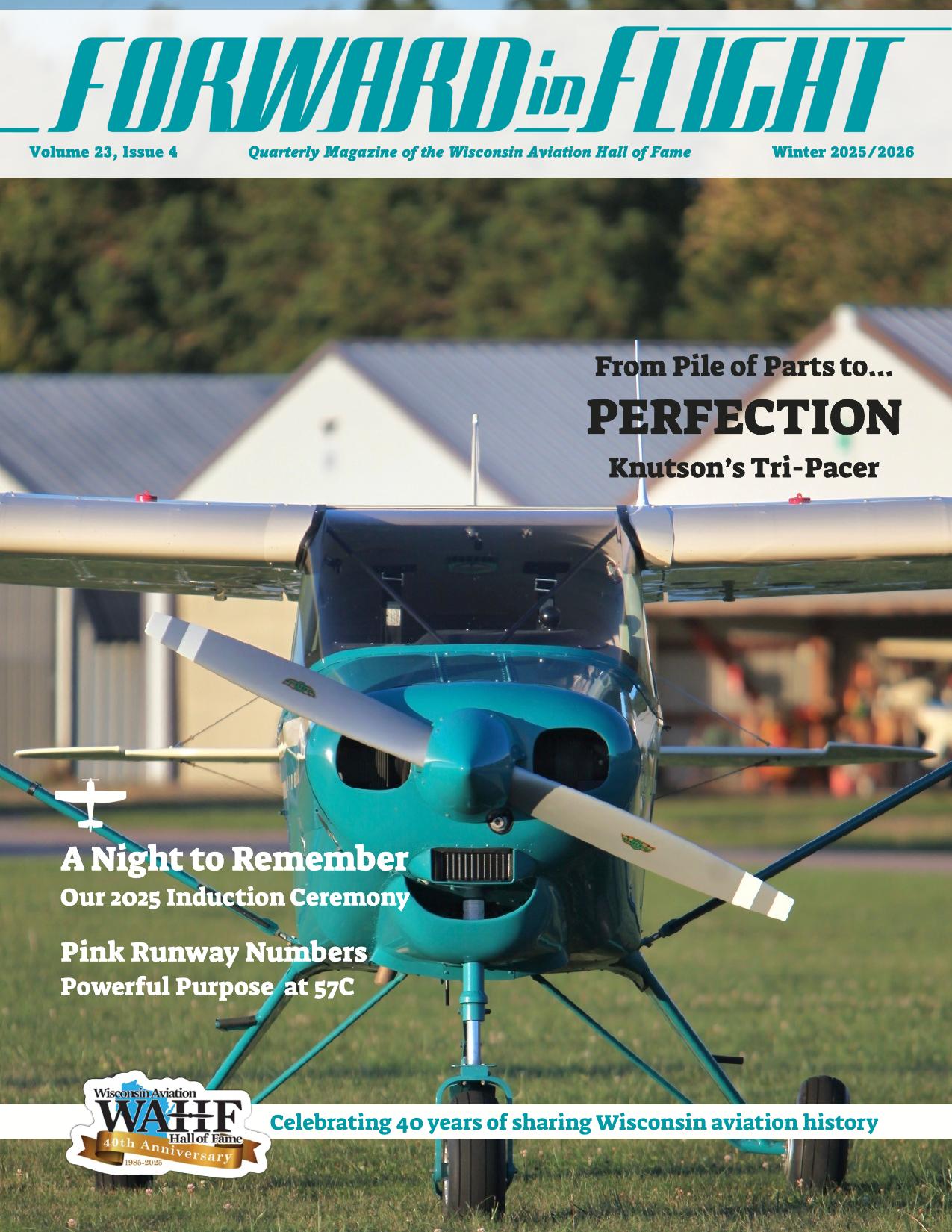
Volume 23, Issue 4 Quarterly Magazine of the Wisconsin Aviation Hall of Fame Winter 2025/2026 From Pile of Parts to... PERFECTION Knutson’s Tri-Pacer A Night to Remember Our 2025 Induction Ceremony Pink Runway Numbers Powerful Purpose at 57C Celebrating 40 years of sharing Wisconsin aviation history
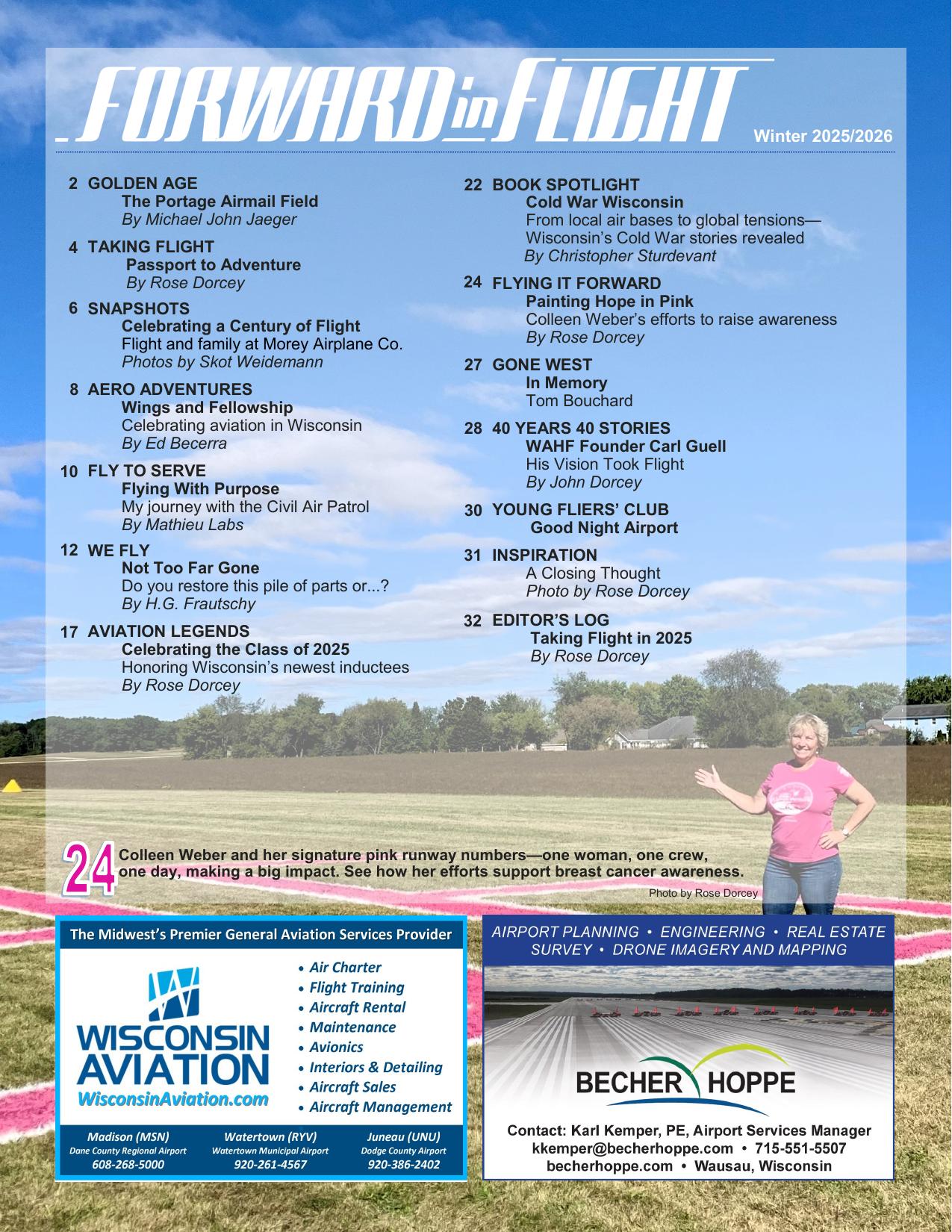
Winter 2025/2026 2 GOLDEN AGE The Portage Airmail Field By Michael John Jaeger 4 TAKING FLIGHT Passport to Adventure By Rose Dorcey 6 SNAPSHOTS Celebrating a Century of Flight Flight and family at Morey Airplane Co. Photos by Skot Weidemann 8 AERO ADVENTURES Wings and Fellowship Celebrating aviation in Wisconsin By Ed Becerra 10 FLY TO SERVE Flying With Purpose My journey with the Civil Air Patrol By Mathieu Labs 12 WE FLY Not Too Far Gone Do you restore this pile of parts or...? By H.G. Frautschy 17 AVIATION LEGENDS Celebrating the Class of 2025 Honoring Wisconsin’s newest inductees By Rose Dorcey 22 BOOK SPOTLIGHT Cold War Wisconsin From local air bases to global tensions— Wisconsin’s Cold War stories revealed By Christopher Sturdevant 24 FLYING IT FORWARD Painting Hope in Pink Colleen Weber’s efforts to raise awareness By Rose Dorcey 27 GONE WEST In Memory Tom Bouchard 28 40 YEARS 40 STORIES WAHF Founder Carl Guell His Vision Took Flight By John Dorcey 30 YOUNG FLIERS’ CLUB Good Night Airport 31 INSPIRATION A Closing Thought Photo by Rose Dorcey 32 EDITOR’S LOG Taking Flight in 2025 By Rose Dorcey Colleen Weber and her signature pink runway numbers—one woman, one crew, one day, making a big impact. See how her efforts support breast cancer awareness. Photo by Rose Dorcey
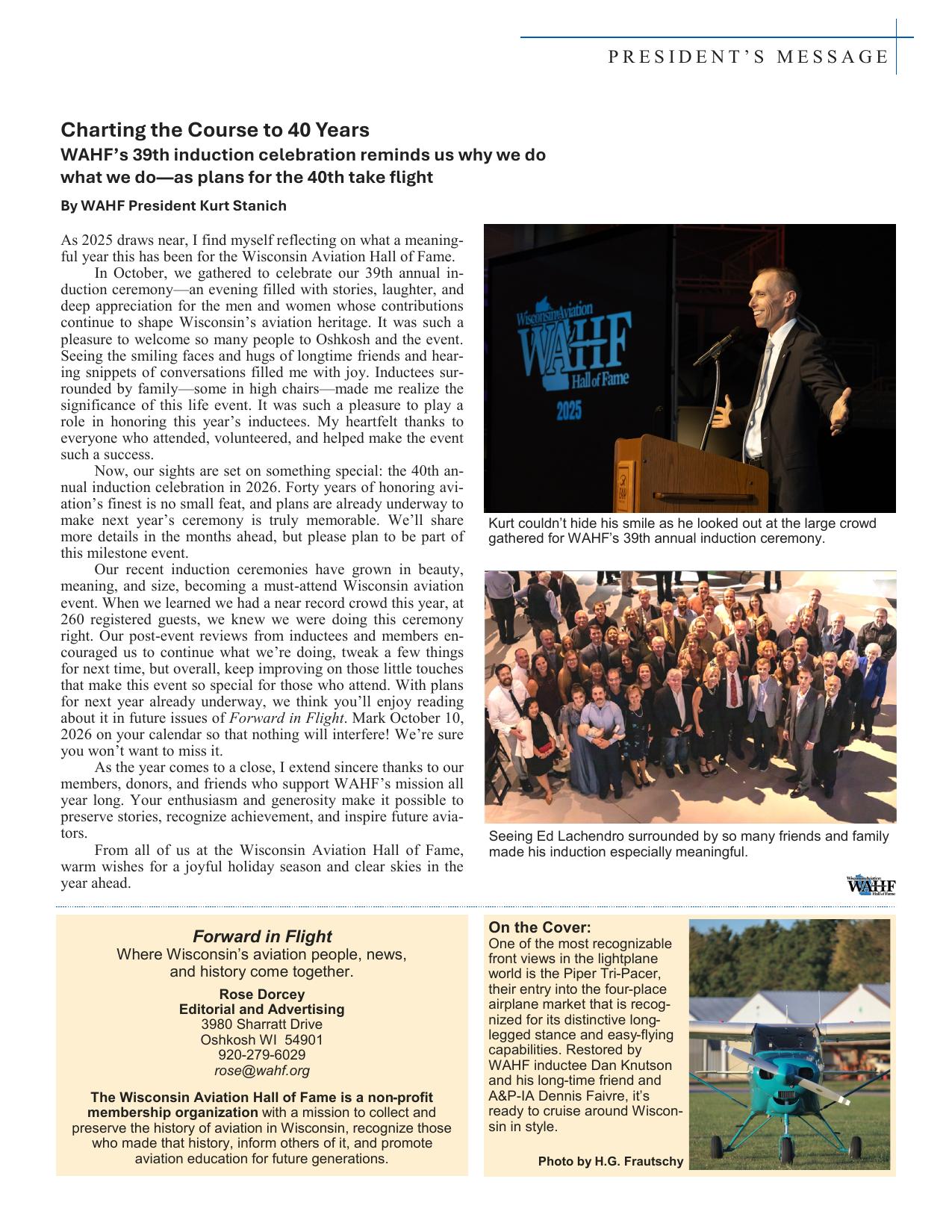
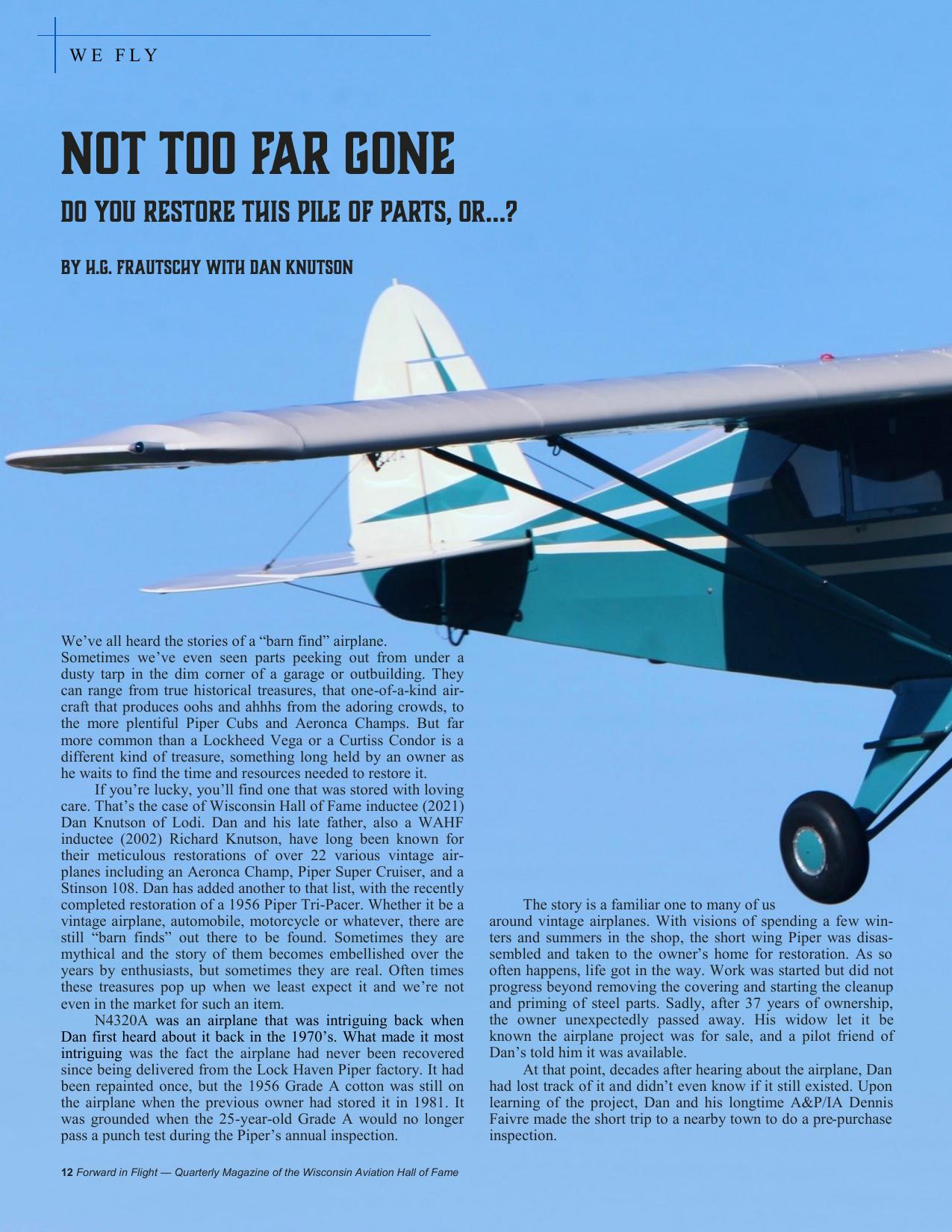
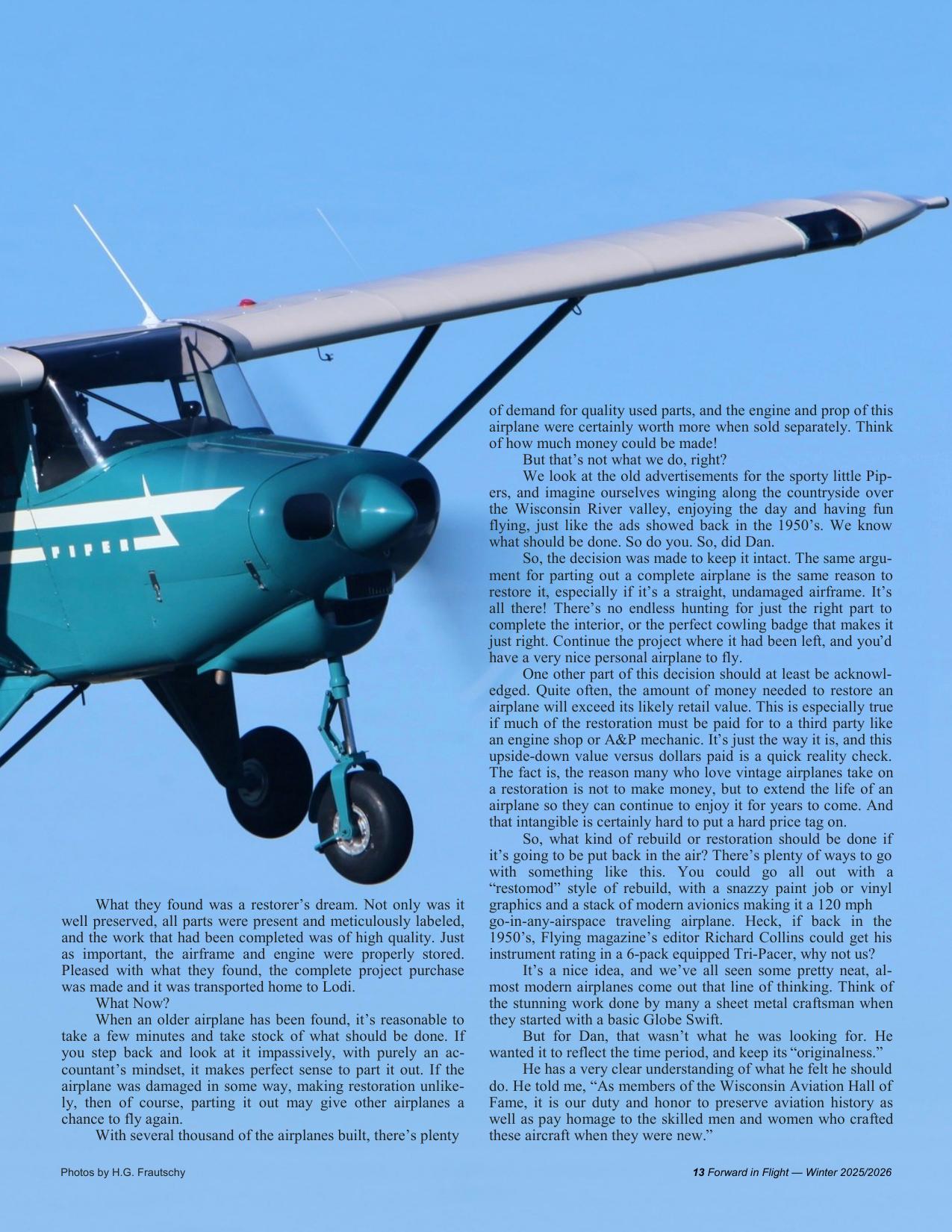
PRESIDENT’S MESSAGE Charting the Course to 40 Years WAHF’s 39th induction celebration reminds us why we do what we do—as plans for the 40th take flight By WAHF President Kurt Stanich As 2025 draws near, I find myself reflecting on what a meaningful year this has been for the Wisconsin Aviation Hall of Fame. In October, we gathered to celebrate our 39th annual induction ceremony—an evening filled with stories, laughter, and deep appreciation for the men and women whose contributions continue to shape Wisconsin’s aviation heritage. It was such a pleasure to welcome so many people to Oshkosh and the event. Seeing the smiling faces and hugs of longtime friends and hearing snippets of conversations filled me with joy. Inductees surrounded by family—some in high chairs—made me realize the significance of this life event. It was such a pleasure to play a role in honoring this year’s inductees. My heartfelt thanks to everyone who attended, volunteered, and helped make the event such a success. Now, our sights are set on something special: the 40th annual induction celebration in 2026. Forty years of honoring aviation’s finest is no small feat, and plans are already underway to make next year’s ceremony is truly memorable. We’ll share more details in the months ahead, but please plan to be part of this milestone event. Our recent induction ceremonies have grown in beauty, meaning, and size, becoming a must-attend Wisconsin aviation event. When we learned we had a near record crowd this year, at 260 registered guests, we knew we were doing this ceremony right. Our post-event reviews from inductees and members encouraged us to continue what we’re doing, tweak a few things for next time, but overall, keep improving on those little touches that make this event so special for those who attend. With plans for next year already underway, we think you’ll enjoy reading about it in future issues of Forward in Flight. Mark October 10, 2026 on your calendar so that nothing will interfere! We’re sure you won’t want to miss it. As the year comes to a close, I extend sincere thanks to our members, donors, and friends who support WAHF’s mission all year long. Your enthusiasm and generosity make it possible to preserve stories, recognize achievement, and inspire future aviators. From all of us at the Wisconsin Aviation Hall of Fame, warm wishes for a joyful holiday season and clear skies in the year ahead. Forward in Flight Where Wisconsin’s aviation people, news, and history come together. Rose Dorcey Editorial and Advertising 3980 Sharratt Drive Oshkosh WI 54901 920-279-6029 rose@wahf.org The Wisconsin Aviation Hall of Fame is a non-profit membership organization with a mission to collect and preserve the history of aviation in Wisconsin, recognize those who made that history, inform others of it, and promote aviation education for future generations. Kurt couldn’t hide his smile as he looked out at the large crowd gathered for WAHF’s 39th annual induction ceremony. Seeing Ed Lachendro surrounded by so many friends and family made his induction especially meaningful. On the Cover: One of the most recognizable front views in the lightplane world is the Piper Tri-Pacer, their entry into the four-place airplane market that is recognized for its distinctive longlegged stance and easy-flying capabilities. Restored by WAHF inductee Dan Knutson and his long-time friend and A&P-IA Dennis Faivre, it’s ready to cruise around Wisconsin in style. Photo by H.G. Frautschy
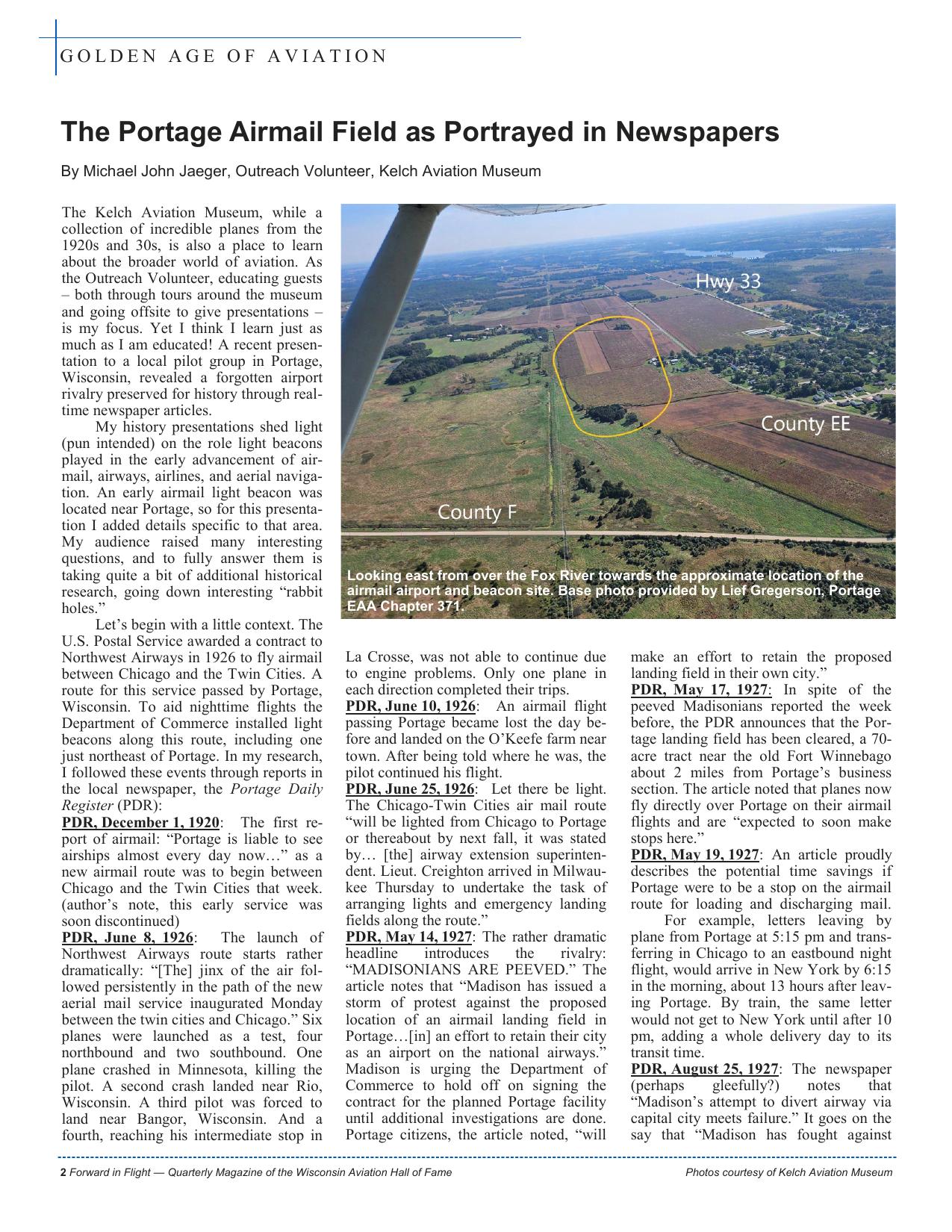
GOLDEN AGE OF AVIATION The Portage Airmail Field as Portrayed in Newspapers By Michael John Jaeger, Outreach Volunteer, Kelch Aviation Museum The Kelch Aviation Museum, while a collection of incredible planes from the 1920s and 30s, is also a place to learn about the broader world of aviation. As the Outreach Volunteer, educating guests – both through tours around the museum and going offsite to give presentations – is my focus. Yet I think I learn just as much as I am educated! A recent presentation to a local pilot group in Portage, Wisconsin, revealed a forgotten airport rivalry preserved for history through realtime newspaper articles. My history presentations shed light (pun intended) on the role light beacons played in the early advancement of airmail, airways, airlines, and aerial navigation. An early airmail light beacon was located near Portage, so for this presentation I added details specific to that area. My audience raised many interesting questions, and to fully answer them is taking quite a bit of additional historical research, going down interesting “rabbit holes.” Let’s begin with a little context. The U.S. Postal Service awarded a contract to Northwest Airways in 1926 to fly airmail between Chicago and the Twin Cities. A route for this service passed by Portage, Wisconsin. To aid nighttime flights the Department of Commerce installed light beacons along this route, including one just northeast of Portage. In my research, I followed these events through reports in the local newspaper, the Portage Daily Register (PDR): PDR, December 1, 1920: The first report of airmail: “Portage is liable to see airships almost every day now…” as a new airmail route was to begin between Chicago and the Twin Cities that week. (author’s note, this early service was soon discontinued) PDR, June 8, 1926: The launch of Northwest Airways route starts rather dramatically: “[The] jinx of the air followed persistently in the path of the new aerial mail service inaugurated Monday between the twin cities and Chicago.” Six planes were launched as a test, four northbound and two southbound. One plane crashed in Minnesota, killing the pilot. A second crash landed near Rio, Wisconsin. A third pilot was forced to land near Bangor, Wisconsin. And a fourth, reaching his intermediate stop in Looking east from over the Fox River towards the approximate location of the airmail airport and beacon site. Base photo provided by Lief Gregerson, Portage EAA Chapter 371. La Crosse, was not able to continue due to engine problems. Only one plane in each direction completed their trips. PDR, June 10, 1926: An airmail flight passing Portage became lost the day before and landed on the O’Keefe farm near town. After being told where he was, the pilot continued his flight. PDR, June 25, 1926: Let there be light. The Chicago-Twin Cities air mail route “will be lighted from Chicago to Portage or thereabout by next fall, it was stated by… [the] airway extension superintendent. Lieut. Creighton arrived in Milwaukee Thursday to undertake the task of arranging lights and emergency landing fields along the route.” PDR, May 14, 1927: The rather dramatic headline introduces the rivalry: “MADISONIANS ARE PEEVED.” The article notes that “Madison has issued a storm of protest against the proposed location of an airmail landing field in Portage…[in] an effort to retain their city as an airport on the national airways.” Madison is urging the Department of Commerce to hold off on signing the contract for the planned Portage facility until additional investigations are done. Portage citizens, the article noted, “will 2 Forward in Flight — Quarterly Magazine of the Wisconsin Aviation Hall of Fame make an effort to retain the proposed landing field in their own city.” PDR, May 17, 1927: In spite of the peeved Madisonians reported the week before, the PDR announces that the Portage landing field has been cleared, a 70acre tract near the old Fort Winnebago about 2 miles from Portage’s business section. The article noted that planes now fly directly over Portage on their airmail flights and are “expected to soon make stops here.” PDR, May 19, 1927: An article proudly describes the potential time savings if Portage were to be a stop on the airmail route for loading and discharging mail. For example, letters leaving by plane from Portage at 5:15 pm and transferring in Chicago to an eastbound night flight, would arrive in New York by 6:15 in the morning, about 13 hours after leaving Portage. By train, the same letter would not get to New York until after 10 pm, adding a whole delivery day to its transit time. PDR, August 25, 1927: The newspaper (perhaps gleefully?) notes that “Madison’s attempt to divert airway via capital city meets failure.” It goes on the say that “Madison has fought against Photos courtesy of Kelch Aviation Museum
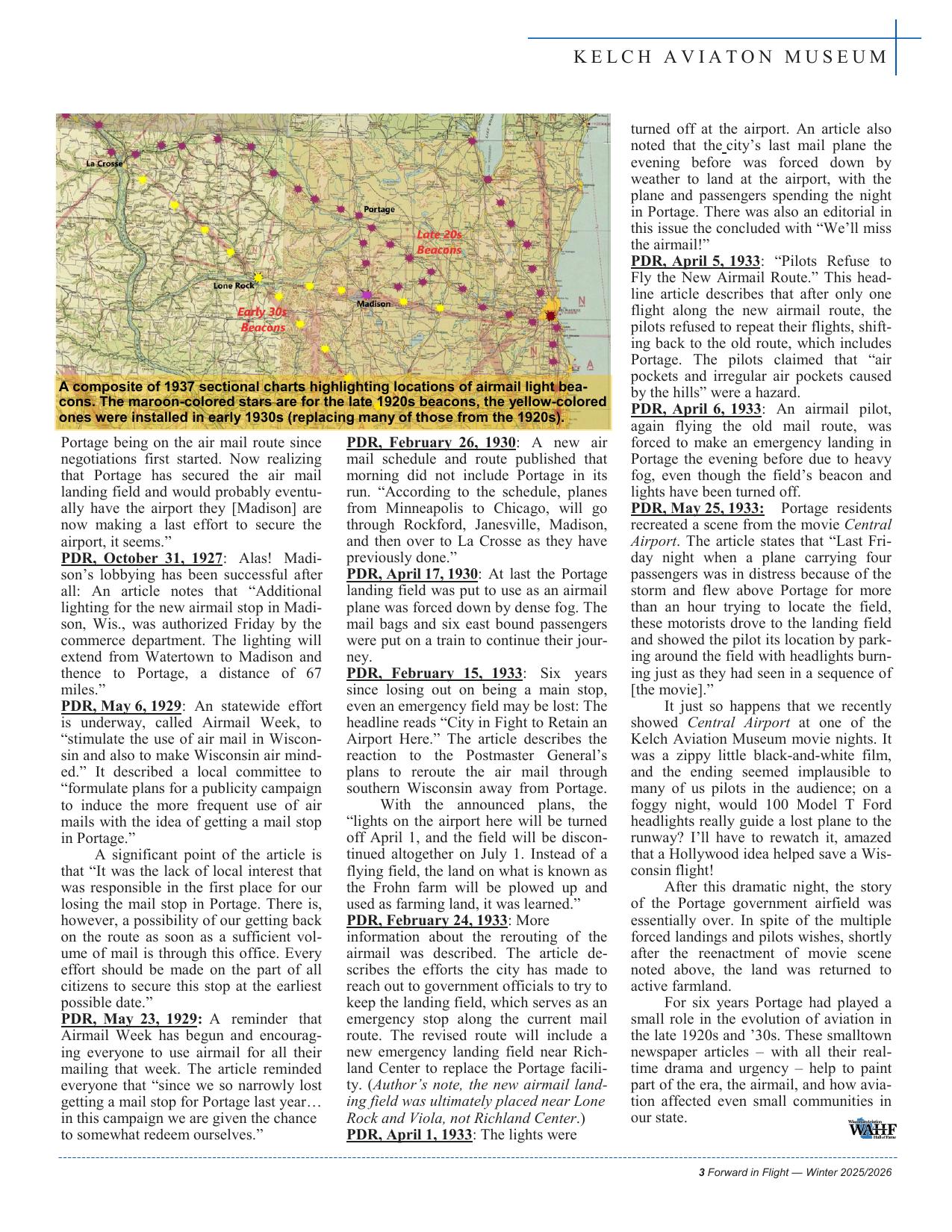
KELCH AVIATON MUSEUM A composite of 1937 sectional charts highlighting locations of airmail light beacons. The maroon-colored stars are for the late 1920s beacons, the yellow-colored ones were installed in early 1930s (replacing many of those from the 1920s). Portage being on the air mail route since negotiations first started. Now realizing that Portage has secured the air mail landing field and would probably eventually have the airport they [Madison] are now making a last effort to secure the airport, it seems.” PDR, October 31, 1927: Alas! Madison’s lobbying has been successful after all: An article notes that “Additional lighting for the new airmail stop in Madison, Wis., was authorized Friday by the commerce department. The lighting will extend from Watertown to Madison and thence to Portage, a distance of 67 miles.” PDR, May 6, 1929: An statewide effort is underway, called Airmail Week, to “stimulate the use of air mail in Wisconsin and also to make Wisconsin air minded.” It described a local committee to “formulate plans for a publicity campaign to induce the more frequent use of air mails with the idea of getting a mail stop in Portage.” A significant point of the article is that “It was the lack of local interest that was responsible in the first place for our losing the mail stop in Portage. There is, however, a possibility of our getting back on the route as soon as a sufficient volume of mail is through this office. Every effort should be made on the part of all citizens to secure this stop at the earliest possible date.” PDR, May 23, 1929: A reminder that Airmail Week has begun and encouraging everyone to use airmail for all their mailing that week. The article reminded everyone that “since we so narrowly lost getting a mail stop for Portage last year… in this campaign we are given the chance to somewhat redeem ourselves.” PDR, February 26, 1930: A new air mail schedule and route published that morning did not include Portage in its run. “According to the schedule, planes from Minneapolis to Chicago, will go through Rockford, Janesville, Madison, and then over to La Crosse as they have previously done.” PDR, April 17, 1930: At last the Portage landing field was put to use as an airmail plane was forced down by dense fog. The mail bags and six east bound passengers were put on a train to continue their journey. PDR, February 15, 1933: Six years since losing out on being a main stop, even an emergency field may be lost: The headline reads “City in Fight to Retain an Airport Here.” The article describes the reaction to the Postmaster General’s plans to reroute the air mail through southern Wisconsin away from Portage. With the announced plans, the “lights on the airport here will be turned off April 1, and the field will be discontinued altogether on July 1. Instead of a flying field, the land on what is known as the Frohn farm will be plowed up and used as farming land, it was learned.” PDR, February 24, 1933: More information about the rerouting of the airmail was described. The article describes the efforts the city has made to reach out to government officials to try to keep the landing field, which serves as an emergency stop along the current mail route. The revised route will include a new emergency landing field near Richland Center to replace the Portage facility. (Author’s note, the new airmail landing field was ultimately placed near Lone Rock and Viola, not Richland Center.) PDR, April 1, 1933: The lights were turned off at the airport. An article also noted that the city’s last mail plane the evening before was forced down by weather to land at the airport, with the plane and passengers spending the night in Portage. There was also an editorial in this issue the concluded with “We’ll miss the airmail!” PDR, April 5, 1933: “Pilots Refuse to Fly the New Airmail Route.” This headline article describes that after only one flight along the new airmail route, the pilots refused to repeat their flights, shifting back to the old route, which includes Portage. The pilots claimed that “air pockets and irregular air pockets caused by the hills” were a hazard. PDR, April 6, 1933: An airmail pilot, again flying the old mail route, was forced to make an emergency landing in Portage the evening before due to heavy fog, even though the field’s beacon and lights have been turned off. PDR, May 25, 1933: Portage residents recreated a scene from the movie Central Airport. The article states that “Last Friday night when a plane carrying four passengers was in distress because of the storm and flew above Portage for more than an hour trying to locate the field, these motorists drove to the landing field and showed the pilot its location by parking around the field with headlights burning just as they had seen in a sequence of [the movie].” It just so happens that we recently showed Central Airport at one of the Kelch Aviation Museum movie nights. It was a zippy little black-and-white film, and the ending seemed implausible to many of us pilots in the audience; on a foggy night, would 100 Model T Ford headlights really guide a lost plane to the runway? I’ll have to rewatch it, amazed that a Hollywood idea helped save a Wisconsin flight! After this dramatic night, the story of the Portage government airfield was essentially over. In spite of the multiple forced landings and pilots wishes, shortly after the reenactment of movie scene noted above, the land was returned to active farmland. For six years Portage had played a small role in the evolution of aviation in the late 1920s and ’30s. These smalltown newspaper articles – with all their realtime drama and urgency – help to paint part of the era, the airmail, and how aviation affected even small communities in our state. 3 Forward in Flight — Winter 2025/2026
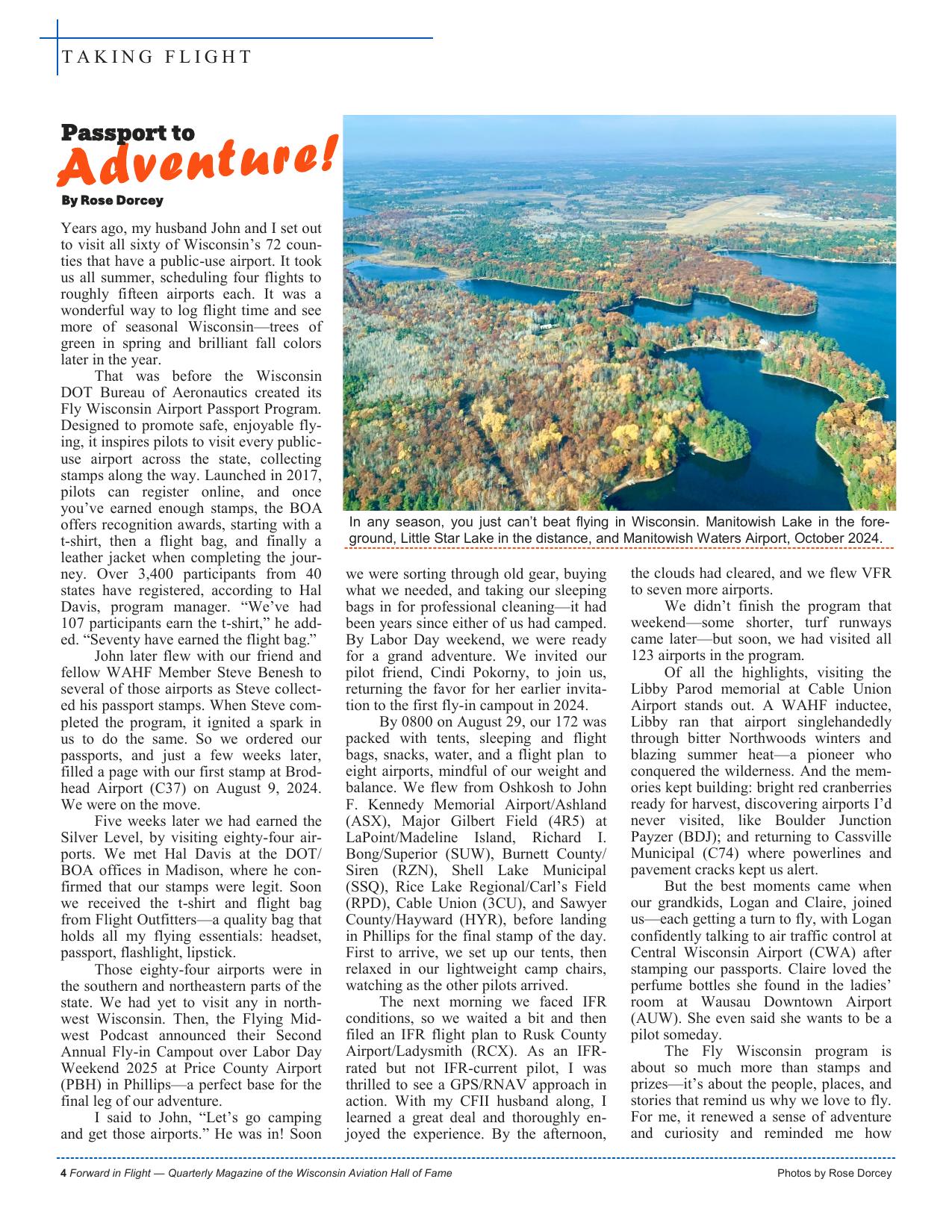
TAKING FLIGHT Passport to By Rose Dorcey Years ago, my husband John and I set out to visit all sixty of Wisconsin’s 72 counties that have a public-use airport. It took us all summer, scheduling four flights to roughly fifteen airports each. It was a wonderful way to log flight time and see more of seasonal Wisconsin—trees of green in spring and brilliant fall colors later in the year. That was before the Wisconsin DOT Bureau of Aeronautics created its Fly Wisconsin Airport Passport Program. Designed to promote safe, enjoyable flying, it inspires pilots to visit every publicuse airport across the state, collecting stamps along the way. Launched in 2017, pilots can register online, and once you’ve earned enough stamps, the BOA offers recognition awards, starting with a t-shirt, then a flight bag, and finally a leather jacket when completing the journey. Over 3,400 participants from 40 states have registered, according to Hal Davis, program manager. “We’ve had 107 participants earn the t-shirt,” he added. “Seventy have earned the flight bag.” John later flew with our friend and fellow WAHF Member Steve Benesh to several of those airports as Steve collected his passport stamps. When Steve completed the program, it ignited a spark in us to do the same. So we ordered our passports, and just a few weeks later, filled a page with our first stamp at Brodhead Airport (C37) on August 9, 2024. We were on the move. Five weeks later we had earned the Silver Level, by visiting eighty-four airports. We met Hal Davis at the DOT/ BOA offices in Madison, where he confirmed that our stamps were legit. Soon we received the t-shirt and flight bag from Flight Outfitters—a quality bag that holds all my flying essentials: headset, passport, flashlight, lipstick. Those eighty-four airports were in the southern and northeastern parts of the state. We had yet to visit any in northwest Wisconsin. Then, the Flying Midwest Podcast announced their Second Annual Fly-in Campout over Labor Day Weekend 2025 at Price County Airport (PBH) in Phillips—a perfect base for the final leg of our adventure. I said to John, “Let’s go camping and get those airports.” He was in! Soon In any season, you just can’t beat flying in Wisconsin. Manitowish Lake in the foreground, Little Star Lake in the distance, and Manitowish Waters Airport, October 2024. we were sorting through old gear, buying what we needed, and taking our sleeping bags in for professional cleaning—it had been years since either of us had camped. By Labor Day weekend, we were ready for a grand adventure. We invited our pilot friend, Cindi Pokorny, to join us, returning the favor for her earlier invitation to the first fly-in campout in 2024. By 0800 on August 29, our 172 was packed with tents, sleeping and flight bags, snacks, water, and a flight plan to eight airports, mindful of our weight and balance. We flew from Oshkosh to John F. Kennedy Memorial Airport/Ashland (ASX), Major Gilbert Field (4R5) at LaPoint/Madeline Island, Richard I. Bong/Superior (SUW), Burnett County/ Siren (RZN), Shell Lake Municipal (SSQ), Rice Lake Regional/Carl’s Field (RPD), Cable Union (3CU), and Sawyer County/Hayward (HYR), before landing in Phillips for the final stamp of the day. First to arrive, we set up our tents, then relaxed in our lightweight camp chairs, watching as the other pilots arrived. The next morning we faced IFR conditions, so we waited a bit and then filed an IFR flight plan to Rusk County Airport/Ladysmith (RCX). As an IFRrated but not IFR-current pilot, I was thrilled to see a GPS/RNAV approach in action. With my CFII husband along, I learned a great deal and thoroughly enjoyed the experience. By the afternoon, 4 Forward in Flight — Quarterly Magazine of the Wisconsin Aviation Hall of Fame the clouds had cleared, and we flew VFR to seven more airports. We didn’t finish the program that weekend—some shorter, turf runways came later—but soon, we had visited all 123 airports in the program. Of all the highlights, visiting the Libby Parod memorial at Cable Union Airport stands out. A WAHF inductee, Libby ran that airport singlehandedly through bitter Northwoods winters and blazing summer heat—a pioneer who conquered the wilderness. And the memories kept building: bright red cranberries ready for harvest, discovering airports I’d never visited, like Boulder Junction Payzer (BDJ); and returning to Cassville Municipal (C74) where powerlines and pavement cracks kept us alert. But the best moments came when our grandkids, Logan and Claire, joined us—each getting a turn to fly, with Logan confidently talking to air traffic control at Central Wisconsin Airport (CWA) after stamping our passports. Claire loved the perfume bottles she found in the ladies’ room at Wausau Downtown Airport (AUW). She even said she wants to be a pilot someday. The Fly Wisconsin program is about so much more than stamps and prizes—it’s about the people, places, and stories that remind us why we love to fly. For me, it renewed a sense of adventure and curiosity and reminded me how Photos by Rose Dorcey
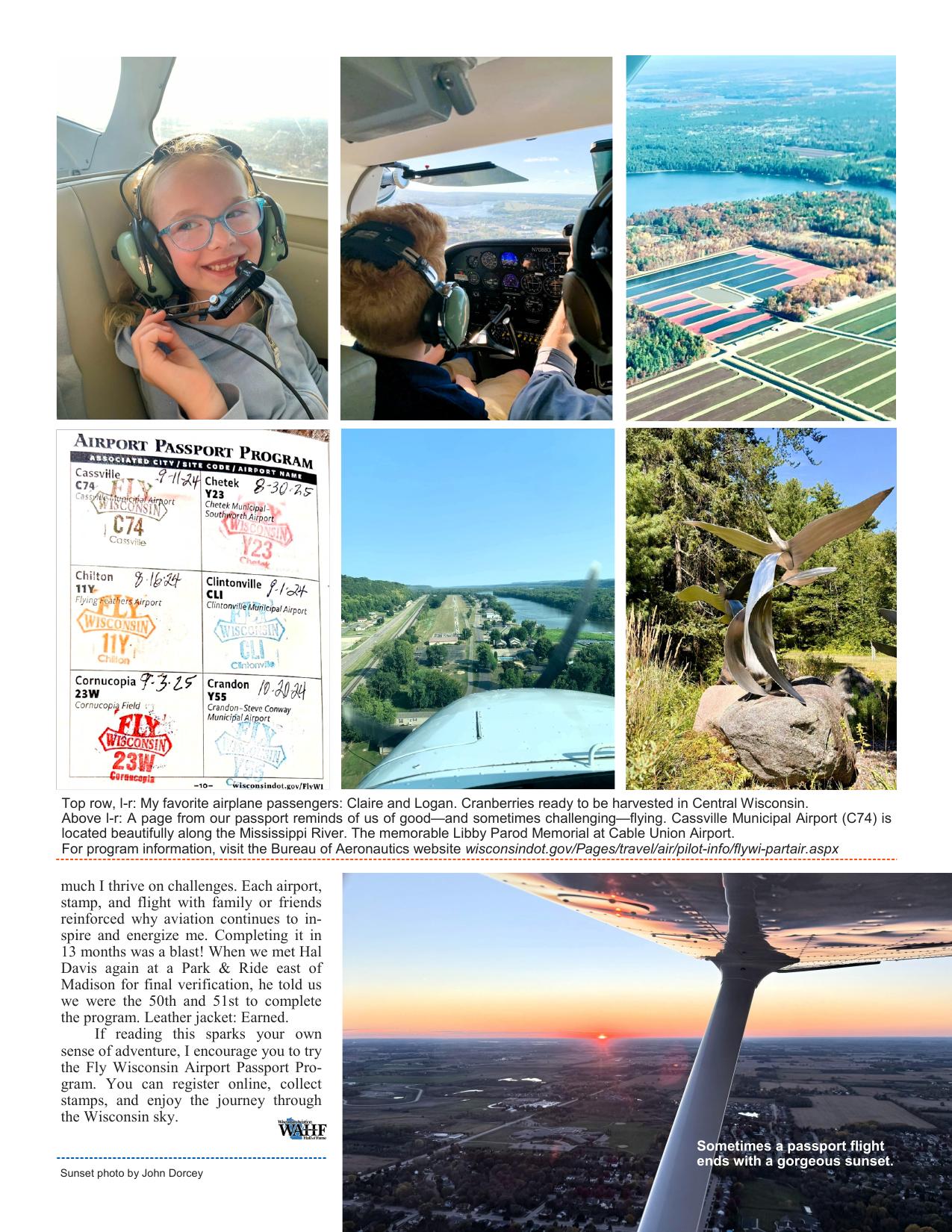
Top row, l-r: My favorite airplane passengers: Claire and Logan. Cranberries ready to be harvested in Central Wisconsin. Above l-r: A page from our passport reminds of us of good—and sometimes challenging—flying. Cassville Municipal Airport (C74) is located beautifully along the Mississippi River. The memorable Libby Parod Memorial at Cable Union Airport. For program information, visit the Bureau of Aeronautics website wisconsindot.gov/Pages/travel/air/pilot-info/flywi-partair.aspx much I thrive on challenges. Each airport, stamp, and flight with family or friends reinforced why aviation continues to inspire and energize me. Completing it in 13 months was a blast! When we met Hal Davis again at a Park & Ride east of Madison for final verification, he told us we were the 50th and 51st to complete the program. Leather jacket: Earned. If reading this sparks your own sense of adventure, I encourage you to try the Fly Wisconsin Airport Passport Program. You can register online, collect stamps, and enjoy the journey through the Wisconsin sky. Sunset photo by John Dorcey Sometimes a passport flight ends with a gorgeous sunset. 5 Forward in Flight — Winter 2025/2026
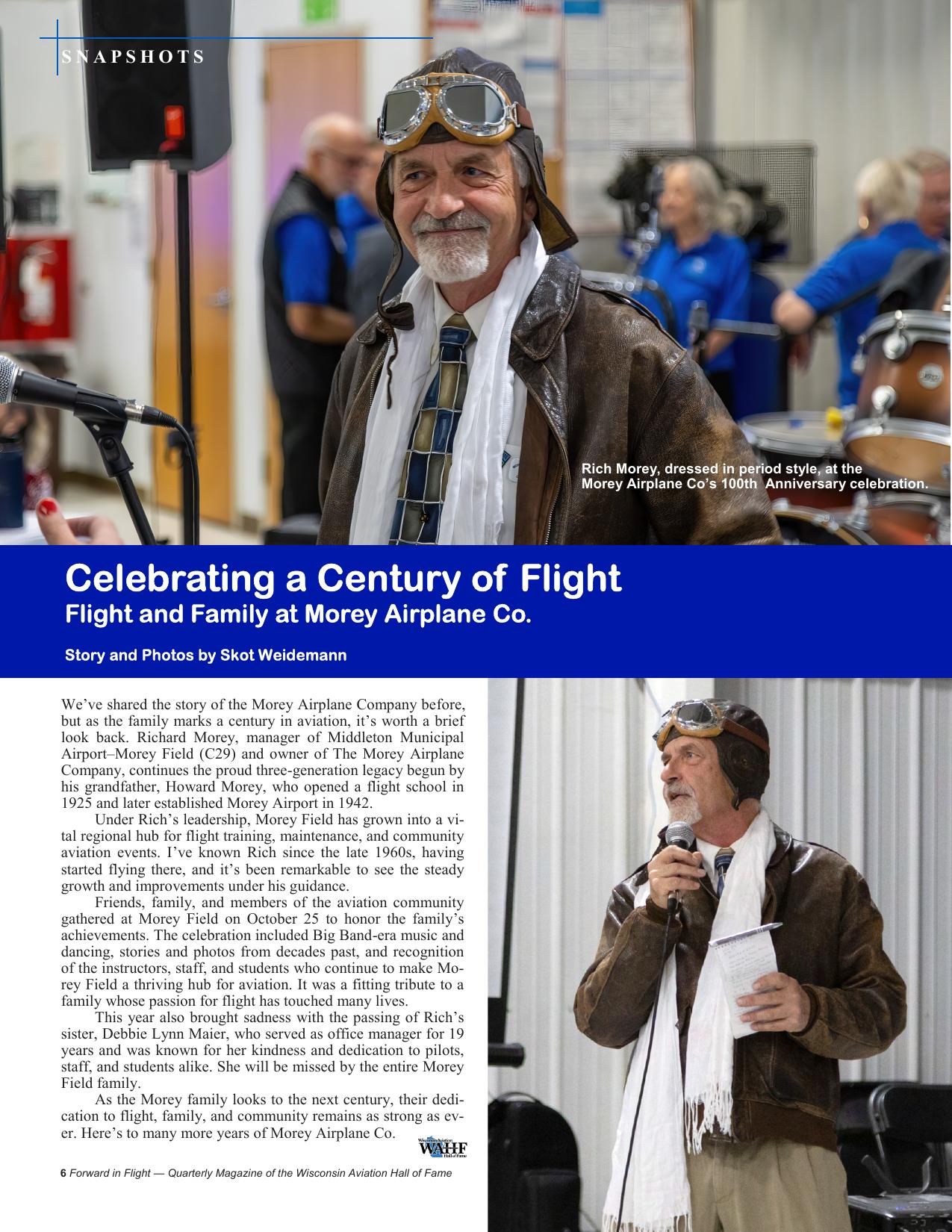
SNAPSHOTS Rich Morey, dressed in period style, at the Morey Airplane Co’s 100th Anniversary celebration. Celebrating a Century of Flight Flight and Family at Morey Airplane Co. Story and Photos by Skot Weidemann We’ve shared the story of the Morey Airplane Company before, but as the family marks a century in aviation, it’s worth a brief look back. Richard Morey, manager of Middleton Municipal Airport–Morey Field (C29) and owner of The Morey Airplane Company, continues the proud three-generation legacy begun by his grandfather, Howard Morey, who opened a flight school in 1925 and later established Morey Airport in 1942. Under Rich’s leadership, Morey Field has grown into a vital regional hub for flight training, maintenance, and community aviation events. I’ve known Rich since the late 1960s, having started flying there, and it’s been remarkable to see the steady growth and improvements under his guidance. Friends, family, and members of the aviation community gathered at Morey Field on October 25 to honor the family’s achievements. The celebration included Big Band-era music and dancing, stories and photos from decades past, and recognition of the instructors, staff, and students who continue to make Morey Field a thriving hub for aviation. It was a fitting tribute to a family whose passion for flight has touched many lives. This year also brought sadness with the passing of Rich’s sister, Debbie Lynn Maier, who served as office manager for 19 years and was known for her kindness and dedication to pilots, staff, and students alike. She will be missed by the entire Morey Field family. As the Morey family looks to the next century, their dedication to flight, family, and community remains as strong as ever. Here’s to many more years of Morey Airplane Co. 6 Forward in Flight — Quarterly Magazine of the Wisconsin Aviation Hall of Fame
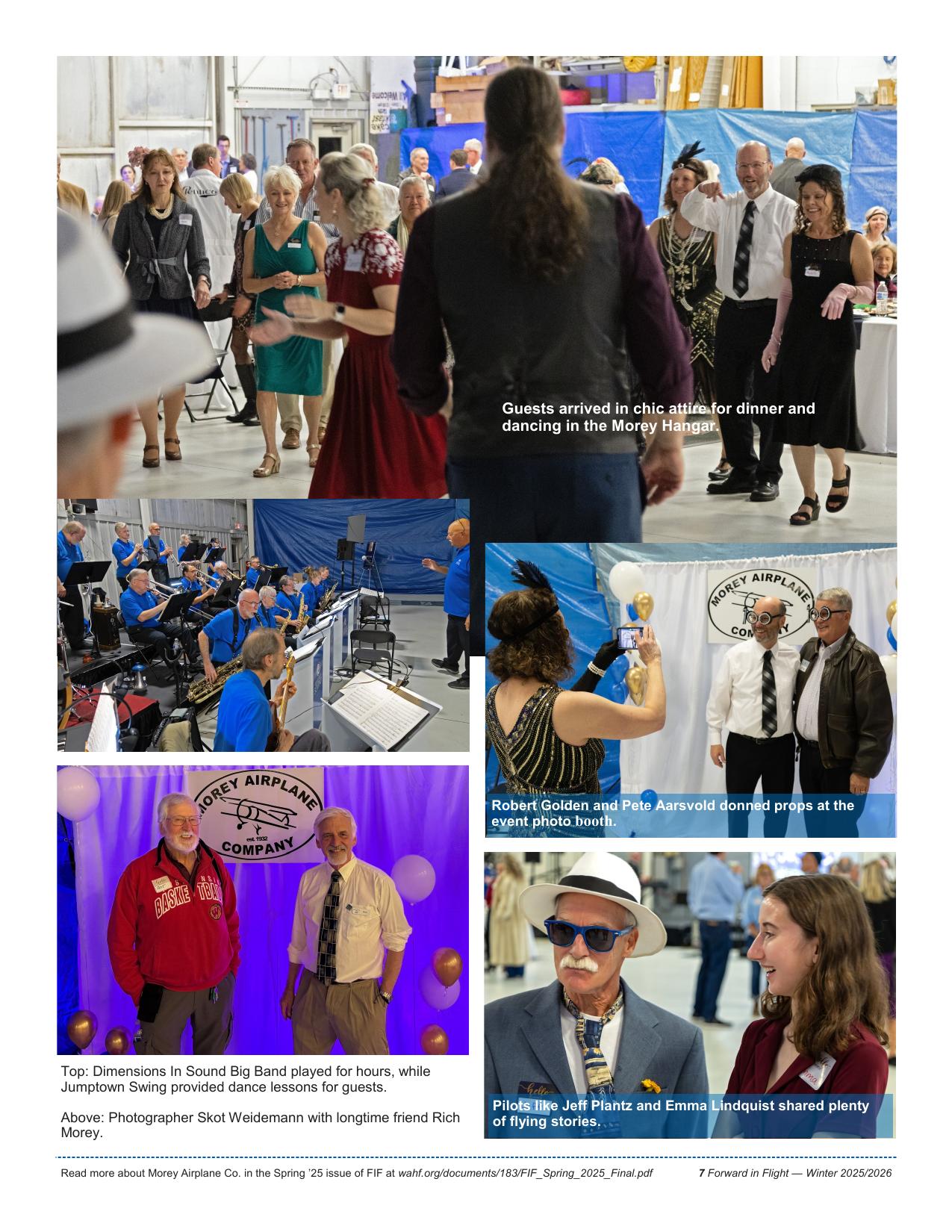
Guests arrived in chic attire for dinner and dancing in the Morey Hangar. Robert Golden and Pete Aarsvold donned props at the event photo booth. Top: Dimensions In Sound Big Band played for hours, while Jumptown Swing provided dance lessons for guests. Above: Photographer Skot Weidemann with longtime friend Rich Morey. Pilots like Jeff Plantz and Emma Lindquist shared plenty of flying stories. Read more about Morey Airplane Co. in the Spring ’25 issue of FIF at wahf.org/documents/183/FIF_Spring_2025_Final.pdf 7 Forward in Flight — Winter 2025/2026
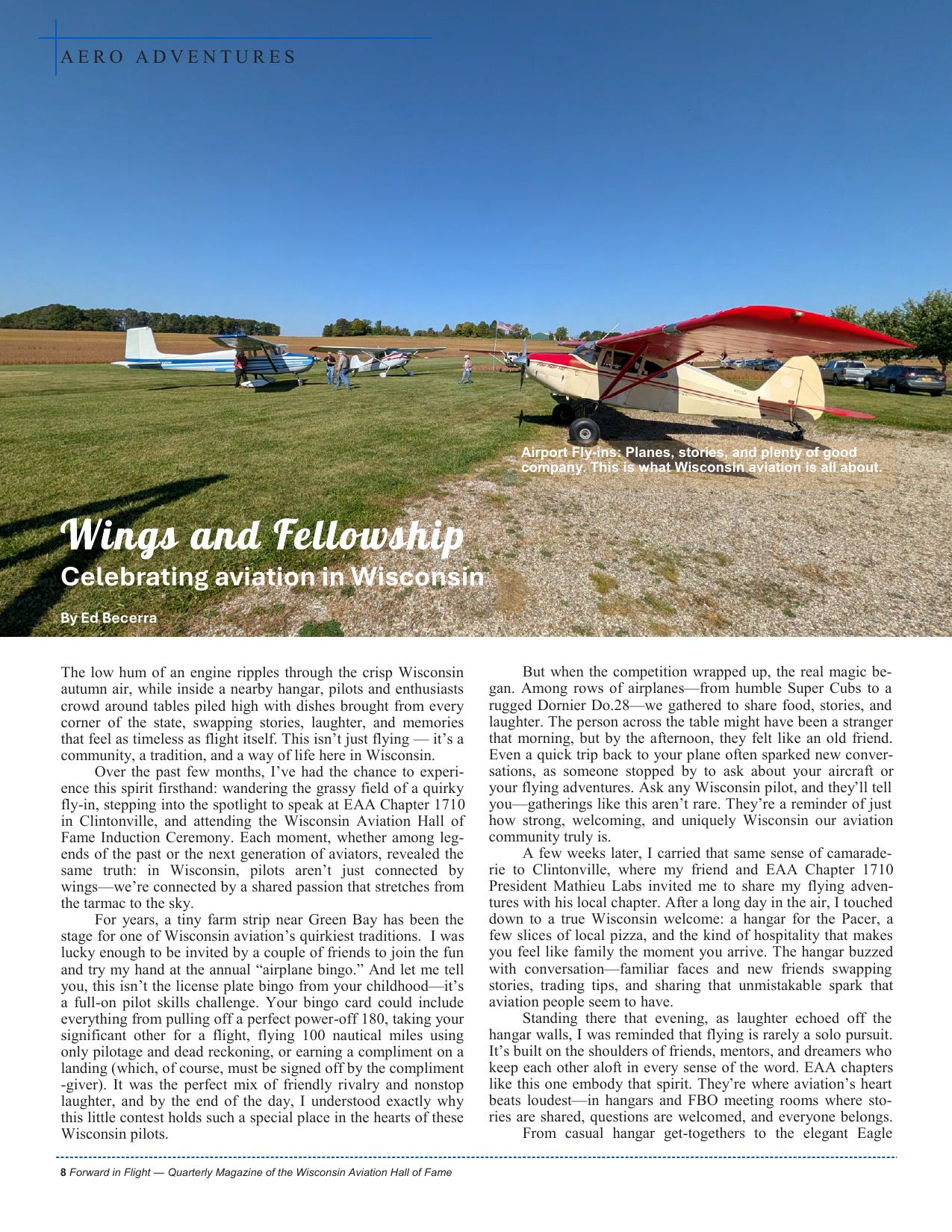
AERO ADVENTURES Airport Fly-ins: Planes, stories, and plenty of good company. This is what Wisconsin aviation is all about. Wings and Fellowship Celebrating aviation in Wisconsin By Ed Becerra The low hum of an engine ripples through the crisp Wisconsin autumn air, while inside a nearby hangar, pilots and enthusiasts crowd around tables piled high with dishes brought from every corner of the state, swapping stories, laughter, and memories that feel as timeless as flight itself. This isn’t just flying — it’s a community, a tradition, and a way of life here in Wisconsin. Over the past few months, I’ve had the chance to experience this spirit firsthand: wandering the grassy field of a quirky fly-in, stepping into the spotlight to speak at EAA Chapter 1710 in Clintonville, and attending the Wisconsin Aviation Hall of Fame Induction Ceremony. Each moment, whether among legends of the past or the next generation of aviators, revealed the same truth: in Wisconsin, pilots aren’t just connected by wings—we’re connected by a shared passion that stretches from the tarmac to the sky. For years, a tiny farm strip near Green Bay has been the stage for one of Wisconsin aviation’s quirkiest traditions. I was lucky enough to be invited by a couple of friends to join the fun and try my hand at the annual “airplane bingo.” And let me tell you, this isn’t the license plate bingo from your childhood—it’s a full-on pilot skills challenge. Your bingo card could include everything from pulling off a perfect power-off 180, taking your significant other for a flight, flying 100 nautical miles using only pilotage and dead reckoning, or earning a compliment on a landing (which, of course, must be signed off by the compliment -giver). It was the perfect mix of friendly rivalry and nonstop laughter, and by the end of the day, I understood exactly why this little contest holds such a special place in the hearts of these Wisconsin pilots. 8 Forward in Flight — Quarterly Magazine of the Wisconsin Aviation Hall of Fame But when the competition wrapped up, the real magic began. Among rows of airplanes—from humble Super Cubs to a rugged Dornier Do.28—we gathered to share food, stories, and laughter. The person across the table might have been a stranger that morning, but by the afternoon, they felt like an old friend. Even a quick trip back to your plane often sparked new conversations, as someone stopped by to ask about your aircraft or your flying adventures. Ask any Wisconsin pilot, and they’ll tell you—gatherings like this aren’t rare. They’re a reminder of just how strong, welcoming, and uniquely Wisconsin our aviation community truly is. A few weeks later, I carried that same sense of camaraderie to Clintonville, where my friend and EAA Chapter 1710 President Mathieu Labs invited me to share my flying adventures with his local chapter. After a long day in the air, I touched down to a true Wisconsin welcome: a hangar for the Pacer, a few slices of local pizza, and the kind of hospitality that makes you feel like family the moment you arrive. The hangar buzzed with conversation—familiar faces and new friends swapping stories, trading tips, and sharing that unmistakable spark that aviation people seem to have. Standing there that evening, as laughter echoed off the hangar walls, I was reminded that flying is rarely a solo pursuit. It’s built on the shoulders of friends, mentors, and dreamers who keep each other aloft in every sense of the word. EAA chapters like this one embody that spirit. They’re where aviation’s heart beats loudest—in hangars and FBO meeting rooms where stories are shared, questions are welcomed, and everyone belongs. From casual hangar get-togethers to the elegant Eagle
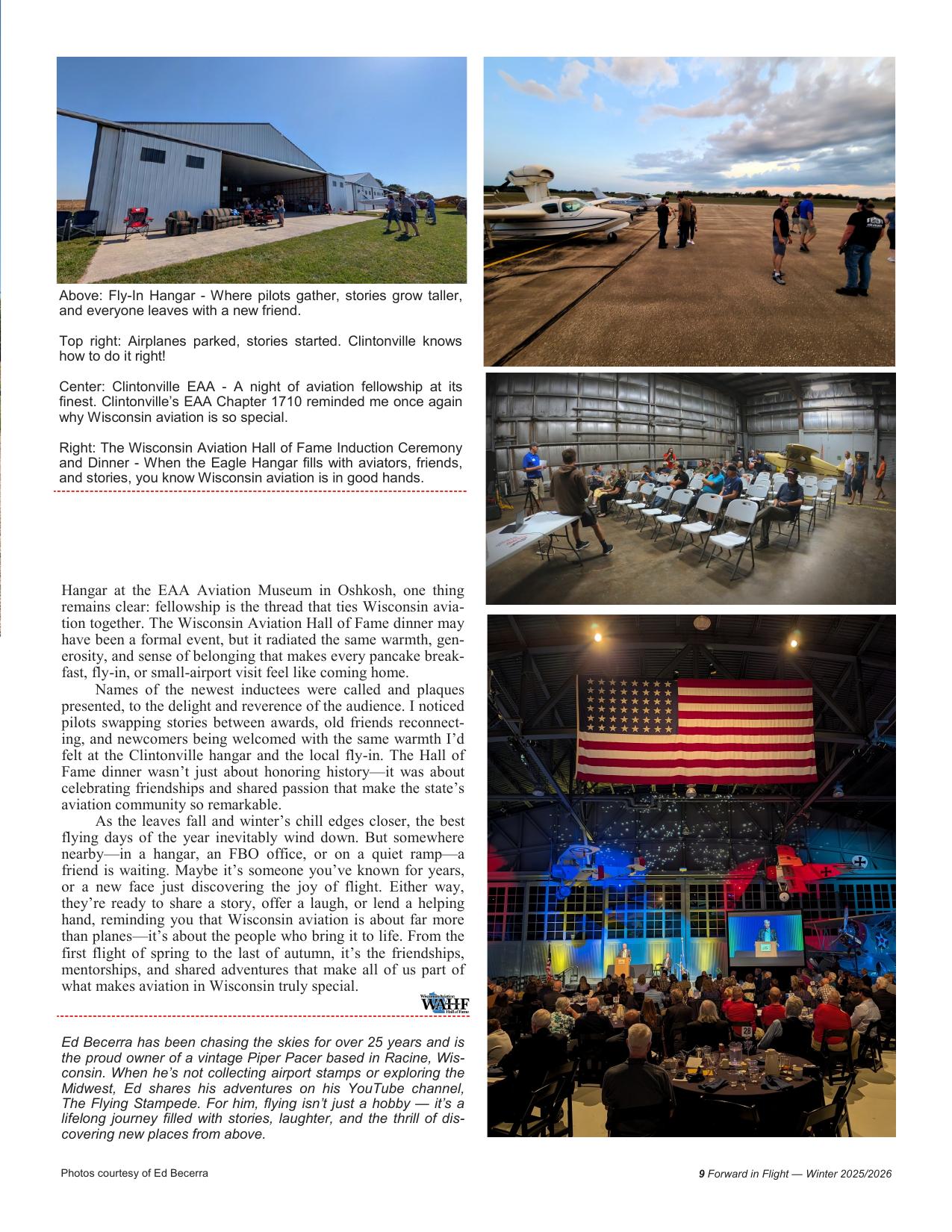
Above: Fly-In Hangar - Where pilots gather, stories grow taller, and everyone leaves with a new friend. Top right: Airplanes parked, stories started. Clintonville knows how to do it right! Center: Clintonville EAA - A night of aviation fellowship at its finest. Clintonville’s EAA Chapter 1710 reminded me once again why Wisconsin aviation is so special. Right: The Wisconsin Aviation Hall of Fame Induction Ceremony and Dinner - When the Eagle Hangar fills with aviators, friends, and stories, you know Wisconsin aviation is in good hands. Hangar at the EAA Aviation Museum in Oshkosh, one thing remains clear: fellowship is the thread that ties Wisconsin aviation together. The Wisconsin Aviation Hall of Fame dinner may have been a formal event, but it radiated the same warmth, generosity, and sense of belonging that makes every pancake breakfast, fly-in, or small-airport visit feel like coming home. Names of the newest inductees were called and plaques presented, to the delight and reverence of the audience. I noticed pilots swapping stories between awards, old friends reconnecting, and newcomers being welcomed with the same warmth I’d felt at the Clintonville hangar and the local fly-in. The Hall of Fame dinner wasn’t just about honoring history—it was about celebrating friendships and shared passion that make the state’s aviation community so remarkable. As the leaves fall and winter’s chill edges closer, the best flying days of the year inevitably wind down. But somewhere nearby—in a hangar, an FBO office, or on a quiet ramp—a friend is waiting. Maybe it’s someone you’ve known for years, or a new face just discovering the joy of flight. Either way, they’re ready to share a story, offer a laugh, or lend a helping hand, reminding you that Wisconsin aviation is about far more than planes—it’s about the people who bring it to life. From the first flight of spring to the last of autumn, it’s the friendships, mentorships, and shared adventures that make all of us part of what makes aviation in Wisconsin truly special. Ed Becerra has been chasing the skies for over 25 years and is the proud owner of a vintage Piper Pacer based in Racine, Wisconsin. When he’s not collecting airport stamps or exploring the Midwest, Ed shares his adventures on his YouTube channel, The Flying Stampede. For him, flying isn’t just a hobby — it’s a lifelong journey filled with stories, laughter, and the thrill of discovering new places from above. Photos courtesy of Ed Becerra 9 Forward in Flight — Winter 2025/2026
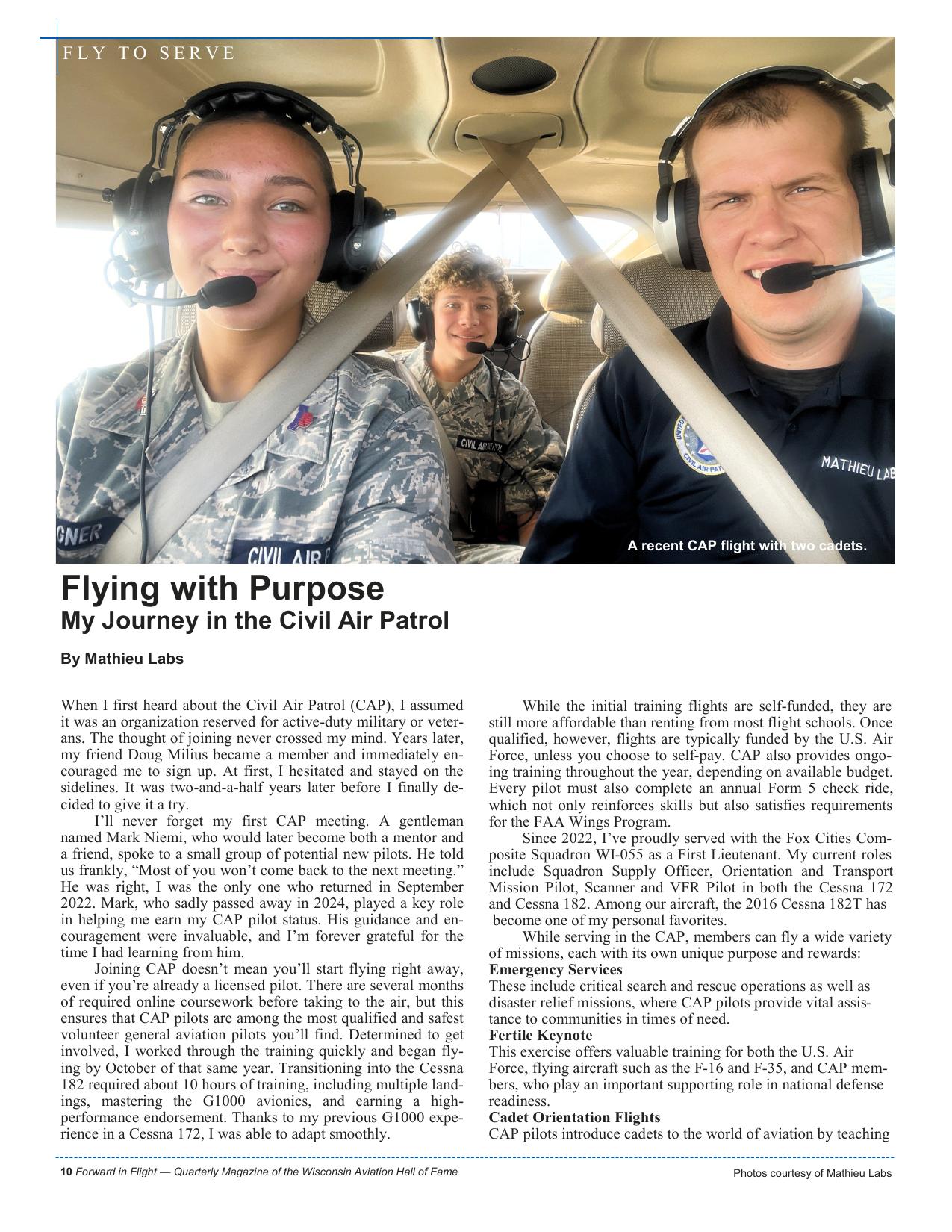
FLY TO SERVE A recent CAP flight with two cadets. Flying with Purpose My Journey in the Civil Air Patrol By Mathieu Labs When I first heard about the Civil Air Patrol (CAP), I assumed it was an organization reserved for active-duty military or veterans. The thought of joining never crossed my mind. Years later, my friend Doug Milius became a member and immediately encouraged me to sign up. At first, I hesitated and stayed on the sidelines. It was two-and-a-half years later before I finally decided to give it a try. I’ll never forget my first CAP meeting. A gentleman named Mark Niemi, who would later become both a mentor and a friend, spoke to a small group of potential new pilots. He told us frankly, “Most of you won’t come back to the next meeting.” He was right, I was the only one who returned in September 2022. Mark, who sadly passed away in 2024, played a key role in helping me earn my CAP pilot status. His guidance and encouragement were invaluable, and I’m forever grateful for the time I had learning from him. Joining CAP doesn’t mean you’ll start flying right away, even if you’re already a licensed pilot. There are several months of required online coursework before taking to the air, but this ensures that CAP pilots are among the most qualified and safest volunteer general aviation pilots you’ll find. Determined to get involved, I worked through the training quickly and began flying by October of that same year. Transitioning into the Cessna 182 required about 10 hours of training, including multiple landings, mastering the G1000 avionics, and earning a highperformance endorsement. Thanks to my previous G1000 experience in a Cessna 172, I was able to adapt smoothly. While the initial training flights are self-funded, they are still more affordable than renting from most flight schools. Once qualified, however, flights are typically funded by the U.S. Air Force, unless you choose to self-pay. CAP also provides ongoing training throughout the year, depending on available budget. Every pilot must also complete an annual Form 5 check ride, which not only reinforces skills but also satisfies requirements for the FAA Wings Program. Since 2022, I’ve proudly served with the Fox Cities Composite Squadron WI-055 as a First Lieutenant. My current roles include Squadron Supply Officer, Orientation and Transport Mission Pilot, Scanner and VFR Pilot in both the Cessna 172 and Cessna 182. Among our aircraft, the 2016 Cessna 182T has become one of my personal favorites. While serving in the CAP, members can fly a wide variety of missions, each with its own unique purpose and rewards: Emergency Services These include critical search and rescue operations as well as disaster relief missions, where CAP pilots provide vital assistance to communities in times of need. Fertile Keynote This exercise offers valuable training for both the U.S. Air Force, flying aircraft such as the F-16 and F-35, and CAP members, who play an important supporting role in national defense readiness. Cadet Orientation Flights CAP pilots introduce cadets to the world of aviation by teaching 10 Forward in Flight — Quarterly Magazine of the Wisconsin Aviation Hall of Fame Photos courtesy of Mathieu Labs
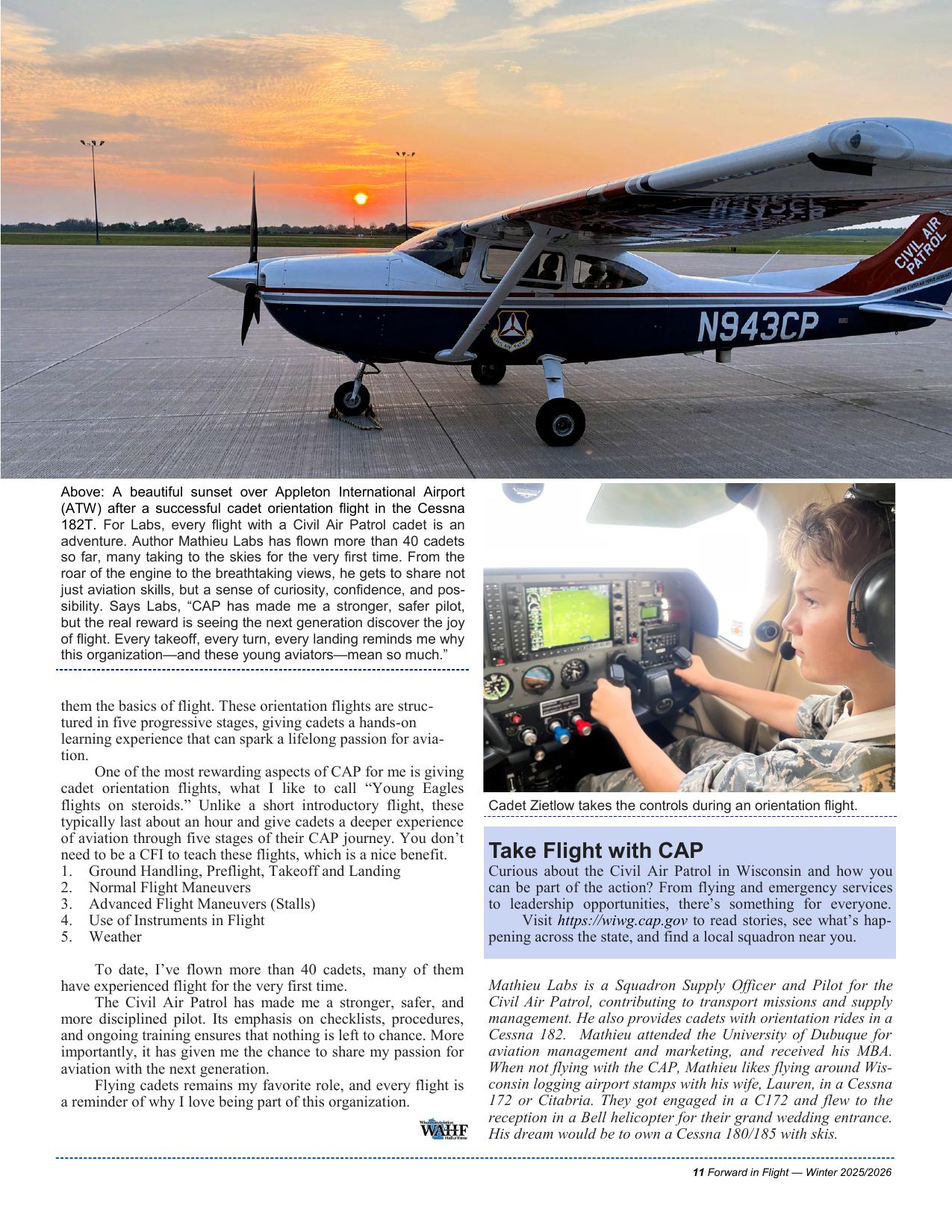
Above: A beautiful sunset over Appleton International Airport (ATW) after a successful cadet orientation flight in the Cessna 182T. For Labs, every flight with a Civil Air Patrol cadet is an adventure. Author Mathieu Labs has flown more than 40 cadets so far, many taking to the skies for the very first time. From the roar of the engine to the breathtaking views, he gets to share not just aviation skills, but a sense of curiosity, confidence, and possibility. Says Labs, “CAP has made me a stronger, safer pilot, but the real reward is seeing the next generation discover the joy of flight. Every takeoff, every turn, every landing reminds me why this organization—and these young aviators—mean so much.” them the basics of flight. These orientation flights are structured in five progressive stages, giving cadets a hands-on learning experience that can spark a lifelong passion for aviation. One of the most rewarding aspects of CAP for me is giving cadet orientation flights, what I like to call “Young Eagles flights on steroids.” Unlike a short introductory flight, these typically last about an hour and give cadets a deeper experience of aviation through five stages of their CAP journey. You don’t need to be a CFI to teach these flights, which is a nice benefit. 1. Ground Handling, Preflight, Takeoff and Landing 2. Normal Flight Maneuvers 3. Advanced Flight Maneuvers (Stalls) 4. Use of Instruments in Flight 5. Weather To date, I’ve flown more than 40 cadets, many of them have experienced flight for the very first time. The Civil Air Patrol has made me a stronger, safer, and more disciplined pilot. Its emphasis on checklists, procedures, and ongoing training ensures that nothing is left to chance. More importantly, it has given me the chance to share my passion for aviation with the next generation. Flying cadets remains my favorite role, and every flight is a reminder of why I love being part of this organization. Cadet Zietlow takes the controls during an orientation flight. Take Flight with CAP Curious about the Civil Air Patrol in Wisconsin and how you can be part of the action? From flying and emergency services to leadership opportunities, there’s something for everyone. Visit https://wiwg.cap.gov to read stories, see what’s happening across the state, and find a local squadron near you. Mathieu Labs is a Squadron Supply Officer and Pilot for the Civil Air Patrol, contributing to transport missions and supply management. He also provides cadets with orientation rides in a Cessna 182. Mathieu attended the University of Dubuque for aviation management and marketing, and received his MBA. When not flying with the CAP, Mathieu likes flying around Wisconsin logging airport stamps with his wife, Lauren, in a Cessna 172 or Citabria. They got engaged in a C172 and flew to the reception in a Bell helicopter for their grand wedding entrance. His dream would be to own a Cessna 180/185 with skis. 11 Forward in Flight — Winter 2025/2026
WE FLY Not Too Far Gone Do You Restore this Pile of Parts, or…? By H.G. Frautschy with Dan Knutson We’ve all heard the stories of a “barn find” airplane. Sometimes we’ve even seen parts peeking out from under a dusty tarp in the dim corner of a garage or outbuilding. They can range from true historical treasures, that one-of-a-kind aircraft that produces oohs and ahhhs from the adoring crowds, to the more plentiful Piper Cubs and Aeronca Champs. But far more common than a Lockheed Vega or a Curtiss Condor is a different kind of treasure, something long held by an owner as he waits to find the time and resources needed to restore it. If you’re lucky, you’ll find one that was stored with loving care. That’s the case of Wisconsin Hall of Fame inductee (2021) Dan Knutson of Lodi. Dan and his late father, also a WAHF inductee (2002) Richard Knutson, have long been known for their meticulous restorations of over 22 various vintage airplanes including an Aeronca Champ, Piper Super Cruiser, and a Stinson 108. Dan has added another to that list, with the recently completed restoration of a 1956 Piper Tri-Pacer. Whether it be a vintage airplane, automobile, motorcycle or whatever, there are still “barn finds” out there to be found. Sometimes they are mythical and the story of them becomes embellished over the years by enthusiasts, but sometimes they are real. Often times these treasures pop up when we least expect it and we’re not even in the market for such an item. N4320A was an airplane that was intriguing back when Dan first heard about it back in the 1970’s. What made it most intriguing was the fact the airplane had never been recovered since being delivered from the Lock Haven Piper factory. It had been repainted once, but the 1956 Grade A cotton was still on the airplane when the previous owner had stored it in 1981. It was grounded when the 25-year-old Grade A would no longer pass a punch test during the Piper’s annual inspection. 12 Forward in Flight — Quarterly Magazine of the Wisconsin Aviation Hall of Fame The story is a familiar one to many of us around vintage airplanes. With visions of spending a few winters and summers in the shop, the short wing Piper was disassembled and taken to the owner’s home for restoration. As so often happens, life got in the way. Work was started but did not progress beyond removing the covering and starting the cleanup and priming of steel parts. Sadly, after 37 years of ownership, the owner unexpectedly passed away. His widow let it be known the airplane project was for sale, and a pilot friend of Dan’s told him it was available. At that point, decades after hearing about the airplane, Dan had lost track of it and didn’t even know if it still existed. Upon learning of the project, Dan and his longtime A&P/IA Dennis Faivre made the short trip to a nearby town to do a pre-purchase inspection.
What they found was a restorer’s dream. Not only was it well preserved, all parts were present and meticulously labeled, and the work that had been completed was of high quality. Just as important, the airframe and engine were properly stored. Pleased with what they found, the complete project purchase was made and it was transported home to Lodi. What Now? When an older airplane has been found, it’s reasonable to take a few minutes and take stock of what should be done. If you step back and look at it impassively, with purely an accountant’s mindset, it makes perfect sense to part it out. If the airplane was damaged in some way, making restoration unlikely, then of course, parting it out may give other airplanes a chance to fly again. With several thousand of the airplanes built, there’s plenty Photos by H.G. Frautschy of demand for quality used parts, and the engine and prop of this airplane were certainly worth more when sold separately. Think of how much money could be made! But that’s not what we do, right? We look at the old advertisements for the sporty little Pipers, and imagine ourselves winging along the countryside over the Wisconsin River valley, enjoying the day and having fun flying, just like the ads showed back in the 1950’s. We know what should be done. So do you. So, did Dan. So, the decision was made to keep it intact. The same argument for parting out a complete airplane is the same reason to restore it, especially if it’s a straight, undamaged airframe. It’s all there! There’s no endless hunting for just the right part to complete the interior, or the perfect cowling badge that makes it just right. Continue the project where it had been left, and you’d have a very nice personal airplane to fly. One other part of this decision should at least be acknowledged. Quite often, the amount of money needed to restore an airplane will exceed its likely retail value. This is especially true if much of the restoration must be paid for to a third party like an engine shop or A&P mechanic. It’s just the way it is, and this upside-down value versus dollars paid is a quick reality check. The fact is, the reason many who love vintage airplanes take on a restoration is not to make money, but to extend the life of an airplane so they can continue to enjoy it for years to come. And that intangible is certainly hard to put a hard price tag on. So, what kind of rebuild or restoration should be done if it’s going to be put back in the air? There’s plenty of ways to go with something like this. You could go all out with a “restomod” style of rebuild, with a snazzy paint job or vinyl graphics and a stack of modern avionics making it a 120 mph go-in-any-airspace traveling airplane. Heck, if back in the 1950’s, Flying magazine’s editor Richard Collins could get his instrument rating in a 6-pack equipped Tri-Pacer, why not us? It’s a nice idea, and we’ve all seen some pretty neat, almost modern airplanes come out that line of thinking. Think of the stunning work done by many a sheet metal craftsman when they started with a basic Globe Swift. But for Dan, that wasn’t what he was looking for. He wanted it to reflect the time period, and keep its “originalness.” He has a very clear understanding of what he felt he should do. He told me, “As members of the Wisconsin Aviation Hall of Fame, it is our duty and honor to preserve aviation history as well as pay homage to the skilled men and women who crafted these aircraft when they were new.” 13 Forward in Flight — Winter 2025/2026
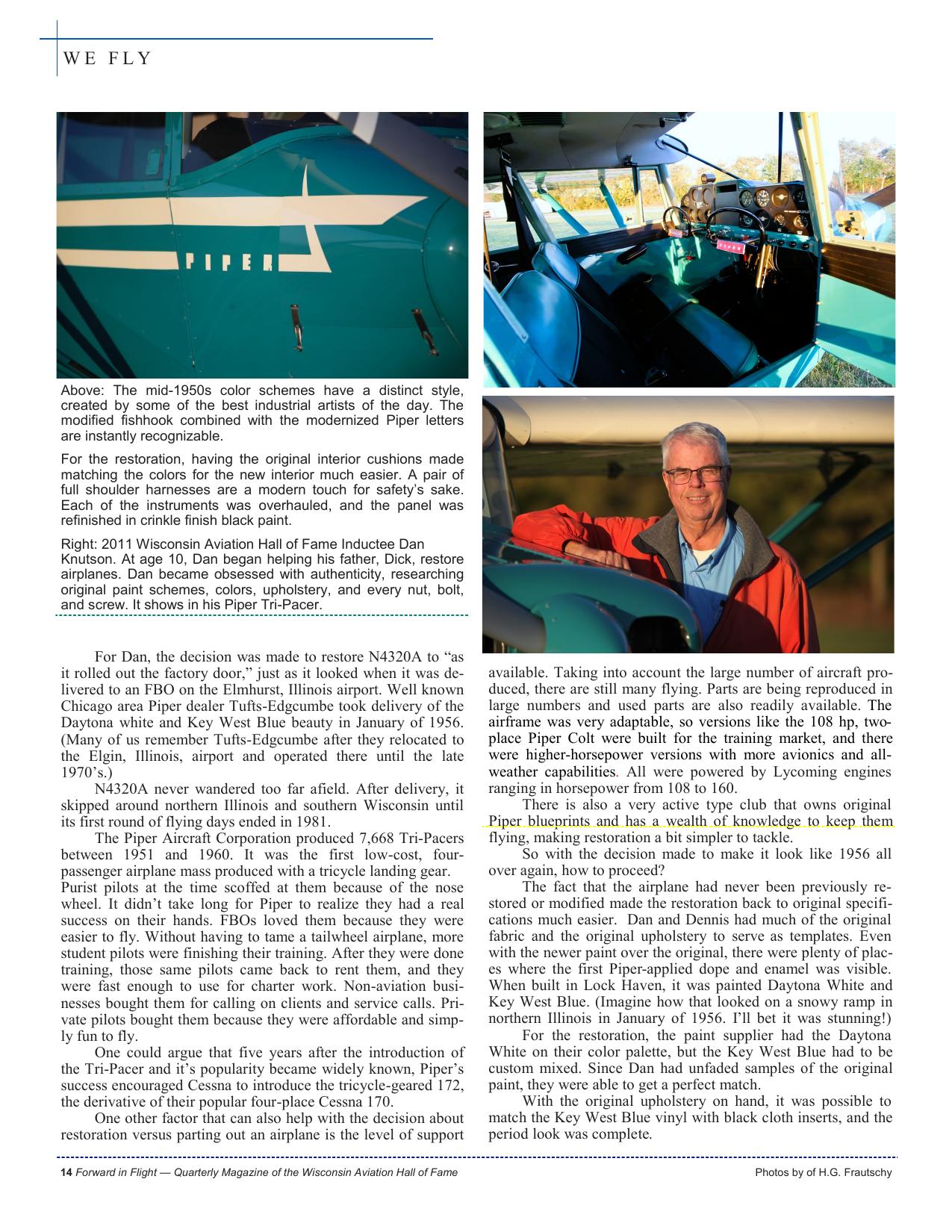
WE FLY Above: The mid-1950s color schemes have a distinct style, created by some of the best industrial artists of the day. The modified fishhook combined with the modernized Piper letters are instantly recognizable. For the restoration, having the original interior cushions made matching the colors for the new interior much easier. A pair of full shoulder harnesses are a modern touch for safety’s sake. Each of the instruments was overhauled, and the panel was refinished in crinkle finish black paint. Right: 2011 Wisconsin Aviation Hall of Fame Inductee Dan Knutson. At age 10, Dan began helping his father, Dick, restore airplanes. Dan became obsessed with authenticity, researching original paint schemes, colors, upholstery, and every nut, bolt, and screw. It shows in his Piper Tri-Pacer. For Dan, the decision was made to restore N4320A to “as it rolled out the factory door,” just as it looked when it was delivered to an FBO on the Elmhurst, Illinois airport. Well known Chicago area Piper dealer Tufts-Edgcumbe took delivery of the Daytona white and Key West Blue beauty in January of 1956. (Many of us remember Tufts-Edgcumbe after they relocated to the Elgin, Illinois, airport and operated there until the late 1970’s.) N4320A never wandered too far afield. After delivery, it skipped around northern Illinois and southern Wisconsin until its first round of flying days ended in 1981. The Piper Aircraft Corporation produced 7,668 Tri-Pacers between 1951 and 1960. It was the first low-cost, fourpassenger airplane mass produced with a tricycle landing gear. Purist pilots at the time scoffed at them because of the nose wheel. It didn’t take long for Piper to realize they had a real success on their hands. FBOs loved them because they were easier to fly. Without having to tame a tailwheel airplane, more student pilots were finishing their training. After they were done training, those same pilots came back to rent them, and they were fast enough to use for charter work. Non-aviation businesses bought them for calling on clients and service calls. Private pilots bought them because they were affordable and simply fun to fly. One could argue that five years after the introduction of the Tri-Pacer and it’s popularity became widely known, Piper’s success encouraged Cessna to introduce the tricycle-geared 172, the derivative of their popular four-place Cessna 170. One other factor that can also help with the decision about restoration versus parting out an airplane is the level of support available. Taking into account the large number of aircraft produced, there are still many flying. Parts are being reproduced in large numbers and used parts are also readily available. The airframe was very adaptable, so versions like the 108 hp, twoplace Piper Colt were built for the training market, and there were higher-horsepower versions with more avionics and allweather capabilities. All were powered by Lycoming engines ranging in horsepower from 108 to 160. There is also a very active type club that owns original Piper blueprints and has a wealth of knowledge to keep them flying, making restoration a bit simpler to tackle. So with the decision made to make it look like 1956 all over again, how to proceed? The fact that the airplane had never been previously restored or modified made the restoration back to original specifications much easier. Dan and Dennis had much of the original fabric and the original upholstery to serve as templates. Even with the newer paint over the original, there were plenty of places where the first Piper-applied dope and enamel was visible. When built in Lock Haven, it was painted Daytona White and Key West Blue. (Imagine how that looked on a snowy ramp in northern Illinois in January of 1956. I’ll bet it was stunning!) For the restoration, the paint supplier had the Daytona White on their color palette, but the Key West Blue had to be custom mixed. Since Dan had unfaded samples of the original paint, they were able to get a perfect match. With the original upholstery on hand, it was possible to match the Key West Blue vinyl with black cloth inserts, and the period look was complete. 14 Forward in Flight — Quarterly Magazine of the Wisconsin Aviation Hall of Fame Photos by of H.G. Frautschy
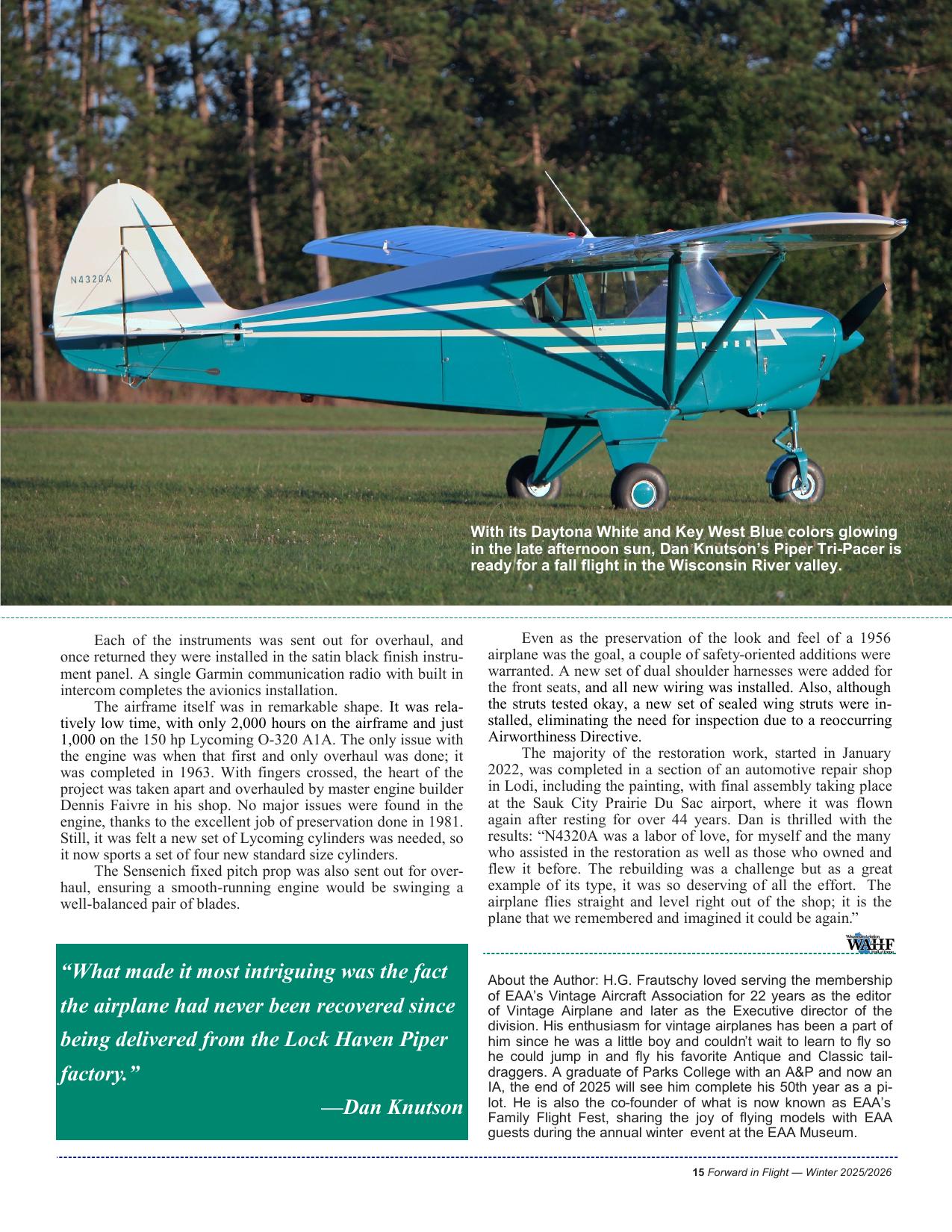
With its Daytona White and Key West Blue colors glowing in the late afternoon sun, Dan Knutson’s Piper Tri-Pacer is ready for a fall flight in the Wisconsin River valley. Each of the instruments was sent out for overhaul, and once returned they were installed in the satin black finish instrument panel. A single Garmin communication radio with built in intercom completes the avionics installation. The airframe itself was in remarkable shape. It was relatively low time, with only 2,000 hours on the airframe and just 1,000 on the 150 hp Lycoming O-320 A1A. The only issue with the engine was when that first and only overhaul was done; it was completed in 1963. With fingers crossed, the heart of the project was taken apart and overhauled by master engine builder Dennis Faivre in his shop. No major issues were found in the engine, thanks to the excellent job of preservation done in 1981. Still, it was felt a new set of Lycoming cylinders was needed, so it now sports a set of four new standard size cylinders. The Sensenich fixed pitch prop was also sent out for overhaul, ensuring a smooth-running engine would be swinging a well-balanced pair of blades. “What made it most intriguing was the fact the airplane had never been recovered since being delivered from the Lock Haven Piper factory.” —Dan Knutson Even as the preservation of the look and feel of a 1956 airplane was the goal, a couple of safety-oriented additions were warranted. A new set of dual shoulder harnesses were added for the front seats, and all new wiring was installed. Also, although the struts tested okay, a new set of sealed wing struts were installed, eliminating the need for inspection due to a reoccurring Airworthiness Directive. The majority of the restoration work, started in January 2022, was completed in a section of an automotive repair shop in Lodi, including the painting, with final assembly taking place at the Sauk City Prairie Du Sac airport, where it was flown again after resting for over 44 years. Dan is thrilled with the results: “N4320A was a labor of love, for myself and the many who assisted in the restoration as well as those who owned and flew it before. The rebuilding was a challenge but as a great example of its type, it was so deserving of all the effort. The airplane flies straight and level right out of the shop; it is the plane that we remembered and imagined it could be again.” About the Author: H.G. Frautschy loved serving the membership of EAA’s Vintage Aircraft Association for 22 years as the editor of Vintage Airplane and later as the Executive director of the division. His enthusiasm for vintage airplanes has been a part of him since he was a little boy and couldn’t wait to learn to fly so he could jump in and fly his favorite Antique and Classic taildraggers. A graduate of Parks College with an A&P and now an IA, the end of 2025 will see him complete his 50th year as a pilot. He is also the co-founder of what is now known as EAA’s Family Flight Fest, sharing the joy of flying models with EAA guests during the annual winter event at the EAA Museum. 15 Forward in Flight — Winter 2025/2026
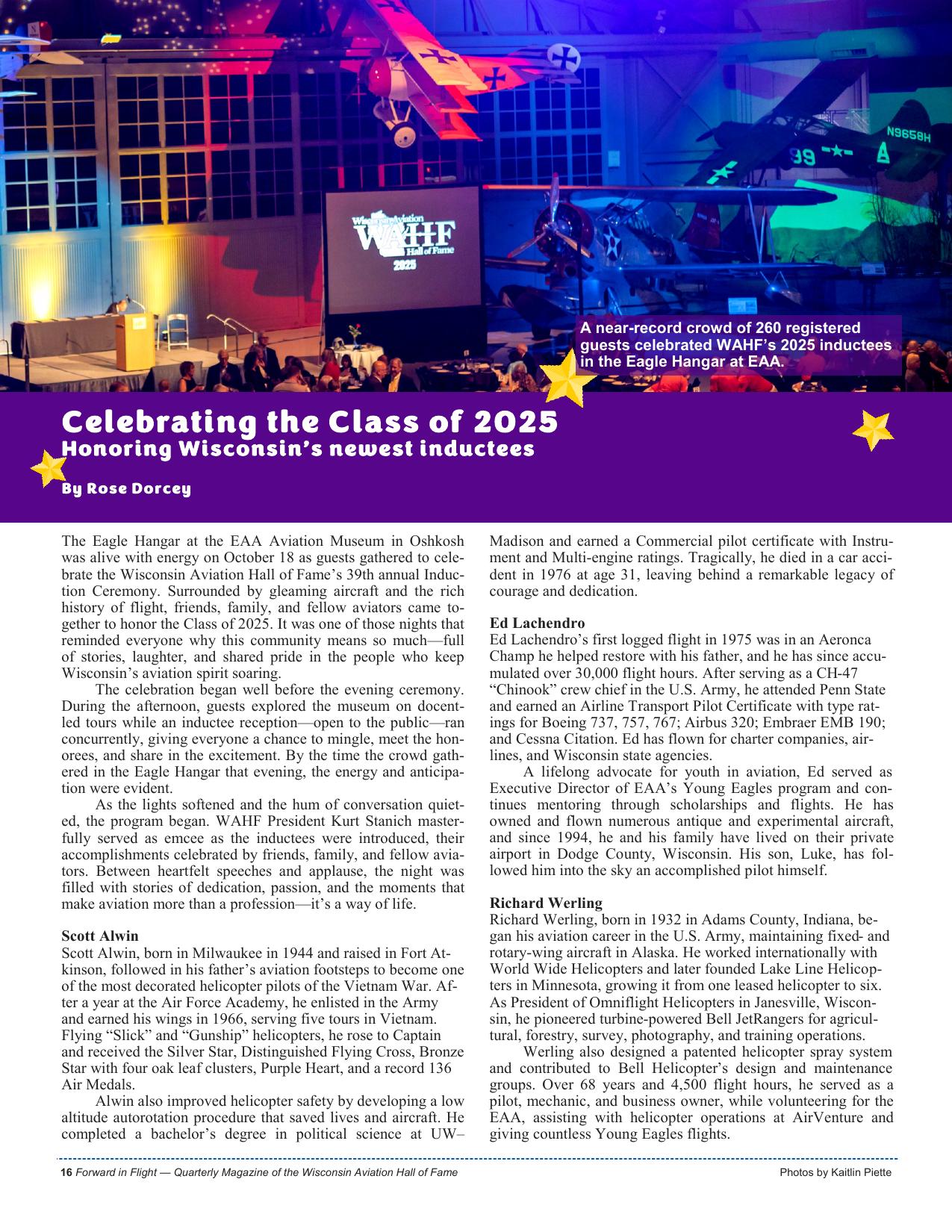
A near-record crowd of 260 registered guests celebrated WAHF’s 2025 inductees in the Eagle Hangar at EAA. The Eagle Hangar at the EAA Aviation Museum in Oshkosh was alive with energy on October 18 as guests gathered to celebrate the Wisconsin Aviation Hall of Fame’s 39th annual Induction Ceremony. Surrounded by gleaming aircraft and the rich history of flight, friends, family, and fellow aviators came together to honor the Class of 2025. It was one of those nights that reminded everyone why this community means so much—full of stories, laughter, and shared pride in the people who keep Wisconsin’s aviation spirit soaring. The celebration began well before the evening ceremony. During the afternoon, guests explored the museum on docentled tours while an inductee reception—open to the public—ran concurrently, giving everyone a chance to mingle, meet the honorees, and share in the excitement. By the time the crowd gathered in the Eagle Hangar that evening, the energy and anticipation were evident. As the lights softened and the hum of conversation quieted, the program began. WAHF President Kurt Stanich masterfully served as emcee as the inductees were introduced, their accomplishments celebrated by friends, family, and fellow aviators. Between heartfelt speeches and applause, the night was filled with stories of dedication, passion, and the moments that make aviation more than a profession—it’s a way of life. Madison and earned a Commercial pilot certificate with Instrument and Multi-engine ratings. Tragically, he died in a car accident in 1976 at age 31, leaving behind a remarkable legacy of courage and dedication. Ed Lachendro Ed Lachendro’s first logged flight in 1975 was in an Aeronca Champ he helped restore with his father, and he has since accumulated over 30,000 flight hours. After serving as a CH-47 “Chinook” crew chief in the U.S. Army, he attended Penn State and earned an Airline Transport Pilot Certificate with type ratings for Boeing 737, 757, 767; Airbus 320; Embraer EMB 190; and Cessna Citation. Ed has flown for charter companies, airlines, and Wisconsin state agencies. A lifelong advocate for youth in aviation, Ed served as Executive Director of EAA’s Young Eagles program and continues mentoring through scholarships and flights. He has owned and flown numerous antique and experimental aircraft, and since 1994, he and his family have lived on their private airport in Dodge County, Wisconsin. His son, Luke, has followed him into the sky an accomplished pilot himself. Scott Alwin Scott Alwin, born in Milwaukee in 1944 and raised in Fort Atkinson, followed in his father’s aviation footsteps to become one of the most decorated helicopter pilots of the Vietnam War. After a year at the Air Force Academy, he enlisted in the Army and earned his wings in 1966, serving five tours in Vietnam. Flying “Slick” and “Gunship” helicopters, he rose to Captain and received the Silver Star, Distinguished Flying Cross, Bronze Star with four oak leaf clusters, Purple Heart, and a record 136 Air Medals. Alwin also improved helicopter safety by developing a low altitude autorotation procedure that saved lives and aircraft. He completed a bachelor’s degree in political science at UW– Richard Werling Richard Werling, born in 1932 in Adams County, Indiana, began his aviation career in the U.S. Army, maintaining fixed- and rotary-wing aircraft in Alaska. He worked internationally with World Wide Helicopters and later founded Lake Line Helicopters in Minnesota, growing it from one leased helicopter to six. As President of Omniflight Helicopters in Janesville, Wisconsin, he pioneered turbine-powered Bell JetRangers for agricultural, forestry, survey, photography, and training operations. Werling also designed a patented helicopter spray system and contributed to Bell Helicopter’s design and maintenance groups. Over 68 years and 4,500 flight hours, he served as a pilot, mechanic, and business owner, while volunteering for the EAA, assisting with helicopter operations at AirVenture and giving countless Young Eagles flights. 16 Forward in Flight — Quarterly Magazine of the Wisconsin Aviation Hall of Fame Photos by Kaitlin Piette
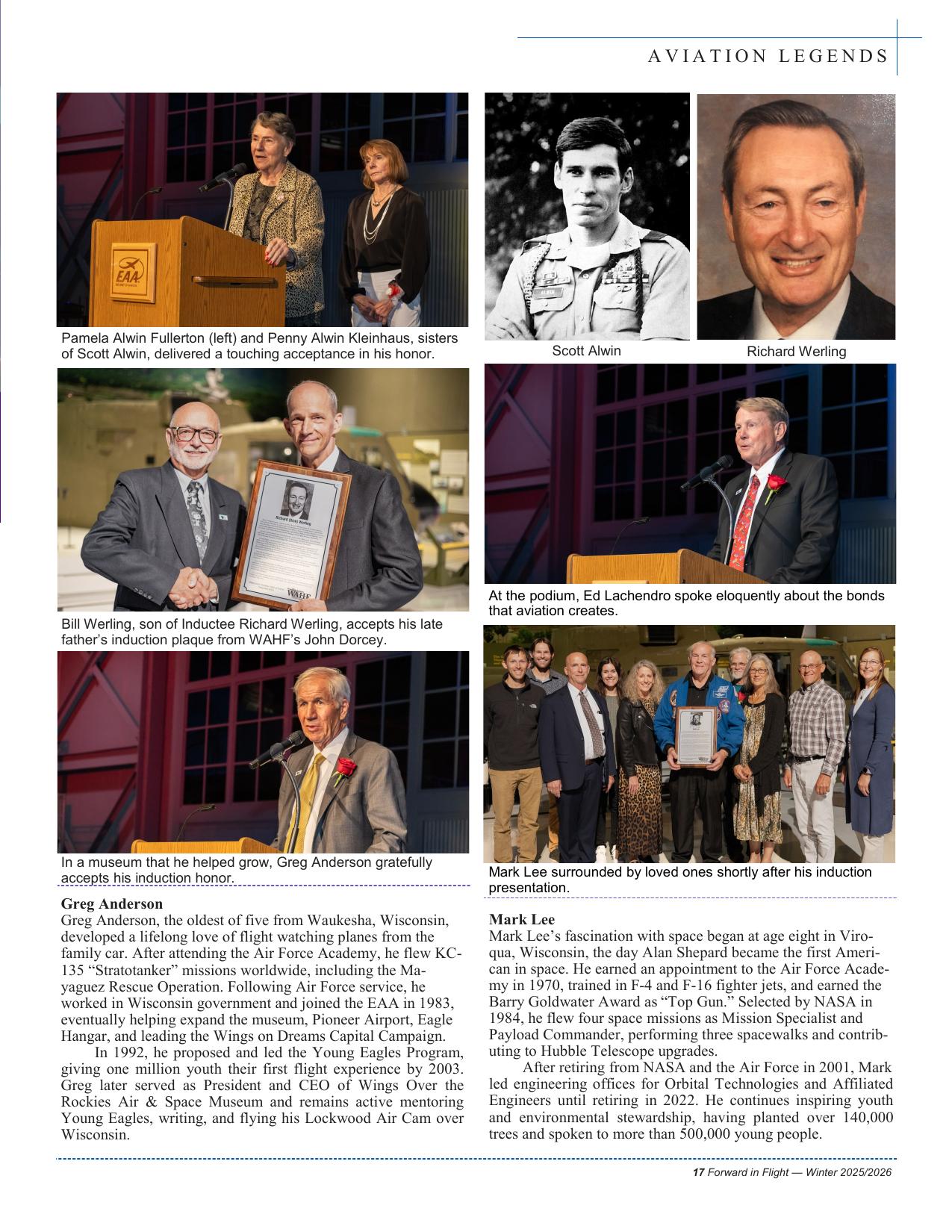
AVIATION LEGENDS Pamela Alwin Fullerton (left) and Penny Alwin Kleinhaus, sisters of Scott Alwin, delivered a touching acceptance in his honor. Bill Werling, son of Inductee Richard Werling, accepts his late father’s induction plaque from WAHF’s John Dorcey. In a museum that he helped grow, Greg Anderson gratefully accepts his induction honor. Greg Anderson Greg Anderson, the oldest of five from Waukesha, Wisconsin, developed a lifelong love of flight watching planes from the family car. After attending the Air Force Academy, he flew KC135 “Stratotanker” missions worldwide, including the Mayaguez Rescue Operation. Following Air Force service, he worked in Wisconsin government and joined the EAA in 1983, eventually helping expand the museum, Pioneer Airport, Eagle Hangar, and leading the Wings on Dreams Capital Campaign. In 1992, he proposed and led the Young Eagles Program, giving one million youth their first flight experience by 2003. Greg later served as President and CEO of Wings Over the Rockies Air & Space Museum and remains active mentoring Young Eagles, writing, and flying his Lockwood Air Cam over Wisconsin. Scott Alwin Richard Werling At the podium, Ed Lachendro spoke eloquently about the bonds that aviation creates. Mark Lee surrounded by loved ones shortly after his induction presentation. Mark Lee Mark Lee’s fascination with space began at age eight in Viroqua, Wisconsin, the day Alan Shepard became the first American in space. He earned an appointment to the Air Force Academy in 1970, trained in F-4 and F-16 fighter jets, and earned the Barry Goldwater Award as “Top Gun.” Selected by NASA in 1984, he flew four space missions as Mission Specialist and Payload Commander, performing three spacewalks and contributing to Hubble Telescope upgrades. After retiring from NASA and the Air Force in 2001, Mark led engineering offices for Orbital Technologies and Affiliated Engineers until retiring in 2022. He continues inspiring youth and environmental stewardship, having planted over 140,000 trees and spoken to more than 500,000 young people. 17 Forward in Flight — Winter 2025/2026
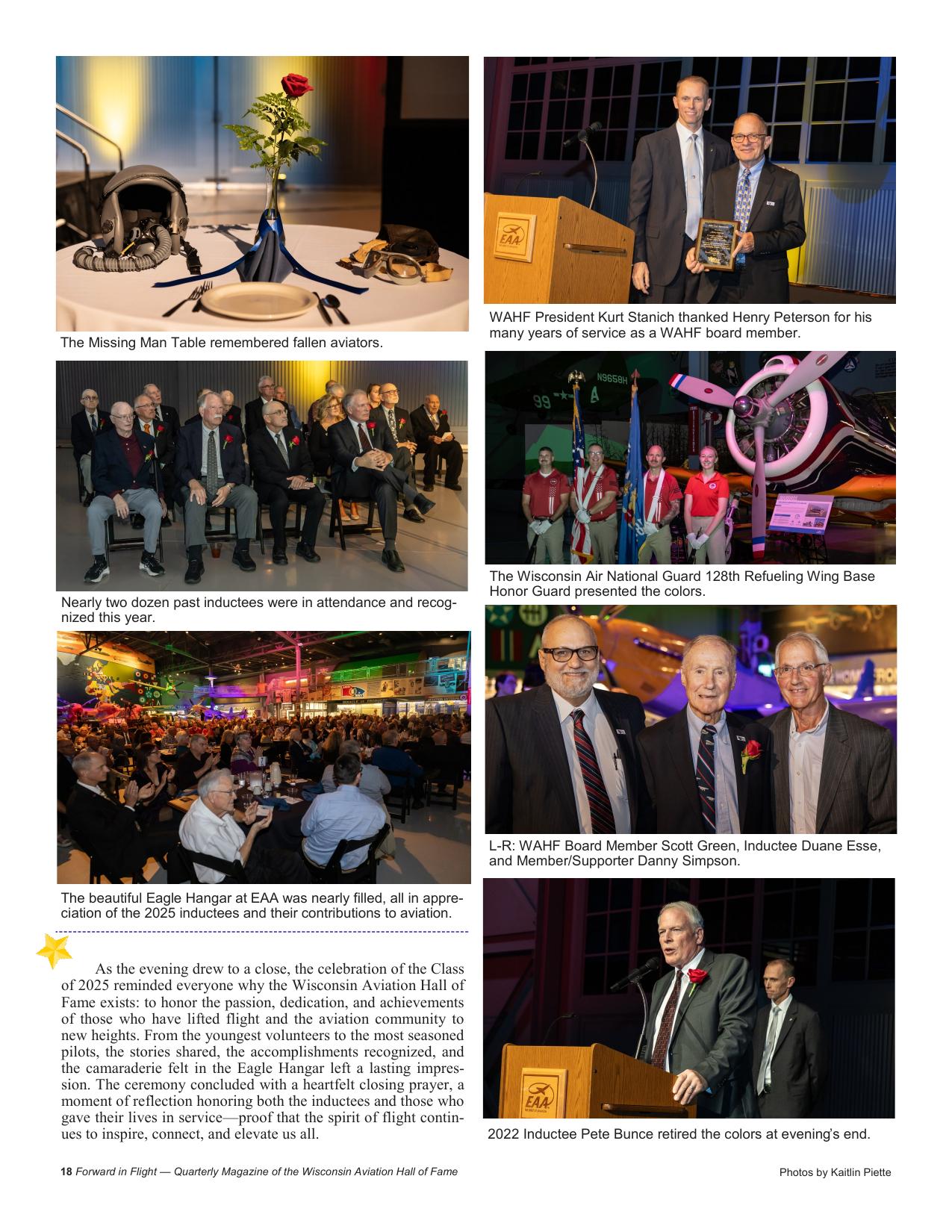
The Missing Man Table remembered fallen aviators. Nearly two dozen past inductees were in attendance and recognized this year. WAHF President Kurt Stanich thanked Henry Peterson for his many years of service as a WAHF board member. The Wisconsin Air National Guard 128th Refueling Wing Base Honor Guard presented the colors. L-R: WAHF Board Member Scott Green, Inductee Duane Esse, and Member/Supporter Danny Simpson. The beautiful Eagle Hangar at EAA was nearly filled, all in appreciation of the 2025 inductees and their contributions to aviation. As the evening drew to a close, the celebration of the Class of 2025 reminded everyone why the Wisconsin Aviation Hall of Fame exists: to honor the passion, dedication, and achievements of those who have lifted flight and the aviation community to new heights. From the youngest volunteers to the most seasoned pilots, the stories shared, the accomplishments recognized, and the camaraderie felt in the Eagle Hangar left a lasting impression. The ceremony concluded with a heartfelt closing prayer, a moment of reflection honoring both the inductees and those who gave their lives in service—proof that the spirit of flight continues to inspire, connect, and elevate us all. 18 Forward in Flight — Quarterly Magazine of the Wisconsin Aviation Hall of Fame 2022 Inductee Pete Bunce retired the colors at evening’s end. Photos by Kaitlin Piette
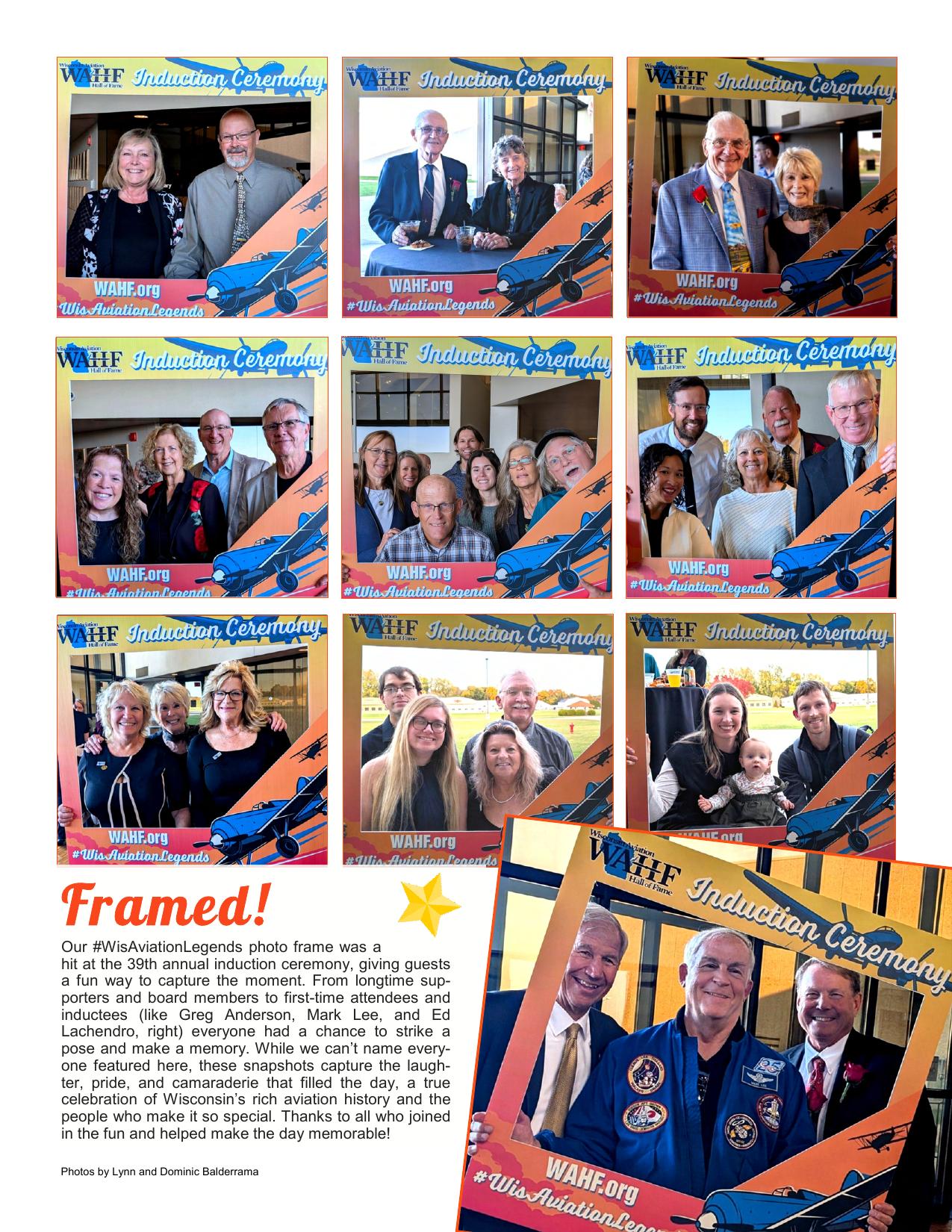
Framed! Our #WisAviationLegends photo frame was a hit at the 39th annual induction ceremony, giving guests a fun way to capture the moment. From longtime supporters and board members to first-time attendees and inductees (like Greg Anderson, Mark Lee, and Ed Lachendro, right) everyone had a chance to strike a pose and make a memory. While we can’t name everyone featured here, these snapshots capture the laughter, pride, and camaraderie that filled the day, a true celebration of Wisconsin’s rich aviation history and the people who make it so special. Thanks to all who joined in the fun and helped make the day memorable! Photos by Lynn and Dominic Balderrama
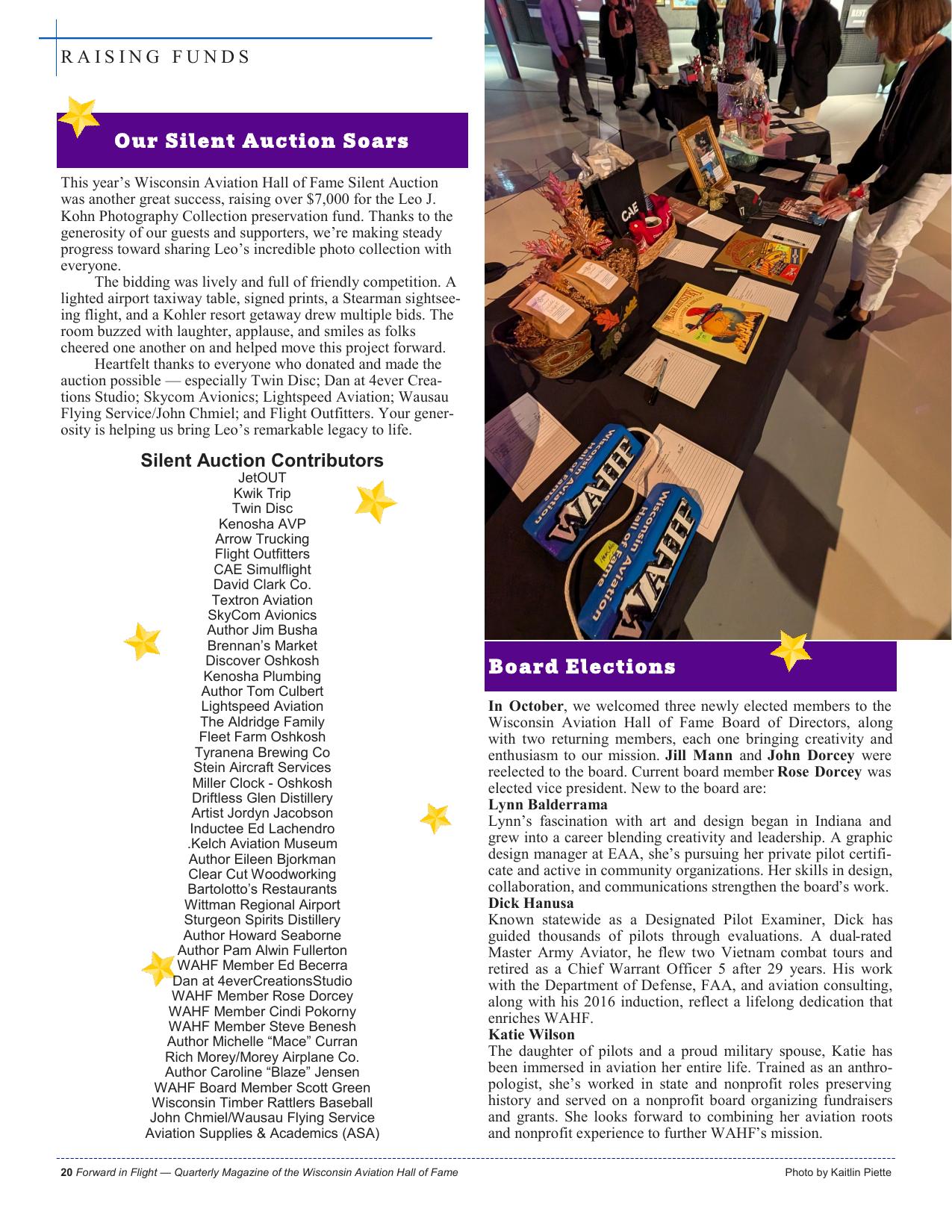
RAISING FUNDS Our Silent Auction Soars This year’s Wisconsin Aviation Hall of Fame Silent Auction was another great success, raising over $7,000 for the Leo J. Kohn Photography Collection preservation fund. Thanks to the generosity of our guests and supporters, we’re making steady progress toward sharing Leo’s incredible photo collection with everyone. The bidding was lively and full of friendly competition. A lighted airport taxiway table, signed prints, a Stearman sightseeing flight, and a Kohler resort getaway drew multiple bids. The room buzzed with laughter, applause, and smiles as folks cheered one another on and helped move this project forward. Heartfelt thanks to everyone who donated and made the auction possible — especially Twin Disc; Dan at 4ever Creations Studio; Skycom Avionics; Lightspeed Aviation; Wausau Flying Service/John Chmiel; and Flight Outfitters. Your generosity is helping us bring Leo’s remarkable legacy to life. Silent Auction Contributors JetOUT Kwik Trip Twin Disc Kenosha AVP Arrow Trucking Flight Outfitters CAE Simulflight David Clark Co. Textron Aviation SkyCom Avionics Author Jim Busha Brennan’s Market Discover Oshkosh Kenosha Plumbing Author Tom Culbert Lightspeed Aviation The Aldridge Family Fleet Farm Oshkosh Tyranena Brewing Co Stein Aircraft Services Miller Clock - Oshkosh Driftless Glen Distillery Artist Jordyn Jacobson Inductee Ed Lachendro .Kelch Aviation Museum Author Eileen Bjorkman Clear Cut Woodworking Bartolotto’s Restaurants Wittman Regional Airport Sturgeon Spirits Distillery Author Howard Seaborne Author Pam Alwin Fullerton WAHF Member Ed Becerra Dan at 4everCreationsStudio WAHF Member Rose Dorcey WAHF Member Cindi Pokorny WAHF Member Steve Benesh Author Michelle “Mace” Curran Rich Morey/Morey Airplane Co. Author Caroline “Blaze” Jensen WAHF Board Member Scott Green Wisconsin Timber Rattlers Baseball John Chmiel/Wausau Flying Service Aviation Supplies & Academics (ASA) 20 Forward in Flight — Quarterly Magazine of the Wisconsin Aviation Hall of Fame Board Elections In October, we welcomed three newly elected members to the Wisconsin Aviation Hall of Fame Board of Directors, along with two returning members, each one bringing creativity and enthusiasm to our mission. Jill Mann and John Dorcey were reelected to the board. Current board member Rose Dorcey was elected vice president. New to the board are: Lynn Balderrama Lynn’s fascination with art and design began in Indiana and grew into a career blending creativity and leadership. A graphic design manager at EAA, she’s pursuing her private pilot certificate and active in community organizations. Her skills in design, collaboration, and communications strengthen the board’s work. Dick Hanusa Known statewide as a Designated Pilot Examiner, Dick has guided thousands of pilots through evaluations. A dual-rated Master Army Aviator, he flew two Vietnam combat tours and retired as a Chief Warrant Officer 5 after 29 years. His work with the Department of Defense, FAA, and aviation consulting, along with his 2016 induction, reflect a lifelong dedication that enriches WAHF. Katie Wilson The daughter of pilots and a proud military spouse, Katie has been immersed in aviation her entire life. Trained as an anthropologist, she’s worked in state and nonprofit roles preserving history and served on a nonprofit board organizing fundraisers and grants. She looks forward to combining her aviation roots and nonprofit experience to further WAHF’s mission. Photo by Kaitlin Piette
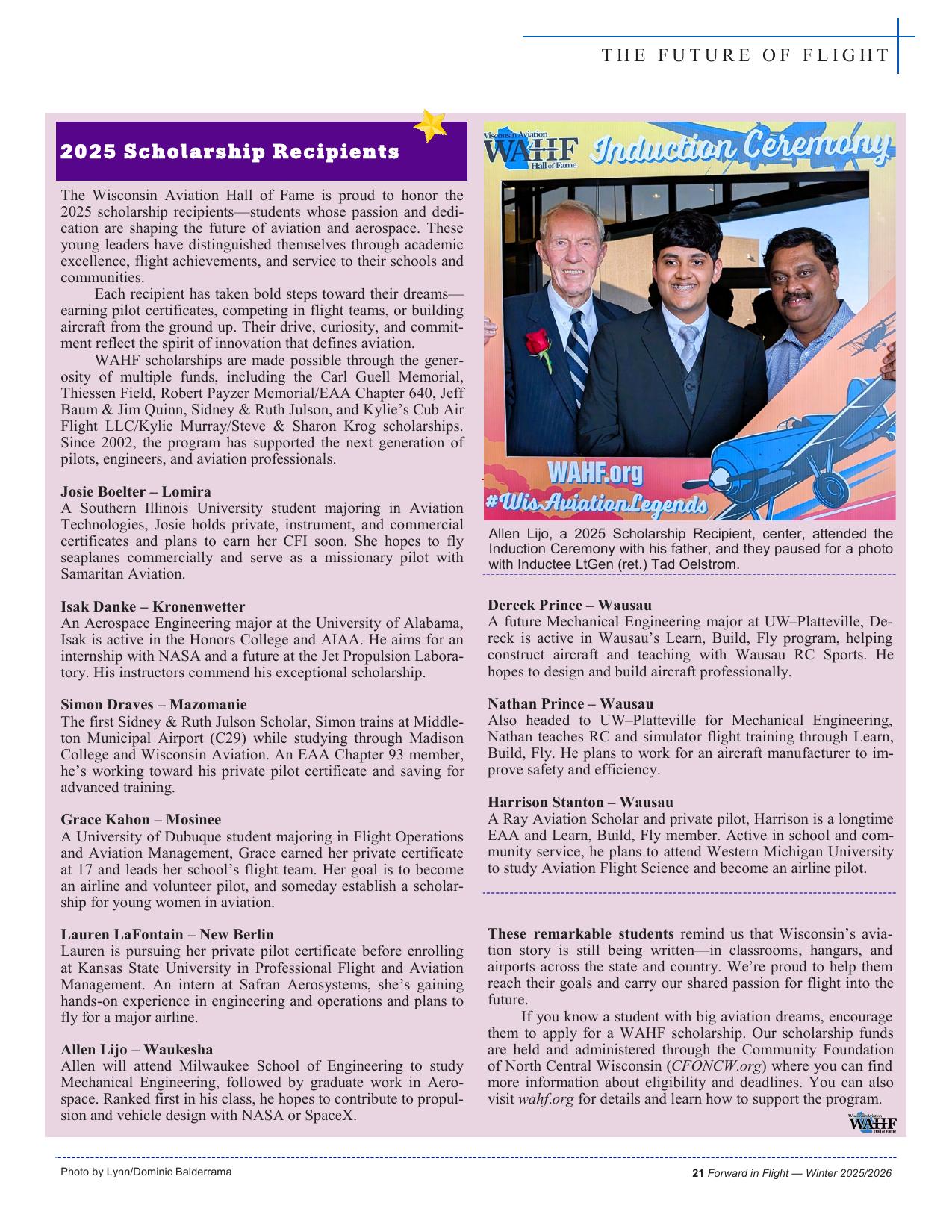
THE FUTURE OF FLIGHT 2025 Scholarship Recipients The Wisconsin Aviation Hall of Fame is proud to honor the 2025 scholarship recipients—students whose passion and dedication are shaping the future of aviation and aerospace. These young leaders have distinguished themselves through academic excellence, flight achievements, and service to their schools and communities. Each recipient has taken bold steps toward their dreams— earning pilot certificates, competing in flight teams, or building aircraft from the ground up. Their drive, curiosity, and commitment reflect the spirit of innovation that defines aviation. WAHF scholarships are made possible through the generosity of multiple funds, including the Carl Guell Memorial, Thiessen Field, Robert Payzer Memorial/EAA Chapter 640, Jeff Baum & Jim Quinn, Sidney & Ruth Julson, and Kylie’s Cub Air Flight LLC/Kylie Murray/Steve & Sharon Krog scholarships. Since 2002, the program has supported the next generation of pilots, engineers, and aviation professionals. Josie Boelter – Lomira A Southern Illinois University student majoring in Aviation Technologies, Josie holds private, instrument, and commercial certificates and plans to earn her CFI soon. She hopes to fly seaplanes commercially and serve as a missionary pilot with Samaritan Aviation. Allen Lijo, a 2025 Scholarship Recipient, center, attended the Induction Ceremony with his father, and they paused for a photo with Inductee LtGen (ret.) Tad Oelstrom. Isak Danke – Kronenwetter An Aerospace Engineering major at the University of Alabama, Isak is active in the Honors College and AIAA. He aims for an internship with NASA and a future at the Jet Propulsion Laboratory. His instructors commend his exceptional scholarship. Dereck Prince – Wausau A future Mechanical Engineering major at UW–Platteville, Dereck is active in Wausau’s Learn, Build, Fly program, helping construct aircraft and teaching with Wausau RC Sports. He hopes to design and build aircraft professionally. Simon Draves – Mazomanie The first Sidney & Ruth Julson Scholar, Simon trains at Middleton Municipal Airport (C29) while studying through Madison College and Wisconsin Aviation. An EAA Chapter 93 member, he’s working toward his private pilot certificate and saving for advanced training. Nathan Prince – Wausau Also headed to UW–Platteville for Mechanical Engineering, Nathan teaches RC and simulator flight training through Learn, Build, Fly. He plans to work for an aircraft manufacturer to improve safety and efficiency. Grace Kahon – Mosinee A University of Dubuque student majoring in Flight Operations and Aviation Management, Grace earned her private certificate at 17 and leads her school’s flight team. Her goal is to become an airline and volunteer pilot, and someday establish a scholarship for young women in aviation. Lauren LaFontain – New Berlin Lauren is pursuing her private pilot certificate before enrolling at Kansas State University in Professional Flight and Aviation Management. An intern at Safran Aerosystems, she’s gaining hands-on experience in engineering and operations and plans to fly for a major airline. Allen Lijo – Waukesha Allen will attend Milwaukee School of Engineering to study Mechanical Engineering, followed by graduate work in Aerospace. Ranked first in his class, he hopes to contribute to propulsion and vehicle design with NASA or SpaceX. Photo by Lynn/Dominic Balderrama Harrison Stanton – Wausau A Ray Aviation Scholar and private pilot, Harrison is a longtime EAA and Learn, Build, Fly member. Active in school and community service, he plans to attend Western Michigan University to study Aviation Flight Science and become an airline pilot. These remarkable students remind us that Wisconsin’s aviation story is still being written—in classrooms, hangars, and airports across the state and country. We’re proud to help them reach their goals and carry our shared passion for flight into the future. If you know a student with big aviation dreams, encourage them to apply for a WAHF scholarship. Our scholarship funds are held and administered through the Community Foundation of North Central Wisconsin (CFONCW.org) where you can find more information about eligibility and deadlines. You can also visit wahf.org for details and learn how to support the program. 21 Forward in Flight — Winter 2025/2026
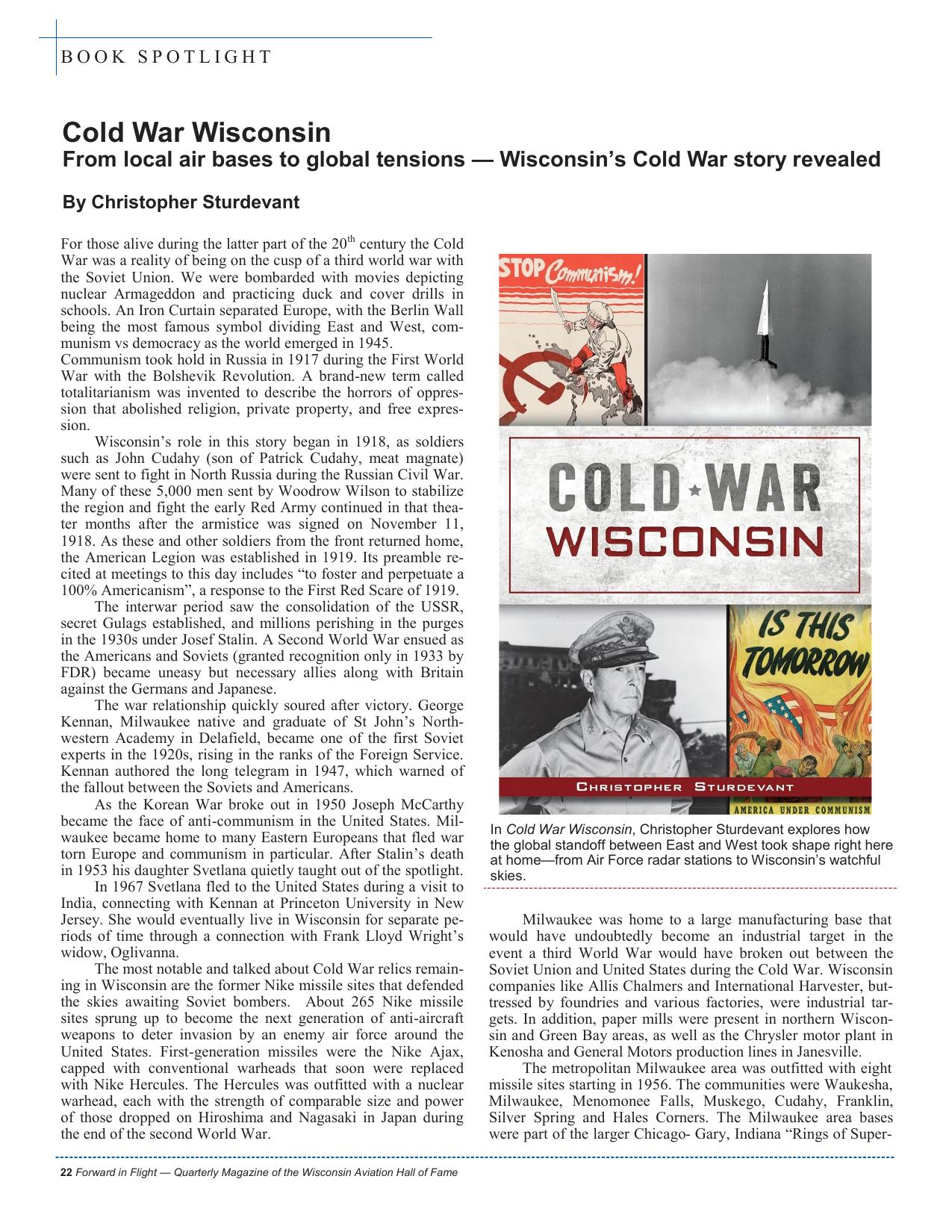
BOOK SPOTLIGHT Cold War Wisconsin From local air bases to global tensions — Wisconsin’s Cold War story revealed By Christopher Sturdevant For those alive during the latter part of the 20th century the Cold War was a reality of being on the cusp of a third world war with the Soviet Union. We were bombarded with movies depicting nuclear Armageddon and practicing duck and cover drills in schools. An Iron Curtain separated Europe, with the Berlin Wall being the most famous symbol dividing East and West, communism vs democracy as the world emerged in 1945. Communism took hold in Russia in 1917 during the First World War with the Bolshevik Revolution. A brand-new term called totalitarianism was invented to describe the horrors of oppression that abolished religion, private property, and free expression. Wisconsin’s role in this story began in 1918, as soldiers such as John Cudahy (son of Patrick Cudahy, meat magnate) were sent to fight in North Russia during the Russian Civil War. Many of these 5,000 men sent by Woodrow Wilson to stabilize the region and fight the early Red Army continued in that theater months after the armistice was signed on November 11, 1918. As these and other soldiers from the front returned home, the American Legion was established in 1919. Its preamble recited at meetings to this day includes “to foster and perpetuate a 100% Americanism”, a response to the First Red Scare of 1919. The interwar period saw the consolidation of the USSR, secret Gulags established, and millions perishing in the purges in the 1930s under Josef Stalin. A Second World War ensued as the Americans and Soviets (granted recognition only in 1933 by FDR) became uneasy but necessary allies along with Britain against the Germans and Japanese. The war relationship quickly soured after victory. George Kennan, Milwaukee native and graduate of St John’s Northwestern Academy in Delafield, became one of the first Soviet experts in the 1920s, rising in the ranks of the Foreign Service. Kennan authored the long telegram in 1947, which warned of the fallout between the Soviets and Americans. As the Korean War broke out in 1950 Joseph McCarthy became the face of anti-communism in the United States. Milwaukee became home to many Eastern Europeans that fled war torn Europe and communism in particular. After Stalin’s death in 1953 his daughter Svetlana quietly taught out of the spotlight. In 1967 Svetlana fled to the United States during a visit to India, connecting with Kennan at Princeton University in New Jersey. She would eventually live in Wisconsin for separate periods of time through a connection with Frank Lloyd Wright’s widow, Oglivanna. The most notable and talked about Cold War relics remaining in Wisconsin are the former Nike missile sites that defended the skies awaiting Soviet bombers. About 265 Nike missile sites sprung up to become the next generation of anti-aircraft weapons to deter invasion by an enemy air force around the United States. First-generation missiles were the Nike Ajax, capped with conventional warheads that soon were replaced with Nike Hercules. The Hercules was outfitted with a nuclear warhead, each with the strength of comparable size and power of those dropped on Hiroshima and Nagasaki in Japan during the end of the second World War. 22 Forward in Flight — Quarterly Magazine of the Wisconsin Aviation Hall of Fame In Cold War Wisconsin, Christopher Sturdevant explores how the global standoff between East and West took shape right here at home—from Air Force radar stations to Wisconsin’s watchful skies. Milwaukee was home to a large manufacturing base that would have undoubtedly become an industrial target in the event a third World War would have broken out between the Soviet Union and United States during the Cold War. Wisconsin companies like Allis Chalmers and International Harvester, buttressed by foundries and various factories, were industrial targets. In addition, paper mills were present in northern Wisconsin and Green Bay areas, as well as the Chrysler motor plant in Kenosha and General Motors production lines in Janesville. The metropolitan Milwaukee area was outfitted with eight missile sites starting in 1956. The communities were Waukesha, Milwaukee, Menomonee Falls, Muskego, Cudahy, Franklin, Silver Spring and Hales Corners. The Milwaukee area bases were part of the larger Chicago- Gary, Indiana “Rings of Super-
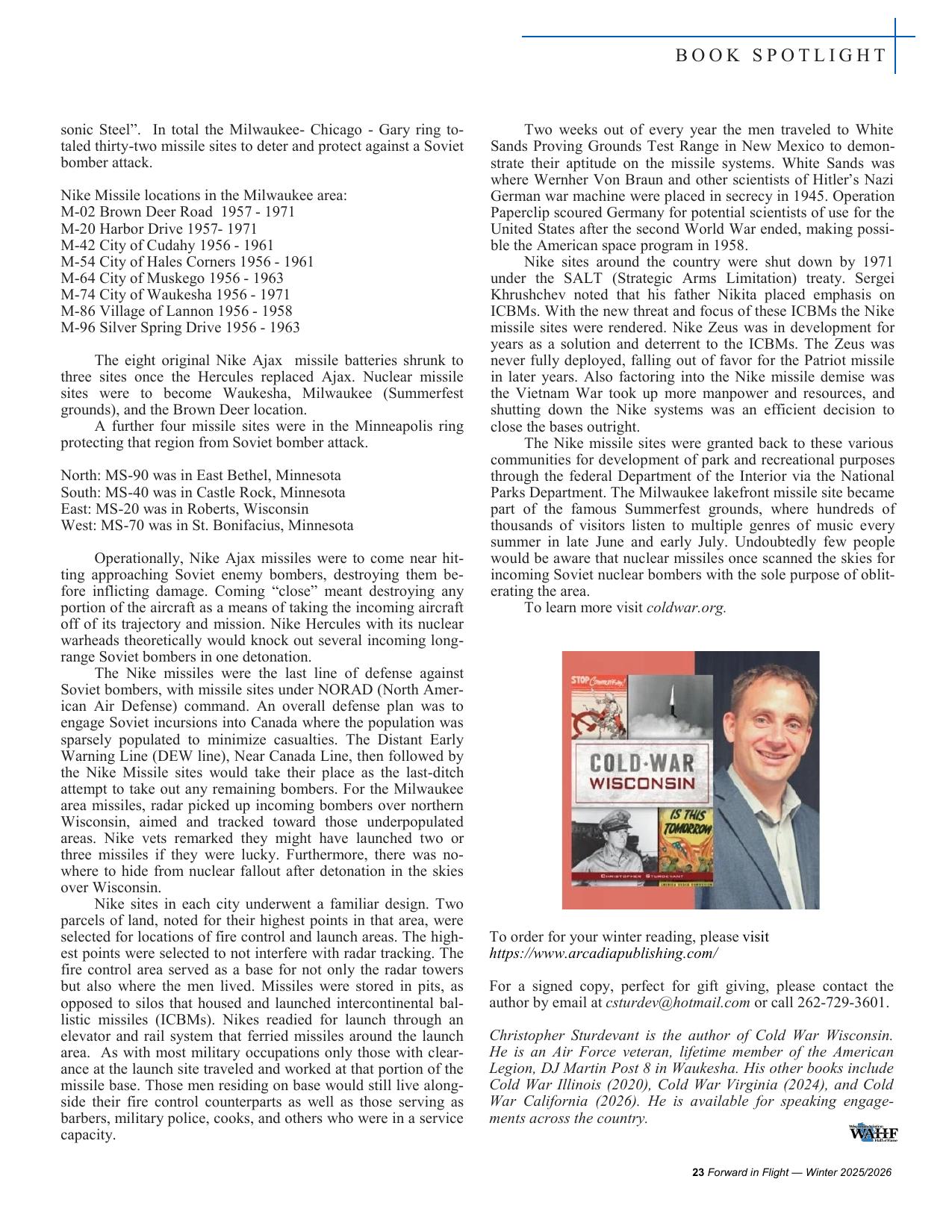
BOOK SPOTLIGHT sonic Steel”. In total the Milwaukee- Chicago - Gary ring totaled thirty-two missile sites to deter and protect against a Soviet bomber attack. Nike Missile locations in the Milwaukee area: M-02 Brown Deer Road 1957 - 1971 M-20 Harbor Drive 1957- 1971 M-42 City of Cudahy 1956 - 1961 M-54 City of Hales Corners 1956 - 1961 M-64 City of Muskego 1956 - 1963 M-74 City of Waukesha 1956 - 1971 M-86 Village of Lannon 1956 - 1958 M-96 Silver Spring Drive 1956 - 1963 The eight original Nike Ajax missile batteries shrunk to three sites once the Hercules replaced Ajax. Nuclear missile sites were to become Waukesha, Milwaukee (Summerfest grounds), and the Brown Deer location. A further four missile sites were in the Minneapolis ring protecting that region from Soviet bomber attack. North: MS-90 was in East Bethel, Minnesota South: MS-40 was in Castle Rock, Minnesota East: MS-20 was in Roberts, Wisconsin West: MS-70 was in St. Bonifacius, Minnesota Operationally, Nike Ajax missiles were to come near hitting approaching Soviet enemy bombers, destroying them before inflicting damage. Coming “close” meant destroying any portion of the aircraft as a means of taking the incoming aircraft off of its trajectory and mission. Nike Hercules with its nuclear warheads theoretically would knock out several incoming longrange Soviet bombers in one detonation. The Nike missiles were the last line of defense against Soviet bombers, with missile sites under NORAD (North American Air Defense) command. An overall defense plan was to engage Soviet incursions into Canada where the population was sparsely populated to minimize casualties. The Distant Early Warning Line (DEW line), Near Canada Line, then followed by the Nike Missile sites would take their place as the last-ditch attempt to take out any remaining bombers. For the Milwaukee area missiles, radar picked up incoming bombers over northern Wisconsin, aimed and tracked toward those underpopulated areas. Nike vets remarked they might have launched two or three missiles if they were lucky. Furthermore, there was nowhere to hide from nuclear fallout after detonation in the skies over Wisconsin. Nike sites in each city underwent a familiar design. Two parcels of land, noted for their highest points in that area, were selected for locations of fire control and launch areas. The highest points were selected to not interfere with radar tracking. The fire control area served as a base for not only the radar towers but also where the men lived. Missiles were stored in pits, as opposed to silos that housed and launched intercontinental ballistic missiles (ICBMs). Nikes readied for launch through an elevator and rail system that ferried missiles around the launch area. As with most military occupations only those with clearance at the launch site traveled and worked at that portion of the missile base. Those men residing on base would still live alongside their fire control counterparts as well as those serving as barbers, military police, cooks, and others who were in a service capacity. Two weeks out of every year the men traveled to White Sands Proving Grounds Test Range in New Mexico to demonstrate their aptitude on the missile systems. White Sands was where Wernher Von Braun and other scientists of Hitler’s Nazi German war machine were placed in secrecy in 1945. Operation Paperclip scoured Germany for potential scientists of use for the United States after the second World War ended, making possible the American space program in 1958. Nike sites around the country were shut down by 1971 under the SALT (Strategic Arms Limitation) treaty. Sergei Khrushchev noted that his father Nikita placed emphasis on ICBMs. With the new threat and focus of these ICBMs the Nike missile sites were rendered. Nike Zeus was in development for years as a solution and deterrent to the ICBMs. The Zeus was never fully deployed, falling out of favor for the Patriot missile in later years. Also factoring into the Nike missile demise was the Vietnam War took up more manpower and resources, and shutting down the Nike systems was an efficient decision to close the bases outright. The Nike missile sites were granted back to these various communities for development of park and recreational purposes through the federal Department of the Interior via the National Parks Department. The Milwaukee lakefront missile site became part of the famous Summerfest grounds, where hundreds of thousands of visitors listen to multiple genres of music every summer in late June and early July. Undoubtedly few people would be aware that nuclear missiles once scanned the skies for incoming Soviet nuclear bombers with the sole purpose of obliterating the area. To learn more visit coldwar.org. To order for your winter reading, please visit https://www.arcadiapublishing.com/ For a signed copy, perfect for gift giving, please contact the author by email at csturdev@hotmail.com or call 262-729-3601. Christopher Sturdevant is the author of Cold War Wisconsin. He is an Air Force veteran, lifetime member of the American Legion, DJ Martin Post 8 in Waukesha. His other books include Cold War Illinois (2020), Cold War Virginia (2024), and Cold War California (2026). He is available for speaking engagements across the country. 23 Forward in Flight — Winter 2025/2026
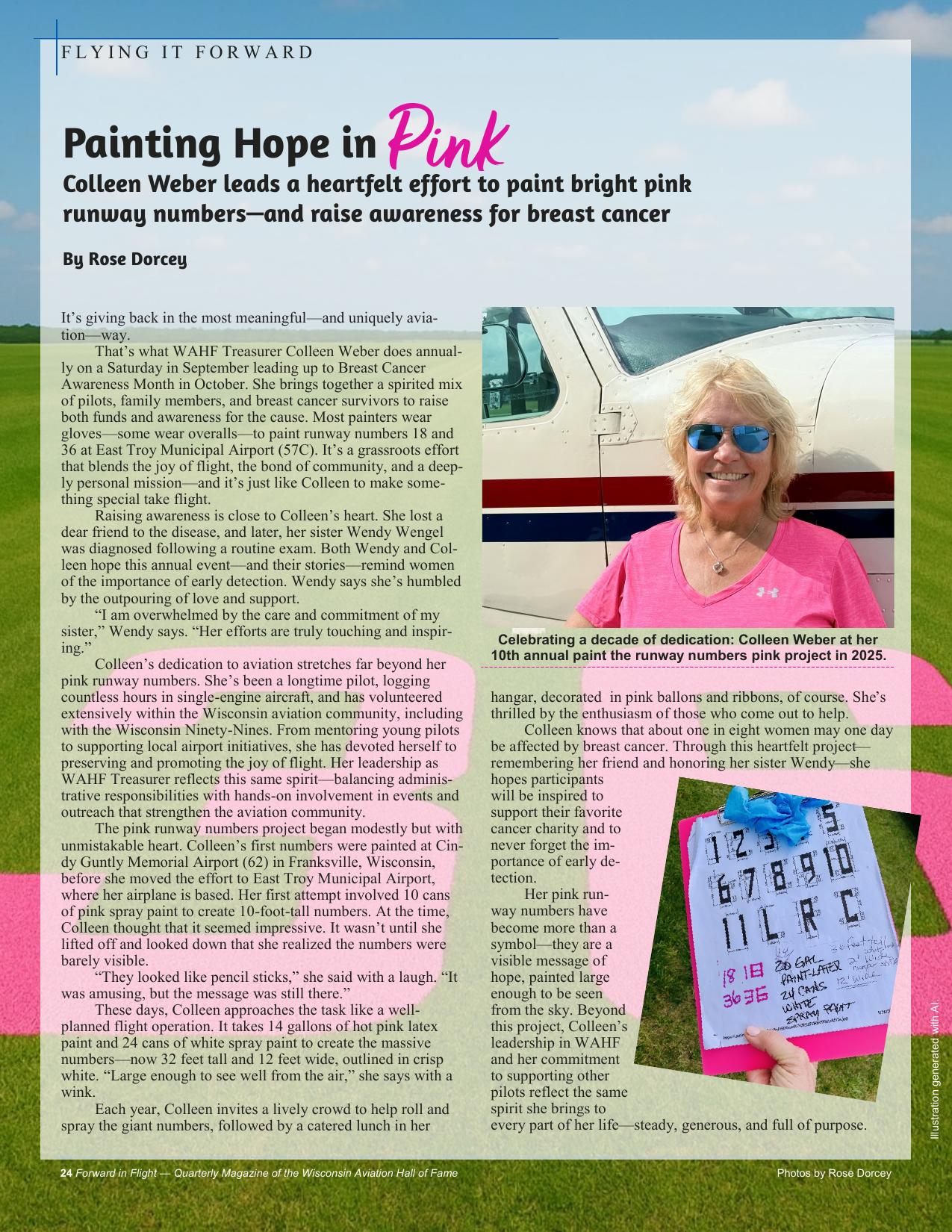
FLYING IT FORWARD Painting Hope in Pink Colleen Weber leads a heartfelt effort to paint bright pink runway numbers—and raise awareness for breast cancer By Rose Dorcey 24 Forward in Flight — Quarterly Magazine of the Wisconsin Aviation Hall of Fame Celebrating a decade of dedication: Colleen Weber at her 10th annual paint the runway numbers pink project in 2025. hangar, decorated in pink ballons and ribbons, of course. She’s thrilled by the enthusiasm of those who come out to help. Colleen knows that about one in eight women may one day be affected by breast cancer. Through this heartfelt project— remembering her friend and honoring her sister Wendy—she hopes participants will be inspired to support their favorite cancer charity and to never forget the importance of early detection. Her pink runway numbers have become more than a symbol—they are a visible message of hope, painted large enough to be seen from the sky. Beyond this project, Colleen’s leadership in WAHF and her commitment to supporting other pilots reflect the same spirit she brings to every part of her life—steady, generous, and full of purpose. Photos by Rose Dorcey Illustration generated with AI. It’s giving back in the most meaningful—and uniquely aviation—way. That’s what WAHF Treasurer Colleen Weber does annually on a Saturday in September leading up to Breast Cancer Awareness Month in October. She brings together a spirited mix of pilots, family members, and breast cancer survivors to raise both funds and awareness for the cause. Most painters wear gloves—some wear overalls—to paint runway numbers 18 and 36 at East Troy Municipal Airport (57C). It’s a grassroots effort that blends the joy of flight, the bond of community, and a deeply personal mission—and it’s just like Colleen to make something special take flight. Raising awareness is close to Colleen’s heart. She lost a dear friend to the disease, and later, her sister Wendy Wengel was diagnosed following a routine exam. Both Wendy and Colleen hope this annual event—and their stories—remind women of the importance of early detection. Wendy says she’s humbled by the outpouring of love and support. “I am overwhelmed by the care and commitment of my sister,” Wendy says. “Her efforts are truly touching and inspiring.” Colleen’s dedication to aviation stretches far beyond her pink runway numbers. She’s been a longtime pilot, logging countless hours in single-engine aircraft, and has volunteered extensively within the Wisconsin aviation community, including with the Wisconsin Ninety-Nines. From mentoring young pilots to supporting local airport initiatives, she has devoted herself to preserving and promoting the joy of flight. Her leadership as WAHF Treasurer reflects this same spirit—balancing administrative responsibilities with hands-on involvement in events and outreach that strengthen the aviation community. The pink runway numbers project began modestly but with unmistakable heart. Colleen’s first numbers were painted at Cindy Guntly Memorial Airport (62) in Franksville, Wisconsin, before she moved the effort to East Troy Municipal Airport, where her airplane is based. Her first attempt involved 10 cans of pink spray paint to create 10-foot-tall numbers. At the time, Colleen thought that it seemed impressive. It wasn’t until she lifted off and looked down that she realized the numbers were barely visible. “They looked like pencil sticks,” she said with a laugh. “It was amusing, but the message was still there.” These days, Colleen approaches the task like a wellplanned flight operation. It takes 14 gallons of hot pink latex paint and 24 cans of white spray paint to create the massive numbers—now 32 feet tall and 12 feet wide, outlined in crisp white. “Large enough to see well from the air,” she says with a wink. Each year, Colleen invites a lively crowd to help roll and spray the giant numbers, followed by a catered lunch in her
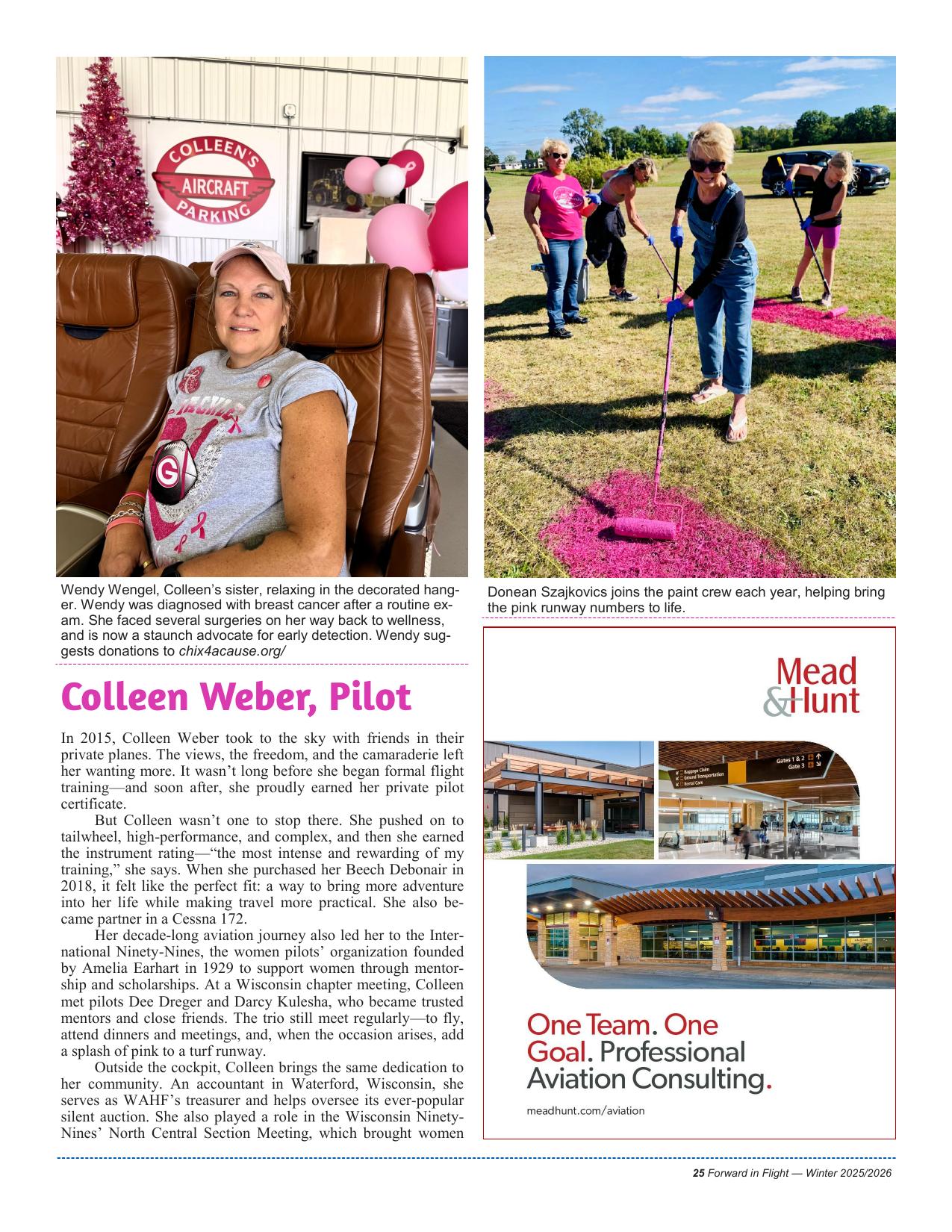
Wendy Wengel, Colleen’s sister, relaxing in the decorated hanger. Wendy was diagnosed with breast cancer after a routine exam. She faced several surgeries on her way back to wellness, and is now a staunch advocate for early detection. Wendy suggests donations to chix4acause.org/ Donean Szajkovics joins the paint crew each year, helping bring the pink runway numbers to life. Colleen Weber, Pilot In 2015, Colleen Weber took to the sky with friends in their private planes. The views, the freedom, and the camaraderie left her wanting more. It wasn’t long before she began formal flight training—and soon after, she proudly earned her private pilot certificate. But Colleen wasn’t one to stop there. She pushed on to tailwheel, high-performance, and complex, and then she earned the instrument rating—“the most intense and rewarding of my training,” she says. When she purchased her Beech Debonair in 2018, it felt like the perfect fit: a way to bring more adventure into her life while making travel more practical. She also became partner in a Cessna 172. Her decade-long aviation journey also led her to the International Ninety-Nines, the women pilots’ organization founded by Amelia Earhart in 1929 to support women through mentorship and scholarships. At a Wisconsin chapter meeting, Colleen met pilots Dee Dreger and Darcy Kulesha, who became trusted mentors and close friends. The trio still meet regularly—to fly, attend dinners and meetings, and, when the occasion arises, add a splash of pink to a turf runway. Outside the cockpit, Colleen brings the same dedication to her community. An accountant in Waterford, Wisconsin, she serves as WAHF’s treasurer and helps oversee its ever-popular silent auction. She also played a role in the Wisconsin NinetyNines’ North Central Section Meeting, which brought women 25 Forward in Flight — Winter 2025/2026
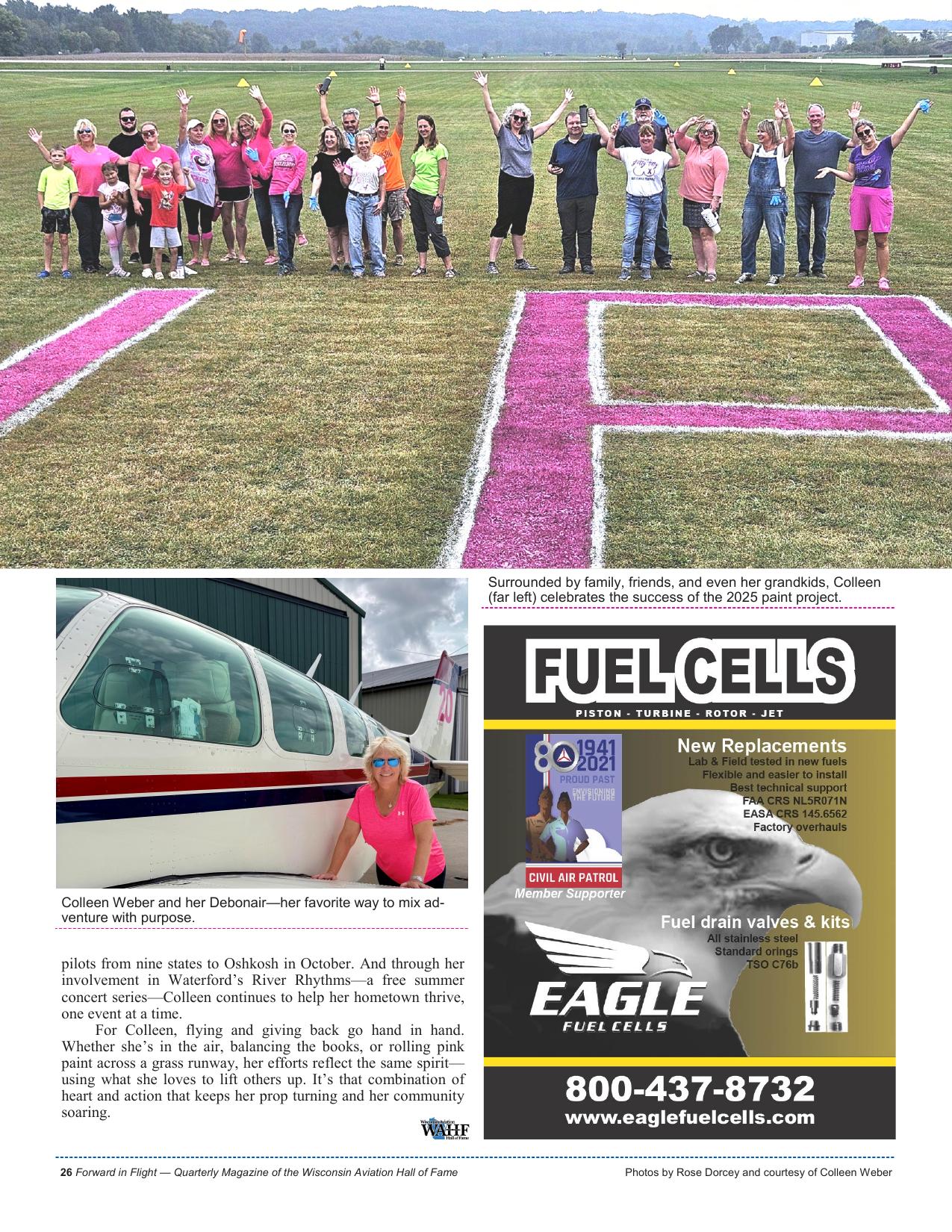
WAHF NEWS & UPDATES Surrounded by family, friends, and even her grandkids, Colleen (far left) celebrates the success of the 2025 paint project. Colleen Weber and her Debonair—her favorite way to mix adventure with purpose. pilots from nine states to Oshkosh in October. And through her involvement in Waterford’s River Rhythms—a free summer concert series—Colleen continues to help her hometown thrive, one event at a time. For Colleen, flying and giving back go hand in hand. Whether she’s in the air, balancing the books, or rolling pink paint across a grass runway, her efforts reflect the same spirit— using what she loves to lift others up. It’s that combination of heart and action that keeps her prop turning and her community soaring. 26 Forward in Flight — Quarterly Magazine of the Wisconsin Aviation Hall of Fame Photos by Rose Dorcey and courtesy of Colleen Weber
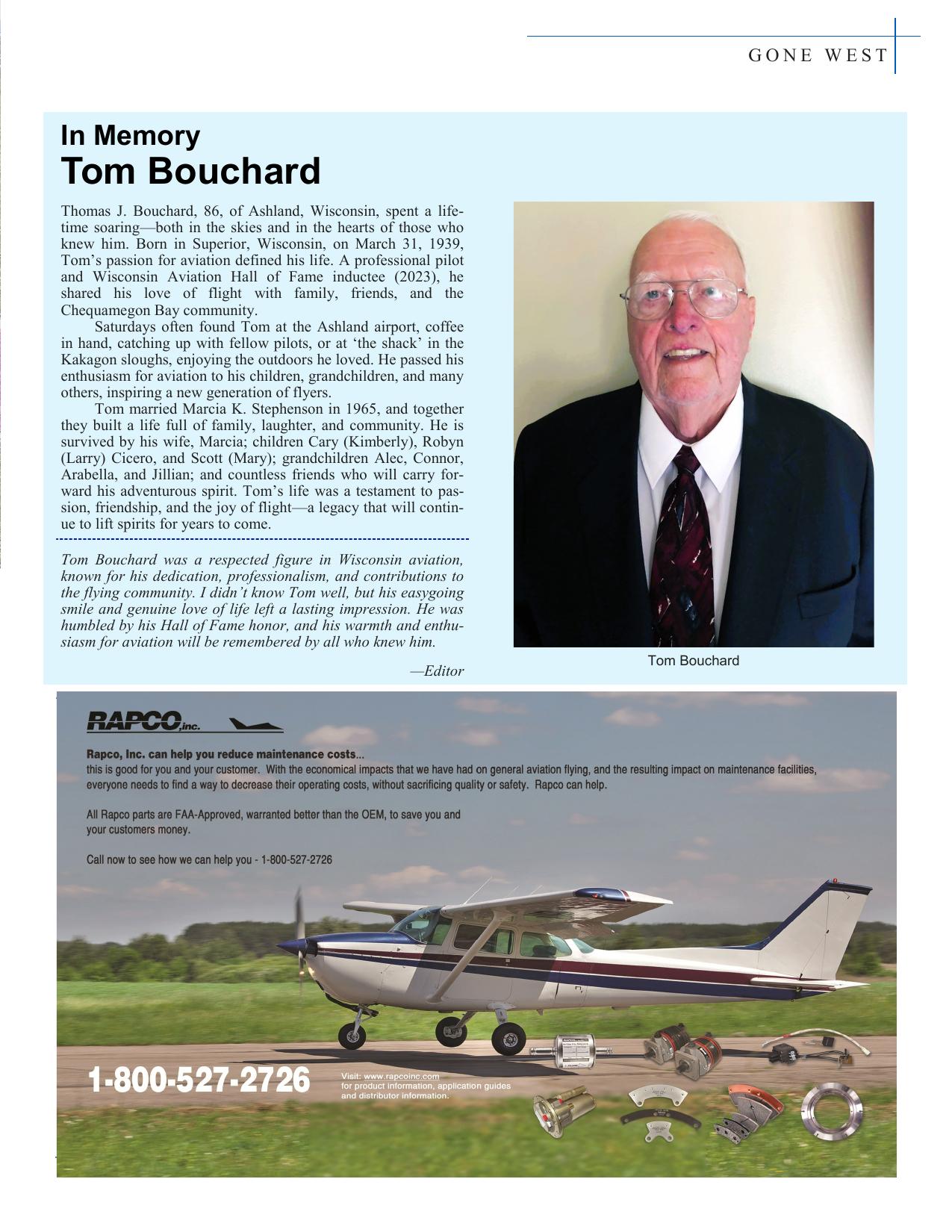
GONE WEST In Memory Tom Bouchard Thomas J. Bouchard, 86, of Ashland, Wisconsin, spent a lifetime soaring—both in the skies and in the hearts of those who knew him. Born in Superior, Wisconsin, on March 31, 1939, Tom’s passion for aviation defined his life. A professional pilot and Wisconsin Aviation Hall of Fame inductee (2023), he shared his love of flight with family, friends, and the Chequamegon Bay community. Saturdays often found Tom at the Ashland airport, coffee in hand, catching up with fellow pilots, or at ‘the shack’ in the Kakagon sloughs, enjoying the outdoors he loved. He passed his enthusiasm for aviation to his children, grandchildren, and many others, inspiring a new generation of flyers. Tom married Marcia K. Stephenson in 1965, and together they built a life full of family, laughter, and community. He is survived by his wife, Marcia; children Cary (Kimberly), Robyn (Larry) Cicero, and Scott (Mary); grandchildren Alec, Connor, Arabella, and Jillian; and countless friends who will carry forward his adventurous spirit. Tom’s life was a testament to passion, friendship, and the joy of flight—a legacy that will continue to lift spirits for years to come. Tom Bouchard was a respected figure in Wisconsin aviation, known for his dedication, professionalism, and contributions to the flying community. I didn’t know Tom well, but his easygoing smile and genuine love of life left a lasting impression. He was humbled by his Hall of Fame honor, and his warmth and enthusiasm for aviation will be remembered by all who knew him. —Editor Tom Bouchard Tom Bouchard
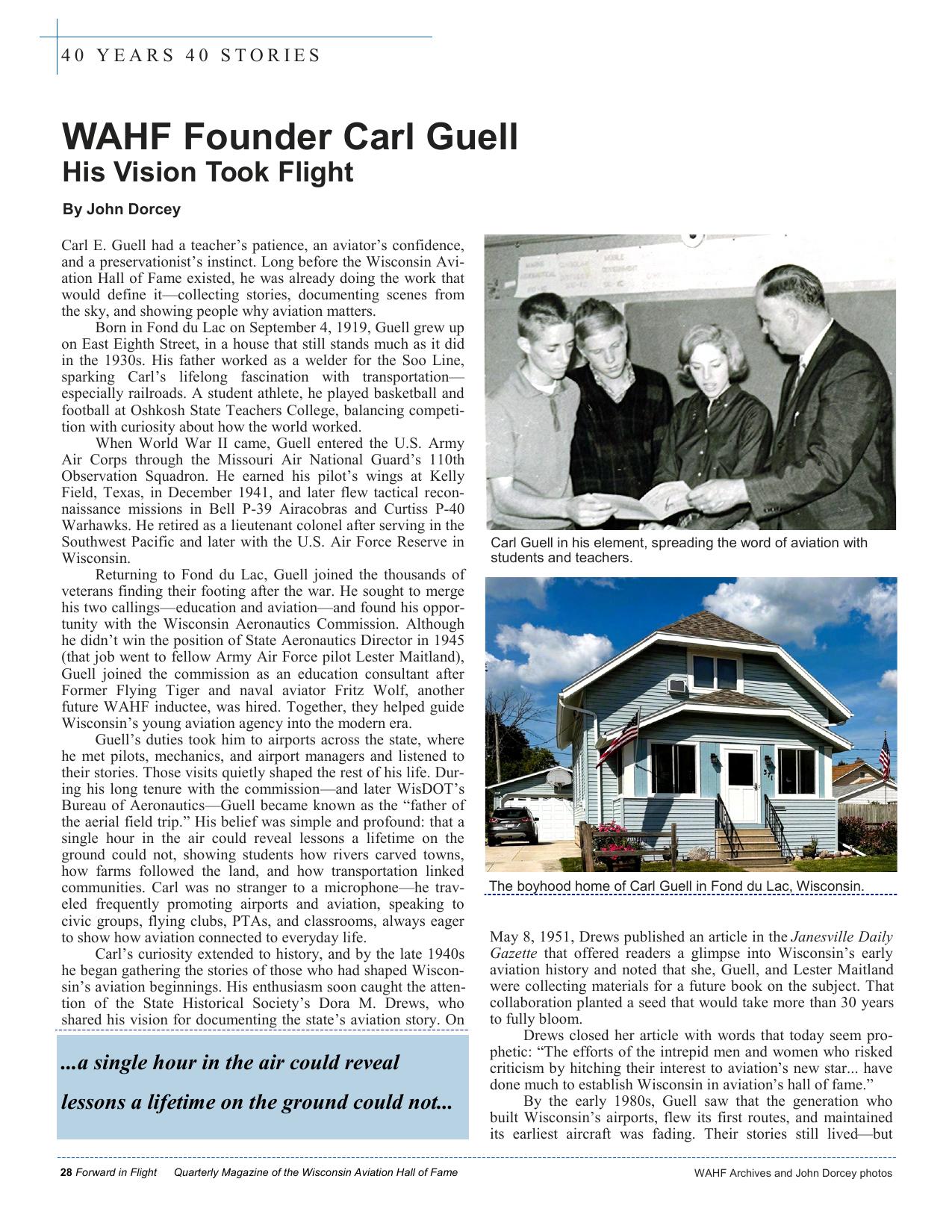
40 YEARS 40 STORIES WAHF Founder Carl Guell His Vision Took Flight By John Dorcey Carl E. Guell had a teacher’s patience, an aviator’s confidence, and a preservationist’s instinct. Long before the Wisconsin Aviation Hall of Fame existed, he was already doing the work that would define it—collecting stories, documenting scenes from the sky, and showing people why aviation matters. Born in Fond du Lac on September 4, 1919, Guell grew up on East Eighth Street, in a house that still stands much as it did in the 1930s. His father worked as a welder for the Soo Line, sparking Carl’s lifelong fascination with transportation— especially railroads. A student athlete, he played basketball and football at Oshkosh State Teachers College, balancing competition with curiosity about how the world worked. When World War II came, Guell entered the U.S. Army Air Corps through the Missouri Air National Guard’s 110th Observation Squadron. He earned his pilot’s wings at Kelly Field, Texas, in December 1941, and later flew tactical reconnaissance missions in Bell P-39 Airacobras and Curtiss P-40 Warhawks. He retired as a lieutenant colonel after serving in the Southwest Pacific and later with the U.S. Air Force Reserve in Wisconsin. Returning to Fond du Lac, Guell joined the thousands of veterans finding their footing after the war. He sought to merge his two callings—education and aviation—and found his opportunity with the Wisconsin Aeronautics Commission. Although he didn’t win the position of State Aeronautics Director in 1945 (that job went to fellow Army Air Force pilot Lester Maitland), Guell joined the commission as an education consultant after Former Flying Tiger and naval aviator Fritz Wolf, another future WAHF inductee, was hired. Together, they helped guide Wisconsin’s young aviation agency into the modern era. Guell’s duties took him to airports across the state, where he met pilots, mechanics, and airport managers and listened to their stories. Those visits quietly shaped the rest of his life. During his long tenure with the commission—and later WisDOT’s Bureau of Aeronautics—Guell became known as the “father of the aerial field trip.” His belief was simple and profound: that a single hour in the air could reveal lessons a lifetime on the ground could not, showing students how rivers carved towns, how farms followed the land, and how transportation linked communities. Carl was no stranger to a microphone—he traveled frequently promoting airports and aviation, speaking to civic groups, flying clubs, PTAs, and classrooms, always eager to show how aviation connected to everyday life. Carl’s curiosity extended to history, and by the late 1940s he began gathering the stories of those who had shaped Wisconsin’s aviation beginnings. His enthusiasm soon caught the attention of the State Historical Society’s Dora M. Drews, who shared his vision for documenting the state’s aviation story. On ...a single hour in the air could reveal lessons a lifetime on the ground could not... 28 Forward in Flight — Quarterly Magazine of the Wisconsin Aviation Hall of Fame Carl Guell in his element, spreading the word of aviation with students and teachers. The boyhood home of Carl Guell in Fond du Lac, Wisconsin. May 8, 1951, Drews published an article in the Janesville Daily Gazette that offered readers a glimpse into Wisconsin’s early aviation history and noted that she, Guell, and Lester Maitland were collecting materials for a future book on the subject. That collaboration planted a seed that would take more than 30 years to fully bloom. Drews closed her article with words that today seem prophetic: “The efforts of the intrepid men and women who risked criticism by hitching their interest to aviation’s new star... have done much to establish Wisconsin in aviation’s hall of fame.” By the early 1980s, Guell saw that the generation who built Wisconsin’s airports, flew its first routes, and maintained its earliest aircraft was fading. Their stories still lived—but WAHF Archives and John Dorcey photos
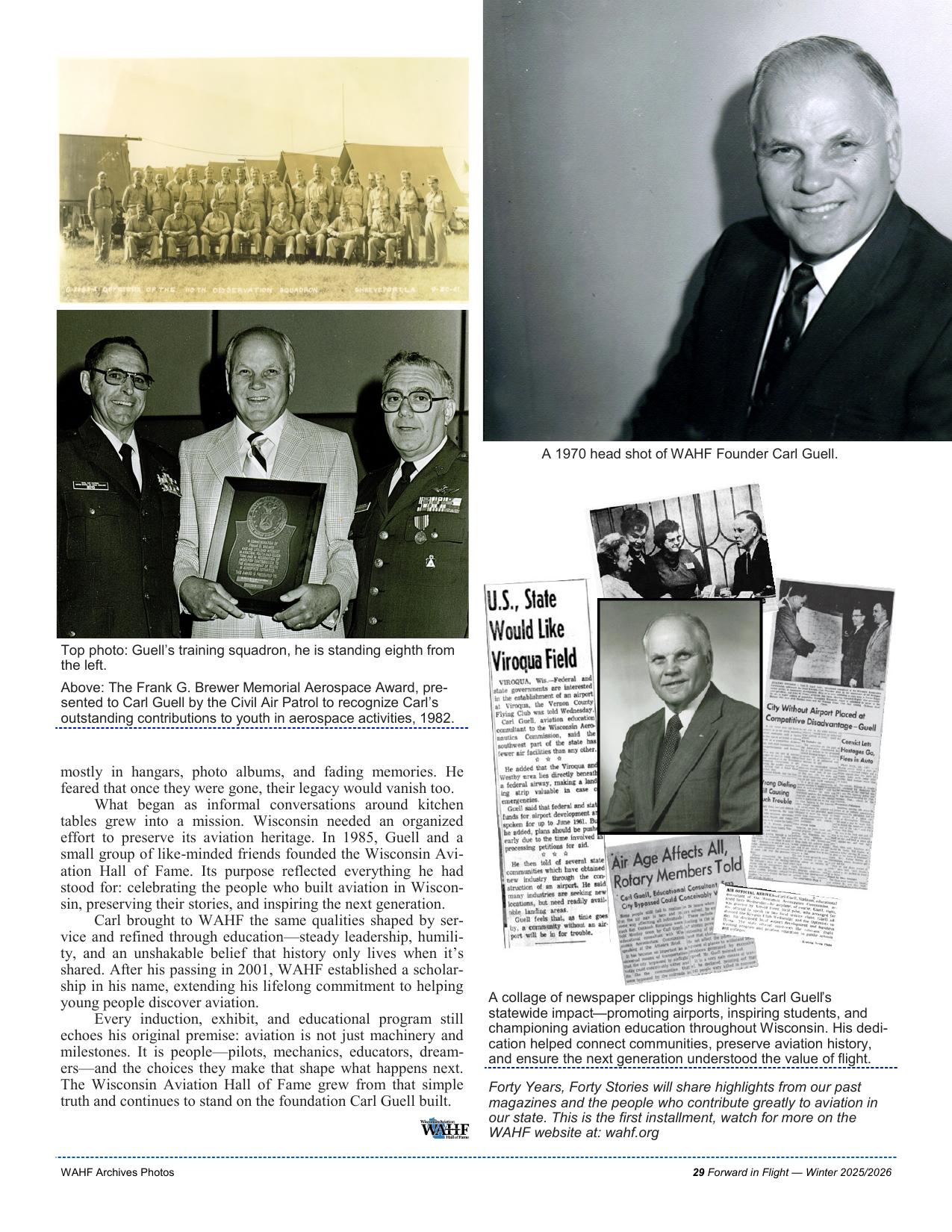
A 1970 head shot of WAHF Founder Carl Guell. Top photo: Guell’s training squadron, he is standing eighth from the left. Above: The Frank G. Brewer Memorial Aerospace Award, presented to Carl Guell by the Civil Air Patrol to recognize Carl’s outstanding contributions to youth in aerospace activities, 1982. mostly in hangars, photo albums, and fading memories. He feared that once they were gone, their legacy would vanish too. What began as informal conversations around kitchen tables grew into a mission. Wisconsin needed an organized effort to preserve its aviation heritage. In 1985, Guell and a small group of like-minded friends founded the Wisconsin Aviation Hall of Fame. Its purpose reflected everything he had stood for: celebrating the people who built aviation in Wisconsin, preserving their stories, and inspiring the next generation. Carl brought to WAHF the same qualities shaped by service and refined through education—steady leadership, humility, and an unshakable belief that history only lives when it’s shared. After his passing in 2001, WAHF established a scholarship in his name, extending his lifelong commitment to helping young people discover aviation. Every induction, exhibit, and educational program still echoes his original premise: aviation is not just machinery and milestones. It is people—pilots, mechanics, educators, dreamers—and the choices they make that shape what happens next. The Wisconsin Aviation Hall of Fame grew from that simple truth and continues to stand on the foundation Carl Guell built. WAHF Archives Photos A collage of newspaper clippings highlights Carl Guell’s statewide impact—promoting airports, inspiring students, and championing aviation education throughout Wisconsin. His dedication helped connect communities, preserve aviation history, and ensure the next generation understood the value of flight. Forty Years, Forty Stories will share highlights from our past magazines and the people who contribute greatly to aviation in our state. This is the first installment, watch for more on the WAHF website at: wahf.org 29 Forward in Flight — Winter 2025/2026
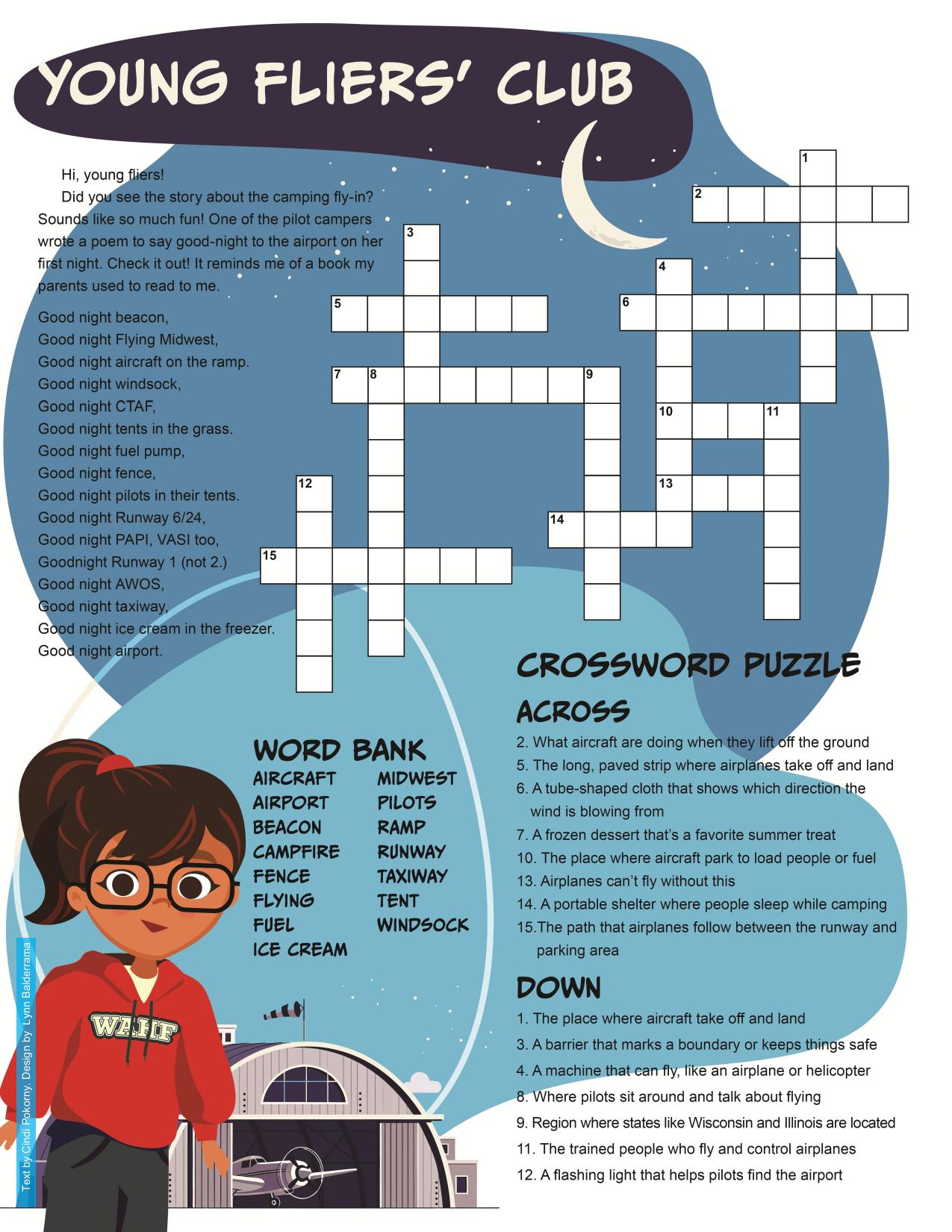
Text by Cindi Pokorny. Design by Lynn Balderrama 28 Forward in Flight — Quarterly Magazine of the Wisconsin Aviation Hall of Fame
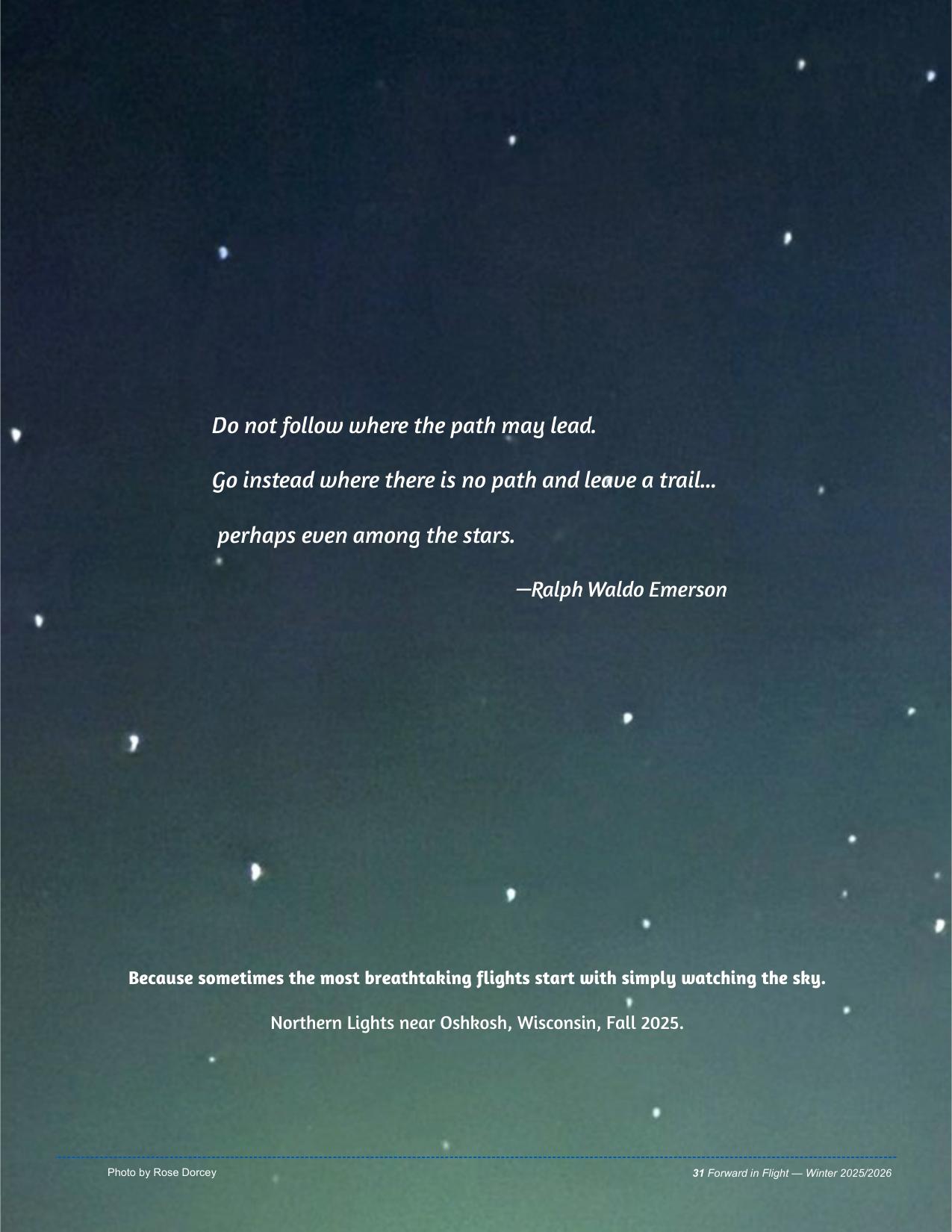
Do not follow where the path may lead. Go instead where there is no path and leave a trail... perhaps even among the stars. —Ralph Waldo Emerson Because sometimes the most breathtaking flights start with simply watching the sky. Northern Lights near Oshkosh, Wisconsin, Fall 2025. Photo by Rose Dorcey 31 Forward in Flight — Winter 2025/2026
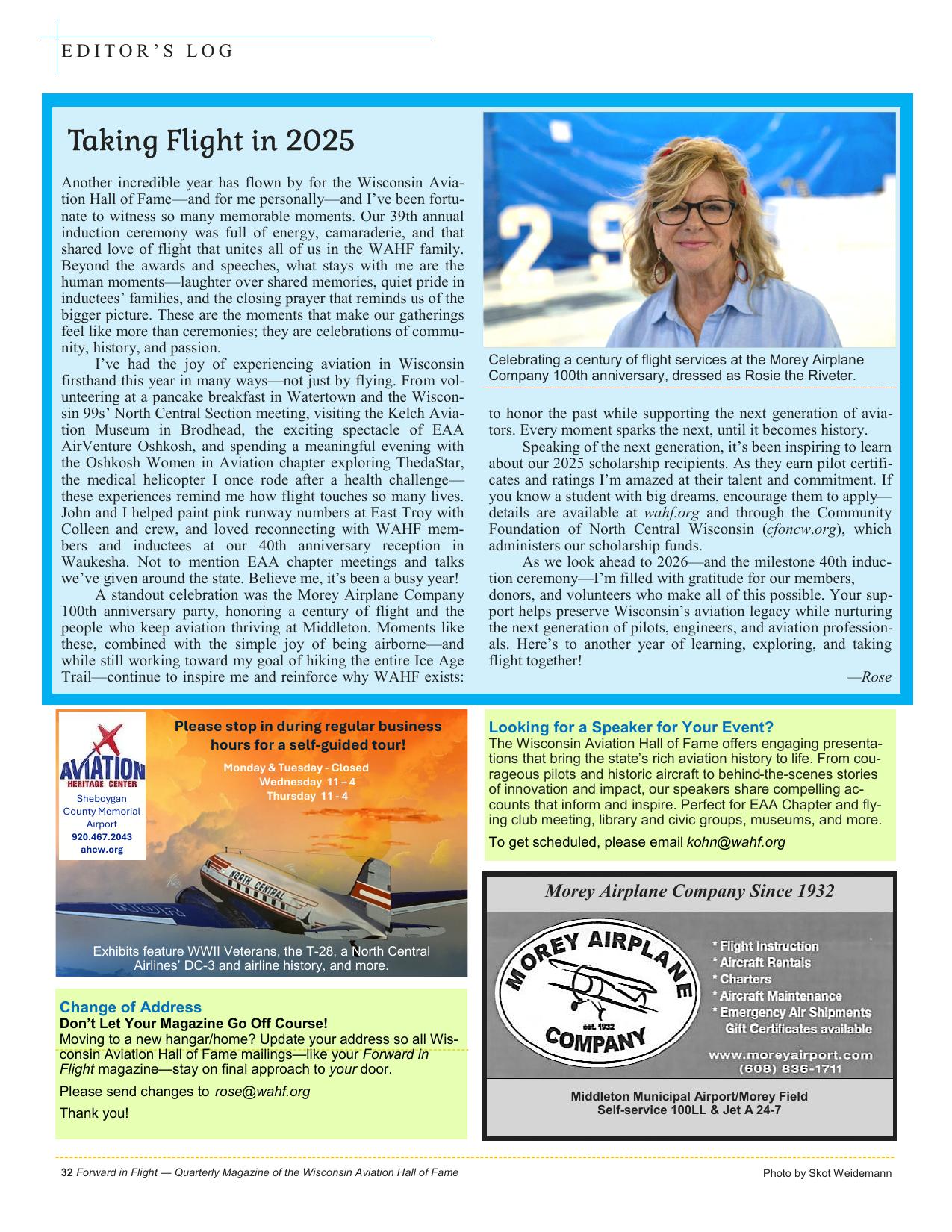
EDITOR’S LOG Taking Flight in 2025 Another incredible year has flown by for the Wisconsin Aviation Hall of Fame—and for me personally—and I’ve been fortunate to witness so many memorable moments. Our 39th annual induction ceremony was full of energy, camaraderie, and that shared love of flight that unites all of us in the WAHF family. Beyond the awards and speeches, what stays with me are the human moments—laughter over shared memories, quiet pride in inductees’ families, and the closing prayer that reminds us of the bigger picture. These are the moments that make our gatherings feel like more than ceremonies; they are celebrations of community, history, and passion. I’ve had the joy of experiencing aviation in Wisconsin firsthand this year in many ways—not just by flying. From volunteering at a pancake breakfast in Watertown and the Wisconsin 99s’ North Central Section meeting, visiting the Kelch Aviation Museum in Brodhead, the exciting spectacle of EAA AirVenture Oshkosh, and spending a meaningful evening with the Oshkosh Women in Aviation chapter exploring ThedaStar, the medical helicopter I once rode after a health challenge— these experiences remind me how flight touches so many lives. John and I helped paint pink runway numbers at East Troy with Colleen and crew, and loved reconnecting with WAHF members and inductees at our 40th anniversary reception in Waukesha. Not to mention EAA chapter meetings and talks we’ve given around the state. Believe me, it’s been a busy year! A standout celebration was the Morey Airplane Company 100th anniversary party, honoring a century of flight and the people who keep aviation thriving at Middleton. Moments like these, combined with the simple joy of being airborne—and while still working toward my goal of hiking the entire Ice Age Trail—continue to inspire me and reinforce why WAHF exists: Please stop in during regular business hours for a self-guided tour! Sheboygan County Memorial Airport 920.467.2043 ahcw.org Monday & Tuesday - Closed Wednesday 11 – 4 Thursday 11 - 4 Celebrating a century of flight services at the Morey Airplane Company 100th anniversary, dressed as Rosie the Riveter. to honor the past while supporting the next generation of aviators. Every moment sparks the next, until it becomes history. Speaking of the next generation, it’s been inspiring to learn about our 2025 scholarship recipients. As they earn pilot certificates and ratings I’m amazed at their talent and commitment. If you know a student with big dreams, encourage them to apply— details are available at wahf.org and through the Community Foundation of North Central Wisconsin (cfoncw.org), which administers our scholarship funds. As we look ahead to 2026—and the milestone 40th induction ceremony—I’m filled with gratitude for our members, donors, and volunteers who make all of this possible. Your support helps preserve Wisconsin’s aviation legacy while nurturing the next generation of pilots, engineers, and aviation professionals. Here’s to another year of learning, exploring, and taking flight together! —Rose Looking for a Speaker for Your Event? The Wisconsin Aviation Hall of Fame offers engaging presentations that bring the state’s rich aviation history to life. From courageous pilots and historic aircraft to behind-the-scenes stories of innovation and impact, our speakers share compelling accounts that inform and inspire. Perfect for EAA Chapter and flying club meeting, library and civic groups, museums, and more. To get scheduled, please email kohn@wahf.org Morey Airplane Company Since 1932 Exhibits feature WWII Veterans, the T-28, a North Central Airlines’ DC-3 and airline history, and more. Change of Address Don’t Let Your Magazine Go Off Course! Moving to a new hangar/home? Update your address so all Wisconsin Aviation Hall of Fame mailings—like your Forward in Flight magazine—stay on final approach to your door. Please send changes to rose@wahf.org Thank you! 32 Forward in Flight — Quarterly Magazine of the Wisconsin Aviation Hall of Fame Middleton Municipal Airport/Morey Field Self-service 100LL & Jet A 24-7 Photo by Skot Weidemann
Membership Subscription and Donation Form Use for New Memberships and Renewals ANNUAL MEMBERSHIP LEVELS _____ Youth (Under age 18) _____ Individual (Annual) _____ Couple (Annual) _____ Lifetime (Individual) _____ Lifetime (Couple) $10 $30 $40 $500 $750 TAX DEDUCTIBLE CONTRIBUTIONS Your contributions help ensure Wisconsin’s aviation pioneers and outstanding students in aviation education will continue to be recognized. Your contributions, in any amount, are appreciated. WAHF Supporting Contribution $___________ (General operating/programming fund) Leo J. Kohn Collection Preservation Fund $___________ WAHF Scholarship Fund* $___________ Name________________________________________ Address______________________________________ City__________________________________________ State, Zip_____________________________________ Phone_______________________________________ Email________________________________________ Members receive WAHF’s quarterly magazine Forward in Flight. Join Online! WAHF.org Donate Online WAHF.org or WAHF.org/kohn Or, mail this form, along with your check payable to: Wisconsin Aviation Hall of Fame, Inc. *for scholarship donations please write a separate check payable to: Community Foundation of North Central Wisconsin or visit www.CFONCW.org Send to: Rose Dorcey/WAHF 3980 Sharratt Drive Oshkosh WI 54901 The Wisconsin Aviation Hall of Fame is a 501(c)(3) organization. 33 Forward in Flight — Winter 2025/2026
PRSRT STD US Postage Paid Wisc Rapids WI Permit 98 Forward in Flight c/o Rose Dorcey 3980 Sharratt Drive Oshkosh WI 54901-1276 Welcome New WAHF Member/Supporters! Chuck Adrian Conrad Andringa Phyllis Andringa Dan Bauknecht Rusty Everhard William Fitch Scott Hagedorn Carl Hilgendorf* Kim Hilgendorf* Teri Jaeger Karen Kalishek Joy Lachendro Dawn Madeja Melissa Miller Carrie & Greg Rasberry Deb Redemann-Drahn Daegen Silva Katie Wilson Thanks for coming onboard! Your support helps us continue our efforts of collecting, preserving, and sharing Wisconsin aviation history, and honoring those who make it. We also thank the many members who have recently renewed your memberships. We appreciate your support. *Life Membership Thank you Jeanne Robinson for your recent donation to WAHF’s general operating fund, in support of the costs of producing Forward in Flight. We appreciate your generous support and are so pleased that you enjoy reading each issue! About the Ceremony Photographer: Kaitlin Piette is an event photographer from Appleton, with a background in Communication Media Studies from UW–Stevens Point. She began volunteering at AirVenture in 2021 and has since photographed for the AirVenture Today newspaper. She also captures weddings and other special moments. Her instagram: KaitlinPportfolio Email: leafheartgwe@gmail.com Our Appreciation We sincerely thank the following individuals for their generous support of the Wisconsin Aviation Hall of Fame. Your contributions help preserve and share aviation history to inspire the next generation of pilots and aviation professionals: Jeff Baum Patti Bruha John & Rose Dorcey Michael Goc Lynn Erickson Sune Ericson Duane Esse Peter & Carolyn Halbauer Lyman Hatz Dave Hedgecock Carl & Kim Hilgendorf Bryan Kust Keith Mathews Tad Oelstrom Henry Peterson Nancy Rasmussen Jeanne Robinson Steinar Saevdal Danny Simpson Joe Snow Tom & Jeanne Thomas Joanie Vehlow Jim Zuelsdorf Your generosity makes a real difference — thank you for being part of our mission! With the Christmas season nearly upon us, we’re wishing you a Merry Christmas and smooth skies into the New Year! May your days be filled with warmth, joy, and the wonder of flight.