Volume 16, Issue 4
🗞️ Download Issue (PDF)
Forward in Flight
Volume 16, Issue 4 Quarterly Magazine of the Wisconsin Aviation Hall of Fame Winter 2018-2019
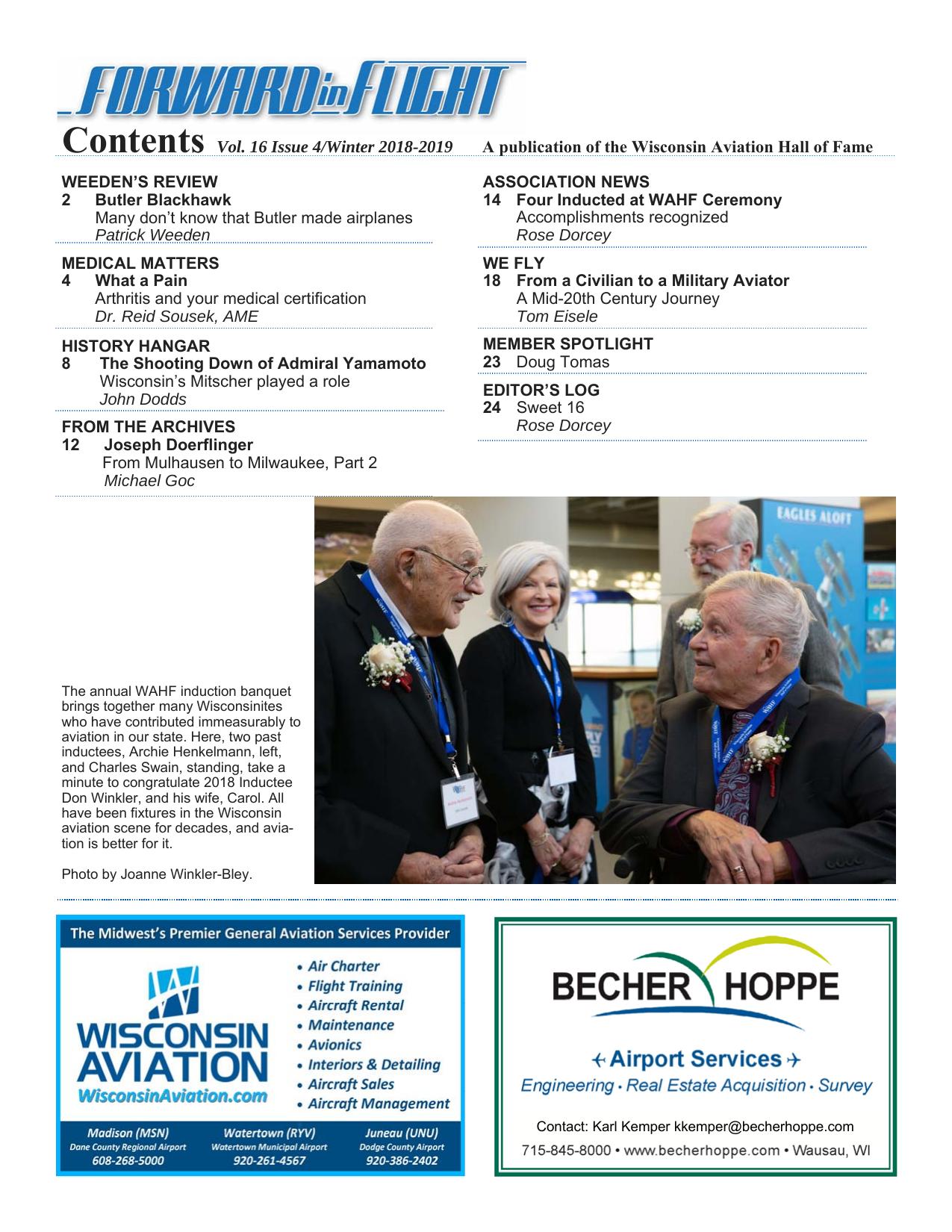
Contents Vol. 16 Issue 4/Winter 2018-2019 A publication of the Wisconsin Aviation Hall of Fame WEEDEN’S REVIEW 2 Butler Blackhawk Many don’t know that Butler made airplanes Patrick Weeden ASSOCIATION NEWS 14 Four Inducted at WAHF Ceremony Accomplishments recognized Rose Dorcey MEDICAL MATTERS 4 What a Pain Arthritis and your medical certification Dr. Reid Sousek, AME WE FLY 18 From a Civilian to a Military Aviator A Mid-20th Century Journey Tom Eisele HISTORY HANGAR 8 The Shooting Down of Admiral Yamamoto Wisconsin’s Mitscher played a role John Dodds MEMBER SPOTLIGHT 23 Doug Tomas FROM THE ARCHIVES 12 Joseph Doerflinger From Mulhausen to Milwaukee, Part 2 Michael Goc EDITOR’S LOG 24 Sweet 16 Rose Dorcey The annual WAHF induction banquet brings together many Wisconsinites who have contributed immeasurably to aviation in our state. Here, two past inductees, Archie Henkelmann, left, and Charles Swain, standing, take a minute to congratulate 2018 Inductee Don Winkler, and his wife, Carol. All have been fixtures in the Wisconsin aviation scene for decades, and aviation is better for it. Photo by Joanne Winkler-Bley. Contact: Karl Kemper kkemper@becherhoppe.com
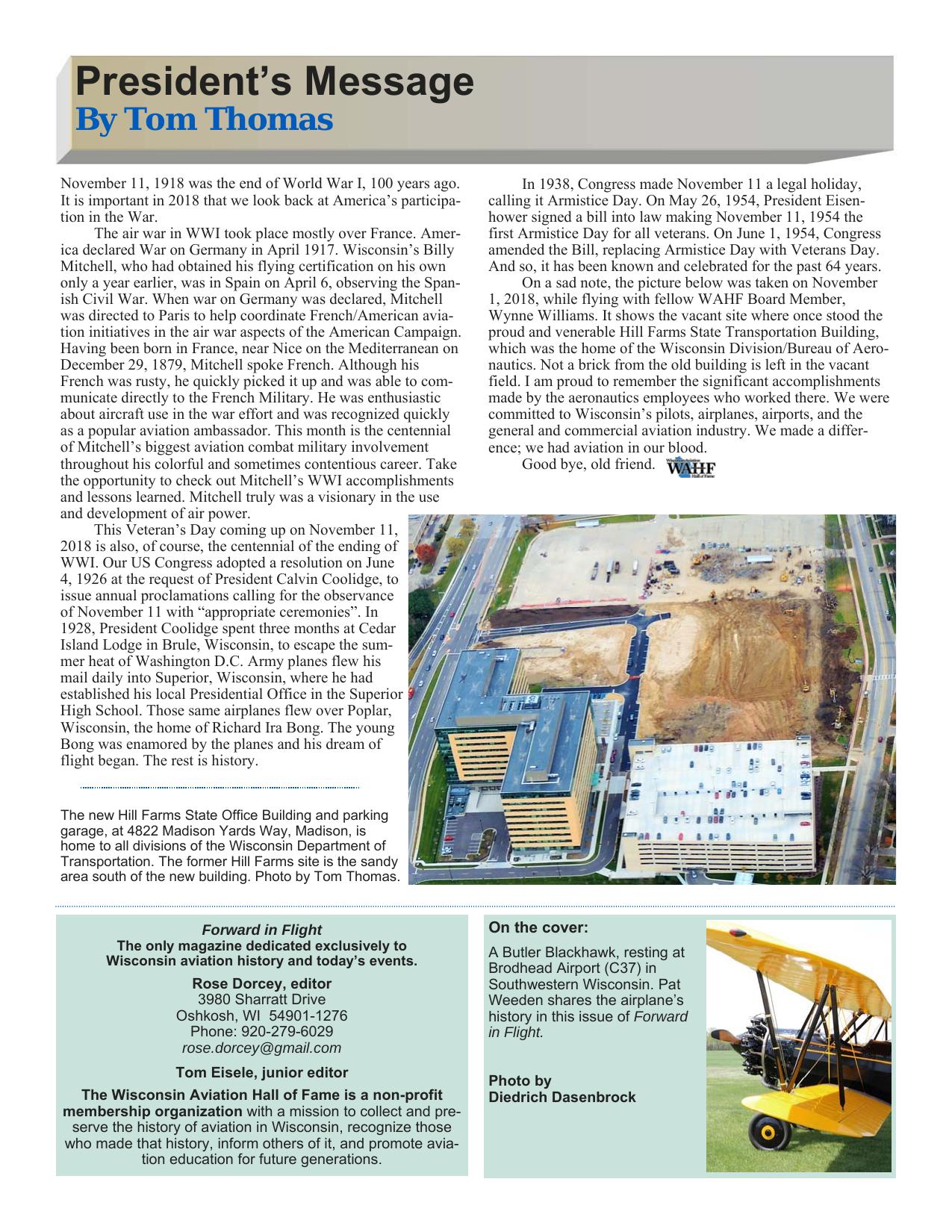
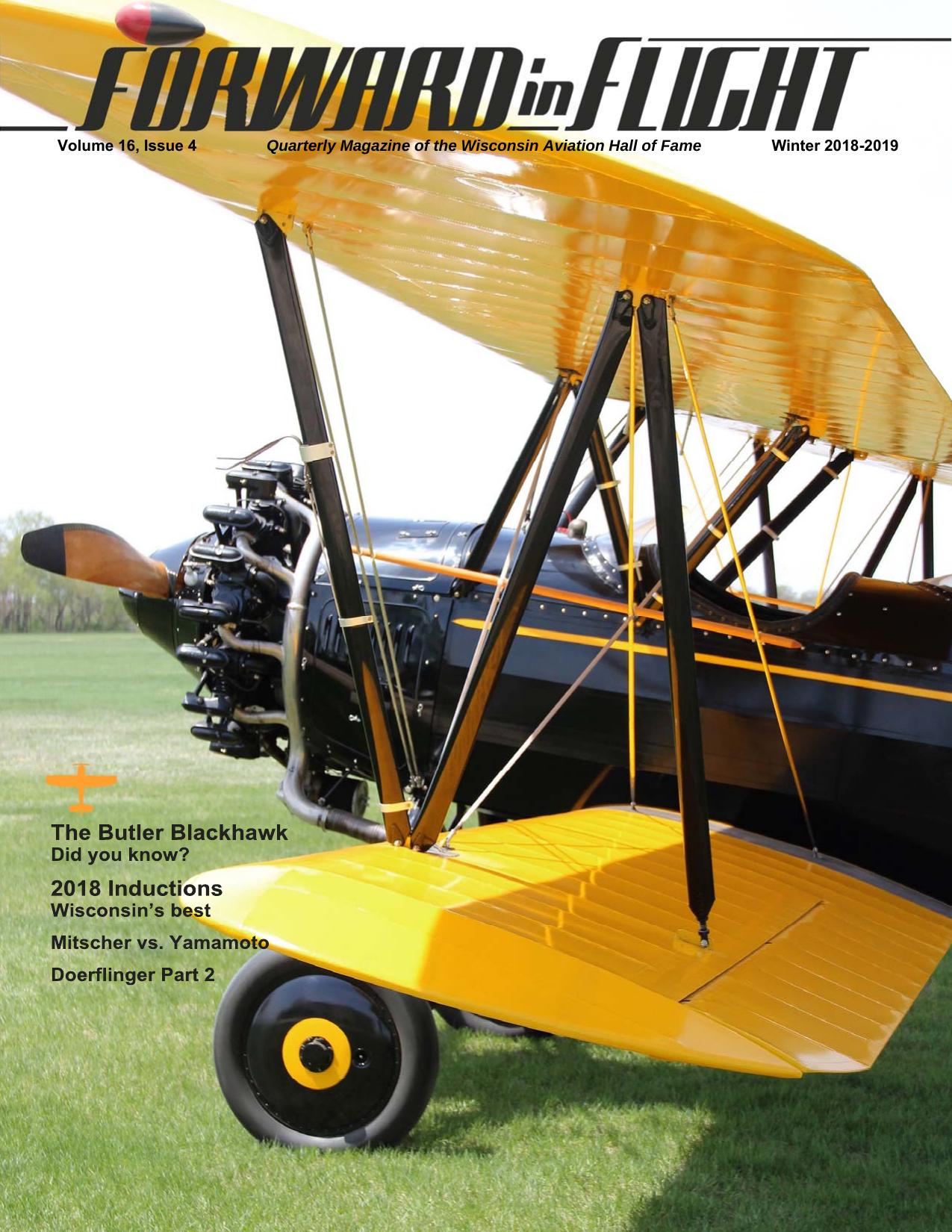
President’s Message By Tom Thomas November 11, 1918 was the end of World War I, 100 years ago. It is important in 2018 that we look back at America’s participation in the War. The air war in WWI took place mostly over France. America declared War on Germany in April 1917. Wisconsin’s Billy Mitchell, who had obtained his flying certification on his own only a year earlier, was in Spain on April 6, observing the Spanish Civil War. When war on Germany was declared, Mitchell was directed to Paris to help coordinate French/American aviation initiatives in the air war aspects of the American Campaign. Having been born in France, near Nice on the Mediterranean on December 29, 1879, Mitchell spoke French. Although his French was rusty, he quickly picked it up and was able to communicate directly to the French Military. He was enthusiastic about aircraft use in the war effort and was recognized quickly as a popular aviation ambassador. This month is the centennial of Mitchell’s biggest aviation combat military involvement throughout his colorful and sometimes contentious career. Take the opportunity to check out Mitchell’s WWI accomplishments and lessons learned. Mitchell truly was a visionary in the use and development of air power. This Veteran’s Day coming up on November 11, 2018 is also, of course, the centennial of the ending of WWI. Our US Congress adopted a resolution on June 4, 1926 at the request of President Calvin Coolidge, to issue annual proclamations calling for the observance of November 11 with “appropriate ceremonies”. In 1928, President Coolidge spent three months at Cedar Island Lodge in Brule, Wisconsin, to escape the summer heat of Washington D.C. Army planes flew his mail daily into Superior, Wisconsin, where he had established his local Presidential Office in the Superior High School. Those same airplanes flew over Poplar, Wisconsin, the home of Richard Ira Bong. The young Bong was enamored by the planes and his dream of flight began. The rest is history. In 1938, Congress made November 11 a legal holiday, calling it Armistice Day. On May 26, 1954, President Eisenhower signed a bill into law making November 11, 1954 the first Armistice Day for all veterans. On June 1, 1954, Congress amended the Bill, replacing Armistice Day with Veterans Day. And so, it has been known and celebrated for the past 64 years. On a sad note, the picture below was taken on November 1, 2018, while flying with fellow WAHF Board Member, Wynne Williams. It shows the vacant site where once stood the proud and venerable Hill Farms State Transportation Building, which was the home of the Wisconsin Division/Bureau of Aeronautics. Not a brick from the old building is left in the vacant field. I am proud to remember the significant accomplishments made by the aeronautics employees who worked there. We were committed to Wisconsin’s pilots, airplanes, airports, and the general and commercial aviation industry. We made a difference; we had aviation in our blood. Good bye, old friend. The new Hill Farms State Office Building and parking garage, at 4822 Madison Yards Way, Madison, is home to all divisions of the Wisconsin Department of Transportation. The former Hill Farms site is the sandy area south of the new building. Photo by Tom Thomas. Forward in Flight The only magazine dedicated exclusively to Wisconsin aviation history and today’s events. Rose Dorcey, editor 3980 Sharratt Drive Oshkosh, WI 54901-1276 Phone: 920-279-6029 rose.dorcey@gmail.com Tom Eisele, junior editor The Wisconsin Aviation Hall of Fame is a non-profit membership organization with a mission to collect and preserve the history of aviation in Wisconsin, recognize those who made that history, inform others of it, and promote aviation education for future generations. On the cover: A Butler Blackhawk, resting at Brodhead Airport (C37) in Southwestern Wisconsin. Pat Weeden shares the airplane’s history in this issue of Forward in Flight. Photo by Diedrich Dasenbrock
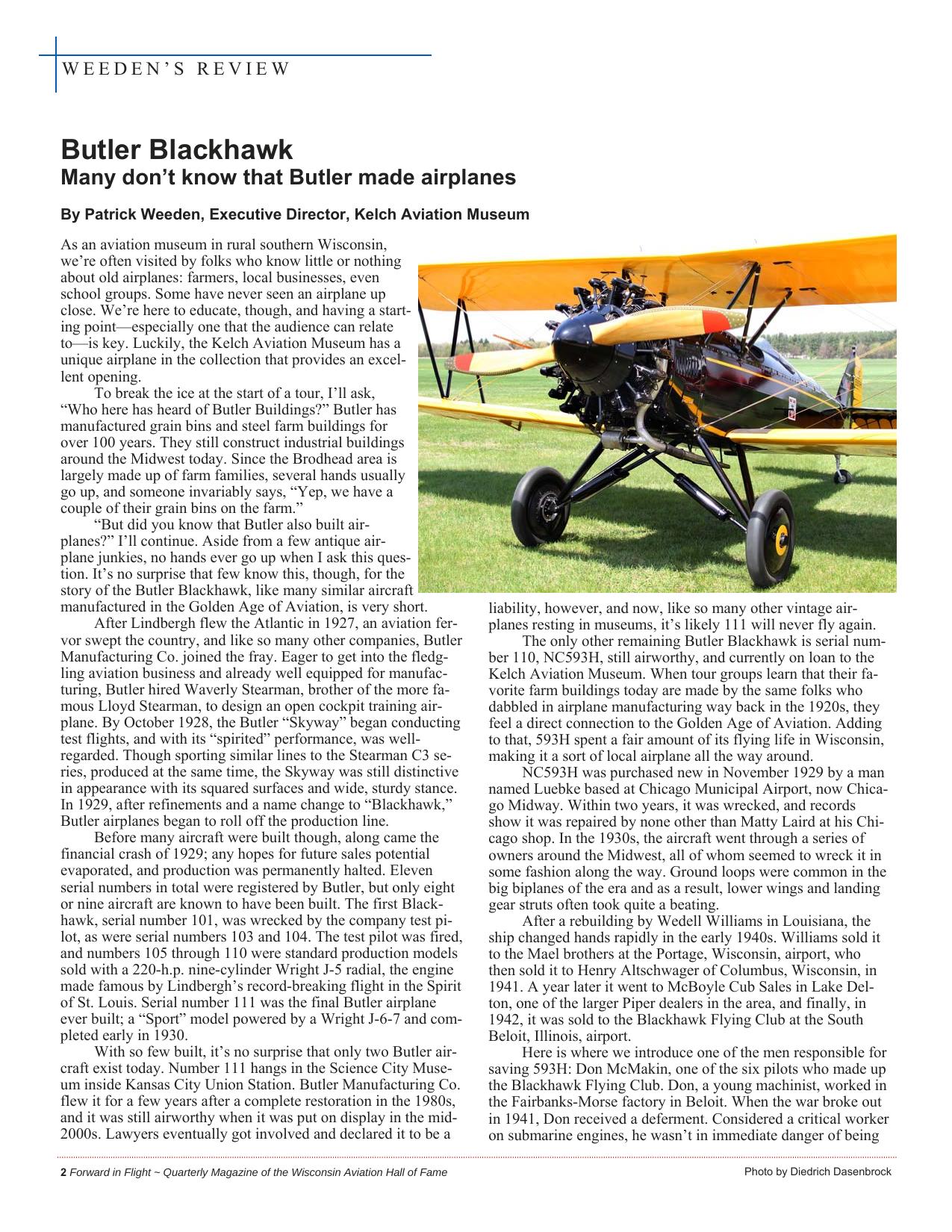
WEEDEN’S REVIEW Butler Blackhawk Many don’t know that Butler made airplanes By Patrick Weeden, Executive Director, Kelch Aviation Museum As an aviation museum in rural southern Wisconsin, we’re often visited by folks who know little or nothing about old airplanes: farmers, local businesses, even school groups. Some have never seen an airplane up close. We’re here to educate, though, and having a starting point—especially one that the audience can relate to—is key. Luckily, the Kelch Aviation Museum has a unique airplane in the collection that provides an excellent opening. To break the ice at the start of a tour, I’ll ask, “Who here has heard of Butler Buildings?” Butler has manufactured grain bins and steel farm buildings for over 100 years. They still construct industrial buildings around the Midwest today. Since the Brodhead area is largely made up of farm families, several hands usually go up, and someone invariably says, “Yep, we have a couple of their grain bins on the farm.” “But did you know that Butler also built airplanes?” I’ll continue. Aside from a few antique airplane junkies, no hands ever go up when I ask this question. It’s no surprise that few know this, though, for the story of the Butler Blackhawk, like many similar aircraft manufactured in the Golden Age of Aviation, is very short. After Lindbergh flew the Atlantic in 1927, an aviation fervor swept the country, and like so many other companies, Butler Manufacturing Co. joined the fray. Eager to get into the fledgling aviation business and already well equipped for manufacturing, Butler hired Waverly Stearman, brother of the more famous Lloyd Stearman, to design an open cockpit training airplane. By October 1928, the Butler “Skyway” began conducting test flights, and with its “spirited” performance, was wellregarded. Though sporting similar lines to the Stearman C3 series, produced at the same time, the Skyway was still distinctive in appearance with its squared surfaces and wide, sturdy stance. In 1929, after refinements and a name change to “Blackhawk,” Butler airplanes began to roll off the production line. Before many aircraft were built though, along came the financial crash of 1929; any hopes for future sales potential evaporated, and production was permanently halted. Eleven serial numbers in total were registered by Butler, but only eight or nine aircraft are known to have been built. The first Blackhawk, serial number 101, was wrecked by the company test pilot, as were serial numbers 103 and 104. The test pilot was fired, and numbers 105 through 110 were standard production models sold with a 220-h.p. nine-cylinder Wright J-5 radial, the engine made famous by Lindbergh’s record-breaking flight in the Spirit of St. Louis. Serial number 111 was the final Butler airplane ever built; a “Sport” model powered by a Wright J-6-7 and completed early in 1930. With so few built, it’s no surprise that only two Butler aircraft exist today. Number 111 hangs in the Science City Museum inside Kansas City Union Station. Butler Manufacturing Co. flew it for a few years after a complete restoration in the 1980s, and it was still airworthy when it was put on display in the mid2000s. Lawyers eventually got involved and declared it to be a 2 Forward in Flight ~ Quarterly Magazine of the Wisconsin Aviation Hall of Fame liability, however, and now, like so many other vintage airplanes resting in museums, it’s likely 111 will never fly again. The only other remaining Butler Blackhawk is serial number 110, NC593H, still airworthy, and currently on loan to the Kelch Aviation Museum. When tour groups learn that their favorite farm buildings today are made by the same folks who dabbled in airplane manufacturing way back in the 1920s, they feel a direct connection to the Golden Age of Aviation. Adding to that, 593H spent a fair amount of its flying life in Wisconsin, making it a sort of local airplane all the way around. NC593H was purchased new in November 1929 by a man named Luebke based at Chicago Municipal Airport, now Chicago Midway. Within two years, it was wrecked, and records show it was repaired by none other than Matty Laird at his Chicago shop. In the 1930s, the aircraft went through a series of owners around the Midwest, all of whom seemed to wreck it in some fashion along the way. Ground loops were common in the big biplanes of the era and as a result, lower wings and landing gear struts often took quite a beating. After a rebuilding by Wedell Williams in Louisiana, the ship changed hands rapidly in the early 1940s. Williams sold it to the Mael brothers at the Portage, Wisconsin, airport, who then sold it to Henry Altschwager of Columbus, Wisconsin, in 1941. A year later it went to McBoyle Cub Sales in Lake Delton, one of the larger Piper dealers in the area, and finally, in 1942, it was sold to the Blackhawk Flying Club at the South Beloit, Illinois, airport. Here is where we introduce one of the men responsible for saving 593H: Don McMakin, one of the six pilots who made up the Blackhawk Flying Club. Don, a young machinist, worked in the Fairbanks-Morse factory in Beloit. When the war broke out in 1941, Don received a deferment. Considered a critical worker on submarine engines, he wasn’t in immediate danger of being Photo by Diedrich Dasenbrock
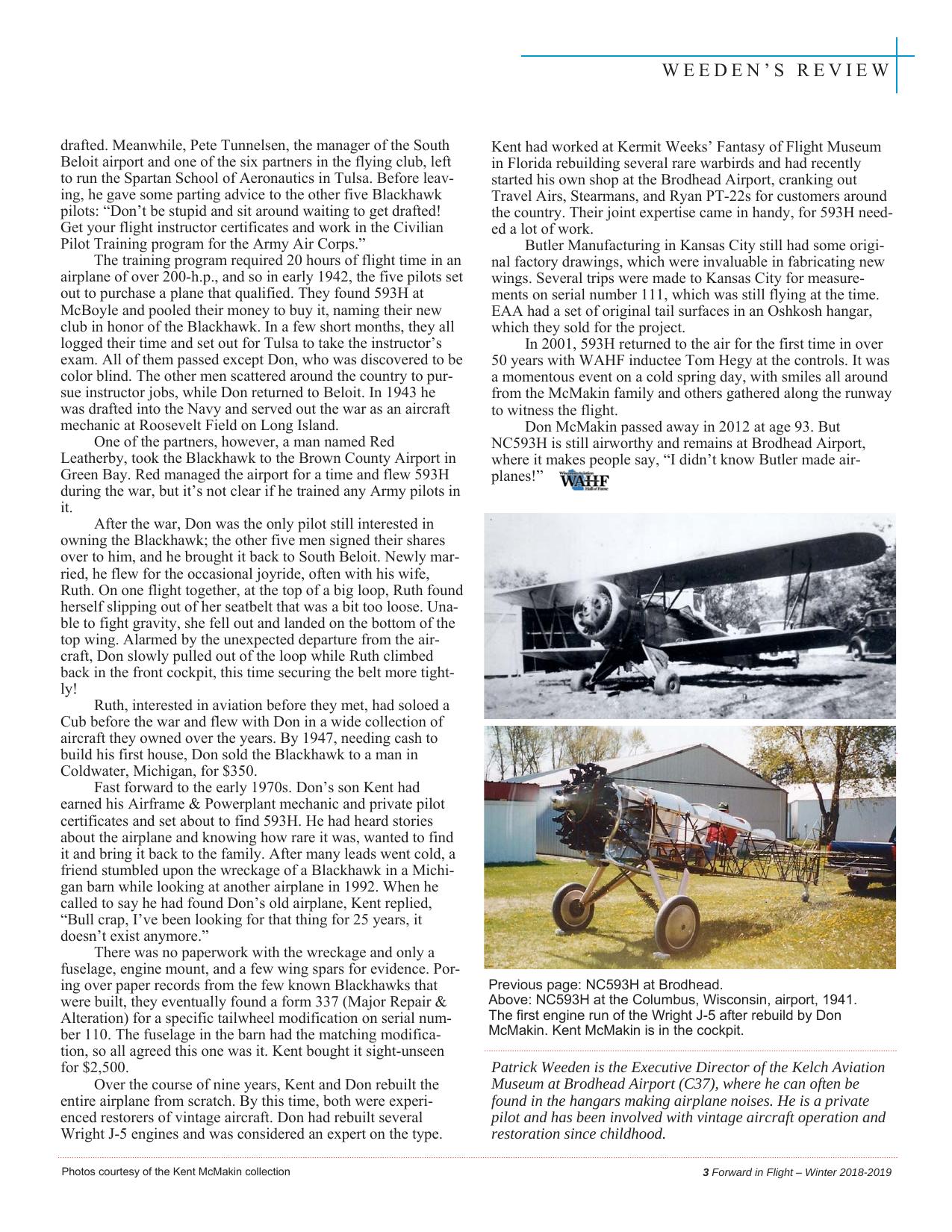
WEEDEN’S REVIEW drafted. Meanwhile, Pete Tunnelsen, the manager of the South Beloit airport and one of the six partners in the flying club, left to run the Spartan School of Aeronautics in Tulsa. Before leaving, he gave some parting advice to the other five Blackhawk pilots: “Don’t be stupid and sit around waiting to get drafted! Get your flight instructor certificates and work in the Civilian Pilot Training program for the Army Air Corps.” The training program required 20 hours of flight time in an airplane of over 200-h.p., and so in early 1942, the five pilots set out to purchase a plane that qualified. They found 593H at McBoyle and pooled their money to buy it, naming their new club in honor of the Blackhawk. In a few short months, they all logged their time and set out for Tulsa to take the instructor’s exam. All of them passed except Don, who was discovered to be color blind. The other men scattered around the country to pursue instructor jobs, while Don returned to Beloit. In 1943 he was drafted into the Navy and served out the war as an aircraft mechanic at Roosevelt Field on Long Island. One of the partners, however, a man named Red Leatherby, took the Blackhawk to the Brown County Airport in Green Bay. Red managed the airport for a time and flew 593H during the war, but it’s not clear if he trained any Army pilots in it. After the war, Don was the only pilot still interested in owning the Blackhawk; the other five men signed their shares over to him, and he brought it back to South Beloit. Newly married, he flew for the occasional joyride, often with his wife, Ruth. On one flight together, at the top of a big loop, Ruth found herself slipping out of her seatbelt that was a bit too loose. Unable to fight gravity, she fell out and landed on the bottom of the top wing. Alarmed by the unexpected departure from the aircraft, Don slowly pulled out of the loop while Ruth climbed back in the front cockpit, this time securing the belt more tightly! Ruth, interested in aviation before they met, had soloed a Cub before the war and flew with Don in a wide collection of aircraft they owned over the years. By 1947, needing cash to build his first house, Don sold the Blackhawk to a man in Coldwater, Michigan, for $350. Fast forward to the early 1970s. Don’s son Kent had earned his Airframe & Powerplant mechanic and private pilot certificates and set about to find 593H. He had heard stories about the airplane and knowing how rare it was, wanted to find it and bring it back to the family. After many leads went cold, a friend stumbled upon the wreckage of a Blackhawk in a Michigan barn while looking at another airplane in 1992. When he called to say he had found Don’s old airplane, Kent replied, “Bull crap, I’ve been looking for that thing for 25 years, it doesn’t exist anymore.” There was no paperwork with the wreckage and only a fuselage, engine mount, and a few wing spars for evidence. Poring over paper records from the few known Blackhawks that were built, they eventually found a form 337 (Major Repair & Alteration) for a specific tailwheel modification on serial number 110. The fuselage in the barn had the matching modification, so all agreed this one was it. Kent bought it sight-unseen for $2,500. Over the course of nine years, Kent and Don rebuilt the entire airplane from scratch. By this time, both were experienced restorers of vintage aircraft. Don had rebuilt several Wright J-5 engines and was considered an expert on the type. Photos courtesy of the Kent McMakin collection Kent had worked at Kermit Weeks’ Fantasy of Flight Museum in Florida rebuilding several rare warbirds and had recently started his own shop at the Brodhead Airport, cranking out Travel Airs, Stearmans, and Ryan PT-22s for customers around the country. Their joint expertise came in handy, for 593H needed a lot of work. Butler Manufacturing in Kansas City still had some original factory drawings, which were invaluable in fabricating new wings. Several trips were made to Kansas City for measurements on serial number 111, which was still flying at the time. EAA had a set of original tail surfaces in an Oshkosh hangar, which they sold for the project. In 2001, 593H returned to the air for the first time in over 50 years with WAHF inductee Tom Hegy at the controls. It was a momentous event on a cold spring day, with smiles all around from the McMakin family and others gathered along the runway to witness the flight. Don McMakin passed away in 2012 at age 93. But NC593H is still airworthy and remains at Brodhead Airport, where it makes people say, “I didn’t know Butler made airplanes!” Previous page: NC593H at Brodhead. Above: NC593H at the Columbus, Wisconsin, airport, 1941. The first engine run of the Wright J-5 after rebuild by Don McMakin. Kent McMakin is in the cockpit. Patrick Weeden is the Executive Director of the Kelch Aviation Museum at Brodhead Airport (C37), where he can often be found in the hangars making airplane noises. He is a private pilot and has been involved with vintage aircraft operation and restoration since childhood. 3 Forward in Flight – Winter 2018-2019
MEDICAL MATTERS What a Pain Arthritis and your medical certification By Dr. Reid Sousek Though some might feel differently, this title is not specifically about dealing with the FAA. Rather this article is about joint pain...that is, arthritis. If you’ve watched a Packers game, you’ve seen the drug company ads on tv, so you’ve heard about arthritis. But, really, what is arthritis? “Arthr-” relates to a joint and “-itis” refers to inflammation, so we are referring to joint inflammation and pain, rather than myositis (muscle inflammation), vasculitis (vessel inflammation) or neuritis (nerve inflammation). There are many different types of arthritic conditions including Osteoarthritis, Rheumatoid Arthritis, Lupus, gout, and so on. Arthritis and autoimmune conditions are an incredibly complicated area of medicine. The science of these conditions is still being discovered and new medications are released almost daily. My intent with this article is not to frighten anyone. In fact, if done properly, being certified with arthritis can be an almost “painless” process. I hope that pilots will seek evaluation if they are developing progressive or persisting joint problems. These conditions are not a time to fly below the FAA’s radar, just so you can pass your next medical! According to the CDC, over 54 million Americans (22-23 percent of our population) have been told by a clinician that they have arthritis. These rates vary regionally. Based on the Behavioral Risk Factor Surveillance System (BRFSS), which is a self-reported random telephone-based survey, Hawaii has the lowest percent prevalence of arthritis at 17.2 percent and West Virginia has the highest at 33.6 percent. Wisconsin came in at 22.1 percent. Early treatment can change disease progression before it has caused permanent, irreversible joint changes. Fortunately, multiple forms of arthritis are classified under a CACI condition (CACI = Conditions AMEs Can Issue). This means that, assuming certain criteria, documentation, and testing is up-to-date, your AME (Aviation medical Examiner) will be able to issue a medical certificate without deferral or waiting for an FAA decision. Osteoarthritis (OA) is the most common form of arthritis. OA varies between individuals in terms of age, of onset, rate of progression, and joints affected. Common initial symptoms are joint pain and stiffness, which result in movement restrictions. This pain often worsens with use and improves with rest; however, many also experience night time pain as the condition worsens. OA may affect one or many joints in varying disease states. OA often affects knees, hips, and fingers. It also frequently affects the “thumb side” of the “wrist-palm” joints and “great toe side” of the “foot-toe” joints. OA may affect the 4 Forward in Flight ~ Quarterly Magazine of the Wisconsin Aviation Hall of Fame spine, where a tendency towards lower neck and lower lumbar vertebral involvement is noted. OA is usually not seen in individuals under age 40, except in those who have had a major joint injury. Lab testing for inflammatory markers is usually normal in individuals with OA. Joints affected by OA will show loss of cartilage. On xray, thickening of the bone below the cartilage, joint space narrowing, and formation of bone spurs are often noted. “Wear and tear” has often been blamed as the cause for OA, yet there are likely other factors involved. Marathon runners do not always have higher rates of knee and hip arthritis as lifetime mileage increases. In fact, some studies show they may have lower rates than non-runners or low mileage runners (J Bone Joint Surg Am 2018 Jan 17,100(2):131-137). Risk factors for developing OA appear to include aging, obesity, trauma, inflammation, and genetic predisposition. The main treatments currently for OA are for symptom control or end-stage disease alteration (i.e., joint replacement or fusion). Another form of arthritis is Rheumatoid Arthritis (RA). RA is a systemic, inflammatory condition. The lifetime risk of RA in adults is 3.6 percent (1 in 28) for women and 1.7 percent (1 in 59) for men (Arthritis Rheum 2001 Mar, 63(3) 633-639). Peak age of onset is between age 50 and 75. Early diagnosis and treatment may avoid or slow progression of joint damage in 90percent of patients (JAMA. 2018 Oct 2;320(13):1360-1372). In contrast to OA, RA generally shows up in lab abnormalities. Rheumatoid Factor (RF) and anti-cyclic citrullinated peptide (CCP) antibodies, if elevated, may confirm the diagnosis. However, on initial presentation, up to 50 percent of patients may have negative testing and this testing may remain negative in up to 20 percent of patients (Ann Intern Med. 2010 Apr 6:152(7) 456-464). Erythrocyte sedimentation rate (ESR) and C-reactive protein (CRP), while not helpful in OA diagnosis, are often elevated in untreated RA. These non-specific tests of inflammation may be used to monitor effectiveness of treatment. Twin studies show that there is a genetic predisposition to RA. However, environmental exposures appear to play a role as well. Cigarette smoking is a strong risk factor for RA. One study showed a 40percent increase in RA in smokers who had smoked 1 pack per day for 20 years or more (Arthritis Rheum. 1999; 42(5)910). Early diagnosis and treatment of RA can prevent or limit irreversible joint damage. Early recognition and treatment are so important that, in 2010, a joint work group of the American College of Rheumatology and the European League Against Rheumatism released new criteria for classification of “definite RA” earlier in the disease course. This was an attempt to drive earlier treatment before erosive and joint damaging disease developed (Arthritis Rheum. 2010;62(9) 2569). Psoriatic arthritis (PsA) is an inflammatory arthritis associated with psoriasis. Around 1 to 2 per 1000 patients are affected by PsA. Not all individuals with skin changes of psoriasis will develop PsA (different studies show differing rates ranging from 4 to 30 percent).

MEDICAL MATTERS Other conditions such as gout and lupus may cause arthritis. They are not included in this article as they have their own FAA aeromedical dispositions and do not fall under these CACI guidelines. Medically certifying pilots with OA, RA, and PsA forms of arthritis requires an assessment of disease status and functional limitations. For those on NSAIDS (Aleve, Advil, ibuprofen, naproxen), which are being taken only on an as-needed basis, no Special Issuance or CACI worksheet is required. If symptoms are well-controlled and there are no functional limitations, a medical certificate can usually be issued. The process is a little different for those on medications other than NSAIDS or those requiring daily scheduled medications. For the CACI process, a status report from the treating physician is required. The AME basically needs documentation that the condition is stable and that no change to the treatment plan is recommended. The condition would be considered stable if the joints have relatively normal range of motion and there are no significant limitations in day to day life. For the CACI process, the causes of arthritis must be either Rheumatoid (limited to joint...RA can also cause other systemic effects), psoriatic, or osteoarthritis, for an AME to deal with. Other causes of arthritis may be certifiable; but, they would likely need a Special Issuance. While there has been significant progress in treatment options over the past few years, to meet the CACI criteria, only oral steroids, methotrexate, or hydroxychloroquine are allowed. Oral steroid dosing must be below a prednisone equivalent dose of 20mg/day. For example, methylprednisolone 16 mg or hydrocortisone 80 mg would be allowed based on steroid equivalence calculations. Unfortunately, these treatment options come with some risks or side effects. Monitoring lab work is required to meet the CACI criteria. Required current labs (within 90 days) including a Complete Blood Count (CBC) and a comprehensive metabolic panel (liver and kidney testing) are required. Methotrexate, for example, can cause numerous, potentially adverse, side effects. Some individuals are not able to tolerate an effective dose of methotrexate due to the medication altering production of red blood cells, white blood cells, and platelets. To monitor for these changes, the American College of Rheumatology (ACR) recommends checking a CBC every month for the first three months of treatment and thereafter every 2-3 months. So, the “labs within 90 days” required by the CACI protocol is basically following standards your Rheumatologist is likely already following. Liver and kidney lab testing are based on similar monitoring principles. Hydroxychloroquine (Plaquenil) is another potential treatment option for RA. Interestingly, hydroxychloroquine is approved for use in prevention of malaria, but it is also often used as a treatment option (off-label) for RA and other auto-immune conditions. Hydroxychloroquine not only has activity against the malaria parasite but also modifies specific pathways within the human immune system to decrease the autoimmune or “selfattack” that leads to the inflammatory conditions. In addition to monitoring lab work, if hydroxychloroquine (Plaquenil) is the treatment, a special eye exam must be completed (Form 85007). The Report of Eye Evaluation Form is completed by an OphWomensHealth.org photo Flying is an option for many pilots with arthritis. Joint pain or problems throughout your body may respond well to treatment, and some conditions may not need a Special Issuance. Seek evaluation for persisting joint problems. thalmologist or Optometrist and submitted to the FAA. But, this should not delay certification unless an abnormality is noted. This eye exam is completed with special attention to the visual fields in the case of Plaquenil. Entirely new medications and classes of medications are developed almost daily. Medications such as Humira, Orencia, and Enbrel are advertised ad nauseum. Many of these have biosimilar drugs. Erelzl is an approved biosimilar to Enbrel. The World Health Organization defines a biosimilar as “a biotherapeutic product which is similar in terms of quality, safety and efficacy to an already licensed reference biotherapeutic product”. In the back of my mind, I consider this like the similarity between a Chevy pickup truck and a GMC pickup truck! They are essentially the same. These medications, while highly effective (and expensive), do not meet the CACI protocol and will need deferral to the FAA for consideration of an AASI or SI. If the above criteria are met, and there are no other disqualifying medical conditions, the AME will document “CACI Qualified - Arthritis” in block 60, and the pilot will receive his or her medical certificate. There are no changes to the duration of certification. So, a First-Class medical will last the same duration whether or not the airman is certified under CACI. If an airman is under a Special Issuance or AME-Assisted Special Issuance (AASI), the certificate may be time limited by a statement “Not Valid for any Class after MM/DD/YYYY.” Remember: Early treatment can change disease progression before it has caused permanent, irreversible joint changes. And, many treatment options will not even require a Special Issuance. If these arthritic conditions are diagnosed, contact your AME well ahead of your next medical certification exam to make sure proper documentation and testing are ready to be submitted. Then, not only will your joints be happier, but hopefully you will be strapped into an airplane seat after passing your medical! 5 Forward in Flight ~ Winter 2018-2019
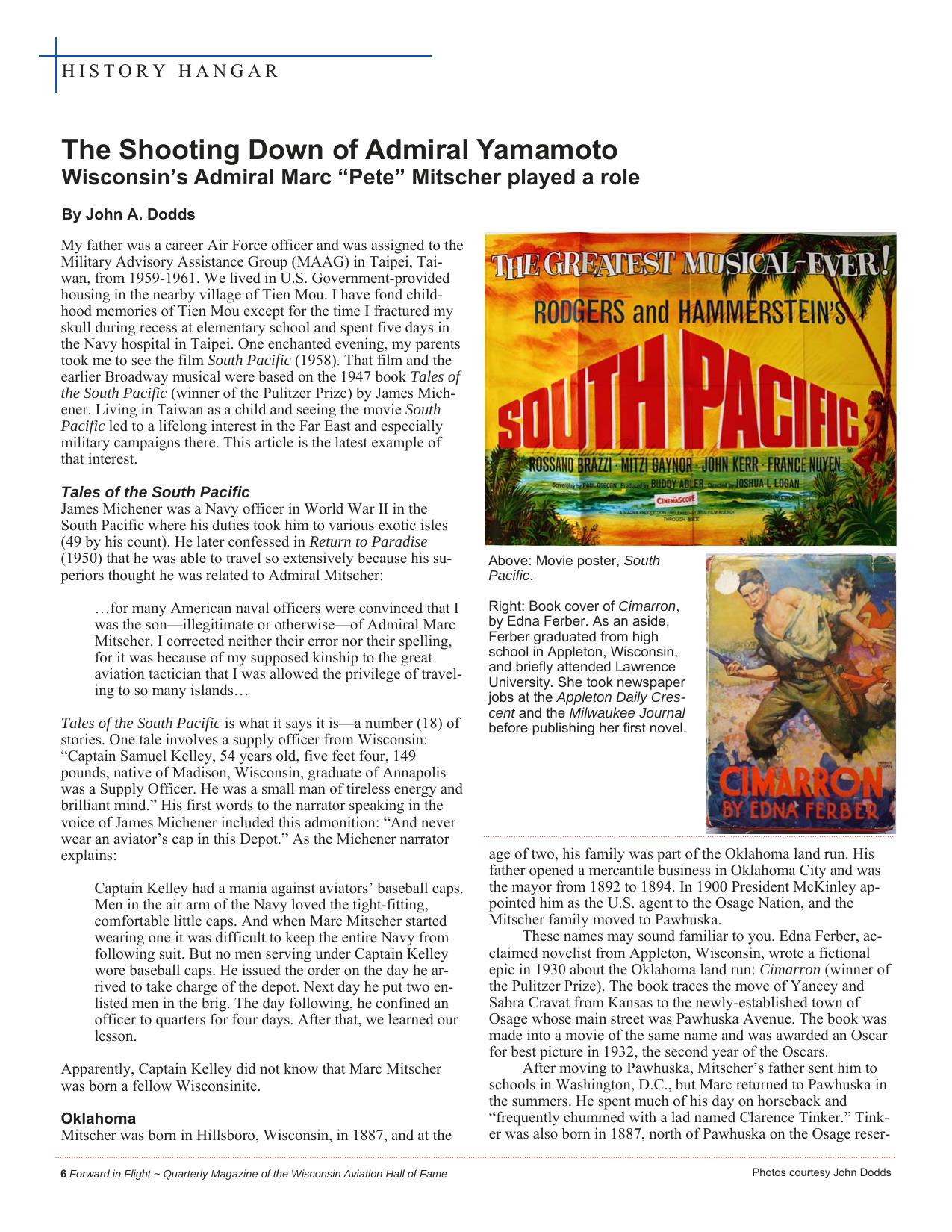
HISTORY HANGAR The Shooting Down of Admiral Yamamoto Wisconsin’s Admiral Marc “Pete” Mitscher played a role By John A. Dodds My father was a career Air Force officer and was assigned to the Military Advisory Assistance Group (MAAG) in Taipei, Taiwan, from 1959-1961. We lived in U.S. Government-provided housing in the nearby village of Tien Mou. I have fond childhood memories of Tien Mou except for the time I fractured my skull during recess at elementary school and spent five days in the Navy hospital in Taipei. One enchanted evening, my parents took me to see the film South Pacific (1958). That film and the earlier Broadway musical were based on the 1947 book Tales of the South Pacific (winner of the Pulitzer Prize) by James Michener. Living in Taiwan as a child and seeing the movie South Pacific led to a lifelong interest in the Far East and especially military campaigns there. This article is the latest example of that interest. Tales of the South Pacific James Michener was a Navy officer in World War II in the South Pacific where his duties took him to various exotic isles (49 by his count). He later confessed in Return to Paradise (1950) that he was able to travel so extensively because his superiors thought he was related to Admiral Mitscher: …for many American naval officers were convinced that I was the son—illegitimate or otherwise—of Admiral Marc Mitscher. I corrected neither their error nor their spelling, for it was because of my supposed kinship to the great aviation tactician that I was allowed the privilege of traveling to so many islands… Tales of the South Pacific is what it says it is—a number (18) of stories. One tale involves a supply officer from Wisconsin: “Captain Samuel Kelley, 54 years old, five feet four, 149 pounds, native of Madison, Wisconsin, graduate of Annapolis was a Supply Officer. He was a small man of tireless energy and brilliant mind.” His first words to the narrator speaking in the voice of James Michener included this admonition: “And never wear an aviator’s cap in this Depot.” As the Michener narrator explains: Above: Movie poster, South Pacific. Right: Book cover of Cimarron, by Edna Ferber. As an aside, Ferber graduated from high school in Appleton, Wisconsin, and briefly attended Lawrence University. She took newspaper jobs at the Appleton Daily Crescent and the Milwaukee Journal before publishing her first novel. Oklahoma Mitscher was born in Hillsboro, Wisconsin, in 1887, and at the age of two, his family was part of the Oklahoma land run. His father opened a mercantile business in Oklahoma City and was the mayor from 1892 to 1894. In 1900 President McKinley appointed him as the U.S. agent to the Osage Nation, and the Mitscher family moved to Pawhuska. These names may sound familiar to you. Edna Ferber, acclaimed novelist from Appleton, Wisconsin, wrote a fictional epic in 1930 about the Oklahoma land run: Cimarron (winner of the Pulitzer Prize). The book traces the move of Yancey and Sabra Cravat from Kansas to the newly-established town of Osage whose main street was Pawhuska Avenue. The book was made into a movie of the same name and was awarded an Oscar for best picture in 1932, the second year of the Oscars. After moving to Pawhuska, Mitscher’s father sent him to schools in Washington, D.C., but Marc returned to Pawhuska in the summers. He spent much of his day on horseback and “frequently chummed with a lad named Clarence Tinker.” Tinker was also born in 1887, north of Pawhuska on the Osage reser- 6 Forward in Flight ~ Quarterly Magazine of the Wisconsin Aviation Hall of Fame Photos courtesy John Dodds Captain Kelley had a mania against aviators’ baseball caps. Men in the air arm of the Navy loved the tight-fitting, comfortable little caps. And when Marc Mitscher started wearing one it was difficult to keep the entire Navy from following suit. But no men serving under Captain Kelley wore baseball caps. He issued the order on the day he arrived to take charge of the depot. Next day he put two enlisted men in the brig. The day following, he confined an officer to quarters for four days. After that, we learned our lesson. Apparently, Captain Kelley did not know that Marc Mitscher was born a fellow Wisconsinite.
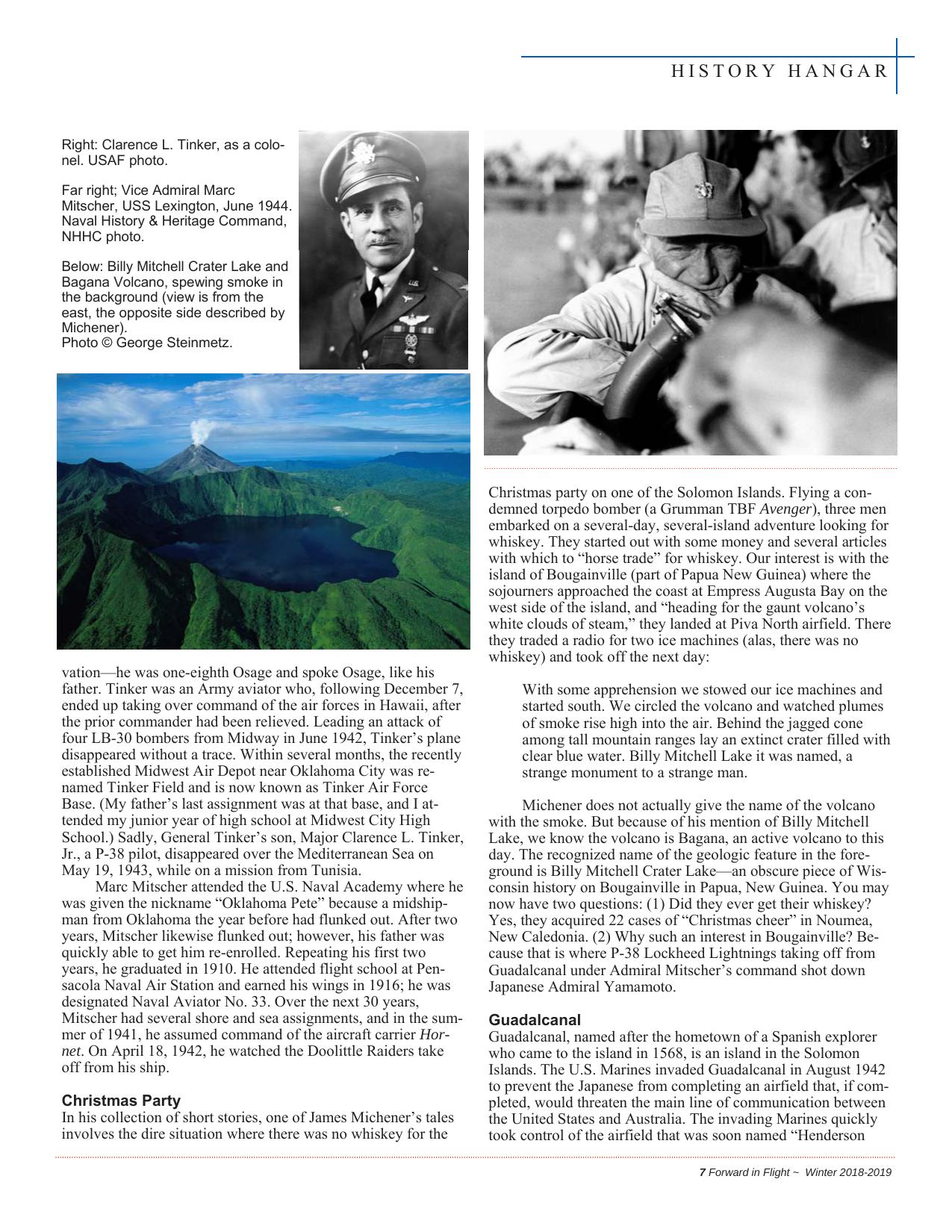
HISTORY HANGAR Right: Clarence L. Tinker, as a colonel. USAF photo. Far right; Vice Admiral Marc Mitscher, USS Lexington, June 1944. Naval History & Heritage Command, NHHC photo. Below: Billy Mitchell Crater Lake and Bagana Volcano, spewing smoke in the background (view is from the east, the opposite side described by Michener). Photo © George Steinmetz. vation—he was one-eighth Osage and spoke Osage, like his father. Tinker was an Army aviator who, following December 7, ended up taking over command of the air forces in Hawaii, after the prior commander had been relieved. Leading an attack of four LB-30 bombers from Midway in June 1942, Tinker’s plane disappeared without a trace. Within several months, the recently established Midwest Air Depot near Oklahoma City was renamed Tinker Field and is now known as Tinker Air Force Base. (My father’s last assignment was at that base, and I attended my junior year of high school at Midwest City High School.) Sadly, General Tinker’s son, Major Clarence L. Tinker, Jr., a P-38 pilot, disappeared over the Mediterranean Sea on May 19, 1943, while on a mission from Tunisia. Marc Mitscher attended the U.S. Naval Academy where he was given the nickname “Oklahoma Pete” because a midshipman from Oklahoma the year before had flunked out. After two years, Mitscher likewise flunked out; however, his father was quickly able to get him re-enrolled. Repeating his first two years, he graduated in 1910. He attended flight school at Pensacola Naval Air Station and earned his wings in 1916; he was designated Naval Aviator No. 33. Over the next 30 years, Mitscher had several shore and sea assignments, and in the summer of 1941, he assumed command of the aircraft carrier Hornet. On April 18, 1942, he watched the Doolittle Raiders take off from his ship. Christmas Party In his collection of short stories, one of James Michener’s tales involves the dire situation where there was no whiskey for the Christmas party on one of the Solomon Islands. Flying a condemned torpedo bomber (a Grumman TBF Avenger), three men embarked on a several-day, several-island adventure looking for whiskey. They started out with some money and several articles with which to “horse trade” for whiskey. Our interest is with the island of Bougainville (part of Papua New Guinea) where the sojourners approached the coast at Empress Augusta Bay on the west side of the island, and “heading for the gaunt volcano’s white clouds of steam,” they landed at Piva North airfield. There they traded a radio for two ice machines (alas, there was no whiskey) and took off the next day: With some apprehension we stowed our ice machines and started south. We circled the volcano and watched plumes of smoke rise high into the air. Behind the jagged cone among tall mountain ranges lay an extinct crater filled with clear blue water. Billy Mitchell Lake it was named, a strange monument to a strange man. Michener does not actually give the name of the volcano with the smoke. But because of his mention of Billy Mitchell Lake, we know the volcano is Bagana, an active volcano to this day. The recognized name of the geologic feature in the foreground is Billy Mitchell Crater Lake—an obscure piece of Wisconsin history on Bougainville in Papua, New Guinea. You may now have two questions: (1) Did they ever get their whiskey? Yes, they acquired 22 cases of “Christmas cheer” in Noumea, New Caledonia. (2) Why such an interest in Bougainville? Because that is where P-38 Lockheed Lightnings taking off from Guadalcanal under Admiral Mitscher’s command shot down Japanese Admiral Yamamoto. Guadalcanal Guadalcanal, named after the hometown of a Spanish explorer who came to the island in 1568, is an island in the Solomon Islands. The U.S. Marines invaded Guadalcanal in August 1942 to prevent the Japanese from completing an airfield that, if completed, would threaten the main line of communication between the United States and Australia. The invading Marines quickly took control of the airfield that was soon named “Henderson 7 Forward in Flight ~ Winter 2018-2019
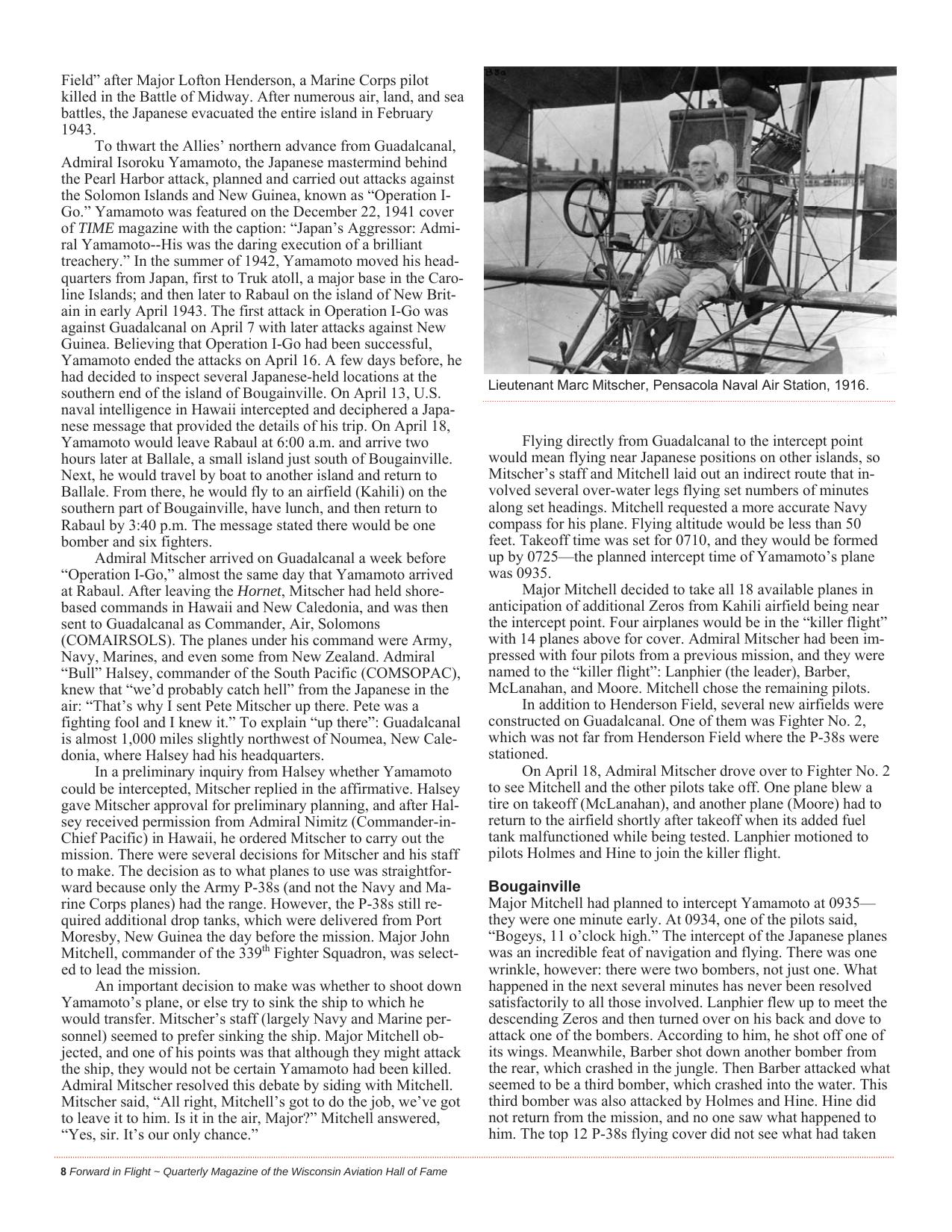
Field” after Major Lofton Henderson, a Marine Corps pilot killed in the Battle of Midway. After numerous air, land, and sea battles, the Japanese evacuated the entire island in February 1943. To thwart the Allies’ northern advance from Guadalcanal, Admiral Isoroku Yamamoto, the Japanese mastermind behind the Pearl Harbor attack, planned and carried out attacks against the Solomon Islands and New Guinea, known as “Operation IGo.” Yamamoto was featured on the December 22, 1941 cover of TIME magazine with the caption: “Japan’s Aggressor: Admiral Yamamoto--His was the daring execution of a brilliant treachery.” In the summer of 1942, Yamamoto moved his headquarters from Japan, first to Truk atoll, a major base in the Caroline Islands; and then later to Rabaul on the island of New Britain in early April 1943. The first attack in Operation I-Go was against Guadalcanal on April 7 with later attacks against New Guinea. Believing that Operation I-Go had been successful, Yamamoto ended the attacks on April 16. A few days before, he had decided to inspect several Japanese-held locations at the southern end of the island of Bougainville. On April 13, U.S. naval intelligence in Hawaii intercepted and deciphered a Japanese message that provided the details of his trip. On April 18, Yamamoto would leave Rabaul at 6:00 a.m. and arrive two hours later at Ballale, a small island just south of Bougainville. Next, he would travel by boat to another island and return to Ballale. From there, he would fly to an airfield (Kahili) on the southern part of Bougainville, have lunch, and then return to Rabaul by 3:40 p.m. The message stated there would be one bomber and six fighters. Admiral Mitscher arrived on Guadalcanal a week before “Operation I-Go,” almost the same day that Yamamoto arrived at Rabaul. After leaving the Hornet, Mitscher had held shorebased commands in Hawaii and New Caledonia, and was then sent to Guadalcanal as Commander, Air, Solomons (COMAIRSOLS). The planes under his command were Army, Navy, Marines, and even some from New Zealand. Admiral “Bull” Halsey, commander of the South Pacific (COMSOPAC), knew that “we’d probably catch hell” from the Japanese in the air: “That’s why I sent Pete Mitscher up there. Pete was a fighting fool and I knew it.” To explain “up there”: Guadalcanal is almost 1,000 miles slightly northwest of Noumea, New Caledonia, where Halsey had his headquarters. In a preliminary inquiry from Halsey whether Yamamoto could be intercepted, Mitscher replied in the affirmative. Halsey gave Mitscher approval for preliminary planning, and after Halsey received permission from Admiral Nimitz (Commander-inChief Pacific) in Hawaii, he ordered Mitscher to carry out the mission. There were several decisions for Mitscher and his staff to make. The decision as to what planes to use was straightforward because only the Army P-38s (and not the Navy and Marine Corps planes) had the range. However, the P-38s still required additional drop tanks, which were delivered from Port Moresby, New Guinea the day before the mission. Major John Mitchell, commander of the 339th Fighter Squadron, was selected to lead the mission. An important decision to make was whether to shoot down Yamamoto’s plane, or else try to sink the ship to which he would transfer. Mitscher’s staff (largely Navy and Marine personnel) seemed to prefer sinking the ship. Major Mitchell objected, and one of his points was that although they might attack the ship, they would not be certain Yamamoto had been killed. Admiral Mitscher resolved this debate by siding with Mitchell. Mitscher said, “All right, Mitchell’s got to do the job, we’ve got to leave it to him. Is it in the air, Major?” Mitchell answered, “Yes, sir. It’s our only chance.” 8 Forward in Flight ~ Quarterly Magazine of the Wisconsin Aviation Hall of Fame Lieutenant Marc Mitscher, Pensacola Naval Air Station, 1916. Flying directly from Guadalcanal to the intercept point would mean flying near Japanese positions on other islands, so Mitscher’s staff and Mitchell laid out an indirect route that involved several over-water legs flying set numbers of minutes along set headings. Mitchell requested a more accurate Navy compass for his plane. Flying altitude would be less than 50 feet. Takeoff time was set for 0710, and they would be formed up by 0725—the planned intercept time of Yamamoto’s plane was 0935. Major Mitchell decided to take all 18 available planes in anticipation of additional Zeros from Kahili airfield being near the intercept point. Four airplanes would be in the “killer flight” with 14 planes above for cover. Admiral Mitscher had been impressed with four pilots from a previous mission, and they were named to the “killer flight”: Lanphier (the leader), Barber, McLanahan, and Moore. Mitchell chose the remaining pilots. In addition to Henderson Field, several new airfields were constructed on Guadalcanal. One of them was Fighter No. 2, which was not far from Henderson Field where the P-38s were stationed. On April 18, Admiral Mitscher drove over to Fighter No. 2 to see Mitchell and the other pilots take off. One plane blew a tire on takeoff (McLanahan), and another plane (Moore) had to return to the airfield shortly after takeoff when its added fuel tank malfunctioned while being tested. Lanphier motioned to pilots Holmes and Hine to join the killer flight. Bougainville Major Mitchell had planned to intercept Yamamoto at 0935— they were one minute early. At 0934, one of the pilots said, “Bogeys, 11 o’clock high.” The intercept of the Japanese planes was an incredible feat of navigation and flying. There was one wrinkle, however: there were two bombers, not just one. What happened in the next several minutes has never been resolved satisfactorily to all those involved. Lanphier flew up to meet the descending Zeros and then turned over on his back and dove to attack one of the bombers. According to him, he shot off one of its wings. Meanwhile, Barber shot down another bomber from the rear, which crashed in the jungle. Then Barber attacked what seemed to be a third bomber, which crashed into the water. This third bomber was also attacked by Holmes and Hine. Hine did not return from the mission, and no one saw what happened to him. The top 12 P-38s flying cover did not see what had taken
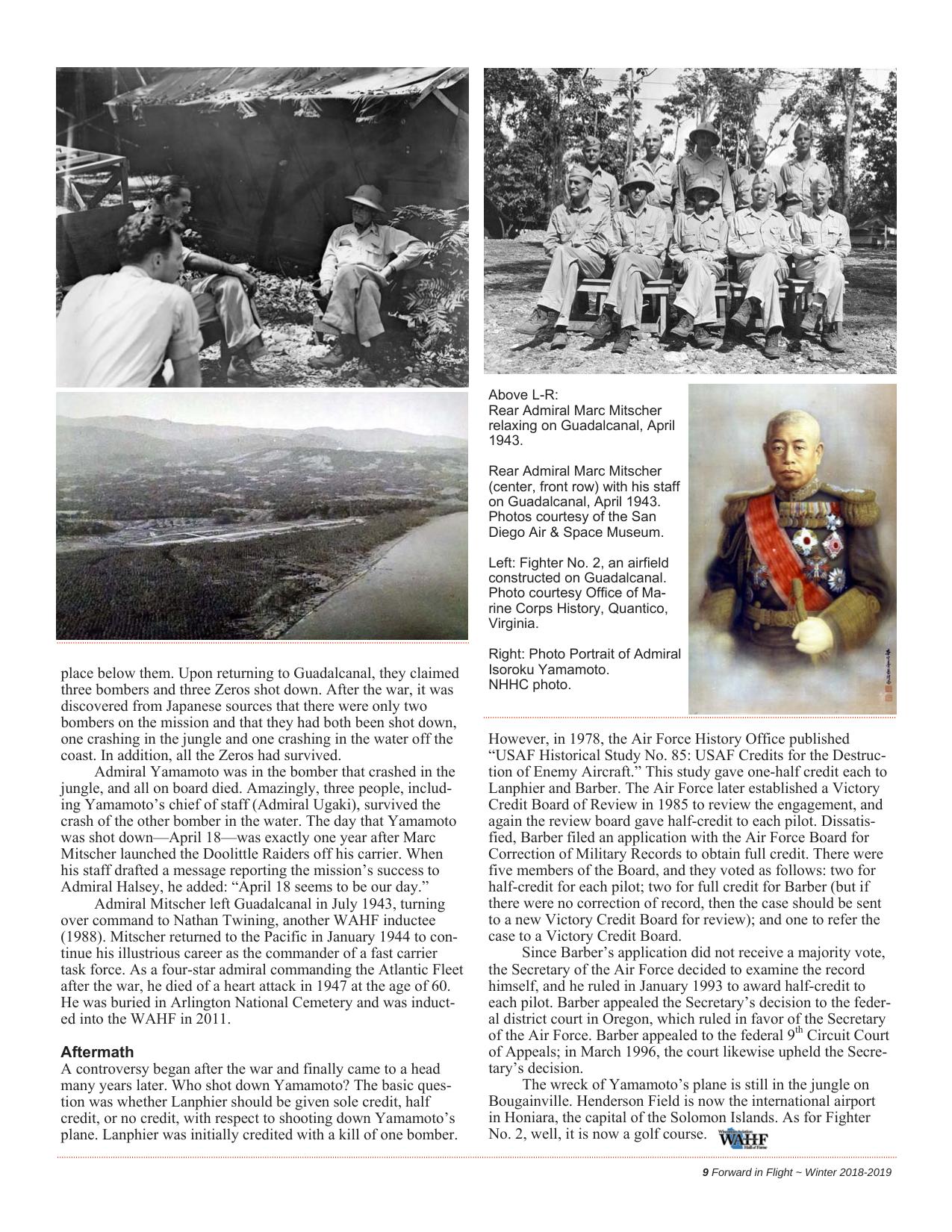
Above L-R: Rear Admiral Marc Mitscher relaxing on Guadalcanal, April 1943. Rear Admiral Marc Mitscher (center, front row) with his staff on Guadalcanal, April 1943. Photos courtesy of the San Diego Air & Space Museum. Left: Fighter No. 2, an airfield constructed on Guadalcanal. Photo courtesy Office of Marine Corps History, Quantico, Virginia. place below them. Upon returning to Guadalcanal, they claimed three bombers and three Zeros shot down. After the war, it was discovered from Japanese sources that there were only two bombers on the mission and that they had both been shot down, one crashing in the jungle and one crashing in the water off the coast. In addition, all the Zeros had survived. Admiral Yamamoto was in the bomber that crashed in the jungle, and all on board died. Amazingly, three people, including Yamamoto’s chief of staff (Admiral Ugaki), survived the crash of the other bomber in the water. The day that Yamamoto was shot down—April 18—was exactly one year after Marc Mitscher launched the Doolittle Raiders off his carrier. When his staff drafted a message reporting the mission’s success to Admiral Halsey, he added: “April 18 seems to be our day.” Admiral Mitscher left Guadalcanal in July 1943, turning over command to Nathan Twining, another WAHF inductee (1988). Mitscher returned to the Pacific in January 1944 to continue his illustrious career as the commander of a fast carrier task force. As a four-star admiral commanding the Atlantic Fleet after the war, he died of a heart attack in 1947 at the age of 60. He was buried in Arlington National Cemetery and was inducted into the WAHF in 2011. Aftermath A controversy began after the war and finally came to a head many years later. Who shot down Yamamoto? The basic question was whether Lanphier should be given sole credit, half credit, or no credit, with respect to shooting down Yamamoto’s plane. Lanphier was initially credited with a kill of one bomber. Right: Photo Portrait of Admiral Isoroku Yamamoto. NHHC photo. However, in 1978, the Air Force History Office published “USAF Historical Study No. 85: USAF Credits for the Destruction of Enemy Aircraft.” This study gave one-half credit each to Lanphier and Barber. The Air Force later established a Victory Credit Board of Review in 1985 to review the engagement, and again the review board gave half-credit to each pilot. Dissatisfied, Barber filed an application with the Air Force Board for Correction of Military Records to obtain full credit. There were five members of the Board, and they voted as follows: two for half-credit for each pilot; two for full credit for Barber (but if there were no correction of record, then the case should be sent to a new Victory Credit Board for review); and one to refer the case to a Victory Credit Board. Since Barber’s application did not receive a majority vote, the Secretary of the Air Force decided to examine the record himself, and he ruled in January 1993 to award half-credit to each pilot. Barber appealed the Secretary’s decision to the federal district court in Oregon, which ruled in favor of the Secretary of the Air Force. Barber appealed to the federal 9th Circuit Court of Appeals; in March 1996, the court likewise upheld the Secretary’s decision. The wreck of Yamamoto’s plane is still in the jungle on Bougainville. Henderson Field is now the international airport in Honiara, the capital of the Solomon Islands. As for Fighter No. 2, well, it is now a golf course. 9 Forward in Flight ~ Winter 2018-2019
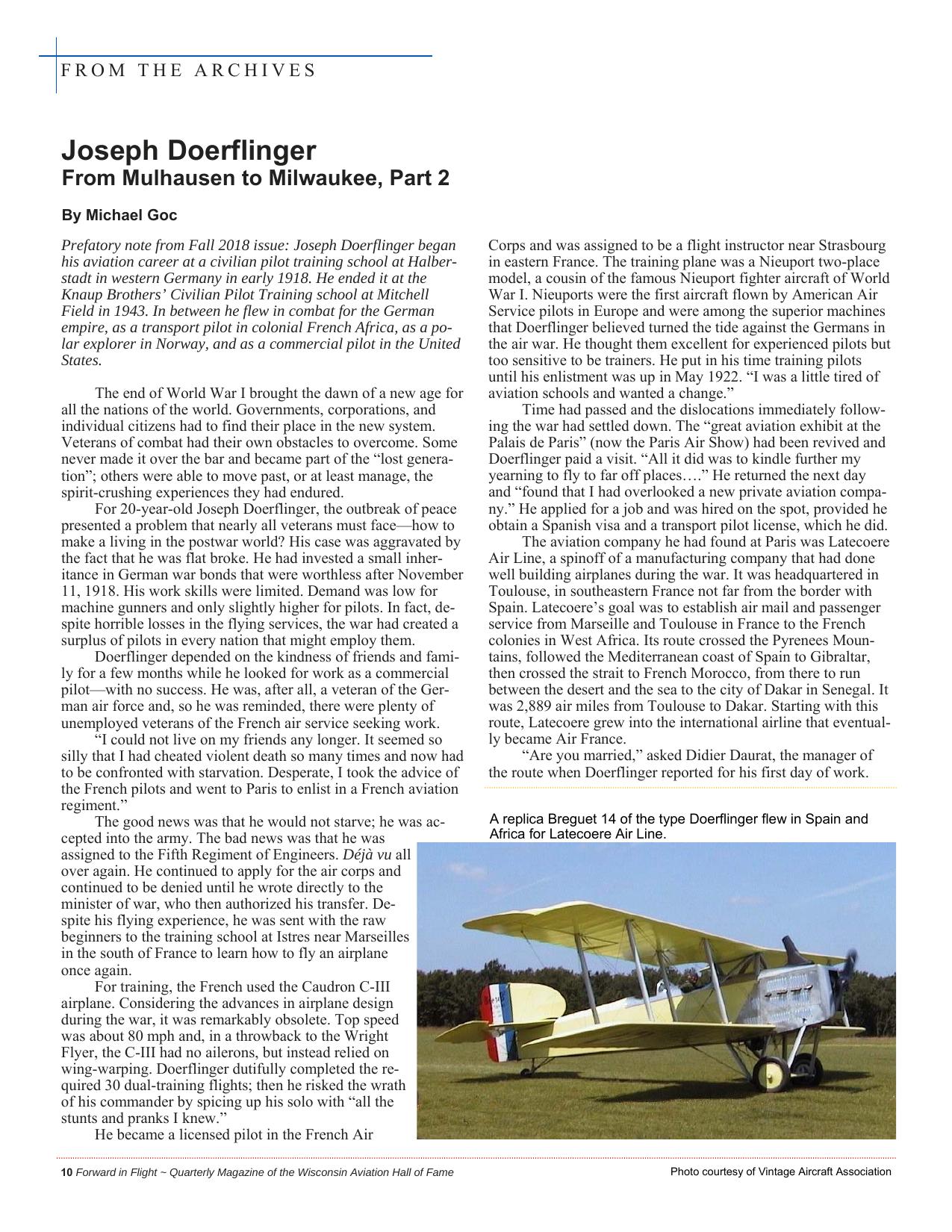
FROM THE ARCHIVES Joseph Doerflinger From Mulhausen to Milwaukee, Part 2 By Michael Goc Prefatory note from Fall 2018 issue: Joseph Doerflinger began his aviation career at a civilian pilot training school at Halberstadt in western Germany in early 1918. He ended it at the Knaup Brothers’ Civilian Pilot Training school at Mitchell Field in 1943. In between he flew in combat for the German empire, as a transport pilot in colonial French Africa, as a polar explorer in Norway, and as a commercial pilot in the United States. The end of World War I brought the dawn of a new age for all the nations of the world. Governments, corporations, and individual citizens had to find their place in the new system. Veterans of combat had their own obstacles to overcome. Some never made it over the bar and became part of the “lost generation”; others were able to move past, or at least manage, the spirit-crushing experiences they had endured. For 20-year-old Joseph Doerflinger, the outbreak of peace presented a problem that nearly all veterans must face—how to make a living in the postwar world? His case was aggravated by the fact that he was flat broke. He had invested a small inheritance in German war bonds that were worthless after November 11, 1918. His work skills were limited. Demand was low for machine gunners and only slightly higher for pilots. In fact, despite horrible losses in the flying services, the war had created a surplus of pilots in every nation that might employ them. Doerflinger depended on the kindness of friends and family for a few months while he looked for work as a commercial pilot—with no success. He was, after all, a veteran of the German air force and, so he was reminded, there were plenty of unemployed veterans of the French air service seeking work. “I could not live on my friends any longer. It seemed so silly that I had cheated violent death so many times and now had to be confronted with starvation. Desperate, I took the advice of the French pilots and went to Paris to enlist in a French aviation regiment.” The good news was that he would not starve; he was accepted into the army. The bad news was that he was assigned to the Fifth Regiment of Engineers. Déjà vu all over again. He continued to apply for the air corps and continued to be denied until he wrote directly to the minister of war, who then authorized his transfer. Despite his flying experience, he was sent with the raw beginners to the training school at Istres near Marseilles in the south of France to learn how to fly an airplane once again. For training, the French used the Caudron C-III airplane. Considering the advances in airplane design during the war, it was remarkably obsolete. Top speed was about 80 mph and, in a throwback to the Wright Flyer, the C-III had no ailerons, but instead relied on wing-warping. Doerflinger dutifully completed the required 30 dual-training flights; then he risked the wrath of his commander by spicing up his solo with “all the stunts and pranks I knew.” He became a licensed pilot in the French Air 10 Forward in Flight ~ Quarterly Magazine of the Wisconsin Aviation Hall of Fame Corps and was assigned to be a flight instructor near Strasbourg in eastern France. The training plane was a Nieuport two-place model, a cousin of the famous Nieuport fighter aircraft of World War I. Nieuports were the first aircraft flown by American Air Service pilots in Europe and were among the superior machines that Doerflinger believed turned the tide against the Germans in the air war. He thought them excellent for experienced pilots but too sensitive to be trainers. He put in his time training pilots until his enlistment was up in May 1922. “I was a little tired of aviation schools and wanted a change.” Time had passed and the dislocations immediately following the war had settled down. The “great aviation exhibit at the Palais de Paris” (now the Paris Air Show) had been revived and Doerflinger paid a visit. “All it did was to kindle further my yearning to fly to far off places….” He returned the next day and “found that I had overlooked a new private aviation company.” He applied for a job and was hired on the spot, provided he obtain a Spanish visa and a transport pilot license, which he did. The aviation company he had found at Paris was Latecoere Air Line, a spinoff of a manufacturing company that had done well building airplanes during the war. It was headquartered in Toulouse, in southeastern France not far from the border with Spain. Latecoere’s goal was to establish air mail and passenger service from Marseille and Toulouse in France to the French colonies in West Africa. Its route crossed the Pyrenees Mountains, followed the Mediterranean coast of Spain to Gibraltar, then crossed the strait to French Morocco, from there to run between the desert and the sea to the city of Dakar in Senegal. It was 2,889 air miles from Toulouse to Dakar. Starting with this route, Latecoere grew into the international airline that eventually became Air France. “Are you married,” asked Didier Daurat, the manager of the route when Doerflinger reported for his first day of work. A replica Breguet 14 of the type Doerflinger flew in Spain and Africa for Latecoere Air Line. Photo courtesy of Vintage Aircraft Association
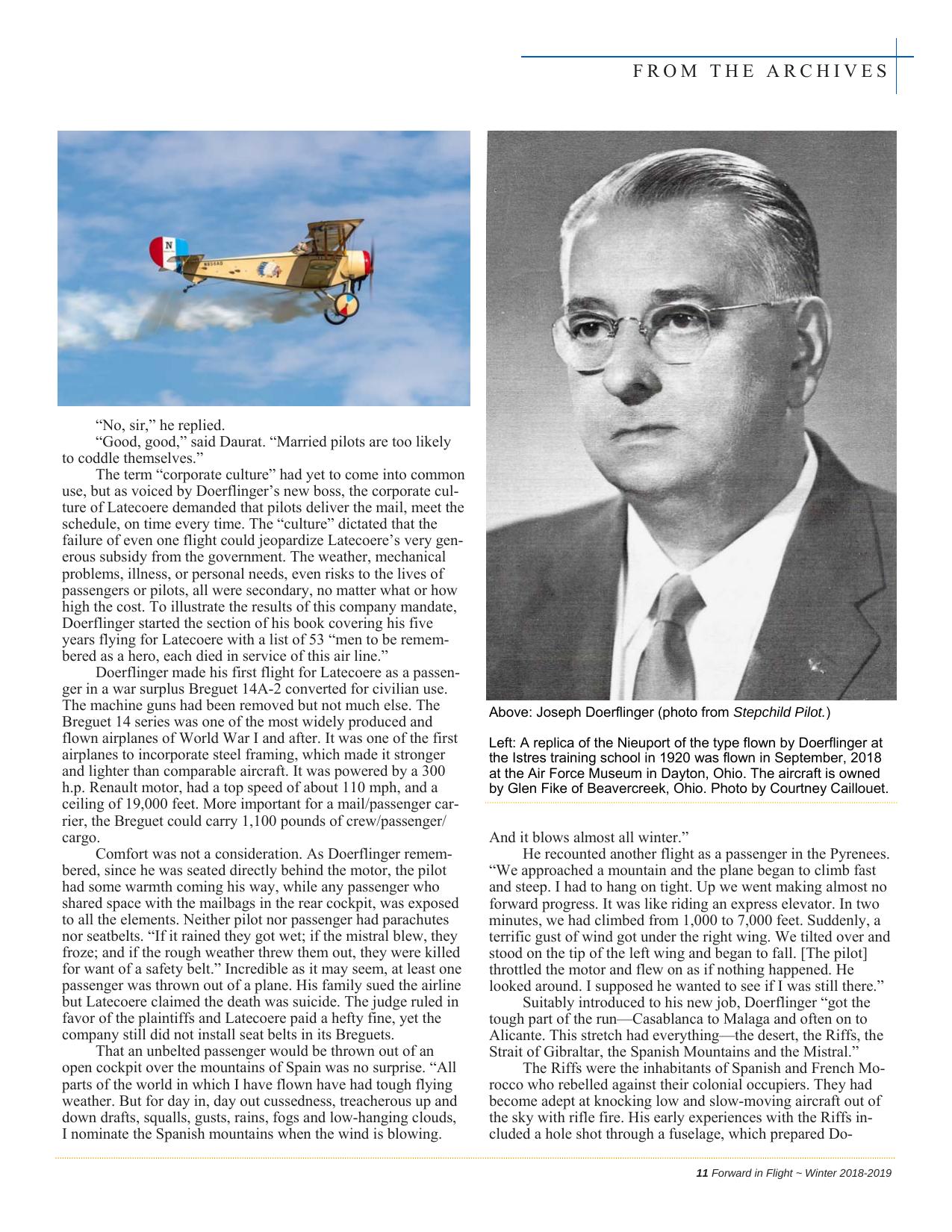
FROM THE ARCHIVES “No, sir,” he replied. “Good, good,” said Daurat. “Married pilots are too likely to coddle themselves.” The term “corporate culture” had yet to come into common use, but as voiced by Doerflinger’s new boss, the corporate culture of Latecoere demanded that pilots deliver the mail, meet the schedule, on time every time. The “culture” dictated that the failure of even one flight could jeopardize Latecoere’s very generous subsidy from the government. The weather, mechanical problems, illness, or personal needs, even risks to the lives of passengers or pilots, all were secondary, no matter what or how high the cost. To illustrate the results of this company mandate, Doerflinger started the section of his book covering his five years flying for Latecoere with a list of 53 “men to be remembered as a hero, each died in service of this air line.” Doerflinger made his first flight for Latecoere as a passenger in a war surplus Breguet 14A-2 converted for civilian use. The machine guns had been removed but not much else. The Breguet 14 series was one of the most widely produced and flown airplanes of World War I and after. It was one of the first airplanes to incorporate steel framing, which made it stronger and lighter than comparable aircraft. It was powered by a 300 h.p. Renault motor, had a top speed of about 110 mph, and a ceiling of 19,000 feet. More important for a mail/passenger carrier, the Breguet could carry 1,100 pounds of crew/passenger/ cargo. Comfort was not a consideration. As Doerflinger remembered, since he was seated directly behind the motor, the pilot had some warmth coming his way, while any passenger who shared space with the mailbags in the rear cockpit, was exposed to all the elements. Neither pilot nor passenger had parachutes nor seatbelts. “If it rained they got wet; if the mistral blew, they froze; and if the rough weather threw them out, they were killed for want of a safety belt.” Incredible as it may seem, at least one passenger was thrown out of a plane. His family sued the airline but Latecoere claimed the death was suicide. The judge ruled in favor of the plaintiffs and Latecoere paid a hefty fine, yet the company still did not install seat belts in its Breguets. That an unbelted passenger would be thrown out of an open cockpit over the mountains of Spain was no surprise. “All parts of the world in which I have flown have had tough flying weather. But for day in, day out cussedness, treacherous up and down drafts, squalls, gusts, rains, fogs and low-hanging clouds, I nominate the Spanish mountains when the wind is blowing. Above: Joseph Doerflinger (photo from Stepchild Pilot.) Left: A replica of the Nieuport of the type flown by Doerflinger at the Istres training school in 1920 was flown in September, 2018 at the Air Force Museum in Dayton, Ohio. The aircraft is owned by Glen Fike of Beavercreek, Ohio. Photo by Courtney Caillouet. And it blows almost all winter.” He recounted another flight as a passenger in the Pyrenees. “We approached a mountain and the plane began to climb fast and steep. I had to hang on tight. Up we went making almost no forward progress. It was like riding an express elevator. In two minutes, we had climbed from 1,000 to 7,000 feet. Suddenly, a terrific gust of wind got under the right wing. We tilted over and stood on the tip of the left wing and began to fall. [The pilot] throttled the motor and flew on as if nothing happened. He looked around. I supposed he wanted to see if I was still there.” Suitably introduced to his new job, Doerflinger “got the tough part of the run—Casablanca to Malaga and often on to Alicante. This stretch had everything—the desert, the Riffs, the Strait of Gibraltar, the Spanish Mountains and the Mistral.” The Riffs were the inhabitants of Spanish and French Morocco who rebelled against their colonial occupiers. They had become adept at knocking low and slow-moving aircraft out of the sky with rifle fire. His early experiences with the Riffs included a hole shot through a fuselage, which prepared Do11 Forward in Flight ~ Winter 2018-2019
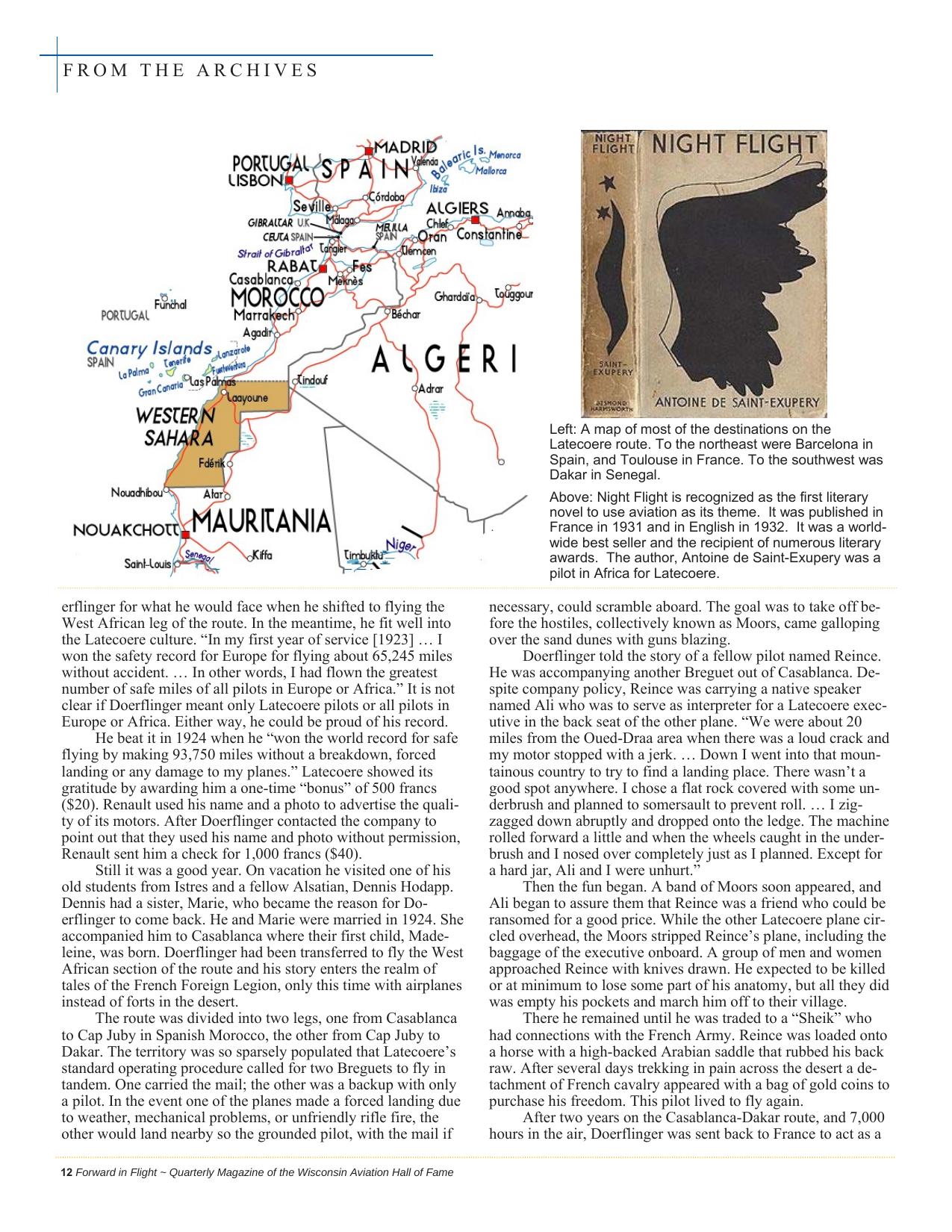
FROM THE ARCHIVES Left: A map of most of the destinations on the Latecoere route. To the northeast were Barcelona in Spain, and Toulouse in France. To the southwest was Dakar in Senegal. Above: Night Flight is recognized as the first literary novel to use aviation as its theme. It was published in France in 1931 and in English in 1932. It was a worldwide best seller and the recipient of numerous literary awards. The author, Antoine de Saint-Exupery was a pilot in Africa for Latecoere. erflinger for what he would face when he shifted to flying the West African leg of the route. In the meantime, he fit well into the Latecoere culture. “In my first year of service [1923] … I won the safety record for Europe for flying about 65,245 miles without accident. … In other words, I had flown the greatest number of safe miles of all pilots in Europe or Africa.” It is not clear if Doerflinger meant only Latecoere pilots or all pilots in Europe or Africa. Either way, he could be proud of his record. He beat it in 1924 when he “won the world record for safe flying by making 93,750 miles without a breakdown, forced landing or any damage to my planes.” Latecoere showed its gratitude by awarding him a one-time “bonus” of 500 francs ($20). Renault used his name and a photo to advertise the quality of its motors. After Doerflinger contacted the company to point out that they used his name and photo without permission, Renault sent him a check for 1,000 francs ($40). Still it was a good year. On vacation he visited one of his old students from Istres and a fellow Alsatian, Dennis Hodapp. Dennis had a sister, Marie, who became the reason for Doerflinger to come back. He and Marie were married in 1924. She accompanied him to Casablanca where their first child, Madeleine, was born. Doerflinger had been transferred to fly the West African section of the route and his story enters the realm of tales of the French Foreign Legion, only this time with airplanes instead of forts in the desert. The route was divided into two legs, one from Casablanca to Cap Juby in Spanish Morocco, the other from Cap Juby to Dakar. The territory was so sparsely populated that Latecoere’s standard operating procedure called for two Breguets to fly in tandem. One carried the mail; the other was a backup with only a pilot. In the event one of the planes made a forced landing due to weather, mechanical problems, or unfriendly rifle fire, the other would land nearby so the grounded pilot, with the mail if 12 Forward in Flight ~ Quarterly Magazine of the Wisconsin Aviation Hall of Fame necessary, could scramble aboard. The goal was to take off before the hostiles, collectively known as Moors, came galloping over the sand dunes with guns blazing. Doerflinger told the story of a fellow pilot named Reince. He was accompanying another Breguet out of Casablanca. Despite company policy, Reince was carrying a native speaker named Ali who was to serve as interpreter for a Latecoere executive in the back seat of the other plane. “We were about 20 miles from the Oued-Draa area when there was a loud crack and my motor stopped with a jerk. … Down I went into that mountainous country to try to find a landing place. There wasn’t a good spot anywhere. I chose a flat rock covered with some underbrush and planned to somersault to prevent roll. … I zigzagged down abruptly and dropped onto the ledge. The machine rolled forward a little and when the wheels caught in the underbrush and I nosed over completely just as I planned. Except for a hard jar, Ali and I were unhurt.” Then the fun began. A band of Moors soon appeared, and Ali began to assure them that Reince was a friend who could be ransomed for a good price. While the other Latecoere plane circled overhead, the Moors stripped Reince’s plane, including the baggage of the executive onboard. A group of men and women approached Reince with knives drawn. He expected to be killed or at minimum to lose some part of his anatomy, but all they did was empty his pockets and march him off to their village. There he remained until he was traded to a “Sheik” who had connections with the French Army. Reince was loaded onto a horse with a high-backed Arabian saddle that rubbed his back raw. After several days trekking in pain across the desert a detachment of French cavalry appeared with a bag of gold coins to purchase his freedom. This pilot lived to fly again. After two years on the Casablanca-Dakar route, and 7,000 hours in the air, Doerflinger was sent back to France to act as a
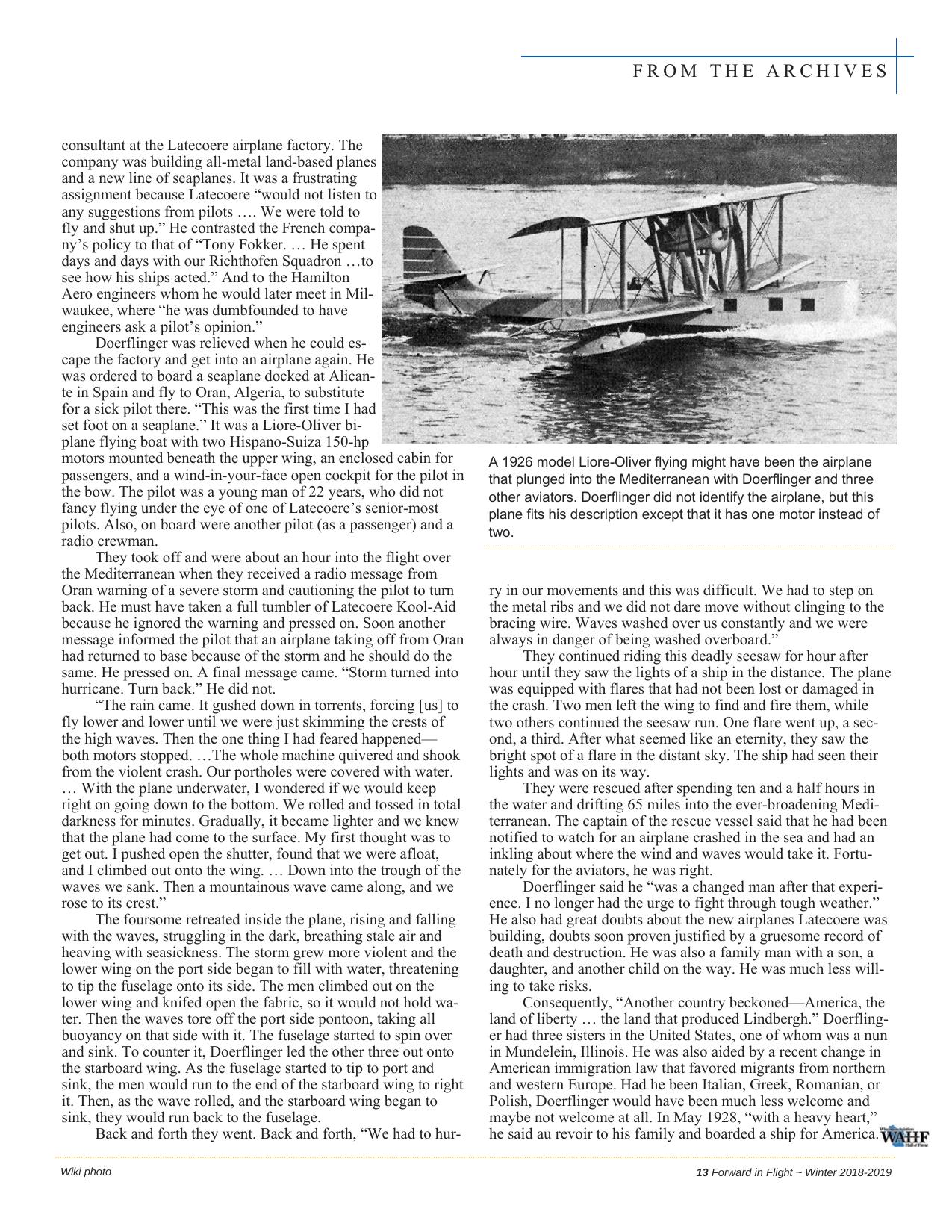
FROM THE ARCHIVES consultant at the Latecoere airplane factory. The company was building all-metal land-based planes and a new line of seaplanes. It was a frustrating assignment because Latecoere “would not listen to any suggestions from pilots …. We were told to fly and shut up.” He contrasted the French company’s policy to that of “Tony Fokker. … He spent days and days with our Richthofen Squadron …to see how his ships acted.” And to the Hamilton Aero engineers whom he would later meet in Milwaukee, where “he was dumbfounded to have engineers ask a pilot’s opinion.” Doerflinger was relieved when he could escape the factory and get into an airplane again. He was ordered to board a seaplane docked at Alicante in Spain and fly to Oran, Algeria, to substitute for a sick pilot there. “This was the first time I had set foot on a seaplane.” It was a Liore-Oliver biplane flying boat with two Hispano-Suiza 150-hp motors mounted beneath the upper wing, an enclosed cabin for passengers, and a wind-in-your-face open cockpit for the pilot in the bow. The pilot was a young man of 22 years, who did not fancy flying under the eye of one of Latecoere’s senior-most pilots. Also, on board were another pilot (as a passenger) and a radio crewman. They took off and were about an hour into the flight over the Mediterranean when they received a radio message from Oran warning of a severe storm and cautioning the pilot to turn back. He must have taken a full tumbler of Latecoere Kool-Aid because he ignored the warning and pressed on. Soon another message informed the pilot that an airplane taking off from Oran had returned to base because of the storm and he should do the same. He pressed on. A final message came. “Storm turned into hurricane. Turn back.” He did not. “The rain came. It gushed down in torrents, forcing [us] to fly lower and lower until we were just skimming the crests of the high waves. Then the one thing I had feared happened— both motors stopped. …The whole machine quivered and shook from the violent crash. Our portholes were covered with water. … With the plane underwater, I wondered if we would keep right on going down to the bottom. We rolled and tossed in total darkness for minutes. Gradually, it became lighter and we knew that the plane had come to the surface. My first thought was to get out. I pushed open the shutter, found that we were afloat, and I climbed out onto the wing. … Down into the trough of the waves we sank. Then a mountainous wave came along, and we rose to its crest.” The foursome retreated inside the plane, rising and falling with the waves, struggling in the dark, breathing stale air and heaving with seasickness. The storm grew more violent and the lower wing on the port side began to fill with water, threatening to tip the fuselage onto its side. The men climbed out on the lower wing and knifed open the fabric, so it would not hold water. Then the waves tore off the port side pontoon, taking all buoyancy on that side with it. The fuselage started to spin over and sink. To counter it, Doerflinger led the other three out onto the starboard wing. As the fuselage started to tip to port and sink, the men would run to the end of the starboard wing to right it. Then, as the wave rolled, and the starboard wing began to sink, they would run back to the fuselage. Back and forth they went. Back and forth, “We had to hurWiki photo A 1926 model Liore-Oliver flying might have been the airplane that plunged into the Mediterranean with Doerflinger and three other aviators. Doerflinger did not identify the airplane, but this plane fits his description except that it has one motor instead of two. ry in our movements and this was difficult. We had to step on the metal ribs and we did not dare move without clinging to the bracing wire. Waves washed over us constantly and we were always in danger of being washed overboard.” They continued riding this deadly seesaw for hour after hour until they saw the lights of a ship in the distance. The plane was equipped with flares that had not been lost or damaged in the crash. Two men left the wing to find and fire them, while two others continued the seesaw run. One flare went up, a second, a third. After what seemed like an eternity, they saw the bright spot of a flare in the distant sky. The ship had seen their lights and was on its way. They were rescued after spending ten and a half hours in the water and drifting 65 miles into the ever-broadening Mediterranean. The captain of the rescue vessel said that he had been notified to watch for an airplane crashed in the sea and had an inkling about where the wind and waves would take it. Fortunately for the aviators, he was right. Doerflinger said he “was a changed man after that experience. I no longer had the urge to fight through tough weather.” He also had great doubts about the new airplanes Latecoere was building, doubts soon proven justified by a gruesome record of death and destruction. He was also a family man with a son, a daughter, and another child on the way. He was much less willing to take risks. Consequently, “Another country beckoned—America, the land of liberty … the land that produced Lindbergh.” Doerflinger had three sisters in the United States, one of whom was a nun in Mundelein, Illinois. He was also aided by a recent change in American immigration law that favored migrants from northern and western Europe. Had he been Italian, Greek, Romanian, or Polish, Doerflinger would have been much less welcome and maybe not welcome at all. In May 1928, “with a heavy heart,” he said au revoir to his family and boarded a ship for America. 13 Forward in Flight ~ Winter 2018-2019
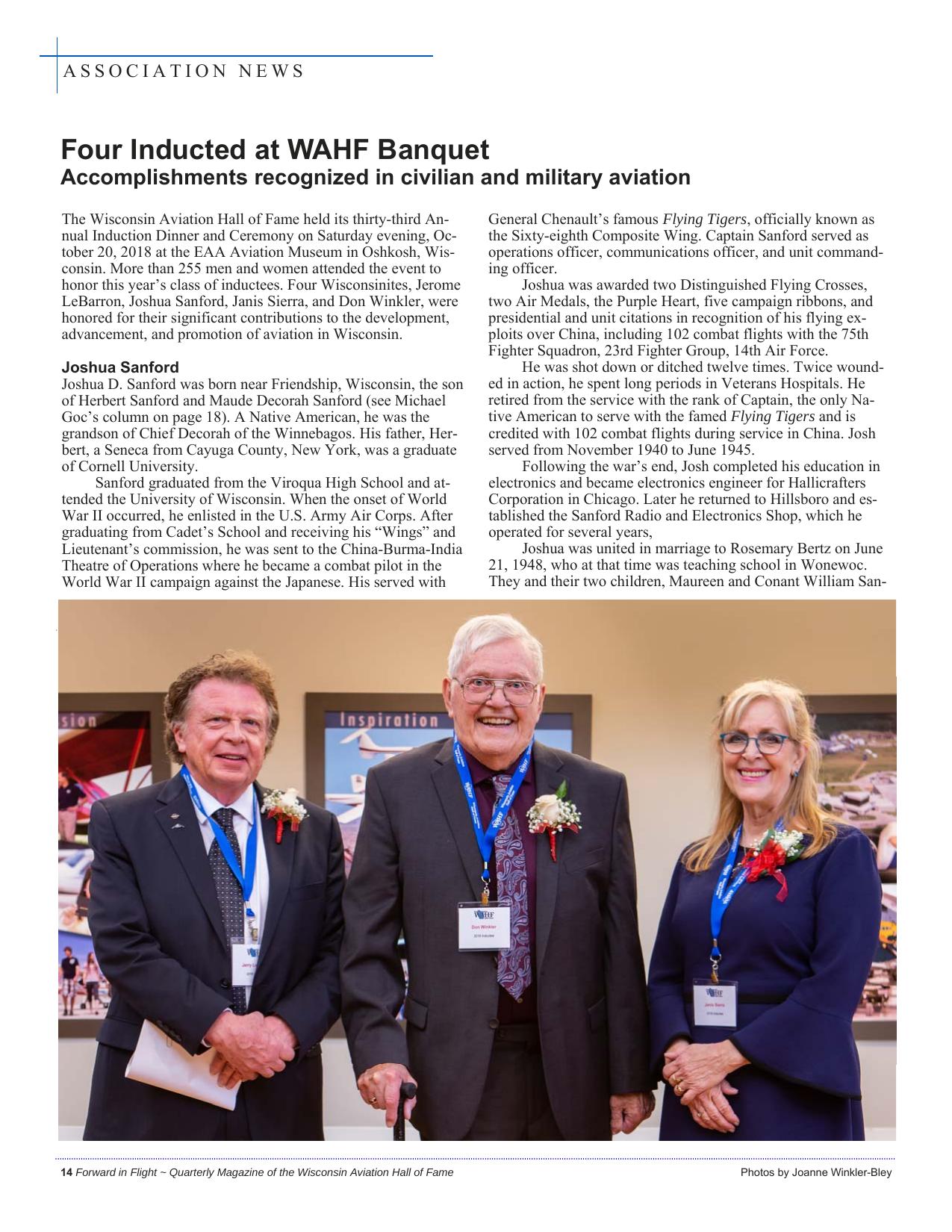
ASSOCIATION NEWS Four Inducted at WAHF Banquet Accomplishments recognized in civilian and military aviation The Wisconsin Aviation Hall of Fame held its thirty-third Annual Induction Dinner and Ceremony on Saturday evening, October 20, 2018 at the EAA Aviation Museum in Oshkosh, Wisconsin. More than 255 men and women attended the event to honor this year’s class of inductees. Four Wisconsinites, Jerome LeBarron, Joshua Sanford, Janis Sierra, and Don Winkler, were honored for their significant contributions to the development, advancement, and promotion of aviation in Wisconsin. Joshua Sanford Joshua D. Sanford was born near Friendship, Wisconsin, the son of Herbert Sanford and Maude Decorah Sanford (see Michael Goc’s column on page 18). A Native American, he was the grandson of Chief Decorah of the Winnebagos. His father, Herbert, a Seneca from Cayuga County, New York, was a graduate of Cornell University. Sanford graduated from the Viroqua High School and attended the University of Wisconsin. When the onset of World War II occurred, he enlisted in the U.S. Army Air Corps. After graduating from Cadet’s School and receiving his “Wings” and Lieutenant’s commission, he was sent to the China-Burma-India Theatre of Operations where he became a combat pilot in the World War II campaign against the Japanese. His served with 14 Forward in Flight ~ Quarterly Magazine of the Wisconsin Aviation Hall of Fame General Chenault’s famous Flying Tigers, officially known as the Sixty-eighth Composite Wing. Captain Sanford served as operations officer, communications officer, and unit commanding officer. Joshua was awarded two Distinguished Flying Crosses, two Air Medals, the Purple Heart, five campaign ribbons, and presidential and unit citations in recognition of his flying exploits over China, including 102 combat flights with the 75th Fighter Squadron, 23rd Fighter Group, 14th Air Force. He was shot down or ditched twelve times. Twice wounded in action, he spent long periods in Veterans Hospitals. He retired from the service with the rank of Captain, the only Native American to serve with the famed Flying Tigers and is credited with 102 combat flights during service in China. Josh served from November 1940 to June 1945. Following the war’s end, Josh completed his education in electronics and became electronics engineer for Hallicrafters Corporation in Chicago. Later he returned to Hillsboro and established the Sanford Radio and Electronics Shop, which he operated for several years, Joshua was united in marriage to Rosemary Bertz on June 21, 1948, who at that time was teaching school in Wonewoc. They and their two children, Maureen and Conant William San- Photos by Joanne Winkler-Bley
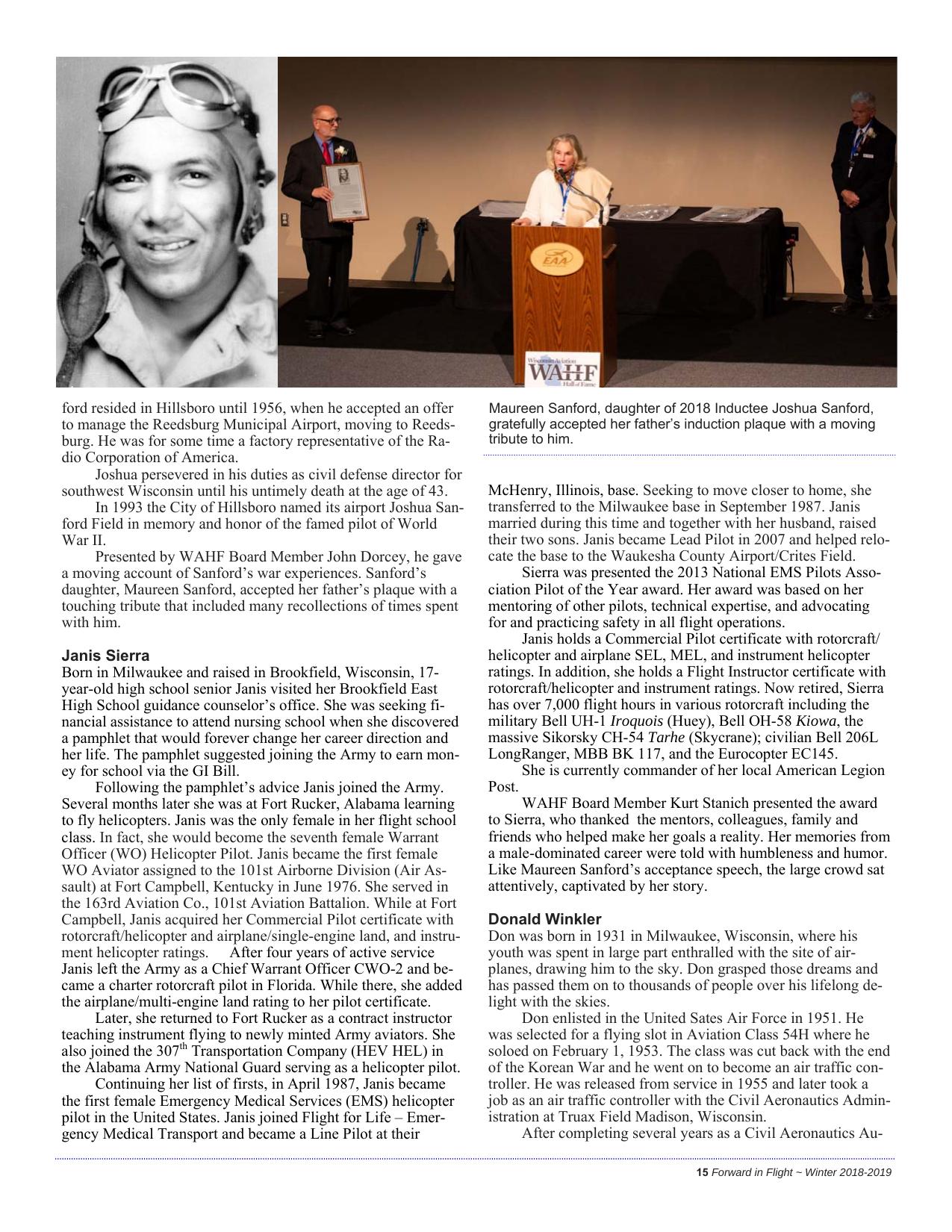
ford resided in Hillsboro until 1956, when he accepted an offer to manage the Reedsburg Municipal Airport, moving to Reedsburg. He was for some time a factory representative of the Radio Corporation of America. Joshua persevered in his duties as civil defense director for southwest Wisconsin until his untimely death at the age of 43. In 1993 the City of Hillsboro named its airport Joshua Sanford Field in memory and honor of the famed pilot of World War II. Presented by WAHF Board Member John Dorcey, he gave a moving account of Sanford’s war experiences. Sanford’s daughter, Maureen Sanford, accepted her father’s plaque with a touching tribute that included many recollections of times spent with him. Janis Sierra Born in Milwaukee and raised in Brookfield, Wisconsin, 17year-old high school senior Janis visited her Brookfield East High School guidance counselor’s office. She was seeking financial assistance to attend nursing school when she discovered a pamphlet that would forever change her career direction and her life. The pamphlet suggested joining the Army to earn money for school via the GI Bill. Following the pamphlet’s advice Janis joined the Army. Several months later she was at Fort Rucker, Alabama learning to fly helicopters. Janis was the only female in her flight school class. In fact, she would become the seventh female Warrant Officer (WO) Helicopter Pilot. Janis became the first female WO Aviator assigned to the 101st Airborne Division (Air Assault) at Fort Campbell, Kentucky in June 1976. She served in the 163rd Aviation Co., 101st Aviation Battalion. While at Fort Campbell, Janis acquired her Commercial Pilot certificate with rotorcraft/helicopter and airplane/single-engine land, and instrument helicopter ratings. After four years of active service Janis left the Army as a Chief Warrant Officer CWO-2 and became a charter rotorcraft pilot in Florida. While there, she added the airplane/multi-engine land rating to her pilot certificate. Later, she returned to Fort Rucker as a contract instructor teaching instrument flying to newly minted Army aviators. She also joined the 307th Transportation Company (HEV HEL) in the Alabama Army National Guard serving as a helicopter pilot. Continuing her list of firsts, in April 1987, Janis became the first female Emergency Medical Services (EMS) helicopter pilot in the United States. Janis joined Flight for Life – Emergency Medical Transport and became a Line Pilot at their Maureen Sanford, daughter of 2018 Inductee Joshua Sanford, gratefully accepted her father’s induction plaque with a moving tribute to him. McHenry, Illinois, base. Seeking to move closer to home, she transferred to the Milwaukee base in September 1987. Janis married during this time and together with her husband, raised their two sons. Janis became Lead Pilot in 2007 and helped relocate the base to the Waukesha County Airport/Crites Field. Sierra was presented the 2013 National EMS Pilots Association Pilot of the Year award. Her award was based on her mentoring of other pilots, technical expertise, and advocating for and practicing safety in all flight operations. Janis holds a Commercial Pilot certificate with rotorcraft/ helicopter and airplane SEL, MEL, and instrument helicopter ratings. In addition, she holds a Flight Instructor certificate with rotorcraft/helicopter and instrument ratings. Now retired, Sierra has over 7,000 flight hours in various rotorcraft including the military Bell UH-1 Iroquois (Huey), Bell OH-58 Kiowa, the massive Sikorsky CH-54 Tarhe (Skycrane); civilian Bell 206L LongRanger, MBB BK 117, and the Eurocopter EC145. She is currently commander of her local American Legion Post. WAHF Board Member Kurt Stanich presented the award to Sierra, who thanked the mentors, colleagues, family and friends who helped make her goals a reality. Her memories from a male-dominated career were told with humbleness and humor. Like Maureen Sanford’s acceptance speech, the large crowd sat attentively, captivated by her story. Donald Winkler Don was born in 1931 in Milwaukee, Wisconsin, where his youth was spent in large part enthralled with the site of airplanes, drawing him to the sky. Don grasped those dreams and has passed them on to thousands of people over his lifelong delight with the skies. Don enlisted in the United Sates Air Force in 1951. He was selected for a flying slot in Aviation Class 54H where he soloed on February 1, 1953. The class was cut back with the end of the Korean War and he went on to become an air traffic controller. He was released from service in 1955 and later took a job as an air traffic controller with the Civil Aeronautics Administration at Truax Field Madison, Wisconsin. After completing several years as a Civil Aeronautics Au15 Forward in Flight ~ Winter 2018-2019
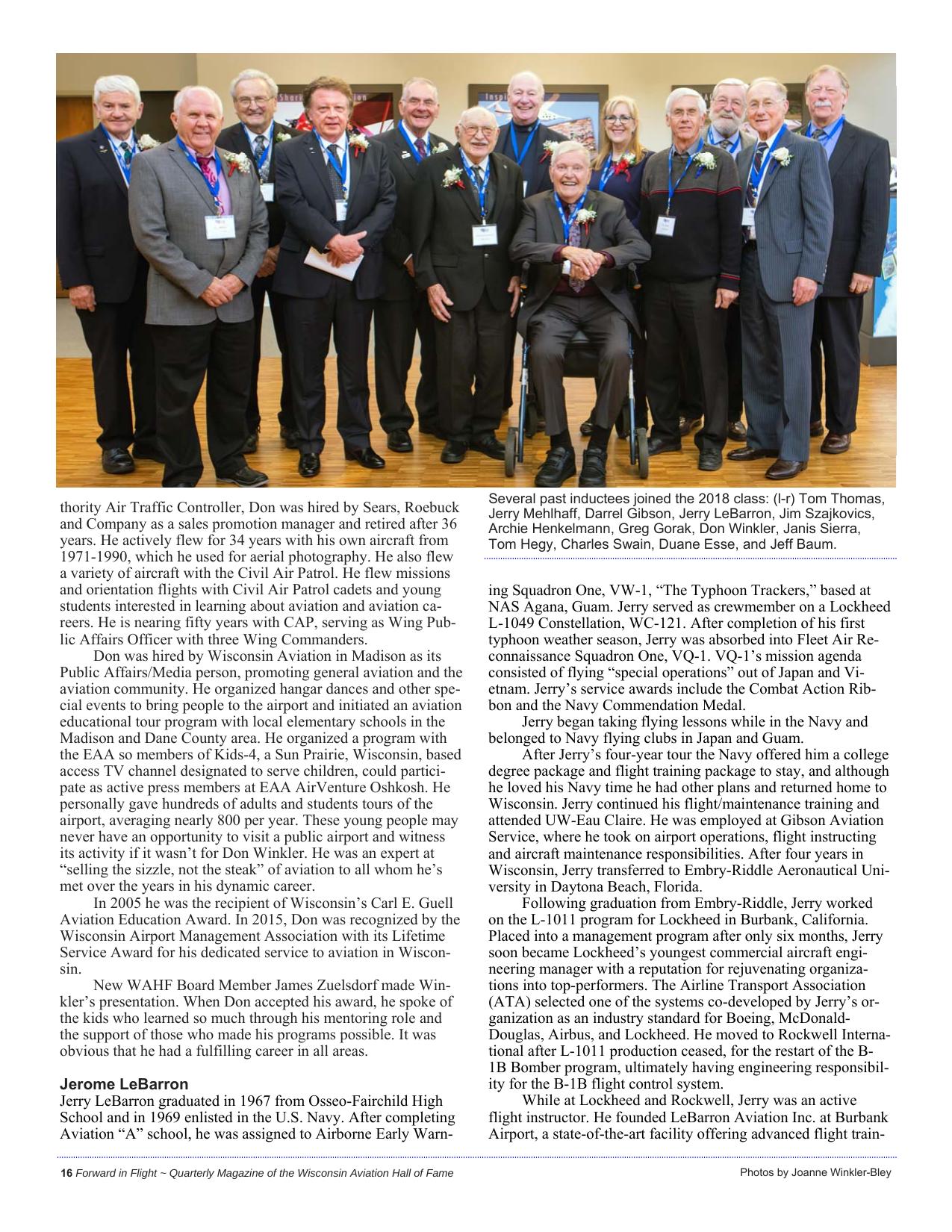
thority Air Traffic Controller, Don was hired by Sears, Roebuck and Company as a sales promotion manager and retired after 36 years. He actively flew for 34 years with his own aircraft from 1971-1990, which he used for aerial photography. He also flew a variety of aircraft with the Civil Air Patrol. He flew missions and orientation flights with Civil Air Patrol cadets and young students interested in learning about aviation and aviation careers. He is nearing fifty years with CAP, serving as Wing Public Affairs Officer with three Wing Commanders. Don was hired by Wisconsin Aviation in Madison as its Public Affairs/Media person, promoting general aviation and the aviation community. He organized hangar dances and other special events to bring people to the airport and initiated an aviation educational tour program with local elementary schools in the Madison and Dane County area. He organized a program with the EAA so members of Kids-4, a Sun Prairie, Wisconsin, based access TV channel designated to serve children, could participate as active press members at EAA AirVenture Oshkosh. He personally gave hundreds of adults and students tours of the airport, averaging nearly 800 per year. These young people may never have an opportunity to visit a public airport and witness its activity if it wasn’t for Don Winkler. He was an expert at “selling the sizzle, not the steak” of aviation to all whom he’s met over the years in his dynamic career. In 2005 he was the recipient of Wisconsin’s Carl E. Guell Aviation Education Award. In 2015, Don was recognized by the Wisconsin Airport Management Association with its Lifetime Service Award for his dedicated service to aviation in Wisconsin. New WAHF Board Member James Zuelsdorf made Winkler’s presentation. When Don accepted his award, he spoke of the kids who learned so much through his mentoring role and the support of those who made his programs possible. It was obvious that he had a fulfilling career in all areas. Several past inductees joined the 2018 class: (l-r) Tom Thomas, Jerry Mehlhaff, Darrel Gibson, Jerry LeBarron, Jim Szajkovics, Archie Henkelmann, Greg Gorak, Don Winkler, Janis Sierra, Tom Hegy, Charles Swain, Duane Esse, and Jeff Baum. Jerome LeBarron Jerry LeBarron graduated in 1967 from Osseo-Fairchild High School and in 1969 enlisted in the U.S. Navy. After completing Aviation “A” school, he was assigned to Airborne Early Warn- ing Squadron One, VW-1, “The Typhoon Trackers,” based at NAS Agana, Guam. Jerry served as crewmember on a Lockheed L-1049 Constellation, WC-121. After completion of his first typhoon weather season, Jerry was absorbed into Fleet Air Reconnaissance Squadron One, VQ-1. VQ-1’s mission agenda consisted of flying “special operations” out of Japan and Vietnam. Jerry’s service awards include the Combat Action Ribbon and the Navy Commendation Medal. Jerry began taking flying lessons while in the Navy and belonged to Navy flying clubs in Japan and Guam. After Jerry’s four-year tour the Navy offered him a college degree package and flight training package to stay, and although he loved his Navy time he had other plans and returned home to Wisconsin. Jerry continued his flight/maintenance training and attended UW-Eau Claire. He was employed at Gibson Aviation Service, where he took on airport operations, flight instructing and aircraft maintenance responsibilities. After four years in Wisconsin, Jerry transferred to Embry-Riddle Aeronautical University in Daytona Beach, Florida. Following graduation from Embry-Riddle, Jerry worked on the L-1011 program for Lockheed in Burbank, California. Placed into a management program after only six months, Jerry soon became Lockheed’s youngest commercial aircraft engineering manager with a reputation for rejuvenating organizations into top-performers. The Airline Transport Association (ATA) selected one of the systems co-developed by Jerry’s organization as an industry standard for Boeing, McDonaldDouglas, Airbus, and Lockheed. He moved to Rockwell International after L-1011 production ceased, for the restart of the B1B Bomber program, ultimately having engineering responsibility for the B-1B flight control system. While at Lockheed and Rockwell, Jerry was an active flight instructor. He founded LeBarron Aviation Inc. at Burbank Airport, a state-of-the-art facility offering advanced flight train- 16 Forward in Flight ~ Quarterly Magazine of the Wisconsin Aviation Hall of Fame Photos by Joanne Winkler-Bley
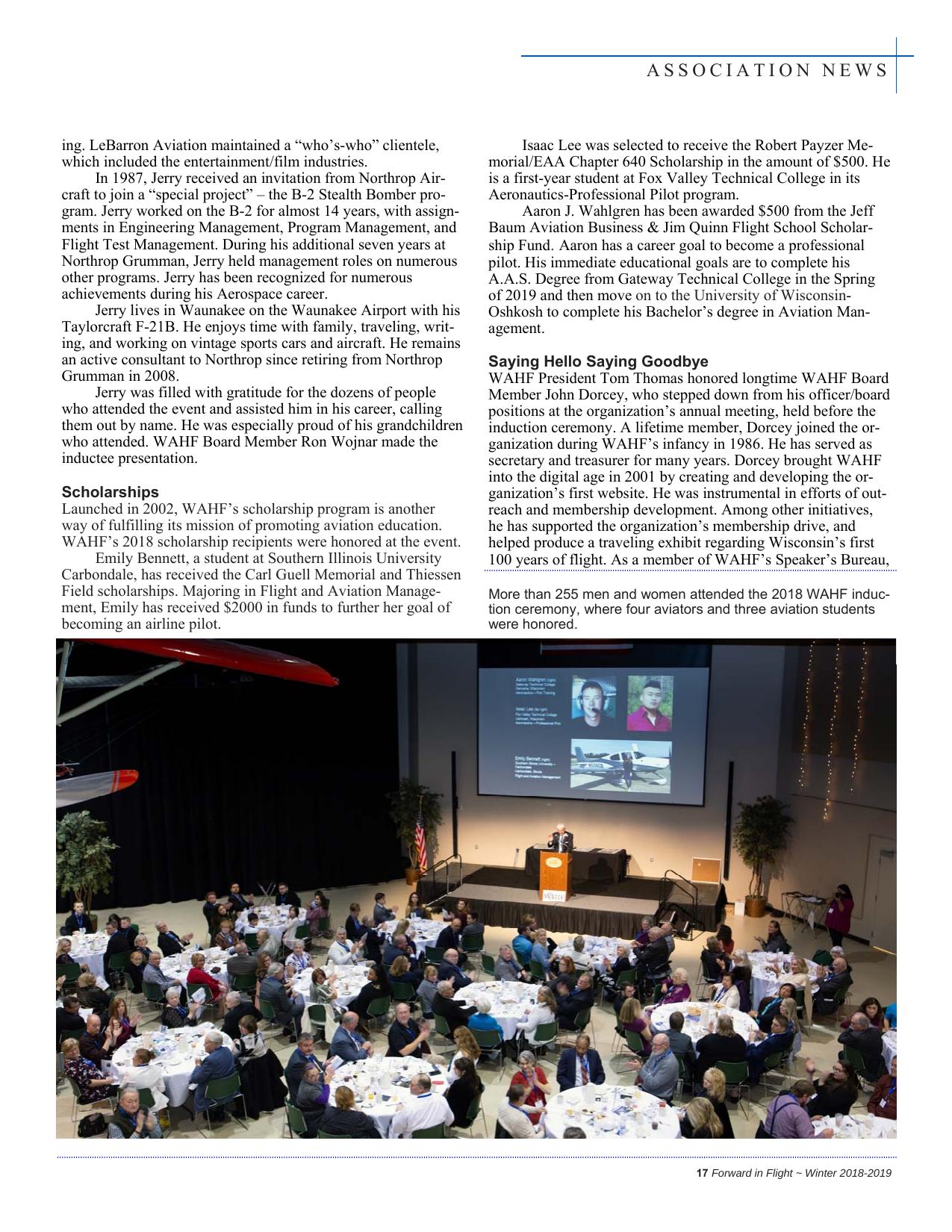
ASSOCIATION NEWS ing. LeBarron Aviation maintained a “who’s-who” clientele, which included the entertainment/film industries. In 1987, Jerry received an invitation from Northrop Aircraft to join a “special project” – the B-2 Stealth Bomber program. Jerry worked on the B-2 for almost 14 years, with assignments in Engineering Management, Program Management, and Flight Test Management. During his additional seven years at Northrop Grumman, Jerry held management roles on numerous other programs. Jerry has been recognized for numerous achievements during his Aerospace career. Jerry lives in Waunakee on the Waunakee Airport with his Taylorcraft F-21B. He enjoys time with family, traveling, writing, and working on vintage sports cars and aircraft. He remains an active consultant to Northrop since retiring from Northrop Grumman in 2008. Jerry was filled with gratitude for the dozens of people who attended the event and assisted him in his career, calling them out by name. He was especially proud of his grandchildren who attended. WAHF Board Member Ron Wojnar made the inductee presentation. Scholarships Launched in 2002, WAHF’s scholarship program is another way of fulfilling its mission of promoting aviation education. WAHF’s 2018 scholarship recipients were honored at the event. Emily Bennett, a student at Southern Illinois University Carbondale, has received the Carl Guell Memorial and Thiessen Field scholarships. Majoring in Flight and Aviation Management, Emily has received $2000 in funds to further her goal of becoming an airline pilot. Isaac Lee was selected to receive the Robert Payzer Memorial/EAA Chapter 640 Scholarship in the amount of $500. He is a first-year student at Fox Valley Technical College in its Aeronautics-Professional Pilot program. Aaron J. Wahlgren has been awarded $500 from the Jeff Baum Aviation Business & Jim Quinn Flight School Scholarship Fund. Aaron has a career goal to become a professional pilot. His immediate educational goals are to complete his A.A.S. Degree from Gateway Technical College in the Spring of 2019 and then move on to the University of WisconsinOshkosh to complete his Bachelor’s degree in Aviation Management. Saying Hello Saying Goodbye WAHF President Tom Thomas honored longtime WAHF Board Member John Dorcey, who stepped down from his officer/board positions at the organization’s annual meeting, held before the induction ceremony. A lifetime member, Dorcey joined the organization during WAHF’s infancy in 1986. He has served as secretary and treasurer for many years. Dorcey brought WAHF into the digital age in 2001 by creating and developing the organization’s first website. He was instrumental in efforts of outreach and membership development. Among other initiatives, he has supported the organization’s membership drive, and helped produce a traveling exhibit regarding Wisconsin’s first 100 years of flight. As a member of WAHF’s Speaker’s Bureau, More than 255 men and women attended the 2018 WAHF induction ceremony, where four aviators and three aviation students were honored. 17 Forward in Flight ~ Winter 2018-2019
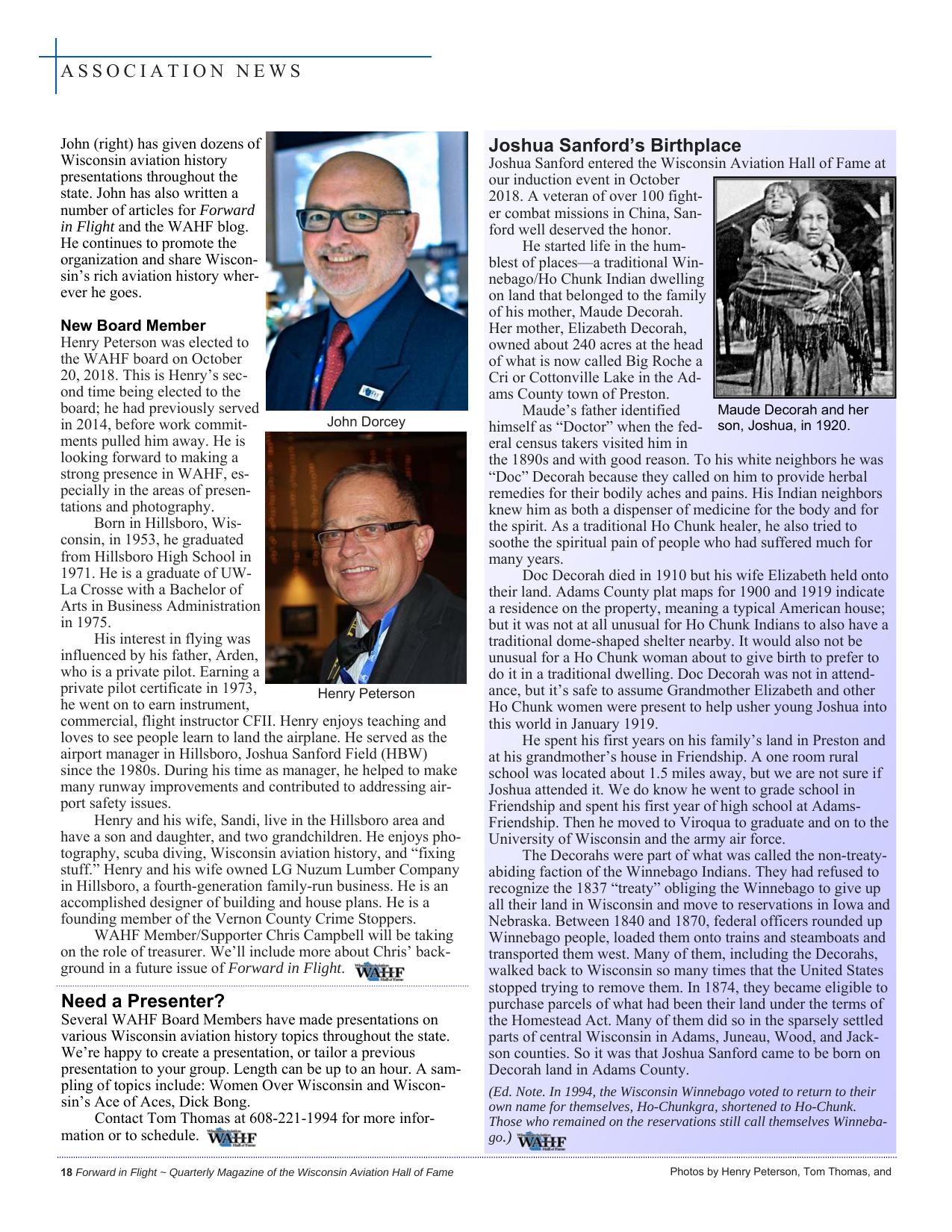
ASSOCIATION NEWS John (right) has given dozens of Wisconsin aviation history presentations throughout the state. John has also written a number of articles for Forward in Flight and the WAHF blog. He continues to promote the organization and share Wisconsin’s rich aviation history wherever he goes. New Board Member Henry Peterson was elected to the WAHF board on October 20, 2018. This is Henry’s second time being elected to the board; he had previously served John Dorcey in 2014, before work commitments pulled him away. He is looking forward to making a strong presence in WAHF, especially in the areas of presentations and photography. Born in Hillsboro, Wisconsin, in 1953, he graduated from Hillsboro High School in 1971. He is a graduate of UWLa Crosse with a Bachelor of Arts in Business Administration in 1975. His interest in flying was influenced by his father, Arden, who is a private pilot. Earning a private pilot certificate in 1973, Henry Peterson he went on to earn instrument, commercial, flight instructor CFII. Henry enjoys teaching and loves to see people learn to land the airplane. He served as the airport manager in Hillsboro, Joshua Sanford Field (HBW) since the 1980s. During his time as manager, he helped to make many runway improvements and contributed to addressing airport safety issues. Henry and his wife, Sandi, live in the Hillsboro area and have a son and daughter, and two grandchildren. He enjoys photography, scuba diving, Wisconsin aviation history, and “fixing stuff.” Henry and his wife owned LG Nuzum Lumber Company in Hillsboro, a fourth-generation family-run business. He is an accomplished designer of building and house plans. He is a founding member of the Vernon County Crime Stoppers. WAHF Member/Supporter Chris Campbell will be taking on the role of treasurer. We’ll include more about Chris’ background in a future issue of Forward in Flight. Need a Presenter? Several WAHF Board Members have made presentations on various Wisconsin aviation history topics throughout the state. We’re happy to create a presentation, or tailor a previous presentation to your group. Length can be up to an hour. A sampling of topics include: Women Over Wisconsin and Wisconsin’s Ace of Aces, Dick Bong. Contact Tom Thomas at 608-221-1994 for more information or to schedule. 18 Forward in Flight ~ Quarterly Magazine of the Wisconsin Aviation Hall of Fame Joshua Sanford’s Birthplace Joshua Sanford entered the Wisconsin Aviation Hall of Fame at our induction event in October 2018. A veteran of over 100 fighter combat missions in China, Sanford well deserved the honor. He started life in the humblest of places—a traditional Winnebago/Ho Chunk Indian dwelling on land that belonged to the family of his mother, Maude Decorah. Her mother, Elizabeth Decorah, owned about 240 acres at the head of what is now called Big Roche a Cri or Cottonville Lake in the Adams County town of Preston. Maude Decorah and her Maude’s father identified himself as “Doctor” when the fed- son, Joshua, in 1920. eral census takers visited him in the 1890s and with good reason. To his white neighbors he was “Doc” Decorah because they called on him to provide herbal remedies for their bodily aches and pains. His Indian neighbors knew him as both a dispenser of medicine for the body and for the spirit. As a traditional Ho Chunk healer, he also tried to soothe the spiritual pain of people who had suffered much for many years. Doc Decorah died in 1910 but his wife Elizabeth held onto their land. Adams County plat maps for 1900 and 1919 indicate a residence on the property, meaning a typical American house; but it was not at all unusual for Ho Chunk Indians to also have a traditional dome-shaped shelter nearby. It would also not be unusual for a Ho Chunk woman about to give birth to prefer to do it in a traditional dwelling. Doc Decorah was not in attendance, but it’s safe to assume Grandmother Elizabeth and other Ho Chunk women were present to help usher young Joshua into this world in January 1919. He spent his first years on his family’s land in Preston and at his grandmother’s house in Friendship. A one room rural school was located about 1.5 miles away, but we are not sure if Joshua attended it. We do know he went to grade school in Friendship and spent his first year of high school at AdamsFriendship. Then he moved to Viroqua to graduate and on to the University of Wisconsin and the army air force. The Decorahs were part of what was called the non-treatyabiding faction of the Winnebago Indians. They had refused to recognize the 1837 “treaty” obliging the Winnebago to give up all their land in Wisconsin and move to reservations in Iowa and Nebraska. Between 1840 and 1870, federal officers rounded up Winnebago people, loaded them onto trains and steamboats and transported them west. Many of them, including the Decorahs, walked back to Wisconsin so many times that the United States stopped trying to remove them. In 1874, they became eligible to purchase parcels of what had been their land under the terms of the Homestead Act. Many of them did so in the sparsely settled parts of central Wisconsin in Adams, Juneau, Wood, and Jackson counties. So it was that Joshua Sanford came to be born on Decorah land in Adams County. (Ed. Note. In 1994, the Wisconsin Winnebago voted to return to their own name for themselves, Ho-Chunkgra, shortened to Ho-Chunk. Those who remained on the reservations still call themselves Winnebago.) Photos by Henry Peterson, Tom Thomas, and
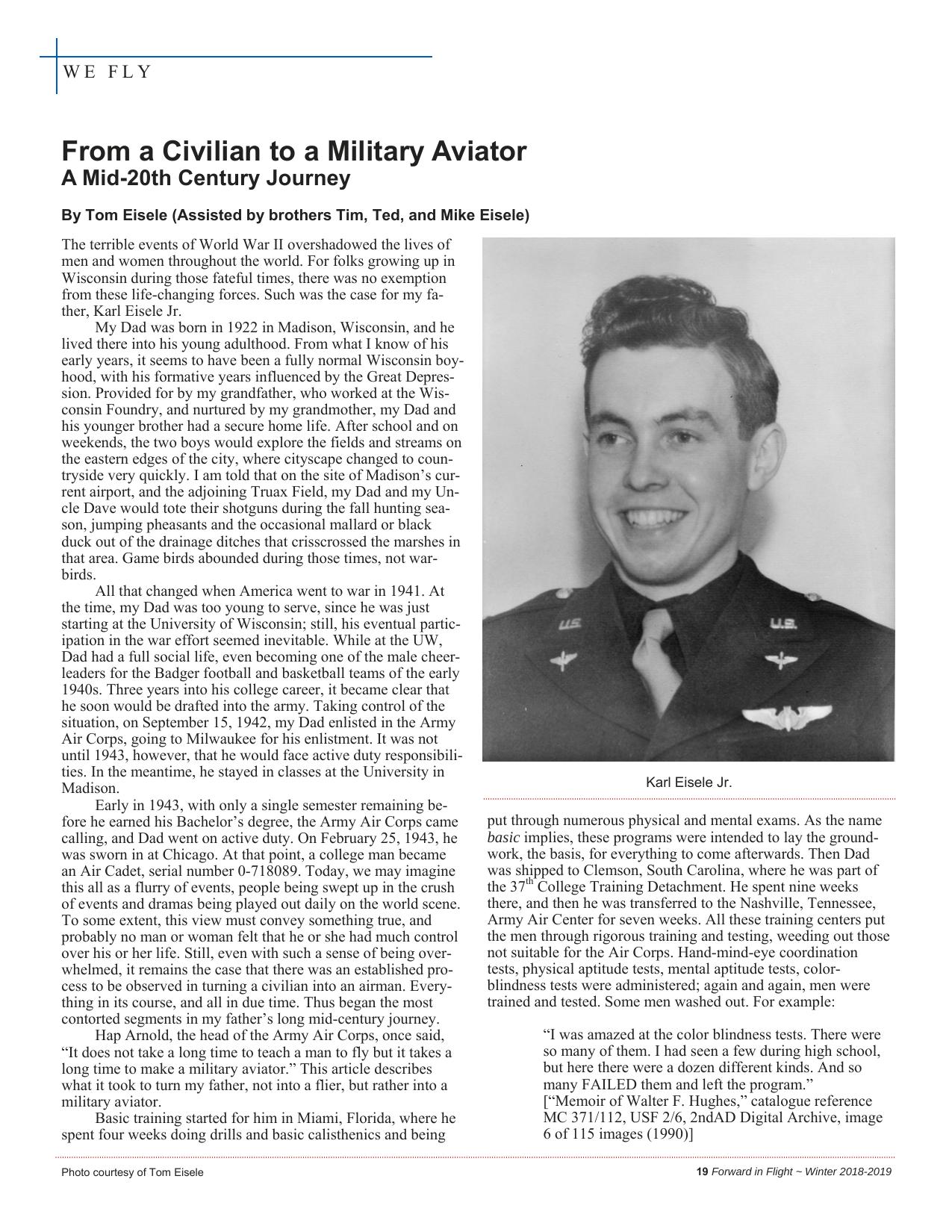
WE FLY From a Civilian to a Military Aviator A Mid-20th Century Journey By Tom Eisele (Assisted by brothers Tim, Ted, and Mike Eisele) The terrible events of World War II overshadowed the lives of men and women throughout the world. For folks growing up in Wisconsin during those fateful times, there was no exemption from these life-changing forces. Such was the case for my father, Karl Eisele Jr. My Dad was born in 1922 in Madison, Wisconsin, and he lived there into his young adulthood. From what I know of his early years, it seems to have been a fully normal Wisconsin boyhood, with his formative years influenced by the Great Depression. Provided for by my grandfather, who worked at the Wisconsin Foundry, and nurtured by my grandmother, my Dad and his younger brother had a secure home life. After school and on weekends, the two boys would explore the fields and streams on the eastern edges of the city, where cityscape changed to countryside very quickly. I am told that on the site of Madison’s current airport, and the adjoining Truax Field, my Dad and my Uncle Dave would tote their shotguns during the fall hunting season, jumping pheasants and the occasional mallard or black duck out of the drainage ditches that crisscrossed the marshes in that area. Game birds abounded during those times, not warbirds. All that changed when America went to war in 1941. At the time, my Dad was too young to serve, since he was just starting at the University of Wisconsin; still, his eventual participation in the war effort seemed inevitable. While at the UW, Dad had a full social life, even becoming one of the male cheerleaders for the Badger football and basketball teams of the early 1940s. Three years into his college career, it became clear that he soon would be drafted into the army. Taking control of the situation, on September 15, 1942, my Dad enlisted in the Army Air Corps, going to Milwaukee for his enlistment. It was not until 1943, however, that he would face active duty responsibilities. In the meantime, he stayed in classes at the University in Madison. Early in 1943, with only a single semester remaining before he earned his Bachelor’s degree, the Army Air Corps came calling, and Dad went on active duty. On February 25, 1943, he was sworn in at Chicago. At that point, a college man became an Air Cadet, serial number 0-718089. Today, we may imagine this all as a flurry of events, people being swept up in the crush of events and dramas being played out daily on the world scene. To some extent, this view must convey something true, and probably no man or woman felt that he or she had much control over his or her life. Still, even with such a sense of being overwhelmed, it remains the case that there was an established process to be observed in turning a civilian into an airman. Everything in its course, and all in due time. Thus began the most contorted segments in my father’s long mid-century journey. Hap Arnold, the head of the Army Air Corps, once said, “It does not take a long time to teach a man to fly but it takes a long time to make a military aviator.” This article describes what it took to turn my father, not into a flier, but rather into a military aviator. Basic training started for him in Miami, Florida, where he spent four weeks doing drills and basic calisthenics and being Photo courtesy of Tom Eisele Karl Eisele Jr. put through numerous physical and mental exams. As the name basic implies, these programs were intended to lay the groundwork, the basis, for everything to come afterwards. Then Dad was shipped to Clemson, South Carolina, where he was part of the 37th College Training Detachment. He spent nine weeks there, and then he was transferred to the Nashville, Tennessee, Army Air Center for seven weeks. All these training centers put the men through rigorous training and testing, weeding out those not suitable for the Air Corps. Hand-mind-eye coordination tests, physical aptitude tests, mental aptitude tests, colorblindness tests were administered; again and again, men were trained and tested. Some men washed out. For example: “I was amazed at the color blindness tests. There were so many of them. I had seen a few during high school, but here there were a dozen different kinds. And so many FAILED them and left the program.” [“Memoir of Walter F. Hughes,” catalogue reference MC 371/112, USF 2/6, 2ndAD Digital Archive, image 6 of 115 images (1990)] 19 Forward in Flight ~ Winter 2018-2019
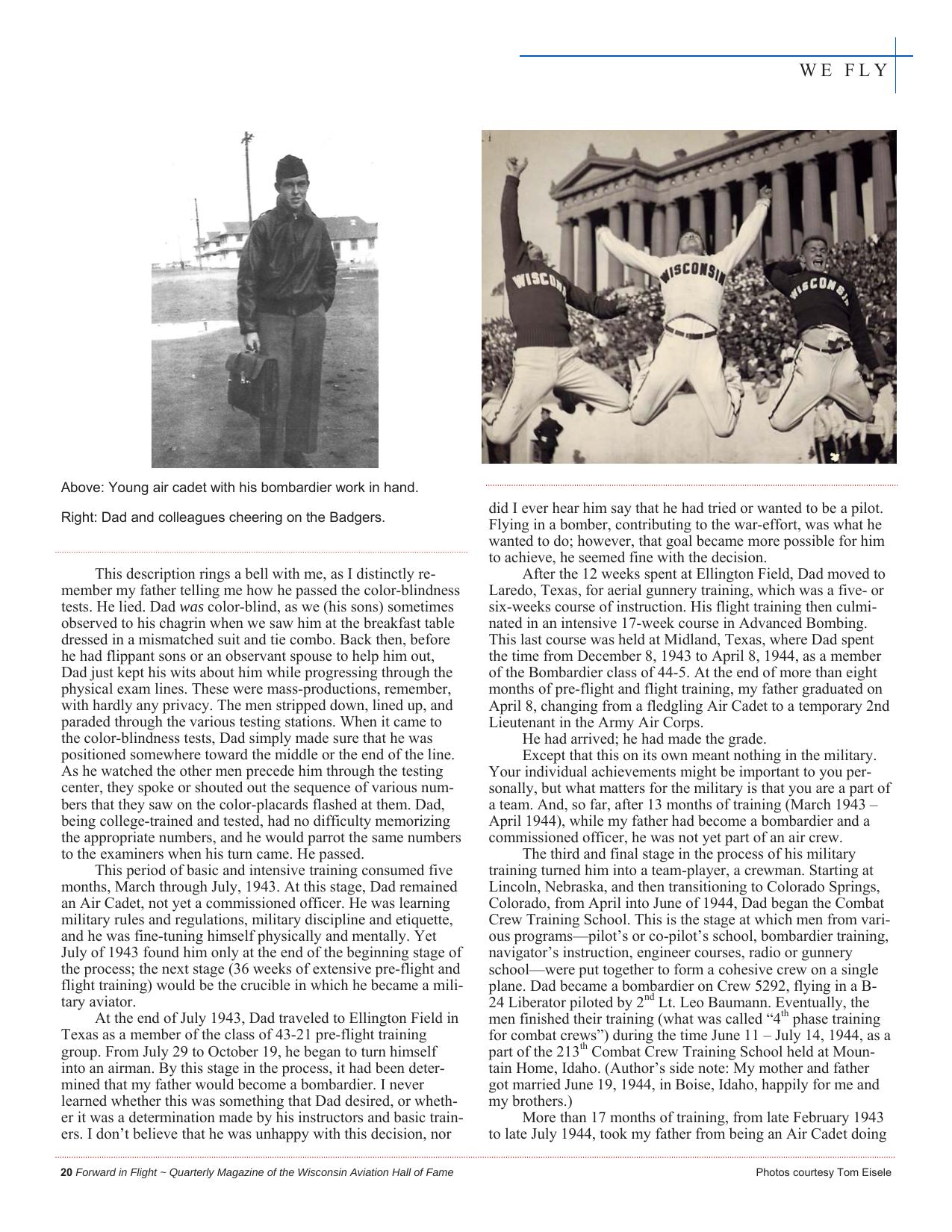
WE FLY Above: Young air cadet with his bombardier work in hand. Right: Dad and colleagues cheering on the Badgers. This description rings a bell with me, as I distinctly remember my father telling me how he passed the color-blindness tests. He lied. Dad was color-blind, as we (his sons) sometimes observed to his chagrin when we saw him at the breakfast table dressed in a mismatched suit and tie combo. Back then, before he had flippant sons or an observant spouse to help him out, Dad just kept his wits about him while progressing through the physical exam lines. These were mass-productions, remember, with hardly any privacy. The men stripped down, lined up, and paraded through the various testing stations. When it came to the color-blindness tests, Dad simply made sure that he was positioned somewhere toward the middle or the end of the line. As he watched the other men precede him through the testing center, they spoke or shouted out the sequence of various numbers that they saw on the color-placards flashed at them. Dad, being college-trained and tested, had no difficulty memorizing the appropriate numbers, and he would parrot the same numbers to the examiners when his turn came. He passed. This period of basic and intensive training consumed five months, March through July, 1943. At this stage, Dad remained an Air Cadet, not yet a commissioned officer. He was learning military rules and regulations, military discipline and etiquette, and he was fine-tuning himself physically and mentally. Yet July of 1943 found him only at the end of the beginning stage of the process; the next stage (36 weeks of extensive pre-flight and flight training) would be the crucible in which he became a military aviator. At the end of July 1943, Dad traveled to Ellington Field in Texas as a member of the class of 43-21 pre-flight training group. From July 29 to October 19, he began to turn himself into an airman. By this stage in the process, it had been determined that my father would become a bombardier. I never learned whether this was something that Dad desired, or whether it was a determination made by his instructors and basic trainers. I don’t believe that he was unhappy with this decision, nor 20 Forward in Flight ~ Quarterly Magazine of the Wisconsin Aviation Hall of Fame did I ever hear him say that he had tried or wanted to be a pilot. Flying in a bomber, contributing to the war-effort, was what he wanted to do; however, that goal became more possible for him to achieve, he seemed fine with the decision. After the 12 weeks spent at Ellington Field, Dad moved to Laredo, Texas, for aerial gunnery training, which was a five- or six-weeks course of instruction. His flight training then culminated in an intensive 17-week course in Advanced Bombing. This last course was held at Midland, Texas, where Dad spent the time from December 8, 1943 to April 8, 1944, as a member of the Bombardier class of 44-5. At the end of more than eight months of pre-flight and flight training, my father graduated on April 8, changing from a fledgling Air Cadet to a temporary 2nd Lieutenant in the Army Air Corps. He had arrived; he had made the grade. Except that this on its own meant nothing in the military. Your individual achievements might be important to you personally, but what matters for the military is that you are a part of a team. And, so far, after 13 months of training (March 1943 – April 1944), while my father had become a bombardier and a commissioned officer, he was not yet part of an air crew. The third and final stage in the process of his military training turned him into a team-player, a crewman. Starting at Lincoln, Nebraska, and then transitioning to Colorado Springs, Colorado, from April into June of 1944, Dad began the Combat Crew Training School. This is the stage at which men from various programs—pilot’s or co-pilot’s school, bombardier training, navigator’s instruction, engineer courses, radio or gunnery school—were put together to form a cohesive crew on a single plane. Dad became a bombardier on Crew 5292, flying in a B24 Liberator piloted by 2nd Lt. Leo Baumann. Eventually, the men finished their training (what was called “4th phase training for combat crews”) during the time June 11 – July 14, 1944, as a part of the 213th Combat Crew Training School held at Mountain Home, Idaho. (Author’s side note: My mother and father got married June 19, 1944, in Boise, Idaho, happily for me and my brothers.) More than 17 months of training, from late February 1943 to late July 1944, took my father from being an Air Cadet doing Photos courtesy Tom Eisele
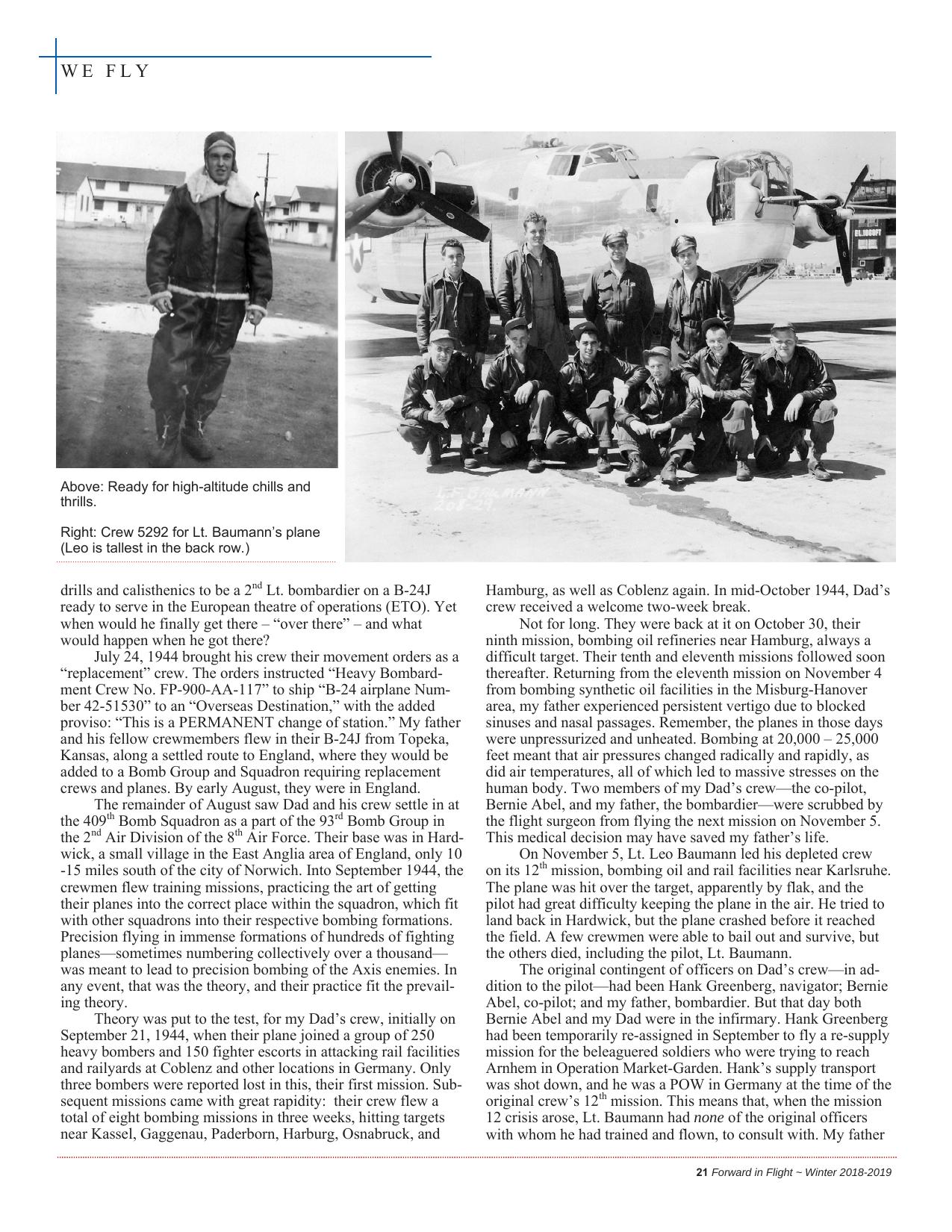
WE FLY Above: Ready for high-altitude chills and thrills. Right: Crew 5292 for Lt. Baumann’s plane (Leo is tallest in the back row.) drills and calisthenics to be a 2nd Lt. bombardier on a B-24J ready to serve in the European theatre of operations (ETO). Yet when would he finally get there – “over there” – and what would happen when he got there? July 24, 1944 brought his crew their movement orders as a “replacement” crew. The orders instructed “Heavy Bombardment Crew No. FP-900-AA-117” to ship “B-24 airplane Number 42-51530” to an “Overseas Destination,” with the added proviso: “This is a PERMANENT change of station.” My father and his fellow crewmembers flew in their B-24J from Topeka, Kansas, along a settled route to England, where they would be added to a Bomb Group and Squadron requiring replacement crews and planes. By early August, they were in England. The remainder of August saw Dad and his crew settle in at the 409th Bomb Squadron as a part of the 93rd Bomb Group in the 2nd Air Division of the 8th Air Force. Their base was in Hardwick, a small village in the East Anglia area of England, only 10 -15 miles south of the city of Norwich. Into September 1944, the crewmen flew training missions, practicing the art of getting their planes into the correct place within the squadron, which fit with other squadrons into their respective bombing formations. Precision flying in immense formations of hundreds of fighting planes—sometimes numbering collectively over a thousand— was meant to lead to precision bombing of the Axis enemies. In any event, that was the theory, and their practice fit the prevailing theory. Theory was put to the test, for my Dad’s crew, initially on September 21, 1944, when their plane joined a group of 250 heavy bombers and 150 fighter escorts in attacking rail facilities and railyards at Coblenz and other locations in Germany. Only three bombers were reported lost in this, their first mission. Subsequent missions came with great rapidity: their crew flew a total of eight bombing missions in three weeks, hitting targets near Kassel, Gaggenau, Paderborn, Harburg, Osnabruck, and Hamburg, as well as Coblenz again. In mid-October 1944, Dad’s crew received a welcome two-week break. Not for long. They were back at it on October 30, their ninth mission, bombing oil refineries near Hamburg, always a difficult target. Their tenth and eleventh missions followed soon thereafter. Returning from the eleventh mission on November 4 from bombing synthetic oil facilities in the Misburg-Hanover area, my father experienced persistent vertigo due to blocked sinuses and nasal passages. Remember, the planes in those days were unpressurized and unheated. Bombing at 20,000 – 25,000 feet meant that air pressures changed radically and rapidly, as did air temperatures, all of which led to massive stresses on the human body. Two members of my Dad’s crew—the co-pilot, Bernie Abel, and my father, the bombardier—were scrubbed by the flight surgeon from flying the next mission on November 5. This medical decision may have saved my father’s life. On November 5, Lt. Leo Baumann led his depleted crew on its 12th mission, bombing oil and rail facilities near Karlsruhe. The plane was hit over the target, apparently by flak, and the pilot had great difficulty keeping the plane in the air. He tried to land back in Hardwick, but the plane crashed before it reached the field. A few crewmen were able to bail out and survive, but the others died, including the pilot, Lt. Baumann. The original contingent of officers on Dad’s crew—in addition to the pilot—had been Hank Greenberg, navigator; Bernie Abel, co-pilot; and my father, bombardier. But that day both Bernie Abel and my Dad were in the infirmary. Hank Greenberg had been temporarily re-assigned in September to fly a re-supply mission for the beleaguered soldiers who were trying to reach Arnhem in Operation Market-Garden. Hank’s supply transport was shot down, and he was a POW in Germany at the time of the original crew’s 12th mission. This means that, when the mission 12 crisis arose, Lt. Baumann had none of the original officers with whom he had trained and flown, to consult with. My father 21 Forward in Flight ~ Winter 2018-2019
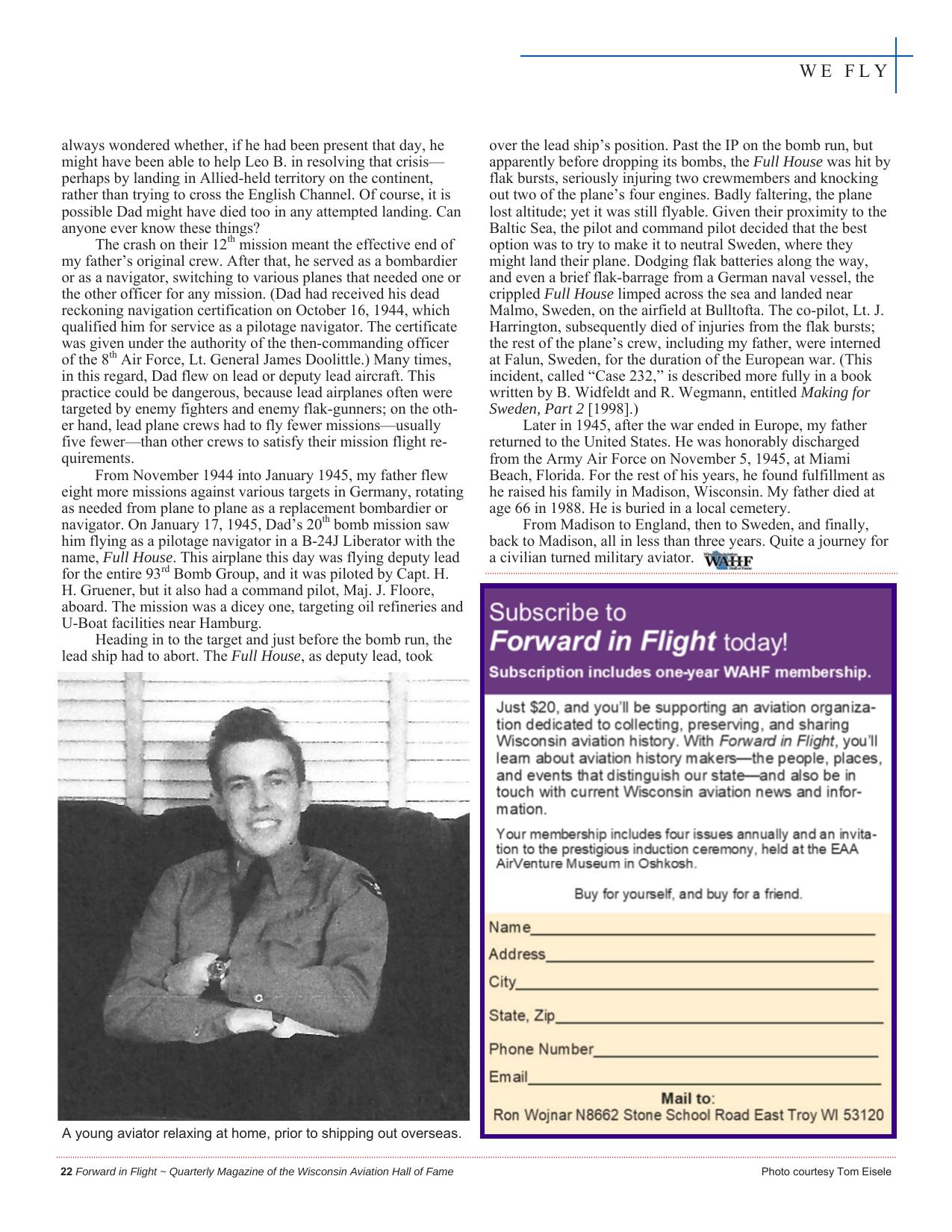
WE FLY always wondered whether, if he had been present that day, he might have been able to help Leo B. in resolving that crisis— perhaps by landing in Allied-held territory on the continent, rather than trying to cross the English Channel. Of course, it is possible Dad might have died too in any attempted landing. Can anyone ever know these things? The crash on their 12th mission meant the effective end of my father’s original crew. After that, he served as a bombardier or as a navigator, switching to various planes that needed one or the other officer for any mission. (Dad had received his dead reckoning navigation certification on October 16, 1944, which qualified him for service as a pilotage navigator. The certificate was given under the authority of the then-commanding officer of the 8th Air Force, Lt. General James Doolittle.) Many times, in this regard, Dad flew on lead or deputy lead aircraft. This practice could be dangerous, because lead airplanes often were targeted by enemy fighters and enemy flak-gunners; on the other hand, lead plane crews had to fly fewer missions—usually five fewer—than other crews to satisfy their mission flight requirements. From November 1944 into January 1945, my father flew eight more missions against various targets in Germany, rotating as needed from plane to plane as a replacement bombardier or navigator. On January 17, 1945, Dad’s 20th bomb mission saw him flying as a pilotage navigator in a B-24J Liberator with the name, Full House. This airplane this day was flying deputy lead for the entire 93rd Bomb Group, and it was piloted by Capt. H. H. Gruener, but it also had a command pilot, Maj. J. Floore, aboard. The mission was a dicey one, targeting oil refineries and U-Boat facilities near Hamburg. Heading in to the target and just before the bomb run, the lead ship had to abort. The Full House, as deputy lead, took over the lead ship’s position. Past the IP on the bomb run, but apparently before dropping its bombs, the Full House was hit by flak bursts, seriously injuring two crewmembers and knocking out two of the plane’s four engines. Badly faltering, the plane lost altitude; yet it was still flyable. Given their proximity to the Baltic Sea, the pilot and command pilot decided that the best option was to try to make it to neutral Sweden, where they might land their plane. Dodging flak batteries along the way, and even a brief flak-barrage from a German naval vessel, the crippled Full House limped across the sea and landed near Malmo, Sweden, on the airfield at Bulltofta. The co-pilot, Lt. J. Harrington, subsequently died of injuries from the flak bursts; the rest of the plane’s crew, including my father, were interned at Falun, Sweden, for the duration of the European war. (This incident, called “Case 232,” is described more fully in a book written by B. Widfeldt and R. Wegmann, entitled Making for Sweden, Part 2 [1998].) Later in 1945, after the war ended in Europe, my father returned to the United States. He was honorably discharged from the Army Air Force on November 5, 1945, at Miami Beach, Florida. For the rest of his years, he found fulfillment as he raised his family in Madison, Wisconsin. My father died at age 66 in 1988. He is buried in a local cemetery. From Madison to England, then to Sweden, and finally, back to Madison, all in less than three years. Quite a journey for a civilian turned military aviator. A young aviator relaxing at home, prior to shipping out overseas. 22 Forward in Flight ~ Quarterly Magazine of the Wisconsin Aviation Hall of Fame Photo courtesy Tom Eisele
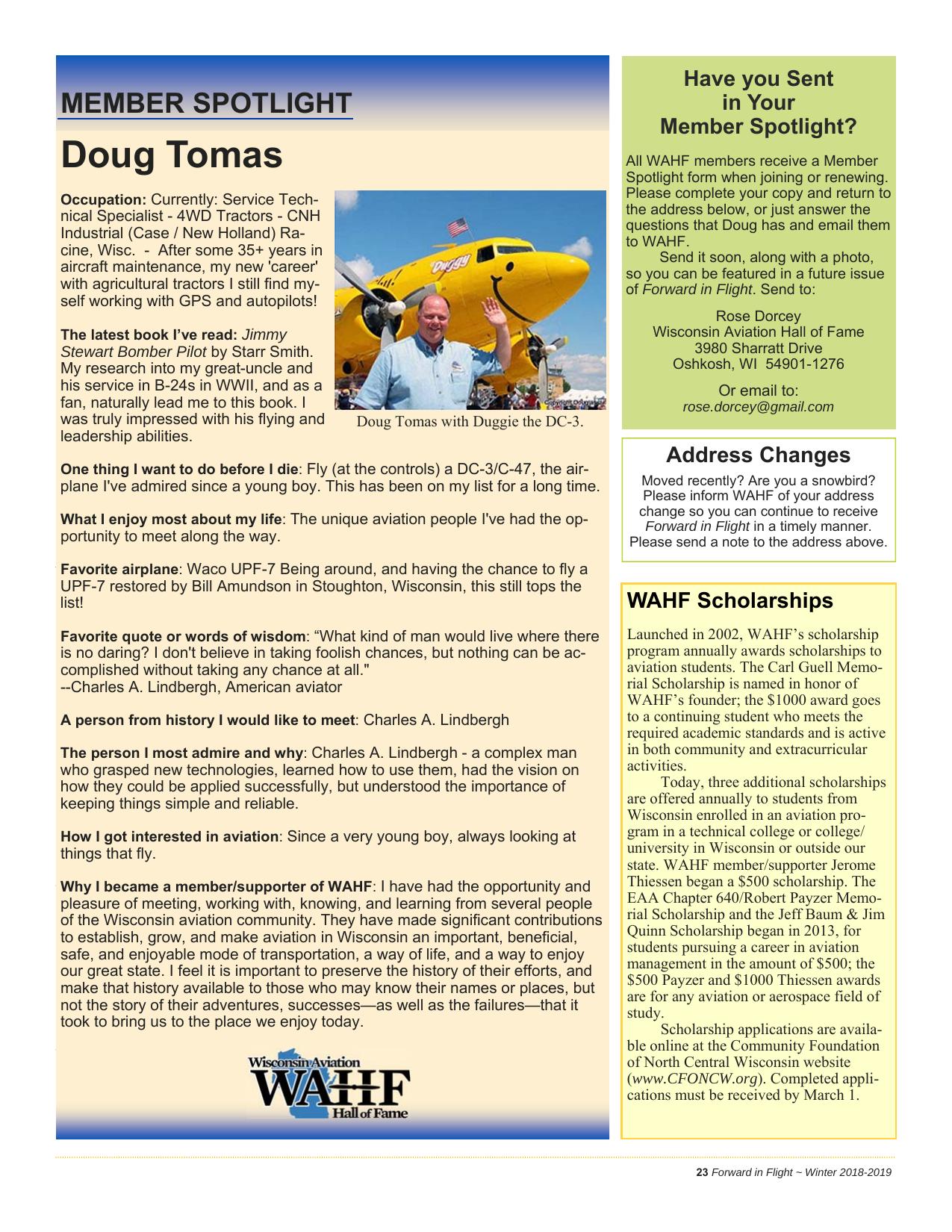
Have you Sent in Your Member Spotlight? MEMBER SPOTLIGHT Doug Tomas All WAHF members receive a Member Spotlight form when joining or renewing. Please complete your copy and return to the address below, or just answer the questions that Doug has and email them to WAHF. Send it soon, along with a photo, so you can be featured in a future issue of Forward in Flight. Send to: Occupation: Currently: Service Tech- nical Specialist - 4WD Tractors - CNH Industrial (Case / New Holland) Racine, Wisc. - After some 35+ years in aircraft maintenance, my new 'career' with agricultural tractors I still find myself working with GPS and autopilots! Rose Dorcey Wisconsin Aviation Hall of Fame 3980 Sharratt Drive Oshkosh, WI 54901-1276 The latest book I’ve read: Jimmy Stewart Bomber Pilot by Starr Smith. My research into my great-uncle and his service in B-24s in WWII, and as a fan, naturally lead me to this book. I was truly impressed with his flying and leadership abilities. Or email to: Doug Tomas with Duggie the DC-3. One thing I want to do before I die: Fly (at the controls) a DC-3/C-47, the air- rose.dorcey@gmail.com Address Changes portunity to meet along the way. Moved recently? Are you a snowbird? Please inform WAHF of your address change so you can continue to receive Forward in Flight in a timely manner. Please send a note to the address above. Favorite airplane: Waco UPF-7 Being around, and having the chance to fly a UPF-7 restored by Bill Amundson in Stoughton, Wisconsin, this still tops the list! WAHF Scholarships plane I've admired since a young boy. This has been on my list for a long time. What I enjoy most about my life: The unique aviation people I've had the op- Favorite quote or words of wisdom: “What kind of man would live where there is no daring? I don't believe in taking foolish chances, but nothing can be accomplished without taking any chance at all." --Charles A. Lindbergh, American aviator A person from history I would like to meet: Charles A. Lindbergh The person I most admire and why: Charles A. Lindbergh - a complex man who grasped new technologies, learned how to use them, had the vision on how they could be applied successfully, but understood the importance of keeping things simple and reliable. How I got interested in aviation: Since a very young boy, always looking at things that fly. Why I became a member/supporter of WAHF: I have had the opportunity and pleasure of meeting, working with, knowing, and learning from several people of the Wisconsin aviation community. They have made significant contributions to establish, grow, and make aviation in Wisconsin an important, beneficial, safe, and enjoyable mode of transportation, a way of life, and a way to enjoy our great state. I feel it is important to preserve the history of their efforts, and make that history available to those who may know their names or places, but not the story of their adventures, successes—as well as the failures—that it took to bring us to the place we enjoy today. Launched in 2002, WAHF’s scholarship program annually awards scholarships to aviation students. The Carl Guell Memorial Scholarship is named in honor of WAHF’s founder; the $1000 award goes to a continuing student who meets the required academic standards and is active in both community and extracurricular activities. Today, three additional scholarships are offered annually to students from Wisconsin enrolled in an aviation program in a technical college or college/ university in Wisconsin or outside our state. WAHF member/supporter Jerome Thiessen began a $500 scholarship. The EAA Chapter 640/Robert Payzer Memorial Scholarship and the Jeff Baum & Jim Quinn Scholarship began in 2013, for students pursuing a career in aviation management in the amount of $500; the $500 Payzer and $1000 Thiessen awards are for any aviation or aerospace field of study. Scholarship applications are available online at the Community Foundation of North Central Wisconsin website (www.CFONCW.org). Completed applications must be received by March 1. 23 Forward in Flight ~ Winter 2018-2019
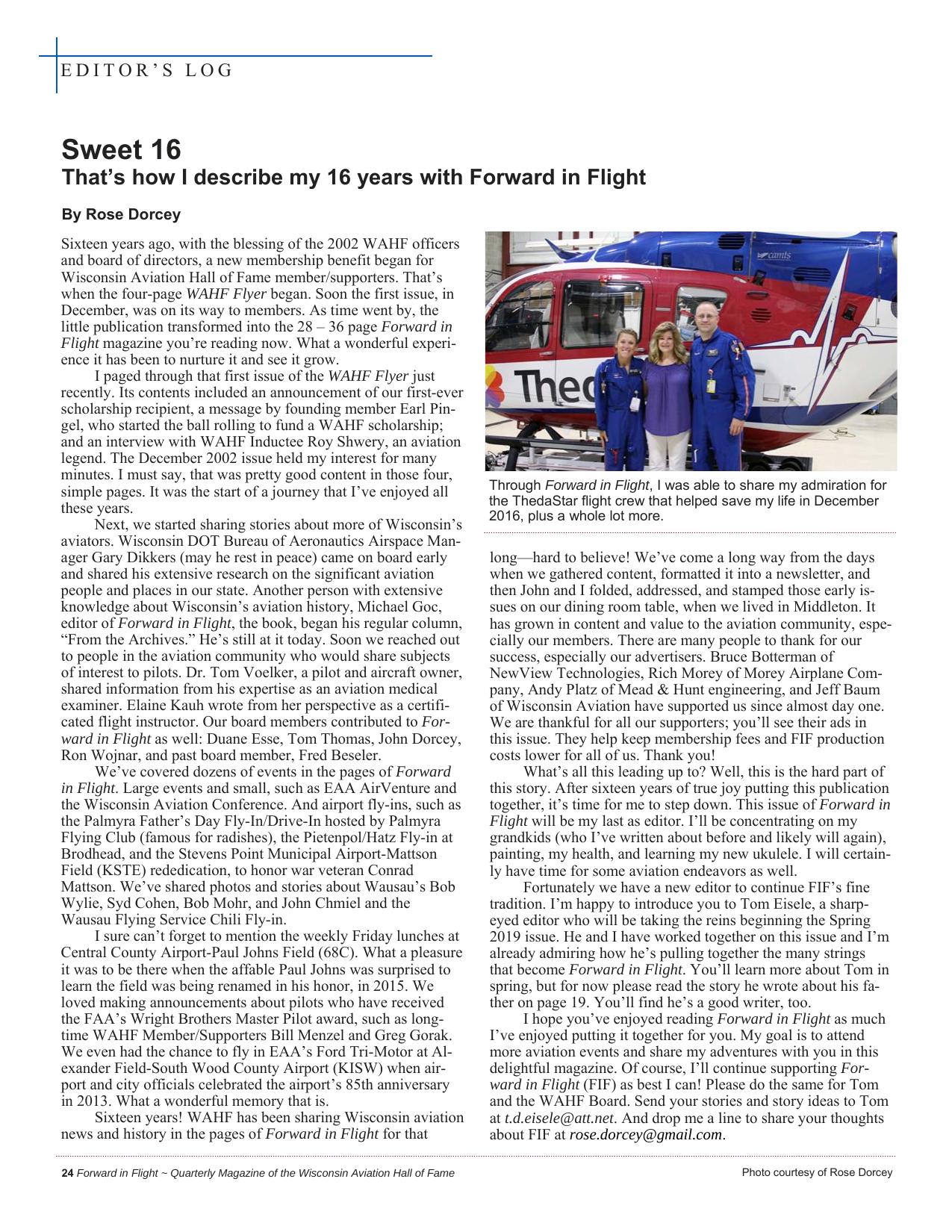
EDITOR’S LOG Sweet 16 That’s how I describe my 16 years with Forward in Flight By Rose Dorcey Sixteen years ago, with the blessing of the 2002 WAHF officers and board of directors, a new membership benefit began for Wisconsin Aviation Hall of Fame member/supporters. That’s when the four-page WAHF Flyer began. Soon the first issue, in December, was on its way to members. As time went by, the little publication transformed into the 28 – 36 page Forward in Flight magazine you’re reading now. What a wonderful experience it has been to nurture it and see it grow. I paged through that first issue of the WAHF Flyer just recently. Its contents included an announcement of our first-ever scholarship recipient, a message by founding member Earl Pingel, who started the ball rolling to fund a WAHF scholarship; and an interview with WAHF Inductee Roy Shwery, an aviation legend. The December 2002 issue held my interest for many minutes. I must say, that was pretty good content in those four, simple pages. It was the start of a journey that I’ve enjoyed all these years. Next, we started sharing stories about more of Wisconsin’s aviators. Wisconsin DOT Bureau of Aeronautics Airspace Manager Gary Dikkers (may he rest in peace) came on board early and shared his extensive research on the significant aviation people and places in our state. Another person with extensive knowledge about Wisconsin’s aviation history, Michael Goc, editor of Forward in Flight, the book, began his regular column, “From the Archives.” He’s still at it today. Soon we reached out to people in the aviation community who would share subjects of interest to pilots. Dr. Tom Voelker, a pilot and aircraft owner, shared information from his expertise as an aviation medical examiner. Elaine Kauh wrote from her perspective as a certificated flight instructor. Our board members contributed to Forward in Flight as well: Duane Esse, Tom Thomas, John Dorcey, Ron Wojnar, and past board member, Fred Beseler. We’ve covered dozens of events in the pages of Forward in Flight. Large events and small, such as EAA AirVenture and the Wisconsin Aviation Conference. And airport fly-ins, such as the Palmyra Father’s Day Fly-In/Drive-In hosted by Palmyra Flying Club (famous for radishes), the Pietenpol/Hatz Fly-in at Brodhead, and the Stevens Point Municipal Airport-Mattson Field (KSTE) rededication, to honor war veteran Conrad Mattson. We’ve shared photos and stories about Wausau’s Bob Wylie, Syd Cohen, Bob Mohr, and John Chmiel and the Wausau Flying Service Chili Fly-in. I sure can’t forget to mention the weekly Friday lunches at Central County Airport-Paul Johns Field (68C). What a pleasure it was to be there when the affable Paul Johns was surprised to learn the field was being renamed in his honor, in 2015. We loved making announcements about pilots who have received the FAA’s Wright Brothers Master Pilot award, such as longtime WAHF Member/Supporters Bill Menzel and Greg Gorak. We even had the chance to fly in EAA’s Ford Tri-Motor at Alexander Field-South Wood County Airport (KISW) when airport and city officials celebrated the airport’s 85th anniversary in 2013. What a wonderful memory that is. Sixteen years! WAHF has been sharing Wisconsin aviation news and history in the pages of Forward in Flight for that 24 Forward in Flight ~ Quarterly Magazine of the Wisconsin Aviation Hall of Fame Through Forward in Flight, I was able to share my admiration for the ThedaStar flight crew that helped save my life in December 2016, plus a whole lot more. long—hard to believe! We’ve come a long way from the days when we gathered content, formatted it into a newsletter, and then John and I folded, addressed, and stamped those early issues on our dining room table, when we lived in Middleton. It has grown in content and value to the aviation community, especially our members. There are many people to thank for our success, especially our advertisers. Bruce Botterman of NewView Technologies, Rich Morey of Morey Airplane Company, Andy Platz of Mead & Hunt engineering, and Jeff Baum of Wisconsin Aviation have supported us since almost day one. We are thankful for all our supporters; you’ll see their ads in this issue. They help keep membership fees and FIF production costs lower for all of us. Thank you! What’s all this leading up to? Well, this is the hard part of this story. After sixteen years of true joy putting this publication together, it’s time for me to step down. This issue of Forward in Flight will be my last as editor. I’ll be concentrating on my grandkids (who I’ve written about before and likely will again), painting, my health, and learning my new ukulele. I will certainly have time for some aviation endeavors as well. Fortunately we have a new editor to continue FIF’s fine tradition. I’m happy to introduce you to Tom Eisele, a sharpeyed editor who will be taking the reins beginning the Spring 2019 issue. He and I have worked together on this issue and I’m already admiring how he’s pulling together the many strings that become Forward in Flight. You’ll learn more about Tom in spring, but for now please read the story he wrote about his father on page 19. You’ll find he’s a good writer, too. I hope you’ve enjoyed reading Forward in Flight as much I’ve enjoyed putting it together for you. My goal is to attend more aviation events and share my adventures with you in this delightful magazine. Of course, I’ll continue supporting Forward in Flight (FIF) as best I can! Please do the same for Tom and the WAHF Board. Send your stories and story ideas to Tom at t.d.eisele@att.net. And drop me a line to share your thoughts about FIF at rose.dorcey@gmail.com. Photo courtesy of Rose Dorcey

Morey Airplane Company Since 1932 Middleton Municipal Airport/Morey Field Self-service 100LL & Jet A 24-7
PRSRT STD US Postage Paid Wisc Rapids WI Permit 98 3980 SHARRATT DRIVE OSHKOSH WI 54901-1276 The Wisconsin Aviation Hall of Fame is a non-profit membership organization dedicated to preserving the past and fostering the future of flight. CHANGE SERVICE REQUESTED Welcome New WAHF Member/Supporters Jeff Anderson Linda Baun Steve Benesh Erin Brueggen Vernel Ficken John Hofman Tom Horton Tom Hotek John Jepson Jack Johnson Len Knitter Jessica Landaen Steve Mayer Rowan McCormick Tom McTerman Bob Netzler Troy Noel Elsie Peterson Alan Pichn Dick Schmidt Richard Shrapshire Janis Sierra Nic Tarczynski Margaret Williams James Wilson Thanks for coming on board. We hope to see you at a WAHF event soon! MEMBERSHIP RENEWALS The WAHF board and directors appreciate your support. Because of you, we are able to continue our efforts of sharing Wisconsin aviation history. If you renew your membership annually you’ll soon be receiving your renewal reminder. We urge you to renew promptly! Don’t want to wait? Use the form on the inside back cover of this magazine, and mail to Ron Wojnar at the address to the right. Thank you! HAS YOUR ADDRESS CHANGED? Please contact us to inform us of your new address. A timely reminder of your new address is very much appreciated as it helps save time—and money—for our small non-profit. It’s easy, send a note to Membership Chair Ron Wojnar at the email to the right, or call 262347-7464. Happy Thanksgiving and Merry Christmas from your WAHF board members, officers, and Forward in Flight editors. As you celebrate with family and friends may good will and cheer be yours in abundance throughout this holiday season. Wisconsin Aviation Hall of Fame Officers Tom Thomas, President Jill Mann, Vice-President Chris Campbell, Treasurer Board of Directors Henry Peterson, Secretary Kurt Stanich Charles Swain Jim Szajkovics Wynne Williams Ron Wojnar James Zuelsdorf Wisconsin Aviation Hall of Fame c/o Tom Thomas, president 5210 Kingsbridge Road Madison, WI 53714-3416 608-221-1994 Become a member/supporter today! For information call Ron Wojnar, Membership Chair 262-347-7464 rwojnar@wi.rr.com www.wisconsinaviationhalloffame.org