Volume 20, Issue 1
🗞️ Download Issue (PDF)
Forward in Flight - Spring 2022
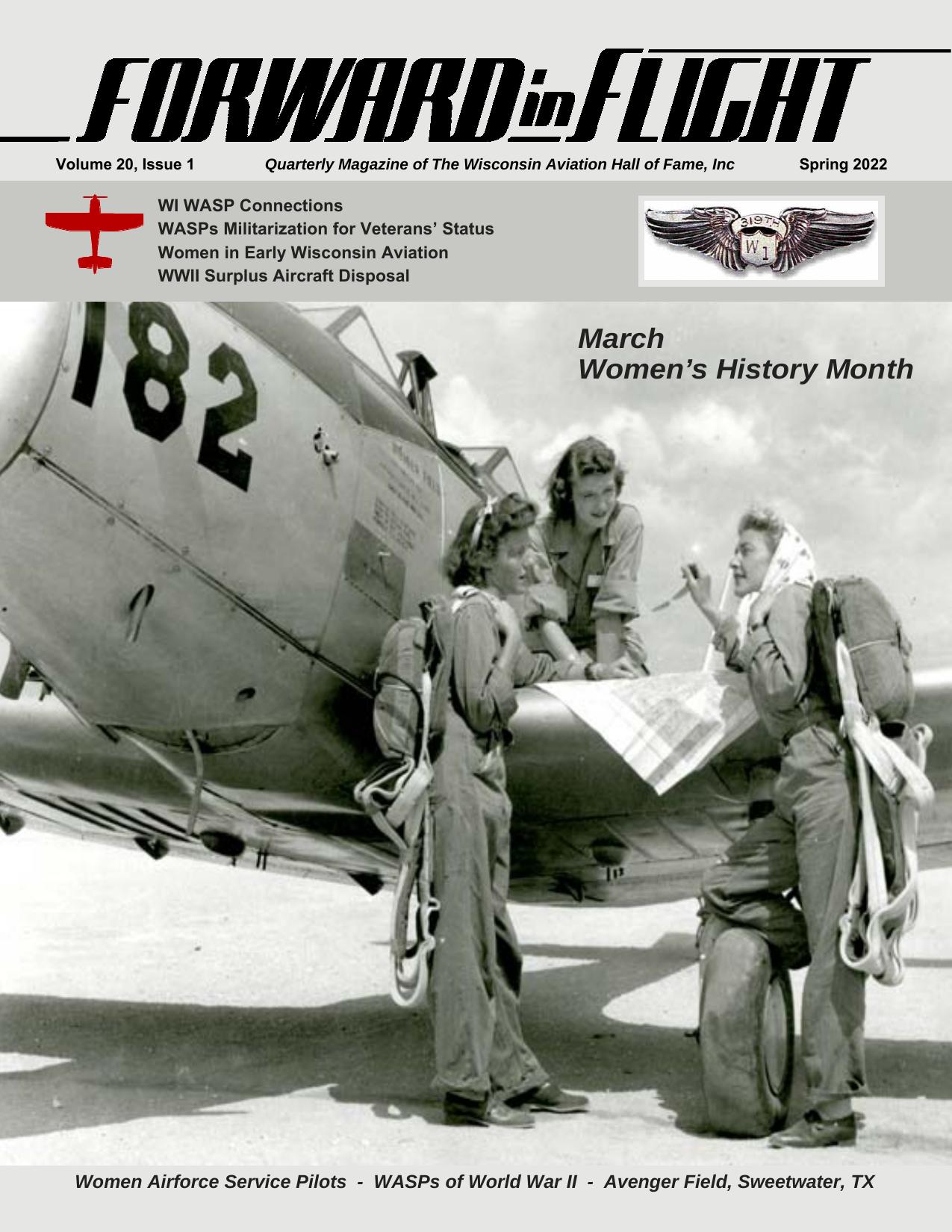
Volume 20, Issue 1 Quarterly Magazine of The Wisconsin Aviation Hall of Fame, Inc Spring 2022 WI WASP Connections WASPs Militarization for Veterans’ Status Women in Early Wisconsin Aviation WWII Surplus Aircraft Disposal March Women’s History Month Women Airforce Service Pilots - WASPs of World War II - Avenger Field, Sweetwater, TX
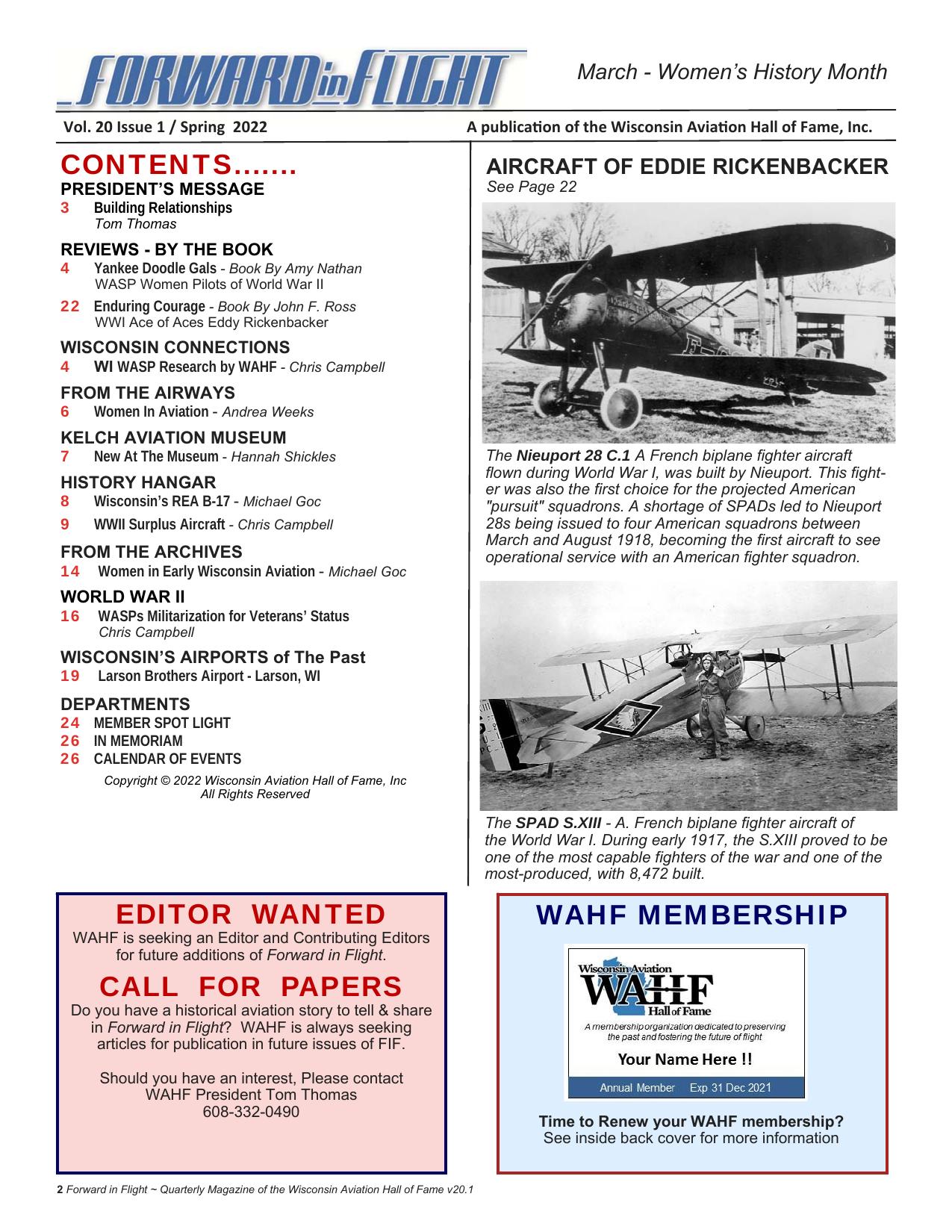
March - Women’s History Month Vol. 20 Issue 1 / Spring 2022 A publica on of the Wisconsin Avia on Hall of Fame, Inc. CONTENTS……. PRESIDENT’S MESSAGE 3 AIRCRAFT OF EDDIE RICKENBACKER See Page 22 Building Relationships Tom Thomas REVIEWS - BY THE BOOK 4 Yankee Doodle Gals - Book By Amy Nathan WASP Women Pilots of World War II 22 Enduring Courage - Book By John F. Ross WWI Ace of Aces Eddy Rickenbacker WISCONSIN CONNECTIONS 4 WI WASP Research by WAHF - Chris Campbell FROM THE AIRWAYS 6 Women In Aviation - Andrea Weeks KELCH AVIATION MUSEUM 7 New At The Museum - Hannah Shickles HISTORY HANGAR 8 9 Wisconsin’s REA B-17 - Michael Goc WWII Surplus Aircraft - Chris Campbell FROM THE ARCHIVES 14 Women in Early Wisconsin Aviation - Michael Goc The Nieuport 28 C.1 A French biplane fighter aircraft flown during World War I, was built by Nieuport. This fighter was also the first choice for the projected American "pursuit" squadrons. A shortage of SPADs led to Nieuport 28s being issued to four American squadrons between March and August 1918, becoming the first aircraft to see operational service with an American fighter squadron. WORLD WAR II 16 WASPs Militarization for Veterans’ Status Chris Campbell WISCONSIN’S AIRPORTS of The Past 19 Larson Brothers Airport - Larson, WI DEPARTMENTS 24 MEMBER SPOT LIGHT 26 IN MEMORIAM 26 CALENDAR OF EVENTS Copyright © 2022 Wisconsin Aviation Hall of Fame, Inc All Rights Reserved The SPAD S.XIII - A. French biplane fighter aircraft of the World War I. During early 1917, the S.XIII proved to be one of the most capable fighters of the war and one of the most-produced, with 8,472 built. EDITOR WANTED WAHF is seeking an Editor and Contributing Editors for future additions of Forward in Flight. WAHF MEMBERSHIP CALL FOR PAPERS Do you have a historical aviation story to tell & share in Forward in Flight? WAHF is always seeking articles for publication in future issues of FIF. Should you have an interest, Please contact WAHF President Tom Thomas 608-332-0490 2 Forward in Flight ~ Quarterly Magazine of the Wisconsin Aviation Hall of Fame v20.1 Time to Renew your WAHF membership? See inside back cover for more information
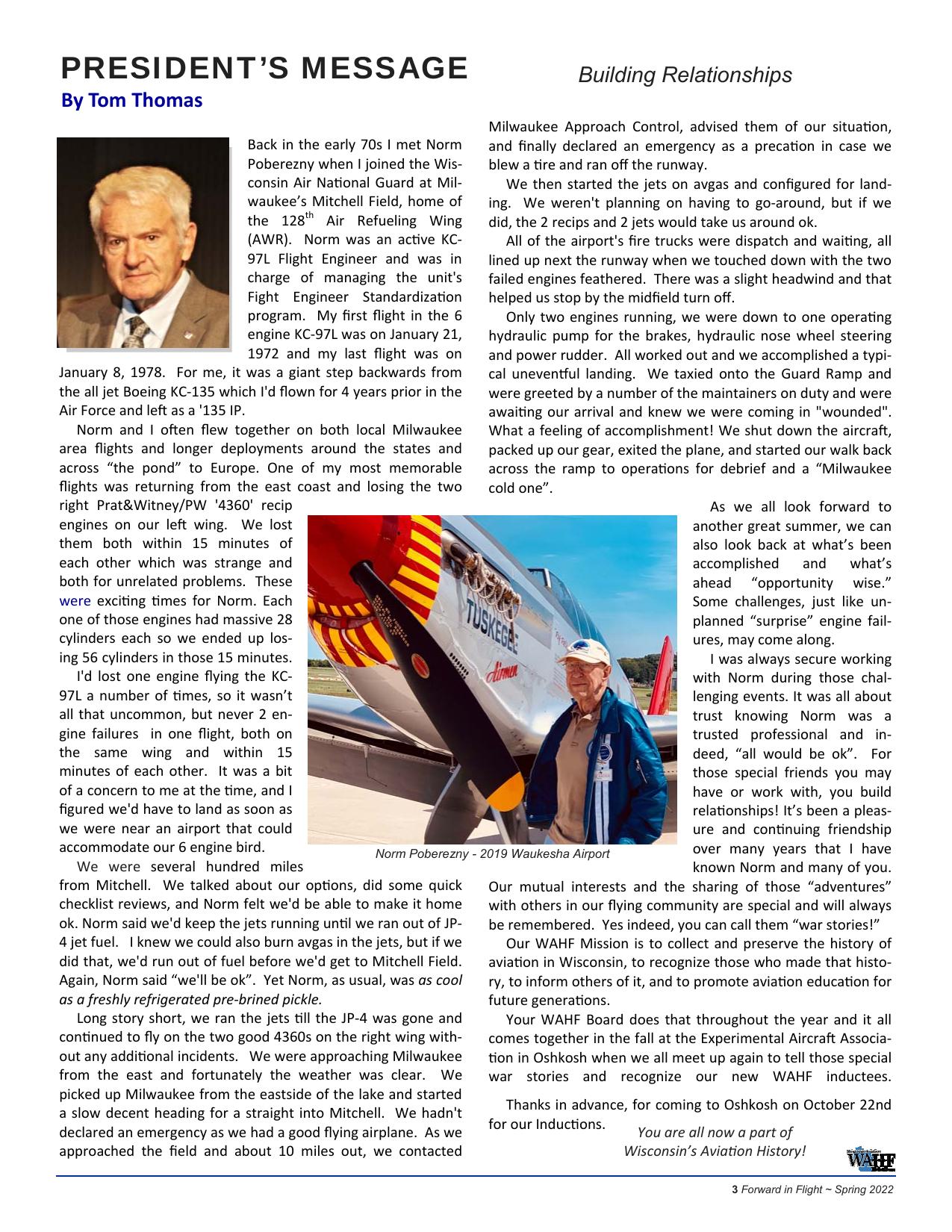
PRESIDENT’S MESSAGE Building Relationships By Tom Thomas Milwaukee Approach Control, advised them of our situa on, Back in the early 70s I met Norm and finally declared an emergency as a preca on in case we Poberezny when I joined the Wis‐ blew a re and ran off the runway. consin Air Na onal Guard at Mil‐ We then started the jets on avgas and configured for land‐ waukee’s Mitchell Field, home of ing. We weren't planning on having to go‐around, but if we the 128th Air Refueling Wing did, the 2 recips and 2 jets would take us around ok. (AWR). Norm was an ac ve KC‐ All of the airport's fire trucks were dispatch and wai ng, all 97L Flight Engineer and was in lined up next the runway when we touched down with the two charge of managing the unit's failed engines feathered. There was a slight headwind and that Fight Engineer Standardiza on helped us stop by the midfield turn off. program. My first flight in the 6 Only two engines running, we were down to one opera ng engine KC‐97L was on January 21, hydraulic pump for the brakes, hydraulic nose wheel steering 1972 and my last flight was on and power rudder. All worked out and we accomplished a typi‐ January 8, 1978. For me, it was a giant step backwards from cal uneven ul landing. We taxied onto the Guard Ramp and the all jet Boeing KC‐135 which I'd flown for 4 years prior in the were greeted by a number of the maintainers on duty and were Air Force and le as a '135 IP. awai ng our arrival and knew we were coming in "wounded". Norm and I o en flew together on both local Milwaukee What a feeling of accomplishment! We shut down the aircra , area flights and longer deployments around the states and packed up our gear, exited the plane, and started our walk back across “the pond” to Europe. One of my most memorable across the ramp to opera ons for debrief and a “Milwaukee flights was returning from the east coast and losing the two cold one”. right Prat&Witney/PW '4360' recip As we all look forward to engines on our le wing. We lost another great summer, we can them both within 15 minutes of also look back at what’s been each other which was strange and accomplished and what’s both for unrelated problems. These ahead “opportunity wise.” were exci ng mes for Norm. Each Some challenges, just like un‐ one of those engines had massive 28 planned “surprise” engine fail‐ cylinders each so we ended up los‐ ures, may come along. ing 56 cylinders in those 15 minutes. I was always secure working I'd lost one engine flying the KC‐ with Norm during those chal‐ 97L a number of mes, so it wasn’t lenging events. It was all about all that uncommon, but never 2 en‐ trust knowing Norm was a gine failures in one flight, both on trusted professional and in‐ the same wing and within 15 deed, “all would be ok”. For minutes of each other. It was a bit those special friends you may of a concern to me at the me, and I have or work with, you build figured we'd have to land as soon as rela onships! It’s been a pleas‐ we were near an airport that could ure and con nuing friendship accommodate our 6 engine bird. over many years that I have Norm Poberezny - 2019 Waukesha Airport We were several hundred miles known Norm and many of you. from Mitchell. We talked about our op ons, did some quick Our mutual interests and the sharing of those “adventures” checklist reviews, and Norm felt we'd be able to make it home with others in our flying community are special and will always ok. Norm said we'd keep the jets running un l we ran out of JP‐ be remembered. Yes indeed, you can call them “war stories!” 4 jet fuel. I knew we could also burn avgas in the jets, but if we Our WAHF Mission is to collect and preserve the history of did that, we'd run out of fuel before we'd get to Mitchell Field. avia on in Wisconsin, to recognize those who made that histo‐ Again, Norm said “we'll be ok”. Yet Norm, as usual, was as cool ry, to inform others of it, and to promote avia on educa on for as a freshly refrigerated pre‐brined pickle. future genera ons. Long story short, we ran the jets ll the JP‐4 was gone and Your WAHF Board does that throughout the year and it all con nued to fly on the two good 4360s on the right wing with‐ comes together in the fall at the Experimental Aircra Associa‐ out any addi onal incidents. We were approaching Milwaukee on in Oshkosh when we all meet up again to tell those special from the east and fortunately the weather was clear. We war stories and recognize our new WAHF inductees. picked up Milwaukee from the eastside of the lake and started Thanks in advance, for coming to Oshkosh on October 22nd a slow decent heading for a straight into Mitchell. We hadn't for our Induc ons. declared an emergency as we had a good flying airplane. As we You are all now a part of approached the field and about 10 miles out, we contacted Wisconsin’s Avia on History! 3 Forward in Flight ~ Spring 2022
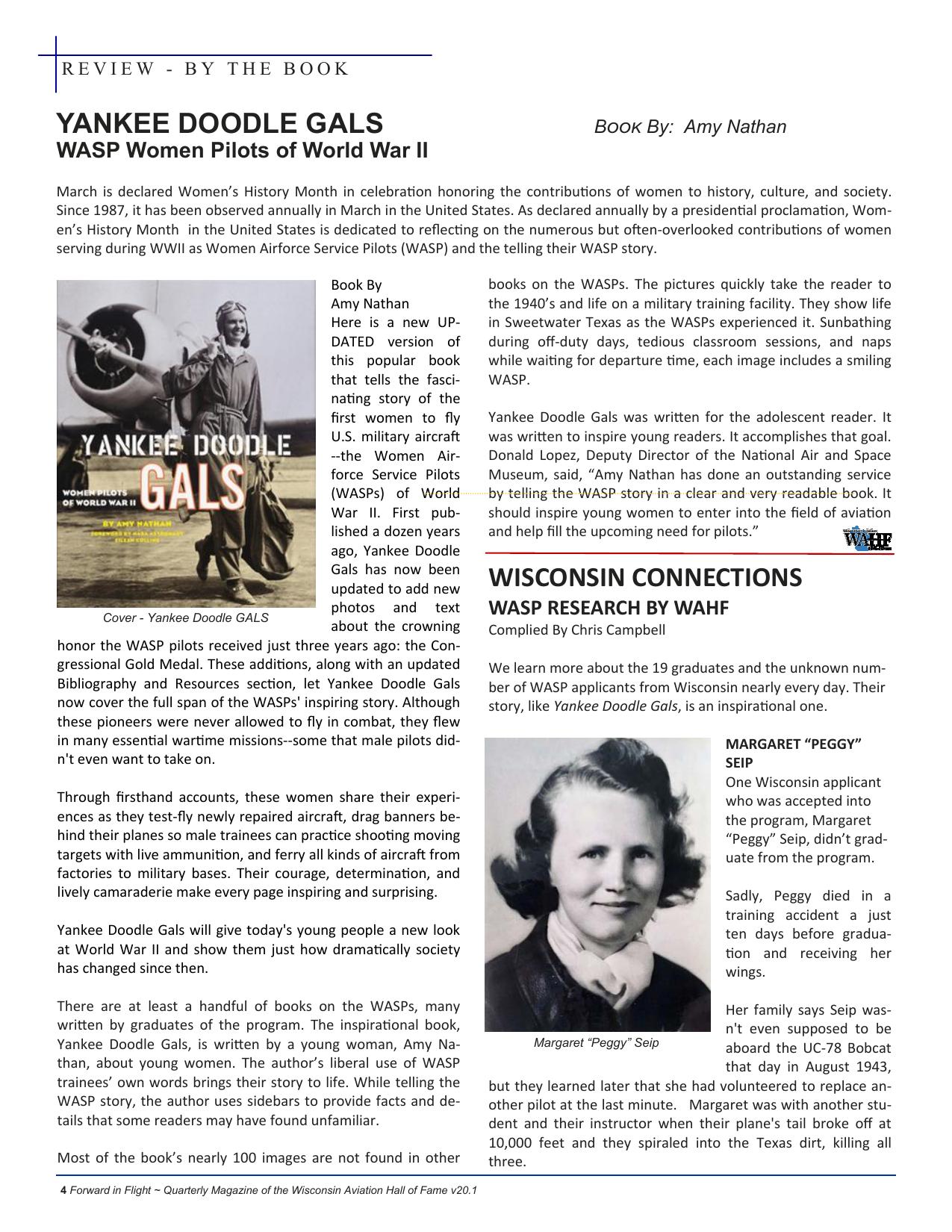
REVIEW - BY THE BOOK YANKEE DOODLE GALS Bਮਮਪ By: Amy Nathan WASP Women Pilots of World War II March is declared Women’s History Month in celebra on honoring the contribu ons of women to history, culture, and society. Since 1987, it has been observed annually in March in the United States. As declared annually by a presiden al proclama on, Wom‐ en’s History Month in the United States is dedicated to reflec ng on the numerous but o en‐overlooked contribu ons of women serving during WWII as Women Airforce Service Pilots (WASP) and the telling their WASP story. Book By Amy Nathan Here is a new UP‐ DATED version of this popular book that tells the fasci‐ na ng story of the first women to fly U.S. military aircra ‐‐the Women Air‐ force Service Pilots (WASPs) of World War II. First pub‐ lished a dozen years ago, Yankee Doodle Gals has now been updated to add new photos and text Cover - Yankee Doodle GALS about the crowning honor the WASP pilots received just three years ago: the Con‐ gressional Gold Medal. These addi ons, along with an updated Bibliography and Resources sec on, let Yankee Doodle Gals now cover the full span of the WASPs' inspiring story. Although these pioneers were never allowed to fly in combat, they flew in many essen al war me missions‐‐some that male pilots did‐ n't even want to take on. Through firsthand accounts, these women share their experi‐ ences as they test‐fly newly repaired aircra , drag banners be‐ hind their planes so male trainees can prac ce shoo ng moving targets with live ammuni on, and ferry all kinds of aircra from factories to military bases. Their courage, determina on, and lively camaraderie make every page inspiring and surprising. Yankee Doodle Gals will give today's young people a new look at World War II and show them just how drama cally society has changed since then. There are at least a handful of books on the WASPs, many wri en by graduates of the program. The inspira onal book, Yankee Doodle Gals, is wri en by a young woman, Amy Na‐ than, about young women. The author’s liberal use of WASP trainees’ own words brings their story to life. While telling the WASP story, the author uses sidebars to provide facts and de‐ tails that some readers may have found unfamiliar. Most of the book’s nearly 100 images are not found in other 4 Forward in Flight ~ Quarterly Magazine of the Wisconsin Aviation Hall of Fame v20.1 books on the WASPs. The pictures quickly take the reader to the 1940’s and life on a military training facility. They show life in Sweetwater Texas as the WASPs experienced it. Sunbathing during off‐duty days, tedious classroom sessions, and naps while wai ng for departure me, each image includes a smiling WASP. Yankee Doodle Gals was wri en for the adolescent reader. It was wri en to inspire young readers. It accomplishes that goal. Donald Lopez, Deputy Director of the Na onal Air and Space Museum, said, “Amy Nathan has done an outstanding service by telling the WASP story in a clear and very readable book. It should inspire young women to enter into the field of avia on and help fill the upcoming need for pilots.” WISCONSIN CONNECTIONS WASP RESEARCH BY WAHF Complied By Chris Campbell We learn more about the 19 graduates and the unknown num‐ ber of WASP applicants from Wisconsin nearly every day. Their story, like Yankee Doodle Gals, is an inspira onal one. MARGARET “PEGGY” SEIP One Wisconsin applicant who was accepted into the program, Margaret “Peggy” Seip, didn’t grad‐ uate from the program. Sadly, Peggy died in a training accident a just ten days before gradua‐ on and receiving her wings. Her family says Seip was‐ n't even supposed to be Margaret “Peggy” Seip aboard the UC‐78 Bobcat that day in August 1943, but they learned later that she had volunteered to replace an‐ other pilot at the last minute. Margaret was with another stu‐ dent and their instructor when their plane's tail broke off at 10,000 feet and they spiraled into the Texas dirt, killing all three.
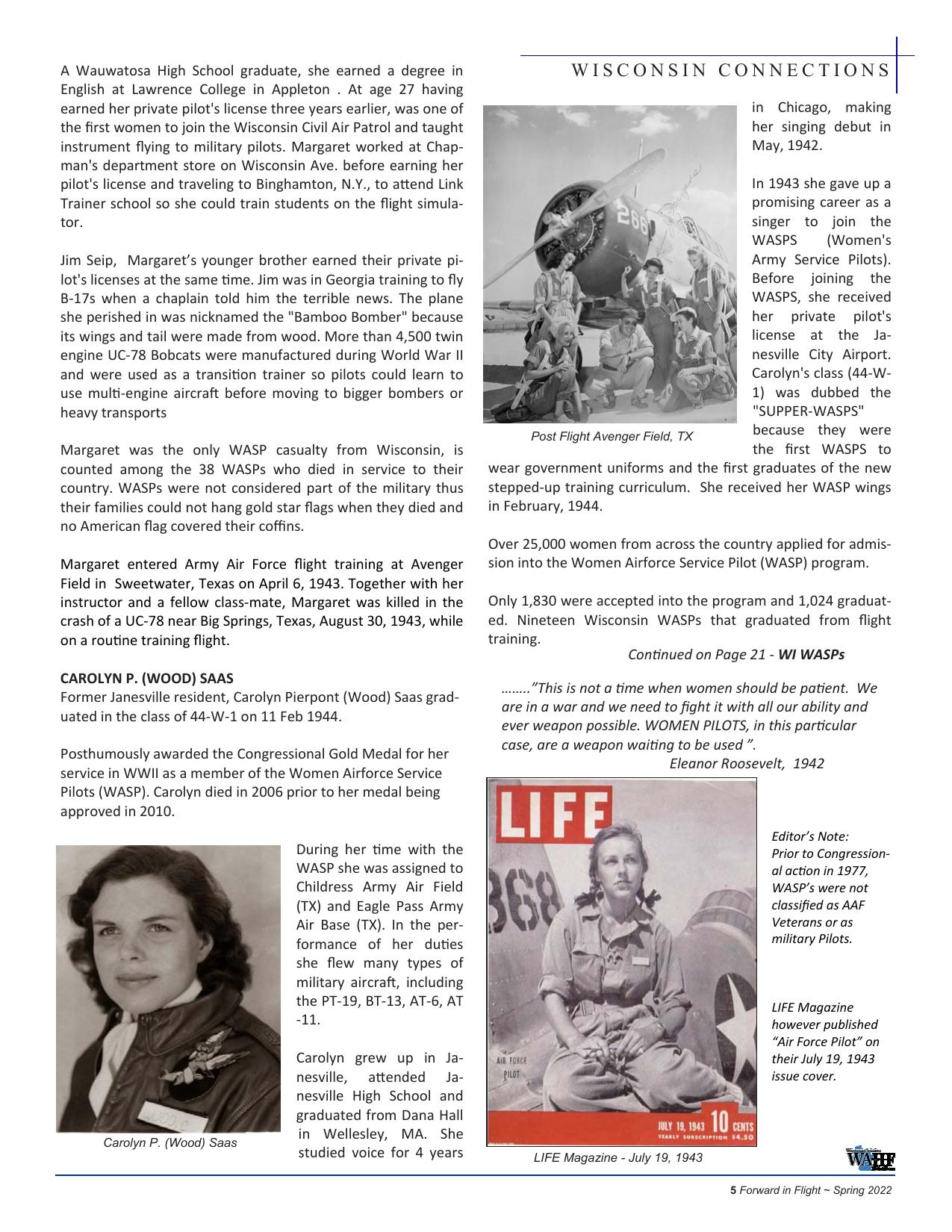
A Wauwatosa High School graduate, she earned a degree in English at Lawrence College in Appleton . At age 27 having earned her private pilot's license three years earlier, was one of the first women to join the Wisconsin Civil Air Patrol and taught instrument flying to military pilots. Margaret worked at Chap‐ man's department store on Wisconsin Ave. before earning her pilot's license and traveling to Binghamton, N.Y., to a end Link Trainer school so she could train students on the flight simula‐ tor. Jim Seip, Margaret’s younger brother earned their private pi‐ lot's licenses at the same me. Jim was in Georgia training to fly B‐17s when a chaplain told him the terrible news. The plane she perished in was nicknamed the "Bamboo Bomber" because its wings and tail were made from wood. More than 4,500 twin engine UC‐78 Bobcats were manufactured during World War II and were used as a transi on trainer so pilots could learn to use mul ‐engine aircra before moving to bigger bombers or heavy transports Margaret was the only WASP casualty from Wisconsin, is counted among the 38 WASPs who died in service to their country. WASPs were not considered part of the military thus their families could not hang gold star flags when they died and no American flag covered their coffins. Margaret entered Army Air Force flight training at Avenger Field in Sweetwater, Texas on April 6, 1943. Together with her instructor and a fellow class‐mate, Margaret was killed in the crash of a UC‐78 near Big Springs, Texas, August 30, 1943, while on a rou ne training flight. CAROLYN P. (WOOD) SAAS Former Janesville resident, Carolyn Pierpont (Wood) Saas grad‐ uated in the class of 44‐W‐1 on 11 Feb 1944. Posthumously awarded the Congressional Gold Medal for her service in WWII as a member of the Women Airforce Service Pilots (WASP). Carolyn died in 2006 prior to her medal being approved in 2010. WISCONSIN CONNECTIONS in Chicago, making her singing debut in May, 1942. In 1943 she gave up a promising career as a singer to join the WASPS (Women's Army Service Pilots). Before joining the WASPS, she received her private pilot's license at the Ja‐ nesville City Airport. Carolyn's class (44‐W‐ 1) was dubbed the "SUPPER‐WASPS" because they were Post Flight Avenger Field, TX the first WASPS to wear government uniforms and the first graduates of the new stepped‐up training curriculum. She received her WASP wings in February, 1944. Over 25,000 women from across the country applied for admis‐ sion into the Women Airforce Service Pilot (WASP) program. Only 1,830 were accepted into the program and 1,024 graduat‐ ed. Nineteen Wisconsin WASPs that graduated from flight training. Con nued on Page 21 ‐ WI WASPs ……..”This is not a me when women should be pa ent. We are in a war and we need to fight it with all our ability and ever weapon possible. WOMEN PILOTS, in this par cular case, are a weapon wai ng to be used ”. Eleanor Roosevelt, 1942 Editor’s Note: Prior to Congression‐ al ac on in 1977, WASP’s were not classified as AAF Veterans or as military Pilots. During her me with the WASP she was assigned to Childress Army Air Field (TX) and Eagle Pass Army Air Base (TX). In the per‐ formance of her du es she flew many types of military aircra , including the PT‐19, BT‐13, AT‐6, AT ‐11. Carolyn P. (Wood) Saas Carolyn grew up in Ja‐ nesville, a ended Ja‐ nesville High School and graduated from Dana Hall in Wellesley, MA. She studied voice for 4 years LIFE Magazine however published “Air Force Pilot” on their July 19, 1943 issue cover. LIFE Magazine - July 19, 1943 5 Forward in Flight ~ Spring 2022
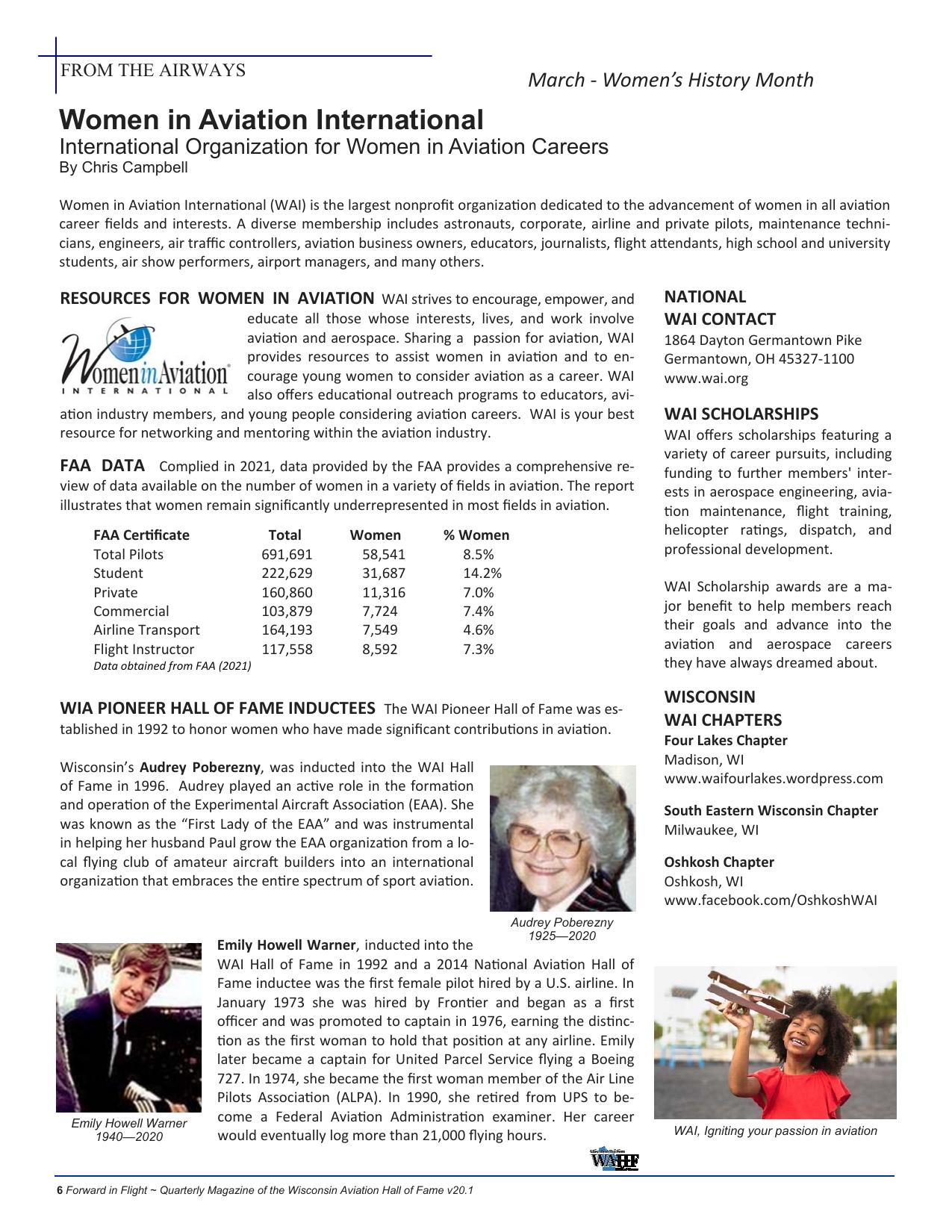
FROM THE AIRWAYS March ‐ Women’s History Month Women in Aviation International International Organization for Women in Aviation Careers By Chris Campbell Women in Avia on Interna onal (WAI) is the largest nonprofit organiza on dedicated to the advancement of women in all avia on career fields and interests. A diverse membership includes astronauts, corporate, airline and private pilots, maintenance techni‐ cians, engineers, air traffic controllers, avia on business owners, educators, journalists, flight a endants, high school and university students, air show performers, airport managers, and many others. RESOURCES FOR WOMEN IN AVIATION WAI strives to encourage, empower, and educate all those whose interests, lives, and work involve avia on and aerospace. Sharing a passion for avia on, WAI provides resources to assist women in avia on and to en‐ courage young women to consider avia on as a career. WAI also offers educa onal outreach programs to educators, avi‐ a on industry members, and young people considering avia on careers. WAI is your best resource for networking and mentoring within the avia on industry. FAA DATA Complied in 2021, data provided by the FAA provides a comprehensive re‐ view of data available on the number of women in a variety of fields in avia on. The report illustrates that women remain significantly underrepresented in most fields in avia on. FAA Cer ficate Total Pilots Student Private Commercial Airline Transport Flight Instructor Total 691,691 222,629 160,860 103,879 164,193 117,558 Women 58,541 31,687 11,316 7,724 7,549 8,592 % Women 8.5% 14.2% 7.0% 7.4% 4.6% 7.3% NATIONAL WAI CONTACT 1864 Dayton Germantown Pike Germantown, OH 45327‐1100 www.wai.org WAI SCHOLARSHIPS WAI offers scholarships featuring a variety of career pursuits, including funding to further members' inter‐ ests in aerospace engineering, avia‐ on maintenance, flight training, helicopter ra ngs, dispatch, and professional development. WAI Scholarship awards are a ma‐ jor benefit to help members reach their goals and advance into the avia on and aerospace careers they have always dreamed about. Data obtained from FAA (2021) WIA PIONEER HALL OF FAME INDUCTEES The WAI Pioneer Hall of Fame was es‐ tablished in 1992 to honor women who have made significant contribu ons in avia on. Wisconsin’s Audrey Poberezny, was inducted into the WAI Hall of Fame in 1996. Audrey played an ac ve role in the forma on and opera on of the Experimental Aircra Associa on (EAA). She was known as the “First Lady of the EAA” and was instrumental in helping her husband Paul grow the EAA organiza on from a lo‐ cal flying club of amateur aircra builders into an interna onal organiza on that embraces the en re spectrum of sport avia on. WISCONSIN WAI CHAPTERS Four Lakes Chapter Madison, WI www.waifourlakes.wordpress.com South Eastern Wisconsin Chapter Milwaukee, WI Oshkosh Chapter Oshkosh, WI www.facebook.com/OshkoshWAI Audrey Poberezny 1925—2020 Emily Howell Warner 1940—2020 Emily Howell Warner, inducted into the WAI Hall of Fame in 1992 and a 2014 Na onal Avia on Hall of Fame inductee was the first female pilot hired by a U.S. airline. In January 1973 she was hired by Fron er and began as a first officer and was promoted to captain in 1976, earning the dis nc‐ on as the first woman to hold that posi on at any airline. Emily later became a captain for United Parcel Service flying a Boeing 727. In 1974, she became the first woman member of the Air Line Pilots Associa on (ALPA). In 1990, she re red from UPS to be‐ come a Federal Avia on Administra on examiner. Her career would eventually log more than 21,000 flying hours. 6 Forward in Flight ~ Quarterly Magazine of the Wisconsin Aviation Hall of Fame v20.1 WAI, Igniting your passion in aviation
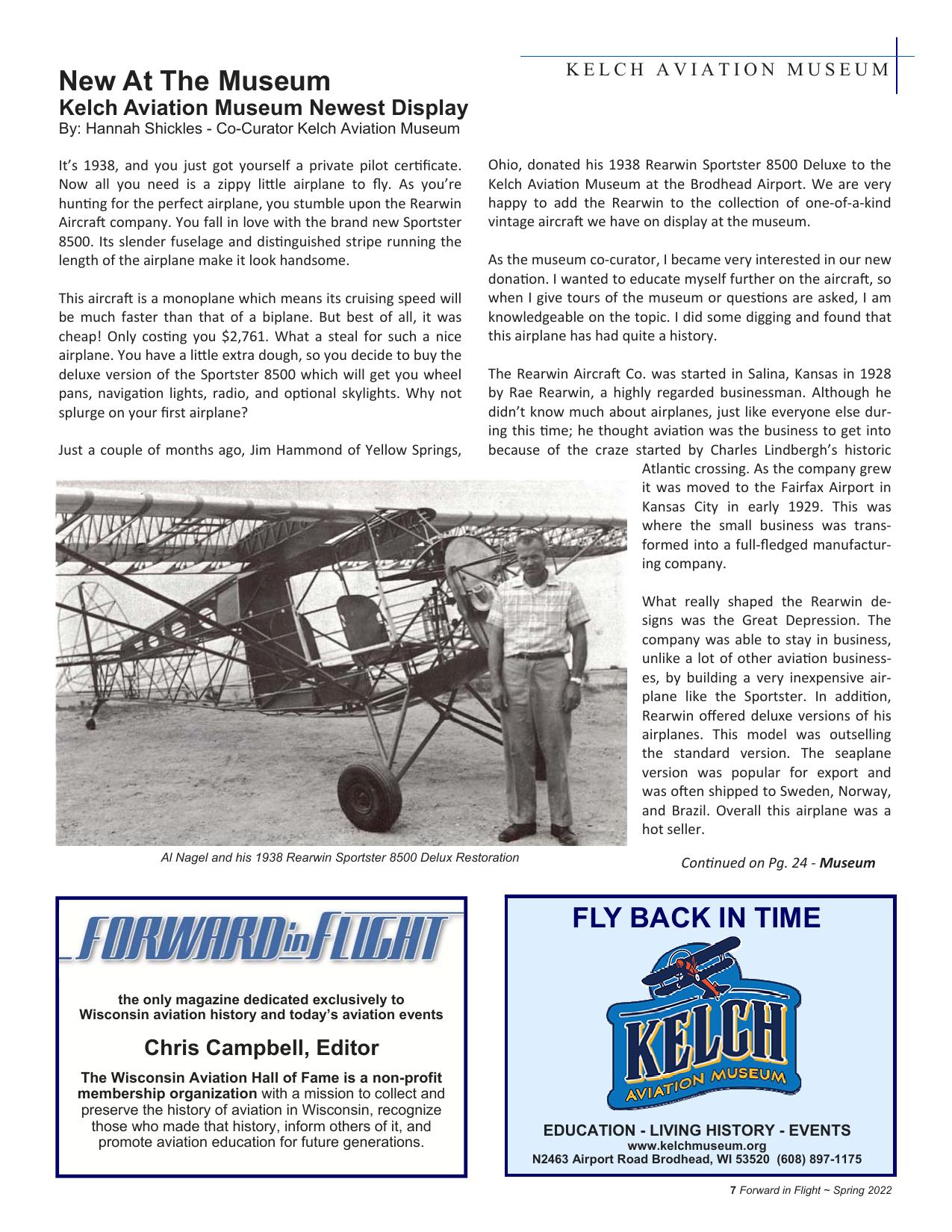
KELCH AVIATION MUSEUM New At The Museum Kelch Aviation Museum Newest Display By: Hannah Shickles - Co-Curator Kelch Aviation Museum It’s 1938, and you just got yourself a private pilot cer ficate. Now all you need is a zippy li le airplane to fly. As you’re hun ng for the perfect airplane, you stumble upon the Rearwin Aircra company. You fall in love with the brand new Sportster 8500. Its slender fuselage and dis nguished stripe running the length of the airplane make it look handsome. This aircra is a monoplane which means its cruising speed will be much faster than that of a biplane. But best of all, it was cheap! Only cos ng you $2,761. What a steal for such a nice airplane. You have a li le extra dough, so you decide to buy the deluxe version of the Sportster 8500 which will get you wheel pans, naviga on lights, radio, and op onal skylights. Why not splurge on your first airplane? Just a couple of months ago, Jim Hammond of Yellow Springs, Ohio, donated his 1938 Rearwin Sportster 8500 Deluxe to the Kelch Avia on Museum at the Brodhead Airport. We are very happy to add the Rearwin to the collec on of one‐of‐a‐kind vintage aircra we have on display at the museum. As the museum co‐curator, I became very interested in our new dona on. I wanted to educate myself further on the aircra , so when I give tours of the museum or ques ons are asked, I am knowledgeable on the topic. I did some digging and found that this airplane has had quite a history. The Rearwin Aircra Co. was started in Salina, Kansas in 1928 by Rae Rearwin, a highly regarded businessman. Although he didn’t know much about airplanes, just like everyone else dur‐ ing this me; he thought avia on was the business to get into because of the craze started by Charles Lindbergh’s historic Atlan c crossing. As the company grew it was moved to the Fairfax Airport in Kansas City in early 1929. This was where the small business was trans‐ formed into a full‐fledged manufactur‐ ing company. What really shaped the Rearwin de‐ signs was the Great Depression. The company was able to stay in business, unlike a lot of other avia on business‐ es, by building a very inexpensive air‐ plane like the Sportster. In addi on, Rearwin offered deluxe versions of his airplanes. This model was outselling the standard version. The seaplane version was popular for export and was o en shipped to Sweden, Norway, and Brazil. Overall this airplane was a hot seller. Al Nagel and his 1938 Rearwin Sportster 8500 Delux Restoration Con nued on Pg. 24 ‐ Museum FLY BACK IN TIME the only magazine dedicated exclusively to Wisconsin aviation history and today’s aviation events Chris Campbell, Editor The Wisconsin Aviation Hall of Fame is a non-profit membership organization with a mission to collect and preserve the history of aviation in Wisconsin, recognize those who made that history, inform others of it, and promote aviation education for future generations. EDUCATION - LIVING HISTORY - EVENTS www.kelchmuseum.org N2463 Airport Road Brodhead, WI 53520 (608) 897-1175 7 Forward in Flight ~ Spring 2022
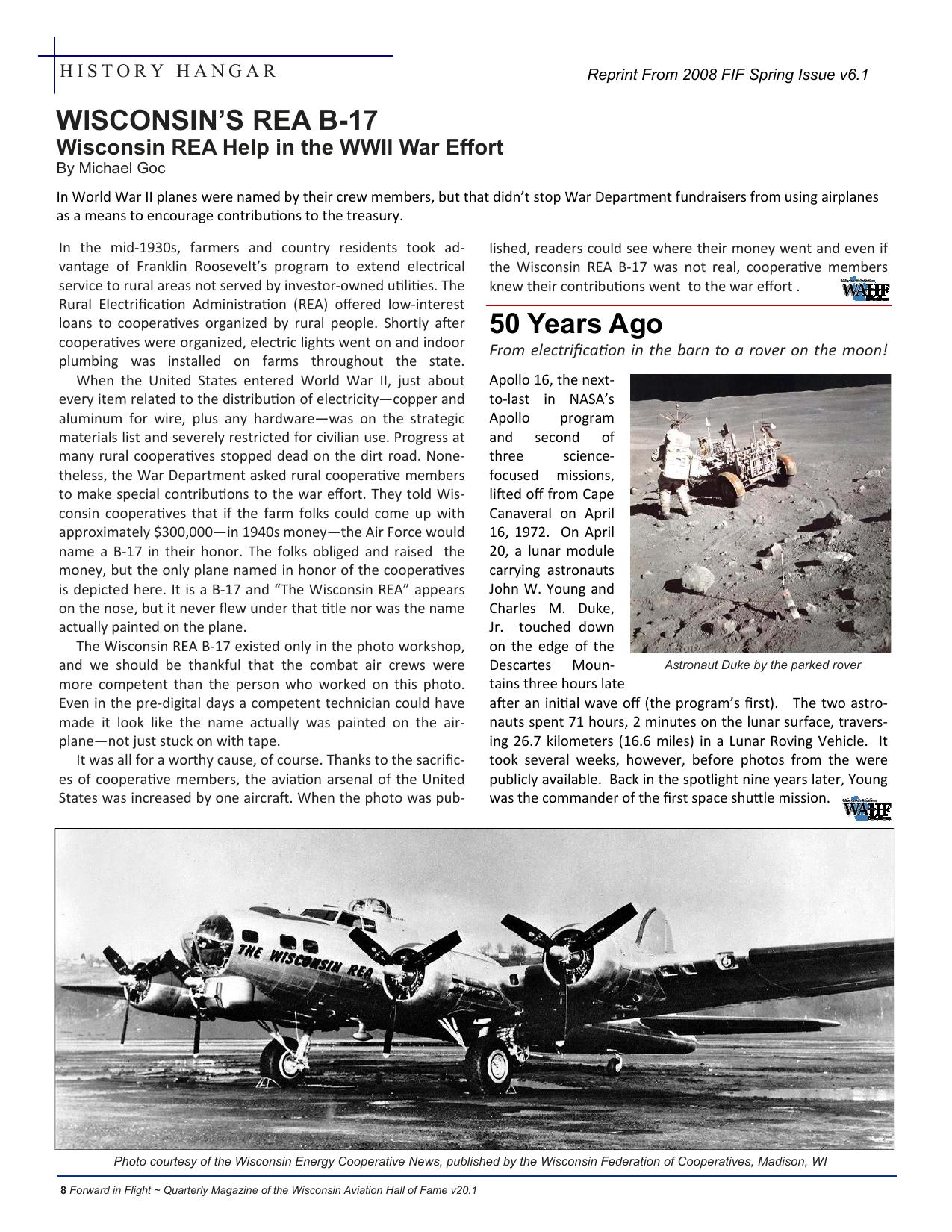
HISTORY HANGAR Reprint From 2008 FIF Spring Issue v6.1 WISCONSIN’S REA B-17 Wisconsin REA Help in the WWII War Effort By Michael Goc In World War II planes were named by their crew members, but that didn’t stop War Department fundraisers from using airplanes as a means to encourage contribu ons to the treasury. In the mid‐1930s, farmers and country residents took ad‐ vantage of Franklin Roosevelt’s program to extend electrical service to rural areas not served by investor‐owned u li es. The Rural Electrifica on Administra on (REA) offered low‐interest loans to coopera ves organized by rural people. Shortly a er coopera ves were organized, electric lights went on and indoor plumbing was installed on farms throughout the state. When the United States entered World War II, just about every item related to the distribu on of electricity—copper and aluminum for wire, plus any hardware—was on the strategic materials list and severely restricted for civilian use. Progress at many rural coopera ves stopped dead on the dirt road. None‐ theless, the War Department asked rural coopera ve members to make special contribu ons to the war effort. They told Wis‐ consin coopera ves that if the farm folks could come up with approximately $300,000—in 1940s money—the Air Force would name a B‐17 in their honor. The folks obliged and raised the money, but the only plane named in honor of the coopera ves is depicted here. It is a B‐17 and “The Wisconsin REA” appears on the nose, but it never flew under that tle nor was the name actually painted on the plane. The Wisconsin REA B‐17 existed only in the photo workshop, and we should be thankful that the combat air crews were more competent than the person who worked on this photo. Even in the pre‐digital days a competent technician could have made it look like the name actually was painted on the air‐ plane—not just stuck on with tape. It was all for a worthy cause, of course. Thanks to the sacrific‐ es of coopera ve members, the avia on arsenal of the United States was increased by one aircra . When the photo was pub‐ lished, readers could see where their money went and even if the Wisconsin REA B‐17 was not real, coopera ve members knew their contribu ons went to the war effort . 50 Years Ago From electrifica on in the barn to a rover on the moon! Apollo 16, the next‐ to‐last in NASA’s Apollo program and second of three science‐ focused missions, li ed off from Cape Canaveral on April 16, 1972. On April 20, a lunar module carrying astronauts John W. Young and Charles M. Duke, Jr. touched down on the edge of the Astronaut Duke by the parked rover Descartes Moun‐ tains three hours late a er an ini al wave off (the program’s first). The two astro‐ nauts spent 71 hours, 2 minutes on the lunar surface, travers‐ ing 26.7 kilometers (16.6 miles) in a Lunar Roving Vehicle. It took several weeks, however, before photos from the were publicly available. Back in the spotlight nine years later, Young was the commander of the first space shu le mission. Photo courtesy of the Wisconsin Energy Cooperative News, published by the Wisconsin Federation of Cooperatives, Madison, WI 8 Forward in Flight ~ Quarterly Magazine of the Wisconsin Aviation Hall of Fame v20.1
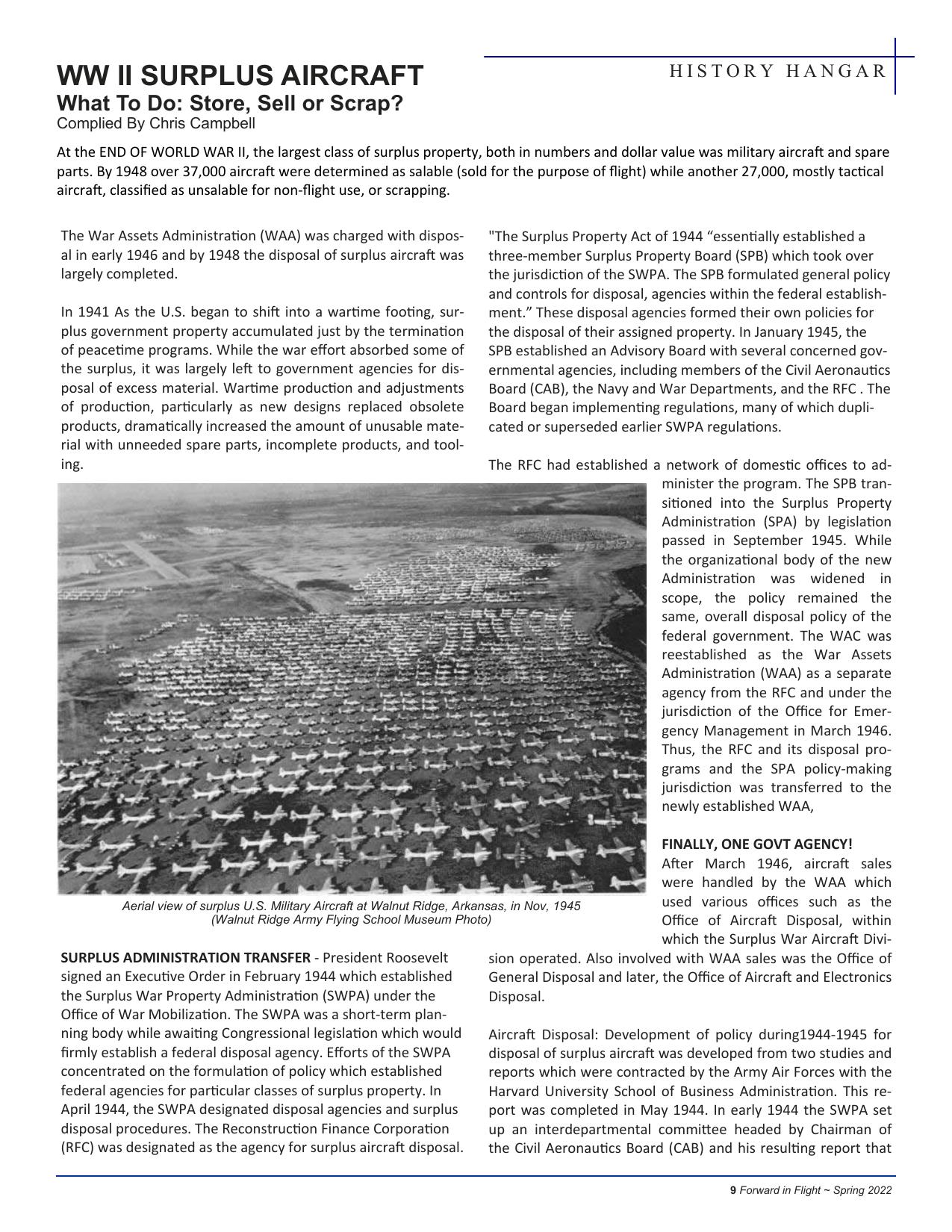
WW II SURPLUS AIRCRAFT HISTORY HANGAR What To Do: Store, Sell or Scrap? Complied By Chris Campbell At the END OF WORLD WAR II, the largest class of surplus property, both in numbers and dollar value was military aircra and spare parts. By 1948 over 37,000 aircra were determined as salable (sold for the purpose of flight) while another 27,000, mostly tac cal aircra , classified as unsalable for non‐flight use, or scrapping. The War Assets Administra on (WAA) was charged with dispos‐ al in early 1946 and by 1948 the disposal of surplus aircra was largely completed. In 1941 As the U.S. began to shi into a war me foo ng, sur‐ plus government property accumulated just by the termina on of peace me programs. While the war effort absorbed some of the surplus, it was largely le to government agencies for dis‐ posal of excess material. War me produc on and adjustments of produc on, par cularly as new designs replaced obsolete products, drama cally increased the amount of unusable mate‐ rial with unneeded spare parts, incomplete products, and tool‐ ing. "The Surplus Property Act of 1944 “essen ally established a three‐member Surplus Property Board (SPB) which took over the jurisdic on of the SWPA. The SPB formulated general policy and controls for disposal, agencies within the federal establish‐ ment.” These disposal agencies formed their own policies for the disposal of their assigned property. In January 1945, the SPB established an Advisory Board with several concerned gov‐ ernmental agencies, including members of the Civil Aeronau cs Board (CAB), the Navy and War Departments, and the RFC . The Board began implemen ng regula ons, many of which dupli‐ cated or superseded earlier SWPA regula ons. The RFC had established a network of domes c offices to ad‐ minister the program. The SPB tran‐ si oned into the Surplus Property Administra on (SPA) by legisla on passed in September 1945. While the organiza onal body of the new Administra on was widened in scope, the policy remained the same, overall disposal policy of the federal government. The WAC was reestablished as the War Assets Administra on (WAA) as a separate agency from the RFC and under the jurisdic on of the Office for Emer‐ gency Management in March 1946. Thus, the RFC and its disposal pro‐ grams and the SPA policy‐making jurisdic on was transferred to the newly established WAA, FINALLY, ONE GOVT AGENCY! A er March 1946, aircra sales were handled by the WAA which used various offices such as the Aerial view of surplus U.S. Military Aircraft at Walnut Ridge, Arkansas, in Nov, 1945 (Walnut Ridge Army Flying School Museum Photo) Office of Aircra Disposal, within which the Surplus War Aircra Divi‐ SURPLUS ADMINISTRATION TRANSFER ‐ President Roosevelt sion operated. Also involved with WAA sales was the Office of signed an Execu ve Order in February 1944 which established General Disposal and later, the Office of Aircra and Electronics the Surplus War Property Administra on (SWPA) under the Disposal. Office of War Mobiliza on. The SWPA was a short‐term plan‐ ning body while awai ng Congressional legisla on which would Aircra Disposal: Development of policy during1944‐1945 for firmly establish a federal disposal agency. Efforts of the SWPA disposal of surplus aircra was developed from two studies and concentrated on the formula on of policy which established reports which were contracted by the Army Air Forces with the federal agencies for par cular classes of surplus property. In Harvard University School of Business Administra on. This re‐ April 1944, the SWPA designated disposal agencies and surplus port was completed in May 1944. In early 1944 the SWPA set disposal procedures. The Reconstruc on Finance Corpora on up an interdepartmental commi ee headed by Chairman of (RFC) was designated as the agency for surplus aircra disposal. the Civil Aeronau cs Board (CAB) and his resul ng report that 9 Forward in Flight ~ Spring 2022
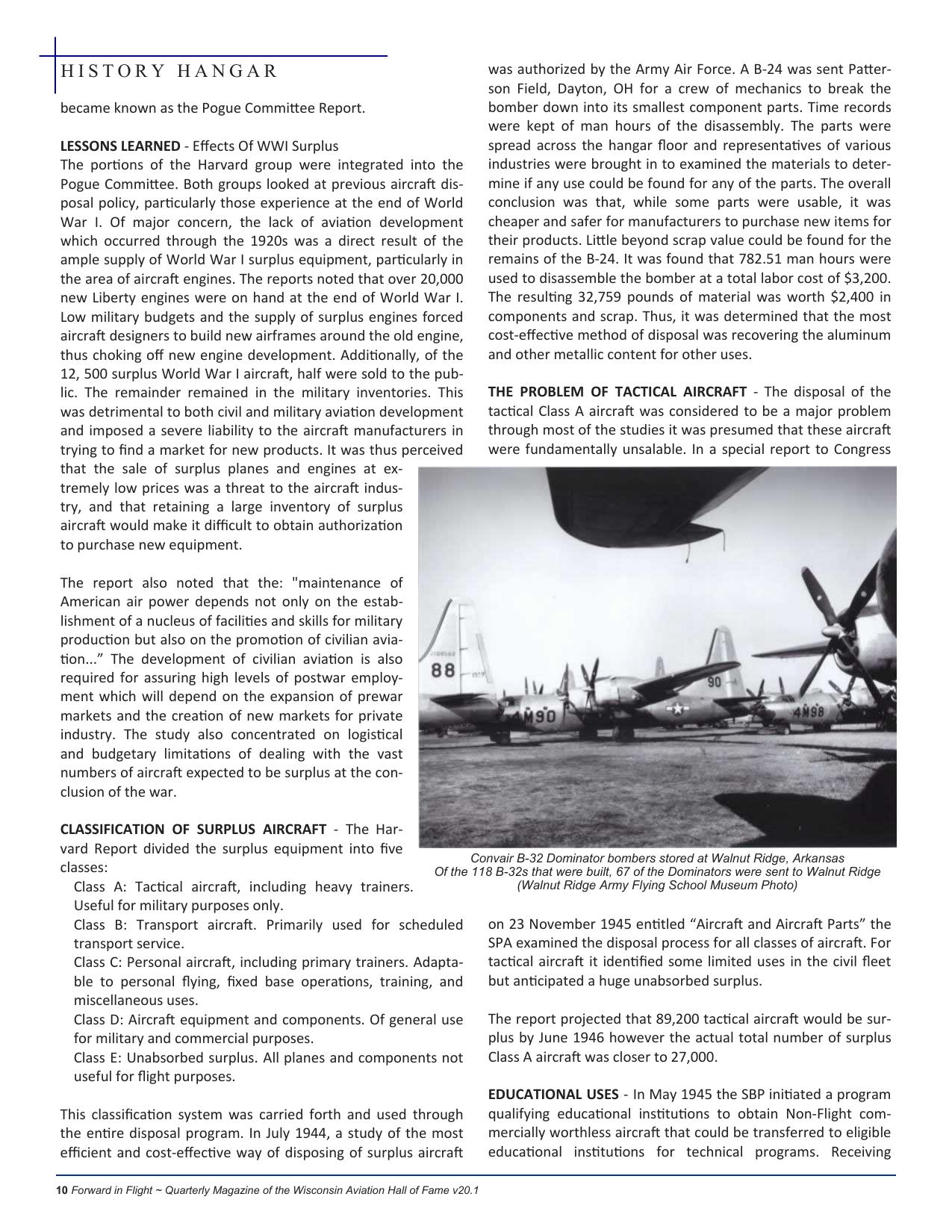
HISTORY HANGAR became known as the Pogue Commi ee Report. LESSONS LEARNED ‐ Effects Of WWI Surplus The por ons of the Harvard group were integrated into the Pogue Commi ee. Both groups looked at previous aircra dis‐ posal policy, par cularly those experience at the end of World War I. Of major concern, the lack of avia on development which occurred through the 1920s was a direct result of the ample supply of World War I surplus equipment, par cularly in the area of aircra engines. The reports noted that over 20,000 new Liberty engines were on hand at the end of World War I. Low military budgets and the supply of surplus engines forced aircra designers to build new airframes around the old engine, thus choking off new engine development. Addi onally, of the 12, 500 surplus World War I aircra , half were sold to the pub‐ lic. The remainder remained in the military inventories. This was detrimental to both civil and military avia on development and imposed a severe liability to the aircra manufacturers in trying to find a market for new products. It was thus perceived that the sale of surplus planes and engines at ex‐ tremely low prices was a threat to the aircra indus‐ try, and that retaining a large inventory of surplus aircra would make it difficult to obtain authoriza on to purchase new equipment. was authorized by the Army Air Force. A B‐24 was sent Pa er‐ son Field, Dayton, OH for a crew of mechanics to break the bomber down into its smallest component parts. Time records were kept of man hours of the disassembly. The parts were spread across the hangar floor and representa ves of various industries were brought in to examined the materials to deter‐ mine if any use could be found for any of the parts. The overall conclusion was that, while some parts were usable, it was cheaper and safer for manufacturers to purchase new items for their products. Li le beyond scrap value could be found for the remains of the B‐24. It was found that 782.51 man hours were used to disassemble the bomber at a total labor cost of $3,200. The resul ng 32,759 pounds of material was worth $2,400 in components and scrap. Thus, it was determined that the most cost‐effec ve method of disposal was recovering the aluminum and other metallic content for other uses. THE PROBLEM OF TACTICAL AIRCRAFT ‐ The disposal of the tac cal Class A aircra was considered to be a major problem through most of the studies it was presumed that these aircra were fundamentally unsalable. In a special report to Congress The report also noted that the: "maintenance of American air power depends not only on the estab‐ lishment of a nucleus of facili es and skills for military produc on but also on the promo on of civilian avia‐ on...” The development of civilian avia on is also required for assuring high levels of postwar employ‐ ment which will depend on the expansion of prewar markets and the crea on of new markets for private industry. The study also concentrated on logis cal and budgetary limita ons of dealing with the vast numbers of aircra expected to be surplus at the con‐ clusion of the war. CLASSIFICATION OF SURPLUS AIRCRAFT ‐ The Har‐ vard Report divided the surplus equipment into five Convair B-32 Dominator bombers stored at Walnut Ridge, Arkansas classes: Of the 118 B-32s that were built, 67 of the Dominators were sent to Walnut Ridge (Walnut Ridge Army Flying School Museum Photo) Class A: Tac cal aircra , including heavy trainers. Useful for military purposes only. on 23 November 1945 en tled “Aircra and Aircra Parts” the Class B: Transport aircra . Primarily used for scheduled SPA examined the disposal process for all classes of aircra . For transport service. tac cal aircra it iden fied some limited uses in the civil fleet Class C: Personal aircra , including primary trainers. Adapta‐ but an cipated a huge unabsorbed surplus. ble to personal flying, fixed base opera ons, training, and miscellaneous uses. The report projected that 89,200 tac cal aircra would be sur‐ Class D: Aircra equipment and components. Of general use plus by June 1946 however the actual total number of surplus for military and commercial purposes. Class A aircra was closer to 27,000. Class E: Unabsorbed surplus. All planes and components not useful for flight purposes. EDUCATIONAL USES ‐ In May 1945 the SBP ini ated a program qualifying educa onal ins tu ons to obtain Non‐Flight com‐ This classifica on system was carried forth and used through mercially worthless aircra that could be transferred to eligible the en re disposal program. In July 1944, a study of the most educa onal ins tu ons for technical programs. Receiving efficient and cost‐effec ve way of disposing of surplus aircra 10 Forward in Flight ~ Quarterly Magazine of the Wisconsin Aviation Hall of Fame v20.1
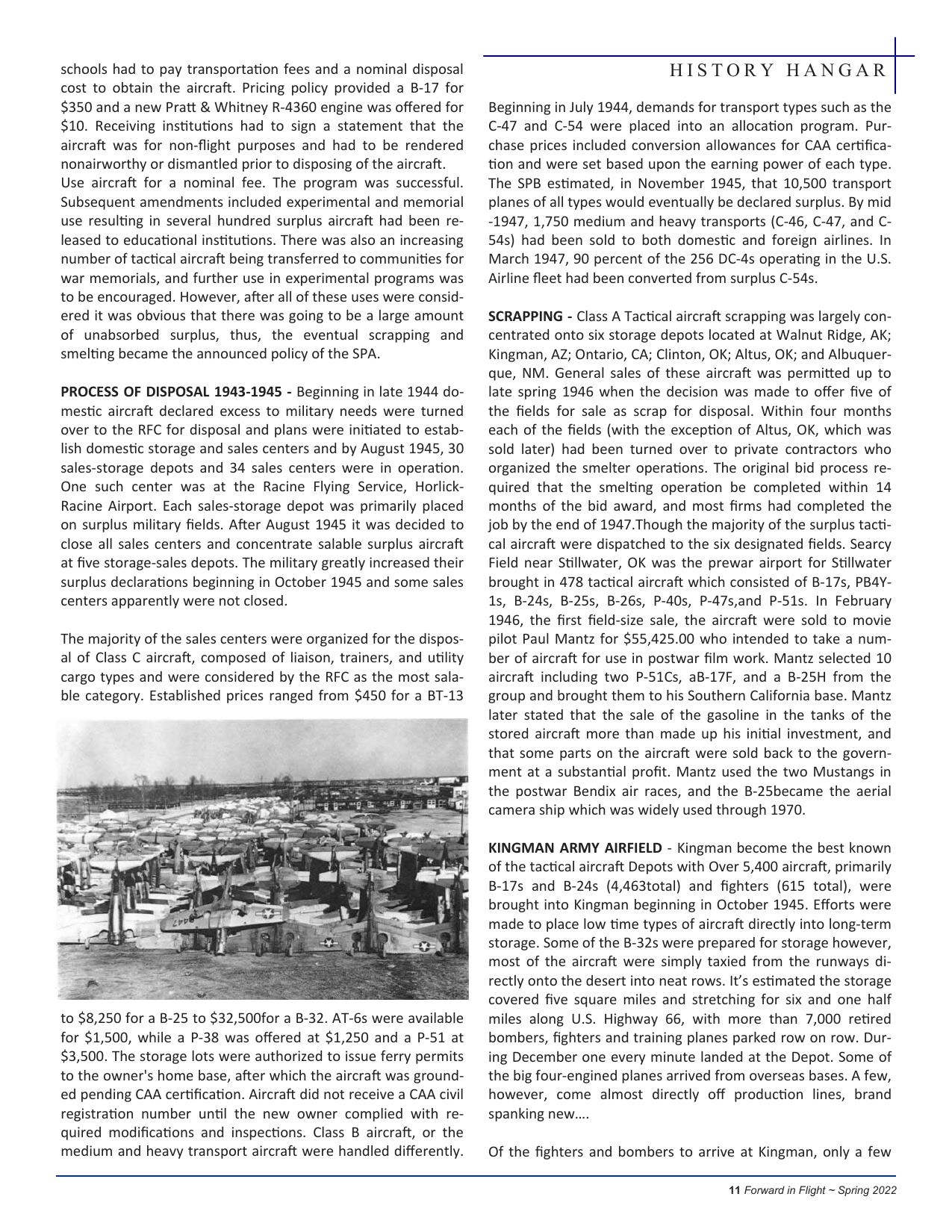
schools had to pay transporta on fees and a nominal disposal cost to obtain the aircra . Pricing policy provided a B‐17 for $350 and a new Pra & Whitney R‐4360 engine was offered for $10. Receiving ins tu ons had to sign a statement that the aircra was for non‐flight purposes and had to be rendered nonairworthy or dismantled prior to disposing of the aircra . Use aircra for a nominal fee. The program was successful. Subsequent amendments included experimental and memorial use resul ng in several hundred surplus aircra had been re‐ leased to educa onal ins tu ons. There was also an increasing number of tac cal aircra being transferred to communi es for war memorials, and further use in experimental programs was to be encouraged. However, a er all of these uses were consid‐ ered it was obvious that there was going to be a large amount of unabsorbed surplus, thus, the eventual scrapping and smel ng became the announced policy of the SPA. PROCESS OF DISPOSAL 1943‐1945 ‐ Beginning in late 1944 do‐ mes c aircra declared excess to military needs were turned over to the RFC for disposal and plans were ini ated to estab‐ lish domes c storage and sales centers and by August 1945, 30 sales‐storage depots and 34 sales centers were in opera on. One such center was at the Racine Flying Service, Horlick‐ Racine Airport. Each sales‐storage depot was primarily placed on surplus military fields. A er August 1945 it was decided to close all sales centers and concentrate salable surplus aircra at five storage‐sales depots. The military greatly increased their surplus declara ons beginning in October 1945 and some sales centers apparently were not closed. The majority of the sales centers were organized for the dispos‐ al of Class C aircra , composed of liaison, trainers, and u lity cargo types and were considered by the RFC as the most sala‐ ble category. Established prices ranged from $450 for a BT‐13 to $8,250 for a B‐25 to $32,500for a B‐32. AT‐6s were available for $1,500, while a P‐38 was offered at $1,250 and a P‐51 at $3,500. The storage lots were authorized to issue ferry permits to the owner's home base, a er which the aircra was ground‐ ed pending CAA cer fica on. Aircra did not receive a CAA civil registra on number un l the new owner complied with re‐ quired modifica ons and inspec ons. Class B aircra , or the medium and heavy transport aircra were handled differently. HISTORY HANGAR Beginning in July 1944, demands for transport types such as the C‐47 and C‐54 were placed into an alloca on program. Pur‐ chase prices included conversion allowances for CAA cer fica‐ on and were set based upon the earning power of each type. The SPB es mated, in November 1945, that 10,500 transport planes of all types would eventually be declared surplus. By mid ‐1947, 1,750 medium and heavy transports (C‐46, C‐47, and C‐ 54s) had been sold to both domes c and foreign airlines. In March 1947, 90 percent of the 256 DC‐4s opera ng in the U.S. Airline fleet had been converted from surplus C‐54s. SCRAPPING ‐ Class A Tac cal aircra scrapping was largely con‐ centrated onto six storage depots located at Walnut Ridge, AK; Kingman, AZ; Ontario, CA; Clinton, OK; Altus, OK; and Albuquer‐ que, NM. General sales of these aircra was permi ed up to late spring 1946 when the decision was made to offer five of the fields for sale as scrap for disposal. Within four months each of the fields (with the excep on of Altus, OK, which was sold later) had been turned over to private contractors who organized the smelter opera ons. The original bid process re‐ quired that the smel ng opera on be completed within 14 months of the bid award, and most firms had completed the job by the end of 1947.Though the majority of the surplus tac ‐ cal aircra were dispatched to the six designated fields. Searcy Field near S llwater, OK was the prewar airport for S llwater brought in 478 tac cal aircra which consisted of B‐17s, PB4Y‐ 1s, B‐24s, B‐25s, B‐26s, P‐40s, P‐47s,and P‐51s. In February 1946, the first field‐size sale, the aircra were sold to movie pilot Paul Mantz for $55,425.00 who intended to take a num‐ ber of aircra for use in postwar film work. Mantz selected 10 aircra including two P‐51Cs, aB‐17F, and a B‐25H from the group and brought them to his Southern California base. Mantz later stated that the sale of the gasoline in the tanks of the stored aircra more than made up his ini al investment, and that some parts on the aircra were sold back to the govern‐ ment at a substan al profit. Mantz used the two Mustangs in the postwar Bendix air races, and the B‐25became the aerial camera ship which was widely used through 1970. KINGMAN ARMY AIRFIELD ‐ Kingman become the best known of the tac cal aircra Depots with Over 5,400 aircra , primarily B‐17s and B‐24s (4,463total) and fighters (615 total), were brought into Kingman beginning in October 1945. Efforts were made to place low me types of aircra directly into long‐term storage. Some of the B‐32s were prepared for storage however, most of the aircra were simply taxied from the runways di‐ rectly onto the desert into neat rows. It’s es mated the storage covered five square miles and stretching for six and one half miles along U.S. Highway 66, with more than 7,000 re red bombers, fighters and training planes parked row on row. Dur‐ ing December one every minute landed at the Depot. Some of the big four‐engined planes arrived from overseas bases. A few, however, come almost directly off produc on lines, brand spanking new…. Of the fighters and bombers to arrive at Kingman, only a few 11 Forward in Flight ~ Spring 2022
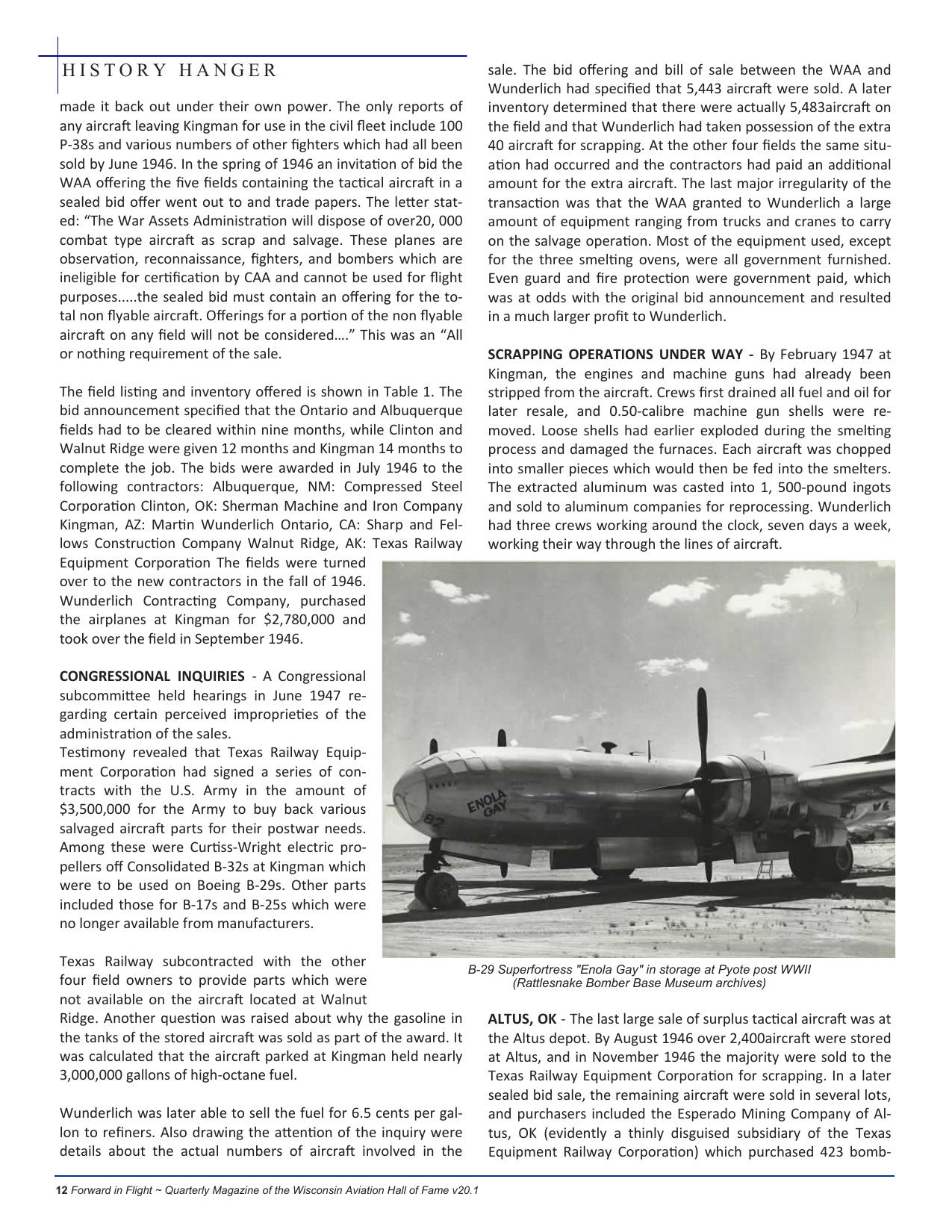
HISTORY HANGER made it back out under their own power. The only reports of any aircra leaving Kingman for use in the civil fleet include 100 P‐38s and various numbers of other fighters which had all been sold by June 1946. In the spring of 1946 an invita on of bid the WAA offering the five fields containing the tac cal aircra in a sealed bid offer went out to and trade papers. The le er stat‐ ed: “The War Assets Administra on will dispose of over20, 000 combat type aircra as scrap and salvage. These planes are observa on, reconnaissance, fighters, and bombers which are ineligible for cer fica on by CAA and cannot be used for flight purposes.....the sealed bid must contain an offering for the to‐ tal non flyable aircra . Offerings for a por on of the non flyable aircra on any field will not be considered….” This was an “All or nothing requirement of the sale. The field lis ng and inventory offered is shown in Table 1. The bid announcement specified that the Ontario and Albuquerque fields had to be cleared within nine months, while Clinton and Walnut Ridge were given 12 months and Kingman 14 months to complete the job. The bids were awarded in July 1946 to the following contractors: Albuquerque, NM: Compressed Steel Corpora on Clinton, OK: Sherman Machine and Iron Company Kingman, AZ: Mar n Wunderlich Ontario, CA: Sharp and Fel‐ lows Construc on Company Walnut Ridge, AK: Texas Railway Equipment Corpora on The fields were turned over to the new contractors in the fall of 1946. Wunderlich Contrac ng Company, purchased the airplanes at Kingman for $2,780,000 and took over the field in September 1946. sale. The bid offering and bill of sale between the WAA and Wunderlich had specified that 5,443 aircra were sold. A later inventory determined that there were actually 5,483aircra on the field and that Wunderlich had taken possession of the extra 40 aircra for scrapping. At the other four fields the same situ‐ a on had occurred and the contractors had paid an addi onal amount for the extra aircra . The last major irregularity of the transac on was that the WAA granted to Wunderlich a large amount of equipment ranging from trucks and cranes to carry on the salvage opera on. Most of the equipment used, except for the three smel ng ovens, were all government furnished. Even guard and fire protec on were government paid, which was at odds with the original bid announcement and resulted in a much larger profit to Wunderlich. SCRAPPING OPERATIONS UNDER WAY ‐ By February 1947 at Kingman, the engines and machine guns had already been stripped from the aircra . Crews first drained all fuel and oil for later resale, and 0.50‐calibre machine gun shells were re‐ moved. Loose shells had earlier exploded during the smel ng process and damaged the furnaces. Each aircra was chopped into smaller pieces which would then be fed into the smelters. The extracted aluminum was casted into 1, 500‐pound ingots and sold to aluminum companies for reprocessing. Wunderlich had three crews working around the clock, seven days a week, working their way through the lines of aircra . CONGRESSIONAL INQUIRIES ‐ A Congressional subcommi ee held hearings in June 1947 re‐ garding certain perceived improprie es of the administra on of the sales. Tes mony revealed that Texas Railway Equip‐ ment Corpora on had signed a series of con‐ tracts with the U.S. Army in the amount of $3,500,000 for the Army to buy back various salvaged aircra parts for their postwar needs. Among these were Cur ss‐Wright electric pro‐ pellers off Consolidated B‐32s at Kingman which were to be used on Boeing B‐29s. Other parts included those for B‐17s and B‐25s which were no longer available from manufacturers. Texas Railway subcontracted with the other B-29 Superfortress "Enola Gay" in storage at Pyote post WWII four field owners to provide parts which were (Rattlesnake Bomber Base Museum archives) not available on the aircra located at Walnut Ridge. Another ques on was raised about why the gasoline in ALTUS, OK ‐ The last large sale of surplus tac cal aircra was at the tanks of the stored aircra was sold as part of the award. It the Altus depot. By August 1946 over 2,400aircra were stored was calculated that the aircra parked at Kingman held nearly at Altus, and in November 1946 the majority were sold to the 3,000,000 gallons of high‐octane fuel. Texas Railway Equipment Corpora on for scrapping. In a later sealed bid sale, the remaining aircra were sold in several lots, Wunderlich was later able to sell the fuel for 6.5 cents per gal‐ and purchasers included the Esperado Mining Company of Al‐ lon to refiners. Also drawing the a en on of the inquiry were tus, OK (evidently a thinly disguised subsidiary of the Texas details about the actual numbers of aircra involved in the Equipment Railway Corpora on) which purchased 423 bomb‐ 12 Forward in Flight ~ Quarterly Magazine of the Wisconsin Aviation Hall of Fame v20.1
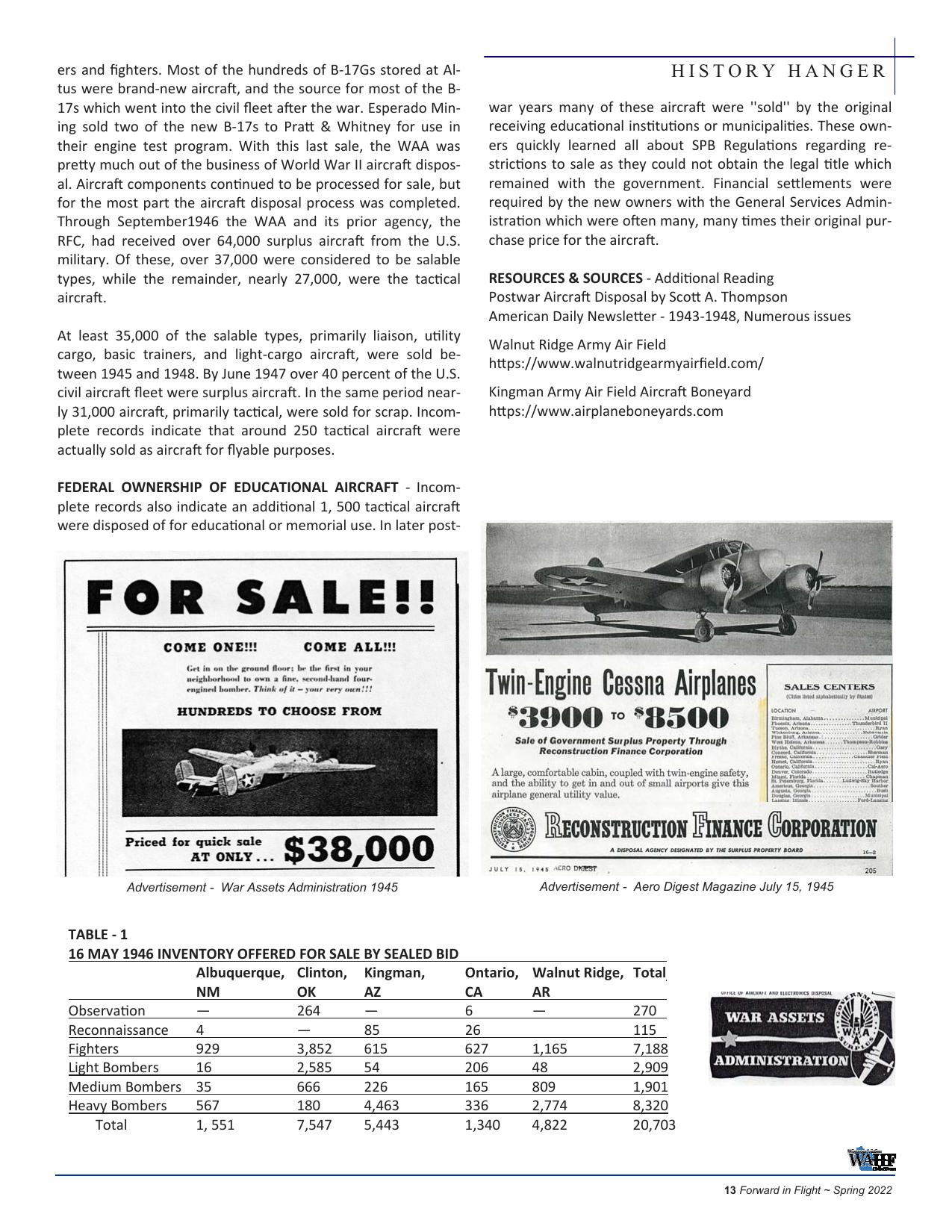
ers and fighters. Most of the hundreds of B‐17Gs stored at Al‐ tus were brand‐new aircra , and the source for most of the B‐ 17s which went into the civil fleet a er the war. Esperado Min‐ ing sold two of the new B‐17s to Pra & Whitney for use in their engine test program. With this last sale, the WAA was pre y much out of the business of World War II aircra dispos‐ al. Aircra components con nued to be processed for sale, but for the most part the aircra disposal process was completed. Through September1946 the WAA and its prior agency, the RFC, had received over 64,000 surplus aircra from the U.S. military. Of these, over 37,000 were considered to be salable types, while the remainder, nearly 27,000, were the tac cal aircra . At least 35,000 of the salable types, primarily liaison, u lity cargo, basic trainers, and light‐cargo aircra , were sold be‐ tween 1945 and 1948. By June 1947 over 40 percent of the U.S. civil aircra fleet were surplus aircra . In the same period near‐ ly 31,000 aircra , primarily tac cal, were sold for scrap. Incom‐ plete records indicate that around 250 tac cal aircra were actually sold as aircra for flyable purposes. HISTORY HANGER war years many of these aircra were ''sold'' by the original receiving educa onal ins tu ons or municipali es. These own‐ ers quickly learned all about SPB Regula ons regarding re‐ stric ons to sale as they could not obtain the legal tle which remained with the government. Financial se lements were required by the new owners with the General Services Admin‐ istra on which were o en many, many mes their original pur‐ chase price for the aircra . RESOURCES & SOURCES ‐ Addi onal Reading Postwar Aircra Disposal by Sco A. Thompson American Daily Newsle er ‐ 1943‐1948, Numerous issues Walnut Ridge Army Air Field h ps://www.walnutridgearmyairfield.com/ Kingman Army Air Field Aircra Boneyard h ps://www.airplaneboneyards.com FEDERAL OWNERSHIP OF EDUCATIONAL AIRCRAFT ‐ Incom‐ plete records also indicate an addi onal 1, 500 tac cal aircra were disposed of for educa onal or memorial use. In later post‐ Advertisement - War Assets Administration 1945 TABLE ‐ 1 16 MAY 1946 INVENTORY OFFERED FOR SALE BY SEALED BID Albuquerque, Clinton, Kingman, Ontario, NM OK AZ CA Observa on — 264 — 6 Reconnaissance 4 — 85 26 Fighters 929 3,852 615 627 Light Bombers 16 2,585 54 206 Medium Bombers 35 666 226 165 Heavy Bombers 567 180 4,463 336 Total 1, 551 7,547 5,443 1,340 Advertisement - Aero Digest Magazine July 15, 1945 Walnut Ridge, Total AR — 270 115 1,165 7,188 48 2,909 809 1,901 2,774 8,320 4,822 20,703 13 Forward in Flight ~ Spring 2022
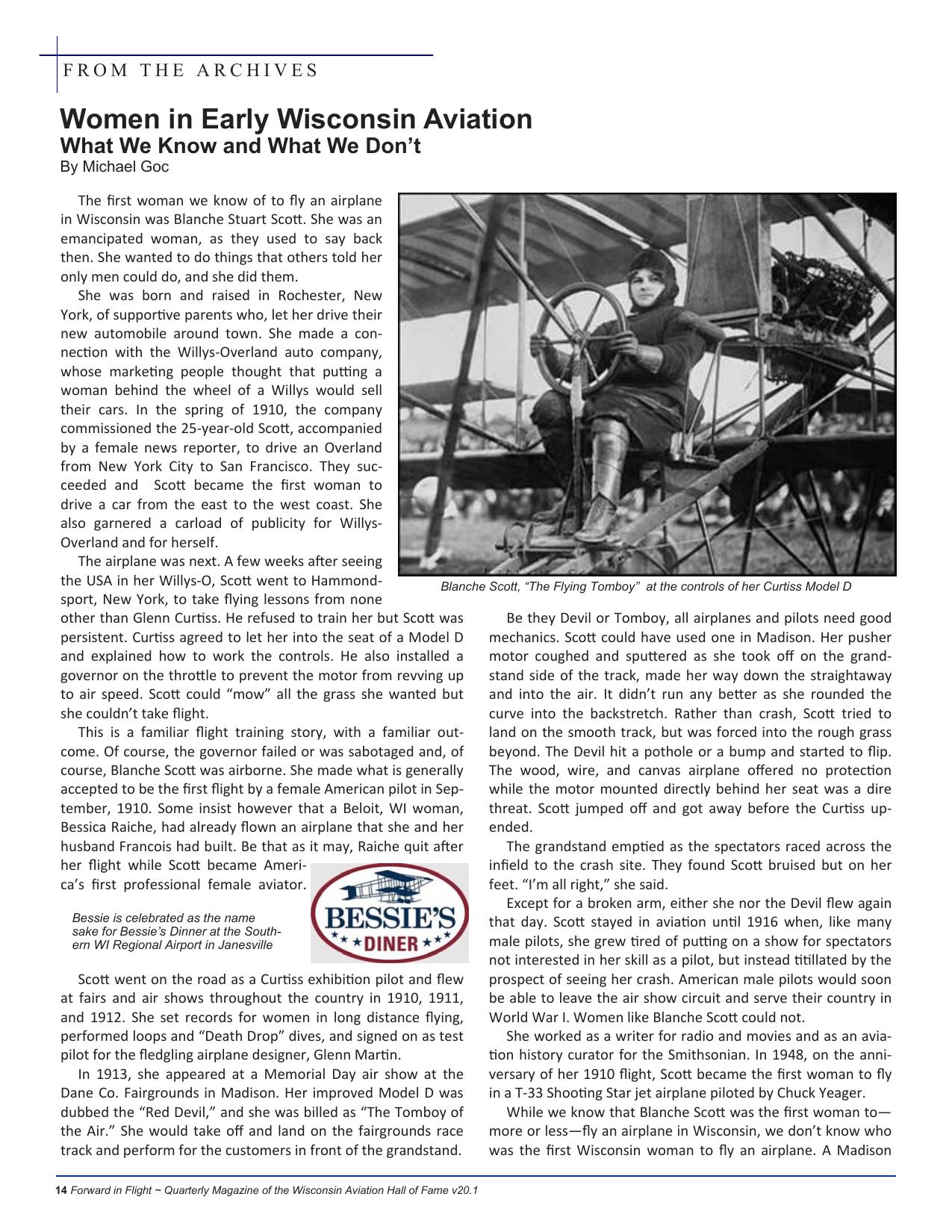
FROM THE ARCHIVES Women in Early Wisconsin Aviation What We Know and What We Don’t By Michael Goc The first woman we know of to fly an airplane in Wisconsin was Blanche Stuart Sco . She was an emancipated woman, as they used to say back then. She wanted to do things that others told her only men could do, and she did them. She was born and raised in Rochester, New York, of suppor ve parents who, let her drive their new automobile around town. She made a con‐ nec on with the Willys‐Overland auto company, whose marke ng people thought that pu ng a woman behind the wheel of a Willys would sell their cars. In the spring of 1910, the company commissioned the 25‐year‐old Sco , accompanied by a female news reporter, to drive an Overland from New York City to San Francisco. They suc‐ ceeded and Sco became the first woman to drive a car from the east to the west coast. She also garnered a carload of publicity for Willys‐ Overland and for herself. The airplane was next. A few weeks a er seeing the USA in her Willys‐O, Sco went to Hammond‐ Blanche Scott, “The Flying Tomboy” at the controls of her Curtiss Model D sport, New York, to take flying lessons from none other than Glenn Cur ss. He refused to train her but Sco was Be they Devil or Tomboy, all airplanes and pilots need good persistent. Cur ss agreed to let her into the seat of a Model D mechanics. Sco could have used one in Madison. Her pusher and explained how to work the controls. He also installed a motor coughed and spu ered as she took off on the grand‐ governor on the thro le to prevent the motor from revving up stand side of the track, made her way down the straightaway to air speed. Sco could “mow” all the grass she wanted but and into the air. It didn’t run any be er as she rounded the she couldn’t take flight. curve into the backstretch. Rather than crash, Sco tried to This is a familiar flight training story, with a familiar out‐ land on the smooth track, but was forced into the rough grass come. Of course, the governor failed or was sabotaged and, of beyond. The Devil hit a pothole or a bump and started to flip. course, Blanche Sco was airborne. She made what is generally The wood, wire, and canvas airplane offered no protec on accepted to be the first flight by a female American pilot in Sep‐ while the motor mounted directly behind her seat was a dire tember, 1910. Some insist however that a Beloit, WI woman, threat. Sco jumped off and got away before the Cur ss up‐ Bessica Raiche, had already flown an airplane that she and her ended. husband Francois had built. Be that as it may, Raiche quit a er The grandstand emp ed as the spectators raced across the her flight while Sco became Ameri‐ infield to the crash site. They found Sco bruised but on her ca’s first professional female aviator. feet. “I’m all right,” she said. Except for a broken arm, either she nor the Devil flew again Bessie is celebrated as the name that day. Sco stayed in avia on un l 1916 when, like many sake for Bessie’s Dinner at the Southmale pilots, she grew red of pu ng on a show for spectators ern WI Regional Airport in Janesville not interested in her skill as a pilot, but instead llated by the Sco went on the road as a Cur ss exhibi on pilot and flew prospect of seeing her crash. American male pilots would soon at fairs and air shows throughout the country in 1910, 1911, be able to leave the air show circuit and serve their country in and 1912. She set records for women in long distance flying, World War I. Women like Blanche Sco could not. performed loops and “Death Drop” dives, and signed on as test She worked as a writer for radio and movies and as an avia‐ pilot for the fledgling airplane designer, Glenn Mar n. on history curator for the Smithsonian. In 1948, on the anni‐ In 1913, she appeared at a Memorial Day air show at the versary of her 1910 flight, Sco became the first woman to fly Dane Co. Fairgrounds in Madison. Her improved Model D was in a T‐33 Shoo ng Star jet airplane piloted by Chuck Yeager. dubbed the “Red Devil,” and she was billed as “The Tomboy of While we know that Blanche Sco was the first woman to— the Air.” She would take off and land on the fairgrounds race more or less—fly an airplane in Wisconsin, we don’t know who track and perform for the customers in front of the grandstand. was the first Wisconsin woman to fly an airplane. A Madison 14 Forward in Flight ~ Quarterly Magazine of the Wisconsin Aviation Hall of Fame v20.1
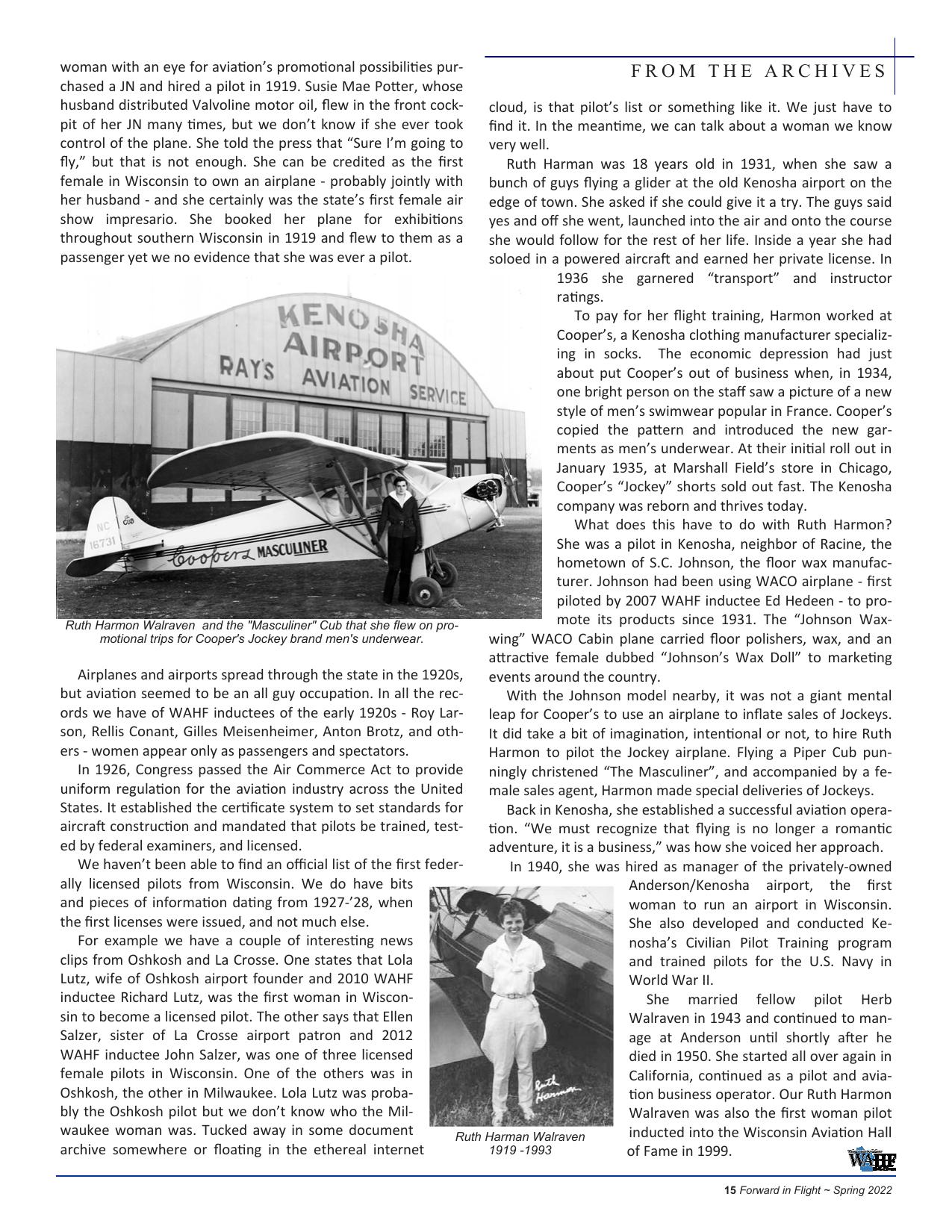
woman with an eye for avia on’s promo onal possibili es pur‐ chased a JN and hired a pilot in 1919. Susie Mae Po er, whose husband distributed Valvoline motor oil, flew in the front cock‐ pit of her JN many mes, but we don’t know if she ever took control of the plane. She told the press that “Sure I’m going to fly,” but that is not enough. She can be credited as the first female in Wisconsin to own an airplane ‐ probably jointly with her husband ‐ and she certainly was the state’s first female air show impresario. She booked her plane for exhibi ons throughout southern Wisconsin in 1919 and flew to them as a passenger yet we no evidence that she was ever a pilot. FROM THE ARCHIVES cloud, is that pilot’s list or something like it. We just have to find it. In the mean me, we can talk about a woman we know very well. Ruth Harman was 18 years old in 1931, when she saw a bunch of guys flying a glider at the old Kenosha airport on the edge of town. She asked if she could give it a try. The guys said yes and off she went, launched into the air and onto the course she would follow for the rest of her life. Inside a year she had soloed in a powered aircra and earned her private license. In 1936 she garnered “transport” and instructor ra ngs. To pay for her flight training, Harmon worked at Cooper’s, a Kenosha clothing manufacturer specializ‐ ing in socks. The economic depression had just about put Cooper’s out of business when, in 1934, one bright person on the staff saw a picture of a new style of men’s swimwear popular in France. Cooper’s copied the pa ern and introduced the new gar‐ ments as men’s underwear. At their ini al roll out in January 1935, at Marshall Field’s store in Chicago, Cooper’s “Jockey” shorts sold out fast. The Kenosha company was reborn and thrives today. What does this have to do with Ruth Harmon? She was a pilot in Kenosha, neighbor of Racine, the hometown of S.C. Johnson, the floor wax manufac‐ turer. Johnson had been using WACO airplane ‐ first piloted by 2007 WAHF inductee Ed Hedeen ‐ to pro‐ mote its products since 1931. The “Johnson Wax‐ Ruth Harmon Walraven and the "Masculiner" Cub that she flew on promotional trips for Cooper's Jockey brand men's underwear. wing” WACO Cabin plane carried floor polishers, wax, and an a rac ve female dubbed “Johnson’s Wax Doll” to marke ng Airplanes and airports spread through the state in the 1920s, events around the country. but avia on seemed to be an all guy occupa on. In all the rec‐ With the Johnson model nearby, it was not a giant mental ords we have of WAHF inductees of the early 1920s ‐ Roy Lar‐ leap for Cooper’s to use an airplane to inflate sales of Jockeys. son, Rellis Conant, Gilles Meisenheimer, Anton Brotz, and oth‐ It did take a bit of imagina on, inten onal or not, to hire Ruth ers ‐ women appear only as passengers and spectators. Harmon to pilot the Jockey airplane. Flying a Piper Cub pun‐ In 1926, Congress passed the Air Commerce Act to provide ningly christened “The Masculiner”, and accompanied by a fe‐ uniform regula on for the avia on industry across the United male sales agent, Harmon made special deliveries of Jockeys. States. It established the cer ficate system to set standards for Back in Kenosha, she established a successful avia on opera‐ aircra construc on and mandated that pilots be trained, test‐ on. “We must recognize that flying is no longer a roman c ed by federal examiners, and licensed. adventure, it is a business,” was how she voiced her approach. We haven’t been able to find an official list of the first feder‐ In 1940, she was hired as manager of the privately‐owned ally licensed pilots from Wisconsin. We do have bits Anderson/Kenosha airport, the first and pieces of informa on da ng from 1927‐’28, when woman to run an airport in Wisconsin. the first licenses were issued, and not much else. She also developed and conducted Ke‐ For example we have a couple of interes ng news nosha’s Civilian Pilot Training program clips from Oshkosh and La Crosse. One states that Lola and trained pilots for the U.S. Navy in Lutz, wife of Oshkosh airport founder and 2010 WAHF World War II. inductee Richard Lutz, was the first woman in Wiscon‐ She married fellow pilot Herb sin to become a licensed pilot. The other says that Ellen Walraven in 1943 and con nued to man‐ Salzer, sister of La Crosse airport patron and 2012 age at Anderson un l shortly a er he WAHF inductee John Salzer, was one of three licensed died in 1950. She started all over again in female pilots in Wisconsin. One of the others was in California, con nued as a pilot and avia‐ Oshkosh, the other in Milwaukee. Lola Lutz was proba‐ on business operator. Our Ruth Harmon bly the Oshkosh pilot but we don’t know who the Mil‐ Walraven was also the first woman pilot waukee woman was. Tucked away in some document inducted into the Wisconsin Avia on Hall Ruth Harman Walraven archive somewhere or floa ng in the ethereal internet 1919 -1993 of Fame in 1999. 15 Forward in Flight ~ Spring 2022
WORLD WAR II WASP Militarization for Veterans’ Status 1977 Congressional Legislative Action Compiled By Chris Campbell U.S. Senate commi ee conducted public hearings on Senate Bill S247 aimed at gran ng veterans benefits to recognize the service of WASPs during World War II by deeming their service military ac ve duty for purposes of laws administered by the U.S. Depart‐ ment of Veterans Affairs (USDVA). Senate bill S247 was introduced by Sen. Barry Goldwater (AZ) principally for medical care, com‐ pensa on, pension, and burial benefits. These hearings were to try and determine if there was actual military ac ve duty per‐ formed in the Armed Forces, not for compensa ng for a military commitment to this group of individuals who many felt were only civilians working and performing du es within the military community, in other words, WASP pilots and their instructors were civil‐ ian contracted individuals by the military. The following is some of the most interes ng por ons from congressional transcripts of these hearings. WASHINGTON, DC ‐ May 25, 1977 OPENING STATEMENT OF BY ALAN CRANSTON, CHAIRMAN OF THE COMMITTEE ON VETERANS' AFFAIRS (Pg. 31) In 1942, when the need for trained pilots was becoming acute, the Women's Air Forces Service Pilots were organized under the aegis of the U.S. Army Air Force(AAF). Women were accept‐ ed for this program only a er they had mastered the rudiments of flying. A er rigorous training, the WASPs ferried planes and performed other flying du es for the AAF within the con nen‐ tal United States. In 1944, the War Department requested Con‐ gress to enact legisla on that would have made the WASPs a formal part of the AAF. This legisla on was not enacted, and in December 1944, the WASP program was terminated. STATEMENTS BY HON. BARRY GOLDWATER, U.S. SENATOR (Pgs. 32‐39) I. ORIGINS OF THE WASPs Serious efforts to establish the World War II women's pilot pro‐ gram began at the direc on of President Roosevelt himself. On July 3, 1941, Miss Jacqueline Cochran, winner of several avia‐ on awards, lunched with President and Mrs. Roosevelt, and it was then suggested that she go over to the AAF and deter‐ mined if women pilots could be usefully employed in the Unit‐ ed States. A few days later, by direc on of the President, Miss Cochran met with Gen. "Hap" Arnold, Chief of the Air Corps; Col. Robert Olds, who was then head of the Ferrying Command; and Mr. Robert Love , the Assistant Secretary of War for Air. The purpose of the mee ng, as it is recorded, was to consider "the possibili es of u lizing women pilots to ferry primary, basic, and advanced trainers from factories to Air Corps sta‐ ons, thus releasing combat pilots for more important duty. Mrs. Eleanor Roosevelt openly promoted the use of women pilots by the military in several of her na onal newspaper col‐ umns. On September 3, 1942, General Arnold issued formal orders direc ng that the details be worked out for using wom‐ en pilots to the maximum on the ferrying of military aircra . 16 Forward in Flight ~ Quarterly Magazine of the Wisconsin Aviation Hall of Fame v20.1 The plan evolved in two separate steps: First: Recrui ng was started almost immediately of experi‐ enced women pilots to serve with the Air Transport Command. This was the women's auxiliary ferrying squadron‐WAFS. Second: A training program was established for women pilots with less flight experience than the women who joined the WAFs. This program was known as the women's flying training detachment. These girls entered training at Houston, TX, on Nov 16, 1942. Early in 1943, the two programs were merged into one, and this is when the organiza on took on the name of WASP, Women's Air Force Service Pilots. II. OBJECTIVES OF THE WASPs General Arnold summed up the objec ves of the WASP in a memorandum dated November 3, 1942, informing the Flying Training Command as follows On March 22, 1944, Gen. Arnold tes fied before the House commi ee on military affairs in support of legisla on providing for the appointment of women pilots as officers in the Air Corps. “Right at this moment,” he said, “the Army is short over 200,000 men.” He added: “we must provide figh ng men wher‐ ever we can, replacing them with women wherever we can” and so we “can release men and make available the younger men to actually do the figh ng”. To illustrate how serious the problem was, Gen. Arnold told the commi ee that, on account of the manpower shortage, the Air Corps had returned to the ground and service forces 36,000 highly qualified men were needed to go into figh ng units immediately. III. WHAT DID THE WASPs DO To sa sfy the need, 1102 WASP were assigned to opera onal du es this included 1074 WASP who graduated from training and an addi onal 28 WAFS who entered upon opera onal du‐ es without taking the training course. These woman per‐ formed every kind of flying opera on possible and flew 77 types of airplanes from the factories to the modifica on cen‐ ters, depots, and to other des na ons within the United States and Canada. They did tracking and searchlight missions, simu‐ lated strafing, smoke laying, radio control flying, basic and in‐ strument instruc on, and engineering test flying.
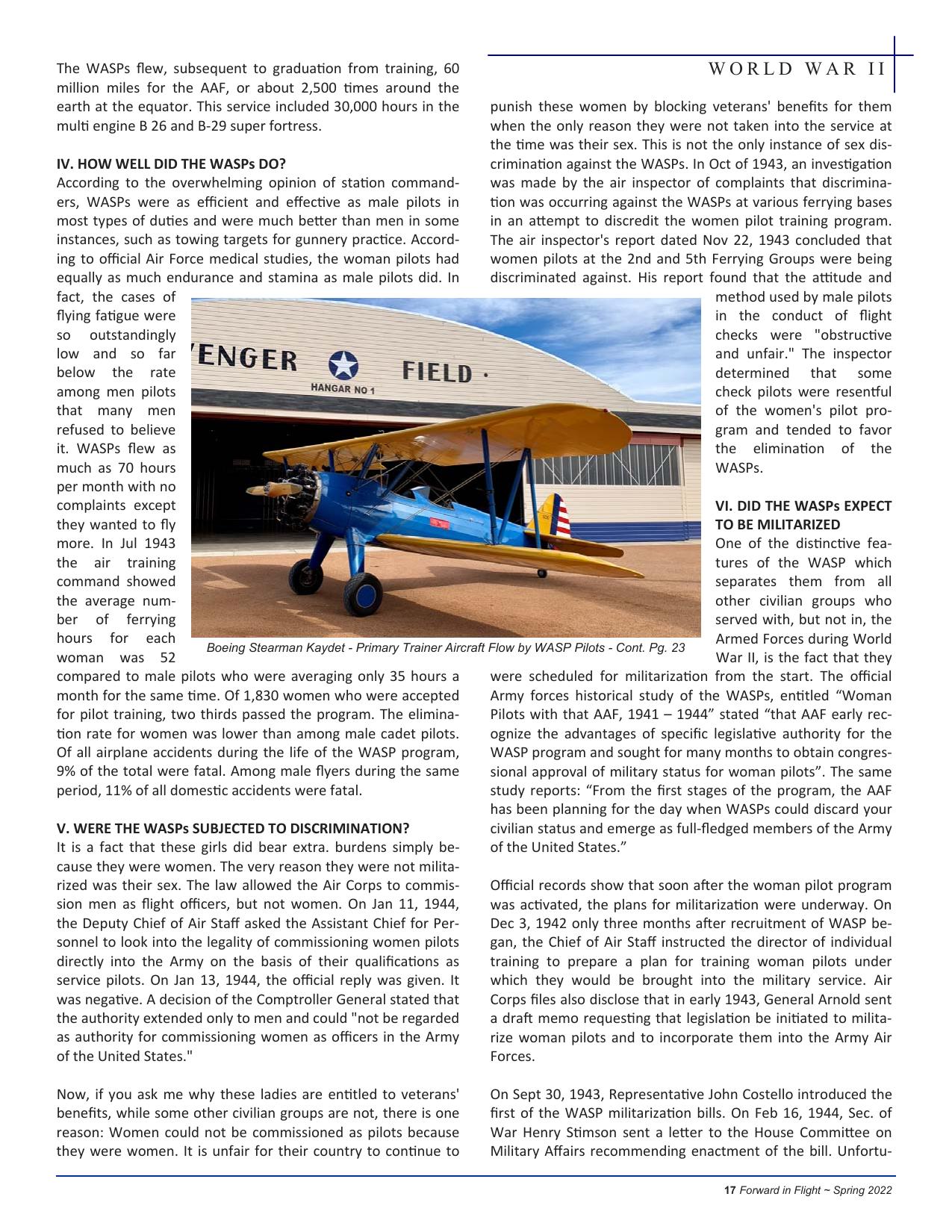
The WASPs flew, subsequent to gradua on from training, 60 million miles for the AAF, or about 2,500 mes around the earth at the equator. This service included 30,000 hours in the mul engine B 26 and B‐29 super fortress. WORLD WAR II punish these women by blocking veterans' benefits for them when the only reason they were not taken into the service at the me was their sex. This is not the only instance of sex dis‐ crimina on against the WASPs. In Oct of 1943, an inves ga on was made by the air inspector of complaints that discrimina‐ on was occurring against the WASPs at various ferrying bases in an a empt to discredit the women pilot training program. The air inspector's report dated Nov 22, 1943 concluded that women pilots at the 2nd and 5th Ferrying Groups were being discriminated against. His report found that the a tude and method used by male pilots in the conduct of flight checks were "obstruc ve and unfair." The inspector determined that some check pilots were resen ul of the women's pilot pro‐ gram and tended to favor the elimina on of the WASPs. IV. HOW WELL DID THE WASPs DO? According to the overwhelming opinion of sta on command‐ ers, WASPs were as efficient and effec ve as male pilots in most types of du es and were much be er than men in some instances, such as towing targets for gunnery prac ce. Accord‐ ing to official Air Force medical studies, the woman pilots had equally as much endurance and stamina as male pilots did. In fact, the cases of flying fa gue were so outstandingly low and so far below the rate among men pilots that many men refused to believe it. WASPs flew as much as 70 hours per month with no complaints except VI. DID THE WASPs EXPECT they wanted to fly TO BE MILITARIZED more. In Jul 1943 One of the dis nc ve fea‐ the air training tures of the WASP which command showed separates them from all the average num‐ other civilian groups who ber of ferrying served with, but not in, the hours for each Armed Forces during World Boeing Stearman Kaydet - Primary Trainer Aircraft Flow by WASP Pilots - Cont. Pg. 23 woman was 52 War II, is the fact that they compared to male pilots who were averaging only 35 hours a were scheduled for militariza on from the start. The official month for the same me. Of 1,830 women who were accepted Army forces historical study of the WASPs, en tled “Woman for pilot training, two thirds passed the program. The elimina‐ Pilots with that AAF, 1941 – 1944” stated “that AAF early rec‐ on rate for women was lower than among male cadet pilots. ognize the advantages of specific legisla ve authority for the Of all airplane accidents during the life of the WASP program, WASP program and sought for many months to obtain congres‐ 9% of the total were fatal. Among male flyers during the same sional approval of military status for woman pilots”. The same period, 11% of all domes c accidents were fatal. study reports: “From the first stages of the program, the AAF has been planning for the day when WASPs could discard your V. WERE THE WASPs SUBJECTED TO DISCRIMINATION? civilian status and emerge as full‐fledged members of the Army It is a fact that these girls did bear extra. burdens simply be‐ of the United States.” cause they were women. The very reason they were not milita‐ rized was their sex. The law allowed the Air Corps to commis‐ Official records show that soon a er the woman pilot program sion men as flight officers, but not women. On Jan 11, 1944, was ac vated, the plans for militariza on were underway. On the Deputy Chief of Air Staff asked the Assistant Chief for Per‐ Dec 3, 1942 only three months a er recruitment of WASP be‐ sonnel to look into the legality of commissioning women pilots gan, the Chief of Air Staff instructed the director of individual directly into the Army on the basis of their qualifica ons as training to prepare a plan for training woman pilots under service pilots. On Jan 13, 1944, the official reply was given. It which they would be brought into the military service. Air was nega ve. A decision of the Comptroller General stated that Corps files also disclose that in early 1943, General Arnold sent the authority extended only to men and could "not be regarded a dra memo reques ng that legisla on be ini ated to milita‐ as authority for commissioning women as officers in the Army rize woman pilots and to incorporate them into the Army Air of the United States." Forces. Now, if you ask me why these ladies are en tled to veterans' benefits, while some other civilian groups are not, there is one reason: Women could not be commissioned as pilots because they were women. It is unfair for their country to con nue to On Sept 30, 1943, Representa ve John Costello introduced the first of the WASP militariza on bills. On Feb 16, 1944, Sec. of War Henry S mson sent a le er to the House Commi ee on Military Affairs recommending enactment of the bill. Unfortu‐ 17 Forward in Flight ~ Spring 2022
WORLD WAR II nately, that bill was defeated because of reasons which will have le an impression of sex discrimina on. The fact that the war department publicly supported passage of the bill in early 1944, just 17 months a er the woman pilots program began, as addi onal evidence that women expected to be taken into the military. Another indica on that women expected to become officers is that their training, from the start, included military instruc on. This covered courses in military courtesy and customs, ar cles of war, the safeguarding of military informa on, drill and cere‐ monies, military organiza on, military correspondence, and chemical warfare. A direc ve from Army Air Force Corps Headquarters dated Mar 6, 1944, the military training was extended from 66 to 137 hours. In fact, a special course wasn’t ins tuted at the AAF school of Applied Tac cs in Orlando, FL, in the spring of 1944 designed to give training to WASPs as prospec ve officers. Dur‐ ing a period of about 5‐1/2 months, 460 WASPs were trained at this school so that they could take care of the du es as officers. Did they know they were being des ned to be militarized? Eve‐ ryone who went through this training had to know it! VII. WOULD THE WASP BILL SET A PRECEDENT? With the above background, we now reach the ques on, why should the WASP receive veterans' benefits and no other civil‐ ian groups who served during war me? The answer is simple. The WASPs were trained and treated as military officers. The other groups were not. The WASPs were scheduled for militari‐ za on from the start. Other civilian groups were not. WASPs had to meet the physical standards set by Army regula ons (form 64). In general, WASP trainees received about the same training as did the flying cadets. All flying cadets, male or fe‐ male, a er gradua on went to transi on training in the type of aircra they were flying. The only difference was that the males went to transi on training schools while the WASPs were ex‐ pected to make the transi on in the airplane when first re‐ quired to fly it. Ferrying division direc ves issued in Apr of 1943 specifically provided that women pilots were to be given transi‐ on to mul engine planes and high‐powered single engine cra , "under the same standards of individual experience and ability as apply to any other pilot." All check rides were given by AAF officers, using the same ser‐ vice pilot standards that applied to men. This fact alone dis n‐ guishes them from male contract pilots and other civilian groups. Women pilot trainees received about the same com‐ pensa on as male flying· cadets, except for not receiving insur‐ ance benefits. Trainees were required to live in barracks on the training base. They were required to follow as closely as possi‐ ble the schedules established. The WASPs were treated for illness by AAF flight as surgeons. WASPs were en tled the same military medical care as cadets and military pilots were. A er gradua on, uniforms were pro‐ 18 Forward in Flight ~ Quarterly Magazine of the Wisconsin Aviation Hall of Fame v20.1 vided the WASPs as in the case of all other flying personnel. They were expressly required by AAF regula on 40‐9 to wear this uniform. A er assignment to opera onal du es, women pilots received slightly less than the pay of a second lieutenant on flying status. · Addi onally, WASPs had no quarters and meals allowances. Nor did they enjoy the right to advancement in pay depending upon their length of service. These pay condi ons, scaled to be comparable with a flight officer's pay, dis nguish the WASPs from other civilian groups. They did not receive the higher sala‐ ries that civilians usually did. The WASPs were comparable to military officers in many other respects. They were sworn in with the same oath of office as given the male officers. They stood formal inspec on. They received officer's training. They could not leave their base without a pass. And, they were on duty 24 hours a day by wri en military memorandum. The WASPs understood that they would be disciplined the same as other officers. They were issued copies of flying safety and court mar al sentences for viola on of flying regula ons. They received disciplinary ac on for flying viola ons under the au‐ thority of the 104th Ar cle of War Manual for Court Mar al. In fact, WASPs served on flight safety boards convened to punish other military pilots. Also, there are on file numerous official orders requiring WASPs, similar to male Air Force pilots, to pro‐ ceed to specific places at specific mes and to perform speci‐ fied du es. VIII. SUMMARY Mr. Chairman, each and every one of the facts I have revealed today about the WASPs is documented on the public record and in official materials located in the historical archives of the Air Force. These facts totally refute the unsupported and emo‐ onal cri cisms made by opponents of the bill. The truth is the WASPs were, to nearly all intents and purposes, in the military. They operated hazardous and complicated military equipment and some mes were used as examples by the Air Corps when headquarters wanted to prove to men that certain new aircra coming off the produc on lines could be operated safely. By having women fly the same planes without mishap; the men were shamed into opera ng aircra which the rumor mills had falsely maligned. Pilo ng military aircra across the country for thousands of miles en rely on their own was dangerous and grueling work. Thirty eight WASPs did lose their lives serving their country. Their government did no even let the families of these dead girls display gold stars. Nor did the government give burial al‐ lowances or insurance payments to surviving dependents. My argument is that the WASPs are en tled to veterans' bene‐ fits · because of the nature of their du es. These benefits should not be given merely to offer recogni on to the women. The benefits are due to them because they were a part of the military. · They did expect to be militarized. They knew militariza on was planned and that steps were being taken to that end. They were not subject to the same dra , yet they volunteered for
low pay, long hours, and military regimen. . Other civilian or‐ ganiza ons contributed to the war effort but none of them operated under the military pay system and the military disci‐ plinary system. None of the others, who remained civilian, were recommended for militariza on by the War Department. VETERANS ADMINISTRATION TESTIMONY (Pgs. 45‐ 52) Below are highlights of tes mony and a determina on given by Dorothy Starbuck, Chief Benefits Director of the Veterans Ad‐ ministra on. Ms. Starbuck in her opening statement stated “that the membership of this group (WASP) consisted of Feder‐ al civilian employees a ached to the US Army air forces during World War II. They performed various noncombat flying jobs, including aircra ferrying and target towing thereby freeing Army pilots for combat duty.” Addi onally, it was acknowledged that flying duty performed by the WASPs are beyond dispute. Duty assignments were is‐ sued by orders from the AAF, the wearing of uniforms was re‐ quired, and provisions were made for subsistence allowance and or military quarters at the duty sta ons. The USDVA also highlighted what they believed to be two significant ways in which the WASPs, as civilians, deferred from the in enlisted and commissioned members of the AAF proper were in regard to the disciplinary procedures to which they were subject and the nature of their employment commitment. As civil servants they were not subject to court‐mar al procedures. Disciplinary ac‐ ons, including discharges, were governed by civil service regu‐ la ons. The commanding officer had the final decision required regarding the appropriate civil service disciplinary ac on. An‐ other crucial dis nc on is that the fact that, as civilians, WASPs were able to resign from the program at any given me. Some 8% of those accepted into the WASP training program exercise this privilege before gradua ng. Of those graduates who com‐ mi ed in the program, 900 of the 1047 graduates remained at the me the program was deac vated in Dec 1944. It was also the opinion of the USDVA that the AAF WASP program was an experimental one, with the possibility of militariza on if it proves successful. It was also recognize the controls militariza‐ on would bring were needed, example, there was nothing to prevent woman who received her flight training at government expense from resigning immediately upon gradua on. This first WASP militariza on bill was introduced in Sept 1943, would have commissioned WASP in the Army of the United States. Capital HR 3358, was amended and resubmi ed as HR 4219, was released from commi ee in Mar 1944. However, this movement coincided with dras c changes in the na on’s pilot training program, including termina on of the Civil Aeronau cs Authority War Training Service, which had helped turned out over 250 flyers for the Armed Forces. Concern arose immedi‐ ately that a great many male civilian students and instructor pilots would be grounded. The bill was defeated on the floor of the house in Jun 1944 and in Dec of that year the WASP pro‐ gram was deac vated. Veterans Administra on tes mony also included the defini on of the term veteran “a person who served in the ac ve duty, naval or air service and who was discharged or released under WORLD WAR II condi ons other than dishonorable”. By comparison, the Veterans Administra on at these hearings also compared the du es performed by WASPs were equivalent to du es performed by other civilian groups performing haz‐ ardous duty including the Civil Air Patrol and members of the merchant Marine, auxiliary military police, construc on fore‐ man with the engineer department, certain Red Cross person‐ nel, certain individuals employed with American Expedi onary Forces of the Signal Corps and in the Postal Service, civilian in‐ terpreters in the Republic of Vietnam, war correspondents, and other civilians serving in such capaci es. Legisla on has been introduced in the past Congresses to ex‐ tend Veterans’ Administra on benefits to these and other civil‐ ians who rendered service during a period of war, but to date none has been enacted. It would, of course, be inequitable to extend veterans benefits to the WASPs, to the exclusion of these other categories, unless significant dis nc ons in the nature of the WASP service can be drawn. Addi onally it was stated, that singling out the WASP disciplines for veteran status we clearly discriminated against those countless other civilians we have likewise contributed greatly in the mes of grave na‐ onal need. POSITION OF THE VETERANS ADMINISTRATION Upon conclusion of the Veterans Administra on tes mony, a summary was presented: “in summary we believe benefits un‐ der laws administered by the USDVA should be limited to the persons who rendered ac ve service in the Arm Forces, and to their dependents. Accordingly, in view of the discriminatory and preceden al aspects of S247, the Veterans Administra on opposes its enactment”. BILL PASSAGE On Nov 3rd & 4th 1977, The House and Senate passed Public Law 95‐202, Title IV, a veterans benefits bill and included the WASPs. President Jimmy Carter signed this bill into law on Nov 23, 1977 making WASPs part of the Army Air Corps. Editor’s Note: The above statements and comments by Sen. Goldwater is only a small por on of the 385 page Congres‐ sional transcript. Addi onal comments and answers to ques ons asked by other panel members, wri en state‐ ments from other governmental en es an actual le ers and documents from surviving’s WASPs is included in this transcript. I would suggest you do a complete reading of these transcripts as they are filled with data and descrip‐ ons of the cultural life and mes of those women during WWII. POST 1977 LEGISLATION Although legisla on was passed to grant WASPs military bene‐ fits (as noted in the previous congressional ac on) the legisla‐ on did not include certain caveats granted to other military veterans. Upon the desire to be buried at Arlington Cemetery, 19 Forward in Flight ~ Spring 2022
WORLD WAR II WASP were denied burial based on determina on by the Veter‐ ans Administra on that previous legisla on did not allow / in‐ clude burial at Arlington. JULY 2009 CONGRESS AUTHORIZED THE GOLD MEDAL President Barack Obama on July 1, 2009 at a White House cere‐ mony signed into law S614 and recognized the invaluable ser‐ vice to the na on more than 60 years ago. More than 200 WASPs a ended the event, many of them wearing their World War II‐era uniforms. The audience, was one of the largest ever in the Capitol and too large to fit into Emancipa on Hall, also included their families, as well as the families of those who have since died or couldn't travel. In 2009, it was es mated that only 300 WASPs remained. To‐ day in 2022, it is es mated that only 30 WASPs remain. MARCH 20210 In a Whitehouse ceremony on 10 March 2010, the Metal of Honor was awarded to the WASPs. The Congressional Gold Medal is the highest and most dis n‐ guished award Congress can award to a civilian. Since the American Revolu on; Congress has commissioned gold medals as its highest expression of na onal apprecia on for dis n‐ guished achievements and contribu ons. In 2000 and 2006, Congress awarded the Gold Medal to the Navajo Code Talkers and the Tuskegee Airmen, respec vely. MARCH 2016 LEGISLATION Legisla on was unanimously passed to allow WASPs to be bur‐ ied in Arlington Na onal Cemetery was introduced Rep. Martha McSally (AZ) to overturn a 2015 decision by the Secretary of the Army John McHugh who rescinded and reversed the origi‐ nal 1977 decision of eligibility of WASPs to be buried at Arling‐ ton. Burial rights were re‐stored and signed into law by Presi‐ dent Obama on 11 May 2016. Jacqueline Cochran in her record-setting F-86 Sabre, talking with Chuck Yeager - Photo Courtesy Air Force Flight Test Center History Office/Air Force Link 20 Forward in Flight ~ Quarterly Magazine of the Wisconsin Aviation Hall of Fame v20.1 ADDITIONAL WASP FACTS In 1942, Nancy Harkness Love created the Women Auxiliary Ferrying Squadron (WAFS) and Jacqueline Cochran formed the Women's Flying Training Detachment (WFTD). The WASP formed in August 1943 as an adjunct to the Army Air Forces' war effort and when the WAFS and WFTD pro‐ grams merged. The WASP logged more than 70 million miles and flew every plane the Army Air Forces possessed and every type of mis‐ sion a male pilot flew during WWII except combat. WASP delivered 12,650 aircra represen ng 78 different types to bases throughout the na on. A er an a empt to change the WASP status from civilian to military in March 1944 a militariza on bill was defeated in Congress in June and by December the program was official‐ ly deac vated. The WASP eventually win their militariza on and veterans status in 1977. See page 16 for congressional hearings. 2010 WASPs awarded the Congressional Gold Medal. 2015 Secretary of the Army John McHugh who rescinded and reversed the original 1977 decision of eligibility of WASPs to be buried at Arlington. 2016 Legisla on was amended to overturn 2015 Arlington burial ban to allow WASPs to be buried at Arlington Ceme‐ tery with full veteran benefits as other WWII veterans. ADDITIONAL WASP RESOURCES ‐ Suggested Links WASP History ‐ Texas Woman's University (twu.edu) h ps://twu.edu/library/womans‐collec on/collec ons/ women‐airforce‐service‐pilots‐official‐archive/history/ Video ‐ 2010 Congressional Gold Medal Ceremony h ps://vimeo.com/106629651 Video ‐ Honor the WASP by Women In Avia on Interna onal h ps://www.youtube.com/watch?v=wLfWC57jNfg Photos ‐ h p://www.wingsacrossamerica.us/photo/ Biography of Jacqueline ‐ h ps://www.britannica.com/ biography/Jacqueline‐Cochran Women in Avia on ‐ www.WAI.org Forward in Flight ‐ Issue 2006 v4.2 WASP Visit to Neillsville, WI High Ground sculpture dedica on. WASP Congressional Gold Metal 2009
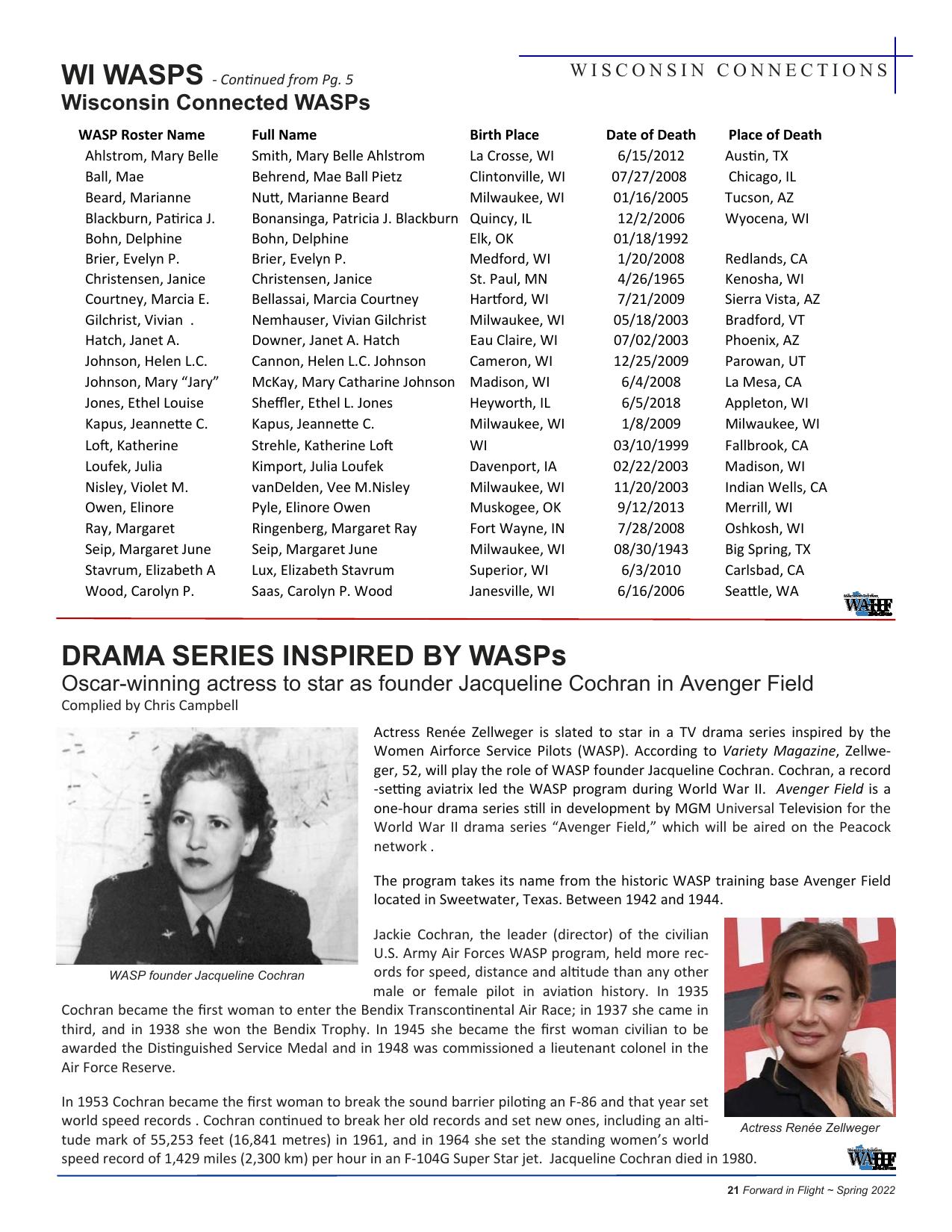
WISCONSIN CONNECTIONS WI WASPS ‐ Con nued from Pg. 5 Wisconsin Connected WASPs WASP Roster Name Ahlstrom, Mary Belle Ball, Mae Beard, Marianne Blackburn, Pa rica J. Bohn, Delphine Brier, Evelyn P. Christensen, Janice Courtney, Marcia E. Gilchrist, Vivian . Hatch, Janet A. Johnson, Helen L.C. Johnson, Mary “Jary” Jones, Ethel Louise Kapus, Jeanne e C. Lo , Katherine Loufek, Julia Nisley, Violet M. Owen, Elinore Ray, Margaret Seip, Margaret June Stavrum, Elizabeth A Wood, Carolyn P. Full Name Birth Place Smith, Mary Belle Ahlstrom La Crosse, WI Behrend, Mae Ball Pietz Clintonville, WI Nu , Marianne Beard Milwaukee, WI Bonansinga, Patricia J. Blackburn Quincy, IL Bohn, Delphine Elk, OK Brier, Evelyn P. Medford, WI Christensen, Janice St. Paul, MN Bellassai, Marcia Courtney Har ord, WI Nemhauser, Vivian Gilchrist Milwaukee, WI Downer, Janet A. Hatch Eau Claire, WI Cannon, Helen L.C. Johnson Cameron, WI McKay, Mary Catharine Johnson Madison, WI Sheffler, Ethel L. Jones Heyworth, IL Kapus, Jeanne e C. Milwaukee, WI Strehle, Katherine Lo WI Kimport, Julia Loufek Davenport, IA vanDelden, Vee M.Nisley Milwaukee, WI Pyle, Elinore Owen Muskogee, OK Ringenberg, Margaret Ray Fort Wayne, IN Seip, Margaret June Milwaukee, WI Lux, Elizabeth Stavrum Superior, WI Saas, Carolyn P. Wood Janesville, WI Date of Death 6/15/2012 07/27/2008 01/16/2005 12/2/2006 01/18/1992 1/20/2008 4/26/1965 7/21/2009 05/18/2003 07/02/2003 12/25/2009 6/4/2008 6/5/2018 1/8/2009 03/10/1999 02/22/2003 11/20/2003 9/12/2013 7/28/2008 08/30/1943 6/3/2010 6/16/2006 Place of Death Aus n, TX Chicago, IL Tucson, AZ Wyocena, WI Redlands, CA Kenosha, WI Sierra Vista, AZ Bradford, VT Phoenix, AZ Parowan, UT La Mesa, CA Appleton, WI Milwaukee, WI Fallbrook, CA Madison, WI Indian Wells, CA Merrill, WI Oshkosh, WI Big Spring, TX Carlsbad, CA Sea le, WA DRAMA SERIES INSPIRED BY WASP Oscar-winning actress to star as founder Jacqueline Cochran in Avenger Field Complied by Chris Campbell Actress Renée Zellweger is slated to star in a TV drama series inspired by the Women Airforce Service Pilots (WASP). According to Variety Magazine, Zellwe‐ ger, 52, will play the role of WASP founder Jacqueline Cochran. Cochran, a record ‐se ng aviatrix led the WASP program during World War II. Avenger Field is a one‐hour drama series s ll in development by MGM Universal Television for the World War II drama series “Avenger Field,” which will be aired on the Peacock network . The program takes its name from the historic WASP training base Avenger Field located in Sweetwater, Texas. Between 1942 and 1944. Jackie Cochran, the leader (director) of the civilian U.S. Army Air Forces WASP program, held more rec‐ ords for speed, distance and al tude than any other WASP founder Jacqueline Cochran male or female pilot in avia on history. In 1935 Cochran became the first woman to enter the Bendix Transcon nental Air Race; in 1937 she came in third, and in 1938 she won the Bendix Trophy. In 1945 she became the first woman civilian to be awarded the Dis nguished Service Medal and in 1948 was commissioned a lieutenant colonel in the Air Force Reserve. In 1953 Cochran became the first woman to break the sound barrier pilo ng an F‐86 and that year set world speed records . Cochran con nued to break her old records and set new ones, including an al ‐ Actress Renée Zellweger tude mark of 55,253 feet (16,841 metres) in 1961, and in 1964 she set the standing women’s world speed record of 1,429 miles (2,300 km) per hour in an F‐104G Super Star jet. Jacqueline Cochran died in 1980. 21 Forward in Flight ~ Spring 2022
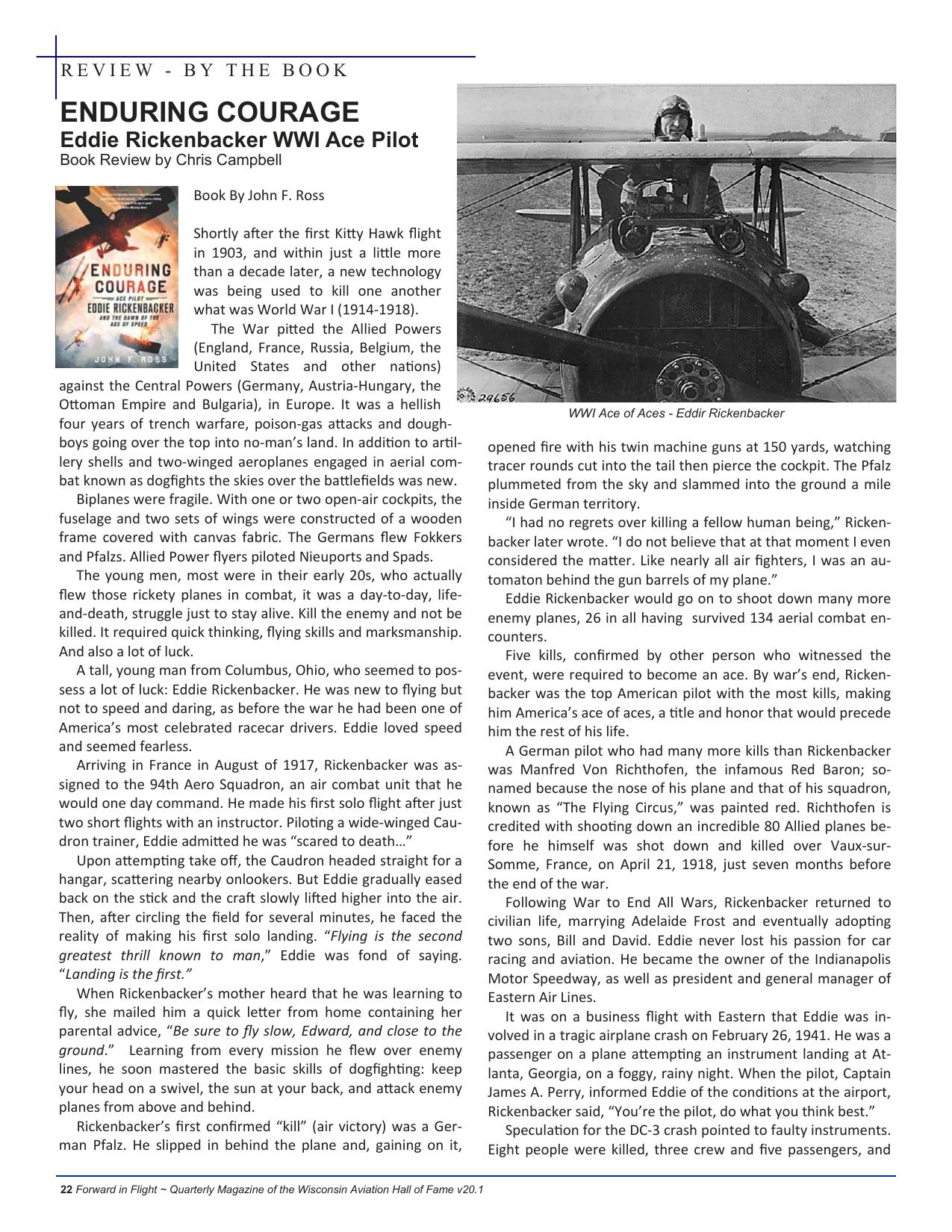
REVIEW - BY THE BOOK ENDURING COURAGE Eddie Rickenbacker WWI Ace Pilot Book Review by Chris Campbell Book By John F. Ross Shortly a er the first Ki y Hawk flight in 1903, and within just a li le more than a decade later, a new technology was being used to kill one another what was World War I (1914‐1918). The War pi ed the Allied Powers (England, France, Russia, Belgium, the United States and other na ons) against the Central Powers (Germany, Austria‐Hungary, the O oman Empire and Bulgaria), in Europe. It was a hellish four years of trench warfare, poison‐gas a acks and dough‐ boys going over the top into no‐man’s land. In addi on to ar l‐ lery shells and two‐winged aeroplanes engaged in aerial com‐ bat known as dogfights the skies over the ba lefields was new. Biplanes were fragile. With one or two open‐air cockpits, the fuselage and two sets of wings were constructed of a wooden frame covered with canvas fabric. The Germans flew Fokkers and Pfalzs. Allied Power flyers piloted Nieuports and Spads. The young men, most were in their early 20s, who actually flew those rickety planes in combat, it was a day‐to‐day, life‐ and‐death, struggle just to stay alive. Kill the enemy and not be killed. It required quick thinking, flying skills and marksmanship. And also a lot of luck. A tall, young man from Columbus, Ohio, who seemed to pos‐ sess a lot of luck: Eddie Rickenbacker. He was new to flying but not to speed and daring, as before the war he had been one of America’s most celebrated racecar drivers. Eddie loved speed and seemed fearless. Arriving in France in August of 1917, Rickenbacker was as‐ signed to the 94th Aero Squadron, an air combat unit that he would one day command. He made his first solo flight a er just two short flights with an instructor. Pilo ng a wide‐winged Cau‐ dron trainer, Eddie admi ed he was “scared to death…” Upon a emp ng take off, the Caudron headed straight for a hangar, sca ering nearby onlookers. But Eddie gradually eased back on the s ck and the cra slowly li ed higher into the air. Then, a er circling the field for several minutes, he faced the reality of making his first solo landing. “Flying is the second greatest thrill known to man,” Eddie was fond of saying. “Landing is the first.” When Rickenbacker’s mother heard that he was learning to fly, she mailed him a quick le er from home containing her parental advice, “Be sure to fly slow, Edward, and close to the ground.” Learning from every mission he flew over enemy lines, he soon mastered the basic skills of dogfigh ng: keep your head on a swivel, the sun at your back, and a ack enemy planes from above and behind. Rickenbacker’s first confirmed “kill” (air victory) was a Ger‐ man Pfalz. He slipped in behind the plane and, gaining on it, 22 Forward in Flight ~ Quarterly Magazine of the Wisconsin Aviation Hall of Fame v20.1 WWI Ace of Aces - Eddir Rickenbacker opened fire with his twin machine guns at 150 yards, watching tracer rounds cut into the tail then pierce the cockpit. The Pfalz plummeted from the sky and slammed into the ground a mile inside German territory. “I had no regrets over killing a fellow human being,” Ricken‐ backer later wrote. “I do not believe that at that moment I even considered the ma er. Like nearly all air fighters, I was an au‐ tomaton behind the gun barrels of my plane.” Eddie Rickenbacker would go on to shoot down many more enemy planes, 26 in all having survived 134 aerial combat en‐ counters. Five kills, confirmed by other person who witnessed the event, were required to become an ace. By war’s end, Ricken‐ backer was the top American pilot with the most kills, making him America’s ace of aces, a tle and honor that would precede him the rest of his life. A German pilot who had many more kills than Rickenbacker was Manfred Von Richthofen, the infamous Red Baron; so‐ named because the nose of his plane and that of his squadron, known as “The Flying Circus,” was painted red. Richthofen is credited with shoo ng down an incredible 80 Allied planes be‐ fore he himself was shot down and killed over Vaux‐sur‐ Somme, France, on April 21, 1918, just seven months before the end of the war. Following War to End All Wars, Rickenbacker returned to civilian life, marrying Adelaide Frost and eventually adop ng two sons, Bill and David. Eddie never lost his passion for car racing and avia on. He became the owner of the Indianapolis Motor Speedway, as well as president and general manager of Eastern Air Lines. It was on a business flight with Eastern that Eddie was in‐ volved in a tragic airplane crash on February 26, 1941. He was a passenger on a plane a emp ng an instrument landing at At‐ lanta, Georgia, on a foggy, rainy night. When the pilot, Captain James A. Perry, informed Eddie of the condi ons at the airport, Rickenbacker said, “You’re the pilot, do what you think best.” Specula on for the DC‐3 crash pointed to faulty instruments. Eight people were killed, three crew and five passengers, and
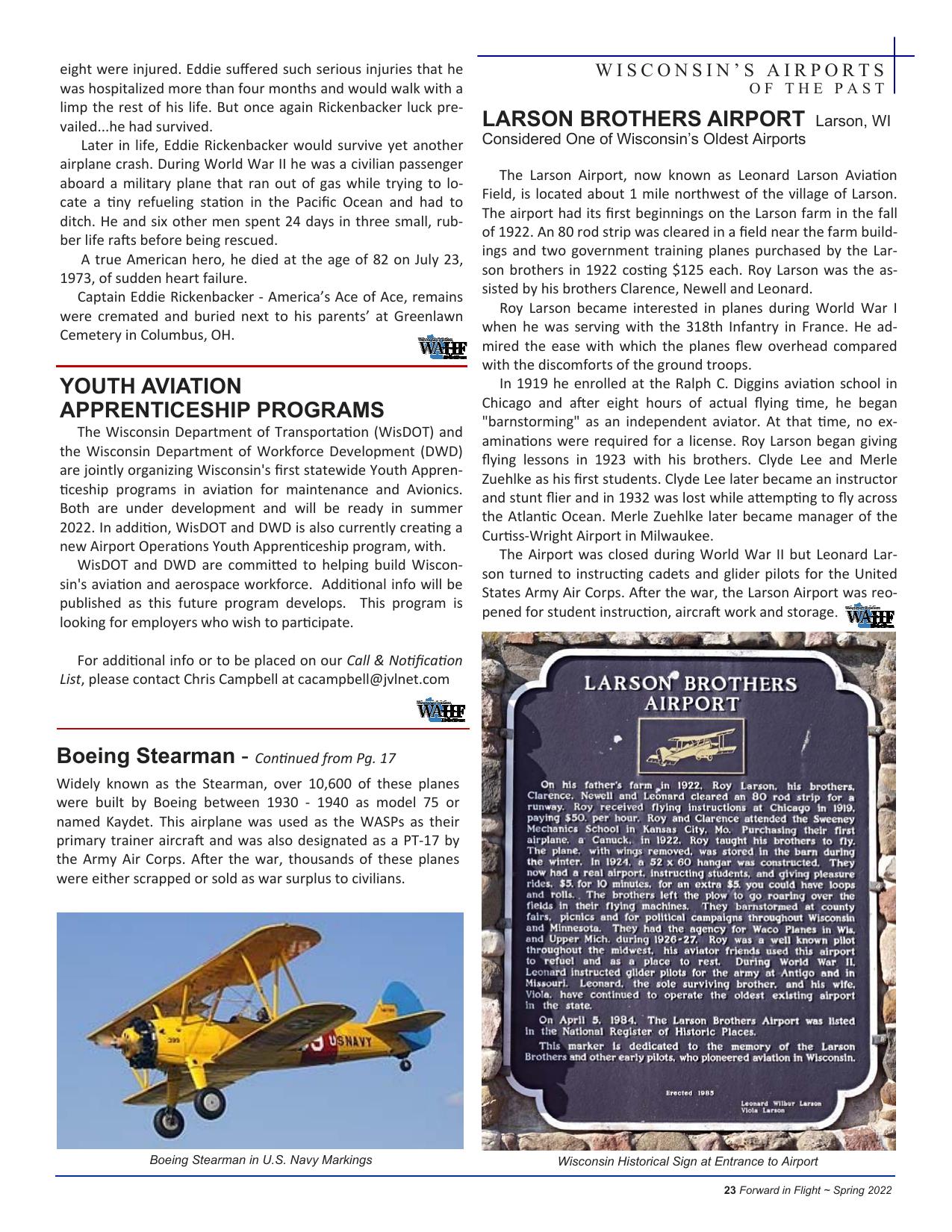
eight were injured. Eddie suffered such serious injuries that he was hospitalized more than four months and would walk with a limp the rest of his life. But once again Rickenbacker luck pre‐ vailed...he had survived. Later in life, Eddie Rickenbacker would survive yet another airplane crash. During World War II he was a civilian passenger aboard a military plane that ran out of gas while trying to lo‐ cate a ny refueling sta on in the Pacific Ocean and had to ditch. He and six other men spent 24 days in three small, rub‐ ber life ra s before being rescued. A true American hero, he died at the age of 82 on July 23, 1973, of sudden heart failure. Captain Eddie Rickenbacker ‐ America’s Ace of Ace, remains were cremated and buried next to his parents’ at Greenlawn Cemetery in Columbus, OH. YOUTH AVIATION APPRENTICESHIP PROGRAMS The Wisconsin Department of Transporta on (WisDOT) and the Wisconsin Department of Workforce Development (DWD) are jointly organizing Wisconsin's first statewide Youth Appren‐ ceship programs in avia on for maintenance and Avionics. Both are under development and will be ready in summer 2022. In addi on, WisDOT and DWD is also currently crea ng a new Airport Opera ons Youth Appren ceship program, with. WisDOT and DWD are commi ed to helping build Wiscon‐ sin's avia on and aerospace workforce. Addi onal info will be published as this future program develops. This program is looking for employers who wish to par cipate. WISCONSIN’S AIRPORTS OF THE PAST LARSON BROTHERS AIRPORT Larson, WI Considered One of Wisconsin’s Oldest Airports The Larson Airport, now known as Leonard Larson Avia on Field, is located about 1 mile northwest of the village of Larson. The airport had its first beginnings on the Larson farm in the fall of 1922. An 80 rod strip was cleared in a field near the farm build‐ ings and two government training planes purchased by the Lar‐ son brothers in 1922 cos ng $125 each. Roy Larson was the as‐ sisted by his brothers Clarence, Newell and Leonard. Roy Larson became interested in planes during World War I when he was serving with the 318th Infantry in France. He ad‐ mired the ease with which the planes flew overhead compared with the discomforts of the ground troops. In 1919 he enrolled at the Ralph C. Diggins avia on school in Chicago and a er eight hours of actual flying me, he began "barnstorming" as an independent aviator. At that me, no ex‐ amina ons were required for a license. Roy Larson began giving flying lessons in 1923 with his brothers. Clyde Lee and Merle Zuehlke as his first students. Clyde Lee later became an instructor and stunt flier and in 1932 was lost while a emp ng to fly across the Atlan c Ocean. Merle Zuehlke later became manager of the Cur ss‐Wright Airport in Milwaukee. The Airport was closed during World War II but Leonard Lar‐ son turned to instruc ng cadets and glider pilots for the United States Army Air Corps. A er the war, the Larson Airport was reo‐ pened for student instruc on, aircra work and storage. For addi onal info or to be placed on our Call & No fica on List, please contact Chris Campbell at cacampbell@jvlnet.com Boeing Stearman - Con nued from Pg. 17 Widely known as the Stearman, over 10,600 of these planes were built by Boeing between 1930 ‐ 1940 as model 75 or named Kaydet. This airplane was used as the WASPs as their primary trainer aircra and was also designated as a PT‐17 by the Army Air Corps. A er the war, thousands of these planes were either scrapped or sold as war surplus to civilians. Boeing Stearman in U.S. Navy Markings Wisconsin Historical Sign at Entrance to Airport 23 Forward in Flight ~ Spring 2022
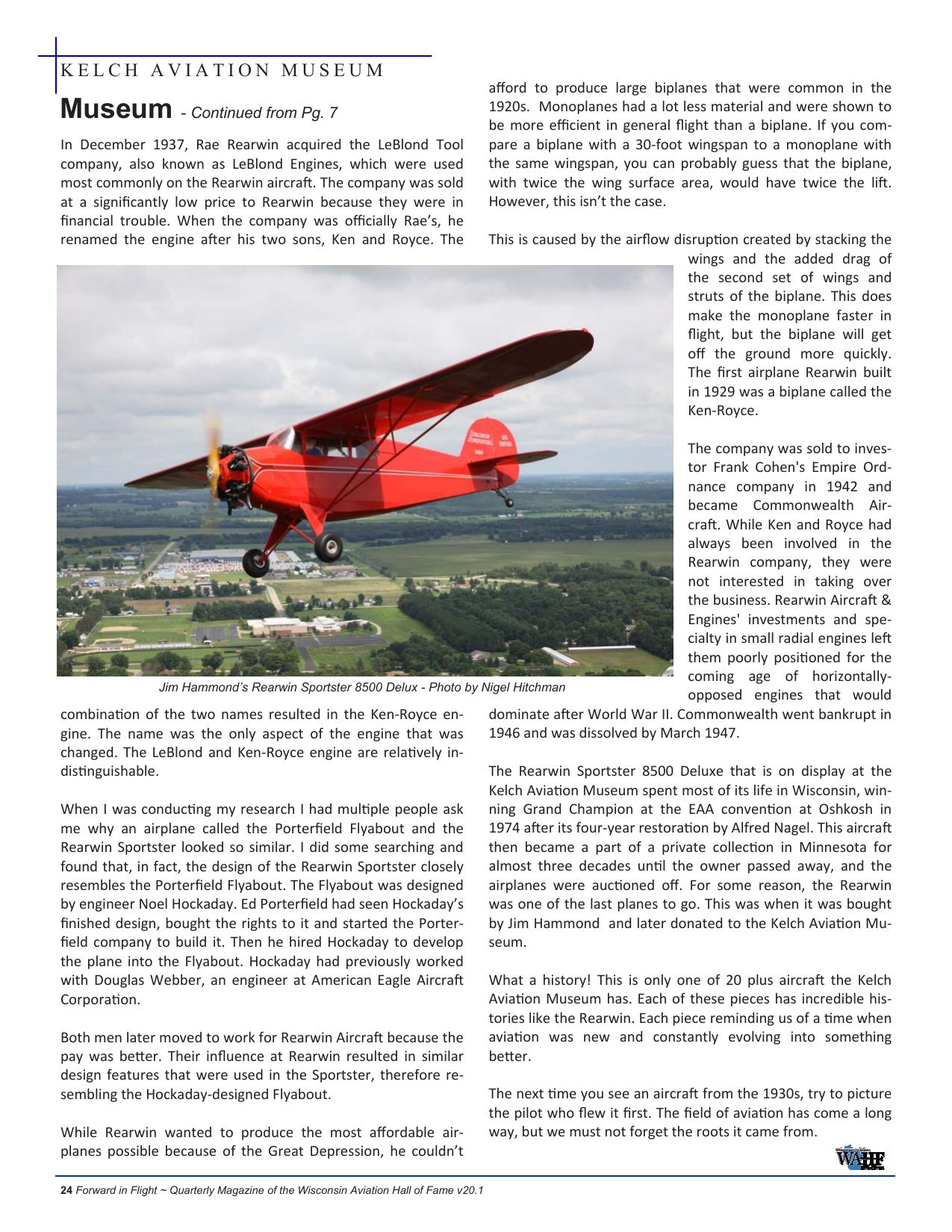
KELCH AVIATION MUSEUM Museum - Continued from Pg. 7 In December 1937, Rae Rearwin acquired the LeBlond Tool company, also known as LeBlond Engines, which were used most commonly on the Rearwin aircra . The company was sold at a significantly low price to Rearwin because they were in financial trouble. When the company was officially Rae’s, he renamed the engine a er his two sons, Ken and Royce. The afford to produce large biplanes that were common in the 1920s. Monoplanes had a lot less material and were shown to be more efficient in general flight than a biplane. If you com‐ pare a biplane with a 30‐foot wingspan to a monoplane with the same wingspan, you can probably guess that the biplane, with twice the wing surface area, would have twice the li . However, this isn’t the case. This is caused by the airflow disrup on created by stacking the wings and the added drag of the second set of wings and struts of the biplane. This does make the monoplane faster in flight, but the biplane will get off the ground more quickly. The first airplane Rearwin built in 1929 was a biplane called the Ken‐Royce. The company was sold to inves‐ tor Frank Cohen's Empire Ord‐ nance company in 1942 and became Commonwealth Air‐ cra . While Ken and Royce had always been involved in the Rearwin company, they were not interested in taking over the business. Rearwin Aircra & Engines' investments and spe‐ cialty in small radial engines le them poorly posi oned for the coming age of horizontally‐ Jim Hammond’s Rearwin Sportster 8500 Delux - Photo by Nigel Hitchman opposed engines that would dominate a er World War II. Commonwealth went bankrupt in combina on of the two names resulted in the Ken‐Royce en‐ 1946 and was dissolved by March 1947. gine. The name was the only aspect of the engine that was changed. The LeBlond and Ken‐Royce engine are rela vely in‐ The Rearwin Sportster 8500 Deluxe that is on display at the dis nguishable. Kelch Avia on Museum spent most of its life in Wisconsin, win‐ ning Grand Champion at the EAA conven on at Oshkosh in When I was conduc ng my research I had mul ple people ask 1974 a er its four‐year restora on by Alfred Nagel. This aircra me why an airplane called the Porterfield Flyabout and the then became a part of a private collec on in Minnesota for Rearwin Sportster looked so similar. I did some searching and almost three decades un l the owner passed away, and the found that, in fact, the design of the Rearwin Sportster closely airplanes were auc oned off. For some reason, the Rearwin resembles the Porterfield Flyabout. The Flyabout was designed was one of the last planes to go. This was when it was bought by engineer Noel Hockaday. Ed Porterfield had seen Hockaday’s by Jim Hammond and later donated to the Kelch Avia on Mu‐ finished design, bought the rights to it and started the Porter‐ seum. field company to build it. Then he hired Hockaday to develop the plane into the Flyabout. Hockaday had previously worked What a history! This is only one of 20 plus aircra the Kelch with Douglas Webber, an engineer at American Eagle Aircra Avia on Museum has. Each of these pieces has incredible his‐ Corpora on. tories like the Rearwin. Each piece reminding us of a me when avia on was new and constantly evolving into something Both men later moved to work for Rearwin Aircra because the be er. pay was be er. Their influence at Rearwin resulted in similar design features that were used in the Sportster, therefore re‐ The next me you see an aircra from the 1930s, try to picture sembling the Hockaday‐designed Flyabout. the pilot who flew it first. The field of avia on has come a long way, but we must not forget the roots it came from. While Rearwin wanted to produce the most affordable air‐ planes possible because of the Great Depression, he couldn’t 24 Forward in Flight ~ Quarterly Magazine of the Wisconsin Aviation Hall of Fame v20.1
WAYS TO MAKE THE MOST OF YOUR WAHF EXPERIENCE By Chris Campbell - Membership Up front, It’s our the mission: To collect and preserve the history of avia on in Wiscon‐ sin, recognize those who made that history, inform oth‐ ers of it and promote avia on educa on for future gen‐ era ons. USE THESE TIPS to take your WAHF membership to the next level. As WAHF looks ahead to the coming year, what are your avia on interests? Do you need new or enhanced skills to reach those goals or change your career path? WAHF membership can help you advance your knowledge of early and current Wisconsin avia on history. We want to help you increase your knowledge and assist you in making new and changing connec ons within the Wisconsin avia on community. Here are a few ways you can take your membership to the next level and shine a light on historical avia on in Wisconsin as well as the en re na on and the accomplishments of those individu‐ als that made that history. 1. ROBUST PARTICIPATION is what adds value, meaning, and sa sfac on to all the things we do. Whether we’re par ci‐ pa ng in a hobby, an occupa on, or even a rela onship – being ac vely engaged is the difference between an ordinary and ex‐ traordinary experience. WAHF events are the best place to get the latest informa on. No ma er where you are in your knowledge of avia on or a career in avia on, there are count‐ less volunteer opportuni es for you to par cipate in. 2. SHARE YOUR KNOWLEDGE Establish yourself as a subject ma er expert (SME) and gain addi onal informa on from your peers by presen ng at a WAHF conference and/or webinar. Par cipate and share our common WAHF Goals & Objec ves: Perpetuate the memory of such persons and record their contribu ons and achievements in a manner that may be deemed appropriate; Foster, promote, and encourage a be er sense of apprecia‐ on of the origins and growth of avia on and the part avia‐ on has played in changing the economic, social, and scien‐ fic aspects of our lives; To establish and maintain a library and archive for collec ng and preserving for posterity, the history of those honored by the organiza on, together with a documenta on of their accomplishments and contribu ons to avia on, including, such items as avia on pictures, pain ngs, books, papers, documents. MEMBERSHIP SPOTLIGHT current call for papers and contribute your wri en ar cles for publica on in Forward In Flight. Whether contribu ng updates to exis ng volumes, or au‐ thoring / coauthoring new ar cles to help capture Wiscon‐ sin’s avia on history, add to our knowledgebase. There’s no be er way of establishing a personal sense of accomplish‐ ment than to be a published writer. WAHF Forward in Flight (FIF) is constantly on the lookout for new authors, manu‐ scripts and topic ideas. Your exper se and skills are in need. Over the years, FIF's editors and co‐editors, WAHF board of directors, and industry leaders have maintained a close working rela onship and collec ve goal to cohesively dis‐ seminate historical avia on informa on to advance WAHF as a trusted historical avia on resource. Share your findings in this respected pla orm and garner addi onal recogni on for your work. 3. SHARE YOUR EXPECTATIONS Do you have an idea for one of our WAHF conferences or FIF ar cles? Contact our FIF editor or a WAHF board member and help shape the topics, speakers, and experience for other professionals in the industry. 4. HELP SHAPE THE INDUSTRY 20 MINUTES AT A TIME. The success of any organiza on and fulfillment of its mission and goals is to "have a language we can all speak together." As a member of the WAHF, you can also consider yourself a member of a Specific Interest Group (SIG) made up of historical enthusiasts and avia on professionals who regularly meet and share our common interests. Each SIG member can easily par cipate with only 20 minutes or less over the course of a year. It's an easy way to impact the future growth of WAHF while sharing your knowledge and as a WAHF SIG influencer. You don't need to be an expert to par cipate and all mem‐ bers are encouraged to par cipate. Invest in yourself by joining or renewing your membership. Your support, your sugges ons, nomina ons, and contribu‐ ons of me, talent, and treasure, help us accomplish our mutual goals. The WAHF board members are very apprecia‐ ve of your efforts. Our strengths is also in a robust membership. Encourage your friends to join WAHF or gi them a subscrip on to FIF. Addi onally, WAHF offers avia on scholarships to our fu‐ ture aviators. See Pg. 26 ‐ for CONTACT US info. We look forward to your robust participation. If public speaking isn't your forte, perhaps wri ng is. View the 25 Forward in Flight ~ Spring 2022
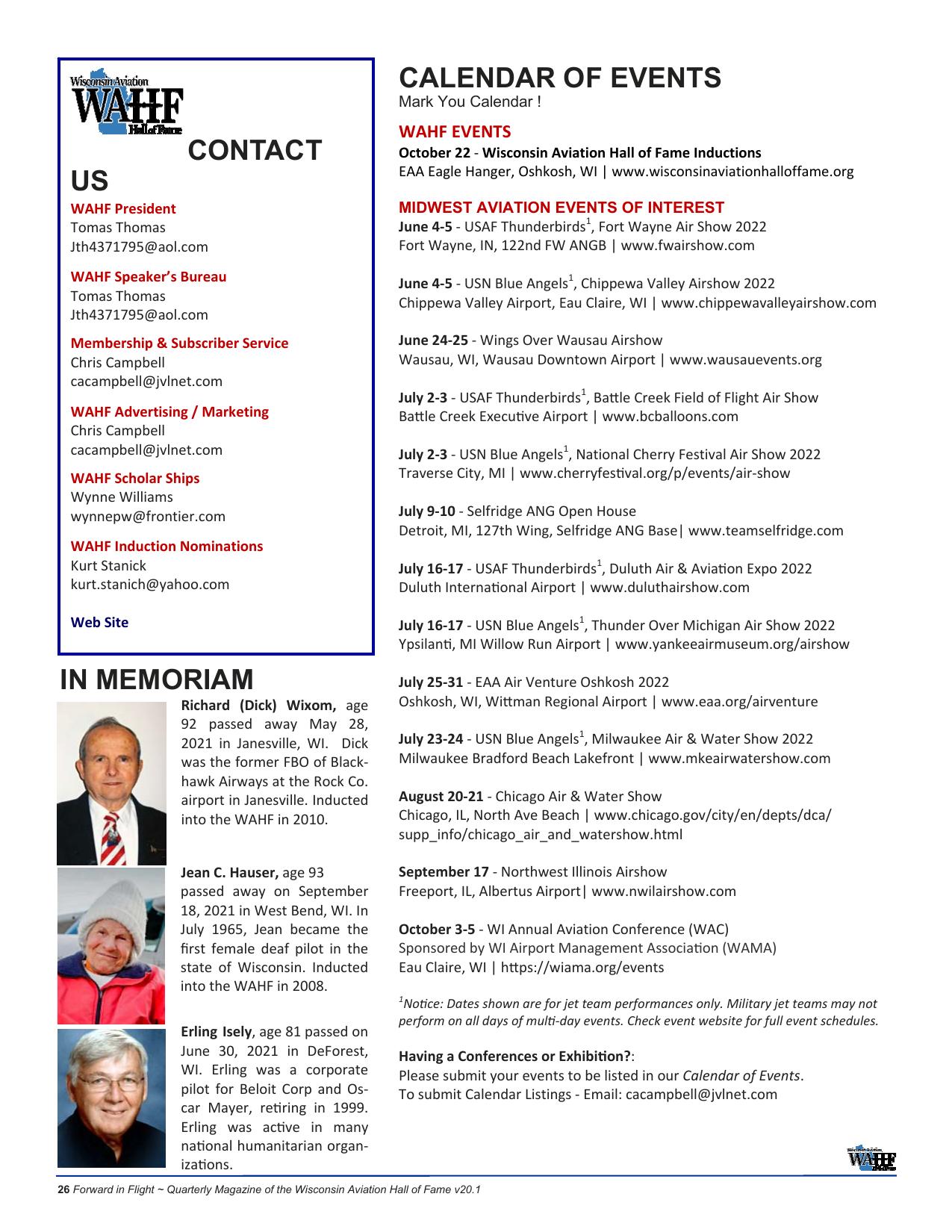
CALENDAR OF EVENTS Mark You Calendar ! US CONTACT WAHF EVENTS October 22 ‐ Wisconsin Aviation Hall of Fame Inductions EAA Eagle Hanger, Oshkosh, WI | www.wisconsinaviationhalloffame.org WAHF President Tomas Thomas Jth4371795@aol.com MIDWEST AVIATION EVENTS OF INTEREST June 4‐5 ‐ USAF Thunderbirds1, Fort Wayne Air Show 2022 Fort Wayne, IN, 122nd FW ANGB | www.fwairshow.com WAHF Speaker’s Bureau Tomas Thomas Jth4371795@aol.com June 4‐5 ‐ USN Blue Angels1, Chippewa Valley Airshow 2022 Chippewa Valley Airport, Eau Claire, WI | www.chippewavalleyairshow.com Membership & Subscriber Service Chris Campbell cacampbell@jvlnet.com June 24‐25 ‐ Wings Over Wausau Airshow Wausau, WI, Wausau Downtown Airport | www.wausauevents.org WAHF Advertising / Marketing Chris Campbell cacampbell@jvlnet.com WAHF Scholar Ships Wynne Williams wynnepw@frontier.com WAHF Induction Nominations Kurt Stanick kurt.stanich@yahoo.com July 2‐3 ‐ USAF Thunderbirds1, Ba le Creek Field of Flight Air Show Ba le Creek Execu ve Airport | www.bcballoons.com July 2‐3 ‐ USN Blue Angels1, National Cherry Festival Air Show 2022 Traverse City, MI | www.cherryfes val.org/p/events/air‐show July 9‐10 ‐ Selfridge ANG Open House Detroit, MI, 127th Wing, Selfridge ANG Base| www.teamselfridge.com July 16‐17 ‐ USAF Thunderbirds1, Duluth Air & Avia on Expo 2022 Duluth Interna onal Airport | www.duluthairshow.com July 16‐17 ‐ USN Blue Angels1, Thunder Over Michigan Air Show 2022 Ypsilan , MI Willow Run Airport | www.yankeeairmuseum.org/airshow Web Site IN MEMORIAM Richard (Dick) Wixom, age 92 passed away May 28, 2021 in Janesville, WI. Dick was the former FBO of Black‐ hawk Airways at the Rock Co. airport in Janesville. Inducted into the WAHF in 2010. Jean C. Hauser, age 93 passed away on September 18, 2021 in West Bend, WI. In July 1965, Jean became the first female deaf pilot in the state of Wisconsin. Inducted into the WAHF in 2008. Erling Isely, age 81 passed on June 30, 2021 in DeForest, WI. Erling was a corporate pilot for Beloit Corp and Os‐ car Mayer, re ring in 1999. Erling was ac ve in many na onal humanitarian organ‐ iza ons. July 25‐31 ‐ EAA Air Venture Oshkosh 2022 Oshkosh, WI, Wi man Regional Airport | www.eaa.org/airventure July 23‐24 ‐ USN Blue Angels1, Milwaukee Air & Water Show 2022 Milwaukee Bradford Beach Lakefront | www.mkeairwatershow.com August 20‐21 ‐ Chicago Air & Water Show Chicago, IL, North Ave Beach | www.chicago.gov/city/en/depts/dca/ supp_info/chicago_air_and_watershow.html September 17 ‐ Northwest Illinois Airshow Freeport, IL, Albertus Airport| www.nwilairshow.com October 3‐5 ‐ WI Annual Aviation Conference (WAC) Sponsored by WI Airport Management Associa on (WAMA) Eau Claire, WI | h ps://wiama.org/events 1 No ce: Dates shown are for jet team performances only. Military jet teams may not perform on all days of mul ‐day events. Check event website for full event schedules. Having a Conferences or Exhibi on?: Please submit your events to be listed in our Calendar of Events. To submit Calendar Listings ‐ Email: cacampbell@jvlnet.com 26 Forward in Flight ~ Quarterly Magazine of the Wisconsin Aviation Hall of Fame v20.1
YOUR WAHF MEMBERSHIP Typically, WAHF membership is for a calendar year. Because of the fantas c support of our members like you, one of the improvements and growth we’ve experienced in recent years is our avia on scholarship program and our recent part‐ nership with the Kelch Avia on Museum in Broadhead, Wis‐ consin. We will con nue expand and grow our accomplishments for you, a valued WAHF member. Any me of year is the right me to give a gi WAHF membership ANNUAL MEMBERSHIP LEVELS: Please Check ____ Youth (Under 18) ____ Individual (Annual) ____ Couple (Annual) ____ Life me (Self) ____ Life me (Couple) $10 $30 $40 $500 $750 Name: ____________________________________________ Address: ___________________________________________ City: ______________________________________________ When you nominate men and women for induc on into the Wisconsin Avia on Hall of Fame, invite members of the WAHF Speakers Bureau to your events, recruit new members, pur‐ chase WAHF logo merchandise, share your issue of Forward in Flight, or simply recommend to your friends to support the Wisconsin Avia on Hall of Fame, you are helping us preserve and share Wisconsin’s rich avia on history. Thank you for your part in making Wisconsin Avia on Hall of Fame become the best it can be! Your prompt renewals save the organiza on me and money so that we can con nue to bring great ar cles about avia on history in Wisconsin and about those who created it. Please renew your membership promptly so you don’t miss another issue of our quarterly avia on magazine Forward in Flight. Thank you again for suppor ng the Wisconsin Avia on Hall of Fame. If your renewal is already on its way, thank you! For membership or adver sing inquiries, please contact: WAHF Membership | cacampbell@jvlnet.com A n: Snowbirds! Please let us know your winter mailing ad‐ dress so we can send your Forward In Flight directly to your Snowbird address and avoid any post office forwarding errors. CALL FOR PAPERS State, Zip __________________________________________ Phone: ____________________________________________ Email: _____________________________________________ TAX DEDUCTIBLE CONTRIBUTIONS Your contribu ons will help ensure Wisconsin’s avia on pio‐ neers and outstanding students in avia on educa on will con‐ nue to be appropriately recognized. Your Contribu ons, in any amount are greatly appreciated. WAHF Suppor ng Contribu on $_________ (General Opera ng / Events Programming Fund) WAHF Scholarship Fund** $_________** **For scholarship dona ons, please make a Separate Check payable to: Community Founda on of North Central Wisconsin or visit www.CFONCW.org for online dona ons. Visit Us At: www.WisconsinAvia onHallofFame.org The Wisconsin Avia on Hall of Fame is a 501(c)(3) organiza on. Mail this form to: Membership, WAHF 416 E. JF Townline Road Janesville, WI 53545 Morey Airplane Company Since 1932 Do you have a historical aviation story to tell & would like to share your works in Forward in Flight? WAHF is always seeking co-editors and articles for publication in future issues of Forward in Flight. Should you have an interest, Please contact WAHF President Tom Thomas 608-332-0490 Middleton Municipal Airport/Morey Field Self-service 100LL & Jet A 24-7 27 Forward in Flight ~ Spring 2022
PRSRT STD U.S. Postage PAID Madison, WI Permit No. 1069 PO BOX 70739 MADISON WI 53707 The Wisconsin Aviation Hall of Fame is a non-profit membership organization dedicated to preserving the past and fostering the future of flight. Thanks to All WAHF Members and Supporters in 2022 Officers 2022 New Members Tom Thomas, President James Zuelsdorf, Vice-President Chris Campbell, Treasurer Henry Peterson, Secretary Paul McCarthy 2022 Corporate Members Reabe Spraying Service - Plover, WI New Life Members Lewis Jaye Board of Directors Kenneth Koch 2022 Supporting Contributors William & Belinda Adams Steve Krog David Cummings Kim & Dennis Klister Terry Railing Cleo Gibson Jeff & Cheryl Baker Don Adriano Sune and Jean Ericson Jimmy Szajkovics Patti Bruha Will Your Address Change? Edward Hall Kurt Mehre Jeff Point Gregory Cunningham Howard Rand Please inform us of your new address. A timely reminder of your new address is very much appreciated, as it helps to save time - and expense - for our small non-profit organization. Jill Mann Kurt Stanich Chuck Swain Jim Szajkovics Patrick Weeden Wynne Williams Wisconsin Aviation Hall of Fame c/o Tom Thomas, President PO Box 70739 Madison, WI 53707 608-332-0490 Become a member / supporter today! www.wisconsinaviationhalloffame.org