Volume 24, Issue 2
🗞️ Download Issue (PDF)
Forward in Flight - Summer 2026
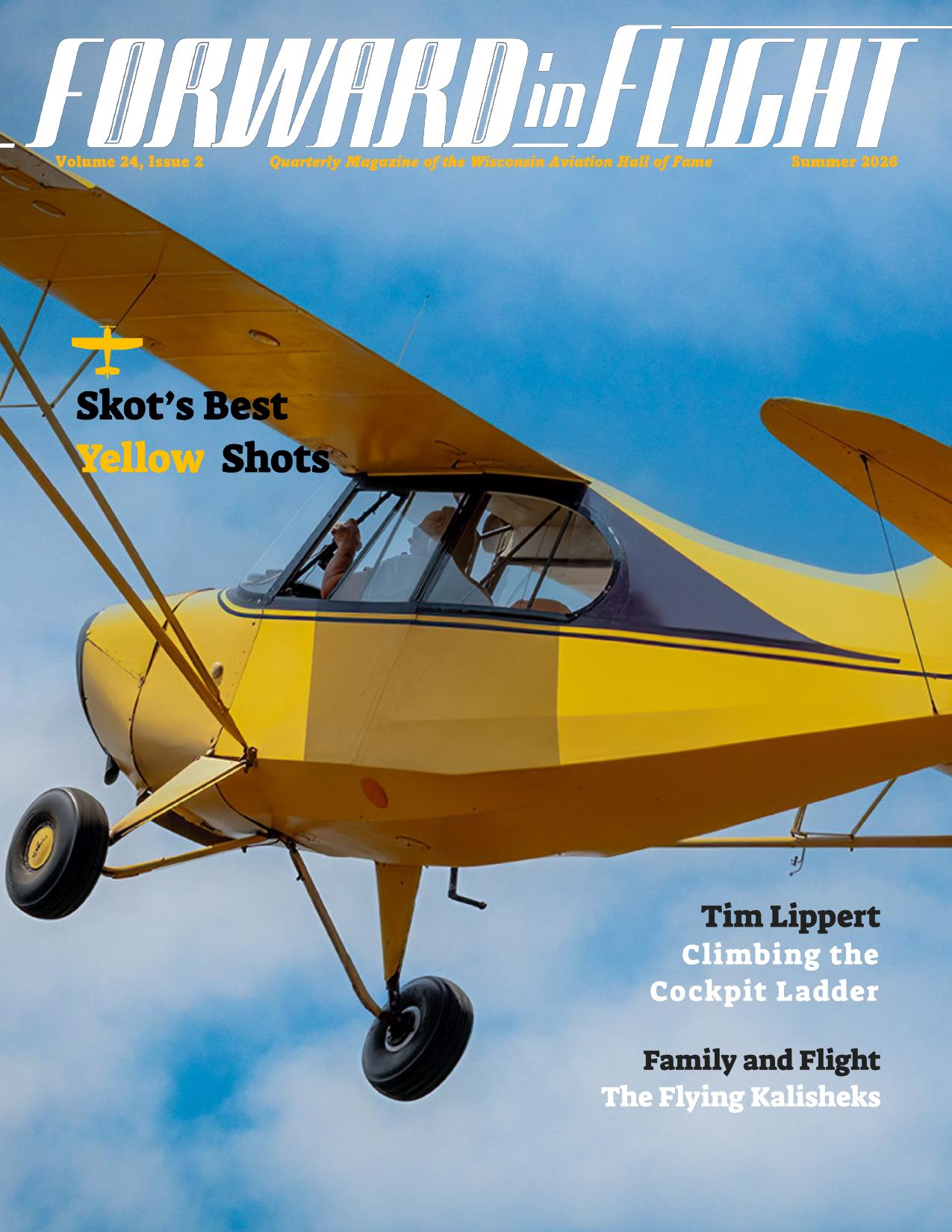
Volume 24, Issue 2 Quarterly Magazine of the Wisconsin Aviation Hall of Fame Summer 2026 Skot’s Best Yellow Shots Tim Lippert Climbing the Co ckpit Ladder Family and Flight The Flying Kalisheks
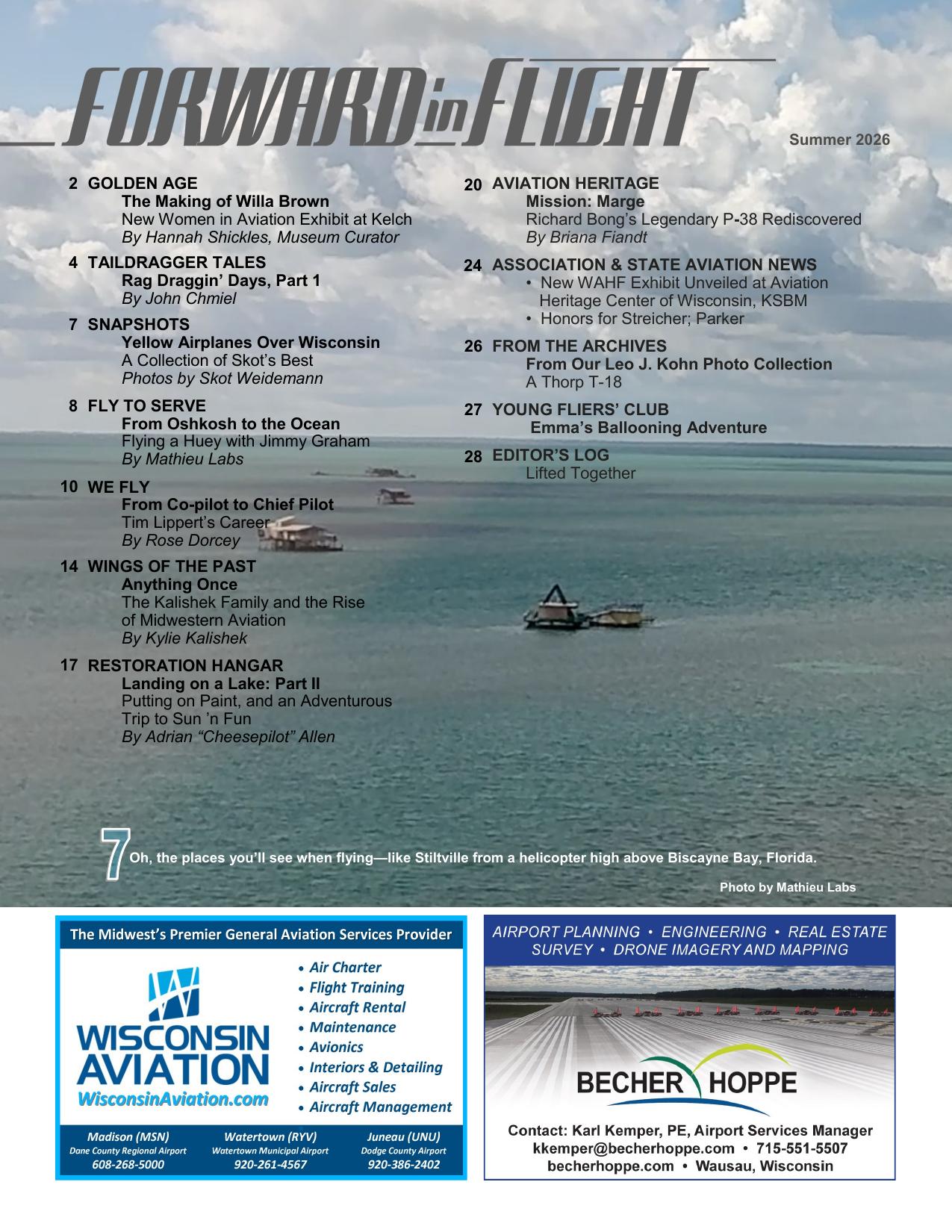
Summer 2026 2 GOLDEN AGE The Making of Willa Brown New Women in Aviation Exhibit at Kelch By Hannah Shickles, Museum Curator 20 AVIATION HERITAGE Mission: Marge Richard Bong’s Legendary P-38 Rediscovered By Briana Fiandt 4 TAILDRAGGER TALES Rag Draggin’ Days, Part 1 By John Chmiel 24 ASSOCIATION & STATE AVIATION NEWS • New WAHF Exhibit Unveiled at Aviation Heritage Center of Wisconsin, KSBM • Honors for Streicher; Parker 7 SNAPSHOTS Yellow Airplanes Over Wisconsin A Collection of Skot’s Best Photos by Skot Weidemann 8 FLY TO SERVE From Oshkosh to the Ocean Flying a Huey with Jimmy Graham By Mathieu Labs 10 WE FLY From Co-pilot to Chief Pilot Tim Lippert’s Career By Rose Dorcey 26 FROM THE ARCHIVES From Our Leo J. Kohn Photo Collection A Thorp T-18 27 YOUNG FLIERS’ CLUB Emma’s Ballooning Adventure 28 EDITOR’S LOG Lifted Together 14 WINGS OF THE PAST Anything Once The Kalishek Family and the Rise of Midwestern Aviation By Kylie Kalishek 17 RESTORATION HANGAR Landing on a Lake: Part II Putting on Paint, and an Adventurous Trip to Sun ’n Fun By Adrian “Cheesepilot” Allen Oh, the places you’ll see when flying—like Stiltville from a helicopter high above Biscayne Bay, Florida. Photo by Mathieu Labs
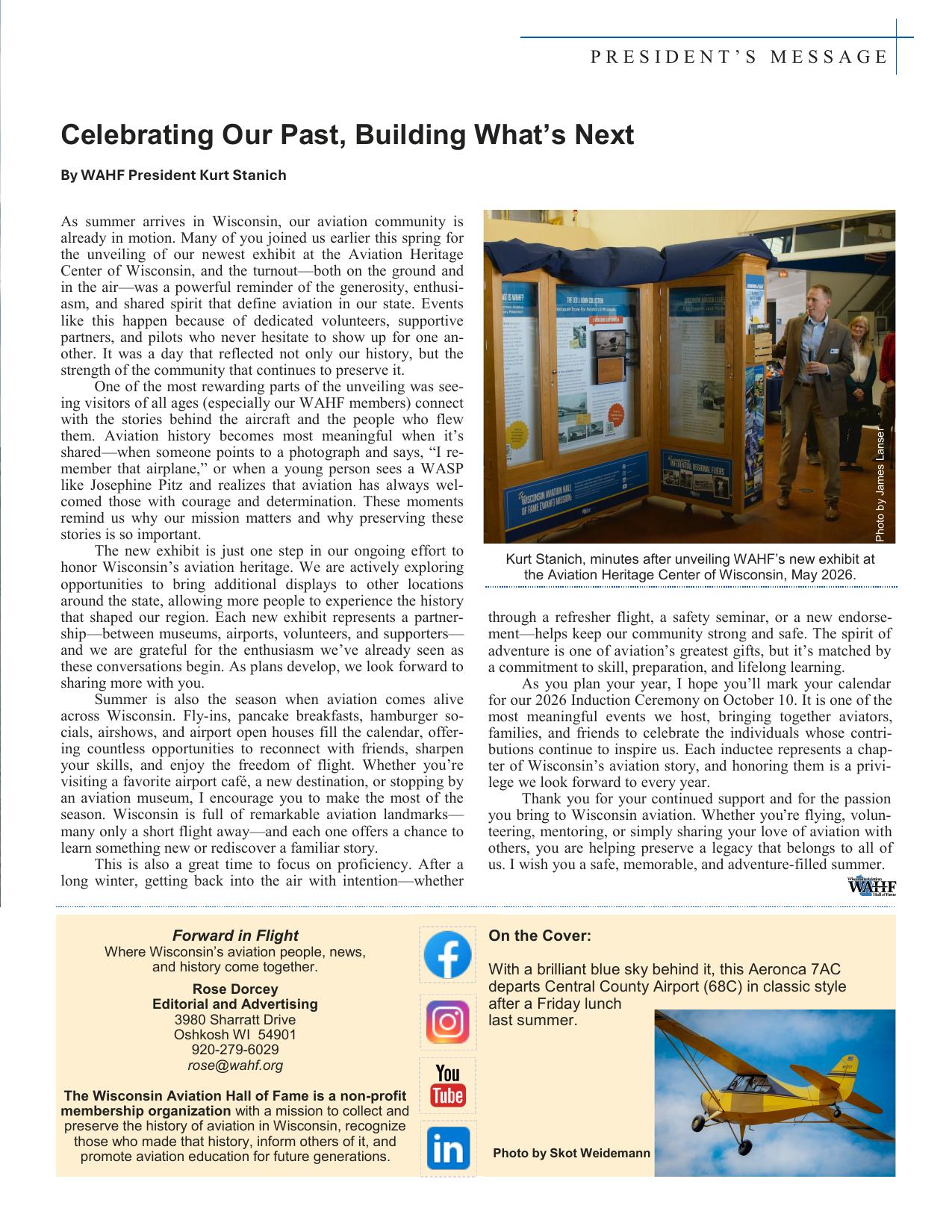
PRESIDENT’S MESSAGE Celebrating Our Past, Building What’s Next As summer arrives in Wisconsin, our aviation community is already in motion. Many of you joined us earlier this spring for the unveiling of our newest exhibit at the Aviation Heritage Center of Wisconsin, and the turnout—both on the ground and in the air—was a powerful reminder of the generosity, enthusiasm, and shared spirit that define aviation in our state. Events like this happen because of dedicated volunteers, supportive partners, and pilots who never hesitate to show up for one another. It was a day that reflected not only our history, but the strength of the community that continues to preserve it. One of the most rewarding parts of the unveiling was seeing visitors of all ages (especially our WAHF members) connect with the stories behind the aircraft and the people who flew them. Aviation history becomes most meaningful when it’s shared—when someone points to a photograph and says, “I remember that airplane,” or when a young person sees a WASP like Josephine Pitz and realizes that aviation has always welcomed those with courage and determination. These moments remind us why our mission matters and why preserving these stories is so important. The new exhibit is just one step in our ongoing effort to honor Wisconsin’s aviation heritage. We are actively exploring opportunities to bring additional displays to other locations around the state, allowing more people to experience the history that shaped our region. Each new exhibit represents a partnership—between museums, airports, volunteers, and supporters— and we are grateful for the enthusiasm we’ve already seen as these conversations begin. As plans develop, we look forward to sharing more with you. Summer is also the season when aviation comes alive across Wisconsin. Fly‑ins, pancake breakfasts, hamburger socials, airshows, and airport open houses fill the calendar, offering countless opportunities to reconnect with friends, sharpen your skills, and enjoy the freedom of flight. Whether you’re visiting a favorite airport café, a new destination, or stopping by an aviation museum, I encourage you to make the most of the season. Wisconsin is full of remarkable aviation landmarks— many only a short flight away—and each one offers a chance to learn something new or rediscover a familiar story. This is also a great time to focus on proficiency. After a long winter, getting back into the air with intention—whether Forward in Flight Where Wisconsin’s aviation people, news, and history come together. Rose Dorcey Editorial and Advertising 3980 Sharratt Drive Oshkosh WI 54901 920-279-6029 rose@wahf.org The Wisconsin Aviation Hall of Fame is a non-profit membership organization with a mission to collect and preserve the history of aviation in Wisconsin, recognize those who made that history, inform others of it, and promote aviation education for future generations. Photo by James Lanser By WAHF President Kurt Stanich Kurt Stanich, minutes after unveiling WAHF’s new exhibit at the Aviation Heritage Center of Wisconsin, May 2026. through a refresher flight, a safety seminar, or a new endorsement—helps keep our community strong and safe. The spirit of adventure is one of aviation’s greatest gifts, but it’s matched by a commitment to skill, preparation, and lifelong learning. As you plan your year, I hope you’ll mark your calendar for our 2026 Induction Ceremony on October 10. It is one of the most meaningful events we host, bringing together aviators, families, and friends to celebrate the individuals whose contributions continue to inspire us. Each inductee represents a chapter of Wisconsin’s aviation story, and honoring them is a privilege we look forward to every year. Thank you for your continued support and for the passion you bring to Wisconsin aviation. Whether you’re flying, volunteering, mentoring, or simply sharing your love of aviation with others, you are helping preserve a legacy that belongs to all of us. I wish you a safe, memorable, and adventure‑filled summer. On the Cover: With a brilliant blue sky behind it, this Aeronca 7AC departs Central County Airport (68C) in classic style after a Friday lunch last summer. Photo by Skot Weidemann
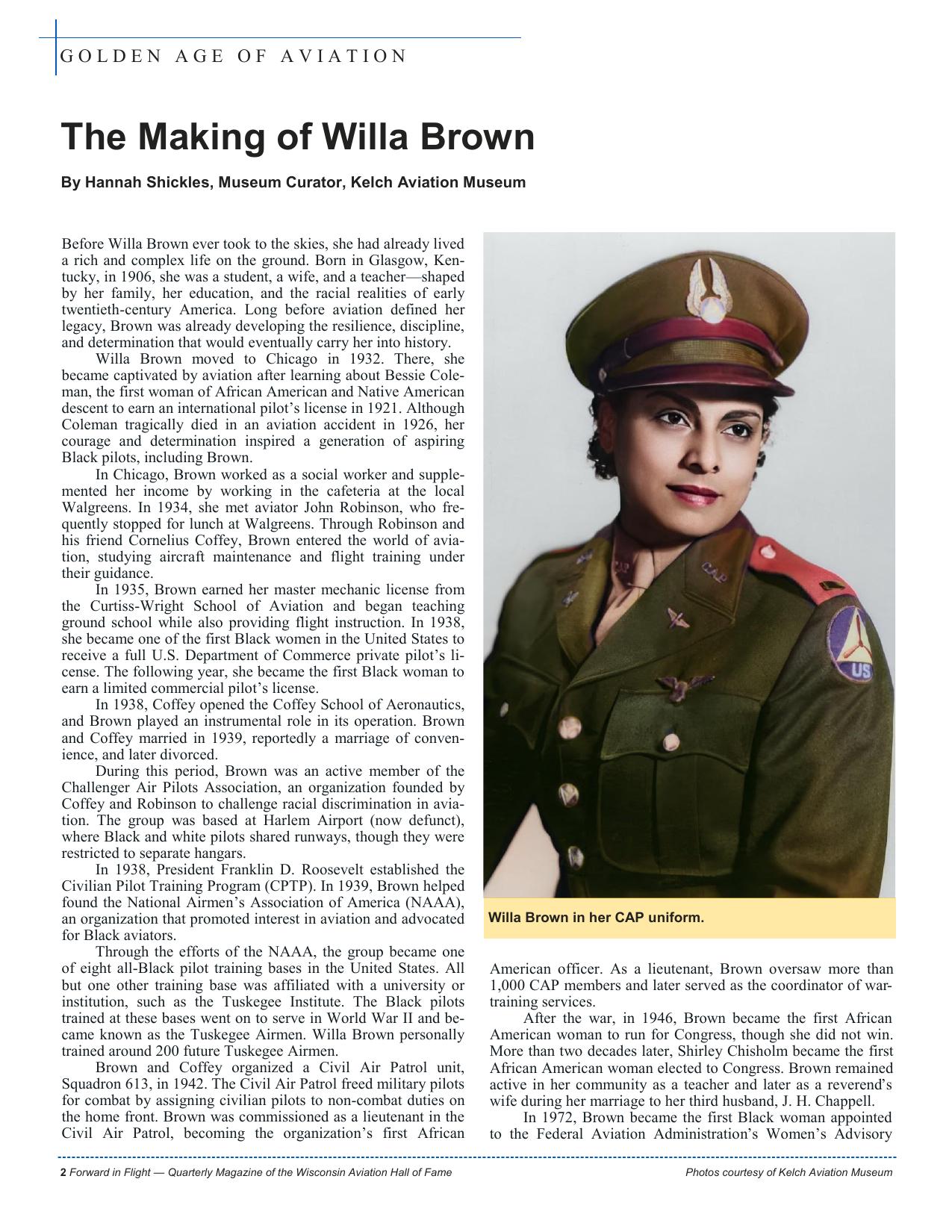
GOLDEN AGE OF AVIATION The Making of Willa Brown By Hannah Shickles, Museum Curator, Kelch Aviation Museum Before Willa Brown ever took to the skies, she had already lived a rich and complex life on the ground. Born in Glasgow, Kentucky, in 1906, she was a student, a wife, and a teacher—shaped by her family, her education, and the racial realities of early twentieth-century America. Long before aviation defined her legacy, Brown was already developing the resilience, discipline, and determination that would eventually carry her into history. Willa Brown moved to Chicago in 1932. There, she became captivated by aviation after learning about Bessie Coleman, the first woman of African American and Native American descent to earn an international pilot’s license in 1921. Although Coleman tragically died in an aviation accident in 1926, her courage and determination inspired a generation of aspiring Black pilots, including Brown. In Chicago, Brown worked as a social worker and supplemented her income by working in the cafeteria at the local Walgreens. In 1934, she met aviator John Robinson, who frequently stopped for lunch at Walgreens. Through Robinson and his friend Cornelius Coffey, Brown entered the world of aviation, studying aircraft maintenance and flight training under their guidance. In 1935, Brown earned her master mechanic license from the Curtiss-Wright School of Aviation and began teaching ground school while also providing flight instruction. In 1938, she became one of the first Black women in the United States to receive a full U.S. Department of Commerce private pilot’s license. The following year, she became the first Black woman to earn a limited commercial pilot’s license. In 1938, Coffey opened the Coffey School of Aeronautics, and Brown played an instrumental role in its operation. Brown and Coffey married in 1939, reportedly a marriage of convenience, and later divorced. During this period, Brown was an active member of the Challenger Air Pilots Association, an organization founded by Coffey and Robinson to challenge racial discrimination in aviation. The group was based at Harlem Airport (now defunct), where Black and white pilots shared runways, though they were restricted to separate hangars. In 1938, President Franklin D. Roosevelt established the Civilian Pilot Training Program (CPTP). In 1939, Brown helped found the National Airmen’s Association of America (NAAA), an organization that promoted interest in aviation and advocated for Black aviators. Through the efforts of the NAAA, the group became one of eight all-Black pilot training bases in the United States. All but one other training base was affiliated with a university or institution, such as the Tuskegee Institute. The Black pilots trained at these bases went on to serve in World War II and became known as the Tuskegee Airmen. Willa Brown personally trained around 200 future Tuskegee Airmen. Brown and Coffey organized a Civil Air Patrol unit, Squadron 613, in 1942. The Civil Air Patrol freed military pilots for combat by assigning civilian pilots to non-combat duties on the home front. Brown was commissioned as a lieutenant in the Civil Air Patrol, becoming the organization’s first African 2 Forward in Flight — Quarterly Magazine of the Wisconsin Aviation Hall of Fame Willa Brown in her CAP uniform. American officer. As a lieutenant, Brown oversaw more than 1,000 CAP members and later served as the coordinator of wartraining services. After the war, in 1946, Brown became the first African American woman to run for Congress, though she did not win. More than two decades later, Shirley Chisholm became the first African American woman elected to Congress. Brown remained active in her community as a teacher and later as a reverend’s wife during her marriage to her third husband, J. H. Chappell. In 1972, Brown became the first Black woman appointed to the Federal Aviation Administration’s Women’s Advisory Photos courtesy of Kelch Aviation Museum
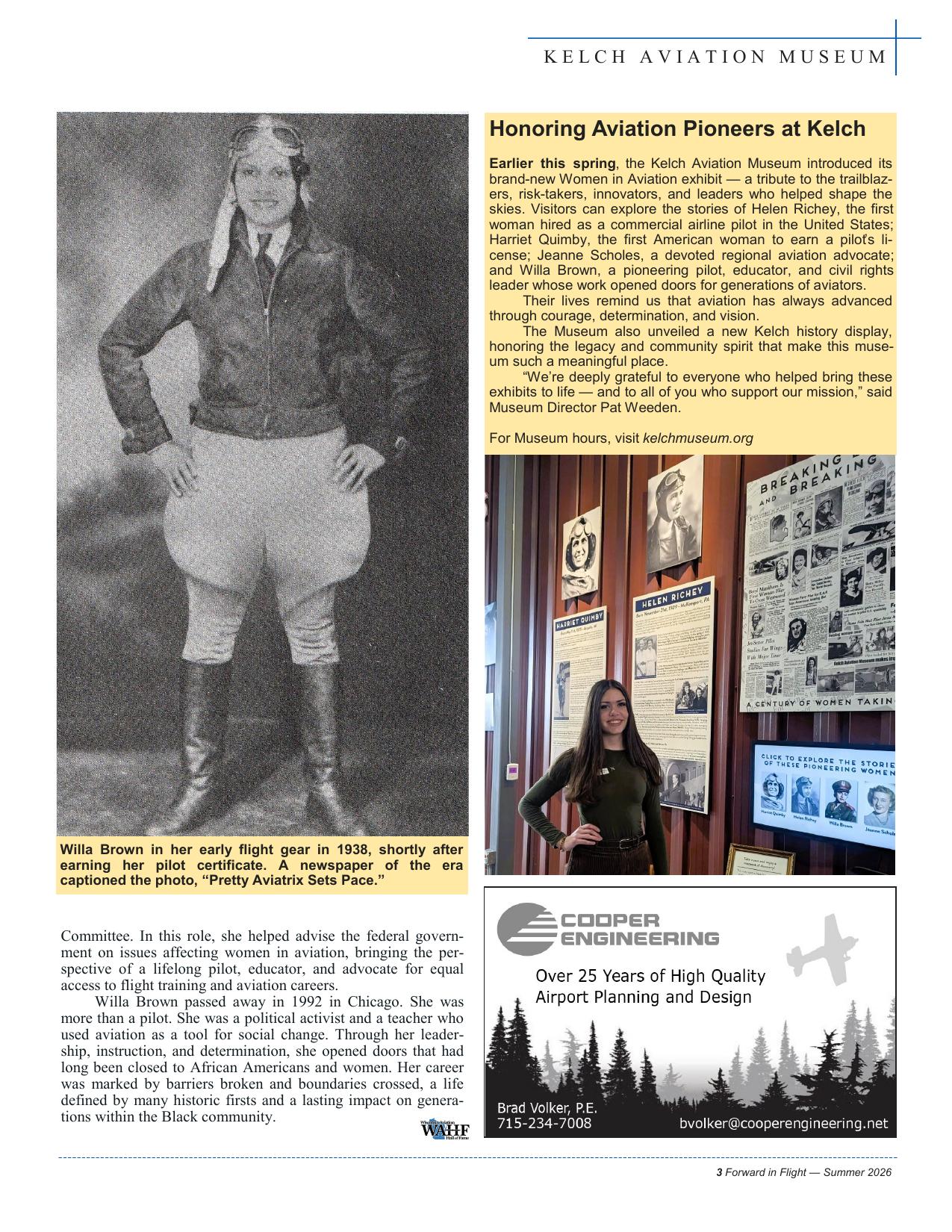
KELCH AVIATION MUSEUM Honoring Aviation Pioneers at Kelch Earlier this spring, the Kelch Aviation Museum introduced its brand-new Women in Aviation exhibit — a tribute to the trailblazers, risk-takers, innovators, and leaders who helped shape the skies. Visitors can explore the stories of Helen Richey, the first woman hired as a commercial airline pilot in the United States; Harriet Quimby, the first American woman to earn a pilot’s license; Jeanne Scholes, a devoted regional aviation advocate; and Willa Brown, a pioneering pilot, educator, and civil rights leader whose work opened doors for generations of aviators. Their lives remind us that aviation has always advanced through courage, determination, and vision. The Museum also unveiled a new Kelch history display, honoring the legacy and community spirit that make this museum such a meaningful place. “We’re deeply grateful to everyone who helped bring these exhibits to life — and to all of you who support our mission,” said Museum Director Pat Weeden. For Museum hours, visit kelchmuseum.org Willa Brown in her early flight gear in 1938, shortly after earning her pilot certificate. A newspaper of the era captioned the photo, “Pretty Aviatrix Sets Pace.” Committee. In this role, she helped advise the federal government on issues affecting women in aviation, bringing the perspective of a lifelong pilot, educator, and advocate for equal access to flight training and aviation careers. Willa Brown passed away in 1992 in Chicago. She was more than a pilot. She was a political activist and a teacher who used aviation as a tool for social change. Through her leadership, instruction, and determination, she opened doors that had long been closed to African Americans and women. Her career was marked by barriers broken and boundaries crossed, a life defined by many historic firsts and a lasting impact on generations within the Black community. 3 Forward in Flight — Summer 2026
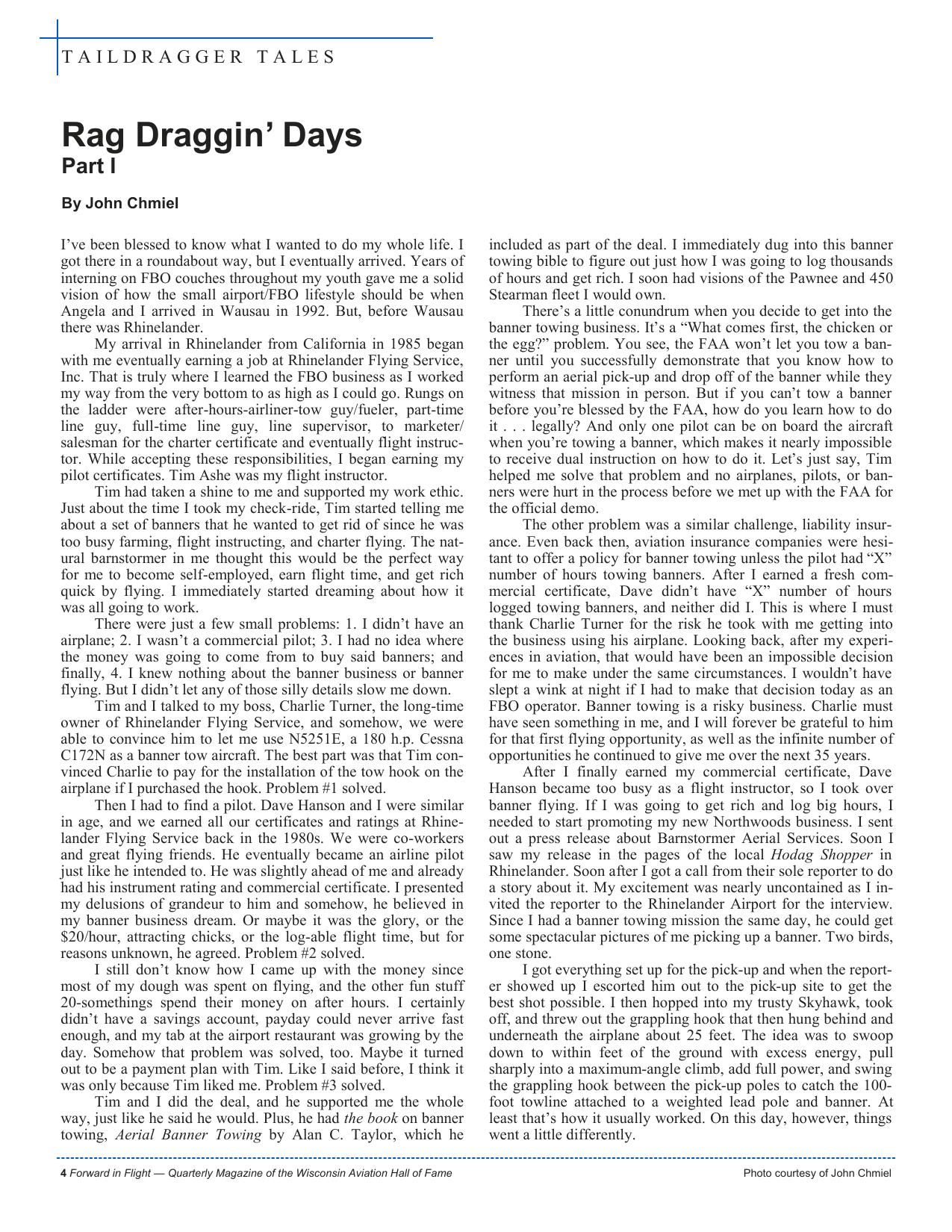
TAILDRAGGER TALES Rag Draggin’ Days Part I By John Chmiel I’ve been blessed to know what I wanted to do my whole life. I got there in a roundabout way, but I eventually arrived. Years of interning on FBO couches throughout my youth gave me a solid vision of how the small airport/FBO lifestyle should be when Angela and I arrived in Wausau in 1992. But, before Wausau there was Rhinelander. My arrival in Rhinelander from California in 1985 began with me eventually earning a job at Rhinelander Flying Service, Inc. That is truly where I learned the FBO business as I worked my way from the very bottom to as high as I could go. Rungs on the ladder were after-hours-airliner-tow guy/fueler, part-time line guy, full-time line guy, line supervisor, to marketer/ salesman for the charter certificate and eventually flight instructor. While accepting these responsibilities, I began earning my pilot certificates. Tim Ashe was my flight instructor. Tim had taken a shine to me and supported my work ethic. Just about the time I took my check-ride, Tim started telling me about a set of banners that he wanted to get rid of since he was too busy farming, flight instructing, and charter flying. The natural barnstormer in me thought this would be the perfect way for me to become self-employed, earn flight time, and get rich quick by flying. I immediately started dreaming about how it was all going to work. There were just a few small problems: 1. I didn’t have an airplane; 2. I wasn’t a commercial pilot; 3. I had no idea where the money was going to come from to buy said banners; and finally, 4. I knew nothing about the banner business or banner flying. But I didn’t let any of those silly details slow me down. Tim and I talked to my boss, Charlie Turner, the long-time owner of Rhinelander Flying Service, and somehow, we were able to convince him to let me use N5251E, a 180 h.p. Cessna C172N as a banner tow aircraft. The best part was that Tim convinced Charlie to pay for the installation of the tow hook on the airplane if I purchased the hook. Problem #1 solved. Then I had to find a pilot. Dave Hanson and I were similar in age, and we earned all our certificates and ratings at Rhinelander Flying Service back in the 1980s. We were co-workers and great flying friends. He eventually became an airline pilot just like he intended to. He was slightly ahead of me and already had his instrument rating and commercial certificate. I presented my delusions of grandeur to him and somehow, he believed in my banner business dream. Or maybe it was the glory, or the $20/hour, attracting chicks, or the log-able flight time, but for reasons unknown, he agreed. Problem #2 solved. I still don’t know how I came up with the money since most of my dough was spent on flying, and the other fun stuff 20-somethings spend their money on after hours. I certainly didn’t have a savings account, payday could never arrive fast enough, and my tab at the airport restaurant was growing by the day. Somehow that problem was solved, too. Maybe it turned out to be a payment plan with Tim. Like I said before, I think it was only because Tim liked me. Problem #3 solved. Tim and I did the deal, and he supported me the whole way, just like he said he would. Plus, he had the book on banner towing, Aerial Banner Towing by Alan C. Taylor, which he 4 Forward in Flight — Quarterly Magazine of the Wisconsin Aviation Hall of Fame included as part of the deal. I immediately dug into this banner towing bible to figure out just how I was going to log thousands of hours and get rich. I soon had visions of the Pawnee and 450 Stearman fleet I would own. There’s a little conundrum when you decide to get into the banner towing business. It’s a “What comes first, the chicken or the egg?” problem. You see, the FAA won’t let you tow a banner until you successfully demonstrate that you know how to perform an aerial pick-up and drop off of the banner while they witness that mission in person. But if you can’t tow a banner before you’re blessed by the FAA, how do you learn how to do it . . . legally? And only one pilot can be on board the aircraft when you’re towing a banner, which makes it nearly impossible to receive dual instruction on how to do it. Let’s just say, Tim helped me solve that problem and no airplanes, pilots, or banners were hurt in the process before we met up with the FAA for the official demo. The other problem was a similar challenge, liability insurance. Even back then, aviation insurance companies were hesitant to offer a policy for banner towing unless the pilot had “X” number of hours towing banners. After I earned a fresh commercial certificate, Dave didn’t have “X” number of hours logged towing banners, and neither did I. This is where I must thank Charlie Turner for the risk he took with me getting into the business using his airplane. Looking back, after my experiences in aviation, that would have been an impossible decision for me to make under the same circumstances. I wouldn’t have slept a wink at night if I had to make that decision today as an FBO operator. Banner towing is a risky business. Charlie must have seen something in me, and I will forever be grateful to him for that first flying opportunity, as well as the infinite number of opportunities he continued to give me over the next 35 years. After I finally earned my commercial certificate, Dave Hanson became too busy as a flight instructor, so I took over banner flying. If I was going to get rich and log big hours, I needed to start promoting my new Northwoods business. I sent out a press release about Barnstormer Aerial Services. Soon I saw my release in the pages of the local Hodag Shopper in Rhinelander. Soon after I got a call from their sole reporter to do a story about it. My excitement was nearly uncontained as I invited the reporter to the Rhinelander Airport for the interview. Since I had a banner towing mission the same day, he could get some spectacular pictures of me picking up a banner. Two birds, one stone. I got everything set up for the pick-up and when the reporter showed up I escorted him out to the pick-up site to get the best shot possible. I then hopped into my trusty Skyhawk, took off, and threw out the grappling hook that then hung behind and underneath the airplane about 25 feet. The idea was to swoop down to within feet of the ground with excess energy, pull sharply into a maximum-angle climb, add full power, and swing the grappling hook between the pick-up poles to catch the 100foot towline attached to a weighted lead pole and banner. At least that’s how it usually worked. On this day, however, things went a little differently. Photo courtesy of John Chmiel
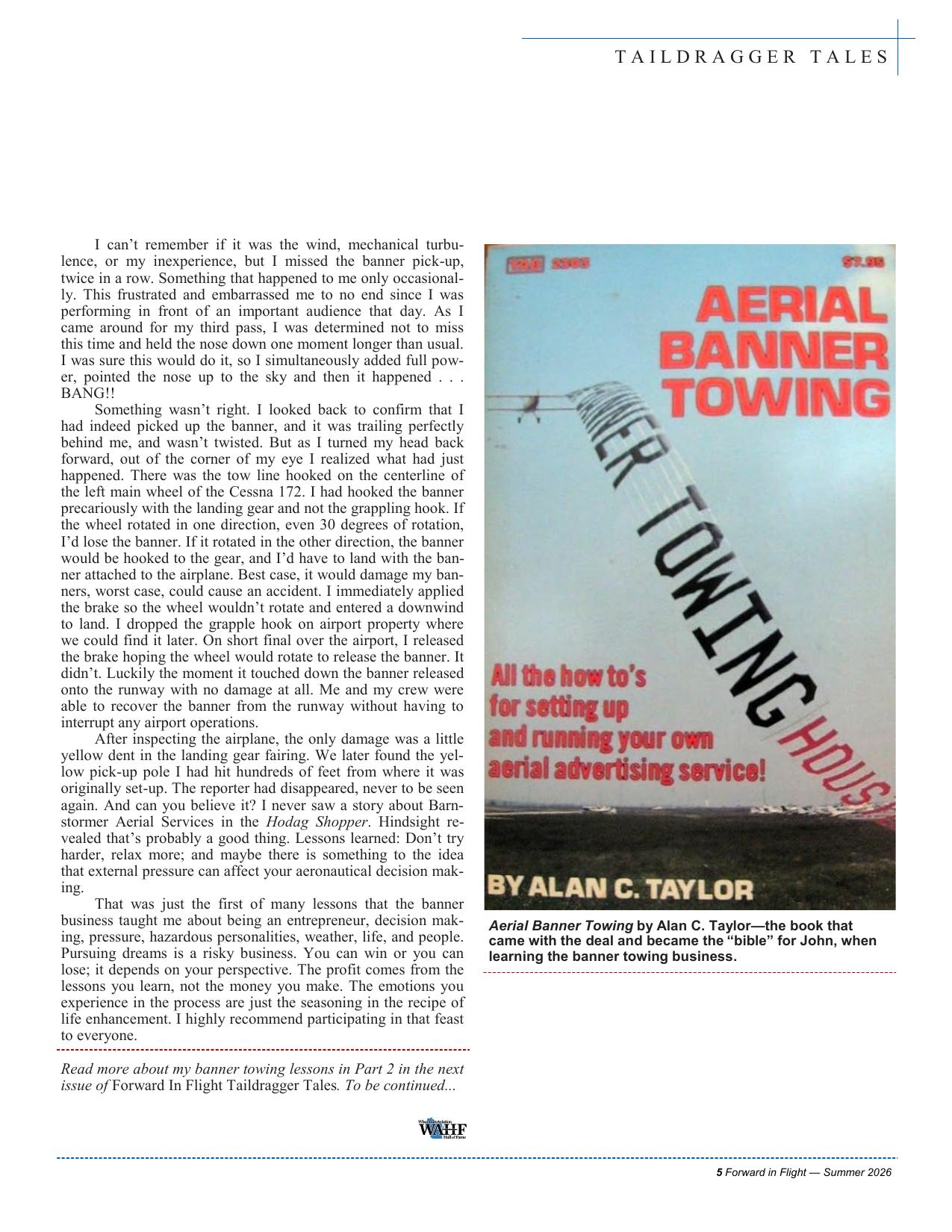
TAILDRAGGER TALES I can’t remember if it was the wind, mechanical turbulence, or my inexperience, but I missed the banner pick-up, twice in a row. Something that happened to me only occasionally. This frustrated and embarrassed me to no end since I was performing in front of an important audience that day. As I came around for my third pass, I was determined not to miss this time and held the nose down one moment longer than usual. I was sure this would do it, so I simultaneously added full power, pointed the nose up to the sky and then it happened . . . BANG!! Something wasn’t right. I looked back to confirm that I had indeed picked up the banner, and it was trailing perfectly behind me, and wasn’t twisted. But as I turned my head back forward, out of the corner of my eye I realized what had just happened. There was the tow line hooked on the centerline of the left main wheel of the Cessna 172. I had hooked the banner precariously with the landing gear and not the grappling hook. If the wheel rotated in one direction, even 30 degrees of rotation, I’d lose the banner. If it rotated in the other direction, the banner would be hooked to the gear, and I’d have to land with the banner attached to the airplane. Best case, it would damage my banners, worst case, could cause an accident. I immediately applied the brake so the wheel wouldn’t rotate and entered a downwind to land. I dropped the grapple hook on airport property where we could find it later. On short final over the airport, I released the brake hoping the wheel would rotate to release the banner. It didn’t. Luckily the moment it touched down the banner released onto the runway with no damage at all. Me and my crew were able to recover the banner from the runway without having to interrupt any airport operations. After inspecting the airplane, the only damage was a little yellow dent in the landing gear fairing. We later found the yellow pick-up pole I had hit hundreds of feet from where it was originally set-up. The reporter had disappeared, never to be seen again. And can you believe it? I never saw a story about Barnstormer Aerial Services in the Hodag Shopper. Hindsight revealed that’s probably a good thing. Lessons learned: Don’t try harder, relax more; and maybe there is something to the idea that external pressure can affect your aeronautical decision making. That was just the first of many lessons that the banner business taught me about being an entrepreneur, decision making, pressure, hazardous personalities, weather, life, and people. Pursuing dreams is a risky business. You can win or you can lose; it depends on your perspective. The profit comes from the lessons you learn, not the money you make. The emotions you experience in the process are just the seasoning in the recipe of life enhancement. I highly recommend participating in that feast to everyone. Aerial Banner Towing by Alan C. Taylor—the book that came with the deal and became the “bible” for John, when learning the banner towing business. Read more about my banner towing lessons in Part 2 in the next issue of Forward In Flight Taildragger Tales. To be continued... 5 Forward in Flight — Summer 2026
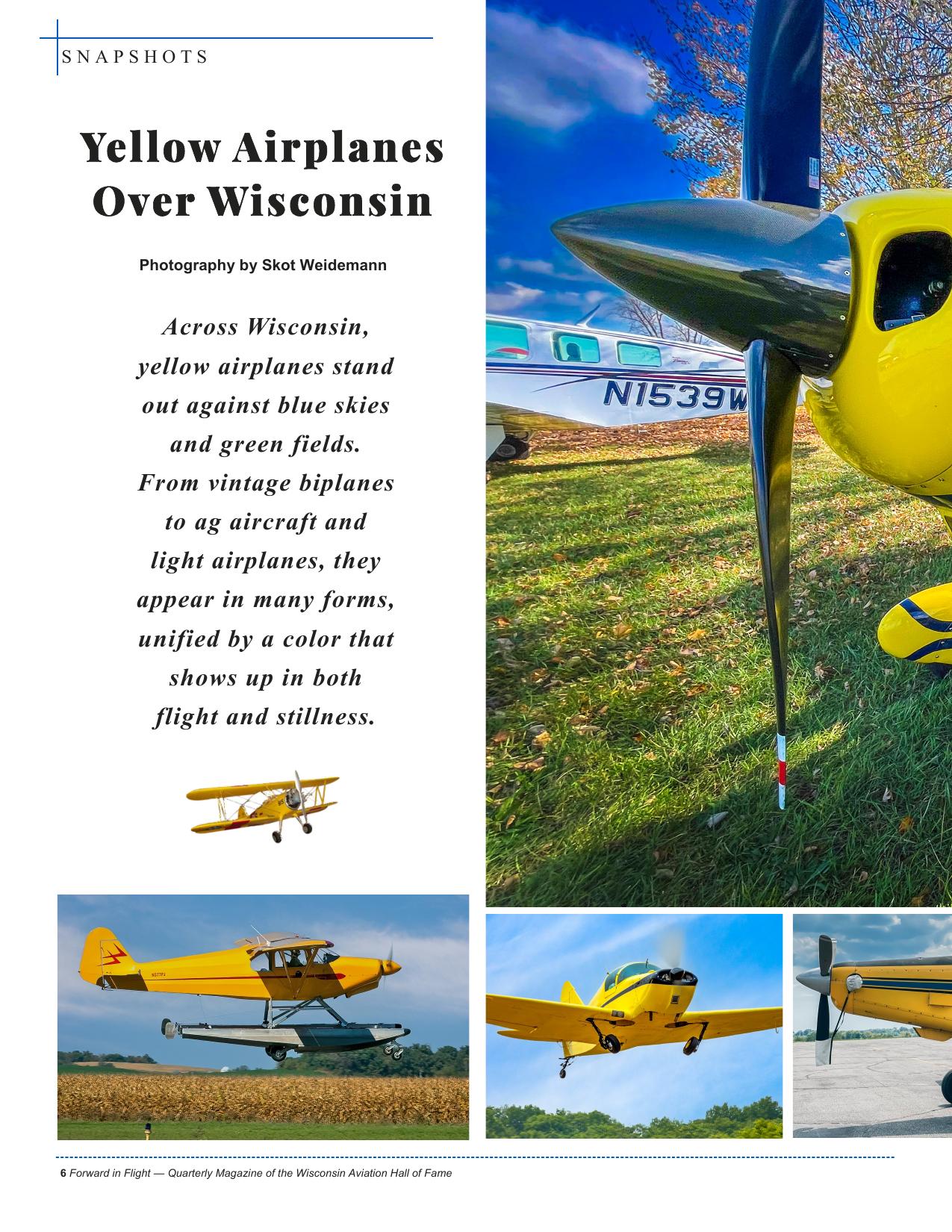
SNAPSHOTS Yellow Airplanes Over Wisconsin Photography by Skot Weidemann Across Wisconsin, yellow airplanes stand out against blue skies and green fields. From vintage biplanes to ag aircraft and light airplanes, they appear in many forms, unified by a color that shows up in both flight and stillness. 6 Forward in Flight — Quarterly Magazine of the Wisconsin Aviation Hall of Fame
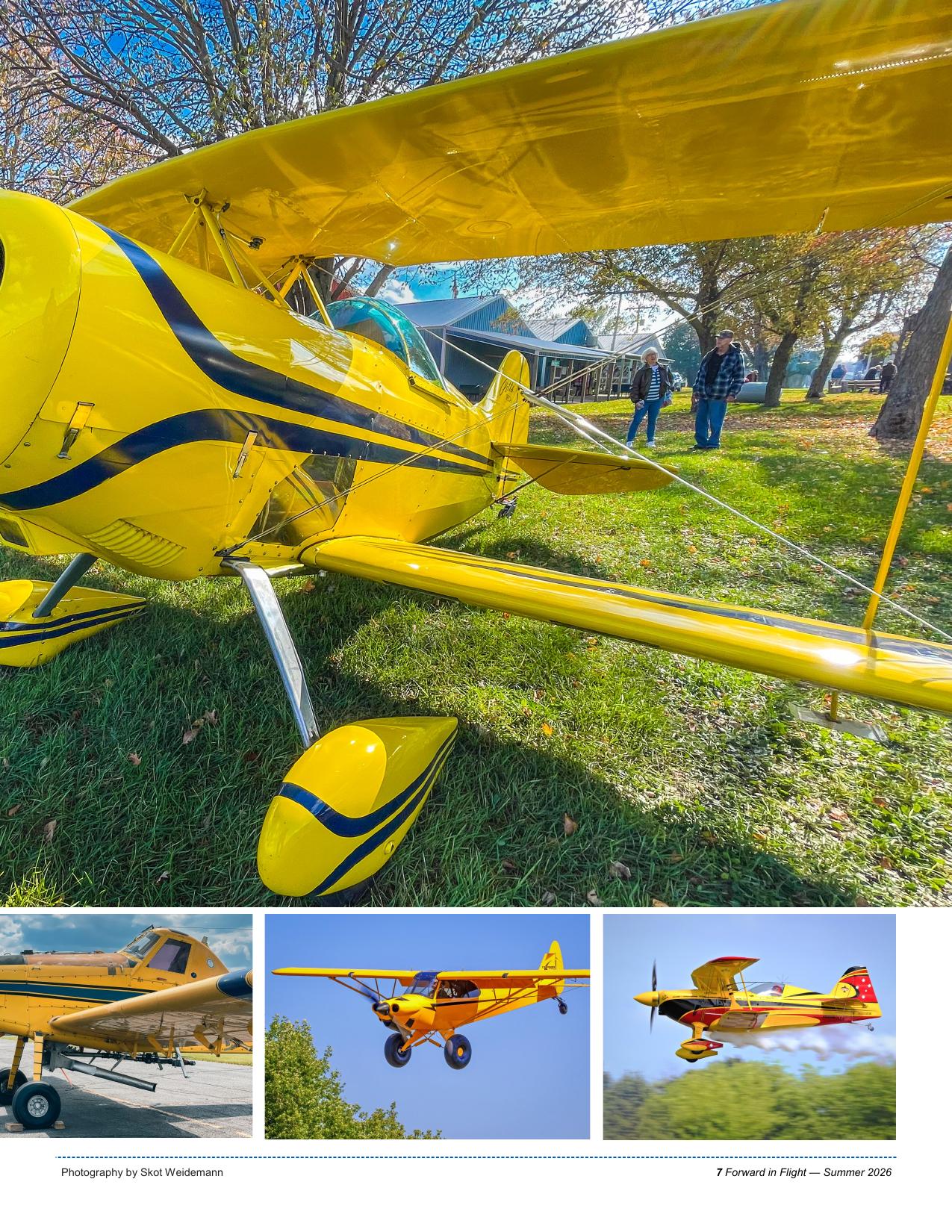
Photography by Skot Weidemann 7 Forward in Flight — Summer 2026
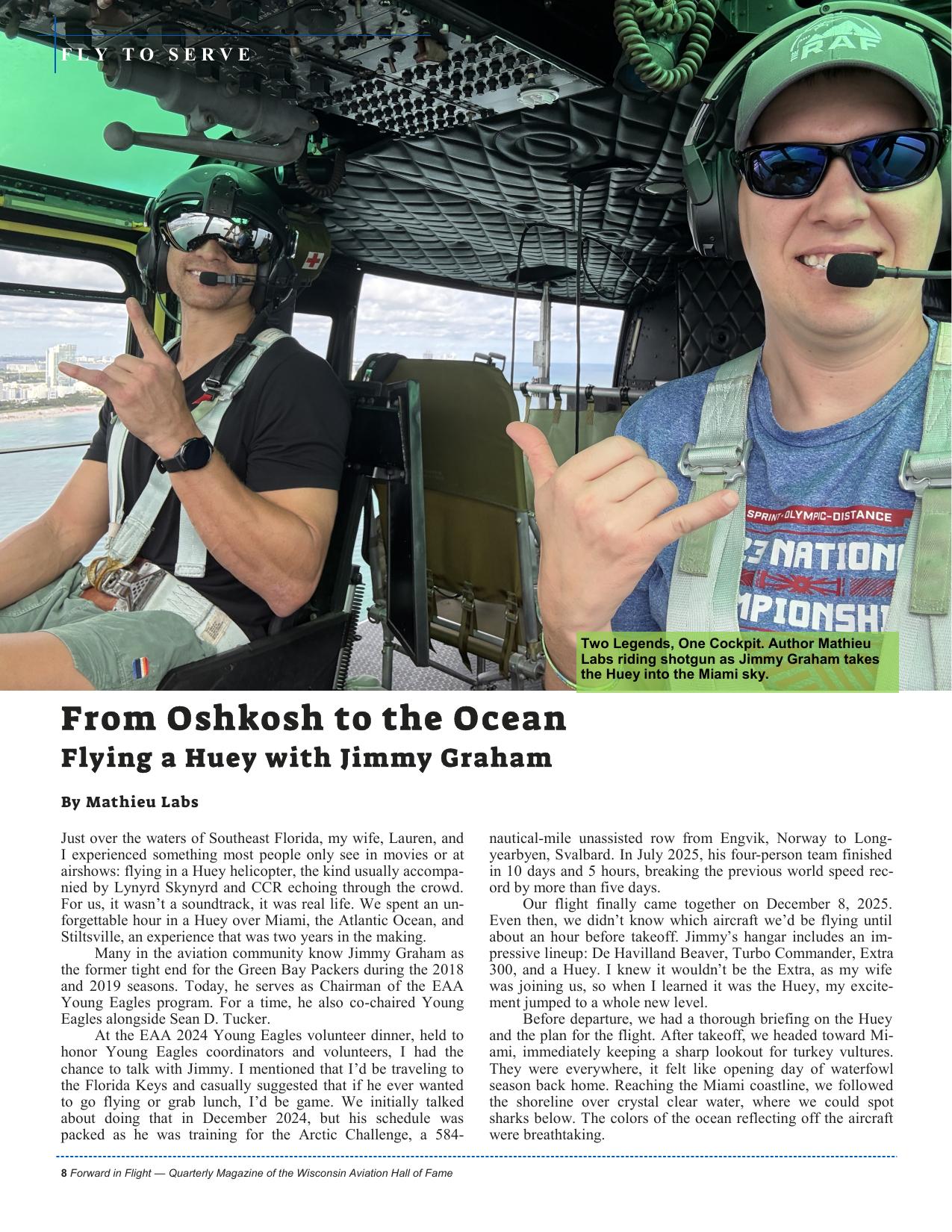
FLY TO SERVE Two Legends, One Cockpit. Author Mathieu Labs riding shotgun as Jimmy Graham takes the Huey into the Miami sky. From Oshkosh to the O cean Flying a Huey with Jimmy Graham By Mathieu Labs Just over the waters of Southeast Florida, my wife, Lauren, and I experienced something most people only see in movies or at airshows: flying in a Huey helicopter, the kind usually accompanied by Lynyrd Skynyrd and CCR echoing through the crowd. For us, it wasn’t a soundtrack, it was real life. We spent an unforgettable hour in a Huey over Miami, the Atlantic Ocean, and Stiltsville, an experience that was two years in the making. Many in the aviation community know Jimmy Graham as the former tight end for the Green Bay Packers during the 2018 and 2019 seasons. Today, he serves as Chairman of the EAA Young Eagles program. For a time, he also co-chaired Young Eagles alongside Sean D. Tucker. At the EAA 2024 Young Eagles volunteer dinner, held to honor Young Eagles coordinators and volunteers, I had the chance to talk with Jimmy. I mentioned that I’d be traveling to the Florida Keys and casually suggested that if he ever wanted to go flying or grab lunch, I’d be game. We initially talked about doing that in December 2024, but his schedule was packed as he was training for the Arctic Challenge, a 5848 Forward in Flight — Quarterly Magazine of the Wisconsin Aviation Hall of Fame nautical-mile unassisted row from Engvik, Norway to Longyearbyen, Svalbard. In July 2025, his four-person team finished in 10 days and 5 hours, breaking the previous world speed record by more than five days. Our flight finally came together on December 8, 2025. Even then, we didn’t know which aircraft we’d be flying until about an hour before takeoff. Jimmy’s hangar includes an impressive lineup: De Havilland Beaver, Turbo Commander, Extra 300, and a Huey. I knew it wouldn’t be the Extra, as my wife was joining us, so when I learned it was the Huey, my excitement jumped to a whole new level. Before departure, we had a thorough briefing on the Huey and the plan for the flight. After takeoff, we headed toward Miami, immediately keeping a sharp lookout for turkey vultures. They were everywhere, it felt like opening day of waterfowl season back home. Reaching the Miami coastline, we followed the shoreline over crystal clear water, where we could spot sharks below. The colors of the ocean reflecting off the aircraft were breathtaking.
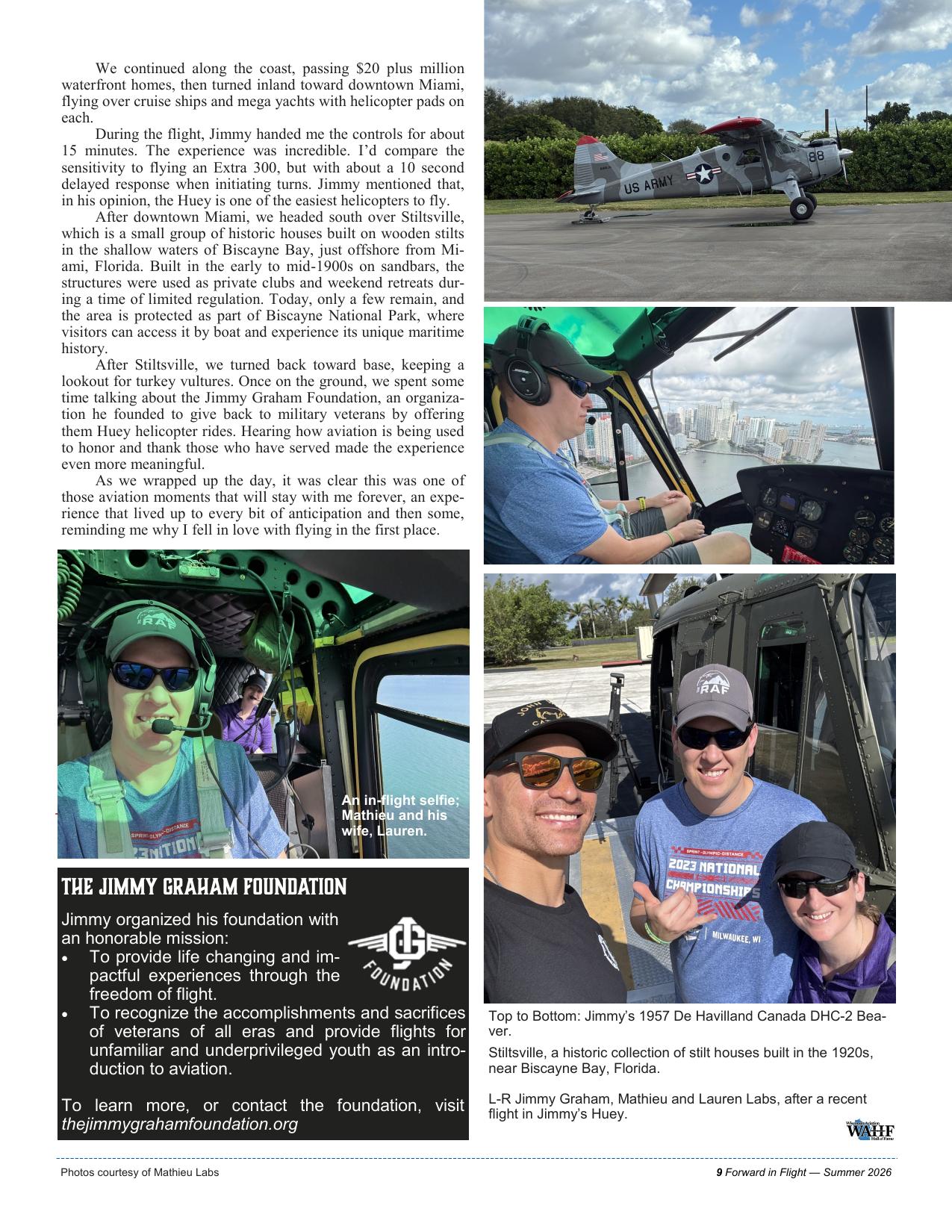
We continued along the coast, passing $20 plus million waterfront homes, then turned inland toward downtown Miami, flying over cruise ships and mega yachts with helicopter pads on each. During the flight, Jimmy handed me the controls for about 15 minutes. The experience was incredible. I’d compare the sensitivity to flying an Extra 300, but with about a 10 second delayed response when initiating turns. Jimmy mentioned that, in his opinion, the Huey is one of the easiest helicopters to fly. After downtown Miami, we headed south over Stiltsville, which is a small group of historic houses built on wooden stilts in the shallow waters of Biscayne Bay, just offshore from Miami, Florida. Built in the early to mid-1900s on sandbars, the structures were used as private clubs and weekend retreats during a time of limited regulation. Today, only a few remain, and the area is protected as part of Biscayne National Park, where visitors can access it by boat and experience its unique maritime history. After Stiltsville, we turned back toward base, keeping a lookout for turkey vultures. Once on the ground, we spent some time talking about the Jimmy Graham Foundation, an organization he founded to give back to military veterans by offering them Huey helicopter rides. Hearing how aviation is being used to honor and thank those who have served made the experience even more meaningful. As we wrapped up the day, it was clear this was one of those aviation moments that will stay with me forever, an experience that lived up to every bit of anticipation and then some, reminding me why I fell in love with flying in the first place. An in-flight selfie; Mathieu and his wife, Lauren. The Jimmy Graham Foundation Jimmy organized his foundation with an honorable mission: · To provide life changing and impactful experiences through the freedom of flight. · To recognize the accomplishments and sacrifices of veterans of all eras and provide flights for unfamiliar and underprivileged youth as an introduction to aviation. To learn more, or contact the foundation, visit thejimmygrahamfoundation.org Photos courtesy of Mathieu Labs Top to Bottom: Jimmy’s 1957 De Havilland Canada DHC-2 Beaver. Stiltsville, a historic collection of stilt houses built in the 1920s, near Biscayne Bay, Florida. L-R Jimmy Graham, Mathieu and Lauren Labs, after a recent flight in Jimmy’s Huey. 9 Forward in Flight — Summer 2026
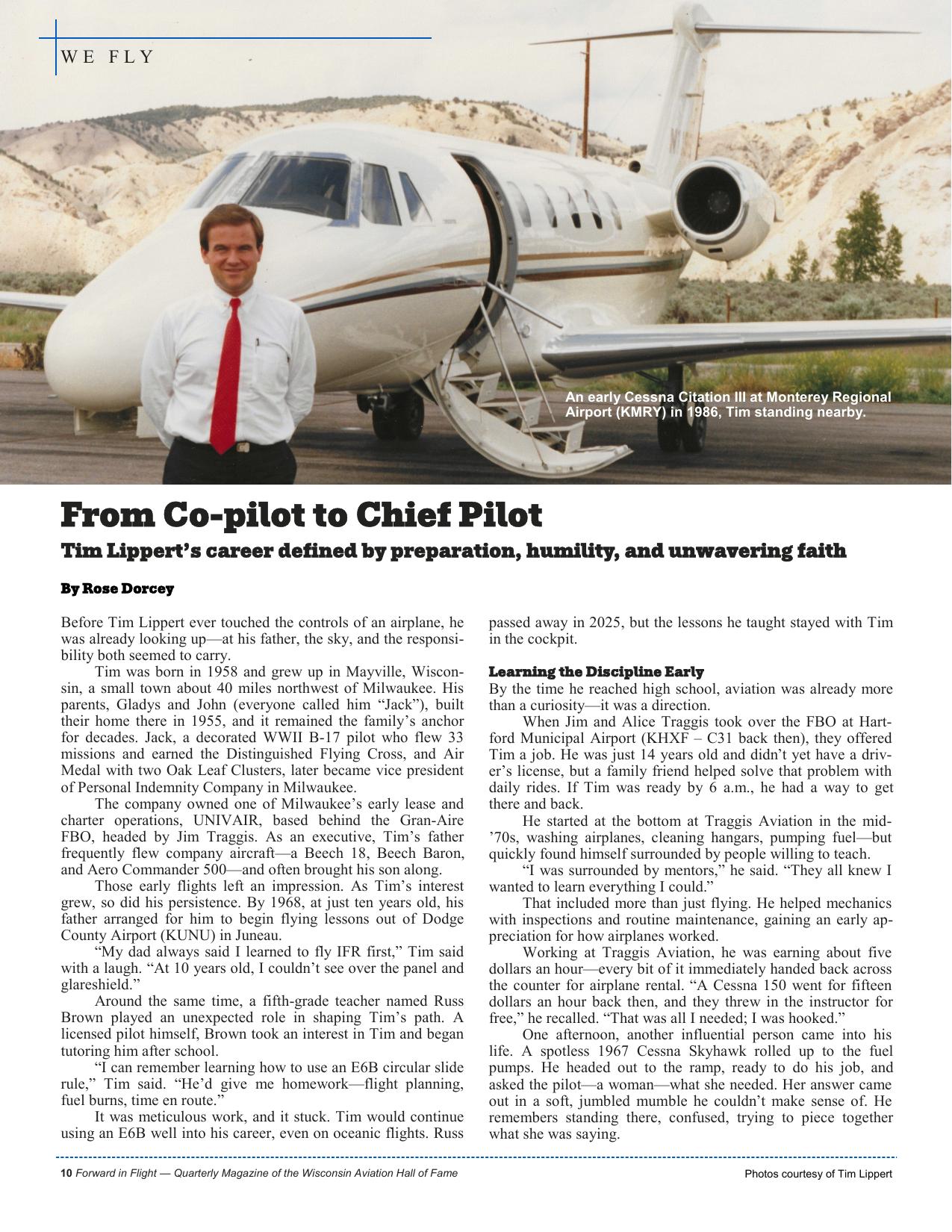
WE FLY An early Cessna Citation III at Monterey Regional Airport (KMRY) in 1986, Tim standing nearby. From Co-pilot to Chief Pilot Tim Lippert’s career defined by preparation, humility, and unwavering faith By Rose Dorcey Before Tim Lippert ever touched the controls of an airplane, he was already looking up—at his father, the sky, and the responsibility both seemed to carry. Tim was born in 1958 and grew up in Mayville, Wisconsin, a small town about 40 miles northwest of Milwaukee. His parents, Gladys and John (everyone called him “Jack”), built their home there in 1955, and it remained the family’s anchor for decades. Jack, a decorated WWII B-17 pilot who flew 33 missions and earned the Distinguished Flying Cross, and Air Medal with two Oak Leaf Clusters, later became vice president of Personal Indemnity Company in Milwaukee. The company owned one of Milwaukee’s early lease and charter operations, UNIVAIR, based behind the Gran-Aire FBO, headed by Jim Traggis. As an executive, Tim’s father frequently flew company aircraft—a Beech 18, Beech Baron, and Aero Commander 500—and often brought his son along. Those early flights left an impression. As Tim’s interest grew, so did his persistence. By 1968, at just ten years old, his father arranged for him to begin flying lessons out of Dodge County Airport (KUNU) in Juneau. “My dad always said I learned to fly IFR first,” Tim said with a laugh. “At 10 years old, I couldn’t see over the panel and glareshield.” Around the same time, a fifth-grade teacher named Russ Brown played an unexpected role in shaping Tim’s path. A licensed pilot himself, Brown took an interest in Tim and began tutoring him after school. “I can remember learning how to use an E6B circular slide rule,” Tim said. “He’d give me homework—flight planning, fuel burns, time en route.” It was meticulous work, and it stuck. Tim would continue using an E6B well into his career, even on oceanic flights. Russ passed away in 2025, but the lessons he taught stayed with Tim in the cockpit. 10 Forward in Flight — Quarterly Magazine of the Wisconsin Aviation Hall of Fame Photos courtesy of Tim Lippert Learning the Discipline Early By the time he reached high school, aviation was already more than a curiosity—it was a direction. When Jim and Alice Traggis took over the FBO at Hartford Municipal Airport (KHXF – C31 back then), they offered Tim a job. He was just 14 years old and didn’t yet have a driver’s license, but a family friend helped solve that problem with daily rides. If Tim was ready by 6 a.m., he had a way to get there and back. He started at the bottom at Traggis Aviation in the mid’70s, washing airplanes, cleaning hangars, pumping fuel—but quickly found himself surrounded by people willing to teach. “I was surrounded by mentors,” he said. “They all knew I wanted to learn everything I could.” That included more than just flying. He helped mechanics with inspections and routine maintenance, gaining an early appreciation for how airplanes worked. Working at Traggis Aviation, he was earning about five dollars an hour—every bit of it immediately handed back across the counter for airplane rental. “A Cessna 150 went for fifteen dollars an hour back then, and they threw in the instructor for free,” he recalled. “That was all I needed; I was hooked.” One afternoon, another influential person came into his life. A spotless 1967 Cessna Skyhawk rolled up to the fuel pumps. He headed out to the ramp, ready to do his job, and asked the pilot—a woman—what she needed. Her answer came out in a soft, jumbled mumble he couldn’t make sense of. He remembers standing there, confused, trying to piece together what she was saying.
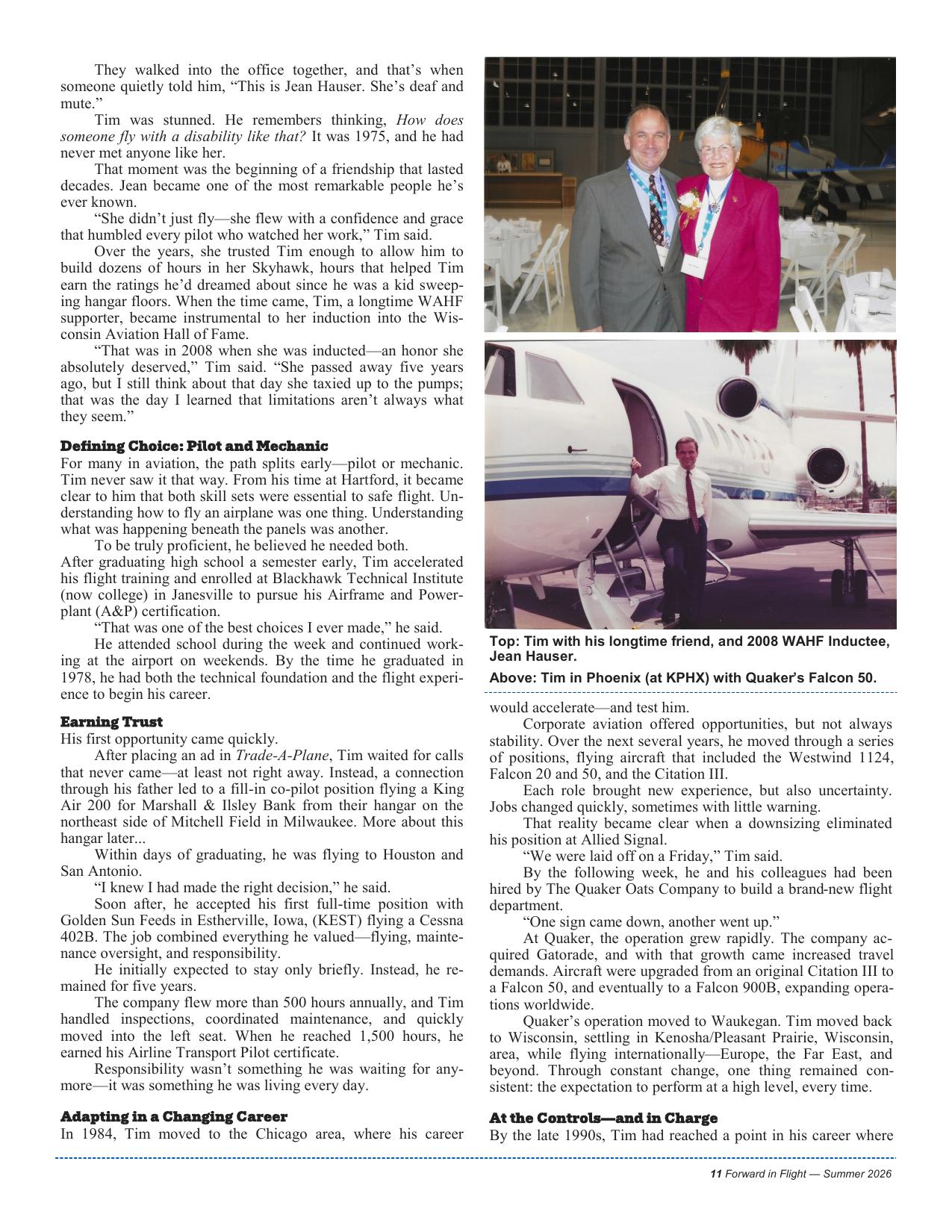
They walked into the office together, and that’s when someone quietly told him, “This is Jean Hauser. She’s deaf and mute.” Tim was stunned. He remembers thinking, How does someone fly with a disability like that? It was 1975, and he had never met anyone like her. That moment was the beginning of a friendship that lasted decades. Jean became one of the most remarkable people he’s ever known. “She didn’t just fly—she flew with a confidence and grace that humbled every pilot who watched her work,” Tim said. Over the years, she trusted Tim enough to allow him to build dozens of hours in her Skyhawk, hours that helped Tim earn the ratings he’d dreamed about since he was a kid sweeping hangar floors. When the time came, Tim, a longtime WAHF supporter, became instrumental to her induction into the Wisconsin Aviation Hall of Fame. “That was in 2008 when she was inducted—an honor she absolutely deserved,” Tim said. “She passed away five years ago, but I still think about that day she taxied up to the pumps; that was the day I learned that limitations aren’t always what they seem.” Defining Choice: Pilot and Mechanic For many in aviation, the path splits early—pilot or mechanic. Tim never saw it that way. From his time at Hartford, it became clear to him that both skill sets were essential to safe flight. Understanding how to fly an airplane was one thing. Understanding what was happening beneath the panels was another. To be truly proficient, he believed he needed both. After graduating high school a semester early, Tim accelerated his flight training and enrolled at Blackhawk Technical Institute (now college) in Janesville to pursue his Airframe and Powerplant (A&P) certification. “That was one of the best choices I ever made,” he said. He attended school during the week and continued working at the airport on weekends. By the time he graduated in 1978, he had both the technical foundation and the flight experience to begin his career. Top: Tim with his longtime friend, and 2008 WAHF Inductee, Jean Hauser. Above: Tim in Phoenix (at KPHX) with Quaker’s Falcon 50. Earning Trust His first opportunity came quickly. After placing an ad in Trade-A-Plane, Tim waited for calls that never came—at least not right away. Instead, a connection through his father led to a fill-in co-pilot position flying a King Air 200 for Marshall & Ilsley Bank from their hangar on the northeast side of Mitchell Field in Milwaukee. More about this hangar later... Within days of graduating, he was flying to Houston and San Antonio. “I knew I had made the right decision,” he said. Soon after, he accepted his first full-time position with Golden Sun Feeds in Estherville, Iowa, (KEST) flying a Cessna 402B. The job combined everything he valued—flying, maintenance oversight, and responsibility. He initially expected to stay only briefly. Instead, he remained for five years. The company flew more than 500 hours annually, and Tim handled inspections, coordinated maintenance, and quickly moved into the left seat. When he reached 1,500 hours, he earned his Airline Transport Pilot certificate. Responsibility wasn’t something he was waiting for anymore—it was something he was living every day. would accelerate—and test him. Corporate aviation offered opportunities, but not always stability. Over the next several years, he moved through a series of positions, flying aircraft that included the Westwind 1124, Falcon 20 and 50, and the Citation III. Each role brought new experience, but also uncertainty. Jobs changed quickly, sometimes with little warning. That reality became clear when a downsizing eliminated his position at Allied Signal. “We were laid off on a Friday,” Tim said. By the following week, he and his colleagues had been hired by The Quaker Oats Company to build a brand-new flight department. “One sign came down, another went up.” At Quaker, the operation grew rapidly. The company acquired Gatorade, and with that growth came increased travel demands. Aircraft were upgraded from an original Citation III to a Falcon 50, and eventually to a Falcon 900B, expanding operations worldwide. Quaker’s operation moved to Waukegan. Tim moved back to Wisconsin, settling in Kenosha/Pleasant Prairie, Wisconsin, area, while flying internationally—Europe, the Far East, and beyond. Through constant change, one thing remained consistent: the expectation to perform at a high level, every time. Adapting in a Changing Career In 1984, Tim moved to the Chicago area, where his career At the Controls—and in Charge By the late 1990s, Tim had reached a point in his career where 11 Forward in Flight — Summer 2026
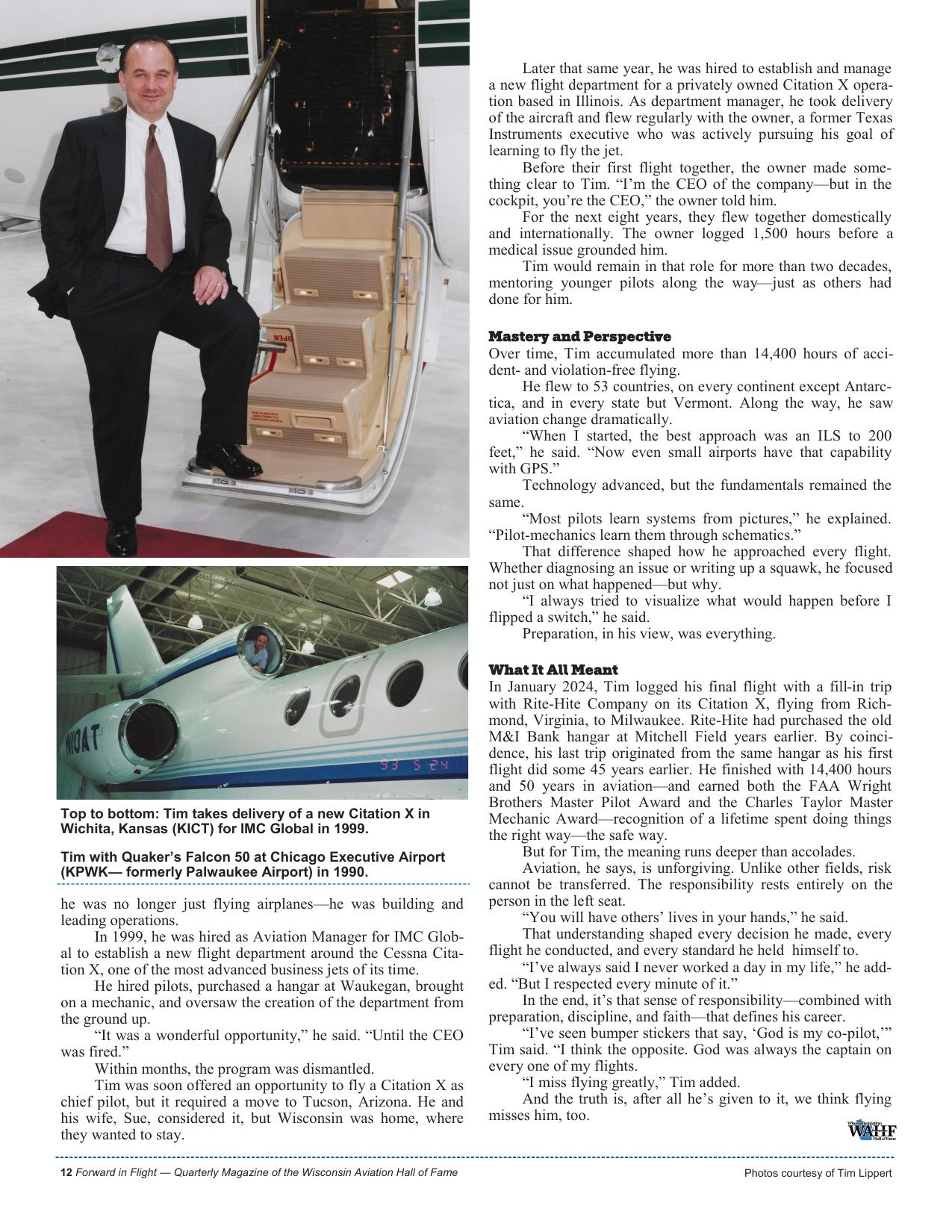
Later that same year, he was hired to establish and manage a new flight department for a privately owned Citation X operation based in Illinois. As department manager, he took delivery of the aircraft and flew regularly with the owner, a former Texas Instruments executive who was actively pursuing his goal of learning to fly the jet. Before their first flight together, the owner made something clear to Tim. “I’m the CEO of the company—but in the cockpit, you’re the CEO,” the owner told him. For the next eight years, they flew together domestically and internationally. The owner logged 1,500 hours before a medical issue grounded him. Tim would remain in that role for more than two decades, mentoring younger pilots along the way—just as others had done for him. Mastery and Perspective Over time, Tim accumulated more than 14,400 hours of accident- and violation-free flying. He flew to 53 countries, on every continent except Antarctica, and in every state but Vermont. Along the way, he saw aviation change dramatically. “When I started, the best approach was an ILS to 200 feet,” he said. “Now even small airports have that capability with GPS.” Technology advanced, but the fundamentals remained the same. “Most pilots learn systems from pictures,” he explained. “Pilot-mechanics learn them through schematics.” That difference shaped how he approached every flight. Whether diagnosing an issue or writing up a squawk, he focused not just on what happened—but why. “I always tried to visualize what would happen before I flipped a switch,” he said. Preparation, in his view, was everything. Top to bottom: Tim takes delivery of a new Citation X in Wichita, Kansas (KICT) for IMC Global in 1999. Tim with Quaker’s Falcon 50 at Chicago Executive Airport (KPWK— formerly Palwaukee Airport) in 1990. he was no longer just flying airplanes—he was building and leading operations. In 1999, he was hired as Aviation Manager for IMC Global to establish a new flight department around the Cessna Citation X, one of the most advanced business jets of its time. He hired pilots, purchased a hangar at Waukegan, brought on a mechanic, and oversaw the creation of the department from the ground up. “It was a wonderful opportunity,” he said. “Until the CEO was fired.” Within months, the program was dismantled. Tim was soon offered an opportunity to fly a Citation X as chief pilot, but it required a move to Tucson, Arizona. He and his wife, Sue, considered it, but Wisconsin was home, where they wanted to stay. 12 Forward in Flight — Quarterly Magazine of the Wisconsin Aviation Hall of Fame What It All Meant In January 2024, Tim logged his final flight with a fill-in trip with Rite-Hite Company on its Citation X, flying from Richmond, Virginia, to Milwaukee. Rite-Hite had purchased the old M&I Bank hangar at Mitchell Field years earlier. By coincidence, his last trip originated from the same hangar as his first flight did some 45 years earlier. He finished with 14,400 hours and 50 years in aviation—and earned both the FAA Wright Brothers Master Pilot Award and the Charles Taylor Master Mechanic Award—recognition of a lifetime spent doing things the right way—the safe way. But for Tim, the meaning runs deeper than accolades. Aviation, he says, is unforgiving. Unlike other fields, risk cannot be transferred. The responsibility rests entirely on the person in the left seat. “You will have others’ lives in your hands,” he said. That understanding shaped every decision he made, every flight he conducted, and every standard he held himself to. “I’ve always said I never worked a day in my life,” he added. “But I respected every minute of it.” In the end, it’s that sense of responsibility—combined with preparation, discipline, and faith—that defines his career. “I’ve seen bumper stickers that say, ‘God is my co-pilot,’” Tim said. “I think the opposite. God was always the captain on every one of my flights. “I miss flying greatly,” Tim added. And the truth is, after all he’s given to it, we think flying misses him, too. Photos courtesy of Tim Lippert
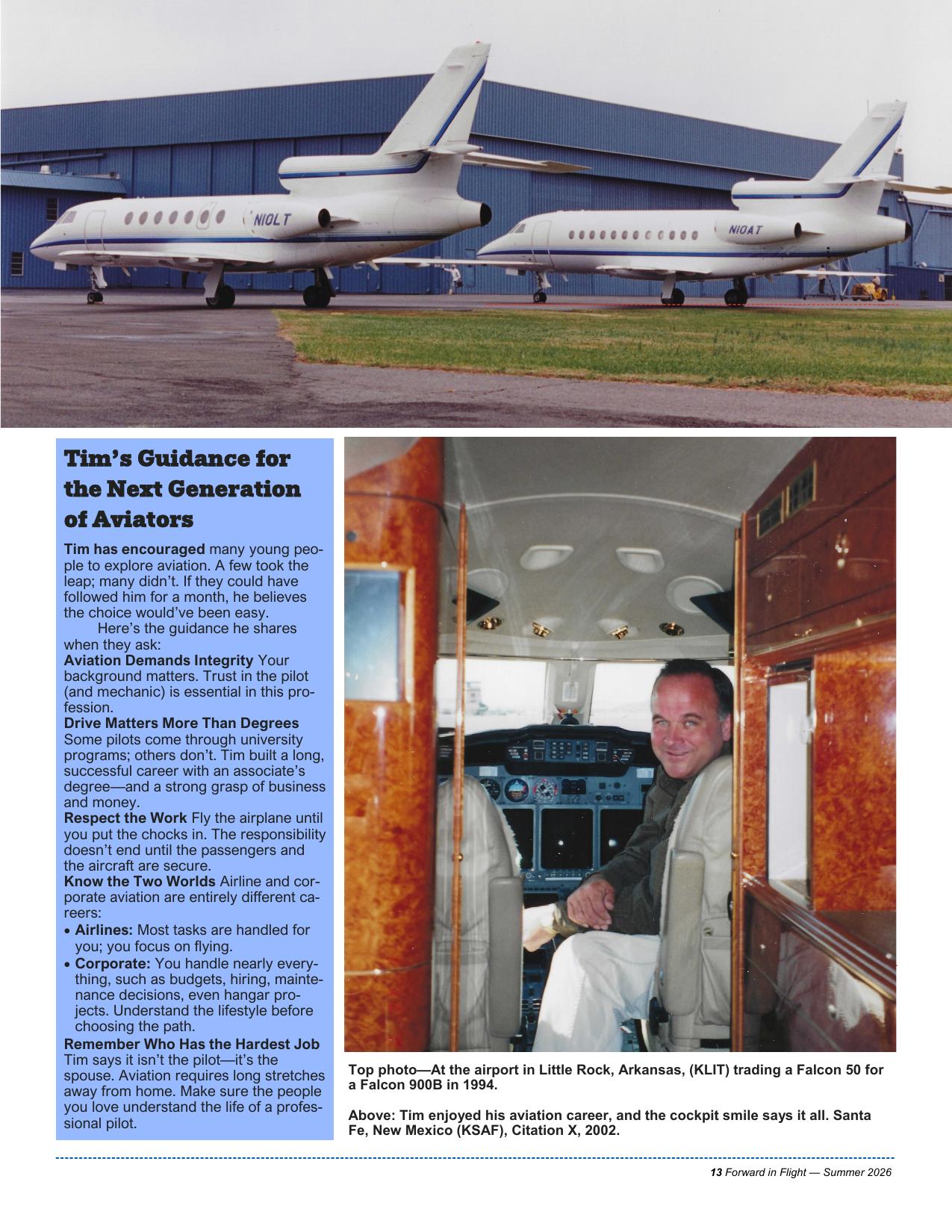
Tim’s Guidance for the Next Generation of Aviators Tim has encouraged many young people to explore aviation. A few took the leap; many didn’t. If they could have followed him for a month, he believes the choice would’ve been easy. Here’s the guidance he shares when they ask: Aviation Demands Integrity Your background matters. Trust in the pilot (and mechanic) is essential in this profession. Drive Matters More Than Degrees Some pilots come through university programs; others don’t. Tim built a long, successful career with an associate’s degree—and a strong grasp of business and money. Respect the Work Fly the airplane until you put the chocks in. The responsibility doesn’t end until the passengers and the aircraft are secure. Know the Two Worlds Airline and corporate aviation are entirely different careers: · Airlines: Most tasks are handled for you; you focus on flying. · Corporate: You handle nearly everything, such as budgets, hiring, maintenance decisions, even hangar projects. Understand the lifestyle before choosing the path. Remember Who Has the Hardest Job Tim says it isn’t the pilot—it’s the spouse. Aviation requires long stretches away from home. Make sure the people you love understand the life of a professional pilot. Top photo—At the airport in Little Rock, Arkansas, (KLIT) trading a Falcon 50 for a Falcon 900B in 1994. Above: Tim enjoyed his aviation career, and the cockpit smile says it all. Santa Fe, New Mexico (KSAF), Citation X, 2002. 13 Forward in Flight — Summer 2026
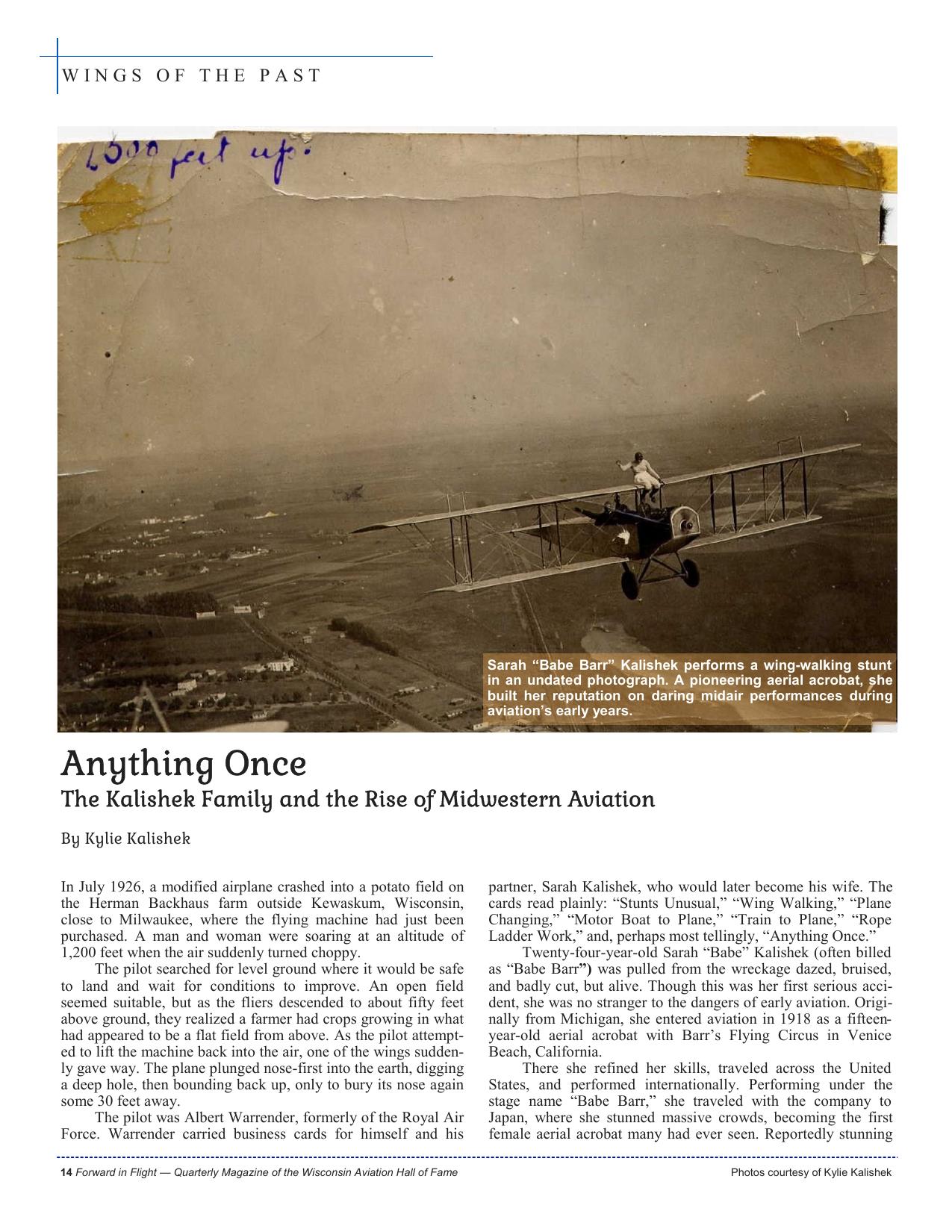
WINGS OF THE PAST Sarah “Babe Barr” Kalishek performs a wing-walking stunt in an undated photograph. A pioneering aerial acrobat, she built her reputation on daring midair performances during aviation’s early years. Anything Once The Kalishek Family and the Rise of Midwestern Aviation By Kylie Kalishek In July 1926, a modified airplane crashed into a potato field on the Herman Backhaus farm outside Kewaskum, Wisconsin, close to Milwaukee, where the flying machine had just been purchased. A man and woman were soaring at an altitude of 1,200 feet when the air suddenly turned choppy. The pilot searched for level ground where it would be safe to land and wait for conditions to improve. An open field seemed suitable, but as the fliers descended to about fifty feet above ground, they realized a farmer had crops growing in what had appeared to be a flat field from above. As the pilot attempted to lift the machine back into the air, one of the wings suddenly gave way. The plane plunged nose-first into the earth, digging a deep hole, then bounding back up, only to bury its nose again some 30 feet away. The pilot was Albert Warrender, formerly of the Royal Air Force. Warrender carried business cards for himself and his partner, Sarah Kalishek, who would later become his wife. The cards read plainly: “Stunts Unusual,” “Wing Walking,” “Plane Changing,” “Motor Boat to Plane,” “Train to Plane,” “Rope Ladder Work,” and, perhaps most tellingly, “Anything Once.” Twenty-four-year-old Sarah “Babe” Kalishek (often billed as “Babe Barr”) was pulled from the wreckage dazed, bruised, and badly cut, but alive. Though this was her first serious accident, she was no stranger to the dangers of early aviation. Originally from Michigan, she entered aviation in 1918 as a fifteenyear-old aerial acrobat with Barr’s Flying Circus in Venice Beach, California. There she refined her skills, traveled across the United States, and performed internationally. Performing under the stage name “Babe Barr,” she traveled with the company to Japan, where she stunned massive crowds, becoming the first female aerial acrobat many had ever seen. Reportedly stunning 14 Forward in Flight — Quarterly Magazine of the Wisconsin Aviation Hall of Fame Photos courtesy of Kylie Kalishek
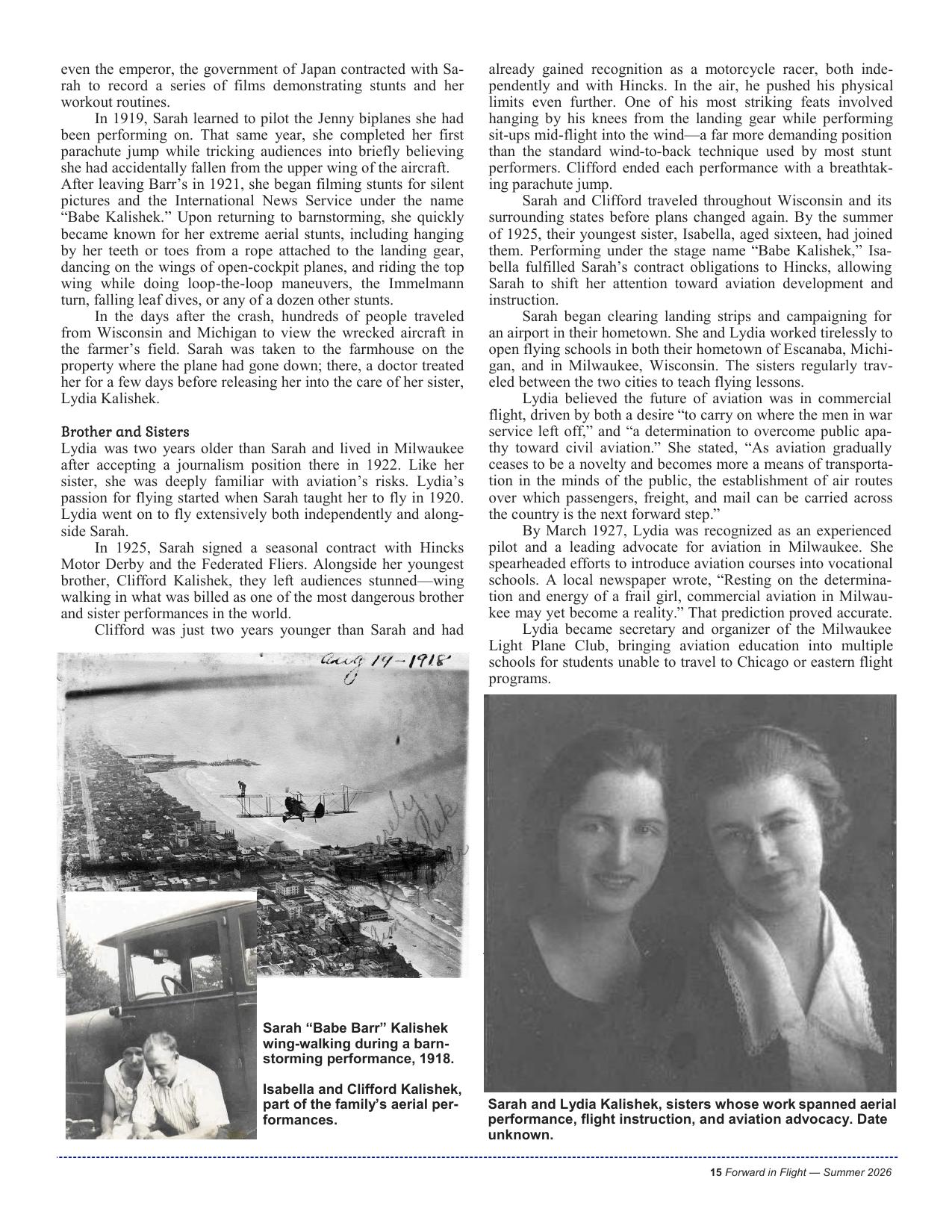
even the emperor, the government of Japan contracted with Sarah to record a series of films demonstrating stunts and her workout routines. In 1919, Sarah learned to pilot the Jenny biplanes she had been performing on. That same year, she completed her first parachute jump while tricking audiences into briefly believing she had accidentally fallen from the upper wing of the aircraft. After leaving Barr’s in 1921, she began filming stunts for silent pictures and the International News Service under the name “Babe Kalishek.” Upon returning to barnstorming, she quickly became known for her extreme aerial stunts, including hanging by her teeth or toes from a rope attached to the landing gear, dancing on the wings of open-cockpit planes, and riding the top wing while doing loop-the-loop maneuvers, the Immelmann turn, falling leaf dives, or any of a dozen other stunts. In the days after the crash, hundreds of people traveled from Wisconsin and Michigan to view the wrecked aircraft in the farmer’s field. Sarah was taken to the farmhouse on the property where the plane had gone down; there, a doctor treated her for a few days before releasing her into the care of her sister, Lydia Kalishek. Brother and Sisters Lydia was two years older than Sarah and lived in Milwaukee after accepting a journalism position there in 1922. Like her sister, she was deeply familiar with aviation’s risks. Lydia’s passion for flying started when Sarah taught her to fly in 1920. Lydia went on to fly extensively both independently and alongside Sarah. In 1925, Sarah signed a seasonal contract with Hincks Motor Derby and the Federated Fliers. Alongside her youngest brother, Clifford Kalishek, they left audiences stunned—wing walking in what was billed as one of the most dangerous brother and sister performances in the world. Clifford was just two years younger than Sarah and had already gained recognition as a motorcycle racer, both independently and with Hincks. In the air, he pushed his physical limits even further. One of his most striking feats involved hanging by his knees from the landing gear while performing sit-ups mid-flight into the wind—a far more demanding position than the standard wind-to-back technique used by most stunt performers. Clifford ended each performance with a breathtaking parachute jump. Sarah and Clifford traveled throughout Wisconsin and its surrounding states before plans changed again. By the summer of 1925, their youngest sister, Isabella, aged sixteen, had joined them. Performing under the stage name “Babe Kalishek,” Isabella fulfilled Sarah’s contract obligations to Hincks, allowing Sarah to shift her attention toward aviation development and instruction. Sarah began clearing landing strips and campaigning for an airport in their hometown. She and Lydia worked tirelessly to open flying schools in both their hometown of Escanaba, Michigan, and in Milwaukee, Wisconsin. The sisters regularly traveled between the two cities to teach flying lessons. Lydia believed the future of aviation was in commercial flight, driven by both a desire “to carry on where the men in war service left off,” and “a determination to overcome public apathy toward civil aviation.” She stated, “As aviation gradually ceases to be a novelty and becomes more a means of transportation in the minds of the public, the establishment of air routes over which passengers, freight, and mail can be carried across the country is the next forward step.” By March 1927, Lydia was recognized as an experienced pilot and a leading advocate for aviation in Milwaukee. She spearheaded efforts to introduce aviation courses into vocational schools. A local newspaper wrote, “Resting on the determination and energy of a frail girl, commercial aviation in Milwaukee may yet become a reality.” That prediction proved accurate. Lydia became secretary and organizer of the Milwaukee Light Plane Club, bringing aviation education into multiple schools for students unable to travel to Chicago or eastern flight programs. Sarah “Babe Barr” Kalishek wing-walking during a barnstorming performance, 1918. Isabella and Clifford Kalishek, part of the family’s aerial performances. Sarah and Lydia Kalishek, sisters whose work spanned aerial performance, flight instruction, and aviation advocacy. Date unknown. 15 Forward in Flight — Summer 2026
That same year, she organized a flying squadron. Starting with just ten young men, the Green Bay Squadron of the Wisconsin Civic Air Service was formed. Under her direction, the group quickly expanded; within months, twenty-two men were meeting weekly to compare notes on monoplanes, five of them building their own aircraft in barns, sheds, and homes under her supervision. “There’s nothing like flying. After you once get used to it, you will love it,” Lydia said in a matter-of-fact way, encouraging the men of Clintonville to form a similar squadron. By 1928, Lydia’s group had grown to fifty members and ten airplanes. Her reputation as an aviation promoter became widely recognized, and she became a consultant for communities seeking airstrips and airports. Lydia looked over locations, blueprints, and proposed sites in New London and between De Pere and Green Bay, while also being one of the few women in the country holding a transport license. One newspaper reported, “Probably no woman in America is taking a more active part in the promotion of commercial aviation than Miss Kalishek.” Preparing for Milwaukee’s first national “baby” plane contest, she told reporters, “People want to see the airplanes. That is the best way to get people interested in aviation.” She supported public viewing of the small aircraft to boost interest, many of which had only two-cylinder engines. Later that year, Lydia helped stage an early aircraft exposition — believed to be the first of its kind in Wisconsin. This demonstrated to others how rapidly aviation was developing in the region. Lydia strongly advocated municipally owned airports rather than privately owned ones, believing they were essential to the future of aviation. In October 1928, she gave an interview stating, “A city without an airport, today, is like a city without a harbor, a good railroad station, or good roads.” Pointing to Cleveland as an example, she urged cities like Green Bay to prepare for the coming age of air travel. Her goal was to have airports in every town that could own and operate their own planes. Her career expanded into leadership roles across aviation organizations. She served as president of the Woman’s Light Plane Club, vice president and general manager of the Wisconsin Civic Air Service, press agent and public relations chair for the American Women’s Air Council, and relief pilot for North American Airways in Appleton. While working in Appleton, she was reportedly the only pilot qualified to fly the Pride of Appleton, (likely a Ford Tri-Motor) an aircraft so large it had to be tethered outside the hangar when not in use. That same year, Lydia established schools in Green Bay and Manitowoc for teaching the fundamentals of flying at cost. The class offered aspiring aviators the chance to learn through the Wisconsin Civic Air Service, a local organization created with the purpose of furthering aviation. For a $25 membership fee, students received a complete ground course, silver wings, a subscription to the official aviation magazine, a pilot’s logbook, and flying instruction at their home airport. The seven-hour course included time in the air, though it did not guarantee a student would solo. Instead, the course gave each person enough experience to know whether they could truly become a flier or had simply tested a profession that did not suit them. Lydia explained, “There is a crying need for good instructors in flying, so many students are turned out who are incapable of obtaining a pilot’s license from the Department of Commerce.” Meanwhile, aviation development continued in Neenah, where public enthusiasm led to the creation of a local airfield in 1927. By 1928, however, the project was already struggling after the city declined to assume control. In June 1929, Lydia briefly served as airport manager—making her one of the earli16 Forward in Flight — Quarterly Magazine of the Wisconsin Aviation Hall of Fame est known women to hold such a role. By August, investors shifted direction and opted to sell the property for residential development, and by November the airfield had ceased operations entirely. Though the venture ultimately ended, her leadership was significant and likely helped prepare her for a later role at Clover Field (now Santa Monica Municipal Airport) in 1934. Legacy The Kalishek family continued to advance in aviation. In 1929, Lydia and Sarah entered the First Women’s Air Derby, a competition for female aviators held in conjunction with the National Air Races. The race—headed by Amelia Earhart—spanned from Santa Monica to Cleveland and required that pilots, mechanics, and official participants be women, marking a major milestone in aviation history. Despite the excitement surrounding the event, both sisters withdrew. At the time, concerns had begun circulating among participants about sabotage to women’s equipment. Together, Sarah, Lydia, Isabella, and Clifford Kalishek stood at the center of aviation’s transformation in Wisconsin and across America. From barnstorming wing-walkers and parachute performers to flight instructors, squadron organizers, and airport developers, they helped carry aviation from exhibition to infrastructure, shaping its place in everyday life. Their legacy is found not only in what they achieved, but in what they made possible. By pushing boundaries and expanding opportunities—especially for women—they helped define the future of flight. Their impact endures as a legacy of Wisconsin’s aviation history. All of Them But Fear , tells more of the Kalishek family of fliers. Order at Amazon: https://a.co/d/00XR2rMN
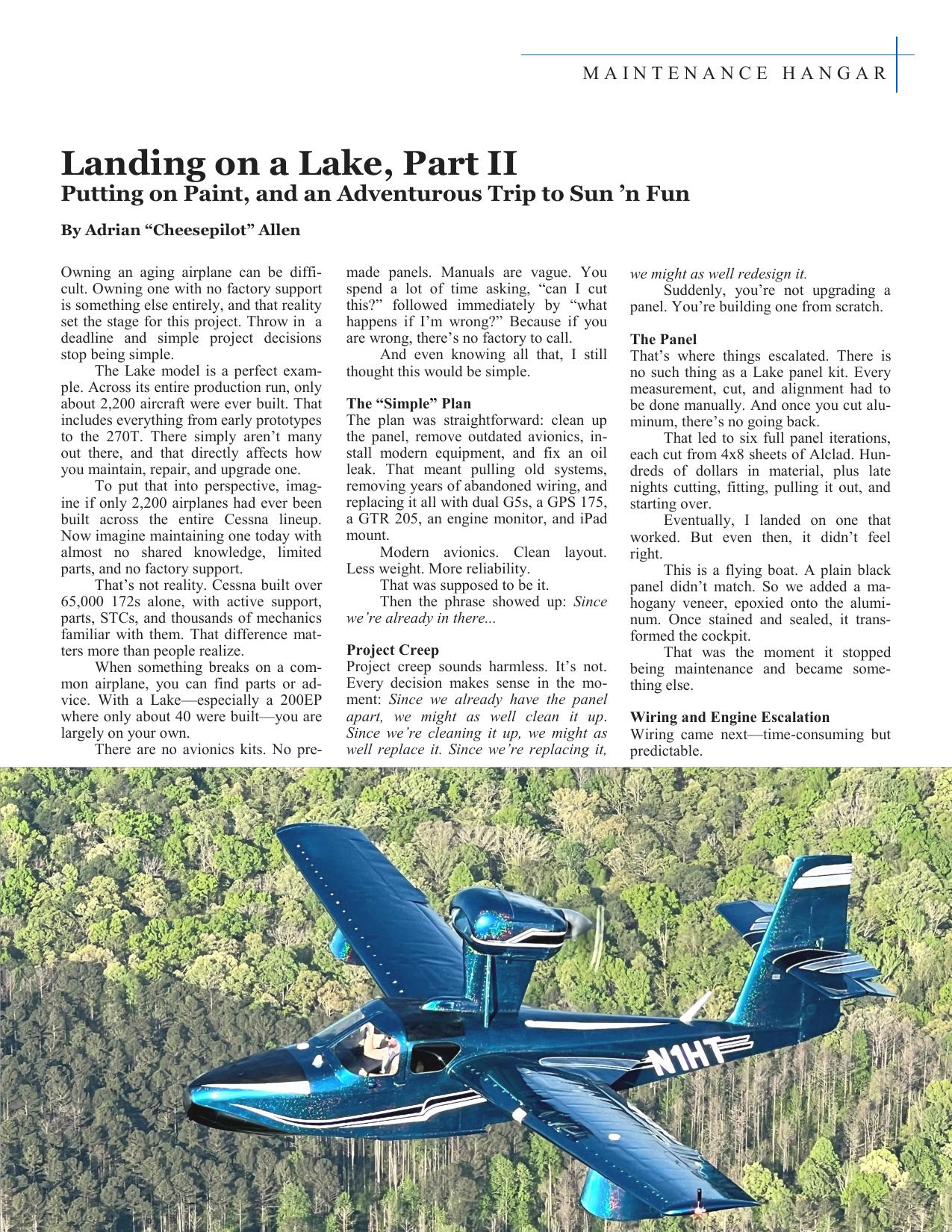
MAINTENANCE HANGAR Landing on a Lake, Part II Putting on Paint, and an Adventurous Trip to Sun ’n Fun By Adrian “Cheesepilot” Allen Owning an aging airplane can be difficult. Owning one with no factory support is something else entirely, and that reality set the stage for this project. Throw in a deadline and simple project decisions stop being simple. The Lake model is a perfect example. Across its entire production run, only about 2,200 aircraft were ever built. That includes everything from early prototypes to the 270T. There simply aren’t many out there, and that directly affects how you maintain, repair, and upgrade one. To put that into perspective, imagine if only 2,200 airplanes had ever been built across the entire Cessna lineup. Now imagine maintaining one today with almost no shared knowledge, limited parts, and no factory support. That’s not reality. Cessna built over 65,000 172s alone, with active support, parts, STCs, and thousands of mechanics familiar with them. That difference matters more than people realize. When something breaks on a common airplane, you can find parts or advice. With a Lake—especially a 200EP where only about 40 were built—you are largely on your own. There are no avionics kits. No pre- made panels. Manuals are vague. You spend a lot of time asking, “can I cut this?” followed immediately by “what happens if I’m wrong?” Because if you are wrong, there’s no factory to call. And even knowing all that, I still thought this would be simple. The “Simple” Plan The plan was straightforward: clean up the panel, remove outdated avionics, install modern equipment, and fix an oil leak. That meant pulling old systems, removing years of abandoned wiring, and replacing it all with dual G5s, a GPS 175, a GTR 205, an engine monitor, and iPad mount. Modern avionics. Clean layout. Less weight. More reliability. That was supposed to be it. Then the phrase showed up: Since we’re already in there... Project Creep Project creep sounds harmless. It’s not. Every decision makes sense in the moment: Since we already have the panel apart, we might as well clean it up. Since we’re cleaning it up, we might as well replace it. Since we’re replacing it, we might as well redesign it. Suddenly, you’re not upgrading a panel. You’re building one from scratch. The Panel That’s where things escalated. There is no such thing as a Lake panel kit. Every measurement, cut, and alignment had to be done manually. And once you cut aluminum, there’s no going back. That led to six full panel iterations, each cut from 4x8 sheets of Alclad. Hundreds of dollars in material, plus late nights cutting, fitting, pulling it out, and starting over. Eventually, I landed on one that worked. But even then, it didn’t feel right. This is a flying boat. A plain black panel didn’t match. So we added a mahogany veneer, epoxied onto the aluminum. Once stained and sealed, it transformed the cockpit. That was the moment it stopped being maintenance and became something else. Wiring and Engine Escalation Wiring came next—time-consuming but predictable. 17 Forward in Flight — Summer 2026
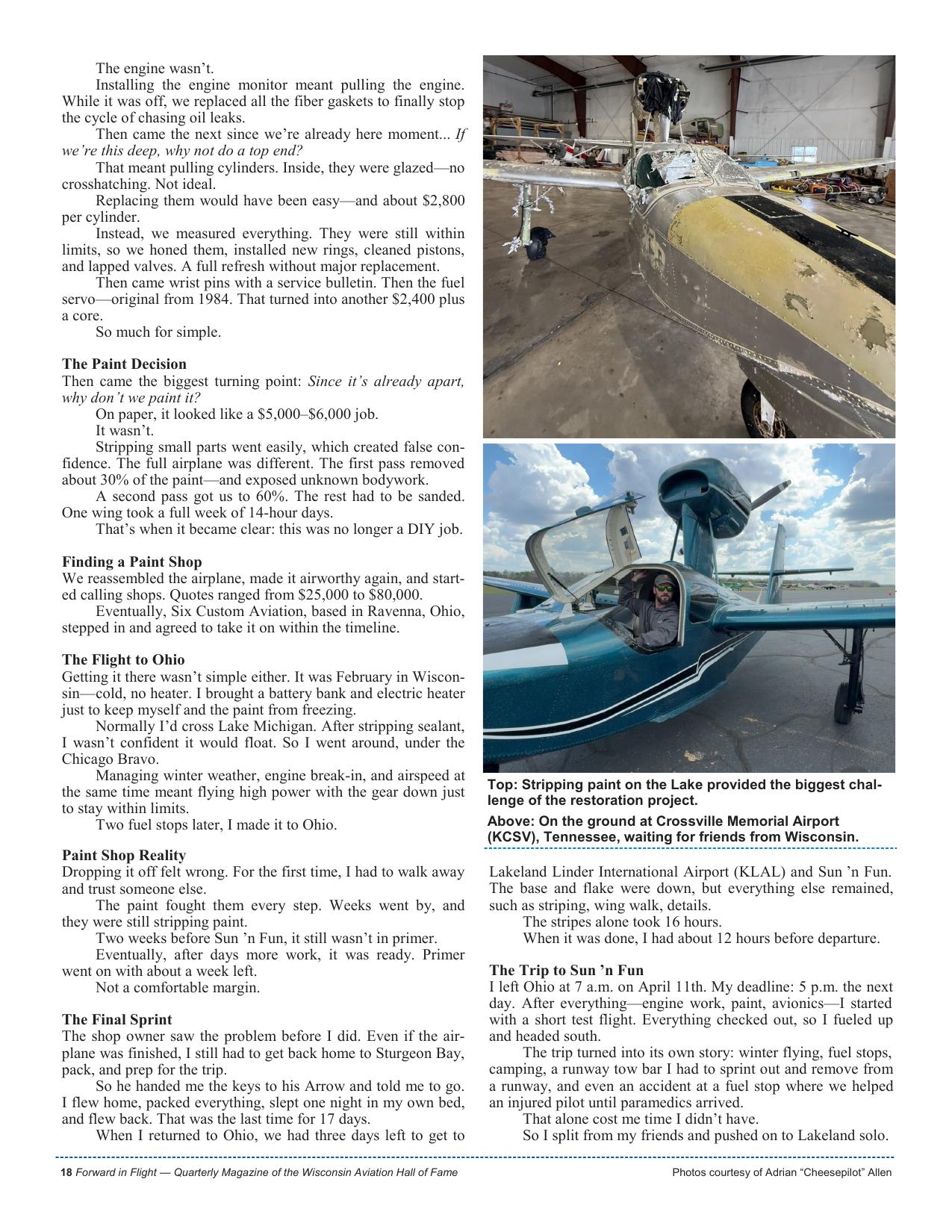
The engine wasn’t. Installing the engine monitor meant pulling the engine. While it was off, we replaced all the fiber gaskets to finally stop the cycle of chasing oil leaks. Then came the next since we’re already here moment... If we’re this deep, why not do a top end? That meant pulling cylinders. Inside, they were glazed—no crosshatching. Not ideal. Replacing them would have been easy—and about $2,800 per cylinder. Instead, we measured everything. They were still within limits, so we honed them, installed new rings, cleaned pistons, and lapped valves. A full refresh without major replacement. Then came wrist pins with a service bulletin. Then the fuel servo—original from 1984. That turned into another $2,400 plus a core. So much for simple. The Paint Decision Then came the biggest turning point: Since it’s already apart, why don’t we paint it? On paper, it looked like a $5,000–$6,000 job. It wasn’t. Stripping small parts went easily, which created false confidence. The full airplane was different. The first pass removed about 30% of the paint—and exposed unknown bodywork. A second pass got us to 60%. The rest had to be sanded. One wing took a full week of 14-hour days. That’s when it became clear: this was no longer a DIY job. Finding a Paint Shop We reassembled the airplane, made it airworthy again, and started calling shops. Quotes ranged from $25,000 to $80,000. Eventually, Six Custom Aviation, based in Ravenna, Ohio, stepped in and agreed to take it on within the timeline. The Flight to Ohio Getting it there wasn’t simple either. It was February in Wisconsin—cold, no heater. I brought a battery bank and electric heater just to keep myself and the paint from freezing. Normally I’d cross Lake Michigan. After stripping sealant, I wasn’t confident it would float. So I went around, under the Chicago Bravo. Managing winter weather, engine break-in, and airspeed at the same time meant flying high power with the gear down just to stay within limits. Two fuel stops later, I made it to Ohio. Paint Shop Reality Dropping it off felt wrong. For the first time, I had to walk away and trust someone else. The paint fought them every step. Weeks went by, and they were still stripping paint. Two weeks before Sun ’n Fun, it still wasn’t in primer. Eventually, after days more work, it was ready. Primer went on with about a week left. Not a comfortable margin. Top: Stripping paint on the Lake provided the biggest challenge of the restoration project. Above: On the ground at Crossville Memorial Airport (KCSV), Tennessee, waiting for friends from Wisconsin. Lakeland Linder International Airport (KLAL) and Sun ’n Fun. The base and flake were down, but everything else remained, such as striping, wing walk, details. The stripes alone took 16 hours. When it was done, I had about 12 hours before departure. The Final Sprint The shop owner saw the problem before I did. Even if the airplane was finished, I still had to get back home to Sturgeon Bay, pack, and prep for the trip. So he handed me the keys to his Arrow and told me to go. I flew home, packed everything, slept one night in my own bed, and flew back. That was the last time for 17 days. When I returned to Ohio, we had three days left to get to The Trip to Sun ’n Fun I left Ohio at 7 a.m. on April 11th. My deadline: 5 p.m. the next day. After everything—engine work, paint, avionics—I started with a short test flight. Everything checked out, so I fueled up and headed south. The trip turned into its own story: winter flying, fuel stops, camping, a runway tow bar I had to sprint out and remove from a runway, and even an accident at a fuel stop where we helped an injured pilot until paramedics arrived. That alone cost me time I didn’t have. So I split from my friends and pushed on to Lakeland solo. 18 Forward in Flight — Quarterly Magazine of the Wisconsin Aviation Hall of Fame Photos courtesy of Adrian “Cheesepilot” Allen
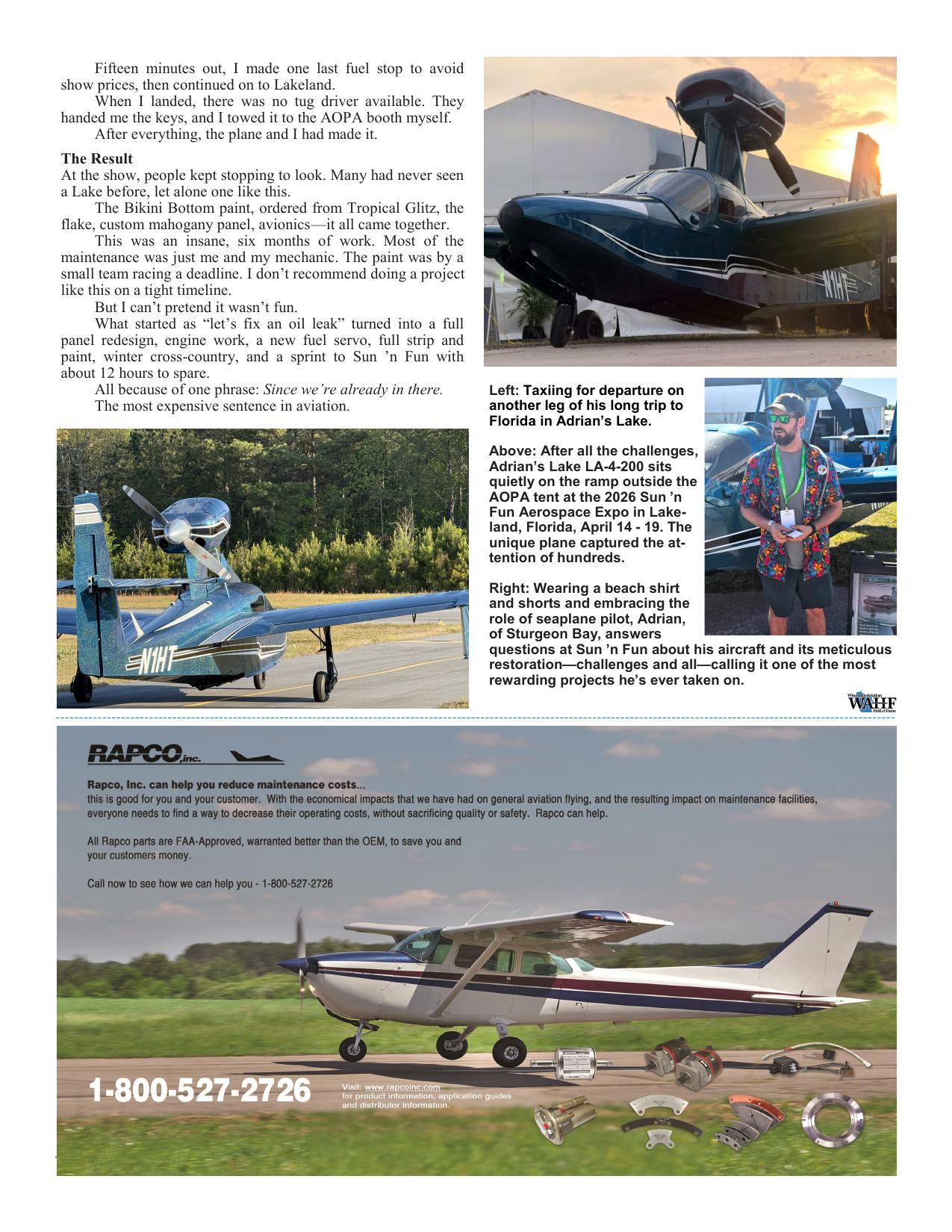
Fifteen minutes out, I made one last fuel stop to avoid show prices, then continued on to Lakeland. When I landed, there was no tug driver available. They handed me the keys, and I towed it to the AOPA booth myself. After everything, the plane and I had made it. The Result At the show, people kept stopping to look. Many had never seen a Lake before, let alone one like this. The Bikini Bottom paint, ordered from Tropical Glitz, the flake, custom mahogany panel, avionics—it all came together. This was an insane, six months of work. Most of the maintenance was just me and my mechanic. The paint was by a small team racing a deadline. I don’t recommend doing a project like this on a tight timeline. But I can’t pretend it wasn’t fun. What started as “let’s fix an oil leak” turned into a full panel redesign, engine work, a new fuel servo, full strip and paint, winter cross-country, and a sprint to Sun ’n Fun with about 12 hours to spare. All because of one phrase: Since we’re already in there. The most expensive sentence in aviation. Left: Taxiing for departure on another leg of his long trip to Florida in Adrian’s Lake. Above: After all the challenges, Adrian’s Lake LA-4-200 sits quietly on the ramp outside the AOPA tent at the 2026 Sun ’n Fun Aerospace Expo in Lakeland, Florida, April 14 - 19. The unique plane captured the attention of hundreds. Right: Wearing a beach shirt and shorts and embracing the role of seaplane pilot, Adrian, of Sturgeon Bay, answers questions at Sun ’n Fun about his aircraft and its meticulous restoration—challenges and all—calling it one of the most rewarding projects he’s ever taken on.
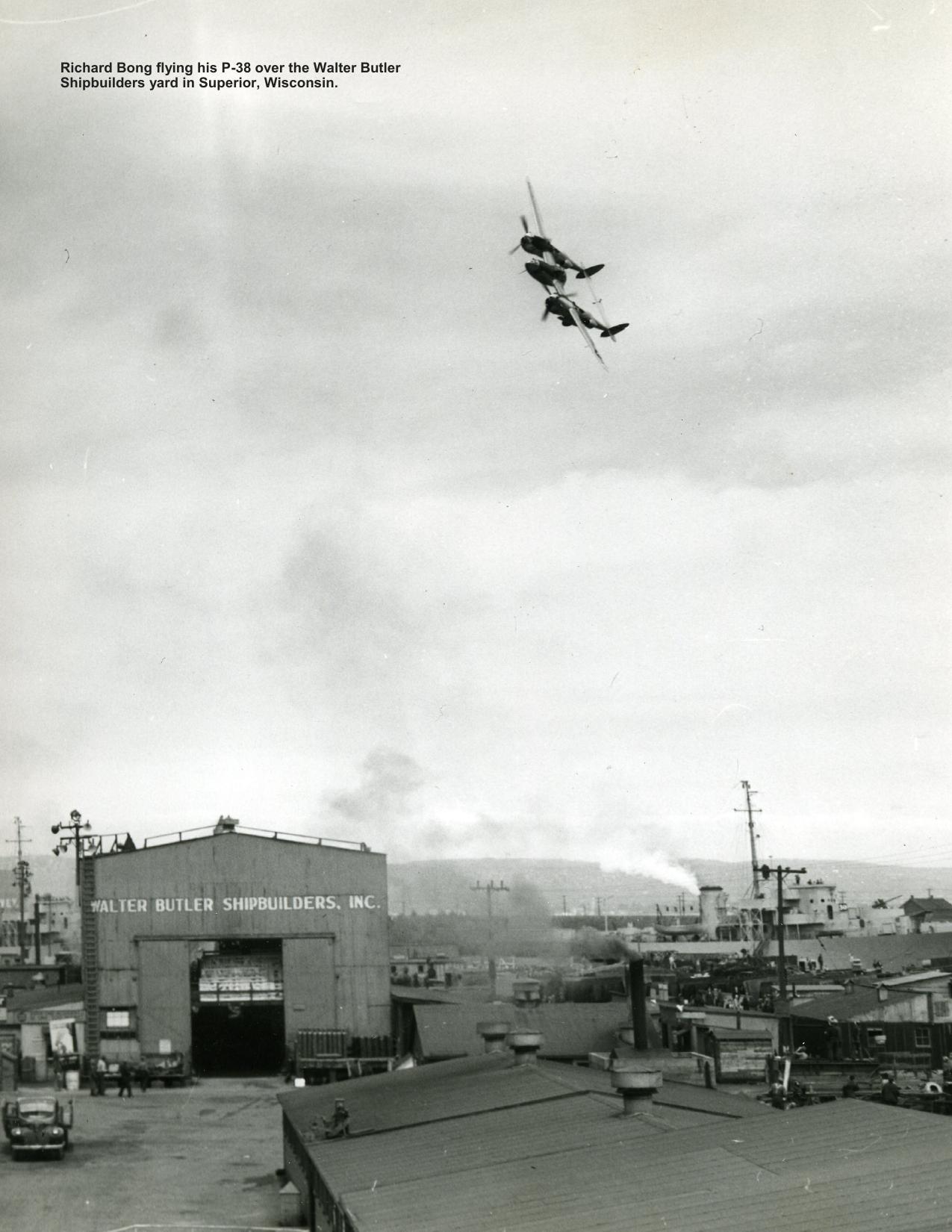
Richard Bong flying his P-38 over the Walter Butler Shipbuilders yard in Superior, Wisconsin.
AVIATION HERITAGE Mission: Marge Richard Bong’s Legendary P-38 Rediscovered By Briana Fiandt, Director of Collections & Exhibits Richard I Bong Veterans Historical Center Richard Ira “Dick” Bong, a farm boy from Poplar, Wisconsin, grew up to become a national hero during WWII as America's top fighter pilot. Flying a P-38 Lightning, he became the “Ace of Aces” shooting down 40 Japanese airplanes, an unparalleled U.S. record that still holds today. His star power has dimmed in the years since WWII, but in 2024, a discovery was made that brought his achievements back into the limelight. The Richard Bong Historical Center in Superior partnered with a non-profit organization, Pacific Wrecks, to help fund an expedition to Papua New Guinea (PNG) to locate Bong’s P-38 airplane, Marge. When Dick was seven years old, he watched for the first time when a plane flew over his family's farm. The plane was delivering mail to President Calvin Coolidge, whose summer White House Office was in nearby Superior. From then on, Dick knew he would become a pilot. His first flight was at the controls of a Piper Cub in September 1940 when he was enrolled in the Civilian Pilot Training Program in nearby Superior. He enlisted in the Army Air Forces (AAF) on May 29, 1941. His AAF pilot training took him from California to Arizona where he worked for several months as a flying instructor. But he wanted to be in the action and was thrilled when he was reassigned to Hamilton Field in California. It was here that he flew the P-38 Lightning for the first time. He said in a letter home, “Wooey!! What an airplane. That’s all I can say, but that is enough.” Bong was sent to the Pacific Theater with the 5th Air Force in late 1942 and on December 27th he shot down his first two Japanese airplanes. He always said that he wasn’t a good shot, but rather, he got so close to the enemy planes, he couldn’t miss. Photos courtesy of Richard I Bong Veterans Historical Center Regardless, the mild-mannered man on the ground became a fierce and fearless fighter in the sky. Bong became one of the top pilots quickly and was part of an elite group all vying to become the war’s leading ace, with five confirmed victories marking the threshold. As his score mounted rapidly, press coverage increased and farm boy from Poplar became a household name. In November 1943, he was sent home from his first Pacific tour. He was welcomed with acclaim from across the country. His first leave brought him to the Superior State Teachers College homecoming dance, where Richard Bong was asked to crown the queen. That’s where he met Marjorie Vattendahl, the previous year’s queen. Bong had not intended to get tied down to one girl while he was serving in the military, but when he met Marge, those intentions went out the window. They double dated with Dick’s sister and her boyfriend; going bowling, to the movies, and out to a local supper club. Their time together was meaningful—albeit brief—and he soon found himself back in the Pacific Theater. In March 1944, Bong was reeling from the death of a fellow pilot and close friend, Thomas Lynch. He asked one of the crew, Jim Nicols, to enlarge a picture of Marge and affix it to the plane. The graduation photo of his beautiful girlfriend, in addition to his fame as the top ace, appealed to reporters who quickly jumped onto the story. Soon the real-life Marge achieved her own fame as the “most shot at girl in the Pacific”. At the end of March, while Bong was flying to Australia, another pilot, Tom Malone, took Marge up on a weather mission. He experienced mechanical failure and bailed out of the plane. That was the last time any American saw the Marge P‑38. She wouldn’t be found again until 2024, when a team, 21 Forward in Flight — Summer 2026
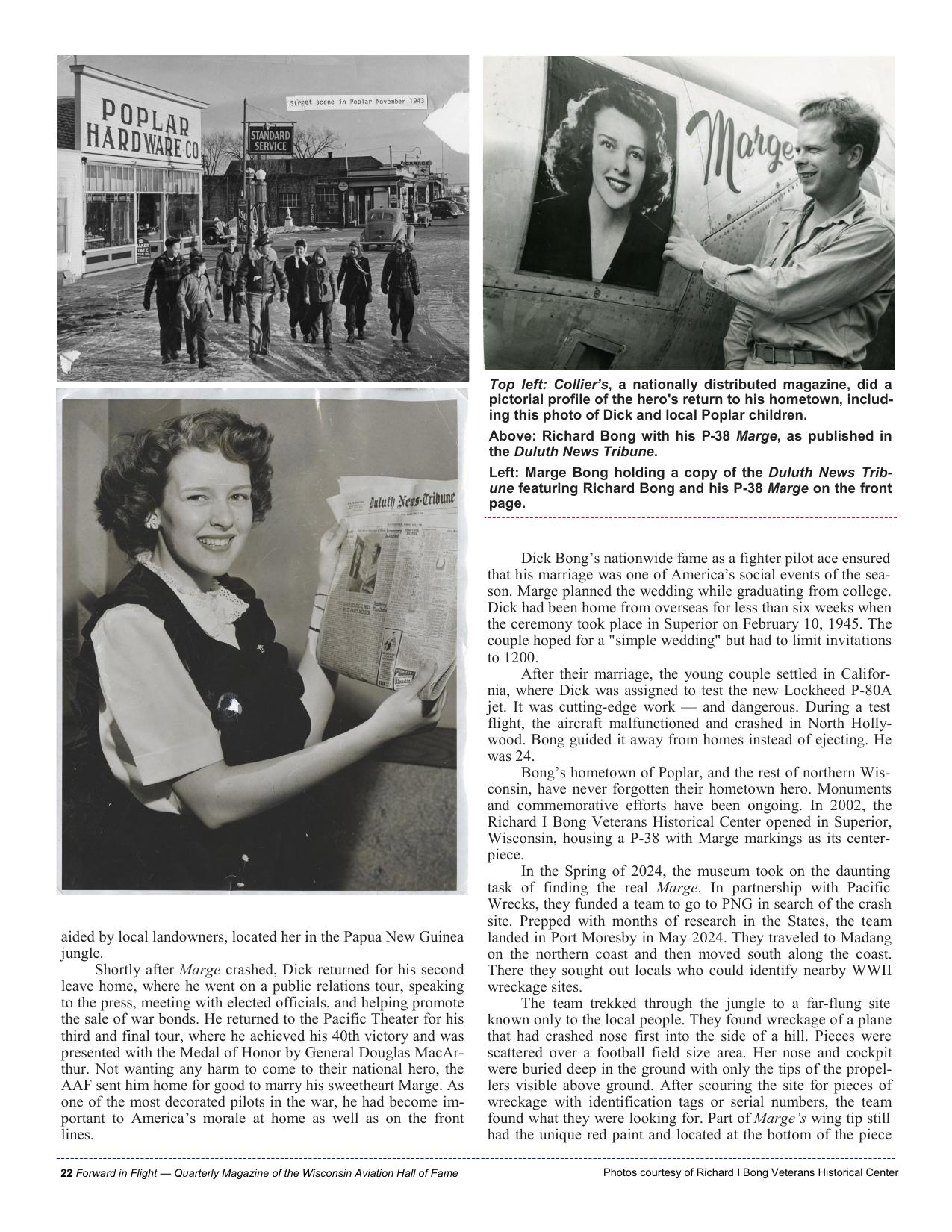
Top left: Collier’s, a nationally distributed magazine, did a pictorial profile of the hero's return to his hometown, including this photo of Dick and local Poplar children. Above: Richard Bong with his P-38 Marge, as published in the Duluth News Tribune. Left: Marge Bong holding a copy of the Duluth News Tribune featuring Richard Bong and his P-38 Marge on the front page. aided by local landowners, located her in the Papua New Guinea jungle. Shortly after Marge crashed, Dick returned for his second leave home, where he went on a public relations tour, speaking to the press, meeting with elected officials, and helping promote the sale of war bonds. He returned to the Pacific Theater for his third and final tour, where he achieved his 40th victory and was presented with the Medal of Honor by General Douglas MacArthur. Not wanting any harm to come to their national hero, the AAF sent him home for good to marry his sweetheart Marge. As one of the most decorated pilots in the war, he had become important to America’s morale at home as well as on the front lines. Dick Bong’s nationwide fame as a fighter pilot ace ensured that his marriage was one of America’s social events of the season. Marge planned the wedding while graduating from college. Dick had been home from overseas for less than six weeks when the ceremony took place in Superior on February 10, 1945. The couple hoped for a "simple wedding" but had to limit invitations to 1200. After their marriage, the young couple settled in California, where Dick was assigned to test the new Lockheed P‑80A jet. It was cutting‑edge work — and dangerous. During a test flight, the aircraft malfunctioned and crashed in North Hollywood. Bong guided it away from homes instead of ejecting. He was 24. Bong’s hometown of Poplar, and the rest of northern Wisconsin, have never forgotten their hometown hero. Monuments and commemorative efforts have been ongoing. In 2002, the Richard I Bong Veterans Historical Center opened in Superior, Wisconsin, housing a P-38 with Marge markings as its centerpiece. In the Spring of 2024, the museum took on the daunting task of finding the real Marge. In partnership with Pacific Wrecks, they funded a team to go to PNG in search of the crash site. Prepped with months of research in the States, the team landed in Port Moresby in May 2024. They traveled to Madang on the northern coast and then moved south along the coast. There they sought out locals who could identify nearby WWII wreckage sites. The team trekked through the jungle to a far-flung site known only to the local people. They found wreckage of a plane that had crashed nose first into the side of a hill. Pieces were scattered over a football field size area. Her nose and cockpit were buried deep in the ground with only the tips of the propellers visible above ground. After scouring the site for pieces of wreckage with identification tags or serial numbers, the team found what they were looking for. Part of Marge’s wing tip still had the unique red paint and located at the bottom of the piece 22 Forward in Flight — Quarterly Magazine of the Wisconsin Aviation Hall of Fame Photos courtesy of Richard I Bong Veterans Historical Center
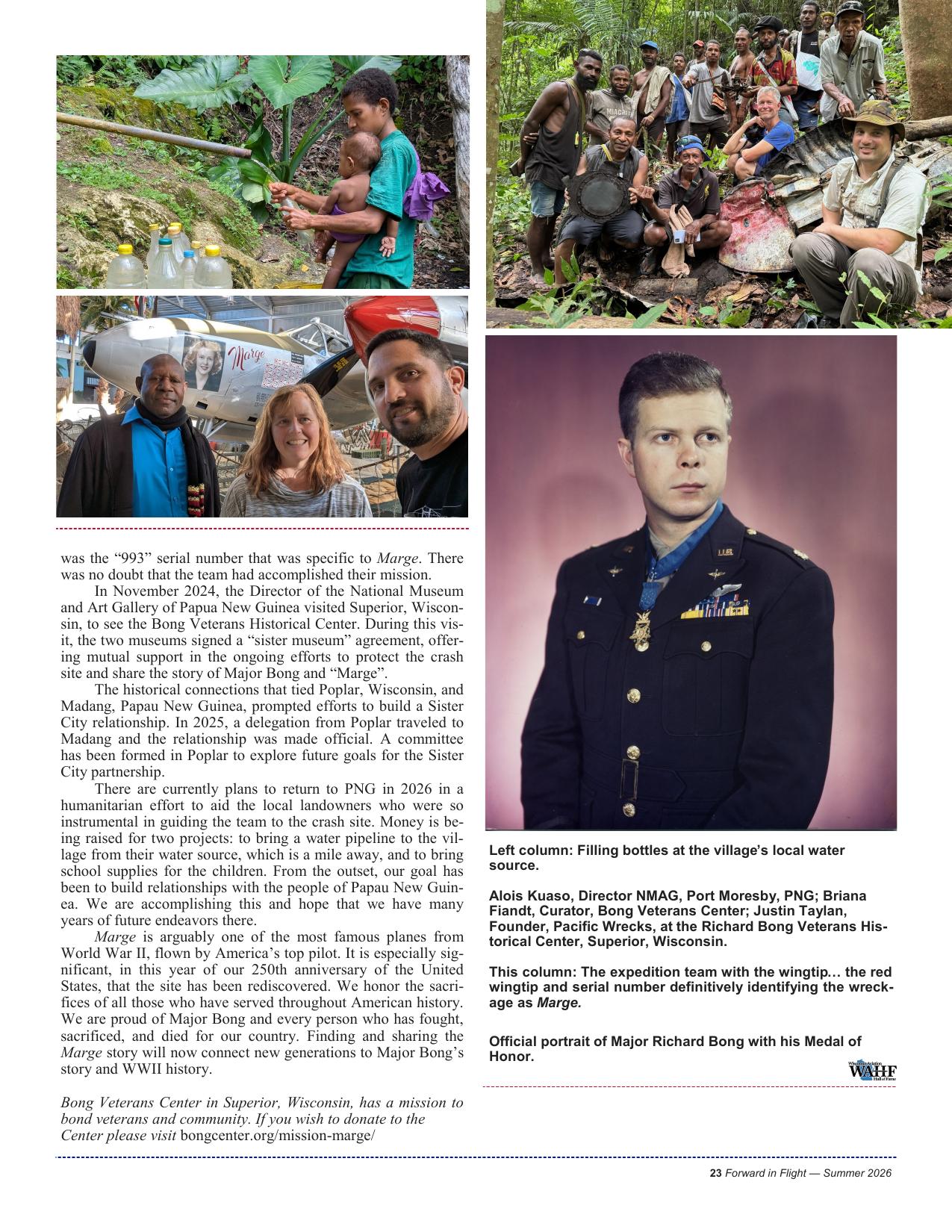
was the “993” serial number that was specific to Marge. There was no doubt that the team had accomplished their mission. In November 2024, the Director of the National Museum and Art Gallery of Papua New Guinea visited Superior, Wisconsin, to see the Bong Veterans Historical Center. During this visit, the two museums signed a “sister museum” agreement, offering mutual support in the ongoing efforts to protect the crash site and share the story of Major Bong and “Marge”. The historical connections that tied Poplar, Wisconsin, and Madang, Papau New Guinea, prompted efforts to build a Sister City relationship. In 2025, a delegation from Poplar traveled to Madang and the relationship was made official. A committee has been formed in Poplar to explore future goals for the Sister City partnership. There are currently plans to return to PNG in 2026 in a humanitarian effort to aid the local landowners who were so instrumental in guiding the team to the crash site. Money is being raised for two projects: to bring a water pipeline to the village from their water source, which is a mile away, and to bring school supplies for the children. From the outset, our goal has been to build relationships with the people of Papau New Guinea. We are accomplishing this and hope that we have many years of future endeavors there. Marge is arguably one of the most famous planes from World War II, flown by America’s top pilot. It is especially significant, in this year of our 250th anniversary of the United States, that the site has been rediscovered. We honor the sacrifices of all those who have served throughout American history. We are proud of Major Bong and every person who has fought, sacrificed, and died for our country. Finding and sharing the Marge story will now connect new generations to Major Bong’s story and WWII history. Left column: Filling bottles at the village’s local water source. Alois Kuaso, Director NMAG, Port Moresby, PNG; Briana Fiandt, Curator, Bong Veterans Center; Justin Taylan, Founder, Pacific Wrecks, at the Richard Bong Veterans Historical Center, Superior, Wisconsin. This column: The expedition team with the wingtip… the red wingtip and serial number definitively identifying the wreckage as Marge. Official portrait of Major Richard Bong with his Medal of Honor. Bong Veterans Center in Superior, Wisconsin, has a mission to bond veterans and community. If you wish to donate to the Center please visit bongcenter.org/mission-marge/ 23 Forward in Flight — Summer 2026
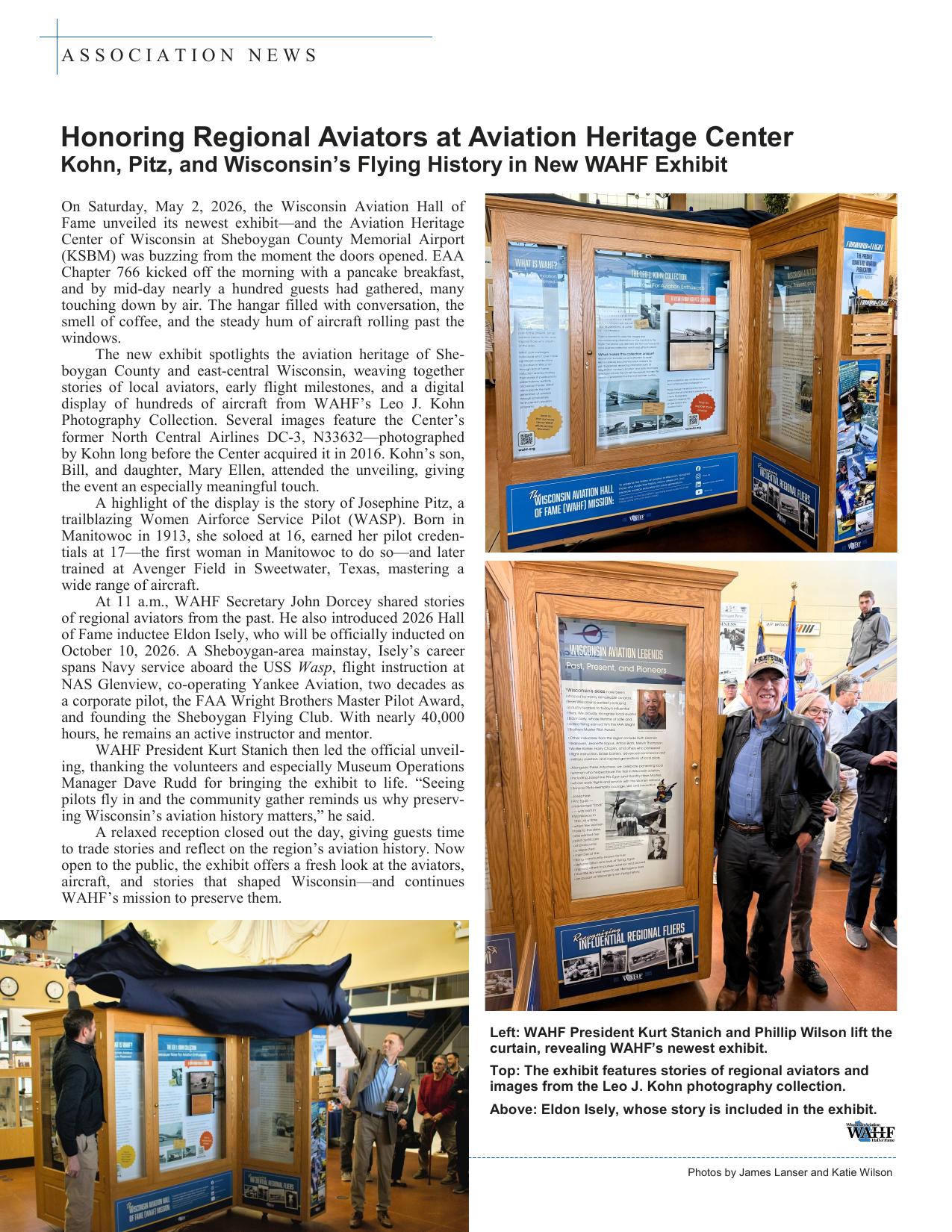
ASSOCIATION NEWS Honoring Regional Aviators at Aviation Heritage Center Kohn, Pitz, and Wisconsin’s Flying History in New WAHF Exhibit On Saturday, May 2, 2026, the Wisconsin Aviation Hall of Fame unveiled its newest exhibit—and the Aviation Heritage Center of Wisconsin at Sheboygan County Memorial Airport (KSBM) was buzzing from the moment the doors opened. EAA Chapter 766 kicked off the morning with a pancake breakfast, and by mid‑day nearly a hundred guests had gathered, many touching down by air. The hangar filled with conversation, the smell of coffee, and the steady hum of aircraft rolling past the windows. The new exhibit spotlights the aviation heritage of Sheboygan County and east‑central Wisconsin, weaving together stories of local aviators, early flight milestones, and a digital display of hundreds of aircraft from WAHF’s Leo J. Kohn Photography Collection. Several images feature the Center’s former North Central Airlines DC‑3, N33632—photographed by Kohn long before the Center acquired it in 2016. Kohn’s son, Bill, and daughter, Mary Ellen, attended the unveiling, giving the event an especially meaningful touch. A highlight of the display is the story of Josephine Pitz, a trailblazing Women Airforce Service Pilot (WASP). Born in Manitowoc in 1913, she soloed at 16, earned her pilot credentials at 17—the first woman in Manitowoc to do so—and later trained at Avenger Field in Sweetwater, Texas, mastering a wide range of aircraft. At 11 a.m., WAHF Secretary John Dorcey shared stories of regional aviators from the past. He also introduced 2026 Hall of Fame inductee Eldon Isely, who will be officially inducted on October 10, 2026. A Sheboygan‑area mainstay, Isely’s career spans Navy service aboard the USS Wasp, flight instruction at NAS Glenview, co‑operating Yankee Aviation, two decades as a corporate pilot, the FAA Wright Brothers Master Pilot Award, and founding the Sheboygan Flying Club. With nearly 40,000 hours, he remains an active instructor and mentor. WAHF President Kurt Stanich then led the official unveiling, thanking the volunteers and especially Museum Operations Manager Dave Rudd for bringing the exhibit to life. “Seeing pilots fly in and the community gather reminds us why preserving Wisconsin’s aviation history matters,” he said. A relaxed reception closed out the day, giving guests time to trade stories and reflect on the region’s aviation history. Now open to the public, the exhibit offers a fresh look at the aviators, aircraft, and stories that shaped Wisconsin—and continues WAHF’s mission to preserve them. Left: WAHF President Kurt Stanich and Phillip Wilson lift the curtain, revealing WAHF’s newest exhibit. Top: The exhibit features stories of regional aviators and images from the Leo J. Kohn photography collection. Above: Eldon Isely, whose story is included in the exhibit. Photos by James Lanser and Katie Wilson
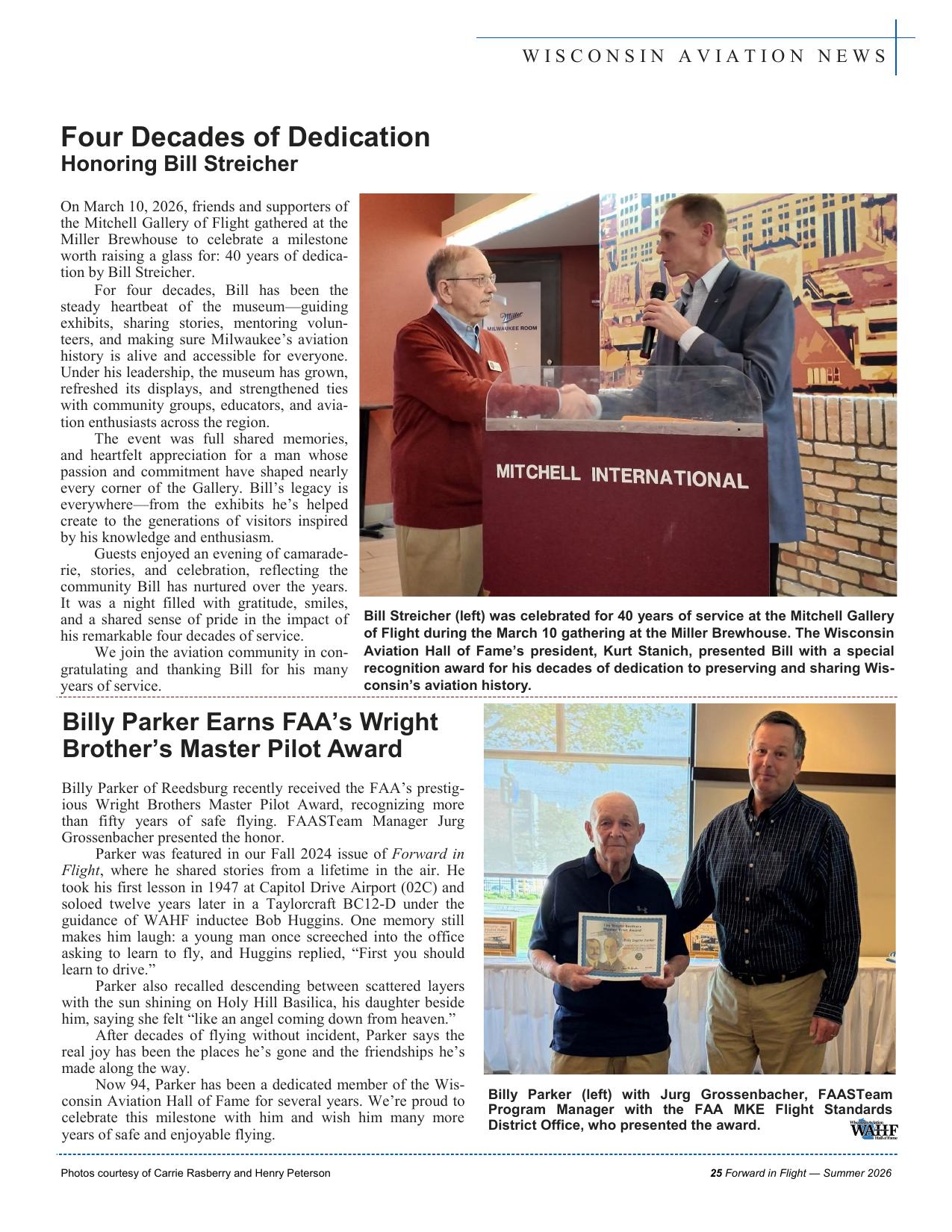
WISCONSIN AVIATION NEWS Four Decades of Dedication Honoring Bill Streicher On March 10, 2026, friends and supporters of the Mitchell Gallery of Flight gathered at the Miller Brewhouse to celebrate a milestone worth raising a glass for: 40 years of dedication by Bill Streicher. For four decades, Bill has been the steady heartbeat of the museum—guiding exhibits, sharing stories, mentoring volunteers, and making sure Milwaukee’s aviation history is alive and accessible for everyone. Under his leadership, the museum has grown, refreshed its displays, and strengthened ties with community groups, educators, and aviation enthusiasts across the region. The event was full shared memories, and heartfelt appreciation for a man whose passion and commitment have shaped nearly every corner of the Gallery. Bill’s legacy is everywhere—from the exhibits he’s helped create to the generations of visitors inspired by his knowledge and enthusiasm. Guests enjoyed an evening of camaraderie, stories, and celebration, reflecting the community Bill has nurtured over the years. It was a night filled with gratitude, smiles, and a shared sense of pride in the impact of his remarkable four decades of service. We join the aviation community in congratulating and thanking Bill for his many years of service. Bill Streicher (left) was celebrated for 40 years of service at the Mitchell Gallery of Flight during the March 10 gathering at the Miller Brewhouse. The Wisconsin Aviation Hall of Fame’s president, Kurt Stanich, presented Bill with a special recognition award for his decades of dedication to preserving and sharing Wisconsin’s aviation history. Billy Parker Earns FAA’s Wright Brother’s Master Pilot Award Billy Parker of Reedsburg recently received the FAA’s prestigious Wright Brothers Master Pilot Award, recognizing more than fifty years of safe flying. FAASTeam Manager Jurg Grossenbacher presented the honor. Parker was featured in our Fall 2024 issue of Forward in Flight, where he shared stories from a lifetime in the air. He took his first lesson in 1947 at Capitol Drive Airport (02C) and soloed twelve years later in a Taylorcraft BC12‑D under the guidance of WAHF inductee Bob Huggins. One memory still makes him laugh: a young man once screeched into the office asking to learn to fly, and Huggins replied, “First you should learn to drive.” Parker also recalled descending between scattered layers with the sun shining on Holy Hill Basilica, his daughter beside him, saying she felt “like an angel coming down from heaven.” After decades of flying without incident, Parker says the real joy has been the places he’s gone and the friendships he’s made along the way. Now 94, Parker has been a dedicated member of the Wisconsin Aviation Hall of Fame for several years. We’re proud to celebrate this milestone with him and wish him many more years of safe and enjoyable flying. Photos courtesy of Carrie Rasberry and Henry Peterson Billy Parker (left) with Jurg Grossenbacher, FAASTeam Program Manager with the FAA MKE Flight Standards District Office, who presented the award. 25 Forward in Flight — Summer 2026
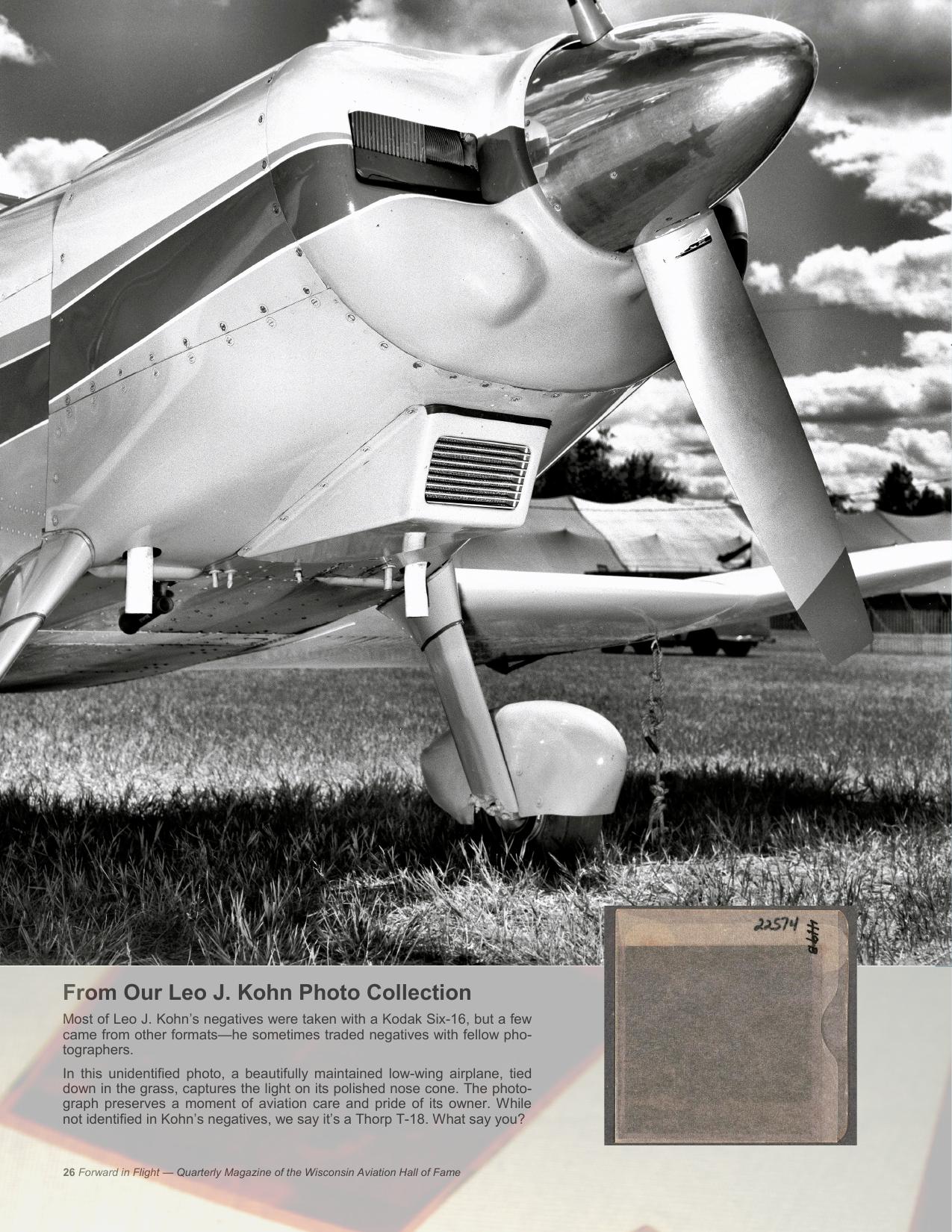
From Our Leo J. Kohn Photo Collection Most of Leo J. Kohn’s negatives were taken with a Kodak Six-16, but a few came from other formats—he sometimes traded negatives with fellow photographers. In this unidentified photo, a beautifully maintained low-wing airplane, tied down in the grass, captures the light on its polished nose cone. The photograph preserves a moment of aviation care and pride of its owner. While not identified in Kohn’s negatives, we say it’s a Thorp T-18. What say you? 26 Forward in Flight — Quarterly Magazine of the Wisconsin Aviation Hall of Fame
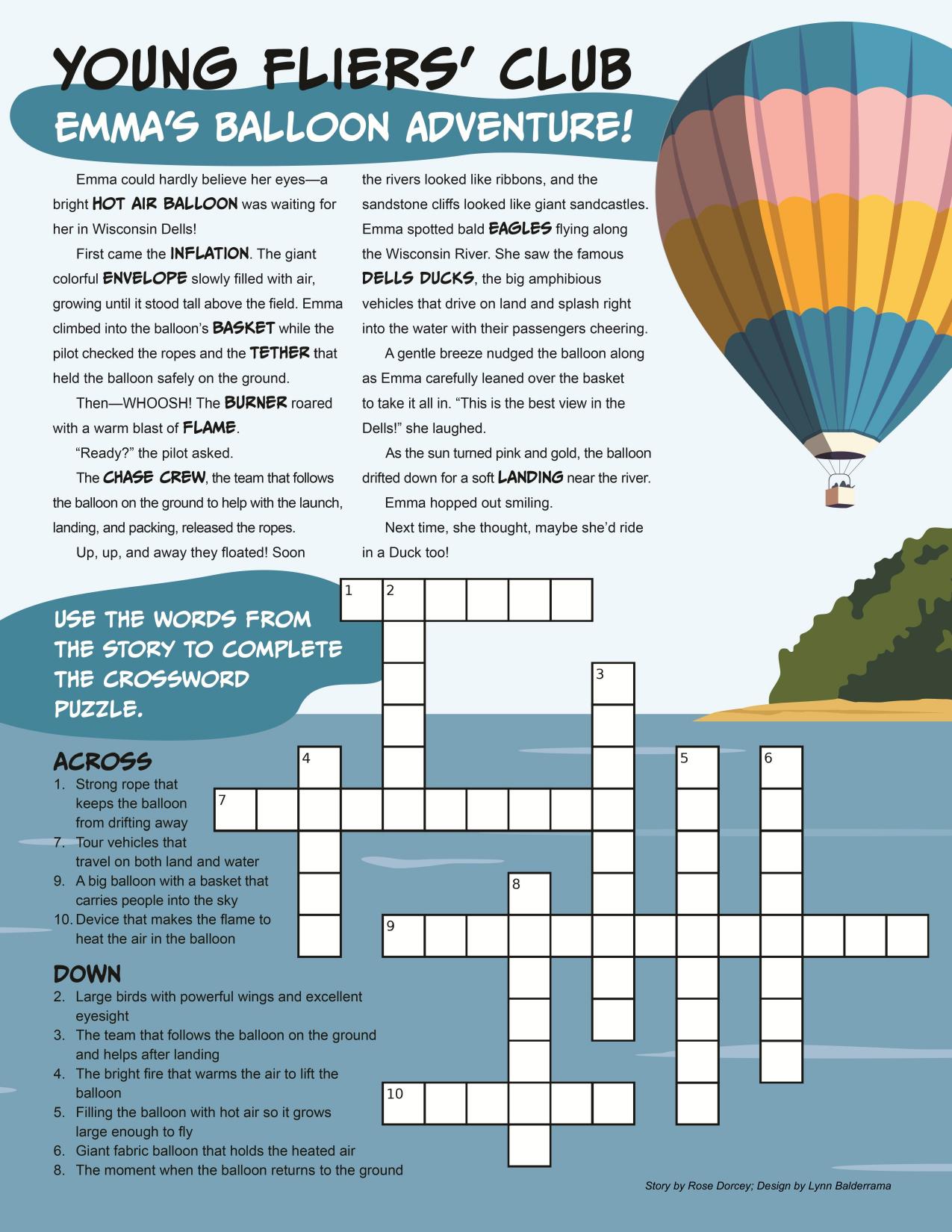
Story by Rose Dorcey; Design by Lynn Balderrama
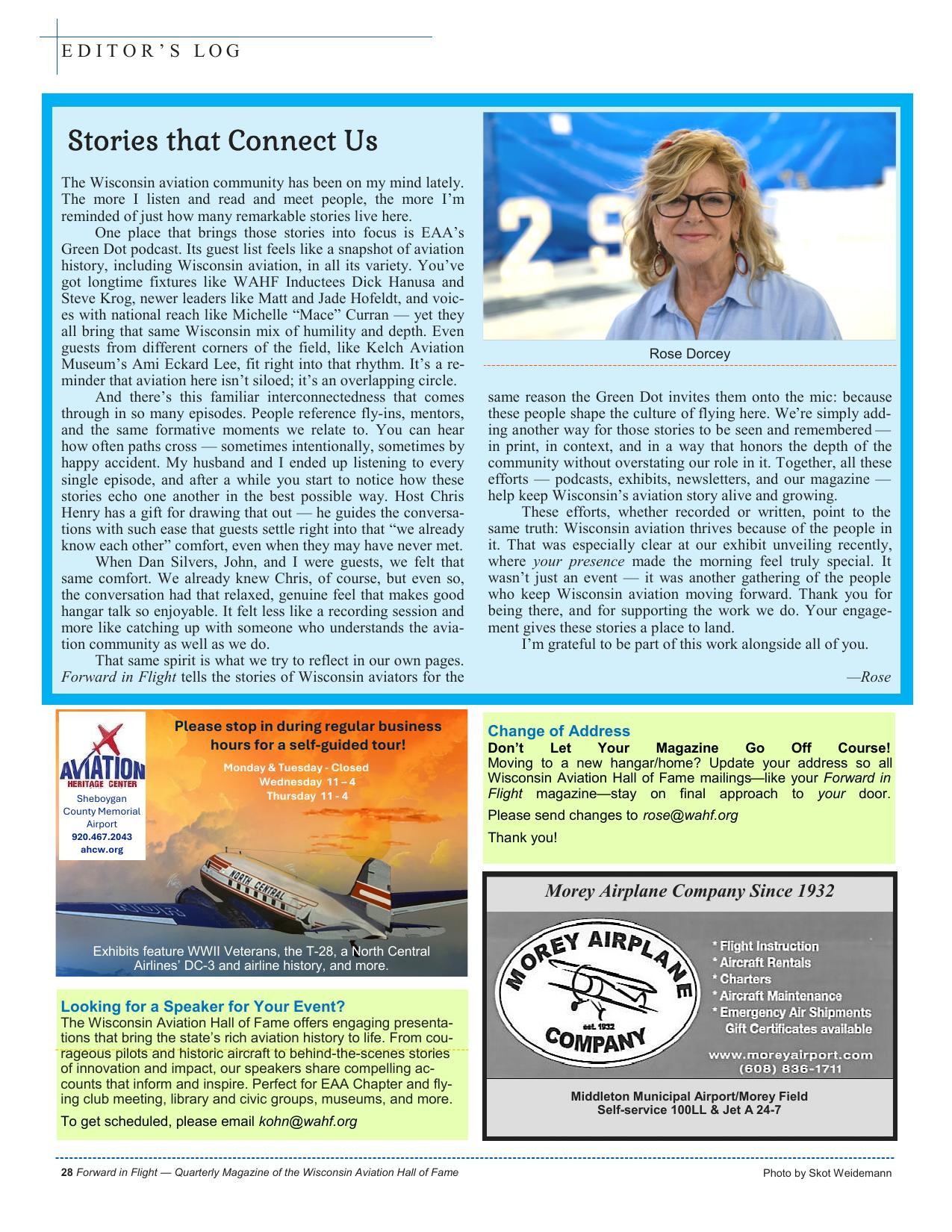
E D IT O R ’ S LOG Stories that Connect Us The Wisconsin aviation community has been on my mind lately. The more I listen and read and meet people, the more I’m reminded of just how many remarkable stories live here. One place that brings those stories into focus is EAA’s Green Dot podcast. Its guest list feels like a snapshot of aviation history, including Wisconsin aviation, in all its variety. You’ve got longtime fixtures like WAHF Inductees Dick Hanusa and Steve Krog, newer leaders like Matt and Jade Hofeldt, and voices with national reach like Michelle “Mace” Curran — yet they all bring that same Wisconsin mix of humility and depth. Even guests from different corners of the field, like Kelch Aviation Museum’s Ami Eckard Lee, fit right into that rhythm. It’s a reminder that aviation here isn’t siloed; it’s an overlapping circle. And there’s this familiar interconnectedness that comes through in so many episodes. People reference fly‑ins, mentors, and the same formative moments we relate to. You can hear how often paths cross — sometimes intentionally, sometimes by happy accident. My husband and I ended up listening to every single episode, and after a while you start to notice how these stories echo one another in the best possible way. Host Chris Henry has a gift for drawing that out — he guides the conversations with such ease that guests settle right into that “we already know each other” comfort, even when they may have never met. When Dan Silvers, John, and I were guests, we felt that same comfort. We already knew Chris, of course, but even so, the conversation had that relaxed, genuine feel that makes good hangar talk so enjoyable. It felt less like a recording session and more like catching up with someone who understands the aviation community as well as we do. That same spirit is what we try to reflect in our own pages. Forward in Flight tells the stories of Wisconsin aviators for the Please stop in during regular business hours for a self-guided tour! Sheboygan County Memorial Airport 920.467.2043 ahcw.org Monday & Tuesday - Closed Wednesday 11 – 4 Thursday 11 - 4 Rose Dorcey same reason the Green Dot invites them onto the mic: because these people shape the culture of flying here. We’re simply adding another way for those stories to be seen and remembered — in print, in context, and in a way that honors the depth of the community without overstating our role in it. Together, all these efforts — podcasts, exhibits, newsletters, and our magazine — help keep Wisconsin’s aviation story alive and growing. These efforts, whether recorded or written, point to the same truth: Wisconsin aviation thrives because of the people in it. That was especially clear at our exhibit unveiling recently, where your presence made the morning feel truly special. It wasn’t just an event — it was another gathering of the people who keep Wisconsin aviation moving forward. Thank you for being there, and for supporting the work we do. Your engagement gives these stories a place to land. I’m grateful to be part of this work alongside all of you. —Rose Change of Address Don’t Let Your Magazine Go Off Course! Moving to a new hangar/home? Update your address so all Wisconsin Aviation Hall of Fame mailings—like your Forward in Flight magazine—stay on final approach to your door. Please send changes to rose@wahf.org Thank you! Morey Airplane Company Since 1932 Exhibits feature WWII Veterans, the T-28, a North Central Airlines’ DC-3 and airline history, and more. Looking for a Speaker for Your Event? The Wisconsin Aviation Hall of Fame offers engaging presentations that bring the state’s rich aviation history to life. From courageous pilots and historic aircraft to behind-the-scenes stories of innovation and impact, our speakers share compelling accounts that inform and inspire. Perfect for EAA Chapter and flying club meeting, library and civic groups, museums, and more. To get scheduled, please email kohn@wahf.org 28 Forward in Flight — Quarterly Magazine of the Wisconsin Aviation Hall of Fame Middleton Municipal Airport/Morey Field Self-service 100LL & Jet A 24-7 Photo by Skot Weidemann
Membership Subscription and Donation Form Use for New Memberships and Renewals ANNUAL & LIFETIME MEMBERSHIPS Name________________________________________ _____ Individual _____ Couple _____ Corporate _____ Lifetime Address______________________________________ $30 $40 $250 $500 TAX DEDUCTIBLE CONTRIBUTIONS Your contributions help ensure Wisconsin’s aviation pioneers and outstanding students in aviation education will continue to be recognized. Your contributions, in any amount, are appreciated. WAHF Supporting Contribution $___________ (General operating/programming fund) Leo J. Kohn Collection Preservation Fund $___________ WAHF Scholarship Fund* $___________ *for scholarship donations please write a separate check payable to: Community Foundation of North Central Wisconsin or visit www.CFONCW.org City__________________________________________ State, Zip_____________________________________ Phone_______________________________________ Email________________________________________ Members receive WAHF’s quarterly magazine Forward in Flight. Join Online WAHF.org/membership Donate Online WAHF.org or WAHF.org/kohn Or, mail this form, along with your check payable to: Wisconsin Aviation Hall of Fame, Inc. Send to: Rose Dorcey/WAHF 3980 Sharratt Drive Oshkosh WI 54901 The Wisconsin Aviation Hall of Fame is a 501(c)(3) organization. 29 Forward in Flight — Spring 2026
PRSRT STD US Postage Paid Wisc Rapids WI Permit 98 Forward in Flight c/o Rose Dorcey 3980 Sharratt Drive Oshkosh WI 54901-1276 Welcome New WAHF Member/Supporters! Britney Klatt Mathew Klatt Karl Frickelton Harold Mester Timothy Meyer Lee Kunze Dirk Wilhelm Justin Zielinski Mitch Wild Batley’s Barber Shop Thanks for coming onboard! Your support helps us continue our efforts of collecting, preserving, and sharing Wisconsin aviation history, and honoring those who make it. We also thank the many members who have recently renewed your memberships. We appreciate your support. Our Appreciation We sincerely thank the following individuals for their generous support of the Wisconsin Aviation Hall of Fame. Your contributions help preserve and share aviation history and inspire the next generation of pilots and aviation professionals: Jeff Baum & Krys Brown Baum Jimmy Szajkovics Britney Klatt & Mathew Klatt Nick Krahn Cheryl Lee Rivard-Baker Greg Cunningham Bruce Botterman/NewView James Zazas Ron Vandervort Dixie Igou Your generosity makes a real difference — thank you for being part of our mission! EAA AirVenture Oshkosh, July 20-26, 2026 “Pioneers of Flight” at AirVenture 2026 Experience aviation’s early years. The “Pioneers of Flight” collection showcases original and replica aircraft from 1903– 1927, including the Blériot XI and Spirit of St. Louis reproduction. Vintage forums, engine run-ups, and demonstrations bring the first milestones of flight to life. eaa.org/airventure