Fred Beseler's article in the Winter 2008/2009 issue with his observations of air refueling while flying on a Wisconsin Air National Guard KC-135, made me think back to what it was like to be on the receiving end. I spent four great years flying the Air Force's F-4 Phantom II during which air-to-air refueling was a common occurrence ~ both for long distance deployments and during operational training.
History of Aerial Refueling
Early in the history of aviation, it became obvious that air-to-air refueling could extend the range and usefulness of airplanes. Naval ships had for many years refueled at sea from tankers while en route, and both Army and Navy aviators longed to do the same with their aircraft.
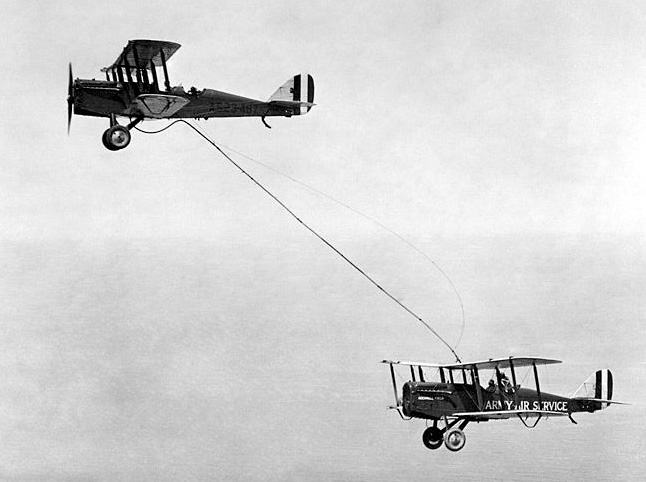
The first time air-to-air refueling is known to have happened was in 1923, when two Army Air Service DH.4 biplanes successfully transferred fuel through a flexible hose. Later that year, the same two airplanes set an endurance record of 37 hours using aerial refueling.
It was obvious air refueling had potential, but in those early years, refueling remained both primitive and dangerous. Early techniques used flexible hoses that would whip around in the wind; the hoses lacked secure connections into fuel tanks and constantly leaked fuel onto the airplane; and the operators had to crank manual pumps to move the fuel.
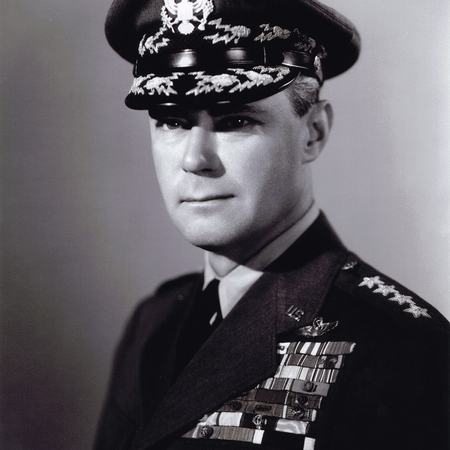
Air-to-air refueling didn't blossom until the late 1940s when the U.S. Air Force's Strategic Air Command (SAC) realized the only way to give their nuclear bombers true intercontinental range was with aerial refueling. Chief of Staff Carl "Tooey" Spaatz gave development of aerial refueling the highest priority, and the KB-50, KC-97, KC-135 "Stratotanker," and the Boeing-designed "flying boom" soon followed.
The "Flying Boom"
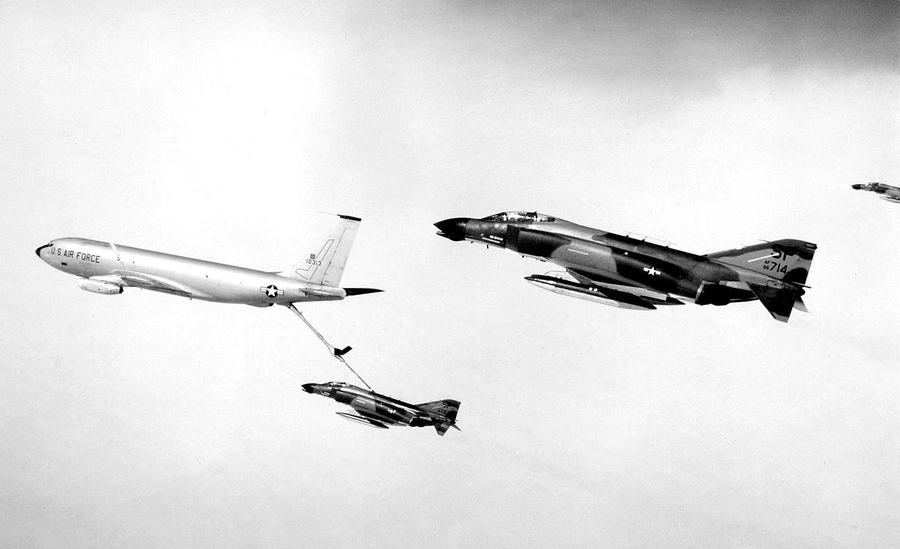
The "flying boom" played a significant role in making aerial refueling a common occurrence. With the flying boom, all the pilot of the receiving aircraft has to do is fly in close trail behind and under the tanker, using light bars on the bottom of the tanker to find the correct spot. The pilot opens a fueling receptacle door, and once stabilized, maintains position while a skilled boom operator (known as the "boomer") "flies" the boom's refueling probe into the receptacle using the V-shaped elevons at the end of the boom. (The boomer has a control stick that looks exactly like the control stick of an airplane. Using the stick, the boomer can "fly" the probe up and down, to the left and right, and extend the boom in and out.) Once the boom probe is locked into the receptacle, the boomer can pump fuel as fast as 6,000 lbs/minute. It is then up to the pilot of the receiving aircraft to maintain a steady position as the fuel adds weight and shifts the center of gravity. The key to success is anticipating the increase in weight, and being ultra-smooth with both the stick and throttles, and making constant, almost imperceptible adjustments. If the pilot of the fighter makes any rapid or erratic control inputs, it is possible to buckle, jam, or even snap off the tanker's refueling boom.
Once the fuel is offloaded, the boomer stops pumping, withdraws the boom, and the pilot of the receiving aircraft moves down and away from the tanker.
There is a second type or air refueling in use called "probe and drogue" where the fighter is equipped with a probe the pilot extends and flies into a basket-shaped drogue attached to a flexible hose trailing behind the tanker. Due to space limitations, I won't go into detail on the "probe and drogue" technique.
Operational Air Refueling
My first experience air aerial refueling was while at an Air Force replacement training unit (RTU) learning to fly the F-4. I found it to be not particularly difficult although it did require intense concentration. Perhaps the most challenging aspect was the rendezvous with the tanker ~ especially at night.
Tankers normally anchored in what we called an air-refueling track where they flew a constant orbit not unlike a giant holding pattern. As we approached the refueling track, a military ground controlled intercept (GCI) operator or FAA air traffic controller would vector us towards the tanker, until the weapons system operator (WSO) in the F-4 could pick up the tanker on radar. At that point, we would tell the controller we were "MARSA" (military assumes responsibility for separation of aircraft) and complete the rendezvous.
If the tanker was flying alone, we would use a point parallel intercept and tell the tanker when to turn, while we headed towards the tanker with closure rates that could be as high as 8-900 knots. (With an 800-knot closure speed, depending on the offset, the WSO would tell the tanker to start its turn 21 miles out.) It was always fun sitting in the front of the F-4 watching the tanker start its turn on radar long before it was visible to the eye. Then about halfway through its turn, I could pick up the tanker visually, and watch as it completed its turn, rolling out in front of the approaching fighters. When everything went right, the tanker would complete its 180-degree turn about 400 yards in front of the joining fighters. It then took only a bit of speed adjustment and maneuvering to close the remaining distance.
If the tanker had "chicks in tow" meaning the tanker was passing gas to other fighters, and couldn't turn in front of us, the tanker would continue along the refueling track, while we did a fighter turn-on and a "stern conversion" intercept. Those were the most fun. Again the WSO would use radar to call the fighter turn long before the tanker was visual, and as soon as the pilot got a "tally ho" on the tanker and its chicks, we would maneuver to complete the rendezvous, using whatever combination of airspeed, bank angle, speed brakes, and afterburner was needed. Again if all went well, we would roll out about 400 yards behind the tanker, and then stabilize in position, waiting until the tanker finished refueling the fighters already in position.
We trained often to stay proficient, and once each quarter a tanker crew and aircraft would deploy to our fighter base for a week of concentrated practice. During that week, we would do both day and night refueling. The image accompanying this story of me flying an F-4 while refueling was taken during one of those weeks. One of the WSOs in our squadron spent a day flying with the tanker so he could take a picture of each crew in our squadron while on the boom.
Aerial refueling is most useful during long distance deployments. My longest flight in the F-4 was 11+ hours going from Spangdahlem AB, Germany to Eglin AFB, FL. During that flight, four KC-135 tankers "dragged" 16 x F-4s across the Atlantic. On that flight I made nine separate refueling hook ups. The reason for the high number was that we never waited until the tanks were almost empty before refueling ~ we always wanted enough fuel on board in the event something went wrong and we had to divert. The 16 fighters on that deployment constantly kept cycling onto and off the tankers to keep their tanks topped. And in fact, one our pilots did divert to Saint Johns, Newfoundland after he got into a pilot induced oscillation (PIO) while on the boom, fouled his air refueling door, and was unable to take any more fuel.
The image of the KC-135 refueling three F-4s was during a squadron-redeployment from eastern Turkey back to Germany. On this flight we had a dedicated tanker for every four fighters and we flew a very loose route formation the length of the Mediterranean following the tanker, topping off when needed. I moved out to the side to take the image of the other three F-4s and the tanker as we crossed the French Alps.
Air-to-air refueling offers tremendous capability and has added much to the usefulness and potential of tactical and strategic aircraft since World War II.