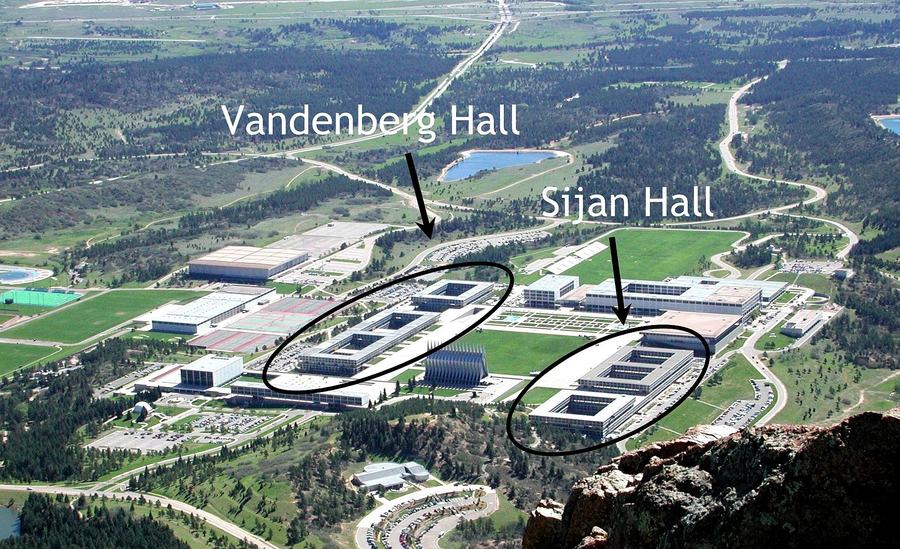
The United States Air Force Academy at Colorado Springs has two dormitories for the 4,000 cadets who train there. Both dorms are named for Wisconsin Aviation Hall of Fame inductees: General Hoyt S. Vandenberg of Milwaukee, and Captain Lance Sijan from Milwaukee's Bay View neighborhood. In what is perhaps an extreme quirk of fate, a third major building on the Academy campus—the cadet dining hall—is also named for a Milwaukee native and WAHF inductee: General Billy Mitchell.
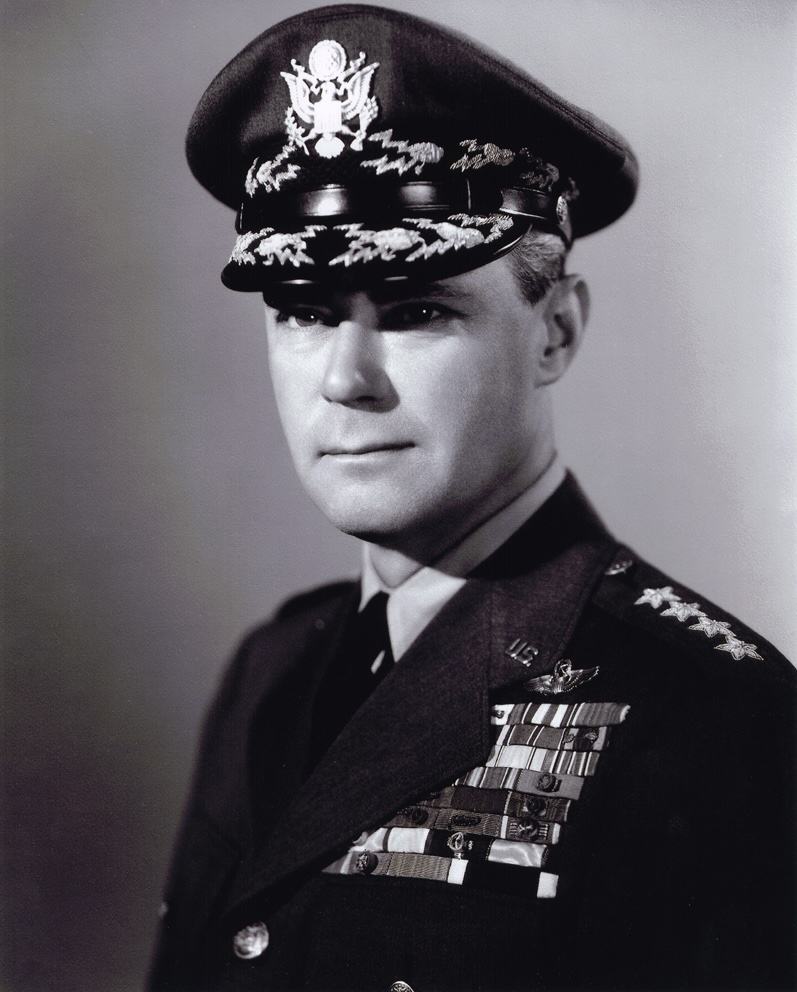
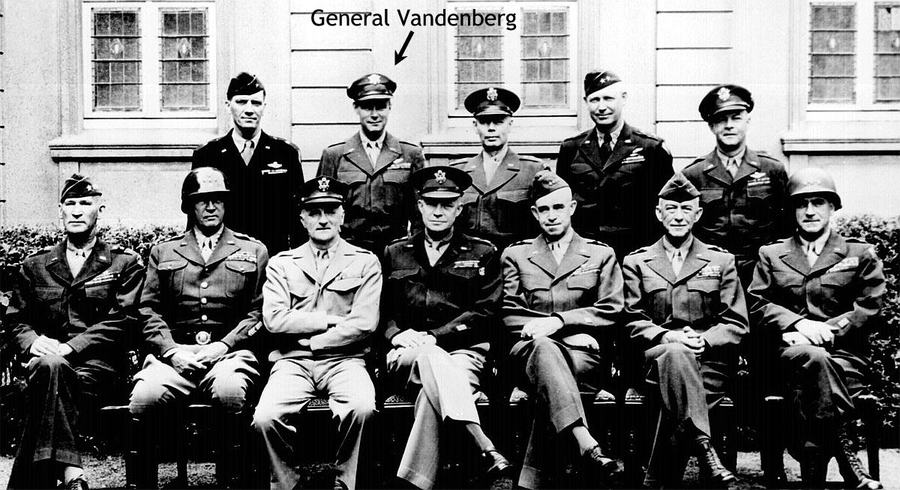
General Hoyt Sanford Vandenberg was born in Milwaukee in 1899, the son of a well-to-do family. At age seven the family moved to Lowell, Massachusetts, where they lived much of the year, spending winters in Florida. As he grew up, young Hoyt was a favorite of his uncle Arthur Vandenberg who was a U.S. Senator from Michigan. He had to constantly switch schools between Massachusetts and Florida, hurting his academic record, although not enough to prevent him from receiving an appointment to the U.S. Military Academy at West Point, New York.
At West Point he stood out as an athlete, but did poorly in the classroom, graduating near the bottom of his class in 1923. Upon graduation, the Army offered him a choice of becoming an infantry officer, or a pilot in the Air Service. Second Lieutenant Vandenberg jumped at the chance to go to pilot training.
After completing pilot training at Kelly Field near San Antonio, he spent the next ten years as an instructor pilot and fighter pilot finally becoming the commander of the Sixth Pursuit Squadron at Wheeler Field in Hawaii where he gained the reputation as the squadron's best aerial gunner — what today we would call the "Top Gun."
In 1927, with the cooperation of the Air Corps, Vandenberg stood in as the stunt double for Hollywood movie star Richard Arlen during the flying scenes of the classic Hollywood movie Wings which told the story of two WW I pilots seeking the heart of the same woman. Wings went on to win the first ever Academy Award for Best Picture, and most film experts still consider its flying scenes to be some of the best ever filmed.
Through the 1930s, Vandenberg served in a number of staff positions where he proved to be an outstanding planner, staff officer, and leader. After Pearl Harbor, the War Department sent Vandenberg to the European Theater where he became the primary air planner for the invasion of France in June 1944.
After the D-Day invasion, Vandenberg took command of the Ninth Air Force where he led and directed 180,000 airmen and 4,000 airplanes in what was the largest air command in history. Vandenberg's Ninth Air Force supported Generals Bradley, Patton, and Hodges as they drove across France into Germany. Vandenberg's Ninth Air Force pilots played major roles in the Operation Cobra breakout at St Lo, France, and in forcing back the Germans when the weather finally broke during the Battle of the Bulge. General George S. Patton later remarked that his Third Army's drive across France from Cherbourg to the border with Germany in 1944 would have been impossible without the air support Vandenberg's Ninth Air Force provided to cover the Third Army's flanks and to blow holes in German defenses as the Third Army approached.
After World War II ended and Vandenberg had made his mark as one of the senior Army and Air Force generals responsible for the victorious allied Crusade in Europe, he returned to Washington D.C. where he became the second director of the newly formed Central Intelligence Agency. After a year as CIA director, he returned to the Air Force and was promoted to the rank of four-star general—the second youngest American ever to achieve that rank.
Even as a four-star general at the peak of his military career, and after having been one of the principles who helped win the Second World War in Europe, Vandenberg's credibility sometimes suffered because of his boyish good looks. Many considered him a "boy general" and more than one newspaper in Washington D.C. went out of its way to comment on his looks. One Washington gossip columnist even described General Vandenberg as "the most impossibly handsome man on the entire Washington scene." Iconic Hollywood movie star and sex symbol Marilyn Monroe named Vandenberg, along with Joe DiMaggio and Albert Einstein, as one of the three people with whom she would most want to be stranded on a deserted island.
In 1948 President Harry Truman selected General Vandenberg to follow General Tooey Spaatz as Air Force Chief of Staff—a position in which Vandenberg served until 1953.
As Chief of Staff, General Vandenberg oversaw a turbulent time in establishing the Air Force as an independent service after its separation from the Army and creation in 1947. During Vandenberg's five year tenure as Chief of Staff, he oversaw the budget battle with the Navy of whether America's nuclear deterrent would be primarily based on long-range, land-based Air Force strategic bombers, or on Navy "super" aircraft carriers. Vandenberg also played a major role in helping the Air Force respond magnificently to the Berlin blockade and airlift, and having the Air Force become part of NATO as a deterrent to possible Soviet aggression in Europe. Other earthshaking events on Vandenberg's watch included the Soviet Union's development of the atomic bomb, the Korea War, the fall of China to communism, and the beginning of the Cold War between the United States and the Soviet Union. Vandenberg also oversaw the selection of Colorado Springs as home to the Air Force's own, independent service academy to train its officers, and when construction of the Academy finally began in 1955, the Air Force named the cadet dormitory in Vandenberg's honor.
General Vandenberg's time as Chief of Staff was marked by quiet competence, tremendous energy, and bold vision as the Air Force transitioned from propellers to jet engines and took its first baby steps into the space age.
General Vandenberg's last few months as Chief of Staff proved painful when he was diagnosed with cancer. Because of his illness, he was medically retired from the Air Force in 1953 to be replaced as Chief of Staff by fellow Wisconsin native (and WAHF inductee) Nathan F. Twining of Monroe (see Spring 2008 issue of Forward in Flight). General Vandenberg died nine months after his retirement in 1954 and is buried in Arlington National Cemetery.
General Hoyt Sanford Vandenberg was inducted into the Wisconsin Aviation Hall of Fame in 1989, and enshrined in the National Aviation Hall of Fame in 1991.