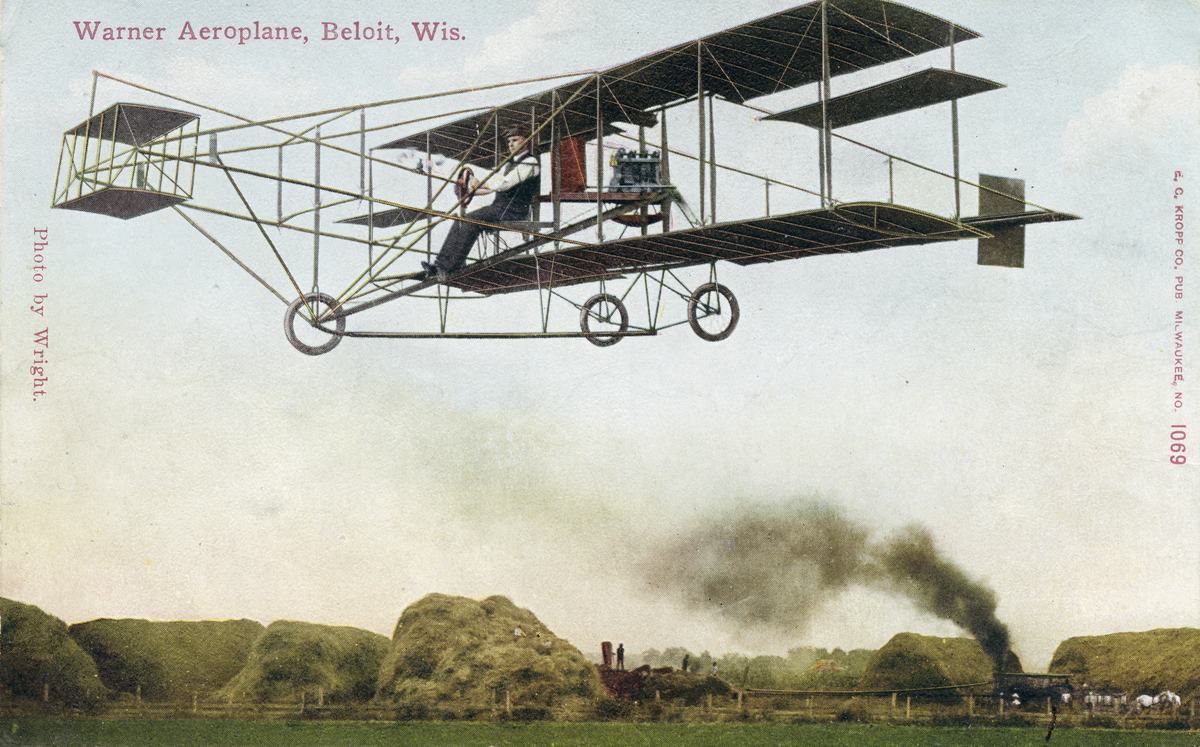
The Wisconsin Centennial of Flight celebration wrapped up on a high note in early November, when hundreds of Beloit-area students and adults learned about the birth of aviation in our state. The celebration in Beloit was the culmination of a year of planning by the Wisconsin Aviation Hall of Fame, in cooperation with EAA Chapter 60 Beloit-Janesville, and Visit Beloit’s Therese Oldenburg and Martha Mitchell.
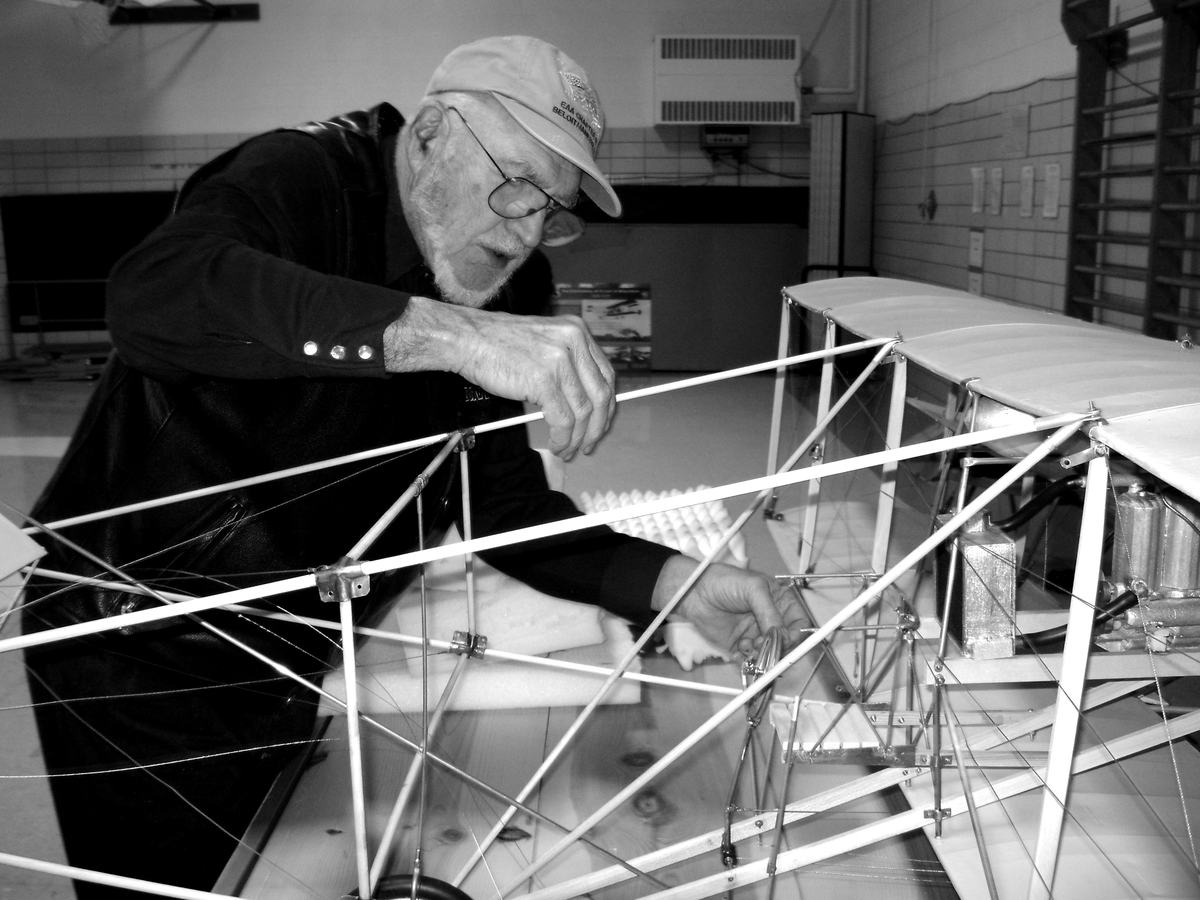
WAHF’s Centennial of Flight exhibit, including a quarter-scale model of the first airplane that flew in Wisconsin, along with educational display boards telling the story of our state’s first aviator, A.P. Warner, had been on tour throughout Wisconsin since its debut in May at the Wisconsin Aviation Conference. After traveling more than 1,500 miles on Wisconsin roads, from Eau Claire to Janesville, Wausau to Manitowoc, Oshkosh to Sheboygan, and many points in between, the airplane was on display in La Crosse for the month of August. The Centennial team took a few breaths before plunging into the busiest weeks of the entire project when the events in Beloit took place in November.
On September 1, Tom Thomas, Wynne Williams, this reporter, and the ever-reliable trailer on loan from Emil Thomas, journeyed to La Crosse to remove the exhibit from the La Crosse Historical Society’s Swarthout Museum. After receiving a $200 donation from the Society to help defer Centennial expenses, we were back on the Interstate, bound for the Wisconsin Aviation terminal at Dane County Regional Airport (MSN) in Madison. Tom and Wynne assembled the exhibit near the glass wall fronting on the runways so visitors could see—at a glance—the beginnings of aviation in Wisconsin and its current state. With help from longtime WAHF member Don Winkler, Tom was able to make presentations on A.P. Warner to students from Sun Prairie High School and the Madison CAP Cadet Squadron. A former Madison CAP Commander, Tom felt right at home with today’s generation of cadets.
The exhibit stayed at Wisconsin Aviation for three weeks, where it was viewed by the hundreds of aviators and non-airline travelers who use the terminal every day. Tom and Wynne then moved the show to Crites Field-Waukesha County Airport (UES), where they were warmly greeted by Airport Manager Keith Markano. The setting was more than appropriate since the airport’s namesake, Dale Crites, had built and flown a Curtiss Pusher in the 1970s very similar to our Warner Curtiss. John and Rose Dorcey traveled from Oshkosh to Waukesha on September 29 to tell the story of Wisconsin’s first flight and A.P. Warner to an interested crowd of visitors.
John and WAHF Board Member Chuck Swain picked the rainiest day of a very rainy month to move the exhibit from Waukesha to the EAA Museum in Oshkosh for our induction banquet on October 17. Wrapped in plastic and protected by its sturdy shipping crate, the model airplane arrived in Oshkosh dry as a desert rock. It was a once-in-a-century addition to our annual induction event.
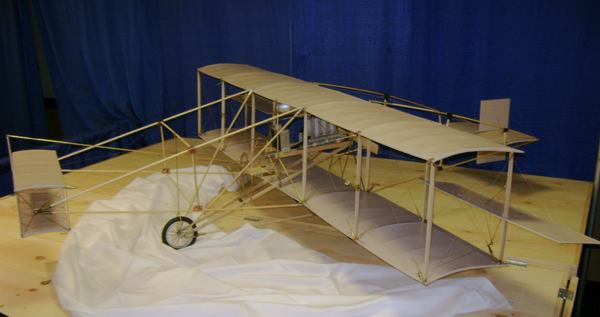
Two days later, Tom and Wynne brought the exhibit from Oshkosh to the Capitol in Madison for the final showing of our centennial tour. With the help of Representative Gary Hebl’s aide Kate Battiato, who was always able to summon a crew of young, energetic aides—who happened to be male—Tom and Wynne got the exhibit inside the building and up the stairs. It remained in the rotunda beneath the capitol dome until Tom, Wynne, and Kate and company removed it for its journey home to Beloit.
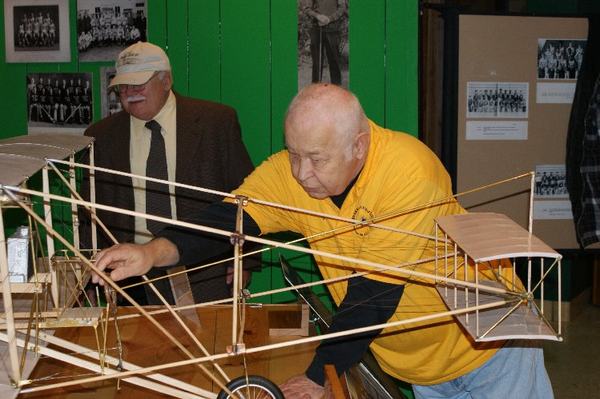
At the end of the month Tom and Wynne (with Emil’s trailer) made the final move of the exhibit to EAA Chapter 60 headquarters at the Beloit Airport (44C). The members who had built the model wanted to spruce it up before the Centennial events in early November.
While the exhibit was progressing toward the big days in November, so were other Centennial items. In cooperation with Martha Mitchell and Therese Oldenburg of the Visit Beloit organization, we worked on the programs for November 4 and 7. Publicity was important and we used all media, from old fashioned print to today’s Twitter and Facebook. Colorful postcards were sent to a selected mailing list of 1300 historically and aviation-minded people. Email reminders were sent to those on the WAHF mailing list. News releases were sent to newspaper, radio, online, and television outlets. An article was written for publication in the Northwest Quarterly regional magazine with circulation in northern Illinois and southern Wisconsin.
As we moved closer to the event, articles appeared in the Beloit Daily News, Janesville Gazette, Stateline News, and the Milwaukee Journal Sentinel. EAA Radio, Wisconsin Public Radio, and Janesville’s WCLO broadcast interviews with WAHF board members and Wisconsin Public Television ran an updated version of its earlier “In Wisconsin” feature about the Centennial. On November 4 and 7, in addition to the Beloit Daily News, television stations from Rockford and Madison, and Beloit’s Public Access station came to the centennial events and aired event coverage. Caryn Melton of Visit Beloit played a key role in linking us to the radio and television stations.
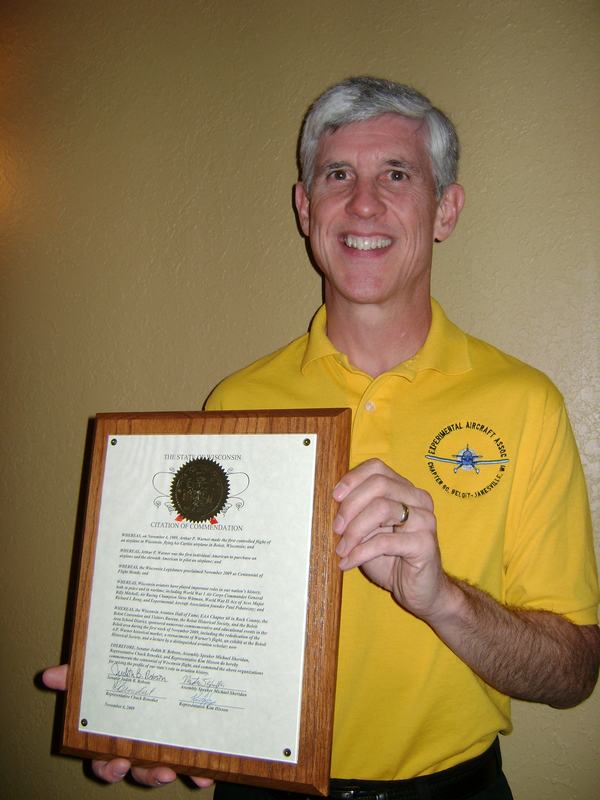
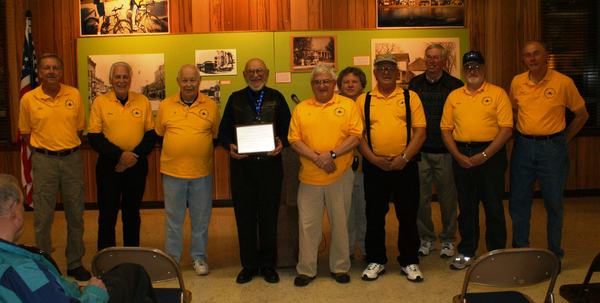
We also designed and ordered centennial plaques; one to be presented to EAA Chapter 60 “in appreciation for exceptional artistry and diligence in building a one-quarter scale model of the first airplane to fly in Wisconsin.” The other plaque was a bronze marker presented to the City of Beloit to be mounted on the A.P. Warner Historical Marker. Since the actual celebration of the Centennial on November 4 would take place at the Morgan School, we drew up a program with Principal Tina Hansen. We wanted to include the 350 students at Morgan as much as possible. The school’s Drama Club gave a wonderful rendition of the Star Spangled Banner to start the event, and they proved to be enthusiastic and inquisitive spectators.
In addition to the students, more than 200 people came to Morgan School. Among them were A.P. Warner’s closest living relative, Steven Warner Newquist, who came from Pasadena, California, with his wife, Robin. They had been contacted and were escorted by Warner Electric retiree Wendell Witten. Wendell was also responsible for WAHF receiving a $1,000 donation from Warner Electric, the company founded by A.P. Warner.
The weather was cool and cloudy at first, but cleared just as WAHF President Rose Dorcey started the program with a salute to armed forces veterans and a “don’t let anyone crush your dreams” message to the students, inspired by A.P. Warner’s story. Beloit City Manager Larry Arft and Assembly Representative Chuck Benedict spoke on the contributions of A. P. Warner before Rose rededicated the Wisconsin Historical Markers that commemorates Warner’s flight. Standing near a life-size reproduction of the historical marker, Rose presented a rededication plaque to Arft, who promised to attach it to the original marker so that Beloit’s residents and visitors would be reminded of this important event in the city’s history.
The twin highlights of the show were the “reenactment” of A.P. Warner’s flight by Beloit aviator Bob Bauer in his ultralight and a flyover by Wisconsin Air National Guard aircraft. Bauer, whose Slipstream International makes and markets light-sport aircraft and ultralights in Beloit, was game to try taking off from and landing on the school soccer field, the approximate site of Warner’s historic flight, but a line of trees crossing the field prompted second thoughts. Safety being more important than ceremony, Bob taxied around the field and hopped briefly into the air. The kids clapped and cheered, all the while chanting, “Fly, fly, fly...”
Wisconsin Air National Guard veteran Tom Thomas worked for months to obtain all the permissions and clearances for two F-16s from Madison to fly over Morgan School. It seemed all set until about one week prior when we learned that President Barack Obama would visit Madison on November 4. The airport would be closed and the F-16s grounded. For months we thought the only variable we would have to worry about was the weather, not the President. As it turned out, in a few days we learned that the President would not arrive in Madison until several hours after our event, so the F-16s could fly. They rocketed over the crowd just as Bob Bauer was taxiing, giving us a vivid demonstration of 100 years of progress in aviation.
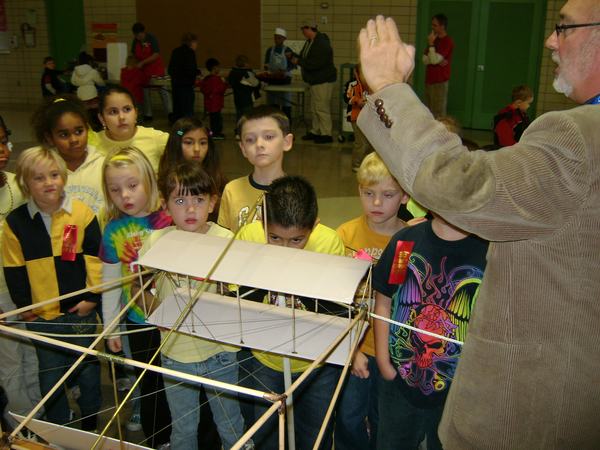
After the ceremony the crowd dispersed, and our school program began. From 10 a.m. until 1 p.m., with a break for lunch, students from kindergarten to the fifth grade entered the gym to see our exhibit. They were greeted by John Dorcey, who gave a series of grade-specific presentations that held every kid’s attention. Combining the story of A.P. Warner with some aviation history and a little flight training, John delivered our message to a new generation. By the time he was finished, he could have enrolled about 300 kids for flight instruction. It was a great ending to a great morning. Then Tom Thomas iced the cake by presenting aerial photos of Morgan School to Principal Hansen, her faculty, students, and staff.
At 5 p.m. we assembled again, this time at the Beloit Historical Society Museum. Here our mission was to present the exhibit for permanent display there and to show our appreciation to EAA Chapter 60. We said good-bye to the model, the panels, and the traveling display crate, knowing they would be in good hands. EAA Chapter 60 members will return to the museum to suspend the model airplane in the atrium.
Dr. Tom Crouch, senior curator at the Smithsonian National Air and Space Museum, landed in Madison at midday on November 5. Tom Thomas met him at the airport and pointed him toward Beloit. That evening, EAA Chapter 60 members, with John and Rose Dorcey, took him to dinner. Crouch came to Beloit one day early to spend Friday, November 6, at Beloit College. He spoke to students in two classes; Physics and Museum Studies, and viewed our Warner Curtiss exhibit at the historical society.
Crouch had agreed to donate his time to speak at our Centennial. His only special consideration was a request for a bicycle. Thanks to Dr. Bob Schwaegler of the Beloit Society of Learning Unlimited, Crouch was provided with a bike and a guide for a morning ride around Beloit. With temperatures in the mid-60s, the weather could not have been better.
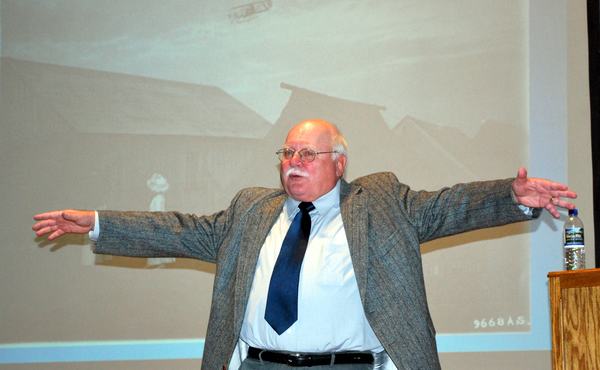
About 100 people attended Crouch’s lecture on the afternoon of November 7, held in the Eaton Chapel on the Beloit College campus, and it was my personal pleasure to introduce him. Just as we had hoped, he reviewed the events of 1909, placing A.P. Warner and his flight in historical context, not only with the Wright Brothers and Glenn Curtiss, but also with the European pioneers who made that year one of aviation’s most memorable. With his lecture, questions afterward, and additional conversation at the reception that followed, Dr. Crouch talked aviation history for a good 3 hours.
Crouch is a rare scholar who can readily share his knowledge with non-scholars. Perhaps the best review of his presentation came from Tina Swain, wife of WAHF board member Chuck Swain. “I’ve been involved in aviation through Chuck for 50 years,” Tina said. “No one helped me understand Chuck’s passion as Dr. Crouch did today.” No more need be said.
…Except to say thank you to the many people from all over the state, especially in Beloit, who made our Centennial celebration a great success.