Recently I read a news article reporting that the United States Navy was training sailors to use the sextant. The centuries-old instrument that determines latitude might save the ship if all the modern, electronic navigational devices fell prey to an enemy attack, a hack, or a simple glitch. The news also made me wonder if the Navy was stowing unhackable mechanical clocks onboard since keeping accurate time is necessary to determine longitude. Maybe.
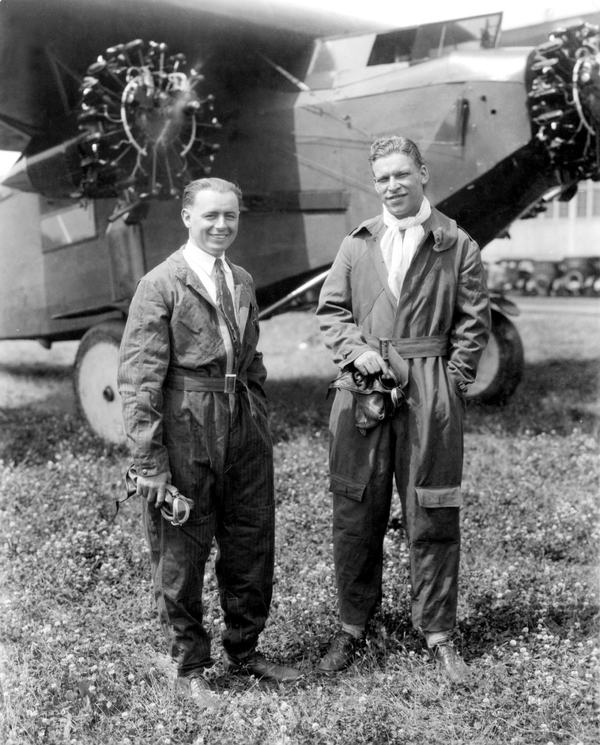
I also thought of Lester Maitland. His Fokker C-2 airplane was loaded with up-to-date navigational equipment when he and co-pilot/navigator Albert F. Hegenberger made their pioneering flight across the Pacific from Oakland to Hawaii in 1927. All the new gear failed, including the whiz-bang radio direction finder, and Hegenberger had to rely on a combination of dead-reckoning, observations of drift on the ocean’s surface made with a compass and, of course, a sextant, to guide the plane to its destination.
Lester Maitland began the journey that would eventually take him to Hawaii on the north side of Milwaukee in 1899. A big guy with strong, handsome features, he was two months past his eighteenth birthday, when the United States entered World War I. He enlisted in the Army and qualified for flight training, even though he was not a college graduate. He completed training and was commissioned as a Reserve officer in May 1918. After a stint as a flight instructor and gunnery school trainee he was ready to go overseas but the war ended in November ’18. Nonetheless, the Army Air Service saw something in him and he saw something in the Air Service because they both decided to stick with each other.
Maitland was first assigned to McCook Field in Ohio to train as a test pilot but was soon transferred to the 6th Aero Squadron in Hawaii. The World War had prompted the United States to pay more attention to aerial defense in the Pacific. The 6th had recently moved to the newly established Luke Field on Ford Island in Pearl Harbor and was equipped with war surplus DH-4s and JN-6s. Maitland was in Hawaii when Congress officially recognized the United States Air Service and his commission as a regular officer in the Army and the Air Service share the date of July 1, 1920.
Not one to hide his light under a bushel, the 20-year-old Lieutenant Maitland had barely arrived in Luke Field when he submitted a proposal to his superiors to fly an airplane back to California. He thought a Martin MB2 bomber could be modified to carry the fuel for the 2,400-mile hop. At the time, no had made a comparable flight except the British aviators John Alcock and Arthur Brown who flew 1,900 miles from Newfoundland to Ireland in 1919. Young Maitland’s proposal didn’t get far up the Army chain, but it might have made an impression on the Assistant Chief of the Air Service, General “Billy” Mitchell.
He was assembling the 1st Provisional Air Brigade, consisting of 1,000 men and 125 aircraft assigned to demonstrate the capability of aircraft in combat with naval vessels. Mitchell brought bombing squadrons flying Handley-Page, Caproni, Martin NBS, and MB2 bombers to Langley Field in Virginia, along with units equipped with SE-5 pursuit and DH-4 observation aircraft. All of them were stationed in the continental states, but somehow young Lt. Maitland was included and ordered back from Hawaii.
The most experienced bomber pilots in the Air Service were present but none of them had ever tried to sink a naval vessel. They all had to train and practice, including Maitland, who likely logged his first hours at the control of a bomber at Langley. He was not one of the pilots whose bombs demonstrated the future of air power by sinking the naval vessels in Mitchell’s controversial demonstration but he was part of Mitchell’s Brigade and that fact opened the door to a promising future.
He did not return to Hawaii. He did become part of the aerial show team that Mitchell commissioned to exhibit the potential of aviation to Americans. Endurance tests, speed races, coast-to-coast flights, and the first round-the-world flight were part of the program. Maitland became a speed racer, piloting the hot buggy of his day, the Curtiss R-6. Several pilots set speed records in the R-6, including Mitchell. Maitland became “the world’s fastest man” in March 1923 when he clocked 236-mph in an R-6 and again in October 1923 when he hit the 244 MPH mark. On the way to those records he became the first pilot to fly faster than 200 mph.
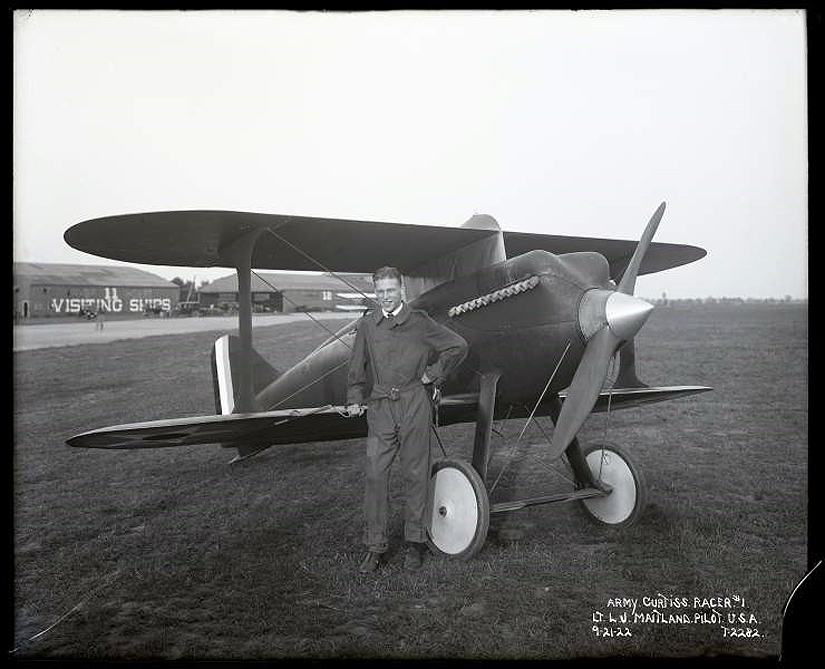
Speed racing separated Maitland from Mitchell, whose controversial career was moving towards its climax and crash in 1924 and ’25. The Assistant Air Chief offered testimony sharply critical of the status quo in American aviation before the Congressional committee headed by Representative Florian Lampert, who just happened to be from Oshkosh. Reassigned to Kelly Field in Texas, Mitchell issued the press release that prompted President Calvin Coolidge to order his courts-martial. Maitland reconnected with Mitchell to assist with his input into the report of the Morrow Board, the committee of inquiry set up by Coolidge to counter the unfavorable findings of the Lampert Committee. A Wall Street banker, Dwight Morrow was the father of Anne Morrow, who later married Charles Lindbergh. The Morrow Board confirmed the status quo in aviation, except for recommending that the Air Service be retitled the Air Corps, and so it was.
Once again, Maitland landed on his feet. Congress had created the position of Assistant Secretary of War for Air in 1926 and Coolidge had named a World War I Air Service veteran turned New York state politician named Trubee Davison to the post. Davison spent much of his three-year tenure touring the country by air with Maitland, who was his Chief Executive Officer, as pilot. Maitland saw his chance to renew his request for authorization of a California-to-Hawaii flight and received Davison’s blessing.
Maitland was not the only Army pilot who had been working on the Hawaii flight. Lt. Albert F. Hegenberger was a student at the Massachusetts Institute of Technology when he enlisted in the Air Service in 1917. That sentence sums up the man. He was very smart scientist, technician and pilot. He stayed in the Air Service after the war and was commissioned, like Maitland, on July 1 1920. He served as chief of the Instrument Branch at McCook Field until 1923, when he was transferred to a bombing squadron at Luke Field, Hawaii where he couldn’t help but think about getting to and from the island by air. He returned to McCook in 1926 and met Lester Maitland.
On the surface the two men were opposites. Maitland, the speed racer, looked like a movie star and was built like a wide receiver. It was noted that he was too big for the standard issue 24-foot parachute and had to use a 28-foot umbrella. He also was one of the minority of men in his day who were tall enough to look Charles Lindbergh straight in the eye. Hegenberger was short, dark, and just as happy to be in the lab as in the cockpit. He represented the unglamorous but vital technological side of aviation. As Maitland described him, Hegenberger “gives the impression of being shy and retiring [but] I know Hegenberger as a man of profound knowledge of navigation and tenacity of purpose that will carry him through any obstacles.” They were the odd but ideal couple for the Hawaii flight.
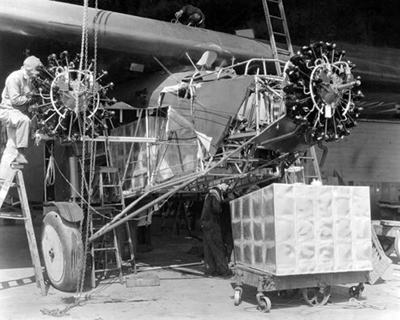
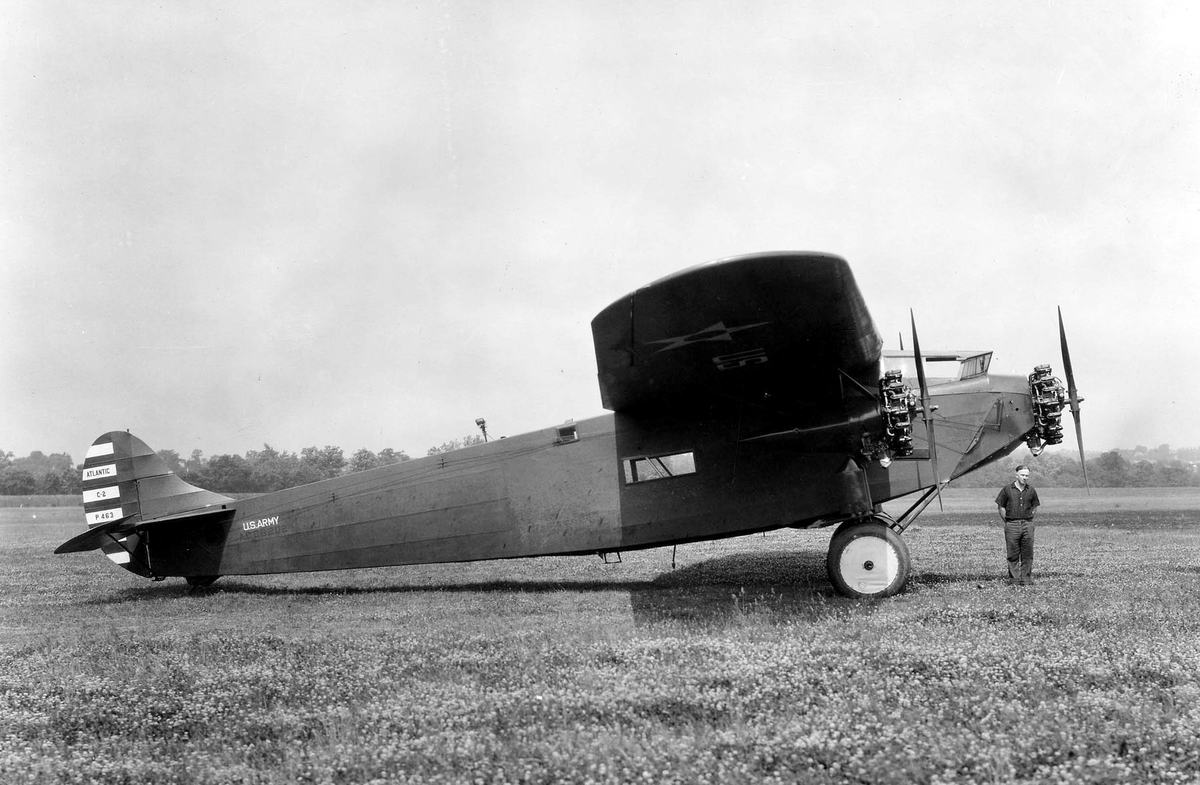
Maitland said he had been waiting since 1919 for the right airplane to come along. He found it in 1926 when the Army purchased a Fokker C-2. It was a multi-passenger/cargo monoplane powered by three Wright J-5, 220 hp radials that could take it to 116mph top speed and cruise at 100 mph. It was the type of plane the contenders in the Orteig Prize race to cross the Atlantic were bringing to Roosevelt Field in New York. Richard Byrd and crew made the third transatlantic hop in a Fokker C-2 and Charles Lindbergh wanted to use a similar Bellanca model for his crossing, but couldn’t make a deal with its owner, Charles Levine. Lindbergh headed west to buy the Mahoney-Ryan Spirit of St. Louis and Levine later accompanied his pilot Clarence Chamberlin to make the second transatlantic crossing in the Bellanca.
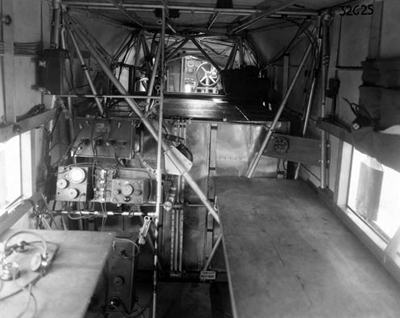
The Army bought the Fokker C-2 and then sent it to the Fokker’s Atlantic Aircraft subsidiary for modifications. The 67-foot wing was replaced with a 71-foot model. The interior was altered to accommodate fuel tanks to hold 1,120 gallons of gas for a 2,500-mile flight. Navigational research was the purpose of the trip for the Army and for Hegenberger and they equipped the plane for it. As Maitland described it, “Our navigation equipment included the radio beacon receiving installation, an Air Corps radio set for receiving and transmitting messages, an aperiodic compass, earth inductor compass, a bubble sextant and three dozen smoke bombs for measuring drifts. We were conducting the first long-distance test on the radio beacon, and we hoped that this ‘electric highway’ would solve our navigation difficulties.” Fully fueled and loaded the Atlantic/Fokker weighed about 14,000 pounds.
Richard Byrd had his America, Levine his Columbia, Lindbergh his Spirit. Maitland and Hegenberger christened their plane in honor of their destination, The Bird of Paradise.
They picked the Bird up at the Atlantic plant in New Jersey, flew to McCook, then took the “southern route” around the Rockies via Arizona and southern California. They landed at the Army air field at the Presidio in San Francisco hoping to take off from there for Hawaii. However, the 4,000-foot runway at the Presidio was too short for the fully-loaded Bird, and the take off was moved to Oakland’s Crissy Field with its new 7,000-foot runway.
After a final inspection from Air Corps Chief General Lyman Patrick on June 27, 1927 Maitland and Hegenberger turned in for a brief night’s sleep. They were up early the next morning, June 28, and ready to take off. Patrick was present and said, “I know you boys will make it.” It was one month and one week after Lindbergh’s Paris flight.
“My particular sensation immediately after the take off was one of elation and relief,” Maitland recalled. “After all the years of effort to win the detail, and after all the months of study, preparation and anxiety, it seemed a blessing to be free from any other responsibility than that of keeping the ship on its course. I had perfect faith in the ship, in Hegenberger, and in myself, and if there was any worry in my head it was that for the first time since 1922 I was flying without a parachute. Of course, a parachute would have done us no good...”
As it turned out, the new navigation gear wasn’t much good either. “First of all we could not use the smoke bombs for measuring drifts because of high winds and heavy seas, then the induction compass called it a day, next the radio beacon failed and on top of all this, to make our bubble sextant virtually worthless, the clouds obscured the sun. All this occurred within the first hour and a half…” Later they discovered that their radio transmission signal was too weak to reach ships they could see below that could give them a fix on their position. “… but little things like that could not stop Hegenberger....he mapped our course by using the ordinary compass to measure drift. He would peer through a trap in the floor and sight the drift by checking on the spume on the waves beneath us.”
The only moment of tension between the two men occurred when, based on his compass work, Hegenberger told Maitland to make a 17-degree correction to his course. Remembering that they had only a 3.5-degree margin for error to find Hawaii, Maitland almost hesitated, then decided to trust his navigator. Had he not, the Bird of Paradise would likely have ended its flight in the drink. Hegenberger’s call was confirmed when a steamer he predicted would appear below “in ten minutes,” turned up in nine.
They flew all day beneath a 200-foot ceiling. As sunset neared they tried to make a sextant shot of the sun but the clouds hid the horizon. After dark, they rose through the clouds in hope of navigating by the stars. When they broke through between ten and eleven thousand feet, their center engine began to cut out. They didn’t know it at the time, but a modification Army mechanics made to the engines in the interest of reducing weight also made them more vulnerable to icing. With one engine sputtering and before Hegenberger could look at the stars, Maitland turned nose down. At about 3,000 feet, the ice cleared and the center engine kicked into normal.
With the engines again hitting on all twenty-seven cylinders, Maitland rose to a chilly but not freezing 7,000 feet. Hegenberger did the best he could to find stars through holes in the soup as they flew on through the night. Eventually, “Hegenberger was able to check our course by the stars, getting nine shots at Polaris, and it was with great elation that we found we were flying straight toward the Islands.”
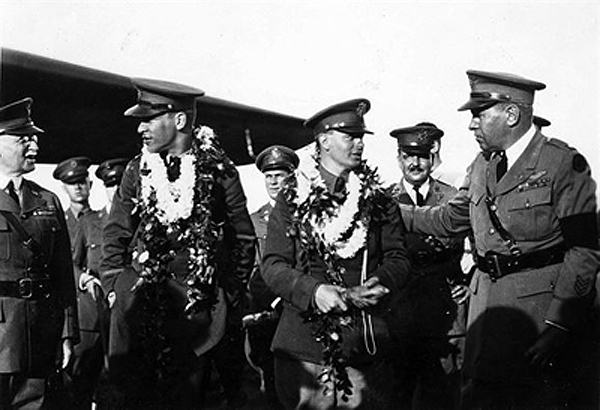
They were 22 hours and 50 minutes into the flight. Since they couldn’t find the thermos of coffee, or the bag of sandwiches they had brought along, they had nothing to eat or drink since Oakland. Hegenberger could shift around a bit, but Maitland could not leave his seat or turn over the controls to his more than competent copilot. The roar of the engines smothered any possibility of conversation. Then in the wee hours before dawn, Maitland “saw a light which was more yellow than a star.” He signaled Hegenberger and pointed it out. He couldn’t see it at first, then spotted it and grabbed for his notepad. So did Maitland and both men scribbled “Kauai” at the same time.
Maitland had spotted the Kilauea Lighthouse on the north shore of the northern and eastern-most Hawaiian Island. It was more of a near thing than anyone wanted to admit. The Bird had already bypassed the island of Hawaii, Oahu, and all the other islands in between. Had they missed Kilauea, Maitland and Hegenberger would have continued flying farther out to sea. Once the sun rose Hegenberger probably would have worked out their position and corrected their course. If their gas held out, they could have made it back to Kauai, which may or may not have had a runway long enough for the Bird to land or maybe they could have made it back to Oahu. Happily, they did not have to test that hypothesis.
They circled in the vicinity of the Kilauea Light until they saw what Maitland called, “the most glorious sunrise I have ever seen.” He then headed southwest for Wheeler Field on Oahu. “We landed 25 hours and 49 minutes after we had taken off at Oakland, California.” They had about another hour’s worth of gas in the tank.
It’s impossible not to compare Maitland’s and Hegenberger’s flight with Lindbergh’s. In terms of total distance flown and hours in the air, Lindbergh’s is the greater feat and—most importantly—he did it alone in a single engine plane. He was the only contender in the Atlantic or what later became the Pacific race, to fly without a backup pilot or motor. While his flight required skill as a navigator, it was not as difficult as the trip to Hawaii. Lindbergh had a whole continent to hit. Maitland and Hegenberger had to hit a dot in the ocean and they almost missed it.
After the flight, Maitland and Hegenberger joined the ranks of the celebrity aviators of their day. They were among the early recipients of the Distinguished Flying Cross. They were invited to the White House for lunch with Calvin Coolidge. Maitland came home to a ticker tape parade and celebration that rivaled the blast Milwaukee had thrown for Lindbergh. The city also named its downtown airport in his honor. Walter Kohler, Wisconsin’s “Flying Governor” named him one of his aviation aides. He became an author, writing, probably with the help of an editor, a book entitled Knights of the Air. It is a very readable and informative summary of American aviation from the Wright Brothers to his own flight. He also wrote the text for a comic strip called Skyroads that featured, of course, a heroic aviator--all while still pursuing his career in the Air Corps. The Army was still the Army. Although decorated and congratulated, neither Maitland nor Hegenberger were promoted. They left Oakland as Lieutenants, came home as Lieutenants, and remained Lieutenants for five more years.
Albert Hegenberger spent less time in the limelight. He returned to research at McCook Field. In 1932, he draped a shroud over the cockpit of a fighter and, relying solely on instruments, took off, flew ten miles at 2,000 feet, then landed safely. It was the first solo instrument flight in history and it earned him another Distinguished Flying Cross.
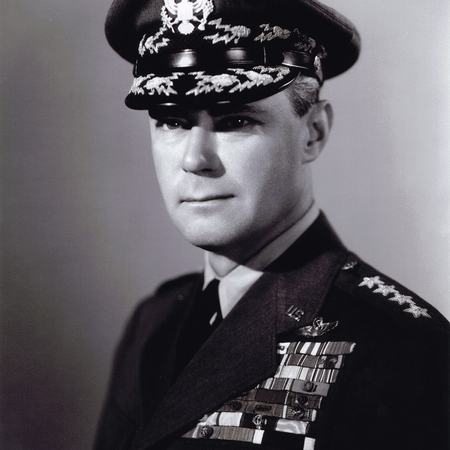
In 1941, both men held command positions in the Pacific. Maitland was base commander at Clark Field in the Philippines until November 1941 when he was named executive officer of the newly activated Far East Air Force. Many of its airplanes were destroyed on the ground at Clark on December 8, 1941. Along with other Far East Air Force staff, Maitland was evacuated to Australia a few weeks later. In 1943, he was given command of the 386th Bomber Wing of the Eighth Air Force in England. He held the post for about six months and, although he was 44 years old and a general, led squadrons of B-26 bombers on four missions over the continent.
Hegenberger was given command of the Eleventh Bomber Group at Hickham Field at Pearl Harbor in 1941. Many of its airplane were destroyed on the ground on December 7. He remained at Hickham until early 1942 when he was transferred to the mainland where he served out the war. Although a general he was still a scientist. Shortly before he retired from the Air Force, in 1949, he invented a listening device that enabled the United States to detect the explosion of the Soviet Union’s first nuclear weapon. He went west in 1983.
After serving briefly as the director of aeronautics bureaus in Wisconsin and Michigan, Maitland entered the seminary and was ordained a priest in the Episcopal church. He was inducted into the Wisconsin Aviation Hall of Fame in 1987 and went west in 1990.