Reidar Olsen was 15 years old when he built his first airplane. It was a pusher biplane on skids powered by a 7-hp motor and quite up-to-date for Norway in 1913. Olsen was one of many teenage prodigies building airplanes in those days. WAHF Inductee Thomas Hamilton made his first airplane in Vancouver, Canada, then, and a teenager we’d like to know more about named Harry Tees was doing the same thing in Green Bay.
Olsen’s airplane was successful enough to win him a scholarship to a training academy run by the German imperial air service. The young Norwegian migrated across the North Sea just as Europe was descending into the hell we call World War I. The extent of Olsen’s service with the Kaiser’s air force is unknown, but it would have been hard for a German military student to avoid duty, even if he was still a boy and a Norwegian.
What is clear is that postwar Germany was not a promising place for a young man even if he was Norwegian, and in 1922, Olsen came to the United States. Merrill, Wisconsin, seemed to be the right place to land because, as the story goes, Olsen believed he could find investors there to back his airplane design and manufacturing scheme. Reidar wanted to build airplanes for people to fly themselves and he had more than one design on his drawing board.
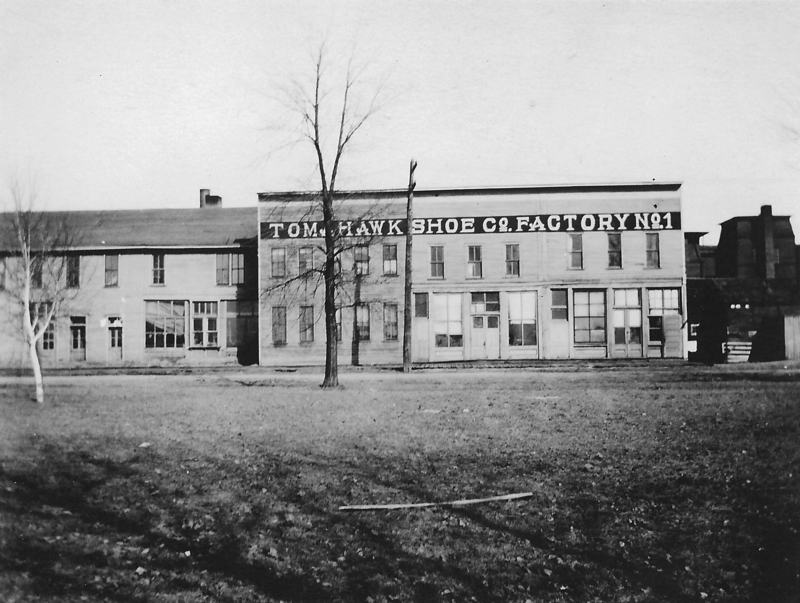
The Merrill investors failed to materialize, but word of the Norwegian inventor had spread up and down the Wisconsin River Valley so Reidar moved upstream to Tomahawk. He occupied the abandoned plant of the Tomahawk Shoe Company and opened a combination auto garage and airplane factory. Selling gas and fixing autos would pay the bills, but Reidar left no doubt about his priorities. It was the Olsen Standard Aeroplane Company first, with “Automotive Motor Department” second. A news report in the May 5, 1926 edition of the Tomahawk Leader said Olsen was “a former manufacturer of aeroplanes for the German government during the world war”. Olsen was barely 20-years-old when the war ended, so calling him “a manufacturer” was an editorial stretch. Nonetheless, Olsen had studied and worked in aviation for more than a decade before he arrived in Tomahawk, where he would build “bi-planes of small dimensions [because] there is a big market for this type both in commercial and sporting circles. He is of the firm conviction that planes will be almost as numerous as automobiles within a comparatively short time.”
The company soon produced its first flyable airplane, dubbed the OSACO 6, perhaps because five failures had preceded it. It measured 14-feet, nose-to-tail, with a 20-foot wingspan and oversized tail wings. It was powered by a 17-hp Harley Davidson motorcycle engine that vibrated wildly enough to crack the motor mounts.
Olsen made his first and only OSACO 6 sale to a trio of aviation wannabes from Rhinelander led by WAHF inductee Steve Shalbreck. The airplane survived a handful of flights until the pilot, either Olsen or Rhinelander’s Ed Bruso, crashed it while trying to avoid a shack full of dynamite used to blast tree stumps and perched on what he thought was a landing field.
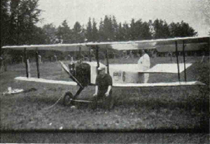
The OSACO 6 was short-lived, but not Reidar Olsen’s steam of inventions. He still saw a market for single seat “sport” aircraft and had a new model on the boards. His search for capital took him to Chippewa Falls and another factory where he organized the Chippewa Aircraft Corporation and unveiled the Chippewa Scout. True to Olsen’s small is beautiful concept, the single-wing Scout measured 17-feet nose to tail and had a wingspan of 27-feet. It had an all steel fuselage and tail assembly, wooden wings with steel ribs, and a 30-hp Szekely motor better suited for an airplane than the OSACO’s Harley. It could carry 300 pounds and make a top speed of 120 mph.
Starting in 1927 and lasting for not much longer, Chippewa Aircraft completed two Scouts, and also built and sold as many as 20 kits. Then the Great Depression hit and the company went out of business. The whereabouts of either planes or kits is unknown, as well as any plans, and would be a great discovery if any were found squirreled away in a backwoods shed some place.
Reidar returned to Merrill and, with a family to support, left aviation. He started a home and commercial heating company that lasted for 35 years, spent some time during World War II working for Lockheed Corporation, and displayed his imaginative side by developing colored and then flavored toothpicks for the Merrill Woodenware Company. In his later years, he spent a lot of time with in John Hatz’s hangar at the Merrill Airport. Young fliers like Lyman Hatz knew him as that familiar figure at small town airports—the old guy who always had a good story to tell.
Reidar Olsen died in 1971 but is not forgotten. He was recently honored by the Tomahawk Historical Society. More than 100 historical society volunteers, family, and friends turned out to hear this reporter talk about the first airplane flight in Tomahawk by WAHF inductee John Kaminski and share stories and memories of the young Norwegian who came to town to build airplanes 10 years later. He is also remembered in Chippewa Falls, where EAA Chapter 509 has expressed interest in building a model, if not a full-sized version of the Chippewa Scout.